Welcome to My Presentation
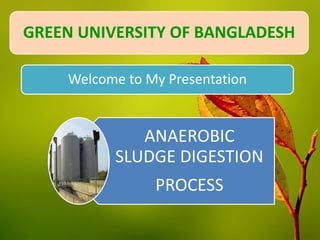
ANAEROBIC
SLUDGE DIGESTION
PROCESS
GREEN UNIVERSITY OF BANGLADESH
Name & ID No:
MD.GOLAM SARWAR 120103019
Course Code : TEX-403
An Assignment Alternating of Class Test
WHAT IS ANAEROBIC SLUDGE DIGESTION ?
WASTEWATER And Sources of Wastewater
SLUDGE And SLUDGE CHARACTERISTICS
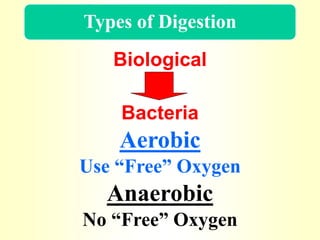
Types of Digestion
AEROBIC DIGESTION AND ANAEROBIC DIGESTION
Anaerobic Digestion Process
Digestion Factors And OPERATION AND CONTROL
SUMMARY
Question & Ans. session
PRESENTATION CONTENTS
WASTEWATER
 Water used to carry waste products away
from homes, schools, commercial
establishments, and industrial enterprises.
Domestic
Industrial
Infiltration
GOAL – PURPOSE – RESPONSIBILITY
Of “Treating” or Stabilizing Wastewater
PROTECTION OF NATURAL RESOURCES
PROTECTION OF PUBLIC HEALTH
The SETTLEABLE solids
separated from liquids
during processing.
SLUDGE CHARACTERISTICS
•Organic /Inorganic
•Oxygen Demand
•Odors
•Nutrients
•Pathogens
•Mostly Water
Types of Digestion
Biological
Bacteria
Aerobic
Anaerobic
Use “Free” Oxygen
No “Free” Oxygen
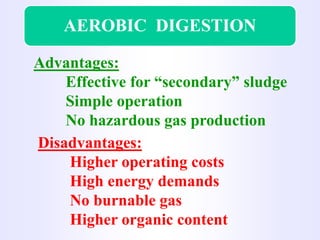
AEROBIC DIGESTION
Advantages:
Effective for “secondary” sludge
Simple operation
No hazardous gas production
Disadvantages:
Higher operating costs
High energy demands
No burnable gas
Higher organic content
ANAEROBIC DIGESTION
Anaerobic digestion process overview
In the anaerobic digestion process, micro-organisms convert
complex organic matter to biogas, which consists of methane
(CH4) and carbon dioxide (CO2)
Some organic matter remains even after the digestion step,
and this is called digestate or digester residue or digested
organic matter
Anaerobic digestion is used to treat high-strength wastewater,
organic solid waste, sewage sludges, blackwater, faecal
sludge, agricultural waste, food industry waste (e.g.
breweries, slaughter houses, dairy).
ANAEROBIC DIGESTION
Advantages
Low operating costs
Proven effectiveness
Burnable gas produced
Disadvantages
Long start-up time
Affected by changes in
loading and conditions
Explosive gas produced
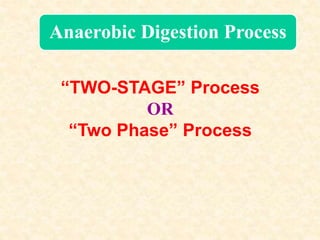
Anaerobic Digestion Process
“TWO-STAGE” Process
OR
“Two Phase” Process
Anaerobic Digestion Process
“TWO-STAGE” Process
This Does Not Mean Two Tanks
Anaerobic Digestion Process
“TWO-STAGE” Process
OR
“Two Phase” Process
Two Types of Bacteria
Each Relying On The Other
First Stage Second Stage
Anaerobic Digestion Process
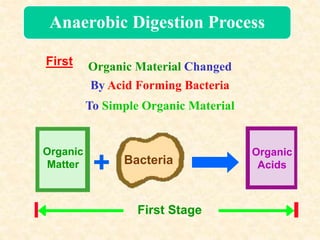
First Organic Material Changed
By Acid Forming Bacteria
To Simple Organic Material
Organic
Matter Bacteria
Organic
Acids
First Stage
+
Anaerobic Digestion Process
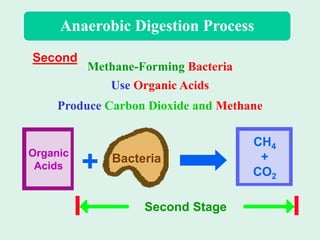
Second
Methane-Forming Bacteria
Use Organic Acids
Produce Carbon Dioxide and Methane
Organic
Acids + Bacteria
CH4
+
CO2
Second Stage
Anaerobic Digestion Process
Continuous Process
“TWO-STAGE” Process
Stabilization
Organic
Matter
Bacteria
Organic
Acids
First Stage
Acid Forming
CH4
+
CO2
Methane Forming
Second Stage
Type of Food
Organic Inorganic
Soluble Insoluble
Anaerobic Digestion Process
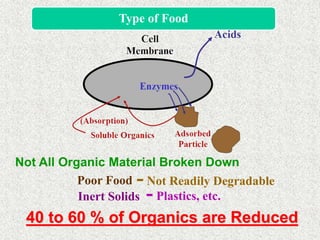
Soluble Organics
Cell
Membrane
Acids
Adsorbed
Particle
Enzymes
(Absorption)
Typical Acid Forming Bacteria
Liquid
Not All Organic Material Broken Down
Type of Food
Poor Food
Inert Solids
-Not Readily Degradable
-Plastics, etc.
40 to 60 % of Organics are Reduced
Anaerobic Digestion Process
“TWO-STAGE” Process
OR
“Two Phase” Process
Two Types of Bacteria
Each Relying On The Other
Must Be In
Balance !
Organic
Matter
Bacteria
Organic
Acids
First Stage
Acid Forming
CH4
+
CO2
Methane Forming
Second Stage
Anaerobic Digestion Process
Volatile
AcidsAcid Phase
Acids Used at Rate Produced
Anaerobic Digestion Process
Products of Digestion
1. Gases
Methane (CH4)
Carbon Dioxide (CO2)
65 to 70 %
30 to 35 %
7 to 12 cubic feet per pound of volatile destroyed
500 to 600 BTU per cubic foot
Can Be Utilized:
Heating Digester
Heating Buildings
Running Engines
Electrical Power
Anaerobic Digestion Process
Products of Digestion
2. Scum
Lighter Solids
Floating from Gas Entrapment
Builds Up If MIXING Is Inadequate
Not Digested ( Separated from Bacteria)
Reduces Digester Capacity
Plugs Piping
Plugs Vents and Flame Traps
Anaerobic Digestion Process
Products of Digestion
3. Supernatant
Liquid That Leaves Digester
Two Sources of Water In Digester:
Water Pumped In
Water Formed During Digestion
Recycled Through Treatment Plant
High In:
Solids
BOD
Ammonia
Anaerobic Digestion Process
Products of Digestion
3. Supernatant
Liquid That Leaves Digester
Should Be Removed
Frequently
in
Small Quantities
Anaerobic Digestion Process
Products of Digestion
4. Digested Sludge
“Stabilized”
Final Product
Inorganic Solids
Volatile (Organic) Solids - Not Easily Digested
TYPICAL “Two-Stage” ANAEROBIC
DIGESTER SYSTEM
Transfer
Pump
Heat
Exchanger
Hot
Water
Gas Gas
Recirculation
Pump
Note: Two-Stage System here refers to two separate tanks (One for the treatment process and
one for water-solids separation)
Digestion Factors
1. ANAEROBIC
2. TEMPERTURE
3. pH
4. VOLATILE ACIDS
Mesophilic - Constant
Best - 6.8 to 7.2
ENVIRONMENT
5. BUFFERS (Alkalinity)
Incoming Sludge and Created
No Oxygen
Not Excessive
Digestion Factors
1. BACTERIA
2. FOOD
3. LOADING
4. CONTACT
5. ENVIRONMENT
OPERATION AND CONTROL
1. BACTERIA
Maintain Adequate Quantity
Don’t Remove Too Much
Don’t Displace Too Much
Plan For Re-Start
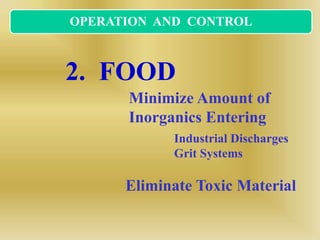
2. FOOD
Minimize Amount of
Inorganics Entering
Eliminate Toxic Material
Industrial Discharges
Grit Systems
OPERATION AND CONTROL
3. LOADING
AMOUNT
Applied to the Treatment Process
Related to the SIZE of the System
For An Anaerobic Digestion System –
The SIZE Is The VOLUME
Available for Digestion
(Volume - Cubic Feet OR Gallons)
1. CONTACT
Bacteria and Food
2. HEAT DISTRIBUTION
3. MINIMIZE SETTLING
4. MINIMIZE SCUM
Even Throughout
Reduces Available Volume
Operational Problems
CONTACT (MIXING)
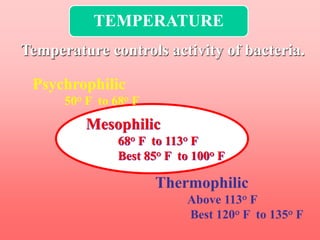
Temperature controls activity of bacteria.
Psychrophilic
50 F to 68 F
Mesophilic
68 F to 113 F
Best 85 F to 100 F
Thermophilic
Above 113 F
Best 120 F to 135 F
TEMPERATURE
OPERATION AND CONTROL
ENVIRONMENT
Temperature Control
90 to 950 F
Methane Formers Very Sensitive to Changes
Good Mixing Essential
SUMMARY
First Stage Second Stage
Balance
Poor Mixing
Over Loading
Excess Water
Temperature
Have you
any
question ?

ANAEROBIC SLUDGE DIGESTION PROCESS