SUBMIT TO : DR. RAJESH SINGH
GARGI ASODARIYA
ENROLLMENT NO : 180502011
MSC SESD SEMESTER II
CENTRAL UNIVERSITY OF GUJARAT
SEQUENCING BATCH REACTORS
(SBRs)
INTRODUCTION
 Sequencing Batch Reactor In a conventional
activated sludge system, unit processes
would be accomplished by using separate
tanks.
 Sequencing batch reactor is a modification of
activated sludge process which has been
successfully used to treat municipal and
industrial wastewater.
 SBR performs equalization, biological
treatment, and secondary clarification in a
SBR OPERATING
PRINCIPLE
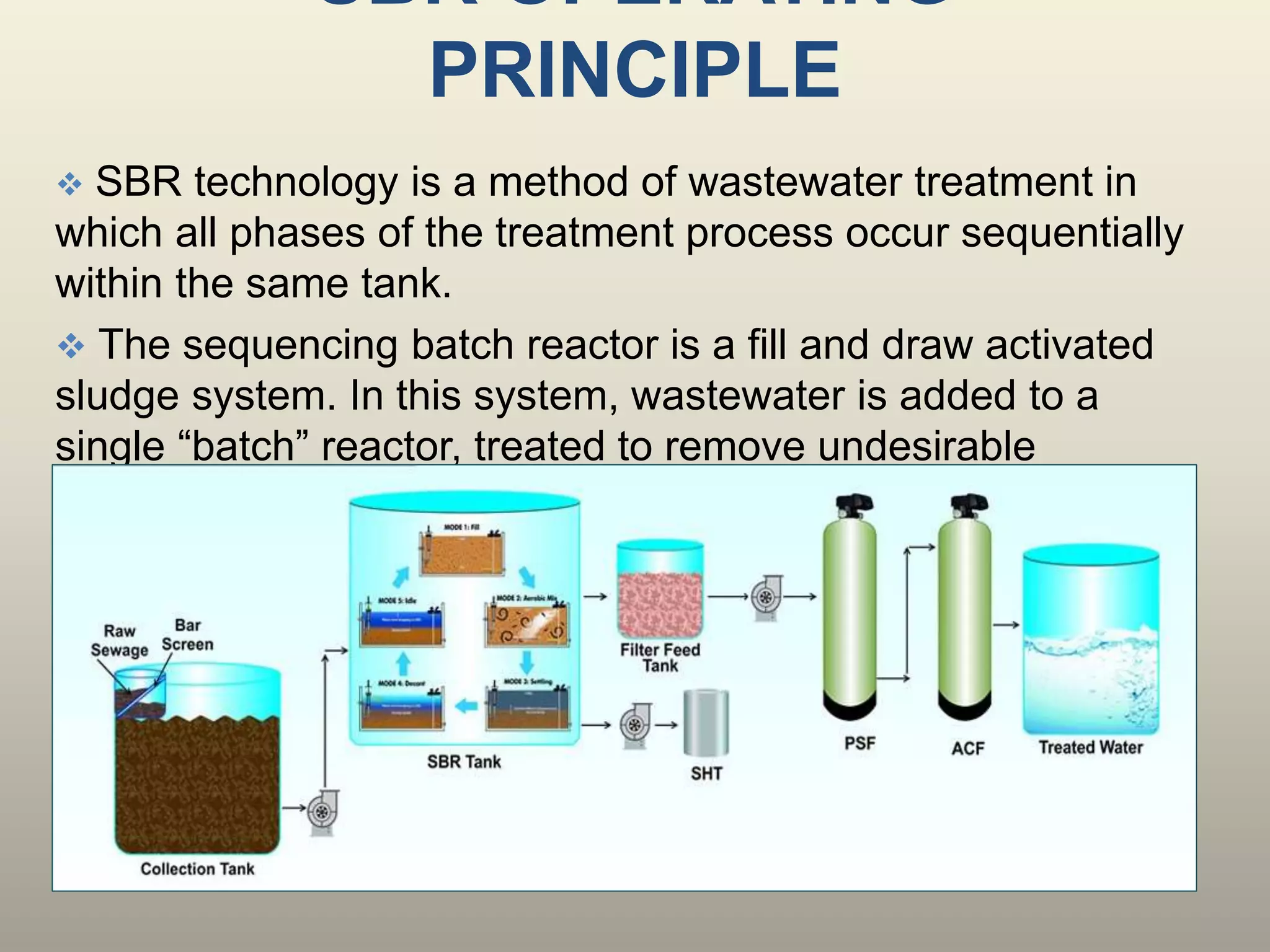
 SBR technology is a method of wastewater treatment in
which all phases of the treatment process occur sequentially
within the same tank.
 The sequencing batch reactor is a fill and draw activated
sludge system. In this system, wastewater is added to a
single “batch” reactor, treated to remove undesirable
components, and then discharged.
BASIC TREATMENT PROCESS
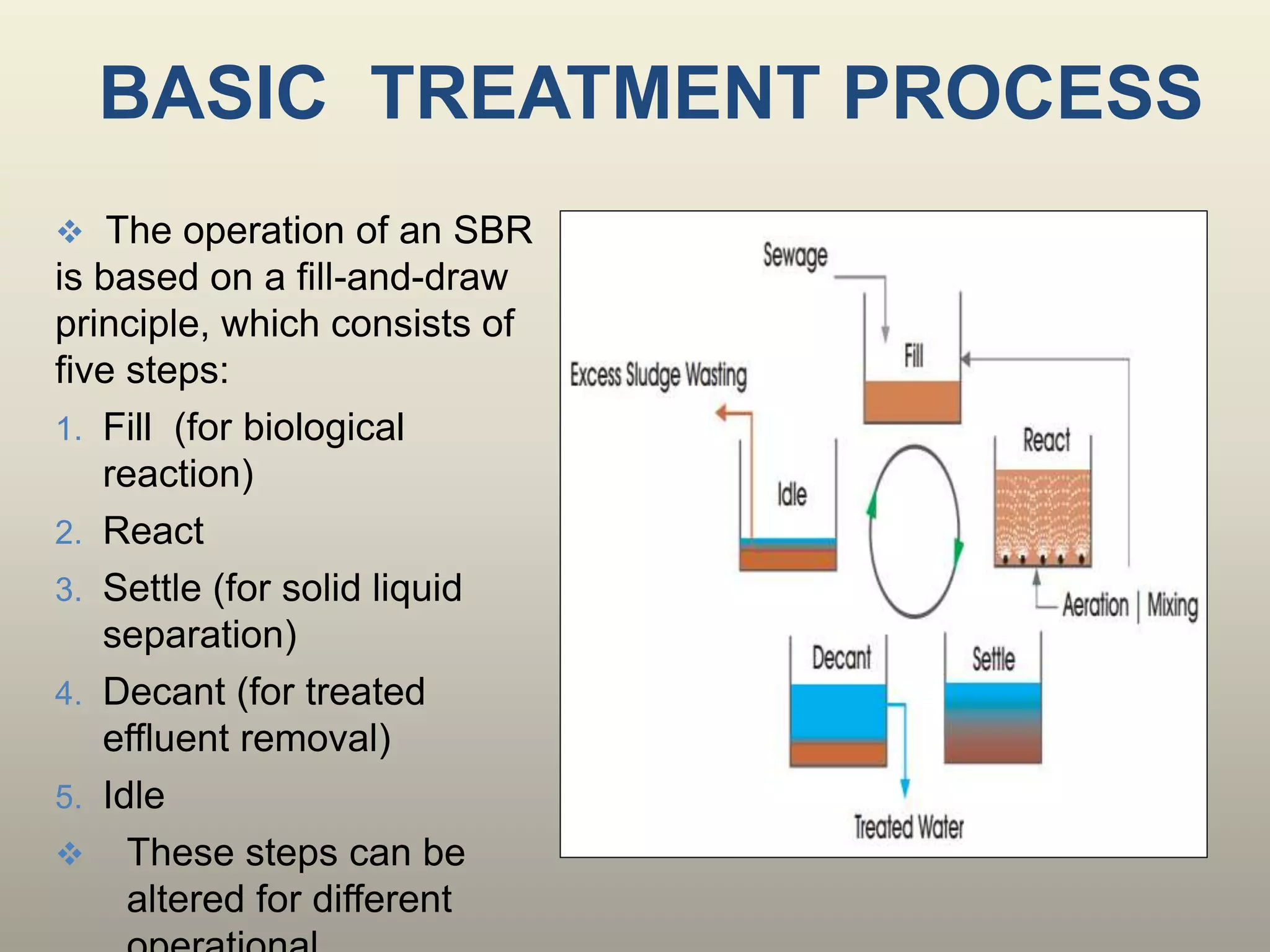
 The operation of an SBR
is based on a fill-and-draw
principle, which consists of
five steps:
1. Fill (for biological
reaction)
2. React
3. Settle (for solid liquid
separation)
4. Decant (for treated
effluent removal)
5. Idle
 These steps can be
altered for different
BASIC TREATMENT
PROCESS
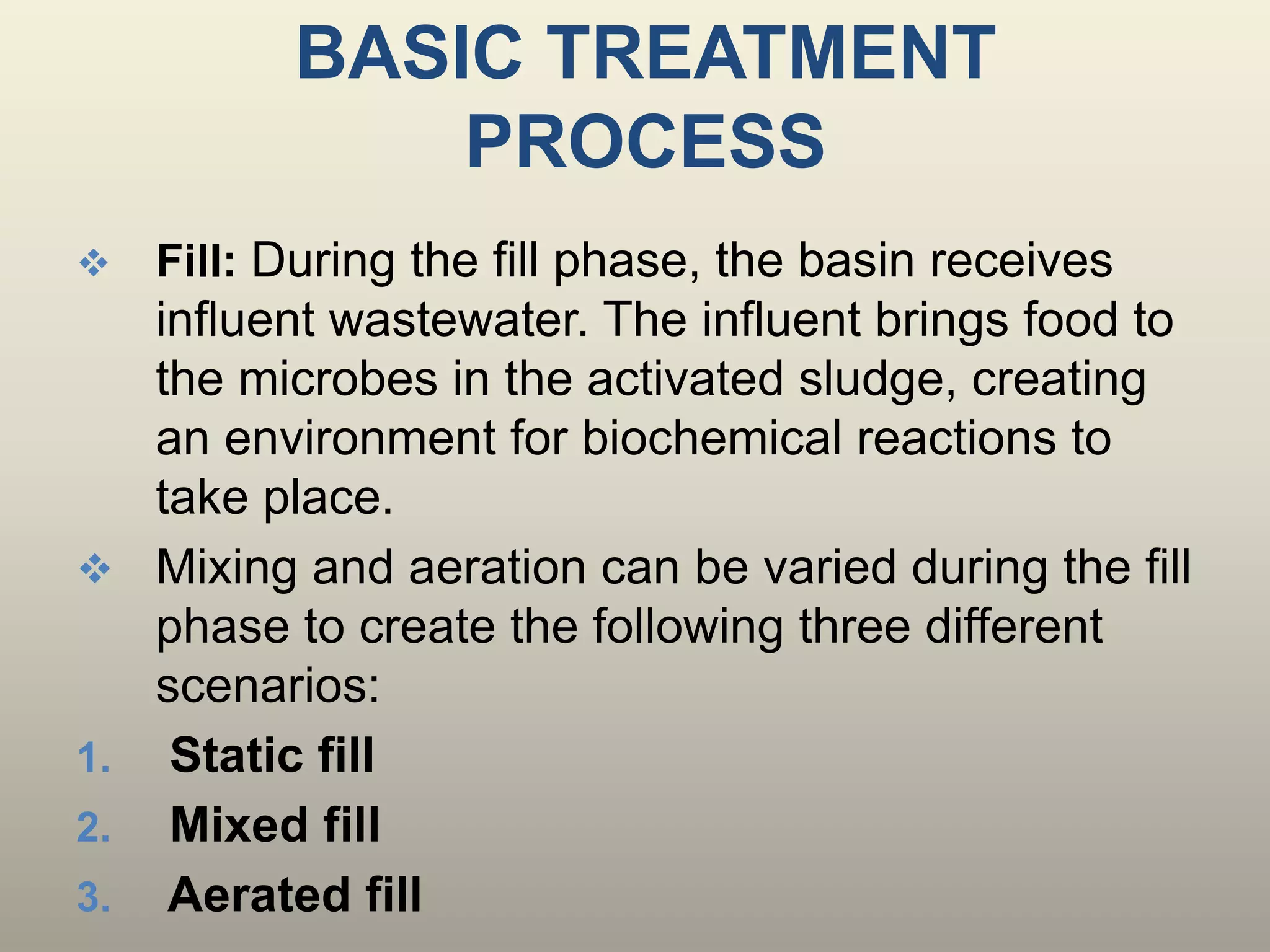
 Fill: During the fill phase, the basin receives
influent wastewater. The influent brings food to
the microbes in the activated sludge, creating
an environment for biochemical reactions to
take place.
 Mixing and aeration can be varied during the fill
phase to create the following three different
scenarios:
1. Static fill
2. Mixed fill
3. Aerated fill
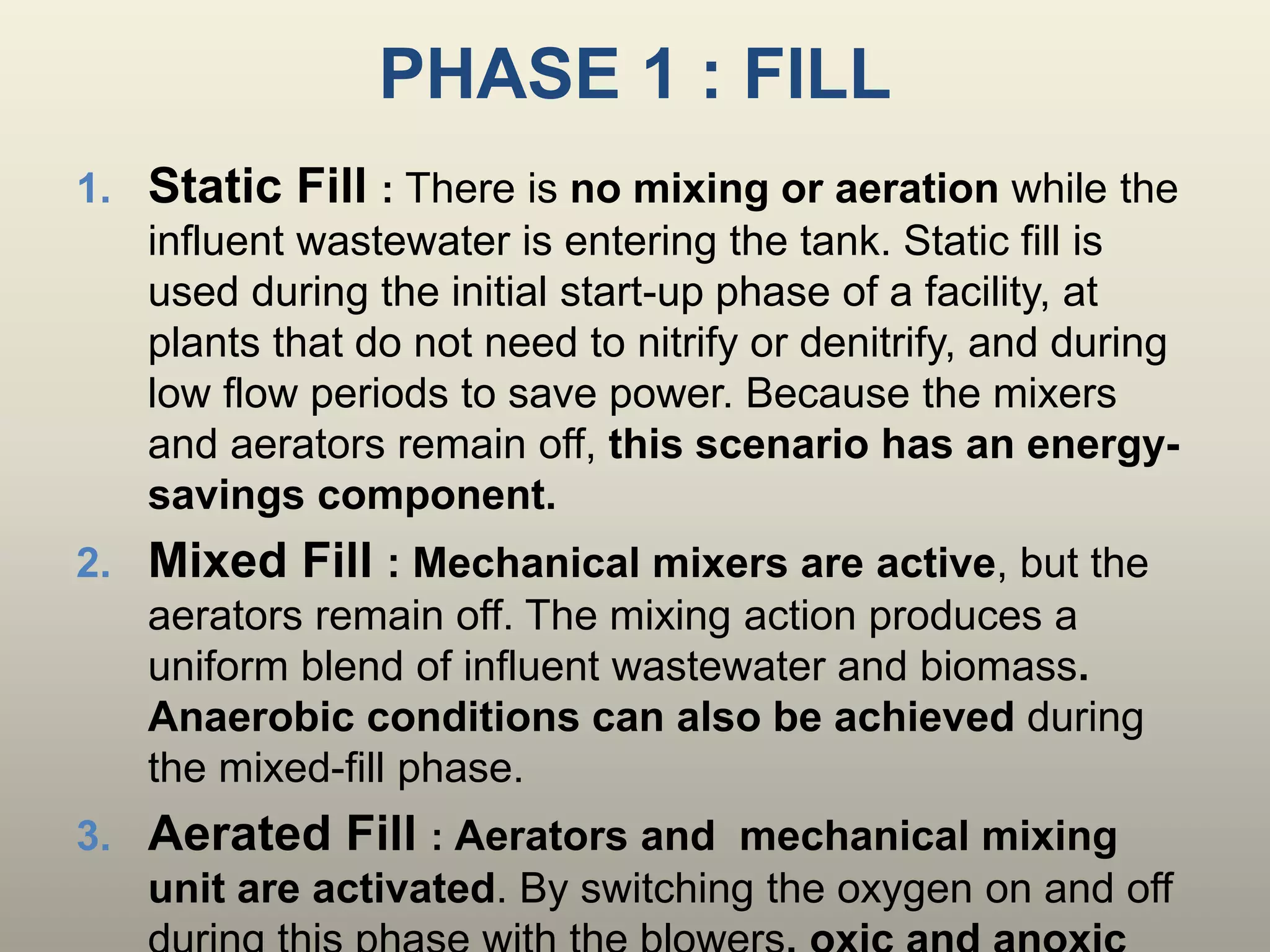
PHASE 1 : FILL
1. Static Fill : There is no mixing or aeration while the
influent wastewater is entering the tank. Static fill is
used during the initial start-up phase of a facility, at
plants that do not need to nitrify or denitrify, and during
low flow periods to save power. Because the mixers
and aerators remain off, this scenario has an energy-
savings component.
2. Mixed Fill : Mechanical mixers are active, but the
aerators remain off. The mixing action produces a
uniform blend of influent wastewater and biomass.
Anaerobic conditions can also be achieved during
the mixed-fill phase.
3. Aerated Fill : Aerators and mechanical mixing
unit are activated. By switching the oxygen on and off
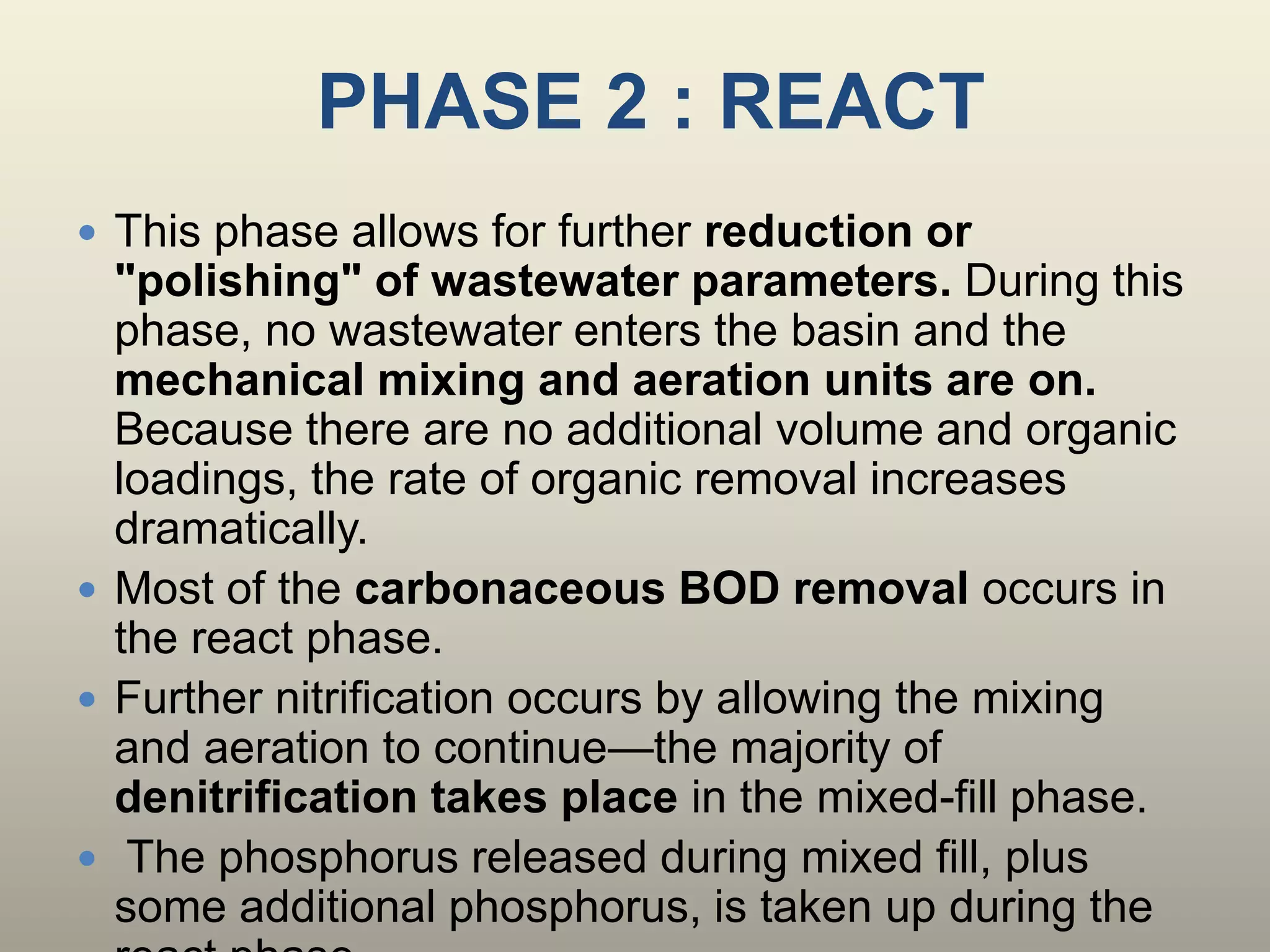
PHASE 2 : REACT
 This phase allows for further reduction or
"polishing" of wastewater parameters. During this
phase, no wastewater enters the basin and the
mechanical mixing and aeration units are on.
Because there are no additional volume and organic
loadings, the rate of organic removal increases
dramatically.
 Most of the carbonaceous BOD removal occurs in
the react phase.
 Further nitrification occurs by allowing the mixing
and aeration to continue—the majority of
denitrification takes place in the mixed-fill phase.
 The phosphorus released during mixed fill, plus
some additional phosphorus, is taken up during the
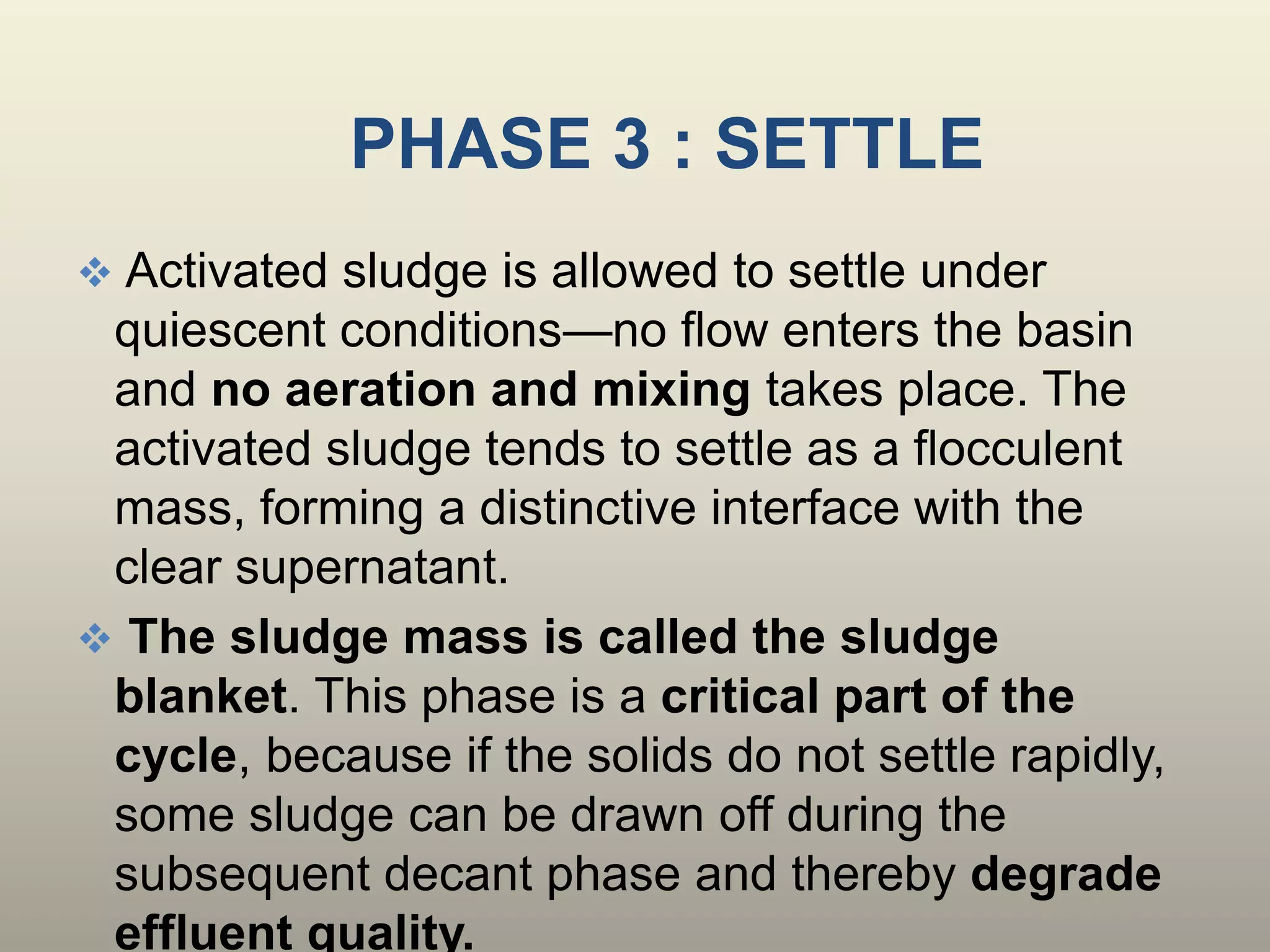
PHASE 3 : SETTLE
 Activated sludge is allowed to settle under
quiescent conditions—no flow enters the basin
and no aeration and mixing takes place. The
activated sludge tends to settle as a flocculent
mass, forming a distinctive interface with the
clear supernatant.
 The sludge mass is called the sludge
blanket. This phase is a critical part of the
cycle, because if the solids do not settle rapidly,
some sludge can be drawn off during the
subsequent decant phase and thereby degrade
effluent quality.
PHASE 4 : DECANT
 A Decanter is used to remove the clear supernatant
effluent. Once the settle phase is complete, a signal is sent to
the decanter to initiate the opening of an effluent-discharge
valve.
 There are floating and fixed-arm decanters :
I. Floating decanters maintain the inlet orifice
slightly below the water surface to minimize the removal
of solids in the effluent removed during the decant phase.
It offer the operator flexibility to vary fill and draw
volumes.
II. Fixed-arm decanters are less expensive and
can be designed to allow the operator to lower or raise
the level of the decanter.
 It is optimal that the decanted volume is the same as the
volume that enters the basin during the fill phase.
 It is also important that no surface foam or scum is decanted.
The vertical distance from the decanter to the bottom of the
tank should be maximized to avoid disturbing the settled
PHASE 5 : IDEAL
 This step occurs between the decant and the fill
phases. The time varies, based on the influent
flow rate and the operating strategy.
 During this phase, a small amount of activated
sludge at the bottom of the SBR basin is pumped
out—a process called wasting.
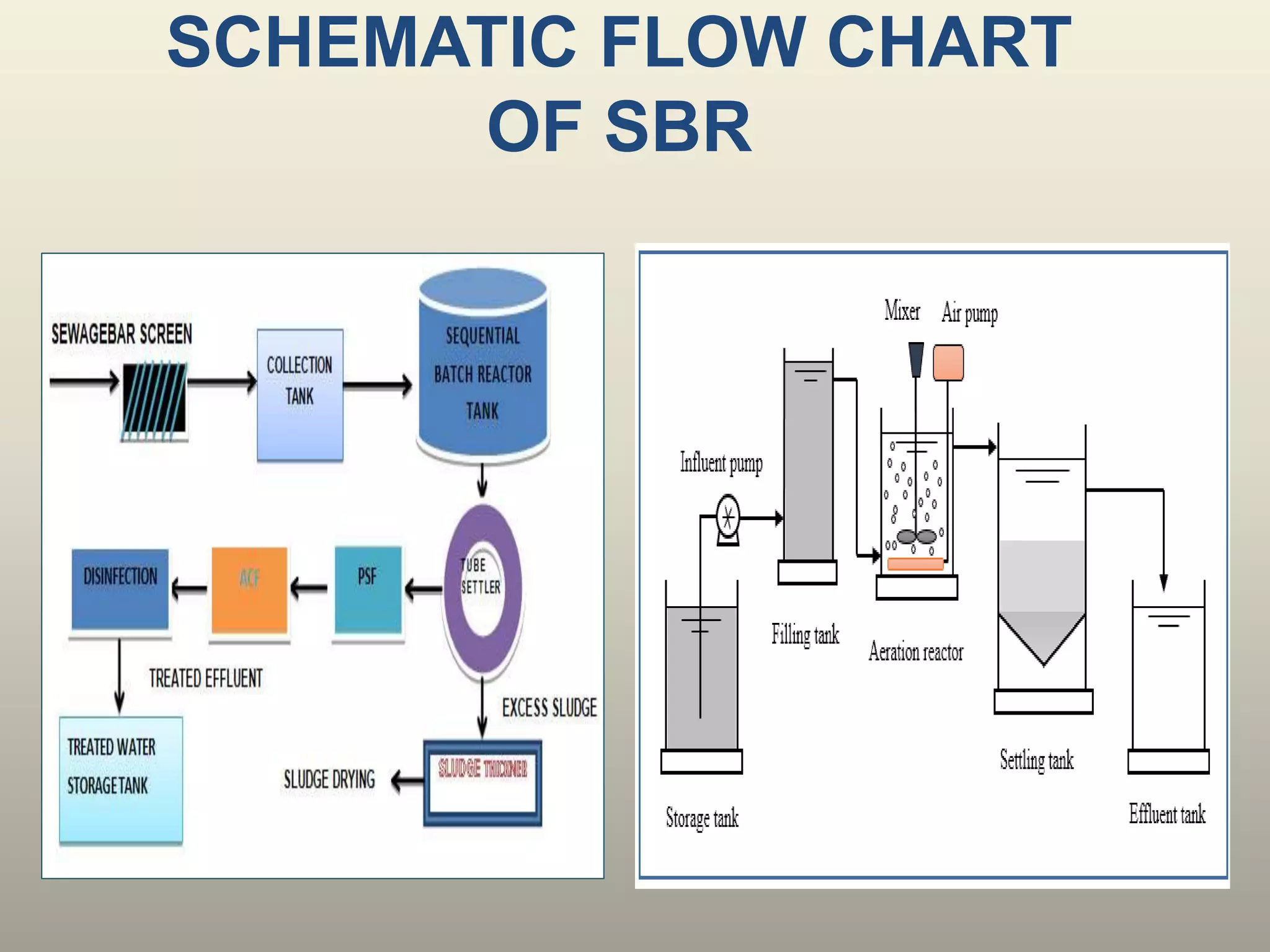
SCHEMATIC FLOW CHART
OF SBR
APPLICABILITY
 SBRs are typically used at flow rates of 5 MGD or
less. The more sophisticated operation required at
larger SBR plants tends to discourage the use of
these plants for large flow rates.
 As these systems have a relatively small footprint,
they are useful for areas where the available land is
limited. In addition, cycles within the system can be
easily modified for nutrient removal in the future, if it
becomes necessary.
 This makes SBRs extremely flexible to adapt to
regulatory changes for effluent parameters such as
nutrient removal. SBRs are also very cost effective if
treatment beyond biological treatment is required,
OPERATION & MAINTENANCE
 The SBR typically eliminates the need for separate primary and
secondary clarifiers in most municipal systems, which reduces
operations and maintenance requirements. In addition, RAS pumps
are not required.
 In conventional biological nutrient removal systems, anoxic basins,
anoxic zone mixers, toxic basins, toxic basin aeration equipment, and
internal MLSS nitrate-nitrogen recirculation pumps may be necessary.
With the SBR, this can be accomplished in one reactor using
aeration/mixing equipment, which will minimize operation and
maintenance requirements otherwise be needed for clarifiers and
pumps.
 Since the heart of the SBR system is the controls, automatic valves,
and automatic switches, these systems may require more
maintenance than a conventional activated sludge system. An
increased level of sophistication usually equates to more items that
can fail or require maintenance.
 The level of sophistication may be very advanced in larger SBR
PERFORMANCE
 The performance of SBRs is typically comparable to
conventional activated sludge systems and depends
on system design and site specific criteria.
 Depending on their mode of operation, SBRs can
achieve good BOD and nutrient removal.
 For SBRs, the BOD removal efficiency is generally 85
to 95 percent.
 SBR will typically provide a process guarantee to
produce an effluent of less than 10 mg/L BOD, 10 mg/L
TSS, 5 - 8 mg/L TN and 1 - 2 mg/L TP.
ADVANTAGES
 Equalization, primary clarification (in most
cases), biological treatment, and secondary
clarification can be achieved in a single reactor
vessel.
 Operating flexibility and control.
 Minimal footprint.
 Potential capital cost savings by eliminating
clarifiers and other equipment.
DISADVANTAGES
 A higher level of sophistication is required (compared
to conventional systems), especially for larger systems,
of timing units and controls.
 Higher level of maintenance (compared to
conventional systems) associated with more
sophisticated controls, automated switches, and
automated valves.
 Potential of discharging floating or settled sludge
during the draw or decant phase with some SBR
configurations.
 Potential plugging of aeration devices during selected
operating cycles, depending on the aeration system
used by the manufacturer.
CONCLUSION
 Sequencing batch reactors(SBRs) are useful for
areas where the available land is limited.
Equalization, primary clarification, biological
treatment and secondary clarification can be
achieved in a single reactor vessel.
 SBRs are a variation of the activated-sludge
process. They differ from activated-sludge plants
because they combine all of the treatment steps and
processes into a single basin, or tank, whereas
conventional facilities rely on multiple basins.
 The pollutant removal efficiency of SBR system is
higher for nitrogen and phosphate.
 Many advantages offered by the SBR process
justifies the recent increase in the implementation of
this process in industrial and municipal wastewater
REFERENCES
 AquaSBR Design Manual. Mikkelson, K.A. of
Aqua-Aerobic Systems 1995.
 Metcalf & Eddy, Tchobanoglous, G, Burton, F. L,
Stensel, H. D. “Wastewater engineering:
treatment and reuse-Metcalf & Eddy, Inc.”, Tata
McGraw-Hill, 2003.
 Paper on Sequencing Batch Reactor in
wastewater treatment by Susheel Arora, M.A.Sc,
P.Eng.
 www.neiwpcc.org/neiwpcc_docs/sbr_manual.pdf

Sequencing batch reactors

  • 1.
    SUBMIT TO :DR. RAJESH SINGH GARGI ASODARIYA ENROLLMENT NO : 180502011 MSC SESD SEMESTER II CENTRAL UNIVERSITY OF GUJARAT SEQUENCING BATCH REACTORS (SBRs)
  • 2.
    INTRODUCTION  Sequencing BatchReactor In a conventional activated sludge system, unit processes would be accomplished by using separate tanks.  Sequencing batch reactor is a modification of activated sludge process which has been successfully used to treat municipal and industrial wastewater.  SBR performs equalization, biological treatment, and secondary clarification in a
  • 3.
    SBR OPERATING PRINCIPLE  SBRtechnology is a method of wastewater treatment in which all phases of the treatment process occur sequentially within the same tank.  The sequencing batch reactor is a fill and draw activated sludge system. In this system, wastewater is added to a single “batch” reactor, treated to remove undesirable components, and then discharged.
  • 4.
    BASIC TREATMENT PROCESS The operation of an SBR is based on a fill-and-draw principle, which consists of five steps: 1. Fill (for biological reaction) 2. React 3. Settle (for solid liquid separation) 4. Decant (for treated effluent removal) 5. Idle  These steps can be altered for different
  • 5.
    BASIC TREATMENT PROCESS  Fill:During the fill phase, the basin receives influent wastewater. The influent brings food to the microbes in the activated sludge, creating an environment for biochemical reactions to take place.  Mixing and aeration can be varied during the fill phase to create the following three different scenarios: 1. Static fill 2. Mixed fill 3. Aerated fill
  • 6.
    PHASE 1 :FILL 1. Static Fill : There is no mixing or aeration while the influent wastewater is entering the tank. Static fill is used during the initial start-up phase of a facility, at plants that do not need to nitrify or denitrify, and during low flow periods to save power. Because the mixers and aerators remain off, this scenario has an energy- savings component. 2. Mixed Fill : Mechanical mixers are active, but the aerators remain off. The mixing action produces a uniform blend of influent wastewater and biomass. Anaerobic conditions can also be achieved during the mixed-fill phase. 3. Aerated Fill : Aerators and mechanical mixing unit are activated. By switching the oxygen on and off
  • 7.
    PHASE 2 :REACT  This phase allows for further reduction or "polishing" of wastewater parameters. During this phase, no wastewater enters the basin and the mechanical mixing and aeration units are on. Because there are no additional volume and organic loadings, the rate of organic removal increases dramatically.  Most of the carbonaceous BOD removal occurs in the react phase.  Further nitrification occurs by allowing the mixing and aeration to continue—the majority of denitrification takes place in the mixed-fill phase.  The phosphorus released during mixed fill, plus some additional phosphorus, is taken up during the
  • 8.
    PHASE 3 :SETTLE  Activated sludge is allowed to settle under quiescent conditions—no flow enters the basin and no aeration and mixing takes place. The activated sludge tends to settle as a flocculent mass, forming a distinctive interface with the clear supernatant.  The sludge mass is called the sludge blanket. This phase is a critical part of the cycle, because if the solids do not settle rapidly, some sludge can be drawn off during the subsequent decant phase and thereby degrade effluent quality.
  • 9.
    PHASE 4 :DECANT  A Decanter is used to remove the clear supernatant effluent. Once the settle phase is complete, a signal is sent to the decanter to initiate the opening of an effluent-discharge valve.  There are floating and fixed-arm decanters : I. Floating decanters maintain the inlet orifice slightly below the water surface to minimize the removal of solids in the effluent removed during the decant phase. It offer the operator flexibility to vary fill and draw volumes. II. Fixed-arm decanters are less expensive and can be designed to allow the operator to lower or raise the level of the decanter.  It is optimal that the decanted volume is the same as the volume that enters the basin during the fill phase.  It is also important that no surface foam or scum is decanted. The vertical distance from the decanter to the bottom of the tank should be maximized to avoid disturbing the settled
  • 10.
    PHASE 5 :IDEAL  This step occurs between the decant and the fill phases. The time varies, based on the influent flow rate and the operating strategy.  During this phase, a small amount of activated sludge at the bottom of the SBR basin is pumped out—a process called wasting.
  • 11.
  • 12.
    APPLICABILITY  SBRs aretypically used at flow rates of 5 MGD or less. The more sophisticated operation required at larger SBR plants tends to discourage the use of these plants for large flow rates.  As these systems have a relatively small footprint, they are useful for areas where the available land is limited. In addition, cycles within the system can be easily modified for nutrient removal in the future, if it becomes necessary.  This makes SBRs extremely flexible to adapt to regulatory changes for effluent parameters such as nutrient removal. SBRs are also very cost effective if treatment beyond biological treatment is required,
  • 13.
    OPERATION & MAINTENANCE The SBR typically eliminates the need for separate primary and secondary clarifiers in most municipal systems, which reduces operations and maintenance requirements. In addition, RAS pumps are not required.  In conventional biological nutrient removal systems, anoxic basins, anoxic zone mixers, toxic basins, toxic basin aeration equipment, and internal MLSS nitrate-nitrogen recirculation pumps may be necessary. With the SBR, this can be accomplished in one reactor using aeration/mixing equipment, which will minimize operation and maintenance requirements otherwise be needed for clarifiers and pumps.  Since the heart of the SBR system is the controls, automatic valves, and automatic switches, these systems may require more maintenance than a conventional activated sludge system. An increased level of sophistication usually equates to more items that can fail or require maintenance.  The level of sophistication may be very advanced in larger SBR
  • 14.
    PERFORMANCE  The performanceof SBRs is typically comparable to conventional activated sludge systems and depends on system design and site specific criteria.  Depending on their mode of operation, SBRs can achieve good BOD and nutrient removal.  For SBRs, the BOD removal efficiency is generally 85 to 95 percent.  SBR will typically provide a process guarantee to produce an effluent of less than 10 mg/L BOD, 10 mg/L TSS, 5 - 8 mg/L TN and 1 - 2 mg/L TP.
  • 15.
    ADVANTAGES  Equalization, primaryclarification (in most cases), biological treatment, and secondary clarification can be achieved in a single reactor vessel.  Operating flexibility and control.  Minimal footprint.  Potential capital cost savings by eliminating clarifiers and other equipment.
  • 16.
    DISADVANTAGES  A higherlevel of sophistication is required (compared to conventional systems), especially for larger systems, of timing units and controls.  Higher level of maintenance (compared to conventional systems) associated with more sophisticated controls, automated switches, and automated valves.  Potential of discharging floating or settled sludge during the draw or decant phase with some SBR configurations.  Potential plugging of aeration devices during selected operating cycles, depending on the aeration system used by the manufacturer.
  • 17.
    CONCLUSION  Sequencing batchreactors(SBRs) are useful for areas where the available land is limited. Equalization, primary clarification, biological treatment and secondary clarification can be achieved in a single reactor vessel.  SBRs are a variation of the activated-sludge process. They differ from activated-sludge plants because they combine all of the treatment steps and processes into a single basin, or tank, whereas conventional facilities rely on multiple basins.  The pollutant removal efficiency of SBR system is higher for nitrogen and phosphate.  Many advantages offered by the SBR process justifies the recent increase in the implementation of this process in industrial and municipal wastewater
  • 18.
    REFERENCES  AquaSBR DesignManual. Mikkelson, K.A. of Aqua-Aerobic Systems 1995.  Metcalf & Eddy, Tchobanoglous, G, Burton, F. L, Stensel, H. D. “Wastewater engineering: treatment and reuse-Metcalf & Eddy, Inc.”, Tata McGraw-Hill, 2003.  Paper on Sequencing Batch Reactor in wastewater treatment by Susheel Arora, M.A.Sc, P.Eng.  www.neiwpcc.org/neiwpcc_docs/sbr_manual.pdf