 Operation process of Lazaret broiler farm.


 Lazaret broiler farm consumes around 2.5 M equivalent LPG yearly which is used for
  heating up of sheds.

 Provide a win-win solution by producing bio gas from the litter generated by the broiler
  farm.

 Company’s investment in the set-up of a anaerobic digestion to meet its energy
  needs.

 Anaerobic Digestion (AD) Process.
Some of the key objectives of the study include;
1.   Characterisation of broiler litter

3.   Design and Construction of modern digester

5.   Enhance purity of bio gas for methane.

7.   Satisfy heating needs using bio gas

9.   Evaluate electricity potential

11. Evaluate potential of reducing green house gas emissions


13. Financial Analysis
DESCRIPTION OF PROBLEM
•    Amount of money spent on the purchase of liquefied
    petroleum gas

      Rs 2.5M on LPG, hence the need to review the energy budget.


• Waste Disposal

      120 tons of broiler litter mixed up with wood shavings disposed each
      month.
ANALYSIS OF ACTUAL SYSTEM
 Analysis of past LPG consumption pattern


 Analysis on the amount of heating required to raise temperature to
  32oC.

 Quantify the level bio gas production needed in view of meeting the
  heating requirements.

 Proper Waste disposal
RESEARCH METHODOLOGY
O (1) Characterisation of the broiler litter into its physico-
  chemical properties.
          • Moisture tests,
          •pH test,
          • The level of Chemical Oxygen Demand (COD),
          •The amount of volatile solids (VS) present,
          •Suspended solids and
          •Bulk Density

O (2) Feed Preparation

          • F:M ratio 4:1
O (3) Evaluating the heating needs of the farm;

         • Shed Dimensions (90.0 m x 9.0 m x 3.5 m)
         •Initial Heating
         •Heat loss by conduction through structures
                                     Q = amount of heat, (kJ)
                                     cp = specific heat ,(kJ/kg.K)
                                     m = mass, (kg)
                                     dT = temperature difference, (K)


                                     Qstructures = Heat transfer through walls, (W)
                                     Ustructure = heat transfer coefficient, (W/m2.K)
                                     A = Area of exposure, (m2)
                                     dT = temperature difference, (K)
O (4) Clean Development Mechanism

         • Amount of CO2 emissions avoided with the AD process.


O (5) Power production capability

         • Prospect of using the excess amount of methane produced
         for producing electricity.

O (6) Bio gas burning heat capacity

         • Flame purity for an enhanced heating capability.
DESIGN OF DIGESTER
(1) 2 Lab scale digesters

       • Check for viability of methane production,
       •Assess and control the evolution of pH, COD, VS.
(2) 3x250 litres Prototype digester
       • Same ratio used for feed preparation,
       • Pressurised, controllable storage tank using water counter-weight,
       • Bio gas purification using a scrubbing tower and a condensation
       column.
(2.1) 2D schematic of digester
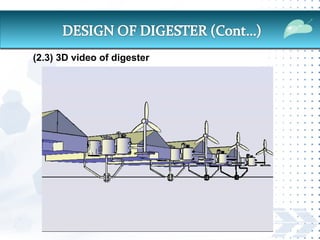
(2.2) 3D schematic of digester
(2.3) 3D video of digester
RESULTS
The study confirmed that methane production using broiler
waste is possible. Key results include;
       (1) The corresponding amount of methane produced was linked with
          the feed the broilers were entailed to.
       (2) The results for the physico-chemical properties of the broiler litter
          and innoculum are shown below.
(3) The ratio used for feed preparation for lab scale digesters and prototype
    digesters is shown below;


                                             Volume of Innoculum = 15,000 ml
                                             Volume of Substrate = 65,000 ml
                                             Volume of water    = 120,000 ml
                                             Total Volume        = 200,000 ml
(4) The cumulative volume of methane produced for both set-ups are shown of
    which the pH for Run2 was modified to suit the alkaline range.
(5) The cumulative volume for the prototype digester.
(6) The pH evolution of the lab scale digesters.
(7) The COD evolution for both lab scale digesters.
(8) The VS evolution for second lab scale digester.
(10) Flame analysis.
FINANCIAL ANALYSIS
CONCLUSION
• The amount of bio gas that can be produced per day is
estimated to be around 151.660 m3 which is more than sufficient
to heat the sheds,
•Surplus bio gas can be used to produce electricity,
•Implementation can lead to further growth using other types of
waste,
•Third party gaining acknowledgement for investing in green
initiative.
FURTHER WORKS
(1)The use of waste heat recovery to trigger methane production,
(2)The use of SCADA to maintain a level of safety in operations.
Thanking you
for your attention
Anaerobic digestion

Anaerobic digestion

  • 3.
     Operation processof Lazaret broiler farm.  Lazaret broiler farm consumes around 2.5 M equivalent LPG yearly which is used for heating up of sheds.  Provide a win-win solution by producing bio gas from the litter generated by the broiler farm.  Company’s investment in the set-up of a anaerobic digestion to meet its energy needs.  Anaerobic Digestion (AD) Process.
  • 4.
    Some of thekey objectives of the study include; 1. Characterisation of broiler litter 3. Design and Construction of modern digester 5. Enhance purity of bio gas for methane. 7. Satisfy heating needs using bio gas 9. Evaluate electricity potential 11. Evaluate potential of reducing green house gas emissions 13. Financial Analysis
  • 6.
  • 7.
    Amount of money spent on the purchase of liquefied petroleum gas Rs 2.5M on LPG, hence the need to review the energy budget. • Waste Disposal 120 tons of broiler litter mixed up with wood shavings disposed each month.
  • 8.
  • 9.
     Analysis ofpast LPG consumption pattern  Analysis on the amount of heating required to raise temperature to 32oC.  Quantify the level bio gas production needed in view of meeting the heating requirements.  Proper Waste disposal
  • 10.
  • 11.
    O (1) Characterisationof the broiler litter into its physico- chemical properties. • Moisture tests, •pH test, • The level of Chemical Oxygen Demand (COD), •The amount of volatile solids (VS) present, •Suspended solids and •Bulk Density O (2) Feed Preparation • F:M ratio 4:1
  • 12.
    O (3) Evaluatingthe heating needs of the farm; • Shed Dimensions (90.0 m x 9.0 m x 3.5 m) •Initial Heating •Heat loss by conduction through structures Q = amount of heat, (kJ) cp = specific heat ,(kJ/kg.K) m = mass, (kg) dT = temperature difference, (K) Qstructures = Heat transfer through walls, (W) Ustructure = heat transfer coefficient, (W/m2.K) A = Area of exposure, (m2) dT = temperature difference, (K)
  • 13.
    O (4) CleanDevelopment Mechanism • Amount of CO2 emissions avoided with the AD process. O (5) Power production capability • Prospect of using the excess amount of methane produced for producing electricity. O (6) Bio gas burning heat capacity • Flame purity for an enhanced heating capability.
  • 14.
  • 15.
    (1) 2 Labscale digesters • Check for viability of methane production, •Assess and control the evolution of pH, COD, VS.
  • 16.
    (2) 3x250 litresPrototype digester • Same ratio used for feed preparation, • Pressurised, controllable storage tank using water counter-weight, • Bio gas purification using a scrubbing tower and a condensation column.
  • 17.
    (2.1) 2D schematicof digester
  • 18.
    (2.2) 3D schematicof digester
  • 19.
    (2.3) 3D videoof digester
  • 20.
  • 21.
    The study confirmedthat methane production using broiler waste is possible. Key results include; (1) The corresponding amount of methane produced was linked with the feed the broilers were entailed to. (2) The results for the physico-chemical properties of the broiler litter and innoculum are shown below.
  • 22.
    (3) The ratioused for feed preparation for lab scale digesters and prototype digesters is shown below; Volume of Innoculum = 15,000 ml Volume of Substrate = 65,000 ml Volume of water = 120,000 ml Total Volume = 200,000 ml
  • 23.
    (4) The cumulativevolume of methane produced for both set-ups are shown of which the pH for Run2 was modified to suit the alkaline range.
  • 24.
    (5) The cumulativevolume for the prototype digester.
  • 25.
    (6) The pHevolution of the lab scale digesters.
  • 26.
    (7) The CODevolution for both lab scale digesters.
  • 27.
    (8) The VSevolution for second lab scale digester.
  • 28.
  • 29.
  • 32.
  • 33.
    • The amountof bio gas that can be produced per day is estimated to be around 151.660 m3 which is more than sufficient to heat the sheds, •Surplus bio gas can be used to produce electricity, •Implementation can lead to further growth using other types of waste, •Third party gaining acknowledgement for investing in green initiative.
  • 34.
  • 35.
    (1)The use ofwaste heat recovery to trigger methane production, (2)The use of SCADA to maintain a level of safety in operations.
  • 36.