Biology
Sylvia S. Mader
Michael Windelspecht
Chapter 5
Membrane Structure
and Function
Lecture Outline
Copyright © The McGraw-Hill Companies, Inc. Permission required for reproduction or display.
1
See separate FlexArt PowerPoint slides
for all figures and tables pre-inserted into
PowerPoint without notes.
2
Outline
• 5.1 Plasma Membrane Structure and
Function
• 5.2 Passive Transport Across a Membrane
• 5.3 Active Transport Across a Membrane
• 5.4 Modification of Cell Surfaces
5.1 Plasma Membrane
Structure and Function
• The plasma membrane is common to all cells
• Separates:
 Internal cytoplasm from the external environment of
the cell
• Phospholipid bilayer:
 External surface lined with hydrophilic polar heads
 Cytoplasmic surface lined with hydrophilic polar
heads
 Nonpolar, hydrophobic, fatty-acid tails sandwiched in
between
3
Plasma Membrane Structure
and Function
• Components of the Plasma Membrane
 Three components:
• Lipid component referred to as phospholipid
bilayer
• Protein molecules
– Float around like icebergs on a sea
– Membrane proteins may be peripheral or
integral
» Peripheral proteins are found on the inner
membrane surface
» Integral proteins are partially or wholly
embedded (transmembrane) in the
membrane
• Cholesterol affects the fluidity of the membrane
4
Membrane Proteins
5
Copyright © The McGraw-Hill Companies, Inc. Permission required for reproduction or display.
hydrophobic
region
phospholipid
Water outside cell
integral
protein
hydrophilic
regions
Water inside cell
peripheral
proteins
cholesterol
Plasma Membrane Structure
and Function
• Carbohydrate Chains
 Glycoproteins
• Proteins with attached carbohydrate chains
 Glycolipids
• Lipids with attached carbohydrate chains
 These carbohydrate chains exist only on the
outside of the membrane
• Makes the membrane asymmetrical
6
Plasma Membrane of an Animal Cell
7
Copyright © The McGraw-Hill Companies, Inc. Permission required for reproduction or display.
Plasma membrane
filaments of cytoskeleton Inside cell
integral protein
cholesterol
peripheral protein
glycolipid
carbohydrate
chain Outside cell
hydrophilic
heads
phospholipid
glycoprotein
extracellular
Matrix (ECM)
phospholipid
bilayer
hydrophobic
tails
Plasma Membrane Structure
and Function
• Functions of Membrane Proteins
 Channel Proteins:
• Allow passage of molecules through membrane via a
channel in the protein
 Carrier Proteins:
• Combine with the substance to be transported
• Assist passage of molecules through membrane
 Cell Recognition Proteins:
• Glycoproteins
• Help the body recognize foreign substances
8
Plasma Membrane Structure
and Function
• Functions of Membrane Proteins (continued)
 Receptor Proteins:
• Bind with specific molecules
• Allow a cell to respond to signals from other cells
 Enzymatic Proteins:
• Carry out metabolic reactions directly
 Junction Proteins:
• Attach adjacent cells
9
Copyright © The McGraw-Hill Companies, Inc. Permission required for reproduction or display.
Channel Protein:
Allows a particular
molecule or ion to
cross the plasma
membrane freely.
Cystic fibrosis, an
inherited disorder,
is caused by a
faulty chloride (Cl–
)
channel; a thick
mucus collects in
airways and in
pancreatic and
liver ducts.
a.
Membrane Protein Diversity
b.
Carrier Protein:
Selectively interacts
with a specific
molecule or ion so
that it can cross the
plasma membrane.
The inability of some
persons to use
energy for sodium-
potassium (Na+
–K+
)
transport has been
suggested as the
cause of their obesity.
Copyright © The McGraw-Hill Companies, Inc. Permission required for reproduction or display.
Cell Recognition
Protein:
The MHC (major
histocompatibility
complex) glycoproteins
are different for each
person, so organ
transplants are difficult
to achieve. Cells with
foreign MHC
glycoproteins are
attacked by white blood
cells responsible for
immunity.
c.
Copyright © The McGraw-Hill Companies, Inc. Permission required for reproduction or display.
Receptor Protein:
Is shaped in such a
way that a specific
molecule can bind to
it. Pygmies are short,
not because they do
not produce enough
growth hormone, but
because their plasma
membrane growth
hormone receptors
are faulty and cannot
interact with growth
hormone.
d.
Enzymatic Protein:
Catalyzes a specific
reaction. The membrane
protein, adenylate
cyclase, is involved in
ATP metabolism. Cholera
bacteria release a toxin
that interferes with the
proper functioning of
adenylate cyclase;
sodium (Na+
) and water
leave intestinal cells, and
the individual may die
from severe diarrhea.
e.
Copyright © The McGraw-Hill Companies, Inc. Permission required for reproduction or display.
Junction Proteins:
Tight junctions join
cells so that a tissue
can fulfill a function, as
when a tissue pinches
off the neural tube
during development.
Without this
cooperation between
cells, an animal
embryo would have no
nervous system.
f.
Copyright © The McGraw-Hill Companies, Inc. Permission required for reproduction or display.
Channel Protein:
Allows a particular
molecule or ion to
cross the plasma
membrane freely.
Cystic fibrosis, an
inherited disorder,
is caused by a
faulty chloride (Cl–
)
channel; a thick
mucus collects in
airways and in
pancreatic and
liver ducts.
Carrier Protein:
Selectively interacts
with a specific
molecule or ion so
that it can cross the
plasma membrane.
The inability of some
persons to use
energy for sodium-
potassium (Na+
–K+
)
transport has been
suggested as the
cause of their obesity.
Receptor Protein:
Is shaped in such a
way that a specific
molecule can bind to
it. Pygmies are short,
not because they do
not produce enough
growth hormone, but
because their plasma
membrane growth
hormone receptors
are faulty and cannot
interact with growth
hormone.
Enzymatic Protein:
Catalyzes a specific
reaction. The membrane
protein, adenylate
cyclase, is involved in
ATP metabolism. Cholera
bacteria release a toxin
that interferes with the
proper functioning of
adenylate cyclase;
sodium (Na+
) and water
leave intestinal cells, and
the individual may die
from severe
diarrhea.
Junction Proteins:
Tight junctions join
cells so that a tissue
can fulfill a function, as
when a tissue pinches
off the neural tube
during development.
Without this
cooperation between
cells, an animal
embryo would have no
nervous system.
Cell Recognition
Protein:
The MHC (major
histocompatibility
complex) glycoproteins
are different for each
person, so organ
transplants are difficult
to achieve. Cells with
foreign MHC
glycoproteins are
attacked by white blood
cells responsible for
immunity.
a. b.
d. e.
c.
f.
Membrane Protein Diversity
How Cells Talk to One
Another
• Signaling molecules serve as chemical
messengers allowing cells to communicate with
one another
 Cell receptors bind to specific signaling molecules
 Once the signaling molecule and the cell receptor
bind a cascade of events occurs that elicits a cellular
response
• Signal transduction pathway
17
Cell Signaling
18
Copyright © The McGraw-Hill Companies, Inc. Permission required for reproduction or display.
Cellular
response:
Altered shape
or movement
of cell
Altered
metabolism
or cellular
function
Altered gene
expression
and the types
and amount
of proteins
produced
gene
regulatory
protein
Nucleus
b.
Cytoplasm
unactivated
receptor
protein
Nuclear
envelope
enzyme
structural
protein
receptor
activation
signaling
molecule
Targeted
protein:
plasma
membrane
newborna. egg embryo
Left: © Anatomical Travelogue/Photo Researchers, Inc.; Middle: © Neil Harding/Stone/Getty Images; Right: © Photodisc Collection/Getty RF
2.Transduction pathway: Series
of relay proteins that ends when
a protein is activated.
3. Response: Targeted protein(s)
bring about a cellular response.
1. Receptor: Binds to a signaling
molecule, becomes activated and
initiates a transduction pathway.
Plasma Membrane Structure
and Function
• Permeability of the Plasma Membrane
 The plasma membrane is selectively permeable
• Allows some substances to move across the membrane
• Inhibits passage of other molecules
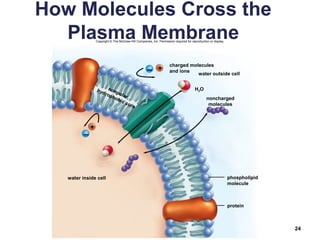
 Small, non-charged molecules (CO2, O2, glycerol,
alcohol) freely cross the membrane by passing
through the phospholipid bilayer
• These molecules follow their concentration gradient
– Move from an area of high concentration to an area of
low concentration.
19
Plasma Membrane Structure
and Function
• Permeability of the Plasma Membrane
 Water moves across the plasma membrane
• Specialized proteins termed aquaporins speed up water
transport across the membrane
 The movement of ions and polar molecules across
the membrane is often assisted by carrier proteins
 Some molecules must move against their
concentration gradient with the expenditure of energy
• Active transport
 Large particles enter or exit the cell via bulk transport
• Exocytosis
• Endocytosis
20
How Molecules Cross the
Plasma Membrane
21
Copyright © The McGraw-Hill Companies, Inc. Permission required for reproduction or display.
water inside cell phospholipid
molecule
protein
water outside cell
nonpolar,
hydrophobic core
How Molecules Cross the
Plasma Membrane
22
+
–
+
water inside cell phospholipid
molecule
protein
water outside cell
charged molecules
and ions–
nonpolar,
hydrophobic core
Copyright © The McGraw-Hill Companies, Inc. Permission required for reproduction or display.
How Molecules Cross the
Plasma Membrane
23
+
–
+
water inside cell phospholipid
molecule
protein
charged molecules
and ions
H2O
–
nonpolar,
hydrophobic core
Copyright © The McGraw-Hill Companies, Inc. Permission required for reproduction or display.
How Molecules Cross the
Plasma Membrane
24
+
–
+
water inside cell phospholipid
molecule
protein
noncharged
molecules
water outside cell
charged molecules
and ions
H2O
–
nonpolar,
hydrophobic core
Copyright © The McGraw-Hill Companies, Inc. Permission required for reproduction or display.
How Molecules Cross the
Plasma Membrane
25
+
–
+
water inside cell phospholipid
molecule
protein
macromolecule
noncharged
molecules
water outside cell
charged molecules
and ions
H2O
–
nonpolar,
hydrophobic core
Copyright © The McGraw-Hill Companies, Inc. Permission required for reproduction or display.
Passage of Molecules Into
and out of the Cell
26
5.2 Passive Transport Across
a Membrane
• A solution consists of:
 A solvent (liquid), and
 A solute (dissolved solid)
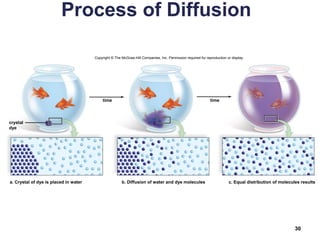
• Diffusion
 Net movement of molecules down a concentration
gradient
 Molecules move both ways along gradient, but net
movement is from high to low concentration
 Equilibrium:
• When NET movement stops
• Solute concentration is uniform – no gradient
27
Process of Diffusion
28
Copyright © The McGraw-Hill Companies, Inc. Permission required for reproduction or display.
crystal
dye
a. Crystal of dye is placed in water
Process of Diffusion
29
Copyright © The McGraw-Hill Companies, Inc. Permission required for reproduction or display.
time
crystal
dye
a. Crystal of dye is placed in water b. Diffusion of water and dye molecules
Process of Diffusion
30
Copyright © The McGraw-Hill Companies, Inc. Permission required for reproduction or display.
time time
crystal
dye
a. Crystal of dye is placed in water b. Diffusion of water and dye molecules c. Equal distribution of molecules results
Gas Exchange in Lungs
31
O2
oxygen
O2
O2
O2
O2
O2
O2
O2
O2
O2
O2
O2
O2
O2
highO2
concentration
lowO2
concentration
bronchiole
capillaryalveolus
Copyright © The McGraw-Hill Companies, Inc. Permission required for reproduction or display.
Passive Transport Across a
Membrane
• Osmosis:
 Special case of diffusion
 Focuses on solvent (water) movement rather than
solute
 Diffusion of water across a selectively permeable
membrane
• Solute concentration on one side is high, but water
concentration is low
• Solute concentration on other side is low, but water
concentration is high
 Water can diffuse both ways across membrane but
the solute cannot
 Net movement of water is toward low water (high
solute) concentration
• Osmotic pressure is the pressure that develops
due to osmosis
32
Osmosis Demonstration
33
Copyright © The McGraw-Hill Companies, Inc. Permission required for reproduction or display.
a.
less water (higher
percentage of solute)
more water (lower
percentage of solute)
10%
5%
<10%
>5%
solute
differentially
permeable
membrane
water
b.
c.
less water (higher
percentage of solute)
more water (lower
percentage of solute)
beaker
thistle
tube
Passive Transport Across a
Membrane
• Isotonic Solutions
 Solute and water concentrations are equal on
both sides of membrane
 No net gain or loss of water by the cell
• Hypotonic Solutions
 Concentration of solute in the solution is lower
than inside the cell
 Cells placed in a hypotonic solution will swell
• Causes turgor pressure in plants
• May cause animal cells to lyse (rupture)
34
Passive Transport Across a
Membrane
• Hypertonic Solutions
 Concentration of solute is higher in the
solution than inside the cell
 Cells placed in a hypertonic solution will
shrink
• Crenation in animal cells
• Plasmolysis in plant cells
35
Osmosis in Animal and Plant Cells
36
Copyright © The McGraw-Hill Companies, Inc. Permission required for reproduction or display.
In a hypertonic solution, water
mainly leaves the cell, which
shrivels (crenation).
In a hypertonic solution, vacuoles
lose water, the cytoplasm shrinks
(plasmolysis), and chloroplasts
are seen in the center of the cell.
In a hypotonic solution, vacuoles
fill with water, turgor pressure
develops, and chloroplasts are
seen next to the cell wall.
In an isotonic solution, there is no
net movement of water.
In an isotonic solution, there is no net
movement of water.
In a hypotonic solution, water
mainly enters the cell, which may
burst (lysis).
plasma
membrane
Animal
cells
nucleus
Plant
cells
central
vacuole
chloroplast
nucleus
cell
wall
plasma
membrane
Passive Transport Across a
Membrane
 Facilitated Transport
• Movement of molecules that cannot pass directly
through the membrane lipids
• These molecules must combine with carrier
proteins to move across the membrane
• Follow concentration gradient, moving from high
concentration to low concentration
37
Copyright © The McGraw-Hill Companies, Inc. Permission required for reproduction or display.
solute
Outside
Inside
plasma
membrane
carrier
protein
Facilitated Transport
Copyright © The McGraw-Hill Companies, Inc. Permission required for reproduction or display.
solute
Outside
Inside
plasma
membrane
carrier
protein
Facilitated Transport
solute
Outside
Inside
plasma
membrane
carrier
protein
Copyright © The McGraw-Hill Companies, Inc. Permission required for reproduction or display.
Facilitated Transport
Copyright © The McGraw-Hill Companies, Inc. Permission required for reproduction or display.
solute
Outside
Inside
plasma
membrane
carrier
protein
Facilitated Transport
5.3 Active Transport Across a
Membrane
 Active Transport
• The movement of molecules against their
concentration gradient
– Movement from low to high concentration
• Movement is facilitated by carrier proteins
• Requires the expenditure of energy in the form of
ATP
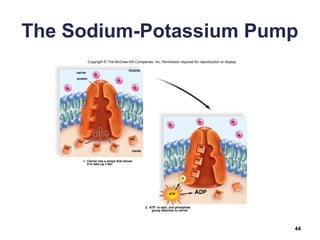
• Ex: sodium-potassium pump
– Uses ATP to move sodium ions out of the cells and
potassium ions into the cell against their concentration
gradients.
42
The Sodium-Potassium Pump
43
Copyright © The McGraw-Hill Companies, Inc. Permission required for reproduction or display.
carrier
protein
1. Carrier has a shape that allows
it to take up 3 Na+
Outside
Inside
K+
K+
Na+
K+
K+
Na+
Na+ Na+
Na+
The Sodium-Potassium Pump
44
Copyright © The McGraw-Hill Companies, Inc. Permission required for reproduction or display.
carrier
protein
1. Carrier has a shape that allows
it to take up 3 Na+
.
2. ATP is split, and phosphate
group attaches to carrier
Outside
Inside
ATP
K+
P
Na+
Na+
K+
K+
K+
K+
K+
Na+
Na+ Na+
Na+
K+
K+
Na+
Na+
Na+
The Sodium-Potassium Pump
45
Copyright © The McGraw-Hill Companies, Inc. Permission required for reproduction or display.
carrier
protein
1. Carrier has a shape that allows
it to take up 3 Na+
.
3. Change in shape results and
causes carrier to release 3 Na+
outside the cell.
Outside
Inside
ATP
K+
K+
K+
P
P
Na+
Na
+
Na+
Na+
K+
K+
K+
Na+
Na+ Na+
K+
K+
K+
Na+
Na+
Na
+
Na+
2. ATP is split, and phosphate
group attaches to carrier
K+
Na
+
Na+
K+
K+
Na+
The Sodium-Potassium Pump
46
carrier
protein
1. Carrier has a shape that allows
it to take up 3 Na+
.
4. Carrier has a shape that
allows it to take up 2K+
.
3. Change in shape results and
causes carrier to release 3 Na+
outside the cell.
Outside
Inside
ATP
K+
K+
K+
K+
K+
K+
K+
K+
P
P
P
Na+
Na+
Na
+
Na+
Na+
Na+
Na+
K+
K+
K+
Na+
Na+ Na+
Na+
Na+
Na+
Na+
Na+
Na+
K+K+
K+
2. ATP is split, and phosphate
group attaches to carrier.
K+
Na+
Na+
K+
Na+
Na+
Copyright © The McGraw-Hill Companies, Inc. Permission required for reproduction or display.
The Sodium-Potassium Pump
47
carrier
protein
1. Carrier has a shape that allows
it to take up 3 Na+
.
4. Carrier has a shape that
allows it to take up 2 K+
.
2. ATP is split, and phosphate
group attaches to carrier.
3. Change in shape results and
causes carrier to release 3 Na+
outside the cell.
5. Phosphate group is released
from carrier.
Outside
Inside
ATP
K+
K+
K+
K+
P
P
P
P
Na
+
Na+
Na+
Na
+
Na
+
Na+
Na
+
Na+
Na+
Na
+
Na+
K+
K+
K+
Na+
Na+ Na+
Na
+
K+K+
K+
Na+
Na+
Na+
Na
+
K+
K+
K+
Na+
K+
K+
K+
Na+
Na
+
K+
K+
Na+
Na+
K+
K+
Na+
Copyright © The McGraw-Hill Companies, Inc. Permission required for reproduction or display.
The Sodium-Potassium Pump
48
carrier
protein
1. Carrier has a shape that allows
it to take up 3 Na+
.
4. Carrier has a shape that
allows it to take up 2 K+
.
2. ATP is split, and phosphate
group attaches to carrier.
3. Change in shape results and
causes carrier to release 3 Na+
outside the cell.
5. Phosphate group is released
from carrier.
Outside
Inside
ATP
K+
K+
K+
K+
P
P
P
P
Na
+
Na+
Na+
Na
+
Na
+
Na+
Na
+
Na+
Na+
Na
+
Na+
K+
K+
K+
Na+
Na+ Na+
Na
+
K+K+
K+
Na+
Na+
Na+
Na+
K+K+
K+
Na+
K+
K+
K+
Na+
Na
+
K+
K+
Na+
Na+
K+
K+
Na+
Copyright © The McGraw-Hill Companies, Inc. Permission required for reproduction or display.
6. Change in shape results and
causes carrier to release 2K+
inside the cell.
K+
K
K+
Na
+
Na+
Na+
Na+ Na+
K+
Active Transport Across a
Membrane
• Macromolecules are transported into or out of
the cell inside vesicles via bulk transport
 Exocytosis – Vesicles fuse with plasma membrane
and secrete contents
 Endocytosis – Cells engulf substances into a pouch
which becomes a vesicle
• Phagocytosis – Large, solid material is taken in by
endocytosis
• Pinocytosis – Vesicles form around a liquid or very small
particles
• Receptor-Mediated Endocytosis– Specific form of
pinocytosis using receptor proteins and a coated pit
49
Exocytosis
50
Copyright © The McGraw-Hill Companies, Inc. Permission required for reproduction or display.
OutsidePlasma membrane
Inside
secretory
vesicle
Three Methods of Endocytosis
51
Copyright © The McGraw-Hill Companies, Inc. Permission required for reproduction or display.
pseudopod
paramecium
vacuole
forming
vesicles
forming
coated
pit
coated
vesicle
solute
solute
a. Phagocytosis
b. Pinocytosis
vacuole
coated vesicle
plasma membrane
receptor protein
coated pit
c. Receptor-mediated endocytosis
vesicle
0.5 μm
399.9 μm
5.4 Modifications of Cell
Surfaces
• Cell Surfaces in Animals
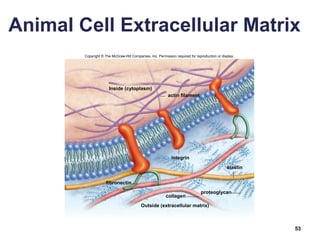
 Extracellular Matrix (ECM)
• Meshwork of proteins and polysaccharides in close
connection with the cell that produced them
– Collagen – resists stretching
– Elastin – provides resilience to the ECM
– Integrin – play role in cell signaling
– Proteoglycans – regulate passage of material through
the ECM to the plasma membrane
52
Animal Cell Extracellular Matrix
53
Copyright © The McGraw-Hill Companies, Inc. Permission required for reproduction or display.
collagen
proteoglycan
actin filament
fibronectin
elastin
integrin
Outside (extracellular matrix)
Inside (cytoplasm)
Modifications of Cell Surfaces
• Cell Surfaces in Animals
 Junctions Between Cells
• Adhesion Junctions - Intercellular filaments
between cells
– Desmosomes – internal cytoplasmic plaques
– Tight Junctions – form impermeable barriers
• Gap Junctions
– Plasma membrane channels are joined (allows
communication)
54
Junctions Between Cells of the
Intestinal Wall
55
Copyright © The McGraw-Hill Companies, Inc. Permission required for reproduction or display.
plasma
membranescytoplasmic
plaque
Filaments
of
cytoskeleton
adhesion
proteins
intercellular
space
a. Adhesion junction
b. Tight junction
c. Gap junction
plasma
membranes
light junction
proteins
intercellular
space
plasma
membranes
intercellular
space
membrane
channels
a: From Douglas E. Kelly, J. Cell Biol. 28 (1966): 51. Reproduced by copyright permission of The Rockefeller University Press; b: © David M. Phillips/Visuals Unlimited;
c: Courtesy Camillo Peracchia, M.D.
20 nm
50 nm
100 nm
Modifications of Cell Surfaces
• Plant Cell Walls
 Plants have a freely permeable cell wall, with
cellulose as the main component
• Plasmodesmata penetrate the cell wall
• Each contains a strand of cytoplasm
• Allow passage of material between cells
56
Plasmodesmata
57
Copyright © The McGraw-Hill Companies, Inc. Permission required for reproduction or display.
cell wall
plasmodesmata
cell wall
Cell 1 Cell 2
plasma
membrane
cell wall cell wall
cytoplasm
plasma
membrane
cytoplasm
middle lamella
plasmodesmata
0.3mm
© E.H. Newcomb/Biological Photo Service

05 lecture ppt membrance structure and Function

  • 1.
    Biology Sylvia S. Mader MichaelWindelspecht Chapter 5 Membrane Structure and Function Lecture Outline Copyright © The McGraw-Hill Companies, Inc. Permission required for reproduction or display. 1 See separate FlexArt PowerPoint slides for all figures and tables pre-inserted into PowerPoint without notes.
  • 2.
    2 Outline • 5.1 PlasmaMembrane Structure and Function • 5.2 Passive Transport Across a Membrane • 5.3 Active Transport Across a Membrane • 5.4 Modification of Cell Surfaces
  • 3.
    5.1 Plasma Membrane Structureand Function • The plasma membrane is common to all cells • Separates:  Internal cytoplasm from the external environment of the cell • Phospholipid bilayer:  External surface lined with hydrophilic polar heads  Cytoplasmic surface lined with hydrophilic polar heads  Nonpolar, hydrophobic, fatty-acid tails sandwiched in between 3
  • 4.
    Plasma Membrane Structure andFunction • Components of the Plasma Membrane  Three components: • Lipid component referred to as phospholipid bilayer • Protein molecules – Float around like icebergs on a sea – Membrane proteins may be peripheral or integral » Peripheral proteins are found on the inner membrane surface » Integral proteins are partially or wholly embedded (transmembrane) in the membrane • Cholesterol affects the fluidity of the membrane 4
  • 5.
    Membrane Proteins 5 Copyright ©The McGraw-Hill Companies, Inc. Permission required for reproduction or display. hydrophobic region phospholipid Water outside cell integral protein hydrophilic regions Water inside cell peripheral proteins cholesterol
  • 6.
    Plasma Membrane Structure andFunction • Carbohydrate Chains  Glycoproteins • Proteins with attached carbohydrate chains  Glycolipids • Lipids with attached carbohydrate chains  These carbohydrate chains exist only on the outside of the membrane • Makes the membrane asymmetrical 6
  • 7.
    Plasma Membrane ofan Animal Cell 7 Copyright © The McGraw-Hill Companies, Inc. Permission required for reproduction or display. Plasma membrane filaments of cytoskeleton Inside cell integral protein cholesterol peripheral protein glycolipid carbohydrate chain Outside cell hydrophilic heads phospholipid glycoprotein extracellular Matrix (ECM) phospholipid bilayer hydrophobic tails
  • 8.
    Plasma Membrane Structure andFunction • Functions of Membrane Proteins  Channel Proteins: • Allow passage of molecules through membrane via a channel in the protein  Carrier Proteins: • Combine with the substance to be transported • Assist passage of molecules through membrane  Cell Recognition Proteins: • Glycoproteins • Help the body recognize foreign substances 8
  • 9.
    Plasma Membrane Structure andFunction • Functions of Membrane Proteins (continued)  Receptor Proteins: • Bind with specific molecules • Allow a cell to respond to signals from other cells  Enzymatic Proteins: • Carry out metabolic reactions directly  Junction Proteins: • Attach adjacent cells 9
  • 10.
    Copyright © TheMcGraw-Hill Companies, Inc. Permission required for reproduction or display. Channel Protein: Allows a particular molecule or ion to cross the plasma membrane freely. Cystic fibrosis, an inherited disorder, is caused by a faulty chloride (Cl– ) channel; a thick mucus collects in airways and in pancreatic and liver ducts. a. Membrane Protein Diversity
  • 11.
    b. Carrier Protein: Selectively interacts witha specific molecule or ion so that it can cross the plasma membrane. The inability of some persons to use energy for sodium- potassium (Na+ –K+ ) transport has been suggested as the cause of their obesity. Copyright © The McGraw-Hill Companies, Inc. Permission required for reproduction or display.
  • 12.
    Copyright © TheMcGraw-Hill Companies, Inc. Permission required for reproduction or display. Cell Recognition Protein: The MHC (major histocompatibility complex) glycoproteins are different for each person, so organ transplants are difficult to achieve. Cells with foreign MHC glycoproteins are attacked by white blood cells responsible for immunity. c.
  • 13.
    Copyright © TheMcGraw-Hill Companies, Inc. Permission required for reproduction or display. Receptor Protein: Is shaped in such a way that a specific molecule can bind to it. Pygmies are short, not because they do not produce enough growth hormone, but because their plasma membrane growth hormone receptors are faulty and cannot interact with growth hormone. d.
  • 14.
    Enzymatic Protein: Catalyzes aspecific reaction. The membrane protein, adenylate cyclase, is involved in ATP metabolism. Cholera bacteria release a toxin that interferes with the proper functioning of adenylate cyclase; sodium (Na+ ) and water leave intestinal cells, and the individual may die from severe diarrhea. e. Copyright © The McGraw-Hill Companies, Inc. Permission required for reproduction or display.
  • 15.
    Junction Proteins: Tight junctionsjoin cells so that a tissue can fulfill a function, as when a tissue pinches off the neural tube during development. Without this cooperation between cells, an animal embryo would have no nervous system. f. Copyright © The McGraw-Hill Companies, Inc. Permission required for reproduction or display.
  • 16.
    Copyright © TheMcGraw-Hill Companies, Inc. Permission required for reproduction or display. Channel Protein: Allows a particular molecule or ion to cross the plasma membrane freely. Cystic fibrosis, an inherited disorder, is caused by a faulty chloride (Cl– ) channel; a thick mucus collects in airways and in pancreatic and liver ducts. Carrier Protein: Selectively interacts with a specific molecule or ion so that it can cross the plasma membrane. The inability of some persons to use energy for sodium- potassium (Na+ –K+ ) transport has been suggested as the cause of their obesity. Receptor Protein: Is shaped in such a way that a specific molecule can bind to it. Pygmies are short, not because they do not produce enough growth hormone, but because their plasma membrane growth hormone receptors are faulty and cannot interact with growth hormone. Enzymatic Protein: Catalyzes a specific reaction. The membrane protein, adenylate cyclase, is involved in ATP metabolism. Cholera bacteria release a toxin that interferes with the proper functioning of adenylate cyclase; sodium (Na+ ) and water leave intestinal cells, and the individual may die from severe diarrhea. Junction Proteins: Tight junctions join cells so that a tissue can fulfill a function, as when a tissue pinches off the neural tube during development. Without this cooperation between cells, an animal embryo would have no nervous system. Cell Recognition Protein: The MHC (major histocompatibility complex) glycoproteins are different for each person, so organ transplants are difficult to achieve. Cells with foreign MHC glycoproteins are attacked by white blood cells responsible for immunity. a. b. d. e. c. f. Membrane Protein Diversity
  • 17.
    How Cells Talkto One Another • Signaling molecules serve as chemical messengers allowing cells to communicate with one another  Cell receptors bind to specific signaling molecules  Once the signaling molecule and the cell receptor bind a cascade of events occurs that elicits a cellular response • Signal transduction pathway 17
  • 18.
    Cell Signaling 18 Copyright ©The McGraw-Hill Companies, Inc. Permission required for reproduction or display. Cellular response: Altered shape or movement of cell Altered metabolism or cellular function Altered gene expression and the types and amount of proteins produced gene regulatory protein Nucleus b. Cytoplasm unactivated receptor protein Nuclear envelope enzyme structural protein receptor activation signaling molecule Targeted protein: plasma membrane newborna. egg embryo Left: © Anatomical Travelogue/Photo Researchers, Inc.; Middle: © Neil Harding/Stone/Getty Images; Right: © Photodisc Collection/Getty RF 2.Transduction pathway: Series of relay proteins that ends when a protein is activated. 3. Response: Targeted protein(s) bring about a cellular response. 1. Receptor: Binds to a signaling molecule, becomes activated and initiates a transduction pathway.
  • 19.
    Plasma Membrane Structure andFunction • Permeability of the Plasma Membrane  The plasma membrane is selectively permeable • Allows some substances to move across the membrane • Inhibits passage of other molecules  Small, non-charged molecules (CO2, O2, glycerol, alcohol) freely cross the membrane by passing through the phospholipid bilayer • These molecules follow their concentration gradient – Move from an area of high concentration to an area of low concentration. 19
  • 20.
    Plasma Membrane Structure andFunction • Permeability of the Plasma Membrane  Water moves across the plasma membrane • Specialized proteins termed aquaporins speed up water transport across the membrane  The movement of ions and polar molecules across the membrane is often assisted by carrier proteins  Some molecules must move against their concentration gradient with the expenditure of energy • Active transport  Large particles enter or exit the cell via bulk transport • Exocytosis • Endocytosis 20
  • 21.
    How Molecules Crossthe Plasma Membrane 21 Copyright © The McGraw-Hill Companies, Inc. Permission required for reproduction or display. water inside cell phospholipid molecule protein water outside cell nonpolar, hydrophobic core
  • 22.
    How Molecules Crossthe Plasma Membrane 22 + – + water inside cell phospholipid molecule protein water outside cell charged molecules and ions– nonpolar, hydrophobic core Copyright © The McGraw-Hill Companies, Inc. Permission required for reproduction or display.
  • 23.
    How Molecules Crossthe Plasma Membrane 23 + – + water inside cell phospholipid molecule protein charged molecules and ions H2O – nonpolar, hydrophobic core Copyright © The McGraw-Hill Companies, Inc. Permission required for reproduction or display.
  • 24.
    How Molecules Crossthe Plasma Membrane 24 + – + water inside cell phospholipid molecule protein noncharged molecules water outside cell charged molecules and ions H2O – nonpolar, hydrophobic core Copyright © The McGraw-Hill Companies, Inc. Permission required for reproduction or display.
  • 25.
    How Molecules Crossthe Plasma Membrane 25 + – + water inside cell phospholipid molecule protein macromolecule noncharged molecules water outside cell charged molecules and ions H2O – nonpolar, hydrophobic core Copyright © The McGraw-Hill Companies, Inc. Permission required for reproduction or display.
  • 26.
    Passage of MoleculesInto and out of the Cell 26
  • 27.
    5.2 Passive TransportAcross a Membrane • A solution consists of:  A solvent (liquid), and  A solute (dissolved solid) • Diffusion  Net movement of molecules down a concentration gradient  Molecules move both ways along gradient, but net movement is from high to low concentration  Equilibrium: • When NET movement stops • Solute concentration is uniform – no gradient 27
  • 28.
    Process of Diffusion 28 Copyright© The McGraw-Hill Companies, Inc. Permission required for reproduction or display. crystal dye a. Crystal of dye is placed in water
  • 29.
    Process of Diffusion 29 Copyright© The McGraw-Hill Companies, Inc. Permission required for reproduction or display. time crystal dye a. Crystal of dye is placed in water b. Diffusion of water and dye molecules
  • 30.
    Process of Diffusion 30 Copyright© The McGraw-Hill Companies, Inc. Permission required for reproduction or display. time time crystal dye a. Crystal of dye is placed in water b. Diffusion of water and dye molecules c. Equal distribution of molecules results
  • 31.
    Gas Exchange inLungs 31 O2 oxygen O2 O2 O2 O2 O2 O2 O2 O2 O2 O2 O2 O2 O2 highO2 concentration lowO2 concentration bronchiole capillaryalveolus Copyright © The McGraw-Hill Companies, Inc. Permission required for reproduction or display.
  • 32.
    Passive Transport Acrossa Membrane • Osmosis:  Special case of diffusion  Focuses on solvent (water) movement rather than solute  Diffusion of water across a selectively permeable membrane • Solute concentration on one side is high, but water concentration is low • Solute concentration on other side is low, but water concentration is high  Water can diffuse both ways across membrane but the solute cannot  Net movement of water is toward low water (high solute) concentration • Osmotic pressure is the pressure that develops due to osmosis 32
  • 33.
    Osmosis Demonstration 33 Copyright ©The McGraw-Hill Companies, Inc. Permission required for reproduction or display. a. less water (higher percentage of solute) more water (lower percentage of solute) 10% 5% <10% >5% solute differentially permeable membrane water b. c. less water (higher percentage of solute) more water (lower percentage of solute) beaker thistle tube
  • 34.
    Passive Transport Acrossa Membrane • Isotonic Solutions  Solute and water concentrations are equal on both sides of membrane  No net gain or loss of water by the cell • Hypotonic Solutions  Concentration of solute in the solution is lower than inside the cell  Cells placed in a hypotonic solution will swell • Causes turgor pressure in plants • May cause animal cells to lyse (rupture) 34
  • 35.
    Passive Transport Acrossa Membrane • Hypertonic Solutions  Concentration of solute is higher in the solution than inside the cell  Cells placed in a hypertonic solution will shrink • Crenation in animal cells • Plasmolysis in plant cells 35
  • 36.
    Osmosis in Animaland Plant Cells 36 Copyright © The McGraw-Hill Companies, Inc. Permission required for reproduction or display. In a hypertonic solution, water mainly leaves the cell, which shrivels (crenation). In a hypertonic solution, vacuoles lose water, the cytoplasm shrinks (plasmolysis), and chloroplasts are seen in the center of the cell. In a hypotonic solution, vacuoles fill with water, turgor pressure develops, and chloroplasts are seen next to the cell wall. In an isotonic solution, there is no net movement of water. In an isotonic solution, there is no net movement of water. In a hypotonic solution, water mainly enters the cell, which may burst (lysis). plasma membrane Animal cells nucleus Plant cells central vacuole chloroplast nucleus cell wall plasma membrane
  • 37.
    Passive Transport Acrossa Membrane  Facilitated Transport • Movement of molecules that cannot pass directly through the membrane lipids • These molecules must combine with carrier proteins to move across the membrane • Follow concentration gradient, moving from high concentration to low concentration 37
  • 38.
    Copyright © TheMcGraw-Hill Companies, Inc. Permission required for reproduction or display. solute Outside Inside plasma membrane carrier protein Facilitated Transport
  • 39.
    Copyright © TheMcGraw-Hill Companies, Inc. Permission required for reproduction or display. solute Outside Inside plasma membrane carrier protein Facilitated Transport
  • 40.
    solute Outside Inside plasma membrane carrier protein Copyright © TheMcGraw-Hill Companies, Inc. Permission required for reproduction or display. Facilitated Transport
  • 41.
    Copyright © TheMcGraw-Hill Companies, Inc. Permission required for reproduction or display. solute Outside Inside plasma membrane carrier protein Facilitated Transport
  • 42.
    5.3 Active TransportAcross a Membrane  Active Transport • The movement of molecules against their concentration gradient – Movement from low to high concentration • Movement is facilitated by carrier proteins • Requires the expenditure of energy in the form of ATP • Ex: sodium-potassium pump – Uses ATP to move sodium ions out of the cells and potassium ions into the cell against their concentration gradients. 42
  • 43.
    The Sodium-Potassium Pump 43 Copyright© The McGraw-Hill Companies, Inc. Permission required for reproduction or display. carrier protein 1. Carrier has a shape that allows it to take up 3 Na+ Outside Inside K+ K+ Na+ K+ K+ Na+ Na+ Na+ Na+
  • 44.
    The Sodium-Potassium Pump 44 Copyright© The McGraw-Hill Companies, Inc. Permission required for reproduction or display. carrier protein 1. Carrier has a shape that allows it to take up 3 Na+ . 2. ATP is split, and phosphate group attaches to carrier Outside Inside ATP K+ P Na+ Na+ K+ K+ K+ K+ K+ Na+ Na+ Na+ Na+ K+ K+ Na+ Na+ Na+
  • 45.
    The Sodium-Potassium Pump 45 Copyright© The McGraw-Hill Companies, Inc. Permission required for reproduction or display. carrier protein 1. Carrier has a shape that allows it to take up 3 Na+ . 3. Change in shape results and causes carrier to release 3 Na+ outside the cell. Outside Inside ATP K+ K+ K+ P P Na+ Na + Na+ Na+ K+ K+ K+ Na+ Na+ Na+ K+ K+ K+ Na+ Na+ Na + Na+ 2. ATP is split, and phosphate group attaches to carrier K+ Na + Na+ K+ K+ Na+
  • 46.
    The Sodium-Potassium Pump 46 carrier protein 1.Carrier has a shape that allows it to take up 3 Na+ . 4. Carrier has a shape that allows it to take up 2K+ . 3. Change in shape results and causes carrier to release 3 Na+ outside the cell. Outside Inside ATP K+ K+ K+ K+ K+ K+ K+ K+ P P P Na+ Na+ Na + Na+ Na+ Na+ Na+ K+ K+ K+ Na+ Na+ Na+ Na+ Na+ Na+ Na+ Na+ Na+ K+K+ K+ 2. ATP is split, and phosphate group attaches to carrier. K+ Na+ Na+ K+ Na+ Na+ Copyright © The McGraw-Hill Companies, Inc. Permission required for reproduction or display.
  • 47.
    The Sodium-Potassium Pump 47 carrier protein 1.Carrier has a shape that allows it to take up 3 Na+ . 4. Carrier has a shape that allows it to take up 2 K+ . 2. ATP is split, and phosphate group attaches to carrier. 3. Change in shape results and causes carrier to release 3 Na+ outside the cell. 5. Phosphate group is released from carrier. Outside Inside ATP K+ K+ K+ K+ P P P P Na + Na+ Na+ Na + Na + Na+ Na + Na+ Na+ Na + Na+ K+ K+ K+ Na+ Na+ Na+ Na + K+K+ K+ Na+ Na+ Na+ Na + K+ K+ K+ Na+ K+ K+ K+ Na+ Na + K+ K+ Na+ Na+ K+ K+ Na+ Copyright © The McGraw-Hill Companies, Inc. Permission required for reproduction or display.
  • 48.
    The Sodium-Potassium Pump 48 carrier protein 1.Carrier has a shape that allows it to take up 3 Na+ . 4. Carrier has a shape that allows it to take up 2 K+ . 2. ATP is split, and phosphate group attaches to carrier. 3. Change in shape results and causes carrier to release 3 Na+ outside the cell. 5. Phosphate group is released from carrier. Outside Inside ATP K+ K+ K+ K+ P P P P Na + Na+ Na+ Na + Na + Na+ Na + Na+ Na+ Na + Na+ K+ K+ K+ Na+ Na+ Na+ Na + K+K+ K+ Na+ Na+ Na+ Na+ K+K+ K+ Na+ K+ K+ K+ Na+ Na + K+ K+ Na+ Na+ K+ K+ Na+ Copyright © The McGraw-Hill Companies, Inc. Permission required for reproduction or display. 6. Change in shape results and causes carrier to release 2K+ inside the cell. K+ K K+ Na + Na+ Na+ Na+ Na+ K+
  • 49.
    Active Transport Acrossa Membrane • Macromolecules are transported into or out of the cell inside vesicles via bulk transport  Exocytosis – Vesicles fuse with plasma membrane and secrete contents  Endocytosis – Cells engulf substances into a pouch which becomes a vesicle • Phagocytosis – Large, solid material is taken in by endocytosis • Pinocytosis – Vesicles form around a liquid or very small particles • Receptor-Mediated Endocytosis– Specific form of pinocytosis using receptor proteins and a coated pit 49
  • 50.
    Exocytosis 50 Copyright © TheMcGraw-Hill Companies, Inc. Permission required for reproduction or display. OutsidePlasma membrane Inside secretory vesicle
  • 51.
    Three Methods ofEndocytosis 51 Copyright © The McGraw-Hill Companies, Inc. Permission required for reproduction or display. pseudopod paramecium vacuole forming vesicles forming coated pit coated vesicle solute solute a. Phagocytosis b. Pinocytosis vacuole coated vesicle plasma membrane receptor protein coated pit c. Receptor-mediated endocytosis vesicle 0.5 μm 399.9 μm
  • 52.
    5.4 Modifications ofCell Surfaces • Cell Surfaces in Animals  Extracellular Matrix (ECM) • Meshwork of proteins and polysaccharides in close connection with the cell that produced them – Collagen – resists stretching – Elastin – provides resilience to the ECM – Integrin – play role in cell signaling – Proteoglycans – regulate passage of material through the ECM to the plasma membrane 52
  • 53.
    Animal Cell ExtracellularMatrix 53 Copyright © The McGraw-Hill Companies, Inc. Permission required for reproduction or display. collagen proteoglycan actin filament fibronectin elastin integrin Outside (extracellular matrix) Inside (cytoplasm)
  • 54.
    Modifications of CellSurfaces • Cell Surfaces in Animals  Junctions Between Cells • Adhesion Junctions - Intercellular filaments between cells – Desmosomes – internal cytoplasmic plaques – Tight Junctions – form impermeable barriers • Gap Junctions – Plasma membrane channels are joined (allows communication) 54
  • 55.
    Junctions Between Cellsof the Intestinal Wall 55 Copyright © The McGraw-Hill Companies, Inc. Permission required for reproduction or display. plasma membranescytoplasmic plaque Filaments of cytoskeleton adhesion proteins intercellular space a. Adhesion junction b. Tight junction c. Gap junction plasma membranes light junction proteins intercellular space plasma membranes intercellular space membrane channels a: From Douglas E. Kelly, J. Cell Biol. 28 (1966): 51. Reproduced by copyright permission of The Rockefeller University Press; b: © David M. Phillips/Visuals Unlimited; c: Courtesy Camillo Peracchia, M.D. 20 nm 50 nm 100 nm
  • 56.
    Modifications of CellSurfaces • Plant Cell Walls  Plants have a freely permeable cell wall, with cellulose as the main component • Plasmodesmata penetrate the cell wall • Each contains a strand of cytoplasm • Allow passage of material between cells 56
  • 57.
    Plasmodesmata 57 Copyright © TheMcGraw-Hill Companies, Inc. Permission required for reproduction or display. cell wall plasmodesmata cell wall Cell 1 Cell 2 plasma membrane cell wall cell wall cytoplasm plasma membrane cytoplasm middle lamella plasmodesmata 0.3mm © E.H. Newcomb/Biological Photo Service