3. Cell Structure and
Function
BI1011 BIOLOGI A
Sem 2 22024 2025 Prodi Biologi SITH ITB 1
Five Levels of Organization
Molecular
Cellular
Organismal
Population
Ecological System
What is a cell?
Cells are the basic building blocks of
all living things.
• They provide structure for the
body, take in nutrients from food,
convert those nutrients into
energy, and carry out specialized
functions.
• Cells also contain the body’s
hereditary material and can make
copies of themselves.
Learning outcomes
Sem 2 2024 2025 Prodi Biologi SITH ITB 4
Describe the characteristics of cell
Explain the basic structure and
function of cell
The Cellular
Level of
Organization
• The cell marks the boundary between the
nonliving and the living.
• It is the structural and functional unit of an
organism.
• It is the smallest structure capable of
performing all the functions necessary for
life.
The Fundamental Units of Life
• All organisms are made of cells
• The cell is the simplest collection of matter
that can be alive
• All cells are related by their descent from
earlier cells
• Though cells can differ substantially from one
another, they share common features
© 2014 Pearson Education, Inc.
Biologists use microscopes and the tools of biochemistry to study cells
• Most cells are between 1 and 100 m in diameter, too small to be seen by the
unaided eye
10 m
1 m
0.1 m
1 cm
1 mm
100 µm
10 µm
100 nm
10 nm
1 nm
0.1 nm
mouse
frog egg
human egg
most bacteria
virus
protein
atom
ant
electron microscope
light microscope
human eye
human
blue whale
chloroplast
rose
1 km
100 m
1 µm
amino
acids
plant and
animal
cells
ostrich
egg
Copyright © The McGraw-Hill Companies, Inc. Permission required for reproduction or display.
Size of human skin
cell, the organel and
molecules
Generally the diameter
of human skin cell is
20 µm
Mitochondrion : 2 µm
Ribosome : 20 nm
Molekul protein :2 nm
Atom :0.2 nm
CELL SIZE AND PARTS
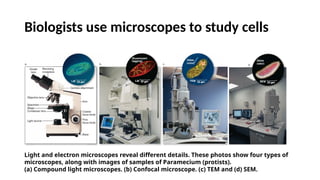
Biologists use microscopes to study cells
Light and electron microscopes reveal different details. These photos show four types of
microscopes, along with images of samples of Paramecium (protists).
(a) Compound light microscopes. (b) Confocal microscope. (c) TEM and (d) SEM.
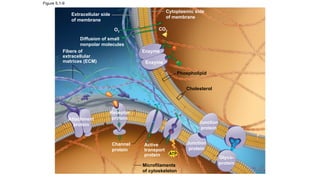
Plasma Membrane and Cytoplasm
• All cells are surrounded by a plasma membrane.
• It forms a boundary that separates the contents of the cell from the
surrounding environment.
• It regulates the entrance and exit of molecules into and out of the cytoplasm.
• The semifluid medium inside of a cell is the cytoplasm.
• It is composed of water, salts, and dissolved organic molecules
Figure 5.1-9
Phospholipid
Cholesterol
Microfilaments
of cytoskeleton
Extracellular side
of membrane
Fibers of
extracellular
matrices (ECM)
Cytoplasmic side
of membrane
O2
CO2
Diffusion of small
nonpolar molecules
Enzyme
Attachment
protein
Receptor
protein
Channel
protein
Active
transport
protein ATP
Junction
protein
Glyco-
protein
Junction
protein
Enzyme
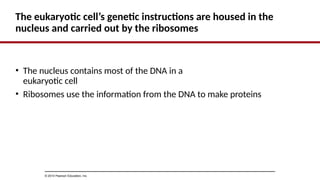
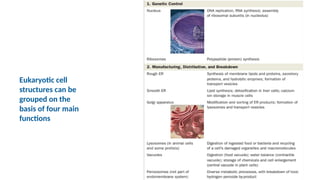
The eukaryotic cell’s genetic instructions are housed in the
nucleus and carried out by the ribosomes
• The nucleus contains most of the DNA in a
eukaryotic cell
• Ribosomes use the information from the DNA to make proteins
© 2014 Pearson Education, Inc.
The Nucleus
The nucleus is a prominent structure with a diameter of ~5μm.
 Stores genetic material, DNA
• Every cell in an individual contains the same DNA.
• DNA governs the characteristics and metabolism of a cell.
 Contains chromatin
• Consists of DNA and associated proteins
• Undergoes coiling and condenses into chromosomes
Figure 4.8
Ribosome
1 m
Chromatin
Rough ER
Nucleus
Nucleolus
Nucleus
Chromatin
0.5
m
0.25
m
Nuclear envelope:
Nuclear pore
Inner membrane
Outer membrane
Pore
complex
Close-up
of nuclear
envelope
Nuclear lamina (TEM)
Surface of nuclear
envelope
Pore complexes (TEM)
Ribosomes
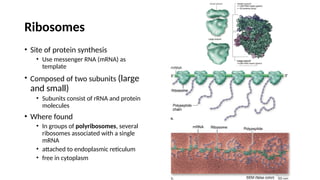
• Site of protein synthesis
• Use messenger RNA (mRNA) as
template
• Composed of two subunits (large
and small)
• Subunits consist of rRNA and protein
molecules
• Where found
• In groups of polyribosomes, several
ribosomes associated with a single
mRNA
• attached to endoplasmic reticulum
• free in cytoplasm
Copyright © The McGraw-Hill Companies, Inc. Permission required for reproduction or display.
plasma
membrane
secretion
enzyme
lysosome
contains digestive enzymes
that break down worn-out
cell parts or substances
entering the cell at the
plasma membrane
secretory vesicle
fuses with the plasma
membrane as secretion
occurs
Golgi apparatus
modifies lipids and proteins
from the ER; sorts them
and packages them in
vesicles
transport vesicle
shuttles lipids to various
locations such as the
Golgi apparatus
lipid
transport vesicle
shuttles proteins to
various locations such as
the Golgi apparatus
protein
ribosome
rough endoplasmic reticulum
folds and processes proteins
and packages them in vesicles;
vesicles commonly go to
the Golgi apparatus
Nucleus
smooth endoplasmic
reticulum
synthesizes lipids and
also per forms various
other functions
incoming vesicle
brings substances into
the cell that are digested
when the vesicle fuses
with a lysosome
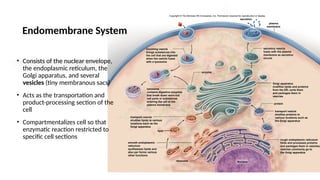
Endomembrane System
• Consists of the nuclear envelope,
the endoplasmic reticulum, the
Golgi apparatus, and several
vesicles (tiny membranous sacs)
• Acts as the transportation and
product-processing section of the
cell
• Compartmentalizes cell so that
enzymatic reaction restricted to
specific cell sections
Endoplasmic
Reticulum
• Rough ER
• Studded with ribosomes
• Processing, folding and modification
of proteins
• Smooth ER
• Has no attached ribosomes
• Synthesizes phospholipids and
steroids
• Stores calcium ions
• Various other functions, depending
on cell type
nuclear envelope
ribosomes
0.08 µm
rough
endoplasmic
reticulum
smooth
endoplasmic
reticulum
Copyright © The McGraw-Hill Companies, Inc. Permission required for reproduction or display.
© R. Bolender & D. Fawcett/Visuals Unlimited
Golgi Apparatus
• Consists of a stack of three to twenty
slightly curved sacs.
• In animal cells, one side is directed toward
the ER, and other side is directed toward
the plasma membrane.
• Often referred to as the shipping center of
the cell.
• Apparatus collects, sorts, packages, and
distributes materials such as proteins and
lipids.
Lysosomes
• Membrane-enclosed vesicles formed by Golgi
• Contain hydrolytic digestive enzymes
• Act as garbage disposals of the cell
• Break down unwanted, foreign substances or
worn-out parts of cells
• Bring macromolecules into the cell
22
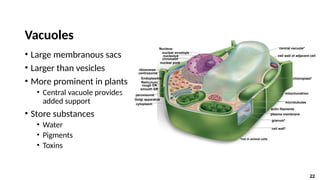
Vacuoles
• Large membranous sacs
• Larger than vesicles
• More prominent in plants
• Central vacuole provides
added support
• Store substances
• Water
• Pigments
• Toxins
central vacuole*
smooth ER
cytoplasm
*not in animal cells
cell wall*
cell wall of adjacent cell
chloroplast*
mitochondrion
microtubules
plasma membrane
actin filaments
granum*
ribosomes
rough ER
Endoplasmic
Reticulum:
centrosome
Nucleus:
nuclear envelope
chromatin
nuclear pore
Golgi apparatus
peroxisome
nucleolus
Energy-Related Organelles
Chloroplasts and Mitochondria are organelles
that specialize in converting energy into useable
forms for cells.
• Chloroplasts use solar energy to synthesize
carbohydrates.
• Mitochondria use the breakdown of
carbohydrates to produce ATP.
Chloroplasts
• Site of photosynthesis in plants and algae
• Structure:
• Double membrane
• Make most of their own proteins
• Stroma – fluid-filled space bounded by
double membranes
• Contains single circular DNA
molecule and ribosomes
• Grana – stacks of thylakoids
• Chlorophyll located in thylakoid
membranes
Copyright © The McGraw-Hill Companies, Inc. Permission required for reproduction or display.
grana thylakoid
stroma
a.
b.
500 nm
double
membrane
outer
membrane
inner
membrane
thylakoid
space
Courtesy Herbert W. Israel, Cornell University
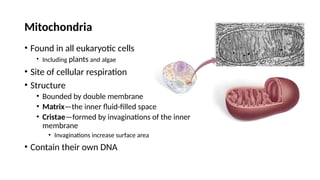
Mitochondria
• Found in all eukaryotic cells
• Including plants and algae
• Site of cellular respiration
• Structure
• Bounded by double membrane
• Matrix—the inner fluid-filled space
• Cristae—formed by invaginations of the inner
membrane
• Invaginations increase surface area
• Contain their own DNA
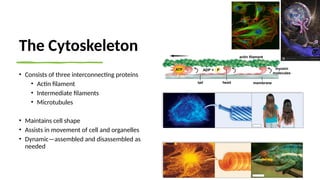
The Cytoskeleton
• Consists of three interconnecting proteins
• Actin filament
• Intermediate filaments
• Microtubules
• Maintains cell shape
• Assists in movement of cell and organelles
• Dynamic—assembled and disassembled as
needed
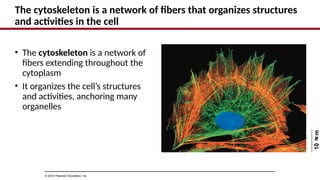
The cytoskeleton is a network of fibers that organizes structures
and activities in the cell
• The cytoskeleton is a network of
fibers extending throughout the
cytoplasm
• It organizes the cell’s structures
and activities, anchoring many
organelles
© 2014 Pearson Education, Inc.
10
m
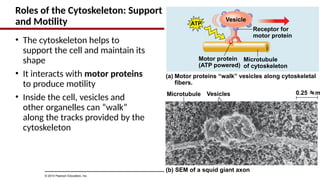
Roles of the Cytoskeleton: Support
and Motility
• The cytoskeleton helps to
support the cell and maintain its
shape
• It interacts with motor proteins
to produce motility
• Inside the cell, vesicles and
other organelles can “walk”
along the tracks provided by the
cytoskeleton
© 2014 Pearson Education, Inc.
Microtubule Vesicles
(b) SEM of a squid giant axon
Receptor for
motor protein
0.25 m
Vesicle
Motor protein
(ATP powered)
ATP
Microtubule
of cytoskeleton
(a) Motor proteins “walk” vesicles along cytoskeletal
fibers.
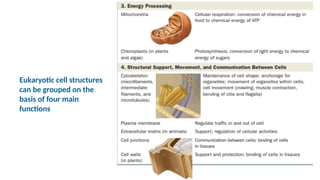
Eukaryotic cell
structures can be
grouped on the
basis of four main
functions
Eukaryotic cell structures
can be grouped on the
basis of four main
functions
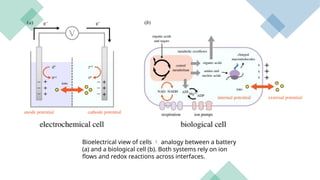
Recent research shows that both prokaryotes
and eukaryotes use ion- and redox-based
electrochemical signals for communication.
Such communication enables the organization of
growth and developmental processes across
multiple length scales.
Bioelectrical view of cells  analogy between a battery
(a) and a biological cell (b). Both systems rely on ion
flows and redox reactions across interfaces.

1741056817094_3-Cell-structure-and-functionpptx.pptx

  • 1.
    3. Cell Structureand Function BI1011 BIOLOGI A Sem 2 22024 2025 Prodi Biologi SITH ITB 1
  • 2.
    Five Levels ofOrganization Molecular Cellular Organismal Population Ecological System
  • 3.
    What is acell? Cells are the basic building blocks of all living things. • They provide structure for the body, take in nutrients from food, convert those nutrients into energy, and carry out specialized functions. • Cells also contain the body’s hereditary material and can make copies of themselves.
  • 4.
    Learning outcomes Sem 22024 2025 Prodi Biologi SITH ITB 4 Describe the characteristics of cell Explain the basic structure and function of cell
  • 5.
    The Cellular Level of Organization •The cell marks the boundary between the nonliving and the living. • It is the structural and functional unit of an organism. • It is the smallest structure capable of performing all the functions necessary for life.
  • 6.
    The Fundamental Unitsof Life • All organisms are made of cells • The cell is the simplest collection of matter that can be alive • All cells are related by their descent from earlier cells • Though cells can differ substantially from one another, they share common features © 2014 Pearson Education, Inc.
  • 7.
    Biologists use microscopesand the tools of biochemistry to study cells • Most cells are between 1 and 100 m in diameter, too small to be seen by the unaided eye 10 m 1 m 0.1 m 1 cm 1 mm 100 µm 10 µm 100 nm 10 nm 1 nm 0.1 nm mouse frog egg human egg most bacteria virus protein atom ant electron microscope light microscope human eye human blue whale chloroplast rose 1 km 100 m 1 µm amino acids plant and animal cells ostrich egg Copyright © The McGraw-Hill Companies, Inc. Permission required for reproduction or display.
  • 8.
    Size of humanskin cell, the organel and molecules Generally the diameter of human skin cell is 20 µm Mitochondrion : 2 µm Ribosome : 20 nm Molekul protein :2 nm Atom :0.2 nm CELL SIZE AND PARTS
  • 9.
    Biologists use microscopesto study cells Light and electron microscopes reveal different details. These photos show four types of microscopes, along with images of samples of Paramecium (protists). (a) Compound light microscopes. (b) Confocal microscope. (c) TEM and (d) SEM.
  • 12.
    Plasma Membrane andCytoplasm • All cells are surrounded by a plasma membrane. • It forms a boundary that separates the contents of the cell from the surrounding environment. • It regulates the entrance and exit of molecules into and out of the cytoplasm. • The semifluid medium inside of a cell is the cytoplasm. • It is composed of water, salts, and dissolved organic molecules
  • 13.
    Figure 5.1-9 Phospholipid Cholesterol Microfilaments of cytoskeleton Extracellularside of membrane Fibers of extracellular matrices (ECM) Cytoplasmic side of membrane O2 CO2 Diffusion of small nonpolar molecules Enzyme Attachment protein Receptor protein Channel protein Active transport protein ATP Junction protein Glyco- protein Junction protein Enzyme
  • 14.
    The eukaryotic cell’sgenetic instructions are housed in the nucleus and carried out by the ribosomes • The nucleus contains most of the DNA in a eukaryotic cell • Ribosomes use the information from the DNA to make proteins © 2014 Pearson Education, Inc.
  • 15.
    The Nucleus The nucleusis a prominent structure with a diameter of ~5μm.  Stores genetic material, DNA • Every cell in an individual contains the same DNA. • DNA governs the characteristics and metabolism of a cell.  Contains chromatin • Consists of DNA and associated proteins • Undergoes coiling and condenses into chromosomes
  • 16.
    Figure 4.8 Ribosome 1 m Chromatin RoughER Nucleus Nucleolus Nucleus Chromatin 0.5 m 0.25 m Nuclear envelope: Nuclear pore Inner membrane Outer membrane Pore complex Close-up of nuclear envelope Nuclear lamina (TEM) Surface of nuclear envelope Pore complexes (TEM)
  • 17.
    Ribosomes • Site ofprotein synthesis • Use messenger RNA (mRNA) as template • Composed of two subunits (large and small) • Subunits consist of rRNA and protein molecules • Where found • In groups of polyribosomes, several ribosomes associated with a single mRNA • attached to endoplasmic reticulum • free in cytoplasm
  • 18.
    Copyright © TheMcGraw-Hill Companies, Inc. Permission required for reproduction or display. plasma membrane secretion enzyme lysosome contains digestive enzymes that break down worn-out cell parts or substances entering the cell at the plasma membrane secretory vesicle fuses with the plasma membrane as secretion occurs Golgi apparatus modifies lipids and proteins from the ER; sorts them and packages them in vesicles transport vesicle shuttles lipids to various locations such as the Golgi apparatus lipid transport vesicle shuttles proteins to various locations such as the Golgi apparatus protein ribosome rough endoplasmic reticulum folds and processes proteins and packages them in vesicles; vesicles commonly go to the Golgi apparatus Nucleus smooth endoplasmic reticulum synthesizes lipids and also per forms various other functions incoming vesicle brings substances into the cell that are digested when the vesicle fuses with a lysosome Endomembrane System • Consists of the nuclear envelope, the endoplasmic reticulum, the Golgi apparatus, and several vesicles (tiny membranous sacs) • Acts as the transportation and product-processing section of the cell • Compartmentalizes cell so that enzymatic reaction restricted to specific cell sections
  • 19.
    Endoplasmic Reticulum • Rough ER •Studded with ribosomes • Processing, folding and modification of proteins • Smooth ER • Has no attached ribosomes • Synthesizes phospholipids and steroids • Stores calcium ions • Various other functions, depending on cell type nuclear envelope ribosomes 0.08 µm rough endoplasmic reticulum smooth endoplasmic reticulum Copyright © The McGraw-Hill Companies, Inc. Permission required for reproduction or display. © R. Bolender & D. Fawcett/Visuals Unlimited
  • 20.
    Golgi Apparatus • Consistsof a stack of three to twenty slightly curved sacs. • In animal cells, one side is directed toward the ER, and other side is directed toward the plasma membrane. • Often referred to as the shipping center of the cell. • Apparatus collects, sorts, packages, and distributes materials such as proteins and lipids.
  • 21.
    Lysosomes • Membrane-enclosed vesiclesformed by Golgi • Contain hydrolytic digestive enzymes • Act as garbage disposals of the cell • Break down unwanted, foreign substances or worn-out parts of cells • Bring macromolecules into the cell
  • 22.
    22 Vacuoles • Large membranoussacs • Larger than vesicles • More prominent in plants • Central vacuole provides added support • Store substances • Water • Pigments • Toxins central vacuole* smooth ER cytoplasm *not in animal cells cell wall* cell wall of adjacent cell chloroplast* mitochondrion microtubules plasma membrane actin filaments granum* ribosomes rough ER Endoplasmic Reticulum: centrosome Nucleus: nuclear envelope chromatin nuclear pore Golgi apparatus peroxisome nucleolus
  • 23.
    Energy-Related Organelles Chloroplasts andMitochondria are organelles that specialize in converting energy into useable forms for cells. • Chloroplasts use solar energy to synthesize carbohydrates. • Mitochondria use the breakdown of carbohydrates to produce ATP.
  • 24.
    Chloroplasts • Site ofphotosynthesis in plants and algae • Structure: • Double membrane • Make most of their own proteins • Stroma – fluid-filled space bounded by double membranes • Contains single circular DNA molecule and ribosomes • Grana – stacks of thylakoids • Chlorophyll located in thylakoid membranes Copyright © The McGraw-Hill Companies, Inc. Permission required for reproduction or display. grana thylakoid stroma a. b. 500 nm double membrane outer membrane inner membrane thylakoid space Courtesy Herbert W. Israel, Cornell University
  • 25.
    Mitochondria • Found inall eukaryotic cells • Including plants and algae • Site of cellular respiration • Structure • Bounded by double membrane • Matrix—the inner fluid-filled space • Cristae—formed by invaginations of the inner membrane • Invaginations increase surface area • Contain their own DNA
  • 26.
    The Cytoskeleton • Consistsof three interconnecting proteins • Actin filament • Intermediate filaments • Microtubules • Maintains cell shape • Assists in movement of cell and organelles • Dynamic—assembled and disassembled as needed
  • 27.
    The cytoskeleton isa network of fibers that organizes structures and activities in the cell • The cytoskeleton is a network of fibers extending throughout the cytoplasm • It organizes the cell’s structures and activities, anchoring many organelles © 2014 Pearson Education, Inc. 10 m
  • 28.
    Roles of theCytoskeleton: Support and Motility • The cytoskeleton helps to support the cell and maintain its shape • It interacts with motor proteins to produce motility • Inside the cell, vesicles and other organelles can “walk” along the tracks provided by the cytoskeleton © 2014 Pearson Education, Inc. Microtubule Vesicles (b) SEM of a squid giant axon Receptor for motor protein 0.25 m Vesicle Motor protein (ATP powered) ATP Microtubule of cytoskeleton (a) Motor proteins “walk” vesicles along cytoskeletal fibers.
  • 29.
    Eukaryotic cell structures canbe grouped on the basis of four main functions
  • 30.
    Eukaryotic cell structures canbe grouped on the basis of four main functions
  • 31.
    Recent research showsthat both prokaryotes and eukaryotes use ion- and redox-based electrochemical signals for communication. Such communication enables the organization of growth and developmental processes across multiple length scales.
  • 32.
    Bioelectrical view ofcells  analogy between a battery (a) and a biological cell (b). Both systems rely on ion flows and redox reactions across interfaces.

Editor's Notes

  • #7 Cell fractionation breaks up cells and separates the components, using centrifugation Cell components separate based on their relative size Cell fractionation enables scientists to determine the functions of organelles Biochemistry and cytology help correlate cell function with structure
  • #13 Figure 5.1-9 Diverse functions of the plasma membrane (part 9)
  • #16 Figure 4.8 The nucleus and its envelope
  • #26 c. Kiri ke kanan: Fibroblas dalam jaringan hewan mengandung mikrotubulus. Gambar menunjukkan bahwa mikrotubulus adalah tabung berongga yang terdiri dari subunit tubulin. Sel-sel kulit bunglon mengandalkan mikrotubulus untuk memindahkan butiran pigmen sehingga mereka dapat mengambil warna lingkungannya.