Eukaryotic Cells
A Generalized Eukaryotic Cell
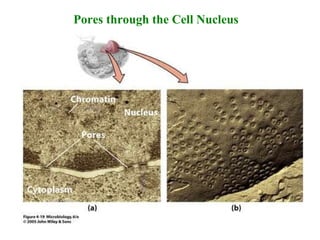
Pores through the Cell Nucleus
Nucleus   The nucleus consists of the nuclear envelope, nucleolus, chromatin, and nucleoplasm.   Nuclear Envelope   Structure  -two unit membranes with a fluid-filled space                   -nuclear pores present                   -outer membrane may be continuous with endoplasmic                     reticulum   Function  -selectively permeable to control movement in or out                  -contains nuclear contents   Chromatin   Structure  -composed of long thin strands of DNA   Function  -contains instructions that control cell metabolism and heredity   Nucleolus   Structure  -non-membraneous matrix of RNA (ribonucleic acid) and protein.   Function  - instructions in DNA are copied here                  - works with ribosomes in the synthesis of protein
 
Centriole   Structure  - nine triplets of microtubules form one centriole                  - two centrioles form one centrosome. Function   - forms spindle fibres to separate chromosomes during cell                    division Vacuole Structure      - a single layer of unit membrane enclosing fluid in a sack   Function      - produces turgor pressure against cell wall for support      - stores water and various chemicals      - may store insoluble wastes   Cytoskeleton Structure - Composed of microtubules Function - Supports cell and provides shape   - Aids movement of materials in and out of cells
Mitochondria Power house of cell and account for 20% of the cell volume, 1 µm diameter. Enzymes carry out oxidative reactions that capture energy in ATP. Glucose  +  Oxygen  ------> Carbon Dioxide  +  Water  + Energy (ATP)   Mitochondria contains mitochondrial DNA and can replicate independently.
Mitochondrial DNA
Chloroplasts Like mitochondria chloroplast too have outer and inner membrane (stroma), it corresponds mitochondrial matrix. Unlike mitochondria chloroplast have separate inner membrane (thylacoids), that contain chlorophyll (in Grana), that capture energy during photosynthesis. chlorophyll  CO 2  + H 2 O ---------------> Glucose + O 2  (food)                        radiant energy   Chloroplast contains chloroplast DNA and can replicate independently.
Ribosome   Structure  - non-membraneous, spherical bodies composed of        RNA (ribonucleic acid) and protein enzymes.   Function  - site of protein synthesis Endoplasmic Reticulum (ER) Structure  - sheets of unit membrane with  ribosomes  on the                     outside   (rough ER) and without ribosome (smooth ER).                 - forms a tubular network throughout the cell       Function   - transports chemicals between cells and within cells                   - provides a large surface area for the organization                    of chemical reactions and synthesis
Lysosome  Structure  - membrane bound bag containing hydrolytic enzymes                  - hydrolytic enzyme = (water split biological catalyst)                    i.e. using water to split chemical bonds. Function  - break large molecules into small molecules by                    inserting a molecule of water into the chemical bond   Peroxisome:   -Membrane bound organelle, contains enzymes.  -These enzymes in plant cell oxidize fats and in animal cell oxidizes amino acids.  -Peroxisomal enzymes converts hydrogen peroxide to water, to prevent the toxic effect of hydrogen peroxide. Golgi Apparatus Structure  - stacks of flattened sacs of unit membrane (cisternae)                  - vesicles pinch off the edges   Function  - modifies chemicals to make them functional                  - secretes chemicals in tiny vesicles                  - stores chemicals                  - may produce endoplasmic reticulum
Prokaryotic and Eukaryotic Flagella Compared One central pair and 9 peripheral pair of microtubules, made up of tubulin. Each pair of peripheral microtubules associated with a protein Dynein, which cross-bridges with other flagellar proteins for movement. The movement is dependent  on ATP hydrolysis by dynein.
Oxytricha The Ciliated Protozoan
The Stroke-and-Recovery Motion of a Cilium
Cilia on an Organism Move in a Synchronized Fashion, Creating a Wave that Propels the Organism Forward
Pseudopodia
Amoeba  (132X)   Amoeba engulfing food particle Food particles
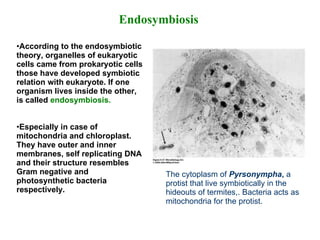
Endosymbiosis According to the endosymbiotic theory, organelles of eukaryotic cells came from prokaryotic cells those have developed symbiotic relation with eukaryote. If one organism lives inside the other, is called  endosymbiosis. Especially in case of mitochondria and chloroplast. They have outer and inner membranes, self replicating DNA and their structure resembles Gram negative and photosynthetic bacteria respectively. The cytoplasm of  Pyrsonympha ,  a protist that live symbiotically in the hideouts of termites,. Bacteria acts as mitochondria for the protist.
Passive Transport:   Cell expends no energy to move substances down a concentration gradient (high to low concentration) Simple Diffusion Facilitated Diffusion Osmosis Active Transport:   Cell expends energy from ATP, enabling it to transport substances against a concentration gradient Movement of substances across the membrane
Simple Diffusion:   The random movements of molecules cause them to spread out (diffuse) from an area of high concentration to area of low concentration
Facilitated Diffusion:   Carrier protein molecules aid in the movement of substances through cell membrane from high to low concentration
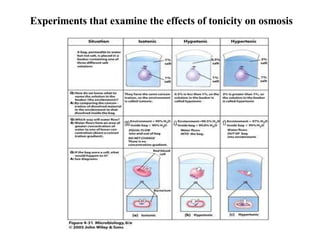
Osmosis:   The diffusion of water from an area of high water concentration to an area of low water concentration through a semi or, selectively permeable membrane (Cell Membrane)
Experiments that examine the effects of tonicity on osmosis
Active Transport:   Carrier protein molecules aid in movement of molecules against a concentration gradient requires energy in form of ATP
Endocytosis and Exocytosis Eukaryotic cells move substances by forming membrane-enclosed vesicles Endocytosis:   Form by invagination (poking in) and surrounding substances from outside the cell Exocytosis:   Vesicles inside the cell fuse with the plasma membrane and extrude contents from the cell
1.Phagocytosis (solid/ semisolid) 2. Pinocytosis (liquid)

Eukariotic Cell Structure

  • 1.
  • 2.
  • 3.
    Pores through theCell Nucleus
  • 4.
    Nucleus The nucleus consists of the nuclear envelope, nucleolus, chromatin, and nucleoplasm. Nuclear Envelope Structure -two unit membranes with a fluid-filled space                 -nuclear pores present                 -outer membrane may be continuous with endoplasmic                   reticulum Function -selectively permeable to control movement in or out                -contains nuclear contents Chromatin Structure -composed of long thin strands of DNA Function -contains instructions that control cell metabolism and heredity Nucleolus Structure -non-membraneous matrix of RNA (ribonucleic acid) and protein. Function - instructions in DNA are copied here                - works with ribosomes in the synthesis of protein
  • 5.
  • 6.
    Centriole Structure - nine triplets of microtubules form one centriole                - two centrioles form one centrosome. Function  - forms spindle fibres to separate chromosomes during cell                  division Vacuole Structure    - a single layer of unit membrane enclosing fluid in a sack Function    - produces turgor pressure against cell wall for support    - stores water and various chemicals    - may store insoluble wastes Cytoskeleton Structure - Composed of microtubules Function - Supports cell and provides shape - Aids movement of materials in and out of cells
  • 7.
    Mitochondria Power houseof cell and account for 20% of the cell volume, 1 µm diameter. Enzymes carry out oxidative reactions that capture energy in ATP. Glucose  +  Oxygen  ------> Carbon Dioxide  +  Water  + Energy (ATP) Mitochondria contains mitochondrial DNA and can replicate independently.
  • 8.
  • 9.
    Chloroplasts Like mitochondriachloroplast too have outer and inner membrane (stroma), it corresponds mitochondrial matrix. Unlike mitochondria chloroplast have separate inner membrane (thylacoids), that contain chlorophyll (in Grana), that capture energy during photosynthesis. chlorophyll CO 2 + H 2 O ---------------> Glucose + O 2 (food)                      radiant energy   Chloroplast contains chloroplast DNA and can replicate independently.
  • 10.
    Ribosome Structure - non-membraneous, spherical bodies composed of      RNA (ribonucleic acid) and protein enzymes. Function - site of protein synthesis Endoplasmic Reticulum (ER) Structure - sheets of unit membrane with ribosomes on the                  outside (rough ER) and without ribosome (smooth ER).                - forms a tubular network throughout the cell   Function - transports chemicals between cells and within cells                - provides a large surface area for the organization                  of chemical reactions and synthesis
  • 11.
    Lysosome Structure - membrane bound bag containing hydrolytic enzymes                - hydrolytic enzyme = (water split biological catalyst)                  i.e. using water to split chemical bonds. Function - break large molecules into small molecules by                  inserting a molecule of water into the chemical bond Peroxisome: -Membrane bound organelle, contains enzymes. -These enzymes in plant cell oxidize fats and in animal cell oxidizes amino acids. -Peroxisomal enzymes converts hydrogen peroxide to water, to prevent the toxic effect of hydrogen peroxide. Golgi Apparatus Structure - stacks of flattened sacs of unit membrane (cisternae)                - vesicles pinch off the edges Function - modifies chemicals to make them functional                - secretes chemicals in tiny vesicles                - stores chemicals                - may produce endoplasmic reticulum
  • 12.
    Prokaryotic and EukaryoticFlagella Compared One central pair and 9 peripheral pair of microtubules, made up of tubulin. Each pair of peripheral microtubules associated with a protein Dynein, which cross-bridges with other flagellar proteins for movement. The movement is dependent on ATP hydrolysis by dynein.
  • 13.
  • 14.
  • 15.
    Cilia on anOrganism Move in a Synchronized Fashion, Creating a Wave that Propels the Organism Forward
  • 16.
  • 17.
    Amoeba (132X) Amoeba engulfing food particle Food particles
  • 18.
    Endosymbiosis According tothe endosymbiotic theory, organelles of eukaryotic cells came from prokaryotic cells those have developed symbiotic relation with eukaryote. If one organism lives inside the other, is called endosymbiosis. Especially in case of mitochondria and chloroplast. They have outer and inner membranes, self replicating DNA and their structure resembles Gram negative and photosynthetic bacteria respectively. The cytoplasm of Pyrsonympha , a protist that live symbiotically in the hideouts of termites,. Bacteria acts as mitochondria for the protist.
  • 19.
    Passive Transport: Cell expends no energy to move substances down a concentration gradient (high to low concentration) Simple Diffusion Facilitated Diffusion Osmosis Active Transport: Cell expends energy from ATP, enabling it to transport substances against a concentration gradient Movement of substances across the membrane
  • 20.
    Simple Diffusion: The random movements of molecules cause them to spread out (diffuse) from an area of high concentration to area of low concentration
  • 21.
    Facilitated Diffusion: Carrier protein molecules aid in the movement of substances through cell membrane from high to low concentration
  • 22.
    Osmosis: The diffusion of water from an area of high water concentration to an area of low water concentration through a semi or, selectively permeable membrane (Cell Membrane)
  • 23.
    Experiments that examinethe effects of tonicity on osmosis
  • 24.
    Active Transport: Carrier protein molecules aid in movement of molecules against a concentration gradient requires energy in form of ATP
  • 25.
    Endocytosis and ExocytosisEukaryotic cells move substances by forming membrane-enclosed vesicles Endocytosis: Form by invagination (poking in) and surrounding substances from outside the cell Exocytosis: Vesicles inside the cell fuse with the plasma membrane and extrude contents from the cell
  • 26.
    1.Phagocytosis (solid/ semisolid)2. Pinocytosis (liquid)