BCD to EXCESS 3 Code Converter 
By 
Ushaswini chowdary.M
Introduction 
• The availability of large variety of codes for the same discrete 
elements of information results in the use of different codes by 
the different systems. 
• A conversion circuit must be inserted between the two systems 
if each use different codes for the same information. 
• Thus a code converter is a circuit that makes the two systems 
compatible even though both uses different binary 
information.
• Code converters, more specifically encoders and decoders, 
have been used to protect private information. 
• Indeed, code converters have proven to be so effective that the 
National Security Agency (NSA) has made a career out of 
creating and breaking codes. 
• To convert from binary to excess 3 code the input lines must 
supply the bit combination of elements as specified by the 
code.
Binary Coded Decimal 
• The term BCD refers to representing the ten decimal digits in 
binary forms; which simply means to count in binary. 
• In computing and electronic systems, binary coded decimal is 
a class of binary encodings of decimal numbers where each 
decimal digit is represented by a fixed number of bits , usually 
four or eight, although other sizes (such as six bits) have been 
used historically. Special bit patterns are sometimes used for 
a sign or for other indications (e.g., error or overflow).
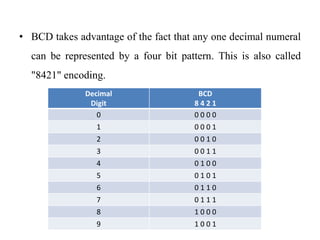
• BCD takes advantage of the fact that any one decimal numeral 
can be represented by a four bit pattern. This is also called 
"8421" encoding. 
Decimal 
Digit 
BCD 
8 4 2 1 
0 0 0 0 0 
1 0 0 0 1 
2 0 0 1 0 
3 0 0 1 1 
4 0 1 0 0 
5 0 1 0 1 
6 0 1 1 0 
7 0 1 1 1 
8 1 0 0 0 
9 1 0 0 1
Excess 3 
• It is a non weighted code. 
• In XS-3, numbers are represented as decimal digits, and each 
digit is represented by four bits as the digit value plus 3 (the 
"excess" amount). 
• The primary advantage of XS-3 coding over non-biased 
coding is that a decimal number can be nines' complemented 
as easily as a binary number can be ones' complemented . In 
addition, when the sum of two XS-3 digits is greater than 9, 
the carry bit of a four bit adder will be set high.
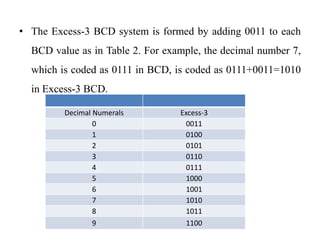
• The Excess-3 BCD system is formed by adding 0011 to each 
BCD value as in Table 2. For example, the decimal number 7, 
which is coded as 0111 in BCD, is coded as 0111+0011=1010 
in Excess-3 BCD. 
Decimal Numerals Excess-3 
0 0011 
1 0100 
2 0101 
3 0110 
4 0111 
5 1000 
6 1001 
7 1010 
8 1011 
9 1100
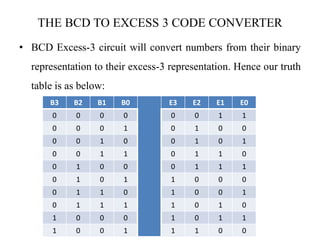
THE BCD TO EXCESS 3 CODE CONVERTER 
• BCD Excess-3 circuit will convert numbers from their binary 
representation to their excess-3 representation. Hence our truth 
table is as below: 
B3 B2 B1 B0 E3 E2 E1 E0 
0 0 0 0 0 0 1 1 
0 0 0 1 0 1 0 0 
0 0 1 0 0 1 0 1 
0 0 1 1 0 1 1 0 
0 1 0 0 0 1 1 1 
0 1 0 1 1 0 0 0 
0 1 1 0 1 0 0 1 
0 1 1 1 1 0 1 0 
1 0 0 0 1 0 1 1 
1 0 0 1 1 1 0 0
K maps 
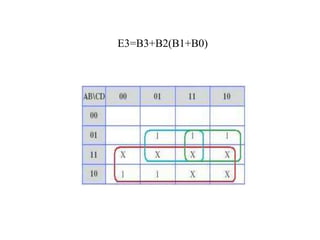
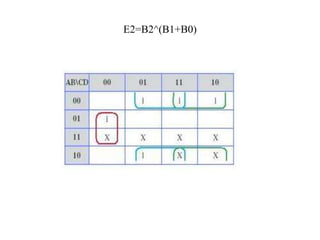
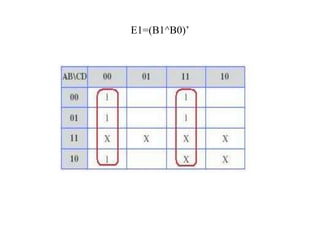
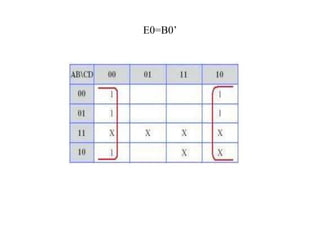
• Our task now is to use the truth table to find four switching 
expressions: one for E3, one for E2, one for E1, and one for E0. 
We have two choices: we can use Boolean algebraic 
manipulations, or we can use Karnaugh maps. 
• We use k maps for simplicity. Here don’t cares are available 
because in the truth table in Table 3, no BCD valuations exist 
for E3E2E1E0 = 1010,1011,1100,1101,1110,1111. As such, we 
evaluate B3B2B1B0= xxxx (either 0 or 1).
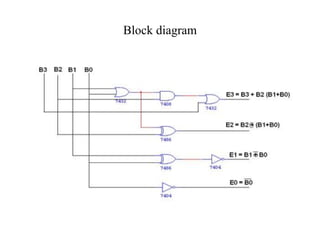
E3=B3+B2(B1+B0)
E2=B2^(B1+B0)
E1=(B1^B0)’
E0=B0’
Block diagram
Applications 
• Excess-3 was used on some older computers 
• Cash registers 
• Hand held portable electronic calculators

Bcd to excess 3 code converter

  • 1.
    BCD to EXCESS3 Code Converter By Ushaswini chowdary.M
  • 2.
    Introduction • Theavailability of large variety of codes for the same discrete elements of information results in the use of different codes by the different systems. • A conversion circuit must be inserted between the two systems if each use different codes for the same information. • Thus a code converter is a circuit that makes the two systems compatible even though both uses different binary information.
  • 3.
    • Code converters,more specifically encoders and decoders, have been used to protect private information. • Indeed, code converters have proven to be so effective that the National Security Agency (NSA) has made a career out of creating and breaking codes. • To convert from binary to excess 3 code the input lines must supply the bit combination of elements as specified by the code.
  • 4.
    Binary Coded Decimal • The term BCD refers to representing the ten decimal digits in binary forms; which simply means to count in binary. • In computing and electronic systems, binary coded decimal is a class of binary encodings of decimal numbers where each decimal digit is represented by a fixed number of bits , usually four or eight, although other sizes (such as six bits) have been used historically. Special bit patterns are sometimes used for a sign or for other indications (e.g., error or overflow).
  • 5.
    • BCD takesadvantage of the fact that any one decimal numeral can be represented by a four bit pattern. This is also called "8421" encoding. Decimal Digit BCD 8 4 2 1 0 0 0 0 0 1 0 0 0 1 2 0 0 1 0 3 0 0 1 1 4 0 1 0 0 5 0 1 0 1 6 0 1 1 0 7 0 1 1 1 8 1 0 0 0 9 1 0 0 1
  • 6.
    Excess 3 •It is a non weighted code. • In XS-3, numbers are represented as decimal digits, and each digit is represented by four bits as the digit value plus 3 (the "excess" amount). • The primary advantage of XS-3 coding over non-biased coding is that a decimal number can be nines' complemented as easily as a binary number can be ones' complemented . In addition, when the sum of two XS-3 digits is greater than 9, the carry bit of a four bit adder will be set high.
  • 7.
    • The Excess-3BCD system is formed by adding 0011 to each BCD value as in Table 2. For example, the decimal number 7, which is coded as 0111 in BCD, is coded as 0111+0011=1010 in Excess-3 BCD. Decimal Numerals Excess-3 0 0011 1 0100 2 0101 3 0110 4 0111 5 1000 6 1001 7 1010 8 1011 9 1100
  • 8.
    THE BCD TOEXCESS 3 CODE CONVERTER • BCD Excess-3 circuit will convert numbers from their binary representation to their excess-3 representation. Hence our truth table is as below: B3 B2 B1 B0 E3 E2 E1 E0 0 0 0 0 0 0 1 1 0 0 0 1 0 1 0 0 0 0 1 0 0 1 0 1 0 0 1 1 0 1 1 0 0 1 0 0 0 1 1 1 0 1 0 1 1 0 0 0 0 1 1 0 1 0 0 1 0 1 1 1 1 0 1 0 1 0 0 0 1 0 1 1 1 0 0 1 1 1 0 0
  • 9.
    K maps •Our task now is to use the truth table to find four switching expressions: one for E3, one for E2, one for E1, and one for E0. We have two choices: we can use Boolean algebraic manipulations, or we can use Karnaugh maps. • We use k maps for simplicity. Here don’t cares are available because in the truth table in Table 3, no BCD valuations exist for E3E2E1E0 = 1010,1011,1100,1101,1110,1111. As such, we evaluate B3B2B1B0= xxxx (either 0 or 1).
  • 10.
  • 11.
  • 12.
  • 13.
  • 14.
  • 15.
    Applications • Excess-3was used on some older computers • Cash registers • Hand held portable electronic calculators