UNIT -I
BINARY SYSTEMS
 Analog Vs Digital


 Digital Systems


 Binary numbers


 Number base conversions


 Compliments


 Octal and Hexadecimal Numbers


 Signed Binary Numbers




ANALOG Vs DIGITAL:
To learn and understand about the digital logic design, the initial knowledge we require is to
differentiate between analog and digital. The following are fews that differentiate between
analog and digital.
• Analog information is made up of a continuum of values within a given range.
• At its most basic, digital information can assume only one of two possible
values: one/zero, on/off, high/low, true/false, etc.
• Digital Information is less susceptible to noise than analog information
• Exact voltage values are not important, only their class (1 or 0)
• The complexity of operations is reduced, thus it is easier to implement them with
high accuracy in digital form.
DIGITAL SYSTEMS
Digital means electronic technology that generates, stores, and processes data in terms of two
states: positive and non-positive. Positive is expressed or represented by the number 1 and
non-positive by the number 0.
A „digital system‟ is a data technology that uses discrete (discontinuous) values represented
by high and low states known as bits. By contrast, non-digital (or analog) systems use a
continuous range of values to represent information. Although digital representations are
discrete, the information represented can be either discrete, such as numbers, letters or icons,
or continuous, such as sounds, images, and other measurements of continuous systems.
BINARY
Binary describes a numbering scheme in which there are only two possible values for each
digit: 0 and 1. The term also refers to any digital encoding/decoding system in which there are
exactly two possible states. In digital data memory, storage, processing, and communications,
the 0 and 1 values are sometimes called "low" and "high," respectively.
BINARY NUMBER/BINARY NUMBER SYSTEM
The binary number system is a numbering system that represents numeric values using two
unique digits (0 and 1). Most of the computing devices use binary numbering to represent
electronic circuit voltage state, (i.e., on/off switch), which considers 0 voltage input as off and
1 input as on.
This is also known as the base-2 number system (The base-2 system is a positional notation
with a radix of 2), or the binary numbering system. Few examples of binary numbers are as
follows:
• 10
• 111
• 10101
• 11110
COMPLIMENTS
Compliments are used in digital computers to simplify the subtraction operation and for logical
manipulation. Simplifying operations leads to simpler, less expensive circuits to implement the
operations.
There are 2 types of complements for each base r system.
(1) The radix complement
(2) Diminished radix compliment
Radix compliment: Also referred to as the r‟s compliment.
Diminished radix compliment: Also referred to as (r-1)‟s compliment.
OCTAL NUMBERS
The Octal Number System is another type of computer and digital base number system. The
Octal Numbering System is very similar in principle to the previous hexadecimal numbering
system except that in Octal, a binary number is divided up into groups of only 3 bits, with each
group or set of bits having a distinct value of between 000 (0) and 111 ( 7 ). Octal numbers
therefore have a range of just “8” digits, (0, 1, 2, 3, 4, 5, 6, 7) making them a Base-8
numbering system and therefore, q is equal to “8”.
HEXADECIMAL NUMBERING SYSTEM: The one main disadvantage of binary numbers
is that the binary string equivalent of a large decimal base-10 number can be quite long. When
working with large digital systems, such as computers, it is common to find binary numbers
consisting of 8, 16 and even 32 digits which makes it difficult to both read and write without
producing errors especially when working with lots of 16 or 32-bit binary numbers. One
common way of overcoming this problem is to arrange the binary numbers into groups or sets
of four bits (4-bits). These groups of 4-bits uses another type of numbering system also
commonly used in computer and digital systems called Hexadecimal Numbers
The “Hexadecimal” or simply “Hex” numbering system uses the Base of 16 system and are a
popular choice for representing long binary values because their format is quite compact and
much easier to understand compared to the long binary strings of 1‟s and 0‟s.
Being a Base-16 system, the hexadecimal numbering system therefore uses 16 (sixteen)
different digits with a combination of numbers from 0 through to 15. In other words, there are
16 possible digit symbols.
Decima Binar Octal Hexadeci
l y mal
0 0000 0 0
1 0001 1 1
2 0010 2 2
3 0011 3 3
4 0100 4 4
5 0101 5 5
6 0110 6 6
7 0111 7 7
8 1000 10 8
9 1001 11 9
10 1010 12 A
11 1011 13 B
12 1100 14 C
13 1101 15 D
14 1110 16 E
15 1111 17 F
SIGNED BINARY NUMBERS
In mathematics, positive numbers (including zero) are represented as unsigned numbers. That
is we do not put the +ve sign in front of them to show that they are positive numbers.
However, when dealing with negative numbers we do use a -ve sign in front of the number to
show that the number is negative in value and different from a positive unsigned value and the
same is true with signed binary numbers. However, in digital circuits there is no provision
made to put a plus or even a minus sign to a number, since digital systems operate with binary
numbers that are represented in terms of “0‟s” and “1‟s”.
So to represent a positive (N) and a negative (-N) binary number we can use the binary
numbers with sign. For signed binary numbers the most significant bit (MSB) is used as the
sign. If the sign bit is “0”, this means the number is positive. If the sign bit is “1”, then the
number is negative. The remaining bits are used to represent the magnitude of the binary
number in the usual unsigned binary number format.
Positive Signed Binary Numbers.
Negative Signed Binary Numbers
BINARY CODES
In the coding, when numbers, letters or words are represented by a specific group of symbols,
it is said that the number, letter or word is being encoded. The group of symbols is called as a
code. The digital data is represented, stored and transmitted as group of binary bits. This group
is also called as binary code. The binary code is represented by the number as well as
alphanumeric letter.
Advantages of Binary Code
Following is the list of advantages that binary code offers.
 Binary codes are suitable for the computer applications.

 Binary codes are suitable for the digital communications.
 Binary codes make the analysis and designing of digital circuits if we use the binary
codes.
 Since only 0 & 1 are being used, implementation becomes easy.
Classification of binary codes
The codes are broadly categorized into following four categories.
 Weighted Codes

 Non-Weighted Codes

 Binary Coded Decimal Code

 Alphanumeric Codes

 Error Detecting Codes

 Error Correcting Codes
Weighted Codes
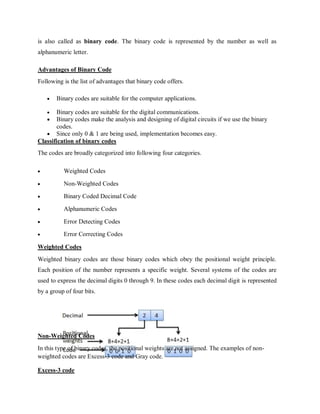
Weighted binary codes are those binary codes which obey the positional weight principle.
Each position of the number represents a specific weight. Several systems of the codes are
used to express the decimal digits 0 through 9. In these codes each decimal digit is represented
by a group of four bits.



Non-Weighted Codes
In this type of binary codes, the positional weights are not assigned. The examples of non-
weighted codes are Excess-3 code and Gray code.
Excess-3 code
The Excess-3 code is also called as XS-3 code. It is non-weighted code used to express decimal
numbers. The Excess-3 code words are derived from the 8421 BCD code words adding (0011)2
or (3)10 to each code word in 8421. The excess-3 codes are obtained as follows.
Gray Code
It is the non-weighted code and it is not arithmetic codes. That means there are no specific
weights assigned to the bit position. It has a very special feature that, only one bit will change
each time the decimal number is incremented as shown in fig. As only one bit changes at a
time, the gray code is called as a unit distance code. The gray code is a cyclic code. Gray code
cannot be used for arithmetic operation.
Application of Gray code
 Gray code is popularly used in the shaft position encoders.

 A shaft position encoder produces a code word which represents the angular
position of the shaft.
Binary Coded Decimal (BCD) code
In this code each decimal digit is represented by a 4-bit binary number. BCD is a way
to express each of the decimal digits with a binary code. In the BCD, with four bits we can
represent sixteen numbers (0000 to 1111). But in BCD code only first ten of these are used
(0000 to 1001). The remaining six code combinations i.e. 1010 to 1111 are invalid in BCD.
Advantages of BCD Codes
 It is very similar to decimal system.

 We need to remember binary equivalent of decimal numbers 0 to 9 only
Disadvantages of BCD Codes
 The addition and subtraction of BCD have different rules.
 The BCD arithmetic is little more complicated.
 BCD needs more number of bits than binary to represent the decimal number. So BCD
is less efficient than binary
Alphanumeric codes
A binary digit or bit can represent only two symbols as it has only two states '0' or '1'. But this
is not enough for communication between two computers because there we need many more
symbols for communication. These symbols are required to represent 26 alphabets with capital
and small letters, numbers from 0 to 9, punctuation marks and other symbols.
The alphanumeric codes are the codes that represent numbers and alphabetic characters.
Mostly such codes also represent other characters such as symbol and various instructions
necessary for conveying information. An alphanumeric code should at least represent 10 digits
and 26 letters of alphabet i.e. total 36 items. The following three alphanumeric codes are very
commonly used for the data representation.
 American Standard Code for Information Interchange (ASCII).

 Extended Binary Coded Decimal Interchange Code (EBCDIC).

 Five bit Baudot Code.
ASCII code is a 7-bit code whereas EBCDIC is an 8-bit code. ASCII code is more commonly
used worldwide while EBCDIC is used primarily in large IBM computers.
Error Codes
There are binary code techniques available to detect and correct data during data transmission.
NUMBER BASE CONVERSIONS
There are many methods or techniques which can be used to convert code from one format to
another. We'll demonstrate here the following
 Binary to BCD Conversion

 BCD to Binary Conversion

 BCD to Excess-3

 Excess-3 to BCD
Binary to BCD Conversion
Steps
 Step 1 -- Convert the binary number to decimal.

 Step 2 -- Convert decimal number to BCD.
Example − convert (11101)2 to BCD.
Step 1 − Convert to Decimal
Binary Number − 111012
Calculating Decimal Equivalent −
Step Binary Number Decimal Number
Step 1 111012 ((1 × 2
4
) + (1 × 2
3
) + (1 × 2
2
) + (0 × 2
1
) + (1 × 2
0
))10
Step 2 111012 (16 + 8 + 4 + 0 + 1)10
Step 3 111012 2910
Binary Number − 111012 = Decimal Number − 2910
Step 2 − Convert to BCD
Decimal Number − 2910
Calculating BCD Equivalent. Convert each digit into groups of four binary digits equivalent
Step Decimal Number Conversion
Step 1 2910 00102 10012
Step 2 2910 00101001BCD
Result
(11101)2 = (00101001)BCD
BCD to Binary Conversion
Steps
 Step 1 -- Convert the BCD number to decimal.

 Step 2 -- Convert decimal to binary.
Example − convert (00101001)BCD to Binary.
Step 1 - Convert to BCD
BCD Number − (00101001)BCD
Calculating Decimal Equivalent. Convert each four digit into a group and get decimal
equivalent for each group.
Step BCD Number Conversion
Step 1 (00101001)BCD 00102 10012
Step 2 (00101001)BCD 210 910
Step 3 (00101001)BCD 2910
BCD Number − (00101001)BCD = Decimal Number − 2910
Step 2 - Convert to Binary
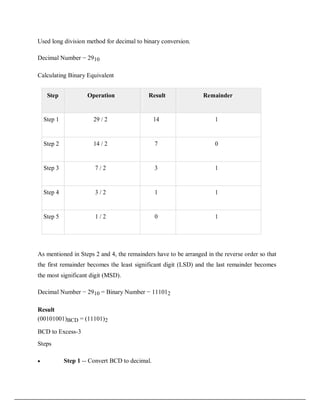
Used long division method for decimal to binary conversion.
Decimal Number − 2910
Calculating Binary Equivalent
Step Operation Result Remainder
Step 1 29 / 2 14 1
Step 2 14 / 2 7 0
Step 3 7 / 2 3 1
Step 4 3 / 2 1 1
Step 5 1 / 2 0 1
As mentioned in Steps 2 and 4, the remainders have to be arranged in the reverse order so that
the first remainder becomes the least significant digit (LSD) and the last remainder becomes
the most significant digit (MSD).
Decimal Number − 2910 = Binary Number − 111012
Result
(00101001)BCD = (11101)2
BCD to Excess-3
Steps
 Step 1 -- Convert BCD to decimal.

 Step 2 -- Add (3)10 to this decimal number.

 Step 3 -- Convert into binary to get excess-3 code.
Example − convert (1001)BCD to Excess-3.
Step 1 − Convert to decimal
(1001)BCD = 910
Step 2 − Add 3 to decimal
(9)10 + (3)10 = (12)10
Step 3 − Convert to Excess-3
(12)10 = (1100)2
Result
(1001)BCD = (1100)XS-3
Excess-3 to BCD Conversion
Steps
 Step 1 -- Subtract (0011)2 from each 4 bit of excess-3 digit to obtain the
corresponding BCD code.
Example − convert (10011010)XS-3 to BCD.
Given XS-3 number = 1 0 0 1 1 0 1 0
Subtract (0011)2 = 0 0 1 1 0 0 1 1
--------------------
BCD = 0 1 1 0 0 1 1 1
Result
(10011010)XS-3 = (01100111)BCD

 Basic Theorems and properties of Boolean Algebra

 Boolean Functions

 Canonical and Standard Forms, Other Logic Operations

 Digital Logic Gates

 Integrated Circuits
Boolean Algebra: Boolean algebra, like any other deductive mathematical system, may be
defined with aset of elements, a set of operators, and a number of unproved axioms or
postulates. A set of elements is anycollection of objects having a common property. If S is a
set and x and y are certain objects, then x Î Sdenotes that x is a member of the set S, and y ÏS
denotes that y is not an element of S. A set with adenumerable number of elements is specified
by braces: A = {1,2,3,4}, i.e. the elements of set A are thenumbers 1, 2, 3, and 4. A binary
operator defined on a set S of elements is a rule that assigns to each pair ofelements from S a
unique element from S._ Example: In a*b=c, we say that * is a binary operator if it specifies a
rule for finding c from the pair (a,b)and also if a, b, c Î S.
CLOSURE: The Boolean system is closed with respect to a binary operator if for every pair
of Boolean values,it produces a Boolean result. For example, logical AND is closed in the
Boolean system because it accepts only Boolean operands and produces only Boolean results.
_ A set S is closed with respect to a binary operator if, for every pair of elements of S, the
binary operator specifies a rule for obtaining a unique element of S.
For example, the set of natural numbers N = {1, 2, 3, 4, … 9} is closed with respect to the
binary operator plus (+) by the rule of arithmetic addition, since for any a, b Î N we obtain a
unique c Î N by the operation a + b = c.
ASSOCIATIVE LAW:A binary operator * on a set S is said to be associative whenever (x *
y) * z = x * (y * z) for all x, y, z Î S, forall Boolean values x, y and z.
COMMUTATIVE LAW:
A binary operator * on a set S is said to be commutative whenever x * y = y * x for all x, y, z є
IDENTITY ELEMENT:
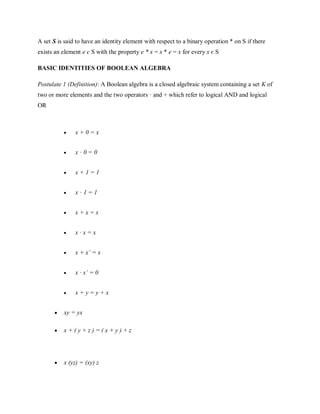
A set S is said to have an identity element with respect to a binary operation * on S if there
exists an element e є S with the property e * x = x * e = x for every x є S
BASIC IDENTITIES OF BOOLEAN ALGEBRA
Postulate 1 (Definition): A Boolean algebra is a closed algebraic system containing a set K of
two or more elements and the two operators · and + which refer to logical AND and logical
OR
 x + 0 = x


 x · 0 = 0


 x + 1 = 1


 x · 1 = 1


 x + x = x


 x · x = x


 x + x’ = x


 x · x’ = 0


 x + y = y + x


 xy = yx

 x + ( y + z ) = ( x + y ) + z


 x (yz) = (xy) z

 x ( y + z ) = xy + xz

 x + yz = ( x + y )( x + z)

 ( x + y )’ = x’ y’

 ( xy )’ = x’ + y’

 (x’)’ = x

DeMorgan's Theorem
(a) (a + b)' = a'b'
(b) (ab)' = a' + b'
Generalized DeMorgan's Theorem
(a) (a + b + … z)' = a'b' … z'
(b) (a.b … z)' = a' + b' + … z„

AXIOMATIC DEFINITION OF BOOLEAN ALGEBRA:
1. Closure
a. Closure with respect to (wrt) OR (+)
b. Closure with respect to AND (•)
2. Identity
a. Identity element wrt to OR : 0
b. Identity element wrt to AND : 1
3. Commutative Property
a. Commutative Property wrt to OR : x + y = y + x
b. Commutative Property wrt to AND : x · y = y · x
4. Distributive Property
a. x · (y + z) = (x·y) + (x·z)
b. x + (y·z) = (x + y)(x + z)
5. Existence of Complement
a. x + x‟ = 1
b. x · x‟ = 0
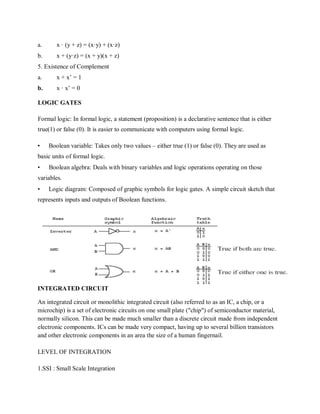
LOGIC GATES
Formal logic: In formal logic, a statement (proposition) is a declarative sentence that is either
true(1) or false (0). It is easier to communicate with computers using formal logic.
• Boolean variable: Takes only two values – either true (1) or false (0). They are used as
basic units of formal logic.
• Boolean algebra: Deals with binary variables and logic operations operating on those
variables.
• Logic diagram: Composed of graphic symbols for logic gates. A simple circuit sketch that
represents inputs and outputs of Boolean functions.
INTEGRATED CIRCUIT
An integrated circuit or monolithic integrated circuit (also referred to as an IC, a chip, or a
microchip) is a set of electronic circuits on one small plate ("chip") of semiconductor material,
normally silicon. This can be made much smaller than a discrete circuit made from independent
electronic components. ICs can be made very compact, having up to several billion transistors
and other electronic components in an area the size of a human fingernail.
LEVEL OF INTEGRATION
1.SSI : Small Scale Integration
It has less than 100 components(about 10gates)
2.MSI: Medium Scale Integration
It contains less than 500 components or have more than 10 but less than 100 gates.
3.LSI: Large scale integration
Number of components is between 500 and 300000 or have more than 100gates.
4.VLSI:very large scale integration. process of creating an integrated circuit (IC)
by combining thousands of transistors into a single chip.
DIGITAL LOGIC FAMILIES
Transistor–transistor logic (TTL) is a class of digital circuits built from bipolar junction
transistors (BJT) and resistors. It is called transistor–transistor logic because both the logic
gating function (e.g., AND) and the amplifying function are performed by transistors (contrast
with resistor–transistor logic (RTL) and diode–transistor logic (DTL).
Emitter coupled logic(ECL)
Emitter-coupled logic (ECL) is the fastest logic circuit family available for conventional logic-
system design.4 High speed is achieved by operating all bipolar transistors out of saturation, thus
avoiding storage-time delays, and by keeping the logic signal swings relatively small (about 0.8
V or less), thus reducing the time required to charge and discharge the various load and parasitic
capacitances.
Complementary Metal oxide semiconductor (CMOS): Technology for constructing integrated
circuits. CMOS technology is used in microprocessors, microcontrollers, static RAM, and other
digital logic circuits. CMOS technology is also used for several analog circuits such as image
sensors (CMOS sensor), data converters, and highly integrated transceivers for many types of
communication.
INTRODUCTION
Minimization of switching functions is to obtain logic circuits with least circuit complexity. This
goal is very difficult since how a minimal function relates to the implementation technology is
important. For example, If we are building a logic circuit that uses discrete logic made of small
scale Integration ICs(SSIs) like 7400 series, in which basic building block are constructed and
are available for use. The goal of minimization would be to reduce the number of ICs and not the
logic gates. For example, If we require two 6 and gates and 5 Or gates,we would require 2 AND
ICs(each has 4 AND gates) and one OR IC. (4 gates). On the other hand if the same logic could
be implemented with only 10 nand gates, we require only 3 ICs. Similarly when we design logic
on Programmable device, we may implement the design with certain number of gates and
remaining gates may not be used. Whatever may be the criteria of minimization we would be
guided by the following:
• Boolean algebra helps us simplify expressions and circuits
• Karnaugh Map: A graphical technique for simplifying a Boolean expression into either
form: minimal sum of products (MSP)
• minimal product of sums (MPS)
• Goal of the simplification.
• There are a minimal number of product/sum terms
• Each term has a minimal number of literals
• Circuit-wise, this leads to a minimal two-level implementation
K-map Simplification
• Imagine a two-variable sum of minterms
• x‟y‟ + x‟y
• Both of these minterms appear in the top row of a Karnaugh map, which means that they
both contain the literal x‟
K-Maps for 2 to 5 Variables
K-Map method is most suitable for minimizing Boolean functions of 2 variables to 5 variables.
Now, let us discuss about the K-Maps for 2 to 5 variables one by one.
2 Variable K-Map
The number of cells in 2 variable K-map is four, since the number of variables is two. The
following figure shows 2 variable K-Map.
 There is only one possibility of grouping 4 adjacent min terms.
 The possible combinations of grouping 2 adjacent min terms are {(m0, m1), (m2,
m3), (m0, m2) and (m1, m3)}.
3 Variable K-Map
The number of cells in 3 variable K-map is eight, since the number of variables is three. The
following figure shows 3 variable K-Map.
 There is only one possibility of grouping 8 adjacent min terms.
 The possible combinations of grouping 4 adjacent min terms are {(m0, m1, m3, m2), (m4,
m5, m7, m6), (m0, m1, m4, m5), (m1, m3, m5, m7), (m3, m2, m7, m6) and (m2, m0, m6, m4)}.
 The possible combinations of grouping 2 adjacent min terms are {(m0, m1), (m1, m3),
(m3, m2), (m2, m0), (m4, m5), (m5, m7), (m7, m6), (m6, m4), (m0, m4), (m1, m5), (m3, m7)
and (m2, m6)}.
 If x=0, then 3 variable K-map becomes 2 variable K-map.
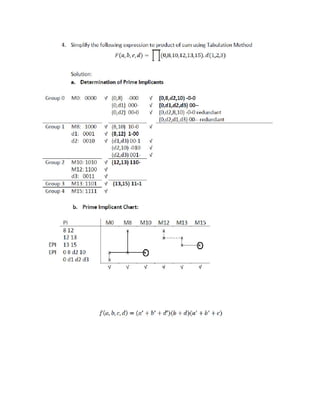
Tabulation Method
Unit 1 Class Notes Printed digital Electronics.pdf

Unit 1 Class Notes Printed digital Electronics.pdf

  • 1.
  • 2.
    BINARY SYSTEMS  AnalogVs Digital    Digital Systems    Binary numbers    Number base conversions    Compliments    Octal and Hexadecimal Numbers    Signed Binary Numbers     ANALOG Vs DIGITAL: To learn and understand about the digital logic design, the initial knowledge we require is to differentiate between analog and digital. The following are fews that differentiate between analog and digital. • Analog information is made up of a continuum of values within a given range. • At its most basic, digital information can assume only one of two possible values: one/zero, on/off, high/low, true/false, etc. • Digital Information is less susceptible to noise than analog information • Exact voltage values are not important, only their class (1 or 0) • The complexity of operations is reduced, thus it is easier to implement them with high accuracy in digital form.
  • 3.
    DIGITAL SYSTEMS Digital meanselectronic technology that generates, stores, and processes data in terms of two states: positive and non-positive. Positive is expressed or represented by the number 1 and non-positive by the number 0. A „digital system‟ is a data technology that uses discrete (discontinuous) values represented by high and low states known as bits. By contrast, non-digital (or analog) systems use a continuous range of values to represent information. Although digital representations are discrete, the information represented can be either discrete, such as numbers, letters or icons, or continuous, such as sounds, images, and other measurements of continuous systems. BINARY Binary describes a numbering scheme in which there are only two possible values for each digit: 0 and 1. The term also refers to any digital encoding/decoding system in which there are exactly two possible states. In digital data memory, storage, processing, and communications, the 0 and 1 values are sometimes called "low" and "high," respectively. BINARY NUMBER/BINARY NUMBER SYSTEM The binary number system is a numbering system that represents numeric values using two unique digits (0 and 1). Most of the computing devices use binary numbering to represent electronic circuit voltage state, (i.e., on/off switch), which considers 0 voltage input as off and 1 input as on. This is also known as the base-2 number system (The base-2 system is a positional notation with a radix of 2), or the binary numbering system. Few examples of binary numbers are as follows: • 10 • 111 • 10101 • 11110
  • 4.
    COMPLIMENTS Compliments are usedin digital computers to simplify the subtraction operation and for logical manipulation. Simplifying operations leads to simpler, less expensive circuits to implement the operations. There are 2 types of complements for each base r system. (1) The radix complement (2) Diminished radix compliment Radix compliment: Also referred to as the r‟s compliment. Diminished radix compliment: Also referred to as (r-1)‟s compliment. OCTAL NUMBERS The Octal Number System is another type of computer and digital base number system. The Octal Numbering System is very similar in principle to the previous hexadecimal numbering system except that in Octal, a binary number is divided up into groups of only 3 bits, with each group or set of bits having a distinct value of between 000 (0) and 111 ( 7 ). Octal numbers therefore have a range of just “8” digits, (0, 1, 2, 3, 4, 5, 6, 7) making them a Base-8 numbering system and therefore, q is equal to “8”. HEXADECIMAL NUMBERING SYSTEM: The one main disadvantage of binary numbers is that the binary string equivalent of a large decimal base-10 number can be quite long. When working with large digital systems, such as computers, it is common to find binary numbers consisting of 8, 16 and even 32 digits which makes it difficult to both read and write without producing errors especially when working with lots of 16 or 32-bit binary numbers. One common way of overcoming this problem is to arrange the binary numbers into groups or sets of four bits (4-bits). These groups of 4-bits uses another type of numbering system also commonly used in computer and digital systems called Hexadecimal Numbers
  • 5.
    The “Hexadecimal” orsimply “Hex” numbering system uses the Base of 16 system and are a popular choice for representing long binary values because their format is quite compact and much easier to understand compared to the long binary strings of 1‟s and 0‟s. Being a Base-16 system, the hexadecimal numbering system therefore uses 16 (sixteen) different digits with a combination of numbers from 0 through to 15. In other words, there are 16 possible digit symbols. Decima Binar Octal Hexadeci l y mal 0 0000 0 0 1 0001 1 1 2 0010 2 2 3 0011 3 3 4 0100 4 4 5 0101 5 5 6 0110 6 6 7 0111 7 7 8 1000 10 8 9 1001 11 9 10 1010 12 A 11 1011 13 B 12 1100 14 C 13 1101 15 D 14 1110 16 E 15 1111 17 F SIGNED BINARY NUMBERS In mathematics, positive numbers (including zero) are represented as unsigned numbers. That is we do not put the +ve sign in front of them to show that they are positive numbers. However, when dealing with negative numbers we do use a -ve sign in front of the number to show that the number is negative in value and different from a positive unsigned value and the
  • 6.
    same is truewith signed binary numbers. However, in digital circuits there is no provision made to put a plus or even a minus sign to a number, since digital systems operate with binary numbers that are represented in terms of “0‟s” and “1‟s”. So to represent a positive (N) and a negative (-N) binary number we can use the binary numbers with sign. For signed binary numbers the most significant bit (MSB) is used as the sign. If the sign bit is “0”, this means the number is positive. If the sign bit is “1”, then the number is negative. The remaining bits are used to represent the magnitude of the binary number in the usual unsigned binary number format. Positive Signed Binary Numbers. Negative Signed Binary Numbers BINARY CODES In the coding, when numbers, letters or words are represented by a specific group of symbols, it is said that the number, letter or word is being encoded. The group of symbols is called as a code. The digital data is represented, stored and transmitted as group of binary bits. This group
  • 7.
    is also calledas binary code. The binary code is represented by the number as well as alphanumeric letter. Advantages of Binary Code Following is the list of advantages that binary code offers.  Binary codes are suitable for the computer applications.   Binary codes are suitable for the digital communications.  Binary codes make the analysis and designing of digital circuits if we use the binary codes.  Since only 0 & 1 are being used, implementation becomes easy. Classification of binary codes The codes are broadly categorized into following four categories.  Weighted Codes   Non-Weighted Codes   Binary Coded Decimal Code   Alphanumeric Codes   Error Detecting Codes   Error Correcting Codes Weighted Codes Weighted binary codes are those binary codes which obey the positional weight principle. Each position of the number represents a specific weight. Several systems of the codes are used to express the decimal digits 0 through 9. In these codes each decimal digit is represented by a group of four bits.    Non-Weighted Codes In this type of binary codes, the positional weights are not assigned. The examples of non- weighted codes are Excess-3 code and Gray code. Excess-3 code
  • 8.
    The Excess-3 codeis also called as XS-3 code. It is non-weighted code used to express decimal numbers. The Excess-3 code words are derived from the 8421 BCD code words adding (0011)2 or (3)10 to each code word in 8421. The excess-3 codes are obtained as follows. Gray Code It is the non-weighted code and it is not arithmetic codes. That means there are no specific weights assigned to the bit position. It has a very special feature that, only one bit will change each time the decimal number is incremented as shown in fig. As only one bit changes at a time, the gray code is called as a unit distance code. The gray code is a cyclic code. Gray code cannot be used for arithmetic operation. Application of Gray code  Gray code is popularly used in the shaft position encoders.   A shaft position encoder produces a code word which represents the angular position of the shaft. Binary Coded Decimal (BCD) code In this code each decimal digit is represented by a 4-bit binary number. BCD is a way to express each of the decimal digits with a binary code. In the BCD, with four bits we can
  • 9.
    represent sixteen numbers(0000 to 1111). But in BCD code only first ten of these are used (0000 to 1001). The remaining six code combinations i.e. 1010 to 1111 are invalid in BCD. Advantages of BCD Codes  It is very similar to decimal system.   We need to remember binary equivalent of decimal numbers 0 to 9 only Disadvantages of BCD Codes  The addition and subtraction of BCD have different rules.  The BCD arithmetic is little more complicated.  BCD needs more number of bits than binary to represent the decimal number. So BCD is less efficient than binary Alphanumeric codes A binary digit or bit can represent only two symbols as it has only two states '0' or '1'. But this is not enough for communication between two computers because there we need many more symbols for communication. These symbols are required to represent 26 alphabets with capital and small letters, numbers from 0 to 9, punctuation marks and other symbols. The alphanumeric codes are the codes that represent numbers and alphabetic characters. Mostly such codes also represent other characters such as symbol and various instructions necessary for conveying information. An alphanumeric code should at least represent 10 digits and 26 letters of alphabet i.e. total 36 items. The following three alphanumeric codes are very commonly used for the data representation.  American Standard Code for Information Interchange (ASCII). 
  • 10.
     Extended BinaryCoded Decimal Interchange Code (EBCDIC).   Five bit Baudot Code. ASCII code is a 7-bit code whereas EBCDIC is an 8-bit code. ASCII code is more commonly used worldwide while EBCDIC is used primarily in large IBM computers. Error Codes There are binary code techniques available to detect and correct data during data transmission. NUMBER BASE CONVERSIONS There are many methods or techniques which can be used to convert code from one format to another. We'll demonstrate here the following  Binary to BCD Conversion   BCD to Binary Conversion   BCD to Excess-3   Excess-3 to BCD Binary to BCD Conversion Steps  Step 1 -- Convert the binary number to decimal.   Step 2 -- Convert decimal number to BCD. Example − convert (11101)2 to BCD. Step 1 − Convert to Decimal Binary Number − 111012 Calculating Decimal Equivalent − Step Binary Number Decimal Number
  • 11.
    Step 1 111012((1 × 2 4 ) + (1 × 2 3 ) + (1 × 2 2 ) + (0 × 2 1 ) + (1 × 2 0 ))10 Step 2 111012 (16 + 8 + 4 + 0 + 1)10 Step 3 111012 2910 Binary Number − 111012 = Decimal Number − 2910 Step 2 − Convert to BCD Decimal Number − 2910 Calculating BCD Equivalent. Convert each digit into groups of four binary digits equivalent Step Decimal Number Conversion Step 1 2910 00102 10012 Step 2 2910 00101001BCD Result (11101)2 = (00101001)BCD BCD to Binary Conversion
  • 12.
    Steps  Step 1-- Convert the BCD number to decimal.   Step 2 -- Convert decimal to binary. Example − convert (00101001)BCD to Binary. Step 1 - Convert to BCD BCD Number − (00101001)BCD Calculating Decimal Equivalent. Convert each four digit into a group and get decimal equivalent for each group. Step BCD Number Conversion Step 1 (00101001)BCD 00102 10012 Step 2 (00101001)BCD 210 910 Step 3 (00101001)BCD 2910 BCD Number − (00101001)BCD = Decimal Number − 2910 Step 2 - Convert to Binary
  • 13.
    Used long divisionmethod for decimal to binary conversion. Decimal Number − 2910 Calculating Binary Equivalent Step Operation Result Remainder Step 1 29 / 2 14 1 Step 2 14 / 2 7 0 Step 3 7 / 2 3 1 Step 4 3 / 2 1 1 Step 5 1 / 2 0 1 As mentioned in Steps 2 and 4, the remainders have to be arranged in the reverse order so that the first remainder becomes the least significant digit (LSD) and the last remainder becomes the most significant digit (MSD). Decimal Number − 2910 = Binary Number − 111012 Result (00101001)BCD = (11101)2 BCD to Excess-3 Steps  Step 1 -- Convert BCD to decimal. 
  • 14.
     Step 2-- Add (3)10 to this decimal number.   Step 3 -- Convert into binary to get excess-3 code. Example − convert (1001)BCD to Excess-3. Step 1 − Convert to decimal (1001)BCD = 910 Step 2 − Add 3 to decimal (9)10 + (3)10 = (12)10 Step 3 − Convert to Excess-3 (12)10 = (1100)2 Result (1001)BCD = (1100)XS-3 Excess-3 to BCD Conversion Steps  Step 1 -- Subtract (0011)2 from each 4 bit of excess-3 digit to obtain the corresponding BCD code. Example − convert (10011010)XS-3 to BCD. Given XS-3 number = 1 0 0 1 1 0 1 0 Subtract (0011)2 = 0 0 1 1 0 0 1 1 -------------------- BCD = 0 1 1 0 0 1 1 1 Result (10011010)XS-3 = (01100111)BCD
  • 17.
      Basic Theoremsand properties of Boolean Algebra   Boolean Functions   Canonical and Standard Forms, Other Logic Operations   Digital Logic Gates   Integrated Circuits Boolean Algebra: Boolean algebra, like any other deductive mathematical system, may be defined with aset of elements, a set of operators, and a number of unproved axioms or postulates. A set of elements is anycollection of objects having a common property. If S is a set and x and y are certain objects, then x Î Sdenotes that x is a member of the set S, and y ÏS denotes that y is not an element of S. A set with adenumerable number of elements is specified by braces: A = {1,2,3,4}, i.e. the elements of set A are thenumbers 1, 2, 3, and 4. A binary operator defined on a set S of elements is a rule that assigns to each pair ofelements from S a unique element from S._ Example: In a*b=c, we say that * is a binary operator if it specifies a rule for finding c from the pair (a,b)and also if a, b, c Î S. CLOSURE: The Boolean system is closed with respect to a binary operator if for every pair of Boolean values,it produces a Boolean result. For example, logical AND is closed in the Boolean system because it accepts only Boolean operands and produces only Boolean results. _ A set S is closed with respect to a binary operator if, for every pair of elements of S, the binary operator specifies a rule for obtaining a unique element of S. For example, the set of natural numbers N = {1, 2, 3, 4, … 9} is closed with respect to the binary operator plus (+) by the rule of arithmetic addition, since for any a, b Î N we obtain a unique c Î N by the operation a + b = c. ASSOCIATIVE LAW:A binary operator * on a set S is said to be associative whenever (x * y) * z = x * (y * z) for all x, y, z Î S, forall Boolean values x, y and z. COMMUTATIVE LAW: A binary operator * on a set S is said to be commutative whenever x * y = y * x for all x, y, z є IDENTITY ELEMENT:
  • 18.
    A set Sis said to have an identity element with respect to a binary operation * on S if there exists an element e є S with the property e * x = x * e = x for every x є S BASIC IDENTITIES OF BOOLEAN ALGEBRA Postulate 1 (Definition): A Boolean algebra is a closed algebraic system containing a set K of two or more elements and the two operators · and + which refer to logical AND and logical OR  x + 0 = x    x · 0 = 0    x + 1 = 1    x · 1 = 1    x + x = x    x · x = x    x + x’ = x    x · x’ = 0    x + y = y + x    xy = yx   x + ( y + z ) = ( x + y ) + z    x (yz) = (xy) z 
  • 19.
     x (y + z ) = xy + xz   x + yz = ( x + y )( x + z)   ( x + y )’ = x’ y’   ( xy )’ = x’ + y’   (x’)’ = x  DeMorgan's Theorem (a) (a + b)' = a'b' (b) (ab)' = a' + b' Generalized DeMorgan's Theorem (a) (a + b + … z)' = a'b' … z' (b) (a.b … z)' = a' + b' + … z„  AXIOMATIC DEFINITION OF BOOLEAN ALGEBRA: 1. Closure a. Closure with respect to (wrt) OR (+) b. Closure with respect to AND (•) 2. Identity a. Identity element wrt to OR : 0 b. Identity element wrt to AND : 1 3. Commutative Property a. Commutative Property wrt to OR : x + y = y + x b. Commutative Property wrt to AND : x · y = y · x 4. Distributive Property
  • 20.
    a. x ·(y + z) = (x·y) + (x·z) b. x + (y·z) = (x + y)(x + z) 5. Existence of Complement a. x + x‟ = 1 b. x · x‟ = 0 LOGIC GATES Formal logic: In formal logic, a statement (proposition) is a declarative sentence that is either true(1) or false (0). It is easier to communicate with computers using formal logic. • Boolean variable: Takes only two values – either true (1) or false (0). They are used as basic units of formal logic. • Boolean algebra: Deals with binary variables and logic operations operating on those variables. • Logic diagram: Composed of graphic symbols for logic gates. A simple circuit sketch that represents inputs and outputs of Boolean functions. INTEGRATED CIRCUIT An integrated circuit or monolithic integrated circuit (also referred to as an IC, a chip, or a microchip) is a set of electronic circuits on one small plate ("chip") of semiconductor material, normally silicon. This can be made much smaller than a discrete circuit made from independent electronic components. ICs can be made very compact, having up to several billion transistors and other electronic components in an area the size of a human fingernail. LEVEL OF INTEGRATION 1.SSI : Small Scale Integration
  • 21.
    It has lessthan 100 components(about 10gates) 2.MSI: Medium Scale Integration It contains less than 500 components or have more than 10 but less than 100 gates. 3.LSI: Large scale integration Number of components is between 500 and 300000 or have more than 100gates. 4.VLSI:very large scale integration. process of creating an integrated circuit (IC) by combining thousands of transistors into a single chip. DIGITAL LOGIC FAMILIES Transistor–transistor logic (TTL) is a class of digital circuits built from bipolar junction transistors (BJT) and resistors. It is called transistor–transistor logic because both the logic gating function (e.g., AND) and the amplifying function are performed by transistors (contrast with resistor–transistor logic (RTL) and diode–transistor logic (DTL). Emitter coupled logic(ECL) Emitter-coupled logic (ECL) is the fastest logic circuit family available for conventional logic- system design.4 High speed is achieved by operating all bipolar transistors out of saturation, thus avoiding storage-time delays, and by keeping the logic signal swings relatively small (about 0.8 V or less), thus reducing the time required to charge and discharge the various load and parasitic capacitances. Complementary Metal oxide semiconductor (CMOS): Technology for constructing integrated circuits. CMOS technology is used in microprocessors, microcontrollers, static RAM, and other digital logic circuits. CMOS technology is also used for several analog circuits such as image sensors (CMOS sensor), data converters, and highly integrated transceivers for many types of communication. INTRODUCTION Minimization of switching functions is to obtain logic circuits with least circuit complexity. This goal is very difficult since how a minimal function relates to the implementation technology is
  • 22.
    important. For example,If we are building a logic circuit that uses discrete logic made of small scale Integration ICs(SSIs) like 7400 series, in which basic building block are constructed and are available for use. The goal of minimization would be to reduce the number of ICs and not the logic gates. For example, If we require two 6 and gates and 5 Or gates,we would require 2 AND ICs(each has 4 AND gates) and one OR IC. (4 gates). On the other hand if the same logic could be implemented with only 10 nand gates, we require only 3 ICs. Similarly when we design logic on Programmable device, we may implement the design with certain number of gates and remaining gates may not be used. Whatever may be the criteria of minimization we would be guided by the following: • Boolean algebra helps us simplify expressions and circuits • Karnaugh Map: A graphical technique for simplifying a Boolean expression into either form: minimal sum of products (MSP) • minimal product of sums (MPS) • Goal of the simplification. • There are a minimal number of product/sum terms • Each term has a minimal number of literals • Circuit-wise, this leads to a minimal two-level implementation K-map Simplification • Imagine a two-variable sum of minterms • x‟y‟ + x‟y • Both of these minterms appear in the top row of a Karnaugh map, which means that they both contain the literal x‟ K-Maps for 2 to 5 Variables K-Map method is most suitable for minimizing Boolean functions of 2 variables to 5 variables. Now, let us discuss about the K-Maps for 2 to 5 variables one by one.
  • 23.
    2 Variable K-Map Thenumber of cells in 2 variable K-map is four, since the number of variables is two. The following figure shows 2 variable K-Map.  There is only one possibility of grouping 4 adjacent min terms.  The possible combinations of grouping 2 adjacent min terms are {(m0, m1), (m2, m3), (m0, m2) and (m1, m3)}. 3 Variable K-Map The number of cells in 3 variable K-map is eight, since the number of variables is three. The following figure shows 3 variable K-Map.  There is only one possibility of grouping 8 adjacent min terms.  The possible combinations of grouping 4 adjacent min terms are {(m0, m1, m3, m2), (m4, m5, m7, m6), (m0, m1, m4, m5), (m1, m3, m5, m7), (m3, m2, m7, m6) and (m2, m0, m6, m4)}.  The possible combinations of grouping 2 adjacent min terms are {(m0, m1), (m1, m3), (m3, m2), (m2, m0), (m4, m5), (m5, m7), (m7, m6), (m6, m4), (m0, m4), (m1, m5), (m3, m7) and (m2, m6)}.  If x=0, then 3 variable K-map becomes 2 variable K-map.
  • 24.