Subject Name
Digital Electronics and Logic Design

Code
DEL-244

Digital Electronics and Logic Design

Credit Hours
3
Subject Name
Digital Electronics and Logic Design

Code
DEL-244

Credit Hours
3

Binary codes
• Binary codes are codes which are represented
in binary system with modification from the
original ones. Below we will be seeing the
following:
• Weighted Binary Systems
• Non Weighted Codes
2
Subject Name
Digital Electronics and Logic Design

Code
DEL-244

Credit Hours
3

Weighted Binary Systems
• Weighted Binary Systems Weighted binary
codes are those which obey the positional
weighting principles, each position of the
number represents a specific weight. The
binary counting sequence is an example.

3
Subject Name
Digital Electronics and Logic Design

Code
DEL-244

Credit Hours
3

4
Subject Name
Digital Electronics and Logic Design

Code
DEL-244

Credit Hours
3

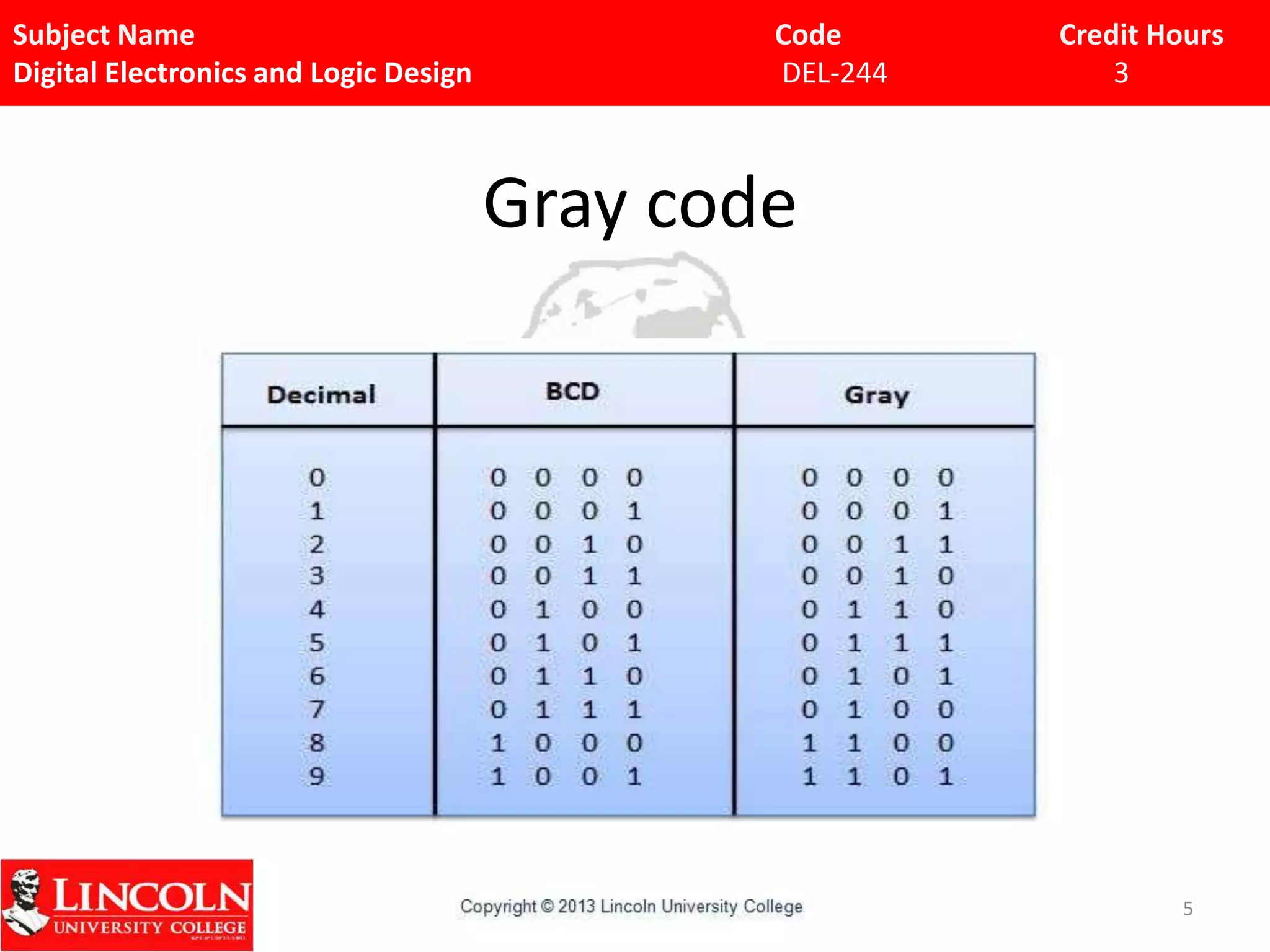
Gray code

5
Subject Name
Digital Electronics and Logic Design

•

•

•
•

Code
DEL-244

Credit Hours
3

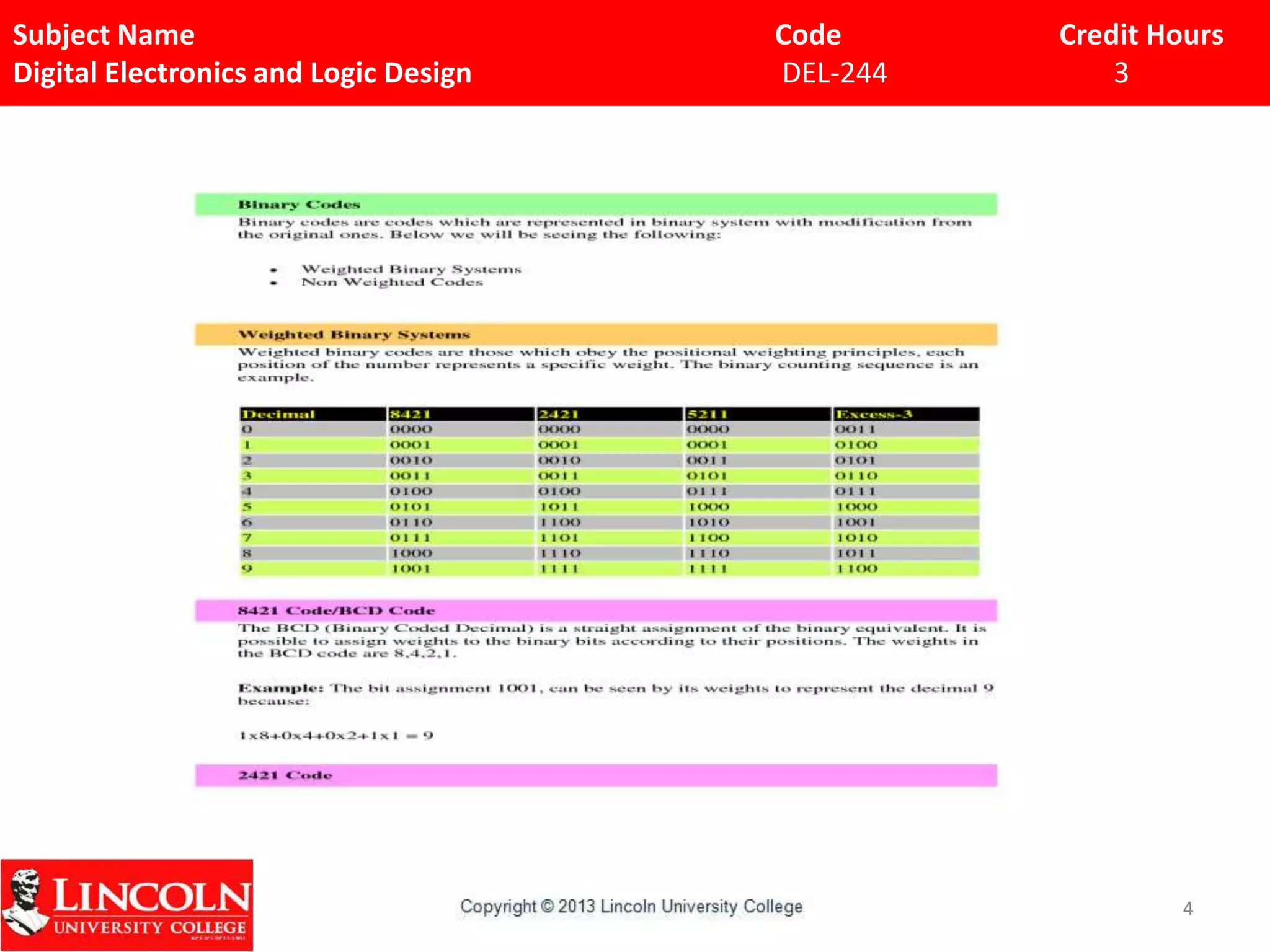
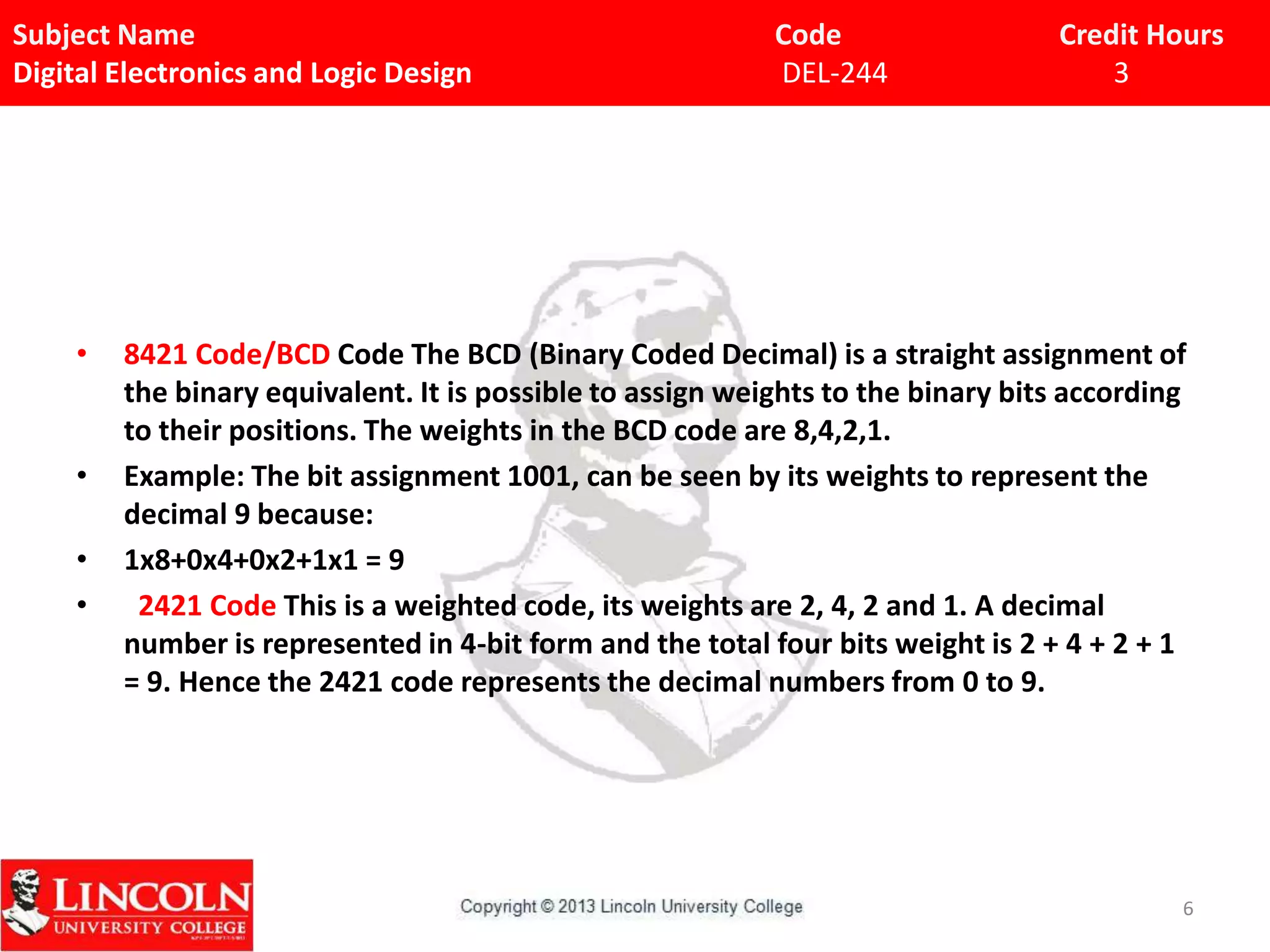
8421 Code/BCD Code The BCD (Binary Coded Decimal) is a straight assignment of
the binary equivalent. It is possible to assign weights to the binary bits according
to their positions. The weights in the BCD code are 8,4,2,1.
Example: The bit assignment 1001, can be seen by its weights to represent the
decimal 9 because:
1x8+0x4+0x2+1x1 = 9
2421 Code This is a weighted code, its weights are 2, 4, 2 and 1. A decimal
number is represented in 4-bit form and the total four bits weight is 2 + 4 + 2 + 1
= 9. Hence the 2421 code represents the decimal numbers from 0 to 9.

6
Subject Name
Digital Electronics and Logic Design

Code
DEL-244

Credit Hours
3

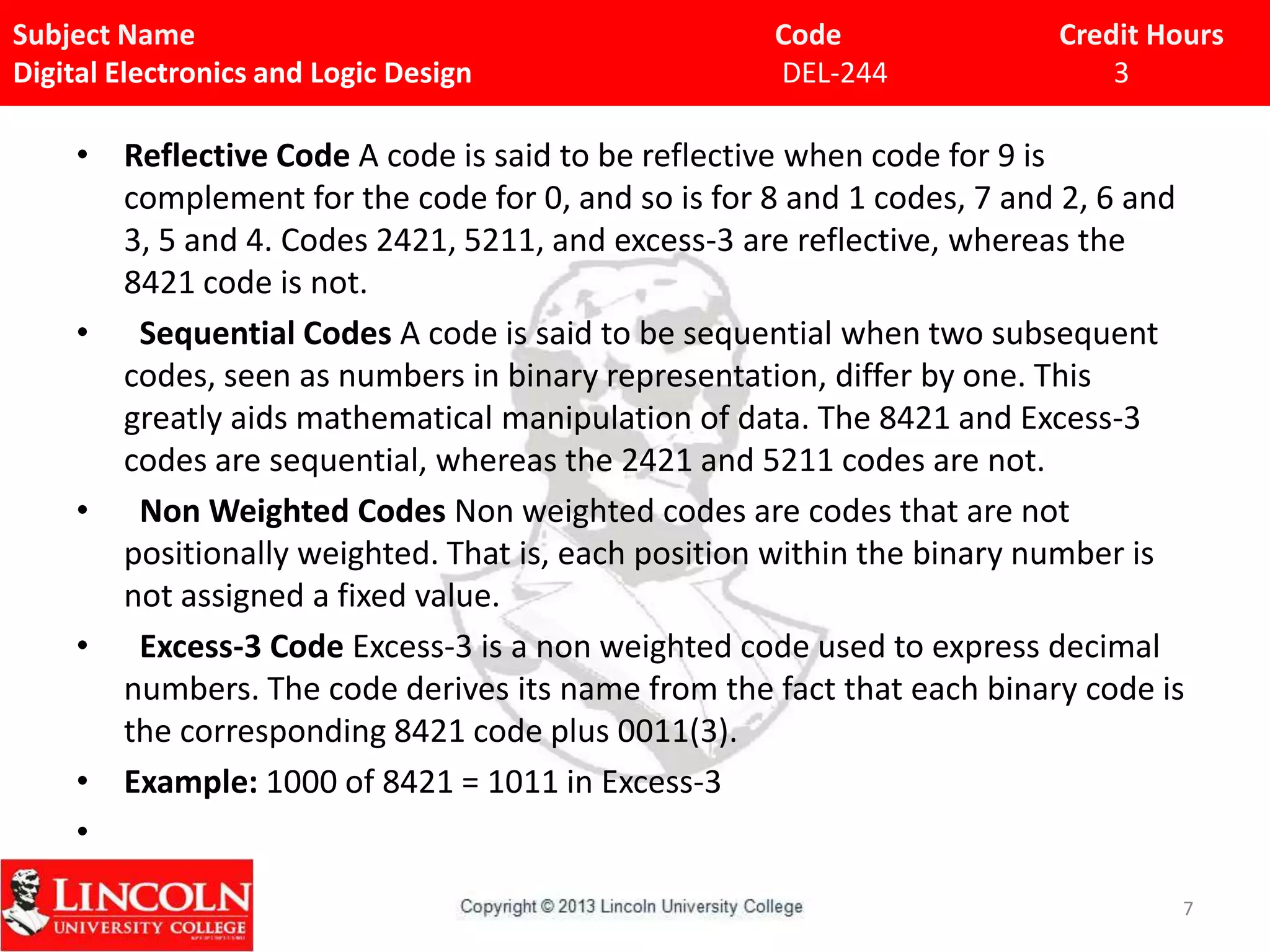
• Reflective Code A code is said to be reflective when code for 9 is
complement for the code for 0, and so is for 8 and 1 codes, 7 and 2, 6 and
3, 5 and 4. Codes 2421, 5211, and excess-3 are reflective, whereas the
8421 code is not.
• Sequential Codes A code is said to be sequential when two subsequent
codes, seen as numbers in binary representation, differ by one. This
greatly aids mathematical manipulation of data. The 8421 and Excess-3
codes are sequential, whereas the 2421 and 5211 codes are not.
• Non Weighted Codes Non weighted codes are codes that are not
positionally weighted. That is, each position within the binary number is
not assigned a fixed value.
• Excess-3 Code Excess-3 is a non weighted code used to express decimal
numbers. The code derives its name from the fact that each binary code is
the corresponding 8421 code plus 0011(3).
• Example: 1000 of 8421 = 1011 in Excess-3
•
7
Subject Name
Digital Electronics and Logic Design

•

Code
DEL-244

Credit Hours
3

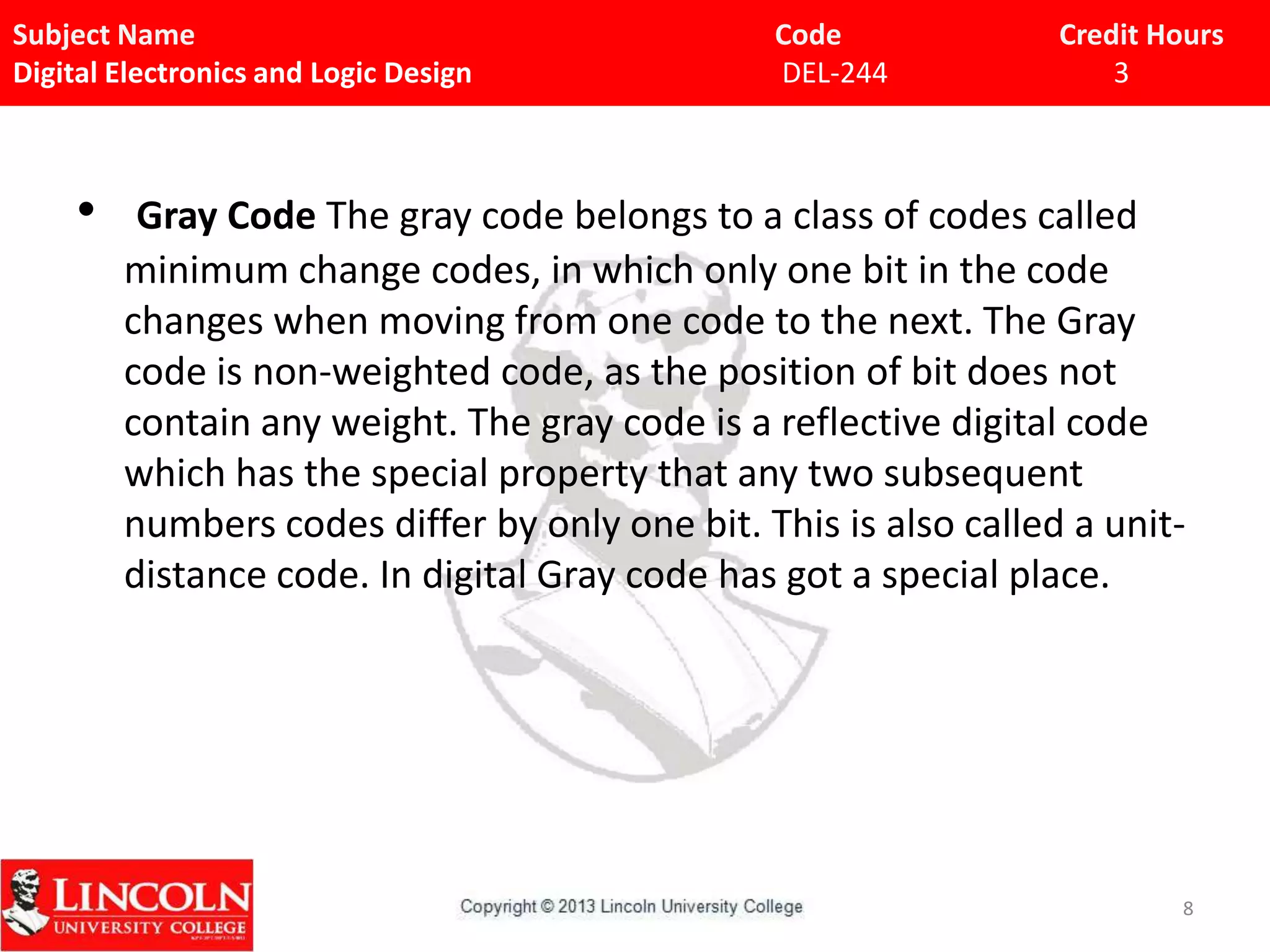
Gray Code The gray code belongs to a class of codes called
minimum change codes, in which only one bit in the code
changes when moving from one code to the next. The Gray
code is non-weighted code, as the position of bit does not
contain any weight. The gray code is a reflective digital code
which has the special property that any two subsequent
numbers codes differ by only one bit. This is also called a unitdistance code. In digital Gray code has got a special place.

8
Subject Name
Digital Electronics and Logic Design

Code
DEL-244

Credit Hours
3

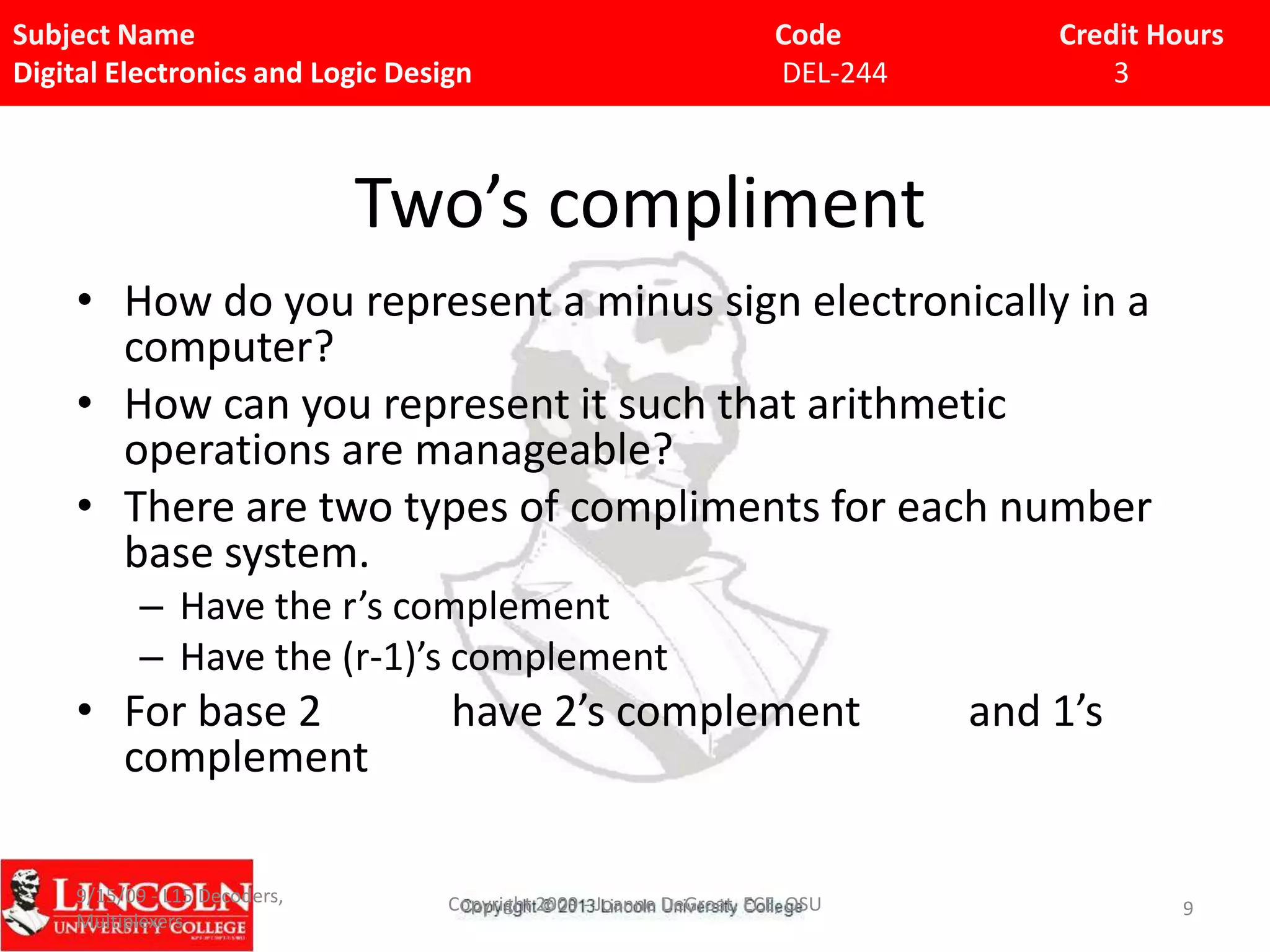
Two’s compliment
• How do you represent a minus sign electronically in a
computer?
• How can you represent it such that arithmetic
operations are manageable?
• There are two types of compliments for each number
base system.
– Have the r’s complement
– Have the (r-1)’s complement

• For base 2
complement

have 2’s complement

9/15/09 - L15 Decoders,
Multiplexers

Copyright 2009 - Joanne DeGroat, ECE, OSU

and 1’s

9
Subject Name
Digital Electronics and Logic Design

Code
DEL-244

Credit Hours
3

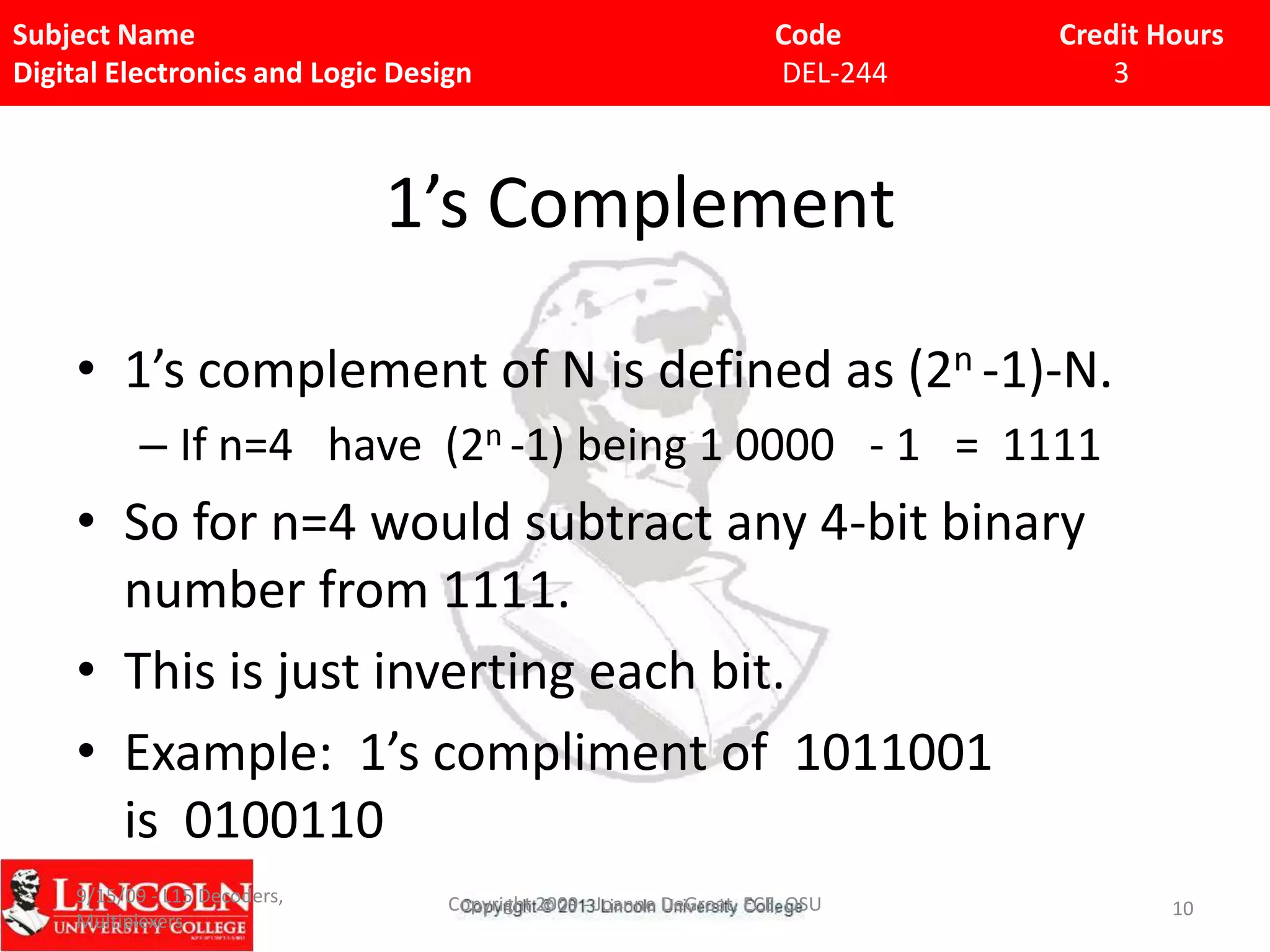
1’s Complement
• 1’s complement of N is defined as (2n -1)-N.
– If n=4 have (2n -1) being 1 0000 - 1 = 1111

• So for n=4 would subtract any 4-bit binary
number from 1111.
• This is just inverting each bit.
• Example: 1’s compliment of 1011001
is 0100110
9/15/09 - L15 Decoders,
Multiplexers

Copyright 2009 - Joanne DeGroat, ECE, OSU

10
Subject Name
Digital Electronics and Logic Design

Code
DEL-244

Credit Hours
3

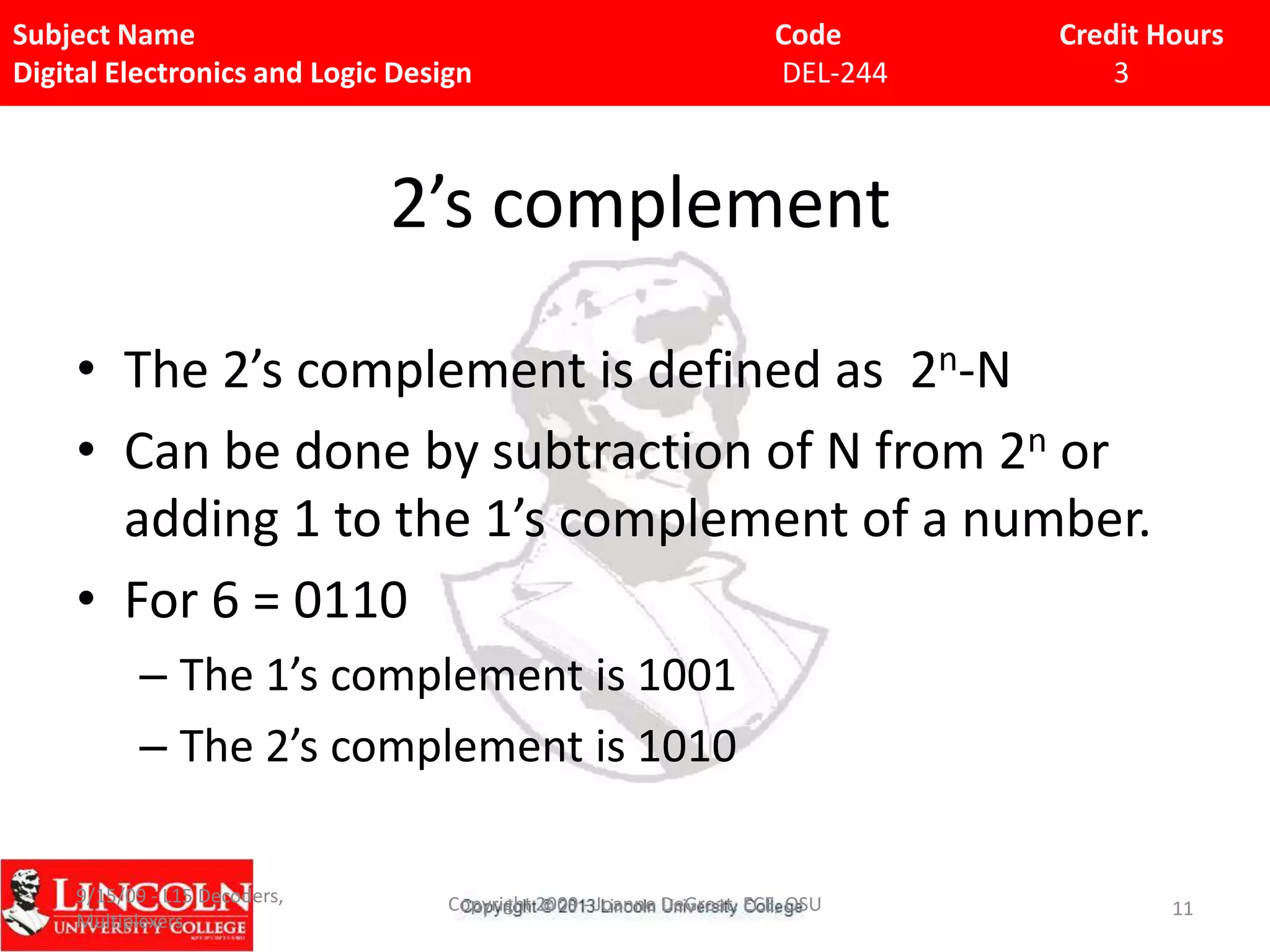
2’s complement
• The 2’s complement is defined as 2n-N
• Can be done by subtraction of N from 2n or
adding 1 to the 1’s complement of a number.
• For 6 = 0110
– The 1’s complement is 1001
– The 2’s complement is 1010
9/15/09 - L15 Decoders,
Multiplexers

Copyright 2009 - Joanne DeGroat, ECE, OSU

11
Subject Name
Digital Electronics and Logic Design

Code
DEL-244

Credit Hours
3

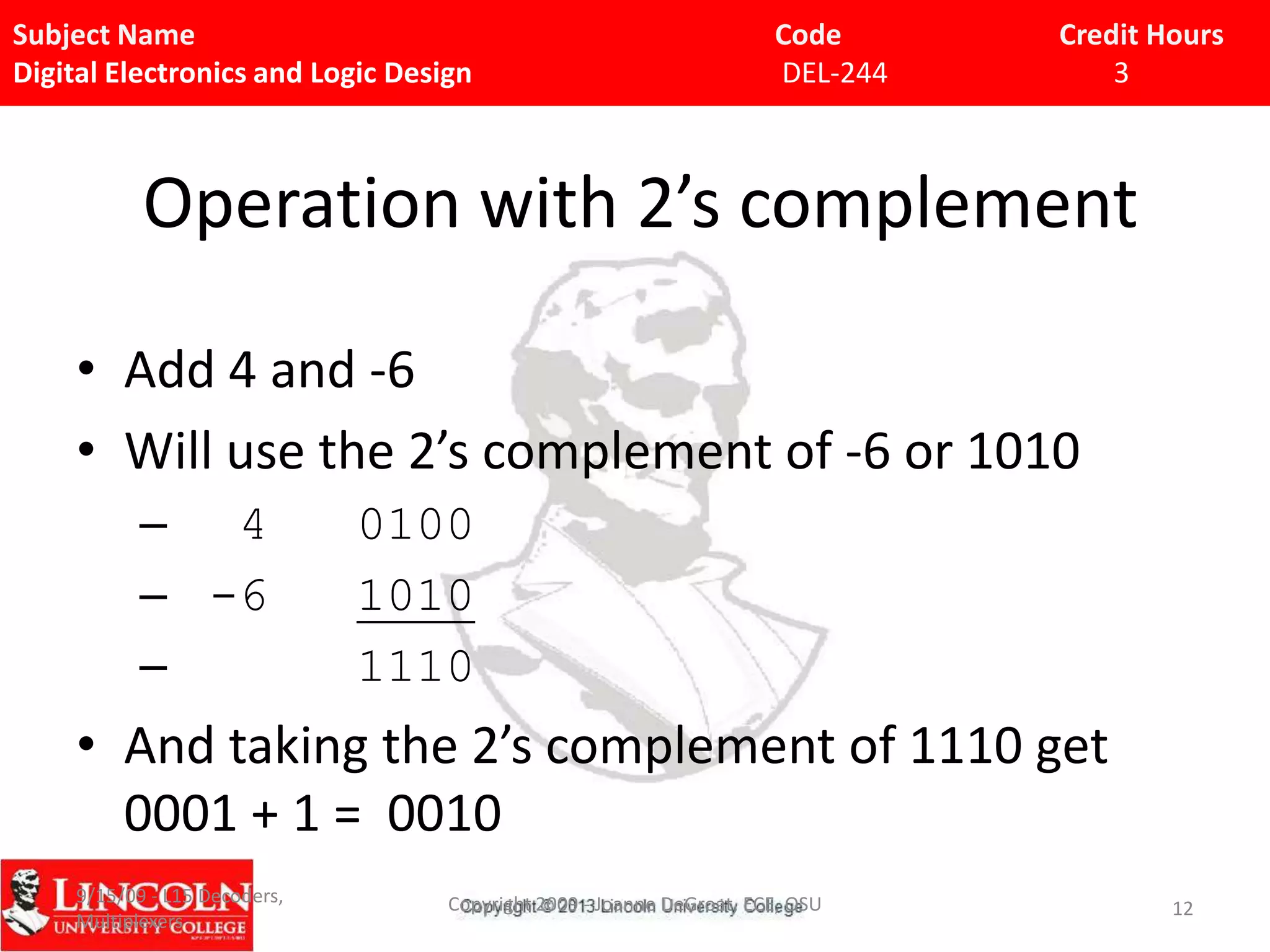
Operation with 2’s complement
• Add 4 and -6
• Will use the 2’s complement of -6 or 1010
– 4
– -6
–

0100
1010
1110

• And taking the 2’s complement of 1110 get
0001 + 1 = 0010
9/15/09 - L15 Decoders,
Multiplexers

Copyright 2009 - Joanne DeGroat, ECE, OSU

12

Chap ii.BCD code,Gray code

  • 1.
    Subject Name Digital Electronicsand Logic Design Code DEL-244 Digital Electronics and Logic Design Credit Hours 3
  • 2.
    Subject Name Digital Electronicsand Logic Design Code DEL-244 Credit Hours 3 Binary codes • Binary codes are codes which are represented in binary system with modification from the original ones. Below we will be seeing the following: • Weighted Binary Systems • Non Weighted Codes 2
  • 3.
    Subject Name Digital Electronicsand Logic Design Code DEL-244 Credit Hours 3 Weighted Binary Systems • Weighted Binary Systems Weighted binary codes are those which obey the positional weighting principles, each position of the number represents a specific weight. The binary counting sequence is an example. 3
  • 4.
    Subject Name Digital Electronicsand Logic Design Code DEL-244 Credit Hours 3 4
  • 5.
    Subject Name Digital Electronicsand Logic Design Code DEL-244 Credit Hours 3 Gray code 5
  • 6.
    Subject Name Digital Electronicsand Logic Design • • • • Code DEL-244 Credit Hours 3 8421 Code/BCD Code The BCD (Binary Coded Decimal) is a straight assignment of the binary equivalent. It is possible to assign weights to the binary bits according to their positions. The weights in the BCD code are 8,4,2,1. Example: The bit assignment 1001, can be seen by its weights to represent the decimal 9 because: 1x8+0x4+0x2+1x1 = 9 2421 Code This is a weighted code, its weights are 2, 4, 2 and 1. A decimal number is represented in 4-bit form and the total four bits weight is 2 + 4 + 2 + 1 = 9. Hence the 2421 code represents the decimal numbers from 0 to 9. 6
  • 7.
    Subject Name Digital Electronicsand Logic Design Code DEL-244 Credit Hours 3 • Reflective Code A code is said to be reflective when code for 9 is complement for the code for 0, and so is for 8 and 1 codes, 7 and 2, 6 and 3, 5 and 4. Codes 2421, 5211, and excess-3 are reflective, whereas the 8421 code is not. • Sequential Codes A code is said to be sequential when two subsequent codes, seen as numbers in binary representation, differ by one. This greatly aids mathematical manipulation of data. The 8421 and Excess-3 codes are sequential, whereas the 2421 and 5211 codes are not. • Non Weighted Codes Non weighted codes are codes that are not positionally weighted. That is, each position within the binary number is not assigned a fixed value. • Excess-3 Code Excess-3 is a non weighted code used to express decimal numbers. The code derives its name from the fact that each binary code is the corresponding 8421 code plus 0011(3). • Example: 1000 of 8421 = 1011 in Excess-3 • 7
  • 8.
    Subject Name Digital Electronicsand Logic Design • Code DEL-244 Credit Hours 3 Gray Code The gray code belongs to a class of codes called minimum change codes, in which only one bit in the code changes when moving from one code to the next. The Gray code is non-weighted code, as the position of bit does not contain any weight. The gray code is a reflective digital code which has the special property that any two subsequent numbers codes differ by only one bit. This is also called a unitdistance code. In digital Gray code has got a special place. 8
  • 9.
    Subject Name Digital Electronicsand Logic Design Code DEL-244 Credit Hours 3 Two’s compliment • How do you represent a minus sign electronically in a computer? • How can you represent it such that arithmetic operations are manageable? • There are two types of compliments for each number base system. – Have the r’s complement – Have the (r-1)’s complement • For base 2 complement have 2’s complement 9/15/09 - L15 Decoders, Multiplexers Copyright 2009 - Joanne DeGroat, ECE, OSU and 1’s 9
  • 10.
    Subject Name Digital Electronicsand Logic Design Code DEL-244 Credit Hours 3 1’s Complement • 1’s complement of N is defined as (2n -1)-N. – If n=4 have (2n -1) being 1 0000 - 1 = 1111 • So for n=4 would subtract any 4-bit binary number from 1111. • This is just inverting each bit. • Example: 1’s compliment of 1011001 is 0100110 9/15/09 - L15 Decoders, Multiplexers Copyright 2009 - Joanne DeGroat, ECE, OSU 10
  • 11.
    Subject Name Digital Electronicsand Logic Design Code DEL-244 Credit Hours 3 2’s complement • The 2’s complement is defined as 2n-N • Can be done by subtraction of N from 2n or adding 1 to the 1’s complement of a number. • For 6 = 0110 – The 1’s complement is 1001 – The 2’s complement is 1010 9/15/09 - L15 Decoders, Multiplexers Copyright 2009 - Joanne DeGroat, ECE, OSU 11
  • 12.
    Subject Name Digital Electronicsand Logic Design Code DEL-244 Credit Hours 3 Operation with 2’s complement • Add 4 and -6 • Will use the 2’s complement of -6 or 1010 – 4 – -6 – 0100 1010 1110 • And taking the 2’s complement of 1110 get 0001 + 1 = 0010 9/15/09 - L15 Decoders, Multiplexers Copyright 2009 - Joanne DeGroat, ECE, OSU 12