REVIEW:DIGITALTRANSMISSIONOFANALOG SIGNALS
• 1. BANDWIDTH REQUIREMENT OF PCM
• 2. Disadvantages of DM
• 3. ADM
• TDM
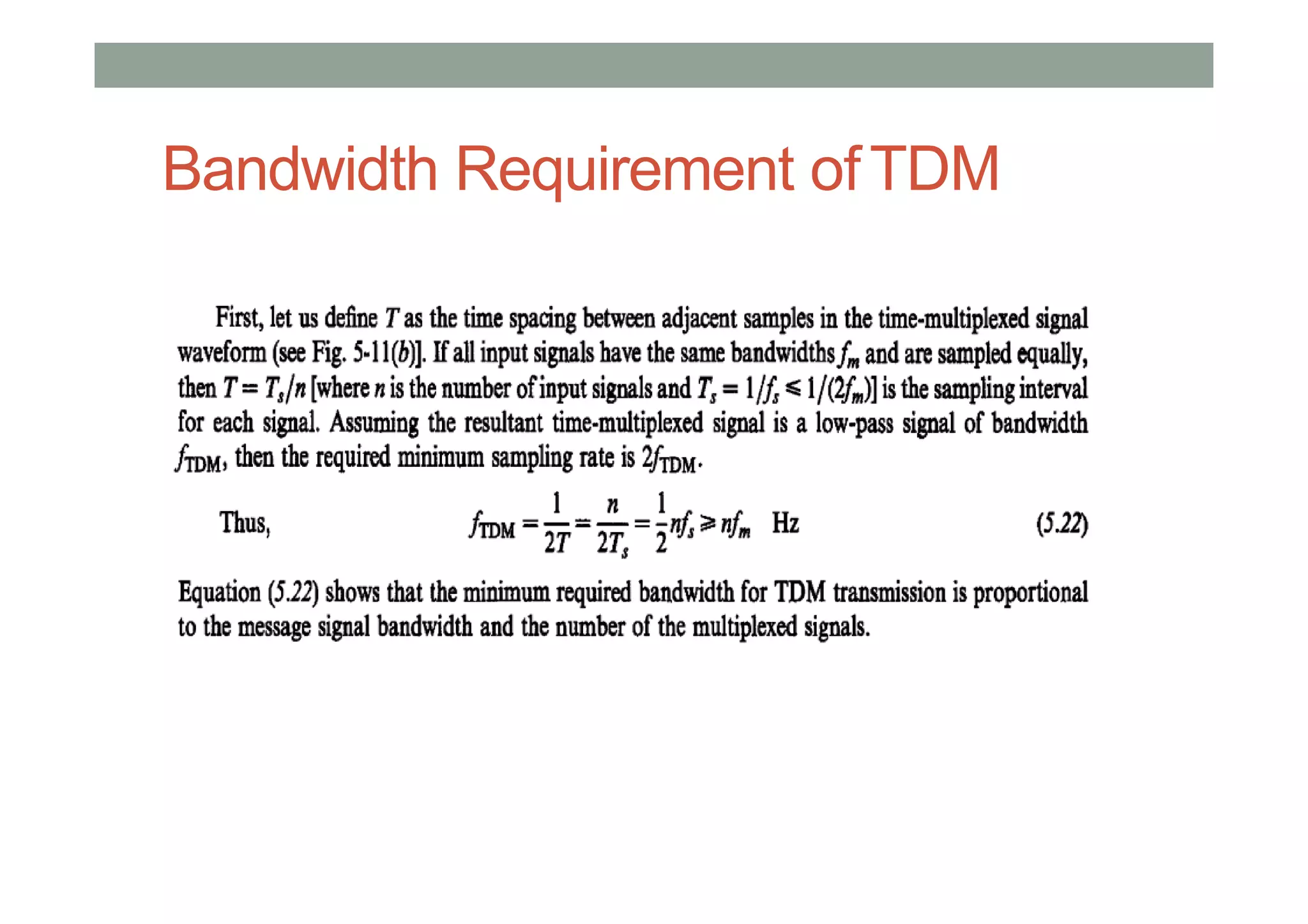
• BANDWIDTH OF TDM
• TRANSMISSION MODES
1. BANDWIDTH REQUIREMENT
OF PCM
Bandwidth Requirement of PCM
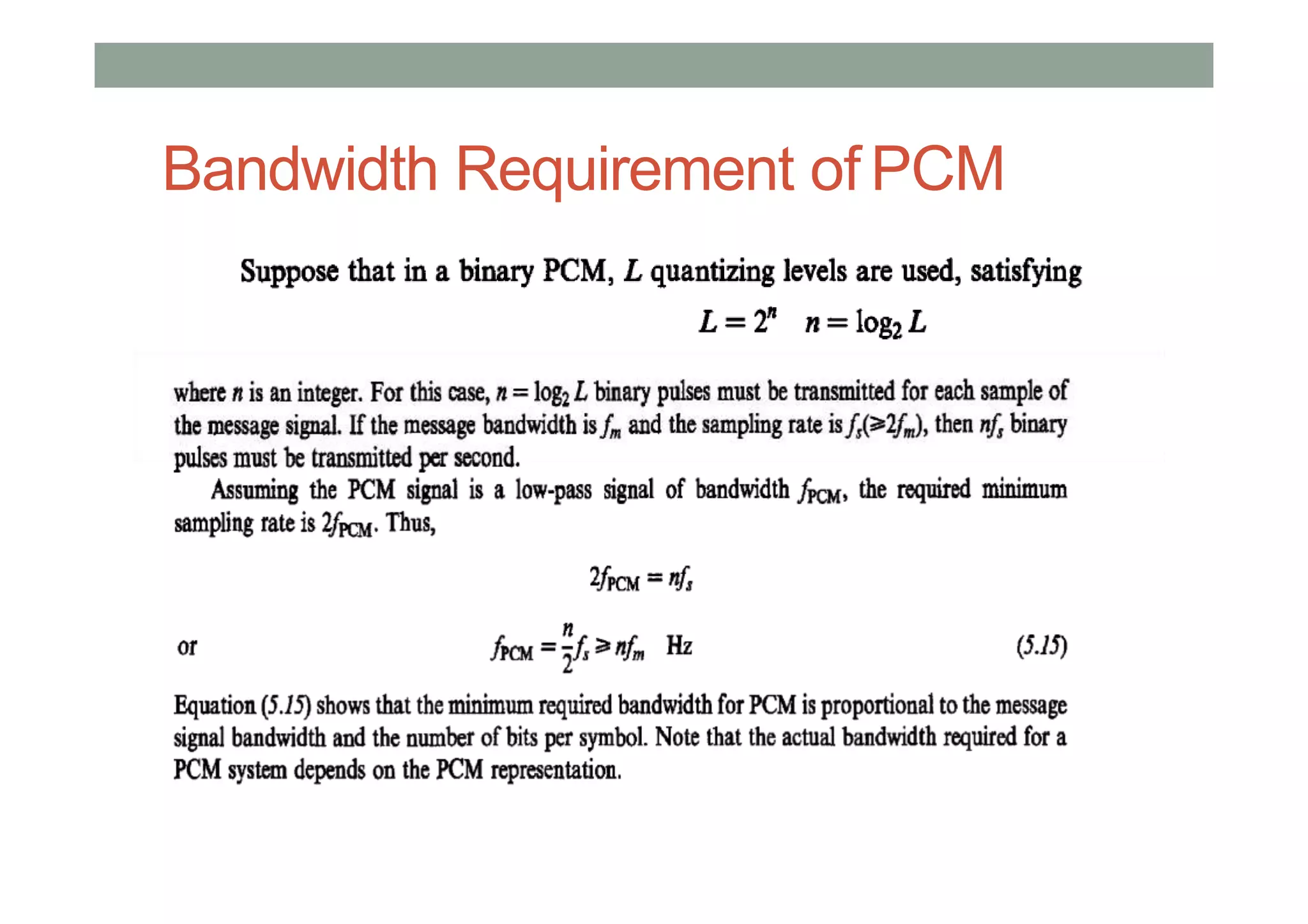
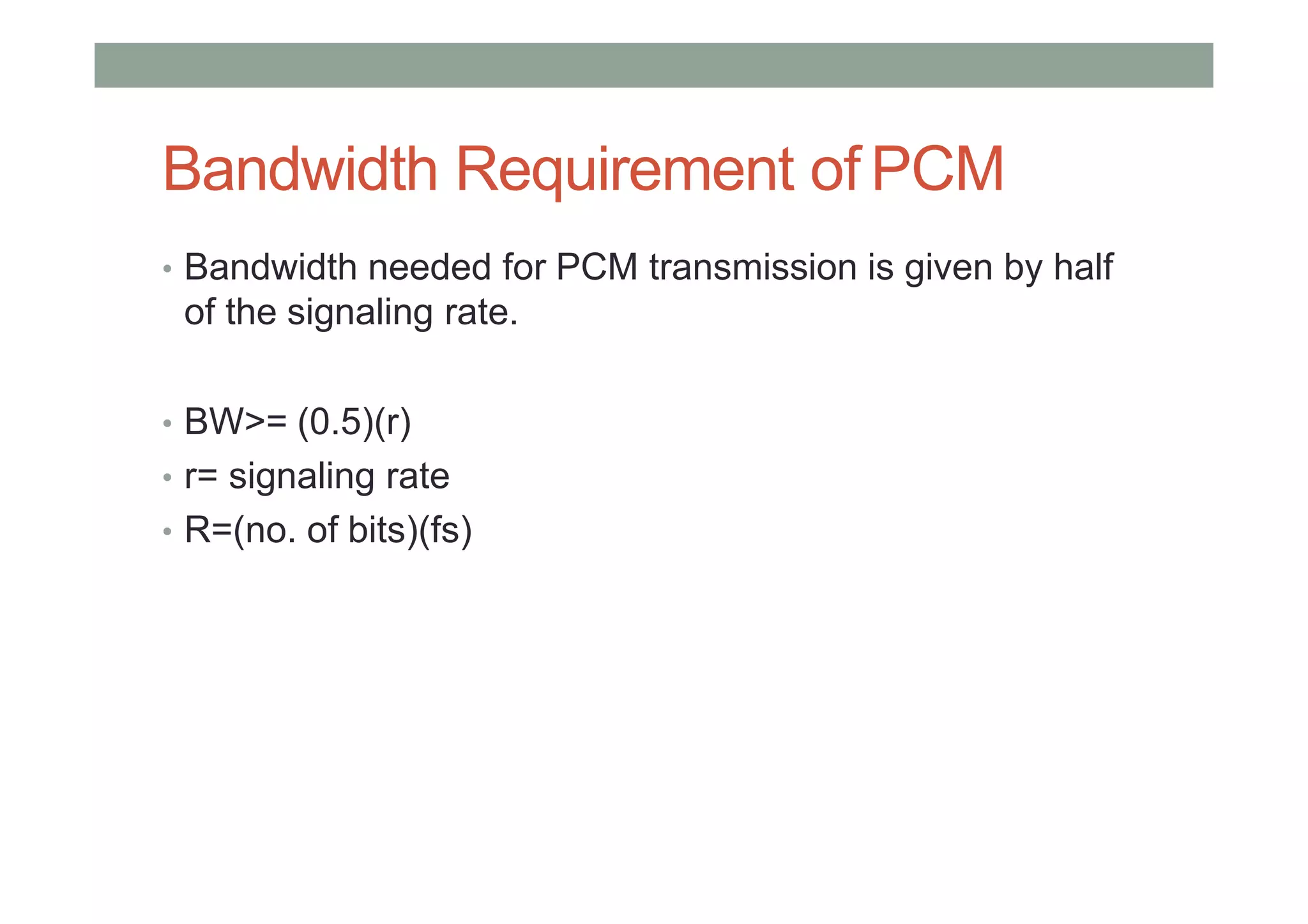
• Bandwidth needed for PCM transmission is given by half
of the signaling rate.
• BW>= (0.5)(r)
• r= signaling rate
• R=(no. of bits)(fs)
Noise consideration inPCM
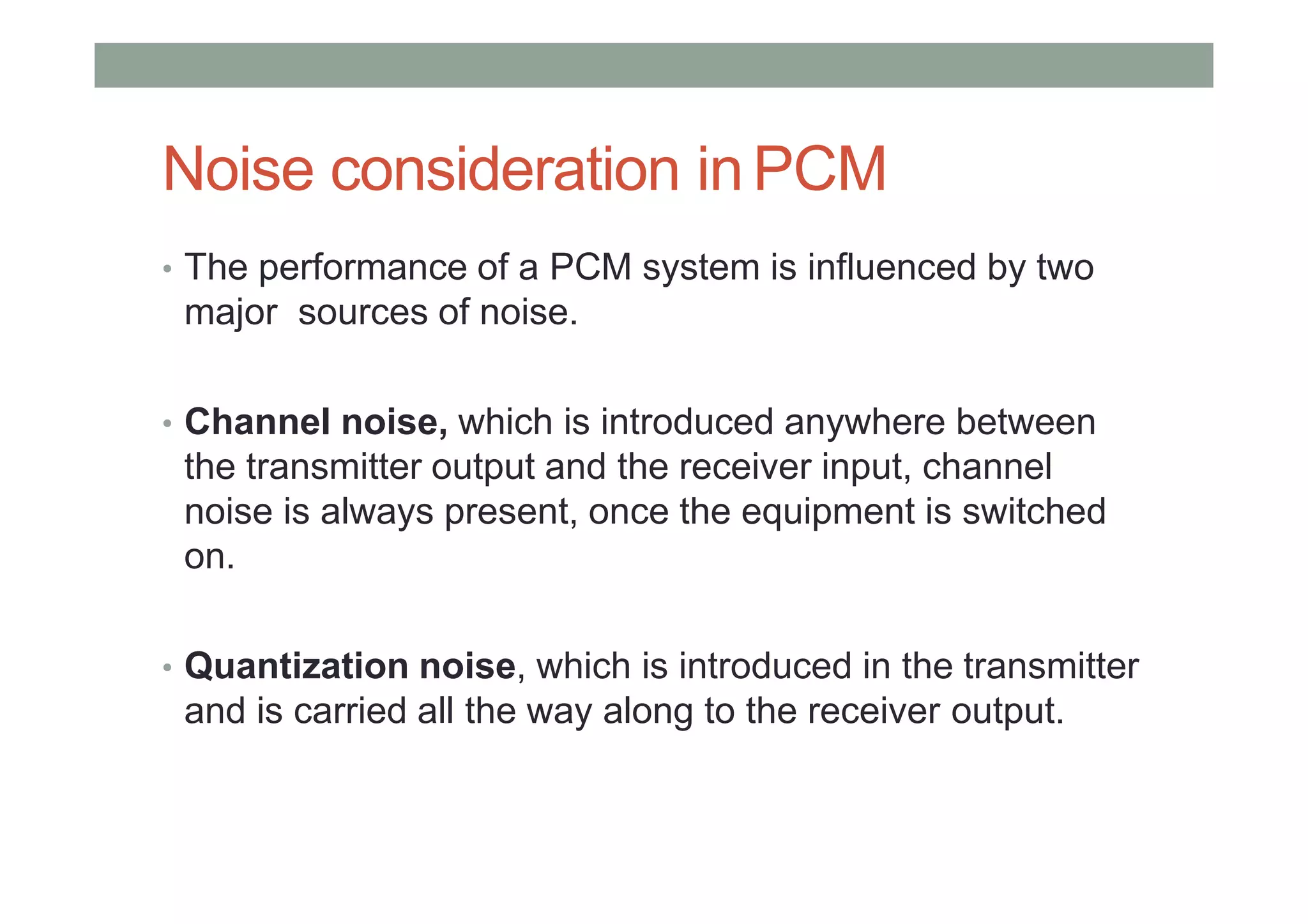
• The performance of a PCM system is influenced by two
major sources of noise.
• Channel noise, which is introduced anywhere between
the transmitter output and the receiver input, channel
noise is always present, once the equipment is switched
on.
• Quantization noise, which is introduced in the transmitter
and is carried all the way along to the receiver output.
Quantization noise
DPCM
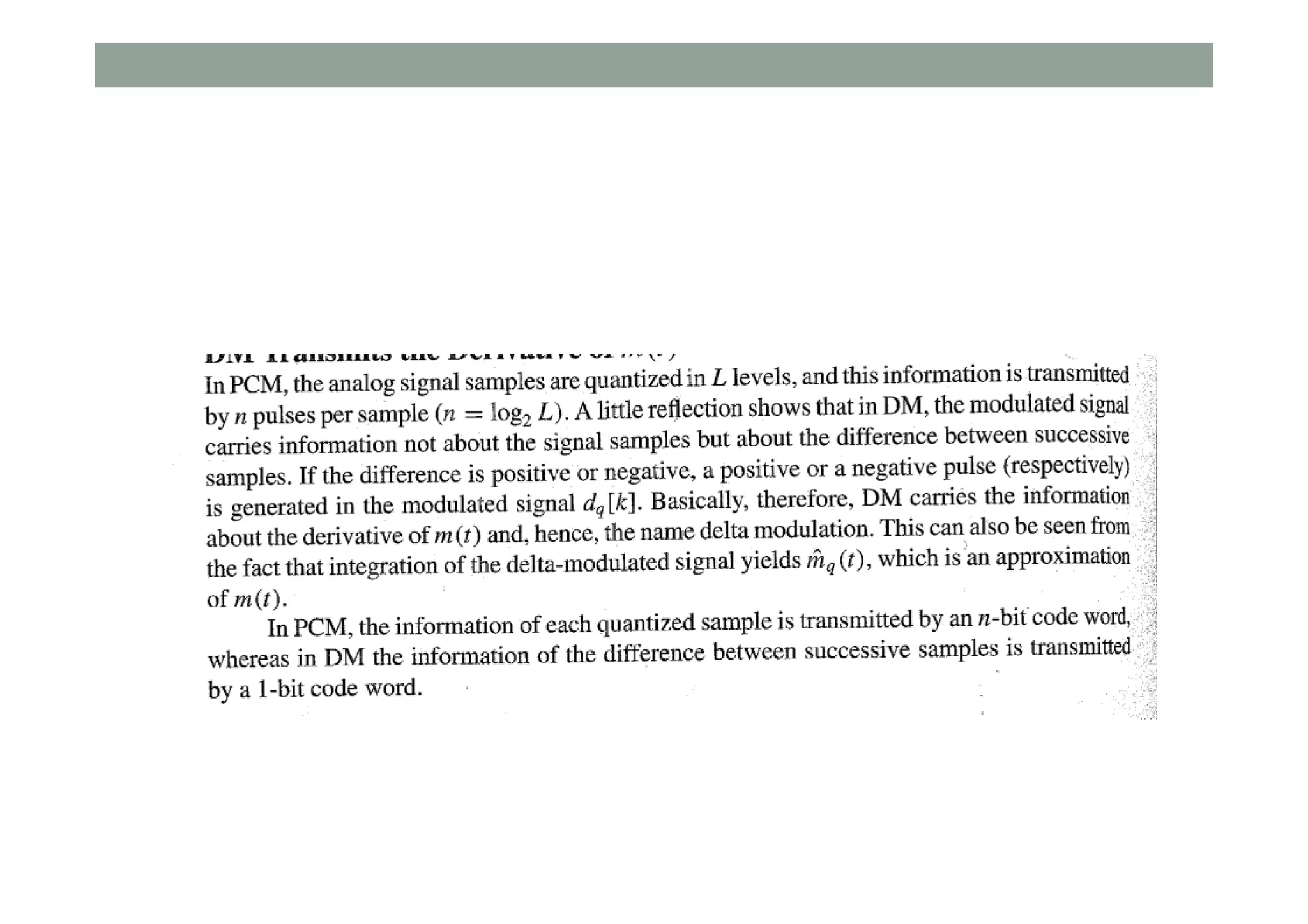
• Delta modulation, a special case of DPCM where the
differences eQ[n] are represented with 1 bit as ±∆
2. REVIEW OF DMAND ITS
DISADVANTES
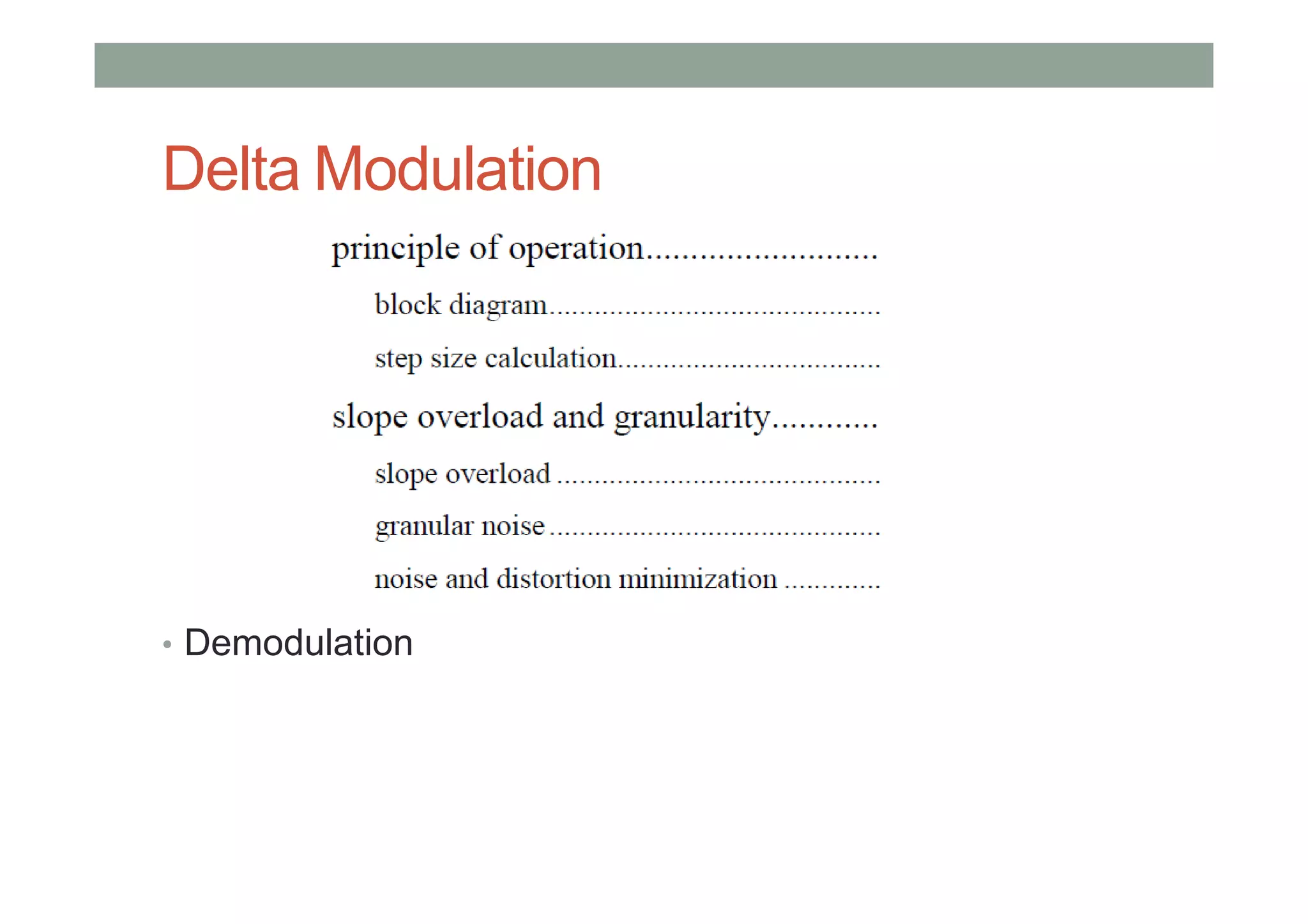
Delta Modulation
• Demodulation
Delta Modulation
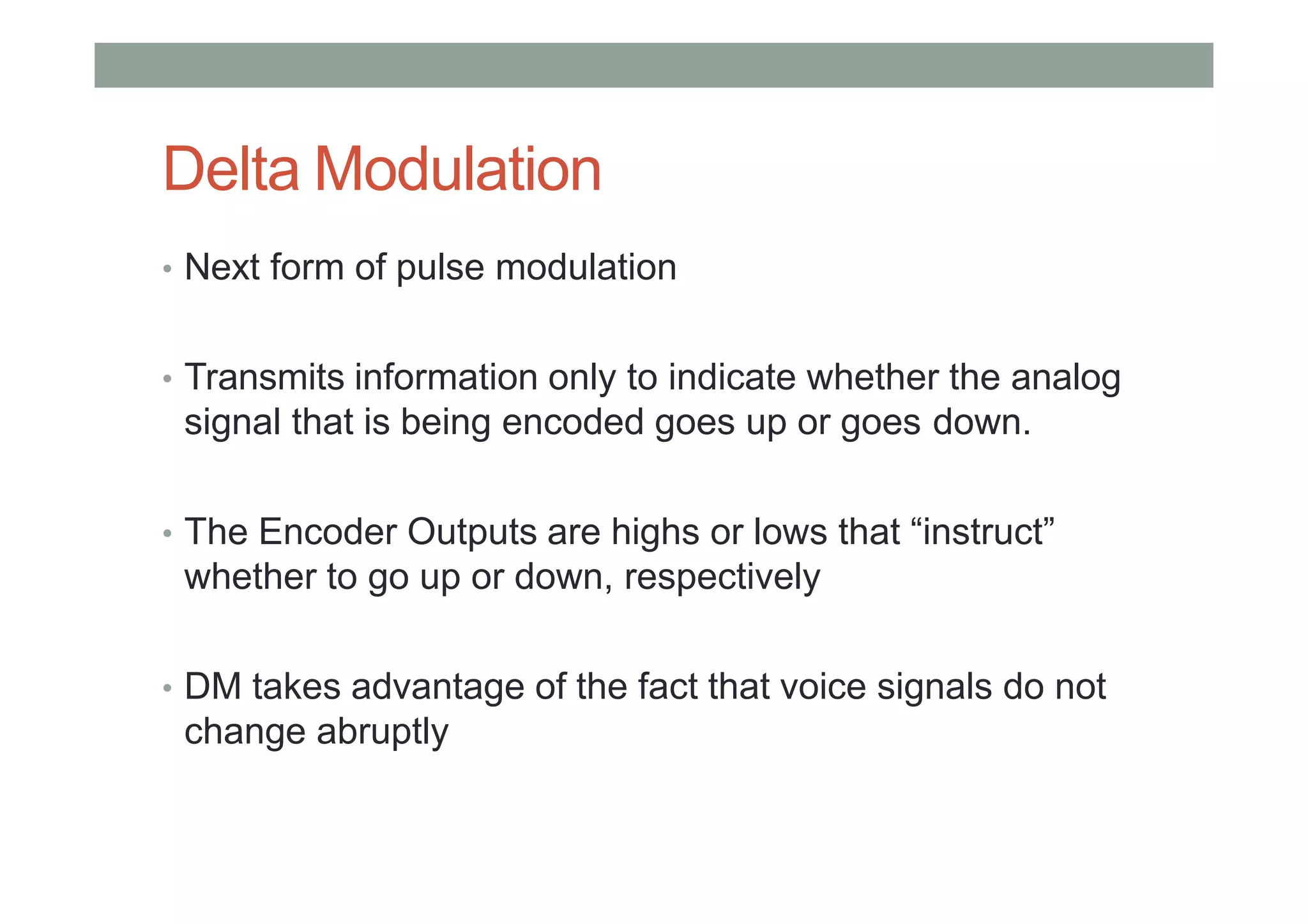
• Next form of pulse modulation
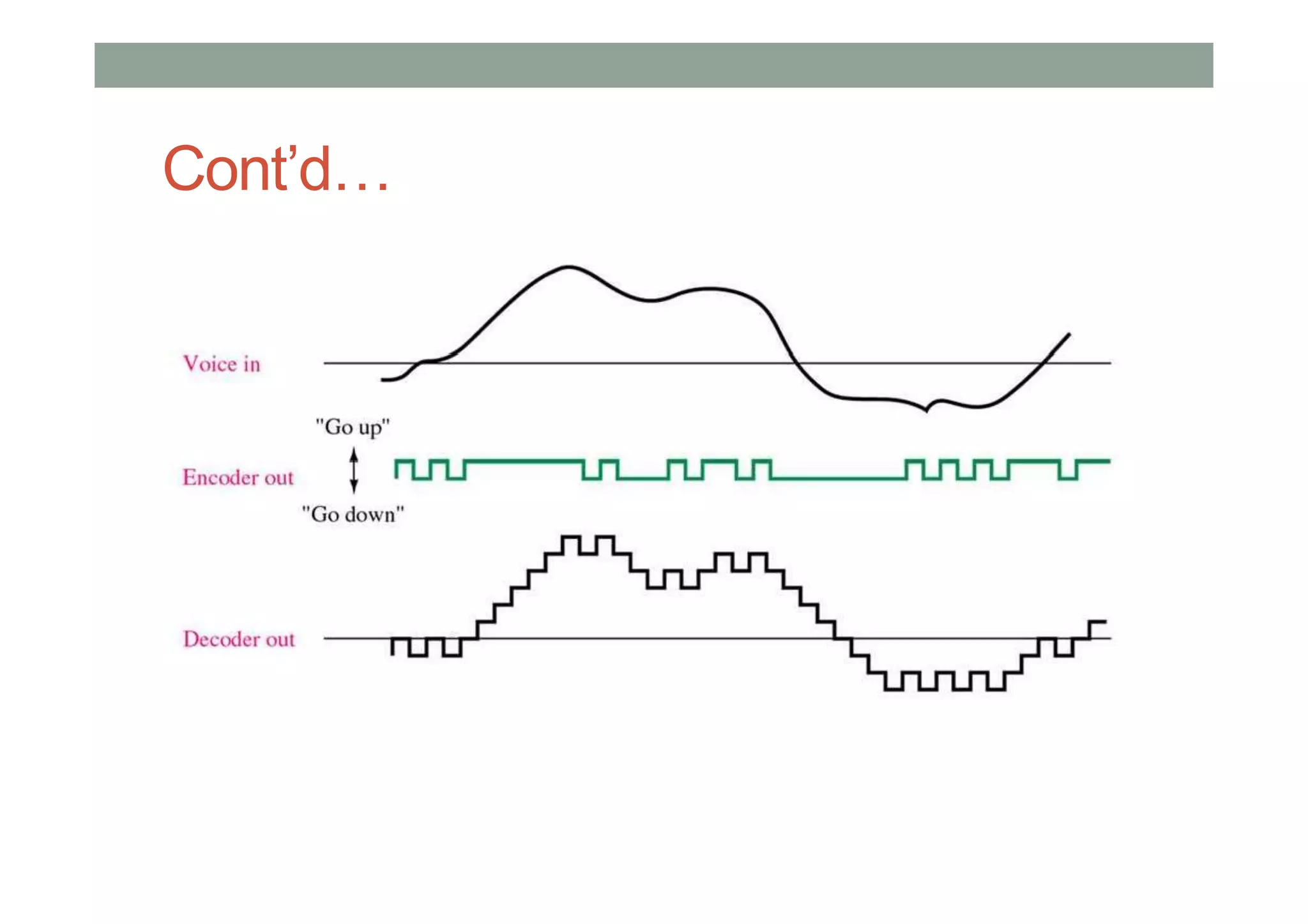
• Transmits information only to indicate whether the analog
signal that is being encoded goes up or goes down.
• The Encoder Outputs are highs or lows that “instruct”
whether to go up or down, respectively
• DM takes advantage of the fact that voice signals do not
change abruptly
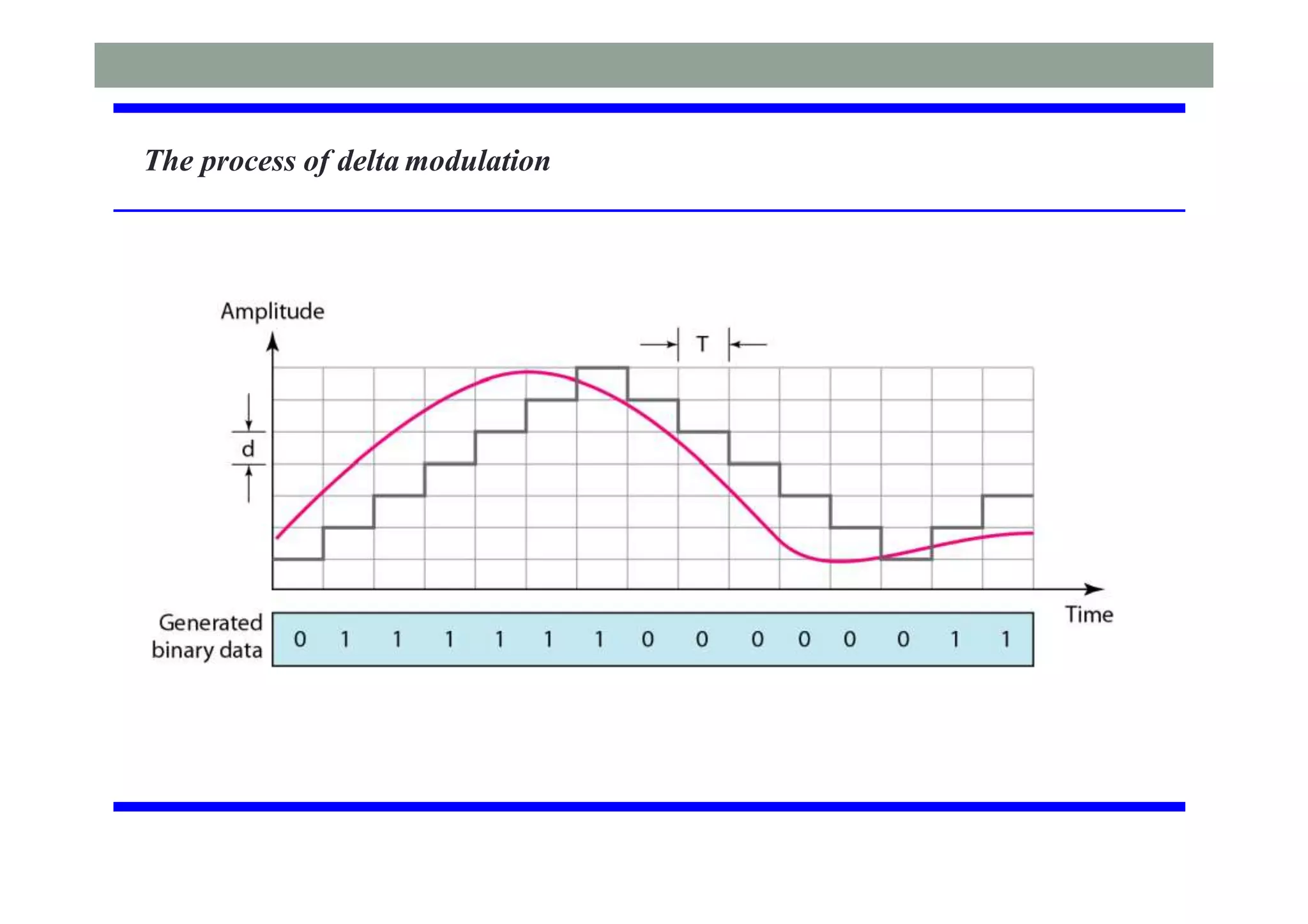
The process of delta modulation
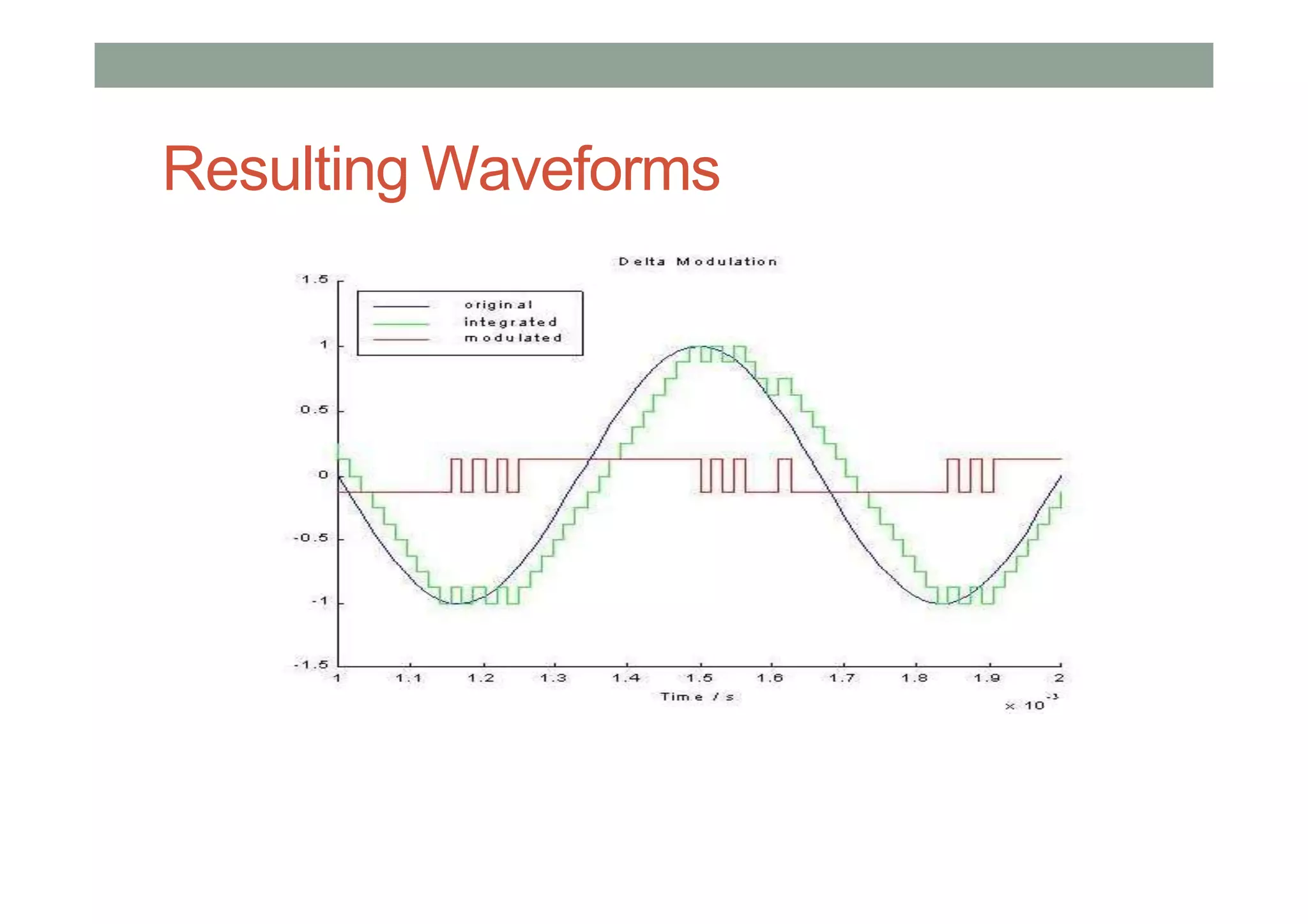
Resulting Waveforms
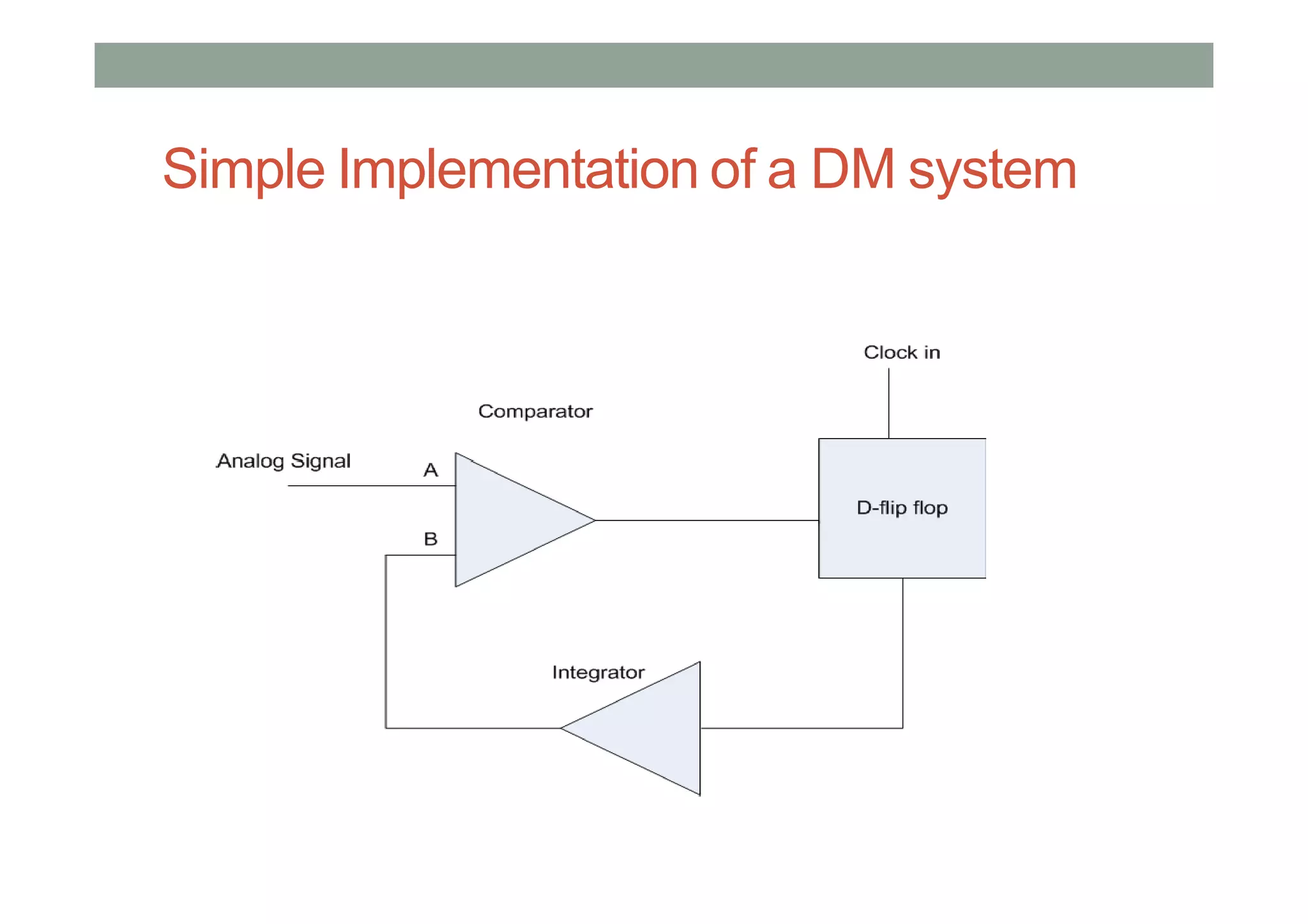
Simple Implementation of a DM system
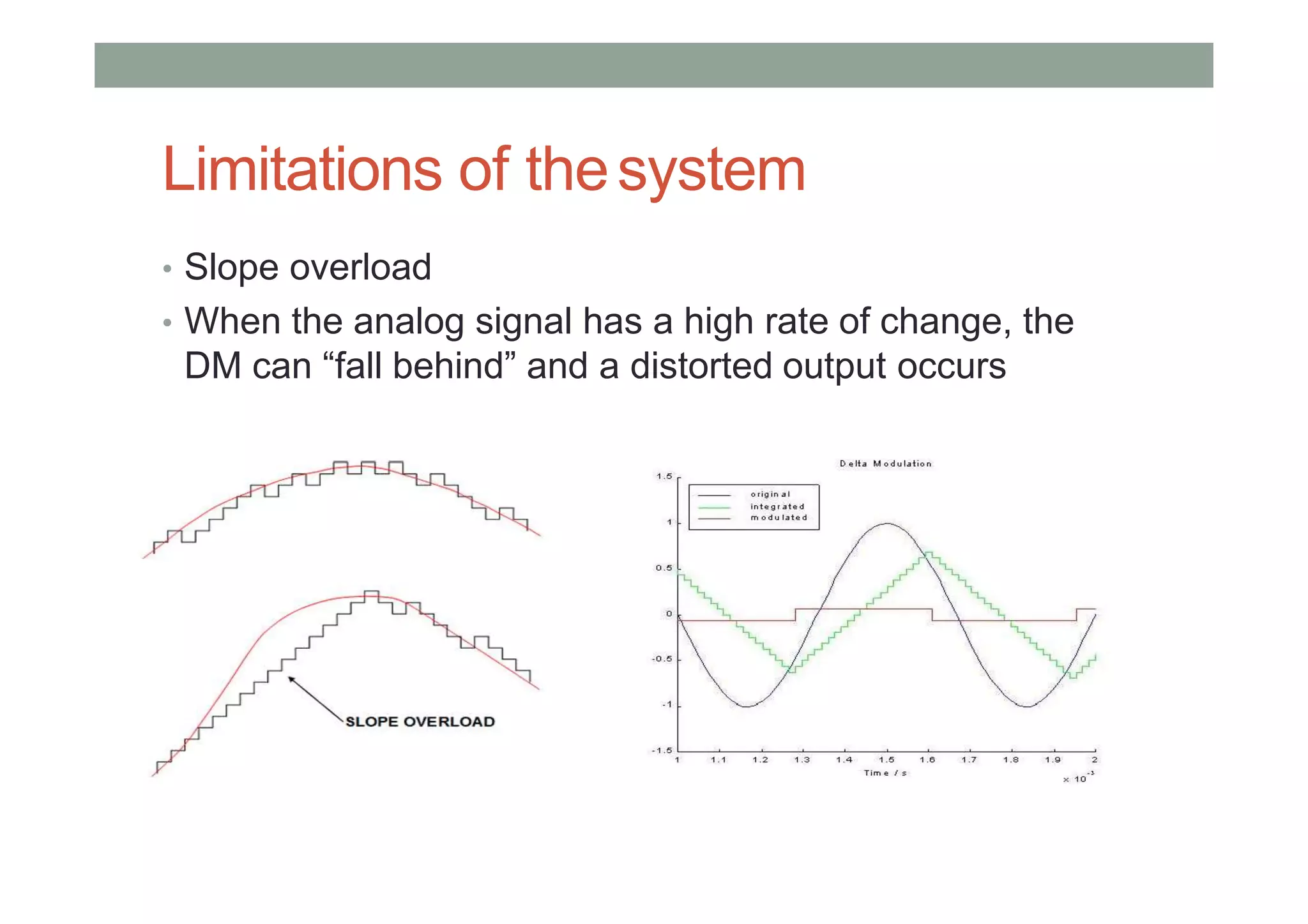
Limitations of thesystem
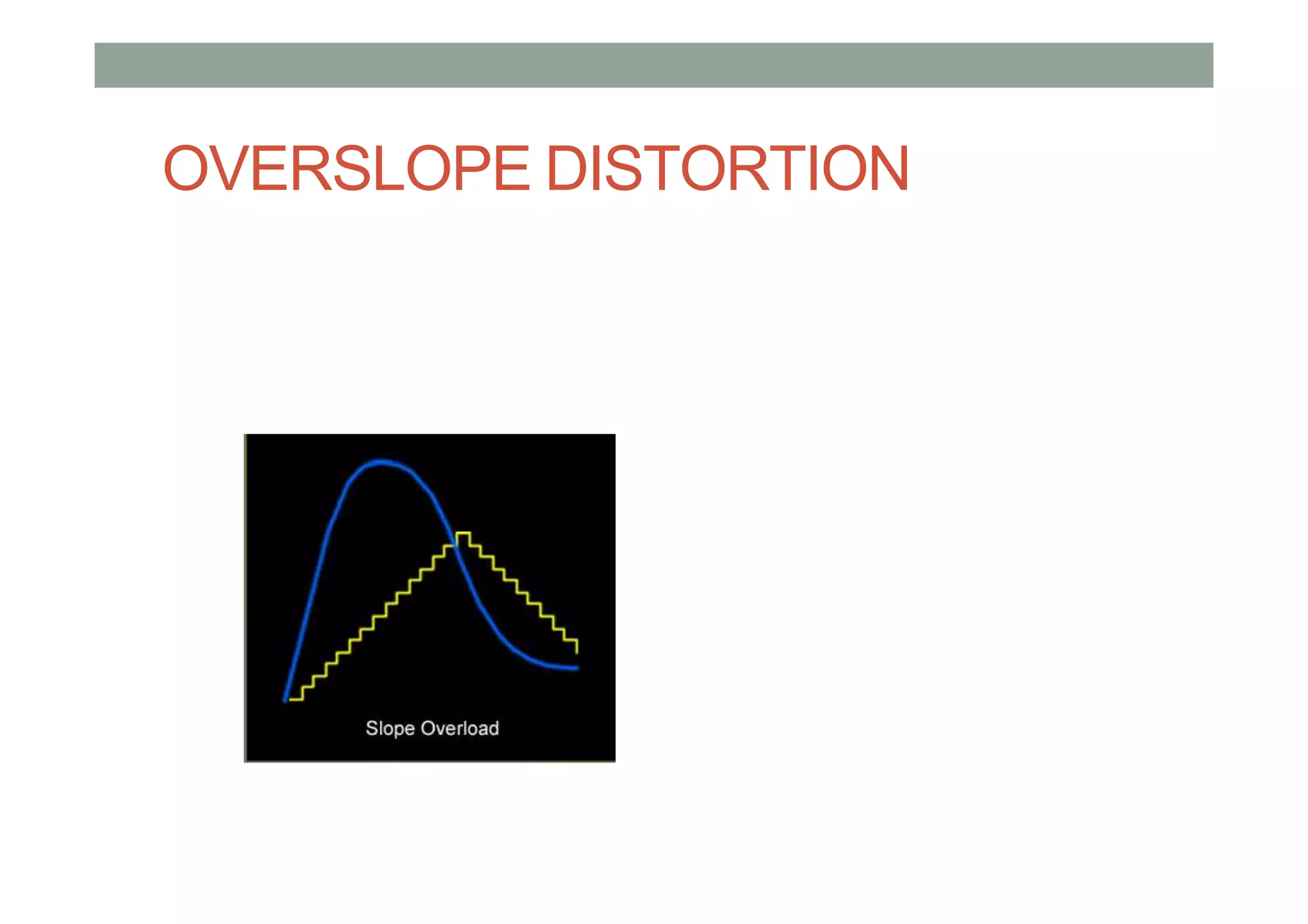
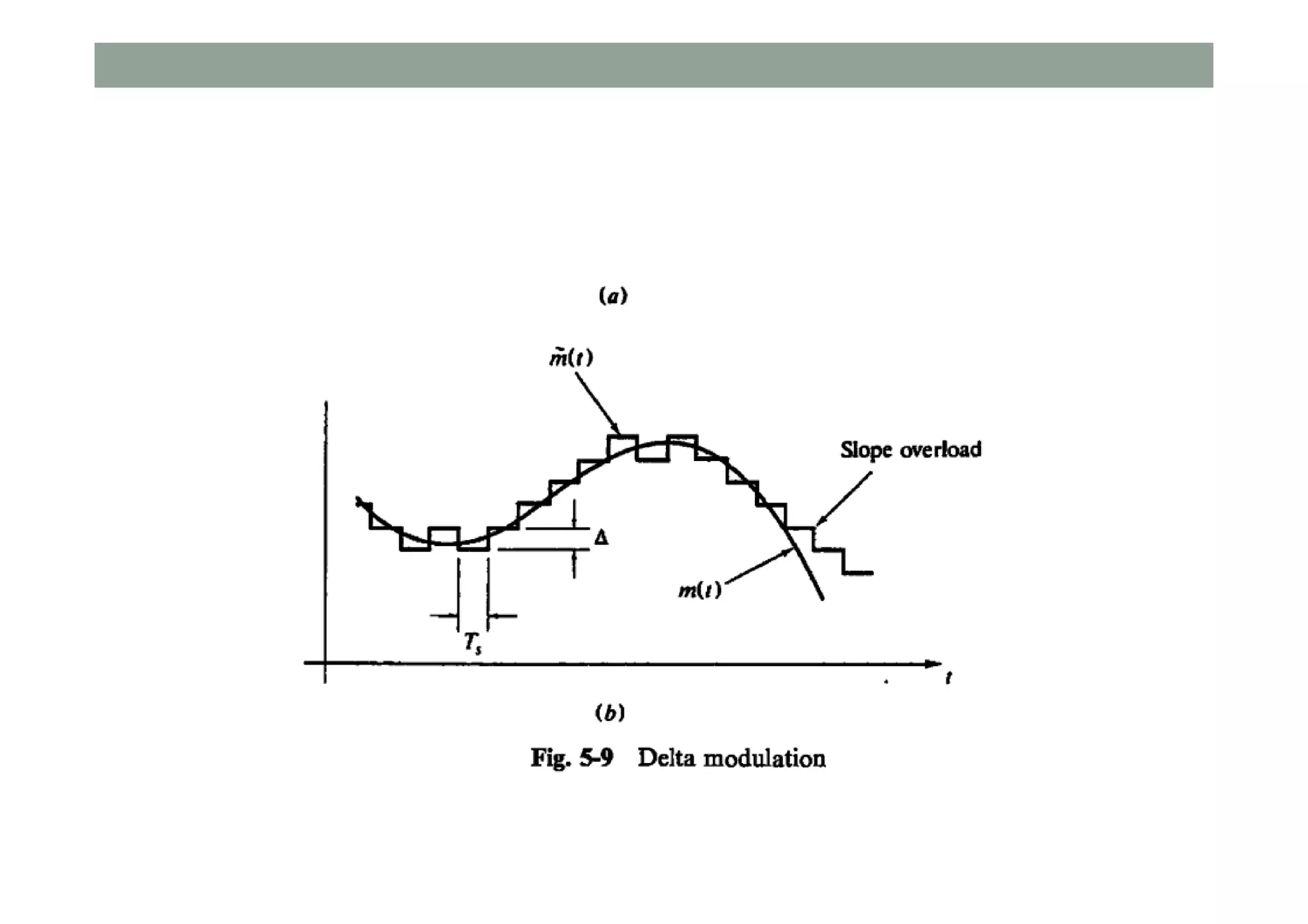
• Slope overload
• When the analog signal has a high rate of change, the
DM can “fall behind” and a distorted output occurs
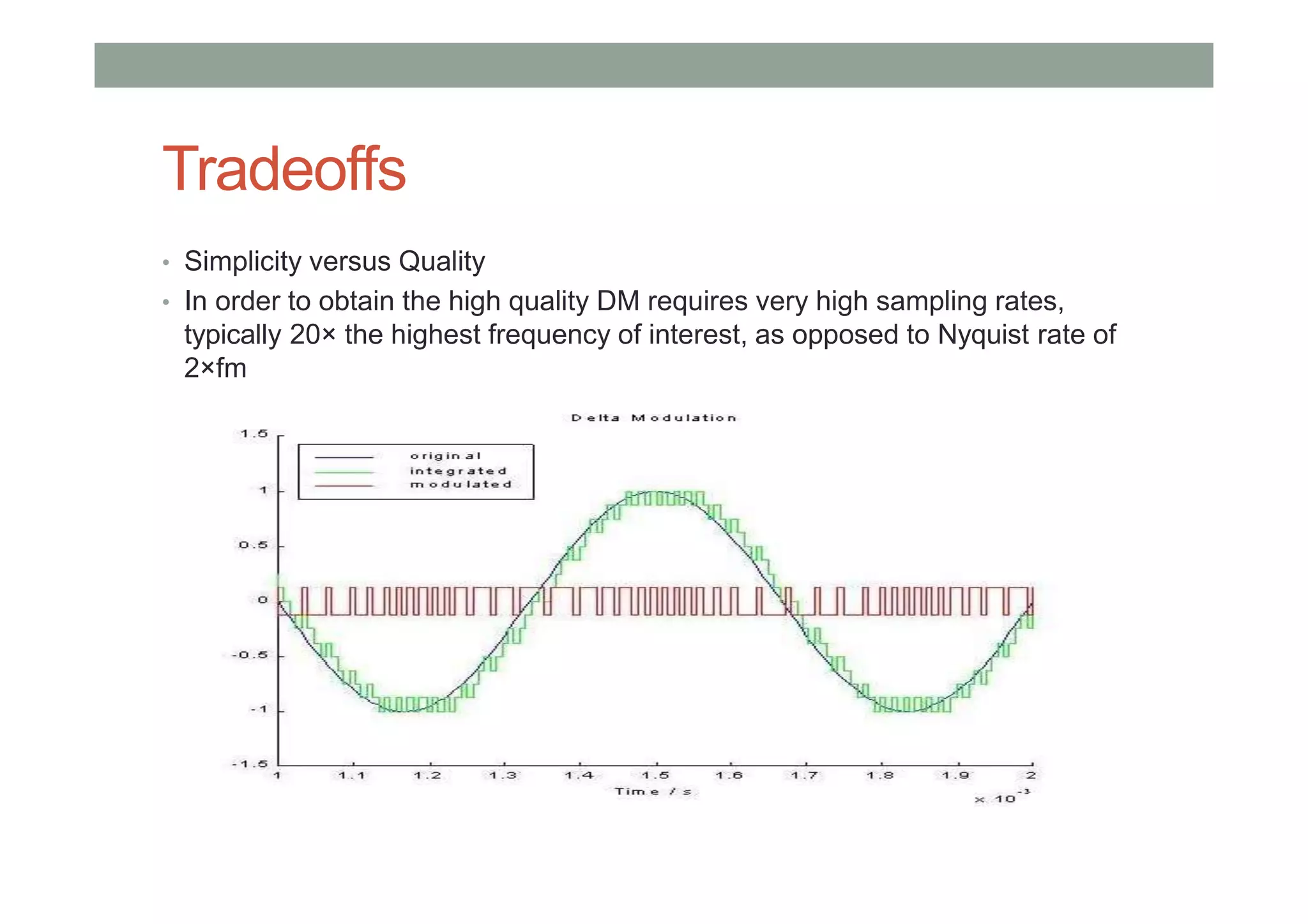
Tradeoffs
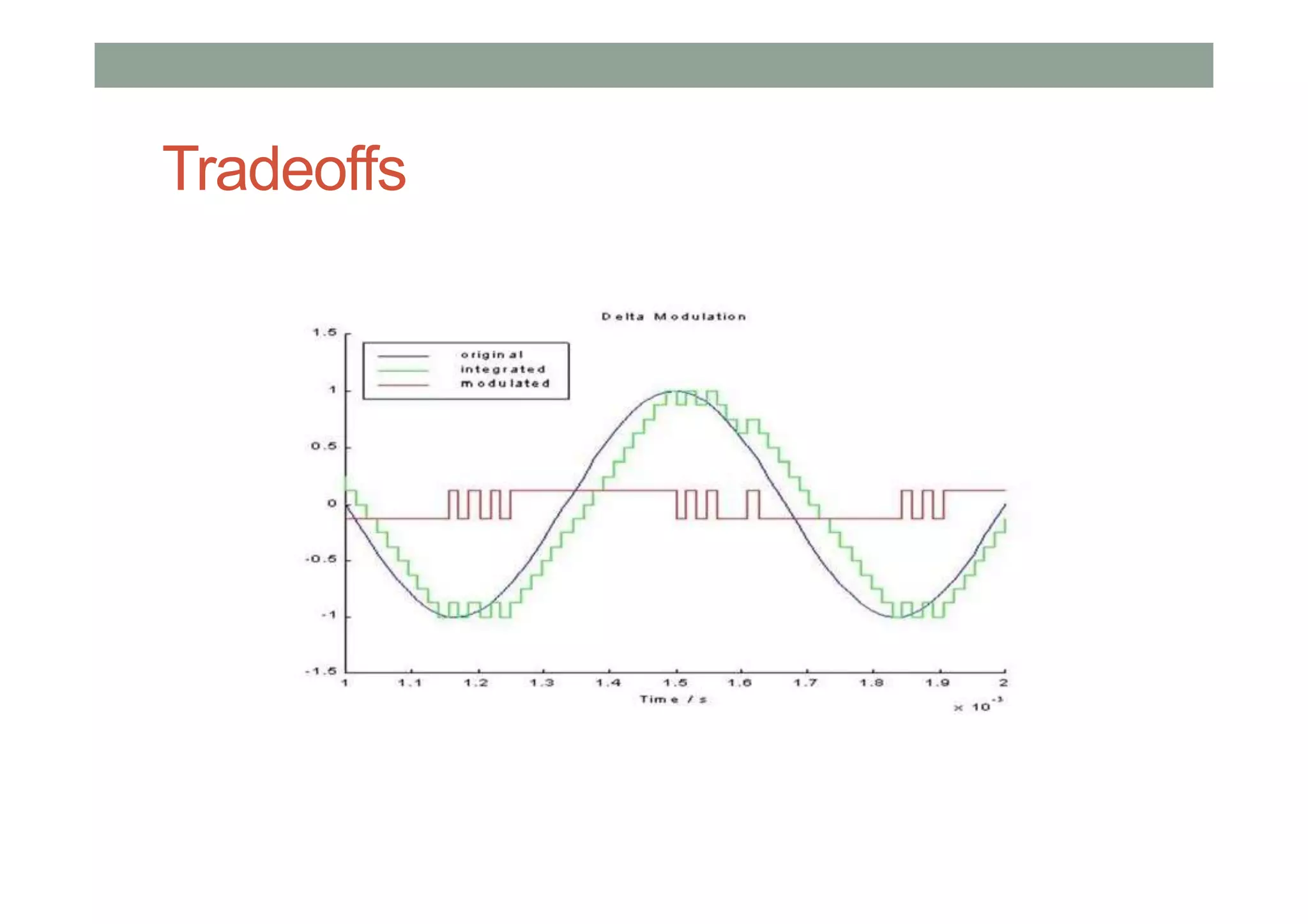
• Simplicity versus Quality
• In order to obtain the high quality DM requires very high sampling rates,
typically 20× the highest frequency of interest, as opposed to Nyquist rate of
2×fm
Tradeoffs
Delta PCM (DPCM)
• Instead of using one bit to indicate positive
and negative differences, we can use more
bits -> quantization of the difference.
• Each bit code is used to represent the value of
the difference.
• The more bits the more levels -> the higher the
accuracy.
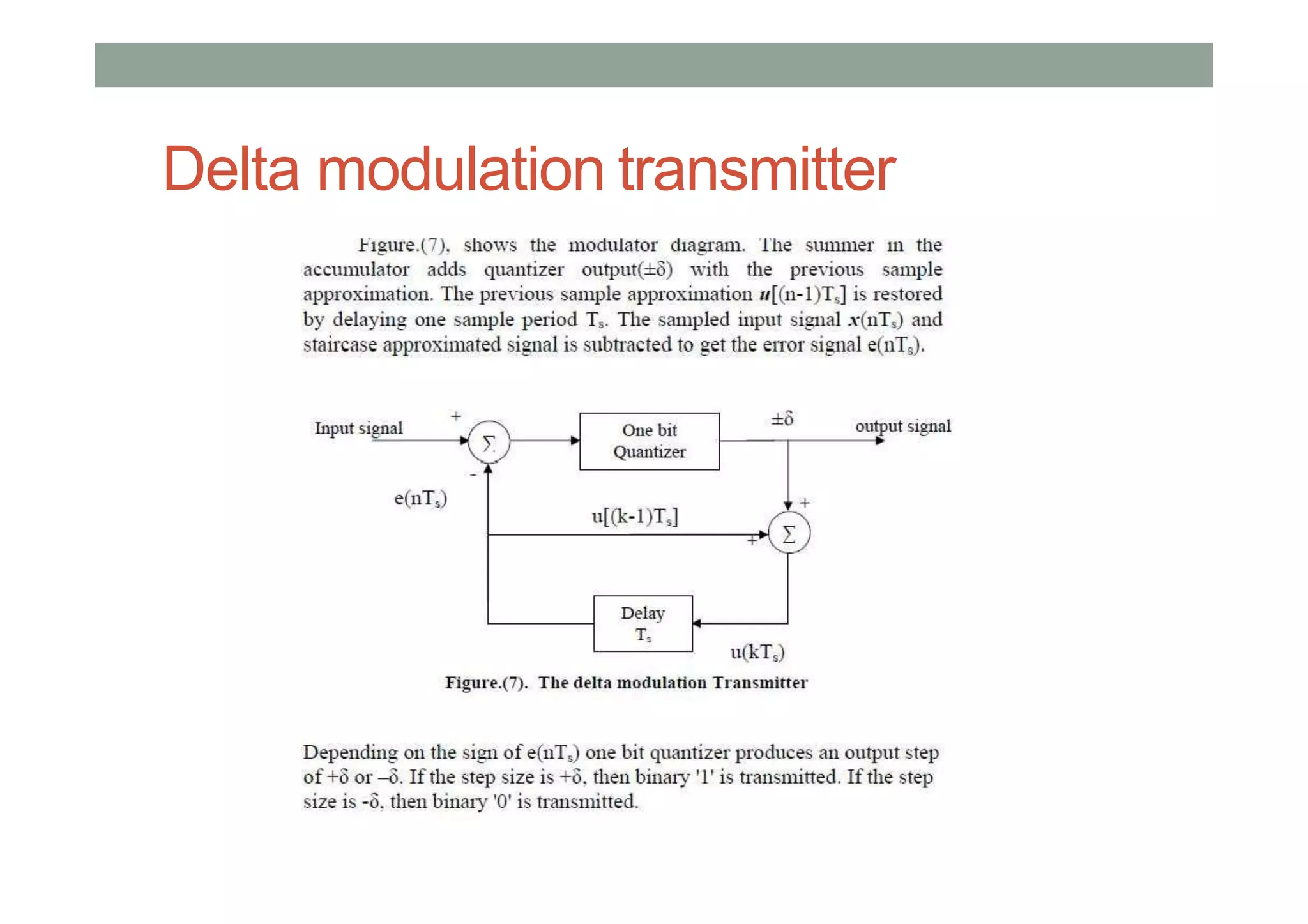
Delta modulation transmitter
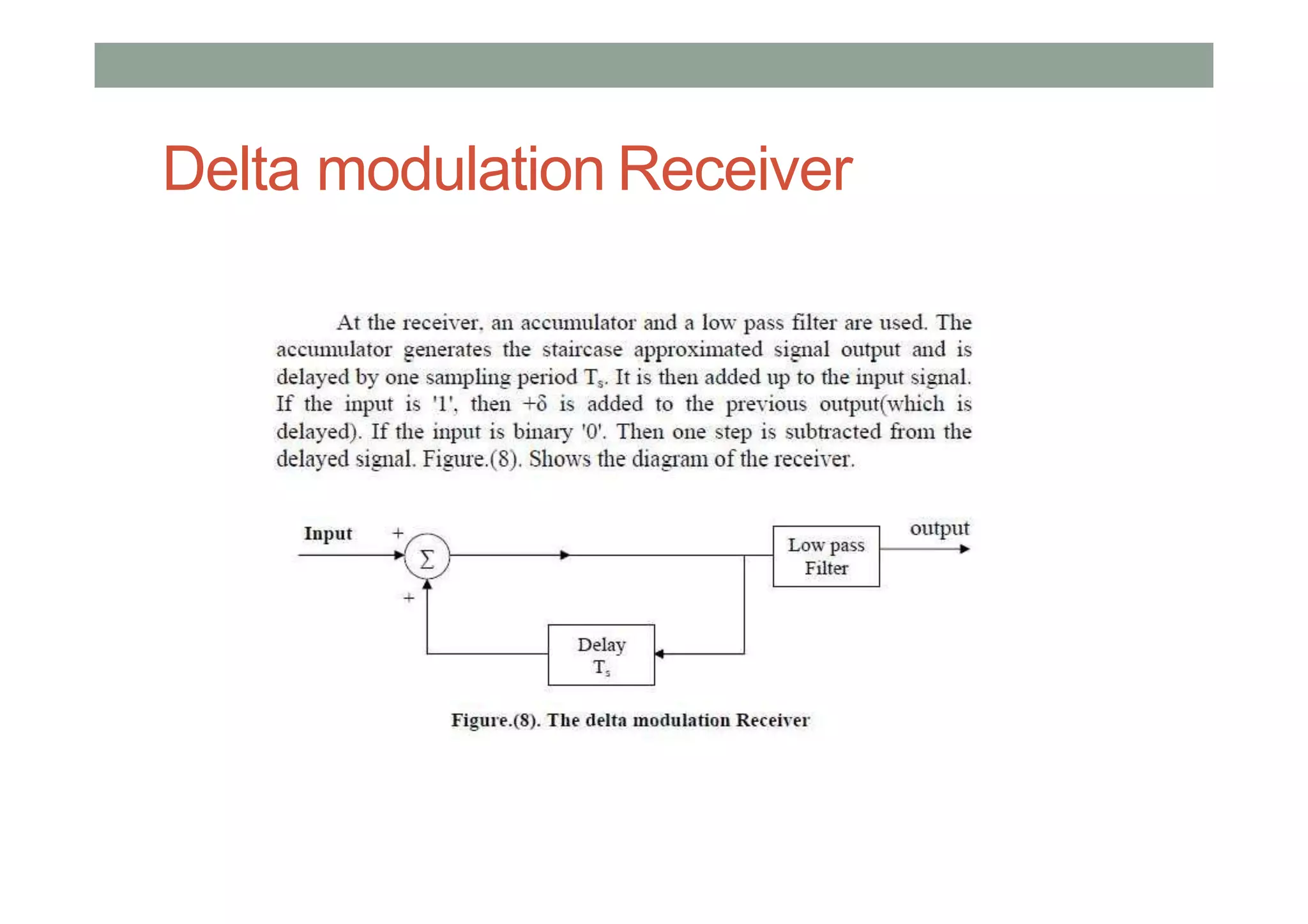
Delta modulation Receiver
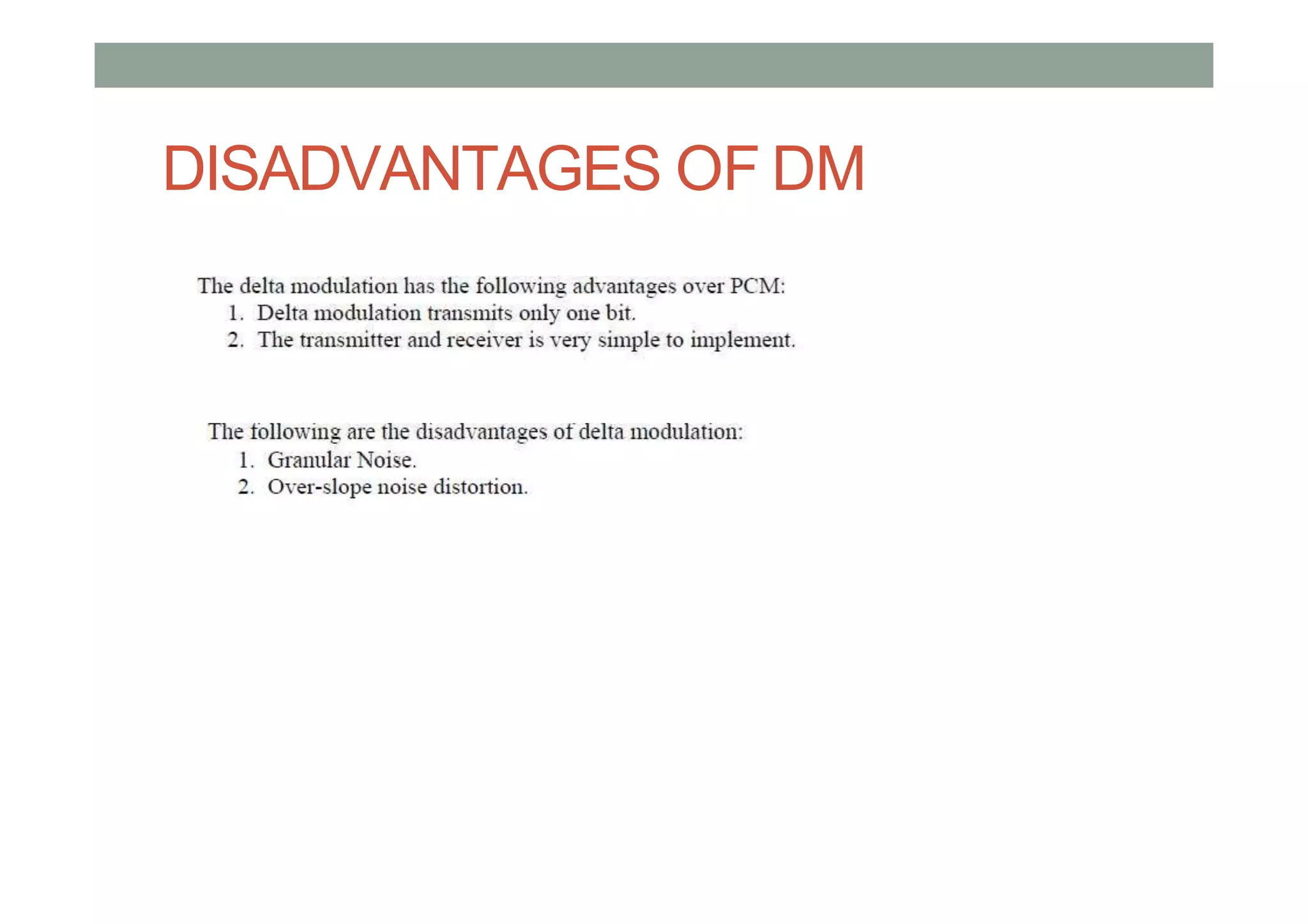
DISADVANTAGES OF DM
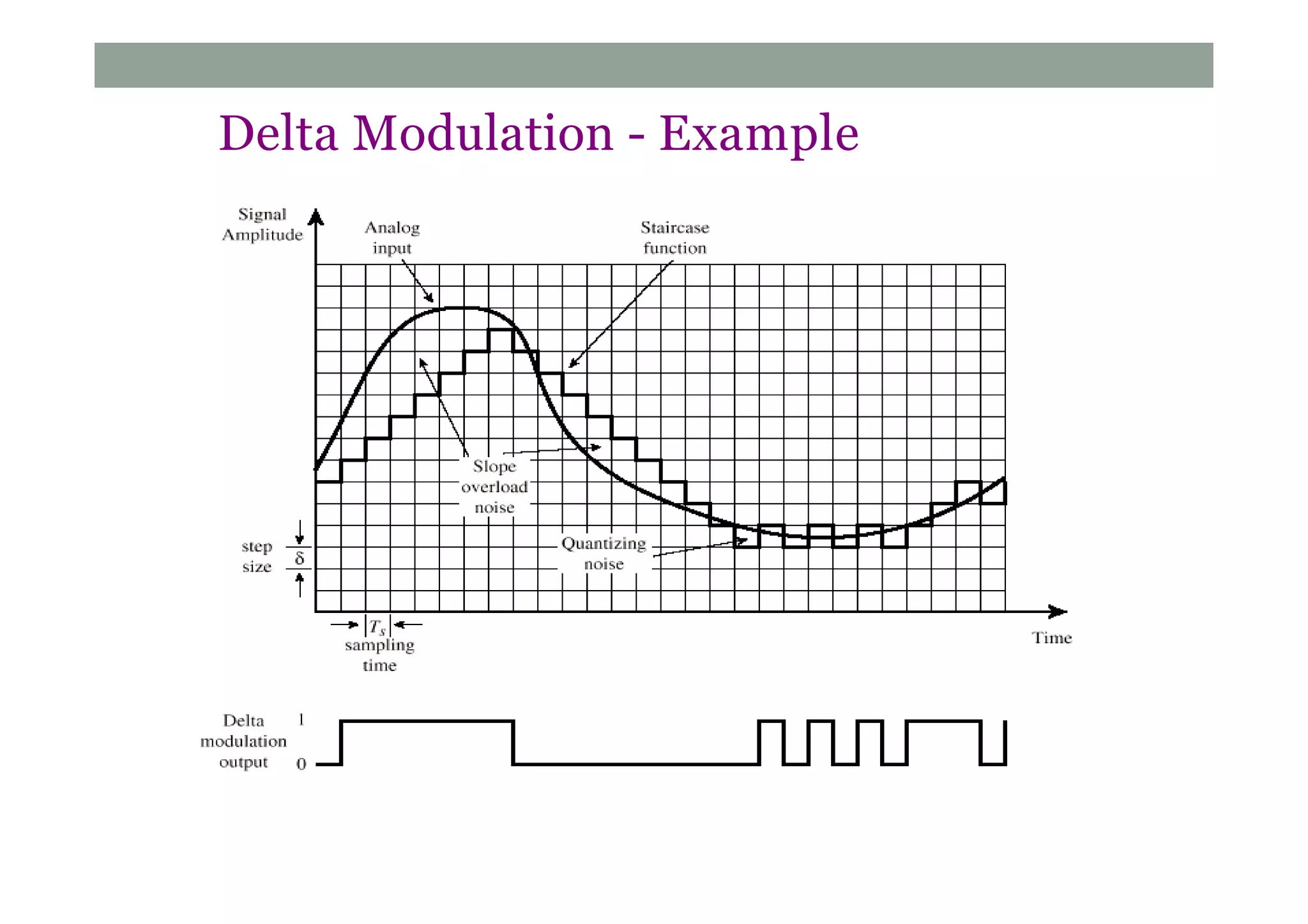
Delta Modulation - Example
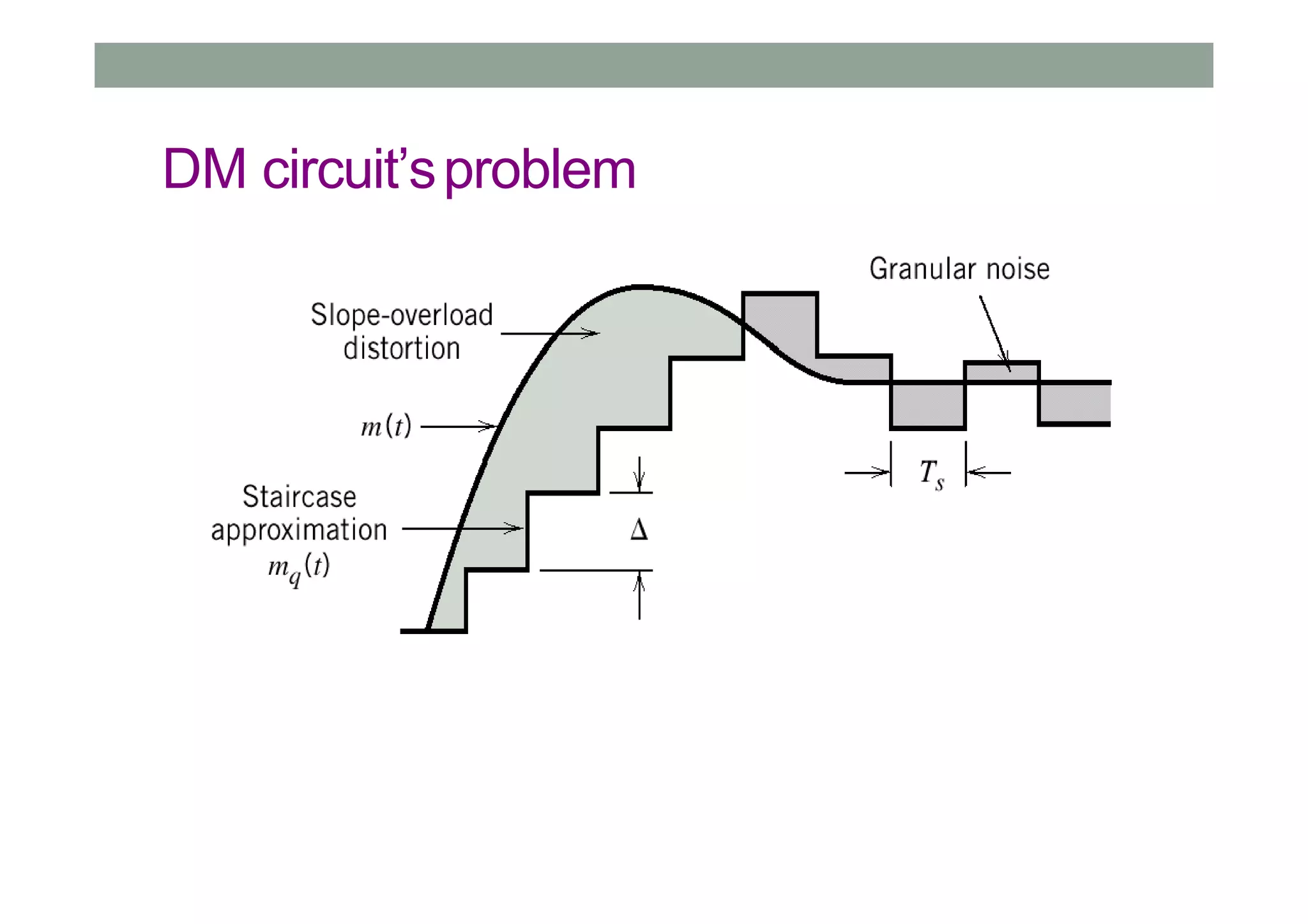
DM circuit’sproblem
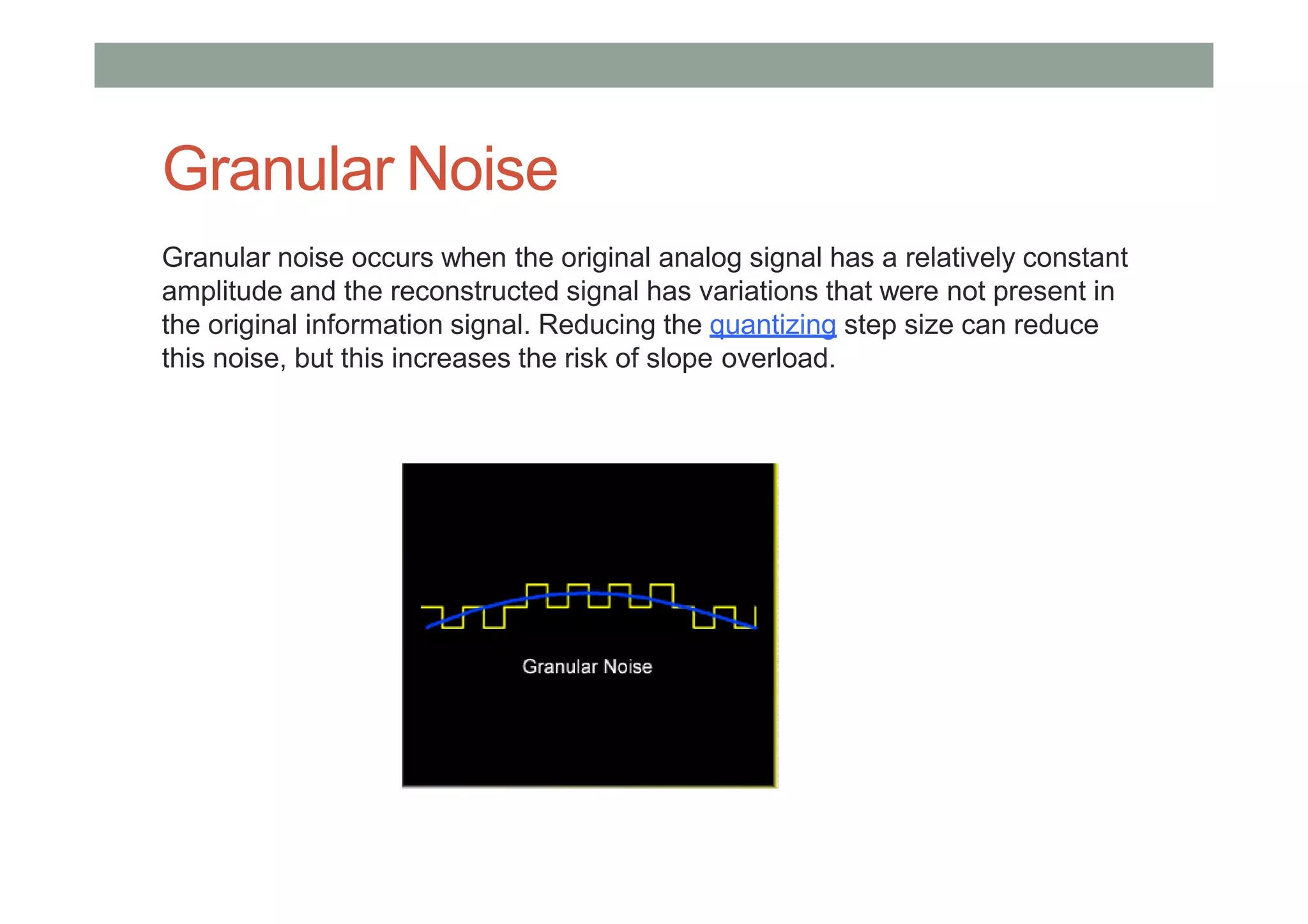
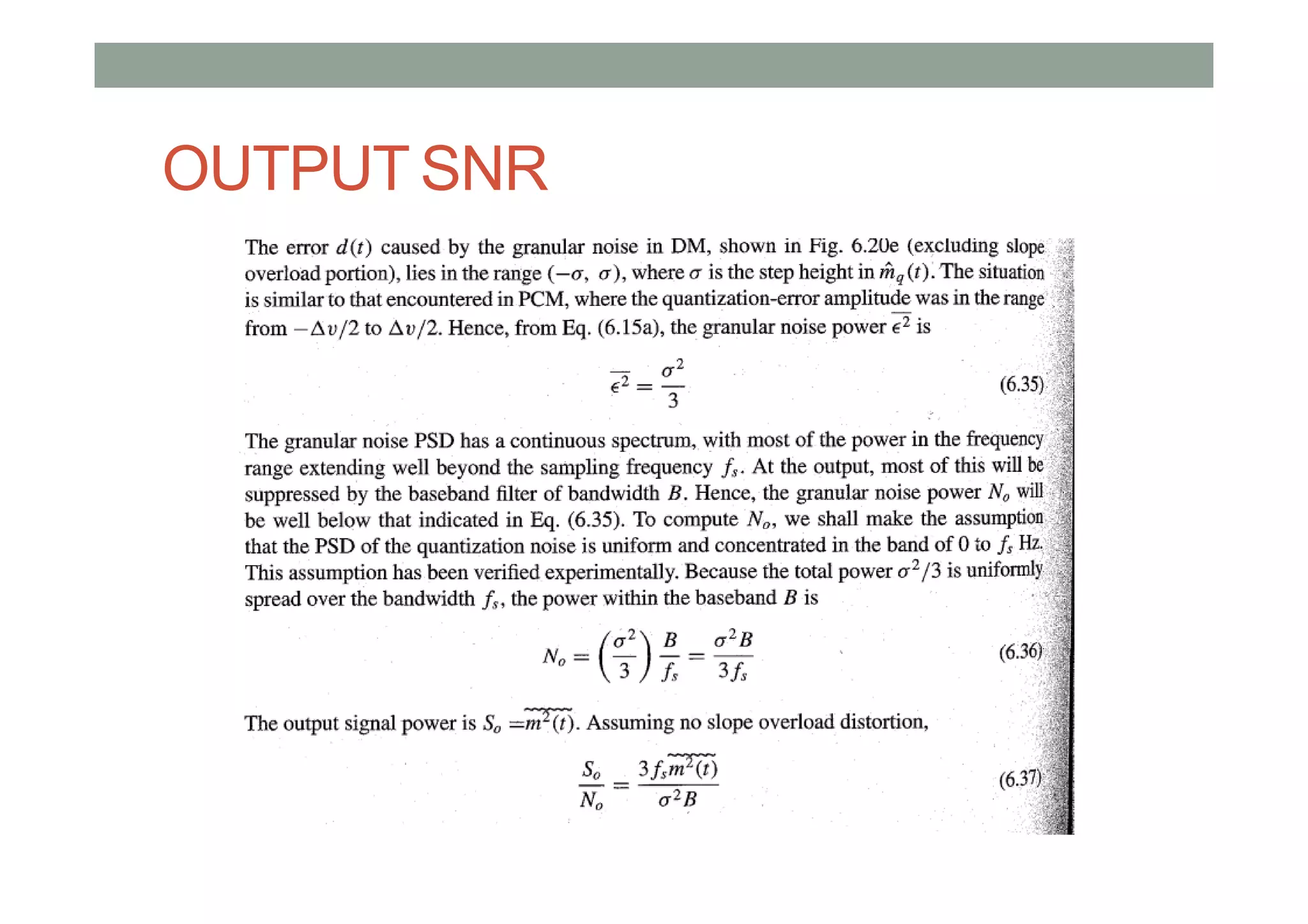
Granular Noise
Granular noise occurs when the original analog signal has a relatively constant
amplitude and the reconstructed signal has variations that were not present in
the original information signal. Reducing the quantizing step size can reduce
this noise, but this increases the risk of slope overload.
OVERSLOPE DISTORTION
Cont’d…
Cont’d...
• Analog input is approximated by a staircase function
• Move up or down one level ()at each sample interval (by one
quantization level at each sampling time)  output of DM is
a single bit.
• Binary behavior
• Function moves up or down at each sample interval
• In DM the quantization levels are represented by two symbols:
0 for - and 1 for +. In fact the coding process is performed
on eq.
• The main advantage of DM is its simplicity.
•Slope overload distortion is due to the fact that the staircase
approximation mq(t) can't follow closely the actual curve of the
message signal m(t ). In contrast to slope-overload distortion,
granular noise occurs when  is too large relative to the local slope
characteristics of m(t). granular noise is similar to quantization noise
in PCM.
•It seems that a large  is needed for rapid variations of m(t) to
reduce the slope-overload distortion and a small  is needed for
slowly varying m(t) to reduce the granular noise. The optimum  can
only be a compromise between the two cases.
•To satisfy both cases, an adaptive DM is needed, where the step
size  can be adjusted in accordance with the input signal m(t).
Cont’d…
Cont’d...
• Insummary
• Slope overload
• Due to the input analog signal amplitude changes faster than the
speed of the modulator
• to minimize : the product of the sampling step size and the
sampling rate must be equal to or larger than the rate of change
of the amplitude of the input analog signal.
• Granular noise
• Due to the difference between step size and sampled voltage.
• To minimize : increase the sampling rate, decrease the step size
of modulator
DM Performance
• Good voice reproduction
• PCM - 128 levels (7 bit)
• Voice bandwidth 4khz
• Should be 8000 x 7 = 56kbps for PCM
• Data compression can improve on this
• e.g. Interframe coding techniques for video
Cont’d...
• Adaptive Delta Modulation (ADM)
• A Delta Modulation system where the step size of the DAC is
automatically varied depending on the amplitude characteristics of
the analog signal.
• A well designed ADM scheme can transmit voice at about halfthe
bit rate of a PCM system with equivalent quality.
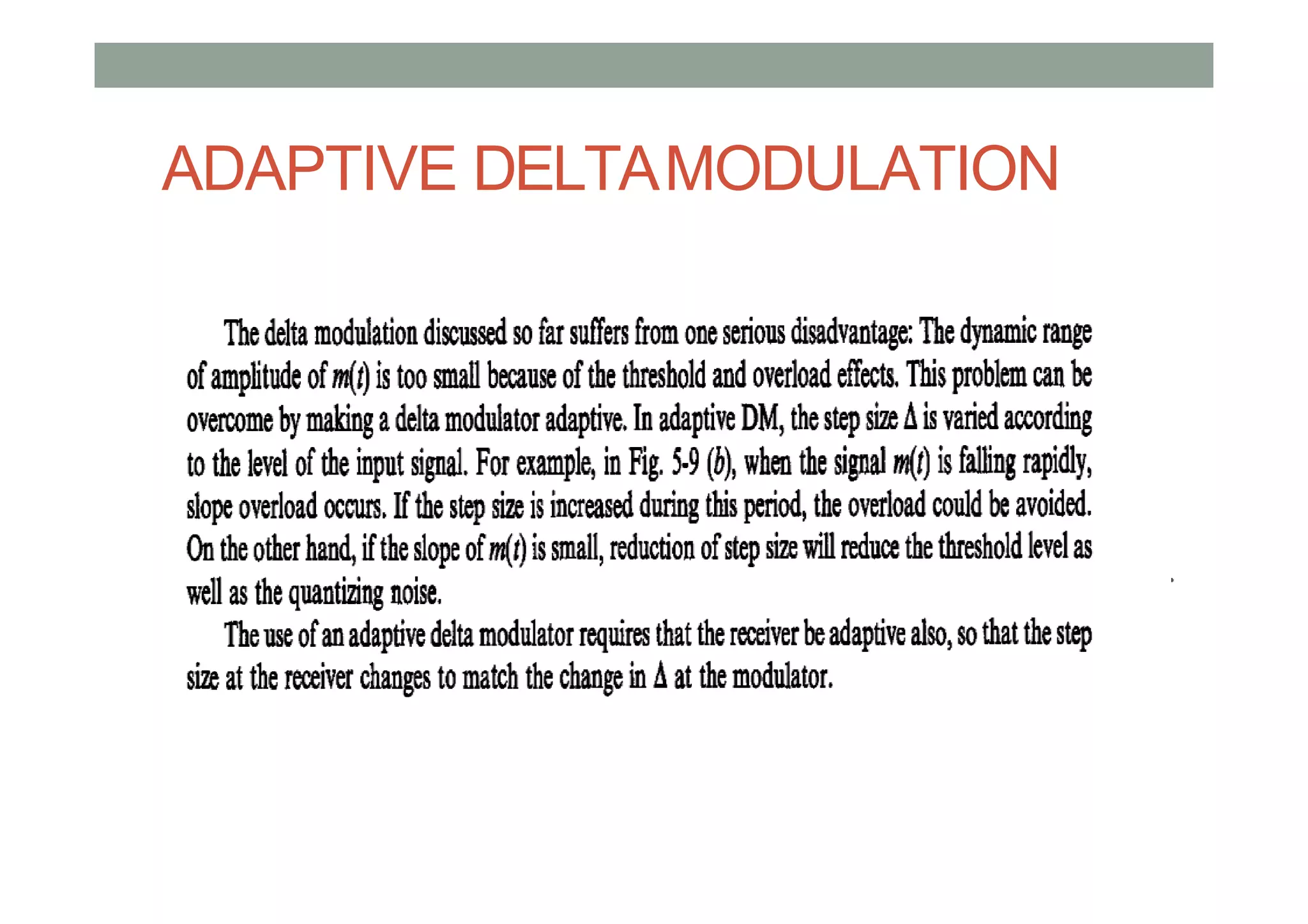
ADAPTIVE DELTAMODULATION
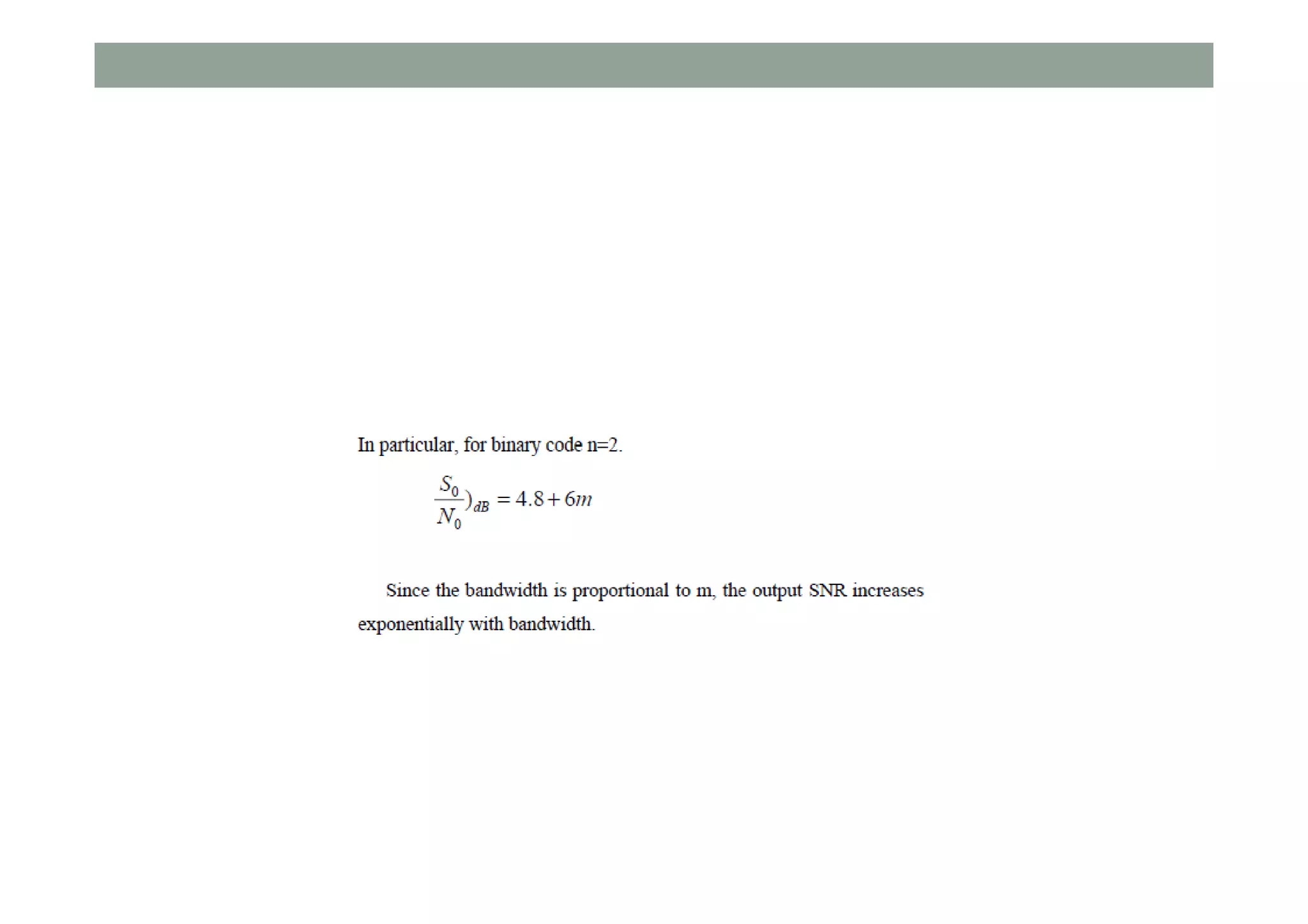
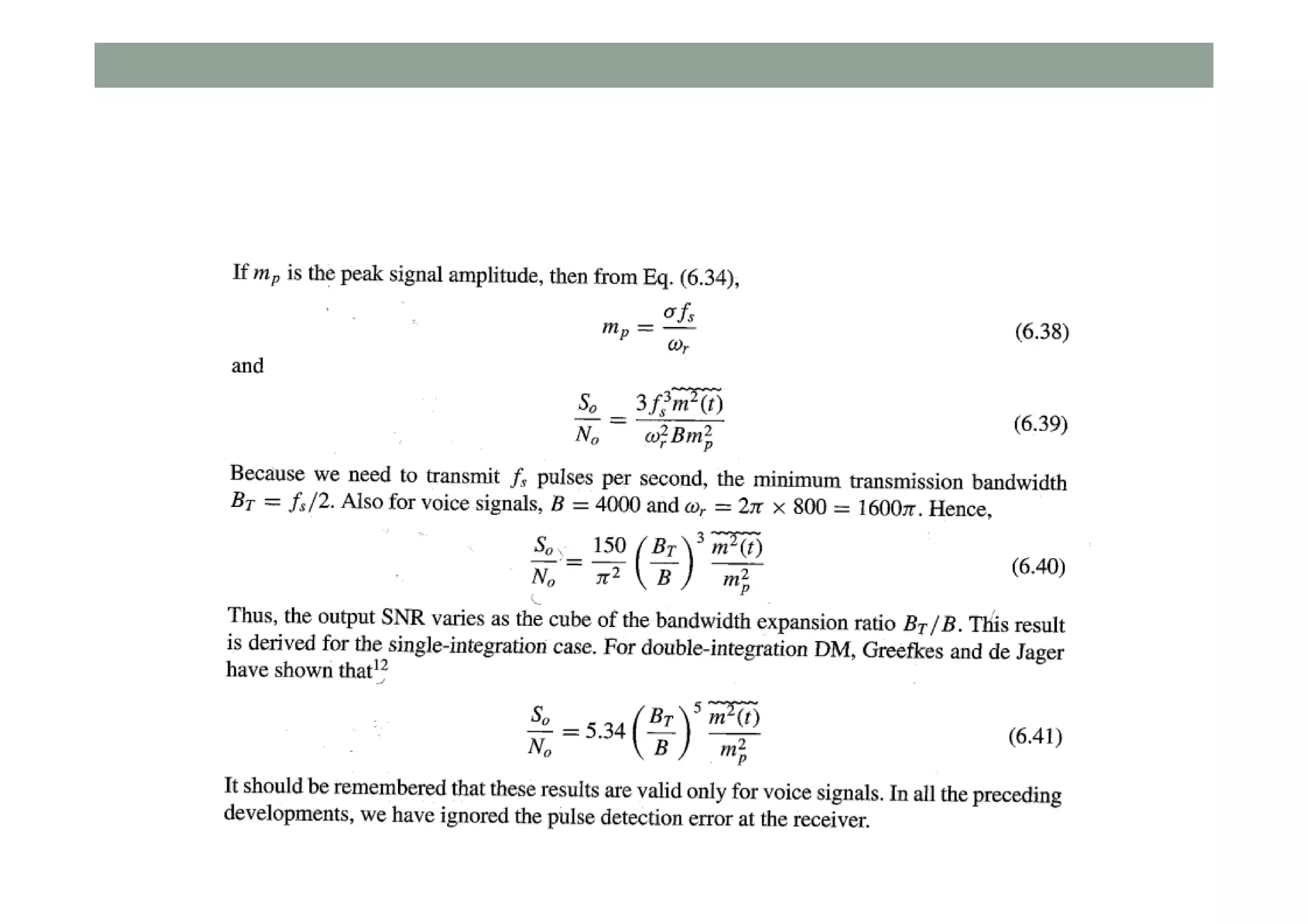
OUTPUT SNR
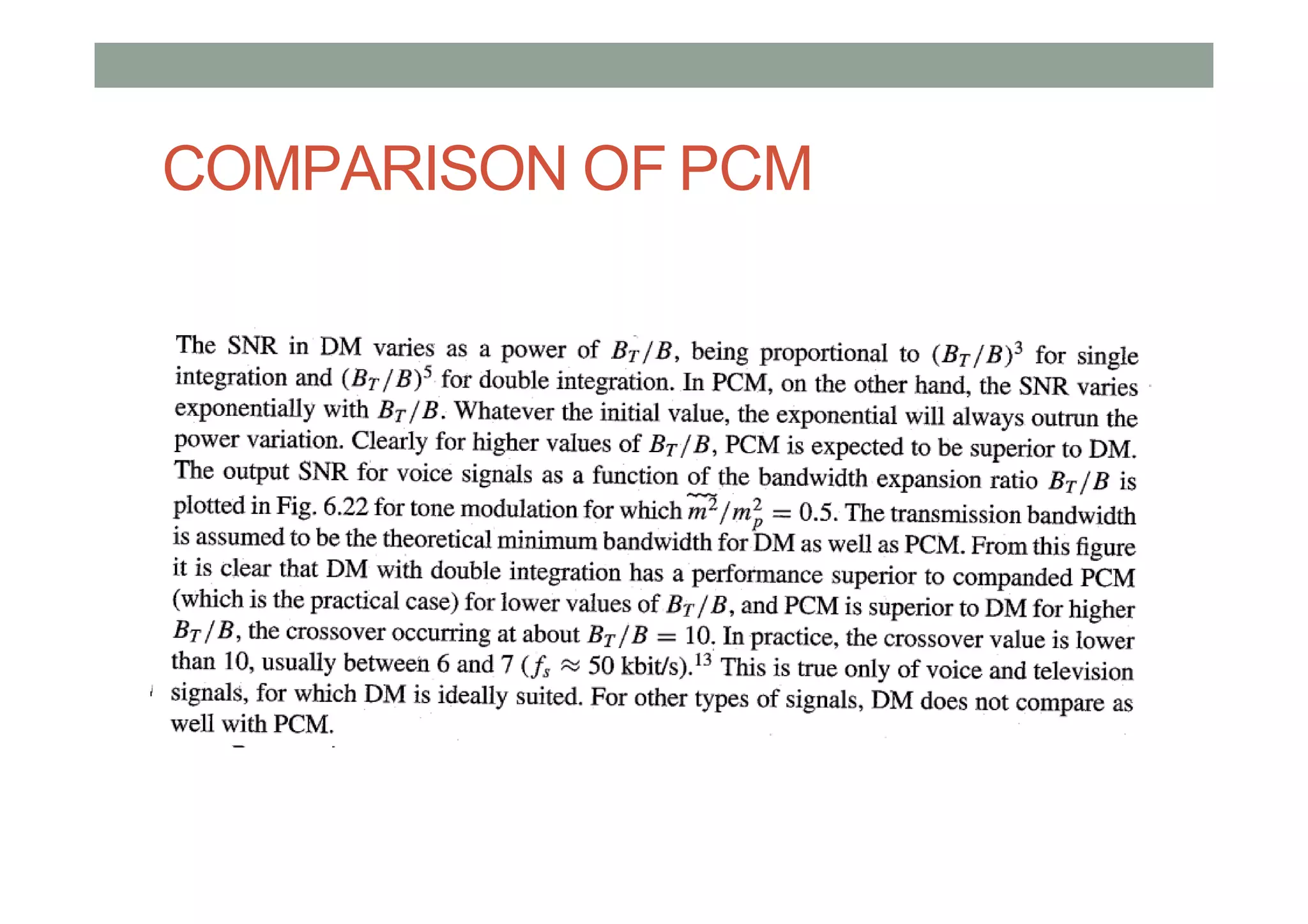
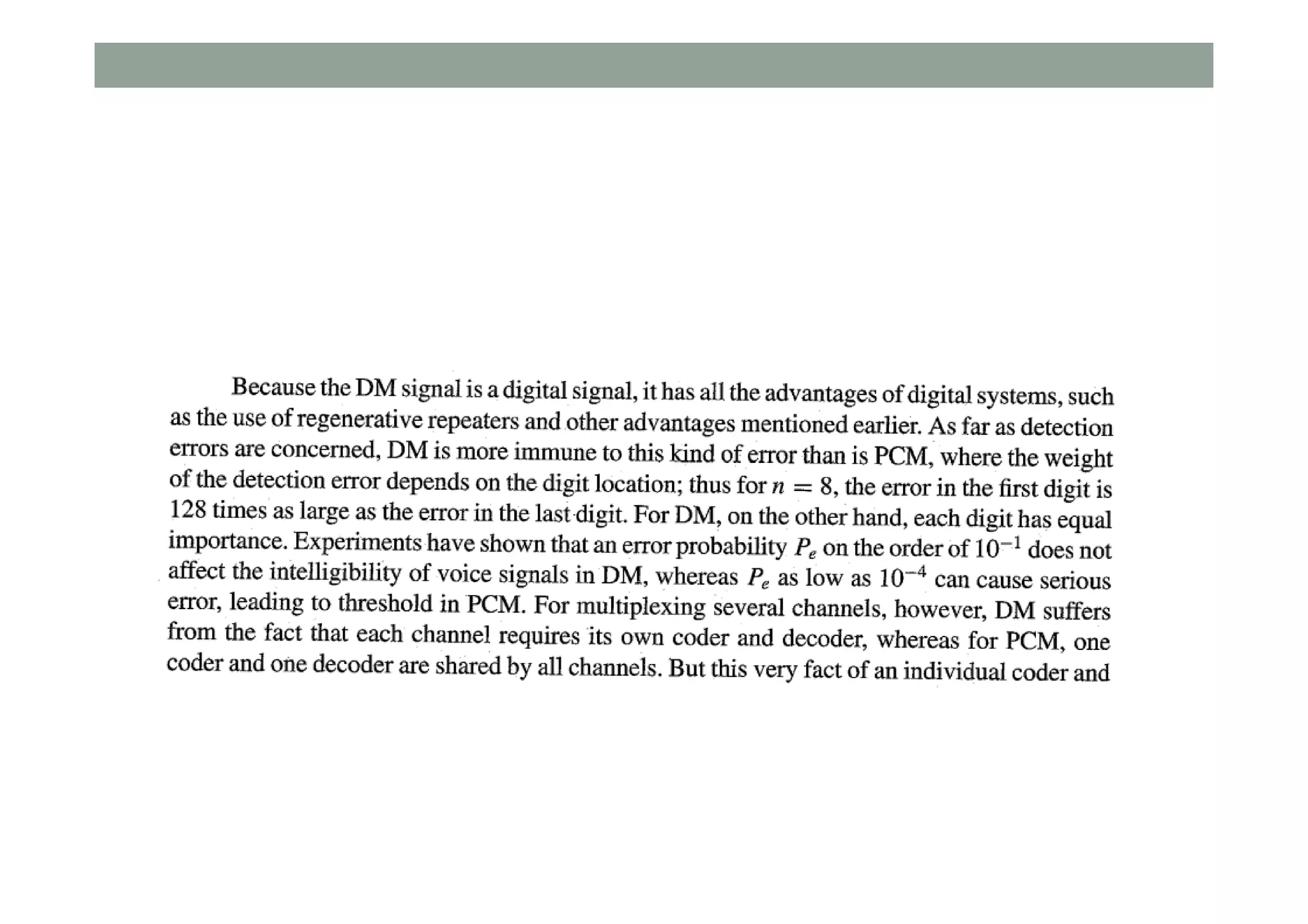
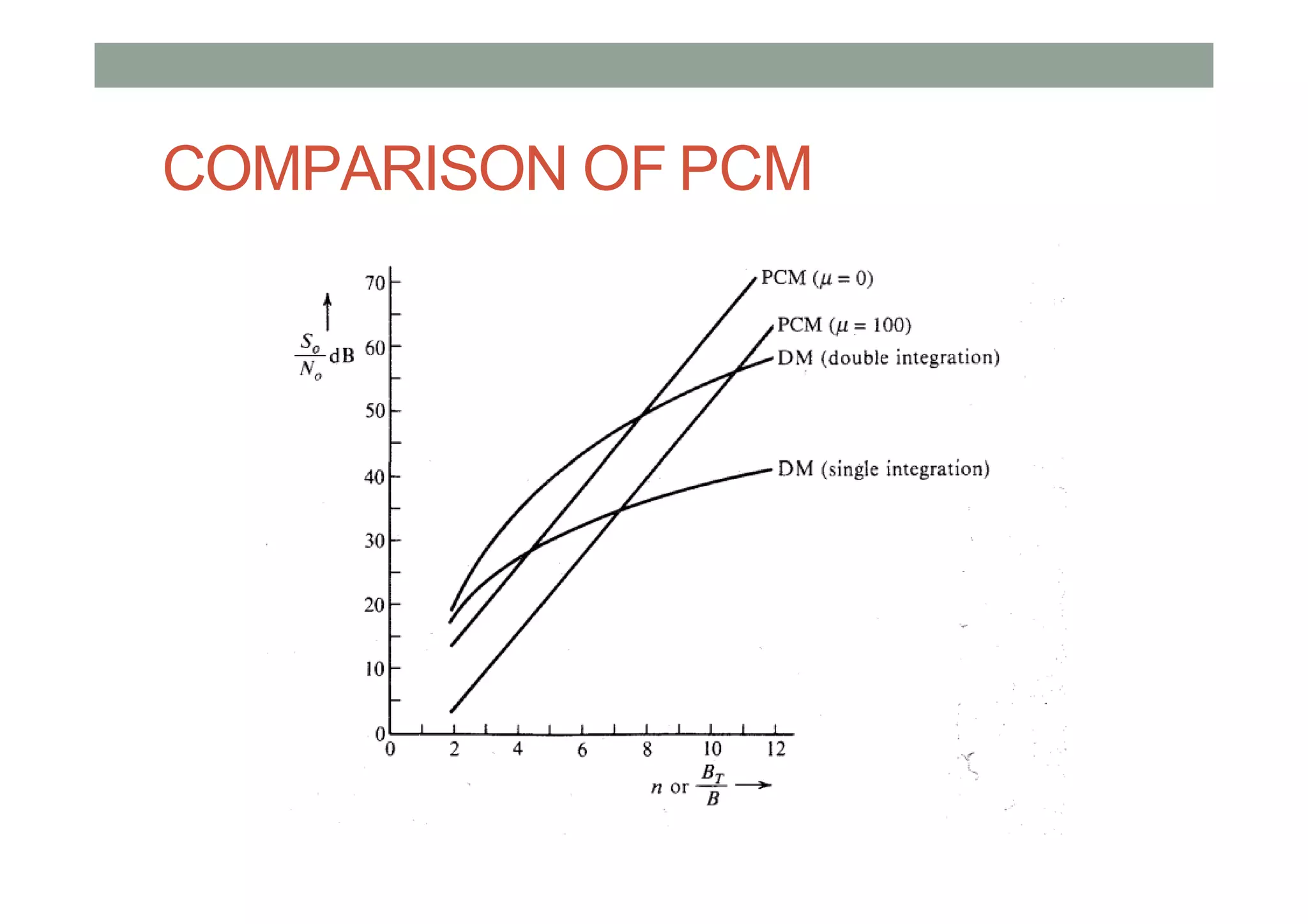
COMPARISON OF PCM
COMPARISON OF PCM
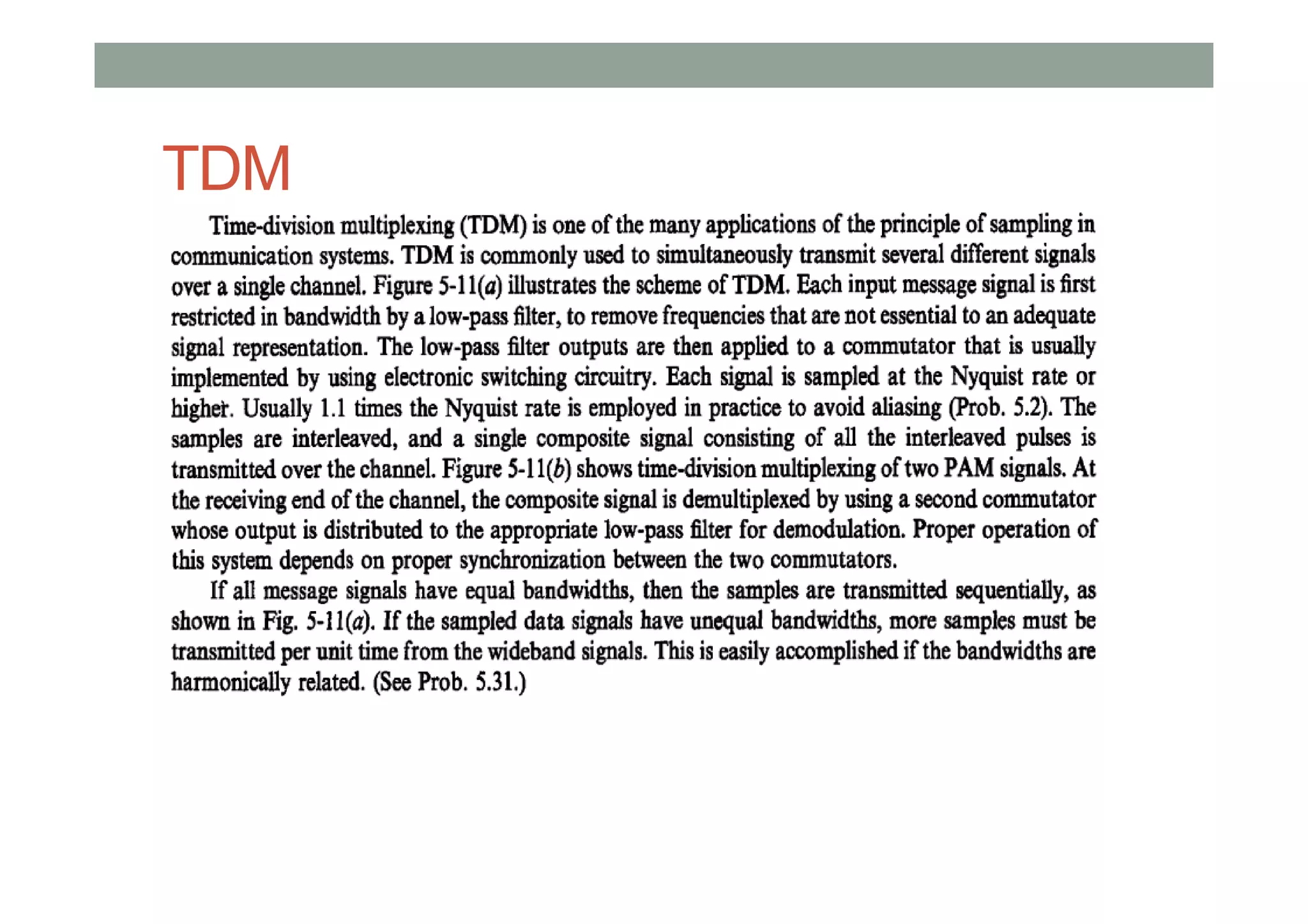
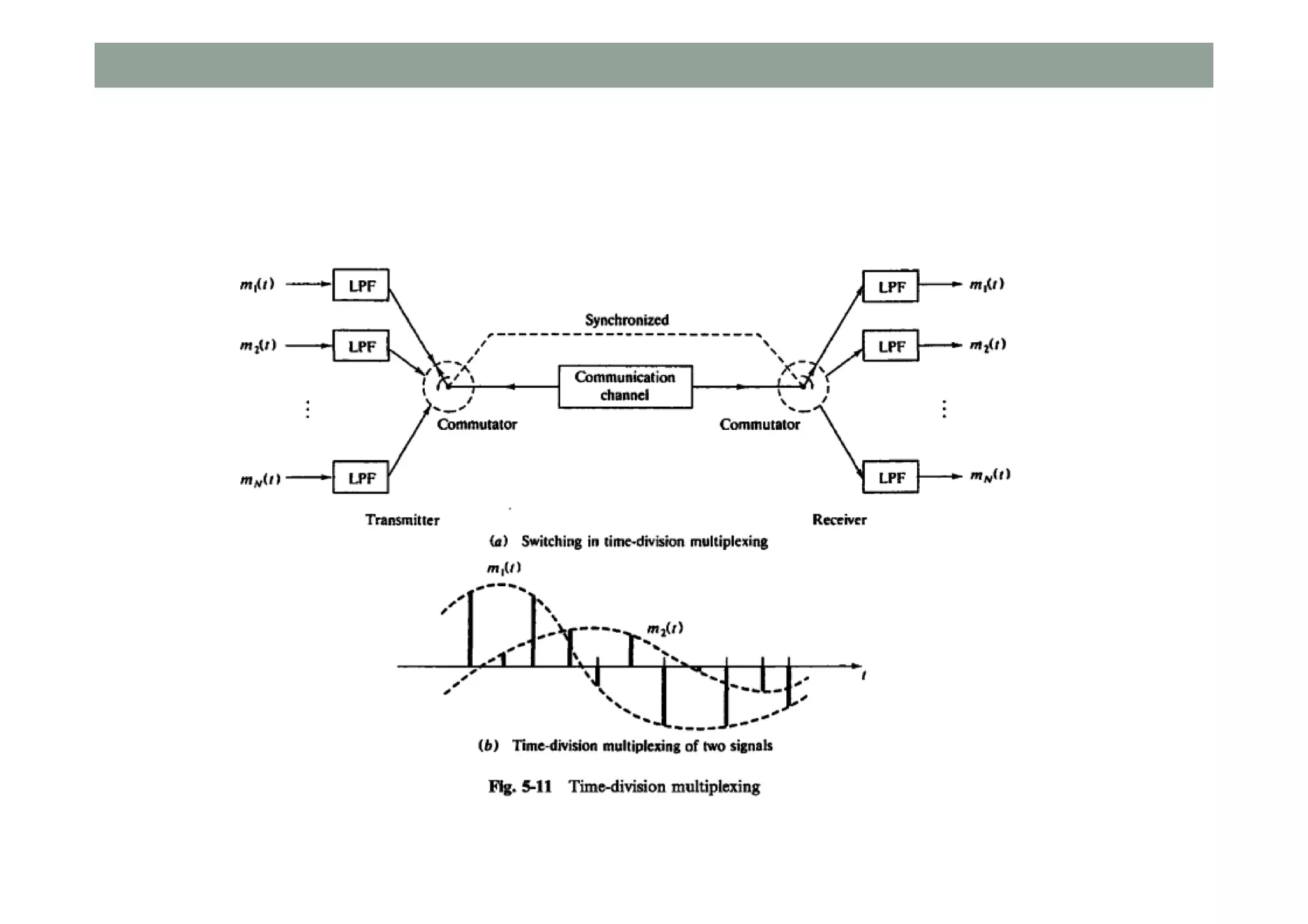
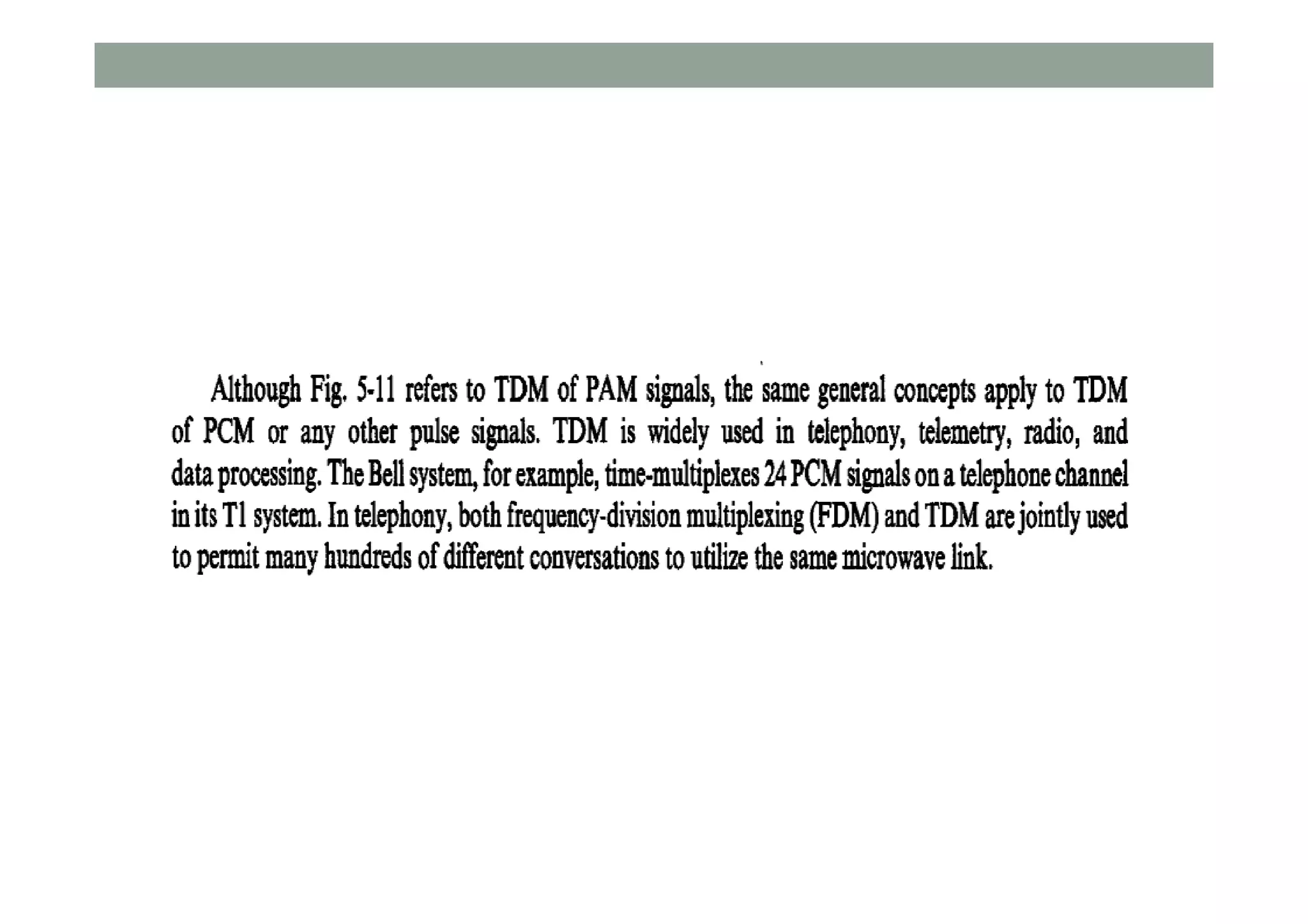
TDM
TDM
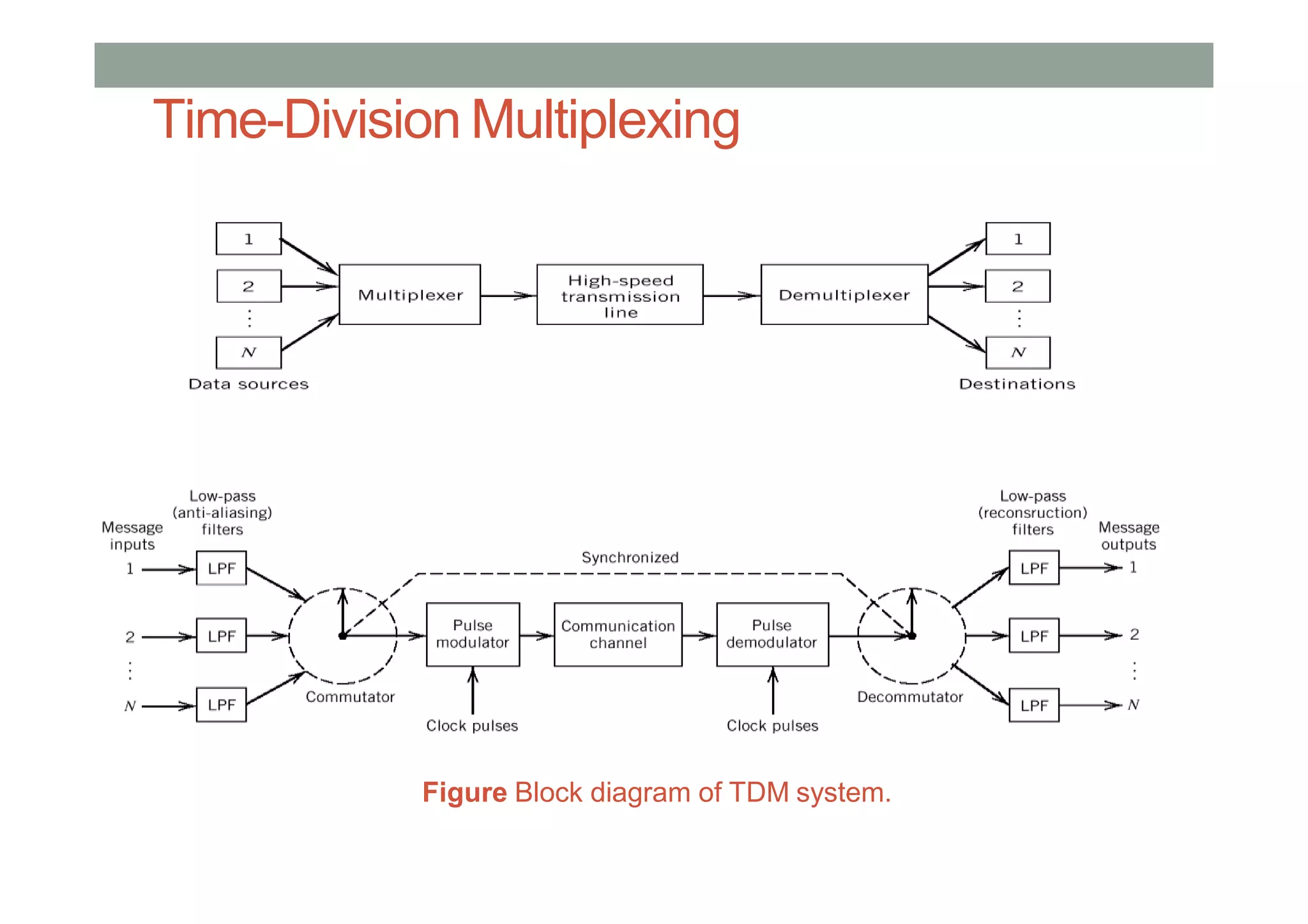
Time-Division Multiplexing
Figure Block diagram of TDM system.
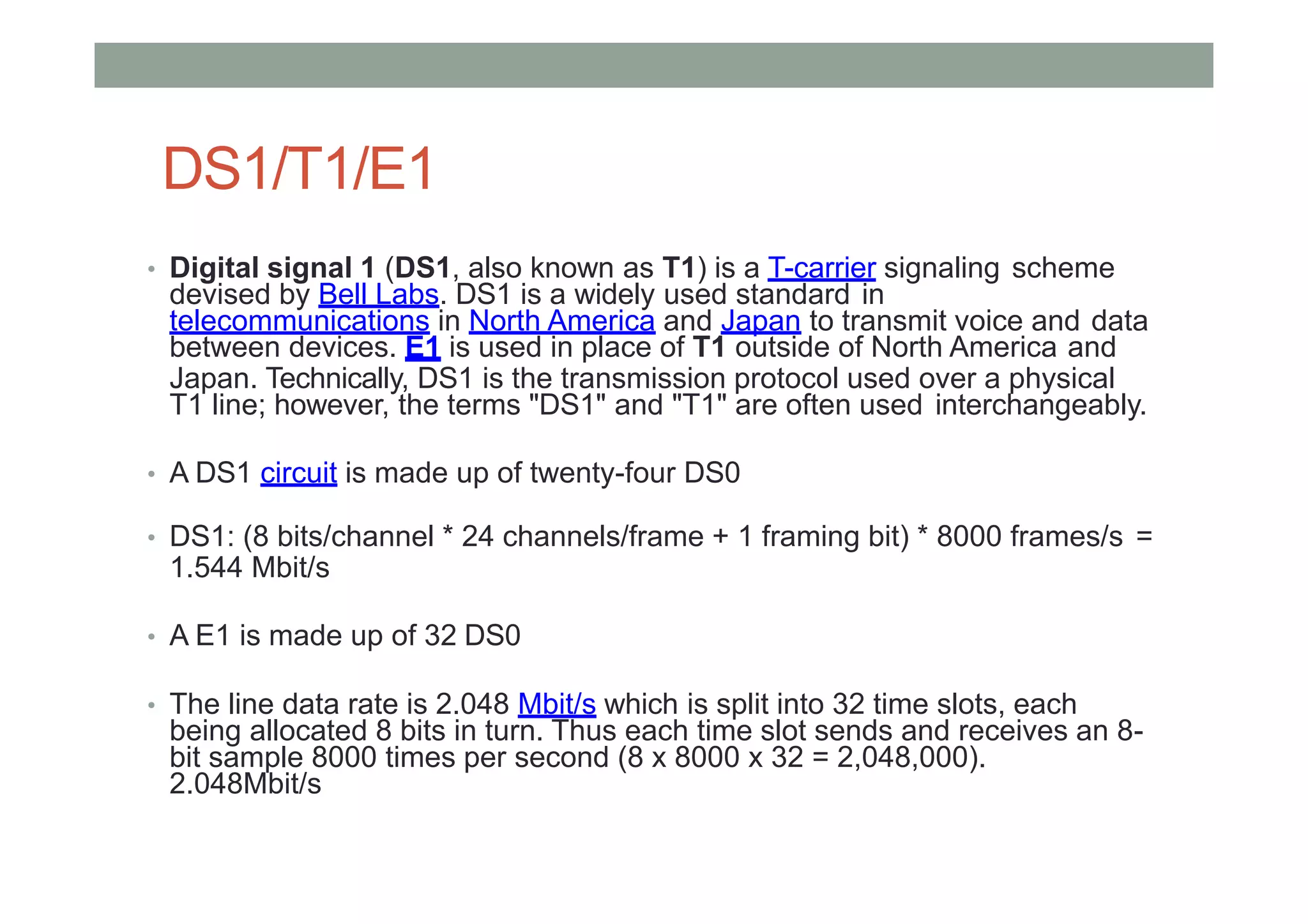
DS1/T1/E1
• Digital signal 1 (DS1, also known as T1) is a T-carrier signaling scheme
devised by Bell Labs. DS1 is a widely used standard in
telecommunications in North America and Japan to transmit voice and data
between devices. E1 is used in place of T1 outside of North America and
Japan. Technically, DS1 is the transmission protocol used over a physical
T1 line; however, the terms "DS1" and "T1" are often used interchangeably.
• A DS1 circuit is made up of twenty-four DS0
• DS1: (8 bits/channel * 24 channels/frame + 1 framing bit) * 8000 frames/s =
1.544 Mbit/s
• A E1 is made up of 32 DS0
• The line data rate is 2.048 Mbit/s which is split into 32 time slots, each
being allocated 8 bits in turn. Thus each time slot sends and receives an 8-
bit sample 8000 times per second (8 x 8000 x 32 = 2,048,000).
2.048Mbit/s
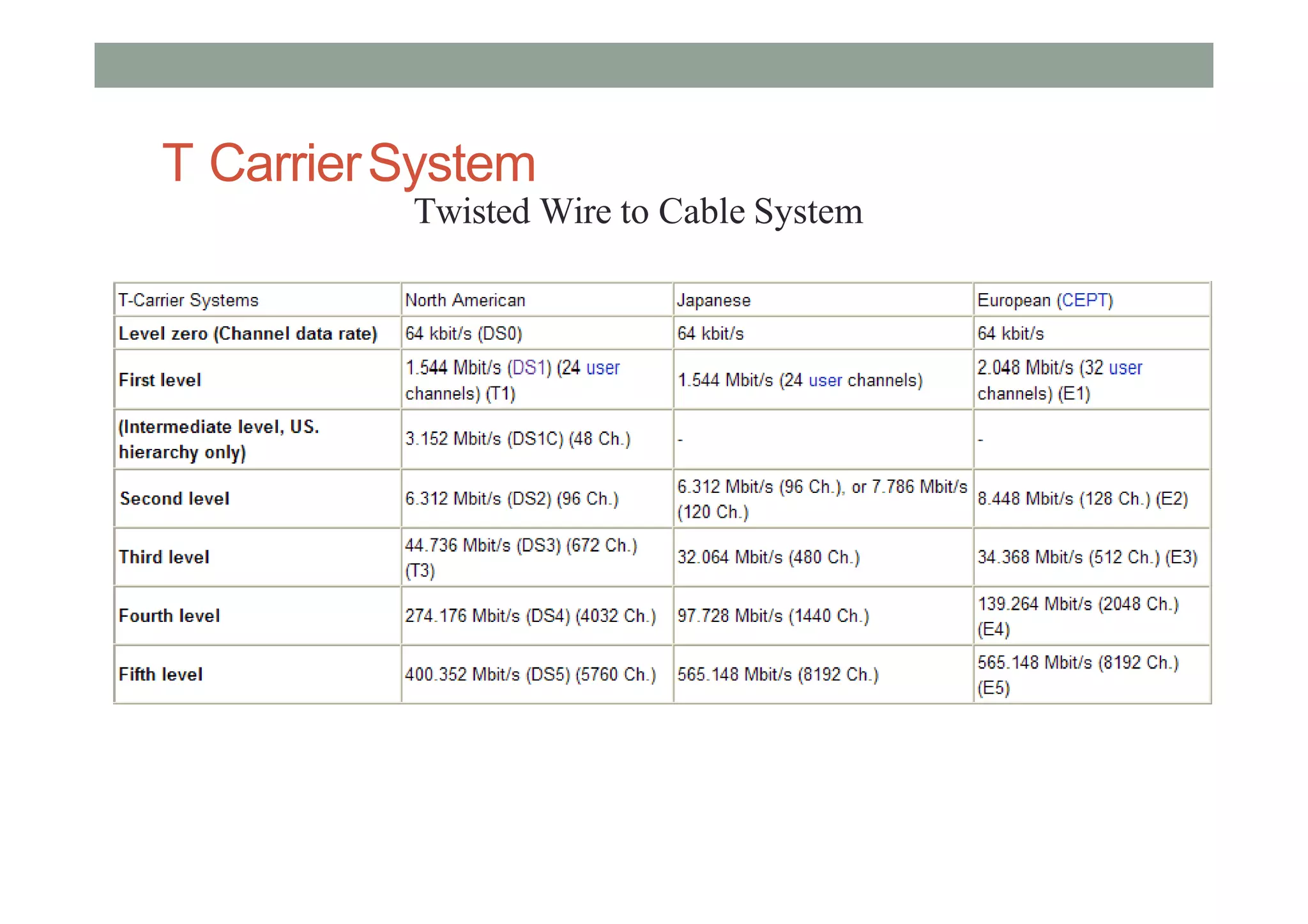
T CarrierSystem
Twisted Wire to Cable System
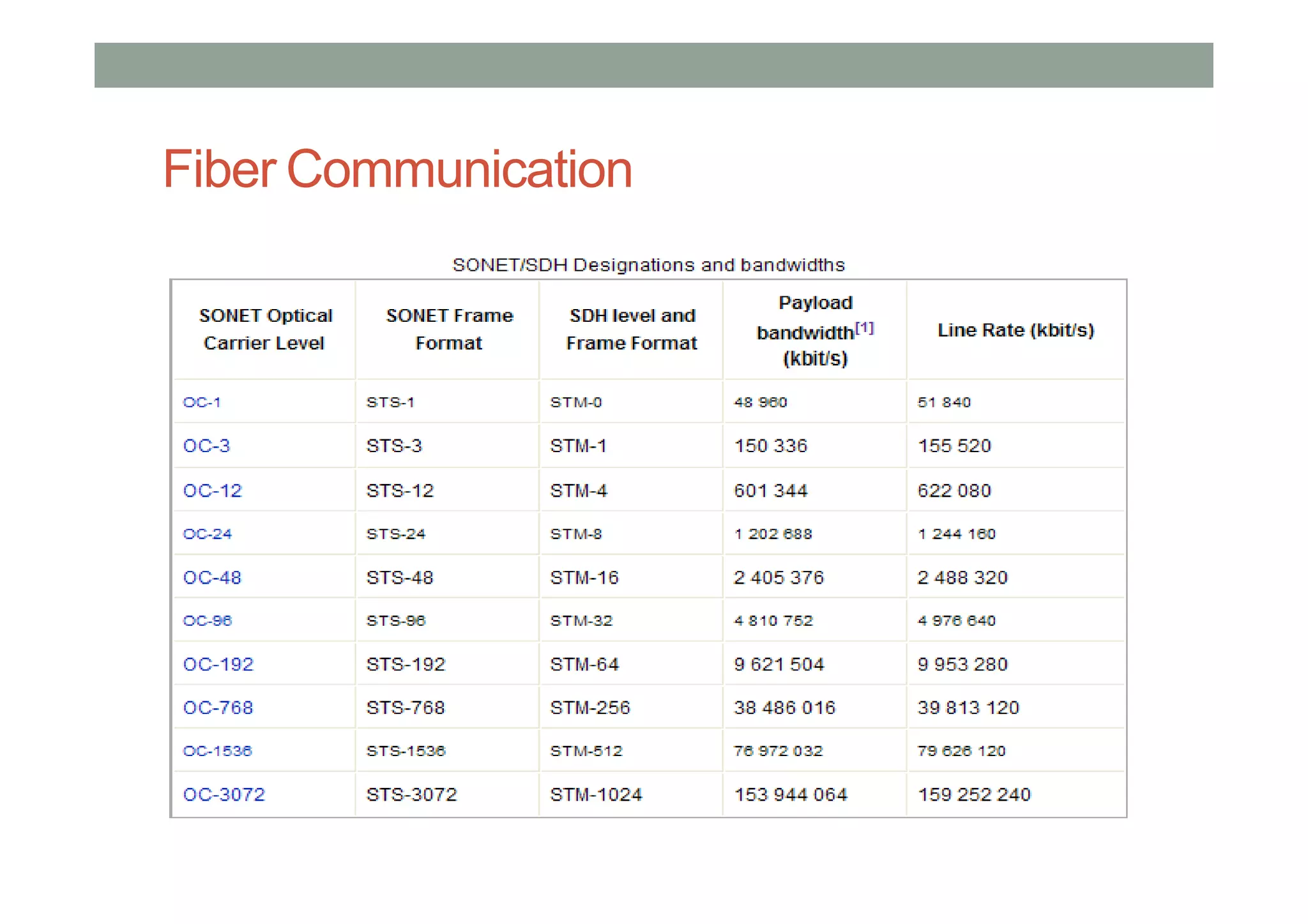
Fiber Communication
Bandwidth Requirement ofTDM
TRANSMISSION
MODES
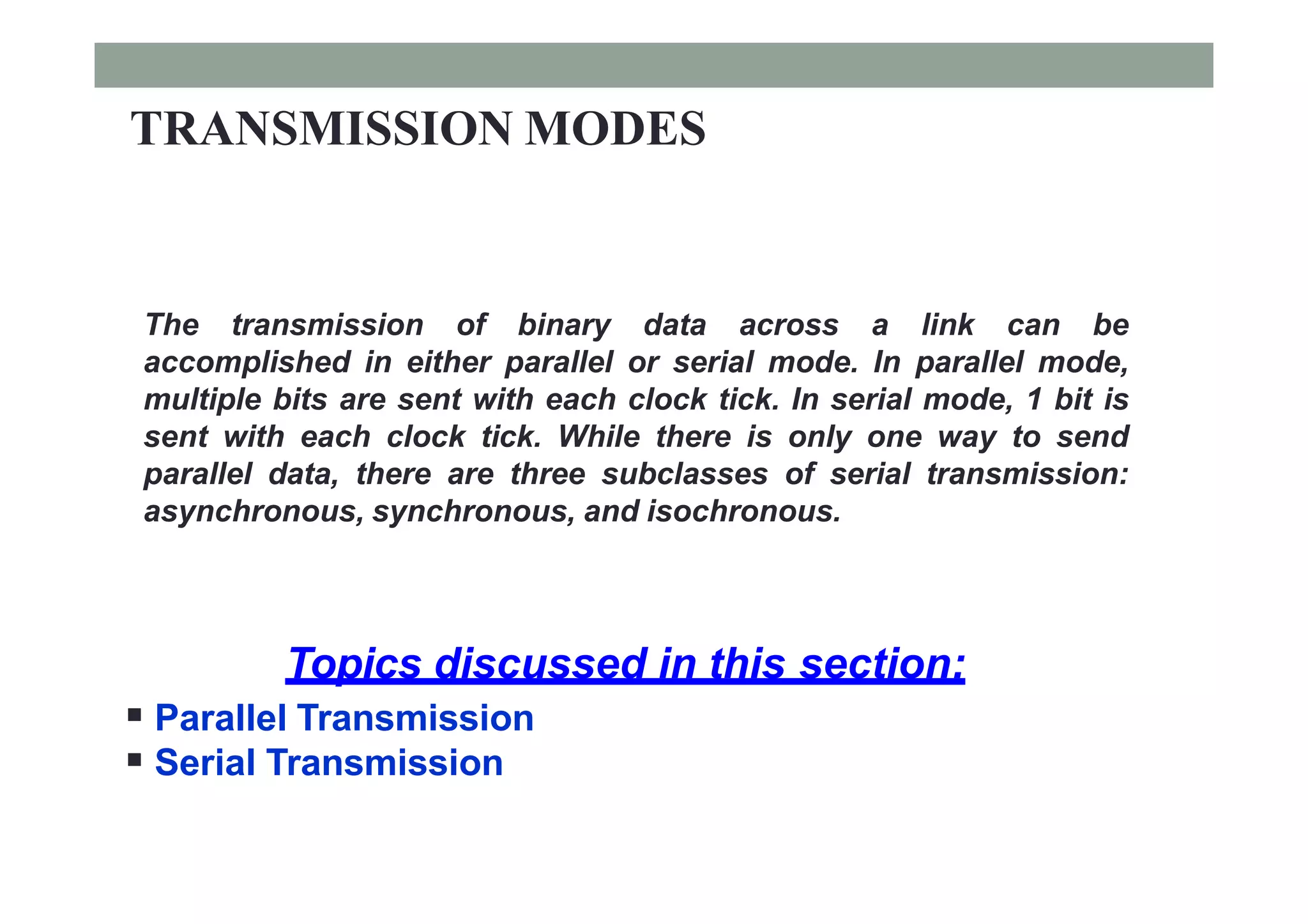
TRANSMISSION MODES
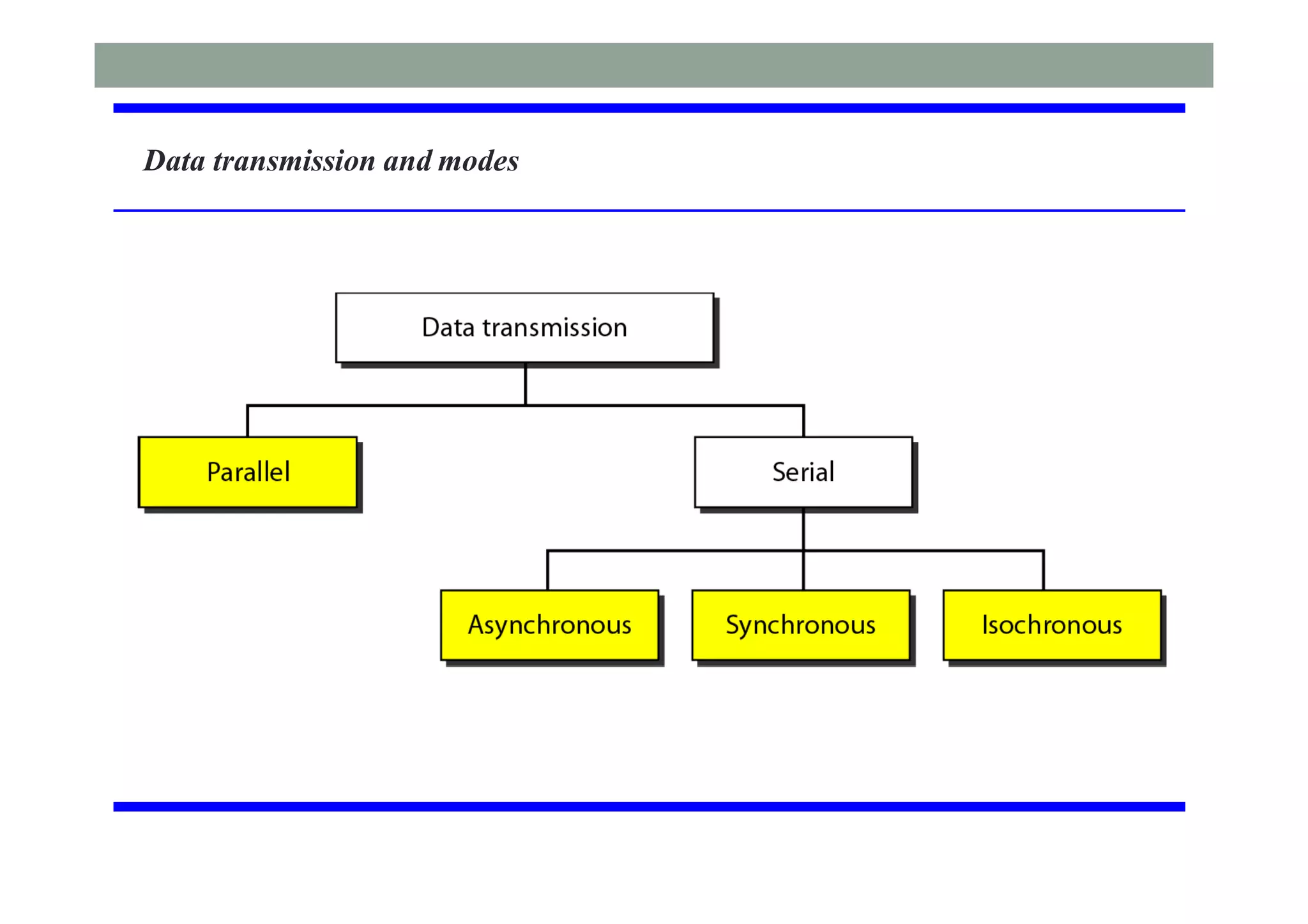
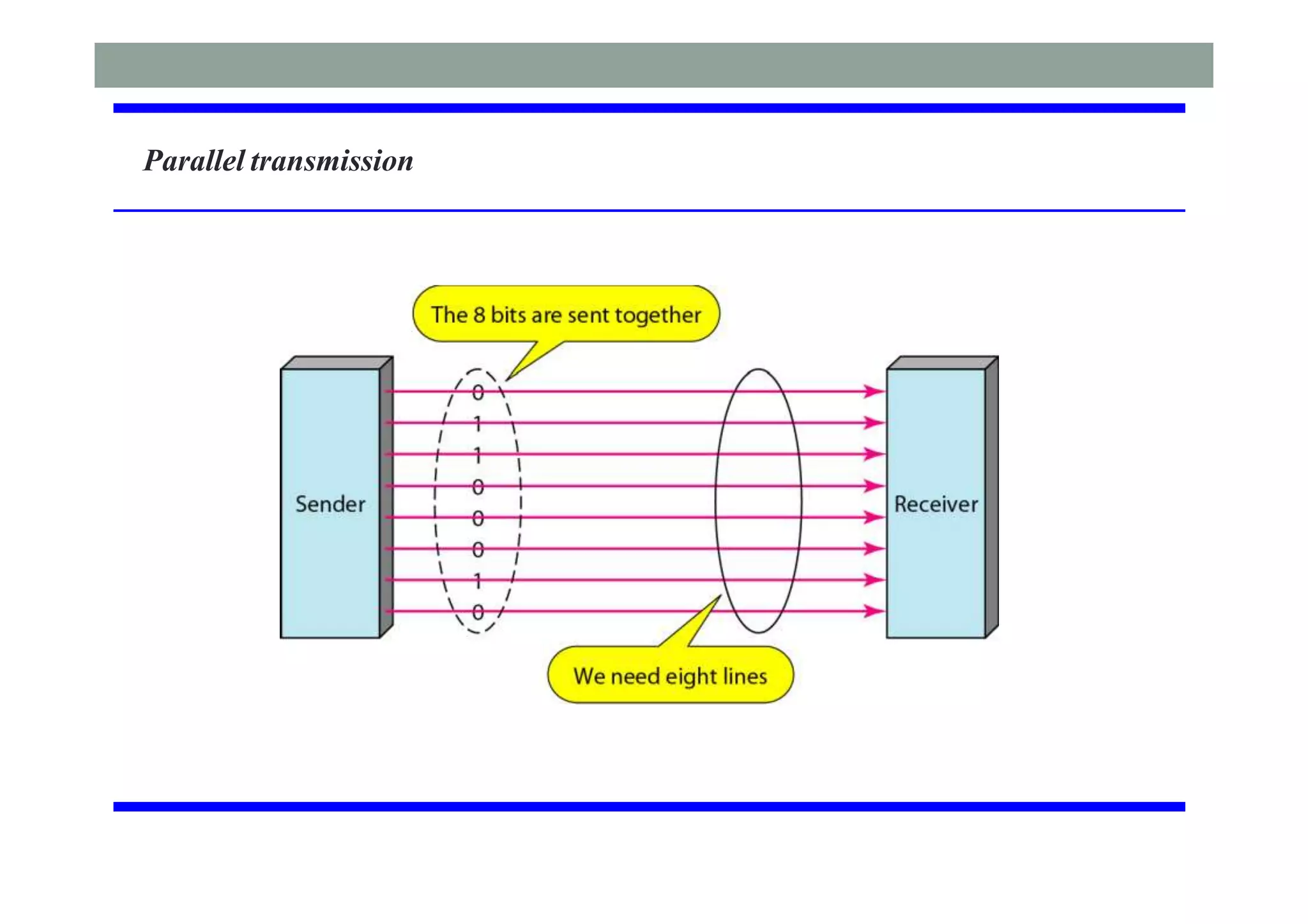
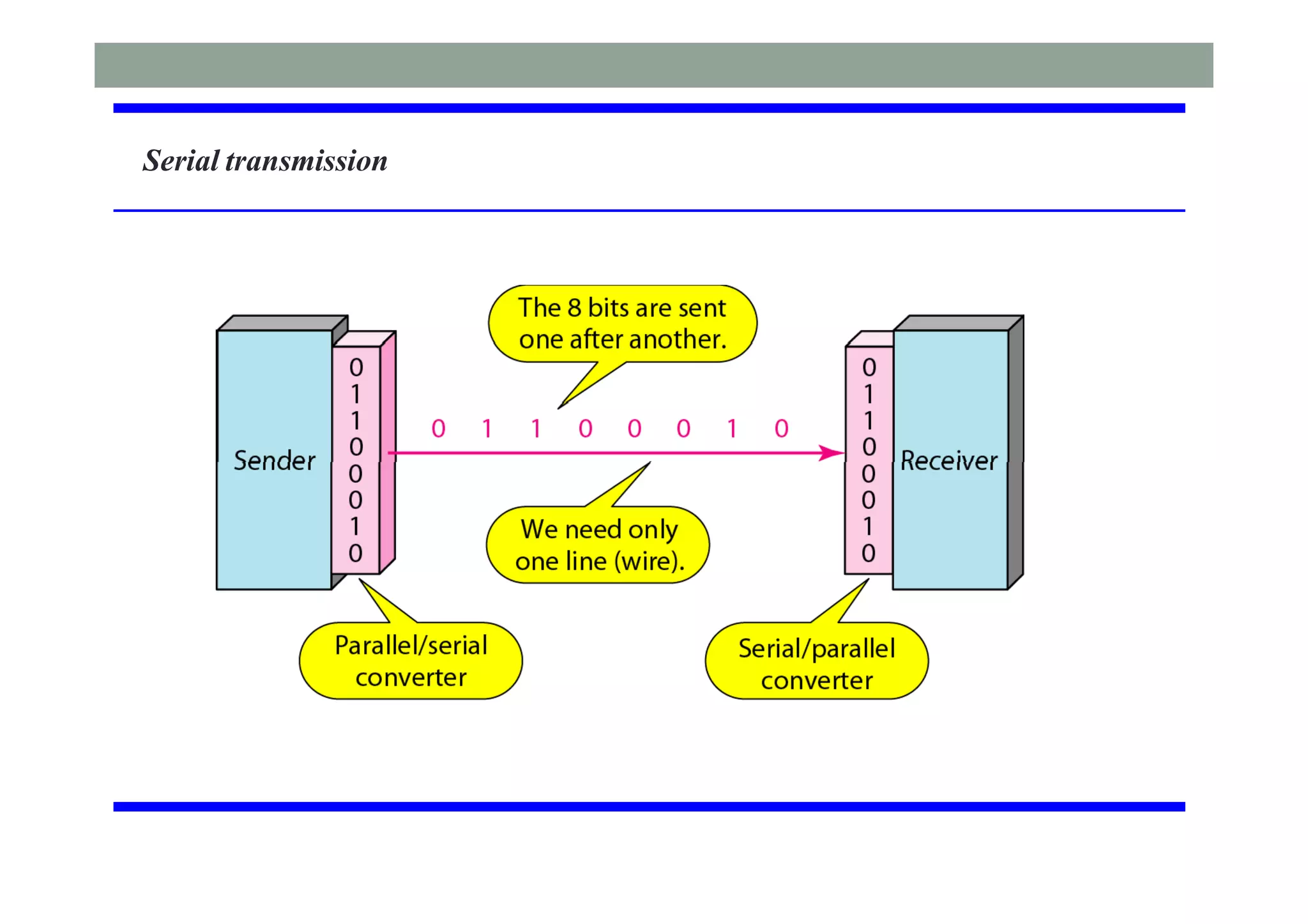
The transmission of binary data across a link can be
accomplished in either parallel or serial mode. In parallel mode,
multiple bits are sent with each clock tick. In serial mode, 1 bit is
sent with each clock tick. While there is only one way to send
parallel data, there are three subclasses of serial transmission:
asynchronous, synchronous, and isochronous.
Topics discussed in this section:
 Parallel Transmission
 Serial Transmission
Data transmission and modes
Parallel transmission
Serial transmission
4.57
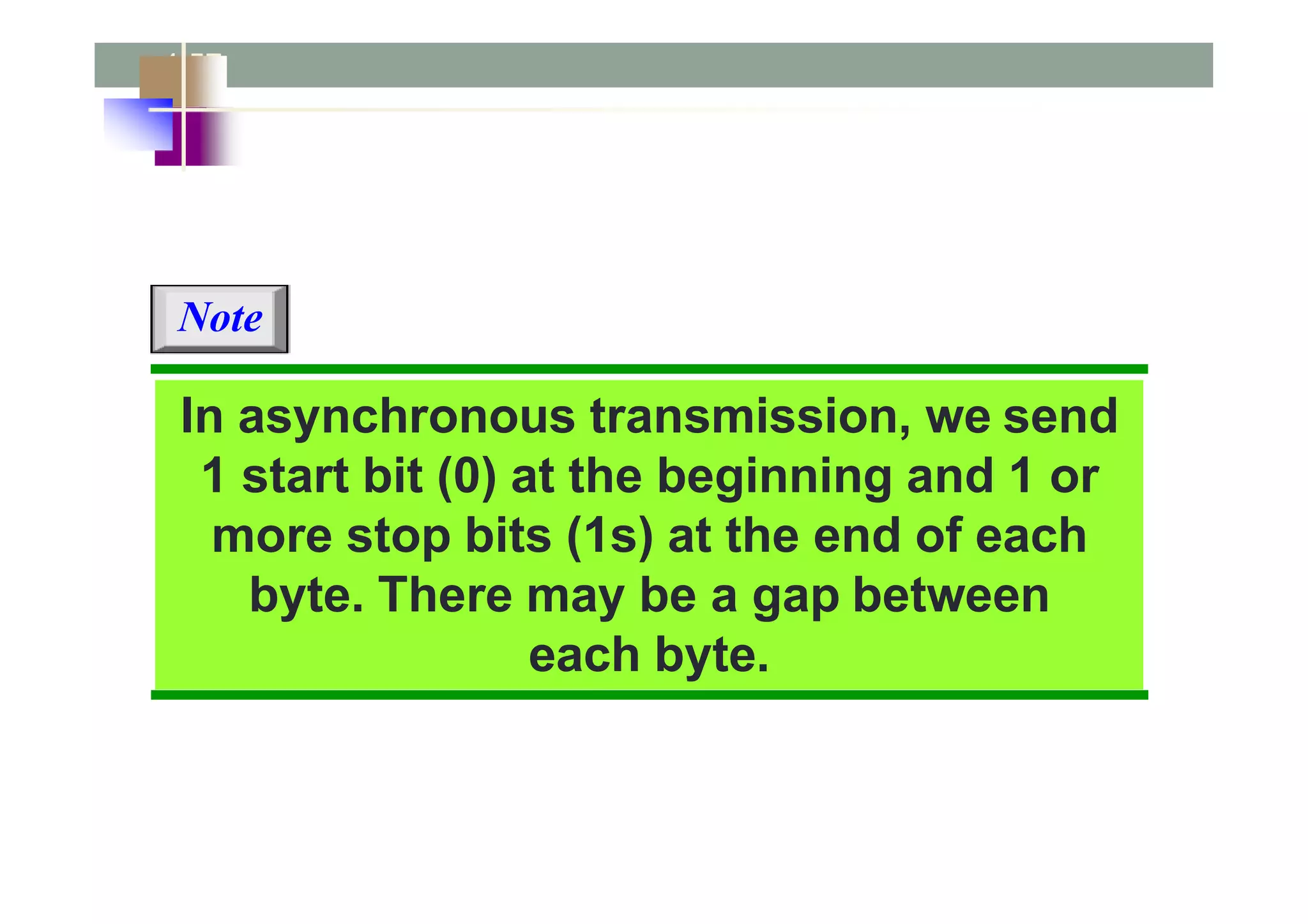
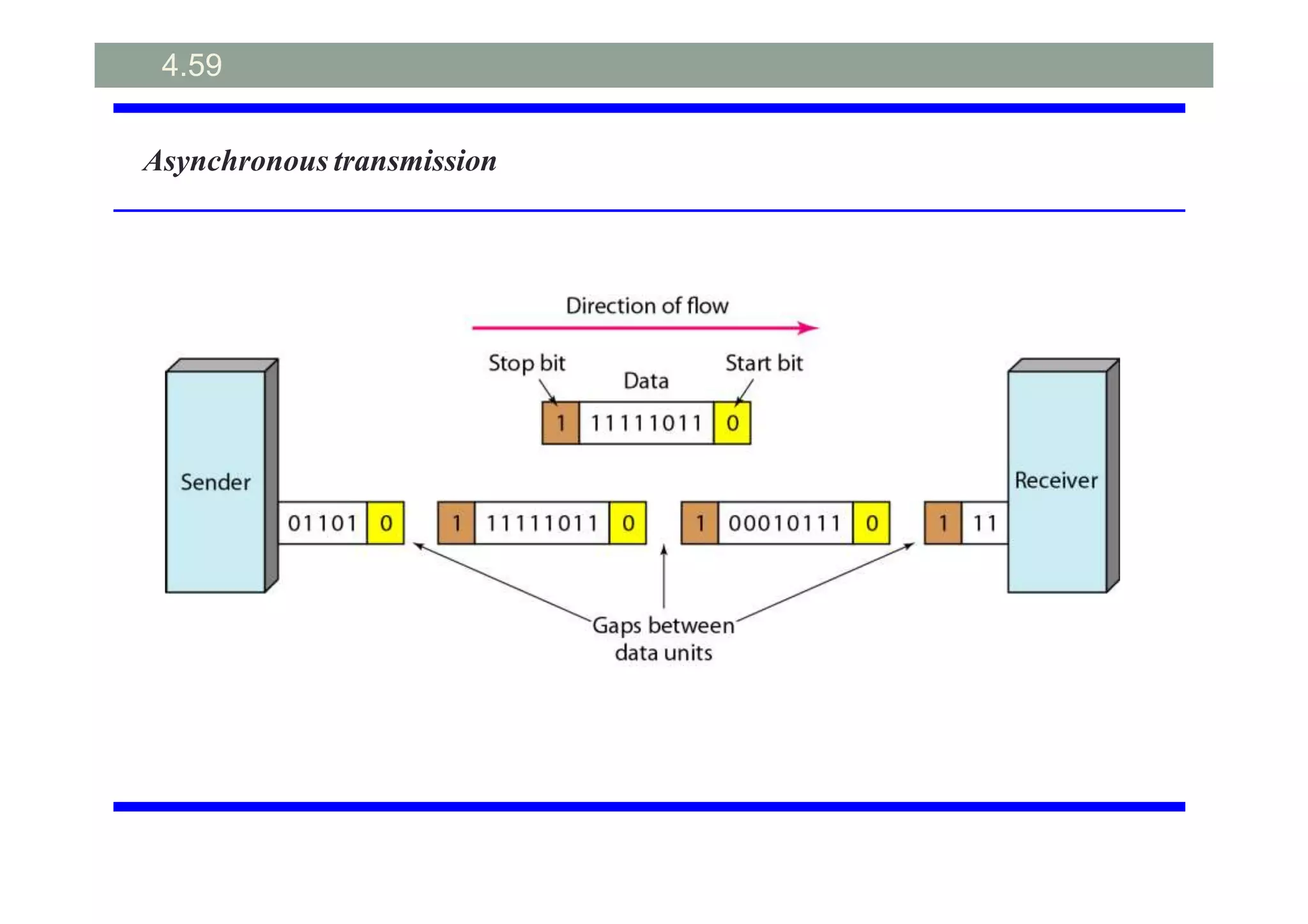
In asynchronous transmission, we send
1 start bit (0) at the beginning and 1 or
more stop bits (1s) at the end of each
byte. There may be a gap between
each byte.
Note
4.58
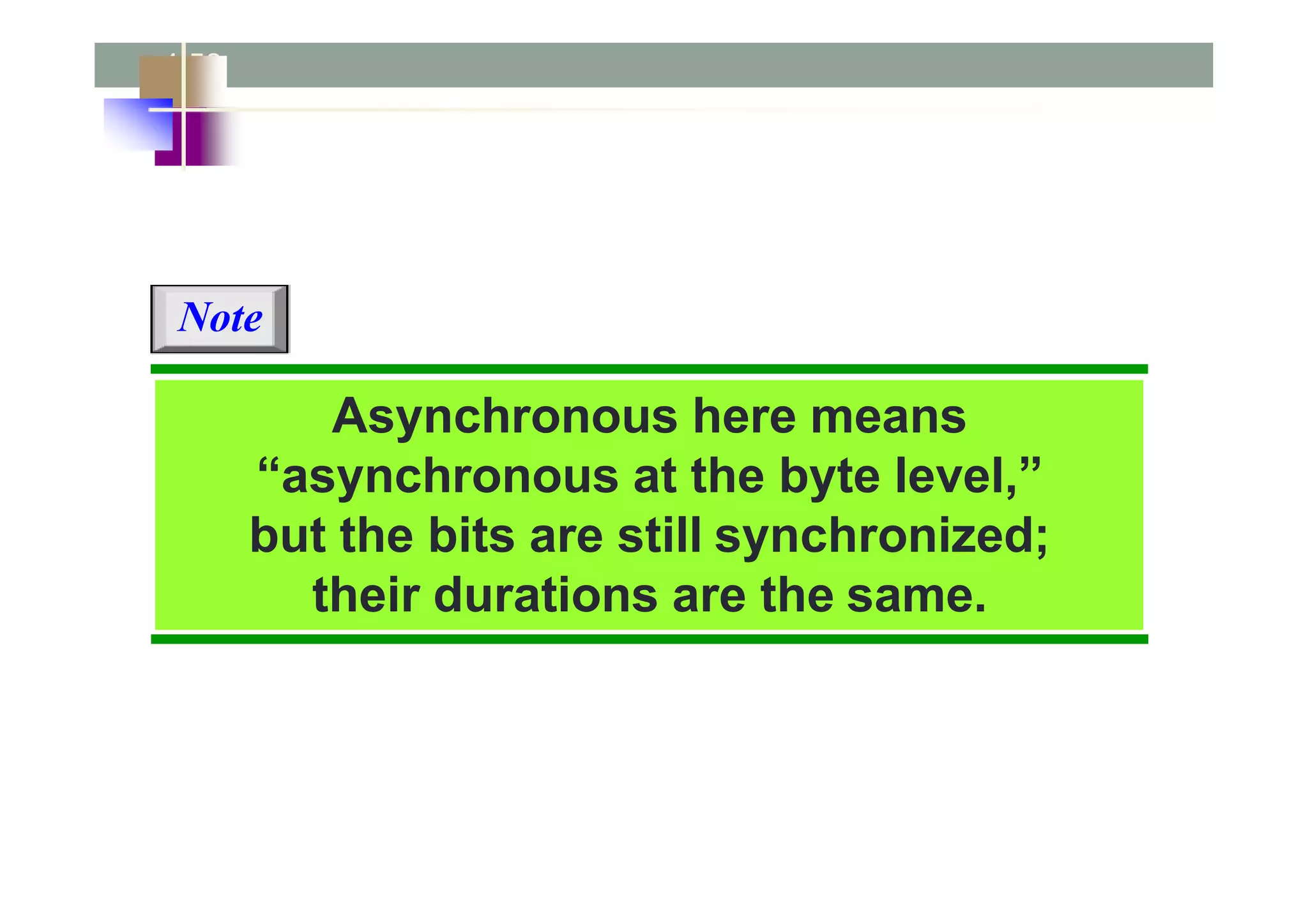
Asynchronous here means
“asynchronous at the byte level,”
but the bits are still synchronized;
their durations are the same.
Note
4.59
Asynchronous transmission
4.60
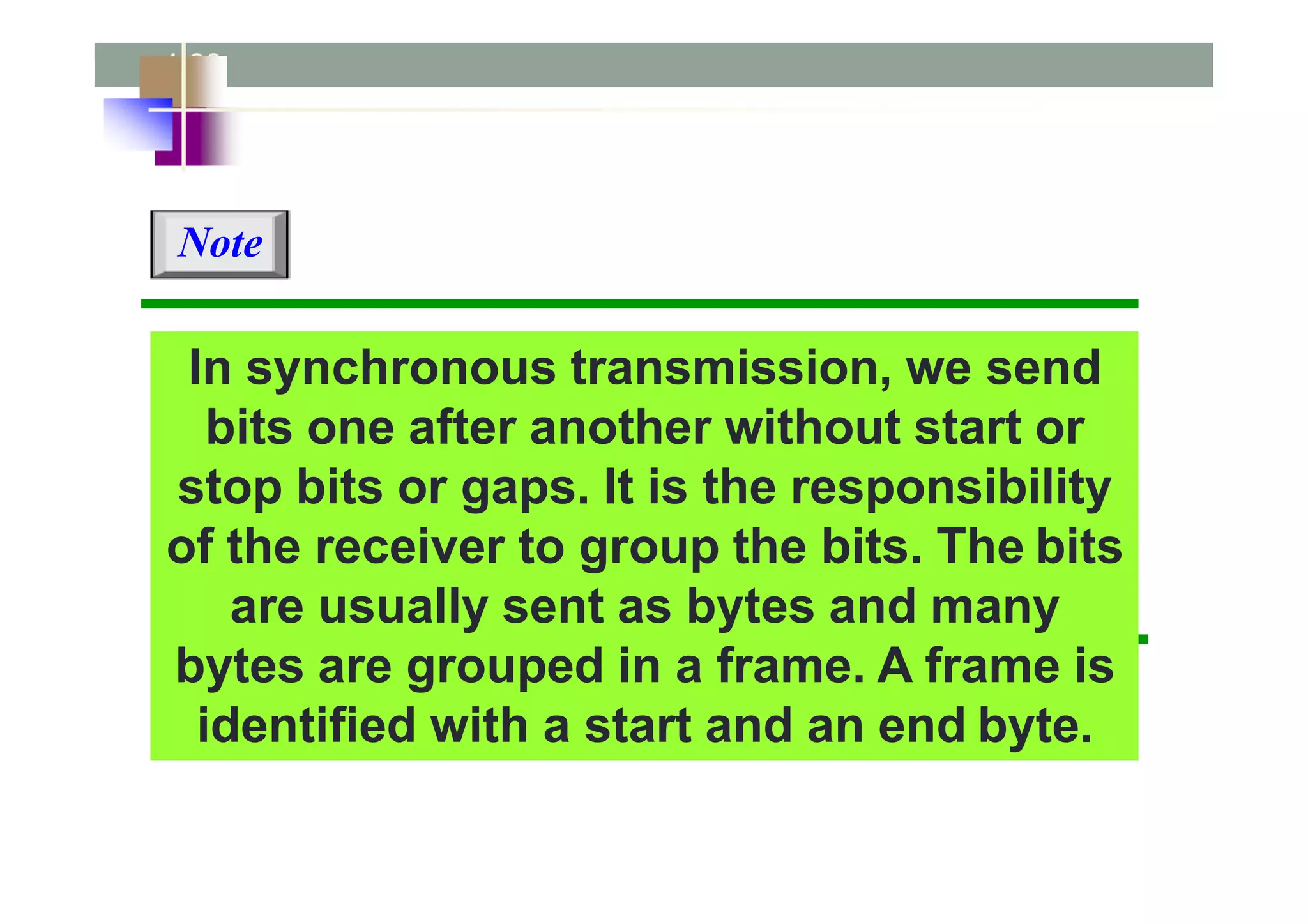
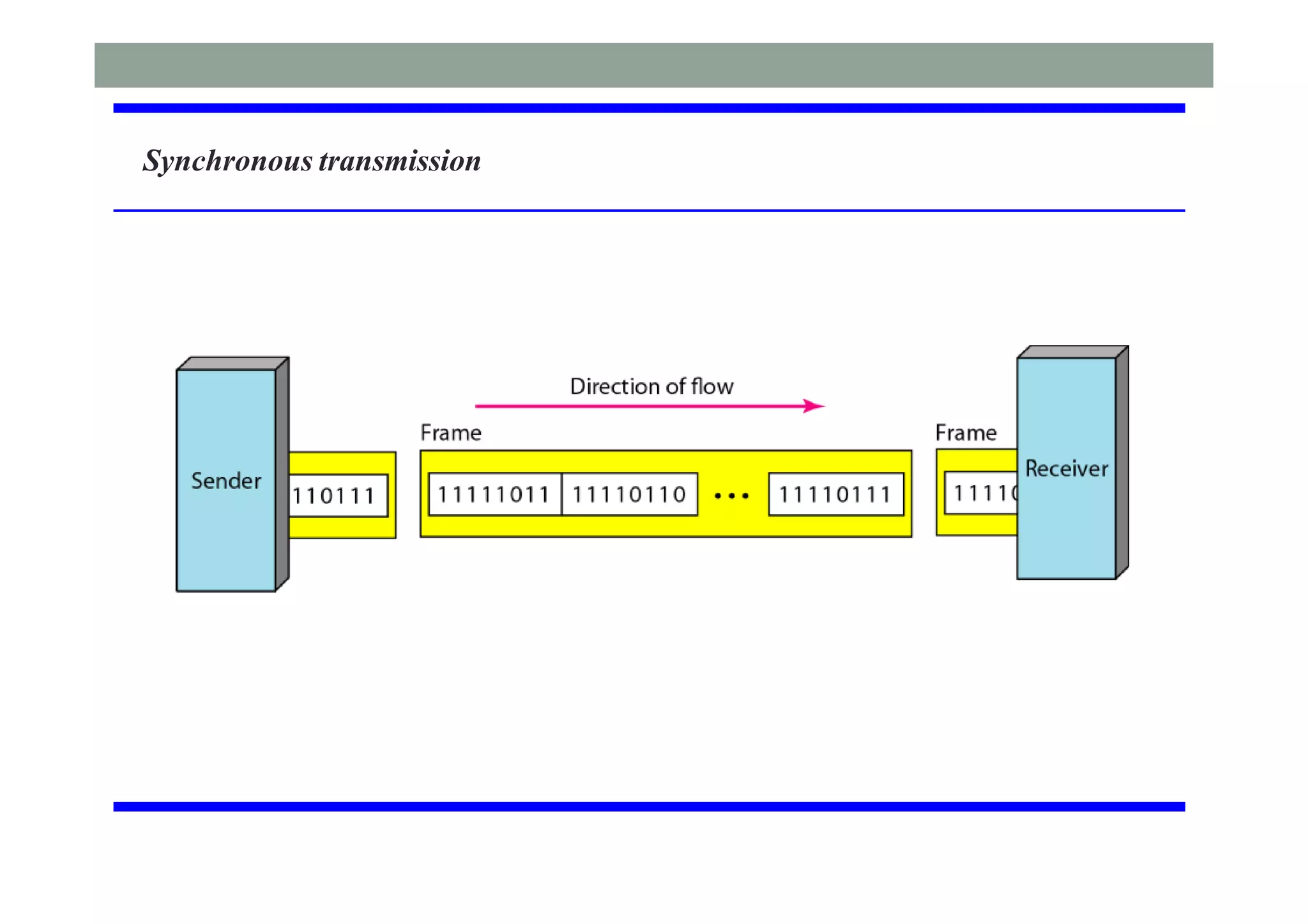
In synchronous transmission, we send
bits one after another without start or
stop bits or gaps. It is the responsibility
of the receiver to group the bits. The bits
are usually sent as bytes and many
bytes are grouped in a frame. A frame is
identified with a start and an end byte.
Note
Synchronous transmission

Communication system lec7

  • 1.
    REVIEW:DIGITALTRANSMISSIONOFANALOG SIGNALS • 1.BANDWIDTH REQUIREMENT OF PCM • 2. Disadvantages of DM • 3. ADM • TDM • BANDWIDTH OF TDM • TRANSMISSION MODES
  • 2.
  • 3.
  • 4.
    Bandwidth Requirement ofPCM • Bandwidth needed for PCM transmission is given by half of the signaling rate. • BW>= (0.5)(r) • r= signaling rate • R=(no. of bits)(fs)
  • 5.
    Noise consideration inPCM •The performance of a PCM system is influenced by two major sources of noise. • Channel noise, which is introduced anywhere between the transmitter output and the receiver input, channel noise is always present, once the equipment is switched on. • Quantization noise, which is introduced in the transmitter and is carried all the way along to the receiver output.
  • 6.
  • 8.
  • 9.
    • Delta modulation,a special case of DPCM where the differences eQ[n] are represented with 1 bit as ±∆
  • 10.
    2. REVIEW OFDMAND ITS DISADVANTES
  • 11.
  • 12.
    Delta Modulation • Nextform of pulse modulation • Transmits information only to indicate whether the analog signal that is being encoded goes up or goes down. • The Encoder Outputs are highs or lows that “instruct” whether to go up or down, respectively • DM takes advantage of the fact that voice signals do not change abruptly
  • 13.
    The process ofdelta modulation
  • 14.
  • 15.
  • 16.
    Limitations of thesystem •Slope overload • When the analog signal has a high rate of change, the DM can “fall behind” and a distorted output occurs
  • 17.
    Tradeoffs • Simplicity versusQuality • In order to obtain the high quality DM requires very high sampling rates, typically 20× the highest frequency of interest, as opposed to Nyquist rate of 2×fm
  • 18.
  • 19.
    Delta PCM (DPCM) •Instead of using one bit to indicate positive and negative differences, we can use more bits -> quantization of the difference. • Each bit code is used to represent the value of the difference. • The more bits the more levels -> the higher the accuracy.
  • 21.
  • 22.
  • 23.
  • 24.
  • 25.
  • 26.
    Granular Noise Granular noiseoccurs when the original analog signal has a relatively constant amplitude and the reconstructed signal has variations that were not present in the original information signal. Reducing the quantizing step size can reduce this noise, but this increases the risk of slope overload.
  • 27.
  • 29.
  • 30.
    Cont’d... • Analog inputis approximated by a staircase function • Move up or down one level ()at each sample interval (by one quantization level at each sampling time)  output of DM is a single bit. • Binary behavior • Function moves up or down at each sample interval • In DM the quantization levels are represented by two symbols: 0 for - and 1 for +. In fact the coding process is performed on eq. • The main advantage of DM is its simplicity.
  • 31.
    •Slope overload distortionis due to the fact that the staircase approximation mq(t) can't follow closely the actual curve of the message signal m(t ). In contrast to slope-overload distortion, granular noise occurs when  is too large relative to the local slope characteristics of m(t). granular noise is similar to quantization noise in PCM. •It seems that a large  is needed for rapid variations of m(t) to reduce the slope-overload distortion and a small  is needed for slowly varying m(t) to reduce the granular noise. The optimum  can only be a compromise between the two cases. •To satisfy both cases, an adaptive DM is needed, where the step size  can be adjusted in accordance with the input signal m(t). Cont’d…
  • 32.
    Cont’d... • Insummary • Slopeoverload • Due to the input analog signal amplitude changes faster than the speed of the modulator • to minimize : the product of the sampling step size and the sampling rate must be equal to or larger than the rate of change of the amplitude of the input analog signal. • Granular noise • Due to the difference between step size and sampled voltage. • To minimize : increase the sampling rate, decrease the step size of modulator
  • 33.
    DM Performance • Goodvoice reproduction • PCM - 128 levels (7 bit) • Voice bandwidth 4khz • Should be 8000 x 7 = 56kbps for PCM • Data compression can improve on this • e.g. Interframe coding techniques for video
  • 34.
    Cont’d... • Adaptive DeltaModulation (ADM) • A Delta Modulation system where the step size of the DAC is automatically varied depending on the amplitude characteristics of the analog signal. • A well designed ADM scheme can transmit voice at about halfthe bit rate of a PCM system with equivalent quality.
  • 35.
  • 36.
  • 38.
  • 41.
  • 42.
  • 43.
  • 46.
  • 47.
    DS1/T1/E1 • Digital signal1 (DS1, also known as T1) is a T-carrier signaling scheme devised by Bell Labs. DS1 is a widely used standard in telecommunications in North America and Japan to transmit voice and data between devices. E1 is used in place of T1 outside of North America and Japan. Technically, DS1 is the transmission protocol used over a physical T1 line; however, the terms "DS1" and "T1" are often used interchangeably. • A DS1 circuit is made up of twenty-four DS0 • DS1: (8 bits/channel * 24 channels/frame + 1 framing bit) * 8000 frames/s = 1.544 Mbit/s • A E1 is made up of 32 DS0 • The line data rate is 2.048 Mbit/s which is split into 32 time slots, each being allocated 8 bits in turn. Thus each time slot sends and receives an 8- bit sample 8000 times per second (8 x 8000 x 32 = 2,048,000). 2.048Mbit/s
  • 48.
  • 49.
  • 50.
  • 51.
  • 52.
    TRANSMISSION MODES The transmissionof binary data across a link can be accomplished in either parallel or serial mode. In parallel mode, multiple bits are sent with each clock tick. In serial mode, 1 bit is sent with each clock tick. While there is only one way to send parallel data, there are three subclasses of serial transmission: asynchronous, synchronous, and isochronous. Topics discussed in this section:  Parallel Transmission  Serial Transmission
  • 53.
  • 54.
  • 55.
  • 56.
    4.57 In asynchronous transmission,we send 1 start bit (0) at the beginning and 1 or more stop bits (1s) at the end of each byte. There may be a gap between each byte. Note
  • 57.
    4.58 Asynchronous here means “asynchronousat the byte level,” but the bits are still synchronized; their durations are the same. Note
  • 58.
  • 59.
    4.60 In synchronous transmission,we send bits one after another without start or stop bits or gaps. It is the responsibility of the receiver to group the bits. The bits are usually sent as bytes and many bytes are grouped in a frame. A frame is identified with a start and an end byte. Note
  • 60.