
BENIGN PROSTATIC
HYPERPLASIA
(BPH)
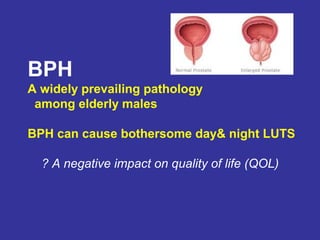
BPH
A widely prevailing pathology
among elderly males
BPH can cause bothersome day& night LUTS
? A negative impact on quality of life (QOL)
Definition Of BPH
Normal prostate:
A compound tubulo-alveolar gland
composed of 3 histological elements:
-Epithelial structure: prostatic acini&ducts
(androgen dependent) lying within a :
-fibro -
-muscular smooth m. innervated by
alpha adrenergic fibres
Stroma
Normal prostate is about 15 g.
in the young adult
BPH results from abnormal (proliferation) of
the 3 histological elements of the prostate:
glandular (acinar)
fibrous
muscular
in different proportions
It can be regarded as a benign tumor:
fibro-myo-adenoma
Aetiogy Of BPH
• Aging
• Androgens
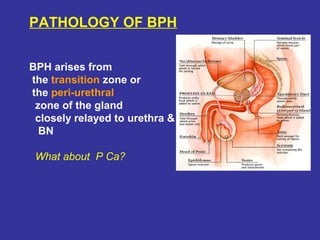
PATHOLOGY OF BPH
BPH arises from
the transition zone or
the peri-urethral
zone of the gland
closely relayed to urethra &
BN
What about P Ca?
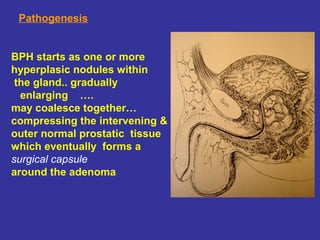
BPH starts as one or more
hyperplasic nodules within
the gland.. gradually
enlarging ….
may coalesce together…
compressing the intervening &
outer normal prostatic tissue
which eventually forms a
surgical capsule
around the adenoma
Pathogenesis
The result will be:
An elongated & compressed prostatic
Urethra
Macroscopically BPH can be:
Monolobar…middle lobe
Bilobar….. 2 lateral lobes
Trilobar… 2 lateral lobes & middle lobe
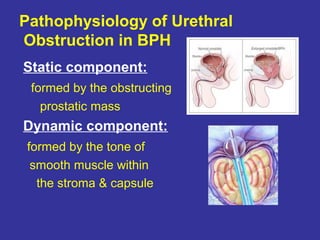
Pathophysiology of Urethral
Obstruction in BPH
Static component:
formed by the obstructing
prostatic mass
Dynamic component:
formed by the tone of
smooth muscle within
the stroma & capsule
Pathological complications of BPH
Increased intravesical pressure:
Early… bladder muscle hypertrophy
Later…. atony..
thinning out of bladder muscle
…diverticulation
The result will be:
High intra-vesical (P) …Bil hydroureteronephrosis
Outlet obstruction…significant amount of
PV residual urine….Stasis:
Rec UTI
Stone formation
Diagnosis of BPH
Clinical Picture
Symptoms:
Old male (over 50 ys) suffering from LUTS
Storage symptoms:
Urinary frequency
nocturia
urgency ,..urgency incontinence
Evacuation symptoms:
Straining during voiding
diminished force & calibre of the stream
bifurcated stream
interrupted stream
PV dribbling
AUR
Symptoms of complications
Rec. UTI
Haematuria
Bladder stone
chronic retention:
SP mass (full bladder)
overflow incontinence
renal insufficiency
Physical examination
• General examination
• Abdominal examination:
? Renal swelling (hydronephrosis)
? SP area ( full bladder)
Hernial orifices
• Genital examination
? associated epididymo-orchitis
• Digital rectal examination (DRE)
size , shape, symmetry, consistency
Is it suspicious of P Ca ?
Investigations
Lab investigations
Urinalysis
Serum creatinine
Serum PSA
Imaging
Abdominal ultrasonography:
size of the gland, PVR,
associated stones
? hydronephrosis,
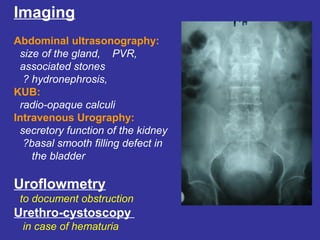
KUB:
radio-opaque calculi
Intravenous Urography:
secretory function of the kidney
?basal smooth filling defect in
the bladder
Uroflowmetry
to document obstruction
Urethro-cystoscopy
in case of hematuria
Differential Diagnosis
Other causes of LUTS
Bladder & urethral calculi
Bladder cancer
BN fibrosis
Prostate cancer
Urethral stricture
Neurogenic voiding dysfunction
TREATMENT of BPH
Non- symptomatic BPH
Reassurance---- Follow up
Symptomatic BPH:
Conservative Treatment:
non-specific measures
* Avoid causes of prostatic congestion
* Phytotherapy
Specific medical treatment:
5- alpha - reductase inhibitors
prevent the conversion of testosterone
to 5-dihydro testosterone
gradual atrophy of the glandular
component of BPH
(slow effect on static component)
Alpha adrenergic blockers
Cause decrease of the smooth muscle
tone within the prostatic stroma&capsule
better urine flow
(rapid effect on dynamic component)
Surgical Intervention
Indications
Repeated AUR
Chronic UR
Severe obstructive symptoms
Failure of medical treatment
Haematuria
Complications:
Rec. UTI
Hydronephrosis
Bladder stones or diverticula
Methods of Surgical intervention
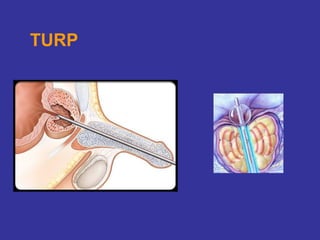
Trans-urethral resection
of the prostate (TURP)
Gold standard 90% of cases
Open surgical prostatectomy
( enucleation adenectomy)
when ?
Very large BPH
Concomitant bladder lesion that needs
open surgery
Patient limitation (limited hip joint mobility)
TURP
Conclusions
• BPH is a disease of aging males
• It can cause disabling LUTS (QOL)
• Corner stone of diagnosis
old male,.. LUTS,
DRE….. sonography
exclude cases of suspected P ca
Conclusions(cont.)
• Most cases ( 70 – 90 % ) can be managed
by medical treatment with reasonable pt.
satisfaction
Only a small percentage will need surgical
intervention where TURP is the standard
of care
Benign prostatic hyperplasia

Benign prostatic hyperplasia

  • 1.
  • 2.
    BPH A widely prevailingpathology among elderly males BPH can cause bothersome day& night LUTS ? A negative impact on quality of life (QOL)
  • 3.
    Definition Of BPH Normalprostate: A compound tubulo-alveolar gland composed of 3 histological elements: -Epithelial structure: prostatic acini&ducts (androgen dependent) lying within a : -fibro - -muscular smooth m. innervated by alpha adrenergic fibres Stroma
  • 4.
    Normal prostate isabout 15 g. in the young adult BPH results from abnormal (proliferation) of the 3 histological elements of the prostate: glandular (acinar) fibrous muscular in different proportions It can be regarded as a benign tumor: fibro-myo-adenoma
  • 5.
    Aetiogy Of BPH •Aging • Androgens
  • 6.
    PATHOLOGY OF BPH BPHarises from the transition zone or the peri-urethral zone of the gland closely relayed to urethra & BN What about P Ca?
  • 7.
    BPH starts asone or more hyperplasic nodules within the gland.. gradually enlarging …. may coalesce together… compressing the intervening & outer normal prostatic tissue which eventually forms a surgical capsule around the adenoma Pathogenesis
  • 8.
    The result willbe: An elongated & compressed prostatic Urethra Macroscopically BPH can be: Monolobar…middle lobe Bilobar….. 2 lateral lobes Trilobar… 2 lateral lobes & middle lobe
  • 9.
    Pathophysiology of Urethral Obstructionin BPH Static component: formed by the obstructing prostatic mass Dynamic component: formed by the tone of smooth muscle within the stroma & capsule
  • 10.
    Pathological complications ofBPH Increased intravesical pressure: Early… bladder muscle hypertrophy Later…. atony.. thinning out of bladder muscle …diverticulation The result will be: High intra-vesical (P) …Bil hydroureteronephrosis Outlet obstruction…significant amount of PV residual urine….Stasis: Rec UTI Stone formation
  • 11.
    Diagnosis of BPH ClinicalPicture Symptoms: Old male (over 50 ys) suffering from LUTS Storage symptoms: Urinary frequency nocturia urgency ,..urgency incontinence Evacuation symptoms: Straining during voiding diminished force & calibre of the stream bifurcated stream interrupted stream PV dribbling AUR
  • 12.
    Symptoms of complications Rec.UTI Haematuria Bladder stone chronic retention: SP mass (full bladder) overflow incontinence renal insufficiency
  • 13.
    Physical examination • Generalexamination • Abdominal examination: ? Renal swelling (hydronephrosis) ? SP area ( full bladder) Hernial orifices • Genital examination ? associated epididymo-orchitis • Digital rectal examination (DRE) size , shape, symmetry, consistency Is it suspicious of P Ca ?
  • 14.
  • 15.
    Imaging Abdominal ultrasonography: size ofthe gland, PVR, associated stones ? hydronephrosis, KUB: radio-opaque calculi Intravenous Urography: secretory function of the kidney ?basal smooth filling defect in the bladder Uroflowmetry to document obstruction Urethro-cystoscopy in case of hematuria
  • 16.
    Differential Diagnosis Other causesof LUTS Bladder & urethral calculi Bladder cancer BN fibrosis Prostate cancer Urethral stricture Neurogenic voiding dysfunction
  • 17.
    TREATMENT of BPH Non-symptomatic BPH Reassurance---- Follow up Symptomatic BPH: Conservative Treatment: non-specific measures * Avoid causes of prostatic congestion * Phytotherapy
  • 18.
    Specific medical treatment: 5-alpha - reductase inhibitors prevent the conversion of testosterone to 5-dihydro testosterone gradual atrophy of the glandular component of BPH (slow effect on static component) Alpha adrenergic blockers Cause decrease of the smooth muscle tone within the prostatic stroma&capsule better urine flow (rapid effect on dynamic component)
  • 19.
    Surgical Intervention Indications Repeated AUR ChronicUR Severe obstructive symptoms Failure of medical treatment Haematuria Complications: Rec. UTI Hydronephrosis Bladder stones or diverticula
  • 20.
    Methods of Surgicalintervention Trans-urethral resection of the prostate (TURP) Gold standard 90% of cases Open surgical prostatectomy ( enucleation adenectomy) when ? Very large BPH Concomitant bladder lesion that needs open surgery Patient limitation (limited hip joint mobility)
  • 21.
  • 22.
    Conclusions • BPH isa disease of aging males • It can cause disabling LUTS (QOL) • Corner stone of diagnosis old male,.. LUTS, DRE….. sonography exclude cases of suspected P ca
  • 23.
    Conclusions(cont.) • Most cases( 70 – 90 % ) can be managed by medical treatment with reasonable pt. satisfaction Only a small percentage will need surgical intervention where TURP is the standard of care