Dr. Rabindra Tamang
Junior Resident
BPKIHS, Dharan
Nepal
Contents
 Introduction
 Types of nephrolithiasis
 Diagnostic evaluation of nephrolithiasis
 Conservative management
 Surgical management
 Conclusion
 References
Introduction
 One of the most common afflictions of
modern society
 The lifetime prevalence of kidney stone disease is
estimated at 1% to 15%
 The age of peak incidence in men 30 to 69 years and in
women 50 to 79 years.
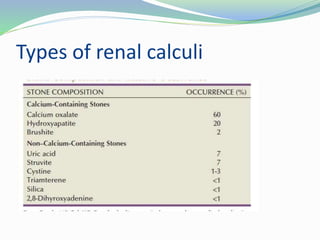
Types of renal calculi
Diagnostic evaluation
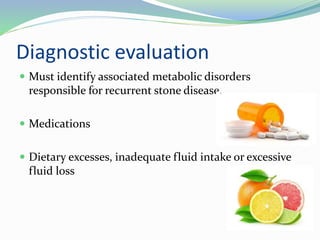
 Must identify associated metabolic disorders
responsible for recurrent stone disease.
 Medications
 Dietary excesses, inadequate fluid intake or excessive
fluid loss
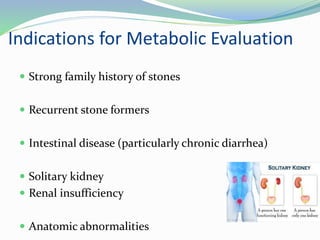
Indications for Metabolic Evaluation
 Strong family history of stones
 Recurrent stone formers
 Intestinal disease (particularly chronic diarrhea)
 Solitary kidney
 Renal insufficiency
 Anatomic abnormalities
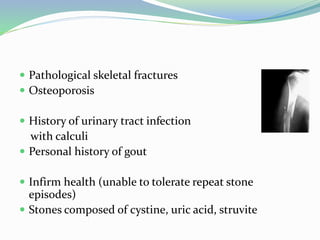
 Pathological skeletal fractures
 Osteoporosis
 History of urinary tract infection
with calculi
 Personal history of gout
 Infirm health (unable to tolerate repeat stone
episodes)
 Stones composed of cystine, uric acid, struvite
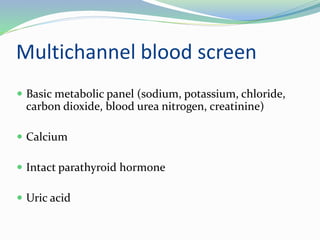
Multichannel blood screen
 Basic metabolic panel (sodium, potassium, chloride,
carbon dioxide, blood urea nitrogen, creatinine)
 Calcium
 Intact parathyroid hormone
 Uric acid
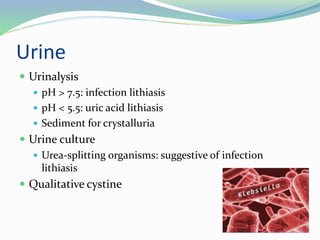
Urine
 Urinalysis
 pH > 7.5: infection lithiasis
 pH < 5.5: uric acid lithiasis
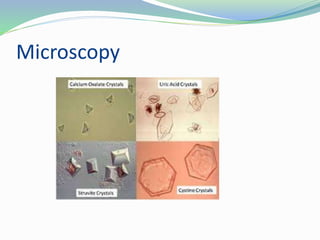
 Sediment for crystalluria
 Urine culture
 Urea-splitting organisms: suggestive of infection
lithiasis
 Qualitative cystine
Microscopy
Radiological investigations
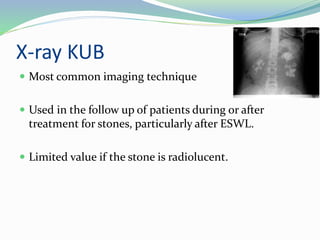
X-ray KUB
 Most common imaging technique
 Used in the follow up of patients during or after
treatment for stones, particularly after ESWL.
 Limited value if the stone is radiolucent.
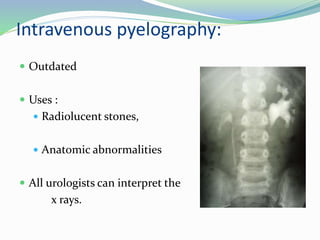
Intravenous pyelography:
 Outdated
 Uses :
 Radiolucent stones,
 Anatomic abnormalities
 All urologists can interpret the
x rays.
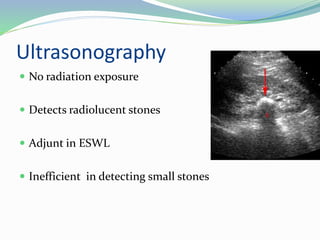
Ultrasonography
 No radiation exposure
 Detects radiolucent stones
 Adjunt in ESWL
 Inefficient in detecting small stones
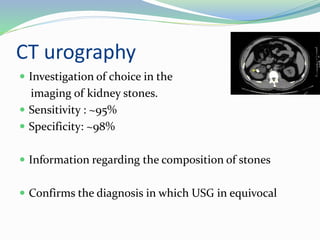
CT urography
 Investigation of choice in the
imaging of kidney stones.
 Sensitivity : ~95%
 Specificity: ~98%
 Information regarding the composition of stones
 Confirms the diagnosis in which USG in equivocal
MRI
 Provide 3D image without radiation
 Lower accuracy and
 Expensive
Stone analysis
 Direct further management
 Struvite: infection lithiasis.
Conservative medical management
 Made for all patients regardless of the underlying
etiology of their stone disease
 Calculi smaller than 0.5 cm pass spontaneously
Fluid recommendations
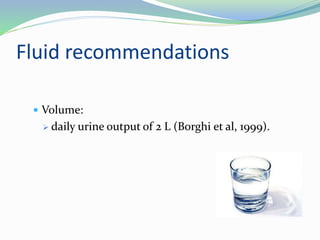
 Volume:
 daily urine output of 2 L (Borghi et al, 1999).
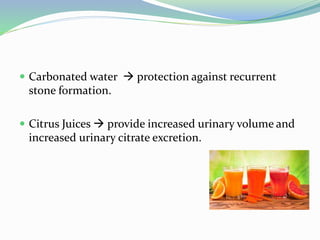
 Carbonated water  protection against recurrent
stone formation.
 Citrus Juices  provide increased urinary volume and
increased urinary citrate excretion.
Dietary Recommendations
 Decreased animal protein intake.
 Sodium restriction
 Combined : stone episodes decrease roughly by 50%
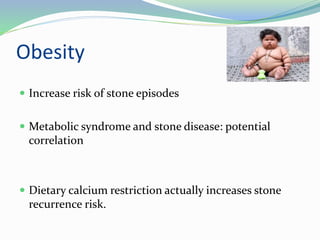
Obesity
 Increase risk of stone episodes
 Metabolic syndrome and stone disease: potential
correlation
 Dietary calcium restriction actually increases stone
recurrence risk.
Evaluation of conservative
management
 Re-evaluation after 3-4 months
 If metabolic or environmental abnormalities have
been corrected:
 Continue treatment and the patient
 Follow up every 6 to 12 months with repeat 24-hour
urine testing.
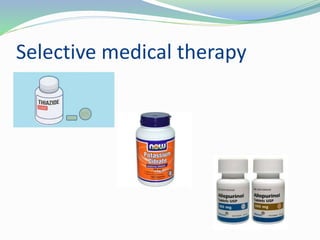
 If, however, a metabolic defect persists, a more
selective medical therapy may be instituted
Selective medical therapy
Surgical management
 Symptomatic renal stones in patients without any
other etiology of pain
Minimally invasive surgeries
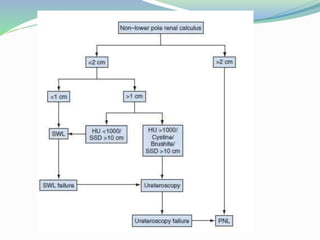
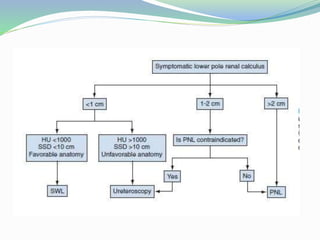
 Percutaneous nephrolithotomy (PNL)
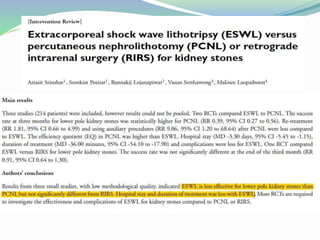
 Extracorporeal shock wave lithotripsy (ESWL)
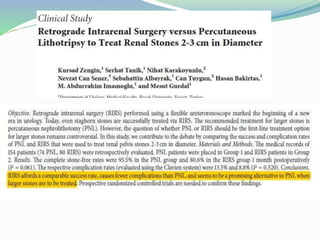
 Retrograde intrarenal surgery (RIRS)
 Laparoscopic and robotic stone surgery
Open surgical management
1. Nephrolithotomy
2. Pyelolithotomy
3. Extended pyelolithotomy
PRE OPERATIVE EVALUATION
Pre-procedural antimicrobials
 Bacteriologic evaluation of the urine is mandatory
for all patients
 Antimicrobial prophylaxis for all cases of
percutaneous renal surgery (Wolf et al, 2008).
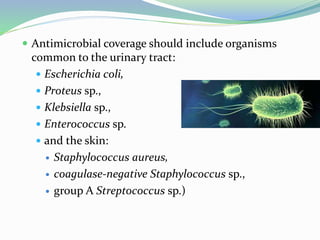
 Antimicrobial coverage should include organisms
common to the urinary tract:
 Escherichia coli,
 Proteus sp.,
 Klebsiella sp.,
 Enterococcus sp.
 and the skin:
 Staphylococcus aureus,
 coagulase-negative Staphylococcus sp.,
 group A Streptococcus sp.)
Percutaneous nephrolithotomy
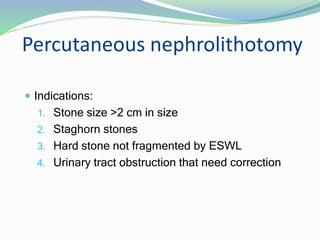
 Indications:
1. Stone size >2 cm in size
2. Staghorn stones
3. Hard stone not fragmented by ESWL
4. Urinary tract obstruction that need correction
 Complications:
 Acute and delayed hemorrhage
 Collecting system injury
 Visceral injury
 Pleural injury
 Metabolic and physiologic complications
 Post op fever and sepsis
 Neuromusculoskeletal complications
 Venous thromboembolism
 Tube dislodgement
 Collecting system obstruction
 Loss of renal function
 Death
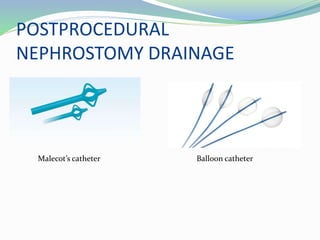
POSTPROCEDURAL
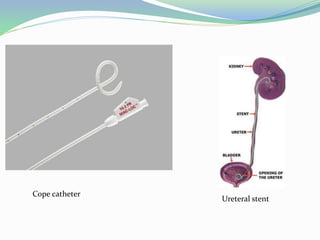
NEPHROSTOMY DRAINAGE
Malecot’s catheter Balloon catheter
Cope catheter
Ureteral stent
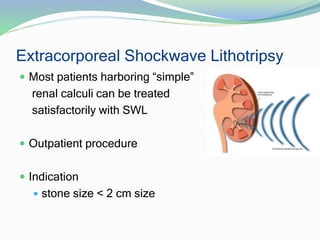
Extracorporeal Shockwave Lithotripsy
 Most patients harboring “simple”
renal calculi can be treated
satisfactorily with SWL
 Outpatient procedure
 Indication
 stone size < 2 cm size
 Contraindications
 Pregnancy
 Large abdominal aortic aneurysm
 Uncorrectable bleeding disorder
 Body habitus
 Obstruction distal to the stone
 Complications:
 Fragments may become impacted in the ureter
 Hematuria
 Renal hematoma
 Infection
 Kidney damage
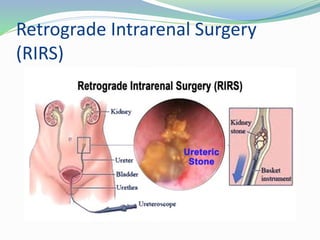
Retrograde Intrarenal Surgery
(RIRS)
 Indications:
 Failed ESWL
 RIRS assisted ESWL
 Radiolucent stones
 Calyceal diverticular stone
 Used in patients with ESWL contra-indications:
 Bleeding disorder or anticoagulant
 Obesity
 Pregnancy
 Complications:
 Sepsis
 Steinstrasse
 Stricture
 Ureteric injury
 UTI
Anatrophic nephrolithotomy
 Gold standard for staghorn calculi
 Removal of all calculi and open surgical correction of
the anatomical obstruction
 Complications:
 Pulmonary complications
 Post op renal hemorrhage
 Stone recurrences
 Urinary extravasation
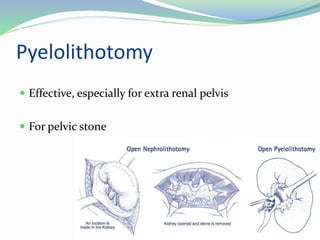
Pyelolithotomy
 Effective, especially for extra renal pelvis
 For pelvic stone
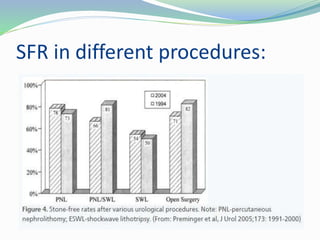
COMPARATIVE STUDIES
SFR in different procedures:
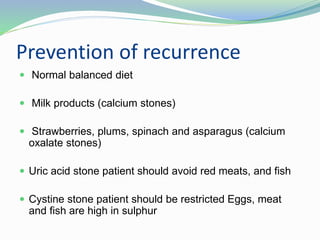
Prevention of recurrence
 Normal balanced diet
 Milk products (calcium stones)
 Strawberries, plums, spinach and asparagus (calcium
oxalate stones)
 Uric acid stone patient should avoid red meats, and fish
 Cystine stone patient should be restricted Eggs, meat
and fish are high in sulphur
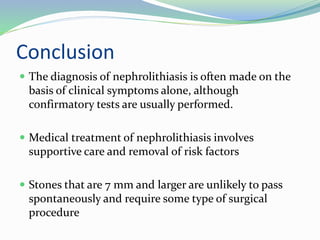
Conclusion
 The diagnosis of nephrolithiasis is often made on the
basis of clinical symptoms alone, although
confirmatory tests are usually performed.
 Medical treatment of nephrolithiasis involves
supportive care and removal of risk factors
 Stones that are 7 mm and larger are unlikely to pass
spontaneously and require some type of surgical
procedure
References
THANK YOU !!!

Management of nephrolithiasis

Editor's Notes

  • #32 Recommended agents include first- and second-generation cephalosporins; aminoglycosides (or aztreonam in patients with renal insufficiency) plus either metronidazole or clindamycin; ampicillin/sulbactam; or a fluoroquinolone.
  • #38 Complications fragments may become impacted in the ureter hematuria renal hematoma