PKD
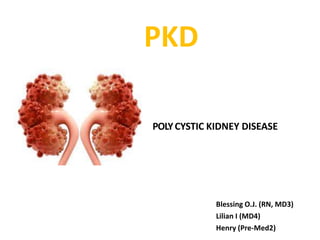
POLYCYSTIC KIDNEY DISEASE
Blessing O.J. (RN, MD3)
Lilian I (MD4)
Henry (Pre-Med2)
DEFINITION
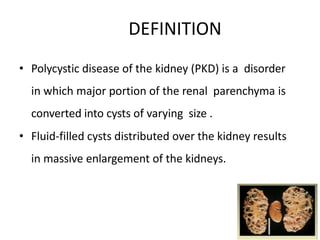
• Polycystic disease of the kidney (PKD) is a disorder
in which major portion of the renal parenchyma is
converted into cysts of varying size .
• Fluid-filled cysts distributed over the kidney results
in massive enlargement of the kidneys.
EPIDEMIOLOGY
Over 12.5 million people globally
TYPES
• 1. Autosomal Dominant Polycystic Kidney Disease(ADPKD)
• Inherited as a Autosomal Dominant Disease…
most common in Adult
• 2. Autosomal Recessive Polycystic Kidney Disease (ARPKD)
• Inherited as a Autosomal Recessive
Disease….most common in infants
[ADPKD(50:50 Chance) and ARPKD(1:4 Chance)]
FEATURES
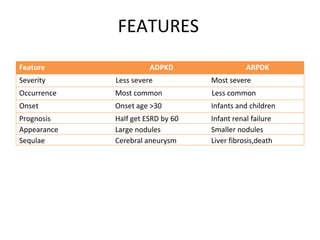
Feature ADPKD ARPDK
Severity Less severe Most severe
Occurrence Most common Less common
Onset Onset age >30 Infants and children
Prognosis Half get ESRD by 60 Infant renal failure
Appearance Large nodules Smaller nodules
Sequlae Cerebral aneurysm Liver fibrosis,death
GENETIC BASIS/ETIOLOGY
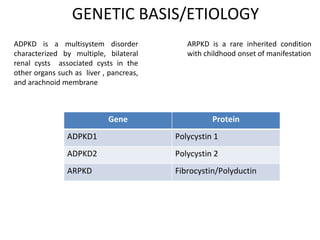
Gene Protein
ADPKD1 Polycystin 1
ADPKD2 Polycystin 2
ARPKD Fibrocystin/Polyductin
ADPKD is a multisystem disorder
characterized by multiple, bilateral
renal cysts associated cysts in the
other organs such as liver , pancreas,
and arachnoid membrane
ARPKD is a rare inherited condition
with childhood onset of manifestation
SIGNS AND SYMPTOMS
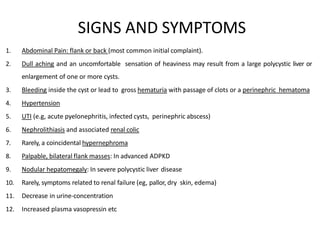
1. Abdominal Pain: flank or back (most common initial complaint).
2. Dull aching and an uncomfortable sensation of heaviness may result from a large polycystic liver or
enlargement of one or more cysts.
3. Bleeding inside the cyst or lead to gross hematuria with passage of clots or a perinephric hematoma
4. Hypertension
5. UTI (e.g, acute pyelonephritis, infected cysts, perinephric abscess)
6. Nephrolithiasis and associated renal colic
7. Rarely, a coincidental hypernephroma
8. Palpable, bilateral flank masses: In advanced ADPKD
9. Nodular hepatomegaly: In severe polycystic liver disease
10. Rarely, symptoms related to renal failure (eg, pallor, dry skin, edema)
11. Decrease in urine-concentration
12. Increased plasma vasopressin etc
PATHOPHYSIOLOGY
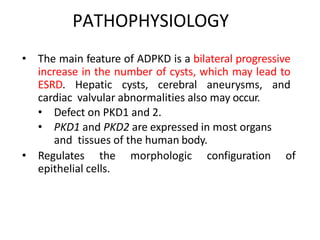
• The main feature of ADPKD is a bilateral progressive
increase in the number of cysts, which may lead to
ESRD. Hepatic cysts, cerebral aneurysms, and
cardiac valvular abnormalities also may occur.
• Defect on PKD1 and 2.
• PKD1 and PKD2 are expressed in most organs
and tissues of the human body.
• Regulates the morphologic configuration of
epithelial cells.
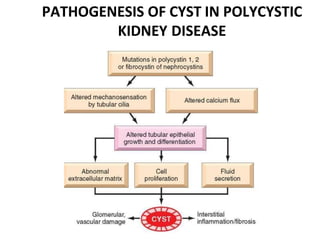
PATHOGENESIS OF CYST IN POLYCYSTIC
KIDNEY DISEASE
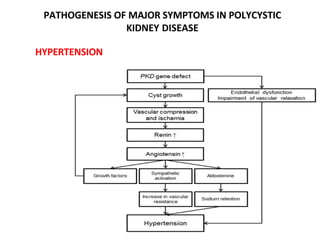
PATHOGENESIS OF MAJOR SYMPTOMS IN POLYCYSTIC
KIDNEY DISEASE
HYPERTENSION
BLEEDING
• Renal cysts with excessive angiogenesis of fragile vessels
stretched across their distended walls.
• Little trauma makes these vessels may leak blood into the
cyst, this makes it to enlarge rapidly, causing excruciating
pain.
• Continuous bleeding may lead to rupture into the collecting
system, which presents with gross hematuria.
DIAGNOSIS
1. Routine laboratory studies include the following
 Serum chemistry profile, including calcium and phosphorus
 CBC count from cysts
 Urinalysis
 Urine culture
2. Genetic testing
 This may be performed young adults potential kidney donors
with negative ultrasonographic.
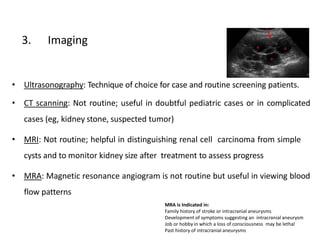
3. Imaging
• Ultrasonography: Technique of choice for case and routine screening patients.
• CT scanning: Not routine; useful in doubtful pediatric cases or in complicated
cases (eg, kidney stone, suspected tumor)
• MRI: Not routine; helpful in distinguishing renal cell carcinoma from simple
cysts and to monitor kidney size after treatment to assess progress
• MRA: Magnetic resonance angiogram is not routine but useful in viewing blood
flow patterns
MRA is Indicated in:
Family history of stroke or intracranial aneurysms
Development of symptoms suggesting an intracranial aneurysm
Job or hobby in which a loss of consciousness may be lethal
Past history of intracranial aneurysms
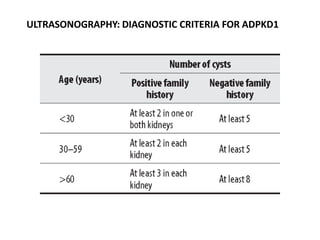
ULTRASONOGRAPHY: DIAGNOSTIC CRITERIA FOR ADPKD1
MANAGEMENT
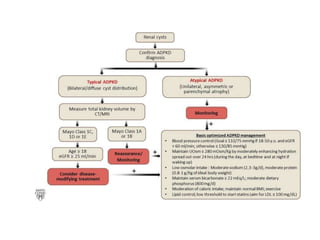
• Control Blood Pressure using ACEIs or ARBs
• Treat Urinary Tract and Cyst Infections using Gyrase inhibitors (eg, ciprofloxacin,
chloramphenicol, clindamycin, levofloxacin); dihydrofolic acid inhibitors
(TMX/SMP_Septrim)
• Treat hematuria: Possibly analgesic plus copious oral hydration
• Reduce abdominal pain produced by enlarged kidneys
• Control abnormalities related to renal failure (Oedema, ascites, weakness,
cephalic involvement etc)
• Prevent cardiac valve infection in patients with intrinsic valve disease
A. Symptomatic Medication (No Specific Medication for ADPKD):
• Surgical drainage: Ultrasonographically guided puncture
• Open-/fiberoptic-guided surgery: For excision/drainage of the outer walls
of cysts to ablate symptoms
• Partial hepatectomy: Tomanage massive hepatomegaly
• Liver transplantation: In cases of portal hypertension due to polycystic
liver or hepatomegaly with nonresectable areas
• Nephrectomy: Last resort for pain control in patients with inaccessible
cysts in the renal medullae; bilateral nephrectomy in patients with
severe hepatic involvement
B. Surgical intervention in ADPKD includes the following
B. End Stage Management
 Hemodialysis
 Peritoneal dialysis
 Renal transplantation
COMPLICATIONS
https://www.slideshare.net/drsamianik/autosomal-dominant-polycystic-kidney-disease-72091730
REFERENCES
1. Davidson principle and practice 22nd edition
2. http://emedicine.medscape.com/article/244 907-workup
3. https://www.slideshare.net/drsamianik/autosomal-dominant-polycystic-
kidney-disease-72091730
4. https://www.slideshare.net/hermycmkindy/polycystic-kidney-disease-
54353445
5. https://www.slideshare.net/peddanasunilkumar/poly-cystic-kidney-
disease
6. Pathophysiology of polycystic kidney disease,experimental studies by
Jeron Nauta

Polycystic Kidney Disease (PKD)

  • 1.
    PKD POLYCYSTIC KIDNEY DISEASE BlessingO.J. (RN, MD3) Lilian I (MD4) Henry (Pre-Med2)
  • 3.
    DEFINITION • Polycystic diseaseof the kidney (PKD) is a disorder in which major portion of the renal parenchyma is converted into cysts of varying size . • Fluid-filled cysts distributed over the kidney results in massive enlargement of the kidneys.
  • 4.
  • 5.
    TYPES • 1. AutosomalDominant Polycystic Kidney Disease(ADPKD) • Inherited as a Autosomal Dominant Disease… most common in Adult • 2. Autosomal Recessive Polycystic Kidney Disease (ARPKD) • Inherited as a Autosomal Recessive Disease….most common in infants [ADPKD(50:50 Chance) and ARPKD(1:4 Chance)]
  • 6.
    FEATURES Feature ADPKD ARPDK SeverityLess severe Most severe Occurrence Most common Less common Onset Onset age >30 Infants and children Prognosis Half get ESRD by 60 Infant renal failure Appearance Large nodules Smaller nodules Sequlae Cerebral aneurysm Liver fibrosis,death
  • 7.
    GENETIC BASIS/ETIOLOGY Gene Protein ADPKD1Polycystin 1 ADPKD2 Polycystin 2 ARPKD Fibrocystin/Polyductin ADPKD is a multisystem disorder characterized by multiple, bilateral renal cysts associated cysts in the other organs such as liver , pancreas, and arachnoid membrane ARPKD is a rare inherited condition with childhood onset of manifestation
  • 8.
    SIGNS AND SYMPTOMS 1.Abdominal Pain: flank or back (most common initial complaint). 2. Dull aching and an uncomfortable sensation of heaviness may result from a large polycystic liver or enlargement of one or more cysts. 3. Bleeding inside the cyst or lead to gross hematuria with passage of clots or a perinephric hematoma 4. Hypertension 5. UTI (e.g, acute pyelonephritis, infected cysts, perinephric abscess) 6. Nephrolithiasis and associated renal colic 7. Rarely, a coincidental hypernephroma 8. Palpable, bilateral flank masses: In advanced ADPKD 9. Nodular hepatomegaly: In severe polycystic liver disease 10. Rarely, symptoms related to renal failure (eg, pallor, dry skin, edema) 11. Decrease in urine-concentration 12. Increased plasma vasopressin etc
  • 9.
    PATHOPHYSIOLOGY • The mainfeature of ADPKD is a bilateral progressive increase in the number of cysts, which may lead to ESRD. Hepatic cysts, cerebral aneurysms, and cardiac valvular abnormalities also may occur. • Defect on PKD1 and 2. • PKD1 and PKD2 are expressed in most organs and tissues of the human body. • Regulates the morphologic configuration of epithelial cells.
  • 10.
    PATHOGENESIS OF CYSTIN POLYCYSTIC KIDNEY DISEASE
  • 11.
    PATHOGENESIS OF MAJORSYMPTOMS IN POLYCYSTIC KIDNEY DISEASE HYPERTENSION
  • 12.
    BLEEDING • Renal cystswith excessive angiogenesis of fragile vessels stretched across their distended walls. • Little trauma makes these vessels may leak blood into the cyst, this makes it to enlarge rapidly, causing excruciating pain. • Continuous bleeding may lead to rupture into the collecting system, which presents with gross hematuria.
  • 13.
    DIAGNOSIS 1. Routine laboratorystudies include the following  Serum chemistry profile, including calcium and phosphorus  CBC count from cysts  Urinalysis  Urine culture 2. Genetic testing  This may be performed young adults potential kidney donors with negative ultrasonographic.
  • 14.
    3. Imaging • Ultrasonography:Technique of choice for case and routine screening patients. • CT scanning: Not routine; useful in doubtful pediatric cases or in complicated cases (eg, kidney stone, suspected tumor) • MRI: Not routine; helpful in distinguishing renal cell carcinoma from simple cysts and to monitor kidney size after treatment to assess progress • MRA: Magnetic resonance angiogram is not routine but useful in viewing blood flow patterns MRA is Indicated in: Family history of stroke or intracranial aneurysms Development of symptoms suggesting an intracranial aneurysm Job or hobby in which a loss of consciousness may be lethal Past history of intracranial aneurysms
  • 15.
  • 16.
    MANAGEMENT • Control BloodPressure using ACEIs or ARBs • Treat Urinary Tract and Cyst Infections using Gyrase inhibitors (eg, ciprofloxacin, chloramphenicol, clindamycin, levofloxacin); dihydrofolic acid inhibitors (TMX/SMP_Septrim) • Treat hematuria: Possibly analgesic plus copious oral hydration • Reduce abdominal pain produced by enlarged kidneys • Control abnormalities related to renal failure (Oedema, ascites, weakness, cephalic involvement etc) • Prevent cardiac valve infection in patients with intrinsic valve disease A. Symptomatic Medication (No Specific Medication for ADPKD):
  • 18.
    • Surgical drainage:Ultrasonographically guided puncture • Open-/fiberoptic-guided surgery: For excision/drainage of the outer walls of cysts to ablate symptoms • Partial hepatectomy: Tomanage massive hepatomegaly • Liver transplantation: In cases of portal hypertension due to polycystic liver or hepatomegaly with nonresectable areas • Nephrectomy: Last resort for pain control in patients with inaccessible cysts in the renal medullae; bilateral nephrectomy in patients with severe hepatic involvement B. Surgical intervention in ADPKD includes the following
  • 19.
    B. End StageManagement  Hemodialysis  Peritoneal dialysis  Renal transplantation
  • 20.
  • 21.
    REFERENCES 1. Davidson principleand practice 22nd edition 2. http://emedicine.medscape.com/article/244 907-workup 3. https://www.slideshare.net/drsamianik/autosomal-dominant-polycystic- kidney-disease-72091730 4. https://www.slideshare.net/hermycmkindy/polycystic-kidney-disease- 54353445 5. https://www.slideshare.net/peddanasunilkumar/poly-cystic-kidney- disease 6. Pathophysiology of polycystic kidney disease,experimental studies by Jeron Nauta