Interpretation of liver
function test
- Dr. Kinisha Patel
(M.D pediatrics , FISPGHAN)
Background
 Liver - to perform various kinds of biochemical
synthetic, excretory functions
 No single test can detect globel liver function
 ‘Liver injury test’ – more appropriate terminology
 Clinical history, physical examination most important in
interpretation of LFT
Use
 Screening
 Pattern of disease: differentiate acute viral hepatitis,
various cholestatic & CLD
 Assess severity & to predict outcome
 Follow up - to evaluate response to therapy (Eg.
Autoimmune hepatitis)
Limitations
 Lack sensitivity :
Normal in certain liver disease like congenital hepatic fibrosis,
non cirrhotic portal fibrosis
 Lack specificity :
Sr. albumin – decreased in chronic disease,
malabsorption,nephrotic synd. Etc.
Aminotransferase – may be raised in cardiac or muscular
disease
Except bile acid – other LFT changes for pathological process
outside liver
So important to keep clinical profile in mind
Classification of liver function test
 Test for transport & drug metabolism
 Test of biochemical activity
- Test of liver cell injury
- Test of cholestasis
 Test of liver synthetic capacity
 Test to detect substances cleared from plasma by liver
 Specific investigation of liver disease
 Other test – imaging studies , histologic studies
Test for transport & drug
metabolism
 Serum bilirubin
 Urine bilirubin
 Urobilinogen
Serum bilirubin
 Endogenous anion derived from hemoglobin degradation from RBC.
 Confirms jaundice, indicates its depth , used to assess the progress
Types
 Total , direct (conjugated & delta), indirect
(unconjugated)
 Conjugated hyperbilirubinemia is defined as a serum
direct/conjugated bilirubin concentration greater than
1.0 mg/dL if the total serum bilirubin (TSB) is <5.0
mg/dL or > 20% of TSB if the TSB is >5.0 mg/dL
 Unconjugated hyperbilirubinemia : over production or
impaired uptake or conjugation of bilirubin
 Conjugated hyperbilirubinemia : decreased excretion or
backward leakage of pigment
 Total bilirubin:
- not sensitive indicator for
hepatic dysfunction
- may not accurately reflect
degree of liver damage
 Unconjugated
hyperbilirubinemia
Hemolytic
Rhesus or ABO incompatibility
Red cell membrane defect
G6PD deficiency
Internal hemorrhage
Sepsis
Polycythemia
Cong. Hypothyroidism
Criggler najjar syndrome
Gilbert syndrome
Galactosemia ( initially f/b conjugated)
 Conjugated hyperbilirubinemia (hepatocellular,
hepatobiliary)
Neonatal cholestasis
Metabolic liver disease
Inborn error of metabolism
Infections (viral hepatitis – hepatotropic, non hepatotropic, bacterial,
parasitic, fungal)
Drug induced liver injury
Ischemic causes
Autoimmune liver disease
Urine bilirubin
 Conjugated bilirubin – water soluble – may be found in
urine
 Early hepatobiliary disease like in acute viral hepatitis –
positive, while patient may or may not be icteric
Urobilinogen
 Formed in terminal ileum & colon from conjugated
bilirubin by anaerobic microbial flora
 20% daily undergo enterohepatic circulation – small
fraction excreted in urine
 In hepatocellular dysfunction – UBG escapes hepatic
uptake thus appear in urine
Transaminase -Test of liver cell injury
ALT/SGPT (Alanine
aminotransferase)
 More sensitive & specific for liver
disease
 Shorter half life so for acute liver
disease
 Normal range: 10 -50 U/L
AST/SGOT ( Aspartate
aminotransferase)
 Rise – early indication for rejection
post transplant
 Isolated rise – hemolysis,
rhabdomyolysis, myopathy,
cardiomyopathy
 Normal range : 10 – 40 U/L
Causes of deranged
aminotransferase
Mild elevation (1-3
times)
Moderate elevation (3-
10 times)
Marked elevation (>10
times)
Neonatal hepatitis Wilson disease (CLD) Acute viral hepatitis
Extra hepatic biliary
atresia
Autoimmune hepatitis
(CLD)
Ischemic hepatitis
NASH Viral / parasitic hepatitis Drugs
Drug toxicity Chronic hepatitis B & C Acute budd chiari
syndrome
Drugs
Cholestatic liver disease
Points to remember
 Sudden decline in levels is a bad sign – indicates fulminant
hepatitis
 Sr. bilirubin level gradual rise than aminotransferase in acute
viral hepatitis. May be declining (steady fall) before sr.
bilirubin in uncomplicated viral hepatitis
 Secondary elevation s/o chronic hepatitis
 AST:ALT >2 Wilson’s disease (few studies)
Test of cholestasis
 Alkaline phoshphatase
 Gamma glutamyl transferase (GGT)
Alkaline phosphatse
 Synthesized by canalicular membrane of hepatocyte –
excreted in bile into intestine
 Found in liver, bone, intestine, kidney , placenta
 Sensitive but not specific for cholestasis
 Raised along with GGT – biliary damage
 Raised : biliary epithelial damage
malignant infiltration
cirrhosis
osteopenia due to vit D deficiency
graft rejection
Normal range : 45 -115 U/L
High ALP
 Cholestatic disorder
 Acute viral hepatitis (normal or
mod. increased)
 Infiltrative liver disease
 Abscess
 Drugs : antibiotics, tricyclic
antidepressant, ACE inhibitor
 Bone metastasis
Low ALP
 Wilson’s disease (ALP: Bili <4)
 Cong. hypophosphatemia
 Hypothyroidism
 Pernicious anemia
GGT
 Synthesized by epithelium of small bile ductule &
hepatocytes
 Sensitive but not specific
 Present in biliary epithelium , kidney, pancreas, brain,
spleen, small intestine
 In neonates higher value
 Normal value : 0 – 30 U/L
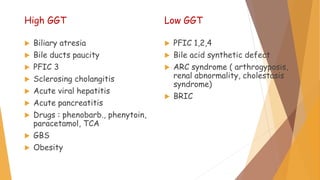
High GGT
 Biliary atresia
 Bile ducts paucity
 PFIC 3
 Sclerosing cholangitis
 Acute viral hepatitis
 Acute pancreatitis
 Drugs : phenobarb., phenytoin,
paracetamol, TCA
 GBS
 Obesity
Low GGT
 PFIC 1,2,4
 Bile acid synthetic defect
 ARC syndrome ( arthrogyposis,
renal abnormality, cholestasis
syndrome)
 BRIC
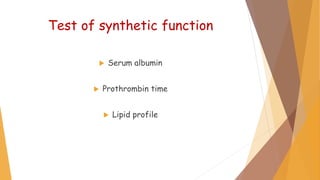
Test of synthetic function
 Serum albumin
 Prothrombin time
 Lipid profile
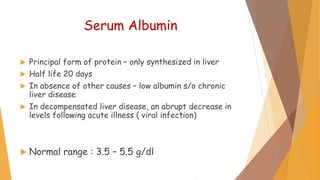
Serum Albumin
 Principal form of protein – only synthesized in liver
 Half life 20 days
 In absence of other causes – low albumin s/o chronic
liver disease
 In decompensated liver disease, an abrupt decrease in
levels following acute illness ( viral infection)
 Normal range : 3.5 – 5.5 g/dl
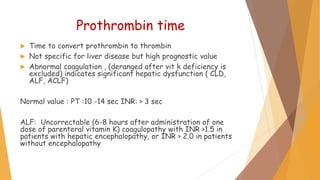
Prothrombin time
 Time to convert prothrombin to thrombin
 Not specific for liver disease but high prognostic value
 Abnormal coagulation , (deranged after vit k deficiency is
excluded) indicates significant hepatic dysfunction ( CLD,
ALF, ACLF)
Normal value : PT :10 -14 sec INR: > 3 sec
ALF: Uncorrectable (6-8 hours after administration of one
dose of parenteral vitamin K) coagulopathy with INR >1.5 in
patients with hepatic encephalopathy, or INR > 2.0 in patients
without encephalopathy
Lipids & lipoproteins
 Synthesized in liver except chylomicrones
 Marked increased in chronic cholestasis ( like in PFIC) –
xanthoma >5times level
 GSD ( mainly type 1)
Test to detect substances cleared
from plasma by liver
 Plasma ammonia
 Amino acids ( specifically tyrosin, phenylalanine,
methionine)
Raised in acute or chronic liver failure
Non specific indication of liver dysfunction
Globulins
Immunoglobulines :
In autoimmune hepatitis/ chronic active hepatitis - raised
IgG
Primary biliary cirrhosis – raised IgM
Bile acids/ bile salts
 Primary bile acids – cholic acid
chenodeoxycholic acid
 Secondary – deoxycholic acid
 Tertiary bile acids – Ursodeoxycholic acid
In cholestasis – increased urine excretion
Low levels – bile acid synthetic defect ( to differentiate
PFIC from BASD)
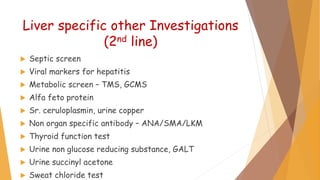
Liver specific other Investigations
(2nd line)
 Septic screen
 Viral markers for hepatitis
 Metabolic screen – TMS, GCMS
 Alfa feto protein
 Sr. ceruloplasmin, urine copper
 Non organ specific antibody – ANA/SMA/LKM
 Thyroid function test
 Urine non glucose reducing substance, GALT
 Urine succinyl acetone
 Sweat chloride test
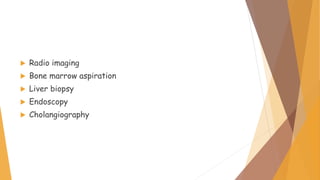
 Radio imaging
 Bone marrow aspiration
 Liver biopsy
 Endoscopy
 Cholangiography
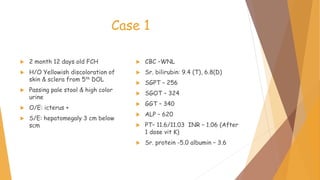
Case 1
 2 month 12 days old FCH
 H/O Yellowish discoloration of
skin & sclera from 5th DOL
 Passing pale stool & high color
urine
 O/E: icterus +
 S/E: hepatomegaly 3 cm below
scm
 CBC –WNL
 Sr. bilirubin: 9.4 (T), 6.8(D)
 SGPT – 256
 SGOT – 324
 GGT – 340
 ALP – 620
 PT– 11.6/11.03 INR – 1.06 (After
1 dose vit K)
 Sr. protein -5.0 albumin – 3.6
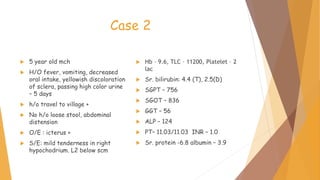
Case 2
 5 year old mch
 H/O fever, vomiting, decreased
oral intake, yellowish discoloration
of sclera, passing high color urine
– 5 days
 h/o travel to village +
 No h/o loose stool, abdominal
distension
 O/E : icterus +
 S/E: mild tenderness in right
hypochodrium. L2 below scm
 Hb – 9.6, TLC – 11200, Platelet – 2
lac
 Sr. bilirubin: 4.4 (T), 2.5(D)
 SGPT – 756
 SGOT – 836
 GGT – 56
 ALP – 124
 PT– 11.03/11.03 INR – 1.0
 Sr. protein -6.8 albumin – 3.9
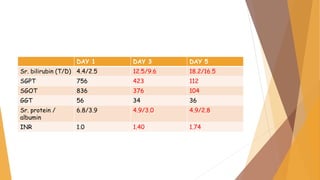
DAY 1 DAY 3 DAY 5
Sr. bilirubin (T/D) 4.4/2.5 12.5/9.6 18.2/16.5
SGPT 756 423 112
SGOT 836 376 104
GGT 56 34 36
Sr. protein /
albumin
6.8/3.9 4.9/3.0 4.9/2.8
INR 1.0 1.40 1.74
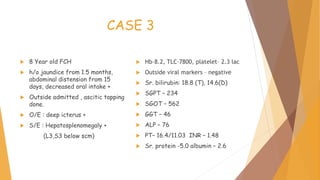
CASE 3
 8 Year old FCH
 h/o jaundice from 1.5 months,
abdominal distension from 15
days, decreased oral intake +
 Outside admitted , ascitic tapping
done.
 O/E : deep icterus +
 S/E : Hepatosplenomegaly +
(L3,S3 below scm)
 Hb–8.2, TLC–7800, platelet– 2.3 lac
 Outside viral markers – negative
 Sr. bilirubin: 18.8 (T), 14.6(D)
 SGPT – 234
 SGOT – 562
 GGT – 46
 ALP – 76
 PT– 16.4/11.03 INR – 1.48
 Sr. protein -5.0 albumin – 2.6
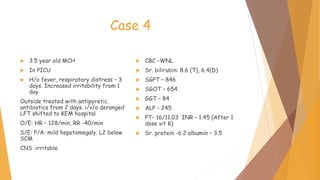
Case 4
 3.5 year old MCH
 In PICU
 H/o fever, respiratory distress – 3
days. Increased irritability from 1
day
Outside treated with antipyretic,
antibiotics from 2 days. i/v/o deranged
LFT shifted to KEM hospital
O/E: HR – 128/min, RR -40/min
S/E: P/A: mild hepatomegaly. L2 below
SCM
CNS :irritable
 CBC –WNL
 Sr. bilirubin: 8.6 (T), 6.4(D)
 SGPT – 846
 SGOT – 654
 GGT – 84
 ALP – 245
 PT– 16/11.03 INR – 1.45 (After 1
dose vit K)
 Sr. protein -6.2 albumin – 3.5
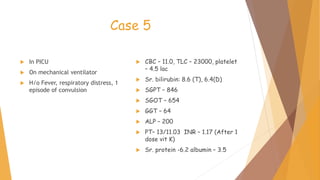
Case 5
 In PICU
 On mechanical ventilator
 H/o Fever, respiratory distress, 1
episode of convulsion
 CBC – 11.0, TLC – 23000, platelet
– 4.5 lac
 Sr. bilirubin: 8.6 (T), 6.4(D)
 SGPT – 846
 SGOT – 654
 GGT – 64
 ALP – 200
 PT– 13/11.03 INR – 1.17 (After 1
dose vit K)
 Sr. protein -6.2 albumin – 3.5
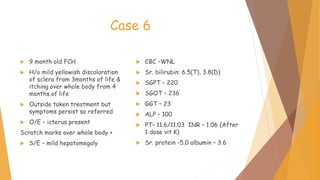
Case 6
 9 month old FCH
 H/o mild yellowish discoloration
of sclera from 3months of life &
itching over whole body from 4
months of life
 Outside taken treatment but
symptoms persist so referred
 O/E – icterus present
Scratch marks over whole body +
 S/E – mild hepatomegaly
 CBC –WNL
 Sr. bilirubin: 6.5(T), 3.8(D)
 SGPT – 220
 SGOT – 236
 GGT – 23
 ALP – 100
 PT– 11.6/11.03 INR – 1.06 (After
1 dose vit K)
 Sr. protein -5.0 albumin – 3.6
Thank you

Interpretation of Liver function test

  • 1.
    Interpretation of liver functiontest - Dr. Kinisha Patel (M.D pediatrics , FISPGHAN)
  • 2.
    Background  Liver -to perform various kinds of biochemical synthetic, excretory functions  No single test can detect globel liver function  ‘Liver injury test’ – more appropriate terminology  Clinical history, physical examination most important in interpretation of LFT
  • 3.
    Use  Screening  Patternof disease: differentiate acute viral hepatitis, various cholestatic & CLD  Assess severity & to predict outcome  Follow up - to evaluate response to therapy (Eg. Autoimmune hepatitis)
  • 4.
    Limitations  Lack sensitivity: Normal in certain liver disease like congenital hepatic fibrosis, non cirrhotic portal fibrosis  Lack specificity : Sr. albumin – decreased in chronic disease, malabsorption,nephrotic synd. Etc. Aminotransferase – may be raised in cardiac or muscular disease Except bile acid – other LFT changes for pathological process outside liver So important to keep clinical profile in mind
  • 5.
    Classification of liverfunction test  Test for transport & drug metabolism  Test of biochemical activity - Test of liver cell injury - Test of cholestasis  Test of liver synthetic capacity  Test to detect substances cleared from plasma by liver  Specific investigation of liver disease  Other test – imaging studies , histologic studies
  • 6.
    Test for transport& drug metabolism  Serum bilirubin  Urine bilirubin  Urobilinogen
  • 7.
    Serum bilirubin  Endogenousanion derived from hemoglobin degradation from RBC.  Confirms jaundice, indicates its depth , used to assess the progress
  • 8.
    Types  Total ,direct (conjugated & delta), indirect (unconjugated)  Conjugated hyperbilirubinemia is defined as a serum direct/conjugated bilirubin concentration greater than 1.0 mg/dL if the total serum bilirubin (TSB) is <5.0 mg/dL or > 20% of TSB if the TSB is >5.0 mg/dL  Unconjugated hyperbilirubinemia : over production or impaired uptake or conjugation of bilirubin  Conjugated hyperbilirubinemia : decreased excretion or backward leakage of pigment
  • 9.
     Total bilirubin: -not sensitive indicator for hepatic dysfunction - may not accurately reflect degree of liver damage  Unconjugated hyperbilirubinemia Hemolytic Rhesus or ABO incompatibility Red cell membrane defect G6PD deficiency Internal hemorrhage Sepsis Polycythemia Cong. Hypothyroidism Criggler najjar syndrome Gilbert syndrome Galactosemia ( initially f/b conjugated)
  • 10.
     Conjugated hyperbilirubinemia(hepatocellular, hepatobiliary) Neonatal cholestasis Metabolic liver disease Inborn error of metabolism Infections (viral hepatitis – hepatotropic, non hepatotropic, bacterial, parasitic, fungal) Drug induced liver injury Ischemic causes Autoimmune liver disease
  • 11.
    Urine bilirubin  Conjugatedbilirubin – water soluble – may be found in urine  Early hepatobiliary disease like in acute viral hepatitis – positive, while patient may or may not be icteric
  • 12.
    Urobilinogen  Formed interminal ileum & colon from conjugated bilirubin by anaerobic microbial flora  20% daily undergo enterohepatic circulation – small fraction excreted in urine  In hepatocellular dysfunction – UBG escapes hepatic uptake thus appear in urine
  • 13.
    Transaminase -Test ofliver cell injury ALT/SGPT (Alanine aminotransferase)  More sensitive & specific for liver disease  Shorter half life so for acute liver disease  Normal range: 10 -50 U/L AST/SGOT ( Aspartate aminotransferase)  Rise – early indication for rejection post transplant  Isolated rise – hemolysis, rhabdomyolysis, myopathy, cardiomyopathy  Normal range : 10 – 40 U/L
  • 14.
    Causes of deranged aminotransferase Mildelevation (1-3 times) Moderate elevation (3- 10 times) Marked elevation (>10 times) Neonatal hepatitis Wilson disease (CLD) Acute viral hepatitis Extra hepatic biliary atresia Autoimmune hepatitis (CLD) Ischemic hepatitis NASH Viral / parasitic hepatitis Drugs Drug toxicity Chronic hepatitis B & C Acute budd chiari syndrome Drugs Cholestatic liver disease
  • 15.
    Points to remember Sudden decline in levels is a bad sign – indicates fulminant hepatitis  Sr. bilirubin level gradual rise than aminotransferase in acute viral hepatitis. May be declining (steady fall) before sr. bilirubin in uncomplicated viral hepatitis  Secondary elevation s/o chronic hepatitis  AST:ALT >2 Wilson’s disease (few studies)
  • 16.
    Test of cholestasis Alkaline phoshphatase  Gamma glutamyl transferase (GGT)
  • 17.
    Alkaline phosphatse  Synthesizedby canalicular membrane of hepatocyte – excreted in bile into intestine  Found in liver, bone, intestine, kidney , placenta  Sensitive but not specific for cholestasis  Raised along with GGT – biliary damage  Raised : biliary epithelial damage malignant infiltration cirrhosis osteopenia due to vit D deficiency graft rejection
  • 18.
    Normal range :45 -115 U/L High ALP  Cholestatic disorder  Acute viral hepatitis (normal or mod. increased)  Infiltrative liver disease  Abscess  Drugs : antibiotics, tricyclic antidepressant, ACE inhibitor  Bone metastasis Low ALP  Wilson’s disease (ALP: Bili <4)  Cong. hypophosphatemia  Hypothyroidism  Pernicious anemia
  • 19.
    GGT  Synthesized byepithelium of small bile ductule & hepatocytes  Sensitive but not specific  Present in biliary epithelium , kidney, pancreas, brain, spleen, small intestine  In neonates higher value  Normal value : 0 – 30 U/L
  • 20.
    High GGT  Biliaryatresia  Bile ducts paucity  PFIC 3  Sclerosing cholangitis  Acute viral hepatitis  Acute pancreatitis  Drugs : phenobarb., phenytoin, paracetamol, TCA  GBS  Obesity Low GGT  PFIC 1,2,4  Bile acid synthetic defect  ARC syndrome ( arthrogyposis, renal abnormality, cholestasis syndrome)  BRIC
  • 21.
    Test of syntheticfunction  Serum albumin  Prothrombin time  Lipid profile
  • 22.
    Serum Albumin  Principalform of protein – only synthesized in liver  Half life 20 days  In absence of other causes – low albumin s/o chronic liver disease  In decompensated liver disease, an abrupt decrease in levels following acute illness ( viral infection)  Normal range : 3.5 – 5.5 g/dl
  • 23.
    Prothrombin time  Timeto convert prothrombin to thrombin  Not specific for liver disease but high prognostic value  Abnormal coagulation , (deranged after vit k deficiency is excluded) indicates significant hepatic dysfunction ( CLD, ALF, ACLF) Normal value : PT :10 -14 sec INR: > 3 sec ALF: Uncorrectable (6-8 hours after administration of one dose of parenteral vitamin K) coagulopathy with INR >1.5 in patients with hepatic encephalopathy, or INR > 2.0 in patients without encephalopathy
  • 24.
    Lipids & lipoproteins Synthesized in liver except chylomicrones  Marked increased in chronic cholestasis ( like in PFIC) – xanthoma >5times level  GSD ( mainly type 1)
  • 25.
    Test to detectsubstances cleared from plasma by liver  Plasma ammonia  Amino acids ( specifically tyrosin, phenylalanine, methionine) Raised in acute or chronic liver failure Non specific indication of liver dysfunction
  • 26.
    Globulins Immunoglobulines : In autoimmunehepatitis/ chronic active hepatitis - raised IgG Primary biliary cirrhosis – raised IgM
  • 27.
    Bile acids/ bilesalts  Primary bile acids – cholic acid chenodeoxycholic acid  Secondary – deoxycholic acid  Tertiary bile acids – Ursodeoxycholic acid In cholestasis – increased urine excretion Low levels – bile acid synthetic defect ( to differentiate PFIC from BASD)
  • 28.
    Liver specific otherInvestigations (2nd line)  Septic screen  Viral markers for hepatitis  Metabolic screen – TMS, GCMS  Alfa feto protein  Sr. ceruloplasmin, urine copper  Non organ specific antibody – ANA/SMA/LKM  Thyroid function test  Urine non glucose reducing substance, GALT  Urine succinyl acetone  Sweat chloride test
  • 29.
     Radio imaging Bone marrow aspiration  Liver biopsy  Endoscopy  Cholangiography
  • 30.
    Case 1  2month 12 days old FCH  H/O Yellowish discoloration of skin & sclera from 5th DOL  Passing pale stool & high color urine  O/E: icterus +  S/E: hepatomegaly 3 cm below scm  CBC –WNL  Sr. bilirubin: 9.4 (T), 6.8(D)  SGPT – 256  SGOT – 324  GGT – 340  ALP – 620  PT– 11.6/11.03 INR – 1.06 (After 1 dose vit K)  Sr. protein -5.0 albumin – 3.6
  • 31.
    Case 2  5year old mch  H/O fever, vomiting, decreased oral intake, yellowish discoloration of sclera, passing high color urine – 5 days  h/o travel to village +  No h/o loose stool, abdominal distension  O/E : icterus +  S/E: mild tenderness in right hypochodrium. L2 below scm  Hb – 9.6, TLC – 11200, Platelet – 2 lac  Sr. bilirubin: 4.4 (T), 2.5(D)  SGPT – 756  SGOT – 836  GGT – 56  ALP – 124  PT– 11.03/11.03 INR – 1.0  Sr. protein -6.8 albumin – 3.9
  • 32.
    DAY 1 DAY3 DAY 5 Sr. bilirubin (T/D) 4.4/2.5 12.5/9.6 18.2/16.5 SGPT 756 423 112 SGOT 836 376 104 GGT 56 34 36 Sr. protein / albumin 6.8/3.9 4.9/3.0 4.9/2.8 INR 1.0 1.40 1.74
  • 33.
    CASE 3  8Year old FCH  h/o jaundice from 1.5 months, abdominal distension from 15 days, decreased oral intake +  Outside admitted , ascitic tapping done.  O/E : deep icterus +  S/E : Hepatosplenomegaly + (L3,S3 below scm)  Hb–8.2, TLC–7800, platelet– 2.3 lac  Outside viral markers – negative  Sr. bilirubin: 18.8 (T), 14.6(D)  SGPT – 234  SGOT – 562  GGT – 46  ALP – 76  PT– 16.4/11.03 INR – 1.48  Sr. protein -5.0 albumin – 2.6
  • 34.
    Case 4  3.5year old MCH  In PICU  H/o fever, respiratory distress – 3 days. Increased irritability from 1 day Outside treated with antipyretic, antibiotics from 2 days. i/v/o deranged LFT shifted to KEM hospital O/E: HR – 128/min, RR -40/min S/E: P/A: mild hepatomegaly. L2 below SCM CNS :irritable  CBC –WNL  Sr. bilirubin: 8.6 (T), 6.4(D)  SGPT – 846  SGOT – 654  GGT – 84  ALP – 245  PT– 16/11.03 INR – 1.45 (After 1 dose vit K)  Sr. protein -6.2 albumin – 3.5
  • 35.
    Case 5  InPICU  On mechanical ventilator  H/o Fever, respiratory distress, 1 episode of convulsion  CBC – 11.0, TLC – 23000, platelet – 4.5 lac  Sr. bilirubin: 8.6 (T), 6.4(D)  SGPT – 846  SGOT – 654  GGT – 64  ALP – 200  PT– 13/11.03 INR – 1.17 (After 1 dose vit K)  Sr. protein -6.2 albumin – 3.5
  • 36.
    Case 6  9month old FCH  H/o mild yellowish discoloration of sclera from 3months of life & itching over whole body from 4 months of life  Outside taken treatment but symptoms persist so referred  O/E – icterus present Scratch marks over whole body +  S/E – mild hepatomegaly  CBC –WNL  Sr. bilirubin: 6.5(T), 3.8(D)  SGPT – 220  SGOT – 236  GGT – 23  ALP – 100  PT– 11.6/11.03 INR – 1.06 (After 1 dose vit K)  Sr. protein -5.0 albumin – 3.6
  • 37.