Benign prostate hyperplasia
Lecturer: Makhmudov A.M.
Abbreviations
• BPH (Benign prostatic hyperplasia)
• LUTS – Lower urinary tract symptoms
• BOO – bladder outlet obstruction
• BPO - benign prostatic obstruction
• OAB – overactive bladder
• BPE - benign prostatic enlargement
• AR – androgen receptor
• HRQoL – Health related quality of life
• IPSS - International Prostate Symptom Score
• Benign prostatic hyperplasia (BPH) is a pathologic process that is one
but certainly not the only cause of lower urinary tract symptoms
(LUTS) in aging men—also described as male LUTS.
• Failure to empty can be related either to an outlet obstruction or to
detrusor underactivity of the bladder or to a combination of both.
• Many men older than 40 years of age will develop histologic
hyperplasia (i.e., BPH), not all will have bothersome LUTS.
• Storage symptoms are currently largely encompassed by the term
overactive bladder (OAB) syndrome, which is defined as urgency,
frequency, nocturia, and urgency incontinence, and which is believed
to be correlated with an underlying detrusor overactivity
Etiology of Benign Prostatic Hyperplasia (1)
• Histopathologically, BPH is characterized by an increased number of
epithelial and stromal cells in the periurethral area of the prostate and thus
is correctly referred to as hyperplasia and not hypertrophy, as is often
found in the older literature
• The precise molecular etiology of this hyperplastic process is uncertain.
• Although androgens do not cause BPH, the development of BPH requires
the presence of testicular androgens during prostate development,
puberty, and aging.
• In the prostate the nuclear membrane bound enzyme steroid 5α-reductase
converts the hormone testosterone into DHT, the principal androgen in this
tissue.
Etiology of Benign Prostatic Hyperplasia (2)
• Androgen Receptors
• Dihydrotestosterone and Steroid 5α-Reductase
• Estrogens
• Regulation of Programmed Cell Death
• Stromal-Epithelial Interaction
• Growth Factors
• Inflammatory Pathways and Cytokines in Benign Prostatic Hyperplasia
• Genetic and Familial Factors
Pathophysiology
• Prostatic hyperplasia increases urethral resistance, resulting in
compensatory changes in bladder function.
• Obstruction-induced changes in detrusor function, compounded by
age-related changes in both bladder and nervous system function,
lead to urinary frequency, urgency, and nocturia, the most
bothersome BPH-related complaints.
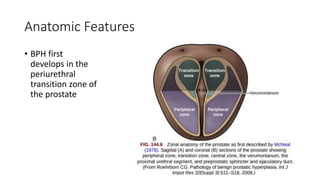
Anatomic Features
• BPH first
develops in the
periurethral
transition zone of
the prostate
Prostatic Capsule
• One of the unique features of the human prostate is the presence of
the prostatic capsule, which plays an important role in the
development of LUTS.
• Clinical evidence of the importance of the capsule can be found in
series that clearly document that incision of the prostatic capsule
(transurethral incision of the prostate) results in a significant
improvement in outflow obstruction, despite the fact that the volume
of the prostate remains the same.
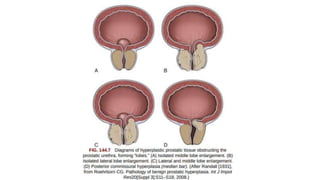
The size of the prostate
does not correlate with the
degree of obstruction
• Prostatic smooth muscle represents a significant volume of the gland
• Active smooth muscle tone in the human prostate is regulated by the
adrenergic nervous system
• Stimulation of the adrenergic nervous system clearly results in a
dynamic increase in prostatic urethral resistance. Blockade of this
stimulation by α-receptor blockers clearly diminishes this response.
The Bladder's Response to Obstruction
• First, the changes that lead to detrusor instability or decreased
compliance are clinically associated with symptoms of frequency and
urgency. Second, the changes associated with decreased detrusor
contractility are associated with further deterioration in the force of
the urinary stream, hesitancy, intermittency, increased residual urine,
and (in a minority of cases) detrusor failure.
• Increase in muscle mass, although an adaptive response to increased
intravesical pressure and maintained flow, is associated with
significant intracellular and extracellular changes in the smooth
muscle cell that lead to detrusor instability and in some cases
impaired contractility.
Correlations
• All relevant parameters such as symptom severity and frequency,
bother, interference, disease-specific HRQoL, maximum flow rate, and
prostate volume tend to worsen with advancing age. However,
reported correlations between these parameters and urodynamic
pressure-flow studies are in general weak with some exceptions.
Strong correlations exist as one might expect between subjective
measures such as symptom severity and frequency (IPSS), bother,
disease-specific HRQoL, and interference scores.
Complications of Benign Prostatic Hyperplasia
• Mortality now is insufficient, between 1990 and 2010 it was greater
than 10 per 100,000
• Bladder Stones - the prevalence of bladder stones was 8 times higher
in men with a histologic diagnosis of BPH (3.4%) compared with
controls (0.4%)
• Bladder Decompensation - Biopsies from trabeculated, obstructed
bladders show dense connective tissue deposition, a finding similar to
that seen in experimentally obstructed animals. However, bladder
fibrosis is seen in both sexes with advancing age and may be a normal
consequence of aging.
Complications of Benign Prostatic Hyperplasia
• Urinary Incontinence
• Urinary Tract Infections
• Upper Urinary Tract Deterioration and Azotemia
• Hematuria
• Acute Urinary Retention - The etiology of AUR is poorly understood,
and obstructive, myogenic, and neurogenic causes all may play a role.
Prostate infection, bladder overdistension, excessive fluid intake,
alcohol consumption, sexual activity, debility, and bed rest have all
been mentioned. Prostatic infarction has been suggested as being an
underlying event causing AUR.
Staging
• Stage 1, those with no bothersome symptoms and no significant
obstruction, they can generally be watched.
• Stage 2, those with bothersome symptoms but without significant
obstruction, they can be treated with
pharmacotherapy/thermotherapy.
• Stage 3, those with significant obstruction defined as uroflow of less
than 10 ml/s with persistent residual urine of > 100 ml, transurethral
prostatic resection (TURP) would be recommended.
• Stage 4, those with complications of BPH such as chronic retention of
urine and bladder stone, they would need TURP.

Benign prostate hyperplasia lecture.pptx

  • 1.
  • 2.
    Abbreviations • BPH (Benignprostatic hyperplasia) • LUTS – Lower urinary tract symptoms • BOO – bladder outlet obstruction • BPO - benign prostatic obstruction • OAB – overactive bladder • BPE - benign prostatic enlargement • AR – androgen receptor • HRQoL – Health related quality of life • IPSS - International Prostate Symptom Score
  • 3.
    • Benign prostatichyperplasia (BPH) is a pathologic process that is one but certainly not the only cause of lower urinary tract symptoms (LUTS) in aging men—also described as male LUTS. • Failure to empty can be related either to an outlet obstruction or to detrusor underactivity of the bladder or to a combination of both. • Many men older than 40 years of age will develop histologic hyperplasia (i.e., BPH), not all will have bothersome LUTS. • Storage symptoms are currently largely encompassed by the term overactive bladder (OAB) syndrome, which is defined as urgency, frequency, nocturia, and urgency incontinence, and which is believed to be correlated with an underlying detrusor overactivity
  • 7.
    Etiology of BenignProstatic Hyperplasia (1) • Histopathologically, BPH is characterized by an increased number of epithelial and stromal cells in the periurethral area of the prostate and thus is correctly referred to as hyperplasia and not hypertrophy, as is often found in the older literature • The precise molecular etiology of this hyperplastic process is uncertain. • Although androgens do not cause BPH, the development of BPH requires the presence of testicular androgens during prostate development, puberty, and aging. • In the prostate the nuclear membrane bound enzyme steroid 5α-reductase converts the hormone testosterone into DHT, the principal androgen in this tissue.
  • 8.
    Etiology of BenignProstatic Hyperplasia (2) • Androgen Receptors • Dihydrotestosterone and Steroid 5α-Reductase • Estrogens • Regulation of Programmed Cell Death • Stromal-Epithelial Interaction • Growth Factors • Inflammatory Pathways and Cytokines in Benign Prostatic Hyperplasia • Genetic and Familial Factors
  • 9.
    Pathophysiology • Prostatic hyperplasiaincreases urethral resistance, resulting in compensatory changes in bladder function. • Obstruction-induced changes in detrusor function, compounded by age-related changes in both bladder and nervous system function, lead to urinary frequency, urgency, and nocturia, the most bothersome BPH-related complaints.
  • 11.
    Anatomic Features • BPHfirst develops in the periurethral transition zone of the prostate
  • 12.
    Prostatic Capsule • Oneof the unique features of the human prostate is the presence of the prostatic capsule, which plays an important role in the development of LUTS. • Clinical evidence of the importance of the capsule can be found in series that clearly document that incision of the prostatic capsule (transurethral incision of the prostate) results in a significant improvement in outflow obstruction, despite the fact that the volume of the prostate remains the same.
  • 13.
    The size ofthe prostate does not correlate with the degree of obstruction
  • 15.
    • Prostatic smoothmuscle represents a significant volume of the gland • Active smooth muscle tone in the human prostate is regulated by the adrenergic nervous system • Stimulation of the adrenergic nervous system clearly results in a dynamic increase in prostatic urethral resistance. Blockade of this stimulation by α-receptor blockers clearly diminishes this response.
  • 16.
    The Bladder's Responseto Obstruction • First, the changes that lead to detrusor instability or decreased compliance are clinically associated with symptoms of frequency and urgency. Second, the changes associated with decreased detrusor contractility are associated with further deterioration in the force of the urinary stream, hesitancy, intermittency, increased residual urine, and (in a minority of cases) detrusor failure. • Increase in muscle mass, although an adaptive response to increased intravesical pressure and maintained flow, is associated with significant intracellular and extracellular changes in the smooth muscle cell that lead to detrusor instability and in some cases impaired contractility.
  • 17.
    Correlations • All relevantparameters such as symptom severity and frequency, bother, interference, disease-specific HRQoL, maximum flow rate, and prostate volume tend to worsen with advancing age. However, reported correlations between these parameters and urodynamic pressure-flow studies are in general weak with some exceptions. Strong correlations exist as one might expect between subjective measures such as symptom severity and frequency (IPSS), bother, disease-specific HRQoL, and interference scores.
  • 18.
    Complications of BenignProstatic Hyperplasia • Mortality now is insufficient, between 1990 and 2010 it was greater than 10 per 100,000 • Bladder Stones - the prevalence of bladder stones was 8 times higher in men with a histologic diagnosis of BPH (3.4%) compared with controls (0.4%) • Bladder Decompensation - Biopsies from trabeculated, obstructed bladders show dense connective tissue deposition, a finding similar to that seen in experimentally obstructed animals. However, bladder fibrosis is seen in both sexes with advancing age and may be a normal consequence of aging.
  • 19.
    Complications of BenignProstatic Hyperplasia • Urinary Incontinence • Urinary Tract Infections • Upper Urinary Tract Deterioration and Azotemia • Hematuria • Acute Urinary Retention - The etiology of AUR is poorly understood, and obstructive, myogenic, and neurogenic causes all may play a role. Prostate infection, bladder overdistension, excessive fluid intake, alcohol consumption, sexual activity, debility, and bed rest have all been mentioned. Prostatic infarction has been suggested as being an underlying event causing AUR.
  • 20.
    Staging • Stage 1,those with no bothersome symptoms and no significant obstruction, they can generally be watched. • Stage 2, those with bothersome symptoms but without significant obstruction, they can be treated with pharmacotherapy/thermotherapy. • Stage 3, those with significant obstruction defined as uroflow of less than 10 ml/s with persistent residual urine of > 100 ml, transurethral prostatic resection (TURP) would be recommended. • Stage 4, those with complications of BPH such as chronic retention of urine and bladder stone, they would need TURP.