BPH
By / Mohamed Elwany
ANATOMY
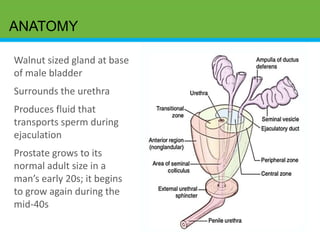
Walnut sized gland at base
of male bladder
Surrounds the urethra
Produces fluid that
transports sperm during
ejaculation
Prostate grows to its
normal adult size in a
man’s early 20s; it begins
to grow again during the
mid-40s
TERMINOLOGY
BPH= benign prostatic hyperplasia;
BPE = benign prostatic enlargement;
BPO = benign prostatic obstruction;
BOO = bladder outlet obstruction
Lower urinary tract symptoms (LUTS) urinary symptoms shared
by disorders affecting the bladder and prostate LUTS can be
subdivided into storage and voiding symptoms. These terms
have largely replaced those historically termed "prostatism."
BPH
Histologic
diagnosis
BPE
Enlargement due
to benign growth
(can be without
obstruction)
BPO
Urodynamically
proven BOO
(static/dynamic
components)
What is BPH?
Disease prevalence has been shown to increase with advancing age.
Indeed the histological prevalence of BPH at autopsy is as high as 50%
to 60% for males in their 60's, increasing to 80% to 90% of those over
70 years of age.
This is supported by studies that have demonstrated increases in
prostate volume with age (2% to 2.5% increase in size per year)
BPH
Benign
=
Non-
cancerous
Prostatic
=
Relating to the
prostate gland
Hyperplasia
=
More cells
than normal
=
ETIOLOGY
The etiology of BPH is influenced by a wide variety of risk factors in addition to direct
hormonal effects of testosterone on prostate tissue.
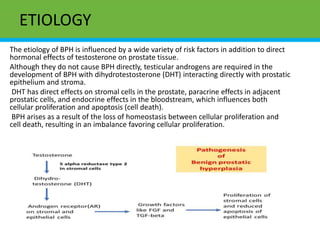
Although they do not cause BPH directly, testicular androgens are required in the
development of BPH with dihydrotestosterone (DHT) interacting directly with prostatic
epithelium and stroma.
DHT has direct effects on stromal cells in the prostate, paracrine effects in adjacent
prostatic cells, and endocrine effects in the bloodstream, which influences both
cellular proliferation and apoptosis (cell death).
BPH arises as a result of the loss of homeostasis between cellular proliferation and
cell death, resulting in an imbalance favoring cellular proliferation.
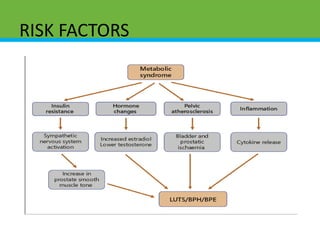
RISK FACTORS
Metabolic syndrome refers to conditions that include
hypertension, glucose intolerance/insulin resistance, and
dyslipidemia. Meta-analysis has demonstrated those with
metabolic syndrome and obesity have significantly higher
prostate volumes
HOWEVER, there were no subsequent significant
differences in IPSS, and the effect of diabetes on LUTS has
been shown to be multifactorial in nature.
Obesity has been shown to be associated with increased
risk of BPH in observational studies
Genetic predisposition to BPH has been demonstrated in
cohort studies, first-degree relatives in one study
demonstrated a four-fold increase in the risk of BPH
compared to control
RISK FACTORS
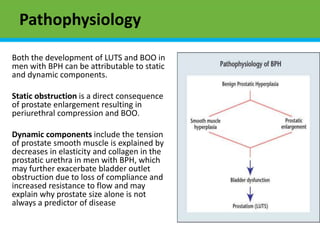
Pathophysiology
Both the development of LUTS and BOO in
men with BPH can be attributable to static
and dynamic components.
Static obstruction is a direct consequence
of prostate enlargement resulting in
periurethral compression and BOO.
Dynamic components include the tension
of prostate smooth muscle is explained by
decreases in elasticity and collagen in the
prostatic urethra in men with BPH, which
may further exacerbate bladder outlet
obstruction due to loss of compliance and
increased resistance to flow and may
explain why prostate size alone is not
always a predictor of disease
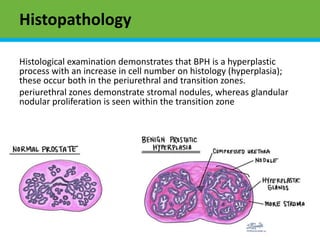
Histopathology
Histological examination demonstrates that BPH is a hyperplastic
process with an increase in cell number on histology (hyperplasia);
these occur both in the periurethral and transition zones.
periurethral zones demonstrate stromal nodules, whereas glandular
nodular proliferation is seen within the transition zone
Evaluation
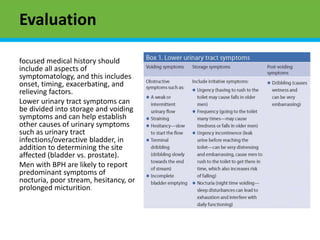
focused medical history should
include all aspects of
symptomatology, and this includes
onset, timing, exacerbating, and
relieving factors.
Lower urinary tract symptoms can
be divided into storage and voiding
symptoms and can help establish
other causes of urinary symptoms
such as urinary tract
infections/overactive bladder, in
addition to determining the site
affected (bladder vs. prostate).
Men with BPH are likely to report
predominant symptoms of
nocturia, poor stream, hesitancy, or
prolonged micturition.
EVALUATION
Physical Examination
the examination should include
abdominal examination (looking
for a palpable bladder/loin pain)
examination of external genitalia
(meatal stenosis or phimosis).
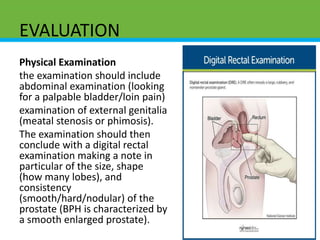
The examination should then
conclude with a digital rectal
examination making a note in
particular of the size, shape
(how many lobes), and
consistency
(smooth/hard/nodular) of the
prostate (BPH is characterized by
a smooth enlarged prostate).
INVESTIGATIONS
Urinalysis
Urine specimen testing can help detect infection,
non-visible haematuria, or metabolic disorders
(glycosuria).
Blood Tests
Blood tests, including renal function tests, are
useful to establish baseline renal function and can
help support the diagnosis of renal failure/acute
kidney injury in someone with chronic high-
pressure retention or acute retention, for example.
Prostate-Specific Antigen (PSA)
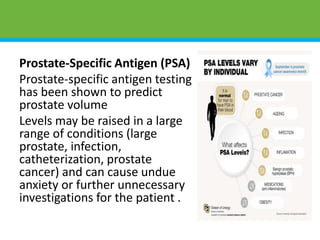
Prostate-specific antigen testing
has been shown to predict
prostate volume
Levels may be raised in a large
range of conditions (large
prostate, infection,
catheterization, prostate
cancer) and can cause undue
anxiety or further unnecessary
investigations for the patient .
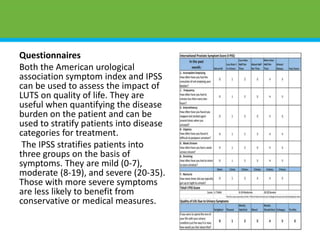
Questionnaires
Both the American urological
association symptom index and IPSS
can be used to assess the impact of
LUTS on quality of life. They are
useful when quantifying the disease
burden on the patient and can be
used to stratify patients into disease
categories for treatment.
The IPSS stratifies patients into
three groups on the basis of
symptoms. They are mild (0-7),
moderate (8-19), and severe (20-35).
Those with more severe symptoms
are less likely to benefit from
conservative or medical measures.
Ultrasound
Ultrasound scans are used to look for evidence of
hydronephrosis and are indicated in patients with
high residual volumes or renal impairment. Other
indications include suspicion of urinary tract stones
or the investigation of haematuria.
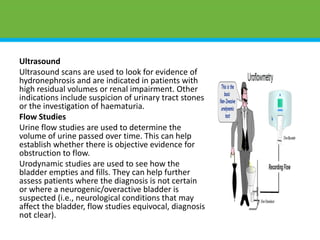
Flow Studies
Urine flow studies are used to determine the
volume of urine passed over time. This can help
establish whether there is objective evidence for
obstruction to flow.
Urodynamic studies are used to see how the
bladder empties and fills. They can help further
assess patients where the diagnosis is not certain
or where a neurogenic/overactive bladder is
suspected (i.e., neurological conditions that may
affect the bladder, flow studies equivocal, diagnosis
not clear).
Thank You

bph.pptx

  • 1.
  • 2.
    ANATOMY Walnut sized glandat base of male bladder Surrounds the urethra Produces fluid that transports sperm during ejaculation Prostate grows to its normal adult size in a man’s early 20s; it begins to grow again during the mid-40s
  • 3.
    TERMINOLOGY BPH= benign prostatichyperplasia; BPE = benign prostatic enlargement; BPO = benign prostatic obstruction; BOO = bladder outlet obstruction Lower urinary tract symptoms (LUTS) urinary symptoms shared by disorders affecting the bladder and prostate LUTS can be subdivided into storage and voiding symptoms. These terms have largely replaced those historically termed "prostatism." BPH Histologic diagnosis BPE Enlargement due to benign growth (can be without obstruction) BPO Urodynamically proven BOO (static/dynamic components)
  • 4.
    What is BPH? Diseaseprevalence has been shown to increase with advancing age. Indeed the histological prevalence of BPH at autopsy is as high as 50% to 60% for males in their 60's, increasing to 80% to 90% of those over 70 years of age. This is supported by studies that have demonstrated increases in prostate volume with age (2% to 2.5% increase in size per year) BPH Benign = Non- cancerous Prostatic = Relating to the prostate gland Hyperplasia = More cells than normal =
  • 5.
    ETIOLOGY The etiology ofBPH is influenced by a wide variety of risk factors in addition to direct hormonal effects of testosterone on prostate tissue. Although they do not cause BPH directly, testicular androgens are required in the development of BPH with dihydrotestosterone (DHT) interacting directly with prostatic epithelium and stroma. DHT has direct effects on stromal cells in the prostate, paracrine effects in adjacent prostatic cells, and endocrine effects in the bloodstream, which influences both cellular proliferation and apoptosis (cell death). BPH arises as a result of the loss of homeostasis between cellular proliferation and cell death, resulting in an imbalance favoring cellular proliferation.
  • 6.
    RISK FACTORS Metabolic syndromerefers to conditions that include hypertension, glucose intolerance/insulin resistance, and dyslipidemia. Meta-analysis has demonstrated those with metabolic syndrome and obesity have significantly higher prostate volumes HOWEVER, there were no subsequent significant differences in IPSS, and the effect of diabetes on LUTS has been shown to be multifactorial in nature. Obesity has been shown to be associated with increased risk of BPH in observational studies Genetic predisposition to BPH has been demonstrated in cohort studies, first-degree relatives in one study demonstrated a four-fold increase in the risk of BPH compared to control
  • 7.
  • 8.
    Pathophysiology Both the developmentof LUTS and BOO in men with BPH can be attributable to static and dynamic components. Static obstruction is a direct consequence of prostate enlargement resulting in periurethral compression and BOO. Dynamic components include the tension of prostate smooth muscle is explained by decreases in elasticity and collagen in the prostatic urethra in men with BPH, which may further exacerbate bladder outlet obstruction due to loss of compliance and increased resistance to flow and may explain why prostate size alone is not always a predictor of disease
  • 9.
    Histopathology Histological examination demonstratesthat BPH is a hyperplastic process with an increase in cell number on histology (hyperplasia); these occur both in the periurethral and transition zones. periurethral zones demonstrate stromal nodules, whereas glandular nodular proliferation is seen within the transition zone
  • 10.
    Evaluation focused medical historyshould include all aspects of symptomatology, and this includes onset, timing, exacerbating, and relieving factors. Lower urinary tract symptoms can be divided into storage and voiding symptoms and can help establish other causes of urinary symptoms such as urinary tract infections/overactive bladder, in addition to determining the site affected (bladder vs. prostate). Men with BPH are likely to report predominant symptoms of nocturia, poor stream, hesitancy, or prolonged micturition.
  • 11.
    EVALUATION Physical Examination the examinationshould include abdominal examination (looking for a palpable bladder/loin pain) examination of external genitalia (meatal stenosis or phimosis). The examination should then conclude with a digital rectal examination making a note in particular of the size, shape (how many lobes), and consistency (smooth/hard/nodular) of the prostate (BPH is characterized by a smooth enlarged prostate).
  • 12.
    INVESTIGATIONS Urinalysis Urine specimen testingcan help detect infection, non-visible haematuria, or metabolic disorders (glycosuria). Blood Tests Blood tests, including renal function tests, are useful to establish baseline renal function and can help support the diagnosis of renal failure/acute kidney injury in someone with chronic high- pressure retention or acute retention, for example.
  • 13.
    Prostate-Specific Antigen (PSA) Prostate-specificantigen testing has been shown to predict prostate volume Levels may be raised in a large range of conditions (large prostate, infection, catheterization, prostate cancer) and can cause undue anxiety or further unnecessary investigations for the patient .
  • 14.
    Questionnaires Both the Americanurological association symptom index and IPSS can be used to assess the impact of LUTS on quality of life. They are useful when quantifying the disease burden on the patient and can be used to stratify patients into disease categories for treatment. The IPSS stratifies patients into three groups on the basis of symptoms. They are mild (0-7), moderate (8-19), and severe (20-35). Those with more severe symptoms are less likely to benefit from conservative or medical measures.
  • 15.
    Ultrasound Ultrasound scans areused to look for evidence of hydronephrosis and are indicated in patients with high residual volumes or renal impairment. Other indications include suspicion of urinary tract stones or the investigation of haematuria. Flow Studies Urine flow studies are used to determine the volume of urine passed over time. This can help establish whether there is objective evidence for obstruction to flow. Urodynamic studies are used to see how the bladder empties and fills. They can help further assess patients where the diagnosis is not certain or where a neurogenic/overactive bladder is suspected (i.e., neurological conditions that may affect the bladder, flow studies equivocal, diagnosis not clear).
  • 16.