BPH AND LUTS
Salman Bangash 2014-081
BPH-LUTS
• Benign prostatic hyperplasia is the histological pattern of the
prostate, characterized by proliferation of smooth muscle
and epithelial cells within the prostatic transition zone. This
may lead to prostatic enlargement.
• Lower urinary tract symptoms refer to storage and/or voiding
disturbances.
• BPH-LUTS refers to bothersome lower urinary tract symptoms
linked to the prostate.
• Not all men with BPH have LUTS and not all patients with LUTS
have BPH.
BPH
• It is considered a normal part of aging in men and is
hormonally dependent on testosterone and DHT
production.
• 50% of men develop BPH by age 60 years and 90% by
age 85 years.
BPH
• Patients with mild LUTS can be treated medically.
• TURP ( transurethral resection of the prostate ) is the
standard procedure for relieving bladder outlet
obstruction secondary to BPH.
PROSTATE
• It is a walnut sized gland and is a part of the male
reproductive system
• Located anterior to the rectum and distal to the urinary
bladder.
• It is connected directly with the penile urethra hence
it’s a conduit between the bladder and urethra.
• BPH originates in the Transition zone which surround the
urethra.
PROSTATE
PROSTATE
• Main function of the prostate is to secrete and alkaline
fluid that compromises 70% of the seminal volume.
• Secretions produce lubrication and nutrition for the
sperm.
• Alkaline fluid helps neutralize the acidic vaginal
environment.
RISK FACTORS
• Obesity
• Lack of physical activity
• Erectile dysfunction
• Increasing age
• Family history of BPH
EVALUATION OF PATIENTS
• Medical history
• Directed physical exam
• Urinalysis
• PSA testing
• Symptom assessment
MEDICAL HISTORY
• Nature and duration of symptoms
• Fluid intake – amount and types of fluid
• Sexual history
• Comorbid conditions
• Prior and current illness
• Prior surgery and trauma
• Current medications
• Any previous treatments.
CLINICAL
MANIFESTATIONS
• Urinary frequency
• Urgency
• Nocturia
• Hesitancy
• Incomplete emptying of bladder
• Straining
• Dribbling
SEXUAL HISTORY
• Sexual history is important because studies have
identified LUTS as an independent risk factor for erectile
dysfunction and ejaculatory dysfunction.
EXAMINATION
• DIGITAL RECTAL EXAM
--- Evaluate prostate for size, consistency, shape
and abnormalities suggestive of prostate
cancer (such as nodules or asymmetry)
• Assess suprapubic area to rule out bladder
distention
• Evaluate overall motor and sensory function of the
perineum and lower limbs
COMPLICATIONS
• Urinary retention
• Renal insufficiency
• Recurrent UTI
• Gross hematuria
• Bladder calculi
• Renal failure or Uremia
URINALYSIS
•Dipstick urinalysis should be performed in all BPH-LUTS
patients to rule out other diagnoses that may cause LUTS.
•Abnormal/borderline urinalysis results should be
repeated and/or followed with a urine culture
URINALYISIS
Urinalysis result Possible diagnosis
Hematuria
Kidney stones
Bladder cancer
Pyuria or nitrates
UTI
Urethral stricture
Proteinuria Underlying renal disease
Glucosuria diabetes
PSA TESTING
• BPH does not cause prostate cancer, however men at
risk of BPH are also at risk of developing prostate
cancer.
• It is a sensitive screening test for prostate volume.
• Men at age 50 who are expected to live at least 10
more year.
• 45 years in men who are at high risk ( African
American’s or close relative with prostate cancer )
ULTRASONOGRAPHY
• Help determine prostate and bladder size and degree
of hydronephrosis in patients with urinary retention.
• Transrectal ultrasonography is recommended in
selected patients to determine the dimensions and
volume of the prostrate.
CYSTOSCOPY
• It is indicated in patients whom a malignancy or foreign
body is suspected.
INTERNATIONAL PROSTATE
SYMPTOM SCORE
1-7 = mild 8-19 = moderate 20-35 = severe
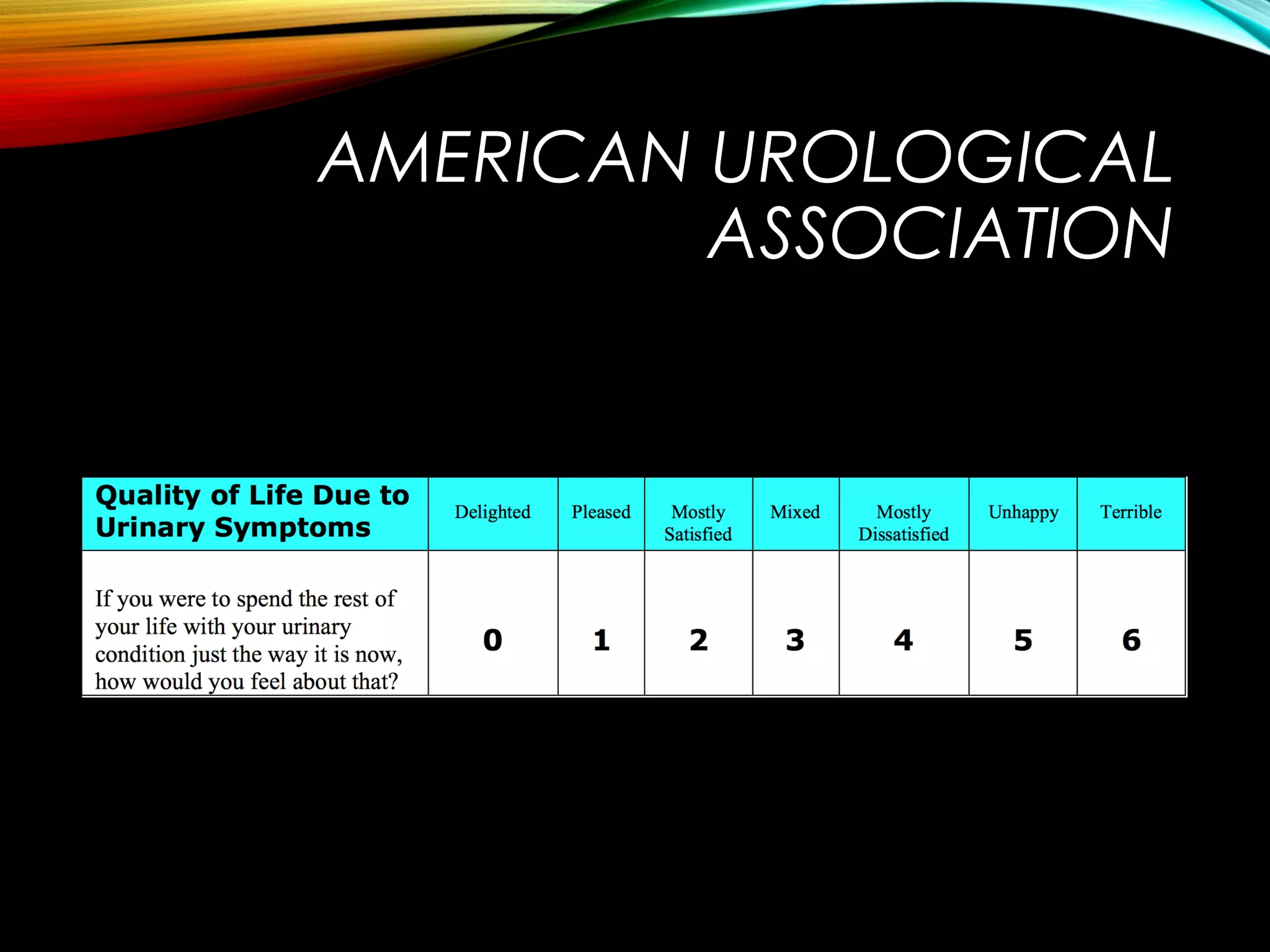
AMERICAN UROLOGICAL
ASSOCIATION
TREATMENT FLOW CHART
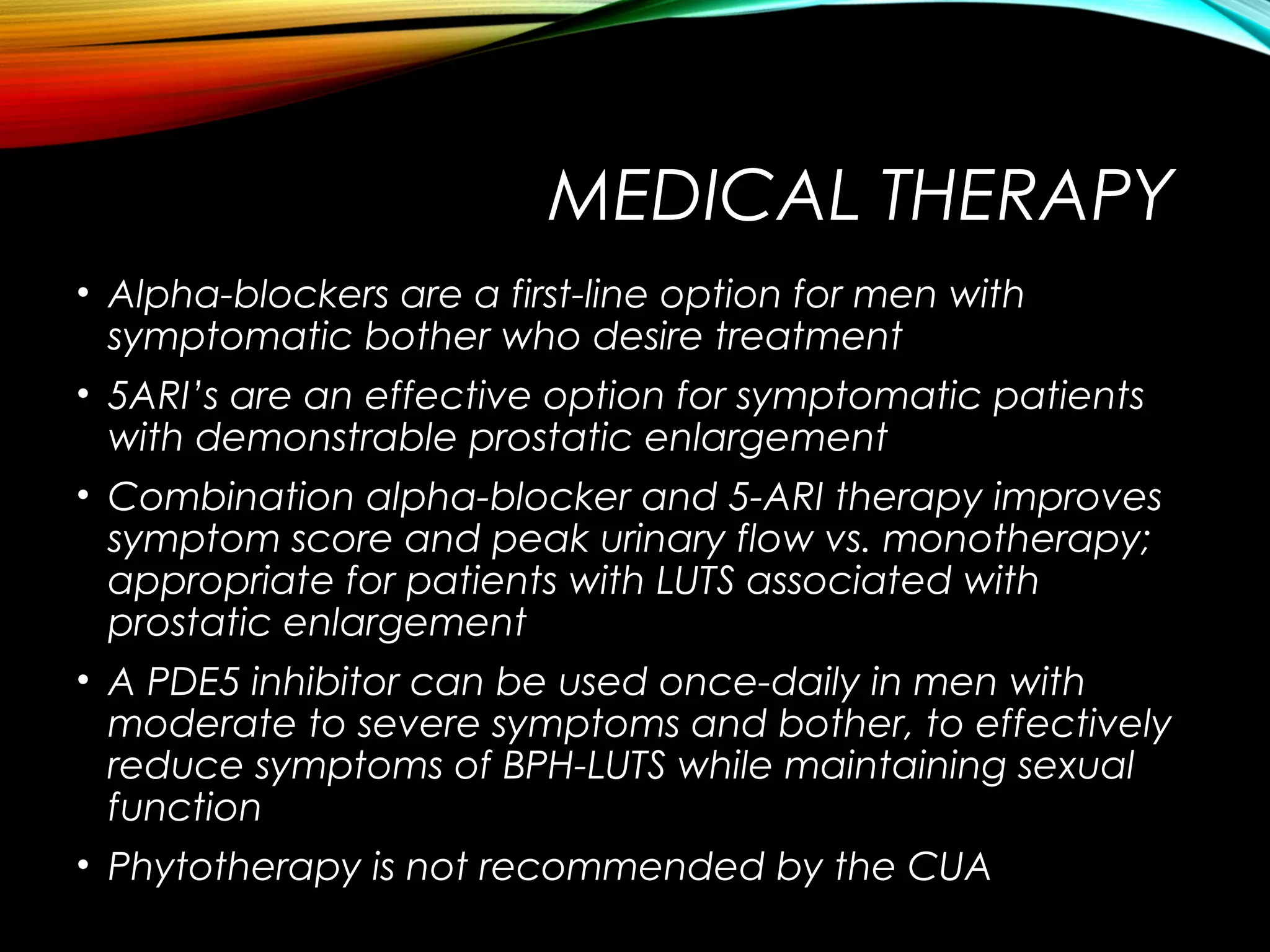
MEDICAL THERAPY
• Alpha-blockers are a first-line option for men with
symptomatic bother who desire treatment
• 5ARI’s are an effective option for symptomatic patients
with demonstrable prostatic enlargement
• Combination alpha-blocker and 5-ARI therapy improves
symptom score and peak urinary flow vs. monotherapy;
appropriate for patients with LUTS associated with
prostatic enlargement
• A PDE5 inhibitor can be used once-daily in men with
moderate to severe symptoms and bother, to effectively
reduce symptoms of BPH-LUTS while maintaining sexual
function
• Phytotherapy is not recommended by the CUA
ALPHA BLOCKERS
• Selective antagonist of α1-adrenoceptors located in:
• Prostate
• Prostatic capsule
• Bladder base
• Bladder neck
• Prostatic urethra
• Help relax smooth muscle in the bladder neck and prostate;
allow urine to flow more freely
• Selective and non-selective alpha-blockers exist
• Non-selective alpha-blockers are not commonly used for BPH-
LUTS
ALPHA BLOCKERS
• First line options include
• Equal clinical effectiveness for LUTS secondary
to BPH
• Do not alter the natural progression of the
disease
• Choice of agent should depend on
comorbidities, side effect profile and tolerance
Selective :- Alfuzosin
Tamsulosin
Silodosin
Non selective: Doxazosin
Terazosin
SIDE EFFECTS
• Retrograde ejaculation
• Erectile dysfunction
• Asthenia •
• Dizziness
• Orthostatic hypotension
• Nasal congestion
5-ALPHA REDUCTASE
INHIBITORS
• Indicated as first-line therapy for men with enlarged
prostates:
• Finasterideinhibits 5α-reductase Type 2 (prostate)
• Dutasterideinhibits 5α-reductase Type 1 AND 2 (liver, skin
and prostate)
• Blocks the conversion of testosterone to DHT (responsible for
prostate growth)
• Treatment with 5-ARIs reduce:
• Prostate size
• PSA
• Long-term risk of acute urinary retention
• Need for surgery
SIDE EFFECTS
• Reduced libido
• Erectile dysfunction
• Decreased ejaculate volume
• Breast tenderness
COMBINATION THERAPY
• Combined alpha-blocker and 5-ARI therapy is effective
for LUTS associated with prostatic enlargement
• Improves symptom score and peak urinary flow greater
than either monotherapy option
• Delays symptomatic disease progression
• Decreased risk of urinary retention and/or prostate
surgery
PDE5 INHIBITORS
• Promote smooth muscle relaxation.
• Improve LUTS.
• Improves quality of life.
• Effective in men with or without erectile dysfunction.
• Tadalafil is the only approved PDE5 inhibitor for BPH-
LUTS.
SIDE EFFECTS
• Headache
• Facial flushing
• Dyspepsia
TREATMENT RESPONSE
Drug class Time for symptom improvement
Alpha blockers 2-4 weeks
5 alpha reductase inhibitors Atleast 6 months
PDE5 inhibitors 4 weeks
CASE SCENARIOS
Case description Recommendation
Moderate – severe bother (PSA
1.3ng/ml)
Alpha blocker
Diabetes Alpha blocker
hypertension Alpha blocker
Erectile dysfunction Alpha blocker or PDE5
Enlarged prostate + PSA >
1.5ng/ml
5-ARI
Enlarged prostate + PSA >
1.5ng/ml + ED
5-ARI and/or PDE5
Bothersome sexual side effects
with α-blocker or 5-ARI PDE5
SURGICAL TREATMENT
• Renal insufficiency
• LUTS complications
• Patient requests surgical treatment
• Medication is ineffective
• Medication side effects are intolerable
PROSTATE SIZE
Very large ( 80-100g ) Large ( 30-80g ) Small ( <30g )
Open prostatectomy TURP TURP
Laser prostatectomy
-holium
-greenlight
Laser prostatectomy
-holium
-greenlight
Minimally Invasive
- TUMT
- TUNA
RISKS OF SURGERY
• Excessive bleeding requiring blood transfusion
• TUR syndrome
• Permanent sexual side effects:
• Retrograde ejaculation
• Erectile dysfunction (less common)
• Urinary tract infections
• Urinary incontinence
• Need for retreatment:
• Prostate regrowth
• Bladder/urethral strictures

Benign Prostatic Hyperplasia (BPH and LUTS)

  • 1.
    BPH AND LUTS SalmanBangash 2014-081
  • 2.
    BPH-LUTS • Benign prostatichyperplasia is the histological pattern of the prostate, characterized by proliferation of smooth muscle and epithelial cells within the prostatic transition zone. This may lead to prostatic enlargement. • Lower urinary tract symptoms refer to storage and/or voiding disturbances. • BPH-LUTS refers to bothersome lower urinary tract symptoms linked to the prostate. • Not all men with BPH have LUTS and not all patients with LUTS have BPH.
  • 3.
    BPH • It isconsidered a normal part of aging in men and is hormonally dependent on testosterone and DHT production. • 50% of men develop BPH by age 60 years and 90% by age 85 years.
  • 4.
    BPH • Patients withmild LUTS can be treated medically. • TURP ( transurethral resection of the prostate ) is the standard procedure for relieving bladder outlet obstruction secondary to BPH.
  • 5.
    PROSTATE • It isa walnut sized gland and is a part of the male reproductive system • Located anterior to the rectum and distal to the urinary bladder. • It is connected directly with the penile urethra hence it’s a conduit between the bladder and urethra. • BPH originates in the Transition zone which surround the urethra.
  • 6.
  • 7.
    PROSTATE • Main functionof the prostate is to secrete and alkaline fluid that compromises 70% of the seminal volume. • Secretions produce lubrication and nutrition for the sperm. • Alkaline fluid helps neutralize the acidic vaginal environment.
  • 8.
    RISK FACTORS • Obesity •Lack of physical activity • Erectile dysfunction • Increasing age • Family history of BPH
  • 9.
    EVALUATION OF PATIENTS •Medical history • Directed physical exam • Urinalysis • PSA testing • Symptom assessment
  • 10.
    MEDICAL HISTORY • Natureand duration of symptoms • Fluid intake – amount and types of fluid • Sexual history • Comorbid conditions • Prior and current illness • Prior surgery and trauma • Current medications • Any previous treatments.
  • 11.
    CLINICAL MANIFESTATIONS • Urinary frequency •Urgency • Nocturia • Hesitancy • Incomplete emptying of bladder • Straining • Dribbling
  • 12.
    SEXUAL HISTORY • Sexualhistory is important because studies have identified LUTS as an independent risk factor for erectile dysfunction and ejaculatory dysfunction.
  • 13.
    EXAMINATION • DIGITAL RECTALEXAM --- Evaluate prostate for size, consistency, shape and abnormalities suggestive of prostate cancer (such as nodules or asymmetry) • Assess suprapubic area to rule out bladder distention • Evaluate overall motor and sensory function of the perineum and lower limbs
  • 14.
    COMPLICATIONS • Urinary retention •Renal insufficiency • Recurrent UTI • Gross hematuria • Bladder calculi • Renal failure or Uremia
  • 15.
    URINALYSIS •Dipstick urinalysis shouldbe performed in all BPH-LUTS patients to rule out other diagnoses that may cause LUTS. •Abnormal/borderline urinalysis results should be repeated and/or followed with a urine culture
  • 16.
    URINALYISIS Urinalysis result Possiblediagnosis Hematuria Kidney stones Bladder cancer Pyuria or nitrates UTI Urethral stricture Proteinuria Underlying renal disease Glucosuria diabetes
  • 17.
    PSA TESTING • BPHdoes not cause prostate cancer, however men at risk of BPH are also at risk of developing prostate cancer. • It is a sensitive screening test for prostate volume. • Men at age 50 who are expected to live at least 10 more year. • 45 years in men who are at high risk ( African American’s or close relative with prostate cancer )
  • 18.
    ULTRASONOGRAPHY • Help determineprostate and bladder size and degree of hydronephrosis in patients with urinary retention. • Transrectal ultrasonography is recommended in selected patients to determine the dimensions and volume of the prostrate.
  • 19.
    CYSTOSCOPY • It isindicated in patients whom a malignancy or foreign body is suspected.
  • 20.
    INTERNATIONAL PROSTATE SYMPTOM SCORE 1-7= mild 8-19 = moderate 20-35 = severe
  • 21.
  • 22.
  • 23.
    MEDICAL THERAPY • Alpha-blockersare a first-line option for men with symptomatic bother who desire treatment • 5ARI’s are an effective option for symptomatic patients with demonstrable prostatic enlargement • Combination alpha-blocker and 5-ARI therapy improves symptom score and peak urinary flow vs. monotherapy; appropriate for patients with LUTS associated with prostatic enlargement • A PDE5 inhibitor can be used once-daily in men with moderate to severe symptoms and bother, to effectively reduce symptoms of BPH-LUTS while maintaining sexual function • Phytotherapy is not recommended by the CUA
  • 24.
    ALPHA BLOCKERS • Selectiveantagonist of α1-adrenoceptors located in: • Prostate • Prostatic capsule • Bladder base • Bladder neck • Prostatic urethra • Help relax smooth muscle in the bladder neck and prostate; allow urine to flow more freely • Selective and non-selective alpha-blockers exist • Non-selective alpha-blockers are not commonly used for BPH- LUTS
  • 25.
    ALPHA BLOCKERS • Firstline options include • Equal clinical effectiveness for LUTS secondary to BPH • Do not alter the natural progression of the disease • Choice of agent should depend on comorbidities, side effect profile and tolerance Selective :- Alfuzosin Tamsulosin Silodosin Non selective: Doxazosin Terazosin
  • 26.
    SIDE EFFECTS • Retrogradeejaculation • Erectile dysfunction • Asthenia • • Dizziness • Orthostatic hypotension • Nasal congestion
  • 27.
    5-ALPHA REDUCTASE INHIBITORS • Indicatedas first-line therapy for men with enlarged prostates: • Finasterideinhibits 5α-reductase Type 2 (prostate) • Dutasterideinhibits 5α-reductase Type 1 AND 2 (liver, skin and prostate) • Blocks the conversion of testosterone to DHT (responsible for prostate growth) • Treatment with 5-ARIs reduce: • Prostate size • PSA • Long-term risk of acute urinary retention • Need for surgery
  • 28.
    SIDE EFFECTS • Reducedlibido • Erectile dysfunction • Decreased ejaculate volume • Breast tenderness
  • 29.
    COMBINATION THERAPY • Combinedalpha-blocker and 5-ARI therapy is effective for LUTS associated with prostatic enlargement • Improves symptom score and peak urinary flow greater than either monotherapy option • Delays symptomatic disease progression • Decreased risk of urinary retention and/or prostate surgery
  • 30.
    PDE5 INHIBITORS • Promotesmooth muscle relaxation. • Improve LUTS. • Improves quality of life. • Effective in men with or without erectile dysfunction. • Tadalafil is the only approved PDE5 inhibitor for BPH- LUTS.
  • 31.
    SIDE EFFECTS • Headache •Facial flushing • Dyspepsia
  • 32.
    TREATMENT RESPONSE Drug classTime for symptom improvement Alpha blockers 2-4 weeks 5 alpha reductase inhibitors Atleast 6 months PDE5 inhibitors 4 weeks
  • 33.
    CASE SCENARIOS Case descriptionRecommendation Moderate – severe bother (PSA 1.3ng/ml) Alpha blocker Diabetes Alpha blocker hypertension Alpha blocker Erectile dysfunction Alpha blocker or PDE5 Enlarged prostate + PSA > 1.5ng/ml 5-ARI Enlarged prostate + PSA > 1.5ng/ml + ED 5-ARI and/or PDE5 Bothersome sexual side effects with α-blocker or 5-ARI PDE5
  • 34.
    SURGICAL TREATMENT • Renalinsufficiency • LUTS complications • Patient requests surgical treatment • Medication is ineffective • Medication side effects are intolerable
  • 35.
    PROSTATE SIZE Very large( 80-100g ) Large ( 30-80g ) Small ( <30g ) Open prostatectomy TURP TURP Laser prostatectomy -holium -greenlight Laser prostatectomy -holium -greenlight Minimally Invasive - TUMT - TUNA
  • 36.
    RISKS OF SURGERY •Excessive bleeding requiring blood transfusion • TUR syndrome • Permanent sexual side effects: • Retrograde ejaculation • Erectile dysfunction (less common) • Urinary tract infections • Urinary incontinence • Need for retreatment: • Prostate regrowth • Bladder/urethral strictures