Erectile Dysfunction:
Evaluation and Management
Dr Shahjada Selim
Associate Professor
Department of Endocrinology, BSMMU
Visiting Professor in Endocrinology, Texila American University, USA
EC Member, International Society of sexual Medicine- ISSM
Website: shahjadaselim.com
Presentation Flow
• Definition ED
• Anatomy and Physiology of erection
• Etiopathology
• Evaluation-
– History
– Examination
– Investigations
• Treatment
Anatomy and Physiology of erection
• Sexual stimulation triggers a cascade of events.
• Erection is neurovascular phenomena combining
neurotransmission and vascular biologic responses.
• Release of neurotransmitters that result in smooth
muscle relaxation in both penile erectile tissue and
the penile arterial walls
• This transforms the penile vasculature and erectile
tissues from contracted, minimally perfused state to
relaxed engorged state.
Anatomy and Physiology of erection
• The limbic system, part of cerebral cortex from which
stimulation can elicit erection.
• Medial preoptic area and paraventricular nucleus of
hypothalamus are high integration centers for sexual drive
and erection.
• Parasympathetic nerves S2-4 mediate erection
• Sympathetic nerves T11-L2 control ejaculation and
detumescence.
• Somatic nerves S2-S4 mediate sensation and motor to
ischiocavernosus and bulbocavernosus muscles.
• Smooth muscle relaxation
– Nitric oxide diffuses into cavernosal smooth
muscle cells, activates Guanylate cyclase,
converts guanosine triphosphate to cGMP
resulting in smooth muscle relaxation.
– Effect of cGMP is stopped by
Phosphodiesterase type 5 (PDE5i) which
exists primarily in corpora cavernosa.
1. Organic: due to vasculogenic, neurologic,
hormonal, or cavernosal abnormalities
2. Psychogenic: due to central inhibition of
the erectile mechanism without a physical
insult
3.Mixed ED: due to combination of organic
and psychogenic factors
ED is commonly classified into three
categories based on its etiology:
Etiopathology
Arteriogenic Cause of ED
• Hypertension
• Smoking
• Diabetes mellitus
• Hyperlipidaemia
• Peripheral vascular disease
• Blunt perineal or pelvic trauma
• Pelvic irradiation
Neurogenic causes of ED
• Lesions of medial preoptic nucleus,
paraventicular nucleus, hippocampus
• Spinal trauma
• Myelodisplasia (spina bifida)
• Pelvic surgery/radiotherapy
• Multiple sclerosis
• Intervertebral disc lesion
• Peripheral neuropathies
– Alcohol
– Diabetes
– HIV
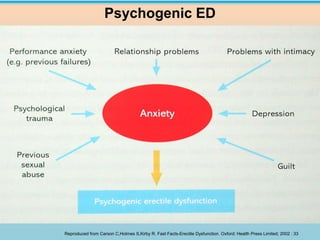
Psychogenic ED
Reproduced from Carson C,Holmes S,Kirby R. Fast Facts-Erectile Dysfunction. Oxford: Health Press Limited; 2002 : 33
Endocrine causes of ED
• Hypogonadism
– Testosterone deficiency
– Raised SHBG
– Raised Prolactin
• Thyroid disease
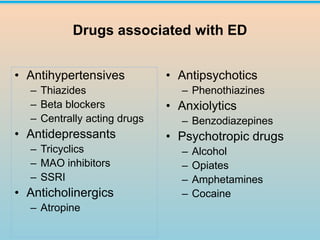
Drugs associated with ED
• Antihypertensives
– Thiazides
– Beta blockers
– Centrally acting drugs
• Antidepressants
– Tricyclics
– MAO inhibitors
– SSRI
• Anticholinergics
– Atropine
• Antipsychotics
– Phenothiazines
• Anxiolytics
– Benzodiazepines
• Psychotropic drugs
– Alcohol
– Opiates
– Amphetamines
– Cocaine
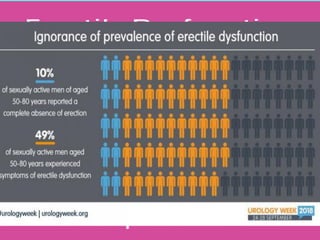
• Several studies accessed the prevalence of ED. The
Massachusetts Male Aging Study reported a prevalence of 52%
[1].
• The study demonstrated that ED is increasingly prevalent with
age: approximately 40% of men are affected at age 40 and
nearly 70% of men are affected at age 70.
• The prevalence of complete ED increased from 5% at age 40 to
15% at age 70 [2].
1. Feldman HA et al. Impotence and its medical and psychosocial correlates: Results of the Massachusetts Male Aging Study. J Urol 1994; 151:54–61.
2. Johannes CB et al. Incidence of erectile dysfunction in men 40 to 69 years old: Longitudinal results from the Massachusetts Male Aging Study. J Urol 2000; 163:460–463.
Prevalence
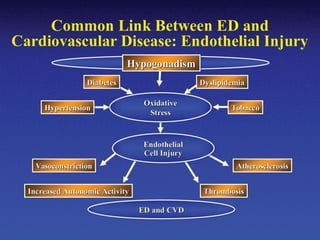
Most significant social implication of ED is - its
increasingly recognized status as an early
marker of vascular disease
ED is a marker of significantly increased risk
of CVD, coronary artery disease (CAD),
stroke and all -cause mortality
Erectile dysfunction commonly occurs in the
presence of silent CAD
Time window between ED onset and a CAD
event is usually 2 to 5 years
A SENTINEL FOR CARDIOVASCULAR DISEASE
ED and Coronary Artery Disease
• Generalised atherosclerosis
• Penile arteries smaller than coronary
arteries
• ED pre-dates coronary artery disease
• Man with ED and no cardiac symptoms is a
cardiac patient until proven otherwise
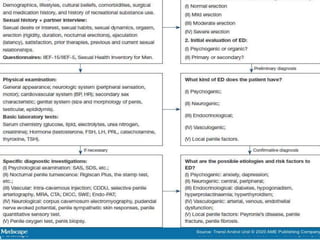
Approach to Patients with ED
Some self-administered measures may be useful in the primary
care setting to screen for and evaluate the degree of ED.12 The
most commonly used instrument is the International Index of
Erectile Function, a 15-item questionnaire that has been
validated in many populations and is considered the gold
standard to evaluate patients for ED.13 The Sexual Health
Inventory for Men is a short-form, 5-item questionnaire
developed to monitor treatment progress.12 It is important to
recognize that short-form questionnaire does not evaluate
specific areas of the sexual cycle, such as sexual desire,
ejaculation, and orgasm; however, it may be useful in discussing
ED with patients and evaluating treatment results over time.
Treatment
Lifestyle Modification
Erectile dysfunction is known to be associated with
general health status, thus, lifestyle modification
improves erectile function and decreases the rate of
decline of function with aging.
✓ One year after discontinuation of smoking, patients
were found to have a 25% improvement in erectile
quality [1].
✓ In addition, multivariate analysis found obesity is
associated with erectile dysfunction with an
approximately 50% increase in ED in obese men as
compared with normal weight men [2].
1. Pourmand G, Alidaee MR, Rasuli S, Maleki A, Mehrsai A. Do cigarette smokers with erectile dysfunction benefit from stopping?: A prospective study. BJU Int 2004; 94:1310–1313).
2.. Janiszewski PM, Janssen I, Ross R. Abdominal obesity and physical inactivity are associated with erectile dysfunction independent of body mass index. J Sex Med 2009; 6:1990–1998
Treatment
….Lifestyle Modification
✓ Little evidence supports that increased physical activity alone
improves erectile quality; however, the strong association
between physical activity and lower BMI is well described, and
therefore recommended for men with erectile dysfunction and
without a contraindication to physical activity.
✓ The Massachusetts Male Aging Study demonstrated
increased risk of ED among heavy alcohol users though the
impact of alcohol use on erection quality is not well
understood [3].
3 Feldman HA, Goldstein I, Hatzichristou DG, Krane RJ, McKinlay JB. Impotence and its medical and psychosocial correlates: Results of the Massachusetts Male Aging Study. J Urol 1994; 151:54–61.
First-line therapy
A. Oral Phosphodiesterase-5 inhibitors
i.e. sildenafil, Tadalafil, vardenafil,
Udenafil
▪First-line therapy for ED irrespective of the
cause, unless the patient has contraindications
to their use ( e.g, concurrent organic nitrate
therapy)
TREATMENT OPTIONS for ED
These oral medications reversibly inhibit penile-
specific PDE5 and enhance the nitric oxide–cGMP
pathways of cavernous smooth muscle relaxation;
that is, all prevent the breakdown of cGMP by PDE5.
It is important to emphasize to patients that these
drugs augment the body’s natural erectile
mechanisms, therefore the neural and
psychoemotional stimuli typically needed for arousal
still need to be activated for the drugs to be
efficacious.
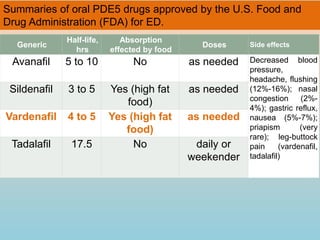
Generic
Half-life,
hrs
Absorption
effected by food
Doses Side effects
Avanafil 5 to 10 No as needed Decreased blood
pressure,
headache, flushing
(12%-16%); nasal
congestion (2%-
4%); gastric reflux,
nausea (5%-7%);
priapism (very
rare); leg-buttock
pain (vardenafil,
tadalafil)
Sildenafil 3 to 5 Yes (high fat
food)
as needed
Vardenafil 4 to 5 Yes (high fat
food)
as needed
Tadalafil 17.5 No daily or
weekender
Summaries of oral PDE5 drugs approved by the U.S. Food and
Drug Administration (FDA) for ED.
Drug Starting dose Dose Modification Instruction related to
food
Sildenafil 50 mg PO 1 hour
before sexual activity
once a day
May be increased to 100
mg or reduced to 25 mg,
depending on effectiveness
and tolerance
1 hour before or 3
hours after taking
meal
Tadalafil 10 mg PO 1 to 3 hrs
before sexual activity
once a day
May be increased to 20 mg
or reduced to 5 mg on
basis of efficacy and
tolerability
Can be taken with or
without food
Vardenafil 10 mg 1 hr before
sexual activity
once a day
May be increased to 20
mg or reduced to 5 mg
on basis of efficacy and
tolerability
Can be taken with
or without food
Udenafil 100 mg PO 1 hour
before sexual activity
once a day
May be increased to 200
mg, based on individual
effectiveness and
toleration
Can be taken with or
without food
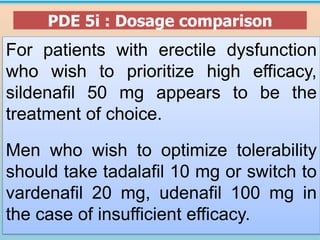
PDE 5i : Dosage comparison
For patients with erectile dysfunction
who wish to prioritize high efficacy,
sildenafil 50 mg appears to be the
treatment of choice.
Men who wish to optimize tolerability
should take tadalafil 10 mg or switch to
vardenafil 20 mg, udenafil 100 mg in
the case of insufficient efficacy.
• No increase in myocardial infarction rates
• No adverse effect on total exercise time or time-to-
ischaemia during exercise testing in men with stable
angina
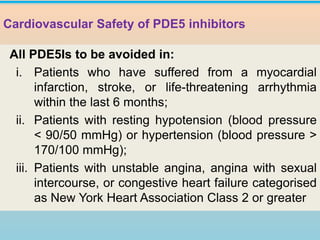
Cardiovascular Safety of PDE5 inhibitors
All PDE5Is to be avoided in:
i. Patients who have suffered from a myocardial
infarction, stroke, or life-threatening arrhythmia
within the last 6 months;
ii. Patients with resting hypotension (blood pressure
< 90/50 mmHg) or hypertension (blood pressure >
170/100 mmHg);
iii. Patients with unstable angina, angina with sexual
intercourse, or congestive heart failure categorised
as New York Heart Association Class 2 or greater
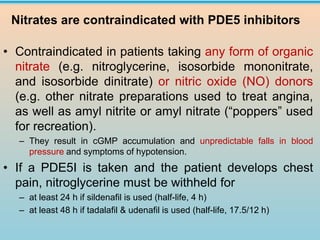
• Contraindicated in patients taking any form of organic
nitrate (e.g. nitroglycerine, isosorbide mononitrate,
and isosorbide dinitrate) or nitric oxide (NO) donors
(e.g. other nitrate preparations used to treat angina,
as well as amyl nitrite or amyl nitrate (“poppers” used
for recreation).
– They result in cGMP accumulation and unpredictable falls in blood
pressure and symptoms of hypotension.
• If a PDE5I is taken and the patient develops chest
pain, nitroglycerine must be withheld for
– at least 24 h if sildenafil is used (half-life, 4 h)
– at least 48 h if tadalafil & udenafil is used (half-life, 17.5/12 h)
Nitrates are contraindicated with PDE5 inhibitors
Prescribing PDE5i
Importance of Sexual Dynamics
Sexual Dynamics
• Frequency of sexual activity
• Predictability of sexual activity
Selecting the Optimal ED Agent
on the basis of sexual dynamics
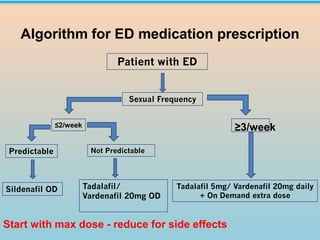
Algorithm for ED medication prescription
Patient with ED
Sexual Frequency
≤2/week
Predictable Not Predictable
Sildenafil OD Tadalafil/
Vardenafil 20mg OD
≥3/week
Tadalafil 5mg/ Vardenafil 20mg daily
+ On Demand extra dose
Start with max dose - reduce for side effects
NON-RESPONDERS OF PDE5IS
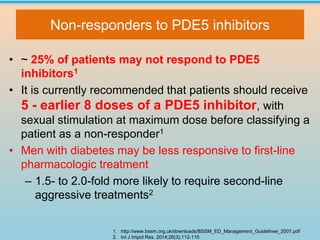
• ~ 25% of patients may not respond to PDE5
inhibitors1
• It is currently recommended that patients should receive
5 - earlier 8 doses of a PDE5 inhibitor, with
sexual stimulation at maximum dose before classifying a
patient as a non-responder1
• Men with diabetes may be less responsive to first-line
pharmacologic treatment
– 1.5- to 2.0-fold more likely to require second-line
aggressive treatments2
Non-responders to PDE5 inhibitors
1. http://www.bssm.org.uk/downloads/BSSM_ED_Management_Guidelines_2007.pdf
2. Int J Impot Res. 2014;26(3):112-115
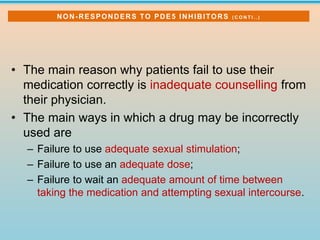
• The main reason why patients fail to use their
medication correctly is inadequate counselling from
their physician.
• The main ways in which a drug may be incorrectly
used are
– Failure to use adequate sexual stimulation;
– Failure to use an adequate dose;
– Failure to wait an adequate amount of time between
taking the medication and attempting sexual intercourse.
NON-RESPONDERS TO PDE5 INHIBITORS ( C O N T I . . )
Measures to be taken in PDE5I non-responders to
salvage the patient from second/third-line therapy
• Re-counselling on proper use
• Optimal treatment of concurrent diseases and
frequent re-evaluation for new risk factors
• Treatment of concurrent hypogonadism
– Testosterone regulates the expression of PDE5 and the
responsiveness of PDE5 inhibitors in the corpus
cavernosum
– Several studies have shown that patients can be
salvaged by treating low or low-normal levels of
testosterone
• Change PDE5 inhibitor: Some patients may respond
better to one drug when another has failed
• More frequent dosing regimes
http://www.bssm.org.uk/downloads/BSSM_ED_Management_Guidelines_2007.pdf
NON-RESPONDERS TO PDE5 INHIBITORS ( C O N T I . . )
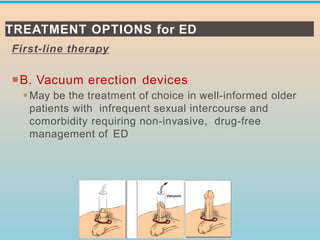
First-line therapy
B. Vacuum erection devices
▪May be the treatment of choice in well-informed older
patients with infrequent sexual intercourse and
comorbidity requiring non-invasive, drug-free
management of ED
TREATMENT OPTIONS for ED
TREATMENT OPTIONS for ED (CONTI)
• Second-line therapy
Intracavernosal injection of vasodilators i.e.
alprostadil,papaverine, phentolamine
▪ Can be used alone or in combination with other medications in patients not
responding to oral drugs
[[
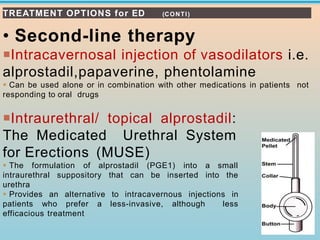
Intraurethral/ topical alprostadil:
The Medicated Urethral System
for Erections (MUSE)
▪ The formulation of alprostadil (PGE1) into a small
intraurethral suppository that can be inserted into the
urethra
▪ Provides an alternative to intracavernous injections in
patients who prefer a less-invasive, although less
efficacious treatment
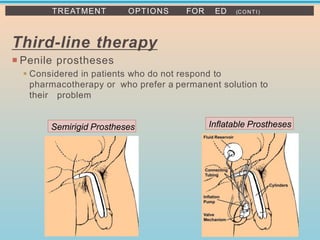
Third-line therapy
 Penile prostheses
▪ Considered in patients who do not respond to
pharmacotherapy or who prefer a permanent solution to
their problem
TREATMENT OPTIONS FOR ED (CONTI)
Semirigid Prostheses Inflatable Prostheses
Take Home: ED medication management
✓ED affects millions of men to various degrees.
✓The majority of cases have an organic etiology, most
commonly vascular disease that decreases blood flow
into the penis.
✓Regardless of the primary cause, erectile dysfunction
can have a negative impact on self-esteem, quality of
life and interpersonal relationships.
✓The initial step in evaluation is a detailed medical and
social history, including a review of medication use.
Take Home: ED medication management
✓Discussion with the patient's sexual partner may clarify
exacerbating issues. The physical examination focuses
on the cardiovascular, neurologic and urogenital
systems.
✓Laboratory tests are useful to screen for common
etiologic factors and, when indicated, to identify
hypogonadal syndromes.
✓Appropriate evaluation of erectile dysfunction leads to
accurate advice, management and referral of patients
with erectile dysfunction.
www.shahjadaselim.com

Erectile Dysfunction:Evaluation and Management by Dr Shahjada Selim

  • 1.
    Erectile Dysfunction: Evaluation andManagement Dr Shahjada Selim Associate Professor Department of Endocrinology, BSMMU Visiting Professor in Endocrinology, Texila American University, USA EC Member, International Society of sexual Medicine- ISSM Website: shahjadaselim.com
  • 2.
    Presentation Flow • DefinitionED • Anatomy and Physiology of erection • Etiopathology • Evaluation- – History – Examination – Investigations • Treatment
  • 4.
    Anatomy and Physiologyof erection • Sexual stimulation triggers a cascade of events. • Erection is neurovascular phenomena combining neurotransmission and vascular biologic responses. • Release of neurotransmitters that result in smooth muscle relaxation in both penile erectile tissue and the penile arterial walls • This transforms the penile vasculature and erectile tissues from contracted, minimally perfused state to relaxed engorged state.
  • 5.
    Anatomy and Physiologyof erection • The limbic system, part of cerebral cortex from which stimulation can elicit erection. • Medial preoptic area and paraventricular nucleus of hypothalamus are high integration centers for sexual drive and erection. • Parasympathetic nerves S2-4 mediate erection • Sympathetic nerves T11-L2 control ejaculation and detumescence. • Somatic nerves S2-S4 mediate sensation and motor to ischiocavernosus and bulbocavernosus muscles.
  • 6.
    • Smooth musclerelaxation – Nitric oxide diffuses into cavernosal smooth muscle cells, activates Guanylate cyclase, converts guanosine triphosphate to cGMP resulting in smooth muscle relaxation. – Effect of cGMP is stopped by Phosphodiesterase type 5 (PDE5i) which exists primarily in corpora cavernosa.
  • 8.
    1. Organic: dueto vasculogenic, neurologic, hormonal, or cavernosal abnormalities 2. Psychogenic: due to central inhibition of the erectile mechanism without a physical insult 3.Mixed ED: due to combination of organic and psychogenic factors ED is commonly classified into three categories based on its etiology:
  • 9.
  • 10.
    Arteriogenic Cause ofED • Hypertension • Smoking • Diabetes mellitus • Hyperlipidaemia • Peripheral vascular disease • Blunt perineal or pelvic trauma • Pelvic irradiation
  • 11.
    Neurogenic causes ofED • Lesions of medial preoptic nucleus, paraventicular nucleus, hippocampus • Spinal trauma • Myelodisplasia (spina bifida) • Pelvic surgery/radiotherapy • Multiple sclerosis • Intervertebral disc lesion • Peripheral neuropathies – Alcohol – Diabetes – HIV
  • 12.
    Psychogenic ED Reproduced fromCarson C,Holmes S,Kirby R. Fast Facts-Erectile Dysfunction. Oxford: Health Press Limited; 2002 : 33
  • 13.
    Endocrine causes ofED • Hypogonadism – Testosterone deficiency – Raised SHBG – Raised Prolactin • Thyroid disease
  • 14.
    Drugs associated withED • Antihypertensives – Thiazides – Beta blockers – Centrally acting drugs • Antidepressants – Tricyclics – MAO inhibitors – SSRI • Anticholinergics – Atropine • Antipsychotics – Phenothiazines • Anxiolytics – Benzodiazepines • Psychotropic drugs – Alcohol – Opiates – Amphetamines – Cocaine
  • 15.
    • Several studiesaccessed the prevalence of ED. The Massachusetts Male Aging Study reported a prevalence of 52% [1]. • The study demonstrated that ED is increasingly prevalent with age: approximately 40% of men are affected at age 40 and nearly 70% of men are affected at age 70. • The prevalence of complete ED increased from 5% at age 40 to 15% at age 70 [2]. 1. Feldman HA et al. Impotence and its medical and psychosocial correlates: Results of the Massachusetts Male Aging Study. J Urol 1994; 151:54–61. 2. Johannes CB et al. Incidence of erectile dysfunction in men 40 to 69 years old: Longitudinal results from the Massachusetts Male Aging Study. J Urol 2000; 163:460–463. Prevalence
  • 18.
    Most significant socialimplication of ED is - its increasingly recognized status as an early marker of vascular disease ED is a marker of significantly increased risk of CVD, coronary artery disease (CAD), stroke and all -cause mortality Erectile dysfunction commonly occurs in the presence of silent CAD Time window between ED onset and a CAD event is usually 2 to 5 years A SENTINEL FOR CARDIOVASCULAR DISEASE
  • 19.
    ED and CoronaryArtery Disease • Generalised atherosclerosis • Penile arteries smaller than coronary arteries • ED pre-dates coronary artery disease • Man with ED and no cardiac symptoms is a cardiac patient until proven otherwise
  • 20.
  • 21.
    Some self-administered measuresmay be useful in the primary care setting to screen for and evaluate the degree of ED.12 The most commonly used instrument is the International Index of Erectile Function, a 15-item questionnaire that has been validated in many populations and is considered the gold standard to evaluate patients for ED.13 The Sexual Health Inventory for Men is a short-form, 5-item questionnaire developed to monitor treatment progress.12 It is important to recognize that short-form questionnaire does not evaluate specific areas of the sexual cycle, such as sexual desire, ejaculation, and orgasm; however, it may be useful in discussing ED with patients and evaluating treatment results over time.
  • 22.
    Treatment Lifestyle Modification Erectile dysfunctionis known to be associated with general health status, thus, lifestyle modification improves erectile function and decreases the rate of decline of function with aging. ✓ One year after discontinuation of smoking, patients were found to have a 25% improvement in erectile quality [1]. ✓ In addition, multivariate analysis found obesity is associated with erectile dysfunction with an approximately 50% increase in ED in obese men as compared with normal weight men [2]. 1. Pourmand G, Alidaee MR, Rasuli S, Maleki A, Mehrsai A. Do cigarette smokers with erectile dysfunction benefit from stopping?: A prospective study. BJU Int 2004; 94:1310–1313). 2.. Janiszewski PM, Janssen I, Ross R. Abdominal obesity and physical inactivity are associated with erectile dysfunction independent of body mass index. J Sex Med 2009; 6:1990–1998
  • 23.
    Treatment ….Lifestyle Modification ✓ Littleevidence supports that increased physical activity alone improves erectile quality; however, the strong association between physical activity and lower BMI is well described, and therefore recommended for men with erectile dysfunction and without a contraindication to physical activity. ✓ The Massachusetts Male Aging Study demonstrated increased risk of ED among heavy alcohol users though the impact of alcohol use on erection quality is not well understood [3]. 3 Feldman HA, Goldstein I, Hatzichristou DG, Krane RJ, McKinlay JB. Impotence and its medical and psychosocial correlates: Results of the Massachusetts Male Aging Study. J Urol 1994; 151:54–61.
  • 24.
    First-line therapy A. OralPhosphodiesterase-5 inhibitors i.e. sildenafil, Tadalafil, vardenafil, Udenafil ▪First-line therapy for ED irrespective of the cause, unless the patient has contraindications to their use ( e.g, concurrent organic nitrate therapy) TREATMENT OPTIONS for ED
  • 25.
    These oral medicationsreversibly inhibit penile- specific PDE5 and enhance the nitric oxide–cGMP pathways of cavernous smooth muscle relaxation; that is, all prevent the breakdown of cGMP by PDE5. It is important to emphasize to patients that these drugs augment the body’s natural erectile mechanisms, therefore the neural and psychoemotional stimuli typically needed for arousal still need to be activated for the drugs to be efficacious.
  • 26.
    Generic Half-life, hrs Absorption effected by food DosesSide effects Avanafil 5 to 10 No as needed Decreased blood pressure, headache, flushing (12%-16%); nasal congestion (2%- 4%); gastric reflux, nausea (5%-7%); priapism (very rare); leg-buttock pain (vardenafil, tadalafil) Sildenafil 3 to 5 Yes (high fat food) as needed Vardenafil 4 to 5 Yes (high fat food) as needed Tadalafil 17.5 No daily or weekender Summaries of oral PDE5 drugs approved by the U.S. Food and Drug Administration (FDA) for ED.
  • 27.
    Drug Starting doseDose Modification Instruction related to food Sildenafil 50 mg PO 1 hour before sexual activity once a day May be increased to 100 mg or reduced to 25 mg, depending on effectiveness and tolerance 1 hour before or 3 hours after taking meal Tadalafil 10 mg PO 1 to 3 hrs before sexual activity once a day May be increased to 20 mg or reduced to 5 mg on basis of efficacy and tolerability Can be taken with or without food Vardenafil 10 mg 1 hr before sexual activity once a day May be increased to 20 mg or reduced to 5 mg on basis of efficacy and tolerability Can be taken with or without food Udenafil 100 mg PO 1 hour before sexual activity once a day May be increased to 200 mg, based on individual effectiveness and toleration Can be taken with or without food PDE 5i : Dosage comparison For patients with erectile dysfunction who wish to prioritize high efficacy, sildenafil 50 mg appears to be the treatment of choice. Men who wish to optimize tolerability should take tadalafil 10 mg or switch to vardenafil 20 mg, udenafil 100 mg in the case of insufficient efficacy.
  • 28.
    • No increasein myocardial infarction rates • No adverse effect on total exercise time or time-to- ischaemia during exercise testing in men with stable angina Cardiovascular Safety of PDE5 inhibitors All PDE5Is to be avoided in: i. Patients who have suffered from a myocardial infarction, stroke, or life-threatening arrhythmia within the last 6 months; ii. Patients with resting hypotension (blood pressure < 90/50 mmHg) or hypertension (blood pressure > 170/100 mmHg); iii. Patients with unstable angina, angina with sexual intercourse, or congestive heart failure categorised as New York Heart Association Class 2 or greater
  • 29.
    • Contraindicated inpatients taking any form of organic nitrate (e.g. nitroglycerine, isosorbide mononitrate, and isosorbide dinitrate) or nitric oxide (NO) donors (e.g. other nitrate preparations used to treat angina, as well as amyl nitrite or amyl nitrate (“poppers” used for recreation). – They result in cGMP accumulation and unpredictable falls in blood pressure and symptoms of hypotension. • If a PDE5I is taken and the patient develops chest pain, nitroglycerine must be withheld for – at least 24 h if sildenafil is used (half-life, 4 h) – at least 48 h if tadalafil & udenafil is used (half-life, 17.5/12 h) Nitrates are contraindicated with PDE5 inhibitors
  • 30.
  • 31.
    Sexual Dynamics • Frequencyof sexual activity • Predictability of sexual activity
  • 32.
    Selecting the OptimalED Agent on the basis of sexual dynamics
  • 33.
    Algorithm for EDmedication prescription Patient with ED Sexual Frequency ≤2/week Predictable Not Predictable Sildenafil OD Tadalafil/ Vardenafil 20mg OD ≥3/week Tadalafil 5mg/ Vardenafil 20mg daily + On Demand extra dose Start with max dose - reduce for side effects
  • 34.
  • 35.
    • ~ 25%of patients may not respond to PDE5 inhibitors1 • It is currently recommended that patients should receive 5 - earlier 8 doses of a PDE5 inhibitor, with sexual stimulation at maximum dose before classifying a patient as a non-responder1 • Men with diabetes may be less responsive to first-line pharmacologic treatment – 1.5- to 2.0-fold more likely to require second-line aggressive treatments2 Non-responders to PDE5 inhibitors 1. http://www.bssm.org.uk/downloads/BSSM_ED_Management_Guidelines_2007.pdf 2. Int J Impot Res. 2014;26(3):112-115
  • 36.
    • The mainreason why patients fail to use their medication correctly is inadequate counselling from their physician. • The main ways in which a drug may be incorrectly used are – Failure to use adequate sexual stimulation; – Failure to use an adequate dose; – Failure to wait an adequate amount of time between taking the medication and attempting sexual intercourse. NON-RESPONDERS TO PDE5 INHIBITORS ( C O N T I . . )
  • 37.
    Measures to betaken in PDE5I non-responders to salvage the patient from second/third-line therapy • Re-counselling on proper use • Optimal treatment of concurrent diseases and frequent re-evaluation for new risk factors • Treatment of concurrent hypogonadism – Testosterone regulates the expression of PDE5 and the responsiveness of PDE5 inhibitors in the corpus cavernosum – Several studies have shown that patients can be salvaged by treating low or low-normal levels of testosterone • Change PDE5 inhibitor: Some patients may respond better to one drug when another has failed • More frequent dosing regimes http://www.bssm.org.uk/downloads/BSSM_ED_Management_Guidelines_2007.pdf NON-RESPONDERS TO PDE5 INHIBITORS ( C O N T I . . )
  • 38.
    First-line therapy B. Vacuumerection devices ▪May be the treatment of choice in well-informed older patients with infrequent sexual intercourse and comorbidity requiring non-invasive, drug-free management of ED TREATMENT OPTIONS for ED
  • 39.
    TREATMENT OPTIONS forED (CONTI) • Second-line therapy Intracavernosal injection of vasodilators i.e. alprostadil,papaverine, phentolamine ▪ Can be used alone or in combination with other medications in patients not responding to oral drugs [[ Intraurethral/ topical alprostadil: The Medicated Urethral System for Erections (MUSE) ▪ The formulation of alprostadil (PGE1) into a small intraurethral suppository that can be inserted into the urethra ▪ Provides an alternative to intracavernous injections in patients who prefer a less-invasive, although less efficacious treatment
  • 40.
    Third-line therapy  Penileprostheses ▪ Considered in patients who do not respond to pharmacotherapy or who prefer a permanent solution to their problem TREATMENT OPTIONS FOR ED (CONTI) Semirigid Prostheses Inflatable Prostheses
  • 41.
    Take Home: EDmedication management ✓ED affects millions of men to various degrees. ✓The majority of cases have an organic etiology, most commonly vascular disease that decreases blood flow into the penis. ✓Regardless of the primary cause, erectile dysfunction can have a negative impact on self-esteem, quality of life and interpersonal relationships. ✓The initial step in evaluation is a detailed medical and social history, including a review of medication use.
  • 42.
    Take Home: EDmedication management ✓Discussion with the patient's sexual partner may clarify exacerbating issues. The physical examination focuses on the cardiovascular, neurologic and urogenital systems. ✓Laboratory tests are useful to screen for common etiologic factors and, when indicated, to identify hypogonadal syndromes. ✓Appropriate evaluation of erectile dysfunction leads to accurate advice, management and referral of patients with erectile dysfunction.
  • 43.