Primary Sclerosing Cholangitis
Usama Ragab Youssif
Assistant Lecturer of Medicine
Moday, 2-4-2018
Definition
 Chronic progressive fibro-obliterative bile duct
inflammation that can involve any part of the
biliary tree.
Epidemiology
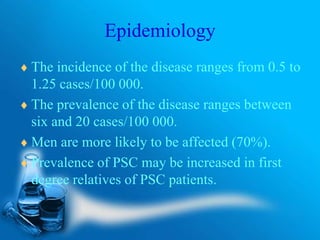
 The incidence of the disease ranges from 0.5 to
1.25 cases/100 000.
 The prevalence of the disease ranges between
six and 20 cases/100 000.
 Men are more likely to be affected (70%).
 Prevalence of PSC may be increased in first
degree relatives of PSC patients.
Etiologies
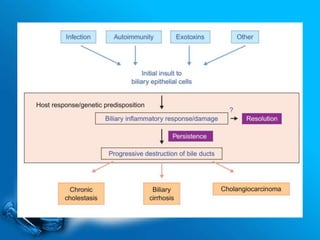
 Unknown.
 Many Hypothesis.
 Genetic element: HLA B8.
 Environmental triggers in genetic susceptible
individuals.
Predictive/risk factors
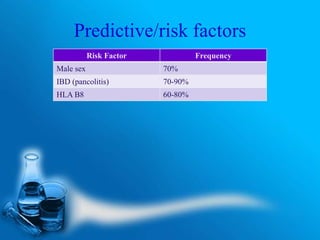
Risk Factor Frequency
Male sex 70%
IBD (pancolitis) 70-90%
HLA B8 60-80%
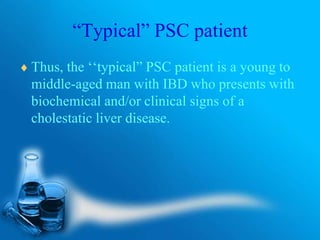
“Typical” PSC patient
 Thus, the ‘‘typical” PSC patient is a young to
middle-aged man with IBD who presents with
biochemical and/or clinical signs of a
cholestatic liver disease.
Screening
 Any patient with a repeatedly abnormal
cholestatic pattern of liver chemistries should
be evaluated.
 Likewise, patients with IBD and abnormal
liver chemistries should be evaluated for PSC
though only 2.4–7.5% will have or develop
PSC.
Associated Conditions
 PSC is frequently associated with
inflammatory bowel disease (80% with
ulcerative colitis). The clinical course of these
conditions is not correlated.
 HLA-A1, B8, & DR3
 Type 1 DM (10 %)
 Thyroid disorders (8%)
 Others: psoriasis, rheumatoid, SLE,
sarcoidosis, celiac disease.
Classification
 Small duct disease is defined as typical
histologic features of PSC with a normal
cholangiogram.
 In large duct PSC, characteristic strictures of
the biliary tree can be detected by
cholangiography.
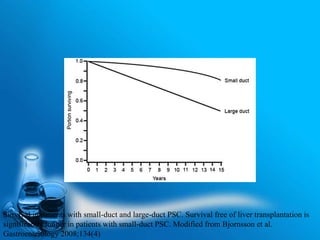
Survival in patients with small-duct and large-duct PSC. Survival free of liver transplantation is
significantly longer in patients with small-duct PSC. Modified from Bjornsson et al.
Gastroenterology 2008;134(4)
Presentation
 The physical examination fndings of PSC are
non-specifc: fatigue, abdominal pain, pruriuts.
 Most patients with PSC present with abnormal
liver chemistries in a cholestatic pattern.
 Rarely patients will be diagnosed with PSC
after a bout of cholangitis or after presenting
with ESLD or cholangiocarcinoma.
Disease severity classifcation
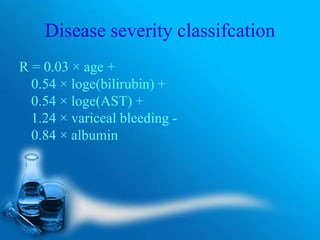
 The Mayo Model can be used to help predict
the probability of survival based on several
parameters including bilirubin, AST, albumin,
history of variceal bleeding and age of the
patient
(www.mayoclinic.org/girst/mayomodel3.html).
Disease severity classifcation
R = 0.03 × age +
0.54 × loge(bilirubin) +
0.54 × loge(AST) +
1.24 × variceal bleeding -
0.84 × albumin
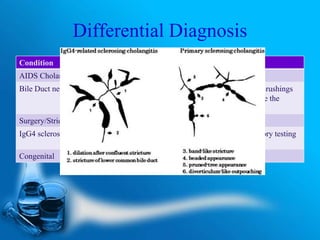
Differential Diagnosis
Condition Comment
AIDS Cholangiopathy Hx of HIV positive, risk factors
Bile Duct neoplasm Can be diffcult to distinguish. Brushings
and biopsy of the bile duct make the
diagnosis
Surgery/Stricture History of prior biliary surgery
IgG4 sclerosing cholangitis Distinguished based on laboratory testing
and history of pancreatitis
Congenital Early presentation
Work Up – Laboratory
 Elevated AP and GGT predominate.
 Serum aminotransferase levels are typically
less than 200 IU/L
 Bilirubin may be elevated.
 Albumin is typically normal except in those
with active IBD.
•
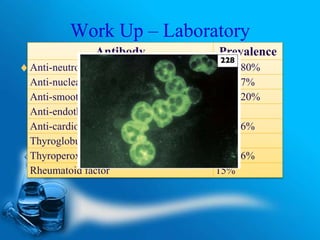
Work Up – Laboratory
 ANA & ASMA is positive in up to 50% of
cases in AIH-PSC overlap, and perinuclear
antineutrophil cytoplasmic antibody (p-
ANCA) is positive in 80% of cases.
Antibody Prevalence
Anti-neutrophil cytoplasmic antibody 50%–80%
Anti-nuclear antibody 7%–77%
Anti-smooth muscle antibody 13%–20%
Anti-endothelial cell antibody 35%
Anti-cardiolipin antibody 4%–66%
Thyroglobulin 4%
Thyroperoxidase 7%–16%
Rheumatoid factor 15%
Work Up – Imaging
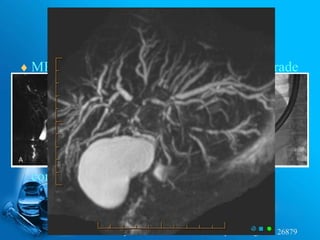
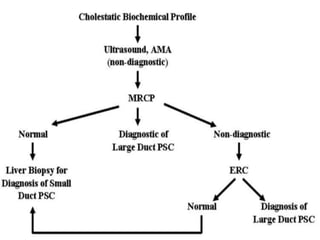
 MRCP is preferred over endoscopic retrograde
cholangiopancreatography (ERCP) to establish
a diagnosis of PSC.
 Liver ultrasound may be useful in establishing
the diagnosis if ductal dilation is present.
 Annual abdominal ultrasonography should be
considered for gallbladder abnormalities
Case courtesy of Dr Chris O'Donnell, Radiopaedia.org, rID: 26879
Work Up – Procedure
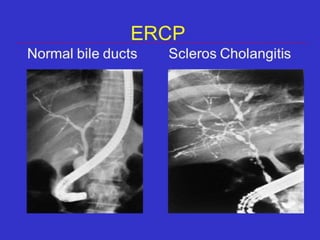
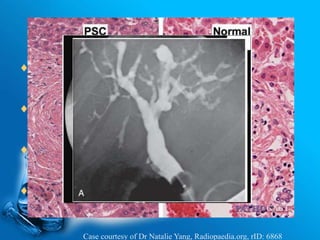
 ERCP: characteristic beading, stricture.
 Liver biopsy: onion skininng appearance.
 Cytological brushing: FISH
 Total Colonoscopy.
Case courtesy of Dr Natalie Yang, Radiopaedia.org, rID: 6868
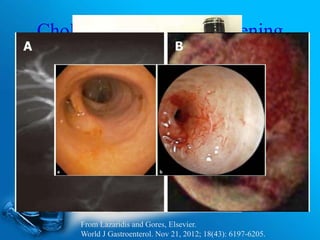
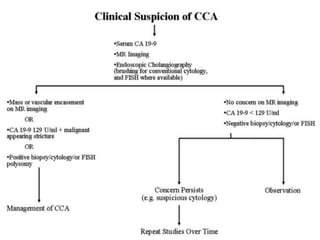
Cholangiocarcinoma Screening
 FISH: Flouresence in situ hybridization.
Brush cytology using EUS-FNA.
Cholangioscopy.
From Lazaridis and Gores, Elsevier.
World J Gastroenterol. Nov 21, 2012; 18(43): 6197-6205.
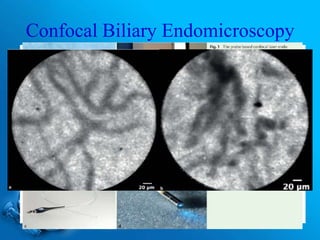
Confocal Biliary Endomicroscopy
Management
 UDCA (20 to 30 mg/kg/day) may be beneficial in improving
liver biochemistries; no sufficient data yet. (ACG, 2015:
Ursodeoxycholic acid (UDCA) in doses >28 mg/kg/day should
not be used for the management of patients with PSC.)
 Corticosteroids and other immunosuppressants are not
indicated for treatment of PSC in adults unless there is
evidence of an overlap syndrome or IgG4 associated PSC.
 Episodes of cholangitis should be managed with IV antibiotics
and endoscopic therapy: ciprofloxacin (oral vancomycin??).
Management
 Pruritis can be managed by cholestyramine 4g/day with other
options e.g. rifampicin 150 – 300 mg/day.
 In patients with hepatic osteopenia, use of calcium 1.0-1.5 g
and vitamin D 1,000 IU daily for therapy.
 In patients with hepatic osteoporosis, use of bisphosphonate
therapy in addition to calcium and vitamin D supplementation.
 In patients with osteoporosis and esophageal varices, use of
parenteral forms of bisphosphonate therapy rather than oral
formulations.
Other Therapies
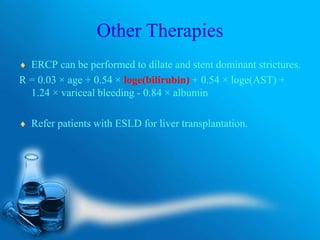
 ERCP can be performed to dilate and stent dominant strictures.
R = 0.03 × age + 0.54 × loge(bilirubin) + 0.54 × loge(AST) +
1.24 × variceal bleeding - 0.84 × albumin
 Refer patients with ESLD for liver transplantation.
When to hospitalize
 Evidence or suspicion of bacterial cholangitis.
 Life-threatening complications of portal hypertension or
cirrhosis.
Final Bottom Line
 PSC is a cholestatic liver disease characterized by
inflammation and fbrosis of the biliary system that
can result in the formation of multifocal biliary
strictures.
 Though the etiology of the disease remains elusive,
evidence suggests the role of genetic and
immunologic factors.
Final Bottom Line
 Disease progression varies from patient to patient; the
disease can result in complications of ESLD, portal
hypertension, cholangitis and/or the development of
cholangiocarcinoma.
 While the majority of patients with PSC have or
develop IBD (70–90%; mainly ulcerative colitis), a
minority of patients with IBD have or will develop
PSC (2.4–7.5%).
Final Bottom Line
 No specifc therapy is of proven beneft and treatment
is supportive.
 Liver transplantation is a viable option and should be
considered early for those that have complications of
their disease.
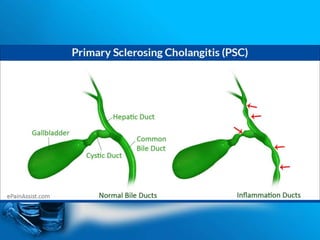
Primary Sclerosing Cholangitis (PSC)

Primary Sclerosing Cholangitis (PSC)

  • 1.
    Primary Sclerosing Cholangitis UsamaRagab Youssif Assistant Lecturer of Medicine Moday, 2-4-2018
  • 4.
    Definition  Chronic progressivefibro-obliterative bile duct inflammation that can involve any part of the biliary tree.
  • 5.
    Epidemiology  The incidenceof the disease ranges from 0.5 to 1.25 cases/100 000.  The prevalence of the disease ranges between six and 20 cases/100 000.  Men are more likely to be affected (70%).  Prevalence of PSC may be increased in first degree relatives of PSC patients.
  • 6.
    Etiologies  Unknown.  ManyHypothesis.  Genetic element: HLA B8.  Environmental triggers in genetic susceptible individuals.
  • 7.
    Predictive/risk factors Risk FactorFrequency Male sex 70% IBD (pancolitis) 70-90% HLA B8 60-80%
  • 8.
    “Typical” PSC patient Thus, the ‘‘typical” PSC patient is a young to middle-aged man with IBD who presents with biochemical and/or clinical signs of a cholestatic liver disease.
  • 9.
    Screening  Any patientwith a repeatedly abnormal cholestatic pattern of liver chemistries should be evaluated.  Likewise, patients with IBD and abnormal liver chemistries should be evaluated for PSC though only 2.4–7.5% will have or develop PSC.
  • 10.
    Associated Conditions  PSCis frequently associated with inflammatory bowel disease (80% with ulcerative colitis). The clinical course of these conditions is not correlated.  HLA-A1, B8, & DR3  Type 1 DM (10 %)  Thyroid disorders (8%)  Others: psoriasis, rheumatoid, SLE, sarcoidosis, celiac disease.
  • 11.
    Classification  Small ductdisease is defined as typical histologic features of PSC with a normal cholangiogram.  In large duct PSC, characteristic strictures of the biliary tree can be detected by cholangiography.
  • 12.
    Survival in patientswith small-duct and large-duct PSC. Survival free of liver transplantation is significantly longer in patients with small-duct PSC. Modified from Bjornsson et al. Gastroenterology 2008;134(4)
  • 13.
    Presentation  The physicalexamination fndings of PSC are non-specifc: fatigue, abdominal pain, pruriuts.  Most patients with PSC present with abnormal liver chemistries in a cholestatic pattern.  Rarely patients will be diagnosed with PSC after a bout of cholangitis or after presenting with ESLD or cholangiocarcinoma.
  • 14.
    Disease severity classifcation The Mayo Model can be used to help predict the probability of survival based on several parameters including bilirubin, AST, albumin, history of variceal bleeding and age of the patient (www.mayoclinic.org/girst/mayomodel3.html).
  • 15.
    Disease severity classifcation R= 0.03 × age + 0.54 × loge(bilirubin) + 0.54 × loge(AST) + 1.24 × variceal bleeding - 0.84 × albumin
  • 16.
    Differential Diagnosis Condition Comment AIDSCholangiopathy Hx of HIV positive, risk factors Bile Duct neoplasm Can be diffcult to distinguish. Brushings and biopsy of the bile duct make the diagnosis Surgery/Stricture History of prior biliary surgery IgG4 sclerosing cholangitis Distinguished based on laboratory testing and history of pancreatitis Congenital Early presentation
  • 17.
    Work Up –Laboratory  Elevated AP and GGT predominate.  Serum aminotransferase levels are typically less than 200 IU/L  Bilirubin may be elevated.  Albumin is typically normal except in those with active IBD. •
  • 18.
    Work Up –Laboratory  ANA & ASMA is positive in up to 50% of cases in AIH-PSC overlap, and perinuclear antineutrophil cytoplasmic antibody (p- ANCA) is positive in 80% of cases. Antibody Prevalence Anti-neutrophil cytoplasmic antibody 50%–80% Anti-nuclear antibody 7%–77% Anti-smooth muscle antibody 13%–20% Anti-endothelial cell antibody 35% Anti-cardiolipin antibody 4%–66% Thyroglobulin 4% Thyroperoxidase 7%–16% Rheumatoid factor 15%
  • 19.
    Work Up –Imaging  MRCP is preferred over endoscopic retrograde cholangiopancreatography (ERCP) to establish a diagnosis of PSC.  Liver ultrasound may be useful in establishing the diagnosis if ductal dilation is present.  Annual abdominal ultrasonography should be considered for gallbladder abnormalities Case courtesy of Dr Chris O'Donnell, Radiopaedia.org, rID: 26879
  • 20.
    Work Up –Procedure  ERCP: characteristic beading, stricture.  Liver biopsy: onion skininng appearance.  Cytological brushing: FISH  Total Colonoscopy. Case courtesy of Dr Natalie Yang, Radiopaedia.org, rID: 6868
  • 22.
    Cholangiocarcinoma Screening  FISH:Flouresence in situ hybridization. Brush cytology using EUS-FNA. Cholangioscopy. From Lazaridis and Gores, Elsevier. World J Gastroenterol. Nov 21, 2012; 18(43): 6197-6205.
  • 23.
  • 25.
    Management  UDCA (20to 30 mg/kg/day) may be beneficial in improving liver biochemistries; no sufficient data yet. (ACG, 2015: Ursodeoxycholic acid (UDCA) in doses >28 mg/kg/day should not be used for the management of patients with PSC.)  Corticosteroids and other immunosuppressants are not indicated for treatment of PSC in adults unless there is evidence of an overlap syndrome or IgG4 associated PSC.  Episodes of cholangitis should be managed with IV antibiotics and endoscopic therapy: ciprofloxacin (oral vancomycin??).
  • 26.
    Management  Pruritis canbe managed by cholestyramine 4g/day with other options e.g. rifampicin 150 – 300 mg/day.  In patients with hepatic osteopenia, use of calcium 1.0-1.5 g and vitamin D 1,000 IU daily for therapy.  In patients with hepatic osteoporosis, use of bisphosphonate therapy in addition to calcium and vitamin D supplementation.  In patients with osteoporosis and esophageal varices, use of parenteral forms of bisphosphonate therapy rather than oral formulations.
  • 27.
    Other Therapies  ERCPcan be performed to dilate and stent dominant strictures. R = 0.03 × age + 0.54 × loge(bilirubin) + 0.54 × loge(AST) + 1.24 × variceal bleeding - 0.84 × albumin  Refer patients with ESLD for liver transplantation.
  • 28.
    When to hospitalize Evidence or suspicion of bacterial cholangitis.  Life-threatening complications of portal hypertension or cirrhosis.
  • 29.
    Final Bottom Line PSC is a cholestatic liver disease characterized by inflammation and fbrosis of the biliary system that can result in the formation of multifocal biliary strictures.  Though the etiology of the disease remains elusive, evidence suggests the role of genetic and immunologic factors.
  • 30.
    Final Bottom Line Disease progression varies from patient to patient; the disease can result in complications of ESLD, portal hypertension, cholangitis and/or the development of cholangiocarcinoma.  While the majority of patients with PSC have or develop IBD (70–90%; mainly ulcerative colitis), a minority of patients with IBD have or will develop PSC (2.4–7.5%).
  • 31.
    Final Bottom Line No specifc therapy is of proven beneft and treatment is supportive.  Liver transplantation is a viable option and should be considered early for those that have complications of their disease.

Editor's Notes

  • #7 Abberant lymphocyte homing. Activation of immune reponse to bacterial pathogen. Toxic bile.
  • #12 Approximately 75% of patients have involvement with both small and large ducts; 15% have only small duct and 10% have only large duct disease. Patients with small duct disease have a more favorable prognosis.
  • #13 Patients with small duct disease have a more favorable prognosis.
  • #14 Patient can present only with vague symptoms of fatigue, abdominal pain and pruritus.
  • #16 Take care of bilirubin.
  • #17 A proportion of individuals will present with features consistent with PSC and extensive biliary changes; however, they will suffer from a closely related condition termed IgG4 related disease which is a distinct entity characterised by dense lymphoplasmacytic infiltrates that are rich in IgG positive plasma cells. Those patients suffer also for autoimmune pancreatitis. IgG4 related disease can affect nearly all organs. IgG4 sclerosing cholangitis, unlike PSC, may respond to steroid therapy. Therefore this condition needs to be differentiated from PSC.
  • #21 Cholangiographic features in primary sclerosing cholangitis. Multifocal strictures with intervening saccular dilation (“beads-on-astring” appearance) of both intrahepatic and extraheaptic bile ducts are shown. Liver biopsy is the only way to diagnose small duct PSC
  • #23 FISH of normal (A) and maligant (B) bile duct cells. Normal cells display duplicate color for each chromosomal probe while malignant cells reveal multiple gains of chromosomes (i.e., polysomy).
  • #24 a Normal bile duct epithelium (reticular network with thin dark branching band<20 μm). b Malignant cholangiocarcinoma (reticular structure with thick dark band).
  • #25 The diagnosis of cholangiocarcinoma can be very diffcult. Its early diagnosis is essential for any chance of successful therapy. Most cases of cholangiocarcinoma are diagnosed within 10 years of the diagnosis of PSC. Patients with PSC and IBD have an increased risk of colorectal carcinoma.
  • #28 Successful endoscopic or radiologically guided balloon dilatation or placement of a stent across a dominant stricture may lead to symptomatic and biochemical improvement in some. Studies have not shown whether this translates to improvement in survival. Those with jaundice or recurrent bouts of cholangitis may also be candidates for such therapy.