


 It is the techniques of preparing different types
of bed in making a patients/clients comfortable
or his/her position suitable for a particular
condition.
 To provide the client with a safe & comfortable
bed to take rest & sleep.
 To keep the ward neat and tidy.
 To adapt to the needs of the client and to be
ready for any emergency or critical condition of
illness.
 To economize time, material & effort.
 To prevent bedsores.
 To observe the client.
 For patients comfort.
 To prevent cross infection.
 For treatment of certain conditions.
 Important to limit movement of organisms and
spread of infection while in bed
 Roll the dirty or soiled linen while removing it
from bed
 Hold dirty linen away from your body
 Place dirty linen in hamper/cart/bag
immediately
 Never place linen on the floor
 Wash your hands after handling dirty linen
 Never bring extra linen into a patients room
 Linen is considered contaminated once it is in
a room and cannot be used for another
person
 Avoid shaking clean sheets to place them on
the bed
 Unfold them gently to inhibit the flow of
microorganisms
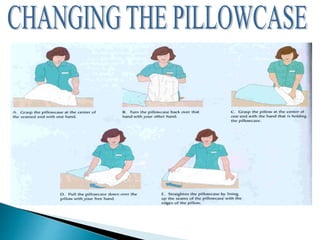
 Place the open end of pillowcase away from
the door
 This looks neater and also helps prevents the
entrance of organisms from the hall
 Observe universal precautions if linen is
contaminated by blood or body fluids
 Wash hands frequently and wear gloves while
handling linen
 Follow agency policy for proper disposal of
linen
 Essential to use correct body mechanics while
bed making
 Also important to conserve time and energy
 Keep linen arranged in order of use
 Make bed completely on one side before doing
other side to limit unnecessary movement from
one side of bed to the opposite side
 Made following discharge of patient
 Purpose is to keep bed clean until new patient
admitted
 Fanfold top sheets to foot of bed to convert
closed bed to open bed
 Fanfold means to fold sheets like accordian
pleats
 Done to welcome a new patient or for patients
who are ambulatory or out-of-bed
 Bed is made while patient is in it
 Usually done after the morning bath
 Cradle placed on bed under the top sheet
 Prevents top sheets from touching parts of the
patients body
 Used for burns, skin ulcers, lesions, blood clots,
fractures, or surgery
 Some cradles have light bulbs to provide heat
for special treatments
 Mattresses used for the client should be firm,
thick, and smooth.
 It gives support to the clients.
 All should have a washable cover.
 The size is 190 cm width.
 Pillows are usually made out of strong cotton or
dunlop.
 Size 60 cm long, 45 cm wide & 10 cm thick.
 It should be bigger than the size of the pillow for
the easy insertion lest they destroy the shape of
the pillow.
 The average size is 65 cm long & 50 cm wide.
 The bed sheets are made of strong cotton
material.
 They are used to protect the mattress from
soiling and to cover the client.
 They should be sufficiently long & wide to tuck
in well at the head, foot & sides.
 Size 108 inches long & 76 inches wide.
 Purpose is to hold linen firmly in place on beds,
stretchers, and exam tables
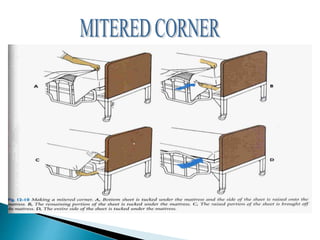
 A mitered corner is a special folding technique
that secures the linen under the mattress
 They are drawn from side to side & usually
extends from the client’s shoulders to below
knees.
 Draw mackintosh is a waterproof sheeting, made
up of either rubber or plastic material.
 It is used to protect the mattress & the bottom
sheet from soiling.
 It is used to cover the mackintosh.
 Extends from patient’s shoulders to the knees.
 The average size will be 150 cm long & 110 cm wide.
 Used to protect the mattress
 If soiled, it can be changed without changing the
bottom sheet
 Disposable bed protectors, also called underpads,
are used in some areas instead of draw sheets
 It is used to give a neat appearance to the bed.
 It protects the blankets & the bed as a whole
from dust.
 Size 3 m long & 3 m wide.
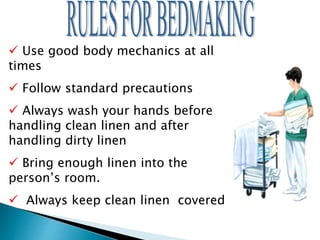
 Use good body mechanics at all
times
 Follow standard precautions
 Always wash your hands before
handling clean linen and after
handling dirty linen
 Bring enough linen into the
person’s room.
 Always keep clean linen covered
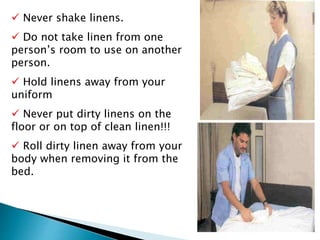
 Never shake linens.
 Do not take linen from one
person’s room to use on another
person.
 Hold linens away from your
uniform
 Never put dirty linens on the
floor or on top of clean linen!!!
 Roll dirty linen away from your
body when removing it from the
bed.
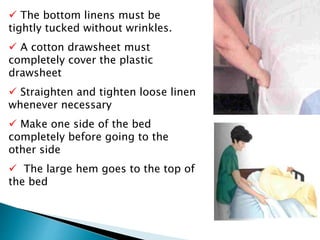
 The bottom linens must be
tightly tucked without wrinkles.
 A cotton drawsheet must
completely cover the plastic
drawsheet
 Straighten and tighten loose linen
whenever necessary
 Make one side of the bed
completely before going to the
other side
 The large hem goes to the top of
the bed
 Wash hand before & after the procedure.
 Don’t expose the client unnecessarily.
 Protect the client from draught.
 Don’t cover the client’s face while placing the
linen.
 Don’t mix clean linen with soiled linen.
 Do not let the linen touch your body or uniform
 Keep a reasonable distance from the face of the
client to prevent cross infection.
 All equipments should be collected before
starting.
 Bed should be made in such a way that
patient can be put in it without difficulty.
 The bed should be free from crumbs and
creases and should give a maximum comfort
to the patient.
 Pillows and other bed accessories should be
well arranged to give support where
necessary.
 The patient's face should never be covered by
sheets or blankets.
 Extra assistance should be available and, if
necessary, one should be called upon to help
lift the patient.
 When pillows are being shaken the nurse
should turn away from the patient.
 The open side of a pillow case should be
away from the main door of the ward.
 Always have a dirty linen bin at hand in which to
put dirty linen.
 Dirty linen should not be carried across the ward
to prevent cross infection.
 Allow room for the patient feet for free
movement or turning when placing the top
sheet over the patient.
 Any conversation during bed making should not
be on personal matters between the nurses.
 Always wash hands before and after bed
making.
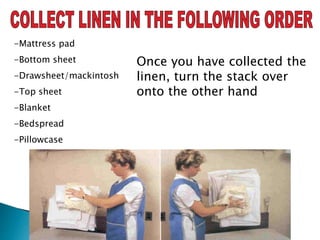
-Mattress pad
-Bottom sheet
-Drawsheet/mackintosh
-Top sheet
-Blanket
-Bedspread
-Pillowcase
Once you have collected the
linen, turn the stack over
onto the other hand
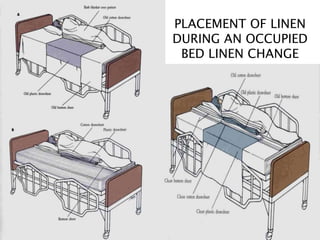
PLACEMENT OF LINEN
DURING AN OCCUPIED
BED LINEN CHANGE
 Raise the bed to a comfortable working height
 Wash your hands before and after every patient contact
 Gather all the equipment needed
 Roll the soiled linen away from your body
 Place the soiled linen in the linen bag or linen hamper.
Never on the floor!!!!
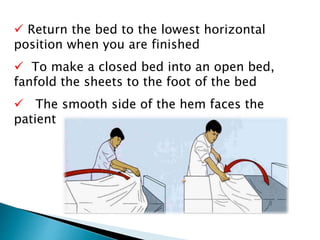
 Return the bed to the lowest horizontal
position when you are finished
 To make a closed bed into an open bed,
fanfold the sheets to the foot of the bed
 The smooth side of the hem faces the
patient
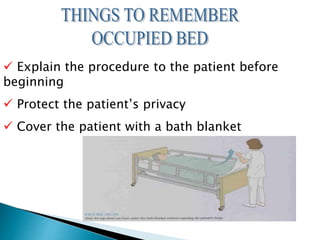
 Explain the procedure to the patient before
beginning
 Protect the patient’s privacy
 Cover the patient with a bath blanket
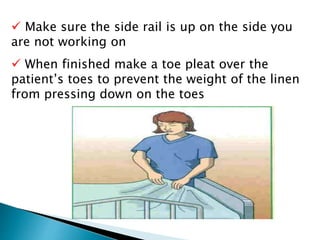
 Make sure the side rail is up on the side you
are not working on
 When finished make a toe pleat over the
patient’s toes to prevent the weight of the linen
from pressing down on the toes

Bed making

  • 2.
     It isthe techniques of preparing different types of bed in making a patients/clients comfortable or his/her position suitable for a particular condition.
  • 3.
     To providethe client with a safe & comfortable bed to take rest & sleep.  To keep the ward neat and tidy.  To adapt to the needs of the client and to be ready for any emergency or critical condition of illness.  To economize time, material & effort.
  • 4.
     To preventbedsores.  To observe the client.  For patients comfort.  To prevent cross infection.  For treatment of certain conditions.
  • 5.
     Important tolimit movement of organisms and spread of infection while in bed  Roll the dirty or soiled linen while removing it from bed  Hold dirty linen away from your body
  • 6.
     Place dirtylinen in hamper/cart/bag immediately  Never place linen on the floor  Wash your hands after handling dirty linen  Never bring extra linen into a patients room
  • 7.
     Linen isconsidered contaminated once it is in a room and cannot be used for another person  Avoid shaking clean sheets to place them on the bed  Unfold them gently to inhibit the flow of microorganisms
  • 8.
     Place theopen end of pillowcase away from the door  This looks neater and also helps prevents the entrance of organisms from the hall
  • 9.
     Observe universalprecautions if linen is contaminated by blood or body fluids  Wash hands frequently and wear gloves while handling linen  Follow agency policy for proper disposal of linen
  • 10.
     Essential touse correct body mechanics while bed making  Also important to conserve time and energy  Keep linen arranged in order of use  Make bed completely on one side before doing other side to limit unnecessary movement from one side of bed to the opposite side
  • 13.
     Made followingdischarge of patient  Purpose is to keep bed clean until new patient admitted
  • 14.
     Fanfold topsheets to foot of bed to convert closed bed to open bed  Fanfold means to fold sheets like accordian pleats  Done to welcome a new patient or for patients who are ambulatory or out-of-bed
  • 15.
     Bed ismade while patient is in it  Usually done after the morning bath
  • 16.
     Cradle placedon bed under the top sheet  Prevents top sheets from touching parts of the patients body  Used for burns, skin ulcers, lesions, blood clots, fractures, or surgery  Some cradles have light bulbs to provide heat for special treatments
  • 17.
     Mattresses usedfor the client should be firm, thick, and smooth.  It gives support to the clients.  All should have a washable cover.  The size is 190 cm width.
  • 18.
     Pillows areusually made out of strong cotton or dunlop.  Size 60 cm long, 45 cm wide & 10 cm thick.
  • 19.
     It shouldbe bigger than the size of the pillow for the easy insertion lest they destroy the shape of the pillow.  The average size is 65 cm long & 50 cm wide.
  • 20.
     The bedsheets are made of strong cotton material.  They are used to protect the mattress from soiling and to cover the client.  They should be sufficiently long & wide to tuck in well at the head, foot & sides.  Size 108 inches long & 76 inches wide.
  • 21.
     Purpose isto hold linen firmly in place on beds, stretchers, and exam tables  A mitered corner is a special folding technique that secures the linen under the mattress
  • 22.
     They aredrawn from side to side & usually extends from the client’s shoulders to below knees.  Draw mackintosh is a waterproof sheeting, made up of either rubber or plastic material.  It is used to protect the mattress & the bottom sheet from soiling.
  • 23.
     It isused to cover the mackintosh.  Extends from patient’s shoulders to the knees.  The average size will be 150 cm long & 110 cm wide.  Used to protect the mattress  If soiled, it can be changed without changing the bottom sheet  Disposable bed protectors, also called underpads, are used in some areas instead of draw sheets
  • 25.
     It isused to give a neat appearance to the bed.  It protects the blankets & the bed as a whole from dust.  Size 3 m long & 3 m wide.
  • 26.
     Use goodbody mechanics at all times  Follow standard precautions  Always wash your hands before handling clean linen and after handling dirty linen  Bring enough linen into the person’s room.  Always keep clean linen covered
  • 27.
     Never shakelinens.  Do not take linen from one person’s room to use on another person.  Hold linens away from your uniform  Never put dirty linens on the floor or on top of clean linen!!!  Roll dirty linen away from your body when removing it from the bed.
  • 28.
     The bottomlinens must be tightly tucked without wrinkles.  A cotton drawsheet must completely cover the plastic drawsheet  Straighten and tighten loose linen whenever necessary  Make one side of the bed completely before going to the other side  The large hem goes to the top of the bed
  • 29.
     Wash handbefore & after the procedure.  Don’t expose the client unnecessarily.  Protect the client from draught.  Don’t cover the client’s face while placing the linen.  Don’t mix clean linen with soiled linen.  Do not let the linen touch your body or uniform  Keep a reasonable distance from the face of the client to prevent cross infection.
  • 30.
     All equipmentsshould be collected before starting.  Bed should be made in such a way that patient can be put in it without difficulty.  The bed should be free from crumbs and creases and should give a maximum comfort to the patient.  Pillows and other bed accessories should be well arranged to give support where necessary.
  • 31.
     The patient'sface should never be covered by sheets or blankets.  Extra assistance should be available and, if necessary, one should be called upon to help lift the patient.  When pillows are being shaken the nurse should turn away from the patient.  The open side of a pillow case should be away from the main door of the ward.
  • 32.
     Always havea dirty linen bin at hand in which to put dirty linen.  Dirty linen should not be carried across the ward to prevent cross infection.  Allow room for the patient feet for free movement or turning when placing the top sheet over the patient.  Any conversation during bed making should not be on personal matters between the nurses.  Always wash hands before and after bed making.
  • 33.
    -Mattress pad -Bottom sheet -Drawsheet/mackintosh -Topsheet -Blanket -Bedspread -Pillowcase Once you have collected the linen, turn the stack over onto the other hand
  • 35.
    PLACEMENT OF LINEN DURINGAN OCCUPIED BED LINEN CHANGE
  • 37.
     Raise thebed to a comfortable working height  Wash your hands before and after every patient contact  Gather all the equipment needed  Roll the soiled linen away from your body  Place the soiled linen in the linen bag or linen hamper. Never on the floor!!!!
  • 38.
     Return thebed to the lowest horizontal position when you are finished  To make a closed bed into an open bed, fanfold the sheets to the foot of the bed  The smooth side of the hem faces the patient
  • 39.
     Explain theprocedure to the patient before beginning  Protect the patient’s privacy  Cover the patient with a bath blanket
  • 40.
     Make surethe side rail is up on the side you are not working on  When finished make a toe pleat over the patient’s toes to prevent the weight of the linen from pressing down on the toes