HOSPITAL BEDS
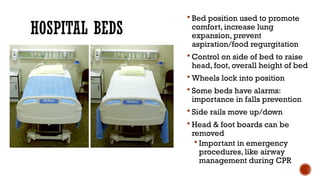
Bedposition used to promote
comfort, increase lung
expansion, prevent
aspiration/food regurgitation
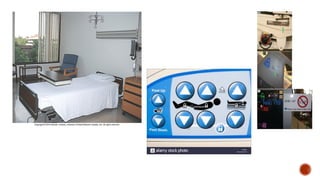
Control on side of bed to raise
head, foot, overall height of bed
Wheels lock into position
Some beds have alarms:
importance in falls prevention
Side rails move up/down
Head & foot boards can be
removed
Important in emergency
procedures, like airway
management during CPR
4.
BEDMAKING
Linen shouldbe clean, dry, wrinkle free
Should be made in a.m. after bath/shower, or when patient up out of bed
Check periodically during shift if dirty, soiled, wet
Follow routine practices for infection prevention
Carry linen away from your uniform
Dispose in dirty linen hamper
Do not put linen on floor
Do not shake dirty linens
Apply principles of good body mechanics, patient safety & privacy
Raise opposite bed rail
Raise bed while working, lower when done
Pull curtain around patient’s area
5.
EQUIPMENT
•Linen bag
•Bottom sheet(flat or fitted)
•Drawsheet (optional)
•Top sheet
•Blanket
•Bedspread
•Waterproof pads or soaker pad (optional)
•Pillowcases
•Bedside chair or table
•Disposable gloves (if linen is soiled)
•Washcloth
•Antiseptic cleanser
6.
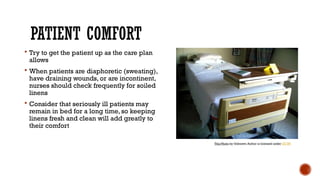
PATIENT COMFORT
Tryto get the patient up as the care plan
allows
When patients are diaphoretic (sweating),
have draining wounds, or are incontinent,
nurses should check frequently for soiled
linens
Consider that seriously ill patients may
remain in bed for a long time, so keeping
linens fresh and clean will add greatly to
their comfort
This Photo by Unknown Author is licensed under CC BY
7.
INFECTION CONTROL
Keepsoiled linens away from your uniform/scrubs
Soiled linens – follow hospital policy for disposal-need a waterproof
bag for very soiled linens with bodily fluids
Do not shake bed linens-microorganisms can travel on air currents
Do not place/throw linen on the floor
If clean linen falls on the floor, do not use – place in hamper
Gloves should be worn if linens are soiled, or if contact with body
secretions is possible
Wipe mattress with antiseptic according to hospital policy
8.
LINENS
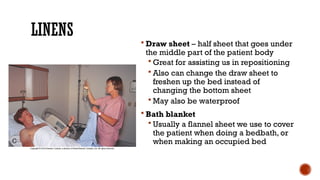
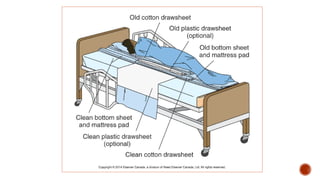
Draw sheet– half sheet that goes under
the middle part of the patient body
Great for assisting us in repositioning
Also can change the draw sheet to
freshen up the bed instead of
changing the bottom sheet
May also be waterproof
Bath blanket
Usually a flannel sheet we use to cover
the patient when doing a bedbath, or
when making an occupied bed
10.
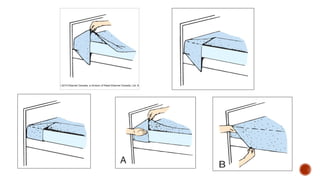
MAKING AN OCCUPIEDBED
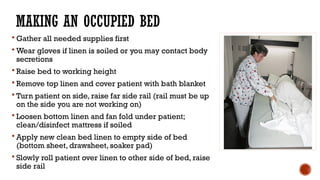
Gather all needed supplies first
Wear gloves if linen is soiled or you may contact body
secretions
Raise bed to working height
Remove top linen and cover patient with bath blanket
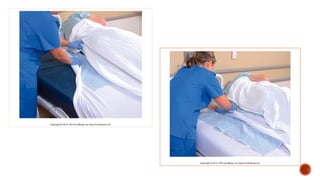
Turn patient on side, raise far side rail (rail must be up
on the side you are not working on)
Loosen bottom linen and fan fold under patient;
clean/disinfect mattress if soiled
Apply new clean bed linen to empty side of bed
(bottom sheet, drawsheet, soaker pad)
Slowly roll patient over linen to other side of bed, raise
side rail
11.
OCCUPIED BED
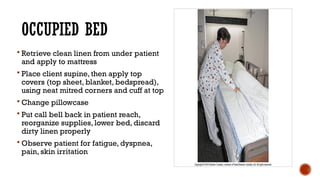
Retrieveclean linen from under patient
and apply to mattress
Place client supine, then apply top
covers (top sheet, blanket, bedspread),
using neat mitred corners and cuff at top
Change pillowcase
Put call bell back in patient reach,
reorganize supplies, lower bed, discard
dirty linen properly
Observe patient for fatigue, dyspnea,
pain, skin irritation
14.
REFERENCES
Astle, B.J. &Duggleby,W. (2024).
Potter & Perry: Canadian
fundamentals of nursing. (7th ed.).
Toronto, ON: Elsevier, (Chapter 39,
Hygiene).
Clinical Skills: Essentials
Collection, 1st
Canadian edition
(2024): Evolve Elsevier.



![CTEV [ clubfoot] DR ARUN LAL ,DR MOHAMED ASHRAF travancore medical college k...](https://cdn.slidesharecdn.com/ss_thumbnails/ctevclubfootdrarunlaldrmohamedashraftravancoremedicalcollegekollamkeralaindia-260208063247-18fc466c-thumbnail.jpg?width=640&height=640&fit=bounds)


