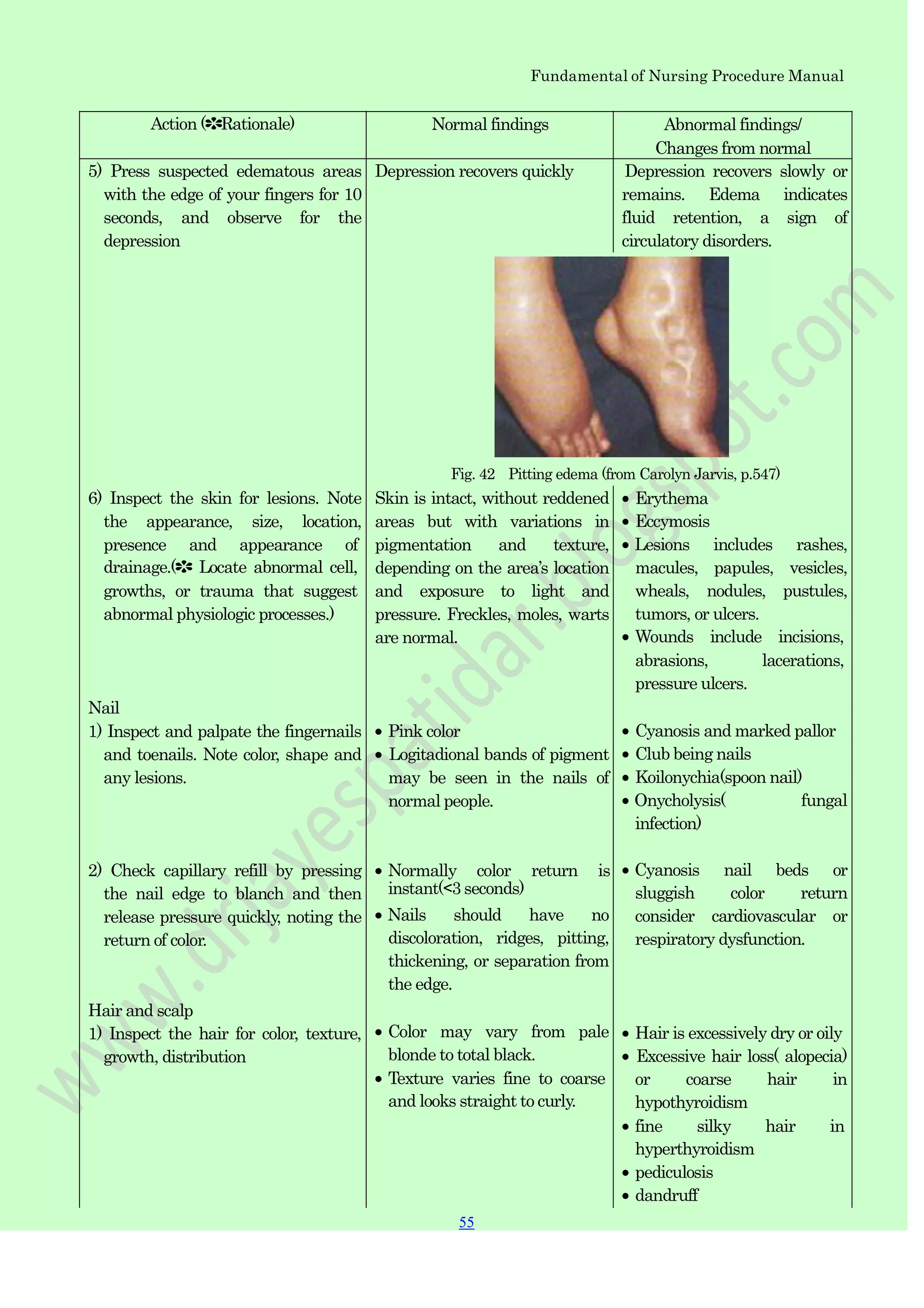
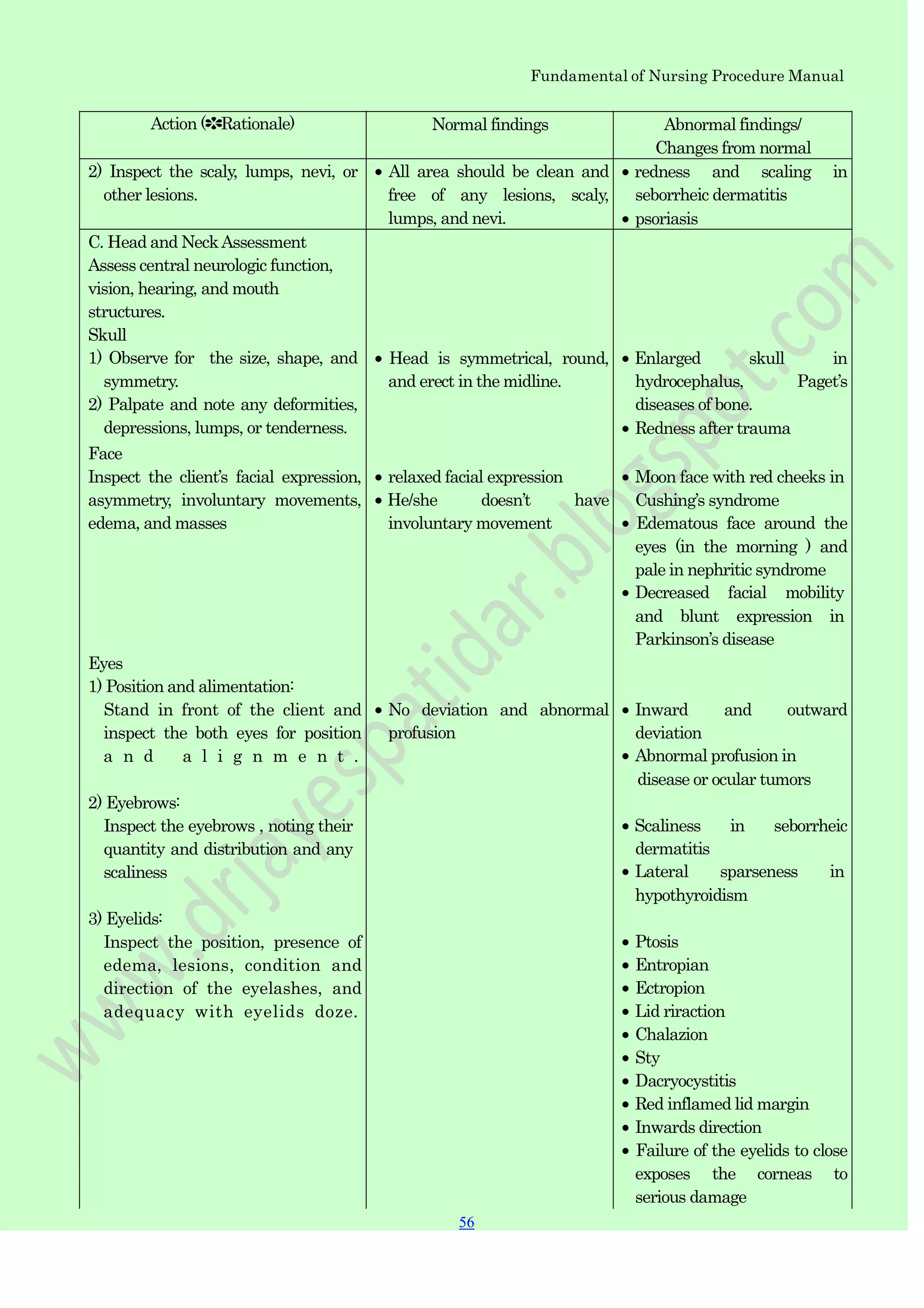
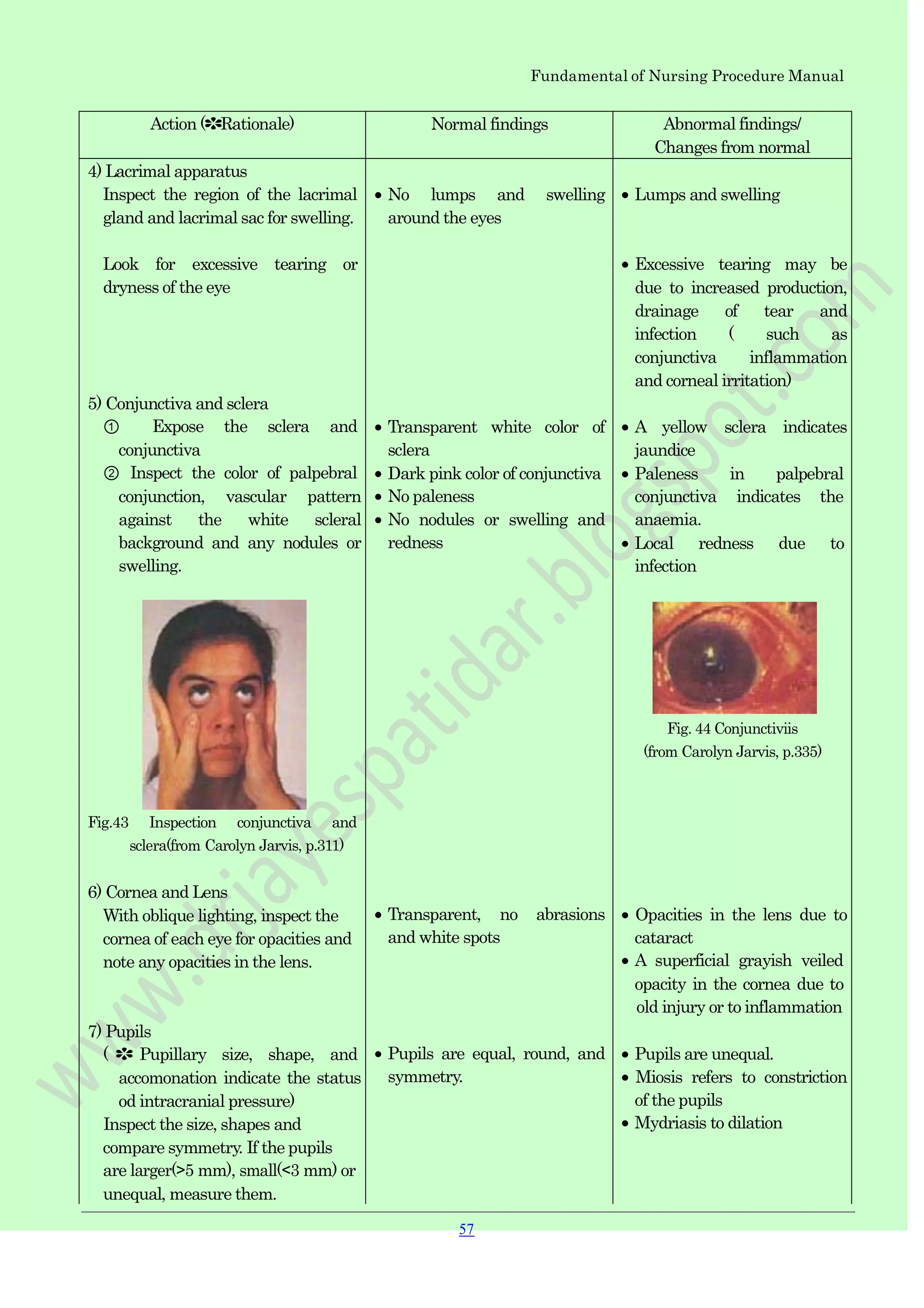
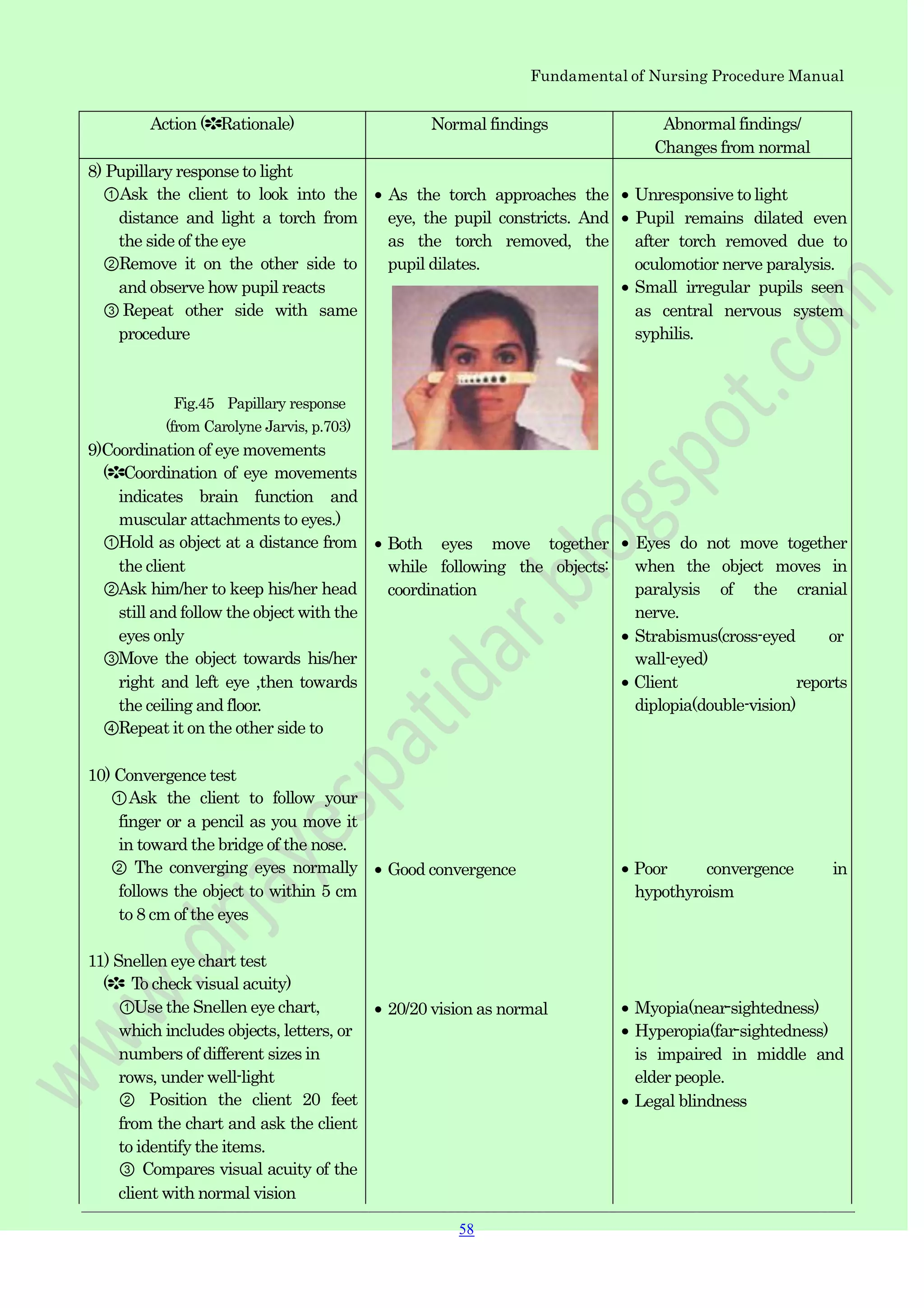
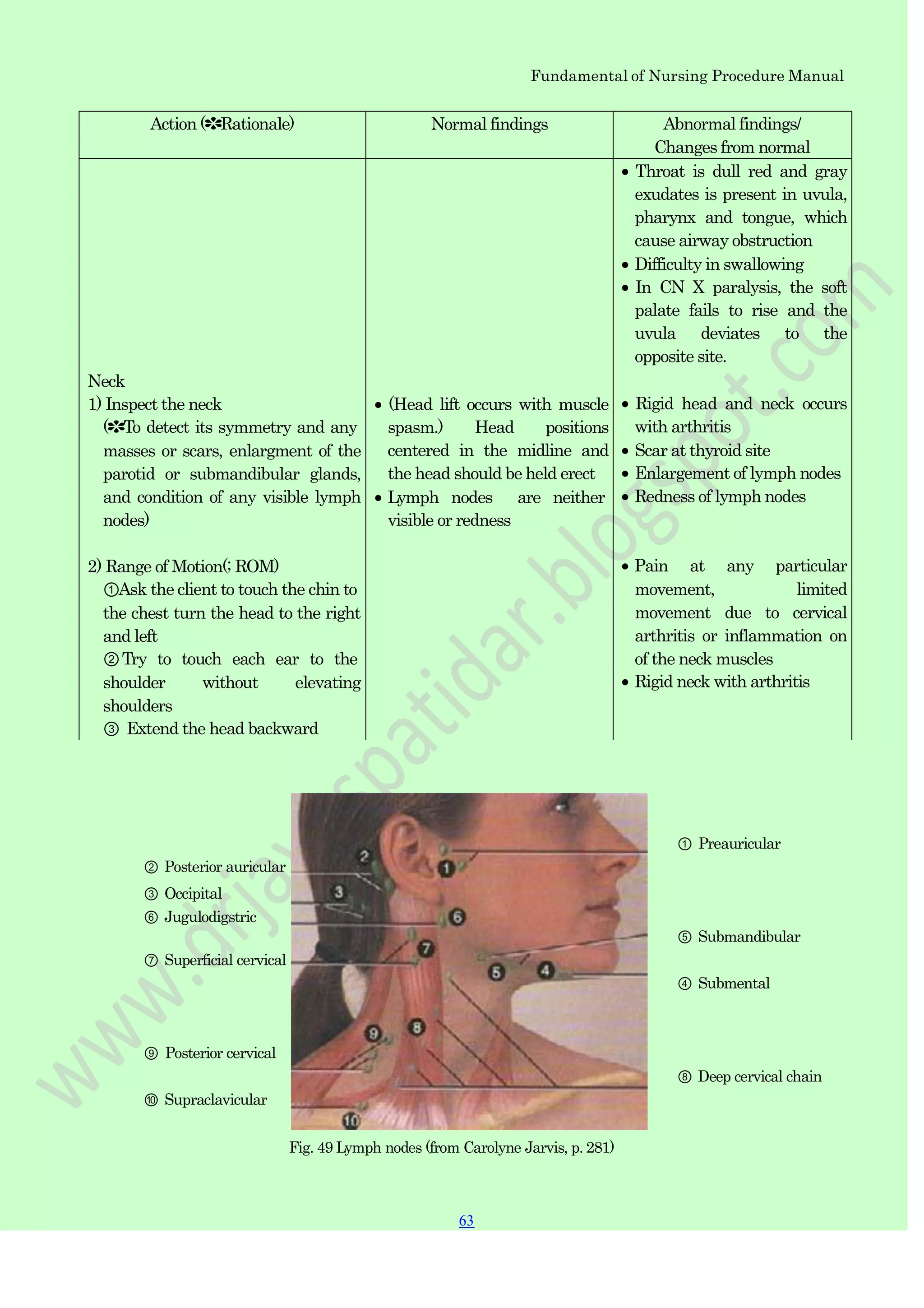
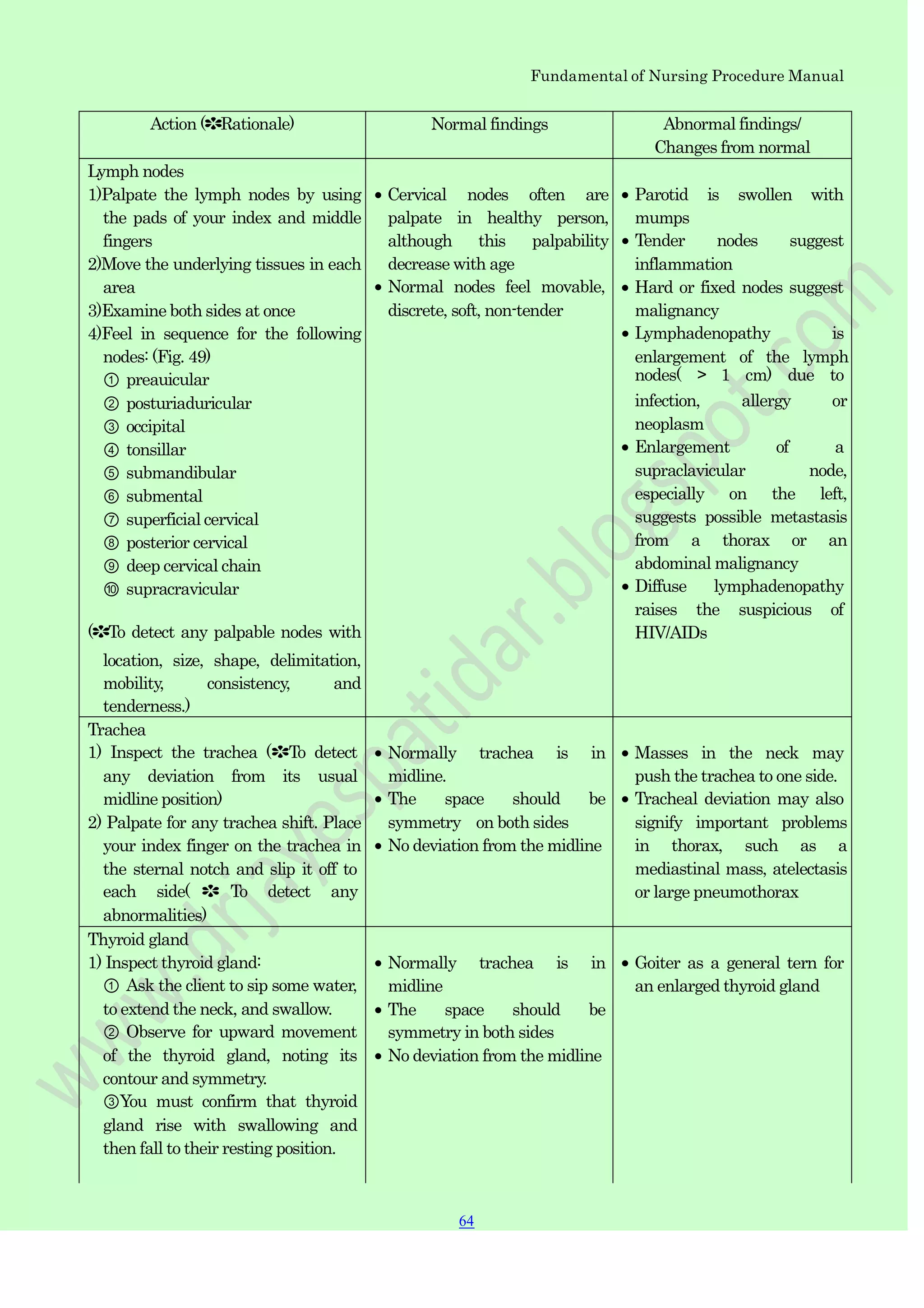
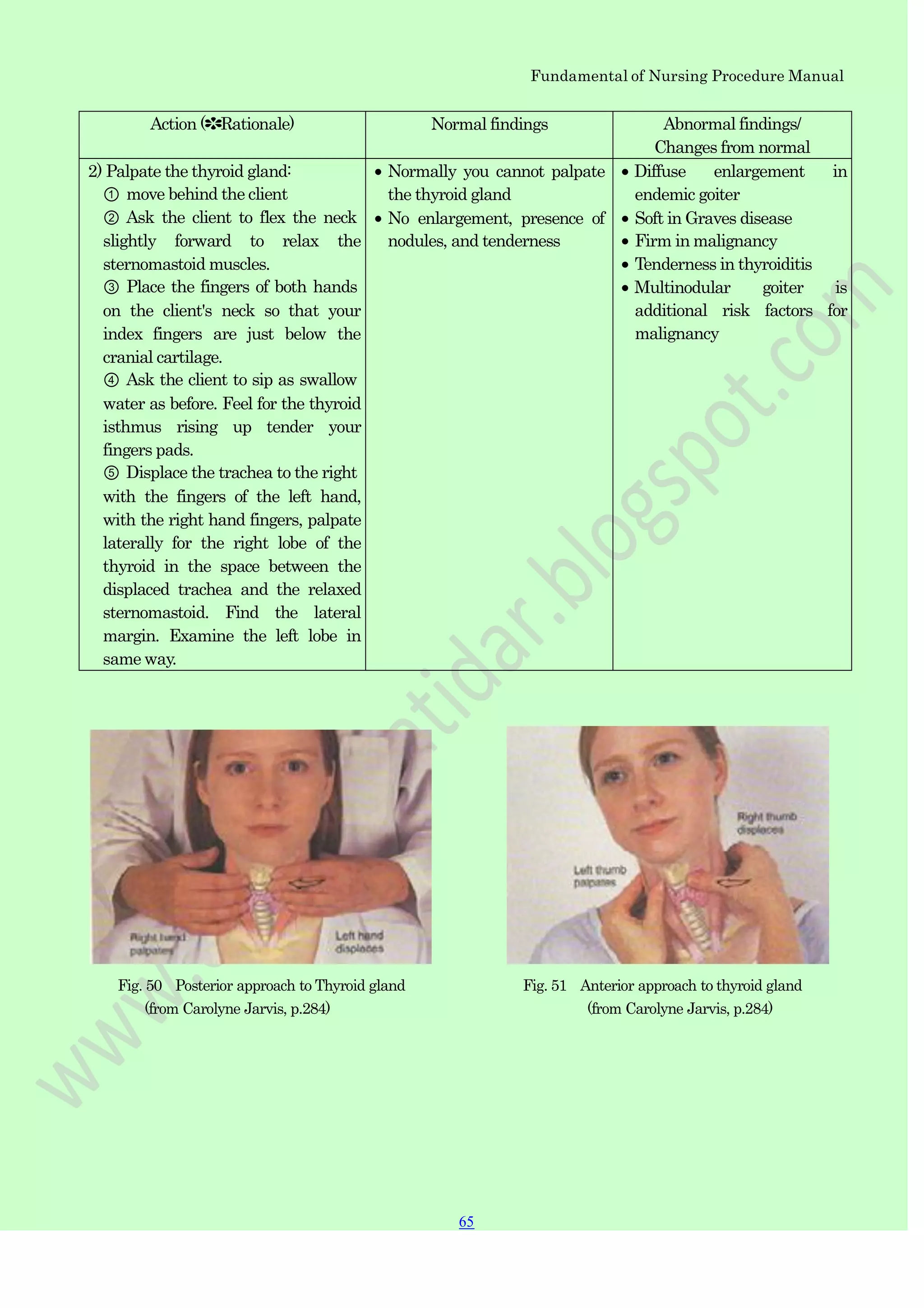
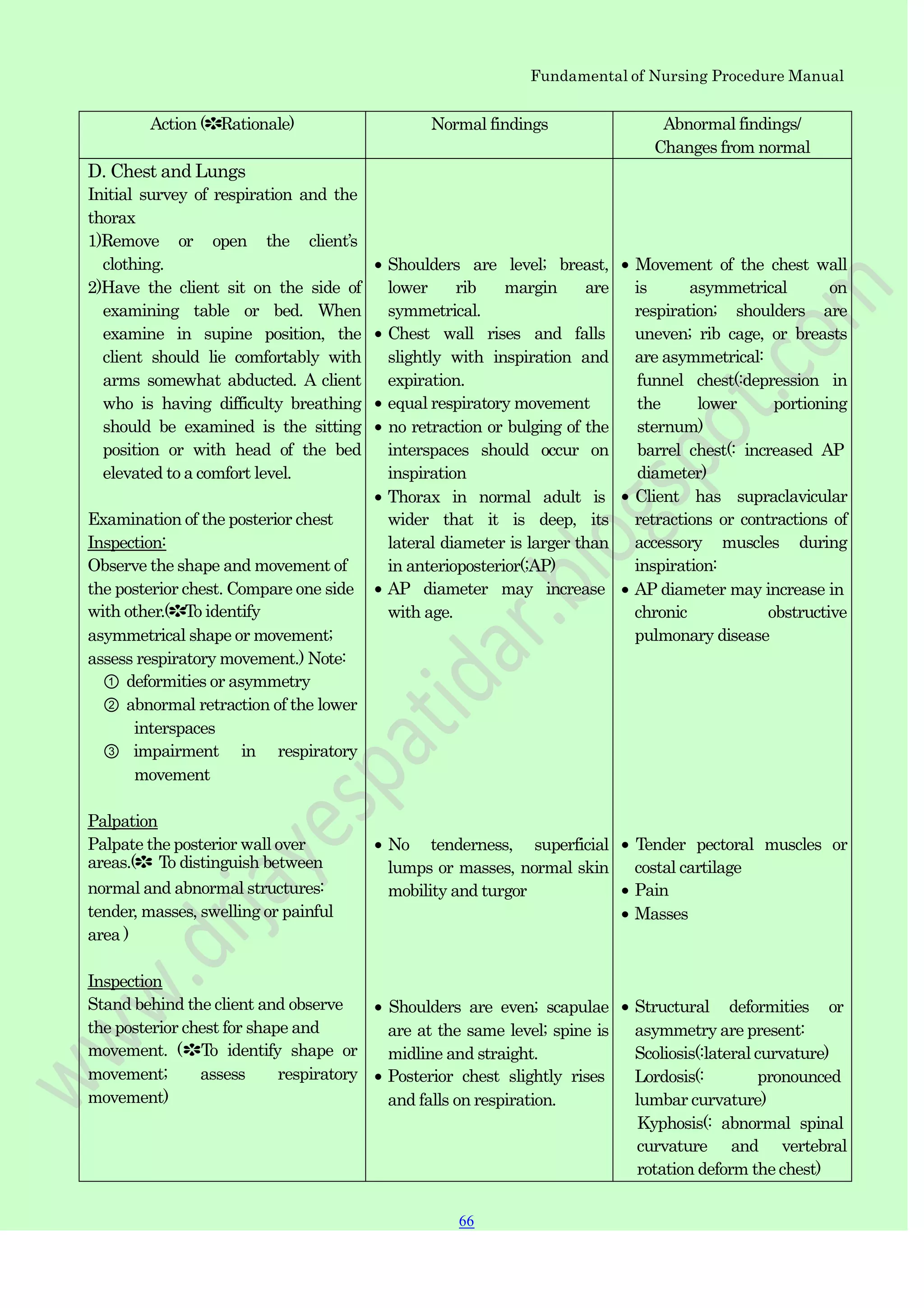
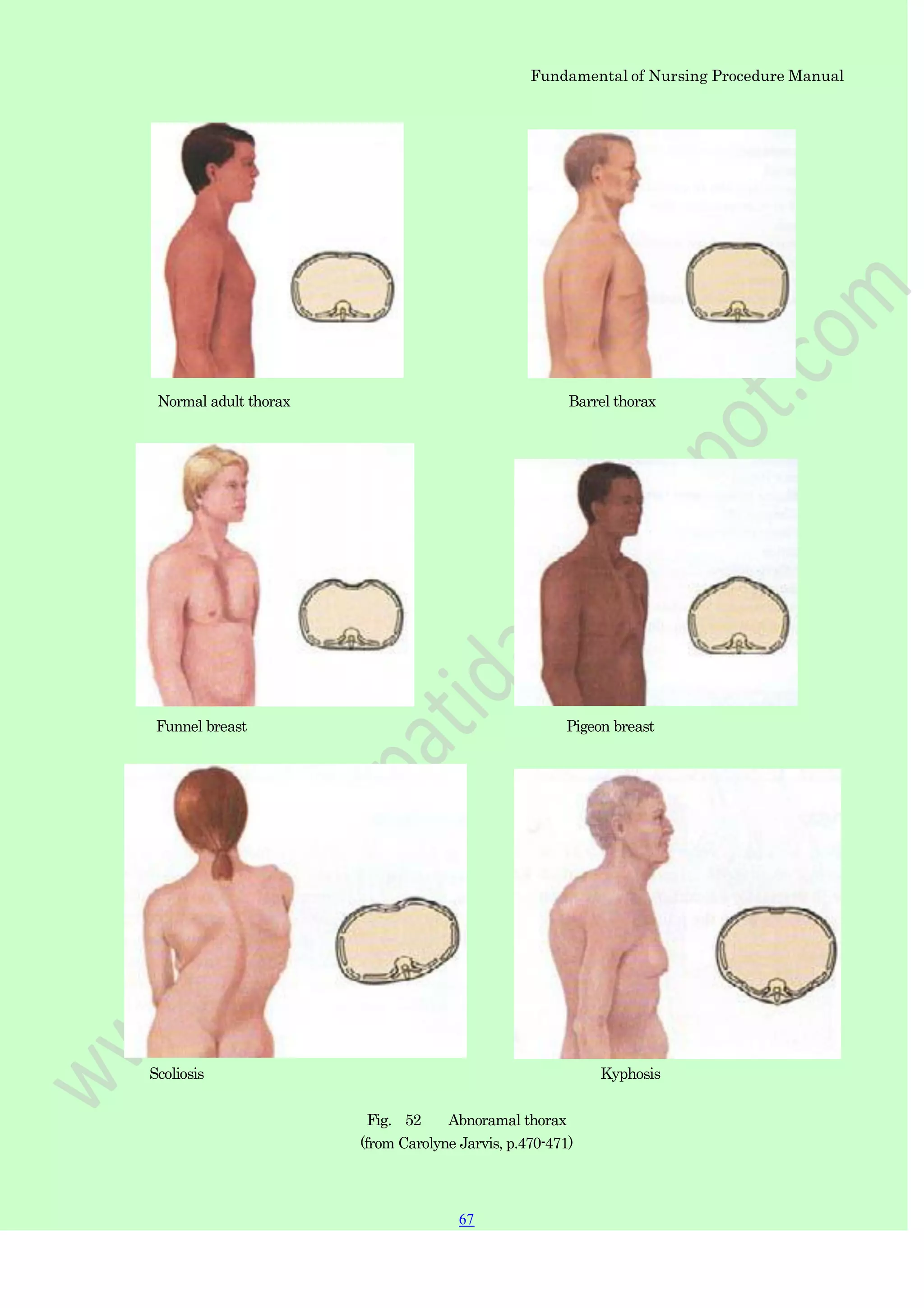
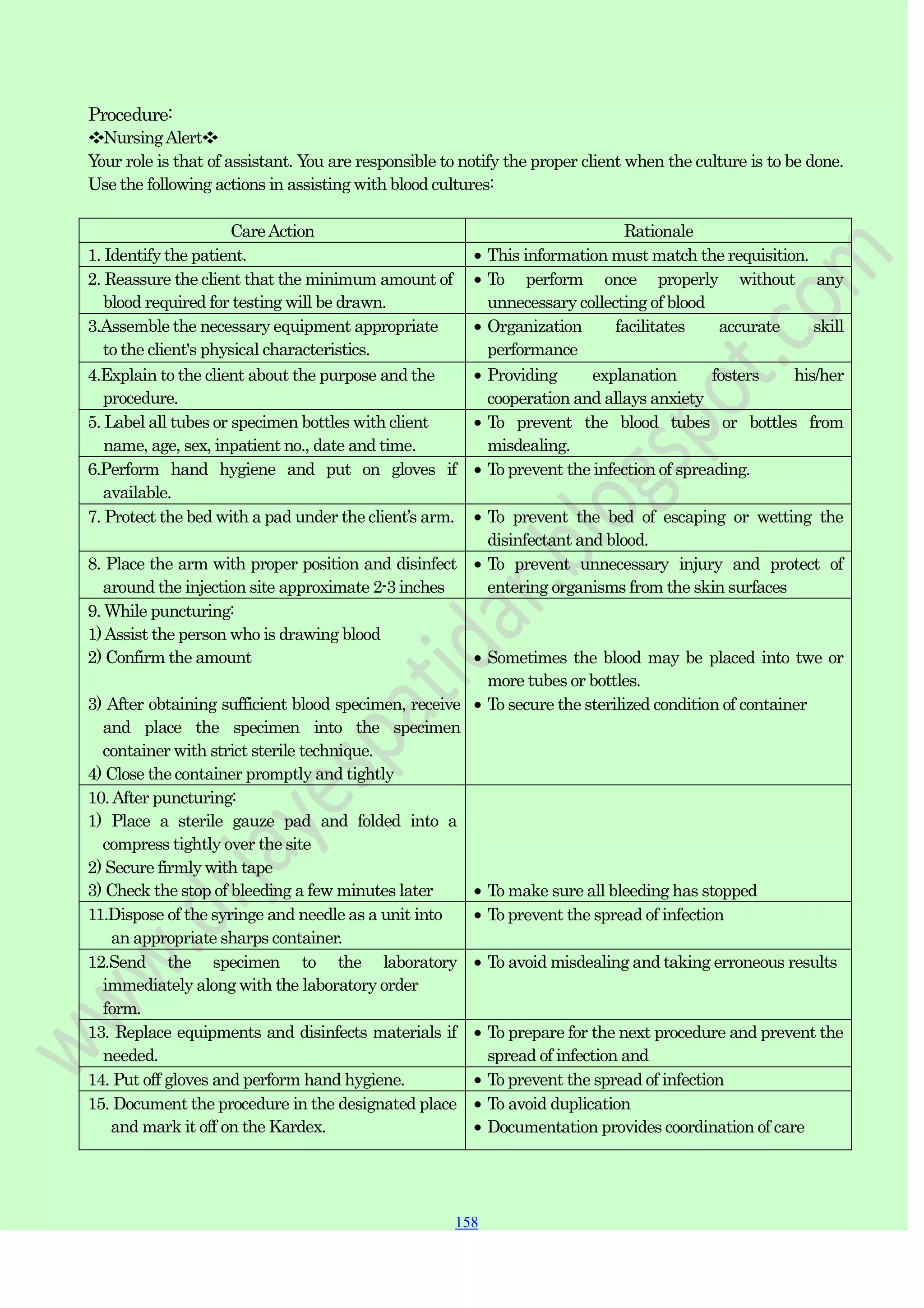
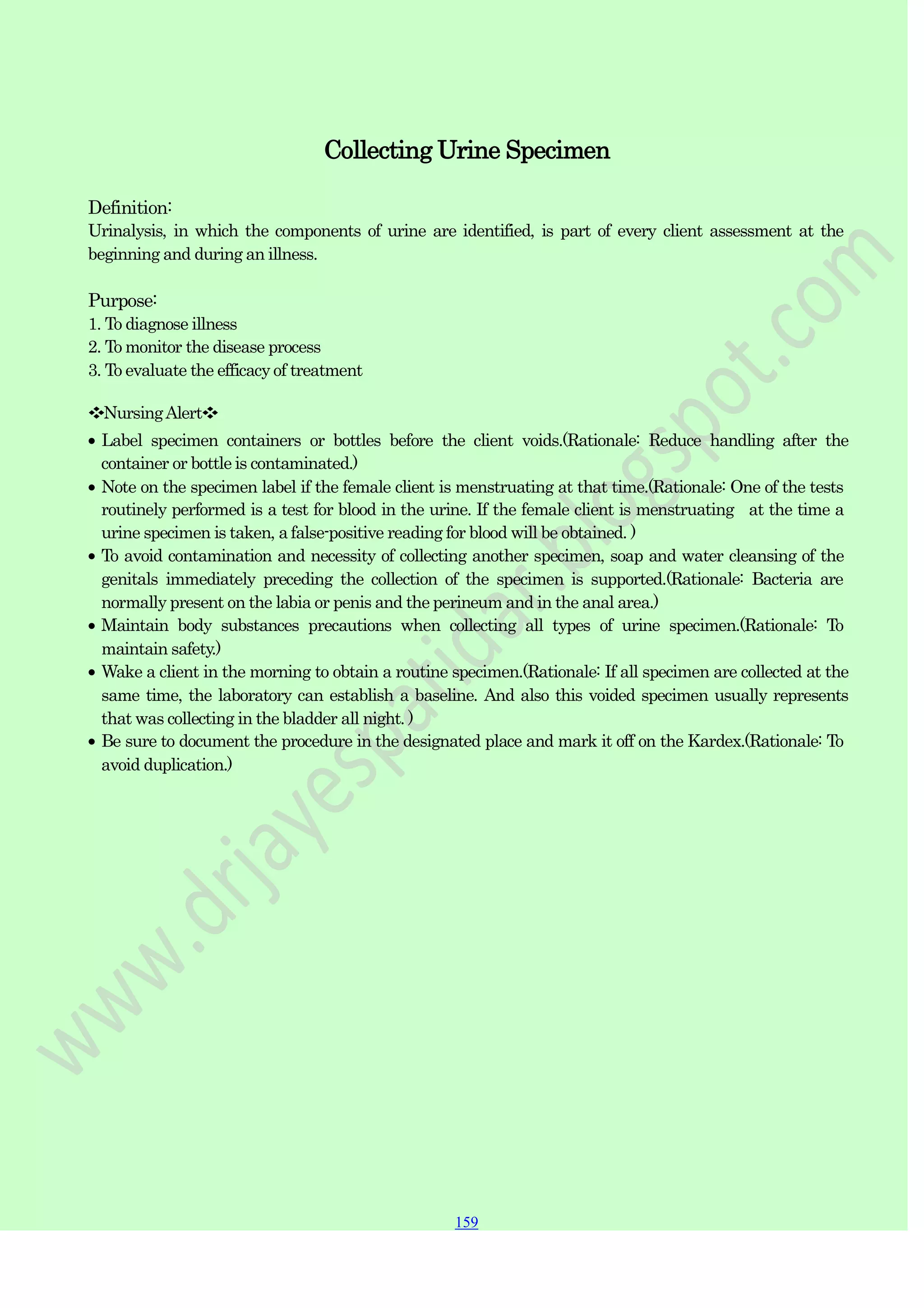
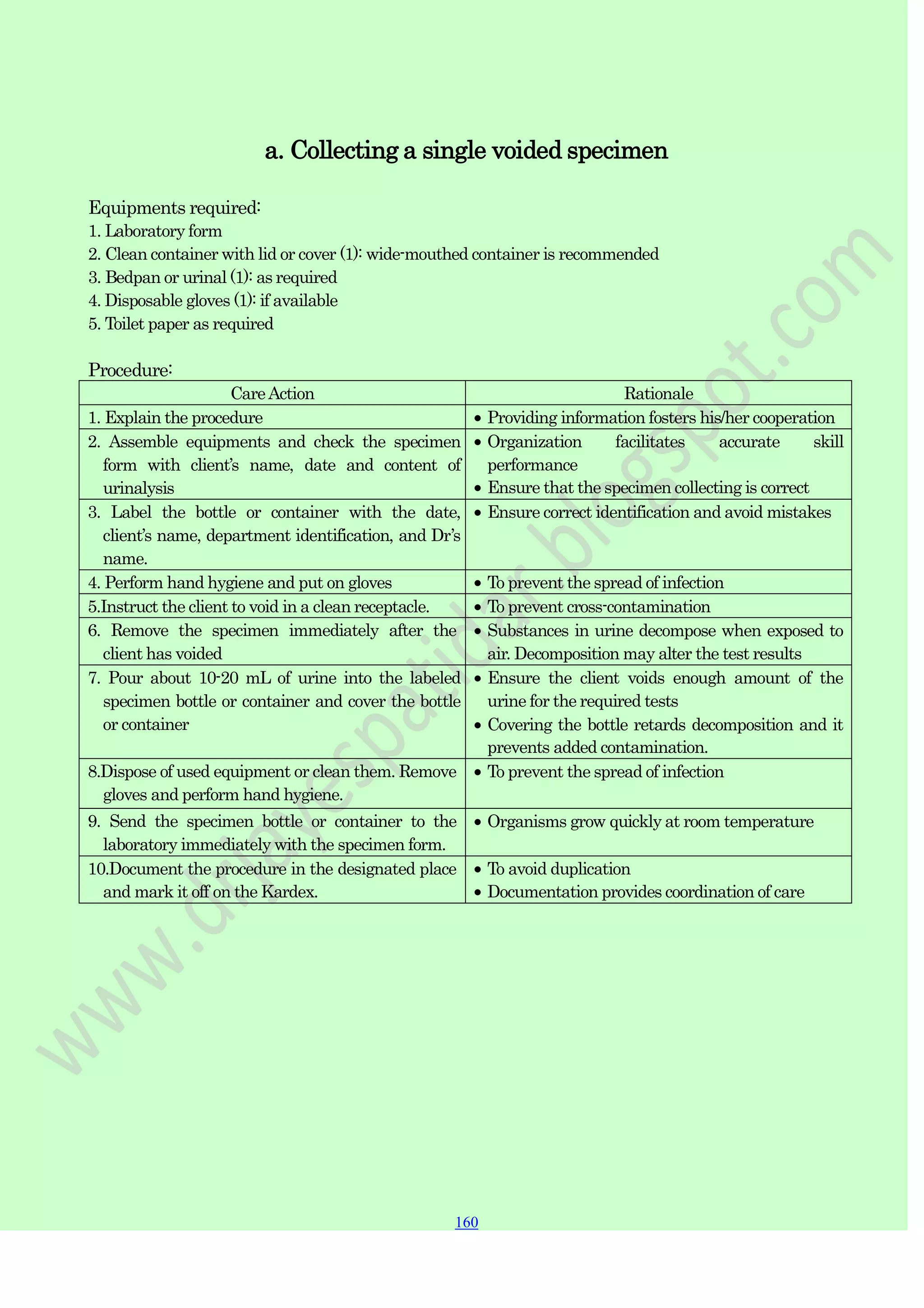
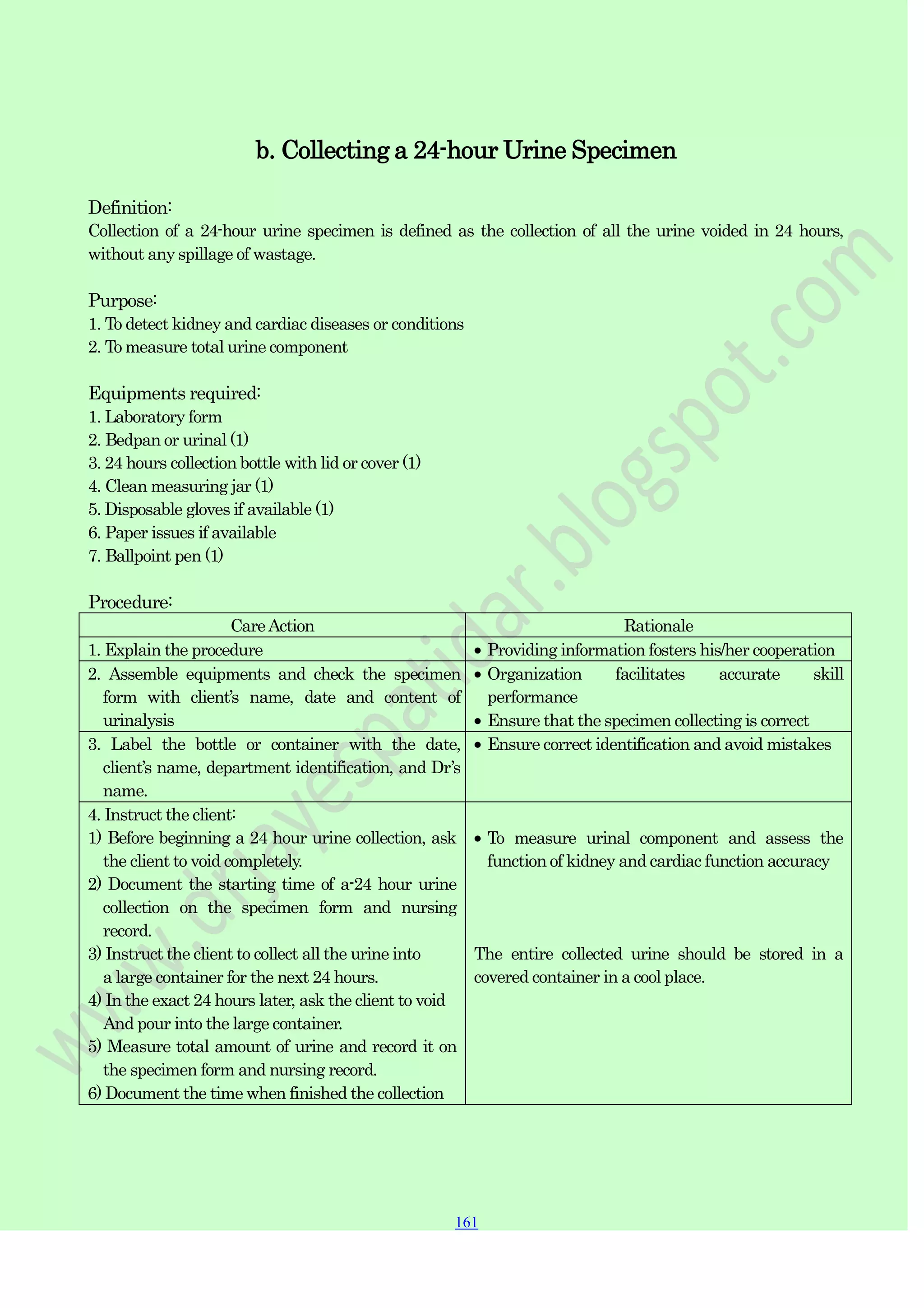
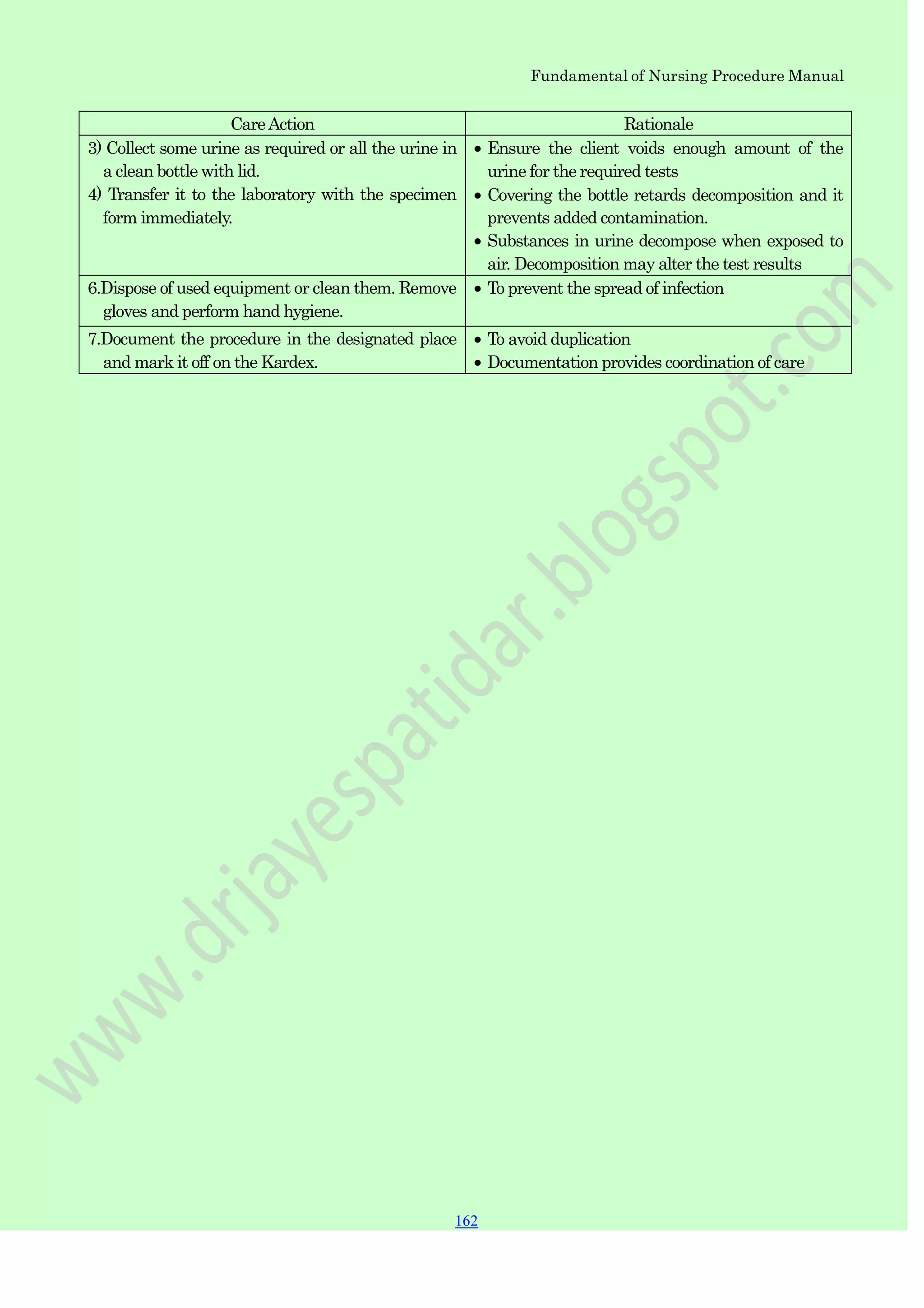
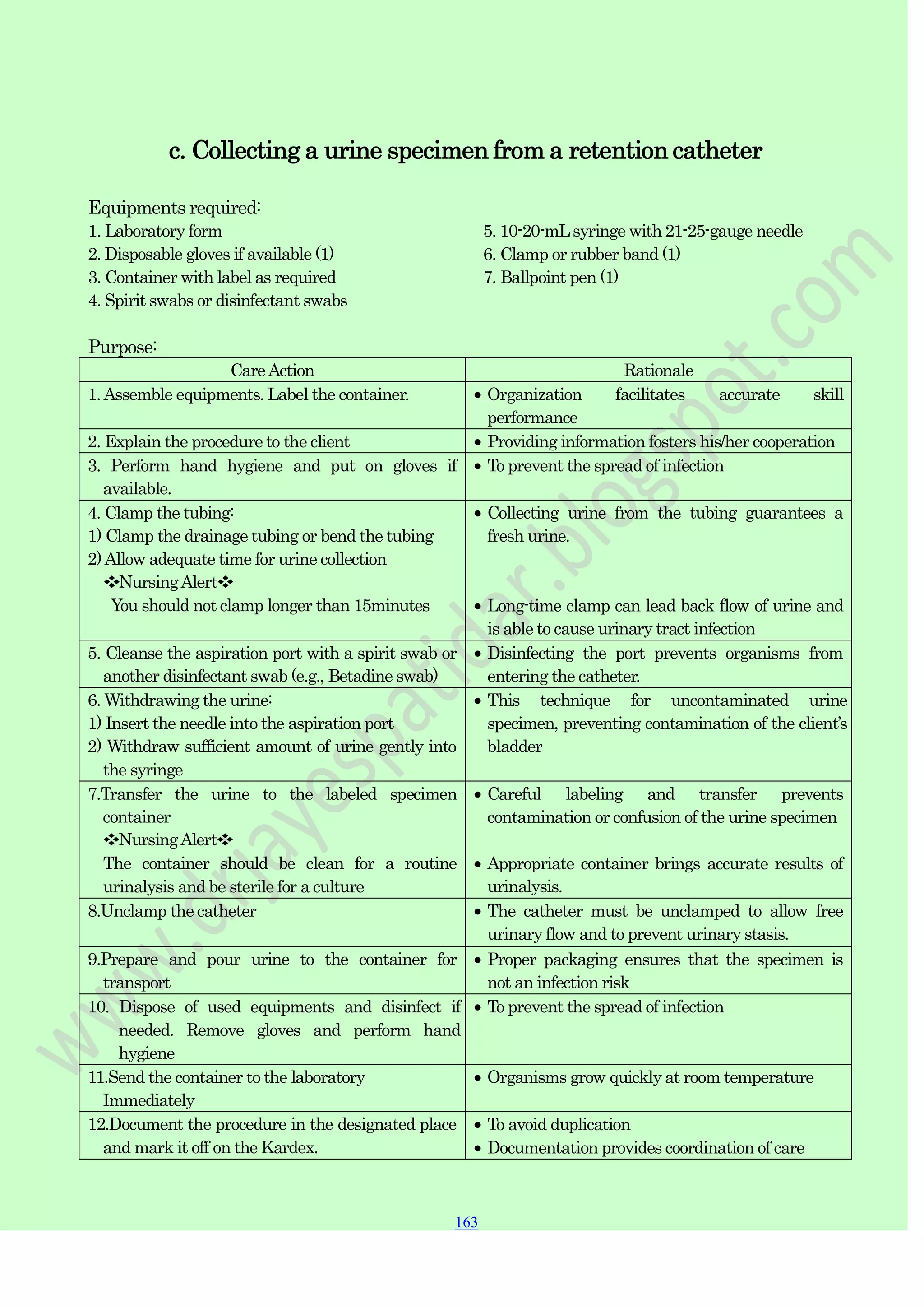
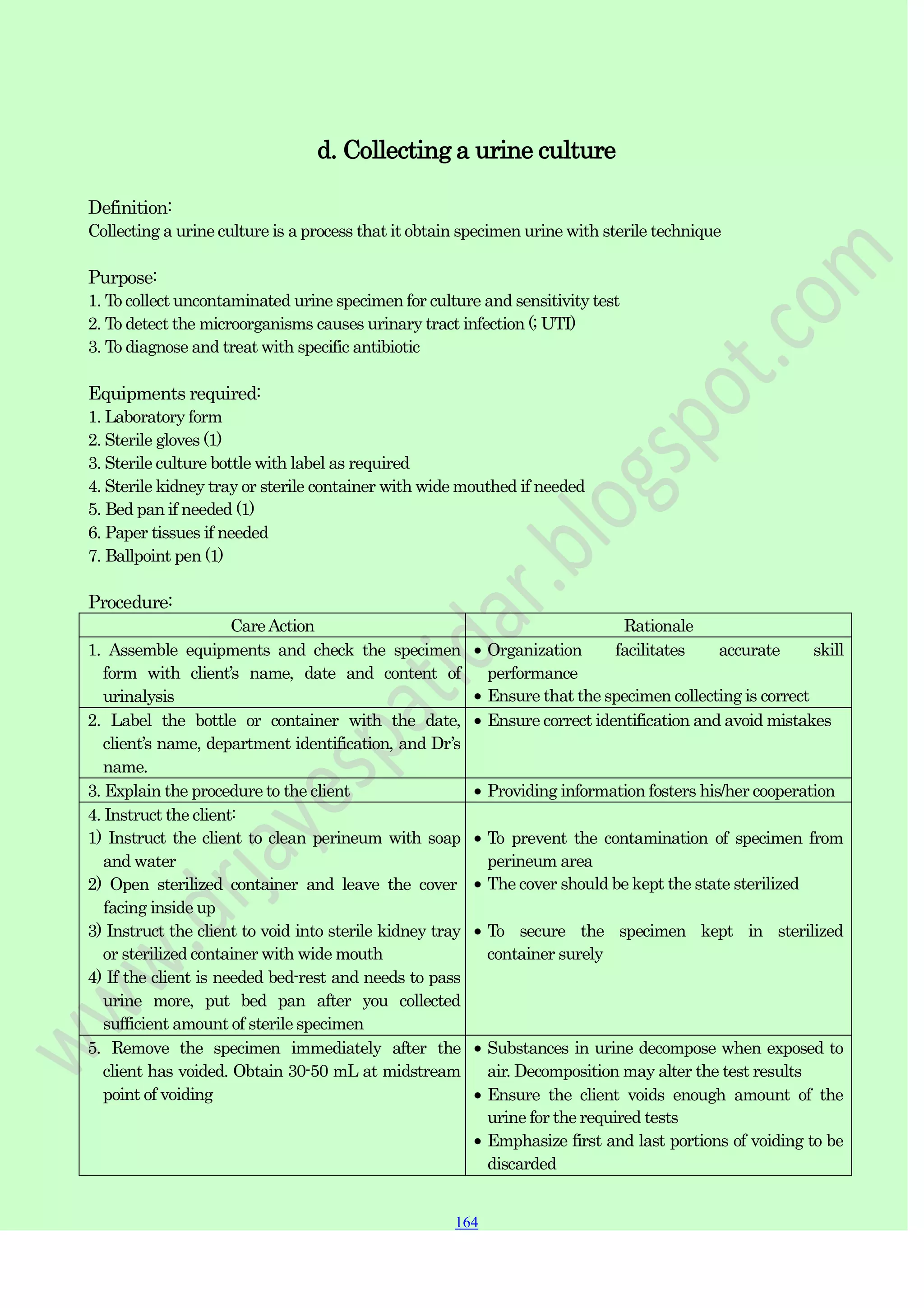
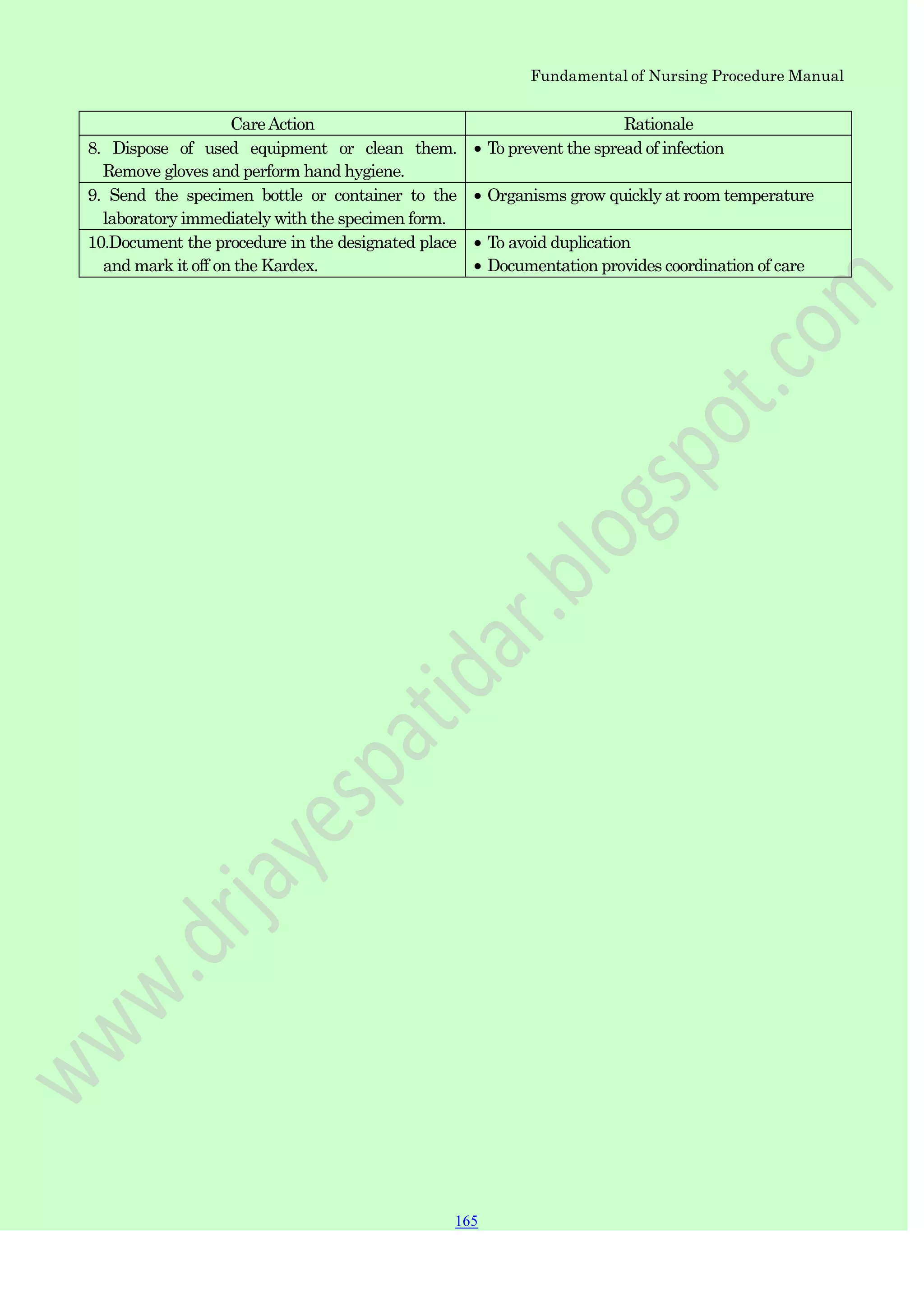
Fundamental of Nursing Procedure Manualwww.drjayeshpatidar.blogspot.com
FUNDAMENTAL OF NURSING
PROCEDURE MANUAL
MR. JAYESH PATIDAR
M.Sc. NURSING
Fundamental of Nursing Procedure Manualwww.drjayeshpatidar.blogspot.com
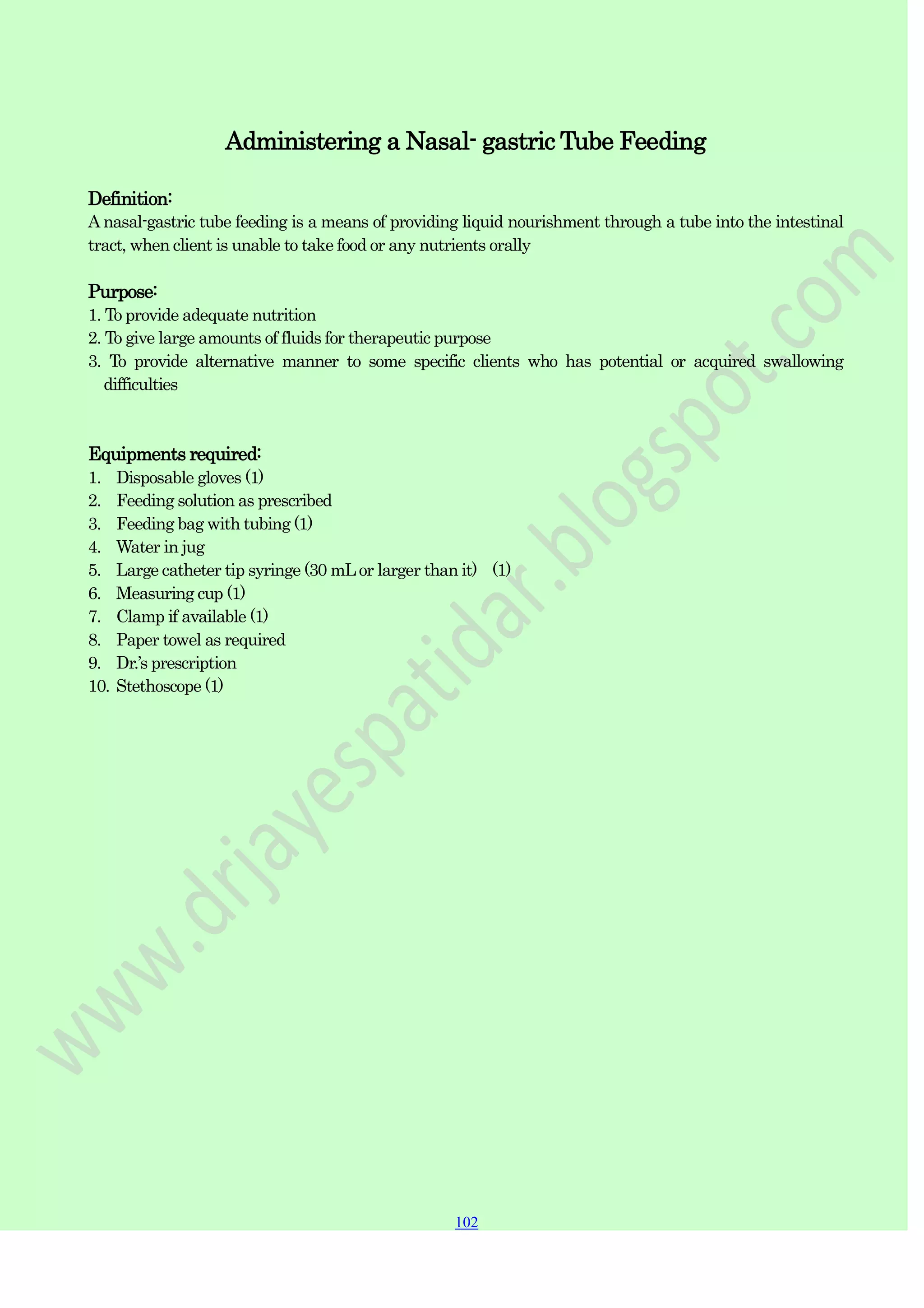
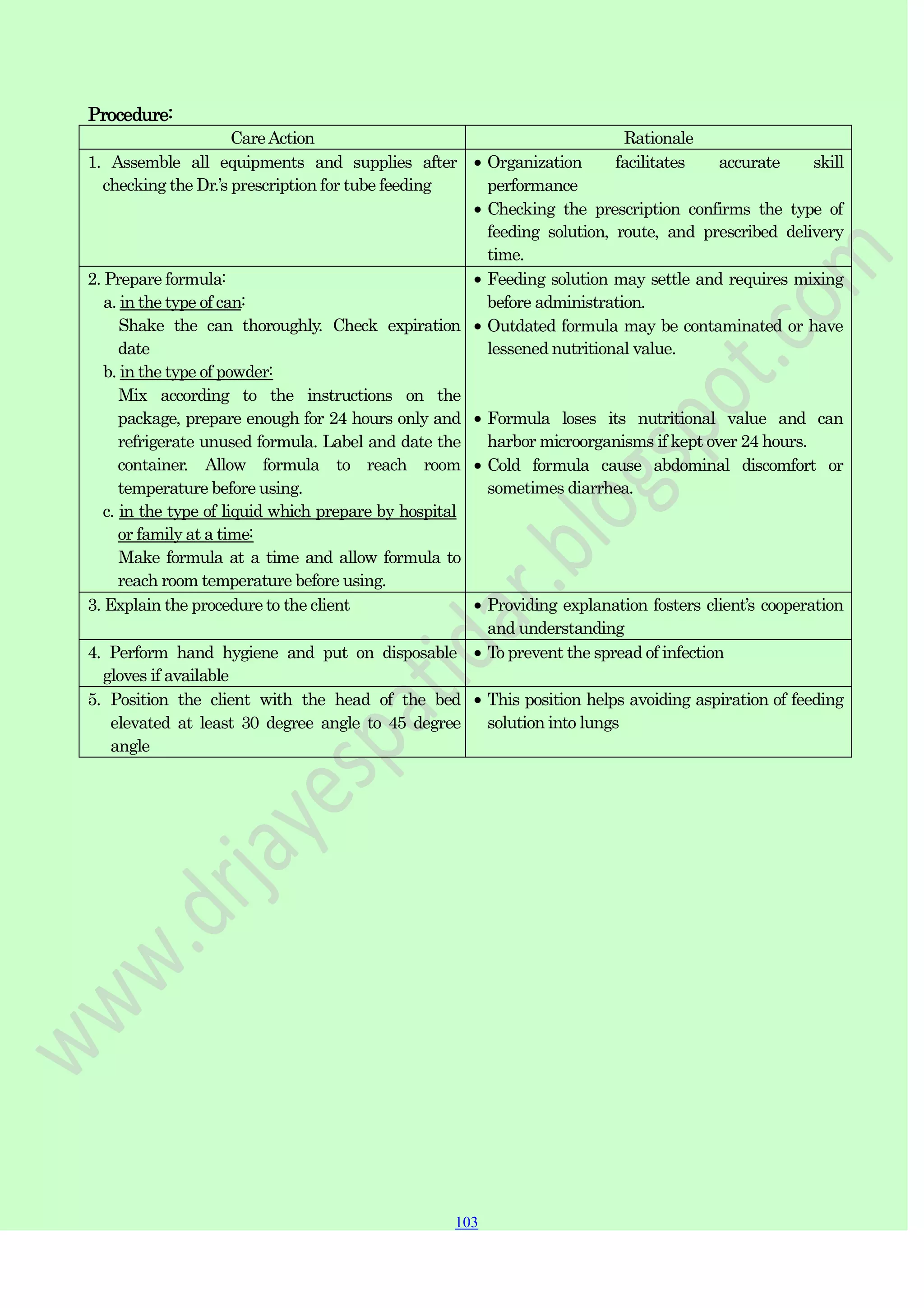
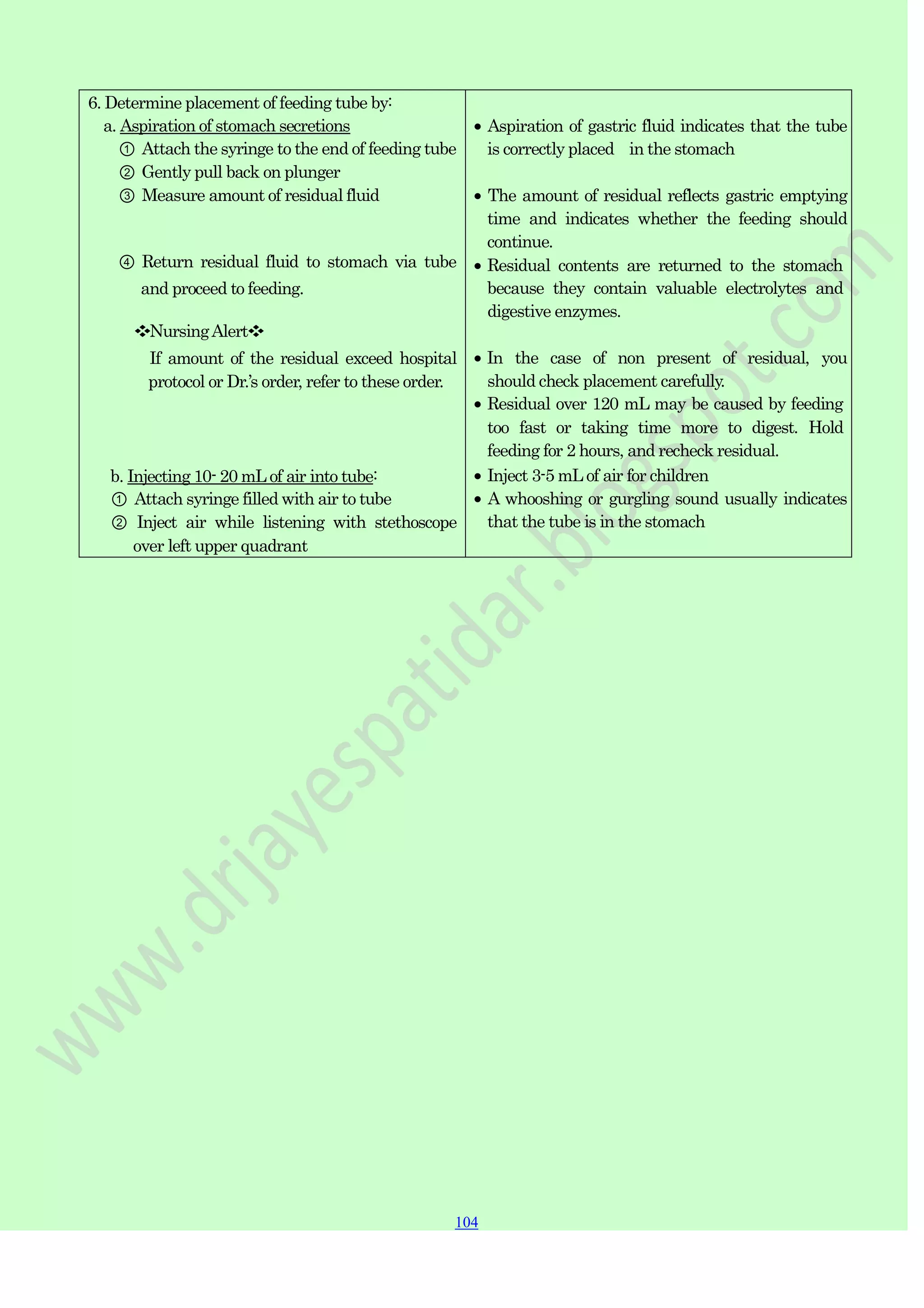
11.Administering Nasal-Gastric tube feeding 102
12. Cleaning a wound andApplying a sterile dressing 106
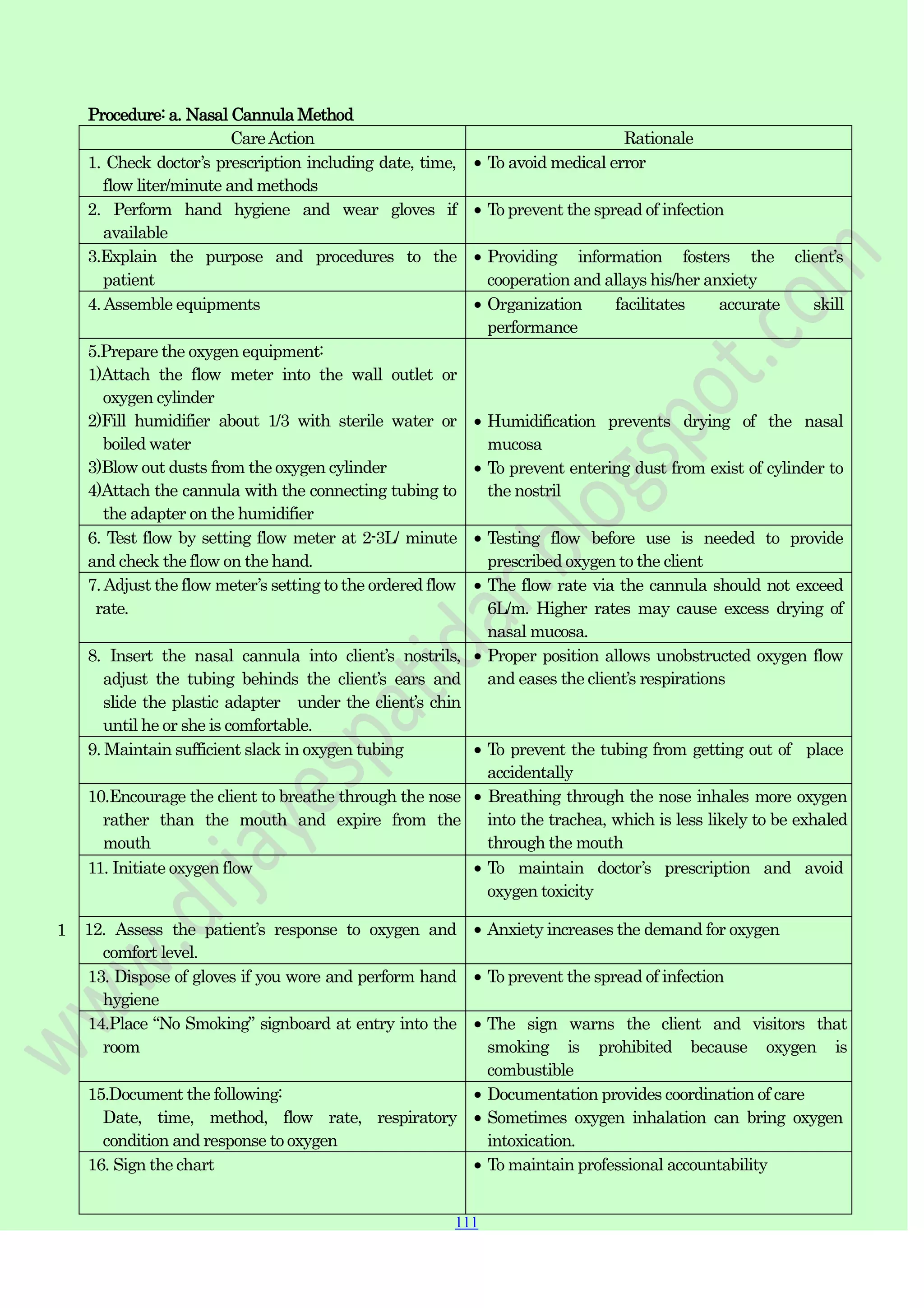
13. Supplying oxygen inhalation 109
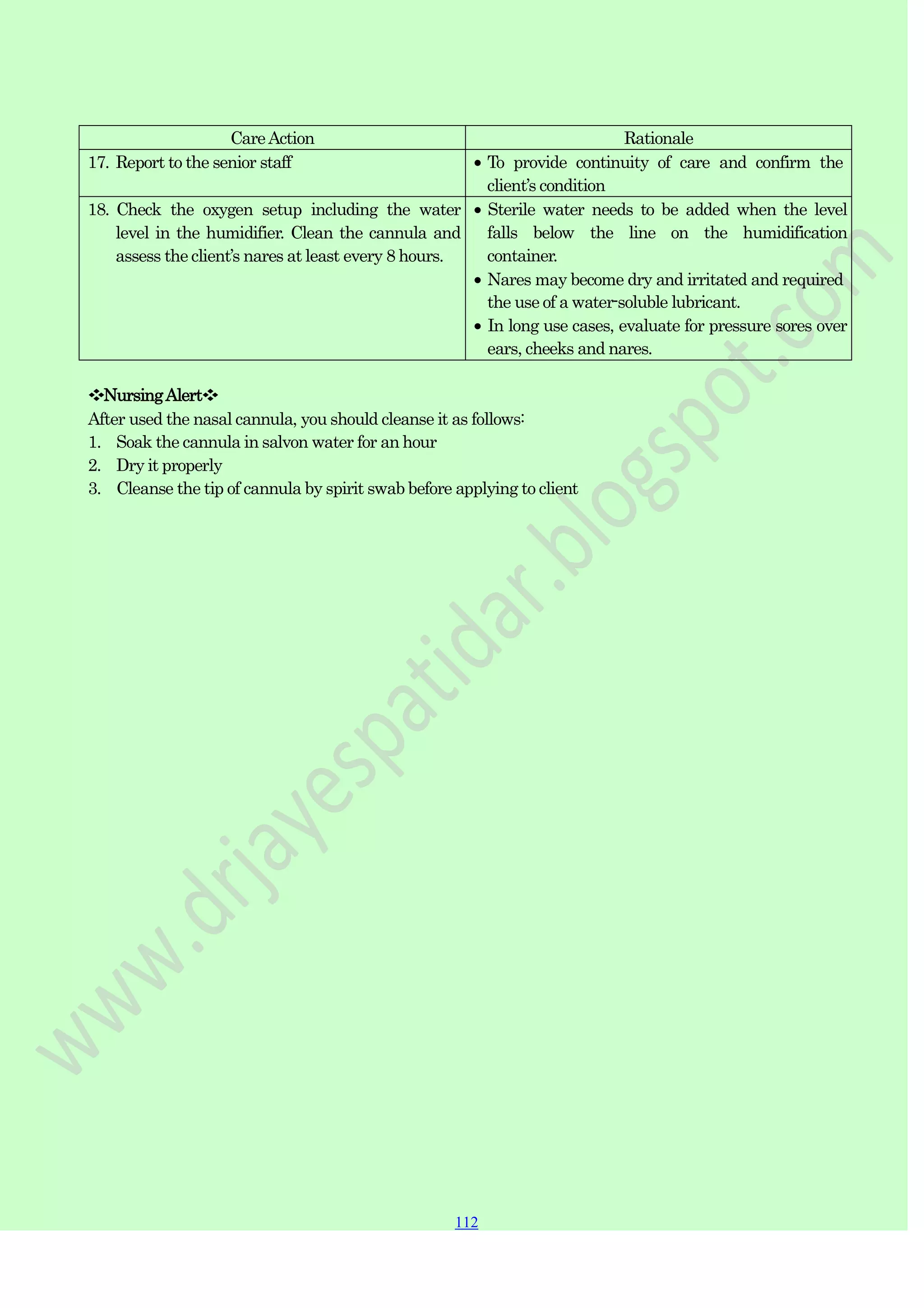
a. Nasal Cannula Method 111
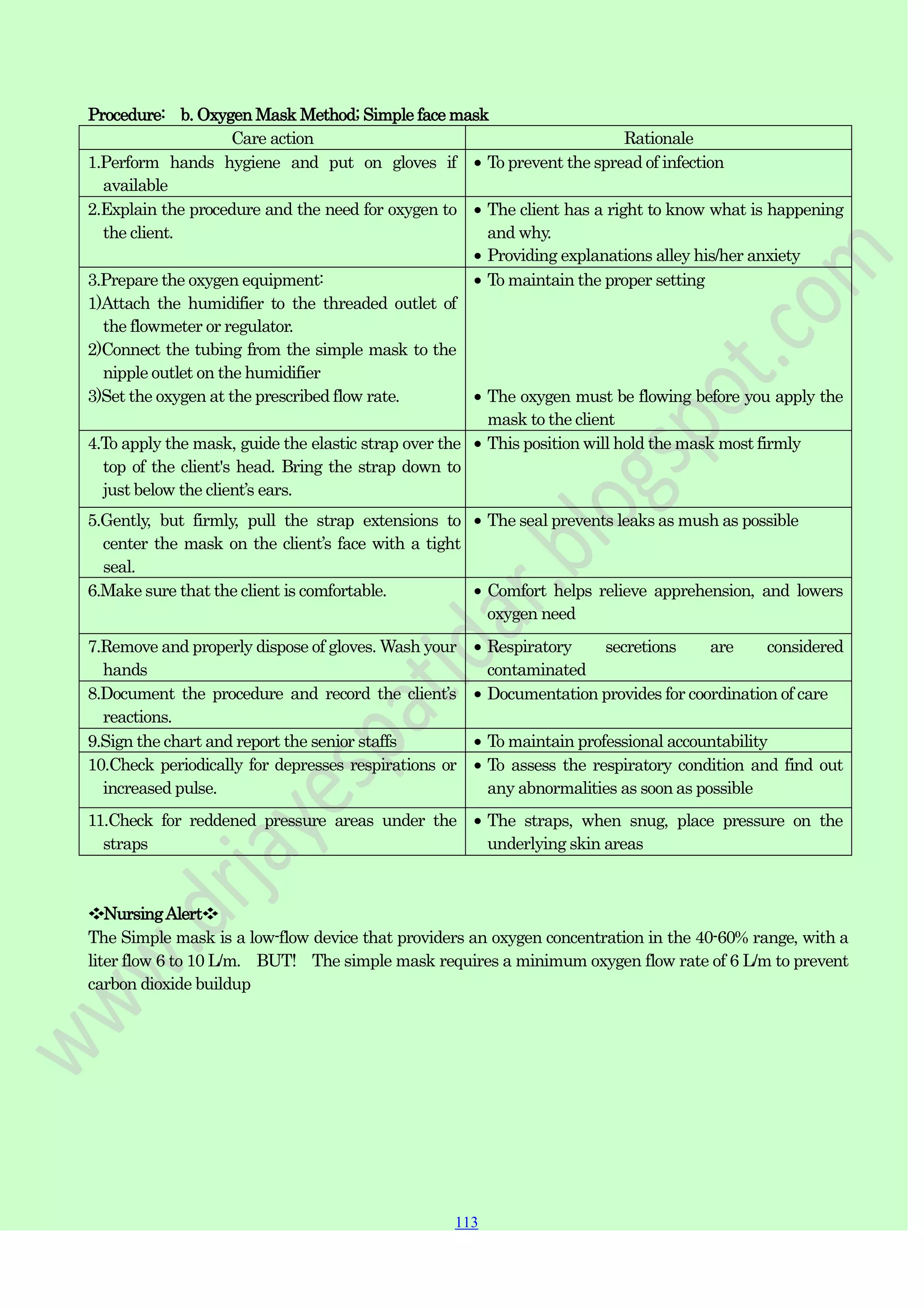
b. Mask Method: Simple face mask 113
Table of Contents
I. Basic Nursing Care/ Skill
1. Bed making
a. Making an Un-occupied bed
b. Changing an Occupied bed
c. Making a Post-operative bed
2. Performing oral care
a.Assisting the client with oral care
b. Providing oral care for dependent client
3. Performing bed bath
4. Performing back care
5. Performing hair washing
6. Care for fingernails/ toenails
7. Performing perineal care
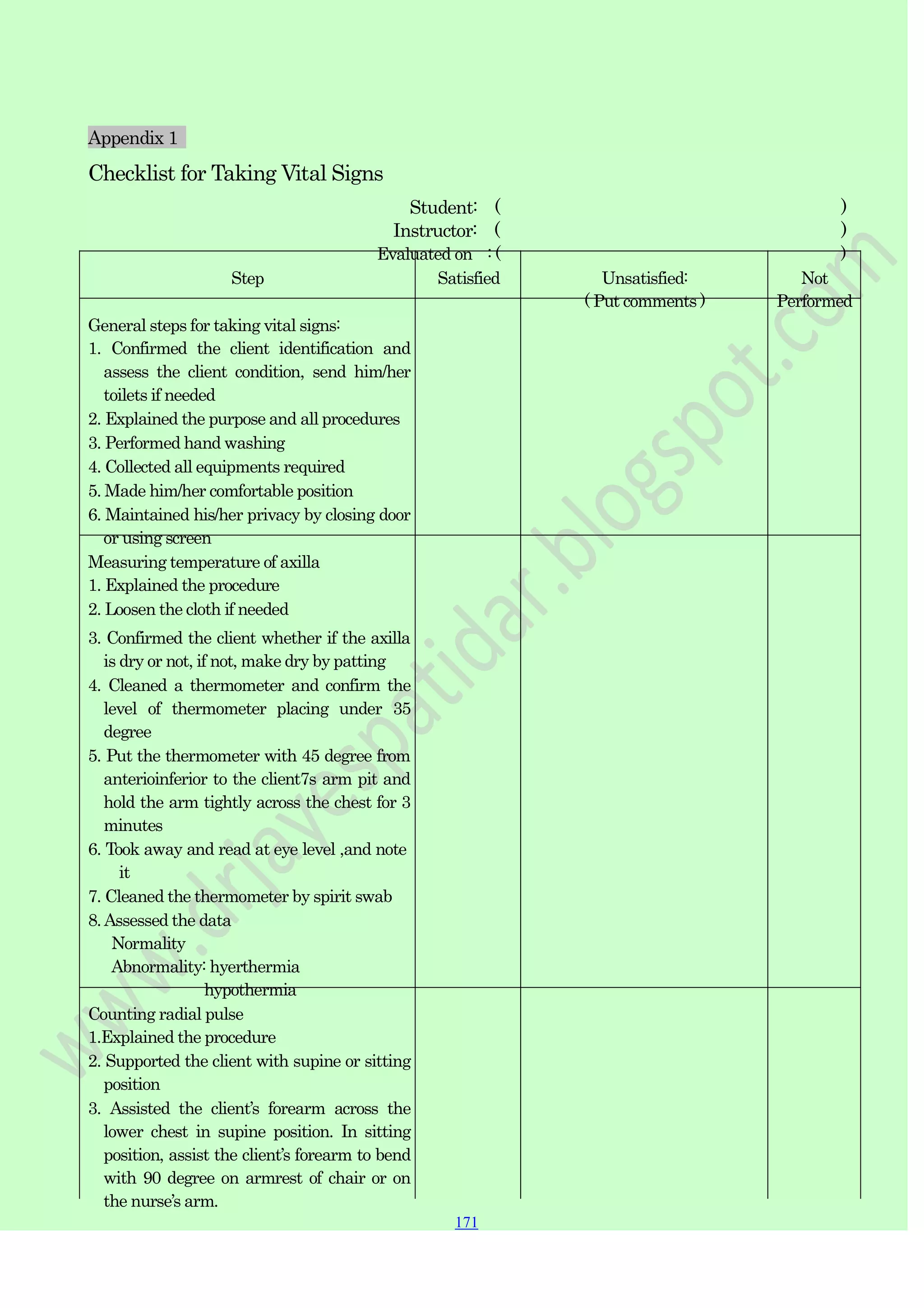
8. Taking vital signs
a. Taking axillary temperature by glass thermometer
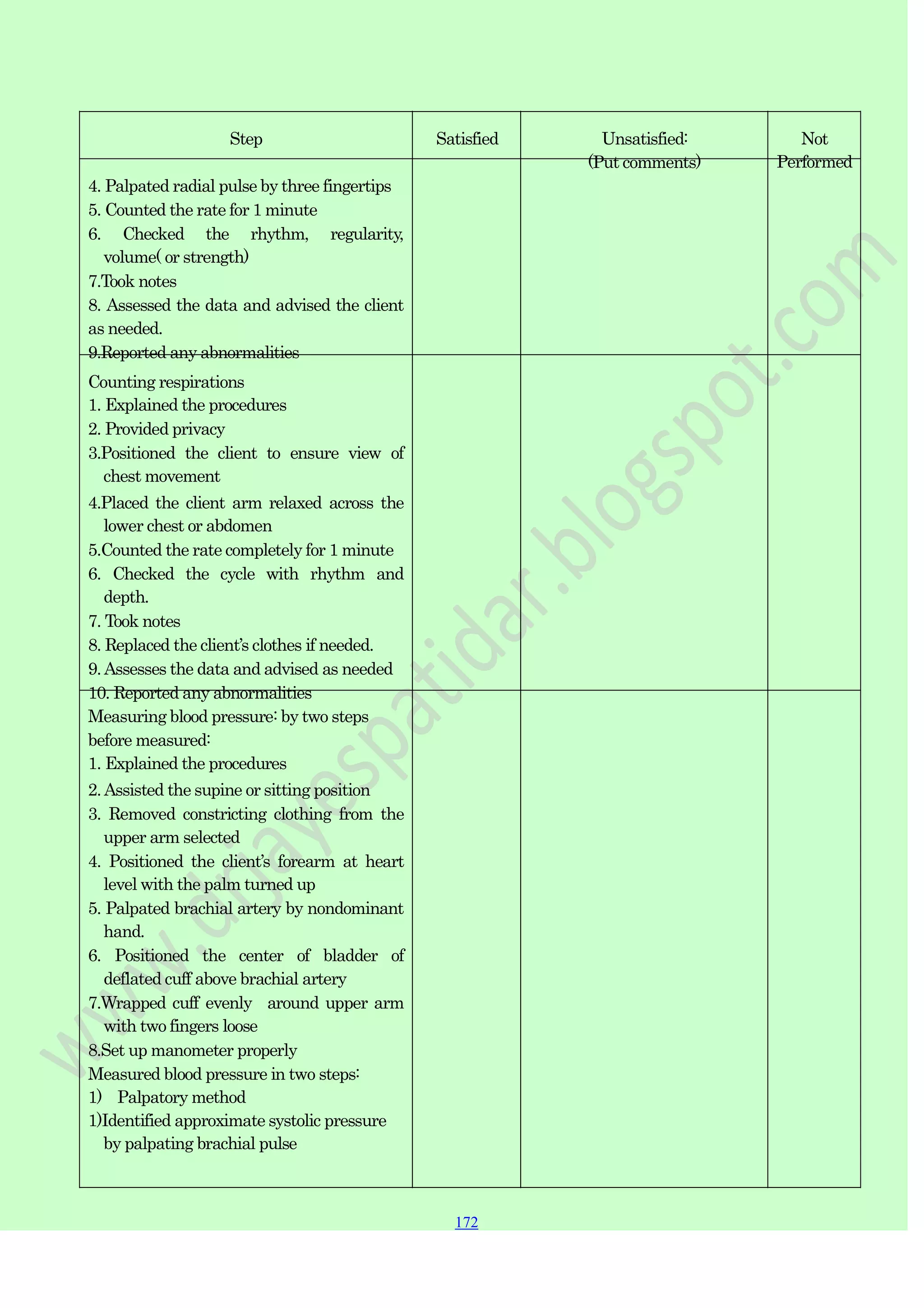
b. Measuring radial pulse
c. Counting respiration
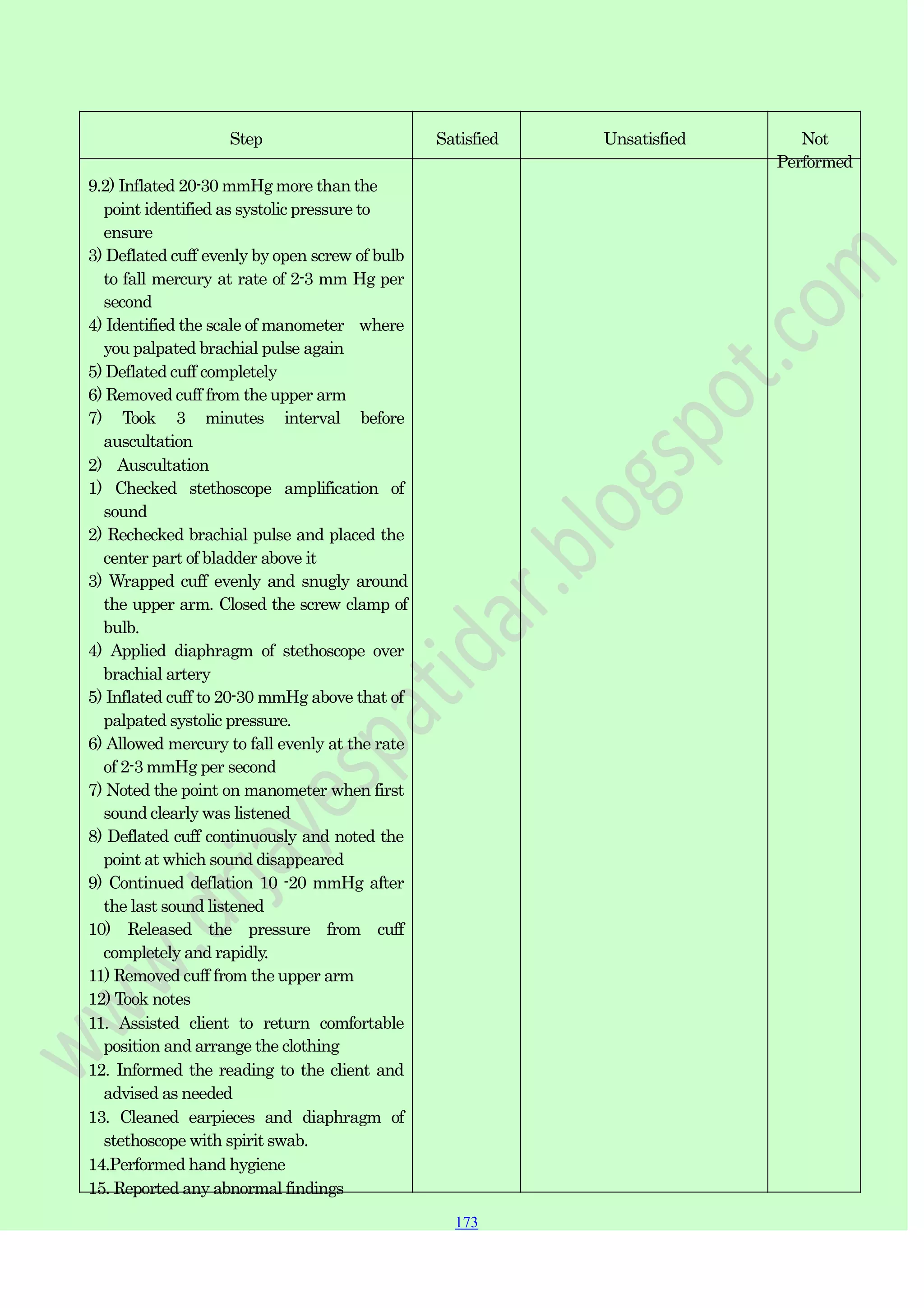
d. Measuring blood pressure
9. Performing physical examination
10. Care for Nasal-gastric Tube
a. Inserting a Nasal-Gastric Tube
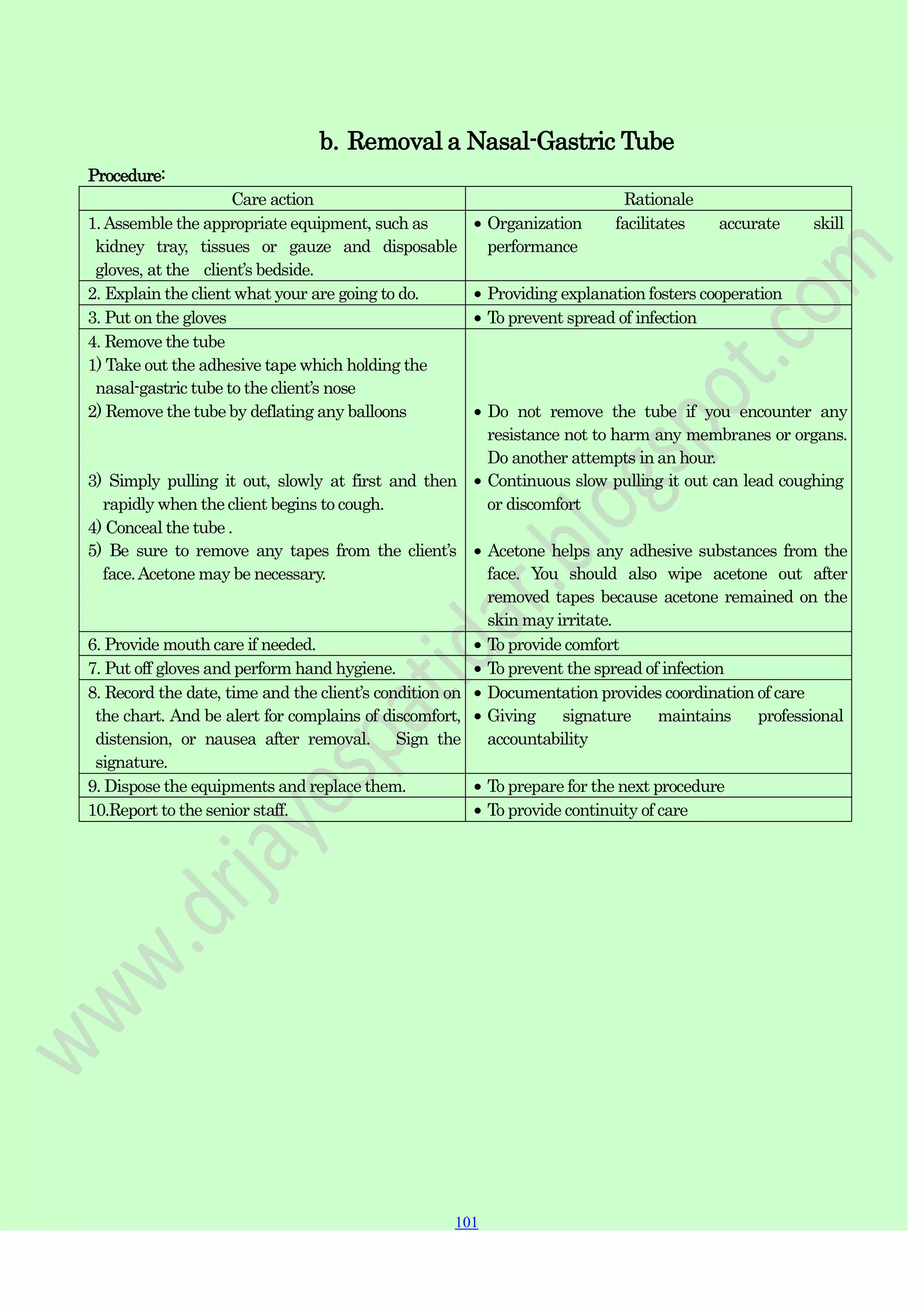
b. Removal a Nasal-Gastric Tube
7
9
13
16
19
21
23
26
30
32
35
37
39
41
43
45
46
49
98
98
101
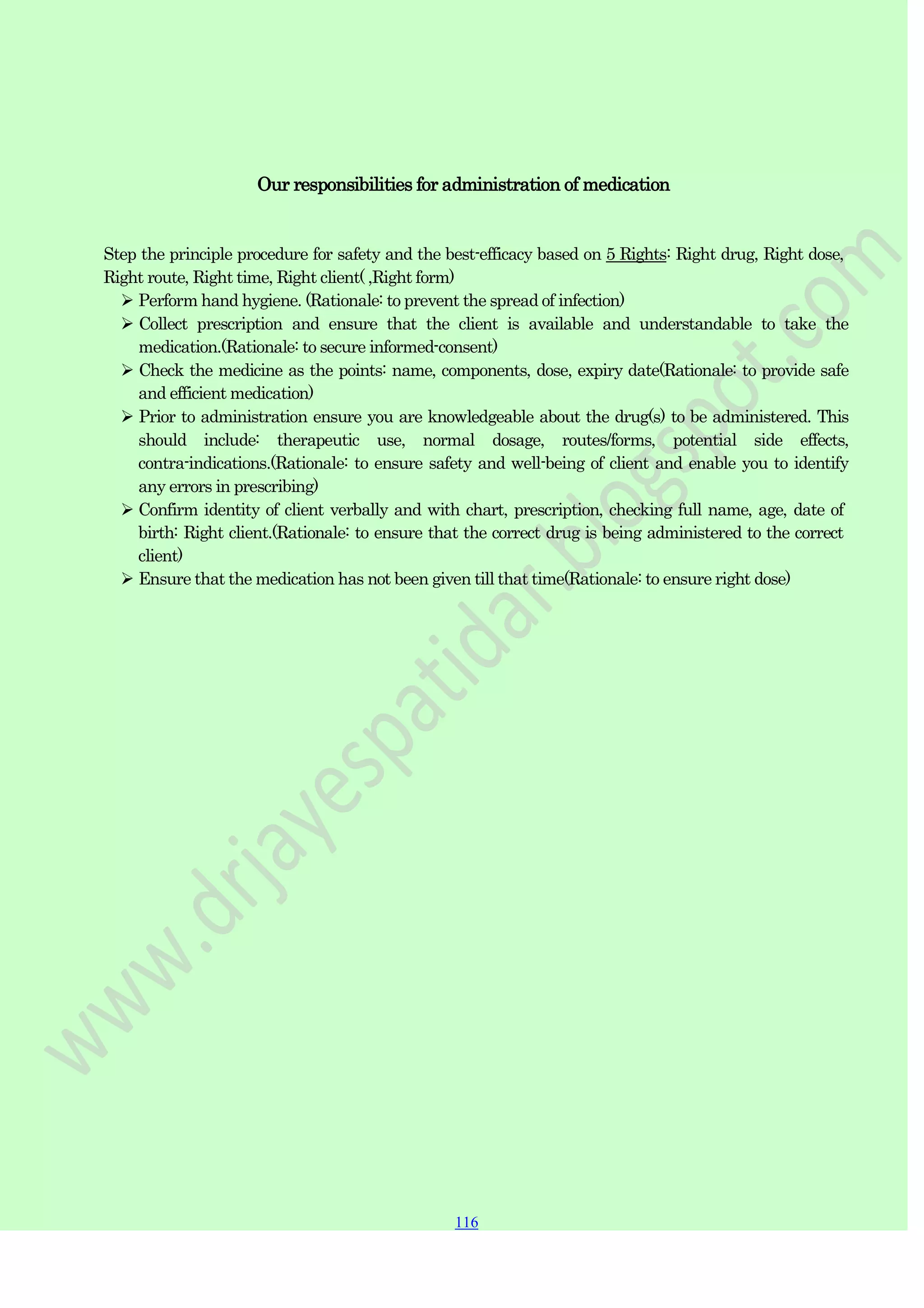
II. Administration of Medications 115
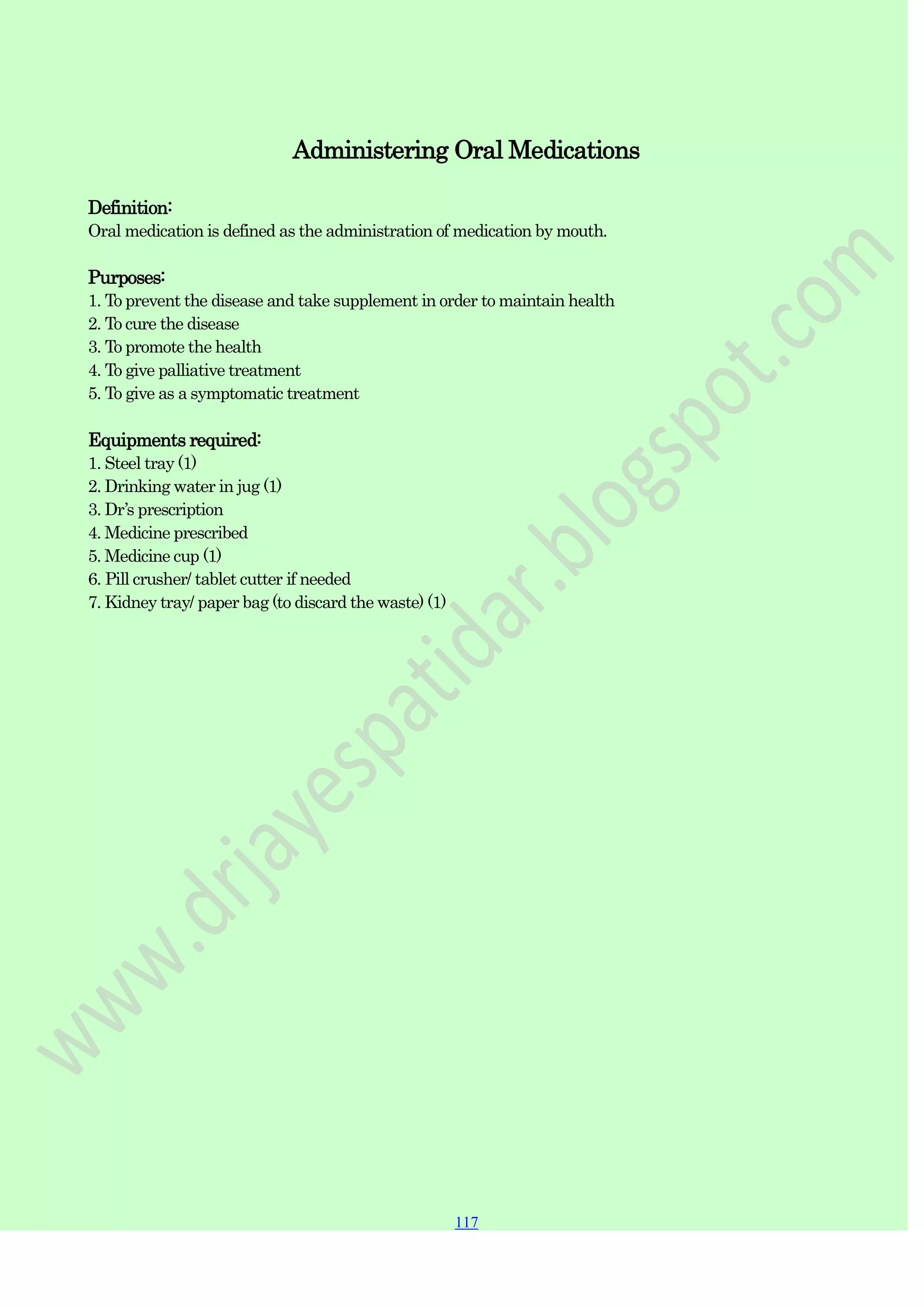
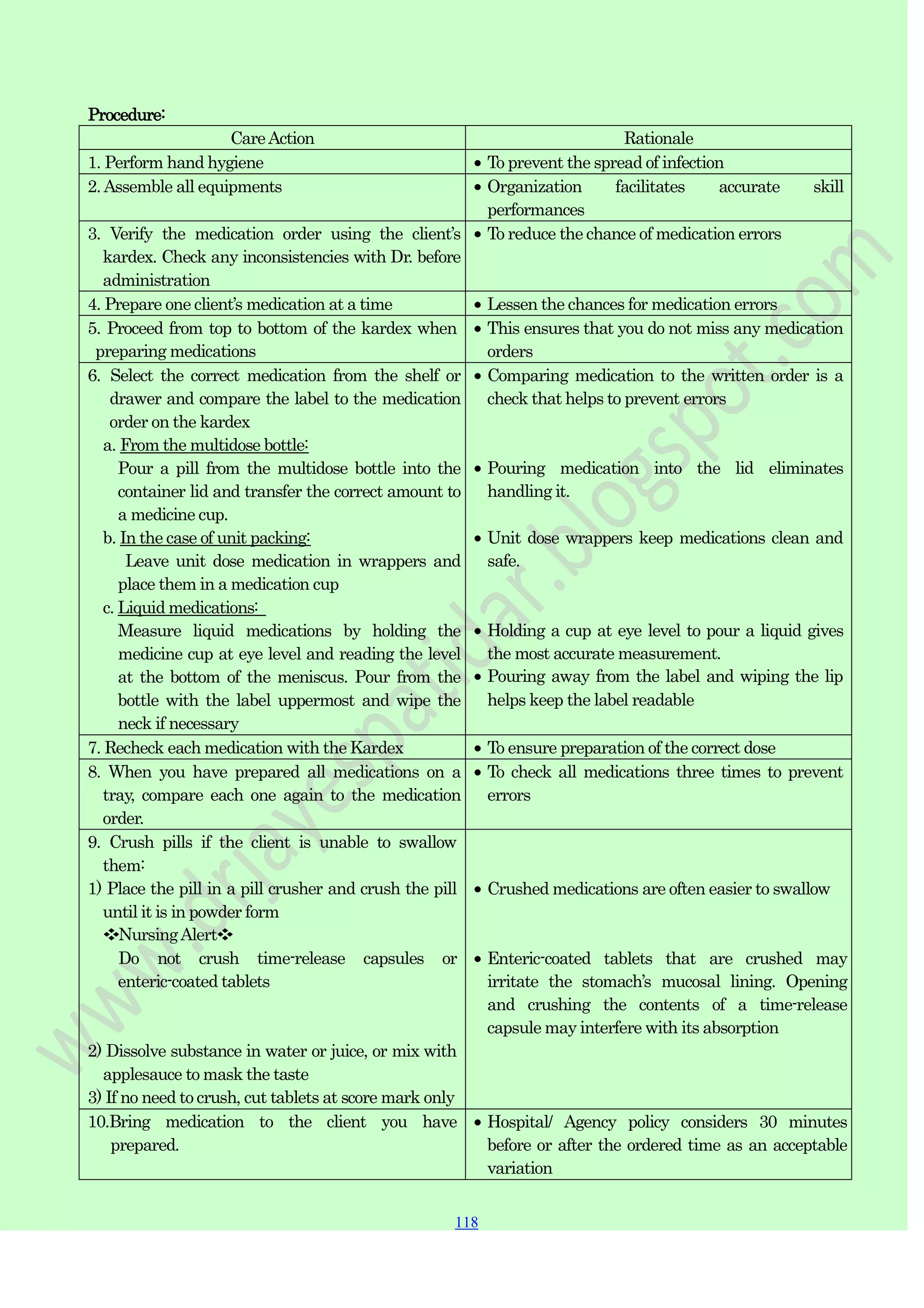
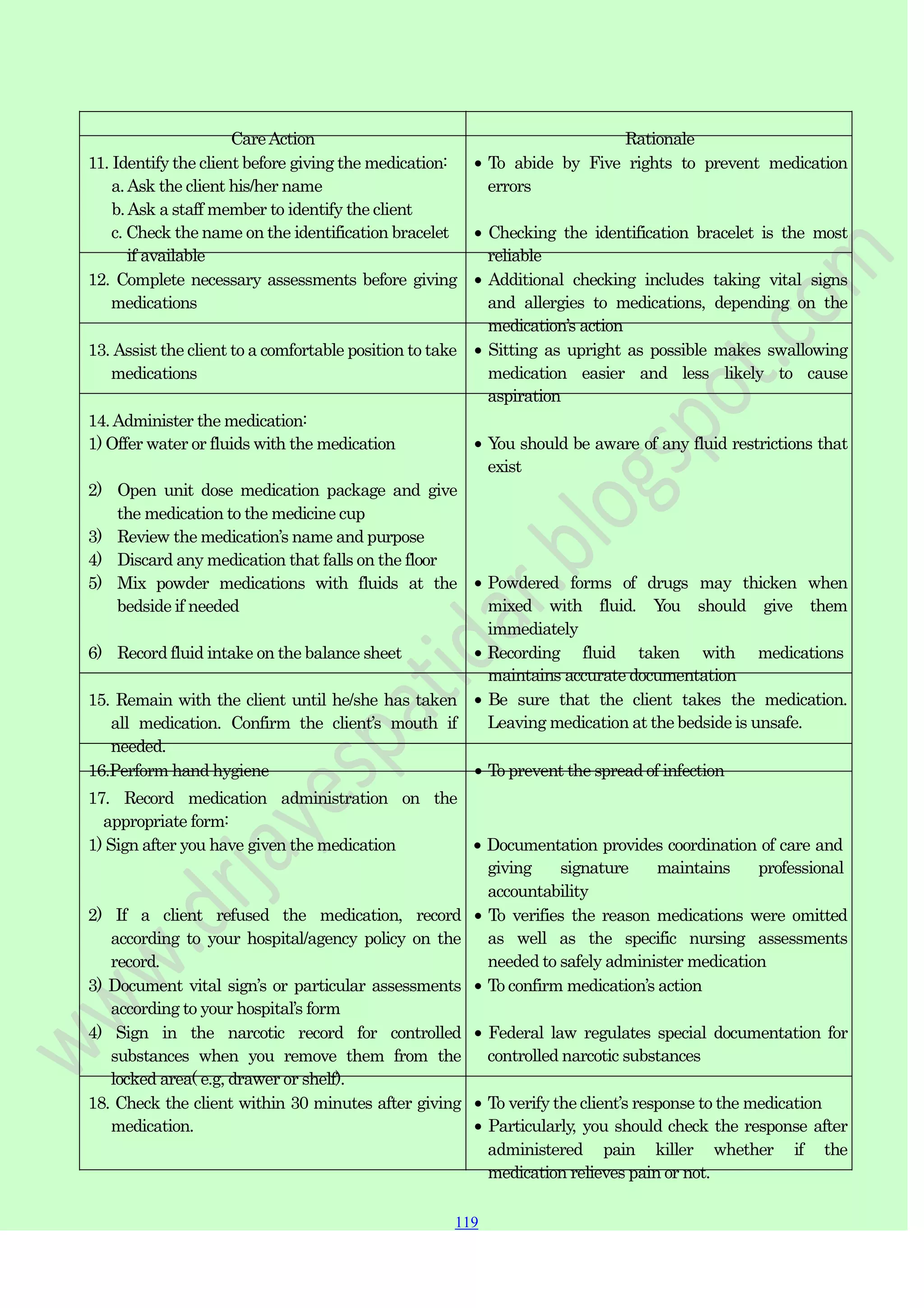
1. Administering oral medications 117
2. Administering oral medications through a Nasal-Gastric Tube 120
3. Removing medications from an ampoule 123
4. Removing medications from a vial 126
5. Prevention of the needle-stick injuries 129
6. Giving an Intra-muscular injection 130
7. Starting an Intra-venous infusion 135
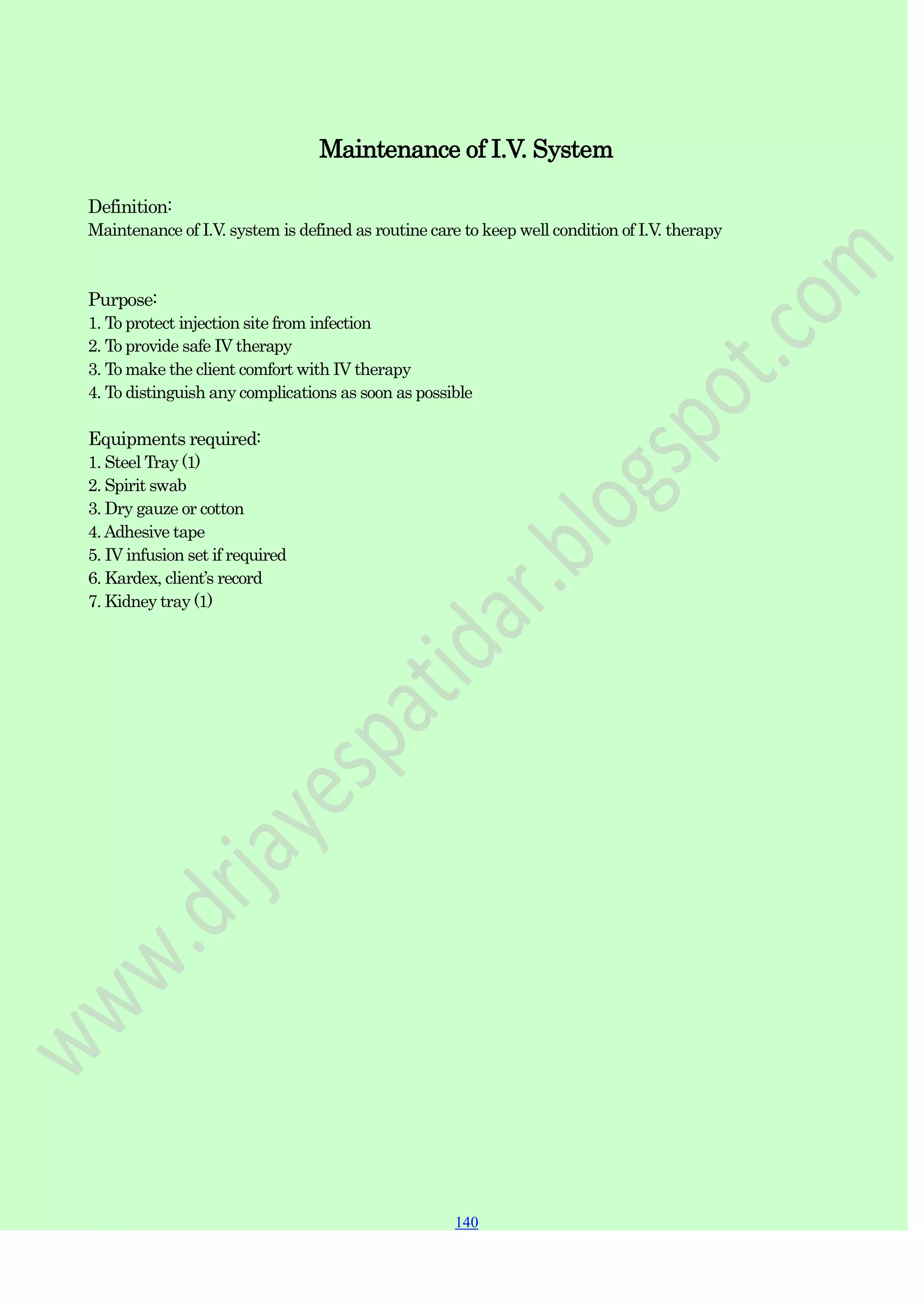
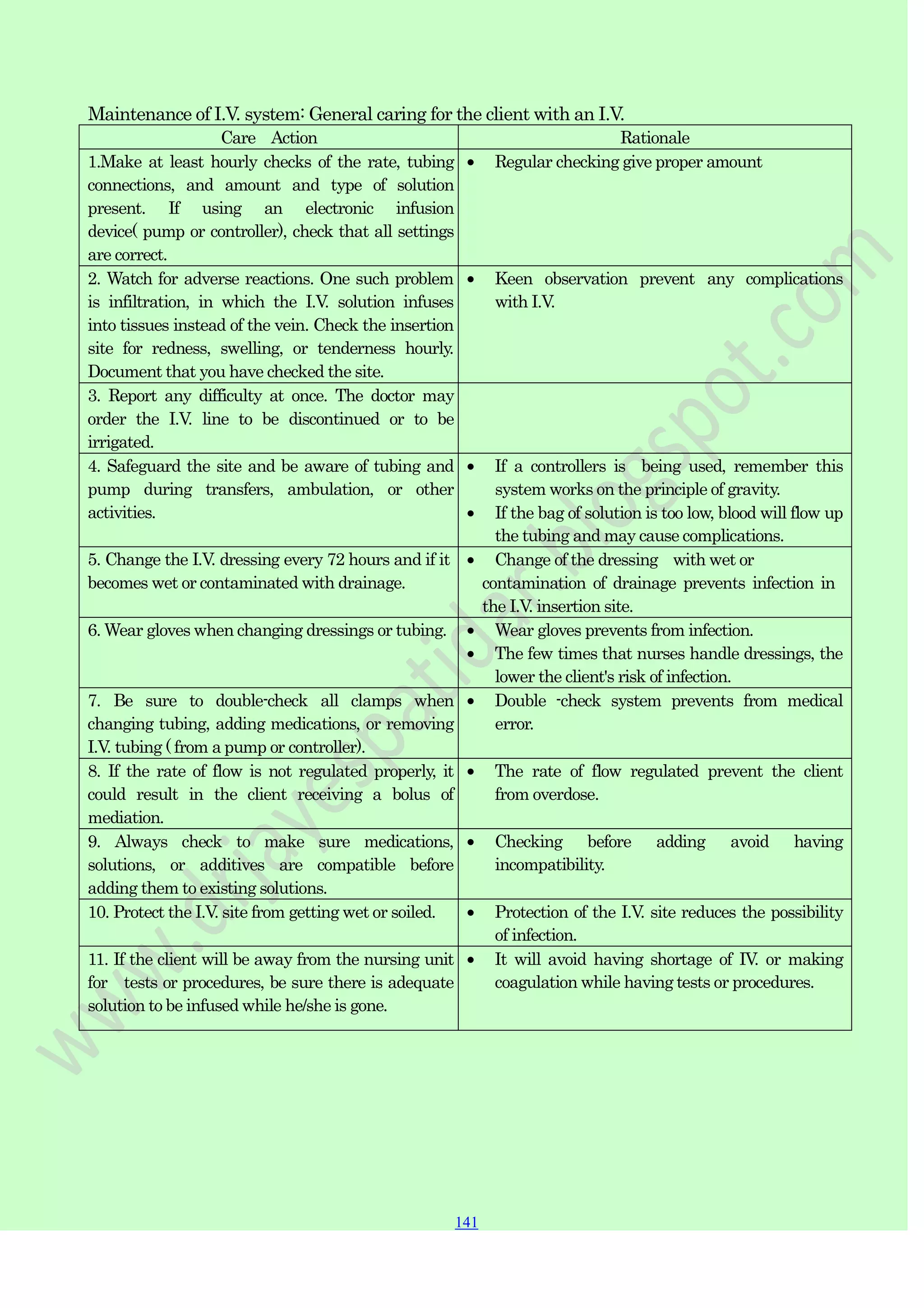
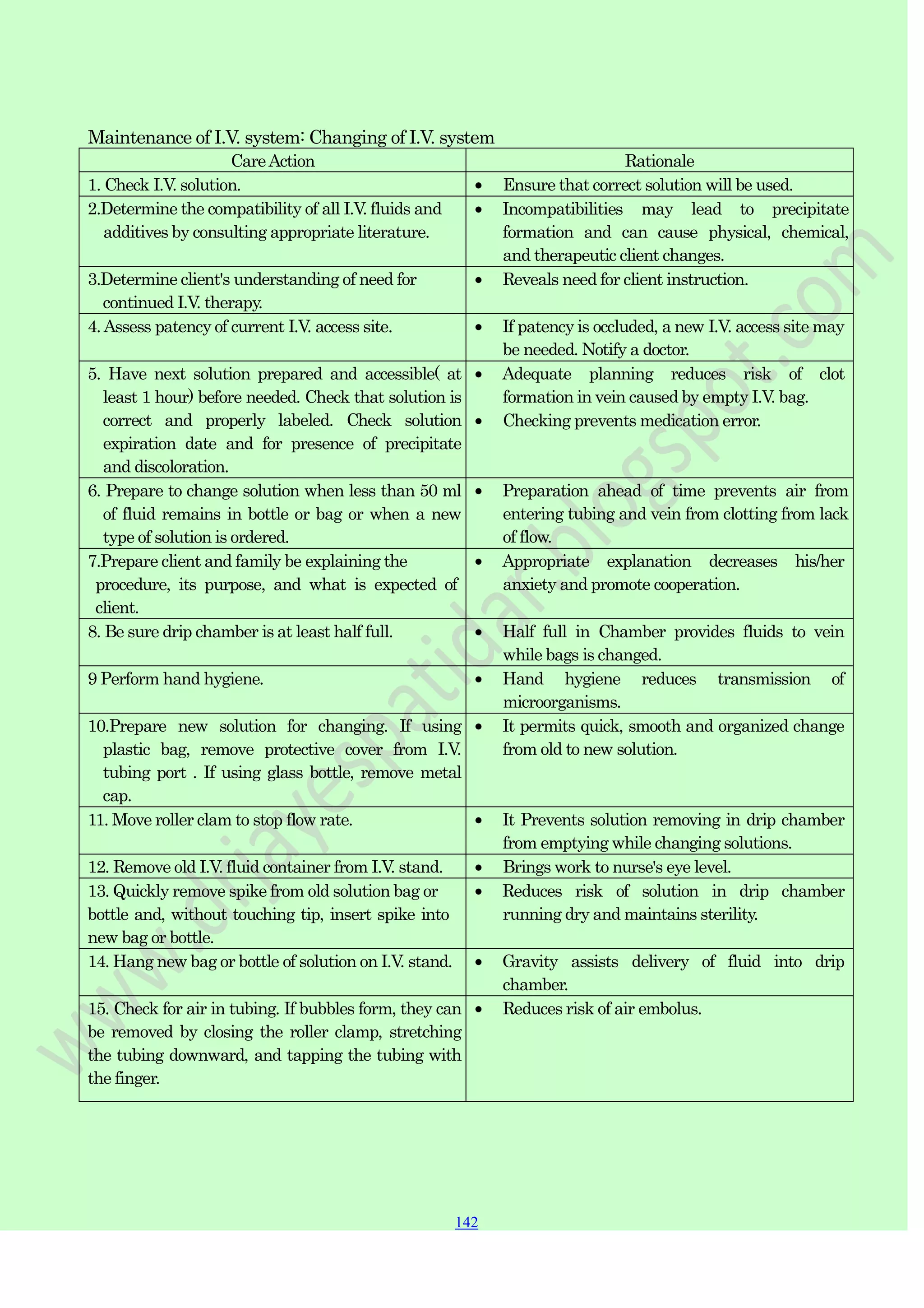
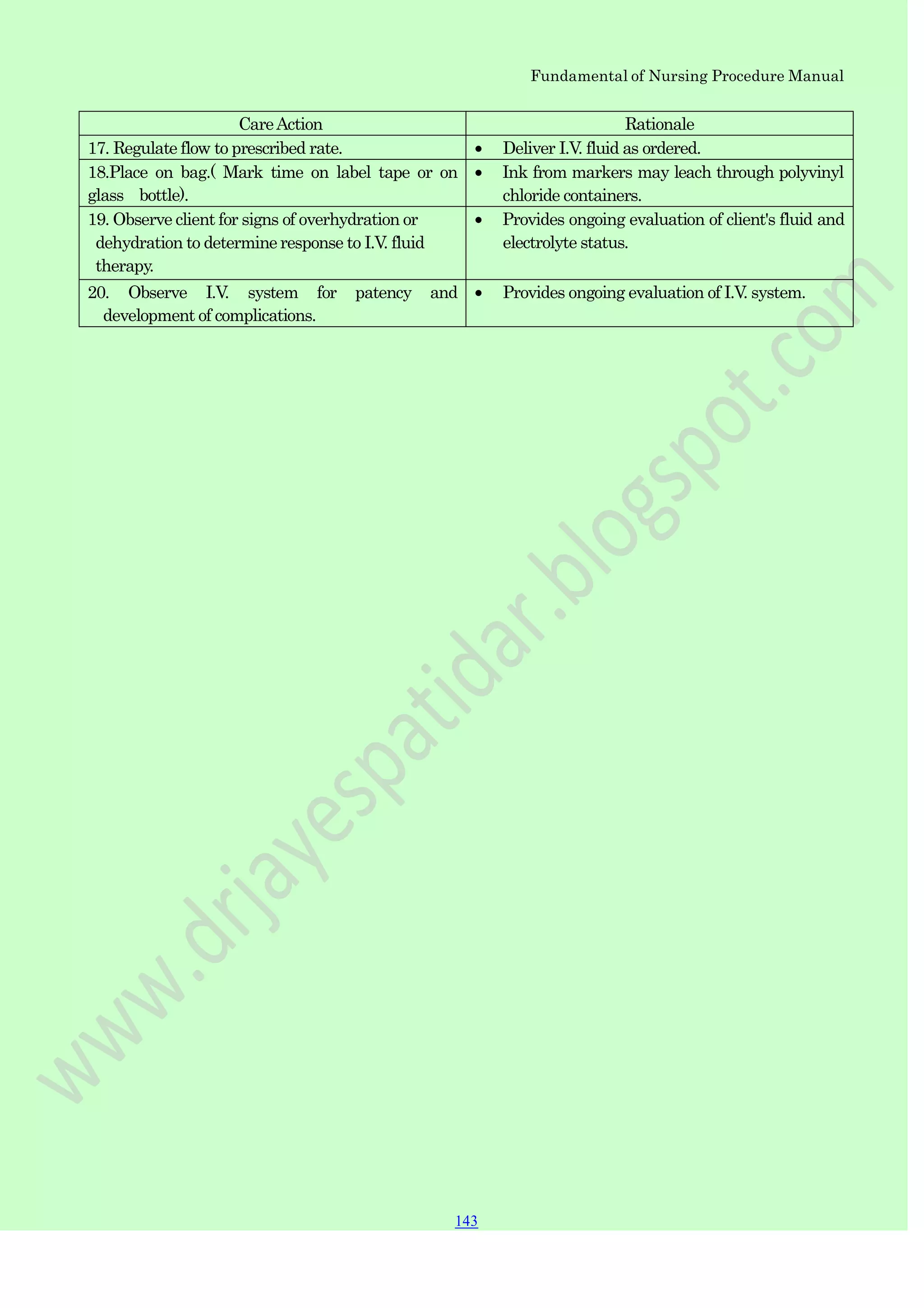
8. Maintenance of I.V. system 140
9. Administering medications by Heparin Lock 144
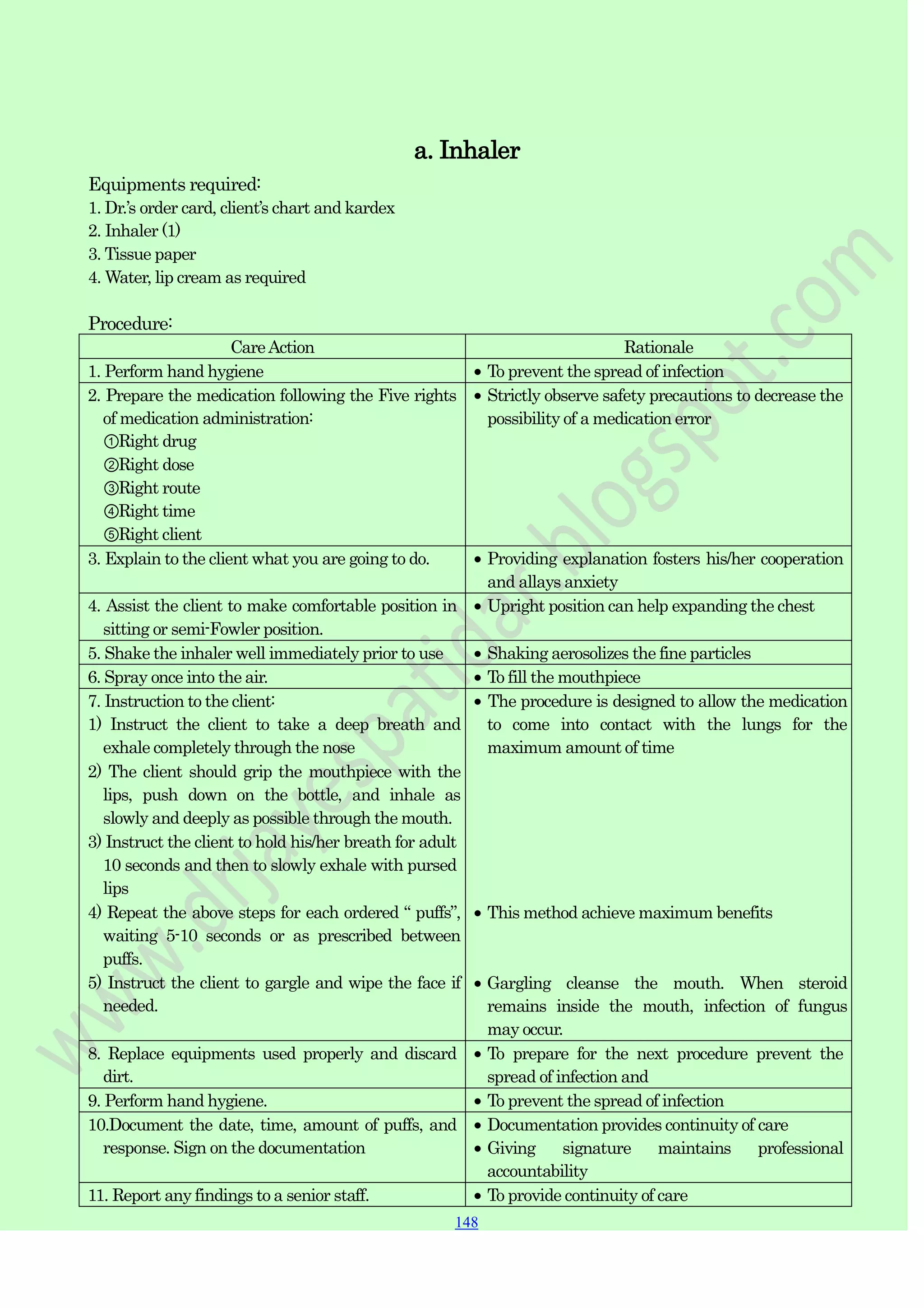
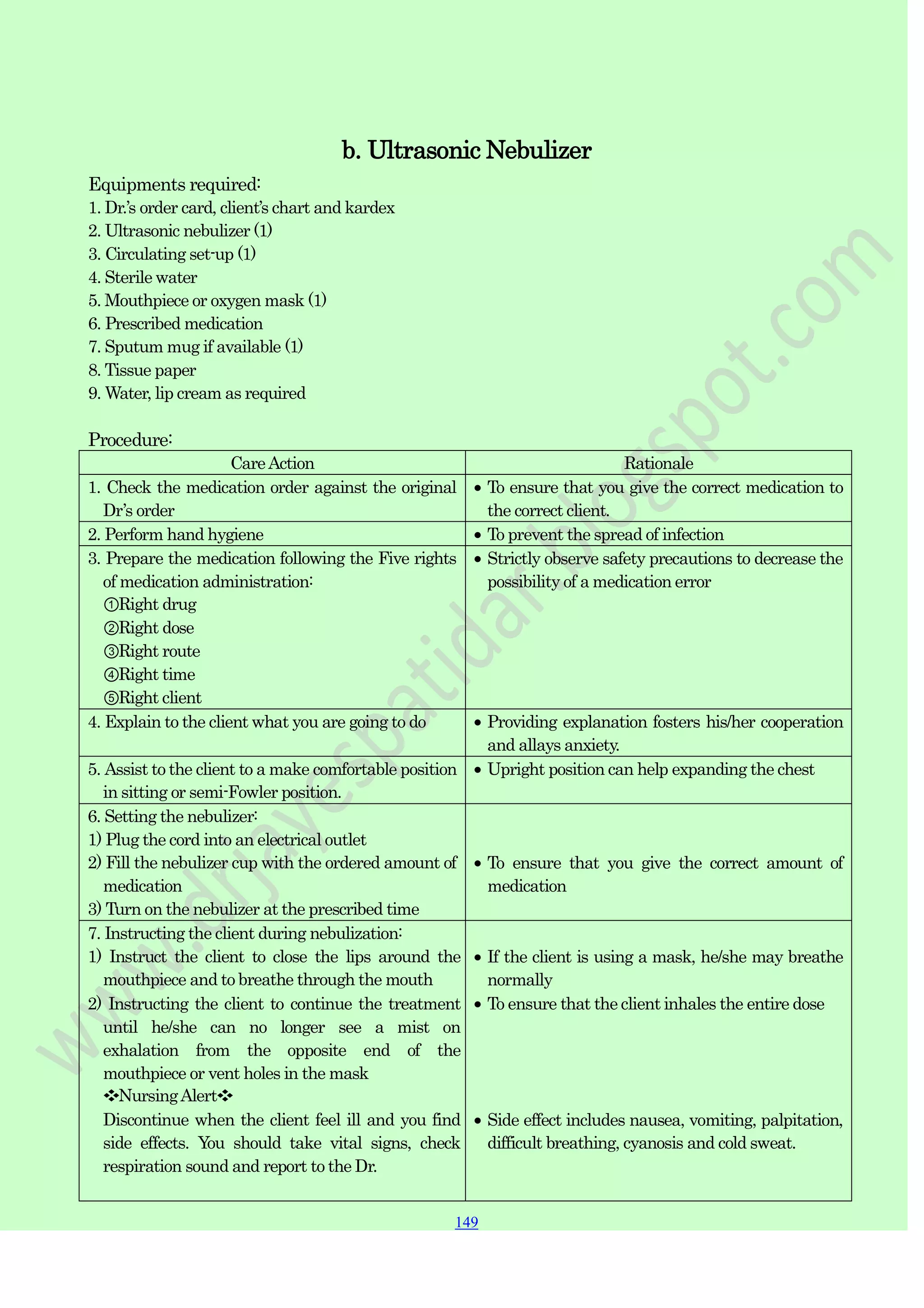
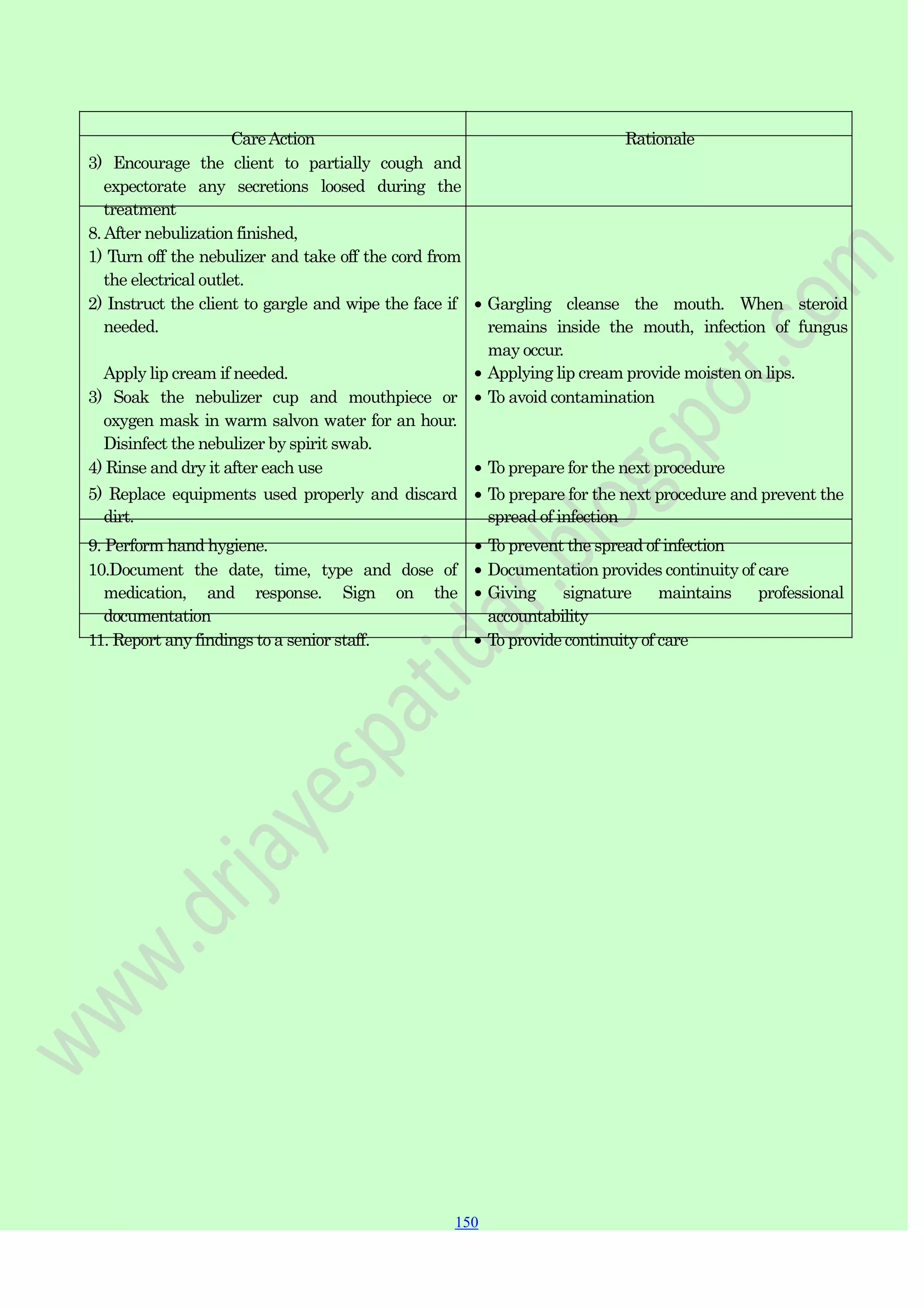
10. Performing Nebulizer Therapy 147
a. Inhaler 148
b. Ultrasonic nebulizer 149
Fundamental of Nursing Procedure Manualwww.drjayeshpatidar.blogspot.com
III. Specimen collection 151
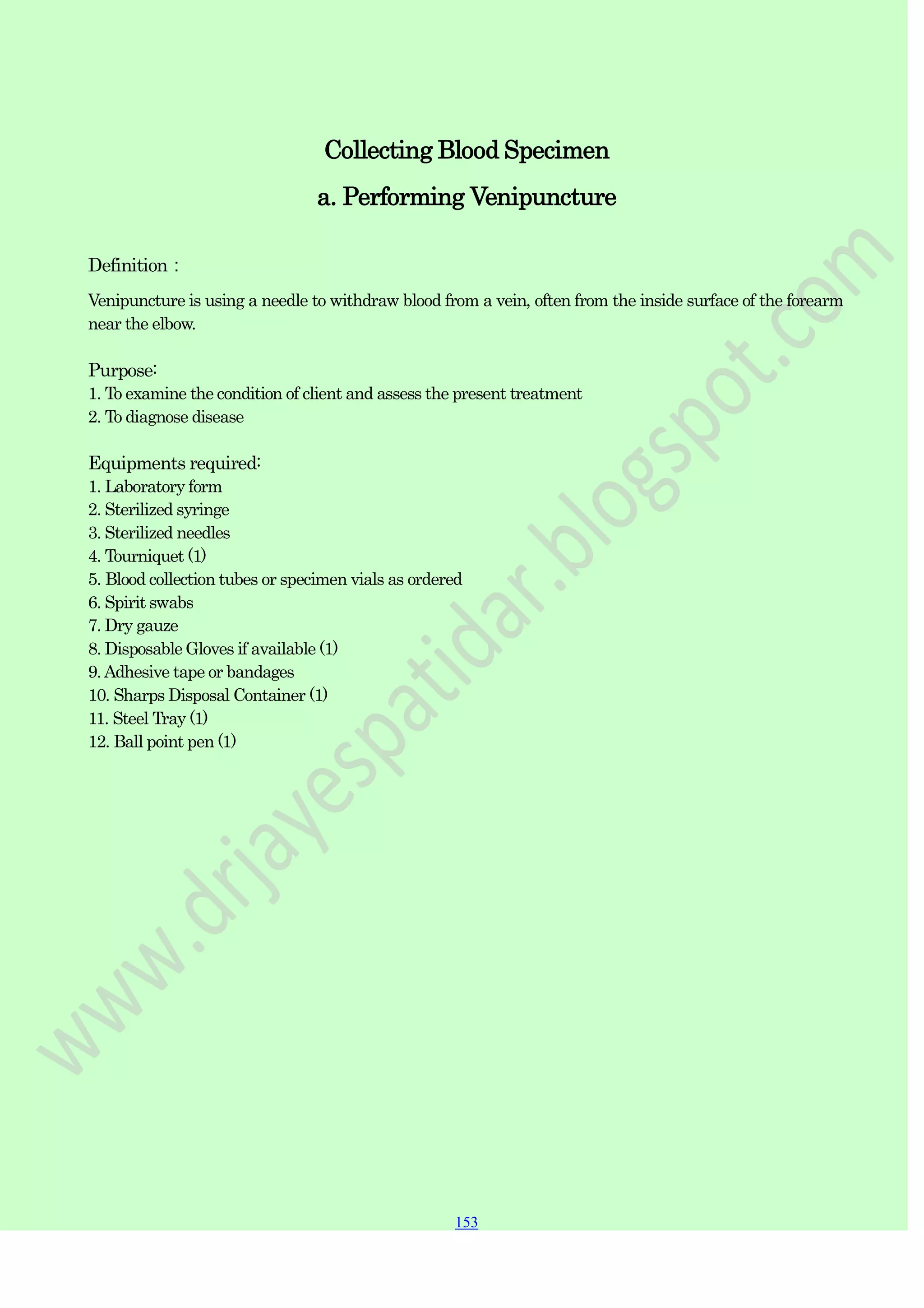
1.Collecting blood specimen 153
a. Performing venipuncture 153
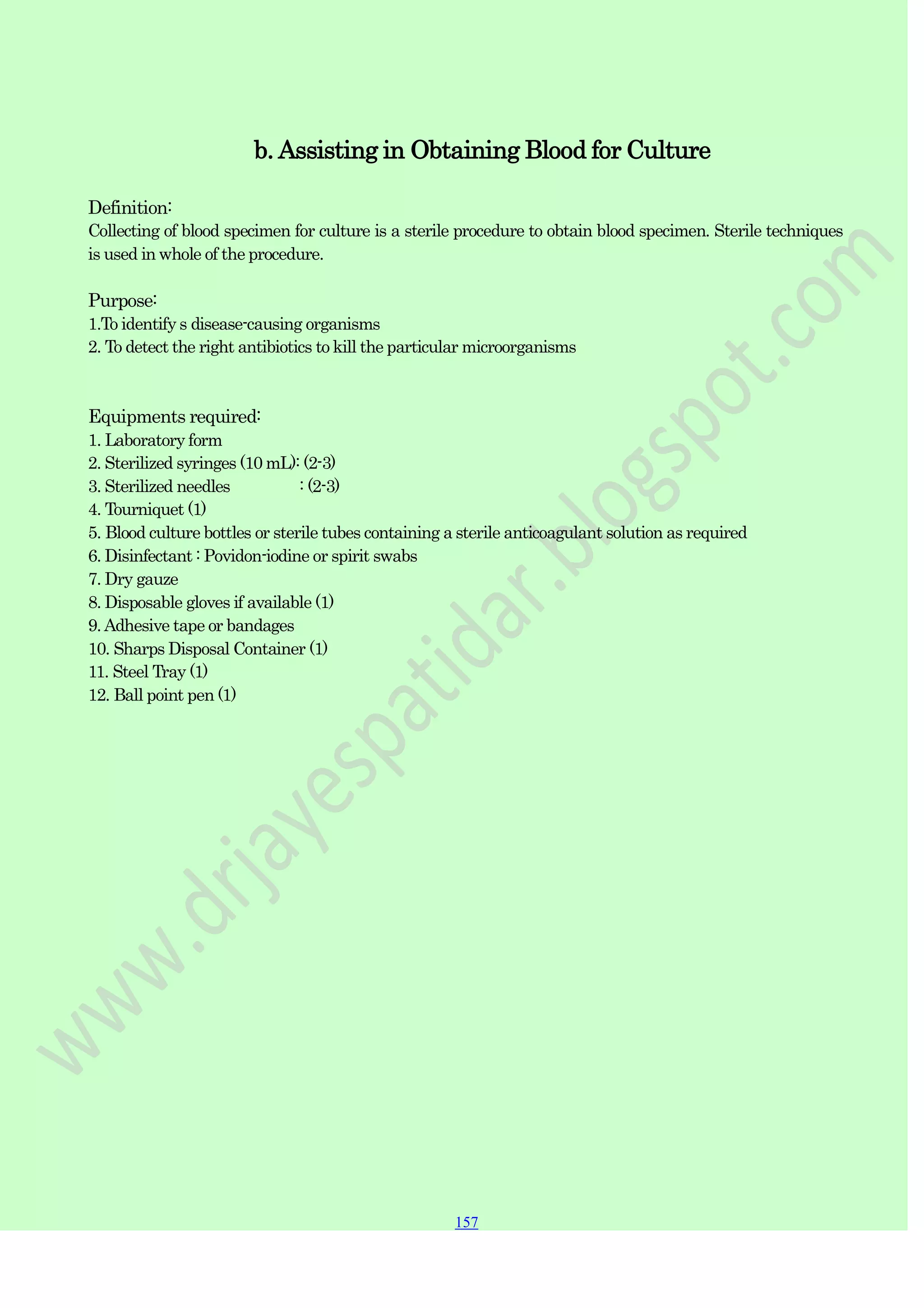
b. Assisting in obtaining blood for culture 157
2.Collecting urine specimen 159
a. Collecting a single voided specimen 160
b. Collecting a 24-hour urine specimen 161
c. Collecting a urine specimen from a retention catheter 163
d. Collecting a urine culture 164
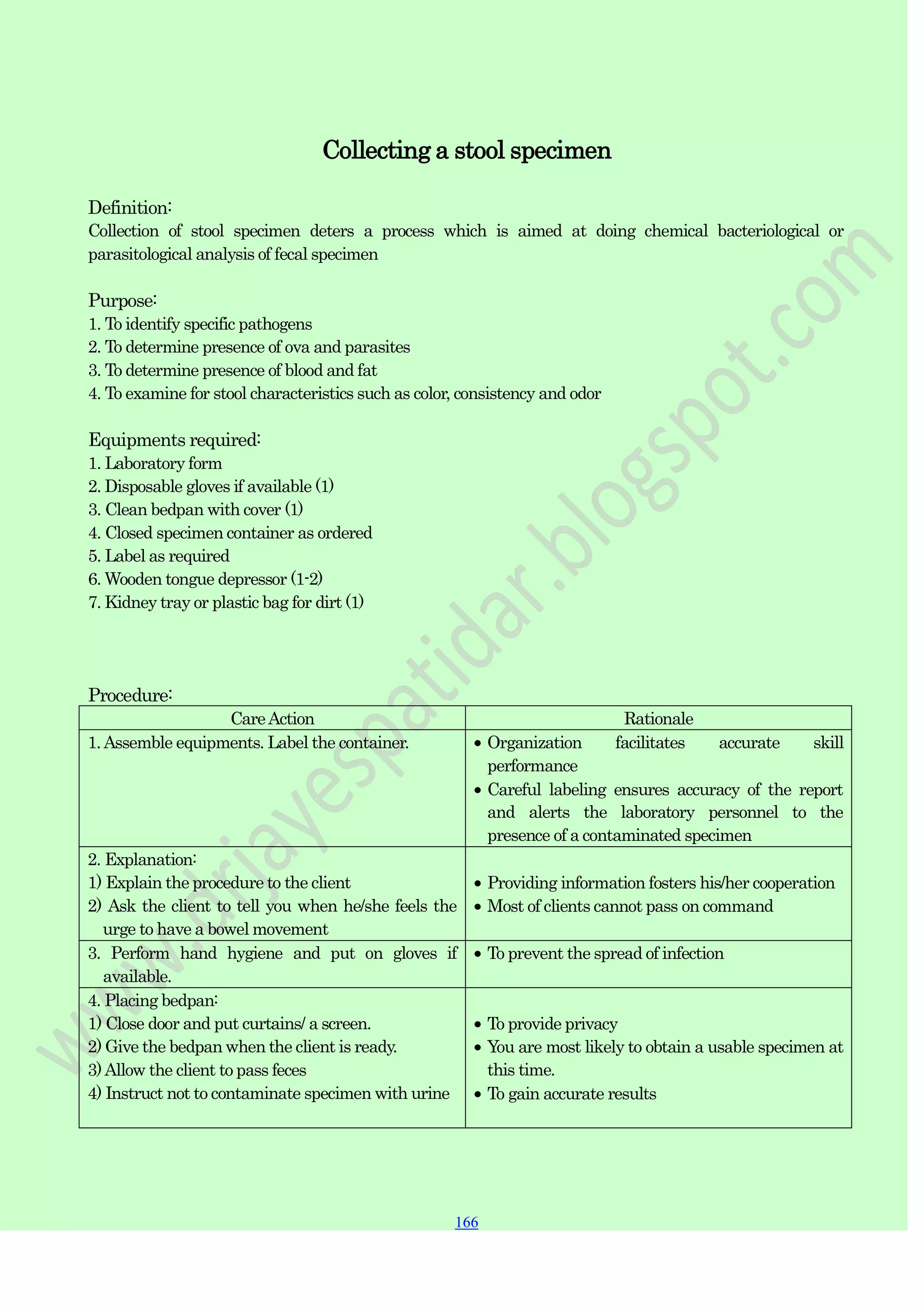
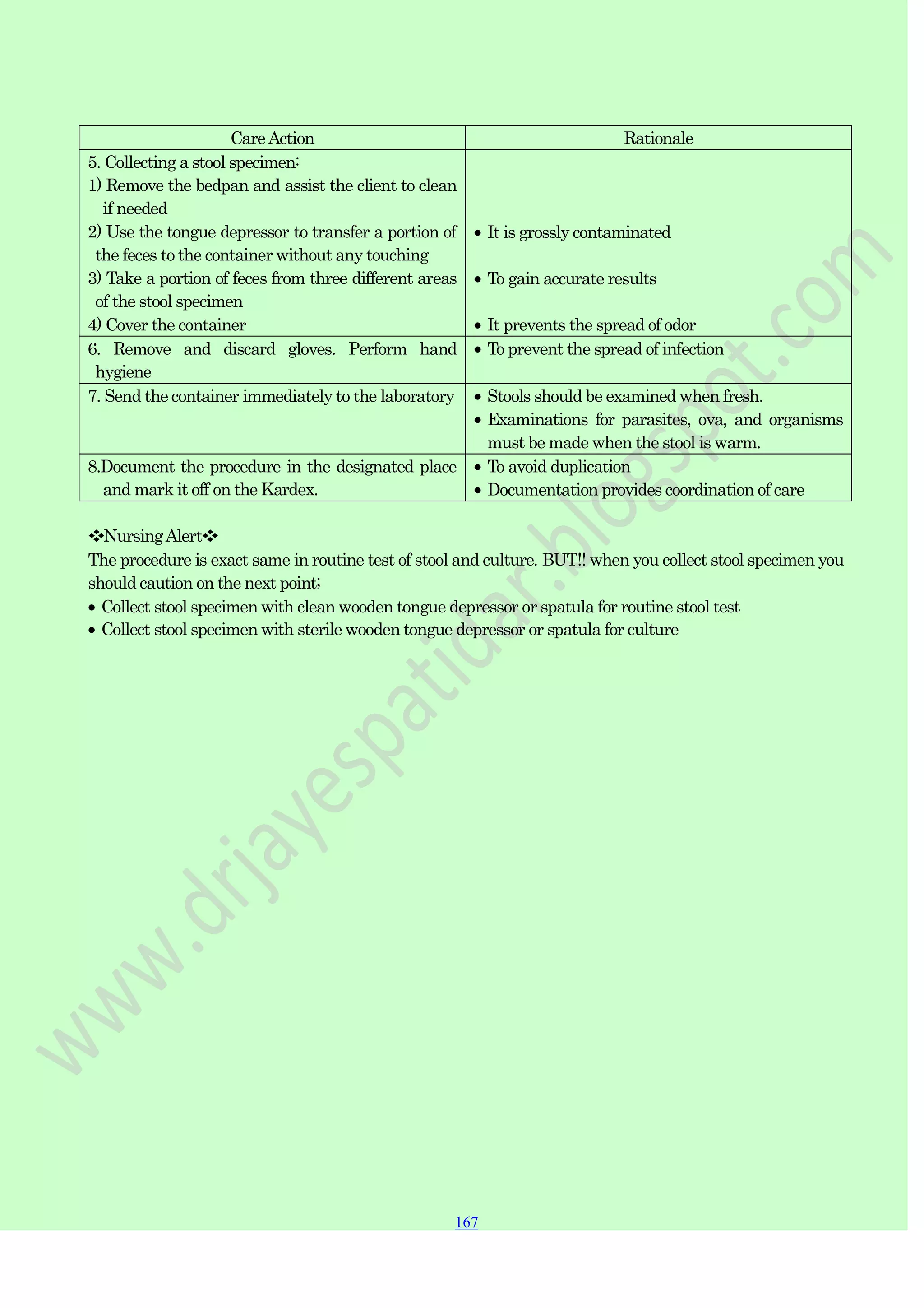
3. Collecting a stool specimen 166
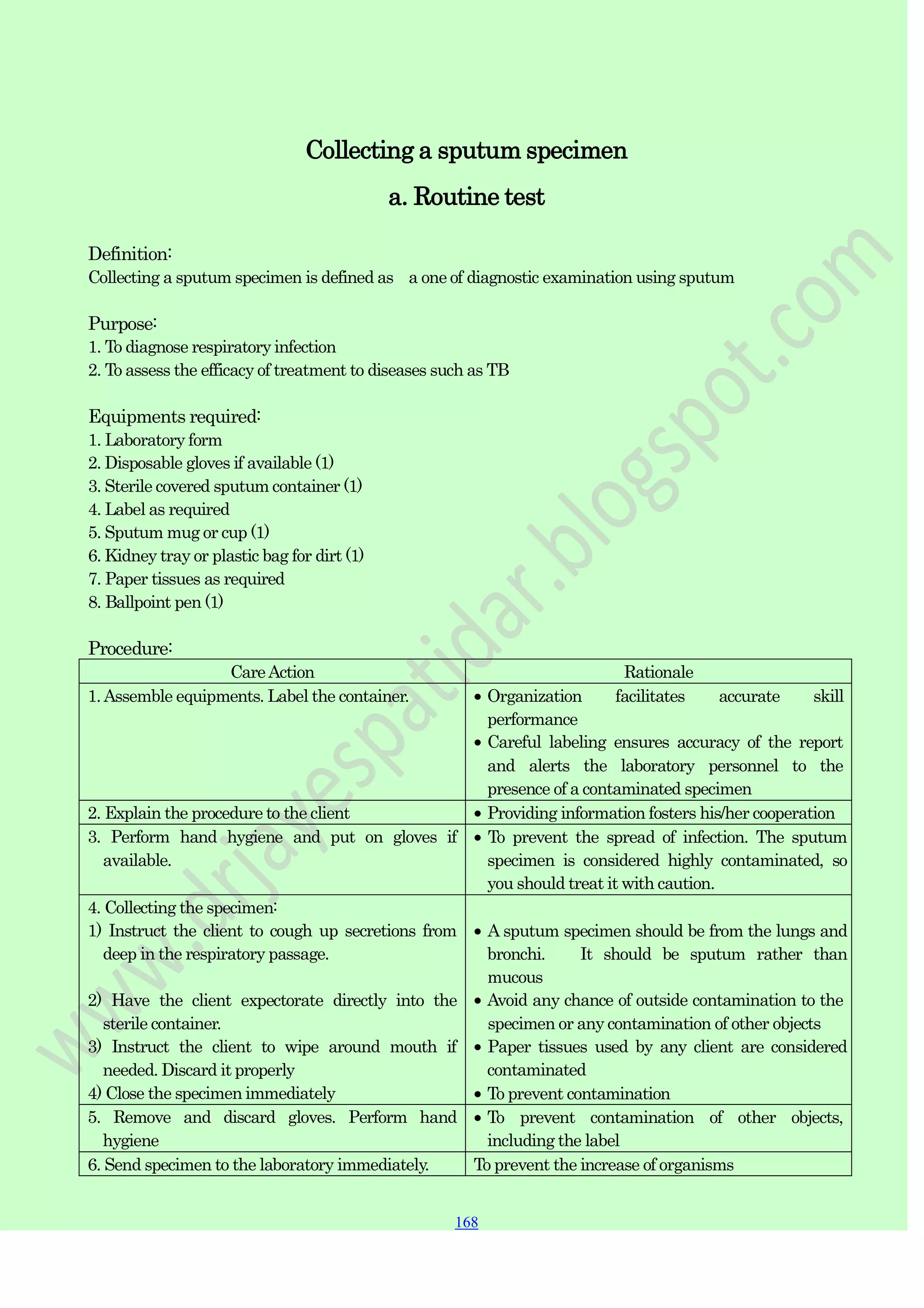
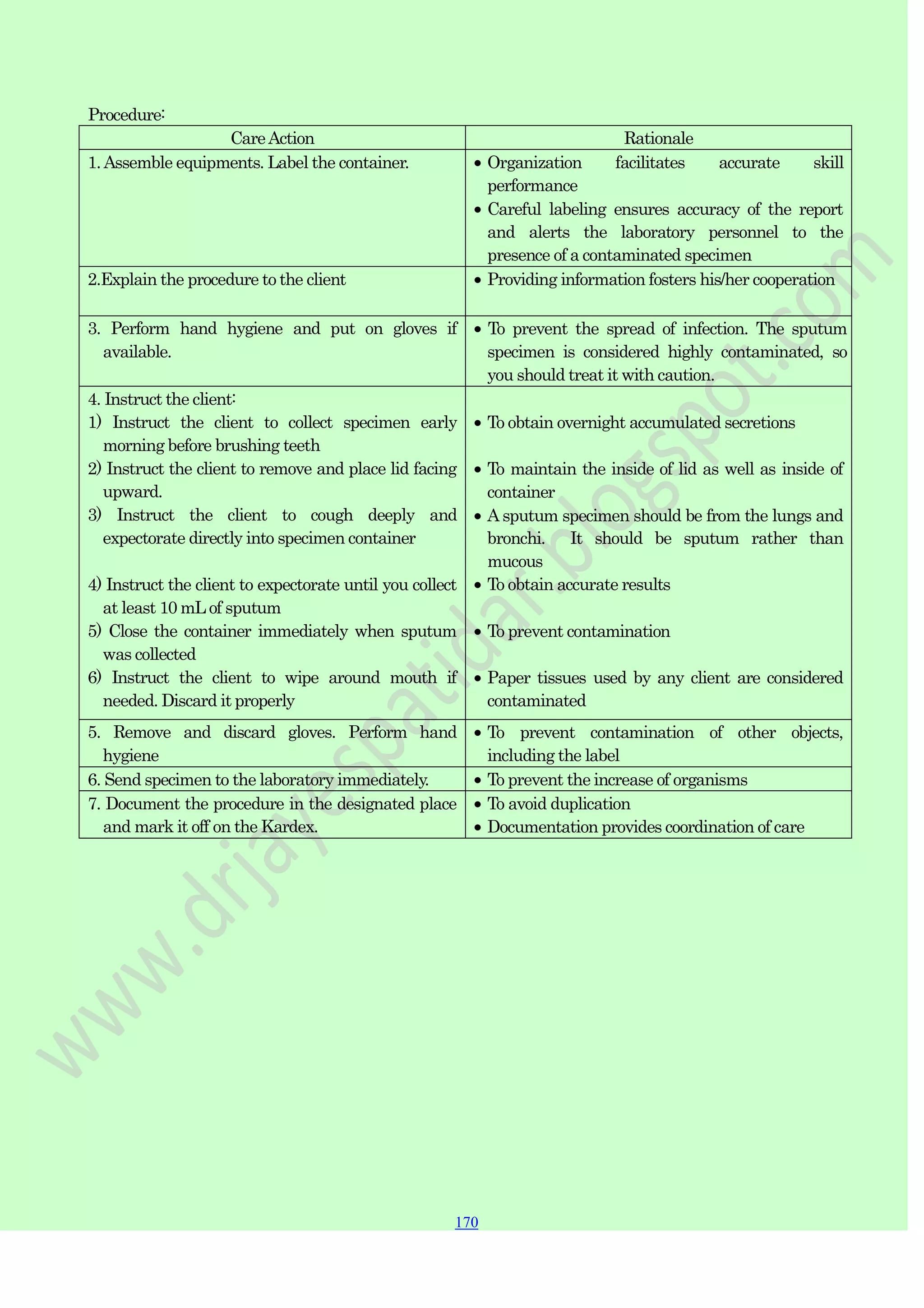
4. Collecting a sputum specimen 168
a. Routine test 168
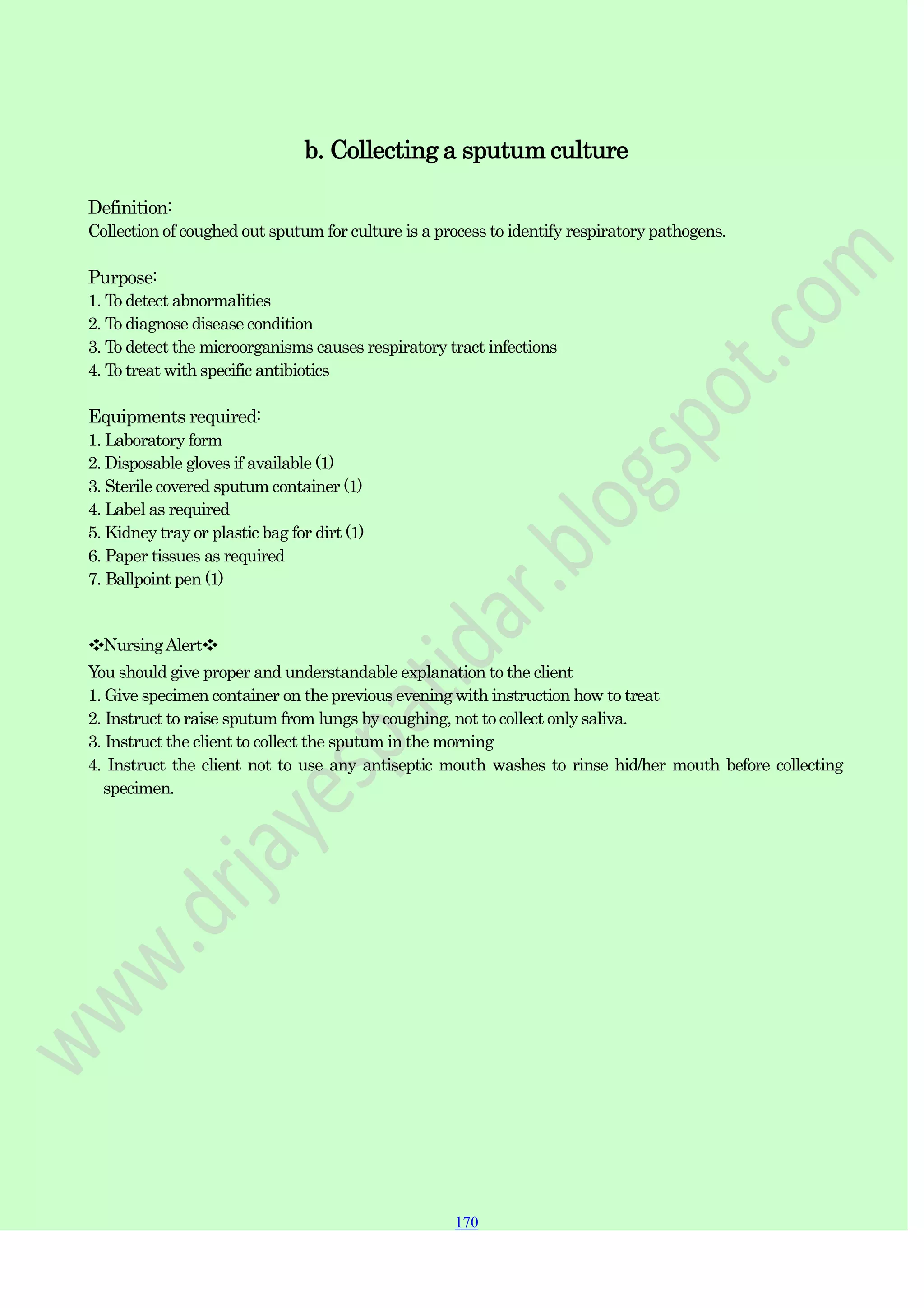
b. Collecting a sputum culture 169
Appendix
References
171
181
Fundamental of Nursing Procedure Manual
6
Fundamental of Nursing Procedure Manual
I. Basic Nursing Care/ Skill
7
Fundamental of Nursing Procedure Manual
8
9
Bed making
a. Making an Un-occupied Bed
Definition:
Abed prepared to receive a new patient is an un-occupied bed.
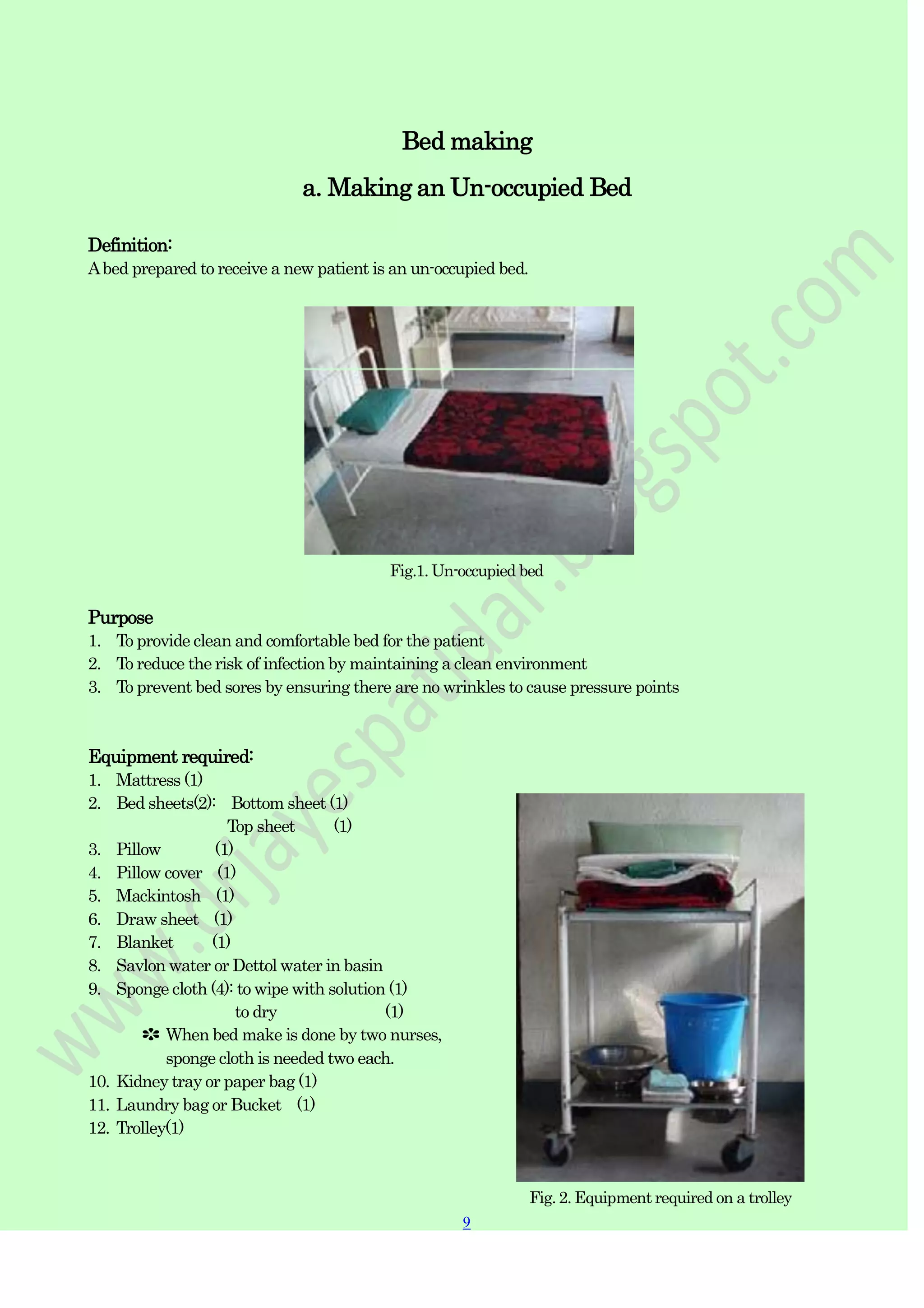
Fig.1. Un-occupied bed
Purpose
1. To provide clean and comfortable bed for the patient
2. To reduce the risk of infection by maintaining a clean environment
3. To prevent bed sores by ensuring there are no wrinkles to cause pressure points
Equipment required:
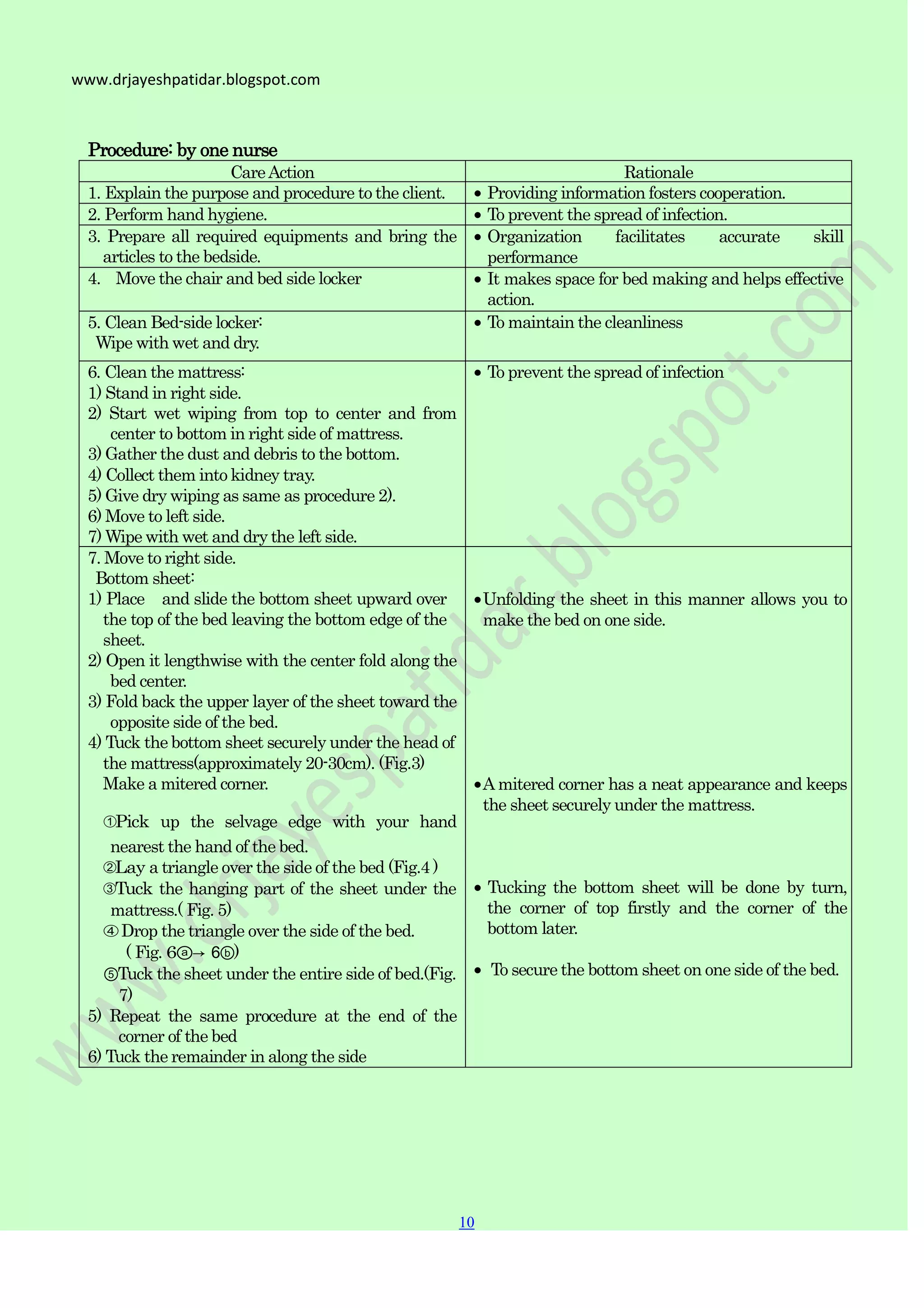
1. Mattress (1)
2. Bed sheets(2): Bottom sheet (1)
Top sheet (1)
3. Pillow (1)
4. Pillow cover (1)
5. Mackintosh (1)
6. Draw sheet (1)
7. Blanket (1)
8. Savlon water or Dettol water in basin
9. Sponge cloth (4): to wipe with solution (1)
to dry (1)
✽ When bed make is done by two nurses,
sponge cloth is needed two each.
10. Kidney tray or paper bag (1)
11. Laundry bag or Bucket (1)
12. Trolley(1)
Fig. 2. Equipment required on a trolley
10
10
www.drjayeshpatidar.blogspot.com
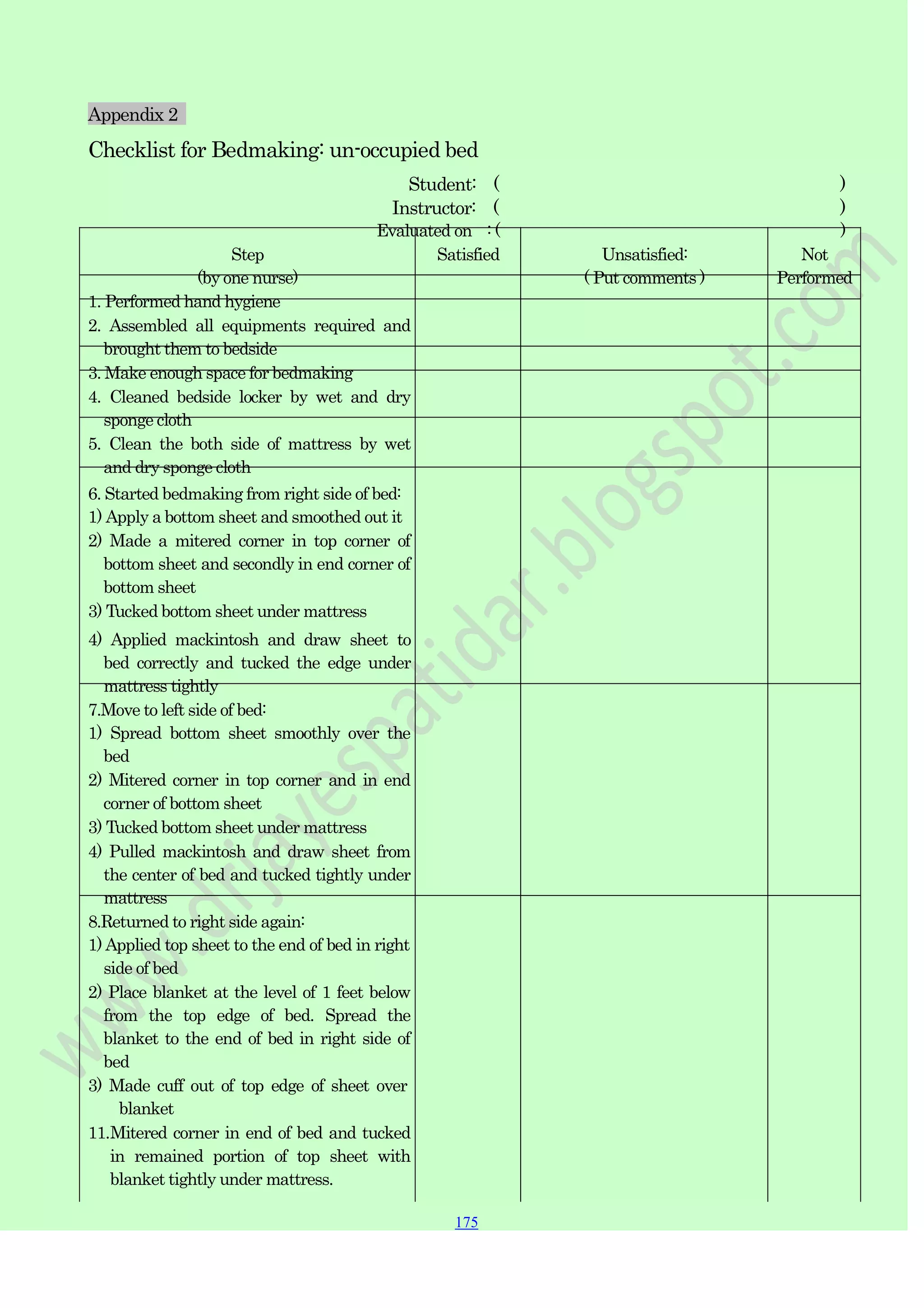
Procedure: by one nurse
CareAction Rationale
1. Explain the purpose and procedure to the client. Providing information fosters cooperation.
2. Perform hand hygiene. To prevent the spread of infection.
3. Prepare all required equipments and bring the
articles to the bedside.
Organization facilitates accurate skill
performance
4. Move the chair and bed side locker It makes space for bed making and helps effective
action.
5. Clean Bed-side locker:
Wipe with wet and dry.
To maintain the cleanliness
6. Clean the mattress:
1) Stand in right side.
2) Start wet wiping from top to center and from
center to bottom in right side of mattress.
3) Gather the dust and debris to the bottom.
4) Collect them into kidney tray.
5) Give dry wiping as same as procedure 2).
6) Move to left side.
7) Wipe with wet and dry the left side.
To prevent the spread of infection
7. Move to right side.
Bottom sheet:
1) Place and slide the bottom sheet upward over
the top of the bed leaving the bottom edge of the
sheet.
2) Open it lengthwise with the center fold along the
bed center.
3) Fold back the upper layer of the sheet toward the
opposite side of the bed.
4) Tuck the bottom sheet securely under the head of
the mattress(approximately 20-30cm). (Fig.3)
Make a mitered corner.
➀Pick up the selvage edge with your hand
nearest the hand of the bed.
➁Lay a triangle over the side of the bed (Fig.4 )
➂Tuck the hanging part of the sheet under the
mattress.( Fig. 5)
➃Drop the triangle over the side of the bed.
( Fig. 6ⓐ→ 6ⓑ)
⑤Tuck the sheet under the entire side of bed.(Fig.
7)
5) Repeat the same procedure at the end of the
corner of the bed
6) Tuck the remainder in along the side
Unfolding the sheet in this manner allows you to
make the bed on one side.
A mitered corner has a neat appearance and keeps
the sheet securely under the mattress.
Tucking the bottom sheet will be done by turn,
the corner of top firstly and the corner of the
bottom later.
To secure the bottom sheet on one side of the bed.
11
11
www.drjayeshpatidar.blogspot.com
8. Mackintosh and draw sheet:
1) Place a mackintosh at the middle of the bed ( if
used), folded half, with the fold in the center of
the bed. used), folded half, with the fold in the
center of the bed.
2) Lift the right half and spread it forward the near
Side.
Mackintosh and draw sheet are additional
protection for the bed and serves as a lifting or
turning sheet for an immobile client.
12
12
www.drjayeshpatidar.blogspot.com
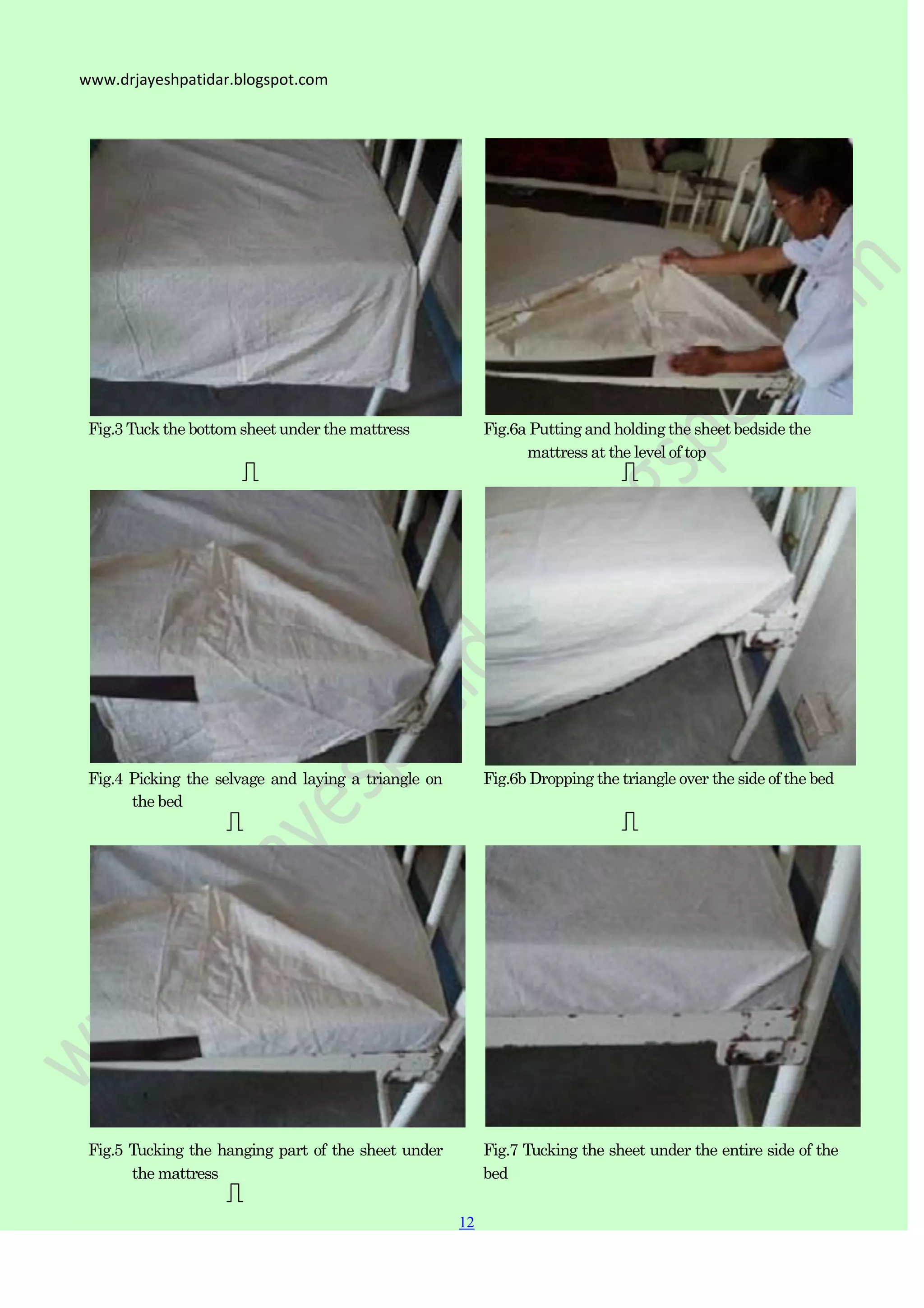
Fig.3 Tuck the bottom sheetunder the mattress
Fig.4 Picking the selvage and laying a triangle on
the bed
Fig.6a Putting and holding the sheet bedside the
mattress at the level of top
Fig.6b Dropping the triangle over the side of the bed
Fig.5 Tucking the hanging part of the sheet under
the mattress
Fig.7 Tucking the sheet under the entire side of the
bed
13
13
www.drjayeshpatidar.blogspot.com
CareAction Rationale
3) Tuck the mackintosh under the mattress.
4) Place the draw sheet on the mackintosh. Spread
and tuck as same as procedure 1)-3).
9.Move to the left side of the bed.
Bottom sheet , mackintosh and draw sheet:
1) Fold and tuck the bottom sheet as in the above
procedure 7.
2) Fold and tuck both the mackintosh and the draw
sheet under the mattress as in the above
procedure 8.
Secure the bottom sheet, mackintosh and draw
sheet on one side of the bed
10. Return to the right side.
Top sheet and blanket:
1) Place the top sheet evenly on the bed, centering
it in the below 20-30cm from the top of the
mattress.
2) Spread it downward.
3) Cover the top sheet with blanket in the below 1
feet from the top of the mattress and spread
downward.
4) Fold the cuff (approximately 1 feet) in the neck
part
5) Tuck all these together under the bottom of
mattress. Miter the corner.
6) Tuck the remainder in along the side
Ablanket provides warmth.
Making the cuff at the neck part prevents
irritation from blanket edge.
Tucking all these pieces together saves time and
provides a neat appearance.
11. Repeat the same as in the above procedure 10 in
left side.
To save time in this manner
12. Return to the right side.
Pillow and pillow cover:
1) Put a clean pillow cover on the pillow.
2) Place a pillow at the top of the bed in the center
with the open end away from the door.
Apillow is a comfortable measure.
Pillow cover keeps cleanliness of the pillow and
neat.
The open end may collect dust or organisms.
The open end away from the door also makes
neat.
13. Return the bed, the chair and bed-side table to
their proper place.
Bedside necessities will be within easy reach for
the client .
14. Replace all equipments in proper place.
Discard lines appropriately.
It makes well-setting for the next.
Proper line disposal prevents the spread of
infection.
15. Perform hand hygiene To prevent the spread of infection.
NursingAlert 
Do not let your uniform touch the bed and the floor not to contaminate yourself.
Never throw soiled lines on the floor not to contaminate the floor.
Staying one side of the bed until one step completely made saves steps and time to do effectively and
save the time.
14
14
www.drjayeshpatidar.blogspot.com
Bed making
b. Changing an Occupied Bed
Definition
The procedure that used lines are changed to a hospitalized patient is an occupied bed.
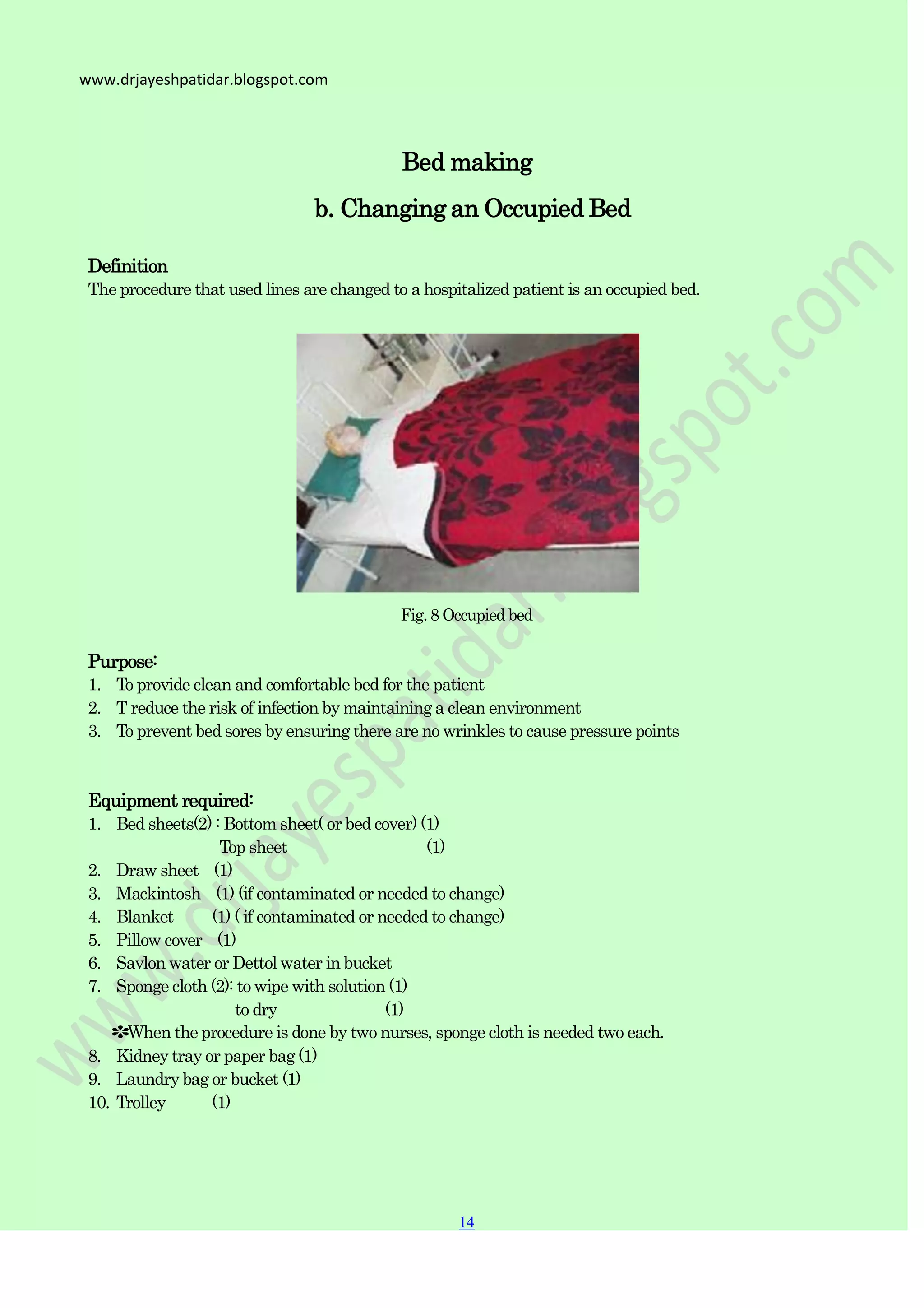
Fig. 8 Occupied bed
Purpose:
1. To provide clean and comfortable bed for the patient
2. T reduce the risk of infection by maintaining a clean environment
3. To prevent bed sores by ensuring there are no wrinkles to cause pressure points
Equipment required:
1. Bed sheets(2) : Bottom sheet( or bed cover) (1)
Top sheet (1)
2. Draw sheet (1)
3. Mackintosh (1) (if contaminated or needed to change)
4. Blanket (1) ( if contaminated or needed to change)
5. Pillow cover (1)
6. Savlon water or Dettol water in bucket
7. Sponge cloth (2): to wipe with solution (1)
to dry (1)
✽When the procedure is done by two nurses, sponge cloth is needed two each.
8. Kidney tray or paper bag (1)
9. Laundry bag or bucket (1)
10. Trolley (1)
15
15
www.drjayeshpatidar.blogspot.com
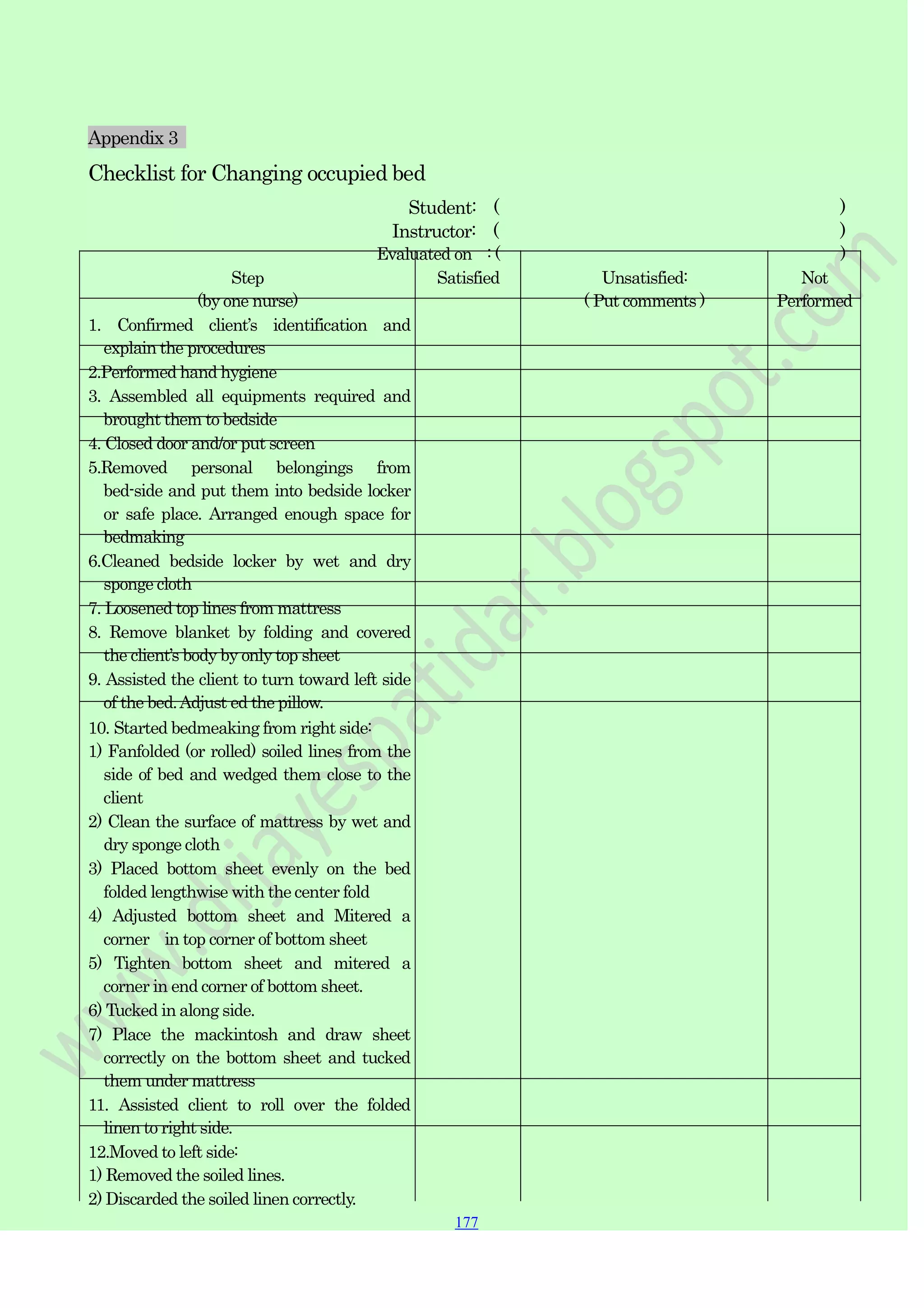
Procedure: by one nurse
CareAction Rationale
1. Check the client‟s identification and condition. To assess necessity and sufficient condition
2. Explain the purpose and procedure to the client Providing information fosters cooperation
3. Perform hand hygiene To prevent the spread of infection.
4. Prepare all required equipments and bring the
articles to the bedside.
Organization facilitates accurate skill performance
5. Close the curtain or door to the room. Put screen. To maintain the client‟s privacy.
6. Remove the client‟s personal belongings from
bed-side and put then into the bed-side locker or
safe place.
To prevent personal belongings from damage and
loss.
7. Lift the client‟s head and move pillow from center
to the left side.
The pillow is comfortable measure for the client.
8. Assist the client to turn toward left side of the
bed. Adjust the pillow. Leaves top sheet in place.
Moving the client as close to the other side of the
bed as possible gives you more room to make the
bed.
Top sheet keeps the client warm and protect his or
her privacy.
9.Stand in right side:
Loose bottom bed linens. Fanfold (or roll) soiled
linens from the side of the bed and wedge them
close to the client.
Placing folded (or rolled) soiled linen close to the
client allows more space to place the clean bottom
sheets.
10. Wipe the surface of mattress by sponge cloth
with wet and dry.
To prevent the spread of infection.
11. Bottom sheet, mackintosh and draw sheet:
1) Place the clean bottom sheet evenly on the bed
folded lengthwise with the center fold as close to
the client‟s back as possible.
2) Adjust and tuck the sheet tightly under the head
of the mattress, making mitered the upper
corner.
3) Tighten the sheet under the end of the mattress
and make mitered the lower corner.
4) Tuck in along side.
5) Place the mackintosh and the draw sheet on the
bottom sheet and tuck in them together.
Soiled linens can easily be removed and clean
linens are positioned to make the other side of the
bed.
12. Assist the client to roll over the folded (rolled)
linen to right side of the bed. Readjust the pillow
and top sheet.
Moving the client to the bed‟s other side allows you
to make the bed on that side.
13. Move to left side:
Discard the soiled linens appropriately. Hold
them away from your uniform. Place them in the
laundry bag (or bucket).
Soiled linens can contaminate your uniform,
which may come into contact with other clients.
14. Wipe the surface of the mattress by sponge cloth
with wet and dry.
To prevent the spread of infection.
15. Bottom sheet, mackintosh and draw sheet:
1) Grasp clean linens and gently pull them out from
under the client.
2) Spread them over the bed‟s unmade side. Pull the
linens taut
Wrinkled linens can cause skin irritation.
Fundamental of Nursing Procedure Manual
CareAction Rationale
3) Tuck the bottom sheet tightly under the head of
the mattress and miter the corner.
4) Tighten the sheet under the end of the mattress
and make mitered the lower corner.
5) Tuck in along side.
6) Tuck the mackintosh and the draw sheet under
the mattress.
16. Assist the client back to the center of the bed.
Adjust the pillow.
The pillow is comfort measure for the client.
17. Return to right side:
Clean top sheet, blanket:
1) Place the clean top sheet at the top side of the
soiled top sheet.
2)Ask the client to hold the upper edge of the clean
top sheet.
3) Hold both the top of the soiled sheet and the end
of the clean sheet with right hand and withdraw
to downward. Remove the soiled top sheet and
put it into a laundry bag (or a bucket).
4) Place the blanket over the top sheet. Fold top
sheet back over the blanket over the client.
5) Tuck the lower ends securely under the mattress.
Miter corners.
6)After finishing the right side, repeat the left side.
Tucking these pieces together saves time and
provides neat, tight corners.
18. Remove the pillow and replace the pillow cover
with clean one and reposition the pillow to the
bed under the client‟s head.
The pillow is a comfortable measures for a client
19. Replace personal belongings back. Return the
bed-side locker and the bed as usual.
To prevent personal belongings from loss and
provide safe surroundings
20. Return all equipments to proper place. To prepare for the next procedure
21. Discard linens appropriately. Perform hand
hygiene.
To prevent the spread of infection.
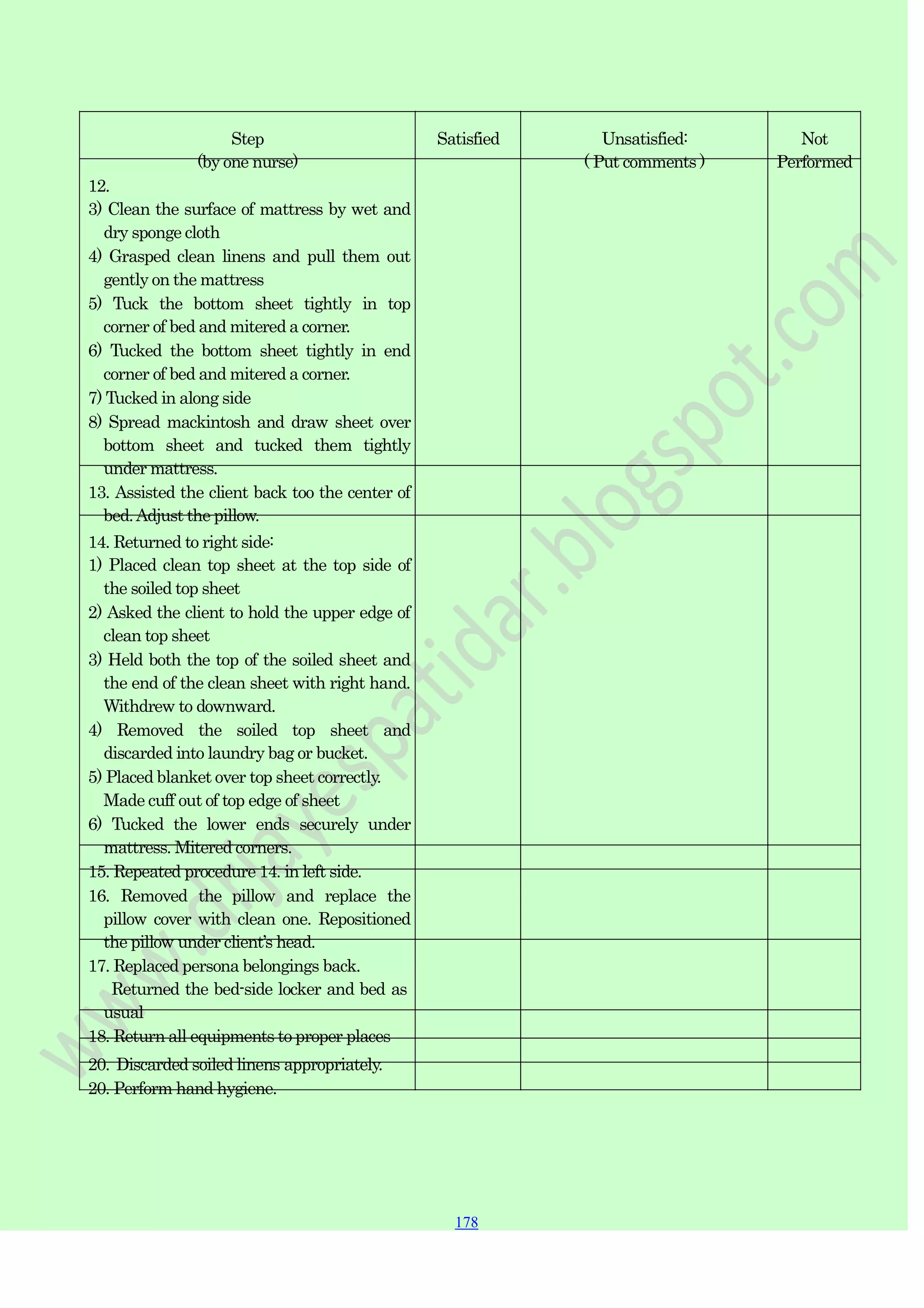
15
16
16
Bed making
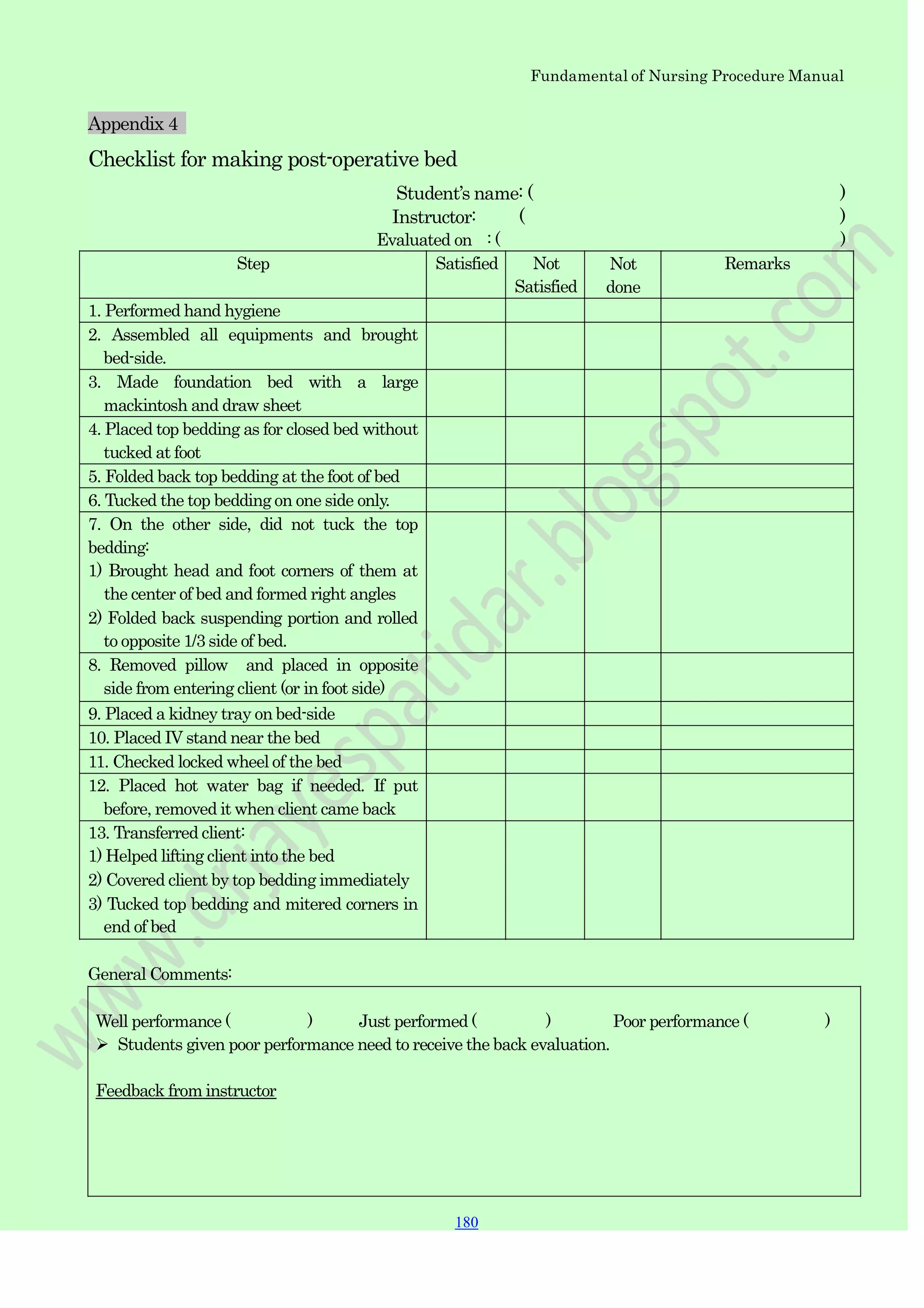
c. Making a Post-operative Bed
Definition:
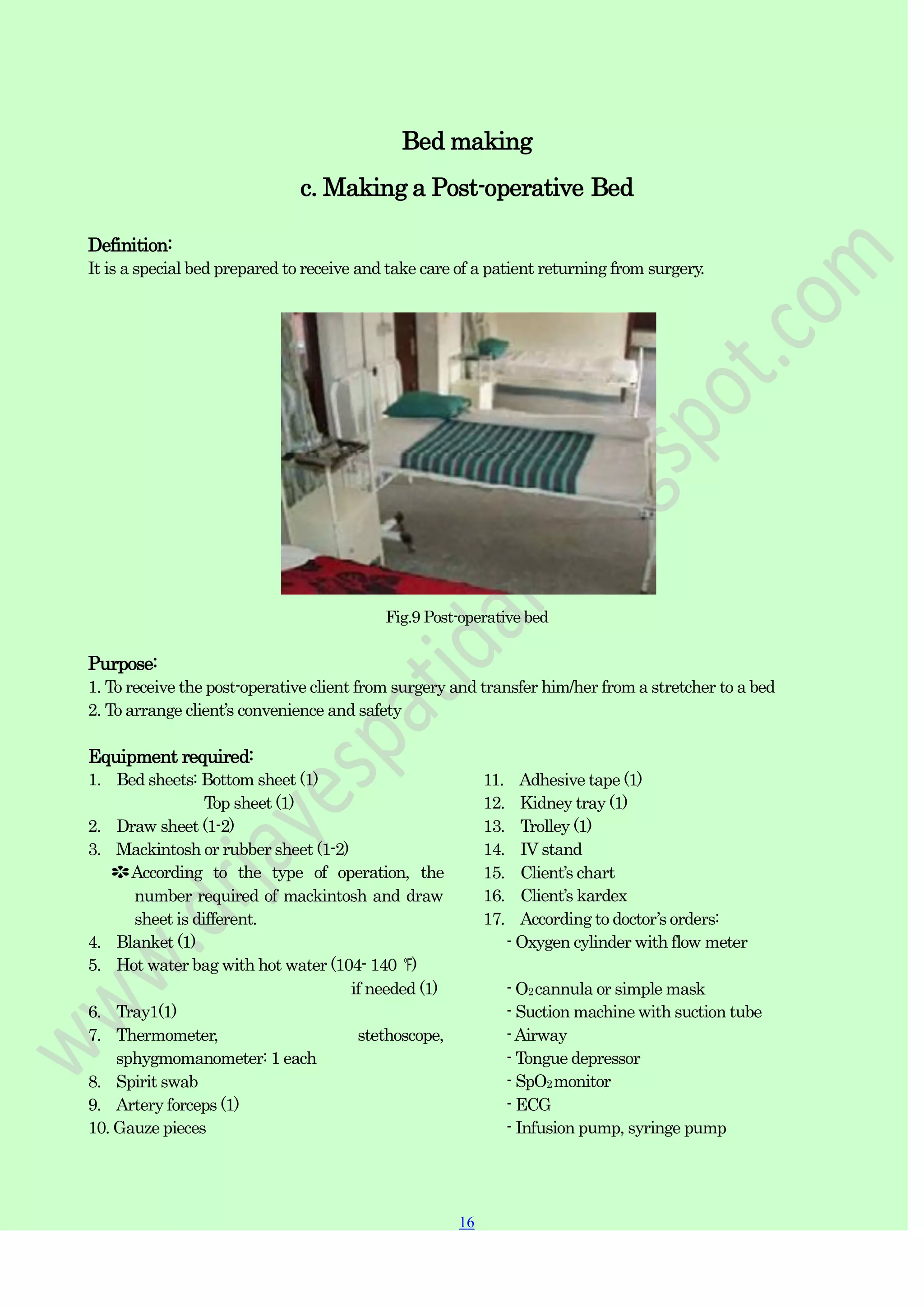
It is a special bed prepared to receive and take care of a patient returning from surgery.
Fig.9 Post-operative bed
Purpose:
1. To receive the post-operative client from surgery and transfer him/her from a stretcher to a bed
2. To arrange client‟s convenience and safety
Equipment required:
1. Bed sheets: Bottom sheet (1)
Top sheet (1)
2. Draw sheet (1-2)
3. Mackintosh or rubber sheet (1-2)
✽According to the type of operation, the
number required of mackintosh and draw
sheet is different.
4. Blanket (1)
5. Hot water bag with hot water (104- 140 ℉)
if needed (1)
6. Tray1(1)
7. Thermometer, stethoscope,
sphygmomanometer: 1 each
8. Spirit swab
9. Artery forceps (1)
10. Gauze pieces
11. Adhesive tape (1)
12. Kidney tray (1)
13. Trolley (1)
14. IV stand
15. Client‟s chart
16. Client‟s kardex
17. According to doctor‟s orders:
- Oxygen cylinder with flow meter
- O2cannula or simple mask
- Suction machine with suction tube
-Airway
- Tongue depressor
- SpO2monitor
- ECG
- Infusion pump, syringe pump
17
17
Procedure: by one nurse
CareAction Rationale
1. Perform hand hygiene To prevent the spread of infection
2.Assemble equipments and bring bed-side Organization facilitates accurate skill
performance
3. Strip bed.
Make foundation bed as usual with a large
mackintosh, and cotton draw sheet.
Mackintosh prevents bottom sheet from wetting
or soiled by sweat, drain or excrement.
Place mackintosh according to operative
technique.
Cotton draw sheet makes the client felt dry or
comfortable without touching the mackintosh
directly.
4. Place top bedding as for closed bed but do not
tuck at foot
Tuck at foot may hamper the client to enter the
bed from a stretcher
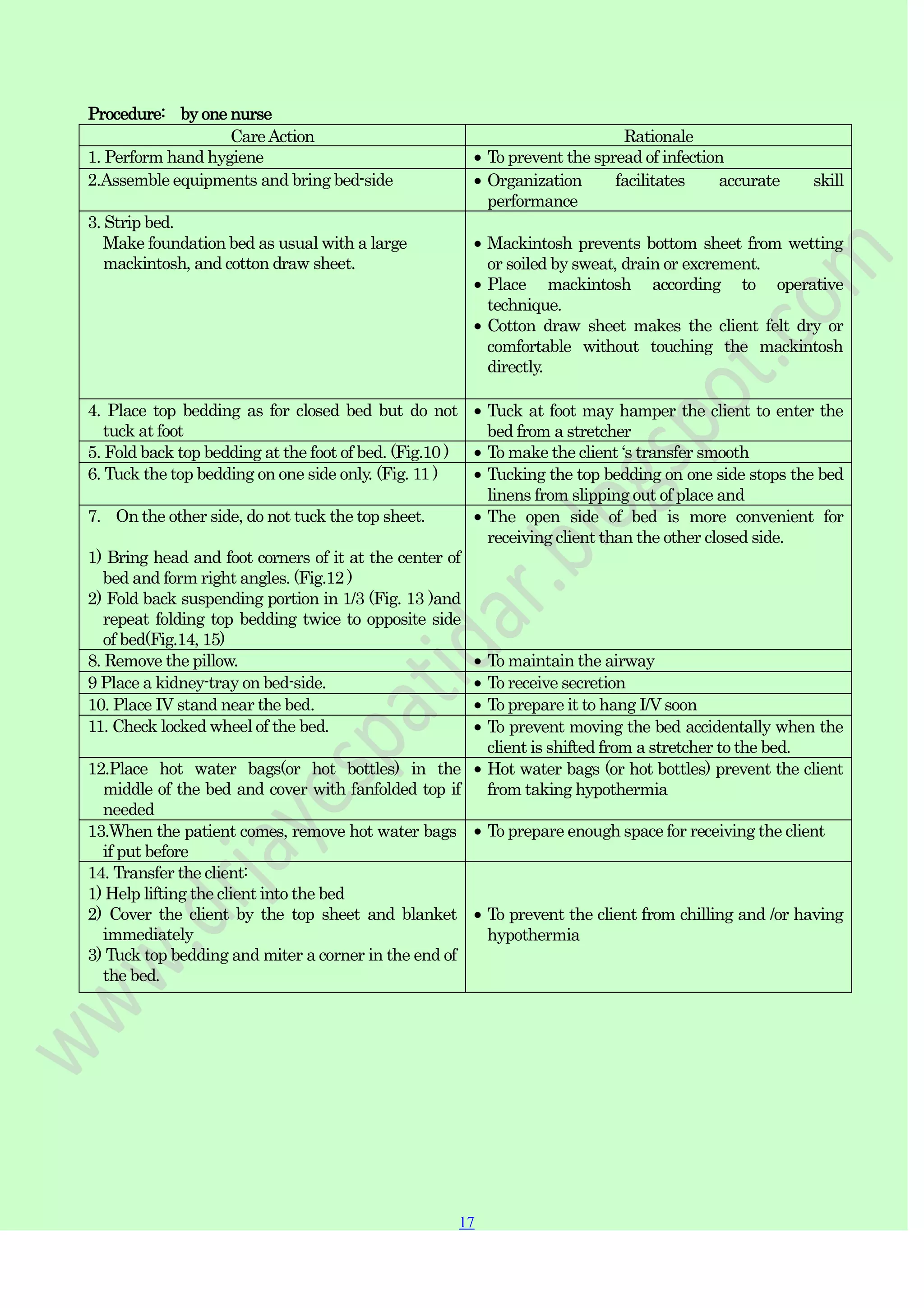
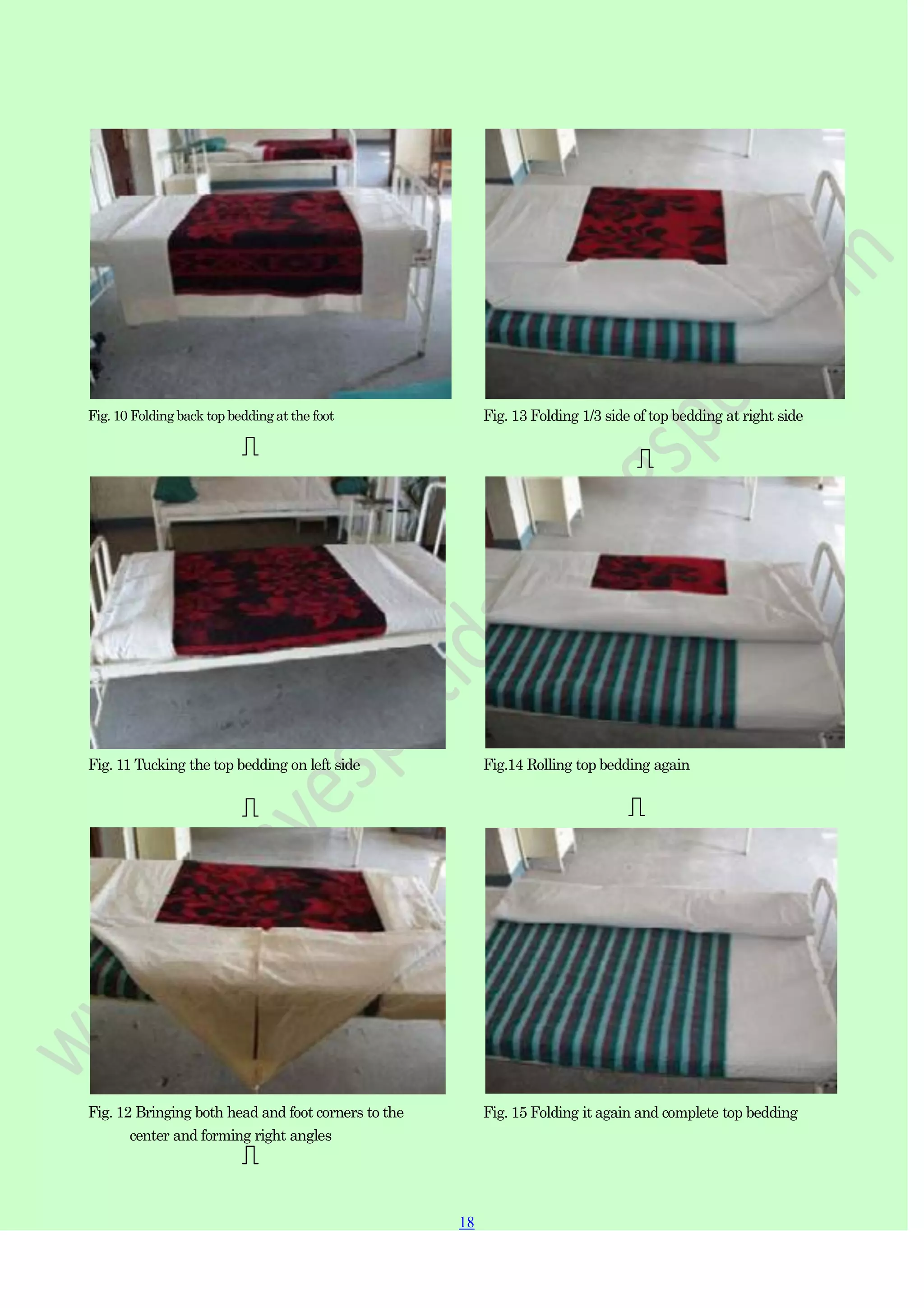
5. Fold back top bedding at the foot of bed. (Fig.10 ) To make the client „s transfer smooth
6. Tuck the top bedding on one side only. (Fig. 11 ) Tucking the top bedding on one side stops the bed
linens from slipping out of place and
7. On the other side, do not tuck the top sheet.
1) Bring head and foot corners of it at the center of
bed and form right angles. (Fig.12 )
2) Fold back suspending portion in 1/3 (Fig. 13 )and
repeat folding top bedding twice to opposite side
of bed(Fig.14, 15)
The open side of bed is more convenient for
receiving client than the other closed side.
8. Remove the pillow. To maintain the airway
9 Place a kidney-tray on bed-side. To receive secretion
10. Place IV stand near the bed. To prepare it to hang I/Vsoon
11. Check locked wheel of the bed. To prevent moving the bed accidentally when the
client is shifted from a stretcher to the bed.
12.Place hot water bags(or hot bottles) in the
middle of the bed and cover with fanfolded top if
needed
Hot water bags (or hot bottles) prevent the client
from taking hypothermia
13.When the patient comes, remove hot water bags
if put before
To prepare enough space for receiving the client
14. Transfer the client:
1) Help lifting the client into the bed
2) Cover the client by the top sheet and blanket
immediately
3) Tuck top bedding and miter a corner in the end of
the bed.
To prevent the client from chilling and /or having
hypothermia
18
18
Fig. 10 Folding back top beddingat the foot Fig. 13 Folding 1/3 side of top bedding at right side
Fig. 11 Tucking the top bedding on left side Fig.14 Rolling top bedding again
Fig. 12 Bringing both head and foot corners to the
center and forming right angles
Fig. 15 Folding it again and complete top bedding
19
19
Performing Oral Care
Definition:
Mouth care is defined as the scientific care of the teeth and mouth.
Purpose:
1. To keep the mucosa clean, soft, moist and intact
2. To keep the lips clean, soft, moist and intact
3. To prevent oral infections
4. To remove food debris as well as dental plaque without damaging the gum
5. To alleviate pain, discomfort and enhance oral intake with appetite
6. To prevent halitosis or relieve it and freshen the mouth
Equipment required:
1. Tray (1)
2. Gauze-padded tongue depressor (1): to suppress tongue
3. Torch(1)
4. Appropriate equipments for cleaning:
- Tooth brush
- Foam swabs
- Gauze-padded tongue depressor
- Cotton ball with artery forceps (1) and dissecting forceps (1)
5. Oral care agents:
Tooth paste/ antiseptic solution
❖NURSING ALERT❖
You should consider nursing assessment, hospital policy and doctor‟s prescription if there is,
when you select oral care agent. Refer to Table 1. on the next page
6. If you need to prepare antiseptic solution as oral care agent:
Gallipot (2): to make antiseptic solution(1)
to set up cotton ball after squeezed (1)
7. Cotton ball
8. Kidney tray (1)
9. Mackintosh (1): small size
10. Middle towel (1)
11. Jug with tap water (1)
12. Paper bag(2): for cotton balls (1)
for dirt(1)
13. Gauze pieces as required: to apply a lubricant
14. Lubricants: Vaseline/ Glycerin/ soft white paraffin gel/ lip cream (1)
15. Suction catheter with suction apparatus (1): if available
16. Disposable gloves( 1 pair): if available
20
20
NOTE:
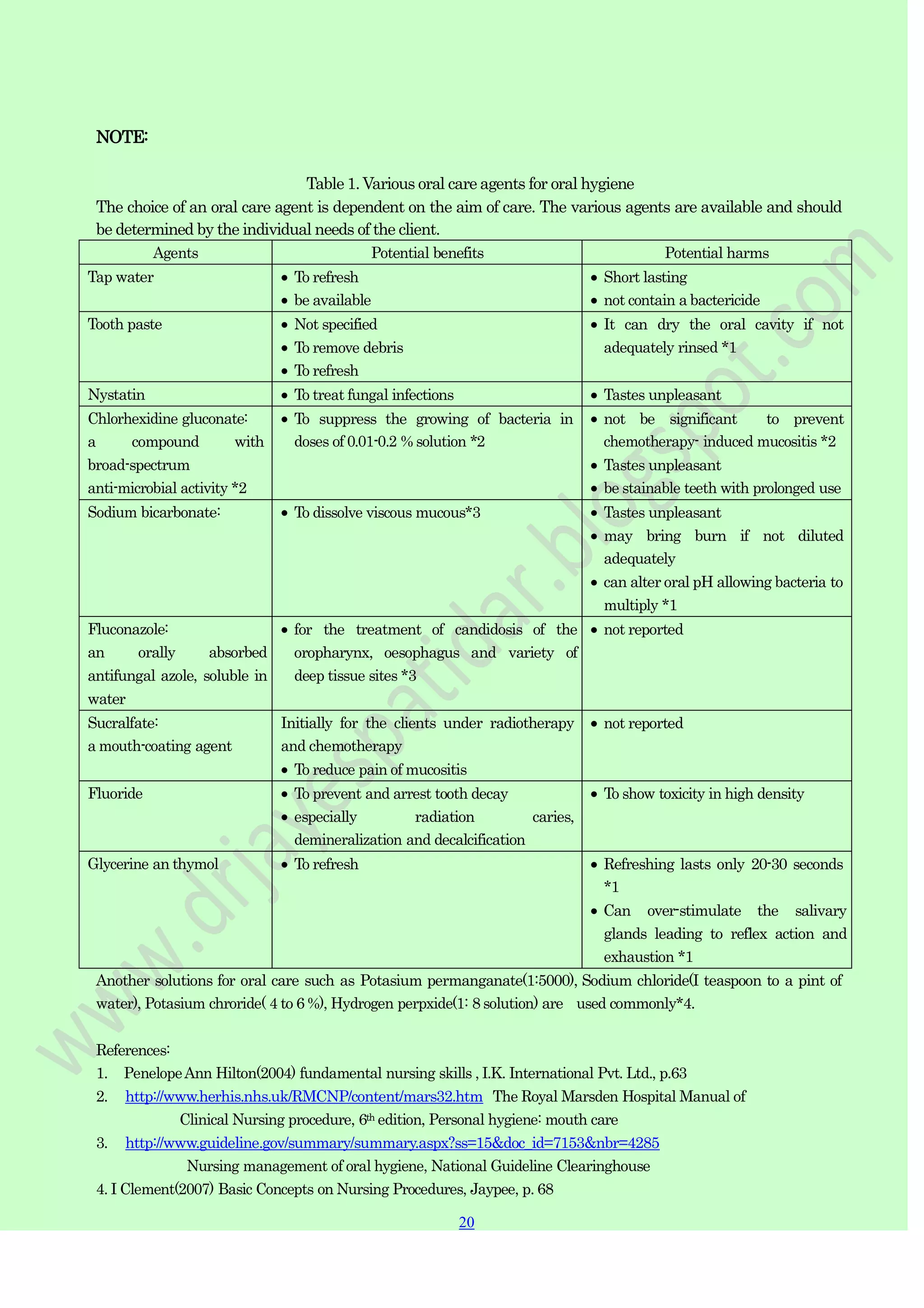
Table 1. Various oral care agents for oral hygiene
The choice of an oral care agent is dependent on the aim of care. The various agents are available and should
be determined by the individual needs of the client.
Agents Potential benefits Potential harms
Tap water To refresh
be available
Short lasting
not contain a bactericide
Tooth paste Not specified
To remove debris
To refresh
It can dry the oral cavity if not
adequately rinsed *1
Nystatin To treat fungal infections Tastes unpleasant
Chlorhexidine gluconate:
a compound with
broad-spectrum
anti-microbial activity *2
To suppress the growing of bacteria in
doses of 0.01-0.2 % solution *2
not be significant to prevent
chemotherapy- induced mucositis *2
Tastes unpleasant
be stainable teeth with prolonged use
Sodium bicarbonate: To dissolve viscous mucous*3 Tastes unpleasant
may bring burn if not diluted
adequately
can alter oral pH allowing bacteria to
multiply *1
Fluconazole:
an orally absorbed
antifungal azole, soluble in
water
for the treatment of candidosis of the
oropharynx, oesophagus and variety of
deep tissue sites *3
not reported
Sucralfate:
a mouth-coating agent
Initially for the clients under radiotherapy
and chemotherapy
To reduce pain of mucositis
not reported
Fluoride To prevent and arrest tooth decay
especially radiation caries,
demineralization and decalcification
To show toxicity in high density
Glycerine an thymol To refresh Refreshing lasts only 20-30 seconds
*1
Can over-stimulate the salivary
glands leading to reflex action and
exhaustion *1
Another solutions for oral care such as Potasium permanganate(1:5000), Sodium chloride(I teaspoon to a pint of
water), Potasium chroride( 4 to 6 %), Hydrogen perpxide(1: 8 solution) are used commonly*4.
References:
1. PenelopeAnn Hilton(2004) fundamental nursing skills , I.K. International Pvt. Ltd., p.63
2. http://www.herhis.nhs.uk/RMCNP/content/mars32.htm The Royal Marsden Hospital Manual of
Clinical Nursing procedure, 6th edition, Personal hygiene: mouth care
3. http://www.guideline.gov/summary/summary.aspx?ss=15&doc_id=7153&nbr=4285
Nursing management of oral hygiene, National Guideline Clearinghouse
4. I Clement(2007) Basic Concepts on Nursing Procedures, Jaypee, p. 68
21
21
Procedure:
a. Assisting the client with Oral care
CareAction Rationale
1.Explain the procedures Providing information fosters cooperation,
understanding and participation in care
2. Collect all instruments required Organization facilitates accurate skill
performance
3. Close door and /or put screen To maintain privacy
4. Perform hand hygiene and wear disposable
gloves if possible
To prevent the spread of infection
5. If you use solutions such as sodium bicarbonate,
prepare solutions required.
Solutions must be prepared each time before use
to maximize their efficacy
6.Assist the client a comfortable upright position or
sitting position
To promote his/her comfort and safety and
effectiveness of the care including oral inspection
and assessment
7. Inspect oral cavity
1) Inspect whole the oral cavity ,such as teeth,
gums, mucosa and tongue, with the aid of
gauze-padded tongue depressor and torch
2) Take notes if you find any abnormalities, e.g.,
bleeding, swollen, ulcers, sores, etc.
Comprehensive assessment is essential to
determine individual needs
Some clients with anemia, immunosuppression,
diabetes, renal impairment epilepsy and taking
steroids should be paid attention to oral condition.
They may have complication in oral cavity.
8. Place face towel over the client chest or on the
thigh with mackintosh (Fig. 16)
To prevent the clothing form wetting and not to
give uncomfortable condition
9. Put kidney tray in hand or assist the client
holding a kidney tray
To receive disposal surely
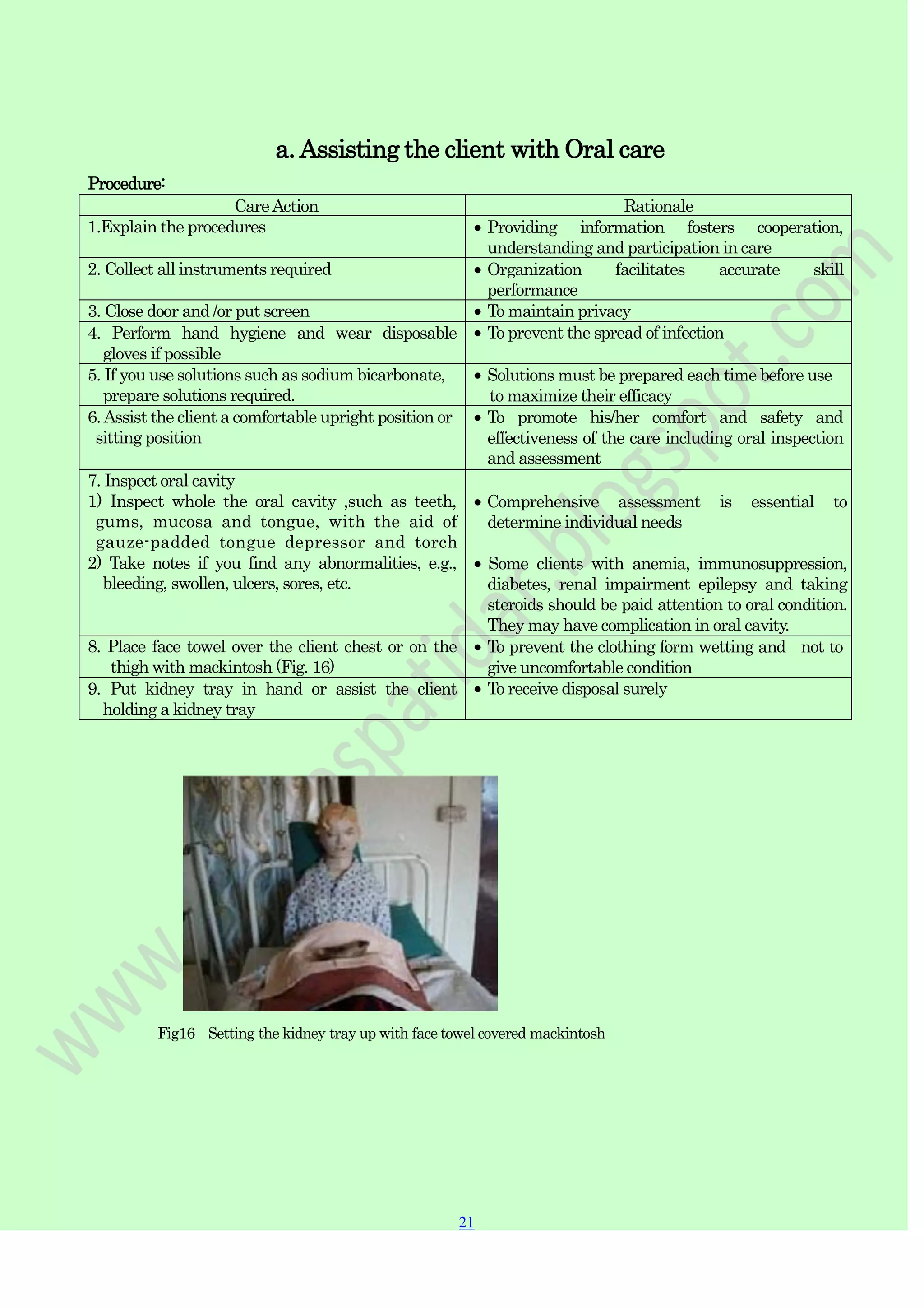
Fig16 Setting the kidney tray up with face towel covered mackintosh
Fundamental of Nursing Procedure Manual
CareAction Rationale
10. Instruct the client to brush teeth
Points of instruction
1) Client places a soft toothbrush at a 45 °angle to
the teeth.
2) Client brushes in direction of the tips of the
bristles under the gum line with tooth paste.
Rotate the bristles using vibrating or jiggling
motion until all outer and inner surfaces of the
teeth and gums are clean.
3) Client brushes biting surfaces of the teeth
4) Client clean tongue from inner to outer and avoid
posterior direction.
Effective in dislodging debris and dental plaque
from teeth and gingival margin
Cleansing posterior direction of the tongue may
cause the gag reflex
11. If the client cannot tolerate toothbrush (or
cannot be available toothbrush), form swabs or
cotton balls can be used
When the client is prone to bleeding and/or pain,
tooth brush is not advisable
12. Rinse oral cavity
1) Ask the client to rinse with fresh water and void
contents into the kidney tray.
2) Advise him/her not to swallow water. If needed,
suction equipment is used to remove any excess.
To make comfort and not to remain any fluid and
debris
To reduce potential for infection and
13. Ask the client to wipe mouth and around it. To make comfort and provide the well-appearance
14. Confirm the condition of client‟s teeth, gums and
tongue.Apply lubricant to lips.
To moisturize lips and reduce risk for cracking
15. Rinse and dry tooth brush thoroughly. Return
the proper place for personal belongings after
drying up.
To prevent the growth of microorganisms
16. Replace all instruments To prepare equipments for the next procedure
17. Discard dirt properly and safety To maintain standard precautions
18. Remove gloves and wash your hands To prevent the spread of infection
19. Document the care and sign on the records. Documentation provides ongoing data collection
and coordination of care
Giving signature maintains professional
accountability
20. Report any findings to senior staffs To provide continuity of care
22
23
23
b. Providing oral care for dependent client
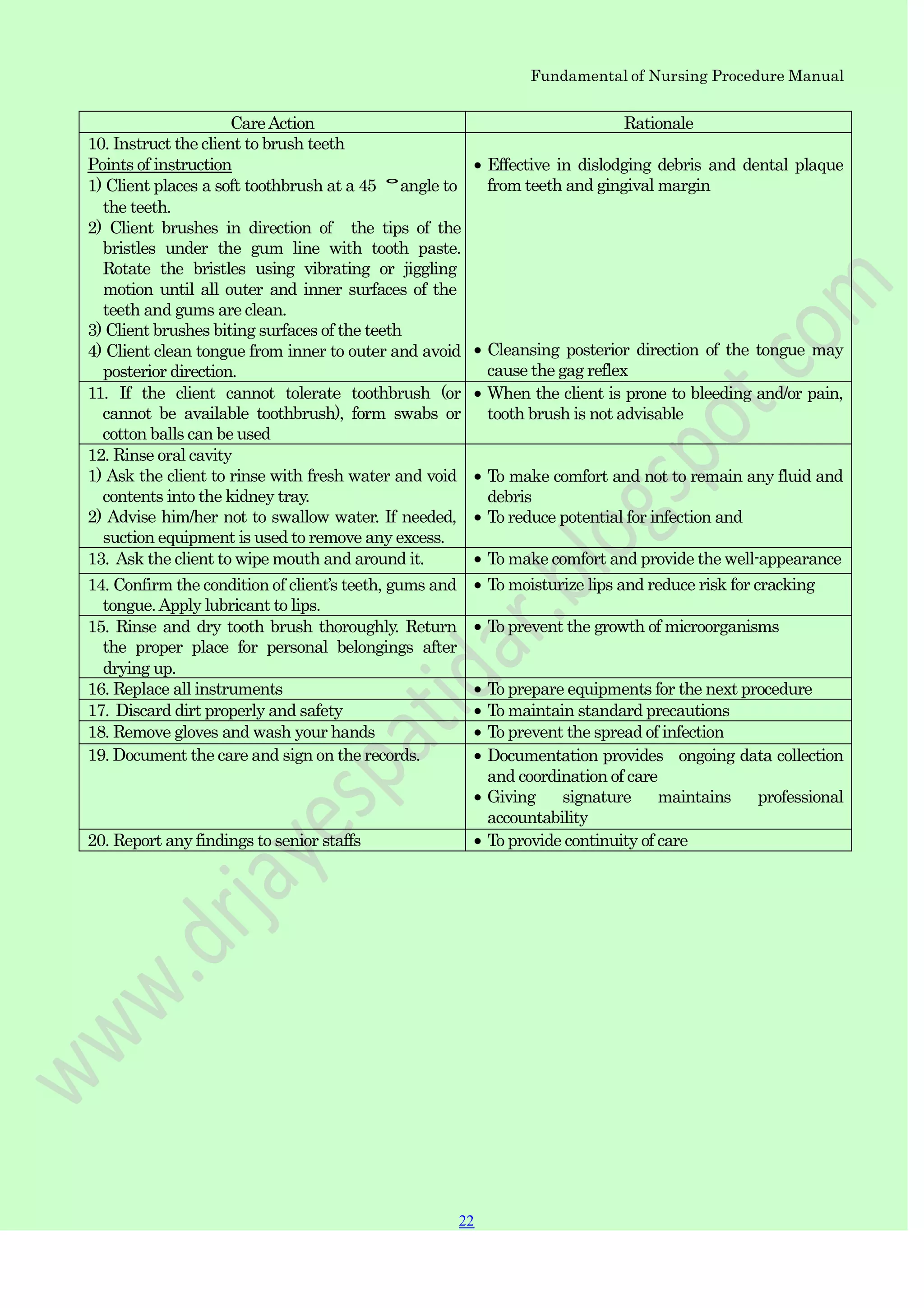
Fig. 17 Equipments required for oral care in depending client
Procedure: The procedure with cotton balls soaked sodium bicarbonate is showed here.
CareAction Rationale
1. Check client‟s identification and condition Providing nursing care for the correct client with
appropriate way.
2. Explain the purpose and procedure to the client Providing information fosters cooperation and
understanding
3.Perform hand hygiene and wear disposable gloves To prevent the spread of infection.
4. Prepare equipments:
1) Collect all required equipments and bring the
articles to the bedside.
2) Prepare sodium bicarbonate solutions in gallipot.
❖NursingAlert❖
If the client is unconscious, use plain tap water.
3) Soak the cotton ball in sodium bicarbonates
solution(3 pinches / 2/3 water in gallipot) with
artery forceps.
4) Squeeze all cotton balls excess solution by artery
forceps and dissecting forceps and put into
another gallipot
Organization facilitates accurate skill
performance
Solutions must be prepared each time before use
to maximize their efficacy
To reduce potential infection
Cleaning solutions aids in removing residue on
the client‟s teeth and softening encrusted areas.
To avoid inspiration of the solution
5. Close the curtain or door to the room. Put screen. It maintains the client‟s privacy
6. Keep the client in a side lying or in comfortable
position.
Proper positioning prevents back strain
Tilting the head downward encourages fluid to
drain out of the client‟s mort and it prevents
aspiration.
24
24
CareAction Rationale
7. Place the mackintosh and towel on the neck to
chest.
The towel and mackintosh protect the client and
bed from soakage.
8. Put the kidney tray over the towel and
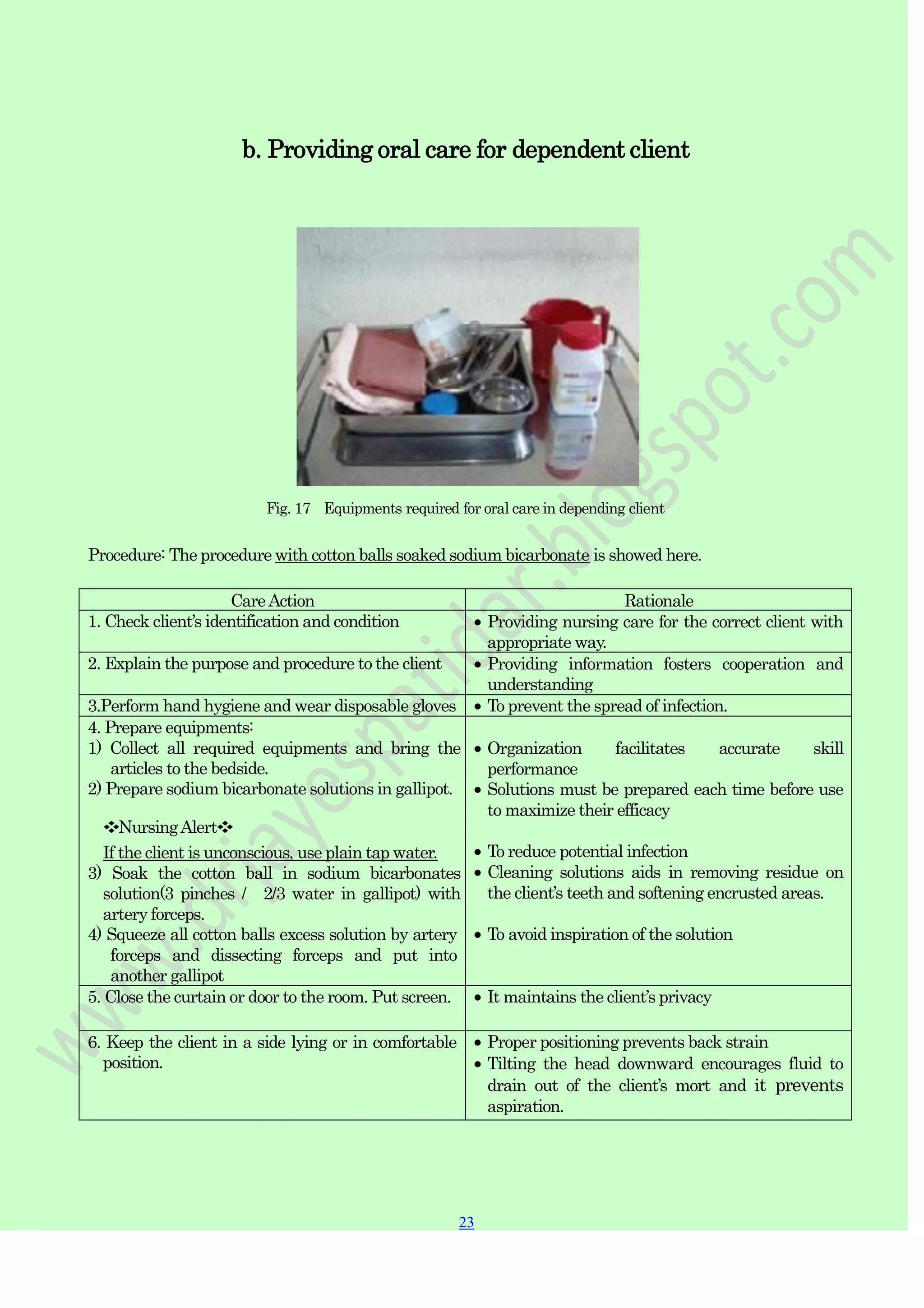
mackintosh under the chin.(Fig. 18)
It facilitates drainage from the client‟s mouth.
9. Inspect oral cavity:
1) Inspect whole the oral cavity, such as teeth,
gums, mucosa and tongue, with the aid of
gauze-padded tongue depressor and torch.
2) Take notes if you find any abnormalities, e.g.,
bleeding, swollen, ulcers, etc.
Comprehensive assessment is essential to
determine individual needs.
Some clients with anemia, immunosuppression,
diabetes, renal impairment, epilepsy and taking
steroids should be paid attention to oral condition.
They may have complication in oral cavity.
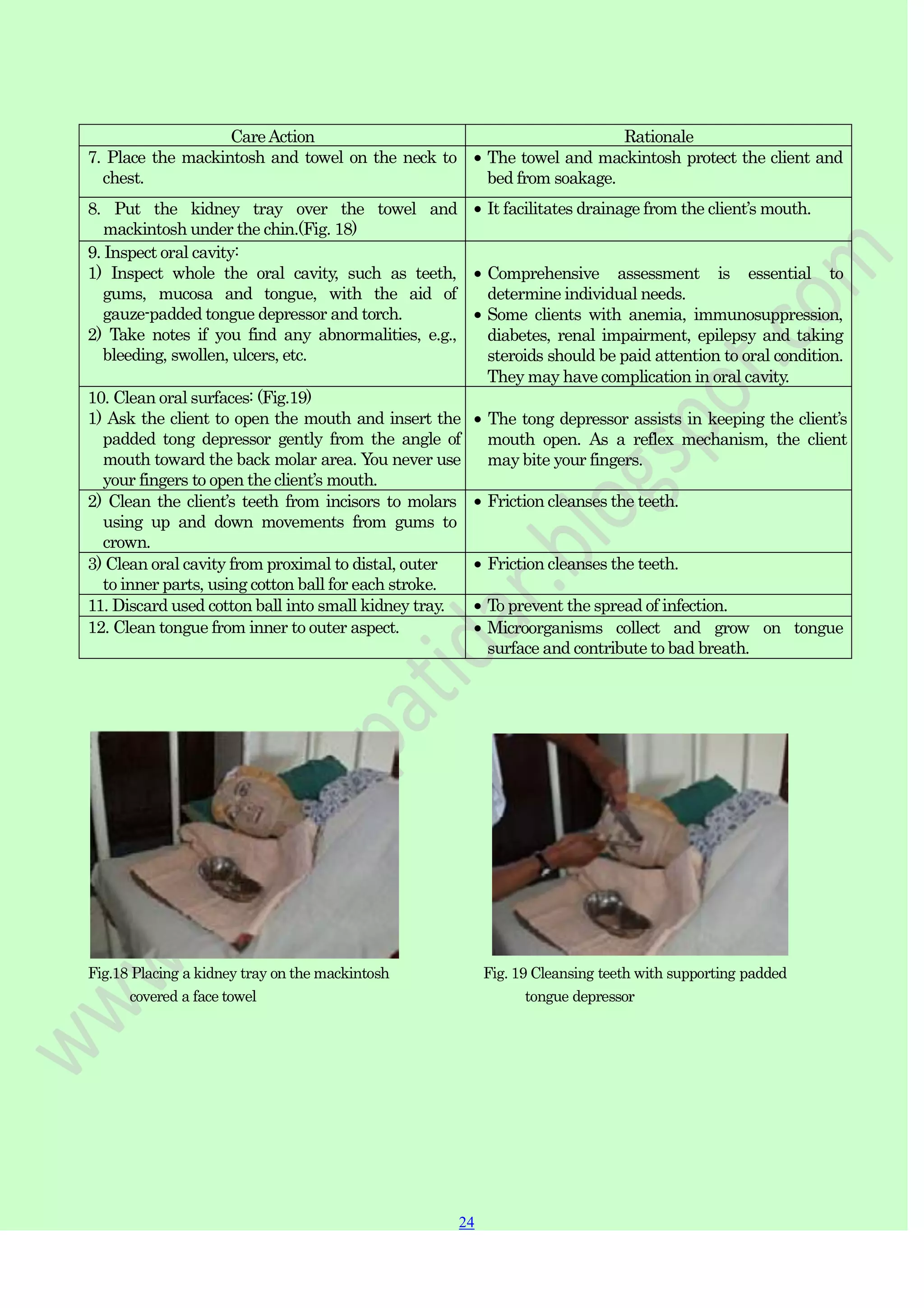
10. Clean oral surfaces: (Fig.19)
1) Ask the client to open the mouth and insert the
padded tong depressor gently from the angle of
mouth toward the back molar area. You never use
your fingers to open the client‟s mouth.
The tong depressor assists in keeping the client‟s
mouth open. As a reflex mechanism, the client
may bite your fingers.
2) Clean the client‟s teeth from incisors to molars
using up and down movements from gums to
crown.
Friction cleanses the teeth.
3) Clean oral cavity from proximal to distal, outer
to inner parts, using cotton ball for each stroke.
Friction cleanses the teeth.
11. Discard used cotton ball into small kidney tray. To prevent the spread of infection.
12. Clean tongue from inner to outer aspect. Microorganisms collect and grow on tongue
surface and contribute to bad breath.
Fig.18 Placing a kidney tray on the mackintosh
covered a face towel
Fig. 19 Cleansing teeth with supporting padded
tongue depressor
25
25
CareAction Rationale
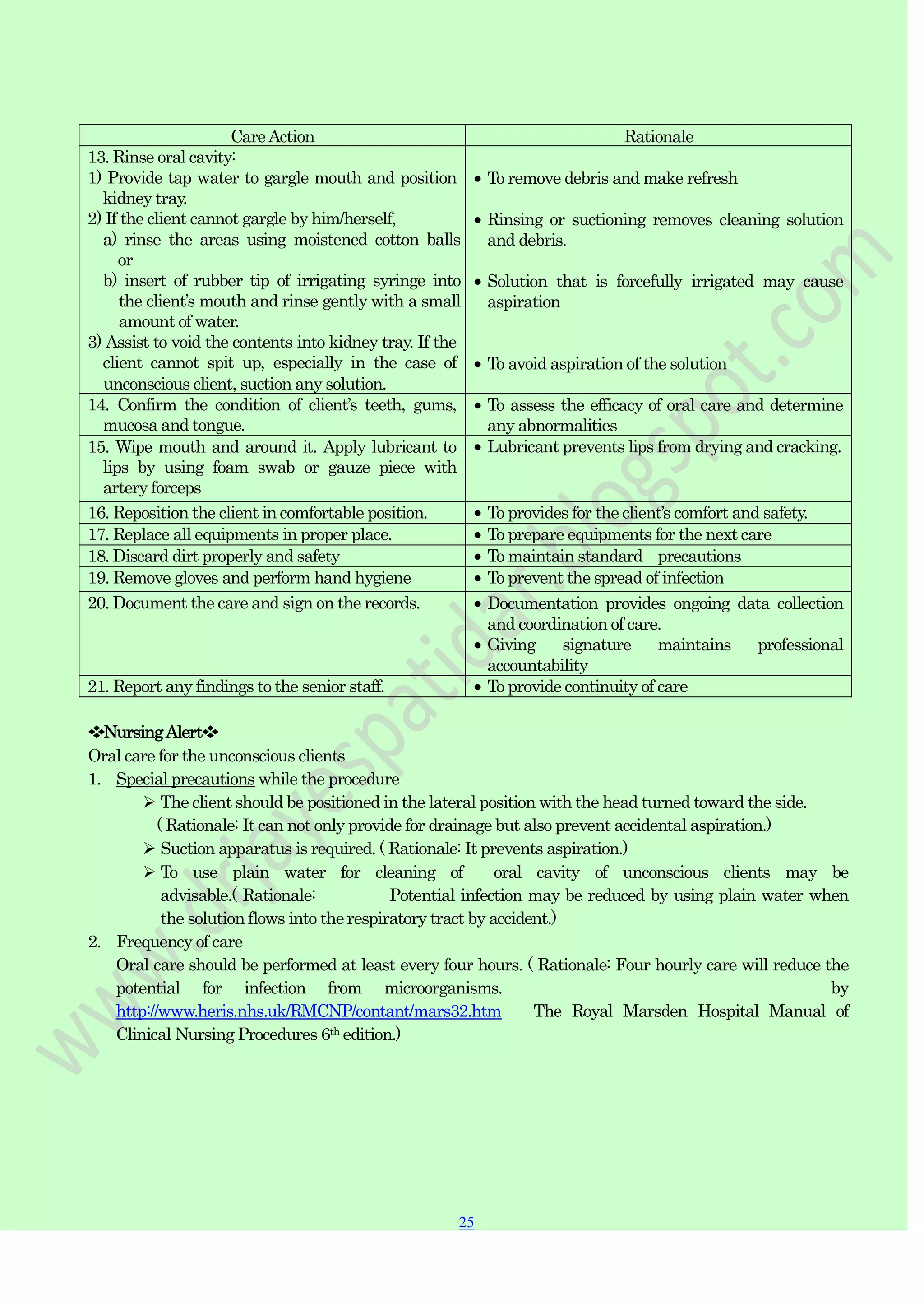
13. Rinse oral cavity:
1) Provide tap water to gargle mouth and position
kidney tray.
2) If the client cannot gargle by him/herself,
a) rinse the areas using moistened cotton balls
or
b) insert of rubber tip of irrigating syringe into
the client‟s mouth and rinse gently with a small
amount of water.
3) Assist to void the contents into kidney tray. If the
client cannot spit up, especially in the case of
unconscious client, suction any solution.
To remove debris and make refresh
Rinsing or suctioning removes cleaning solution
and debris.
Solution that is forcefully irrigated may cause
aspiration
To avoid aspiration of the solution
14. Confirm the condition of client‟s teeth, gums,
mucosa and tongue.
To assess the efficacy of oral care and determine
any abnormalities
15. Wipe mouth and around it. Apply lubricant to
lips by using foam swab or gauze piece with
artery forceps
Lubricant prevents lips from drying and cracking.
16. Reposition the client in comfortable position. To provides for the client‟s comfort and safety.
17. Replace all equipments in proper place. To prepare equipments for the next care
18. Discard dirt properly and safety To maintain standard precautions
19. Remove gloves and perform hand hygiene To prevent the spread of infection
20. Document the care and sign on the records. Documentation provides ongoing data collection
and coordination of care.
Giving signature maintains professional
accountability
21. Report any findings to the senior staff. To provide continuity of care
❖NursingAlert❖
Oral care for the unconscious clients
1. Special precautions while the procedure
 The client should be positioned in the lateral position with the head turned toward the side.
( Rationale: It can not only provide for drainage but also prevent accidental aspiration.)
 Suction apparatus is required. ( Rationale: It prevents aspiration.)
 To use plain water for cleaning of oral cavity of unconscious clients may be
advisable.( Rationale: Potential infection may be reduced by using plain water when
the solution flows into the respiratory tract by accident.)
2. Frequency of care
Oral care should be performed at least every four hours. ( Rationale: Four hourly care will reduce the
potential for infection from microorganisms. by
http://www.heris.nhs.uk/RMCNP/contant/mars32.htm The Royal Marsden Hospital Manual of
Clinical Nursing Procedures 6th edition.)
26
26
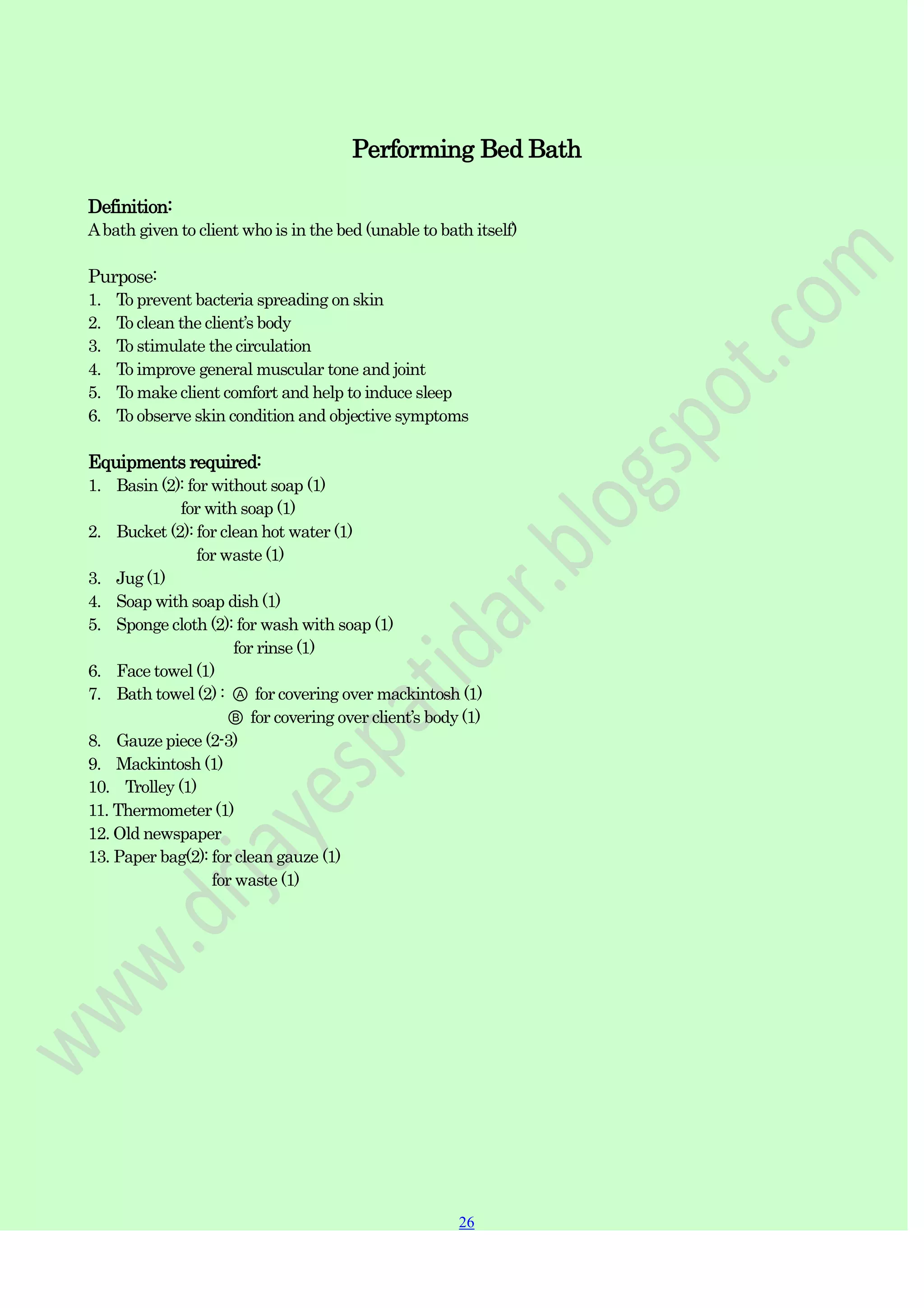
Performing Bed Bath
Definition:
Abath given to client who is in the bed (unable to bath itself)
Purpose:
1. To prevent bacteria spreading on skin
2. To clean the client‟s body
3. To stimulate the circulation
4. To improve general muscular tone and joint
5. To make client comfort and help to induce sleep
6. To observe skin condition and objective symptoms
Equipments required:
1. Basin (2): for without soap (1)
for with soap (1)
2. Bucket (2): for clean hot water (1)
for waste (1)
3. Jug (1)
4. Soap with soap dish (1)
5. Sponge cloth (2): for wash with soap (1)
for rinse (1)
6. Face towel (1)
7. Bath towel (2) : Ⓐ for covering over mackintosh (1)
Ⓑ for covering over client‟s body (1)
8. Gauze piece (2-3)
9. Mackintosh (1)
10. Trolley (1)
11. Thermometer (1)
12. Old newspaper
13. Paper bag(2): for clean gauze (1)
for waste (1)
27
27
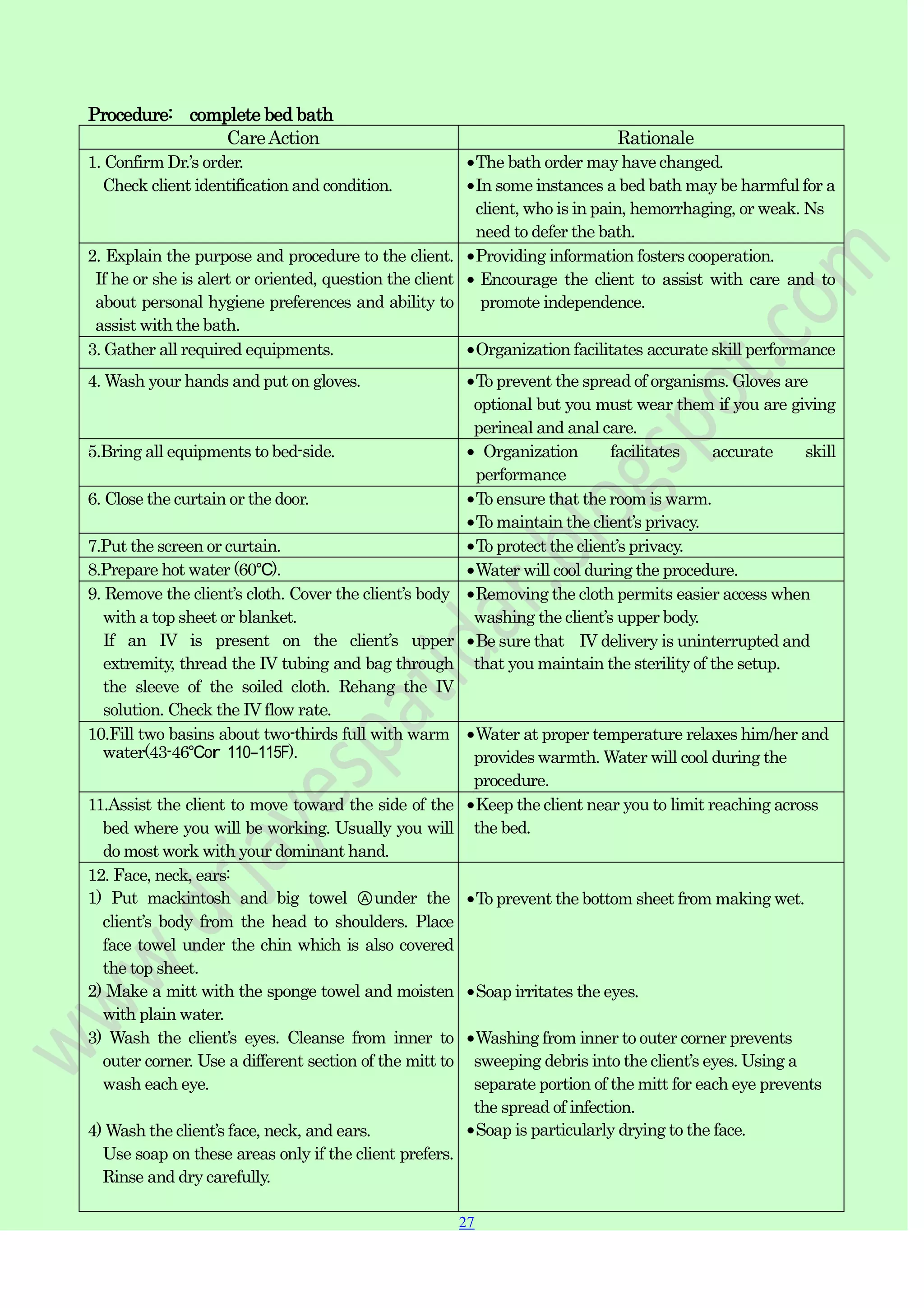
Procedure: complete bed bath
CareAction Rationale
1. Confirm Dr.‟s order.
Check client identification and condition.
The bath order may have changed.
In some instances a bed bath may be harmful for a
client, who is in pain, hemorrhaging, or weak. Ns
need to defer the bath.
2. Explain the purpose and procedure to the client.
If he or she is alert or oriented, question the client
about personal hygiene preferences and ability to
assist with the bath.
Providing information fosters cooperation.
Encourage the client to assist with care and to
promote independence.
3. Gather all required equipments. Organization facilitates accurate skill performance
4. Wash your hands and put on gloves. To prevent the spread of organisms. Gloves are
optional but you must wear them if you are giving
perineal and anal care.
5.Bring all equipments to bed-side. Organization facilitates accurate skill
performance
6. Close the curtain or the door. To ensure that the room is warm.
To maintain the client‟s privacy.
7.Put the screen or curtain. To protect the client‟s privacy.
8.Prepare hot water (60℃). Water will cool during the procedure.
9. Remove the client‟s cloth. Cover the client‟s body
with a top sheet or blanket.
If an IV is present on the client‟s upper
extremity, thread the IV tubing and bag through
the sleeve of the soiled cloth. Rehang the IV
solution. Check the IV flow rate.
Removing the cloth permits easier access when
washing the client‟s upper body.
Be sure that IV delivery is uninterrupted and
that you maintain the sterility of the setup.
10.Fill two basins about two-thirds full with warm
water(43-46℃or 110-115F).
Water at proper temperature relaxes him/her and
provides warmth. Water will cool during the
procedure.
11.Assist the client to move toward the side of the
bed where you will be working. Usually you will
do most work with your dominant hand.
Keep the client near you to limit reaching across
the bed.
12. Face, neck, ears:
1) Put mackintosh and big towel Ⓐunder the
client‟s body from the head to shoulders. Place
face towel under the chin which is also covered
the top sheet.
2) Make a mitt with the sponge towel and moisten
with plain water.
3) Wash the client‟s eyes. Cleanse from inner to
outer corner. Use a different section of the mitt to
wash each eye.
4) Wash the client‟s face, neck, and ears.
Use soap on these areas only if the client prefers.
Rinse and dry carefully.
To prevent the bottom sheet from making wet.
Soap irritates the eyes.
Washing from inner to outer corner prevents
sweeping debris into the client‟s eyes. Using a
separate portion of the mitt for each eye prevents
the spread of infection.
Soap is particularly drying to the face.
Fundamental of Nursing Procedure Manual
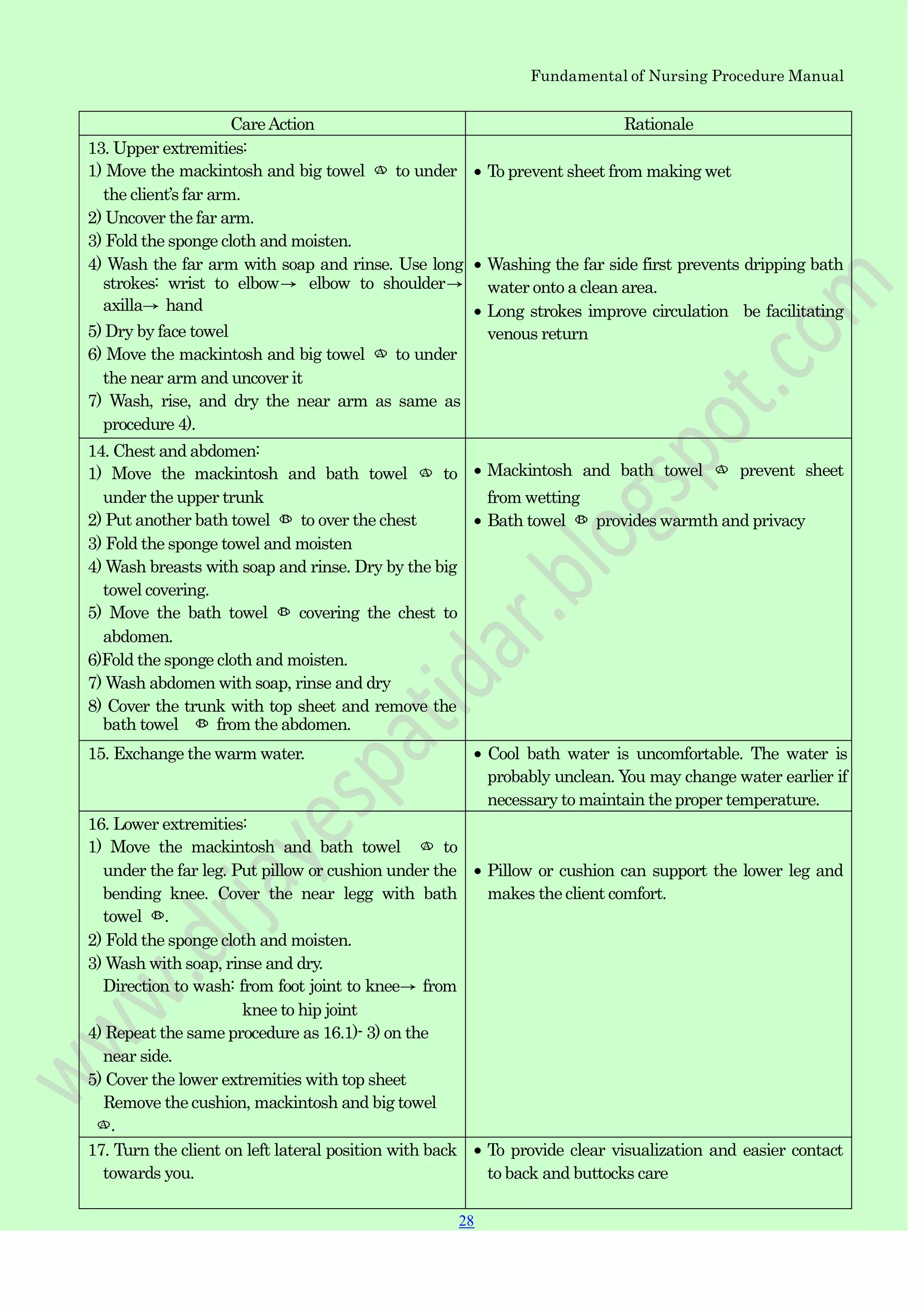
CareAction Rationale
13. Upper extremities:
1) Move the mackintosh and big towel ○A to under
the client‟s far arm.
2) Uncover the far arm.
3) Fold the sponge cloth and moisten.
4) Wash the far arm with soap and rinse. Use long
strokes: wrist to elbow→ elbow to shoulder→
axilla→ hand
5) Dry by face towel
6) Move the mackintosh and big towel ○A to under
the near arm and uncover it
7) Wash, rise, and dry the near arm as same as
procedure 4).
To prevent sheet from making wet
Washing the far side first prevents dripping bath
water onto a clean area.
Long strokes improve circulation be facilitating
venous return
14. Chest and abdomen:
1) Move the mackintosh and bath towel ○A to
under the upper trunk
2) Put another bath towel ○B to over the chest
3) Fold the sponge towel and moisten
4) Wash breasts with soap and rinse. Dry by the big
towel covering.
5) Move the bath towel ○B covering the chest to
abdomen.
6)Fold the sponge cloth and moisten.
7) Wash abdomen with soap, rinse and dry
8) Cover the trunk with top sheet and remove the
bath towel ○B from the abdomen.
Mackintosh and bath towel ○A prevent sheet
from wetting
Bath towel ○B provides warmth and privacy
15. Exchange the warm water. Cool bath water is uncomfortable. The water is
probably unclean. You may change water earlier if
necessary to maintain the proper temperature.
16. Lower extremities:
1) Move the mackintosh and bath towel ○A to
under the far leg. Put pillow or cushion under the
bending knee. Cover the near legg with bath
towel ○B .
2) Fold the sponge cloth and moisten.
3) Wash with soap, rinse and dry.
Direction to wash: from foot joint to knee→ from
knee to hip joint
4) Repeat the same procedure as 16.1)- 3) on the
near side.
5) Cover the lower extremities with top sheet
Remove the cushion, mackintosh and big towel
○A .
Pillow or cushion can support the lower leg and
makes the client comfort.
17. Turn the client on left lateral position with back
towards you.
To provide clear visualization and easier contact
to back and buttocks care
28
Fundamental of Nursing Procedure Manual
CareAction Action
18.Back and buttocks:
1) Move the mackintosh and big towel ○A under
the trunk.
2) Cover the back with big towel ○B .
3) Fold the towel and moisten. Uncover the back.
4) Wash with soap and rinse. Dry with big towel ○B .
5) Back rub if needed
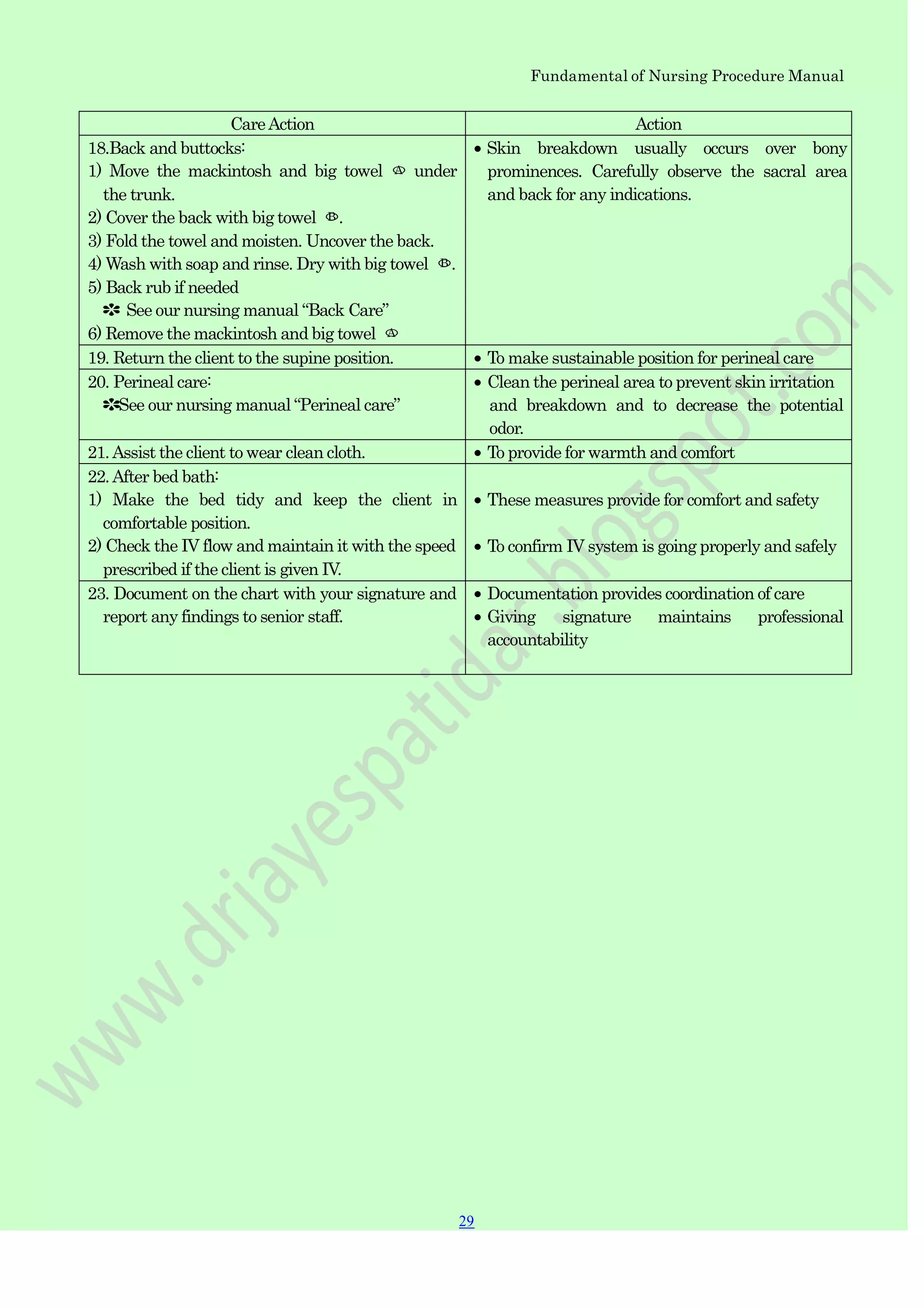
✽ See our nursing manual “Back Care”
6) Remove the mackintosh and big towel ○A
Skin breakdown usually occurs over bony
prominences. Carefully observe the sacral area
and back for any indications.
19. Return the client to the supine position. To make sustainable position for perineal care
20. Perineal care:
✽See our nursing manual “Perineal care”
Clean the perineal area to prevent skin irritation
and breakdown and to decrease the potential
odor.
21.Assist the client to wear clean cloth. To provide for warmth and comfort
22.After bed bath:
1) Make the bed tidy and keep the client in
comfortable position.
2) Check the IV flow and maintain it with the speed
prescribed if the client is given IV.
These measures provide for comfort and safety
To confirm IV system is going properly and safely
23. Document on the chart with your signature and
report any findings to senior staff.
Documentation provides coordination of care
Giving signature maintains professional
accountability
29
30
30
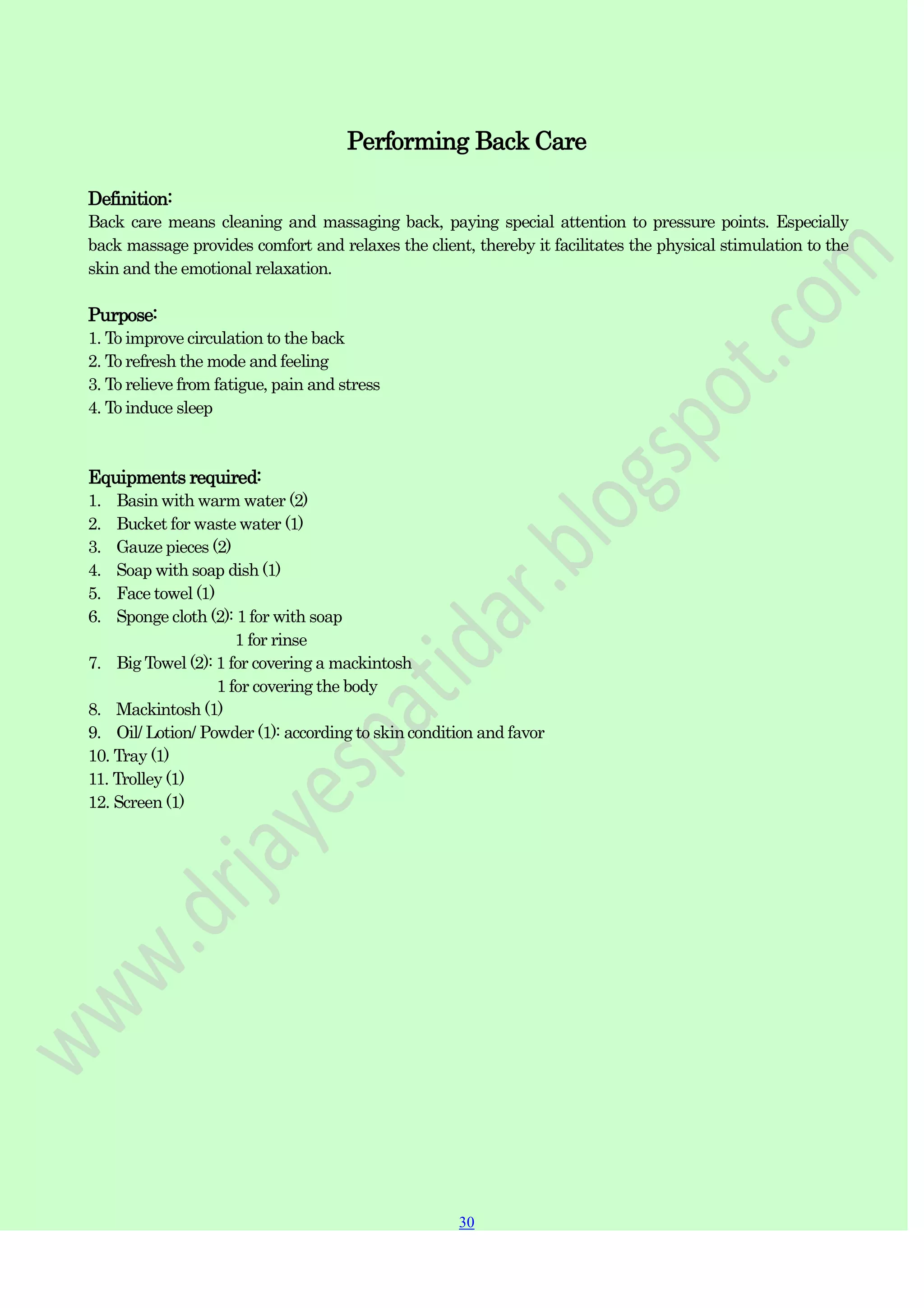
Performing Back Care
Definition:
Back care means cleaning and massaging back, paying special attention to pressure points. Especially
back massage provides comfort and relaxes the client, thereby it facilitates the physical stimulation to the
skin and the emotional relaxation.
Purpose:
1. To improve circulation to the back
2. To refresh the mode and feeling
3. To relieve from fatigue, pain and stress
4. To induce sleep
Equipments required:
1. Basin with warm water (2)
2. Bucket for waste water (1)
3. Gauze pieces (2)
4. Soap with soap dish (1)
5. Face towel (1)
6. Sponge cloth (2): 1 for with soap
1 for rinse
7. Big Towel (2): 1 for covering a mackintosh
1 for covering the body
8. Mackintosh (1)
9. Oil/ Lotion/ Powder (1): according to skin condition and favor
10. Tray (1)
11. Trolley (1)
12. Screen (1)
31
31
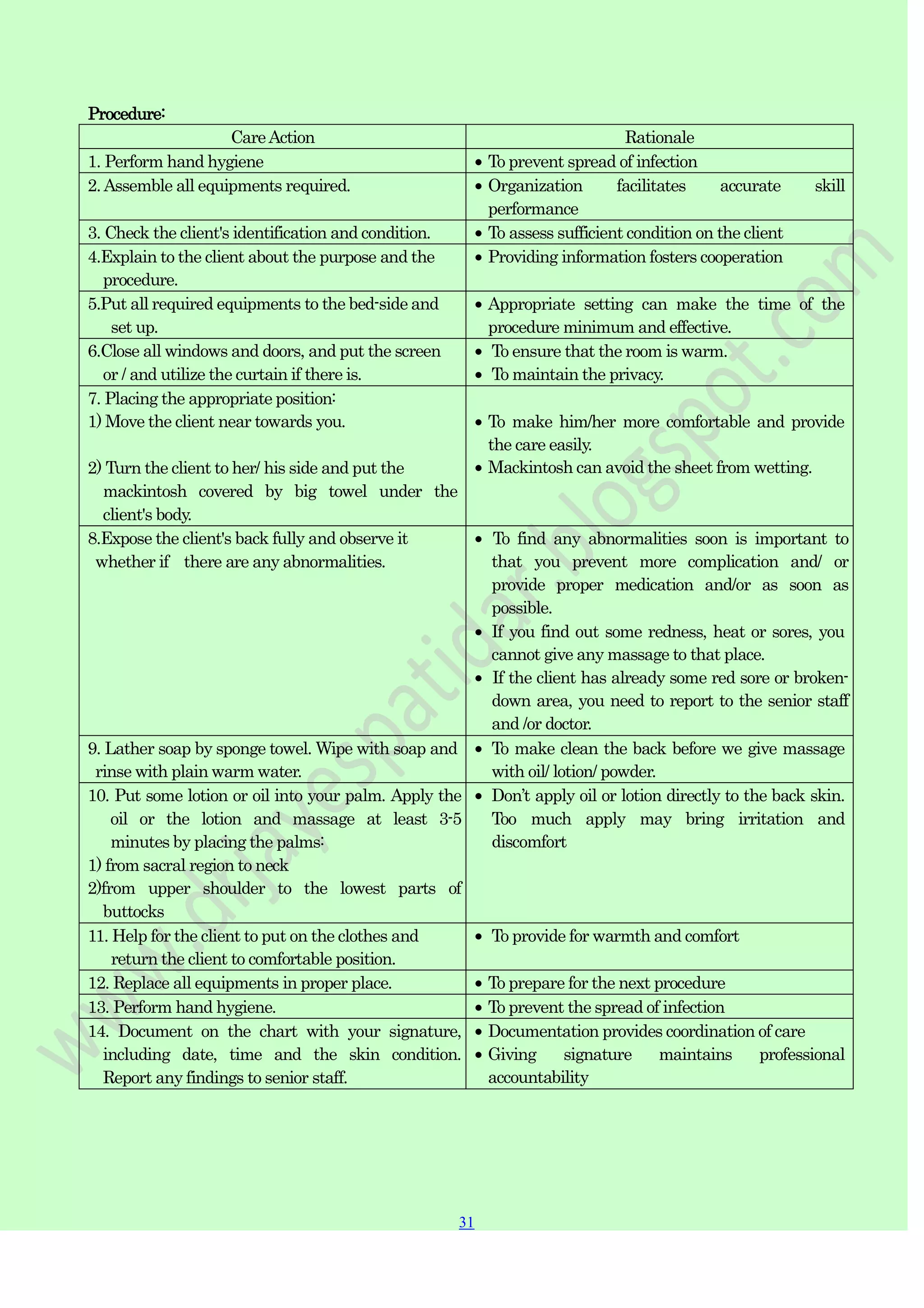
Procedure:
CareAction Rationale
1. Perform hand hygiene To prevent spread of infection
2.Assemble all equipments required. Organization facilitates accurate skill
performance
3. Check the client's identification and condition. To assess sufficient condition on the client
4.Explain to the client about the purpose and the
procedure.
Providing information fosters cooperation
5.Put all required equipments to the bed-side and
set up.
Appropriate setting can make the time of the
procedure minimum and effective.
6.Close all windows and doors, and put the screen
or / and utilize the curtain if there is.
To ensure that the room is warm.
To maintain the privacy.
7. Placing the appropriate position:
1) Move the client near towards you.
2) Turn the client to her/ his side and put the
mackintosh covered by big towel under the
client's body.
To make him/her more comfortable and provide
the care easily.
Mackintosh can avoid the sheet from wetting.
8.Expose the client's back fully and observe it
whether if there are any abnormalities.
To find any abnormalities soon is important to
that you prevent more complication and/ or
provide proper medication and/or as soon as
possible.
If you find out some redness, heat or sores, you
cannot give any massage to that place.
If the client has already some red sore or broken-
down area, you need to report to the senior staff
and /or doctor.
9. Lather soap by sponge towel. Wipe with soap and
rinse with plain warm water.
To make clean the back before we give massage
with oil/ lotion/ powder.
10. Put some lotion or oil into your palm. Apply the
oil or the lotion and massage at least 3-5
minutes by placing the palms:
1) from sacral region to neck
2)from upper shoulder to the lowest parts of
buttocks
Don‟t apply oil or lotion directly to the back skin.
Too much apply may bring irritation and
discomfort
11. Help for the client to put on the clothes and
return the client to comfortable position.
To provide for warmth and comfort
12. Replace all equipments in proper place. To prepare for the next procedure
13. Perform hand hygiene. To prevent the spread of infection
14. Document on the chart with your signature,
including date, time and the skin condition.
Report any findings to senior staff.
Documentation provides coordination of care
Giving signature maintains professional
accountability
32
32
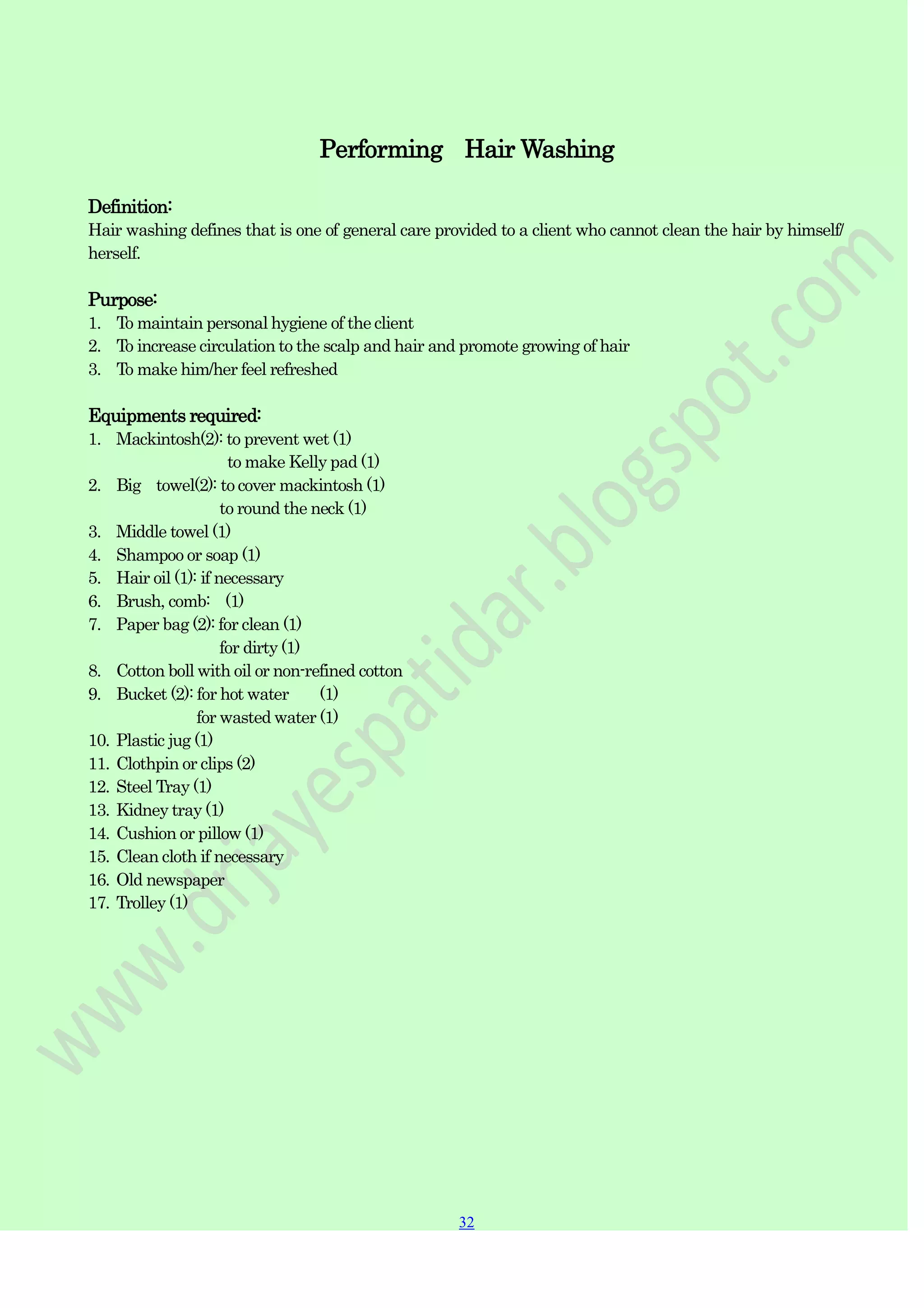
Performing Hair Washing
Definition:
Hair washing defines that is one of general care provided to a client who cannot clean the hair by himself/
herself.
Purpose:
1. To maintain personal hygiene of the client
2. To increase circulation to the scalp and hair and promote growing of hair
3. To make him/her feel refreshed
Equipments required:
1. Mackintosh(2): to prevent wet (1)
to make Kelly pad (1)
2. Big towel(2): to cover mackintosh (1)
to round the neck (1)
3. Middle towel (1)
4. Shampoo or soap (1)
5. Hair oil (1): if necessary
6. Brush, comb: (1)
7. Paper bag (2): for clean (1)
for dirty (1)
8. Cotton boll with oil or non-refined cotton
9. Bucket (2): for hot water (1)
for wasted water (1)
10. Plastic jug (1)
11. Clothpin or clips (2)
12. Steel Tray (1)
13. Kidney tray (1)
14. Cushion or pillow (1)
15. Clean cloth if necessary
16. Old newspaper
17. Trolley (1)
33
33
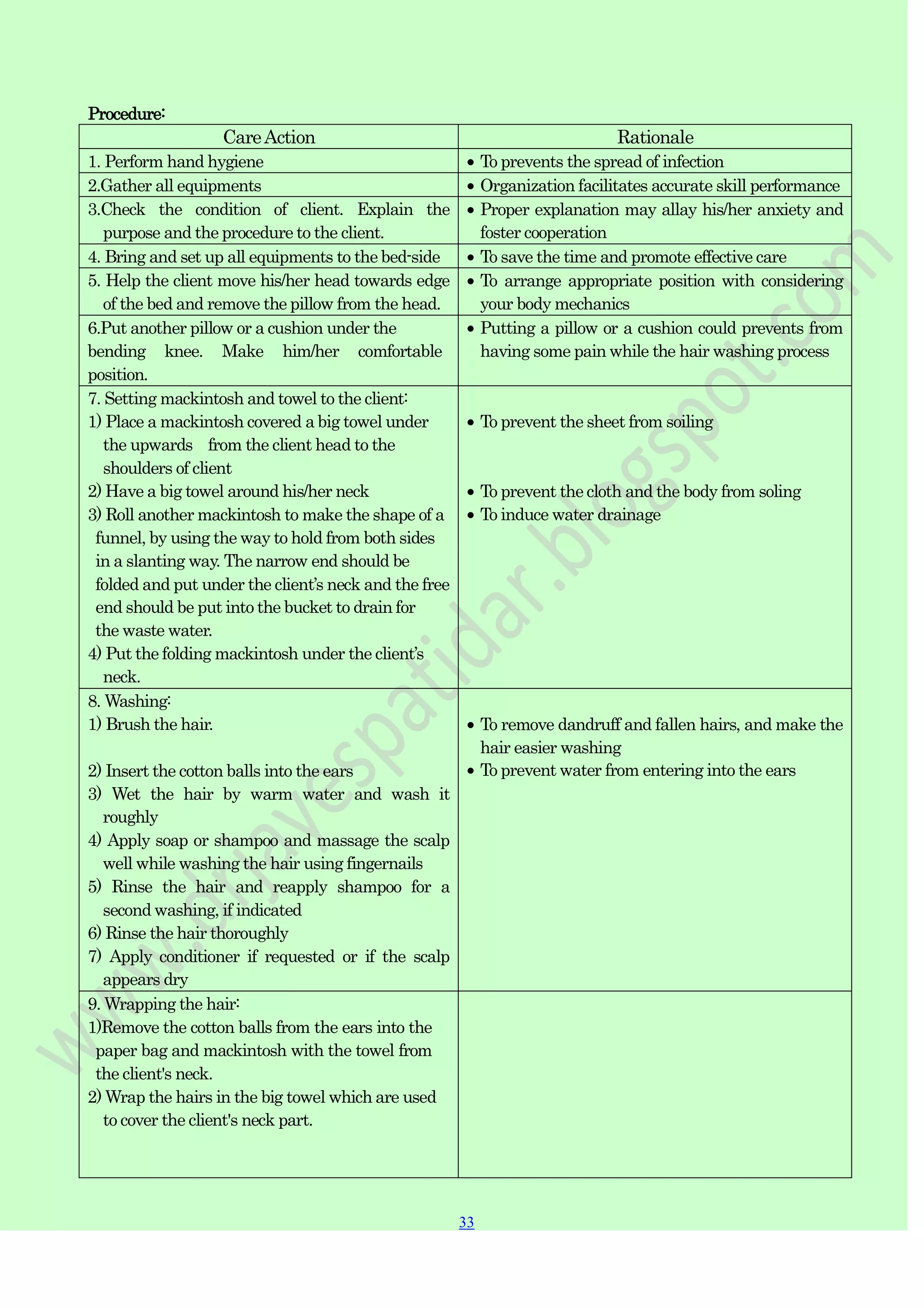
Procedure:
CareAction Rationale
1. Perform hand hygiene To prevents the spread of infection
2.Gather all equipments Organization facilitates accurate skill performance
3.Check the condition of client. Explain the
purpose and the procedure to the client.
Proper explanation may allay his/her anxiety and
foster cooperation
4. Bring and set up all equipments to the bed-side To save the time and promote effective care
5. Help the client move his/her head towards edge
of the bed and remove the pillow from the head.
To arrange appropriate position with considering
your body mechanics
6.Put another pillow or a cushion under the
bending knee. Make him/her comfortable
position.
Putting a pillow or a cushion could prevents from
having some pain while the hair washing process
7. Setting mackintosh and towel to the client:
1) Place a mackintosh covered a big towel under
the upwards from the client head to the
shoulders of client
2) Have a big towel around his/her neck
3) Roll another mackintosh to make the shape of a
funnel, by using the way to hold from both sides
in a slanting way. The narrow end should be
folded and put under the client‟s neck and the free
end should be put into the bucket to drain for
the waste water.
4) Put the folding mackintosh under the client‟s
neck.
To prevent the sheet from soiling
To prevent the cloth and the body from soling
To induce water drainage
8. Washing:
1) Brush the hair.
2) Insert the cotton balls into the ears
3) Wet the hair by warm water and wash it
roughly
4) Apply soap or shampoo and massage the scalp
well while washing the hair using fingernails
5) Rinse the hair and reapply shampoo for a
second washing, if indicated
6) Rinse the hair thoroughly
7) Apply conditioner if requested or if the scalp
appears dry
To remove dandruff and fallen hairs, and make the
hair easier washing
To prevent water from entering into the ears
9. Wrapping the hair:
1)Remove the cotton balls from the ears into the
paper bag and mackintosh with the towel from
the client's neck.
2) Wrap the hairs in the big towel which are used
to cover the client's neck part.
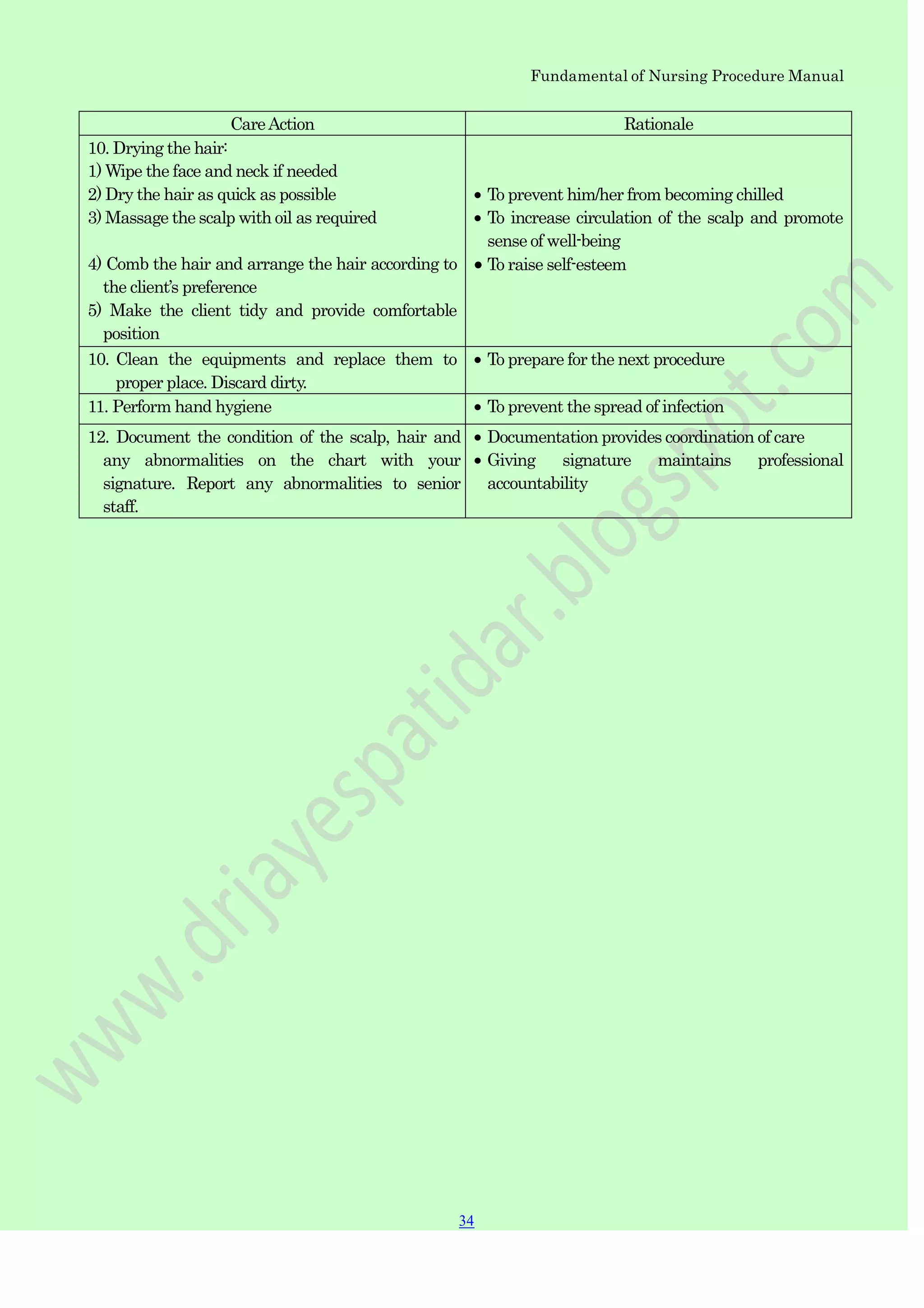
Fundamental of Nursing Procedure Manual
CareAction Rationale
10. Drying the hair:
1) Wipe the face and neck if needed
2) Dry the hair as quick as possible
3) Massage the scalp with oil as required
4) Comb the hair and arrange the hair according to
the client‟s preference
5) Make the client tidy and provide comfortable
position
To prevent him/her from becoming chilled
To increase circulation of the scalp and promote
sense of well-being
To raise self-esteem
10. Clean the equipments and replace them to
proper place. Discard dirty.
To prepare for the next procedure
11. Perform hand hygiene To prevent the spread of infection
12. Document the condition of the scalp, hair and
any abnormalities on the chart with your
signature. Report any abnormalities to senior
staff.
Documentation provides coordination of care
Giving signature maintains professional
accountability
34
35
35
Caring for fingernails and toenails
Definition:
Nail cutting that one of nursing care and general care for personal hygiene is to cut nails on hands and
foots.
Purpose:
1. To keep nails clean
2. To make neatness
3. To prevent the client‟s skin from scratching
4. To avoid infection caused by dirty nail
Equipments required:
1. Nail Cutter (1)
2. Gallipot with water (1): for cotton
3. Kidney tray (1)
4. Sponge cloth (1)
5. Middle towel (1)
6. Mackintosh (1)
7. Plastic bowl in small size (1)
8. Soap with soap dish (1)
Fig.20 Equipments required for nail cutting
36
36
Procedure: Caring for Fingernails
CareAction Rationale
1. Perform hand hygiene To prevent the spread of infection
2. Gather all the required equipments. Organization facilitates accurate skill
performance
3. Check the client‟s identification. To assess needs
4. Explain to the client about the purpose and the
procedure.
Providing explanation fosters cooperation
5. Put all the required equipments to the bed-side
and set up it.
To save the time an promote effective care
6.Assist the client to a comfortable upright position. To provide for comfort
7.In sitting position:
1) Soaking
①Put a mackintosh with covering towel on the
bed.
②Put the basin with warm water over the
mackintosh.
③Soak the client‟s fingers in a basin of warm
water and mild soap.
④Scrub and wash them up.
⑤Dry the client‟s hands thoroughly by using the
middle towel covering the mackintosh.
2) Cutting
①Trim the client‟s nails with nail clippers.
②Wipe all fingernails from thumb to 5th nail side
by side by wet cotton ball. One cotton ball is
used for one nail finger.
③Shape the fingernails with a file, rounding the
corners and wipe both hands by a sponge towel.
Mackintosh can prevent the sheet from wetting
To make nails soft, thereby you can cut nails
easily and safety
Special orders are required before cutting the nails
or cuticles of a client with diabetes to avoid
accidental injury to soft tissues.
8. Replace equipments and discard dirty. To prepare equipments for the next procedure
9. Perform hand hygiene. To prevent the spread of infection
Procedure: Caring for Toenails
Follow the same procedure as for the fingernails with some exceptions:
CareAction Rationale
7.
2) Cutting
①Cut toenails straight across and do not round
off the corners
②Do not shape corners
Cutting into the corners may cause ingrown
nails. If the nails tend to grow inward at the
corners, place a wisp of cotton under the nail to
prevent toe pressure.
A notch cut in the center will pull in edges and
corners. Sometimes, very thick, hard toenails
require surgical removal.
 NURSINGALERT
Never cut the toenails of the clients with diabetes or hemophilia. These clients are particularly susceptible
to injury.
37
37
Performing Perineal Care
Definition:
Perineal care is bathing the genitalia and surrounding area. Proper assessment and care of the perineal
area will need professional clinical judgment.
Purpose:
1. To keep cleanliness and prevent from infection in perineal area
2. To make him/her comfortable
Equipments required:
1. Gloves( non- sterile) (1 pair)
2. Sponge cloth (1)
3. Basin with warm water (1)
4. Waterproof pad or gauze
5. Towels (1)
6. Mackintosh (1)
7. Soap with soap dish (1)
8. Toilet paper
9. Bed pan (1): as required
Procedure: For general case (without urinary catheter)
CareAction Rationale
1. Gather all required equipments. Organization facilitates accurate skill
performance
2. Explain the procedure to the client. Providing information fosters cooperation.
3. Perform hand hygiene and wear on gloves if
available.
To prevent the spread of infection
4. Close the door to the room and place the screen. To protect the client's privacy.
5.Raise the bed to a comfortable height if possible. Proper positioning prevents back strain.
6. Preparation the position:
1) Uncover the client's perineal area.
2) Place a mackintosh and towel ( or waterproof
pad) under the client's hips.
A towel or pad protects the bed. You can use the
towel to dry the client's perineal and rectal area.
7. Cleanse the thighs and groin:
1) Make a mitt with the sponge cloth.
2) Cleanse the client's upper thighs and groin area
with soap and water.
3) Rinse and dry.
4) Wash the genital area next.
38
38
CareAction Rationale
Female client: (Fig.21)
①Use a separate portion of the sponge towel for
each stroke
②Change sponge towel as necessary.
③Separate the labia and cleanse downward from
the pubic to anal area.
④Wash between the labia including the urethral
meatus and vaginal area.
⑤Rinse well and pat dry.
Male Client: (Fig.22)
①Gently grasp the client‟s penis.
②Cleanse in a circular motion moving from the
tip of the penis backwards toward the pubic area
③In an uncircumcised male, carefully retract the
foreskin prior to washing the penis.
④Return the foreskin to its former position.
⑤Wash, rinse, and dry the scrotum carefully.
Cleanse from the pubis toward the anus to wash
from a clean to a dirty area. Prevent
contaminating the vaginal area and urinary
meatus with organisms from the anus.
Cleanse from the tip of the client's penis
backward to prevent transferring organisms from
the anus to the urethra.
Secretions that collect under the foreskin can
cause irritation and odor. Return the foreskin to
its normal position to prevent injury to the tissue.
8. Assist the client to turn on the side. Separate the
client's buttocks and use toilet paper, if necessary,
to remove fecal materials.
Removing fecal material provides for easier
cleaning.
9.Cleanse the anal area, rinse thoroughly, and dry
with a towel. Change sponge towel as necessary.
Keep the anal area clean to minimize the risk of
skin irritation and breakdown.
10.Apply skin care products to the area according
to need or doctor's order.
Lotions may be prescribed to treat skin irritation.
11. Return the client to a comfortable position. To provide for comfort and safety.
12. Remove gloves and perform hand hygiene. To prevent the spread of infection
13. Document the procedure, describing the client's
skin condition. Sign the chart.
To provide continuity of care
Giving signature maintains professional
accountability
(from Caroline Bunker Rosdabl: Textbook of Basic Nursing, 1999, p.591)
Fig.21 Female client Fig. 22 Male client
39
39
Taking Vital Signs:
Temperature, Pulse, Respiration, Blood pressure
Definition:
Taking vital signs are defined as the procedure that takes the sign of basic physiology that includes
temperature , pulse, respiration and blood pressure. If any abnormality occurs in the body, vital signs
change immediately.
Purpose:
1. To assess the client‟s condition
2. To determine the baseline values for future comparisons
3. To detect changes and abnormalities in the condition of the client
Equipments required:
1. Oral/ axilla / rectal thermometer (1)
2. Stethoscope (1)
3. Sphygmomanometer with appropriate cuff size (1)
4. Watch with a second hand (1)
5. Spirit swab or cotton (1)
6. Sponge towel (1)
7. Paper bag (2): for clean (1)
for discard (1)
8. Record form
9. Ball- point pen: blue (1)
black (1)
red (1)
10. Steel tray (1): to set all materials
Fig.23 Equipments required of taking a vital signs
40
40
Fig.24 Stethoscope
Astethoscope consists of : ear pieces, tubing, two heads such as the bell and the diaphragm.
Fig.25 The bell of head of stethoscope
The bell has cup-shaped and is used to correct
low-frequency sounds, such as abnormal
heart sounds.
Fig. 26 The diaphragm of head of stethoscope
The diaphragm is flat side of the head and is used to
test high-frequency sounds: breath, normal breath, and
bowel sounds.
Fig. 27 Aneroid manometer
Aneroid manometer is a kind of sphygmomanometer. Sphygmomanometer consists of:
an inflatable bladder, attached to a bulb and a diameter, enclosed in a cuff, with a
deflating mechanism
41
41
a. Taking axillary temperature by glass thermometer
Definition:
Measuring/ monitoring patient‟s body temperature using clinical thermometer
Purpose:
1. To determine body temperature
2. To assist in diagnosis
3. To evaluate patient‟s recovery from illness
4. To determine if immediate measures should be implemented to reduce dangerously elevated body
temperature or converse body heat when body temperature is dangerous low
5. To evaluate patient‟s response once heat conserving or heal reducing measures have been
implemented
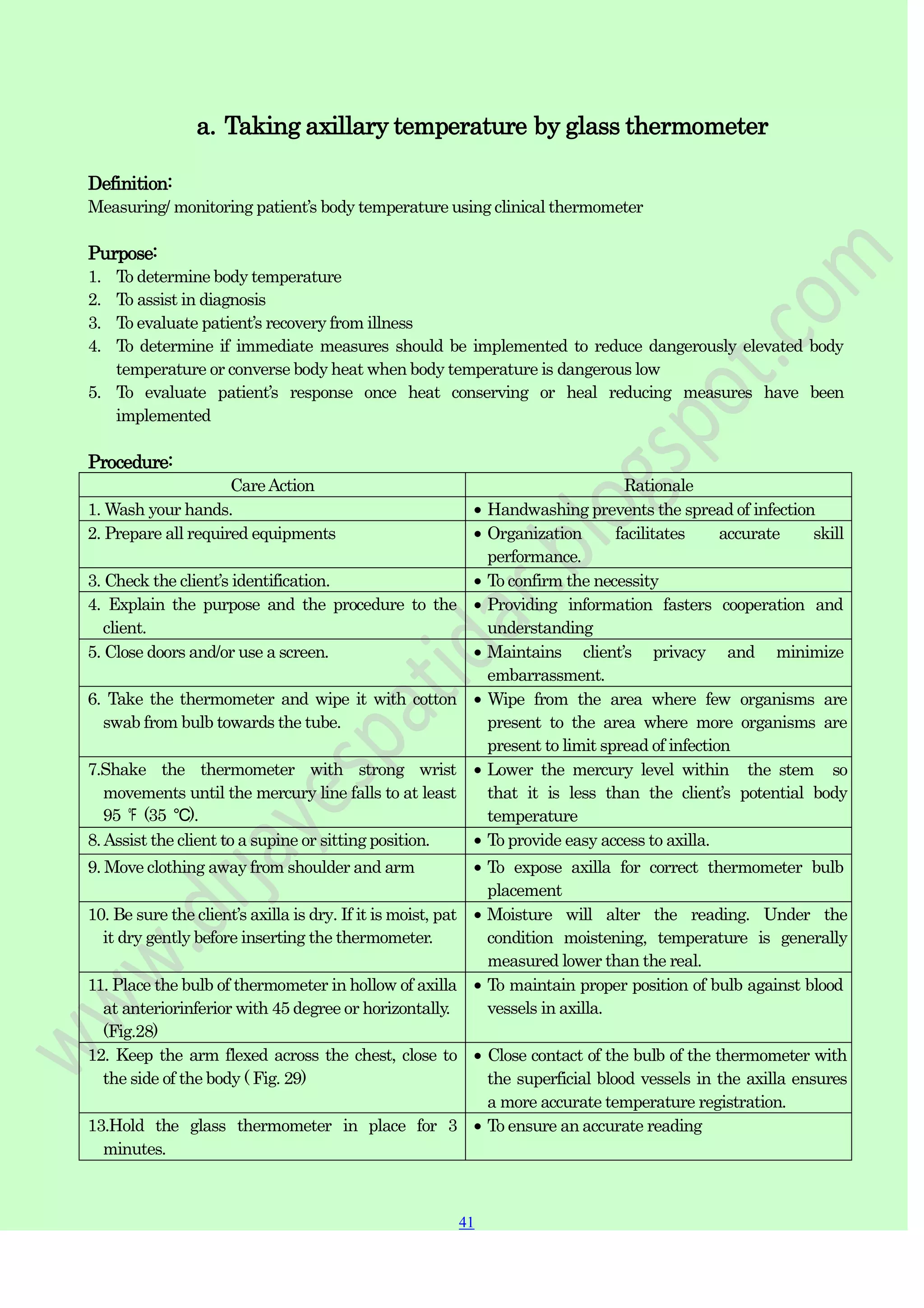
Procedure:
CareAction Rationale
1. Wash your hands. Handwashing prevents the spread of infection
2. Prepare all required equipments Organization facilitates accurate skill
performance.
3. Check the client‟s identification. To confirm the necessity
4. Explain the purpose and the procedure to the
client.
Providing information fasters cooperation and
understanding
5. Close doors and/or use a screen. Maintains client‟s privacy and minimize
embarrassment.
6. Take the thermometer and wipe it with cotton
swab from bulb towards the tube.
Wipe from the area where few organisms are
present to the area where more organisms are
present to limit spread of infection
7.Shake the thermometer with strong wrist
movements until the mercury line falls to at least
95 ℉ (35 ℃).
Lower the mercury level within the stem so
that it is less than the client‟s potential body
temperature
8.Assist the client to a supine or sitting position. To provide easy access to axilla.
9. Move clothing away from shoulder and arm To expose axilla for correct thermometer bulb
placement
10. Be sure the client‟s axilla is dry. If it is moist, pat
it dry gently before inserting the thermometer.
Moisture will alter the reading. Under the
condition moistening, temperature is generally
measured lower than the real.
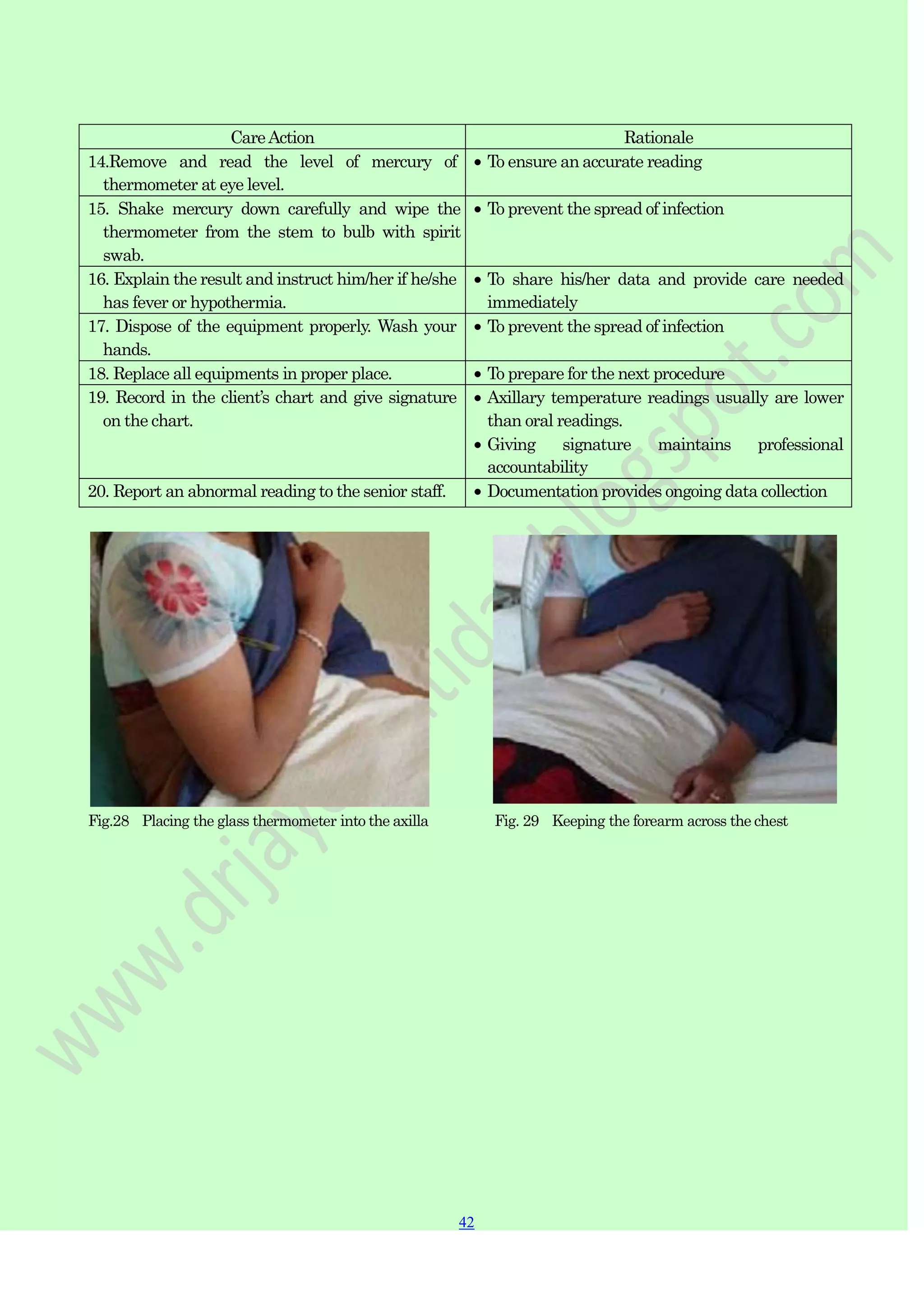
11. Place the bulb of thermometer in hollow of axilla
at anteriorinferior with 45 degree or horizontally.
(Fig.28)
To maintain proper position of bulb against blood
vessels in axilla.
12. Keep the arm flexed across the chest, close to
the side of the body ( Fig. 29)
Close contact of the bulb of the thermometer with
the superficial blood vessels in the axilla ensures
a more accurate temperature registration.
13.Hold the glass thermometer in place for 3
minutes.
To ensure an accurate reading
42
42
CareAction Rationale
14.Remove and read the level of mercury of
thermometer at eye level.
To ensure an accurate reading
15. Shake mercury down carefully and wipe the
thermometer from the stem to bulb with spirit
swab.
To prevent the spread of infection
16. Explain the result and instruct him/her if he/she
has fever or hypothermia.
To share his/her data and provide care needed
immediately
17. Dispose of the equipment properly. Wash your
hands.
To prevent the spread of infection
18. Replace all equipments in proper place. To prepare for the next procedure
19. Record in the client‟s chart and give signature
on the chart.
Axillary temperature readings usually are lower
than oral readings.
Giving signature maintains professional
accountability
20. Report an abnormal reading to the senior staff. Documentation provides ongoing data collection
Fig.28 Placing the glass thermometer into the axilla Fig. 29 Keeping the forearm across the chest
43
43
b. Measuring a Radial Pulse
Definition: Checking presence, rate, rhythm and volume of throbbing of artery.
Purpose:
1. To determine number of heart beats occurring per minute( rate)
2. To gather information about heart rhythm and pattern of beats
3. To evaluate strength of pulse
4. To assess heart's ability to deliver blood to distant areas of the blood viz. fingers and lower extremities
5. To assess response of heart to cardiac medications, activity, blood volume and gas exchange
6. To assess vascular status of limbs
Procedure:
CareAction Rationale
1. Wash hands. Handwashing prevents the spread of infection
2. Prepare all equipments required on tray. Organization facilitates accurate skill problems
3. Check the client‟s identification To confirm the necessity
4. Explain the procedure and purpose to the client. Providing information fosters cooperation and
understanding
5. Assist the client in assuming a supine or sitting
position.
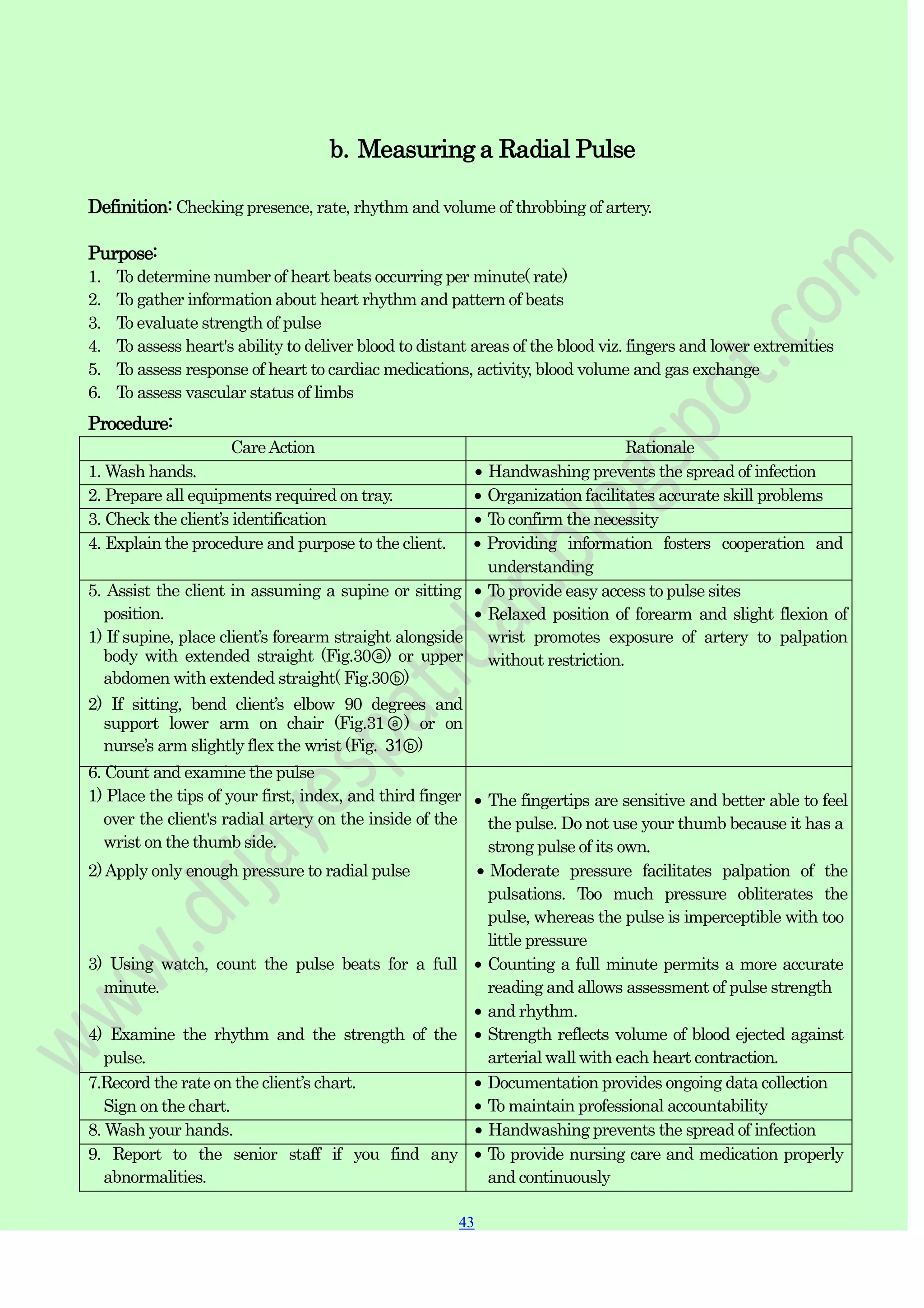
1) If supine, place client‟s forearm straight alongside
body with extended straight (Fig.30ⓐ) or upper
abdomen with extended straight( Fig.30ⓑ)
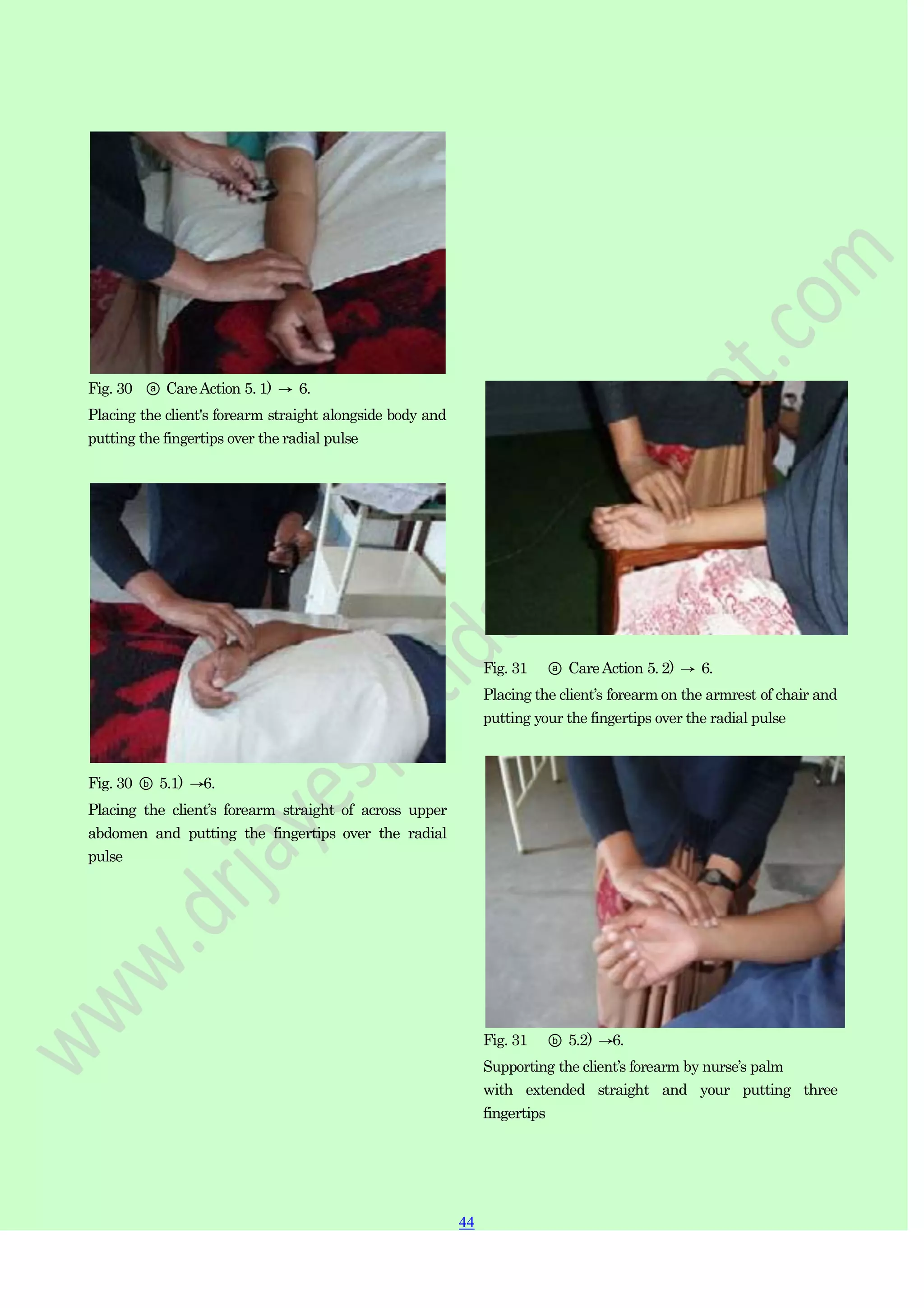
2) If sitting, bend client‟s elbow 90 degrees and
support lower arm on chair (Fig.31ⓐ) or on
nurse‟s arm slightly flex the wrist (Fig. 31ⓑ)
6. Count and examine the pulse
1) Place the tips of your first, index, and third finger
over the client's radial artery on the inside of the
wrist on the thumb side.
To provide easy access to pulse sites
Relaxed position of forearm and slight flexion of
wrist promotes exposure of artery to palpation
without restriction.
The fingertips are sensitive and better able to feel
the pulse. Do not use your thumb because it has a
strong pulse of its own.
2)Apply only enough pressure to radial pulse Moderate pressure facilitates palpation of the
pulsations. Too much pressure obliterates the
pulse, whereas the pulse is imperceptible with too
little pressure
3) Using watch, count the pulse beats for a full
minute.
4) Examine the rhythm and the strength of the
pulse.
7.Record the rate on the client‟s chart.
Sign on the chart.
Counting a full minute permits a more accurate
reading and allows assessment of pulse strength
and rhythm.
Strength reflects volume of blood ejected against
arterial wall with each heart contraction.
Documentation provides ongoing data collection
To maintain professional accountability
8. Wash your hands. Handwashing prevents the spread of infection
9. Report to the senior staff if you find any
abnormalities.
To provide nursing care and medication properly
and continuously
44
44
Fig. 30 ⓐ CareAction 5. 1) → 6.
Placing the client's forearm straight alongside body and
putting the fingertips over the radial pulse
Fig. 30 ⓑ 5.1) →6.
Placing the client‟s forearm straight of across upper
abdomen and putting the fingertips over the radial
pulse
Fig. 31 ⓐ CareAction 5. 2) → 6.
Placing the client‟s forearm on the armrest of chair and
putting your the fingertips over the radial pulse
Fig. 31 ⓑ 5.2) →6.
Supporting the client‟s forearm by nurse‟s palm
with extended straight and your putting three
fingertips
45
45
c. Counting Respiration
Definition: Monitoring the involuntary process of inspiration and expiration in a patient
Purposes:
1. To determine number of respiration occurring per minute
2. To gather information about rhythm and depth
3. To assess response of patient to any related therapy/ medication
Procedure:
CareAction Rationale
1. Close the door and/or use screen. To maintain privacy
2. Make the client's position comfortable, preferably
sitting or lying with the head of the elevated 45 to
60 degrees.
To ensure clear view of chest wall and abdominal
movements. If necessary, move the bed linen.
3. Prepare count respirations by keeping your
fingertips on the client‟s pulse.
Aclient who knows are counting respirations may
not breathe naturally.
4. Counting respiration:
1) Observe the rise and fall of the client‟s (one
inspiration and one expiration).
2) Count respirations for one full minute.
3) Examine the depth, rhythm, facial expression,
cyanosis, cough and movement accessory.
One full cycle consists of an inspiration and an
expiration.
Allow sufficient time to assess respirations,
especially when the rate is with an irregular
Children normally have an irregular, more rapid
rate. Adults with an irregular rate require more
careful assessment including depth and rhythm
of respirations.
5. Replace bed linens if necessary. Record the rate
on the client‟s chart. Sign the chart
Documentation provides ongoing data collection.
Giving signature maintains professional
accountability
6. Perform hand hygiene To prevent the spread of infection
7. Report any irregular findings to the senior staff. To provide continuity of care
46
46
d. Measuring Blood Pressure
Definition: Monitoring blood pressure using palpation and/or sphygmomanometer
Purpose:
1. To obtain baseline data for diagnosis and treatment
2. To compare with subsequent changes that may occur during care of patient
3. To assist in evaluating status of patient‟s blood volume, cardiac output and vascular system
4. To evaluate patient‟s response to changes in physical condition as a result of treatment with fluids or
medications
Procedure: by palpation and aneroid manometer
CareAction Rationale
1. Wash your hands. Handwashing prevents the spread of infection
2. Gather all equipments. Cleanse the stethoscope 's
ear pieces and diaphragm with a spirit swab
wipe.
Organization facilitates performance of the skill.
Cleansing the stethoscope prevents spread of
infection.
3. Check the client‟s identification. Explain the
purpose and procedure to the client.
Providing information fosters the client‟s
cooperation and understanding.
4. Have the client rest at least 5 minutes before
measurement.
Allow the client to relax and helps to avoid falsely
elevate readings.
5. Determine the previous baseline blood pressure ,
if available, from the client‟s record.
To avoid misreading of the client‟s blood pressure
and find any changes his/her blood pressure from
the usual
6. Identify factors likely to interfere which accuracy
of blood pressure measurement : exercise, coffee
and smoking
Exercise and smoking can cause false elevations
in blood pressure.
7. Setting the position:
1)Assist the client to a comfortable position. Be sure
room is warm, quiet and relaxing.
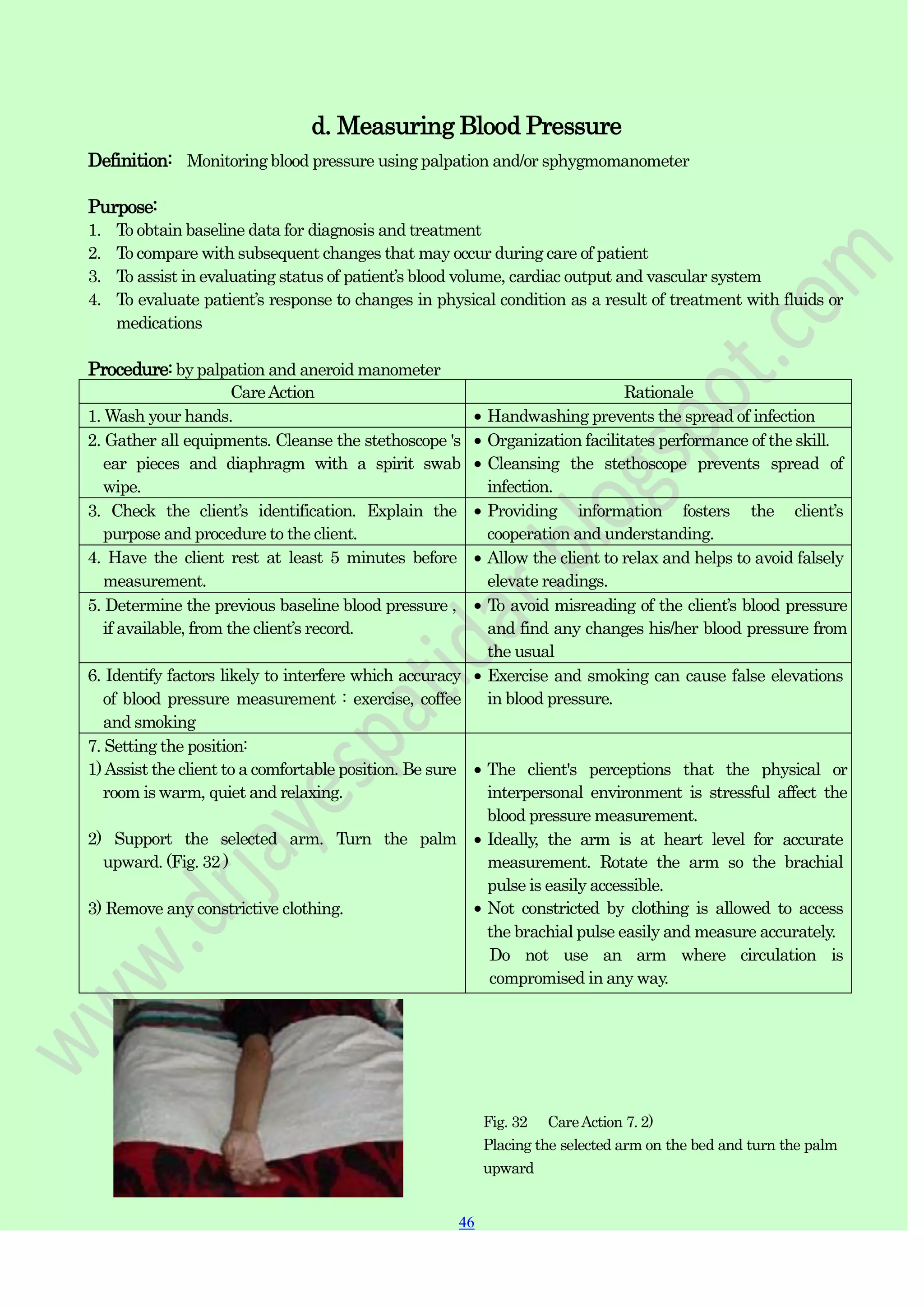
2) Support the selected arm. Turn the palm
upward. (Fig. 32 )
3) Remove any constrictive clothing.
The client's perceptions that the physical or
interpersonal environment is stressful affect the
blood pressure measurement.
Ideally, the arm is at heart level for accurate
measurement. Rotate the arm so the brachial
pulse is easily accessible.
Not constricted by clothing is allowed to access
the brachial pulse easily and measure accurately.
Do not use an arm where circulation is
compromised in any way.
Fig. 32 CareAction 7. 2)
Placing the selected arm on the bed and turn the palm
upward
47
47
CareAction Rationale
8. Checking brachial artery and wrapping the cuff:
1) Palpate brachial artery.
2) Center the cuff‟s bladder approximately 2.5 cm
(1 inch) above the site where you palpated the
brachial pulse
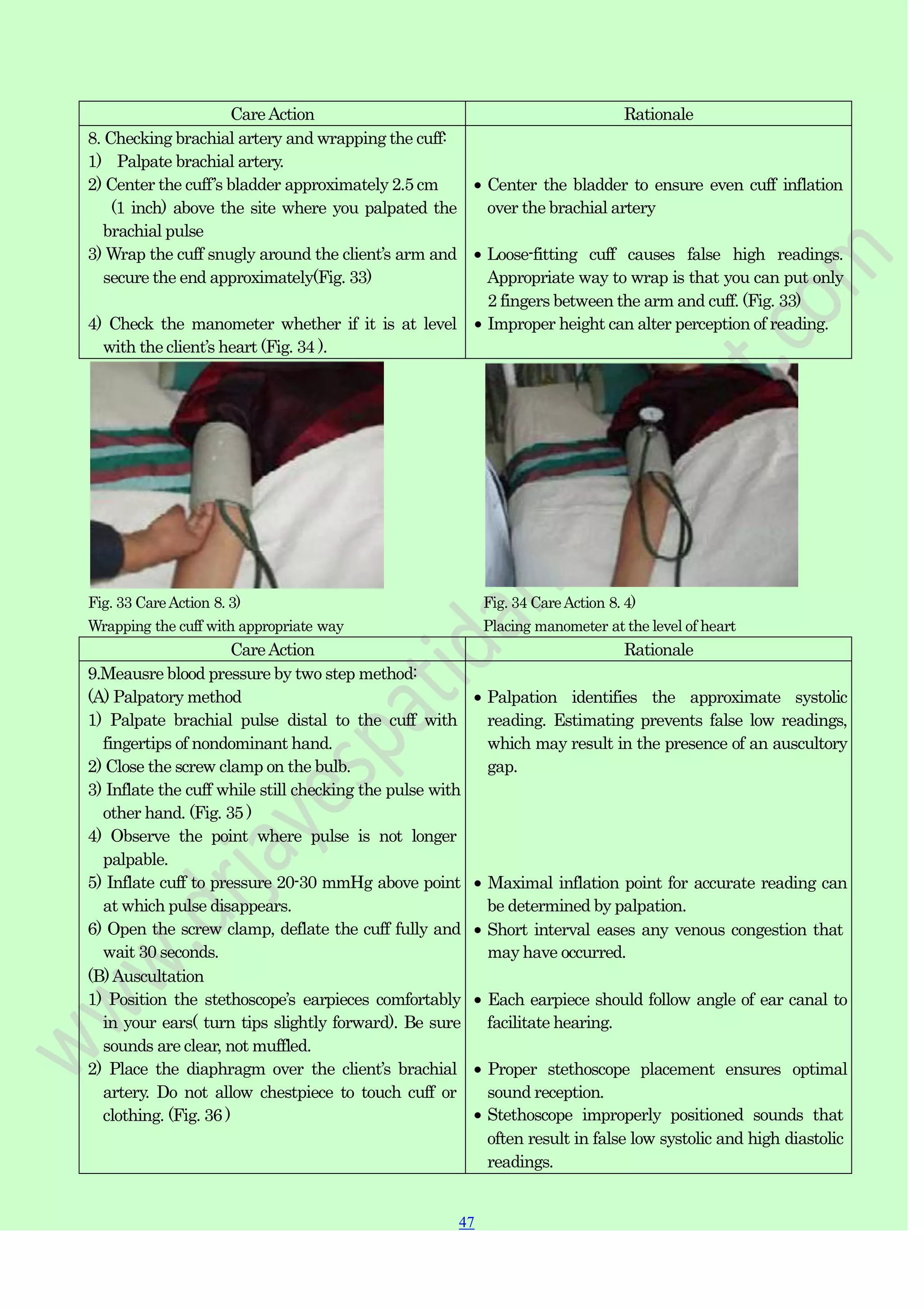
3) Wrap the cuff snugly around the client‟s arm and
secure the end approximately(Fig. 33)
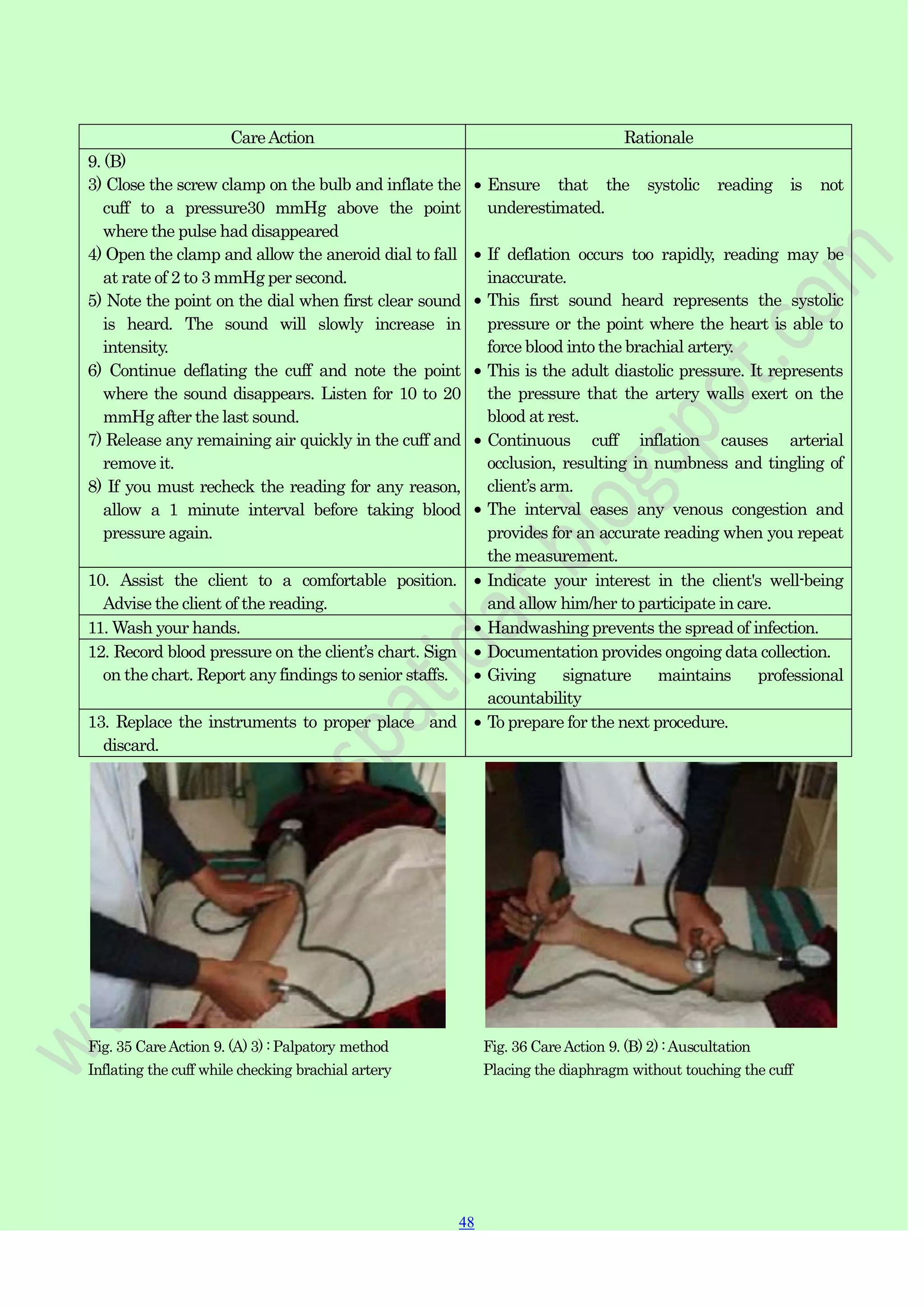
4) Check the manometer whether if it is at level
with the client‟s heart (Fig. 34 ).
Center the bladder to ensure even cuff inflation
over the brachial artery
Loose-fitting cuff causes false high readings.
Appropriate way to wrap is that you can put only
2 fingers between the arm and cuff. (Fig. 33)
Improper height can alter perception of reading.
Fig. 33 CareAction 8. 3)
Wrapping the cuff with appropriate way
Fig. 34 CareAction 8. 4)
Placing manometer at the level of heart
CareAction Rationale
9.Meausre blood pressure by two step method:
(A) Palpatory method
1) Palpate brachial pulse distal to the cuff with
fingertips of nondominant hand.
2) Close the screw clamp on the bulb.
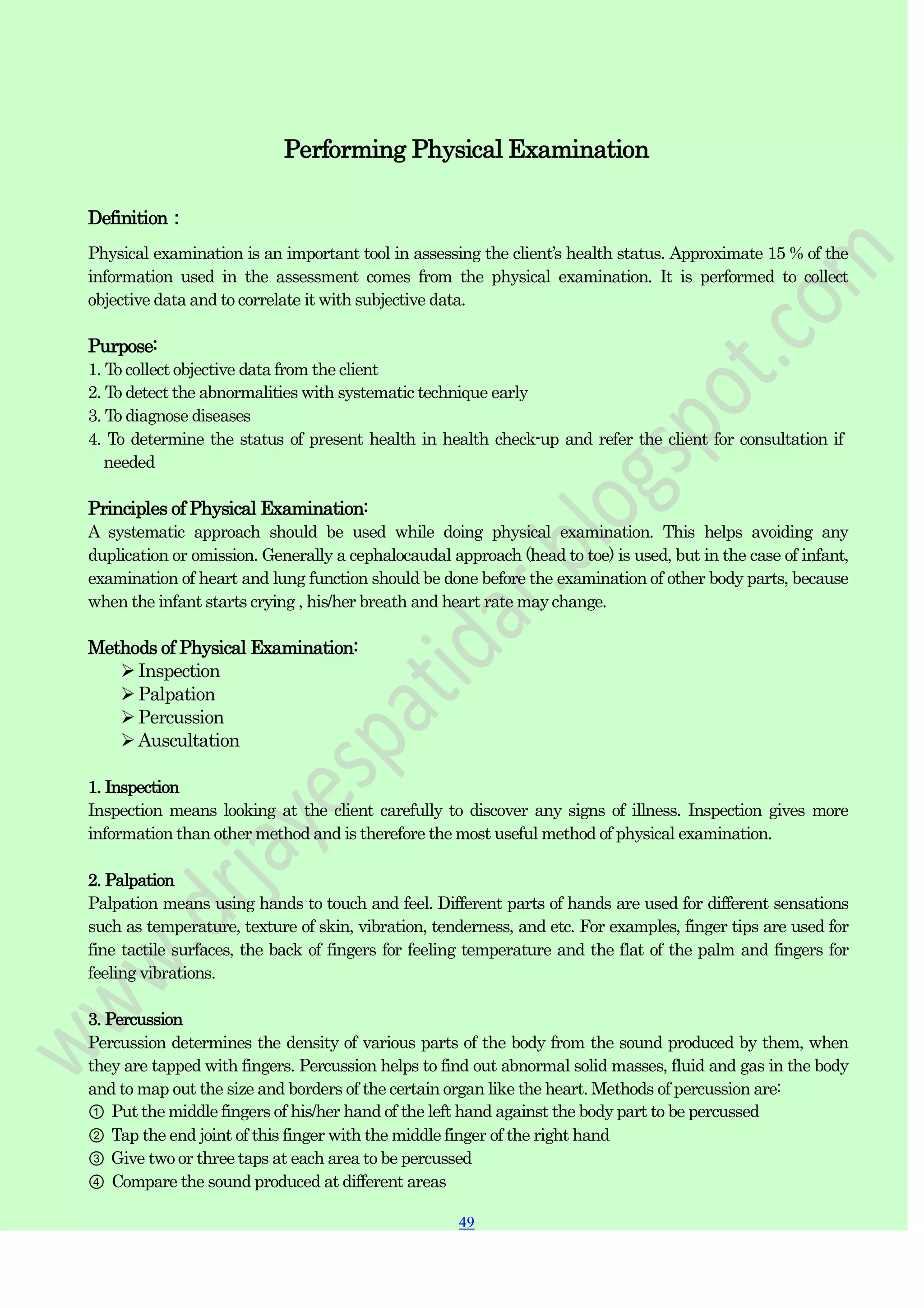
3) Inflate the cuff while still checking the pulse with
other hand. (Fig. 35 )
4) Observe the point where pulse is not longer
palpable.
5) Inflate cuff to pressure 20-30 mmHg above point
at which pulse disappears.
6) Open the screw clamp, deflate the cuff fully and
wait 30 seconds.
(B)Auscultation
1) Position the stethoscope‟s earpieces comfortably
in your ears( turn tips slightly forward). Be sure
sounds are clear, not muffled.
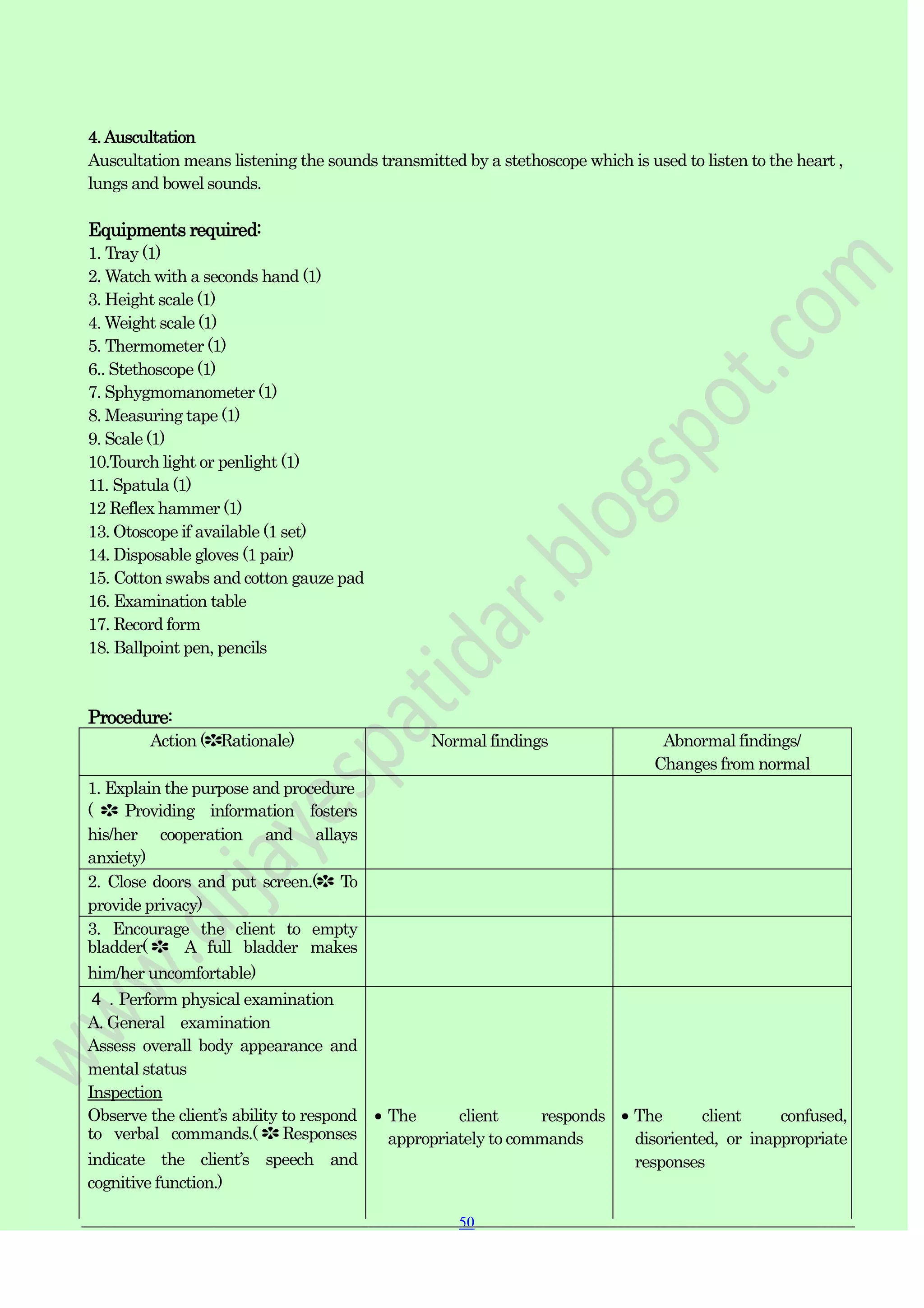
2) Place the diaphragm over the client‟s brachial
artery. Do not allow chestpiece to touch cuff or
clothing. (Fig. 36 )
Palpation identifies the approximate systolic
reading. Estimating prevents false low readings,
which may result in the presence of an auscultory
gap.
Maximal inflation point for accurate reading can
be determined by palpation.
Short interval eases any venous congestion that
may have occurred.
Each earpiece should follow angle of ear canal to
facilitate hearing.
Proper stethoscope placement ensures optimal
sound reception.
Stethoscope improperly positioned sounds that
often result in false low systolic and high diastolic
readings.
48
48
CareAction Rationale
9. (B)
3) Close the screw clamp on the bulb and inflate the
cuff to a pressure30 mmHg above the point
where the pulse had disappeared
4) Open the clamp and allow the aneroid dial to fall
at rate of 2 to 3 mmHg per second.
5) Note the point on the dial when first clear sound
is heard. The sound will slowly increase in
intensity.
6) Continue deflating the cuff and note the point
where the sound disappears. Listen for 10 to 20
mmHg after the last sound.
7) Release any remaining air quickly in the cuff and
remove it.
8) If you must recheck the reading for any reason,
allow a 1 minute interval before taking blood
pressure again.
Ensure that the systolic reading is not
underestimated.
If deflation occurs too rapidly, reading may be
inaccurate.
This first sound heard represents the systolic
pressure or the point where the heart is able to
force blood into the brachial artery.
This is the adult diastolic pressure. It represents
the pressure that the artery walls exert on the
blood at rest.
Continuous cuff inflation causes arterial
occlusion, resulting in numbness and tingling of
client‟s arm.
The interval eases any venous congestion and
provides for an accurate reading when you repeat
the measurement.
10. Assist the client to a comfortable position.
Advise the client of the reading.
Indicate your interest in the client's well-being
and allow him/her to participate in care.
11. Wash your hands. Handwashing prevents the spread of infection.
12. Record blood pressure on the client‟s chart. Sign
on the chart. Report any findings to senior staffs.
Documentation provides ongoing data collection.
Giving signature maintains professional
acountability
13. Replace the instruments to proper place and
discard.
To prepare for the next procedure.
Fig. 35 CareAction 9. (A) 3) : Palpatory method
Inflating the cuff while checking brachial artery
Fig. 36 CareAction 9. (B) 2) :Auscultation
Placing the diaphragm without touching the cuff
49
49
Performing Physical Examination
Definition:
Physical examination is an important tool in assessing the client‟s health status. Approximate 15 % of the
information used in the assessment comes from the physical examination. It is performed to collect
objective data and to correlate it with subjective data.
Purpose:
1. To collect objective data from the client
2. To detect the abnormalities with systematic technique early
3. To diagnose diseases
4. To determine the status of present health in health check-up and refer the client for consultation if
needed
Principles of Physical Examination:
A systematic approach should be used while doing physical examination. This helps avoiding any
duplication or omission. Generally a cephalocaudal approach (head to toe) is used, but in the case of infant,
examination of heart and lung function should be done before the examination of other body parts, because
when the infant starts crying , his/her breath and heart rate may change.
Methods of Physical Examination:
Inspection
Palpation
Percussion
Auscultation
1. Inspection
Inspection means looking at the client carefully to discover any signs of illness. Inspection gives more
information than other method and is therefore the most useful method of physical examination.
2. Palpation
Palpation means using hands to touch and feel. Different parts of hands are used for different sensations
such as temperature, texture of skin, vibration, tenderness, and etc. For examples, finger tips are used for
fine tactile surfaces, the back of fingers for feeling temperature and the flat of the palm and fingers for
feeling vibrations.
3. Percussion
Percussion determines the density of various parts of the body from the sound produced by them, when
they are tapped with fingers. Percussion helps to find out abnormal solid masses, fluid and gas in the body
and to map out the size and borders of the certain organ like the heart. Methods of percussion are:
① Put the middle fingers of his/her hand of the left hand against the body part to be percussed
② Tap the end joint of this finger with the middle finger of the right hand
③ Give two or three taps at each area to be percussed
④ Compare the sound produced at different areas
50
50
4.Auscultation
Auscultation means listening the sounds transmitted by a stethoscope which is used to listen to the heart ,
lungs and bowel sounds.
Equipments required:
1. Tray (1)
2. Watch with a seconds hand (1)
3. Height scale (1)
4. Weight scale (1)
5. Thermometer (1)
6.. Stethoscope (1)
7. Sphygmomanometer (1)
8. Measuring tape (1)
9. Scale (1)
10.Tourch light or penlight (1)
11. Spatula (1)
12 Reflex hammer (1)
13. Otoscope if available (1 set)
14. Disposable gloves (1 pair)
15. Cotton swabs and cotton gauze pad
16. Examination table
17. Record form
18. Ballpoint pen, pencils
Procedure:
Action (✽Rationale) Normal findings Abnormal findings/
Changes from normal
1. Explain the purpose and procedure
( ✽ Providing information fosters
his/her cooperation and allays
anxiety)
2. Close doors and put screen.(✽ To
provide privacy)
3. Encourage the client to empty
bladder( ✽ A full bladder makes
him/her uncomfortable)
4.Perform physical examination
A. General examination
Assess overall body appearance and
mental status
Inspection
Observe the client‟s ability to respond
to verbal commands.( ✽ Responses
indicate the client‟s speech and
cognitive function.)
The client responds
appropriately to commands
The client confused,
disoriented, or inappropriate
responses
51
51
Action (✽Rationale) Normal findings Abnormal findings/
Changes from normal
Observe the client‟s level of
consciousness( ; LOC) and
orientation. Ask the client to state
his/her own name, current location,
and approximate day, month, or
year.(✽Responses indicate the client‟s
brain function. LOC is the degree of
awareness of environmental stimuli.
It varies from full wakefulness and
alertness to coma. Orientation is a
measure of cognitive function or the
ability to think and reason. )
Observe the client‟s ability to think,
remember, process information, and
communicate.( ✽ These processes
indicate cognitive functioning.)
Inspect articulation on speech, style
and contents of speacking
The client is fully awake and
alert: eyes are open and follow
people or objects. The client is
attentive to questions and
responds promptly and
accurately to commands.
If he/she is sleeping, he/she
responds readily to verbal or
physical stimuli and
demonstrates wakefulness
and alertness.
The client is aware of who
he/she is( orientation to
person), where he/she is
( orientation to place), and
when it is( orientation to
time).
The client is able to follow
commands and repeat and
remember information.
smooth/ appropriate native
language
Client has lowered LOC and
shows irritability, short
attention span, or dulled
perceptions.
He/she is uncooperative or
unable to follow simple
commands or answer simple
questions.
At a lowered LOC, he/she
may respond to physical
stimuli only. The lowest
extreme is coma, when the
eyes are closed and the client
fails to respond to verbal or
physical stimuli, when no
voluntary movement.
If LOC is between full
awareness and coma,
objectively note the client‟s
eye movement: voluntary,
withdrawal to stimuli or
withdrawal to noxious
stimuli( pain) only.
Dysphasia
Dysarthria
Memory loss
Disorientation
Hallucinations
not clear/ not smooth/
inappropriate contents
Observe the client‟s ability to see,
hear, smell and distinguish tactile
sensations.
Observe signs of distress(✽ Alert the
examiner to immediate concerns. If
you note distress, the client may
require healthcare interventions
before you continue the exam. )
The client can hear even
though the speaker turns
away.
He/she can identify objects or
reads a clock in the room and
distinguish between sharp
and soft objects.
The client cannnot hear low
tones and must look directly
at the speaker.
He/she cannot read a clock or
distinguish sharp from soft.
The client shows labored
breathing, wheezing, coughing,
wincing, sweating, guarding of
body part (suggests pain),
anxious facial expression, of
fidgety movements.
52
52
Fundamental of Nursing Procedure Manual
Action (✽Rationale) Normal findings Abnormal findings/
Changes from normal
Observe facial expression and mood
( ✽ These could be effected by
disease or ill condition)
Eyes are alert and in contact
with you.
The client is relaxed, smiles or
frowns appropriately and has
a calm demeanor.
Eyes are closed or averted.
The client is frowning or
grimacing.
He/she is unable to answer
questions
Observe general appearance: posture,
gait, and movement( ✽To identify
obvious changes)
Posture is upright
Gait is smooth and equal for
the client‟s age and
development. Limb
movements are bilateral.
Posture is stopped or twisted.
Limbs movements are
uneven or unilateral.
Observe grooming, personal hygiene,
and dress(✽ Personal appearance
can indicate self-comfort. Grooming
suggests his/her ability to perform
self-care.)
Clothing reflects gender, age,
climate.
Hair, skin , and clothing are
clean, well-groomed, and
appropriate for the occasion.
He/she wears unusual
clothing for gender, age, or
climate.
Hair is poor groomed, lack of
cleanliness
Excessive oil is on the skin.
Body odor is present.
Measurement
Height
1) Ask the client to remove shoes and
stand with his/her back and heels
touching the wall.
2) Place a pencil flat on his/her head
so that it makes a mark on the
wall.
3) This shows his/her height
measured with cm tape from the
floor to the mark on the wall(or if
available, measure the height with
measuring scale)
>140(or 145)cm in female <140(or 145) cm in female
53
53
Fundamental of Nursing Procedure Manual
Action (✽Rationale) Normal findings Abnormal findings/
Changes from normal
Weight
Weigh him/her without shoes and much
clothing.
Body Mass index (;BMI) is used to assess the status of nutrition
using weight and height in the world.
Formula for BMI = weight(kg)/ height (m)2
Table 2 BMI
InAdults Women Men
anorexia < 17.5
underweight
in normal range
marginally overweight
overweight
obese
< 19.1
19.1-25.8
25.8-27.3
27.3-32.3
> 32.3
< 20.7
20.7-26.4
26.4-27.8
27.8-31.1
> 31.1
severely obese 35-40
morbidity obese 40-50
super obese 50-60
Take vital signs(✽ Vital signs provide
baseline data)
Temperature 36-37 ℃ hypothermia < 35 ℃
pyrexia 38-40 ℃
hyperpyrexia > 40.1 ℃
Pulse(rate/minute)
Tale the pulse rate and check the beats rate/minute in adult
60-80 / min.
regular and steady
Respiration
Count the breaths without giving notice Breaths /minute 16-20/ min.
clear sound of breaths
regular and steady
rate/ minute in adult
bradycardia
tachycardia
pulse deficit, arrhythmia
Breaths /minute
bradypnea <10/ min.
tachypnea >20/min.
Biot‟s
Cheyne-Stokes
Kussmaul‟s (Fig.37 -41)
wheeze, stridor
Fig.37 Bradypnea Fig. 38 Tachypnea Fig. 39 Biot‟s
Fig. 40 Cheyne-Stokes Fig. 41 Kussmaul‟s
(from Caroline Bunker Rosdabl, p.509)
54
54
Fundamental of Nursing Procedure Manual
Action (✽Rationale) Normal findings Abnormal findings/
Changes from normal
Classification SBP(mmHg) DBP(mmHg)
Normal
Pre-hypertension
Grade 1
Grade 2
Grade 3
<120
120-139
140-159
160-179
>/= 180
<80
80-89
90-99
100-109
>/= 110
Blood pressure
Take blood pressure under quiet and
warm room.
Hypotension: In normal adults < 95/60
Hypertension
Table 3 WHO/ ISH classification of Hypertension(1999)
B. SkinAssessment
Assess integumentary structures(skin,
hair, nails) and function
Skin
SBP: Systolic Blood Pressure, DBP: Diastolic Blood pressure
Inspection and palpation
1) Inspect the back and palms of the
client‟s hands for skin color. Compare
the right and left sides. Make a similar
inspection of the feet and toes,
comparing the right and left sides. (✽
Extremities indicate peripheral
cardiovascular function)
1) Palpate the skin on the back and
palms of the client‟s hands for
moisture, texture.
a. moisture
b. texture
The color varying from
black brown or fair
depending upon the
genetic factors
Color variations on dark
pigmented skin may be
best seen in the mucous
membranes, nail beds,
sclera, or lips.
slight moist, no excessive
moisture or dryness
firm, smooth, soft, elastic
skin
erythema
loss of pigmentation
cyanosis
pallor
jaundice
Excessive dryness indicates
hypothyreidision
Oiliness in acne.
Roughness in
hypothyroidism
Velvety texture in
hyperthyroidism
flaking
perspiration (diaphoresis)
3)Palpate the skin‟s temperature
with the back of your hand.
warmth Generalized warmth in fever
local warmth
Coolness in hypothyroidism
4) Pinch and release the skin on the back
of the client‟s hand. (✽ This palpation
indicates the skin‟s degree of hydration
and turgor.)
Pinched skin that promptly
or gently returns to its
previous stste when
released signifies normal
turgor.
Pinched skin is very slow to
return to normal position.
55
55
Fundamental of Nursing Procedure Manual
Action (✽Rationale) Normal findings Abnormal findings/
Changes from normal
5) Press suspected edematous areas
with the edge of your fingers for 10
seconds, and observe for the
depression
Depression recovers quickly Depression recovers slowly or
remains. Edema indicates
fluid retention, a sign of
circulatory disorders.
Fig. 42 Pitting edema (from Carolyn Jarvis, p.547)
6) Inspect the skin for lesions. Note
the appearance, size, location,
presence and appearance of
drainage.(✽ Locate abnormal cell,
growths, or trauma that suggest
abnormal physiologic processes.)
Nail
1) Inspect and palpate the fingernails
and toenails. Note color, shape and
any lesions.
2) Check capillary refill by pressing
the nail edge to blanch and then
release pressure quickly, noting the
return of color.
Hair and scalp
1) Inspect the hair for color, texture,
growth, distribution
Skin is intact, without reddened
areas but with variations in
pigmentation and texture,
depending on the area‟s location
and exposure to light and
pressure. Freckles, moles, warts
are normal.
Pink color
Logitadional bands of pigment
may be seen in the nails of
normal people.
Normally color return is
instant(<3 seconds)
Nails should have no
discoloration, ridges, pitting,
thickening, or separation from
the edge.
Color may vary from pale
blonde to total black.
Texture varies fine to coarse
and looks straight to curly.
Erythema
Eccymosis
Lesions includes rashes,
macules, papules, vesicles,
wheals, nodules, pustules,
tumors, or ulcers.
Wounds include incisions,
abrasions, lacerations,
pressure ulcers.
Cyanosis and marked pallor
Club being nails
Koilonychia(spoon nail)
Onycholysis( fungal
infection)
Cyanosis nail beds or
sluggish color return
consider cardiovascular or
respiratory dysfunction.
Hair is excessively dry or oily
Excessive hair loss( alopecia)
or coarse hair in
hypothyroidism
fine silky hair in
hyperthyroidism
pediculosis
dandruff
56
56
Fundamental of Nursing Procedure Manual
Action (✽Rationale) Normal findings Abnormal findings/
Changes from normal
2) Inspect the scaly, lumps, nevi, or
other lesions.
C. Head and NeckAssessment
Assess central neurologic function,
vision, hearing, and mouth
structures.
Skull
1) Observe for the size, shape, and
symmetry.
2) Palpate and note any deformities,
depressions, lumps, or tenderness.
Face
Inspect the client‟s facial expression,
asymmetry, involuntary movements,
edema, and masses
Eyes
1) Position and alimentation:
Stand in front of the client and
inspect the both eyes for position
a n d a l i g n m e n t .
2) Eyebrows:
Inspect the eyebrows , noting their
quantity and distribution and any
scaliness
3) Eyelids:
Inspect the position, presence of
edema, lesions, condition and
direction of the eyelashes, and
adequacy with eyelids doze.
All area should be clean and
free of any lesions, scaly,
lumps, and nevi.
Head is symmetrical, round,
and erect in the midline.
relaxed facial expression
He/she doesn‟t have
involuntary movement
No deviation and abnormal
profusion
redness and scaling in
seborrheic dermatitis
psoriasis
Enlarged skull in
hydrocephalus, Paget‟s
diseases of bone.
Redness after trauma
Moon face with red cheeks in
Cushing‟s syndrome
Edematous face around the
eyes (in the morning ) and
pale in nephritic syndrome
Decreased facial mobility
and blunt expression in
Parkinson‟s disease
Inward and outward
deviation
Abnormal profusion in
disease or ocular tumors
Scaliness in seborrheic
dermatitis
Lateral sparseness in
hypothyroidism
Ptosis
Entropian
Ectropion
Lid riraction
Chalazion
Sty
Dacryocystitis
Red inflamed lid margin
Inwards direction
Failure of the eyelids to close
exposes the corneas to
serious damage
Fundamental of Nursing Procedure Manual
Action (✽Rationale) Normal findings Abnormal findings/
Changes from normal
4) Lacrimal apparatus
Inspect the region of the lacrimal
gland and lacrimal sac for swelling.
Look for excessive tearing or
dryness of the eye
5) Conjunctiva and sclera
① Expose the sclera and
conjunctiva
② Inspect the color of palpebral
conjunction, vascular pattern
against the white scleral
background and any nodules or
swelling.
Fig.43 Inspection conjunctiva and
sclera(from Carolyn Jarvis, p.311)
6) Cornea and Lens
With oblique lighting, inspect the
cornea of each eye for opacities and
note any opacities in the lens.
7) Pupils
( ✽ Pupillary size, shape, and
accomonation indicate the status
od intracranial pressure)
Inspect the size, shapes and
compare symmetry. If the pupils
are larger(>5 mm), small(<3 mm) or
unequal, measure them.
No lumps and swelling
around the eyes
Transparent white color of
sclera
Dark pink color of conjunctiva
No paleness
No nodules or swelling and
redness
Transparent, no abrasions
and white spots
Pupils are equal, round, and
symmetry.
Lumps and swelling
Excessive tearing may be
due to increased production,
drainage of tear and
infection ( such as
conjunctiva inflammation
and corneal irritation)
A yellow sclera indicates
jaundice
Paleness in palpebral
conjunctiva indicates the
anaemia.
Local redness due to
infection
Fig. 44 Conjunctiviis
(from Carolyn Jarvis, p.335)
Opacities in the lens due to
cataract
A superficial grayish veiled
opacity in the cornea due to
old injury or to inflammation
Pupils are unequal.
Miosis refers to constriction
of the pupils
Mydriasis to dilation
57
Fundamental of Nursing Procedure Manual
Action (✽Rationale) Normal findings Abnormal findings/
Changes from normal
8) Pupillary response to light
①Ask the client to look into the
distance and light a torch from
the side of the eye
②Remove it on the other side to
and observe how pupil reacts
③ Repeat other side with same
procedure
Fig.45 Papillary response
(from Carolyne Jarvis, p.703)
9)Coordination of eye movements
(✽Coordination of eye movements
indicates brain function and
muscular attachments to eyes.)
①Hold as object at a distance from
the client
②Ask him/her to keep his/her head
still and follow the object with the
eyes only
③Move the object towards his/her
right and left eye ,then towards
the ceiling and floor.
④Repeat it on the other side to
10) Convergence test
①Ask the client to follow your
finger or a pencil as you move it
in toward the bridge of the nose.
② The converging eyes normally
follows the object to within 5 cm
to 8 cm of the eyes
11) Snellen eye chart test
(✽ To check visual acuity)
①Use the Snellen eye chart,
which includes objects, letters, or
numbers of different sizes in
rows, under well-light
② Position the client 20 feet
from the chart and ask the client
to identify the items.
③ Compares visual acuity of the
client with normal vision
As the torch approaches the
eye, the pupil constricts. And
as the torch removed, the
pupil dilates.
Both eyes move together
while following the objects:
coordination
Good convergence
20/20 vision as normal
Unresponsive to light
Pupil remains dilated even
after torch removed due to
oculomotior nerve paralysis.
Small irregular pupils seen
as central nervous system
syphilis.
Eyes do not move together
when the object moves in
paralysis of the cranial
nerve.
Strabismus(cross-eyed or
wall-eyed)
Client reports
diplopia(double-vision)
Poor convergence in
hypothyroism
Myopia(near-sightedness)
Hyperopia(far-sightedness)
is impaired in middle and
elder people.
Legal blindness
58
Fundamental of Nursing Procedure Manual
Action (✽Rationale) Normal findings Abnormal findings/
Changes from normal
Ears
Inspect and palpate the external ears.
1) Inspect location of ears
2) Inspect the shape and measure the
size.
The top of the pinnae meet or
crosses the eye-occiput line
(imaginary line drawn from
the outer canthus of the ear to
the occipital protuberance)
Equal size bilaterally
No swelling or thickening
Unusual size and shape may
be familial trail without
clinical significance
The top of the pinnae don‟t
meet or cross the eye –
occiput line.
Microtia(:ears smaller than 4
cm vertically)
Macrotia(: ears larger than
10 cm vertically)
Edema
Asymmetry shape due to
trauma
Pain with movement occurs
with otitis externa and
Pain at the mastoid process
may indicate mastoiditis or
lymphadenitis of the
posterior auricular node.
Atresia(:absence or closure of
the ear canal)
Clear blood of the brain
haemorrhage
A sticky yellow discharge
accompanies otitis externa or
otitis media.
Impacted cerumen is a
common cause of conductive
hearing loss
Fig. 46Auricle(from Carolyne Jarvis, p.342)
3) Tenderness
①Move the pinna and push on the No pain while moving the
tragus pinna, pushing the tragus,
② Palpate the mastoid process and palpating mastoid process
4) External auditory meatus
Inspect the external auditory canal
(by touch or otoscope) (✽ To inspect
swelling, redness, discharge, foreign
body or cerumen.)
59
Fundamental of Nursing Procedure Manual
Action (✽Rationale) Normal findings Abnormal findings/
Changes from normal
5) Voice test
(✽ Whispered is a high frequency
sound and is used to detect high
tone loss)
①Test one ear at a time.
②Stay 30-60 cm from client‟s ear.
③Exhale and whisper slowly some
two syllable words (such as
Tuesday, Baseball and fourteen.)
Nose
1) Inspect the anterior and inferior
surface of the nose.
① Give gentle pressure in the tip
of the nose with your thumb to
widen the nostrils
②with the aid of penlight, you can
get a partial view of each nasal
vestibule.
③ Observe symmetry, deformity,
size, and flaring.
④ If indicated by pressing on
each ala nasi in turn and ask the
client to breath in.
(✽To test for nasal obstruction)
2) Inspect the inside of the nose
Inspect the inside with otoscope or
penlight cafefully.
( ✽ To detect any deformities or
abnormalities in nasal mucosa,
nasal septum.)
Normally the client repeats
each word correctly after you
said it.
No pain
Symmetry in size
Nostril uniform in size
No flare
no obstruction in both
vestibule
Asymmetry of two sides'
shape is normal.
No deviation
No polyp
Nasal mucosa redder than the
oral mucosa
No bleeding, swelling or
exudates in nasal mucosa
no bleeding, perforation or
deviation of the septum
No polyps, ulcers or foreign
bodies
The client is unable to hear
High tone loss
Tenderness of nasal tip or ala
suggests local infection
Asymmetry in size
Asymmetrical in size
Flaring nostrils
Obstruction in right
vestibule by polyp.
Deviation of the lower
septum is common and may
be easily visible above
deviation, seldom obstructs
air flow.
In viral rhinitis, the mucosa
is reddened and swollen
In allergic rhinitis, it may be
pale bluish or red.
Fresh blood or crusting may
be seen causes of septal
perforation includes trauma,
surgery, and the intranasal
use of cocaine.
60
Fundamental of Nursing Procedure Manual
Action (✽Rationale) Normal findings Abnormal findings/
Changes from normal
3) Palpate for sinus tenderness
① Press up on the frontal sinuses
from under the bony brows,
avoiding pressure on the eyes.
② Press upon the maxillary
sinuses
Fig. 47 Pressing over the frontal sinuses→
Fig.48 Pressing over the maxillary
sinuses (from Carolyne Jarvis, p.382)
→
Mouth
If the client wears dentures, offer a
piece of paper towel and ask to
remove it so that you can see the
mucosa underneath.
1) Lips
① Observe the color, moisture
② Note any lumps, ulcers,
cracking or scaliness.
2) Oral mucosa/ gums/teeth
① Inspect the color, presence of
ulcers, swelling, white patches and
nodules in mucosa and gums
Pink, moist and intact skin
No bluish, discoloration,
cracks and ulcers.
Pink color in both oral mucosa
and gums
Patches brownness may be
present, especially in black
people.
Polyps are pale translucent
masses that usually come
from the middle meatus
Ulcers may result from nasal
use of cocaine
Local tenderness, together
with symptoms such as pain,
fever and nasal discharge,
suggest acute sinusitis
involving the frontal or
maxillary sinuses.
Lips bluish(: cyanosis) and
pallor
Cracks, ulcer
Aphthous ulcer
Yelloish spots
Koplik‟s spots
Small red spots(: petechiae)
Thickened white patch( :
Leuloplakia)
Redness of gingivitis
Black line of lead poisoning
Swollen interdental papillae
in gingivitis
Ulcerative gingivitis
Gums enlargements
61
Fundamental of Nursing Procedure Manual
Action (✽Rationale) Normal findings Abnormal findings/
Changes from normal
② Inspect the teeth for missing,
discolored, misshapen or
abnormally positioned. Palpate
them for check looseness with
gloved thumb and index finger.
③ Inspect the color of roof of the
mouth and architecture of the
harelip.
3) Tongue and floor of the mouth
Inspect the tongue for color, texture
of dorsum, papillae symmetry
4) Inspect the sides and undersurface
of the tongue and the floor of the
mouth.
Pharynx
1)Ask the client to open the mouth
and say “ah”. This actions help to
see the pharynx well. If not press
the tongue, press spatula firmly
down upon the midpoint of the
arched tongue.
2) Inspect soft palate anterior and
posterior pillars, uvula, tonsils, and
pharynx( ✽ To detect color,
symmetry, presence of exudates,
swelling, ulceration or tonsillar
enlargement, and tenderness.)
No lesions, white plaque and
extra bony growth
Pink, moist and papillae
Midline fissure presents and
be symmetrical.
No whit or reddened areas
No nodules or ulcerations
Pink throat
Pink and small tonsils
No swelling, exudates, and
ulceration
No difficulty in swallowing
Missing or looseness of teeth
Dental caries
Attrition of teeth
Erosion of teeth
Abrasion of teeth with
notching
Thrush on the palpate(:
thick, white plaques)
Kaposi‟s sarcoma(: deep
purple color of lesions) in
AIDs
Torus palatinus (: midline
bony growth in the hard
palate)
Hairy tongue
Fissured tongue
Smooth tongue
Whitening coating tongue
Red or pale, dry papillae
fissure absent
Asymmetric protrusion
suggests a lesion of cranial
nerve XII
Any persistent nodule or
ulcer
Red or white area must be
suspected the cancer
Exudative tonsillitis(: red
and enlarged tonsils)
Throat with white exudates
Redness and varcularity of
the pillars and uvula in
pharyngitis
62
Fundamental of Nursing Procedure Manual
Action (✽Rationale) Normal findings Abnormal findings/
Changes from normal
Neck
1) Inspect the neck
(✽To detect its symmetry and any
masses or scars, enlargment of the
parotid or submandibular glands,
and condition of any visible lymph
nodes)
2) Range of Motion(; ROM)
①Ask the client to touch the chin to
the chest turn the head to the right
and left
②Try to touch each ear to the
shoulder without elevating
shoulders
③ Extend the head backward
(Head lift occurs with muscle
spasm.) Head positions
centered in the midline and
the head should be held erect
Lymph nodes are neither
visible or redness
Throat is dull red and gray
exudates is present in uvula,
pharynx and tongue, which
cause airway obstruction
Difficulty in swallowing
In CN X paralysis, the soft
palate fails to rise and the
uvula deviates to the
opposite site.
Rigid head and neck occurs
with arthritis
Scar at thyroid site
Enlargement of lymph nodes
Redness of lymph nodes
Pain at any particular
movement, limited
movement due to cervical
arthritis or inflammation on
of the neck muscles
Rigid neck with arthritis
② Posterior auricular
③ Occipital
⑥ Jugulodigstric
⑦ Superficial cervical
⑨ Posterior cervical
⑩ Supraclavicular
Fig. 49 Lymph nodes (from Carolyne Jarvis, p. 281)
① Preauricular
⑤ Submandibular
④ Submental
⑧ Deep cervical chain
63
Fundamental of Nursing Procedure Manual
Action (✽Rationale) Normal findings Abnormal findings/
Changes from normal
Lymph nodes
1)Palpate the lymph nodes by using
the pads of your index and middle
fingers
2)Move the underlying tissues in each
area
3)Examine both sides at once
4)Feel in sequence for the following
nodes: (Fig. 49)
① preauicular
② posturiaduricular
③ occipital
④ tonsillar
⑤ submandibular
⑥ submental
⑦ superficial cervical
⑧ posterior cervical
⑨ deep cervical chain
⑩ supracravicular
(✽To detect any palpable nodes with
location, size, shape, delimitation,
mobility, consistency, and
tenderness.)
Cervical nodes often are
palpate in healthy person,
although this palpability
decrease with age
Normal nodes feel movable,
discrete, soft, non-tender
Parotid is swollen with
mumps
Tender nodes suggest
inflammation
Hard or fixed nodes suggest
malignancy
Lymphadenopathy is
enlargement of the lymph
nodes( > 1 cm) due to
infection, allergy or
neoplasm
Enlargement of a
supraclavicular node,
especially on the left,
suggests possible metastasis
from a thorax or an
abdominal malignancy
Diffuse lymphadenopathy
raises the suspicious of
HIV/AIDs
Trachea
1) Inspect the trachea (✽To detect
any deviation from its usual
midline position)
2) Palpate for any trachea shift. Place
your index finger on the trachea in
the sternal notch and slip it off to
each side( ✽ To detect any
abnormalities)
Normally trachea is in
midline.
The space should be
symmetry on both sides
No deviation from the midline
Masses in the neck may
push the trachea to one side.
Tracheal deviation may also
signify important problems
in thorax, such as a
mediastinal mass, atelectasis
or large pneumothorax
Thyroid gland
1) Inspect thyroid gland:
① Ask the client to sip some water,
to extend the neck, and swallow.
② Observe for upward movement
of the thyroid gland, noting its
contour and symmetry.
③You must confirm that thyroid
gland rise with swallowing and
then fall to their resting position.
Normally trachea is in
midline
The space should be
symmetry in both sides
No deviation from the midline
Goiter as a general tern for
an enlarged thyroid gland
64
Fundamental of Nursing Procedure Manual
Action (✽Rationale) Normal findings Abnormal findings/
Changes from normal
2) Palpate the thyroid gland:
① move behind the client
② Ask the client to flex the neck
slightly forward to relax the
sternomastoid muscles.
③ Place the fingers of both hands
on the client's neck so that your
index fingers are just below the
cranial cartilage.
④ Ask the client to sip as swallow
water as before. Feel for the thyroid
isthmus rising up tender your
fingers pads.
⑤ Displace the trachea to the right
with the fingers of the left hand,
with the right hand fingers, palpate
laterally for the right lobe of the
thyroid in the space between the
displaced trachea and the relaxed
sternomastoid. Find the lateral
margin. Examine the left lobe in
same way.
Normally you cannot palpate
the thyroid gland
No enlargement, presence of
nodules, and tenderness
Diffuse enlargement in
endemic goiter
Soft in Graves disease
Firm in malignancy
Tenderness in thyroiditis
Multinodular goiter is
additional risk factors for
malignancy
Fig. 50 Posterior approach to Thyroid gland Fig. 51 Anterior approach to thyroid gland
(from Carolyne Jarvis, p.284) (from Carolyne Jarvis, p.284)
65
Fundamental of Nursing Procedure Manual
Action (✽Rationale) Normal findings Abnormal findings/
Changes from normal
D. Chest and Lungs
Initial survey of respiration and the
thorax
1)Remove or open the client‟s
clothing.
2)Have the client sit on the side of
examining table or bed. When
examine in supine position, the
client should lie comfortably with
arms somewhat abducted. A client
who is having difficulty breathing
should be examined is the sitting
position or with head of the bed
elevated to a comfort level.
Examination of the posterior chest
Inspection:
Observe the shape and movement of
the posterior chest. Compare one side
with other.(✽To identify
asymmetrical shape or movement;
assess respiratory movement.) Note:
① deformities or asymmetry
② abnormal retraction of the lower
interspaces
③ impairment in respiratory
movement
Palpation
Palpate the posterior wall over
areas.(✽ To distinguish between
normal and abnormal structures:
tender, masses, swelling or painful
area )
Inspection
Stand behind the client and observe
the posterior chest for shape and
movement. (✽To identify shape or
movement; assess respiratory
movement)
Shoulders are level; breast,
lower rib margin are
symmetrical.
Chest wall rises and falls
slightly with inspiration and
expiration.
equal respiratory movement
no retraction or bulging of the
interspaces should occur on
inspiration
Thorax in normal adult is
wider that it is deep, its
lateral diameter is larger than
in anterioposterior(;AP)
AP diameter may increase
with age.
No tenderness, superficial
lumps or masses, normal skin
mobility and turgor
Shoulders are even; scapulae
are at the same level; spine is
midline and straight.
Posterior chest slightly rises
and falls on respiration.
Movement of the chest wall
is asymmetrical on
respiration; shoulders are
uneven; rib cage, or breasts
are asymmetrical:
funnel chest(:depression in
the lower portioning
sternum)
barrel chest(: increased AP
diameter)
Client has supraclavicular
retractions or contractions of
accessory muscles during
inspiration:
AP diameter may increase in
chronic obstructive
pulmonary disease
Tender pectoral muscles or
costal cartilage
Pain
Masses
Structural deformities or
asymmetry are present:
Scoliosis(:lateral curvature)
Lordosis(: pronounced
lumbar curvature)
Kyphosis(: abnormal spinal
curvature and vertebral
rotation deform the chest)
66
Fundamental of Nursing Procedure Manual
Normal adult thorax Barrel thorax
Funnel breast Pigeon breast
Scoliosis Kyphosis
Fig. 52 Abnoramal thorax
(from Carolyne Jarvis, p.470-471)
67
Fundamental of Nursing Procedure Manual
Action (✽Rationale) Normal findings Abnormal findings/
Changes from normal
Inspection and palpation:
1) Assess chest expansion on the
posterior chest: Symmetric
expansion (Fig.53 )
① Place your hands in the
posterolateral chest wall with
thumbs at the level of T9 or T10
② Slide your hands medially to
pinch up a small fold of skin
between your thumbs
③Ask the client to take a deep
breath.
④Watch your thumbs‟ move apart
symmetrically and not smooth
chest expansion with your finger
2) Assess tactile(vocal) fremitus ( Fig.
54)
①Begin palpating by using the ball
or ulnar surface of your hand from
the lung apices
② Touch the client‟s chest while
he/sherepeats the words
“ninety-nine” or “ blue moon”
③ Compare vibration from one
side to the other
Chest expansion is symmetric.
Vibrations should feel the
same in the corresponding
area on each side
An abnormally wide costal
angle with little inspiratory
variation occurs with
emphysema.
A lag in expansion occurs
with atelectasis and
pneumonia
Pain accompanied deep
breathing when the pleurae
are inflamed
A palpable grating sensation
with breathing indicates
pleural friction fremitus
Decreased fremitus occurs
when anything obstructs
transmission of vibration,
e.g., obstructed bronchus,
pleural effusion,
pneumothorax, or
emphysema.
Increased fremitus occurs
with compression or
consolidation of lung tissue,
e.g., lobar pneumonia.
Rhonchal fremitus is
palpable with thick bronchial
secretions
Pleural friction fremitus is
palpable with inflammation
of the pleura.
68
Fundamental of Nursing Procedure Manual
Action (✽Rationale) Normal findings Abnormal findings/
Changes from normal
Fig.53 Palpation symmetric expansion Fig. 54 Palpation tactile fremitus
in the posterior chest in the posterior chest
(from Carolyne Jarvis, p.450) (from Carolyne Jarvis, p.450
Percussion
Lung Fields
Percuss the posterior chest
comparing both sides.( ✽ To
identify and locate any area
with an abnormal
percussion).( ✽ To enhance
percussion) (Fig. 55 )
1) Percuss the posterior chest
from the apices and then to
interspaces with a -5 cm
intervals.
2) Note any abnormal findings
Diaphragm excursion
(✽To map out the lower lung
border, both in expiration and
inspiration ) (Fig. 56)
1) Ask the client to exhale and
hold it briefly while you percuss
down the scapular line
Resonance is normal lung
sound: except heart area
because heart normally
produces dullness bound, liver
produces dullness stomach
produces tympany, muscles and
bone produces flat
The diaphragm excursion
should be equal bilaterally and
measure about 3 to 5 cm in
adults
Dullness replaces resonance
when fluid or solid tissue
replaces air containing lung or
accupies the pleural space, i.g.,
pneumonia, pleural effusion,
atelectasis, or tumor.
Hyperresonance is found in
COPD and asthma
Hyperresonant or tympanitic in
pneumothorax
An abnormal high level of
dullness or absence of excursion
occurs with pleural effusion or
atelectasis of the lower lobes
69
Fundamental of Nursing Procedure Manual
Action (✽Rationale) Normal findings Abnormal findings/
Changes from normal
2) Continue percussion until the
sounds changes from resonant
to dull on each side
3) Mark the spot
Fig. 55 Sequence for percussion(from Carolyne Jarvis, p.452)
Fig. 56A. Determine diaphragm excursion B. Measuring the differences (from Carolyne Jarvis, p. 452-453)
70
Fundamental of Nursing Procedure Manual
Action (✽Rationale) Normal findings Abnormal findings/
Changes from normal
Auscultation
1)Listen to the breath
posteriorilly with mouth open
and more deeply than the
normal (✽ To note intensity,
identify any variation and any
adventitious sounds)
2) Repeat auscultation in the
posterior chest.
Breath sounds are usually
louder in upper anterior lung
fields
Bronchial, bronchovesicular,
vesicular sounds are normal
breath sounds
None adventitious sounds
Decreased or abscent breath
sounds occur i.g., atelectasis,
pleural effusion,
pneumothorax, chironic
obstructd pulmonary disease(;
COPD)
Increased breath sounds occur
when consolidation or
compression yields a dense
lung area, i.g., pneumonia,
fluid in the intrapleural space
Fig. 57Auscultation the posterior chest using the sequence
(from Carolyne Jarvis, p.455)
Examination of the anterior
chest
Palpate the anterior chest
1)Assess symmetric expansion
① Place your hands on the
anterolateral wall with your
thumbs along the costal
margins and pointing toward
the xiphoid process
② Ask the client to take a deep
breath
③ Watch your hand move apart
Symmetrically
Symmetrical expansion
Smooth chest expansion
An abnormal wide costal angle
with little inspiratory variation
occurs with emphysema
A lag expansion occurs with
atelectasis or pneumonia
A palpable grating sensation
with breathing indicates
pleural fremitus
71
Fundamental of Nursing Procedure Manual
Action (✽Rationale) Normal findings Abnormal findings/
Changes from normal
2)Assess tactile fremitus
① Begin palpating over the
lung apices in the
supraclavicular areas
② Compare vibrations from one
side to other side while
repeating “ninety-nine”
③Avoid palpating over female
breast tissue because breast
tissue normally clamps the
sound.
3) Palpate the anterior chest wall
(✽To note any tenderness, and
detect any superficial lumps or
masses) Note skin mobility,
turgor, skin temperature and
moisture
Percuss the anterior chest
1) Begin percussing the apices in
the supraclavicular areas
2) Percuss the interspaces and
compare one side to the other
3) Move down the anterior chest
Auscultation
1) Auscultate the lungs fields over
the anterior chest from the
apices in the supraclavicular
areas down to the 6th rib
2) Progress from side to side and
listen to one full respiration in
each location
3) Evaluate normal breath
sounds and note abnormal
breath sounds
(Refer to the posterior chest) (Refer to the posterior chest)
Lungs with chronic
emphysema result in
hyperresonnance
72
Fundamental of Nursing Procedure Manual
Fig.58 Palpate anterior expansion Fig. 59Assess tactile fremitus Fig. 60 Sequence of percussion and
auscultation
(from Carolyne Jarvis, p.40-461)
Table 4 Abnormal/ adventitious lung sounds
(from Carolyne Jarvis, p.474)
73
Fundamental of Nursing Procedure Manual
Action (✽Rationale) Normal findings Abnormal findings/
Changes from normal
E. Heart/ Precordium
For most of the cardiac
examination, the client should be
supine with the head elevated
30°. Two other position are also
needed, a. turning to the left side,
b. leaning forward. the examiner
should stand at the client‟s
right.
Inspection
Inspect the anterior chest for
pulsation, you may or may not
see the apical impulse.
Palpate theApical impulse
(✽ To detect some abnormal
conditions)
1) Localize the apical impulse by
using one finger pad
2) Asking the client to “exhale
and then hold it “aids the
examiner in locating the
pulsation.
3) Ask the client to roll midway to
the left to find
4) Note location, size, amplitude,
and duration
.
It is easier to see in children
and in those with thinner chest
The apical impulse is palpable
in about half of adult
Not palpable in obese clients
with thick chest walls
Location: the apical impulse
should occupy only one
interspace, the fourth or fifth,
and be at or medial to the
midclavicular line
Size: Normally 1cm×2cm
Amplitude: normally a short,
gentle tap
Duration: Short, normally
occupies only firsthalf of systole
A heave or lift is a sustained
forceful thrusting of the
ventricle during systole. it
occurs with ventricular
hypertrophy; A right
ventricular heave is seen at the
sternal border. A left ventricular
heave is seen at the apex
Cardiac enlargement:
Left ventricular dilatation
displaces impulse down and to
left , and increases size more
than one space
Increased fore and duration
occurs with left ventricular
hypertrophy
Not palpable with pulmonary
emphysema due to overriding
lungs
→
Fig. 61 Localizing the apical impulse Displacing the apical impulse (from Carolyne Jarvis, p.504)
74
Fundamental of Nursing Procedure Manual
Action (✽Rationale) Normal findings Abnormal findings/
Changes from normal
Palpate across the precordium
1)Using the palmer aspects of
your four fingers, gently palpate
the apex, the left sternal border,
and the base
2)Searching for any other
pulsations
3) If any present, note the timing
Percussion
(✽To outline the heart‟s borders
and detect heart enlargement)
1) Place your stationary finger in
the client‟s fifth intercostals
space over on the left side of the
chest near the anterior axillary
line
2) Slide your stationary finger
toward yourself, percussing as
you go
3) Note the change of sound from
resonance over the lung to
dull( over the heart)
Auscultation
Identify the auscultatory areas
where you listen. These include
the four traditional valve areas.
They are:
Second right interspace – aortic
valve area
Second left interspace-
pulmonic valve area
Leftlower sternal border-
tricuspid valve area
Fifth interspace at around left
midclavicular line- mitral valve
area
None occur
The left border of cardiac
dullness is at the midclavicular
line in the fifth interspace, and
by the second interspace the
border of dullness concides with
the left sternal border.
The right border of dullness
matches the sternal border
Percussion sounds doesn‟t
enlarge
A thrill is a palpable vibration.
The thrill signifies turbulent
blood flow and accompanies
loud murmurs
Cardiac enlargement is due to
increased ventrivular volumeor
wall thickness: it occurs with
hypertension, heart failure and
cardiomyopathy
Fig. 62 Auscultatory areas (from Carolyne Jarvis, p.506)
75
Fundamental of Nursing Procedure Manual
Action (✽Rationale) Normal findings Abnormal findings/
Changes from normal
(continued from the former)
1) Place the stethoscope
2) Try closing eyes briefly to tune
out any distractions.
Concentrate, and listen
selectively to one sound at a
time
3) Note the rate and rhythm:
① When you notice any
irregularity, check for a pulse
deficit by auscultating the
apical beat while
simultaneously palpating the
radial pulse
② Count a serial
measurement(one after the
other) of apical beat and radial
pulse
4) Identify S1 and S2
①First heart sound is S1(lub)
caused by closure of the AV
valves. S1 signals the beginning
of systole
② Second heart sound is
S2(dup) is associated with
closure of the aortic and
pulmonic valves.
5) Listen S1 and S2
① Focus on systole, then
diastole
②Listen for any extra heart
sounds to note its timing and
characteristics
6) Listen for murmurs
If you hear a murmur, describe
it by indicating these
characteristics: timing,
loudness(Grade i- vi), pitch,
pattern, quality, location.
radiation, and posture
Rate ranges normally from 60
-100 beats/ minute
The rhythm should be regular,
although sinus arrhythmia
occurs normally is young adult
and children
S1 is loudest at the apex
S2 is loudest at the base
Lub-dup is the normal heart
sound
S3 occurs immediately after S2
and S4 occurs just before S1
Some clients may have
innocent murmurs
Premature beat; an isolated
beat is early
Irregularly irregular; no
pattern to the sounds
Pulse deficit signals a wear
contraction of the ventricules; it
occurs with atrial fibrillation
and heart failure
Both heart sounds are
diminished in emphysema,
obesity and pericardial fluid.
A pathologic S3 (ventricular
gallop) occurs until heart failure
A pathologic S4 (atrial gallop)
occurs with CAD
A systolic murmur may occur
with a normal heart or with
heart disease
A diastolic murmur always
indicates heart diseases
76
Fundamental of Nursing Procedure Manual
Action (✽Rationale) Normal findings Abnormal findings/
Changes from normal
F. Breasts andAxillae
General appearance
Note symmetry of size and shape
Skin
Inspect color, textile, bulging,
dimpling, any skin lesions or
edema.
Lymphatic drainage areas
Observe the axillary and
supraclavcular regions. Note any
bulging, discoloration, or edema
Nipple
Inspect symmetry, shape, any dry
scaling, any fissure or ulceration,
and bleeding or other discharge.
Symmetry or a slight
asymmetry in size
Often the left breast is slightly
larger than the right
The skin normally is smooth
and of even color
A fine blue vascular network is
visible normally during
pregnancy
Pale linear striae, or stretch
marks, often follow pregnancy
No edema
The nipples should be
symmetrically placed on the
same plane on the two breasts
Nipples usually protrude
A normal variation in about 1 %
o men and women is a
supernumerary nipple
A sudden increase in the size of
one breast signifies
inflammation or new growth
Hyperpigmentation
Redness and heat with
inflammation
Unilateral dilated superficial
veins in a nonpregnant woman
Edema
Deviation in pointing
Recent nipple retraction
signifies acquired disease
Explore any discharge,
especially in the presence of a
breasts mass
Rarely, glandular tissue, a
supermumerary breast, or
polymastia is present
Fig. 63 Paget‟s disease Fig.64 Mastitis Fig.65 Breast abscess
(from Carolyne Jarvis, p.433)
77
Fundamental of Nursing Procedure Manual
Action (✽Rationale) Normal findings Abnormal findings/
Changes from normal
Maneuvers to screen
(✽To inspect skin retraction signs
due to fibrosis in the breasts
tissue)
1) Direct the woman to change
position while you check the
breasts for skin retraction sings
2) First ask her to lift the arms
slowly over the head
3) Next ask her to push her
hands onto her hips and to
push her two palms together
4) Ask the woman with large
pendulous breasts to lean
forward while you support her
forearms
Inspect and palpate the axillae
1) Ask the woman to have sitting
position
2) Inspect the skin, noting any
rash or infection
3) Lift the woman‟s arm and
support it yourself
① use your right hand to
palpate the left axilla
② Reach your fingers high into
axilla
③ Move them firmly down in
four directions: down the chest
wall in a line from the middle of
the axxila, along the anterior
border of the axilla, along te
posterior border, and along the
inner aspect of the upper arm
④ Move the woman‟s arm
through ROM to increase the
surface area you can reach
Palpate the breasts
1) Help her to a supine position
2) Tuck a small pad or towel
under the side to be palpated
and raise her arm over her
head
Both breasts should move up
symmetrically
A slight lifting of both breast
will occur
Both breast show the
symmetric free-forward
movement
Usually nodes are not palpable
Any enlarged and tender lymph
nodes
A lag in movement of one
breast
A dimpling or a pucker(, which
indicates skin retraction)
Fixation to chest wall or skin
retraction
Nodes enlarge with any local
infection of the breast, arm, or
hand, and with breast cancer
metastases
Any significant lumps
78
Fundamental of Nursing Procedure Manual
Action (✽Rationale) Normal findings Abnormal findings/
Changes from normal
3) Use the pads of your three
fingers and make a gentle
rotary motion on the breast
① Start at the nipple and
palpate out to the periphery as
if “Spokes-on- a- wheel pattern
of palpation”, or
② Start at the nipple and
palpate in “Concentric-circles
pattern of palpation”,
increasing out to the periphery
③ Move in a clockwise
direction, taking care to
examine every square inch of
the breast
④ If you feel a lump or mass,
note these characteristics:
Location, shape, consistency,
movable, distinctness, nipple(;
is it displaced or retracted?),
skin over the lump, tenderness,
lymphadenopahy
4) Palpate the nipple, noting any
induration or subareolar mass
① Use your thumbs and
forefinger to apply gentle
pressure or stripping action to
the nipple
② Start at the outside of the
areola, “milk” your fingers
toward the nipple, repeat from
a few different directions
③ if any discharge appears,
note its color and consistency
The male breast
1) Inspect the chest wall, noting
the skin surface and any lumps
or swelling
2) Palpate the nipple area for any
lump or tissue enlargement
In nulliparous women, normal
breast tissue feels firm, smooth,
and elastic
After pregnancy, the tissue feels
softer and looser
Premenstrual enlargement is
normal
Inflammary ridge(; a firm
transverse ridge of compresses
tissue in the lower quadrants)
The normal male breast has
flat disk of undeveloped breast
tissue
Gynecomastia; an enlargement
of breast tissue occurs normally
during puberty on only one side
and is temporary
Heat, redness, and swelling in
nonlactating and
nonpostpartum breasts indicate
inflammation
Except in pregnancy and
lactation, discharge is abnormal
Gynecomastia also occurs with
use of anabolic steroids, some
medications, and some disease
states.
79
Fundamental of Nursing Procedure Manual
Action (✽Rationale) Normal findings Abnormal findings/
Changes from normal
Fig. 66 Gynemastia
(from Carolyne Jarvis, p.434)
G. Abdomen
Preparation
Expose the abdomen to be visible
fully
The client should be emptied the
bladder(✽ To prevent discomfort)
Keep the room warm. The
stethoscope endpiece , your hands
must be warm(✽ To avoid chilling
and tensing of muscles)
Position the client supine, with the
head on a pillow, the knees bent or
on pillow, and arms at the sides or
across the chest( ✽ To enhance
abdominal wall relaxation)
Inquire about any painful areas
and examine such an area last(✽To
avoid any muscle guarding)
Inspect the abdomen
Contour
1) Stand on the client‟s right side and
look down on the abdomen
2) Stoop or sit to gaze across the
abdomen. Your head should be
slightly higher than the abdomen
3) Determine the profile from the rib
margin to the pubic bone
Symmetry
1) Shine a light across the abdomen
toward you or shine it lengthwise
across the client
Normally ranges from flat
to rounded
The abdomen should be
symmentric bilaterally
Scaphoid abdomen
Protuberant abdomen
Abdominal distension
Bulges, masses
Hernia; protrusion of
abdominal viscera through
abnormal opening in muscle
wall
80
Fundamental of Nursing Procedure Manual
Action (✽Rationale) Normal findings Abnormal findings/
Changes from normal
2) Note any localized bulging,
visible mass, or asymmetric
shape while the client takes a
deep breath
Skin
1) Inspect the skin(✽To detect
abnormalities, i.g.,
pigmentation)
2)Note striae, scars, lesions,
rashes, dilated veins, and
turgor
Umbilicus
Observe its contour, location,
inflammation or bulges
Pulsation or movement
1)Observe the pulsations from
the aorta beneath the skin in
the epigastric area
2) Observe for peristlsis waves
The abdomen should be smooth
and symmetric
The surface is smooth and even,
with homogenous color
Old silver striae or stretch
marks is normal after
pregnancy or gained excessive
weight
Recent striae are pink or blue
Good turgor
Normally it is midline and
inverted, with no sign of
discoloration, inflammation, or
hernia
It becomes everted and pushed
upward with pregnancy
Normally, aortic pulsations is
visible in epigastrium
Waves of peristalsis sometimes
are visible in very thin persons
Localized bulges in the
abdominal wall due to hernia
Bulging flanks of ascites,
suprapubic bulge of a distended
bladder or pregnant uterus
Lower abdominal mass of an
ovarium or uterine tumor
Asymmetry from an enlarged
organ or mass
Redness with localized
inflammation
Jaundice
Skin glistening, taut, and striae
in ascites
Pink-purple striae with
Cushing‟s syndrome
Prominent, dilated veins of
hepatic cirrhosis or of inferior
vena caval obstruction
Lesions, rashes
Poor turgor occurs with
dehydration
Everted with ascites, or
underlying mass
Enlarged and everted with
umbilical hernia
Bluish periumbilical color
occurs with intraabdominal
bleeind
Marked pulsation of the aorta
occurs with widened pulse
pressure; i.g., hypertension,
aortic insufficiency,
thyrotoxicosis
Increased peristalsis waves
with a distended abdomen
indicates intestinal obstruction
81
Fundamental of Nursing Procedure Manual
Action (✽Rationale) Normal findings Abnormal findings/
Changes from normal
Auscultate Bowel sounds and
Vascular sounds
Bowel sounds
1) Listen to the abdomen before
performing percussion or
palpation( ✽Not to alter the
frequency of the bowel sounds)
2) Place the diaphragm of your
stethoscope gently in the
abdomen
3) Listen for the sounds, and
noting the character and
frequency of bowel sounds
4) If suspected the absence of
bowel sounds, you must listen
for 5 minutes by your watch
before deciding bowel sounds
are completely absent
Vascular sounds
1) Listen to the abdomen , noting
the presence of any vascular
sounds or bruits
2) Using firmer pressure, check
over the aorta, renal arteries,
iliac, and femoral arteries,
especially in person with
hypertension
3) Note location, pitch, and
timing of a vascular sound
4)Listen over the liver and spleen
for friction rubs
Normal sounds consist of clicks
and gurgles, occurring at
estimated frequency of 5 to 30
(-34 ) times per minute
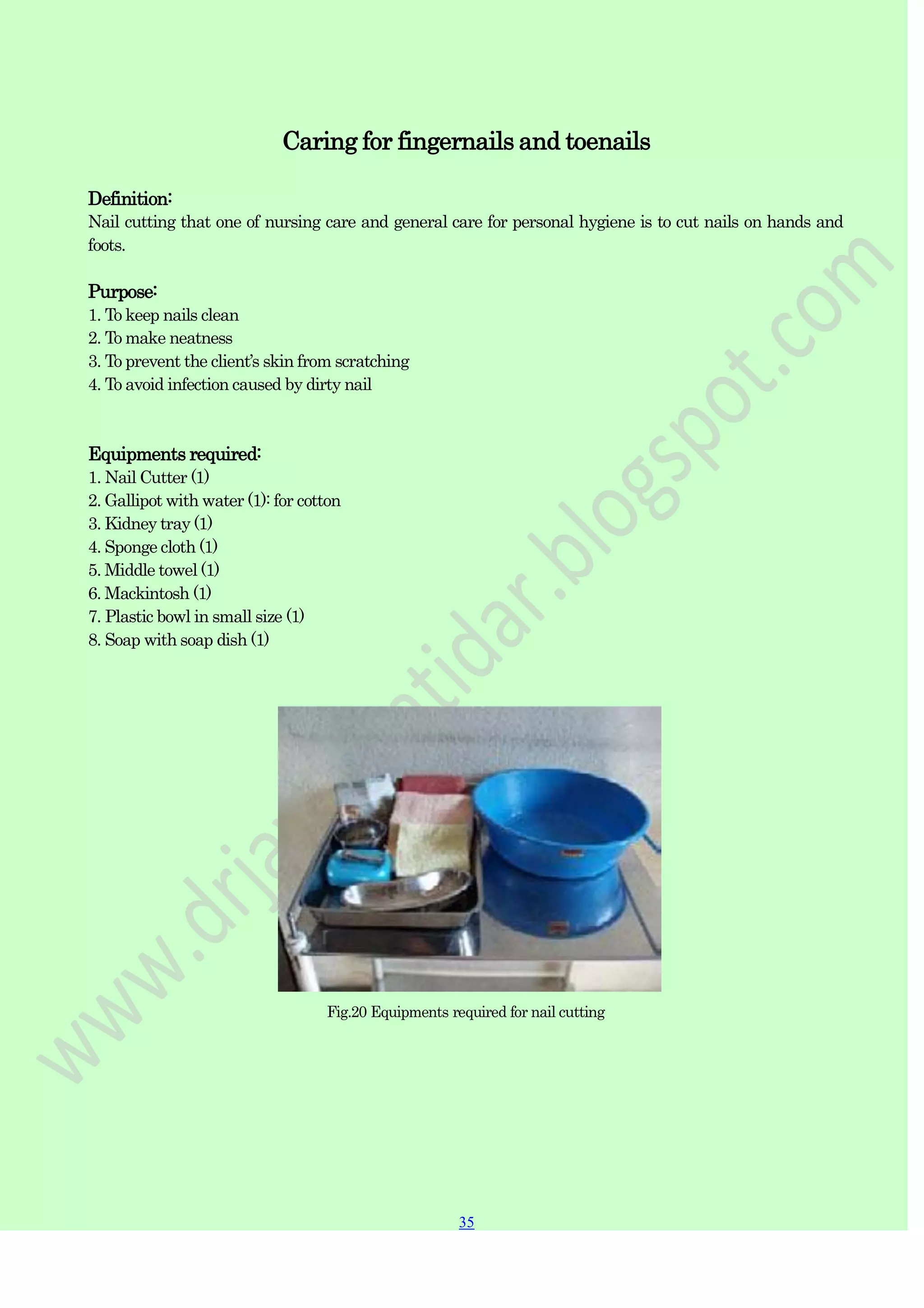
Usually no such sounds is
present
Two distinct patterns of abnormal
bowel sounds occur:
Hyperactive sounds: loud,
highpitched, rushing, tinkling
sounds that signal increased
motility
Hypoactive or absent sounds:
abdominal surgery or with
inflammation of the
peritoneum, paralytic ileus
A systolic bruit(; a pulsatile
blowing sound) occurs with
stenosis or occlusion of an
artery
Friction rubs in liver tumor or
abscess, gonococcal infection
around liver , splenic infection
Fig. 67 Vascular sounds (from Carolyne Jarvis, p.574)
82
83
83
Action (✽Rationale) Normal findings Abnormal findings/
Changes from normal
Percussion general tympany, liver
span, and splenic dullness
(✽To assess the amount and
distribution gas in the abdomen
and to identify possible masses
that are solid or liquid filled,
also to estimate the size of the
liver and spleen)
1) Percuss the abdomen lightly in
all four quadrants(✽ To assess
the distribution of tympany and
dullness)
2) Note any large dull areas that
might indicate an underlying
mass or enlarged organ
3) On each of side of a protuberant
abdomen, not where abdominal
tympany changes to the
dullness of solid posterior
structure
Tympany should
predominate because of gas in
gastrointestinal tract
Scattered area of dullness
from fluid and feces
Normal dullness in the liver
and spleen
A protuberant abdomen that is
tympanitic throughout suggests
intestinal obstruction
Large dullness in pregnant
uterus, ovarian tumor,
distended
Bladder, large liver or spleen
Dullness in both flanks
indicates further assessment
for ascites
Absence of tympany
Fig. 68 Percussing for general tympany
Fig. 69 Shifting dullness A: in supine position B: in right lateral position
(from Carolyne Jarvis, p. 574 and p.578)
84
84
Action (✽Rationale) Normal findings Abnormal findings/
Changes from normal
Palpate surface and deep areas
Perform palpation( ✽To judge
the size, location, and consistency
of certain organs, mobility of any
palpable organs and to screen for
any abnormal enlargement,
masses or tenderness)
Light palpation
(✽To from an overall impression
of the skin surface and superficial
musculature)
1) Place the client is the supine
position, keeping your hand
and forearm on a horizontal
plane with the first four fingers
close together and flat on the
abdominal surface
2)Ask him/her to relax his/her
abdomen
3) Depress the abdominal surface
about 1 cm
2) Make a light and gentle rotary
motion, sliding the fingers and
skin together
3) Lift the fingers and move
clockwise to the next location
around the abdomen
4) Palpate in all quadrants
Deep palpation
Perform deep palpation
(Fig. 70A. –B.)
No abdominal mass
No tenderness
Muscle guarding
Mass
Tenderness
Involuntary rigidity indicates
acute peritoneal inflammation
Fig.70 Deep palpation ( from Carolyne Jarvis, p.578)
A. with Single hand B. Bimanual technique
85
85
Action (✽Rationale) Normal findings Abnormal findings/
Changes from normal
1) Perform deep palpation using
the same technique described
earlier, but push down 5 to 8
cm (2 to 3 inches)
2) Moving clockwise, explore the
entire abdomen
3) To over come the resistance of
a very large or obese abdomen,
use a bimanual technique
① The top hand does the
pushing
② The bottom hand is relaxed
and can concentrate on the
sense of palpation
Liver
1) Stand on the client‟s right side
2) Place your left hand under the
client‟s back parallel to the
11th and 12th ribs
3) Lift up to support the
abdominal contents
4) Place your right hand on the
RUQ, with fingers parallel to
the midline(Fig. 71 )
5) Push deeply down and under
the right costal margin
6) Ask the client to take a deep
breath
7) Feel for liver sliding over the
fingers as the client inspires
8) Note any enlargement or
tenderness.
Normally palpable structure:
xiphoid process, normal liver
edge, right kidney, pulsatile
aorta, rectus muscles, sacral
promontory, cecum ascending
colon, sigmoid colon, uterus, full
bladder
Mild tenderness is normally
present when palpating the
sigmoid colon
Liver is not usually palpable
People may be palpable the
edge of the liver bump
immediately below the costal
margin as the diaphragm
pushes it down during
inhalation: a smooth structure
with a regular contour, firm
and sharp edge
Tenderness occurs with local
inflammation, with
inflammation of the
peritoneum or underlying
organ, and with an enlarged
organ whose capsule is
stretched
Liver palpable as soft hedge or
irregular contour
Except with a depressed
diaphragm, a liver palpated
more than 1 to 2 cm below the
right costal margin is enlarged
If enlarged, estimate the
amount of enlargement beyond
the right costal margin.
Express it in centimeters with
its consistency and tenderness
Fig. 71 Palpation the liver in the RUQ
(from Carolyne Jarvis, p.582)
86
86
Action (✽Rationale) Normal findings Abnormal findings/
Changes from normal
Spleen
In supine position:
1) Reach your left hand over the
abdomen and behind the left
side at the 11th and 12th ribs (Fig.
72A. )
2) Lift up for support
3) Place your right hand obliquely
on the LUQ with the fingers
pointing toward the left axilla
and just inferior to the rib
margin
4) Push your hand deeply down
and under the left costal
margin
5) Ask the client to take a deep
breath
In right lateral position:
1) Roll the client onto his/her
right side to displace the spleen
more forward and
downward(Fig. 72 B.)
2) Palpate as described earlier
Normally spleen is not palpable
No enlargement and
tenderness
The spleen must be enlarged
three times its normal size to be
felt
The enlarged spleen is palpable
about 2 cm below the left costal
margin on deep inspiration
Fig. 72 A. Palpation the spleen in supine position B. Palpation the spleen in right lateral position
(from Carolyne Jarvis, p.583)
87
87
Action (✽Rationale) Normal findings Abnormal findings/
Changes from normal
Kidneys
Palpation in the right kidney:
1) Place the client in the supine
position
2) Place your left hand on the
client between lowest rib and
the pelvic bone
3) Place your right hand on the
client‟s side below the lowest
rib or in the RUQ. Your hands
are placed together in a
“duck-bill” position at the
client‟s right flank (Fig.73 A.)
4) Ask the client to take a deep
breath.
5) At the peak of inspiration,
press your right hand and
deeply into the RUQ, just
below the coastal margin
6) Try to capture the kidney
between two hands
7) Note the enlargement or
tenderness.
Palpation in the left kidney:
1) Search for the left kidney by
reaching your left hand across
the abdomen and behind the
left flank for support(Fig. 73 B.)
2) push your right hand deep into
the abdomen
3) Ask the client to take a deep
breath
4) Feel the change while inspiring
Both kidneys are not usually
palpable
A normal right kidney may be
palpable in well-relaxed women
No change while breathing
deeply on both sides
Normally no change
Enlarged kidney
Tenderness
Kidney mass
Causes of kidney enlargement
include hydronephrosis, cyst or
tumors
Bilateral enlargement suggests
polycystic kidney disease
Fig. 73 Palpation the kidney A. Right kidney B. Left kidney
(from Carolyne Jarvis, p.584)
88
88
Action (✽Rationale) Normal findings Abnormal findings/
Changes from normal
Percussion in the kidney:
(✽To assess the tenderness in the
kidney)
1) Place the ball of one hand in
the costovertebral angle
2) Strike it with the ulnar surface
of your fist, using enough force
to cause a perceptible
Rebound tenderness
( Bulumberg‟s sign)
(✽To test rebound tenderness
when the client feels abdominal
pain or when you elicit
tenderness during palpation )
1) Choose a site away from the
painful area
2) Hold your hand 90 degrees, or
perpendicular, to the abdomen
3) Push down slowly and deeply
and then lift up suddenly
(Fig. 74A.,B.)
Painless jar in fist percussion
As a normal or negative, no
pain on release of pressure
Pain with fist percussion
suggests pyelonephritis, but
may also have a
musculoskeletal cause
Pain in release of pressure
confirms rebound tenderness,
which is a reliable sign of
peritoneal inflammation.
Peritoneal inflammation
accompanies appendicitis
Fig. 74 Rebound tendernessn(from Carolyne Jarvis, p.585)
A. Pushing down the abdomen slowly B. Lift your hand up quickly
Action (✽Rationale) Normal findings Abnormal findings/
Changes from normal
Inguinal area
1) Lift the drape or cloth to
expose the inguinal area and
legs
2) Inspect and palpate each groin
for the femoral pulse and the
inguinal nodes
Normally no palpable nodules Palpable nodes
Swollen, tenderness
89
89
Action (✽Rationale) Normal findings Abnormal findings/
Changes from normal
Bladder
1) The bladder normally cannot
be examined unless it is
distended above the symphysis
pubis on palpation.
2) Check for tenderness
3) Use percussion to check for
dullness and to determine how
high the bladder rises above
the symphysis pubis
Normally not palpable and
tenderness
The dome of distended bladder
feels smooth and round
Bladder distension from outlet
obstruction
Suprapubic tenderness in
bladder infection
NOTE:
Table 5 Common sites of referred abdominal pain
(from Carolyne Jarvis, p.593)
Fundamental of Nursing Procedure Manual
Action (✽Rationale) Normal findings Abnormal findings/
Changes from normal
H. Musculoskeletal system
Inspection the muscle and joints
1)Ask the client to stand
2) Inspect his/her neck , shoulder,
arms, hands, hips, knees, legs,
ankle and feet.
3) Compare one side with other
side
4) Note the size and contour of
the joint, skin and tissues over
the joints for color, swelling,
and any masses or deformities
Range of motion(; ROM)
(✽To inspect the client‟s ability to
move musculoskeletal system)
1) Ask the client to move his/her
neck, shoulders, elbows, wrists,
fingers, hip, knees, ankles and
toes one by one in all possible
directions
2) Note the range of motion and
watch for the signs of pain
Supine
1)Ask the client to stand
2) Place yourself far enough back
3) Inspect and note the line and
the equal horizontal positions
for the shoulders, scapulae,
iliac crests, gluteal folds, and
equal spaces between arm and
lateral thorax on the two sides.
4) From the side, note the normal
convex thorax curve and
concave lumbar curve.
No bone or joint deformities
No redness or swelling of joints
No muscle wasting
Able to move joins freely
No sign of pain while moving
joints
The kneel and feet should be
aligned with the trunk and
should be pointing forward
An enhanced thorax curve, or
kyplosis , is common in aging
people
A pronounced lumbar curve, or
lordosis, is common in obese
people
Presence of bone deformities or
joint deformities
Redness or swelling is
significant and signals joint
irritation
Muscle wasting
Swelling may be due to excess
joint fluid, thickening of the
synovial lining, inflammation of
surrounding soft tissue or bony
enlargement
Deformities include dislocation,
subluxation, contracture, or
ankylosis
Limited movement of the joints
Sign of pain when moving the
joints
A difference of shoulder
elevation and in level of
scapulae and iliac crest occur
with scoliosis
Lateral tilting and forward
bending occur with a herniated
nucleus pulposus
90
Fundamental of Nursing Procedure Manual
Action (✽Rationale) Normal findings Abnormal findings/
Changes from normal
Palpation
1) Palpate each joint, including
its skin for tenderness, its
muscles, bony articulations,
and area of joint capsule
2) Note any heat, tenderness,
swelling or masses.
3) If any tenderness occur, try to
localize it to specific anatomic
structure(skin, muscle,
ligaments, tendons, fat pads or
joint capsule)
4) Holding the each joint one by
one, ask the client to move
these areas. note the range of
motion and for any rough
sensation at the joint
Peripheral vascular examination
Inspection and palpation
1) Inspect the arms for color, size,
any lesion and skin changes
2) Palpate pulses: radial and
brachial pulse
3) Inspect legs for color, size, any
lesions, trophic skin changes or
swelling
4) Palpate temperature of feet
and legs
5) Palpate inguinal nodes
6) Palpate pulses: femoral,
popliteal, posterior tibial,
dorsalis pedis
No swelling, tenderness or
redness in joint
Normal temperature
The synovial membrane
normally is not palpable
A small amount of fluids is
present in the normal joint, but
not palpable
Full range of joint movement
Smooth joint movement
Symmetrical in size and shape
No edema
No lesion
No changes in skin colors
Normal pulse rate
Symmetrical in size and shape
No edema
No lesion
No changes in skin colors
Warm and equal bilaterally
Not palpable nodes and non
tenderness
Normal pulse
Redness, swelling or tenderness
Limited joint movement
Hard muscle with muscle
spasm
Inoreased, temperature over
the joint
Palpable fluid
Limited joint movement
Rough sensation(crepitation) in
moving a joint
Edema of upper extremitis
Increased or decreased pulse
Pallor with vasoconstriction
Cyanosis
Varicose vein
A unilateral cool foot or leg
occurs
With arterial deficit
Enlarged nodes, tender or fixed
A bruit occurs with turbulent
blood flow indicating partial
occlusion
91
Fundamental of Nursing Procedure Manual
Action (✽Rationale) Normal findings Abnormal findings/
Changes from normal
Palpation
1) Press the skin gently and
firmly at the arms, hands over
the skin of the tibia, ankles and
feet for 5 seconds, and then
release .
2) Note whether the finger leaves
an impression on the skin
indication edema
3) Ask the client to stand so that
you assess the venous system
4) Note any visible dilated and
tortuous veins
Muscles strengthen
1) Push against the client‟s
hands, and then feet
2)Ask him/her to resist the push
No impression left on the skin
when pressed
Pit edema commonly is seen if
the person has been standing
all day or during pregnancy
Equal strengthen is both hands
and feet
No muscular weakness
Bilateral pitting edema occurs
with heart failure, diabetic
neuropathy, or hepatic cirrhosis
Unilateral edema occurs with
occlusion of a deep vein
Uni- or bilateral edema occurs
with lymphatic obstruction
Varicosities occur in the
saphenous veins
Muscular weakness on one or
both hands and feet
I. Nervous system
For sensation
1)Ask the client to close the eyes
2) Select areas on face , arms,
hands, legs and feet
3) Give a superficial pain, light
touch and vibration to each site
by turn
4) Note the client‟s ability of
sensation on each site
Test for Cranial nerves
Cranial nerve I: Olfactory nerve
(✽To test the sense of smell )
1)Ask the client to close his/her
eyes
2) Ask him/her the source of smell
using familiar, conveniently
obtainable, and non-noxious
smell such as coffee or tooth
paste
Feels pain, light touch and
vibration
Equally in both side of his/her
body
Decreased pain sensation or
touch sensation
Unable to feel vibration
One can not test smell when
upper respiratory infection or
with sinusitis decreases or loss
of smell with tobacco smoking
or cocaine use
92
Fundamental of Nursing Procedure Manual
Action (✽Rationale) Normal findings Abnormal findings/
Changes from normal
Test stereognosis
1) Ask the client to close his/ her
eyes
2) Place a familiar object(i.g., clip,
key or coin) in the client‟s hand
3)Ask the client to identify it
Test for the cerebellar function of
the upper extremities
Use finger-to- nose test or
rapid-altering –movement test
Test for the cerebellar function of
the lower extremities
1) Ask the client to reach heel down
the opposite shin or
2) Ask the client to stand and walk
across the room in his/her
regular walk back ward, and
then turn toward you
Deep tendon reflex
(✽To elicit the intactness of the arc
at specific spinal level)
Biceps reflex(C5 to C6)
1) Support the client‟s forearm on
yours
2) Place your thumb on the biceps
tendon and strike a blow on your
thumb
3) Observe the response
Triceps reflex(C7 to C8)
1) Tell the client to let the arm “just
go dead” as you suspend it by
holding the upper arm
2) Strike the triceps tendon directly
just above the elbow
3) Observe the response
Brachioradialis reflex(C5 to C6)
1) Hold the client‟s thumb to
suspend the forearms in
relaxation
Normal client can identify the
familiar object
Coordinated, smooth
movement
Straight and balanced walk
Normal response is
contraction of the biceps
muscle and flexion of the
forearm
Normal response is extension
of the forearm
Normal response is flexion
and supination of the forearm
Inability to identify object
correctly, especially in brain
stroke
Uncoordinated movement
Limping, unbalanced walk,
uncoordinated or unsteady gait
Hyperreflexia
Hyporeflexia
93
Fundamental of Nursing Procedure Manual
Action (✽Rationale) Normal findings Abnormal findings/
Changes from normal
2) Strike the forearm directly,
about 2 to 3 cm above the
radial styloid process
3) Observe the response
Quadriceps reflex(“Knee jerk”)
(L2 to L4)
1) Let the lower legs dangle freely
to flex the knee stretch the
tendons
2) Strike the tendon directly just
below the patella
3) Observe the response and
palpate contraction of the
quadriceps
Achilles reflex(“Ankle jerk”) (L5
to S2)
1) Position the client with the
knee flexed and hip externally
rotated
2) Hold the foot in dorsiflexion
3) Strike the Achilles tendon
directly
4) Feel the response
Superficial reflex
Planter reflex (L4 to S2)
1) Position the thigh in slight
external rotation
2) With the reflex hammer,
draw a light stroke up the
lateral side of the sole of the
foot and inward across the ball
of the foot
3) Observe the response
Normal response is extension of
the lower leg
Normal response is the foot
planter flexes against your
hand
Normal response is planter
flexion of all the toes and
inversion and flexion of the
forefoot
Babinski sign: this occurs with
upper motor neuron disease
94
Fundamental of Nursing Procedure Manual
Fig. 75 Biceps reflex Fig. 76 Triceps reflex
Fig. 77 Brachioradilis reflex Fig. 78 Quadriceps reflex
Fig. 79Achilles reflex (from Carolyne Jarvis, p.687, 688, 689)
95
Fundamental of Nursing Procedure Manual
Action (✽Rationale) Normal findings Abnormal findings/
Changes from normal
J. Anus
Inspect the perineal area for any
irritation, cracks, fissure or
enlarged vessels
No irritation, fissure, cracks
No enlarged blood vessels in
anus
Presence of anal irritation, anal
fissure, enlarged and blood
vessels
K. Male Genitalia
Inspect and palpate the penis
1) Inspect the skin, glans, and
urethral meatus
2) If you note urethral discharge,
collect a smear for microscopic
examination and a culture
3) Palpate the shaft of penis
between your thumb and first
two fingers
Inspect and palpate the scrotum
1) Inspect the scrotum
2) Palpate gently each scrotal half
between your thumb and first
two fingers
The skin normally looks
wrinkled, hairless, and without
lesions. The dorsal vein may be
apparent
The glans looks smooth without
lesions
Foreskin easily retractable
The urethral meatus is
positioned just about centrally
Normally the penis feels
smooth, semifirm, and
non-tender
Asymmetry is normal, with the
left scrotal half usually lower
than the right
No scrotal lesions
The skin of scrotum is thin and
loose
No lump, no tenderness
Testes are equal in size
Inflammation
Lesions
Presence of sore or lump
Phimosis: unable to retract the
foreskin
Edges that are red, everted,
edematous, along with purulent
discharge, suggested urethritis
Nodule or induration,
tenderness on the penis
Scrotal swelling occurs with
heart failure, renal failure, or
local inflammation
Lesions
Thick or swollen scrotal skin
Abnormalities in the scrotum:
hernia, tumor, orchitis,
epididymitis, hydrocele,
spermatocele, varicocele
L. Female genitals
For inspection of female
genitals place the client in the
supine position with the knee
flexed and feet resting on the
examination table.
External genitalia
Inspection
1)Note skin color, hair
distribution, labia majora, any
lesions, clitoris, labia minora,
urethral opening, vaginal
opening, perineum, and anus.
Labia are of the same color and
size
no redness or swelling in labia
Urethral opening appears
stellate and in midline
Excoriation, nodules, rash, or
lesions
Inflammation
Polyp in urethral opening
Foul-smelling, white, yellow,
green discharge from vagina
96
Fundamental of Nursing Procedure Manual
Action (✽Rationale) Normal findings Abnormal findings/
Changes from normal
2) Look for any discharge or
bleeding, prolapse, from the
vagina
Vaginal opening may appear as
a vertical slit
Perineum is smooth
Anus has coarse skin increased
pigmentation
No usual discharge from the
vagina
No prolapse
No bleeding from the vagina
except during mensturation
Bleeding
97
98
98
Care for Nasal-Gastric Tube
a. Inserting a Nassal-Gastric Tube
Definition:
Method of introducing a tube through nose into stomach
Purpose:
1. To feed client with fluids when oral intake is not possible
2. To dilute and remove consumed poison
3. To instill ice cold solution to control gastric bleeding
4. To prevent stress on operated site by decompressing stomach of secretions and gas
5. To relieve vomiting and distention
Equipments required:
1. Nasogastric tube in appropriate size (1)
2. Syringe 10 ml (1)
3. Lubricant
4. Cotton balls
5. Kidney tray (1)
6. Adhesive tape
7. Stethoscope (1)
8. Clamp (1)
9. Marker pen (1)
10.Steel Tray (1)
11.Disposable gloves if available (1 pair)
99
99
Procedure:
CareAction Rationale
1. Check the Doctor‟s order for insertion of
Nasal-gastric tube.
This clarifies procedure and type of equipment
required.
2.Explain the procedure to the client. Explanation facilitates client cooperation.
3. Gather the equipments. Organization provides accurate skill performance.
4.Assess client‟s abdomen Assessment determines presence of bowel sounds
and amount of abdominal distention.
5. Perform hand hygiene. Wear disposable gloves if
available.
Hand hygiene deters the spread of
microorganisms. But sterile technique is not
needed because the digestive tract is not sterile.
Gloves protect from exposure to blood or body
fluids.
6.Assist the client to high Fowler‟s position, or 45
degrees, if unable to maintain upright position.
Upright position is more natural for swallowing
and protects against aspiration, if the client
should vomit.
7. Checking the nostril:
1) Check the nares for patency by asking the client
to occlude one nostril and breathe normally
through the other.
2) Clean the nares by using cotton balls
3) Select the nostril through which air passes more
easily.
Tube passes more easily through the nostril with
the largest opening.
8. Measure the distance to insert the tube by
placing:
1) Place the tip of tube at client‟s nostril extending
to tip of earlobe
2) Extend it to the tip of xiphoid process
3) Mark tube with a marker pen or a piece of tape
Measurement ensures that the tube will be long
enough to enter the client‟s stomach.
9. Lubricant the tip of the tube ( at least 1-2 inches)
with a water soluble lubricant
Lubricant reduces friction and facilitates passage
of the tube into the stomach.
Xylocaine jelly may not be recommended to use
as a lubricant due to the risk of xylocaine shock.
Water–soluble lubricant will not cause
pneumonia if tube accidentally enters the lungs.
10. Inserting the tube:
1) Insert the tube into the nostril while directing
the tube downward and backward.
2) The client may gag when the tube reaches the
pharynx.
3) Instruct the client to touch his chin to his chest.
4) Encourage him/her to swallow even if no fluids
are permitted.
Following the normal contour of the nasal
passage while inserting the tube reduces
irritation and the likelihood of mucosal injury
The gag reflex stimulated by the tube
Swallowing helps advance the tube, causes the
epiglottis to cover the opening of the trachea, and
helps to eliminate gagging and coughing
Fundamental of Nursing Procedure Manual
CareAction Rationale
5) Advance the tube in a downward and backward
direction when the client swallow.
6) Stop when the client breathes
7) If gagging and coughing persist, check
placement of tube with a tongue depressor and
flashlight if necessary.
8) Keep advancing the tube until the marking or
the tape marking is reached.
❖NursingAlert❖
 Do not use force. Rotate the tube if it meets
resistance.
 Discontinue the procedure and remove the
tube if the tube are signs of distress, such as
gasping, coughing, cyanosis, and the
inability to speak or hum.
Excessive coughing and gagging may occur if the
tube has curled in the back of throat.
Forcing the tube may injure mucous membranes.
The tube is not in the esophagus if the client
shows signs of distress and is unable to speak or
hum.
11. While keeping one hand on the tube, verify the
tube‟s placement in the stomach.
a. Aspiration of a small amount of stomach
contents:
Attach the syringe to the end of the tube and
aspirate small amount of stomach contents.
Visualize aspirated contents, checking for color
and consistency.
b. Auscultation:
Inject a small amount of air( 10- 15 ml)into
the nasogastric tube while you listen with a
stethoscope approximately 3 inches ( about 8
cm) below the sternum.
c. Obtain radiograph of placement of tube( as
ordered by doctor.)
The tube is in the stomach if its contents can be
aspirated.
If the tube is in the stomach, you will be able to
hear the air enter (a whooshing sound) If the tube
is in the esophagus, injecting the air will be
difficult or impossible. In addition, injection of air
often causes the client to belch immediately. If the
tube is in the larynx, the client usually is unable
to speak.
12. Secure the tube with tape to the client‟s nose.
❖NursingAlert❖
Be careful not to pull the tube too tightly
against the nose.
Constant pressure of the tube against the skin
and mucous membranes causes tissue injury.
13. Clamp the end of nasal-gastric tube while you
bend the tube by fingers not to open
Bending tube prevents the inducing of secretion
14. Putt off and dispose the gloves, Perform hand
hygiene
To prevent the spread of infection
16. Replace and properly dispose of equipment. To prepare for the next procedure
17. Record the date and time, the size of the
nasal-gastric tube, the amount and color of
drainage aspirated and relevant client reactions.
Sign the chart.
Documentation provides coordination of care
18. Report to the senior staff. To provide continuity of care
100
101
101
101
Procedure:
b. Removal a Nasal-Gastric Tube
Care action Rationale
1.Assemble the appropriate equipment, such as
kidney tray, tissues or gauze and disposable
gloves, at the client‟s bedside.
Organization facilitates accurate skill
performance
2. Explain the client what your are going to do. Providing explanation fosters cooperation
3. Put on the gloves To prevent spread of infection
4. Remove the tube
1) Take out the adhesive tape which holding the
nasal-gastric tube to the client‟s nose
2) Remove the tube by deflating any balloons
3) Simply pulling it out, slowly at first and then
rapidly when the client begins to cough.
4) Conceal the tube .
5) Be sure to remove any tapes from the client‟s
face.Acetone may be necessary.
Do not remove the tube if you encounter any
resistance not to harm any membranes or organs.
Do another attempts in an hour.
Continuous slow pulling it out can lead coughing
or discomfort
Acetone helps any adhesive substances from the
face. You should also wipe acetone out after
removed tapes because acetone remained on the
skin may irritate.
6. Provide mouth care if needed. To provide comfort
7. Put off gloves and perform hand hygiene. To prevent the spread of infection
8. Record the date, time and the client‟s condition on
the chart. And be alert for complains of discomfort,
distension, or nausea after removal. Sign the
signature.
Documentation provides coordination of care
Giving signature maintains professional
accountability
9. Dispose the equipments and replace them. To prepare for the next procedure
10.Report to the senior staff. To provide continuity of care
102
102
102
Administering a Nasal- gastric Tube Feeding
Definition:
A nasal-gastric tube feeding is a means of providing liquid nourishment through a tube into the intestinal
tract, when client is unable to take food or any nutrients orally
Purpose:
1. To provide adequate nutrition
2. To give large amounts of fluids for therapeutic purpose
3. To provide alternative manner to some specific clients who has potential or acquired swallowing
difficulties
Equipments required:
1. Disposable gloves (1)
2. Feeding solution as prescribed
3. Feeding bag with tubing (1)
4. Water in jug
5. Large catheter tip syringe (30 mLor larger than it) (1)
6. Measuring cup (1)
7. Clamp if available (1)
8. Paper towel as required
9. Dr.‟s prescription
10. Stethoscope (1)
103
103
103
Procedure:
CareAction Rationale
1. Assemble all equipments and supplies after
checking the Dr.‟s prescription for tube feeding
Organization facilitates accurate skill
performance
Checking the prescription confirms the type of
feeding solution, route, and prescribed delivery
time.
2. Prepare formula:
a. in the type of can:
Shake the can thoroughly. Check expiration
date
b. in the type of powder:
Mix according to the instructions on the
package, prepare enough for 24 hours only and
refrigerate unused formula. Label and date the
container. Allow formula to reach room
temperature before using.
c. in the type of liquid which prepare by hospital
or family at a time:
Make formula at a time and allow formula to
reach room temperature before using.
Feeding solution may settle and requires mixing
before administration.
Outdated formula may be contaminated or have
lessened nutritional value.
Formula loses its nutritional value and can
harbor microorganisms if kept over 24 hours.
Cold formula cause abdominal discomfort or
sometimes diarrhea.
3. Explain the procedure to the client Providing explanation fosters client‟s cooperation
and understanding
4. Perform hand hygiene and put on disposable
gloves if available
To prevent the spread of infection
5. Position the client with the head of the bed
elevated at least 30 degree angle to 45 degree
angle
This position helps avoiding aspiration of feeding
solution into lungs
104
104
104
6. Determine placement of feeding tube by:
a. Aspiration of stomach secretions
① Attach the syringe to the end of feeding tube
② Gently pull back on plunger
③ Measure amount of residual fluid
④ Return residual fluid to stomach via tube
and proceed to feeding.
❖NursingAlert❖
If amount of the residual exceed hospital
protocol or Dr.‟s order, refer to these order.
b. Injecting 10- 20 mL of air into tube:
① Attach syringe filled with air to tube
② Inject air while listening with stethoscope
over left upper quadrant
Aspiration of gastric fluid indicates that the tube
is correctly placed in the stomach
The amount of residual reflects gastric emptying
time and indicates whether the feeding should
continue.
Residual contents are returned to the stomach
because they contain valuable electrolytes and
digestive enzymes.
In the case of non present of residual, you
should check placement carefully.
Residual over 120 mL may be caused by feeding
too fast or taking time more to digest. Hold
feeding for 2 hours, and recheck residual.
Inject 3-5 mL of air for children
A whooshing or gurgling sound usually indicates
that the tube is in the stomach
105
105
105
CareAction Rationale
c. Taking an x-ray or ultrasound It may be needed to determine the tube‟s
placement
Fig. 79
a.Aspiration of stomach secretion b. Injecting 10-20 mL air into Tube
(from Caroline : Textbook of Basic Nursing, 1999, p.355)
CareAction Rationale
106
106
106
Intermittent or Bolus feeding
Using a feeding bag:
7. Feeding the following
1) Hang the feeding bag set-up 12 to 18 inches
above the stomach. Clamp the tubing.
2) Fill the bag with prescribed formula and prepare
the tubing by opening the clamp. Allow the
feeding to flow through the tubing . Reclamp the
tube.
3) Attach the end of the set-up to the gastric tube.
Open the clamp and adjust flow according to the
Dr.‟s order.
4) Add 30-60 mL of water to the feeding bag as
feeding is completed.Allow the flow into basin.
5) Clamp the tube and disconnect the feeding
set-up.
Using the syringe:
7. Feeding the following
1) Clamp the tube. Insert the tip of the large syringe
with plunger, or bulb removed into the gastric
tube.
2) Pour feeding into the syringe
Rapid feeding may cause nausea and abdominal
cramping.
Water clears the tube, keeping it patent.
Clamping when feeding is completed prevents air
from entering the stomach
Fundamental of Nursing Procedure Manual
CareAction Rationale
3) Raise the syringe 12 to 18 inches above the
stomach. Open the clamp.
4) Allow feeding to flow slowly into the stomach.
Raise and lower the syringe to control the rate of
flow.
5)Add additional formula to the syringe as it
empties until feeding is complete
Gravity promotes movement of feeding into the
stomach
Controlling administration and flow rate of
feeding prevents air from entering the stomach
and nausea and abdominal cramping from
developing
8. Termination feeding:
1) Terminate feeding when completed.
2) Instill prescribed amount of water
3) Keep the client‟s head elevated for 20-30 minutes.
To maintain patency of the tube
Elevated position discourages aspiration of
feeding solution into the lung
9. Mouth care:
1) Provide mouth care by brushing teeth
2) Offer mouthwash
3) Keep the lips moist
Mouth care promotes oral hygiene and provide
comfort
10. Clean and replace equipments to proper place To prevent contamination of equipment and
prepare for the next procedure
11. Remove gloves and perform hand hygiene To prevent the spread of infection
12. Document date, time, amount of residual,
amount of feeding, and client‟s reaction to
feeding. Sign the chart
Documentation provides continuity of care
Giving signature maintains professional
accountability
105
106
106
106
Performing Surgical Dressing:
Cleaning a Wound and Applying a Sterile Dressing
Definition:
Sterile protective covering applied to a wound/incision, using aseptic technique with or without medication
Purpose:
1. To promote wound granulation and healing
2. To prevent micro-organisms from entering wound
3. To decrease purulent wound drainage
4. To absorb fluid and provide dry environment
5. To immobilize and support wound
6. To assist in removal of necrotic tissue
7. To apply medication to wound
8. To provide comfort
Equipments required:
1. Sterile gloves (1)
2. Gauze dressing set containing scissors and forceps (1)
3. Cleaning disposable gloves if available (1)
4 Cleaning basin(optional) (1) as required
5. Plastic bag for soiled dressings or bucket (1)
6. Waterproof pad or mackintosh (1)
7. Tape (1)
8. Surgical pads as required
9.Additional dressing supplies as ordered, e.g. antiseptic ointments, extra dressings
10.Acetone or adhesive remover (optional)
11. Sterile normal saline (Optional)
107
107
107
Procedure:
CareAction Rationale
1. Explain the procedure to the client Providing information fosters his/her cooperation
and allays anxiety.
2.Assemble equipments Organization facilitates accurate skill
performance
3. Perform hand hygiene To prevent the spread of infection
4.Check Dr‟s order for dressing change. Note
whether drain is present.
The order clarifies type of dressing
5. Close door and put screen or pull curtains. To provide privacy
6. Position waterproof pad or mackintosh under the
client if desired
To prevent bed sheets from wetting body
substances and disinfectant
7.Assist client to comfortable position that provides
easy access to wound area.
Proper positioning provides for comfort.
8.Place opened, cuffed plastic bag near working
area.
Soiled dressings may be placed in disposal bag
without contamination outside surfaces of bag.
9. Loosen tape on dressing . Use adhesive remover
if necessary. If tape is soiled, put on gloves.
It is easier to loosen tape before putting in gloves.
10.
1) Put on disposable gloves
2) Removed soiled dressings carefully in a clean to
less clean direction.
3) Do not reach over wound.
4) If dressing is adhering to skin surface, it may be
moistened by pouring a small amount of sterile
saline or NS onto it.
5) Keep soiled side of dressing away from client‟s
view.
Using clean gloves protect the nurse when
handling contaminated dressings.
Cautious removal of dressing(s) is more
comfortable for client and ensures that drain is
not removed if it is present.
Sterile saline provides for easier removal of
dressing.
11.Assess amount, type, and odor of drainage. Wound healing process or presence of infection
should be documented.
12.
1) Discard dressings in plastic disposable bag.
2) Pull off gloves inside out and drop it in the bag
when your gloves were contaminated extremely
by drainage.
Proper disposal dressings prevent the spread of
microorganisms by contaminated dressings.
13.Cleaning wound:
a. When you clean wearing sterile gloves:
1) Open sterile dressings and supplies on work area
using aseptic technique.
2) Open sterile cleaning solution
3) Pour over gauze sponges in place container or
over sponges placed in sterile basin.
4) Put on gloves.
5) Clean wound or surgical incision
①Clean from top to bottom or from center
outward
Supplies are within easy reach, and sterility is
maintained.
Sterility of dressings and solution is maintained.
Cleaning is done from least to most contaminated
area.
Fundamental of Nursing Procedure Manual
CareAction Rationale
5) ② Use one gauze square for each wipe,
discarding each square by dropping into plastic
bag. Do not touch bag with gloves.
③Clean around drain if present, moving from
center outward in a circular motion.
④Use one gauze square for each circular
motion.
b. When you clean using sterile forceps:
1) Open sterile dressings and supplies on work area
using aseptic technique.
2) Open sterile cleaning solution
3) Pour over gauze sponges or cottons in place
container or over sponges or cottons placed in
sterile basin.
4) Clean wound or surgical incision:
Follow the former procedure using sterile gloves.
Previously cleaned area is re-contaminated.
Do not touch bag with sterile forceps to prevent
contamination
14. Dry wound or surgical incision using gauze
sponge and same motion.
Moisture provides medium for growth of
microorganisms.
15.Apply antiseptic ointment by forceps if ordered. Growth of microorganisms may be retarded and
healing process improved.
16. Apply a layer of dry, sterile dressing over wound
using sterile forceps.
Primary dressing serves as a wick for drainage.
17. If drainage is present:
Use sterile scissors to cut sterile 4 X 4 gauze
square to place under and around drain.
Drainage is absorbed, and surrounding skin area
is protected.
18.Apply second gauze layer to wound site. Additional layers provide for increased absorption
of drainage.
19. Place surgical pad over wound as outer most
layer if available.
Wound is protected from microorganisms in
environment.
20. Remove gloves from inside out and discard
them in plastic bag if you worn.
To prevent cross-infection
21.Apply tape or existing tape to secure dressings Tape is easier to apply after gloves have been
removed.
22.
1) Perform hand hygiene.
2) Remove all equipments and disinfect them as
needed. Make him./her comfortable.
To prevent the spread of infection
23. Document the following:
1) Record the dressing change
2) Note appearance of wound or surgical incision
including drainage, odor, redness, and presence of
pus and any complication.
3) Sign the chart
Documentation provides coordination of care.
Giving signature maintains professional
accountability
24. Check dressing and wound site every shift. Close observation can find any complication as
soon as possible.
108
109
109
109
Supplying Oxygen Inhalation
Definition:
Method by which oxygen is supplemented at higher percentages than what is available in atmospheric air.
Purpose:
1. To relieve dyspnoea
2. To reduce or prevent hypoxemia and hypoxia
3. To alleviate associated with struggle to breathe
Sources of Oxygen:
Therapeutic oxygen is available from two sources
1. Wall Outlets(; Central supply)
2. Oxygen cylinders
❖NursingAlert❖
Explain to the client the dangers of lighting matches or smoking cigarettes, cigars, pipes. Be sure
the client has no matches, cigarettes, or smoking materials in the bedside table.
Make sure that warning signs (OXYGEN- NO SMOKING) are posted on the client‟s door and
above the client‟s bed.
Do not use oil on oxygen equipment.( Rationale: Oil can ignite if exposed to oxygen.)
With all oxygen delivery systems, the oxygen is turned on before the mask is applied to the client.
Make sure the tubing is patent at all times and that the equipment is working properly.
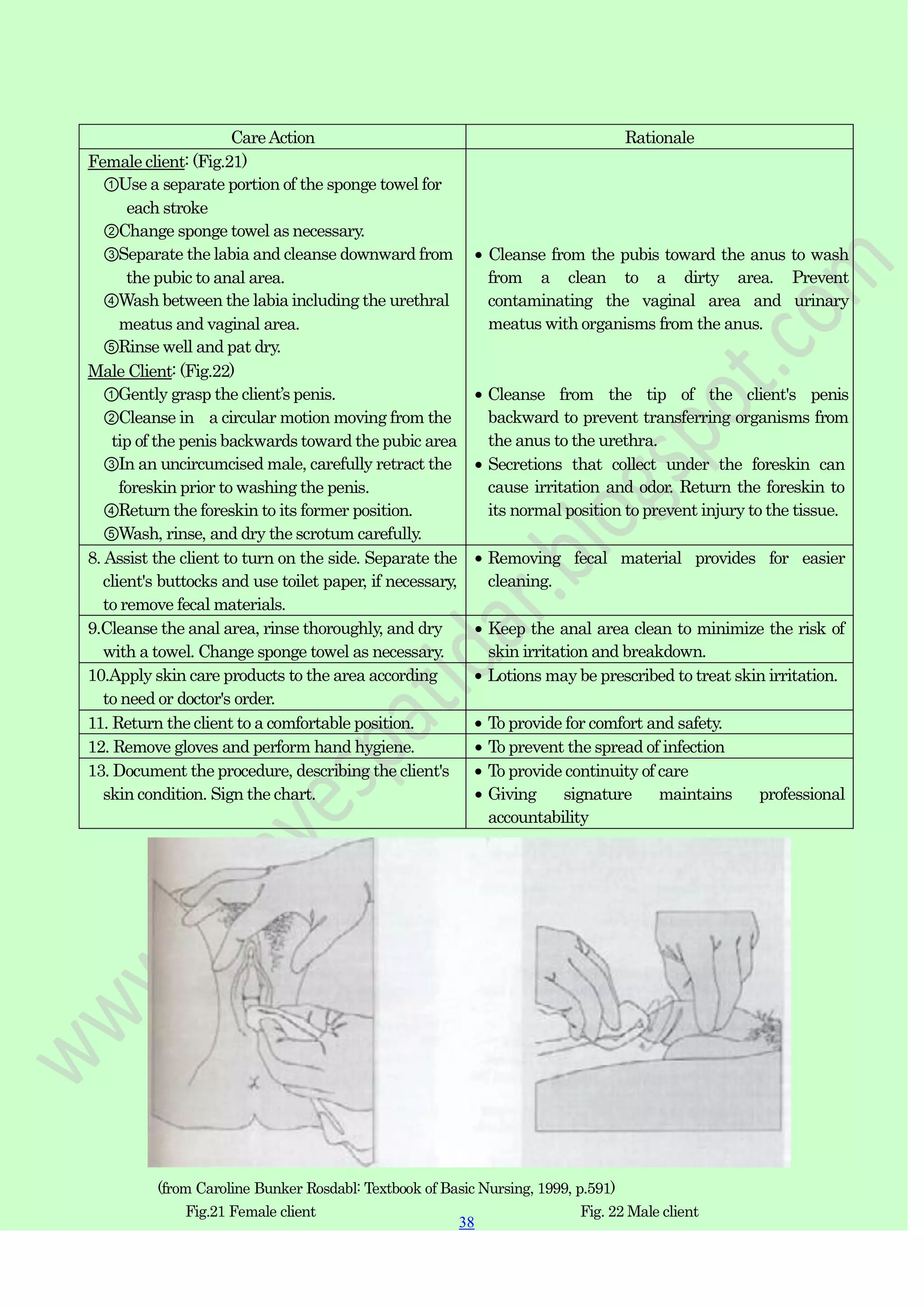
Maintain a constant oxygen concentration for the client to breathe; monitor equipment at regular
intervals.
Give pain medications as needed, prevent chilling and try to ensure that the client gets needed rest.
Be alert to cues about hunger and elimination.( Rationale: The client‟s physical comfort is
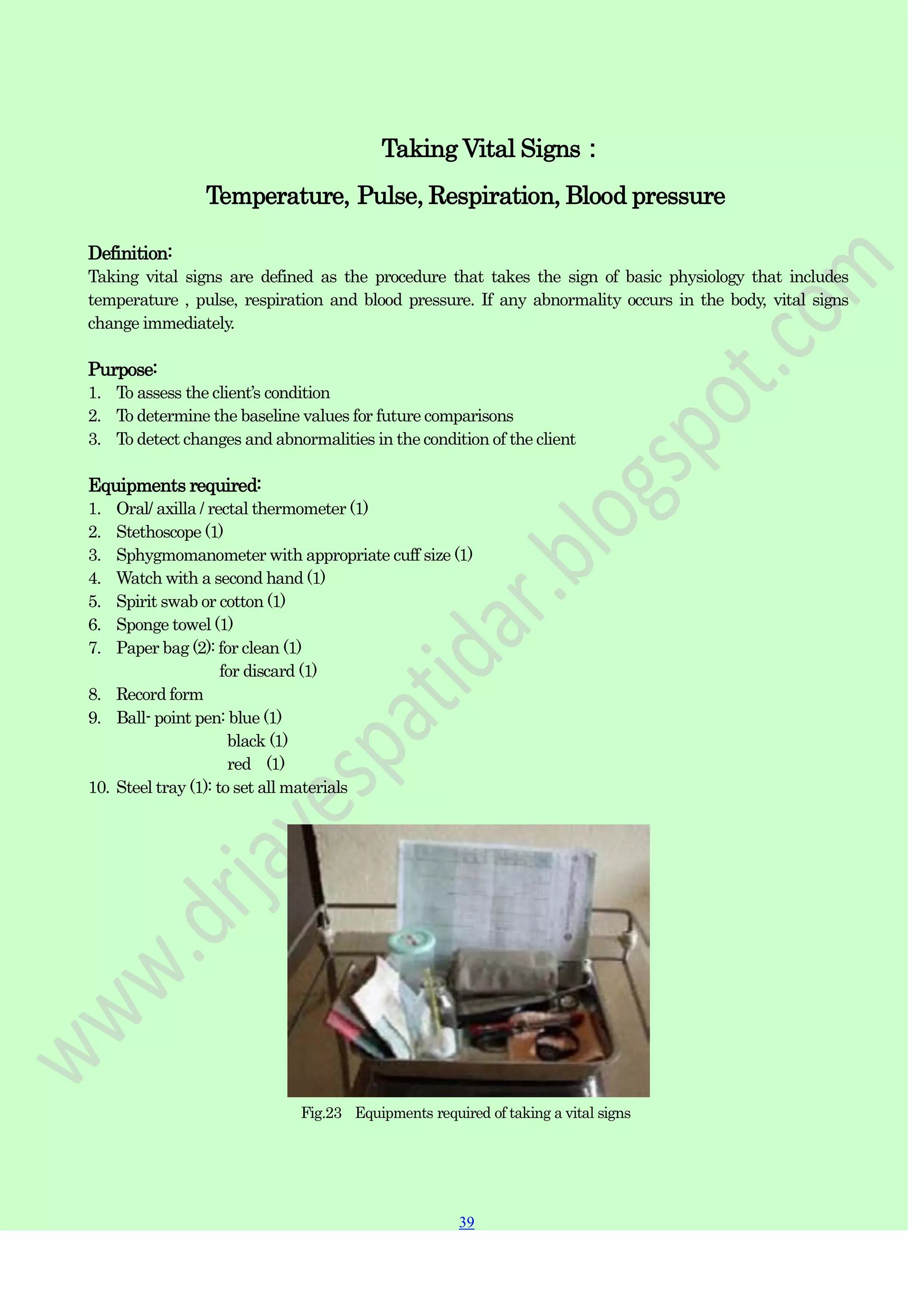
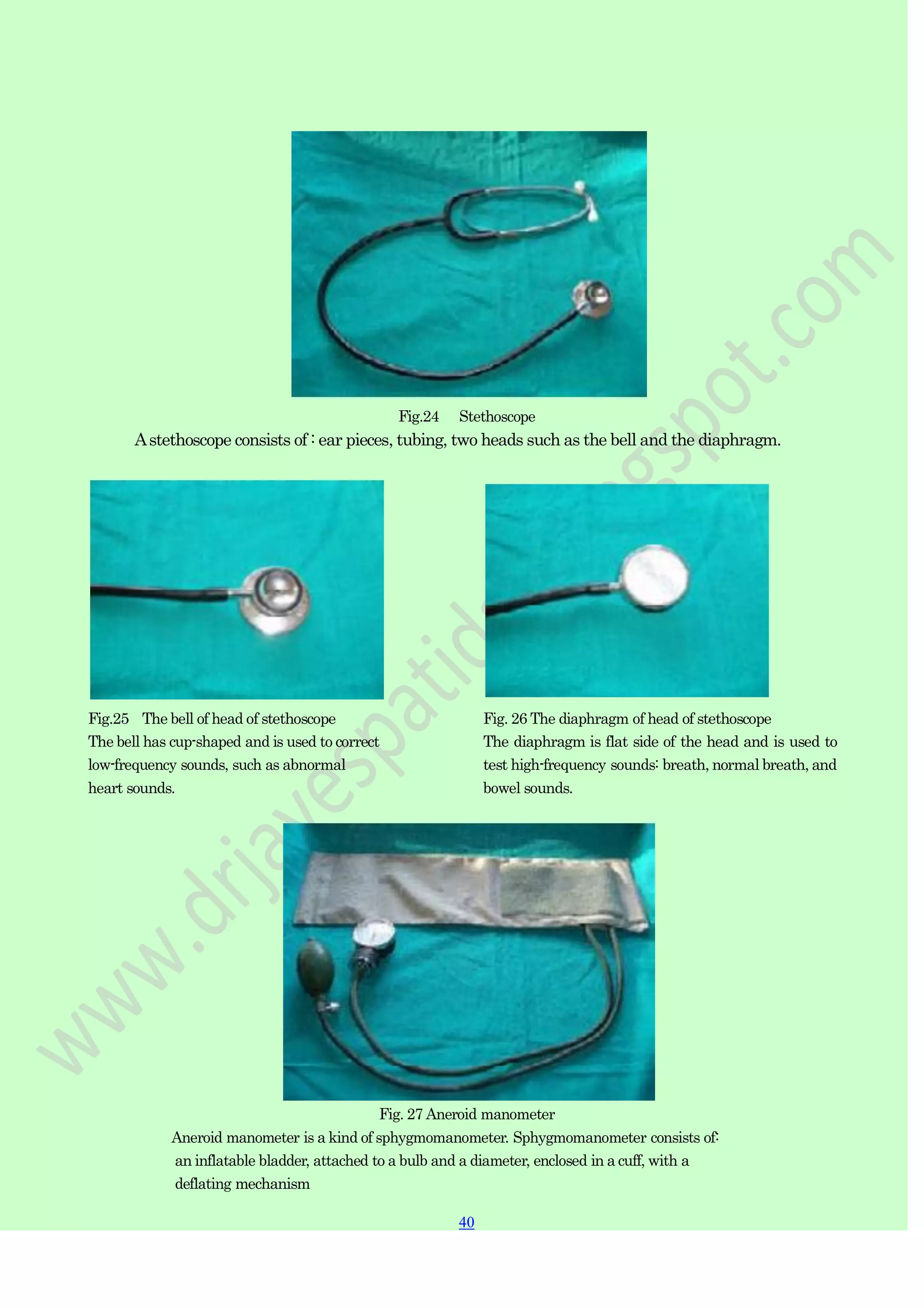
important.)
Watch for respiratory depression or distress.
Encourage or assist the client to move about in bed. ( Rationale: To prevent hypostatic pneumonia
or circulatory difficulties.) Many clients are reluctant to move because they are afraid of the oxygen
apparatus.
Provide frequent mouth care. Make sure the oxygen contains proper humidification.( Rationale:
Oxygen can be drying to mucous membrane.)
Discontinue oxygen only after a physician has evaluated the client. Generally, you should not
abruptly discontinue oxygen given in medium-to-high concentrations( above 30%). Gradually
decrease it in stages, and monitor the client‟s arterial blood gases or oxygen saturation level.
( Rationale: These steps determine whether the client needs continued support.)
Always be careful when you give high levels of oxygen to a client with COPD. The elevated levels of
oxygen in the patient‟s body can depress their stimulus to breathe.
Never use oxygen in the hyperventilation patient.
Wear gloves any time you might come into contact with the client‟s respiratory
secretions.( Rationale: To prevent the spread of infection).
110
110
110
Equipments required:
1. Client‟s chart and Kardex
2. Oxygen connecting tube (1)
3. Flow meter (1)
4. Humidifier filled with sterile water (1)
5. Oxygen source: Wall Outlets or Oxygen cylinder
6. Tray with nasal cannula of appropriate size or oxygen mask (1)
7. Kidney tray (1)
8. Adhassive tape
9. Scissors (1)
10. Oxygen stand (1)
11. Gauze pieces, Cotton swabs if needed
12. “No smoking” sign board
13. Globes if available (1)
NOTE:
Table 6 Characteristics of low flow system of oxygen administration
Method Flow
rate
(L/
min.)
Oxygen
concentration
delivered
Advantages Disadvantages
Nasal cannula
Simple face mask
1 22-24 %
2 26-28 %
3 28-30 %
4 32-36 %
5 36-40 %
6 40-44 %
5-6 40 %
6-7 50 %
7-8(-10) 60 %
Convenient
Comfortable more than face
mask
bring less anxiety
Allows client to talk and eat
Mouth breathing does not
affect the concentration of
delivered oxygen
Can deliver high
concentration of oxygen
more than nasal cannula
Assumes an adequate
breathing pattern
Unable to deliver
concentrations above
44 %
May cause anxiety
able to lead hotness and
claustrophobic
may cause dirty easier, so
cleansing is needed
frequently
should be removed while
eating and talking
Tight seal or long wearing
can cause skin irritation
on face
There are another high flow devices such as venture mask, oxygen hood and tracheostomy mask. You
should choose appropriate method of oxygen administration with Dr‟s prescription and nursing
assessment.
111
111
111
CareAction Rationale
1. Check doctor‟s prescription including date, time,
flow liter/minute and methods
To avoid medical error
2. Perform hand hygiene and wear gloves if
available
To prevent the spread of infection
3.Explain the purpose and procedures to the
patient
Providing information fosters the client‟s
cooperation and allays his/her anxiety
4.Assemble equipments Organization facilitates accurate skill
performance
5.Prepare the oxygen equipment:
1)Attach the flow meter into the wall outlet or
oxygen cylinder
2)Fill humidifier about 1/3 with sterile water or
boiled water
3)Blow out dusts from the oxygen cylinder
4)Attach the cannula with the connecting tubing to
the adapter on the humidifier
Humidification prevents drying of the nasal
mucosa
To prevent entering dust from exist of cylinder to
the nostril
6. Test flow by setting flow meter at 2-3L/ minute
and check the flow on the hand.
Testing flow before use is needed to provide
prescribed oxygen to the client
7.Adjust the flow meter‟s setting to the ordered flow
rate.
The flow rate via the cannula should not exceed
6L/m. Higher rates may cause excess drying of
nasal mucosa.
8. Insert the nasal cannula into client‟s nostrils,
adjust the tubing behinds the client‟s ears and
slide the plastic adapter under the client‟s chin
until he or she is comfortable.
Proper position allows unobstructed oxygen flow
and eases the client‟s respirations
9. Maintain sufficient slack in oxygen tubing To prevent the tubing from getting out of place
accidentally
10.Encourage the client to breathe through the nose
rather than the mouth and expire from the
mouth
Breathing through the nose inhales more oxygen
into the trachea, which is less likely to be exhaled
through the mouth
11. Initiate oxygen flow To maintain doctor‟s prescription and avoid
oxygen toxicity
12. Assess the patient‟s response to oxygen and
comfort level.
Anxiety increases the demand for oxygen
13. Dispose of gloves if you wore and perform hand
hygiene
To prevent the spread of infection
14.Place “No Smoking” signboard at entry into the
room
The sign warns the client and visitors that
smoking is prohibited because oxygen is
combustible
15.Document the following:
Date, time, method, flow rate, respiratory
condition and response to oxygen
Documentation provides coordination of care
Sometimes oxygen inhalation can bring oxygen
intoxication.
16. Sign the chart To maintain professional accountability
Procedure: a. Nasal Cannula Method
1
112
112
112
CareAction Rationale
17. Report to the senior staff To provide continuity of care and confirm the
client‟s condition
18. Check the oxygen setup including the water
level in the humidifier. Clean the cannula and
assess the client‟s nares at least every 8 hours.
Sterile water needs to be added when the level
falls below the line on the humidification
container.
Nares may become dry and irritated and required
the use of a water-soluble lubricant.
In long use cases, evaluate for pressure sores over
ears, cheeks and nares.
❖NursingAlert❖
After used the nasal cannula, you should cleanse it as follows:
1. Soak the cannula in salvon water for an hour
2. Dry it properly
3. Cleanse the tip of cannula by spirit swab before applying to client
113
113
113
Procedure: b. Oxygen Mask Method; Simple face mask
Care action Rationale
1.Perform hands hygiene and put on gloves if
available
To prevent the spread of infection
2.Explain the procedure and the need for oxygen to
the client.
The client has a right to know what is happening
and why.
Providing explanations alley his/her anxiety
3.Prepare the oxygen equipment:
1)Attach the humidifier to the threaded outlet of
the flowmeter or regulator.
2)Connect the tubing from the simple mask to the
nipple outlet on the humidifier
3)Set the oxygen at the prescribed flow rate.
To maintain the proper setting
The oxygen must be flowing before you apply the
mask to the client
4.To apply the mask, guide the elastic strap over the
top of the client's head. Bring the strap down to
just below the client‟s ears.
This position will hold the mask most firmly
5.Gently, but firmly, pull the strap extensions to
center the mask on the client‟s face with a tight
seal.
The seal prevents leaks as mush as possible
6.Make sure that the client is comfortable. Comfort helps relieve apprehension, and lowers
oxygen need
7.Remove and properly dispose of gloves. Wash your
hands
Respiratory secretions are considered
contaminated
8.Document the procedure and record the client‟s
reactions.
Documentation provides for coordination of care
9.Sign the chart and report the senior staffs To maintain professional accountability
10.Check periodically for depresses respirations or
increased pulse.
To assess the respiratory condition and find out
any abnormalities as soon as possible
11.Check for reddened pressure areas under the
straps
The straps, when snug, place pressure on the
underlying skin areas
❖NursingAlert❖
The Simple mask is a low-flow device that providers an oxygen concentration in the 40-60% range, with a
liter flow 6 to 10 L/m. BUT! The simple mask requires a minimum oxygen flow rate of 6 L/m to prevent
carbon dioxide buildup
Fundamental of Nursing Procedure Manual
114
115
115
115
II. Administration of Medications
116
116
116
Our responsibilities for administration of medication
Step the principle procedure for safety and the best-efficacy based on 5 Rights: Right drug, Right dose,
Right route, Right time, Right client( ,Right form)
 Perform hand hygiene. (Rationale: to prevent the spread of infection)
 Collect prescription and ensure that the client is available and understandable to take the
medication.(Rationale: to secure informed-consent)
 Check the medicine as the points: name, components, dose, expiry date(Rationale: to provide safe
and efficient medication)
 Prior to administration ensure you are knowledgeable about the drug(s) to be administered. This
should include: therapeutic use, normal dosage, routes/forms, potential side effects,
contra-indications.(Rationale: to ensure safety and well-being of client and enable you to identify
any errors in prescribing)
 Confirm identity of client verbally and with chart, prescription, checking full name, age, date of
birth: Right client.(Rationale: to ensure that the correct drug is being administered to the correct
client)
 Ensure that the medication has not been given till that time(Rationale: to ensure right dose)
117
117
117
Administering Oral Medications
Definition:
Oral medication is defined as the administration of medication by mouth.
Purposes:
1. To prevent the disease and take supplement in order to maintain health
2. To cure the disease
3. To promote the health
4. To give palliative treatment
5. To give as a symptomatic treatment
Equipments required:
1. Steel tray (1)
2. Drinking water in jug (1)
3. Dr‟s prescription
4. Medicine prescribed
5. Medicine cup (1)
6. Pill crusher/ tablet cutter if needed
7. Kidney tray/ paper bag (to discard the waste) (1)
118
118
118
Procedure:
CareAction Rationale
1. Perform hand hygiene To prevent the spread of infection
2.Assemble all equipments Organization facilitates accurate skill
performances
3. Verify the medication order using the client‟s
kardex. Check any inconsistencies with Dr. before
administration
To reduce the chance of medication errors
4. Prepare one client‟s medication at a time Lessen the chances for medication errors
5. Proceed from top to bottom of the kardex when
preparing medications
This ensures that you do not miss any medication
orders
6. Select the correct medication from the shelf or
drawer and compare the label to the medication
order on the kardex
a. From the multidose bottle:
Pour a pill from the multidose bottle into the
container lid and transfer the correct amount to
a medicine cup.
b. In the case of unit packing:
Leave unit dose medication in wrappers and
place them in a medication cup
c. Liquid medications:
Measure liquid medications by holding the
medicine cup at eye level and reading the level
at the bottom of the meniscus. Pour from the
bottle with the label uppermost and wipe the
neck if necessary
Comparing medication to the written order is a
check that helps to prevent errors
Pouring medication into the lid eliminates
handling it.
Unit dose wrappers keep medications clean and
safe.
Holding a cup at eye level to pour a liquid gives
the most accurate measurement.
Pouring away from the label and wiping the lip
helps keep the label readable
7. Recheck each medication with the Kardex To ensure preparation of the correct dose
8. When you have prepared all medications on a
tray, compare each one again to the medication
order.
To check all medications three times to prevent
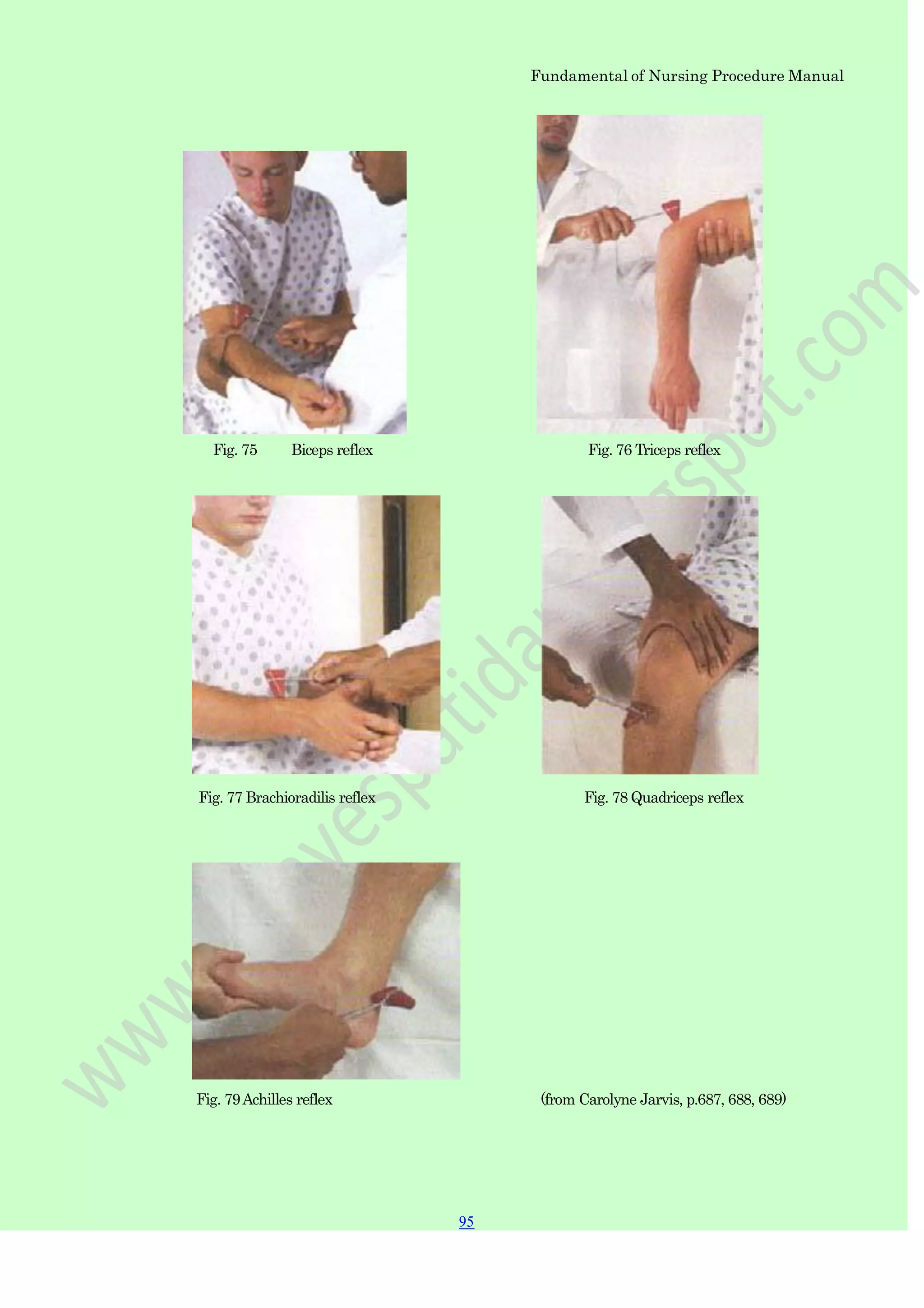
errors
9. Crush pills if the client is unable to swallow
them:
1) Place the pill in a pill crusher and crush the pill
until it is in powder form
❖NursingAlert❖
Do not crush time-release capsules or
enteric-coated tablets
2) Dissolve substance in water or juice, or mix with
applesauce to mask the taste
3) If no need to crush, cut tablets at score mark only
Crushed medications are often easier to swallow
Enteric-coated tablets that are crushed may
irritate the stomach‟s mucosal lining. Opening
and crushing the contents of a time-release
capsule may interfere with its absorption
10.Bring medication to the client you have
prepared.
Hospital/ Agency policy considers 30 minutes
before or after the ordered time as an acceptable
variation
119
119
119
CareAction Rationale
11. Identify the client before giving the medication:
a.Ask the client his/her name
b.Ask a staff member to identify the client
c. Check the name on the identification bracelet
if available
12. Complete necessary assessments before giving
medications
13. Assist the client to a comfortable position to take
medications
14.Administer the medication:
1) Offer water or fluids with the medication
2) Open unit dose medication package and give
the medication to the medicine cup
3) Review the medication‟s name and purpose
4) Discard any medication that falls on the floor
5) Mix powder medications with fluids at the
bedside if needed
6) Record fluid intake on the balance sheet
15. Remain with the client until he/she has taken
all medication. Confirm the client‟s mouth if
needed.
To abide by Five rights to prevent medication
errors
Checking the identification bracelet is the most
reliable
Additional checking includes taking vital signs
and allergies to medications, depending on the
medication‟s action
Sitting as upright as possible makes swallowing
medication easier and less likely to cause
aspiration
You should be aware of any fluid restrictions that
exist
Powdered forms of drugs may thicken when
mixed with fluid. You should give them
immediately
Recording fluid taken with medications
maintains accurate documentation
Be sure that the client takes the medication.
Leaving medication at the bedside is unsafe.
16.Perform hand hygiene To prevent the spread of infection
17. Record medication administration on the
appropriate form:
1) Sign after you have given the medication Documentation provides coordination of care and
giving signature maintains professional
accountability
2) If a client refused the medication, record
according to your hospital/agency policy on the
record.
3) Document vital sign‟s or particular assessments
according to your hospital‟s form
4) Sign in the narcotic record for controlled
substances when you remove them from the
locked area( e.g, drawer or shelf).
18. Check the client within 30 minutes after giving
medication.
To verifies the reason medications were omitted
as well as the specific nursing assessments
needed to safely administer medication
To confirm medication‟s action
Federal law regulates special documentation for
controlled narcotic substances
To verify the client‟s response to the medication
Particularly, you should check the response after
administered pain killer whether if the
medication relieves pain or not.
120
120
120
Administering oral medications through a Nasal-Gastric tube
Definition:
Administering through a nasal-gastric tube is a process that administer oral medication through a
nasal-gastric tube instead of mouth.
Purpose:
as “Administering oral medication”
Equipments required:
1. Client‟s kardex and chart
2. Medication prescribed
3. Medicine cup (1)
4. Water or another fluids as needed
5. Mortar and pestle or pill crusher if an order to crush medications has been obtained ()
6. Disposable gloves (1): if available
7. Large syringe (20-30 mL) (1)
8. Small syringe (3-5 mL) (1)
9. Stethoscope (1)
121
121
121
Procedure:
CareAction Rationale
1. Confirmation the medication:
1) Check the name, dosage, type, time of medication
with the client‟s kardex.
2) If you are going to give more than one
medication, make sure they are compatible
Be sure to administer the correct medication and
dosage to the correct client
2. Check the kardex and the client‟s record for
allergies to medications
You cannot administer a medication to which the
client previously experienced an allergic
reaction
3. Perform hand hygiene To prevent the spread of infection
4.Assemble all equipments Organization helps to eliminate the possibility of
medication errors
5. Set up medication following the Five right of
administration
Strictly adhere to safety precautions to decrease
the possibility of errors
6. Explain the procedure To allay his/her anxiety
7. Put on gloves if available To maintain standard precautions which indicate
to avoid possibility to be infected by any body
fluids or secretions
8. Check the placement of the nasal-gastric tube
1) Connect a small syringe to the end of tube
2) Gently aspirate the gastric juice or endogastric
substances by a syringe
❖NursingAlert❖
Do not aspirate if the client has a button –type
gastric-tube
Ensure that medication will be delivered into the
stomach
If you cannot confirm the tubing‟s placement,
consult senior staffs and be sure the correct
placement.
Aspiration can damage the antireflux valve
9. After checking for the gastric-tube‟s placement,
pinch or clamp the tubing and remove the syringe
Pinch or clamp the tubing prevents endogastric
substances form escaping through the tubing
Ensure that no air enters the stomach, causing
discomfort for the client
10.Administering medications:
1) Remove the plunger from the large syringe and
reconnect the syringe to the tube
2) Release the clamp and pour the medication into
the syringe
3) If the medication does not flow freely down the
tube, insert the plunger and gently apply a slight
pressure to start the flow.
4) If medication flow does not start, determine if the
gastric-tube of plugged.
5) After you have administered the medication,
flush the tube with 15 to 30 ml of water.
6) Clamp the tubing and remove the syringe
7) Replace the tubing plug. If feeding is continued,
reconnect the tubing to the feeding tubing
To clear the tube and decrease the chance of the
tubing becoming clogged
To prevent the medication and water from
escaping
Fundamental of Nursing Procedure Manual
CareAction Rationale
11.Assist the client to a comfortable position To provide comfort
12. Document administration of gastric-tube
feeding of medication and sign
Documentation provides continuity of care and
giving signature maintain professional
accountability
122
123
123
123
www.drjayeshpatidar.blogspot.com
Removing Medications from an Ampoule
Definition:
To remove medication form an ampoule defines that you prepare medication from an ampoule for IV, IM or
another administration of medication.
Purpose:
1. To prepare medication for administration of medication by sterilized method
Equipments required:
1. Medication chart
2. Sterile syringe (1)
3. Sterile needle (1)
4. Second needle (optional)
5. Spirit swab
6.Ampoule of medication prescribed
7.Ampoule cutter if available (1)
8. Kidney tray (1)
9. Steel Tray (1)
10.Container for discards if possible (1)
NOTE:
Fig. 80 Syringe and Needle
124
124
124
www.drjayeshpatidar.blogspot.com
Procedure:
CareAction Rationale
1.Gather equipments. Check the medication order
against the original Dr.'s order according to
hospital/ agency policy.
This comparison helps to identify that may have
occurred when orders were transcribed.
2.Perform hand hygiene To prevent the spread of infection
3.Tap the stem of ampoule or twist your wrist
quickly while holding the ampoule vertically.
(Fig. 83A, B )
This facilitates movement of medication in the
stem to the body of the ampoule.
4. Wipe the neck around of the ampoule by spirit
swab
To prevent entering of dust and microorganisms
5.After drying spirit, put and round a ampoule
cutter to the neck of the ampoule roundly.
To cut smoothly and avoid making any shattered
glass fragments
6. Put spirit swab to the neck of the ampoule. Use a
snapping motion to break off the top of the
ampoule along the pre-scored line at its neck.
Always break away from your body.
This protects the nurses' face and finger from any
shattered glass fragments.
7.
1) Remove the cap from the needle by pulling it
straight off.
2) Hold the ampoule by your non-dominant hand
(usually left hand) and insert the needle into the
ampoule, being careful not to touch the rim.
The rim of the ampoule is considered
contaminated .use of a needle prevents the
accidental withdrawing of small glass particles
with the medication.
Fig. 81 Cut-point on the ampoule Fig. 82cut the ampoule with holding cut-point up
Fig. 83 How to drop medication from the stem
A: Tapping the stem of an ample B: Twisting your wrist holding it vertically
125
125
125
www.drjayeshpatidar.blogspot.com
Fig. 84 Inserting the tip of needle Fig. 85 Withdrawing medication from an ampoule
CareAction Rationale
8. Withdraw medication in the amount ordered plus
a small amount more (- 30 %). Do not inject air
into solutions.
1) Insert the tip of the needle into the ampoule.
(Fig. 84 )
2) Withdraw fluid into the syringe Touch the
plunger at the knob only. (Fig. 85 )
By withdrawing a small amount more of
medication, any air bubbles in the syringe can be
displaced once the syringe is removed.
Handling the plunger at the knob only will keep
the shaft of the plunger sterile.
9.
1) Do not expel any air bubbles that may form in
the solution.
2) Wait until the needle has been withdrawn to tap
the syringe and expel the air carefully.
3) Check the amount of medication in the syringe
and discard any surplus.
Ejecting air into the solution increases pressure in
the ampoule and can force the medication to spill
out over the ampoule. Ampoules may have
overfill.
Careful measurement ensures that the correct
dose is withdrawn.
10.Discard the ampoule in a kidney tray or a
suitable container after comparing with the
medication chart.
If not all of the medication has been removed from
the ampoule, it must be discarded because there
is no way to maintain the sterility of the contents
in an unopened ampoule.
11.Recap to the syringe by sterilized method and
keep the syringe in safe and clean tray. If the
medication is to be given IM or if agency policy
requires the use of a needle to administer
medication, attach the selected needle to the
syringe.
Used needle might be touched with the inside of
the ampoule so the lumen might become dull. If
you give IM, needle should be changed to new one
to insert smoothly into muscle.
12. Perform hand hygiene. To prevent the spread of infection
126
126
126
www.drjayeshpatidar.blogspot.com
Removing medications from a vial
Definition:
To remove medication form a vial defines that you prepare medication from an ampoule for IV, IM or
another administration of medication.
Purpose:
1. To prepare medication for administration of medication by sterilized method
Equipments required:
1. Medication chart
2. Sterile syringe (1)
3. Sterile needle (1)
✽Size depends on medication being administration and client
4. Vial of medication prescribed
5. Spirit swabs
6. Second needle (optional)
✽Size depends on medication being administration and client
7. Kidney Tray (1)
8. Steel Tray (1)
127
127
127
www.drjayeshpatidar.blogspot.com
Procedure:
CareAction Rationale
1.Gather equipments. Check medication order
against the original Dr.‟s order according to
agency policy.
This comparison helps to identify errors that may
have occurred when orders were transcribed.
2. Perform hand hygiene. To prevent the spread of infection
3. Remove the metal or plastic cap on the vial that
protects the rubber stopper.
The metal or plastic cap prevents contamination
of the rubber top.
4. Swab the rubber top with the spirit swab. Sprit removes surface bacteria contamination.
This should be done the first the rubber stopper is
entered, and with any subsequent re-entries into
the vial.
5. Remove the cap from the needle by pulling it
straight off.. Draw back an amount of air into the
syringe that is equal to the specific dose of
medication to be withdrawn.
Before fluid is removed, injection of an equal
amount of air is required to prevent the formation
of a partial vacuum because a vial is a sealed
container. If not enough air is injected, the
negative pressure makes it difficult to withdraw
the medication .
6. Pierce the rubber stopper in the center with the
needle tip and inject the measured air into the
space above the solution. The vial may be
positioned upright on a flat surface or inverted.
Air bubbled through the solution could result in
withdrawal of an inaccurate amount of
medication.
7. Invert the vial and withdraw the needle tip
slightly so that it is below the fluid level. (Fig. 86 )
This prevents air from being aspirated into the
syringe.
8. Draw up the prescribed amount of medication
while holding the syringe at eye level and
vertically.
❖NursingAlert❖
Be careful to touch the plunger at the knob only.
Holding the syringe at eye level facilitates
accurate reading ,and vertical position makes
removal of air bubbles from the syringe easy.
Handling the plunger at the knob only will keep
the shaft of the plunger sterile.
Fig. 86 A: Holding a vial with the syringe Fig. B: Withdrawing medication from a vial
without touching needle and connected in inverting position
site
Fundamental of Nursing Procedure Manualwww.drjayeshpatidar.blogspot.com
CareAction Rationale
9. Removal of air:
1) If any bubbles accumulate in the syringe , tap the
barrel of the syringe sharply and move the needle
past the fluid into the air space to re-inject the air
bubble into the vial.
2) Return the needle tip to the solution and
continue withdrawing the medication.
Removal of air bubbles is necessary to ensure that
the dose of medication is accurate.
10. After the correct dose is withdrawn, remove the
needle from the vial and carefully replace the cap
over the needle.
❖NursingAlert❖
Some agencies recommended changing needles, if
needed to administer the medication, before
administering the medication.
This prevents contamination of he needle and
protects the nurse against accidental needle
sticks.
This method can decrease possibility of
contamination by the first needle and maintain
sharp of the tip on needle
11. If a multidose vial is being used, label the vial
with the date and time opened, and store the vial
containing the remaining medication according to
agency policy.
Because the vial is sealed, the medication inside
remains sterile and can be used for future
injections.
12. Perform hand hygiene. To prevent the spread of infection
128
129
129
129
Prevention of the Needle-Stick Injuries:
One-handed Needle Recapping Technique
Definition:
One-handed needle recapping is a method that place the cap to needle on clean and safe place such as
inside a big tray
Purpose: To prevent own finger or another person by needle from sticking accidentally
Procedure:
Action Rationale
1. Until giving injection:
1) Before giving the injection, place the needle cover
on a solid, immovable object such as the rim of a
bedside table or big tray.
2) The open end of the cap should face the nurse
and be within reach of the nurse‟s dominant, or
injection hand.
3) Give the injection.
Plan safe handling and disposal if needles before
beginning the procedure.
2. Recapping: (Fig. 87)
1) Place the tip of the needle at the entrance of the
cap.
2) Gently slide the needle into the needle cover.
This method can allow time
3. Once the needle is inside the cover, use the
object‟s resistance to completely cover the
needle.
Confirm that the needle is covered by the cap.
4. Dispose of the needle at the first opportunity. This can reduce the risk of needle-sticking
5. Perform hand hygiene. To prevent the spread of infection
NURSINGALERT
This procedure should be used only when a sharpes disposal box is unavailable and the nurse cannot leave
the client‟s room.
Fig.87 A. Preparing to slide
needle into the cap
B. Lifting cap onto needle C. Covering needle with cap
130
130
130
www.drjayeshpatidar.blogspot.com
Definition:
Giving an Intra-Muscular Injection
Intra-muscular injection is the injection of medicine into muscle tissue. To produce quick action an patient
as the medicine given by injection is rapidly absorbed. Intramuscular injections are often given in the
deltoid, vastus laterials, ventrogluteal and dorsogluteal muscles.
Purpose:
1.To relieve symptoms of illness
2. To promote and prevent from disease
3. To treat the disease accordingly
Contraindication:
IM injections may be contraindicated in clients with;
Impaired coagulation mechanisms
Occlusive peripheral vascular disease
Edema
Shock
After thrombolytic therapy
during myocardial infarction
(Rationale: These conditions impair peripheral absorption)
Equipments required:
1. Client‟s chart and kardex
2. Prescribed medication
3. Sterile syringe (3-5 mL) (1)
4. Sterile needle in appropriate size: commonly used 21 to 23 G with 1.5”(3.8cm) needle (1)
5. Spirit swabs
6. Kidney tray (1)
7. Disposable container (1)
8.Ampoule cutter if available (1)
9. Steel Tray (1)
10. Disposable gloves if available (1)
11. Pen
❖NursingAlert❖
The needle may be packaged separately or already attached to the sterile syringe. Prepackaged loaded
syringes usually have a needle that is 1” long. BUT! check the package with care before open it.
The needles used for IM injections are longer thansubcutaneous needles (Rationale: Needles must reach
deep into the muscle.)
Needle length also depends on the injection site, client‟s size, and amount of subcutaneous fat covering
the muscle.
The needle gauge for IM injections should be larger to accommodate viscous solutions and suspensions.
131
131
131
www.drjayeshpatidar.blogspot.com
❖NursingAlert❖
Selection of appropriate site for IM injection
(from Caroline Bunker Rosdabl,p.769)
Fig. 88 Dorsogluteal site Fig. 89 Deltoid site
Inject above and outside a line drawn from the posterior Find the lower edge of the acromial process and the
superior iliac spine to the greater trochanter of the point on the lateral arm in line with the axilla. Insert
femur. Or, divide the buttock into quadrants and the needle 1” to 2” (2.5 cm to 5cm) below the
inject in the upper outer quadrant, about 2” to 3”( 5 to acromial process, usually two or three
7.6 cm) below the iliac crest. Insert the needle fingerbreadths, at a 90-degree angle or angled
at a 90- degree angle. slightly toward the process.
132
132
132
Fundamental of Nursing Procedure Manual
Procedure:
CareAction Rationale
1.Assemble equipments and check the Dr.‟s order This ensures that the client receives the right
medication at the right time by the proper route.
2. Explain the procedure to the client Explanation fosters his/her cooperation and allays
anxiety
3. Perform hand hygiene and put on gloves if
available
To prevent the spread of infection
Gloves act as a barrier and protect the nurse‟s
hands from accidental exposure to blood during
the injection procedure
4. Withdraw medications from an ampoule or a vial
as described in the procedure “Removing
medication from an ampoule” or ” Removing
medication from a vial”
❖NursingAlert❖
Do not add any air to the syringe
To prepare correct medication safely before using
Some references recommend adding air to the
syringe with mediation. But the addition of air
bubble to the syringe is unnecessary and
potentially dangerous because it could result in
an overdose of medication
5. Identify the client carefully using the following
way:
a. Check the name in the identification bracelet
b.Ask the client his/her name
c. Verify the client‟s identification with a staff
member who knows the client
You should not rely on the name on the door, on
the board or over the bed. It is sometimes
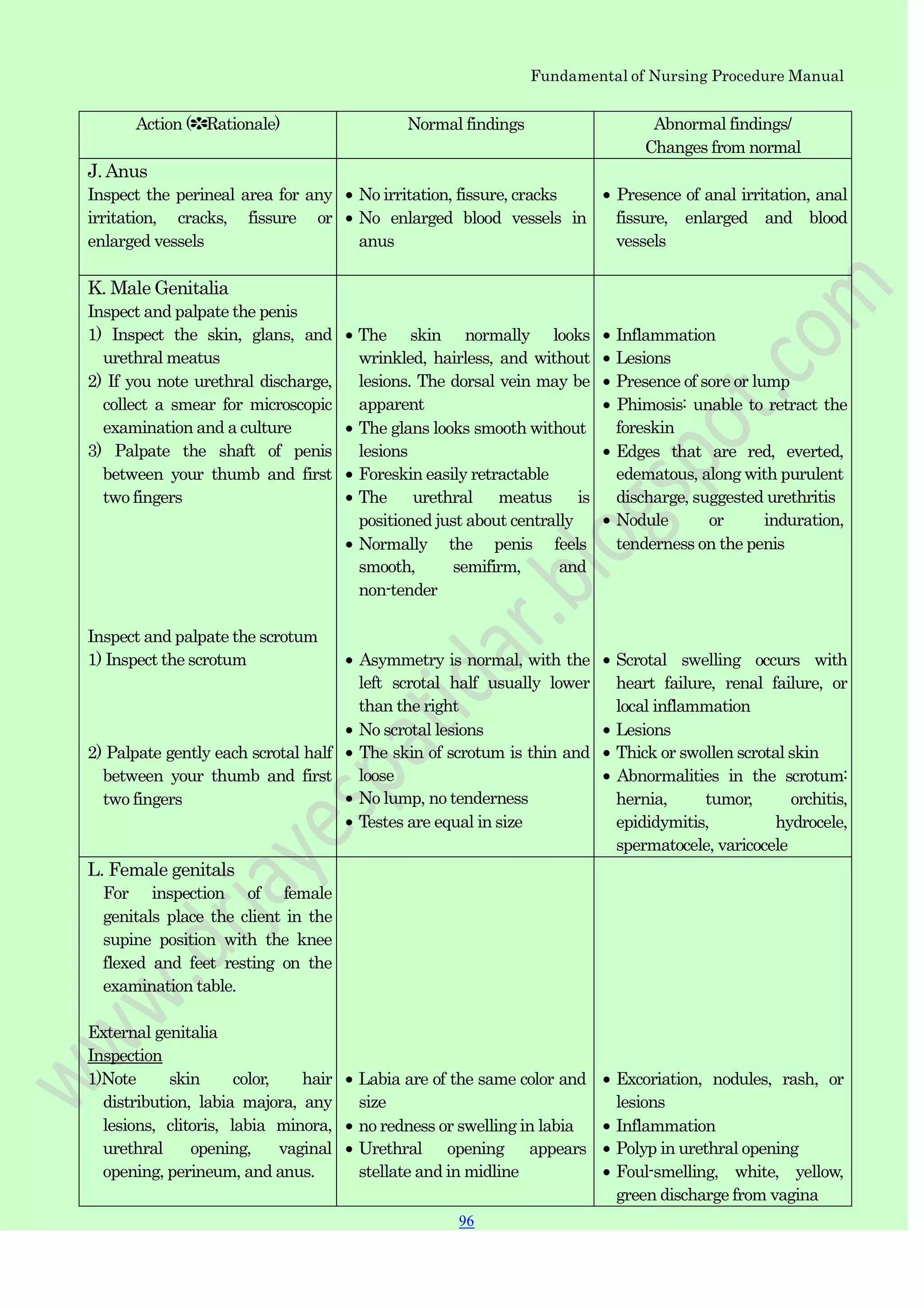
inaccurate.
This is the most reliable method if available
This requires an answer from the client. In the
elderly and/or illness the method may causes
confusion.
This is double-checked identify
6. Close the door and put a screen. To provide for privacy
7.
1)Assist the client to a comfortable position.
2)Select the appropriate injection site using
anatomic landmarks
3) Locate the site of choice
❖NursingAlert❖
Ensure that the area is not tender and is free of
lumps or nodules
Collect site identification decreases the risk of
injury
God visualization is necessary to establish the
correct location of the site and avoid damage to
tissues
Nodules or lumps may indicate a previous
injection site where absorption was inadequate
8. Cleanse the skin with a spirit swab:
1) Start from the injection site and move outward in
a circular motion to a circumference of about 2” (5
cm) from the injection site
2)Allow the area to dry
Cleansing the injection site prepares it for the
injection
This method remove pathogen away from the
injection site
Alcohol or spirit gives full play to disinfect after
dried
Fundamental of Nursing Procedure Manual
CareAction Rationale
3) Place a small, dry gauze or spirit swab on a clean,
nearby surface or hold it between the fingers of
your non-dominant hand.
To prepare a dry gauze or spirit swab to give light
pressure immediately after I.M.
9. Remove the needle cap by pulling it straight off This technique lessens the risk of accidental
needle-stick and also prevents inadvertently
unscrewing the needle from the barrel of the
syringe
10. Spread the skin at the injection site using your
non-dominant hand
This makes the tissue taut and facilitates needle
entry.You may minimize his/her discomfort
11. Hold the syringe in your dominant hand like a
pencil or dart.
This position keeps your fingers off the plunger,
preventing accidental medication loss while
inserting the needle
12. Insert the needle quickly into the tissue at a 90
degree angle
Aquick insertion is less painful
This angle ensures you will enter muscle tissue.
13. Release the skin and move your non-dominant
hand to steady the syringe‟s lower end
To prevent movement of the syringe
14.Aspiration blood:
1) Aspirate gently for blood return by pulling back
on the plunger with your dominant hand
2) If blood enters the syringe on aspiration,
withdraw the needle and prepare a new
injection with a new sterile set-up.
Ablood return indicates IV needle placement
Possibly a serious reaction may occur if a drug
intended for intramuscular use is injected into a
vein
Blood contaminates the medication, which must
be redrawn
15. If no blood appears, inject the medication at a
slow and steady rate(; 10 seconds/ mL of
medication)
Rapid injection may be painful for the client.
Injecting slowly reduces discomfort be allowing
time for the solution to disperse in the tissues
16. Remove the needle quickly at the same angle
you inserted it
Slow needle withdrawal may be uncomfortable
for the client
17. Massage the site gently with a small, dry gauze
or spirit swab, unless contraindicated for specific
Medication. If there are contraindications to
massage, apply gentle pressure at the site with a
small, dry gauze or a spirit swab.
Massaging the site promotes medication
absorption and increases the client‟s comfort.
Do not massage a heparin site because of the
medication‟s anticoagulant action
Light pressure causes less trauma and irritation
the tissues. Massage can force medication into the
subcutaneous tissues in some medications
18. Discard the needle:
1) Do not recap the needle
2) Discard uncapped needle and syringe in
appropriate container if available
Most accidental needle-sticks occur while
recapping needles
Proper disposal prevents injury
19. Assist the client to a position of comfort To facilitate comfort and make him/her relax
20. Remove your gloves and perform hand hygiene To prevent the spread of infection
133
134
134
134
CareAction Rationale
21.Recording:
Record the medication administered, dose, date,
time, route of administration, and IM site on the
appropriate form.
Documentation provides coordination of care
Site rotation prevents injury to muscle tissue
22. Evaluation the client‟s response:
1) Check the client's response to the medication
within an appropriate time
2) Assess the site within 2 to 4 hours after
administration
Drugs administered parenterally have a rapid
onset
Assessment of the site deters any untoward
effects
❖NursingAlert❖
No more than 5 mL should be injected into a single site for an adult with well-developed muscles
If you must inject more than 5 mLof solution, divide the solution and inject it at two separate sites.
The less developed muscles of children and elderly people limit the intramuscular injection to 1 to 2 mL
Special considerations for pediatric:
The gluteal muscles can be used as the injection site only after a toddler has been walking for about 1
year
Special considerations for elder:
IM injection medications can be absorbed more quickly than expected because elder clients have
decreased muscle mass.
135
135
135
Starting an Intra-Venous Infusion
Definition:
Starting intra-venous infusion is a process that gives insertion of Intra-venous catheter for IV therapy
Purpose:
1. To give nutrient instead of oral route
2. To provide medication by vein continuously
Equipments required:
1. I.V. solution prescribed
2. I.V. infusion set/ IV. tubing (1)
3. IV. catheter or butterfly needle in appropriate size (1)
4. Spirit swabs
6. Adhesive tape
7. Disposable gloves if available (1)
8. IV. stand (1)
9. Arm board, if needed, especially for infant
10. Steel Tray (1)
11. Kidney tray (1)
NOTE:
Fig.90 IV infusion set
136
136
136
Procedure:
CareAction Rationale
1.Assemble all equipments and bring to bedside. Having equipment available saves time and
facilitates accurate skill performance
2. Check I.V. solution and medication additives with
Dr.‟s order.
Ensures that the client receives the correct I.V.
solution and medication as ordered by Dr.
3. Explain procedure to the client Explanation allays his/her anxiety and fosters
his/her cooperation
4. Perform hand hygiene To prevent the spread of infection
5. Prepare I.V. solution and tubing:
1) Maintain aseptic technique when opening sterile
packages and I.V. solution
2) Clamp tubing, uncap spike, and insert into entry
site on bag as manufacturer directs
3) Squeeze drip chamber and allow it to fill at least
one-third to half way.
4) Remove cap at end of tubing, release clamp,
allow fluid to move through tubing. Allow fluid to
flow until all air bubbles have disappeared.
5) Close clamp and recap end of tubing,
maintaining sterility of set up.
6) If an electric device is to be used, follow
manufacturer‟s instructions for inserting tubing
and setting infusion rate.
This prevents spread of microorganisms
This punctures the seal in the I.V. bag.
Suction effects cause to move into drip chamber.
Also prevents air from moving down the tubing
This removes air from tubing that can, in larger
amounts, act as an air embolus
To maintain sterility
This ensures correct flow rate and proper use of
equipment
7)Apply label if medication was added to container This provides for administration of correct
solution with prescribed medication or additive.
Pharmacy may have added medication and
applied label
8) Place time-tape (or adhesive tape) on container
as necessary and hang on I.V. stand
6. Preparation the position:
1) Have the client in supine position or comfortable
position in bed.
2) Place protective pad under the client‟s arm.
7. Selection the site for venipuncture:
1) Select an appropriate site and palpate accessible
veins
2) Apply a tourniquet 5-6 inches above the
venipuncture site to obstruct venous blood flow
and distend the vein.
3) Direct the ends of the tourniquet away from the
site of injection.
This permits immediate evaluation of I.V.
according to schedule
Mostly the supine position permits either arm to
be used and allows for good body alignment
The selection of an appropriate site decreases
discomfort for the client and possible damage to
body tissues
Interrupting the blood flow to the heart causes
the vein to distend.
Distended veins are easy to see
The end of the tourniquet could contaminate the
area of injection if directed toward the site of
injection.
Fundamental of Nursing Procedure Manual
CareAction Rationale
4) Check to be sure that the radial pulse is still
present
Too much tight the arm makes the client
discomfort.
Interruption of the arterial flow impedes venous
filling.
8.Palpation the vein
1)Ask the client to open and close his/her fist.
2) Observe and palpate for a suitable vein
3) If a vein cannot be felt and seen, do the following:
a. Release the tourniquet and have the client lower
his/her arm below the level of the heart to fill the
veins. Reapply tourniquet and gently over the
intended vein to help distend it
b. Tap the vein gently
c. Remove tourniquet and place warmed-moist
compress over the intended vein for 10-15
minutes.
Contraction of the muscle of the forearm forces
blood into the veins, thereby distending them
further.
To reduce several puncturing
Lowering the arm below the level of the heart,
tapping the vein, and applying warmth help
distend veins by filling them with blood.
9. Put on clean gloves if available. Care must be used when handling any blood or
body fluids to prevent transmission of HIV and
other blood-born infectious disease
10. Cleanse the entry site with an antiseptic
solution( such as spirit) according to hospital
policy.
a. Use a circular motion to move from the center
to outward for several inches
b. Use several motions with same direction as
from the upward to the downward around
injection site approximate 5-6 inches
Cleansing that begins at the site of entry and
moves outward in a circular motion carries
organisms away from the site of entry
Organisms on the skin can be introduced into the
tissues or blood stream with the needle.
11. Holding the arm with un-dominant hand
a. Place an un-dominant hand about 1 or 2 inches
below entry site to hold the skin taut against
the vein.
b. Place an un-dominant hand to support the
forearm from the back side
❖NursingAlert❖
Avoid touching the prepared site.
Pressure on the vein and surrounding tissues
helps prevent movement of the vein as the needle
or catheter is being inserted.
The needle entry site and catheter must remain
free of contamination from un-sterile hands.
12.Puncturing the vein and withdrawing blood:
1) Enter the skin gently with the catheter held by
the hub in the dominant hand, bevel side up, at a
15-30 degree angle.
2) The catheter may be inserted from directly over
the vein or the side of the vein.
This technique allows needle or catheter to enter
the vein with minimum trauma and deters
passage of the needle through the vein
137
138
138
138
CareAction Rationale
3) While following the course of the vein, advance
the needle or catheter into the vein.
4) A sensation can be felt when the needle enters
the vein.
5) When the blood returns through the lumen of the
needle or the flashback chamber of the catheter,
advance either device 1/8 to 1/4 inch farther into
the vein.
6) A catheter needs to be advanced until hub is at
the venipuncture site
13. Connecting to the tube and stabilizing the
catheter on the skin:
1) Release the tourniquet.
2) Quickly remove protective cap from the I.V.
tubing
3)Attach the tubing to the catheter or needle
The tourniquet causes increased venous pressure
resulting in automatic backflow.
Having the catheter placed well into the vein
helps to prevent dislodgement
The catheter which immediately is connected to
the tube causes minimum bleeding and patency
of the vein is maintained
4) Stabilize the catheter or needle with non-
dominant hand
14.Starting flow
1) Release the clamp on the tubing
2) Start flow of solution promptly Blood clots readily if I.V. flow is not maintained.
3) Examine the drip of solution and the issue
around the entry site for sign of infiltration
If catheter accidentally slips out of vein, solution
will accumulate and infiltrate into surrounding
tissue
15. Fasten the catheter and applying the dressing:
1) Secure the catheter with narrow non-allergenic
tape
2) Place strictly sided-up under the hub and crossed
over the top of the hub
Non-allergenic tape is less likely to tear fragile
skin
The weight of tubing is enough to pull it out of the
vein if it is not well anchored.
There are various way to anchor the hub. You
should follow agency /hospital policy.
3) Loop the tubing near the site of entry To prevent the catheter from removing
accidentally
16. Bring back all equipments and dispose in proper
manner.
To prepare for the next procedure.
17. Remove gloves and perform hand hygiene To prevent the spread of infection
18. If necessary, anchor arm to an arm board for
support
19.Adjust the rate of I.V. solution flow according to
Dr.‟s order
An arm board helps to prevent change in the
position of the catheter in the vein. Site protectors
also will be used to protect the I.V. site.
Dr. prescribed the rate of flow or the amount of
solution in day as required to the client‟s condition
Some medications are given very less amount.
You may use infusion pump to maintain the flow
rate
139
139
139
CareAction Rationale
20. Document the procedure including the time,
site , catheter size, and the client‟s response
This ensures continuity of care
21. Return to check the flow rate and observe for
infiltration
To find any abnormalities immediately
❖Nursing Alert❖
You should have special consideration for the elderly and infant.
To Older adults
Avoid vigorous friction at the insertion site and using too much alcohol.(Rationale: Both can traumatize
fragile skin and veins in the elderly)
To Infant and Children
Hand insertion sites should not be the first choice for children. (Rationale: Nerve endings are more very
close to the surface of the skin and it is more painful)
140
140
140
Maintenance of I.V. System
Definition:
Maintenance of I.V. system is defined as routine care to keep well condition of I.V. therapy
Purpose:
1. To protect injection site from infection
2. To provide safe IV therapy
3. To make the client comfort with IV therapy
4. To distinguish any complications as soon as possible
Equipments required:
1. Steel Tray (1)
2. Spirit swab
3. Dry gauze or cotton
4.Adhesive tape
5. IV infusion set if required
6. Kardex, client‟s record
7. Kidney tray (1)
141
141
141
Maintenance of I.V. system: General caring for the client with an I.V.
Care Action Rationale
1.Make at least hourly checks of the rate, tubing
connections, and amount and type of solution
present. If using an electronic infusion
device( pump or controller), check that all settings
are correct.
Regular checking give proper amount
2. Watch for adverse reactions. One such problem
is infiltration, in which the I.V. solution infuses
into tissues instead of the vein. Check the insertion
site for redness, swelling, or tenderness hourly.
Document that you have checked the site.
Keen observation prevent any complications
with I.V.
3. Report any difficulty at once. The doctor may
order the I.V. line to be discontinued or to be
irrigated.
4. Safeguard the site and be aware of tubing and
pump during transfers, ambulation, or other
activities.
If a controllers is being used, remember this
system works on the principle of gravity.
If the bag of solution is too low, blood will flow up
the tubing and may cause complications.
5. Change the I.V. dressing every 72 hours and if it
becomes wet or contaminated with drainage.
Change of the dressing with wet or
contamination of drainage prevents infection in
the I.V. insertion site.
6. Wear gloves when changing dressings or tubing. Wear gloves prevents from infection.
The few times that nurses handle dressings, the
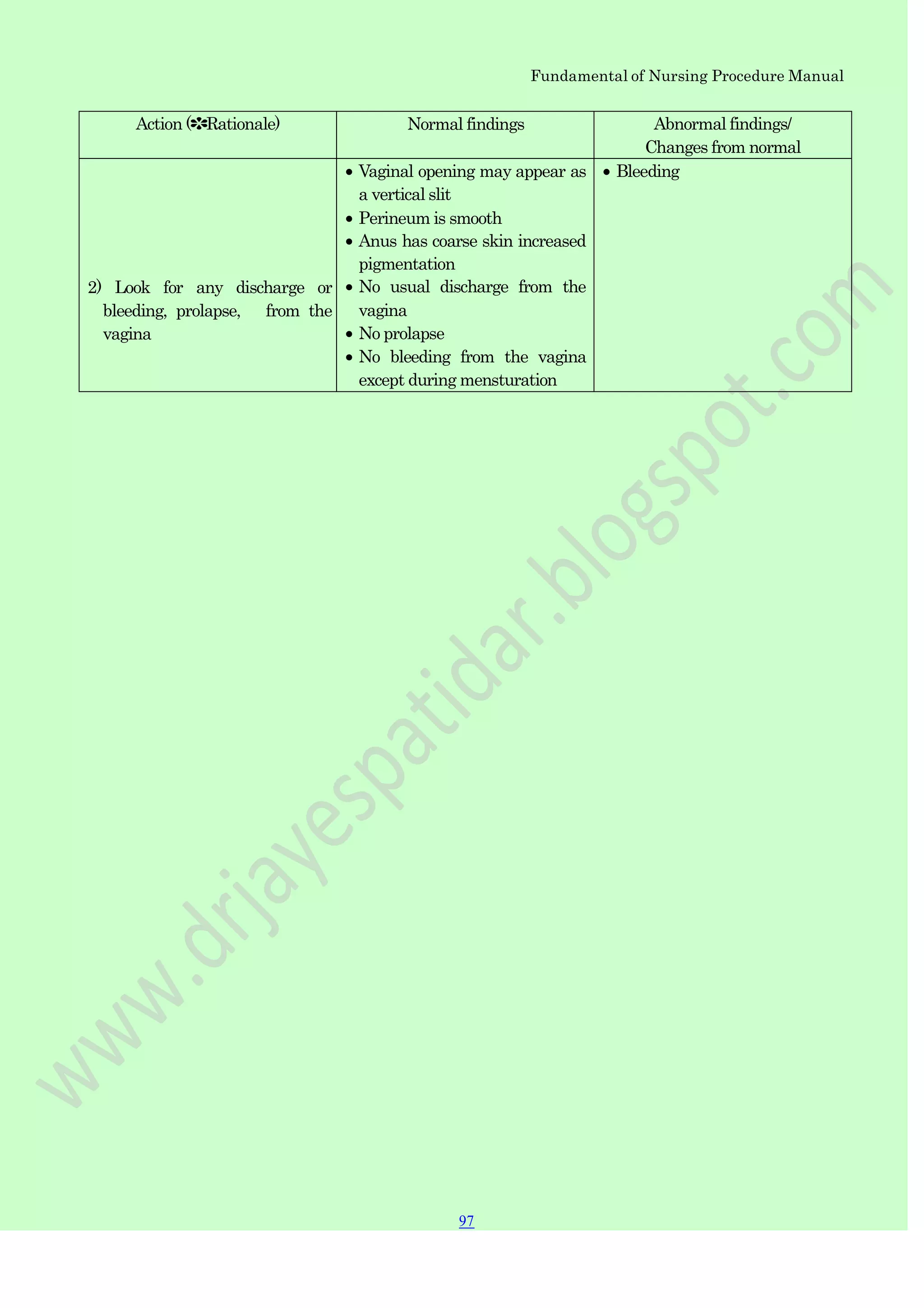
lower the client's risk of infection.
7. Be sure to double-check all clamps when
changing tubing, adding medications, or removing
I.V. tubing ( from a pump or controller).
Double -check system prevents from medical
error.
8. If the rate of flow is not regulated properly, it
could result in the client receiving a bolus of
mediation.
The rate of flow regulated prevent the client
from overdose.
9. Always check to make sure medications,
solutions, or additives are compatible before
adding them to existing solutions.
Checking before adding avoid having
incompatibility.
10. Protect the I.V. site from getting wet or soiled. Protection of the I.V. site reduces the possibility
of infection.
11. If the client will be away from the nursing unit
for tests or procedures, be sure there is adequate
solution to be infused while he/she is gone.
It will avoid having shortage of IV. or making
coagulation while having tests or procedures.
142
142
142
Maintenance of I.V. system: Changing of I.V. system
CareAction Rationale
1. Check I.V. solution. Ensure that correct solution will be used.
2.Determine the compatibility of all I.V. fluids and
additives by consulting appropriate literature.
Incompatibilities may lead to precipitate
formation and can cause physical, chemical,
and therapeutic client changes.
3.Determine client's understanding of need for
continued I.V. therapy.
Reveals need for client instruction.
4.Assess patency of current I.V. access site. If patency is occluded, a new I.V. access site may
be needed. Notify a doctor.
5. Have next solution prepared and accessible( at
least 1 hour) before needed. Check that solution is
correct and properly labeled. Check solution
expiration date and for presence of precipitate
and discoloration.
Adequate planning reduces risk of clot
formation in vein caused by empty I.V. bag.
Checking prevents medication error.
6. Prepare to change solution when less than 50 ml
of fluid remains in bottle or bag or when a new
type of solution is ordered.
Preparation ahead of time prevents air from
entering tubing and vein from clotting from lack
of flow.
7.Prepare client and family be explaining the
procedure, its purpose, and what is expected of
client.
Appropriate explanation decreases his/her
anxiety and promote cooperation.
8. Be sure drip chamber is at least half full. Half full in Chamber provides fluids to vein
while bags is changed.
9 Perform hand hygiene. Hand hygiene reduces transmission of
microorganisms.
10.Prepare new solution for changing. If using
plastic bag, remove protective cover from I.V.
tubing port . If using glass bottle, remove metal
cap.
It permits quick, smooth and organized change
from old to new solution.
11. Move roller clam to stop flow rate. It Prevents solution removing in drip chamber
from emptying while changing solutions.
12. Remove old I.V. fluid container from I.V. stand. Brings work to nurse's eye level.
13. Quickly remove spike from old solution bag or
bottle and, without touching tip, insert spike into
new bag or bottle.
Reduces risk of solution in drip chamber
running dry and maintains sterility.
14. Hang new bag or bottle of solution on I.V. stand. Gravity assists delivery of fluid into drip
chamber.
15. Check for air in tubing. If bubbles form, they can
be removed by closing the roller clamp, stretching
the tubing downward, and tapping the tubing with
the finger.
Reduces risk of air embolus.
143
143
143
16. Make sure drip chamber is one-third to one-half
full. If the drip chamber is too full, pinch off tubing
below the drip chamber, invert the container,
squeeze the drip chamber, hang , hang up the
bottle, replace the tubing.
Reduces risk of air entering tubing.
Fundamental of Nursing Procedure Manual
CareAction Rationale
17. Regulate flow to prescribed rate. Deliver I.V. fluid as ordered.
18.Place on bag.( Mark time on label tape or on
glass bottle).
Ink from markers may leach through polyvinyl
chloride containers.
19. Observe client for signs of overhydration or
dehydration to determine response to I.V. fluid
therapy.
Provides ongoing evaluation of client's fluid and
electrolyte status.
20. Observe I.V. system for patency and
development of complications.
Provides ongoing evaluation of I.V. system.
143
144
144
144
Administering Medications by Heparin Lock
Definition:
A heparin lock is an IV catheter that is inserted into a vein and left in place either for intermittent
administration of medication or as open line in the case of an emergency.
Administering medications by heparin lock is defined as one of IV therapy which can allow to be freedom
clients while he/she has not received IV therapy.
Purpose:
1. To provide intermittent administration of medication
2. To administer medication under the urgent condition
Equipments required:
1. Client‟s chart and Kardex
2. Prescribed medication
3. Spirit swabs
4. Disposable gloves if available (1)
5. Kidney tray (1)
6. Steel Tray (1)
For flush
7. Saline vial or saline in the syringe (1)
8. Heparin flush solution (1)
9. Syringe (3-5 mL) with 21-25 gauge needle (1)
For Intermittent infusion
10. IV bag or bottle with 50-100 mLsolution (1)
11. IV tubing set (1)
12. IV stand (1)
13. 21-23 gauge needle (1)
14.Adhesive tape
❖NursingAlert❖
Aheparin lock has an adapter which is attached to the hub(end)of the catheter.
An anticoagulant, approximately 2 mL heparin, is injected into the heparin lock.
To reduce the possibility of clotting , flush the heparin lock with 2-3 mL of saline 8 hourly (or once a every
duty); Saline lock.
Choose heparin lock or saline lock to decrease the possibility of making coagulation according to your
facility‟s policy or Dr.‟s order.
145
145
145
Procedure:
CareAction Rationale
1. Perform hand hygiene To prevent the spread of infection
2.Assemble all equipments Organization facilities accurate skill performance
3. Verify the medication order To reduce the chances of medication errors
4. Check the medication „s expiration date Outdated medication may be ineffective
For Bolus Injection
5. Prepare the medication. If necessary, withdraw
from an ampoule or a vial
Preparing the medication before entering the
client‟s room facilitates administration
6. Explain the procedure to the client Providing information fosters his/her cooperation
7. Identify the client before giving the medication Abiding by the “Five rights” prevents medication
errors
8. Put on gloves Gloves act as a barrier
9. Cleanse the heparin lock port with a spirit swab Spirit swab removes surface contaminants and
decreases the potential for introducing pathogens
into the system
10.
1) Steady the heparin lock with your dominant
hand
2) Insert the needle of the syringe containing 1
mL of saline into the center of the port
3) Aspirate for blood return
4) Inject the saline
5) Remove the needle and discard the syringe in
the sharps container without recapping it
Blood return on aspiration generally indicates
that the catheter is positioned in the vein.
Saline clears the tubing of any heparin flush or
previous medication
Most accidental needle-sticks occur during
recapping. Proper disposal prevents injury
11.
1) Cleanse the port again with a spirit swab
2) Insert the needle of the syringe containing the
medication
3) Inject the medication slowly
4) Withdraw the syringe and dispose of it properly
Rapid injection of medication can lead to speed
shock
12.
1) Cleanse the port with a spirit swab
2) Flush the lock with 1 mL heparin flush solution
according your hospital/agency policy.
For Intermittent Infusion
5.
1) Use premixed solution in the bag
2)Connect the tubing and add the needle or
needless component
3) Prepare the tubing with solution
6. Follow the former action 6.-10.
To remove contaminants and prevents infection
via the port
Flush clears the lock of medication and keeps it
open
Some agencies recommend only a saline flush to
clear the lock
Preparing the medication before you enter the
client‟s room facilitates administration
Fundamental of Nursing Procedure Manual
CareAction Rationale
11.
1) Cleanse the port again with a spirit swab
2) Insert the needle or needleless component
attached to the IV setup into the port
3) Attach it to the IV infusion pump or calculate the
flow rate
4) Regulate drip according to the prescribed
delivery time
5) Clamp the tubing and withdraw the needle when
all solution has been infused
6) Discard the equipments used safely according to
hospital/ agency‟s policy
12.
1) Cleanse the port with a spirit swab
2) Flush the lock with 1 mL heparin flush solution
according your hospital/agency policy.
To remove contaminants and prevents infection
via the port
Flush clears the lock of medication and keeps it
open
Some agencies recommend only a saline flush to
clear the lock
13. Remove gloves and perform hand hygiene To prevent the spread of infection
14. Record:
1) Record the IV medication administration on the
appropriate form
2)Record the fluid volume on the client‟s balance
sheet
Documentation provides coordination of care
15. Check the client‟s response to the medication
within the appropriate time
Drugs administered parenterally have rapid
onsets of action
146
147
147
147
Performing Nebulizer Therapy
Definition:
Nebulizer Therapy is to liquefy and remove retained secretions from the respiratory tract. Anebulizer is a
device that a stable aerosol of fluid and /or drug particles.
Most aerosol medication have bronchodilating effects and are administered by respiratory therapy
personnel.
Purpose:
1. To relieve respiratory insufficiency due to bronchospasm
2. To correct the underlying respiratory disorders responsible for bronchospasm
3. To liquefy and remove retained thick secretion form the lower respiratory tract
4. To reduce inflammatory and allergic responses the upper respiratory tract
5. To correct humidify deficit resulting from inspired air by passing the airway during the use of
mechanical ventilation in critically and post surgical patients
Types of nebulizer:
1. Inhaler or meterd-dose nebulizer
2. Jet nebulizer
3. Ultrasonic nebulizer
❖NursingAlert❖
Teach the client how to use personnel device. (Rationale: To ensure appropriate self-care after discharge)
Avoid treatment immediately before and after meals.(Rationale: To decrease the chance of vomiting or
appetite suppression, especially with medication that cause the client to cough or expectorate or those
that are done in conjunction with percussion/ bronchial drainage )
148
148
148
Equipments required:
1. Dr.‟s order card, client‟s chart and kardex
2. Inhaler (1)
3. Tissue paper
4. Water, lip cream as required
Procedure:
a. Inhaler
CareAction Rationale
1. Perform hand hygiene To prevent the spread of infection
2. Prepare the medication following the Five rights
of medication administration:
①Right drug
②Right dose
③Right route
④Right time
⑤Right client
Strictly observe safety precautions to decrease the
possibility of a medication error
3. Explain to the client what you are going to do. Providing explanation fosters his/her cooperation
and allays anxiety
4. Assist the client to make comfortable position in
sitting or semi-Fowler position.
Upright position can help expanding the chest
5. Shake the inhaler well immediately prior to use Shaking aerosolizes the fine particles
6. Spray once into the air. To fill the mouthpiece
7. Instruction to the client:
1) Instruct the client to take a deep breath and
exhale completely through the nose
2) The client should grip the mouthpiece with the
lips, push down on the bottle, and inhale as
slowly and deeply as possible through the mouth.
3) Instruct the client to hold his/her breath for adult
10 seconds and then to slowly exhale with pursed
lips
4) Repeat the above steps for each ordered “ puffs”,
waiting 5-10 seconds or as prescribed between
puffs.
5) Instruct the client to gargle and wipe the face if
needed.
The procedure is designed to allow the medication
to come into contact with the lungs for the
maximum amount of time
This method achieve maximum benefits
Gargling cleanse the mouth. When steroid
remains inside the mouth, infection of fungus
may occur.
8. Replace equipments used properly and discard
dirt.
To prepare for the next procedure prevent the
spread of infection and
9. Perform hand hygiene. To prevent the spread of infection
10.Document the date, time, amount of puffs, and
response. Sign on the documentation
Documentation provides continuity of care
Giving signature maintains professional
accountability
11. Report any findings to a senior staff. To provide continuity of care
149
149
149
Equipments required:
b. Ultrasonic Nebulizer
1. Dr.‟s order card, client‟s chart and kardex
2. Ultrasonic nebulizer (1)
3. Circulating set-up (1)
4. Sterile water
5. Mouthpiece or oxygen mask (1)
6. Prescribed medication
7. Sputum mug if available (1)
8. Tissue paper
9. Water, lip cream as required
Procedure:
CareAction Rationale
1. Check the medication order against the original
Dr‟s order
To ensure that you give the correct medication to
the correct client.
2. Perform hand hygiene To prevent the spread of infection
3. Prepare the medication following the Five rights
of medication administration:
①Right drug
②Right dose
③Right route
④Right time
⑤Right client
Strictly observe safety precautions to decrease the
possibility of a medication error
4. Explain to the client what you are going to do Providing explanation fosters his/her cooperation
and allays anxiety.
5. Assist to the client to a make comfortable position
in sitting or semi-Fowler position.
Upright position can help expanding the chest
6. Setting the nebulizer:
1) Plug the cord into an electrical outlet
2) Fill the nebulizer cup with the ordered amount of
medication
3) Turn on the nebulizer at the prescribed time
To ensure that you give the correct amount of
medication
7. Instructing the client during nebulization:
1) Instruct the client to close the lips around the
mouthpiece and to breathe through the mouth
2) Instructing the client to continue the treatment
until he/she can no longer see a mist on
exhalation from the opposite end of the
mouthpiece or vent holes in the mask
❖NursingAlert❖
Discontinue when the client feel ill and you find
side effects. You should take vital signs, check
respiration sound and report to the Dr.
If the client is using a mask, he/she may breathe
normally
To ensure that the client inhales the entire dose
Side effect includes nausea, vomiting, palpitation,
difficult breathing, cyanosis and cold sweat.
150
150
150
CareAction Rationale
3) Encourage the client to partially cough and
expectorate any secretions loosed during the
treatment
8.After nebulization finished,
1) Turn off the nebulizer and take off the cord from
the electrical outlet.
2) Instruct the client to gargle and wipe the face if
needed.
Apply lip cream if needed.
3) Soak the nebulizer cup and mouthpiece or
oxygen mask in warm salvon water for an hour.
Disinfect the nebulizer by spirit swab.
Gargling cleanse the mouth. When steroid
remains inside the mouth, infection of fungus
may occur.
Applying lip cream provide moisten on lips.
To avoid contamination
4) Rinse and dry it after each use To prepare for the next procedure
5) Replace equipments used properly and discard
dirt.
To prepare for the next procedure and prevent the
spread of infection
9. Perform hand hygiene. To prevent the spread of infection
10.Document the date, time, type and dose of
medication, and response. Sign on the
documentation
Documentation provides continuity of care
Giving signature maintains professional
accountability
11. Report any findings to a senior staff. To provide continuity of care
151
151
151
III. Specimen Collection
152
152
152
❖NursingAlert❖
Collecting Specimen
You always should follow the principle steps as the following:
Label specimen tubes or bottles with the client‟s name, age, sex, date, time, inpatient no. and other data
if needed before collecting the specimen.
Always perform hand hygiene before and after collecting any specimen.
Always observe body substance precautions when collecting specimens
Collect the sample according your hospital/agent policy and procedure.
Clean the area involved for sample collection
Maintain the sterile technique if needed for sample or culture.
Transport the specimen to laboratory immediately
Be sure specimen is accompanied by specimen form or appropriate order form
Record the collection and forwarding of the sample to laboratory on the client‟s record
153
153
153
Collecting Blood Specimen
a. Performing Venipuncture
Definition:
Venipuncture is using a needle to withdraw blood from a vein, often from the inside surface of the forearm
near the elbow.
Purpose:
1. To examine the condition of client and assess the present treatment
2. To diagnose disease
Equipments required:
1. Laboratory form
2. Sterilized syringe
3. Sterilized needles
4. Tourniquet (1)
5. Blood collection tubes or specimen vials as ordered
6. Spirit swabs
7. Dry gauze
8. Disposable Gloves if available (1)
9.Adhesive tape or bandages
10. Sharps Disposal Container (1)
11. Steel Tray (1)
12. Ball point pen (1)
154
154
154
Procedure:
CareAction Rationale
1. Identify the patient.
Outpatient are called into the phlebotomy area
and asked their name and date of birth.
Inpatient are identified by asking their name
and date of birth.
This information must match the requisition.
2. Reassure the client that the minimum amount of
blood required for testing will be drawn.
To perform once properly without any
unnecessary venipuncture
3.Assemble the necessary equipment appropriate
to the client's physical characteristics.
Organization facilitates accurate skill
performance
4.Explain to the client about the purpose and the
procedure.
Providing explanation fosters his/her
cooperation and allays anxiety
5.Perform hand hygiene and put on gloves if
available.
To prevent the infection of spreading.
6. Positioning
1) Make the client to be seated comfortably or supine
position
2) Assist the client with the arm extended to form
a straight-line from shoulder to wrist.
3) Place a protective sheet under the arm.
To make the position safe and comfortable is
helpful to success venipuncture at one try.
To prevent the spread of blood
7. Check the client‟s requisition form, blood collection
tubes or vials and make the syringe-needle ready.
To assure the Dr‟s order with the correct client
and to make the procedure smoothed
8. Select the appropriate vein for venipuncture. The larger median cubital, basilica and cephalic
veins are most frequently used, but other may be
necessary and will become more prominent if the
client closes his/her fist tightly.
9.Applying the tourniquet:
1)Apply the tourniquet 3-4 inches( 8 - 10 cm)above
the collection site. Never leave the tourniquet on
for over 1 minute.
2) If a tourniquet is used for preliminary vein
selection, release it and reapply after two minutes.
To prevent the venipunctue site from touching
the tourniquet and keep clear vision
Tightening of more than 1 minute may bring
erroneous results due to the change of some
blood composition.
10. Selection of the vein:
1) Feel the vein using the tip of the finger and detect
the direction, depth and size of vein.
2) Massage the arm from wrist to elbow. If the vein is
not prominent, try the other arm.
To assure venipuncture at one try.
11. Disinfect the selected site:
1) Clean the puncture site by making a smooth
circular pass over the site with the spirit swab,
moving in an outward spiral from the zone of
penetration.
2)Allow the skin to dry before proceeding.
3) Do not touch the puncture site after cleaning.
To prevent the infection from venipuncture site
Disinfectant has the effect on drying
To prevent the site from contaminating
155
155
155
CareAction Rationale
4)After blood is drawn the desired amount,
release the tourniquet and ask the client to open
his/her fist.
5) Place a dry gauze over the puncture site and
remove the needle.
6) Immediately apply slight pressure.Ask the client
to apply pressure for at least 2 minutes.
7) When bleeding stops, apply a fresh bandage or
gauze with tape.
To avoid making ecchymoma
The normal coagulation time is 2-5 minutes.
12.
1) Transfer blood drawn into appropriate blood
specimen bottles or tubes as soon as possible
using a needless syringe .
2)The container or tube containing an additive
should be gently inverted 5-8 times or shaking
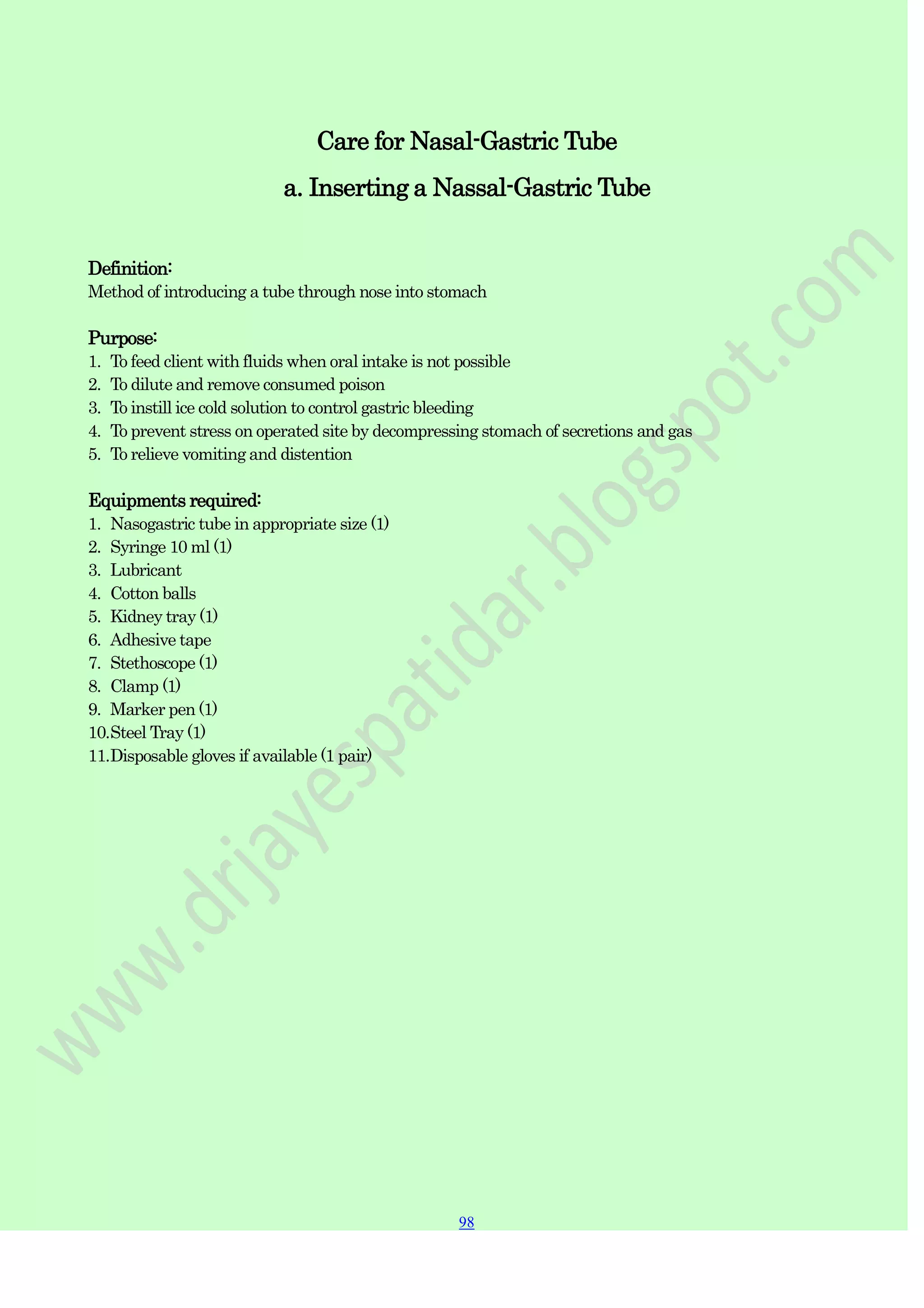
the specimen container by making figure of 8.
Adelay could cause improper coagulation
Do not shake or mix vigorously.
13.Dispose of the syringe and needle as a unit into
an appropriate sharps container.
To prevent the spread of infection
14. Label all tubes or specimen bottles with client
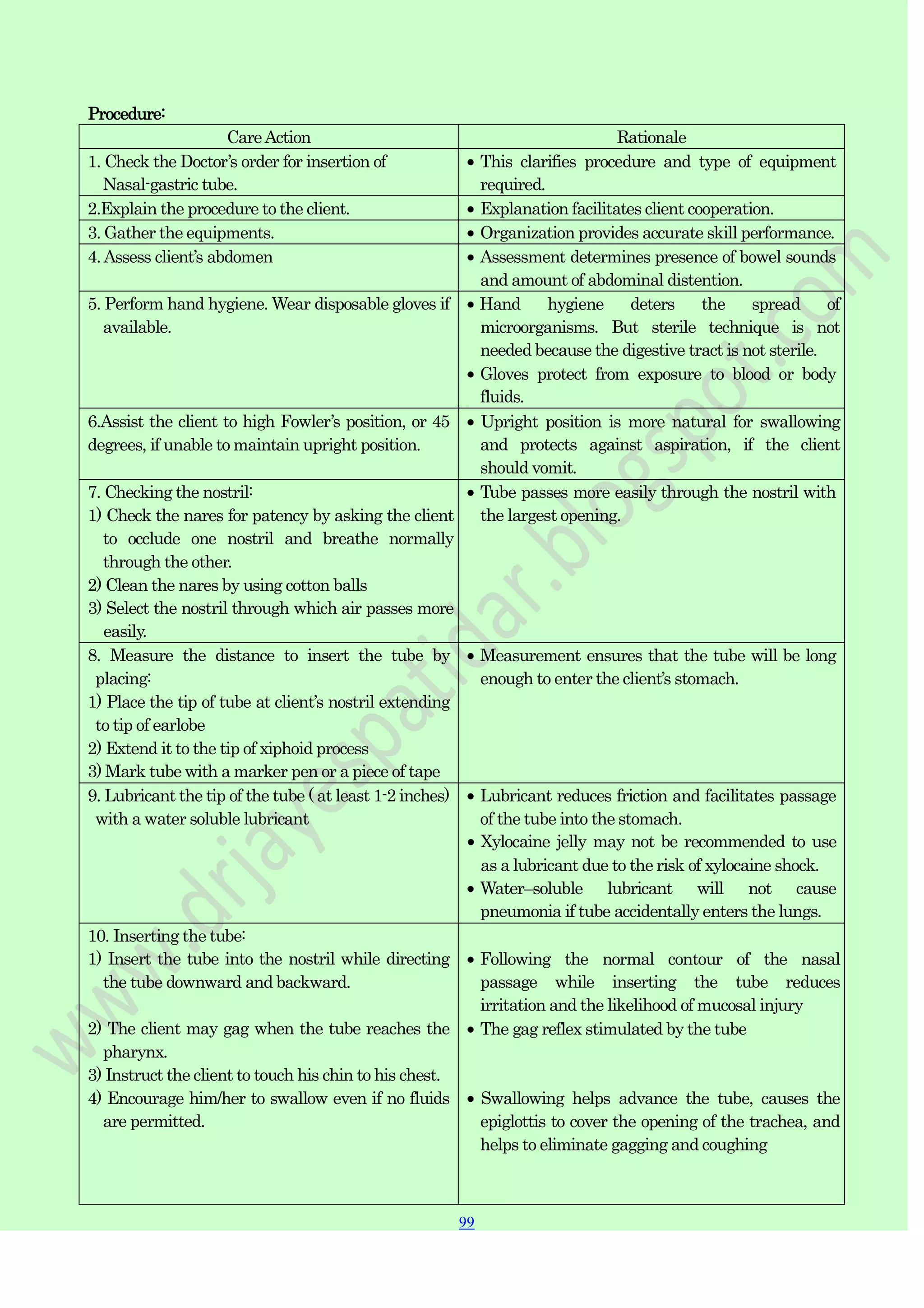
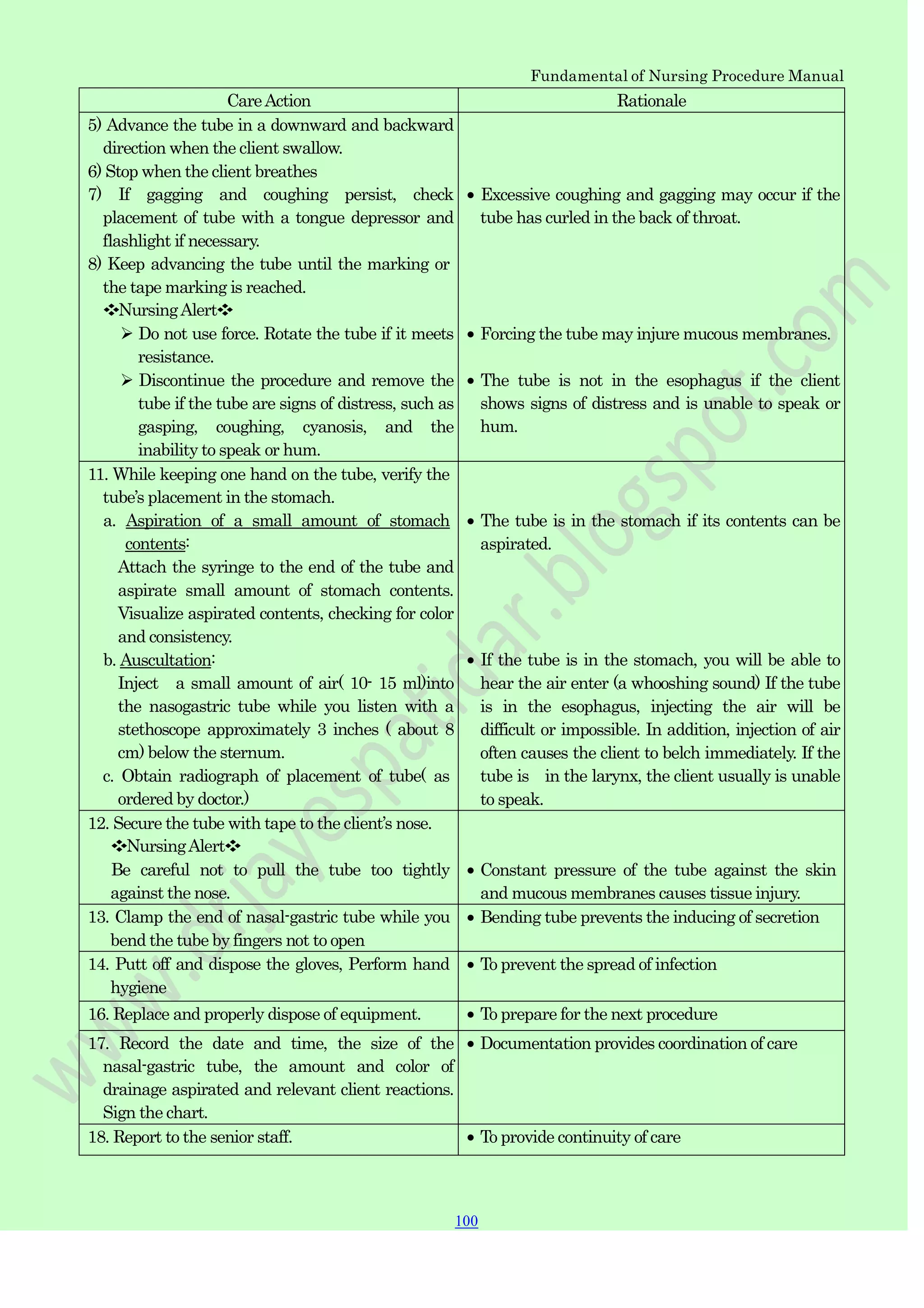
name, age, sex, inpatient no., date and time.
To prevent the blood tubes or bottles from
misdealing.
15.Send the blood specimen to the laboratory
immediately along with the laboratory order
form.
To avoid misdealing and taking erroneous results
16. Replace equipments and disinfects materials if
needed.
To prepare for the next procedure and prevent the
spread of infection and
17. Put off gloves and perform hand hygiene. To prevent the spread of infection
❖NURSING ALERT❖
❍Factors to consider in site selection:
Extensive scarring or healed burn areas should be avoided.
Specimens should not be obtained from the arm on the same side as a mastectomy.
Avoid areas of hematoma.
If an I.V. is in place, samples may be obtained below but NEVER above the I.V. site.
Do not obtain specimens from an arm having a cannula, fistula, or vascular graft.
Allow 10-15 minutes after a transfusion is completed before obtaining a blood sample.
 Safety
Observe universal (standard ) precaution safety precautions. Observe all applicable isolation
procedures.
Needle are never recapped, removed, broken or bent after phlebotomy procedure.
Gloves are to be discarded in the appropriate container immediately after the procedure.
Contaminated surfaces must be cleaned with freshly prepared 10 % bleach solution. All surfaces are
cleaned daily with bleach.
In the case of an accidental needle-stick, immediately wash the area with an antibacterial soap,
express blood from the wound, and contact your supervisor.
156
156
156
 I f a blood sample is not available,
Reposition the needle.
Loosen the tourniquet
Probing is not recommended.
Apatient should never be stuck more than twice unsuccessfully by a same staff. The supervisor or a
senior staff should be called to assess the client.
157
157
157
b. Assisting in Obtaining Blood for Culture
Definition:
Collecting of blood specimen for culture is a sterile procedure to obtain blood specimen. Sterile techniques
is used in whole of the procedure.
Purpose:
1.To identify s disease-causing organisms
2. To detect the right antibiotics to kill the particular microorganisms
Equipments required:
1. Laboratory form
2. Sterilized syringes (10 mL): (2-3)
3. Sterilized needles : (2-3)
4. Tourniquet (1)
5. Blood culture bottles or sterile tubes containing a sterile anticoagulant solution as required
6. Disinfectant : Povidon-iodine or spirit swabs
7. Dry gauze
8. Disposable gloves if available (1)
9.Adhesive tape or bandages
10. Sharps Disposal Container (1)
11. Steel Tray (1)
12. Ball point pen (1)
158
158
158
Procedure:
❖NursingAlert❖
Your role is that of assistant. You are responsible to notify the proper client when the culture is to be done.
Use the following actions in assisting with blood cultures:
CareAction Rationale
1. Identify the patient. This information must match the requisition.
2. Reassure the client that the minimum amount of
blood required for testing will be drawn.
To perform once properly without any
unnecessary collecting of blood
3.Assemble the necessary equipment appropriate
to the client's physical characteristics.
Organization facilitates accurate skill
performance
4.Explain to the client about the purpose and the
procedure.
Providing explanation fosters his/her
cooperation and allays anxiety
5. Label all tubes or specimen bottles with client
name, age, sex, inpatient no., date and time.
To prevent the blood tubes or bottles from
misdealing.
6.Perform hand hygiene and put on gloves if
available.
To prevent the infection of spreading.
7. Protect the bed with a pad under the client‟s arm. To prevent the bed of escaping or wetting the
disinfectant and blood.
8. Place the arm with proper position and disinfect
around the injection site approximate 2-3 inches
To prevent unnecessary injury and protect of
entering organisms from the skin surfaces
9. While puncturing:
1)Assist the person who is drawing blood
2) Confirm the amount
3) After obtaining sufficient blood specimen, receive
and place the specimen into the specimen
container with strict sterile technique.
4) Close the container promptly and tightly
Sometimes the blood may be placed into twe or
more tubes or bottles.
To secure the sterilized condition of container
10.After puncturing:
1) Place a sterile gauze pad and folded into a
compress tightly over the site
2) Secure firmly with tape
3) Check the stop of bleeding a few minutes later To make sure all bleeding has stopped
11.Dispose of the syringe and needle as a unit into
an appropriate sharps container.
To prevent the spread of infection
12.Send the specimen to the laboratory
immediately along with the laboratory order
form.
To avoid misdealing and taking erroneous results
13. Replace equipments and disinfects materials if
needed.
To prepare for the next procedure and prevent the
spread of infection and
14. Put off gloves and perform hand hygiene. To prevent the spread of infection
15. Document the procedure in the designated place
and mark it off on the Kardex.
To avoid duplication
Documentation provides coordination of care
159
159
159
Collecting Urine Specimen
Definition:
Urinalysis, in which the components of urine are identified, is part of every client assessment at the
beginning and during an illness.
Purpose:
1. To diagnose illness
2. To monitor the disease process
3. To evaluate the efficacy of treatment
❖NursingAlert❖
Label specimen containers or bottles before the client voids.(Rationale: Reduce handling after the
container or bottle is contaminated.)
Note on the specimen label if the female client is menstruating at that time.(Rationale: One of the tests
routinely performed is a test for blood in the urine. If the female client is menstruating at the time a
urine specimen is taken, a false-positive reading for blood will be obtained. )
To avoid contamination and necessity of collecting another specimen, soap and water cleansing of the
genitals immediately preceding the collection of the specimen is supported.(Rationale: Bacteria are
normally present on the labia or penis and the perineum and in the anal area.)
Maintain body substances precautions when collecting all types of urine specimen.(Rationale: To
maintain safety.)
Wake a client in the morning to obtain a routine specimen.(Rationale: If all specimen are collected at the
same time, the laboratory can establish a baseline. And also this voided specimen usually represents
that was collecting in the bladder all night. )
Be sure to document the procedure in the designated place and mark it off on the Kardex.(Rationale: To
avoid duplication.)
160
160
160
a. Collecting a single voided specimen
Equipments required:
1. Laboratory form
2. Clean container with lid or cover (1): wide-mouthed container is recommended
3. Bedpan or urinal (1): as required
4. Disposable gloves (1): if available
5. Toilet paper as required
Procedure:
CareAction Rationale
1. Explain the procedure Providing information fosters his/her cooperation
2. Assemble equipments and check the specimen
form with client‟s name, date and content of
urinalysis
Organization facilitates accurate skill
performance
Ensure that the specimen collecting is correct
3. Label the bottle or container with the date,
client‟s name, department identification, and Dr‟s
name.
Ensure correct identification and avoid mistakes
4. Perform hand hygiene and put on gloves To prevent the spread of infection
5.Instruct the client to void in a clean receptacle. To prevent cross-contamination
6. Remove the specimen immediately after the
client has voided
Substances in urine decompose when exposed to
air. Decomposition may alter the test results
7. Pour about 10-20 mL of urine into the labeled
specimen bottle or container and cover the bottle
or container
Ensure the client voids enough amount of the
urine for the required tests
Covering the bottle retards decomposition and it
prevents added contamination.
8.Dispose of used equipment or clean them. Remove
gloves and perform hand hygiene.
To prevent the spread of infection
9. Send the specimen bottle or container to the
laboratory immediately with the specimen form.
Organisms grow quickly at room temperature
10.Document the procedure in the designated place
and mark it off on the Kardex.
To avoid duplication
Documentation provides coordination of care
161
161
161
b. Collecting a 24-hour Urine Specimen
Definition:
Collection of a 24-hour urine specimen is defined as the collection of all the urine voided in 24 hours,
without any spillage of wastage.
Purpose:
1. To detect kidney and cardiac diseases or conditions
2. To measure total urine component
Equipments required:
1. Laboratory form
2. Bedpan or urinal (1)
3. 24 hours collection bottle with lid or cover (1)
4. Clean measuring jar (1)
5. Disposable gloves if available (1)
6. Paper issues if available
7. Ballpoint pen (1)
Procedure:
CareAction Rationale
1. Explain the procedure Providing information fosters his/her cooperation
2. Assemble equipments and check the specimen
form with client‟s name, date and content of
urinalysis
Organization facilitates accurate skill
performance
Ensure that the specimen collecting is correct
3. Label the bottle or container with the date,
client‟s name, department identification, and Dr‟s
name.
Ensure correct identification and avoid mistakes
4. Instruct the client:
1) Before beginning a 24 hour urine collection, ask
the client to void completely.
2) Document the starting time of a-24 hour urine
collection on the specimen form and nursing
record.
3) Instruct the client to collect all the urine into
a large container for the next 24 hours.
4) In the exact 24 hours later, ask the client to void
And pour into the large container.
5) Measure total amount of urine and record it on
the specimen form and nursing record.
6) Document the time when finished the collection
To measure urinal component and assess the
function of kidney and cardiac function accuracy
The entire collected urine should be stored in a
covered container in a cool place.
162
162
162
5. Sending the specimen:
1) Perform hand hygiene and put on gloves if
available.
2) Mix the urine thoroughly
To prevent the contamination
Fundamental of Nursing Procedure Manual
CareAction Rationale
3) Collect some urine as required or all the urine in
a clean bottle with lid.
4) Transfer it to the laboratory with the specimen
form immediately.
Ensure the client voids enough amount of the
urine for the required tests
Covering the bottle retards decomposition and it
prevents added contamination.
Substances in urine decompose when exposed to
air. Decomposition may alter the test results
6.Dispose of used equipment or clean them. Remove
gloves and perform hand hygiene.
To prevent the spread of infection
7.Document the procedure in the designated place
and mark it off on the Kardex.
To avoid duplication
Documentation provides coordination of care
162
163
163
163
c. Collecting a urine specimen from a retention catheter
Equipments required:
1. Laboratory form
2. Disposable gloves if available (1)
3. Container with label as required
4. Spirit swabs or disinfectant swabs
5. 10-20-mLsyringe with 21-25-gauge needle
6. Clamp or rubber band (1)
7. Ballpoint pen (1)
Purpose:
CareAction Rationale
1.Assemble equipments. Label the container. Organization facilitates accurate skill
performance
2. Explain the procedure to the client Providing information fosters his/her cooperation
3. Perform hand hygiene and put on gloves if
available.
To prevent the spread of infection
4. Clamp the tubing:
1) Clamp the drainage tubing or bend the tubing
2)Allow adequate time for urine collection
❖NursingAlert❖
You should not clamp longer than 15minutes
Collecting urine from the tubing guarantees a
fresh urine.
Long-time clamp can lead back flow of urine and
is able to cause urinary tract infection
5. Cleanse the aspiration port with a spirit swab or
another disinfectant swab (e.g., Betadine swab)
Disinfecting the port prevents organisms from
entering the catheter.
6. Withdrawing the urine:
1) Insert the needle into the aspiration port
2) Withdraw sufficient amount of urine gently into
the syringe
This technique for uncontaminated urine
specimen, preventing contamination of the client‟s
bladder
7.Transfer the urine to the labeled specimen
container
❖NursingAlert❖
The container should be clean for a routine
urinalysis and be sterile for a culture
Careful labeling and transfer prevents
contamination or confusion of the urine specimen
Appropriate container brings accurate results of
urinalysis.
8.Unclamp the catheter The catheter must be unclamped to allow free
urinary flow and to prevent urinary stasis.
9.Prepare and pour urine to the container for
transport
Proper packaging ensures that the specimen is
not an infection risk
10. Dispose of used equipments and disinfect if
needed. Remove gloves and perform hand
hygiene
To prevent the spread of infection
11.Send the container to the laboratory
Immediately
Organisms grow quickly at room temperature
12.Document the procedure in the designated place
and mark it off on the Kardex.
To avoid duplication
Documentation provides coordination of care
164
164
164
d. Collecting a urine culture
Definition:
Collecting a urine culture is a process that it obtain specimen urine with sterile technique
Purpose:
1. To collect uncontaminated urine specimen for culture and sensitivity test
2. To detect the microorganisms causes urinary tract infection (; UTI)
3. To diagnose and treat with specific antibiotic
Equipments required:
1. Laboratory form
2. Sterile gloves (1)
3. Sterile culture bottle with label as required
4. Sterile kidney tray or sterile container with wide mouthed if needed
5. Bed pan if needed (1)
6. Paper tissues if needed
7. Ballpoint pen (1)
Procedure:
CareAction Rationale
1. Assemble equipments and check the specimen
form with client‟s name, date and content of
urinalysis
Organization facilitates accurate skill
performance
Ensure that the specimen collecting is correct
2. Label the bottle or container with the date,
client‟s name, department identification, and Dr‟s
name.
Ensure correct identification and avoid mistakes
3. Explain the procedure to the client Providing information fosters his/her cooperation
4. Instruct the client:
1) Instruct the client to clean perineum with soap
and water
2) Open sterilized container and leave the cover
facing inside up
3) Instruct the client to void into sterile kidney tray
or sterilized container with wide mouth
4) If the client is needed bed-rest and needs to pass
urine more, put bed pan after you collected
sufficient amount of sterile specimen
To prevent the contamination of specimen from
perineum area
The cover should be kept the state sterilized
To secure the specimen kept in sterilized
container surely
5. Remove the specimen immediately after the
client has voided. Obtain 30-50 mL at midstream
point of voiding
Substances in urine decompose when exposed to
air. Decomposition may alter the test results
Ensure the client voids enough amount of the
urine for the required tests
Emphasize first and last portions of voiding to be
discarded
165
165
165
7. Close the container securely without touching
inside of cover or cap.
Covering the bottle retards decomposition and it
prevents added contamination.
Fundamental of Nursing Procedure Manual
CareAction Rationale
8. Dispose of used equipment or clean them.
Remove gloves and perform hand hygiene.
To prevent the spread of infection
9. Send the specimen bottle or container to the
laboratory immediately with the specimen form.
Organisms grow quickly at room temperature
10.Document the procedure in the designated place
and mark it off on the Kardex.
To avoid duplication
Documentation provides coordination of care
165
166
166
166
Collecting a stool specimen
Definition:
Collection of stool specimen deters a process which is aimed at doing chemical bacteriological or
parasitological analysis of fecal specimen
Purpose:
1. To identify specific pathogens
2. To determine presence of ova and parasites
3. To determine presence of blood and fat
4. To examine for stool characteristics such as color, consistency and odor
Equipments required:
1. Laboratory form
2. Disposable gloves if available (1)
3. Clean bedpan with cover (1)
4. Closed specimen container as ordered
5. Label as required
6. Wooden tongue depressor (1-2)
7. Kidney tray or plastic bag for dirt (1)
Procedure:
CareAction Rationale
1.Assemble equipments. Label the container. Organization facilitates accurate skill
performance
Careful labeling ensures accuracy of the report
and alerts the laboratory personnel to the
presence of a contaminated specimen
2. Explanation:
1) Explain the procedure to the client
2) Ask the client to tell you when he/she feels the
urge to have a bowel movement
Providing information fosters his/her cooperation
Most of clients cannot pass on command
3. Perform hand hygiene and put on gloves if
available.
To prevent the spread of infection
4. Placing bedpan:
1) Close door and put curtains/ a screen.
2) Give the bedpan when the client is ready.
3)Allow the client to pass feces
4) Instruct not to contaminate specimen with urine
To provide privacy
You are most likely to obtain a usable specimen at
this time.
To gain accurate results
167
167
167
CareAction Rationale
5. Collecting a stool specimen:
1) Remove the bedpan and assist the client to clean
if needed
2) Use the tongue depressor to transfer a portion of
the feces to the container without any touching
3) Take a portion of feces from three different areas
of the stool specimen
4) Cover the container
It is grossly contaminated
To gain accurate results
It prevents the spread of odor
6. Remove and discard gloves. Perform hand
hygiene
To prevent the spread of infection
7. Send the container immediately to the laboratory Stools should be examined when fresh.
Examinations for parasites, ova, and organisms
must be made when the stool is warm.
8.Document the procedure in the designated place
and mark it off on the Kardex.
To avoid duplication
Documentation provides coordination of care
❖NursingAlert❖
The procedure is exact same in routine test of stool and culture. BUT!! when you collect stool specimen you
should caution on the next point;
Collect stool specimen with clean wooden tongue depressor or spatula for routine stool test
Collect stool specimen with sterile wooden tongue depressor or spatula for culture
168
168
168
Collecting a sputum specimen
a. Routine test
Definition:
Collecting a sputum specimen is defined as a one of diagnostic examination using sputum
Purpose:
1. To diagnose respiratory infection
2. To assess the efficacy of treatment to diseases such as TB
Equipments required:
1. Laboratory form
2. Disposable gloves if available (1)
3. Sterile covered sputum container (1)
4. Label as required
5. Sputum mug or cup (1)
6. Kidney tray or plastic bag for dirt (1)
7. Paper tissues as required
8. Ballpoint pen (1)
Procedure:
CareAction Rationale
1.Assemble equipments. Label the container. Organization facilitates accurate skill
performance
Careful labeling ensures accuracy of the report
and alerts the laboratory personnel to the
presence of a contaminated specimen
2. Explain the procedure to the client Providing information fosters his/her cooperation
3. Perform hand hygiene and put on gloves if
available.
To prevent the spread of infection. The sputum
specimen is considered highly contaminated, so
you should treat it with caution.
4. Collecting the specimen:
1) Instruct the client to cough up secretions from
deep in the respiratory passage.
2) Have the client expectorate directly into the
sterile container.
3) Instruct the client to wipe around mouth if
needed. Discard it properly
4) Close the specimen immediately
A sputum specimen should be from the lungs and
bronchi. It should be sputum rather than
mucous
Avoid any chance of outside contamination to the
specimen or any contamination of other objects
Paper tissues used by any client are considered
contaminated
To prevent contamination
5. Remove and discard gloves. Perform hand
hygiene
To prevent contamination of other objects,
including the label
6. Send specimen to the laboratory immediately. To prevent the increase of organisms
169
169
169
7.Document the procedure in the designated place
and mark it off on the Kardex.
To avoid duplication
Documentation provides coordination of care
170
170
170
b. Collecting a sputum culture
Definition:
Collection of coughed out sputum for culture is a process to identify respiratory pathogens.
Purpose:
1. To detect abnormalities
2. To diagnose disease condition
3. To detect the microorganisms causes respiratory tract infections
4. To treat with specific antibiotics
Equipments required:
1. Laboratory form
2. Disposable gloves if available (1)
3. Sterile covered sputum container (1)
4. Label as required
5. Kidney tray or plastic bag for dirt (1)
6. Paper tissues as required
7. Ballpoint pen (1)
❖NursingAlert❖
You should give proper and understandable explanation to the client
1. Give specimen container on the previous evening with instruction how to treat
2. Instruct to raise sputum from lungs by coughing, not to collect only saliva.
3. Instruct the client to collect the sputum in the morning
4. Instruct the client not to use any antiseptic mouth washes to rinse hid/her mouth before collecting
specimen.
170
170
170
Procedure:
CareAction Rationale
1.Assemble equipments. Label the container. Organization facilitates accurate skill
performance
Careful labeling ensures accuracy of the report
and alerts the laboratory personnel to the
presence of a contaminated specimen
2.Explain the procedure to the client Providing information fosters his/her cooperation
3. Perform hand hygiene and put on gloves if
available.
To prevent the spread of infection. The sputum
specimen is considered highly contaminated, so
you should treat it with caution.
4. Instruct the client:
1) Instruct the client to collect specimen early
morning before brushing teeth
2) Instruct the client to remove and place lid facing
upward.
3) Instruct the client to cough deeply and
expectorate directly into specimen container
4) Instruct the client to expectorate until you collect
at least 10 mL of sputum
5) Close the container immediately when sputum
was collected
6) Instruct the client to wipe around mouth if
needed. Discard it properly
To obtain overnight accumulated secretions
To maintain the inside of lid as well as inside of
container
A sputum specimen should be from the lungs and
bronchi. It should be sputum rather than
mucous
To obtain accurate results
To prevent contamination
Paper tissues used by any client are considered
contaminated
5. Remove and discard gloves. Perform hand
hygiene
To prevent contamination of other objects,
including the label
6. Send specimen to the laboratory immediately. To prevent the increase of organisms
7. Document the procedure in the designated place
and mark it off on the Kardex.
To avoid duplication
Documentation provides coordination of care
171
171
171
Appendix 1
Checklist for Taking Vital Signs
Student: ( )
Instructor: ( )
Evaluated on : ( )
Step Satisfied Unsatisfied:
( Put comments )
Not
Performed
General steps for taking vital signs:
1. Confirmed the client identification and
assess the client condition, send him/her
toilets if needed
2. Explained the purpose and all procedures
3. Performed hand washing
4. Collected all equipments required
5. Made him/her comfortable position
6. Maintained his/her privacy by closing door
or using screen
Measuring temperature of axilla
1. Explained the procedure
2. Loosen the cloth if needed
3. Confirmed the client whether if the axilla
is dry or not, if not, make dry by patting
4. Cleaned a thermometer and confirm the
level of thermometer placing under 35
degree
5. Put the thermometer with 45 degree from
anterioinferior to the client7s arm pit and
hold the arm tightly across the chest for 3
minutes
6. Took away and read at eye level ,and note
it
7. Cleaned the thermometer by spirit swab
8.Assessed the data
Normality
Abnormality: hyerthermia
hypothermia
Counting radial pulse
1.Explained the procedure
2. Supported the client with supine or sitting
position
3. Assisted the client‟s forearm across the
lower chest in supine position. In sitting
position, assist the client‟s forearm to bend
with 90 degree on armrest of chair or on
the nurse‟s arm.
172
172
172
Step Satisfied Unsatisfied:
(Put comments)
Not
Performed
4. Palpated radial pulse by three fingertips
5. Counted the rate for 1 minute
6. Checked the rhythm, regularity,
volume( or strength)
7.Took notes
8. Assessed the data and advised the client
as needed.
9.Reported any abnormalities
Counting respirations
1. Explained the procedures
2. Provided privacy
3.Positioned the client to ensure view of
chest movement
4.Placed the client arm relaxed across the
lower chest or abdomen
5.Counted the rate completely for 1 minute
6. Checked the cycle with rhythm and
depth.
7. Took notes
8. Replaced the client‟s clothes if needed.
9.Assesses the data and advised as needed
10. Reported any abnormalities
Measuring blood pressure: by two steps
before measured:
1. Explained the procedures
2.Assisted the supine or sitting position
3. Removed constricting clothing from the
upper arm selected
4. Positioned the client‟s forearm at heart
level with the palm turned up
5. Palpated brachial artery by nondominant
hand.
6. Positioned the center of bladder of
deflated cuff above brachial artery
7.Wrapped cuff evenly around upper arm
with two fingers loose
8.Set up manometer properly
Measured blood pressure in two steps:
1) Palpatory method
1)Identified approximate systolic pressure
by palpating brachial pulse
173
173
173
Step Satisfied Unsatisfied Not
Performed
9.2) Inflated 20-30 mmHg more than the
point identified as systolic pressure to
ensure
3) Deflated cuff evenly by open screw of bulb
to fall mercury at rate of 2-3 mm Hg per
second
4) Identified the scale of manometer where
you palpated brachial pulse again
5) Deflated cuff completely
6) Removed cuff from the upper arm
7) Took 3 minutes interval before
auscultation
2) Auscultation
1) Checked stethoscope amplification of
sound
2) Rechecked brachial pulse and placed the
center part of bladder above it
3) Wrapped cuff evenly and snugly around
the upper arm. Closed the screw clamp of
bulb.
4) Applied diaphragm of stethoscope over
brachial artery
5) Inflated cuff to 20-30 mmHg above that of
palpated systolic pressure.
6) Allowed mercury to fall evenly at the rate
of 2-3 mmHg per second
7) Noted the point on manometer when first
sound clearly was listened
8) Deflated cuff continuously and noted the
point at which sound disappeared
9) Continued deflation 10 -20 mmHg after
the last sound listened
10) Released the pressure from cuff
completely and rapidly.
11) Removed cuff from the upper arm
12) Took notes
11. Assisted client to return comfortable
position and arrange the clothing
12. Informed the reading to the client and
advised as needed
13. Cleaned earpieces and diaphragm of
stethoscope with spirit swab.
14.Performed hand hygiene
15. Reported any abnormal findings
174
174
174
General Comments:
Well performance ( ) Just performed ( ) Poor performance ( )
 Students given poor performance need to receive the back evaluation.
Feedback from instructor
175
175
175
Appendix 2
Checklist for Bedmaking: un-occupied bed
Student: ( )
Instructor: ( )
Evaluated on : ( )
Step
(by one nurse)
1. Performed hand hygiene
2. Assembled all equipments required and
brought them to bedside
3. Make enough space for bedmaking
4. Cleaned bedside locker by wet and dry
sponge cloth
5. Clean the both side of mattress by wet
and dry sponge cloth
6. Started bedmaking from right side of bed:
1) Apply a bottom sheet and smoothed out it
2) Made a mitered corner in top corner of
bottom sheet and secondly in end corner of
bottom sheet
3) Tucked bottom sheet under mattress
4) Applied mackintosh and draw sheet to
bed correctly and tucked the edge under
mattress tightly
7.Move to left side of bed:
1) Spread bottom sheet smoothly over the
bed
2) Mitered corner in top corner and in end
corner of bottom sheet
3) Tucked bottom sheet under mattress
4) Pulled mackintosh and draw sheet from
the center of bed and tucked tightly under
mattress
8.Returned to right side again:
1) Applied top sheet to the end of bed in right
side of bed
2) Place blanket at the level of 1 feet below
from the top edge of bed. Spread the
blanket to the end of bed in right side of
bed
3) Made cuff out of top edge of sheet over
blanket
11.Mitered corner in end of bed and tucked
in remained portion of top sheet with
blanket tightly under mattress.
Satisfied Unsatisfied:
( Put comments )
Not
Performed
176
176
176
Step
(by one nurse)
9. Moved to left side:
1) Pull the top sheet and smoothed it over to
bed
2) Smoothed blanket over to bed
3) Made cuff out of top edge of sheet over
blanket
4) Mitered corner in end of bed and tucked
the remained tightly under mattress
10. Applied a clean pillowcace over pillow
and placed it at the center of bed neatly
11. Rearranged the place of bed and bedside
locker if needed
12. Return all equipments and disposal
13. Perform hand hygiene
Satisfied Unsatisfied:
( Put comments )
Not
Performed
General Comments:
Well performance ( ) Just performed ( ) Poor performance ( )
 Students given poor performance need to receive the back evaluation.
Feedback from instructor
177
177
177
Appendix 3
Checklist for Changing occupied bed
Student: ( )
Instructor: ( )
Evaluated on : ( )
Step
(by one nurse)
1. Confirmed client‟s identification and
explain the procedures
2.Performed hand hygiene
3. Assembled all equipments required and
brought them to bedside
4. Closed door and/or put screen
5.Removed personal belongings from
bed-side and put them into bedside locker
or safe place. Arranged enough space for
bedmaking
6.Cleaned bedside locker by wet and dry
sponge cloth
7. Loosened top lines from mattress
8. Remove blanket by folding and covered
the client‟s body by only top sheet
9. Assisted the client to turn toward left side
of the bed.Adjust ed the pillow.
10. Started bedmeaking from right side:
1) Fanfolded (or rolled) soiled lines from the
side of bed and wedged them close to the
client
2) Clean the surface of mattress by wet and
dry sponge cloth
3) Placed bottom sheet evenly on the bed
folded lengthwise with the center fold
4) Adjusted bottom sheet and Mitered a
corner in top corner of bottom sheet
5) Tighten bottom sheet and mitered a
corner in end corner of bottom sheet.
6) Tucked in along side.
7) Place the mackintosh and draw sheet
correctly on the bottom sheet and tucked
them under mattress
11. Assisted client to roll over the folded
linen to right side.
12.Moved to left side:
1) Removed the soiled lines.
2) Discarded the soiled linen correctly.
Satisfied Unsatisfied:
( Put comments )
Not
Performed
178
178
178
12.
Step
(by one nurse)
Satisfied Unsatisfied:
( Put comments )
Not
Performed
3) Clean the surface of mattress by wet and
dry sponge cloth
4) Grasped clean linens and pull them out
gently on the mattress
5) Tuck the bottom sheet tightly in top
corner of bed and mitered a corner.
6) Tucked the bottom sheet tightly in end
corner of bed and mitered a corner.
7) Tucked in along side
8) Spread mackintosh and draw sheet over
bottom sheet and tucked them tightly
under mattress.
13. Assisted the client back too the center of
bed.Adjust the pillow.
14. Returned to right side:
1) Placed clean top sheet at the top side of
the soiled top sheet
2) Asked the client to hold the upper edge of
clean top sheet
3) Held both the top of the soiled sheet and
the end of the clean sheet with right hand.
Withdrew to downward.
4) Removed the soiled top sheet and
discarded into laundry bag or bucket.
5) Placed blanket over top sheet correctly.
Made cuff out of top edge of sheet
6) Tucked the lower ends securely under
mattress. Mitered corners.
15. Repeated procedure 14. in left side.
16. Removed the pillow and replace the
pillow cover with clean one. Repositioned
the pillow under client‟s head.
17. Replaced persona belongings back.
Returned the bed-side locker and bed as
usual
18. Return all equipments to proper places
20. Discarded soiled linens appropriately.
20. Perform hand hygiene.
179
179
179
General Comments:
Well performance ( ) Just performed ( ) Poor performance ( )
 Students given poor performance need to receive the back evaluation.
Feedback from instructor
Fundamental of Nursing Procedure Manual
180
180
180
Appendix 4
Checklist for making post-operative bed
Student‟s name: ( )
Instructor: ( )
Evaluated on : ( )
Step Satisfied Not
Satisfied
Not
done
Remarks
1. Performed hand hygiene
2. Assembled all equipments and brought
bed-side.
3. Made foundation bed with a large
mackintosh and draw sheet
4. Placed top bedding as for closed bed without
tucked at foot
5. Folded back top bedding at the foot of bed
6. Tucked the top bedding on one side only.
7. On the other side, did not tuck the top
bedding:
1) Brought head and foot corners of them at
the center of bed and formed right angles
2) Folded back suspending portion and rolled
to opposite 1/3 side of bed.
8. Removed pillow and placed in opposite
side from entering client (or in foot side)
9. Placed a kidney tray on bed-side
10. Placed IV stand near the bed
11. Checked locked wheel of the bed
12. Placed hot water bag if needed. If put
before, removed it when client came back
13. Transferred client:
1) Helped lifting client into the bed
2) Covered client by top bedding immediately
3) Tucked top bedding and mitered corners in
end of bed
General Comments:
Well performance ( ) Just performed ( ) Poor performance ( )
 Students given poor performance need to receive the back evaluation.
Feedback from instructor
Fundamental of Nursing Procedure Manual
181
181
181
References:
A. Verghese, S. Shrestha, NM. Shrestha, et.al.: Fundamentals of nursing, 2nd edition, Health
Learning Materials Centre, 1995
AliceAugustine, Jebamani Sugustine,Accamma Chacko: Clinical Nursing Procedure Manual,
B.I. Publications, 2004
Carol Taylor, Carol Lillis, Priscilla Le Mone: Fundamentals of Nursing , TheArt and Science of
Nursing Care, 5th edition, Lippincott Williams & Wilkins, 2006
Caroline Bunker Rosdabl: Textbook of Basic Nursing, Seventh edition, Lippincott, 1999
CTEVT, JICA: Nursing Procedure Manual(I), Fundamentals Nursing Procedure, 2004
Health Learning Materials Center: Fundamentals of Nursing, 2nd edition, HLMC, 1995
http://ccforum.com/content/10/1/R35 Effect of oral decontamination with chlorhexidine on the incidence of
nosocominal pneumonia: a met-analysis, accessed December 20, 2007
http://www.aach.org/AACN/practiceAlert.nsf/Files/ORAL%20CARE/$file/Oral%20Care%20in%20the%20
Critically%20Ill%208-2006.pdf
American Association of Critical-care Nurses, Practice Alert, Oral care in the critically ill,
accessed December 24, 2007
http://www.breastcancerprofessional.com/contents/public/onc/nursing.pdf
Excerpts from Nursing Procedures, Intramuscular Injection Technique, accessed February 7,
2008
http://www.free-ed.net/sweethaven/MedTech/NurseFund/default.asp?iNum=2&fr
Fundamentals of Nursing, 2nd edition,3-8 Basic principles of mouth care, accessed
December20,2008
http://www.guideline.gov/summary/summary.asp
Nursing management of oral hygiene, National Guideline Clearing house, accessed
December 20, 2007
http://www.halls.md/body-mass-index/bmirefs.htm
Body Mass Index formula and average weight percentile statistics, accessed February 6, 2008
http://www.herhis.nhs.uk/RMCNP/contant/mars32.htm The Royal Marsden Hospital Manual of Clinical
Nursing Procedures 6th edn: Personal hygiene: mouth care, accessed December 19, 2007
http://www.lhsc.on.ca/critcare/ucicu/procs/oralcare.htm Adult critical care, intensive care unit, oral care for
incubated patients, accessed December 20, 2007
http://www.medscape.com/viewarticle/471863 The updated WHO/ISH Hypertension Guidelines,
accessed February 7, 2008
Fundamental of Nursing Procedure Manual
182
182
182
http://www.moh.gov.om/nursing/19520120NEBULIZER%20THERAPY%20introduction.pdf
General nursing procedures, Nebulizer therapy, accessed December 20, 2007
http://sciencelinks.jp/j-east/article/200512/000020051205A0431539.php
Science Links Japan, Study on the Method of choosing Intramuscular Injection Site in the
Buttoks, accessed January 31, 2008
http://www.uams.edu/clinlab/venipuncture.htm Routine venipuncture procedure
http://www.med.nyu.edu/patientcare/library/article.html?ChunkIID=33266
NYU Medical Center, Hospitals & Patient Care, Intramuscular Injection(Self-injection),
accessed January 31,2008
I Clement: BASIC CONCEPTS ON NURSING PROCEDURES, Jaypee, 2007
Laligurans Kai Japan: Manual of Basic laboratory techniques for Peripheral Health Care Centers in
Developing Countries, Laliguras Kai Japan, 2001
PatricaA. Castaldi: Clinical Nursing Skills & Techniques, 6th edition,2005, Elsevier Mosby,
PenelopeAnn Hilton: fundamental nursing skills, I.K.International Pvt.Ltd., 2004
Stedmans‟Medical Dictionary, 28th edition, illustrated in color, Lippincott Williams & Willkins,2006
World Health Organization, International Society of Hypertension Writing Group:2003 World Health
Organization (WHO)/International Society of Hypertension(ISH) statement on management
of hypertension, J hypertens, 2003;21
World Health Organization: Obesity: preventing and managing the global epidemic. Report of a WHO
consultation on obesity, World Health organization, Geneva, 1998

Fundamental of nursing procedure mannual

  • 1.
    Fundamental of NursingProcedure Manualwww.drjayeshpatidar.blogspot.com FUNDAMENTAL OF NURSING PROCEDURE MANUAL MR. JAYESH PATIDAR M.Sc. NURSING
  • 2.
    Fundamental of NursingProcedure Manualwww.drjayeshpatidar.blogspot.com 11.Administering Nasal-Gastric tube feeding 102 12. Cleaning a wound andApplying a sterile dressing 106 13. Supplying oxygen inhalation 109 a. Nasal Cannula Method 111 b. Mask Method: Simple face mask 113 Table of Contents I. Basic Nursing Care/ Skill 1. Bed making a. Making an Un-occupied bed b. Changing an Occupied bed c. Making a Post-operative bed 2. Performing oral care a.Assisting the client with oral care b. Providing oral care for dependent client 3. Performing bed bath 4. Performing back care 5. Performing hair washing 6. Care for fingernails/ toenails 7. Performing perineal care 8. Taking vital signs a. Taking axillary temperature by glass thermometer b. Measuring radial pulse c. Counting respiration d. Measuring blood pressure 9. Performing physical examination 10. Care for Nasal-gastric Tube a. Inserting a Nasal-Gastric Tube b. Removal a Nasal-Gastric Tube 7 9 13 16 19 21 23 26 30 32 35 37 39 41 43 45 46 49 98 98 101 II. Administration of Medications 115 1. Administering oral medications 117 2. Administering oral medications through a Nasal-Gastric Tube 120 3. Removing medications from an ampoule 123 4. Removing medications from a vial 126 5. Prevention of the needle-stick injuries 129 6. Giving an Intra-muscular injection 130 7. Starting an Intra-venous infusion 135 8. Maintenance of I.V. system 140 9. Administering medications by Heparin Lock 144 10. Performing Nebulizer Therapy 147 a. Inhaler 148 b. Ultrasonic nebulizer 149
  • 3.
    Fundamental of NursingProcedure Manualwww.drjayeshpatidar.blogspot.com III. Specimen collection 151 1.Collecting blood specimen 153 a. Performing venipuncture 153 b. Assisting in obtaining blood for culture 157 2.Collecting urine specimen 159 a. Collecting a single voided specimen 160 b. Collecting a 24-hour urine specimen 161 c. Collecting a urine specimen from a retention catheter 163 d. Collecting a urine culture 164 3. Collecting a stool specimen 166 4. Collecting a sputum specimen 168 a. Routine test 168 b. Collecting a sputum culture 169 Appendix References 171 181
  • 4.
    Fundamental of NursingProcedure Manual 6
  • 5.
    Fundamental of NursingProcedure Manual I. Basic Nursing Care/ Skill 7
  • 6.
    Fundamental of NursingProcedure Manual 8
  • 7.
    9 Bed making a. Makingan Un-occupied Bed Definition: Abed prepared to receive a new patient is an un-occupied bed. Fig.1. Un-occupied bed Purpose 1. To provide clean and comfortable bed for the patient 2. To reduce the risk of infection by maintaining a clean environment 3. To prevent bed sores by ensuring there are no wrinkles to cause pressure points Equipment required: 1. Mattress (1) 2. Bed sheets(2): Bottom sheet (1) Top sheet (1) 3. Pillow (1) 4. Pillow cover (1) 5. Mackintosh (1) 6. Draw sheet (1) 7. Blanket (1) 8. Savlon water or Dettol water in basin 9. Sponge cloth (4): to wipe with solution (1) to dry (1) ✽ When bed make is done by two nurses, sponge cloth is needed two each. 10. Kidney tray or paper bag (1) 11. Laundry bag or Bucket (1) 12. Trolley(1) Fig. 2. Equipment required on a trolley
  • 8.
    10 10 www.drjayeshpatidar.blogspot.com Procedure: by onenurse CareAction Rationale 1. Explain the purpose and procedure to the client. Providing information fosters cooperation. 2. Perform hand hygiene. To prevent the spread of infection. 3. Prepare all required equipments and bring the articles to the bedside. Organization facilitates accurate skill performance 4. Move the chair and bed side locker It makes space for bed making and helps effective action. 5. Clean Bed-side locker: Wipe with wet and dry. To maintain the cleanliness 6. Clean the mattress: 1) Stand in right side. 2) Start wet wiping from top to center and from center to bottom in right side of mattress. 3) Gather the dust and debris to the bottom. 4) Collect them into kidney tray. 5) Give dry wiping as same as procedure 2). 6) Move to left side. 7) Wipe with wet and dry the left side. To prevent the spread of infection 7. Move to right side. Bottom sheet: 1) Place and slide the bottom sheet upward over the top of the bed leaving the bottom edge of the sheet. 2) Open it lengthwise with the center fold along the bed center. 3) Fold back the upper layer of the sheet toward the opposite side of the bed. 4) Tuck the bottom sheet securely under the head of the mattress(approximately 20-30cm). (Fig.3) Make a mitered corner. ➀Pick up the selvage edge with your hand nearest the hand of the bed. ➁Lay a triangle over the side of the bed (Fig.4 ) ➂Tuck the hanging part of the sheet under the mattress.( Fig. 5) ➃Drop the triangle over the side of the bed. ( Fig. 6ⓐ→ 6ⓑ) ⑤Tuck the sheet under the entire side of bed.(Fig. 7) 5) Repeat the same procedure at the end of the corner of the bed 6) Tuck the remainder in along the side Unfolding the sheet in this manner allows you to make the bed on one side. A mitered corner has a neat appearance and keeps the sheet securely under the mattress. Tucking the bottom sheet will be done by turn, the corner of top firstly and the corner of the bottom later. To secure the bottom sheet on one side of the bed.
  • 9.
    11 11 www.drjayeshpatidar.blogspot.com 8. Mackintosh anddraw sheet: 1) Place a mackintosh at the middle of the bed ( if used), folded half, with the fold in the center of the bed. used), folded half, with the fold in the center of the bed. 2) Lift the right half and spread it forward the near Side. Mackintosh and draw sheet are additional protection for the bed and serves as a lifting or turning sheet for an immobile client.
  • 10.
    12 12 www.drjayeshpatidar.blogspot.com Fig.3 Tuck thebottom sheetunder the mattress Fig.4 Picking the selvage and laying a triangle on the bed Fig.6a Putting and holding the sheet bedside the mattress at the level of top Fig.6b Dropping the triangle over the side of the bed Fig.5 Tucking the hanging part of the sheet under the mattress Fig.7 Tucking the sheet under the entire side of the bed
  • 11.
    13 13 www.drjayeshpatidar.blogspot.com CareAction Rationale 3) Tuckthe mackintosh under the mattress. 4) Place the draw sheet on the mackintosh. Spread and tuck as same as procedure 1)-3). 9.Move to the left side of the bed. Bottom sheet , mackintosh and draw sheet: 1) Fold and tuck the bottom sheet as in the above procedure 7. 2) Fold and tuck both the mackintosh and the draw sheet under the mattress as in the above procedure 8. Secure the bottom sheet, mackintosh and draw sheet on one side of the bed 10. Return to the right side. Top sheet and blanket: 1) Place the top sheet evenly on the bed, centering it in the below 20-30cm from the top of the mattress. 2) Spread it downward. 3) Cover the top sheet with blanket in the below 1 feet from the top of the mattress and spread downward. 4) Fold the cuff (approximately 1 feet) in the neck part 5) Tuck all these together under the bottom of mattress. Miter the corner. 6) Tuck the remainder in along the side Ablanket provides warmth. Making the cuff at the neck part prevents irritation from blanket edge. Tucking all these pieces together saves time and provides a neat appearance. 11. Repeat the same as in the above procedure 10 in left side. To save time in this manner 12. Return to the right side. Pillow and pillow cover: 1) Put a clean pillow cover on the pillow. 2) Place a pillow at the top of the bed in the center with the open end away from the door. Apillow is a comfortable measure. Pillow cover keeps cleanliness of the pillow and neat. The open end may collect dust or organisms. The open end away from the door also makes neat. 13. Return the bed, the chair and bed-side table to their proper place. Bedside necessities will be within easy reach for the client . 14. Replace all equipments in proper place. Discard lines appropriately. It makes well-setting for the next. Proper line disposal prevents the spread of infection. 15. Perform hand hygiene To prevent the spread of infection. NursingAlert  Do not let your uniform touch the bed and the floor not to contaminate yourself. Never throw soiled lines on the floor not to contaminate the floor. Staying one side of the bed until one step completely made saves steps and time to do effectively and save the time.
  • 12.
    14 14 www.drjayeshpatidar.blogspot.com Bed making b. Changingan Occupied Bed Definition The procedure that used lines are changed to a hospitalized patient is an occupied bed. Fig. 8 Occupied bed Purpose: 1. To provide clean and comfortable bed for the patient 2. T reduce the risk of infection by maintaining a clean environment 3. To prevent bed sores by ensuring there are no wrinkles to cause pressure points Equipment required: 1. Bed sheets(2) : Bottom sheet( or bed cover) (1) Top sheet (1) 2. Draw sheet (1) 3. Mackintosh (1) (if contaminated or needed to change) 4. Blanket (1) ( if contaminated or needed to change) 5. Pillow cover (1) 6. Savlon water or Dettol water in bucket 7. Sponge cloth (2): to wipe with solution (1) to dry (1) ✽When the procedure is done by two nurses, sponge cloth is needed two each. 8. Kidney tray or paper bag (1) 9. Laundry bag or bucket (1) 10. Trolley (1)
  • 13.
    15 15 www.drjayeshpatidar.blogspot.com Procedure: by onenurse CareAction Rationale 1. Check the client‟s identification and condition. To assess necessity and sufficient condition 2. Explain the purpose and procedure to the client Providing information fosters cooperation 3. Perform hand hygiene To prevent the spread of infection. 4. Prepare all required equipments and bring the articles to the bedside. Organization facilitates accurate skill performance 5. Close the curtain or door to the room. Put screen. To maintain the client‟s privacy. 6. Remove the client‟s personal belongings from bed-side and put then into the bed-side locker or safe place. To prevent personal belongings from damage and loss. 7. Lift the client‟s head and move pillow from center to the left side. The pillow is comfortable measure for the client. 8. Assist the client to turn toward left side of the bed. Adjust the pillow. Leaves top sheet in place. Moving the client as close to the other side of the bed as possible gives you more room to make the bed. Top sheet keeps the client warm and protect his or her privacy. 9.Stand in right side: Loose bottom bed linens. Fanfold (or roll) soiled linens from the side of the bed and wedge them close to the client. Placing folded (or rolled) soiled linen close to the client allows more space to place the clean bottom sheets. 10. Wipe the surface of mattress by sponge cloth with wet and dry. To prevent the spread of infection. 11. Bottom sheet, mackintosh and draw sheet: 1) Place the clean bottom sheet evenly on the bed folded lengthwise with the center fold as close to the client‟s back as possible. 2) Adjust and tuck the sheet tightly under the head of the mattress, making mitered the upper corner. 3) Tighten the sheet under the end of the mattress and make mitered the lower corner. 4) Tuck in along side. 5) Place the mackintosh and the draw sheet on the bottom sheet and tuck in them together. Soiled linens can easily be removed and clean linens are positioned to make the other side of the bed. 12. Assist the client to roll over the folded (rolled) linen to right side of the bed. Readjust the pillow and top sheet. Moving the client to the bed‟s other side allows you to make the bed on that side. 13. Move to left side: Discard the soiled linens appropriately. Hold them away from your uniform. Place them in the laundry bag (or bucket). Soiled linens can contaminate your uniform, which may come into contact with other clients. 14. Wipe the surface of the mattress by sponge cloth with wet and dry. To prevent the spread of infection. 15. Bottom sheet, mackintosh and draw sheet: 1) Grasp clean linens and gently pull them out from under the client. 2) Spread them over the bed‟s unmade side. Pull the linens taut Wrinkled linens can cause skin irritation.
  • 14.
    Fundamental of NursingProcedure Manual CareAction Rationale 3) Tuck the bottom sheet tightly under the head of the mattress and miter the corner. 4) Tighten the sheet under the end of the mattress and make mitered the lower corner. 5) Tuck in along side. 6) Tuck the mackintosh and the draw sheet under the mattress. 16. Assist the client back to the center of the bed. Adjust the pillow. The pillow is comfort measure for the client. 17. Return to right side: Clean top sheet, blanket: 1) Place the clean top sheet at the top side of the soiled top sheet. 2)Ask the client to hold the upper edge of the clean top sheet. 3) Hold both the top of the soiled sheet and the end of the clean sheet with right hand and withdraw to downward. Remove the soiled top sheet and put it into a laundry bag (or a bucket). 4) Place the blanket over the top sheet. Fold top sheet back over the blanket over the client. 5) Tuck the lower ends securely under the mattress. Miter corners. 6)After finishing the right side, repeat the left side. Tucking these pieces together saves time and provides neat, tight corners. 18. Remove the pillow and replace the pillow cover with clean one and reposition the pillow to the bed under the client‟s head. The pillow is a comfortable measures for a client 19. Replace personal belongings back. Return the bed-side locker and the bed as usual. To prevent personal belongings from loss and provide safe surroundings 20. Return all equipments to proper place. To prepare for the next procedure 21. Discard linens appropriately. Perform hand hygiene. To prevent the spread of infection. 15
  • 15.
    16 16 Bed making c. Makinga Post-operative Bed Definition: It is a special bed prepared to receive and take care of a patient returning from surgery. Fig.9 Post-operative bed Purpose: 1. To receive the post-operative client from surgery and transfer him/her from a stretcher to a bed 2. To arrange client‟s convenience and safety Equipment required: 1. Bed sheets: Bottom sheet (1) Top sheet (1) 2. Draw sheet (1-2) 3. Mackintosh or rubber sheet (1-2) ✽According to the type of operation, the number required of mackintosh and draw sheet is different. 4. Blanket (1) 5. Hot water bag with hot water (104- 140 ℉) if needed (1) 6. Tray1(1) 7. Thermometer, stethoscope, sphygmomanometer: 1 each 8. Spirit swab 9. Artery forceps (1) 10. Gauze pieces 11. Adhesive tape (1) 12. Kidney tray (1) 13. Trolley (1) 14. IV stand 15. Client‟s chart 16. Client‟s kardex 17. According to doctor‟s orders: - Oxygen cylinder with flow meter - O2cannula or simple mask - Suction machine with suction tube -Airway - Tongue depressor - SpO2monitor - ECG - Infusion pump, syringe pump
  • 16.
    17 17 Procedure: by onenurse CareAction Rationale 1. Perform hand hygiene To prevent the spread of infection 2.Assemble equipments and bring bed-side Organization facilitates accurate skill performance 3. Strip bed. Make foundation bed as usual with a large mackintosh, and cotton draw sheet. Mackintosh prevents bottom sheet from wetting or soiled by sweat, drain or excrement. Place mackintosh according to operative technique. Cotton draw sheet makes the client felt dry or comfortable without touching the mackintosh directly. 4. Place top bedding as for closed bed but do not tuck at foot Tuck at foot may hamper the client to enter the bed from a stretcher 5. Fold back top bedding at the foot of bed. (Fig.10 ) To make the client „s transfer smooth 6. Tuck the top bedding on one side only. (Fig. 11 ) Tucking the top bedding on one side stops the bed linens from slipping out of place and 7. On the other side, do not tuck the top sheet. 1) Bring head and foot corners of it at the center of bed and form right angles. (Fig.12 ) 2) Fold back suspending portion in 1/3 (Fig. 13 )and repeat folding top bedding twice to opposite side of bed(Fig.14, 15) The open side of bed is more convenient for receiving client than the other closed side. 8. Remove the pillow. To maintain the airway 9 Place a kidney-tray on bed-side. To receive secretion 10. Place IV stand near the bed. To prepare it to hang I/Vsoon 11. Check locked wheel of the bed. To prevent moving the bed accidentally when the client is shifted from a stretcher to the bed. 12.Place hot water bags(or hot bottles) in the middle of the bed and cover with fanfolded top if needed Hot water bags (or hot bottles) prevent the client from taking hypothermia 13.When the patient comes, remove hot water bags if put before To prepare enough space for receiving the client 14. Transfer the client: 1) Help lifting the client into the bed 2) Cover the client by the top sheet and blanket immediately 3) Tuck top bedding and miter a corner in the end of the bed. To prevent the client from chilling and /or having hypothermia
  • 17.
    18 18 Fig. 10 Foldingback top beddingat the foot Fig. 13 Folding 1/3 side of top bedding at right side Fig. 11 Tucking the top bedding on left side Fig.14 Rolling top bedding again Fig. 12 Bringing both head and foot corners to the center and forming right angles Fig. 15 Folding it again and complete top bedding
  • 18.
    19 19 Performing Oral Care Definition: Mouthcare is defined as the scientific care of the teeth and mouth. Purpose: 1. To keep the mucosa clean, soft, moist and intact 2. To keep the lips clean, soft, moist and intact 3. To prevent oral infections 4. To remove food debris as well as dental plaque without damaging the gum 5. To alleviate pain, discomfort and enhance oral intake with appetite 6. To prevent halitosis or relieve it and freshen the mouth Equipment required: 1. Tray (1) 2. Gauze-padded tongue depressor (1): to suppress tongue 3. Torch(1) 4. Appropriate equipments for cleaning: - Tooth brush - Foam swabs - Gauze-padded tongue depressor - Cotton ball with artery forceps (1) and dissecting forceps (1) 5. Oral care agents: Tooth paste/ antiseptic solution ❖NURSING ALERT❖ You should consider nursing assessment, hospital policy and doctor‟s prescription if there is, when you select oral care agent. Refer to Table 1. on the next page 6. If you need to prepare antiseptic solution as oral care agent: Gallipot (2): to make antiseptic solution(1) to set up cotton ball after squeezed (1) 7. Cotton ball 8. Kidney tray (1) 9. Mackintosh (1): small size 10. Middle towel (1) 11. Jug with tap water (1) 12. Paper bag(2): for cotton balls (1) for dirt(1) 13. Gauze pieces as required: to apply a lubricant 14. Lubricants: Vaseline/ Glycerin/ soft white paraffin gel/ lip cream (1) 15. Suction catheter with suction apparatus (1): if available 16. Disposable gloves( 1 pair): if available
  • 19.
    20 20 NOTE: Table 1. Variousoral care agents for oral hygiene The choice of an oral care agent is dependent on the aim of care. The various agents are available and should be determined by the individual needs of the client. Agents Potential benefits Potential harms Tap water To refresh be available Short lasting not contain a bactericide Tooth paste Not specified To remove debris To refresh It can dry the oral cavity if not adequately rinsed *1 Nystatin To treat fungal infections Tastes unpleasant Chlorhexidine gluconate: a compound with broad-spectrum anti-microbial activity *2 To suppress the growing of bacteria in doses of 0.01-0.2 % solution *2 not be significant to prevent chemotherapy- induced mucositis *2 Tastes unpleasant be stainable teeth with prolonged use Sodium bicarbonate: To dissolve viscous mucous*3 Tastes unpleasant may bring burn if not diluted adequately can alter oral pH allowing bacteria to multiply *1 Fluconazole: an orally absorbed antifungal azole, soluble in water for the treatment of candidosis of the oropharynx, oesophagus and variety of deep tissue sites *3 not reported Sucralfate: a mouth-coating agent Initially for the clients under radiotherapy and chemotherapy To reduce pain of mucositis not reported Fluoride To prevent and arrest tooth decay especially radiation caries, demineralization and decalcification To show toxicity in high density Glycerine an thymol To refresh Refreshing lasts only 20-30 seconds *1 Can over-stimulate the salivary glands leading to reflex action and exhaustion *1 Another solutions for oral care such as Potasium permanganate(1:5000), Sodium chloride(I teaspoon to a pint of water), Potasium chroride( 4 to 6 %), Hydrogen perpxide(1: 8 solution) are used commonly*4. References: 1. PenelopeAnn Hilton(2004) fundamental nursing skills , I.K. International Pvt. Ltd., p.63 2. http://www.herhis.nhs.uk/RMCNP/content/mars32.htm The Royal Marsden Hospital Manual of Clinical Nursing procedure, 6th edition, Personal hygiene: mouth care 3. http://www.guideline.gov/summary/summary.aspx?ss=15&doc_id=7153&nbr=4285 Nursing management of oral hygiene, National Guideline Clearinghouse 4. I Clement(2007) Basic Concepts on Nursing Procedures, Jaypee, p. 68
  • 20.
    21 21 Procedure: a. Assisting theclient with Oral care CareAction Rationale 1.Explain the procedures Providing information fosters cooperation, understanding and participation in care 2. Collect all instruments required Organization facilitates accurate skill performance 3. Close door and /or put screen To maintain privacy 4. Perform hand hygiene and wear disposable gloves if possible To prevent the spread of infection 5. If you use solutions such as sodium bicarbonate, prepare solutions required. Solutions must be prepared each time before use to maximize their efficacy 6.Assist the client a comfortable upright position or sitting position To promote his/her comfort and safety and effectiveness of the care including oral inspection and assessment 7. Inspect oral cavity 1) Inspect whole the oral cavity ,such as teeth, gums, mucosa and tongue, with the aid of gauze-padded tongue depressor and torch 2) Take notes if you find any abnormalities, e.g., bleeding, swollen, ulcers, sores, etc. Comprehensive assessment is essential to determine individual needs Some clients with anemia, immunosuppression, diabetes, renal impairment epilepsy and taking steroids should be paid attention to oral condition. They may have complication in oral cavity. 8. Place face towel over the client chest or on the thigh with mackintosh (Fig. 16) To prevent the clothing form wetting and not to give uncomfortable condition 9. Put kidney tray in hand or assist the client holding a kidney tray To receive disposal surely Fig16 Setting the kidney tray up with face towel covered mackintosh
  • 21.
    Fundamental of NursingProcedure Manual CareAction Rationale 10. Instruct the client to brush teeth Points of instruction 1) Client places a soft toothbrush at a 45 °angle to the teeth. 2) Client brushes in direction of the tips of the bristles under the gum line with tooth paste. Rotate the bristles using vibrating or jiggling motion until all outer and inner surfaces of the teeth and gums are clean. 3) Client brushes biting surfaces of the teeth 4) Client clean tongue from inner to outer and avoid posterior direction. Effective in dislodging debris and dental plaque from teeth and gingival margin Cleansing posterior direction of the tongue may cause the gag reflex 11. If the client cannot tolerate toothbrush (or cannot be available toothbrush), form swabs or cotton balls can be used When the client is prone to bleeding and/or pain, tooth brush is not advisable 12. Rinse oral cavity 1) Ask the client to rinse with fresh water and void contents into the kidney tray. 2) Advise him/her not to swallow water. If needed, suction equipment is used to remove any excess. To make comfort and not to remain any fluid and debris To reduce potential for infection and 13. Ask the client to wipe mouth and around it. To make comfort and provide the well-appearance 14. Confirm the condition of client‟s teeth, gums and tongue.Apply lubricant to lips. To moisturize lips and reduce risk for cracking 15. Rinse and dry tooth brush thoroughly. Return the proper place for personal belongings after drying up. To prevent the growth of microorganisms 16. Replace all instruments To prepare equipments for the next procedure 17. Discard dirt properly and safety To maintain standard precautions 18. Remove gloves and wash your hands To prevent the spread of infection 19. Document the care and sign on the records. Documentation provides ongoing data collection and coordination of care Giving signature maintains professional accountability 20. Report any findings to senior staffs To provide continuity of care 22
  • 22.
    23 23 b. Providing oralcare for dependent client Fig. 17 Equipments required for oral care in depending client Procedure: The procedure with cotton balls soaked sodium bicarbonate is showed here. CareAction Rationale 1. Check client‟s identification and condition Providing nursing care for the correct client with appropriate way. 2. Explain the purpose and procedure to the client Providing information fosters cooperation and understanding 3.Perform hand hygiene and wear disposable gloves To prevent the spread of infection. 4. Prepare equipments: 1) Collect all required equipments and bring the articles to the bedside. 2) Prepare sodium bicarbonate solutions in gallipot. ❖NursingAlert❖ If the client is unconscious, use plain tap water. 3) Soak the cotton ball in sodium bicarbonates solution(3 pinches / 2/3 water in gallipot) with artery forceps. 4) Squeeze all cotton balls excess solution by artery forceps and dissecting forceps and put into another gallipot Organization facilitates accurate skill performance Solutions must be prepared each time before use to maximize their efficacy To reduce potential infection Cleaning solutions aids in removing residue on the client‟s teeth and softening encrusted areas. To avoid inspiration of the solution 5. Close the curtain or door to the room. Put screen. It maintains the client‟s privacy 6. Keep the client in a side lying or in comfortable position. Proper positioning prevents back strain Tilting the head downward encourages fluid to drain out of the client‟s mort and it prevents aspiration.
  • 23.
    24 24 CareAction Rationale 7. Placethe mackintosh and towel on the neck to chest. The towel and mackintosh protect the client and bed from soakage. 8. Put the kidney tray over the towel and mackintosh under the chin.(Fig. 18) It facilitates drainage from the client‟s mouth. 9. Inspect oral cavity: 1) Inspect whole the oral cavity, such as teeth, gums, mucosa and tongue, with the aid of gauze-padded tongue depressor and torch. 2) Take notes if you find any abnormalities, e.g., bleeding, swollen, ulcers, etc. Comprehensive assessment is essential to determine individual needs. Some clients with anemia, immunosuppression, diabetes, renal impairment, epilepsy and taking steroids should be paid attention to oral condition. They may have complication in oral cavity. 10. Clean oral surfaces: (Fig.19) 1) Ask the client to open the mouth and insert the padded tong depressor gently from the angle of mouth toward the back molar area. You never use your fingers to open the client‟s mouth. The tong depressor assists in keeping the client‟s mouth open. As a reflex mechanism, the client may bite your fingers. 2) Clean the client‟s teeth from incisors to molars using up and down movements from gums to crown. Friction cleanses the teeth. 3) Clean oral cavity from proximal to distal, outer to inner parts, using cotton ball for each stroke. Friction cleanses the teeth. 11. Discard used cotton ball into small kidney tray. To prevent the spread of infection. 12. Clean tongue from inner to outer aspect. Microorganisms collect and grow on tongue surface and contribute to bad breath. Fig.18 Placing a kidney tray on the mackintosh covered a face towel Fig. 19 Cleansing teeth with supporting padded tongue depressor
  • 24.
    25 25 CareAction Rationale 13. Rinseoral cavity: 1) Provide tap water to gargle mouth and position kidney tray. 2) If the client cannot gargle by him/herself, a) rinse the areas using moistened cotton balls or b) insert of rubber tip of irrigating syringe into the client‟s mouth and rinse gently with a small amount of water. 3) Assist to void the contents into kidney tray. If the client cannot spit up, especially in the case of unconscious client, suction any solution. To remove debris and make refresh Rinsing or suctioning removes cleaning solution and debris. Solution that is forcefully irrigated may cause aspiration To avoid aspiration of the solution 14. Confirm the condition of client‟s teeth, gums, mucosa and tongue. To assess the efficacy of oral care and determine any abnormalities 15. Wipe mouth and around it. Apply lubricant to lips by using foam swab or gauze piece with artery forceps Lubricant prevents lips from drying and cracking. 16. Reposition the client in comfortable position. To provides for the client‟s comfort and safety. 17. Replace all equipments in proper place. To prepare equipments for the next care 18. Discard dirt properly and safety To maintain standard precautions 19. Remove gloves and perform hand hygiene To prevent the spread of infection 20. Document the care and sign on the records. Documentation provides ongoing data collection and coordination of care. Giving signature maintains professional accountability 21. Report any findings to the senior staff. To provide continuity of care ❖NursingAlert❖ Oral care for the unconscious clients 1. Special precautions while the procedure  The client should be positioned in the lateral position with the head turned toward the side. ( Rationale: It can not only provide for drainage but also prevent accidental aspiration.)  Suction apparatus is required. ( Rationale: It prevents aspiration.)  To use plain water for cleaning of oral cavity of unconscious clients may be advisable.( Rationale: Potential infection may be reduced by using plain water when the solution flows into the respiratory tract by accident.) 2. Frequency of care Oral care should be performed at least every four hours. ( Rationale: Four hourly care will reduce the potential for infection from microorganisms. by http://www.heris.nhs.uk/RMCNP/contant/mars32.htm The Royal Marsden Hospital Manual of Clinical Nursing Procedures 6th edition.)
  • 25.
    26 26 Performing Bed Bath Definition: Abathgiven to client who is in the bed (unable to bath itself) Purpose: 1. To prevent bacteria spreading on skin 2. To clean the client‟s body 3. To stimulate the circulation 4. To improve general muscular tone and joint 5. To make client comfort and help to induce sleep 6. To observe skin condition and objective symptoms Equipments required: 1. Basin (2): for without soap (1) for with soap (1) 2. Bucket (2): for clean hot water (1) for waste (1) 3. Jug (1) 4. Soap with soap dish (1) 5. Sponge cloth (2): for wash with soap (1) for rinse (1) 6. Face towel (1) 7. Bath towel (2) : Ⓐ for covering over mackintosh (1) Ⓑ for covering over client‟s body (1) 8. Gauze piece (2-3) 9. Mackintosh (1) 10. Trolley (1) 11. Thermometer (1) 12. Old newspaper 13. Paper bag(2): for clean gauze (1) for waste (1)
  • 26.
    27 27 Procedure: complete bedbath CareAction Rationale 1. Confirm Dr.‟s order. Check client identification and condition. The bath order may have changed. In some instances a bed bath may be harmful for a client, who is in pain, hemorrhaging, or weak. Ns need to defer the bath. 2. Explain the purpose and procedure to the client. If he or she is alert or oriented, question the client about personal hygiene preferences and ability to assist with the bath. Providing information fosters cooperation. Encourage the client to assist with care and to promote independence. 3. Gather all required equipments. Organization facilitates accurate skill performance 4. Wash your hands and put on gloves. To prevent the spread of organisms. Gloves are optional but you must wear them if you are giving perineal and anal care. 5.Bring all equipments to bed-side. Organization facilitates accurate skill performance 6. Close the curtain or the door. To ensure that the room is warm. To maintain the client‟s privacy. 7.Put the screen or curtain. To protect the client‟s privacy. 8.Prepare hot water (60℃). Water will cool during the procedure. 9. Remove the client‟s cloth. Cover the client‟s body with a top sheet or blanket. If an IV is present on the client‟s upper extremity, thread the IV tubing and bag through the sleeve of the soiled cloth. Rehang the IV solution. Check the IV flow rate. Removing the cloth permits easier access when washing the client‟s upper body. Be sure that IV delivery is uninterrupted and that you maintain the sterility of the setup. 10.Fill two basins about two-thirds full with warm water(43-46℃or 110-115F). Water at proper temperature relaxes him/her and provides warmth. Water will cool during the procedure. 11.Assist the client to move toward the side of the bed where you will be working. Usually you will do most work with your dominant hand. Keep the client near you to limit reaching across the bed. 12. Face, neck, ears: 1) Put mackintosh and big towel Ⓐunder the client‟s body from the head to shoulders. Place face towel under the chin which is also covered the top sheet. 2) Make a mitt with the sponge towel and moisten with plain water. 3) Wash the client‟s eyes. Cleanse from inner to outer corner. Use a different section of the mitt to wash each eye. 4) Wash the client‟s face, neck, and ears. Use soap on these areas only if the client prefers. Rinse and dry carefully. To prevent the bottom sheet from making wet. Soap irritates the eyes. Washing from inner to outer corner prevents sweeping debris into the client‟s eyes. Using a separate portion of the mitt for each eye prevents the spread of infection. Soap is particularly drying to the face.
  • 27.
    Fundamental of NursingProcedure Manual CareAction Rationale 13. Upper extremities: 1) Move the mackintosh and big towel ○A to under the client‟s far arm. 2) Uncover the far arm. 3) Fold the sponge cloth and moisten. 4) Wash the far arm with soap and rinse. Use long strokes: wrist to elbow→ elbow to shoulder→ axilla→ hand 5) Dry by face towel 6) Move the mackintosh and big towel ○A to under the near arm and uncover it 7) Wash, rise, and dry the near arm as same as procedure 4). To prevent sheet from making wet Washing the far side first prevents dripping bath water onto a clean area. Long strokes improve circulation be facilitating venous return 14. Chest and abdomen: 1) Move the mackintosh and bath towel ○A to under the upper trunk 2) Put another bath towel ○B to over the chest 3) Fold the sponge towel and moisten 4) Wash breasts with soap and rinse. Dry by the big towel covering. 5) Move the bath towel ○B covering the chest to abdomen. 6)Fold the sponge cloth and moisten. 7) Wash abdomen with soap, rinse and dry 8) Cover the trunk with top sheet and remove the bath towel ○B from the abdomen. Mackintosh and bath towel ○A prevent sheet from wetting Bath towel ○B provides warmth and privacy 15. Exchange the warm water. Cool bath water is uncomfortable. The water is probably unclean. You may change water earlier if necessary to maintain the proper temperature. 16. Lower extremities: 1) Move the mackintosh and bath towel ○A to under the far leg. Put pillow or cushion under the bending knee. Cover the near legg with bath towel ○B . 2) Fold the sponge cloth and moisten. 3) Wash with soap, rinse and dry. Direction to wash: from foot joint to knee→ from knee to hip joint 4) Repeat the same procedure as 16.1)- 3) on the near side. 5) Cover the lower extremities with top sheet Remove the cushion, mackintosh and big towel ○A . Pillow or cushion can support the lower leg and makes the client comfort. 17. Turn the client on left lateral position with back towards you. To provide clear visualization and easier contact to back and buttocks care 28
  • 28.
    Fundamental of NursingProcedure Manual CareAction Action 18.Back and buttocks: 1) Move the mackintosh and big towel ○A under the trunk. 2) Cover the back with big towel ○B . 3) Fold the towel and moisten. Uncover the back. 4) Wash with soap and rinse. Dry with big towel ○B . 5) Back rub if needed ✽ See our nursing manual “Back Care” 6) Remove the mackintosh and big towel ○A Skin breakdown usually occurs over bony prominences. Carefully observe the sacral area and back for any indications. 19. Return the client to the supine position. To make sustainable position for perineal care 20. Perineal care: ✽See our nursing manual “Perineal care” Clean the perineal area to prevent skin irritation and breakdown and to decrease the potential odor. 21.Assist the client to wear clean cloth. To provide for warmth and comfort 22.After bed bath: 1) Make the bed tidy and keep the client in comfortable position. 2) Check the IV flow and maintain it with the speed prescribed if the client is given IV. These measures provide for comfort and safety To confirm IV system is going properly and safely 23. Document on the chart with your signature and report any findings to senior staff. Documentation provides coordination of care Giving signature maintains professional accountability 29
  • 29.
    30 30 Performing Back Care Definition: Backcare means cleaning and massaging back, paying special attention to pressure points. Especially back massage provides comfort and relaxes the client, thereby it facilitates the physical stimulation to the skin and the emotional relaxation. Purpose: 1. To improve circulation to the back 2. To refresh the mode and feeling 3. To relieve from fatigue, pain and stress 4. To induce sleep Equipments required: 1. Basin with warm water (2) 2. Bucket for waste water (1) 3. Gauze pieces (2) 4. Soap with soap dish (1) 5. Face towel (1) 6. Sponge cloth (2): 1 for with soap 1 for rinse 7. Big Towel (2): 1 for covering a mackintosh 1 for covering the body 8. Mackintosh (1) 9. Oil/ Lotion/ Powder (1): according to skin condition and favor 10. Tray (1) 11. Trolley (1) 12. Screen (1)
  • 30.
    31 31 Procedure: CareAction Rationale 1. Performhand hygiene To prevent spread of infection 2.Assemble all equipments required. Organization facilitates accurate skill performance 3. Check the client's identification and condition. To assess sufficient condition on the client 4.Explain to the client about the purpose and the procedure. Providing information fosters cooperation 5.Put all required equipments to the bed-side and set up. Appropriate setting can make the time of the procedure minimum and effective. 6.Close all windows and doors, and put the screen or / and utilize the curtain if there is. To ensure that the room is warm. To maintain the privacy. 7. Placing the appropriate position: 1) Move the client near towards you. 2) Turn the client to her/ his side and put the mackintosh covered by big towel under the client's body. To make him/her more comfortable and provide the care easily. Mackintosh can avoid the sheet from wetting. 8.Expose the client's back fully and observe it whether if there are any abnormalities. To find any abnormalities soon is important to that you prevent more complication and/ or provide proper medication and/or as soon as possible. If you find out some redness, heat or sores, you cannot give any massage to that place. If the client has already some red sore or broken- down area, you need to report to the senior staff and /or doctor. 9. Lather soap by sponge towel. Wipe with soap and rinse with plain warm water. To make clean the back before we give massage with oil/ lotion/ powder. 10. Put some lotion or oil into your palm. Apply the oil or the lotion and massage at least 3-5 minutes by placing the palms: 1) from sacral region to neck 2)from upper shoulder to the lowest parts of buttocks Don‟t apply oil or lotion directly to the back skin. Too much apply may bring irritation and discomfort 11. Help for the client to put on the clothes and return the client to comfortable position. To provide for warmth and comfort 12. Replace all equipments in proper place. To prepare for the next procedure 13. Perform hand hygiene. To prevent the spread of infection 14. Document on the chart with your signature, including date, time and the skin condition. Report any findings to senior staff. Documentation provides coordination of care Giving signature maintains professional accountability
  • 31.
    32 32 Performing Hair Washing Definition: Hairwashing defines that is one of general care provided to a client who cannot clean the hair by himself/ herself. Purpose: 1. To maintain personal hygiene of the client 2. To increase circulation to the scalp and hair and promote growing of hair 3. To make him/her feel refreshed Equipments required: 1. Mackintosh(2): to prevent wet (1) to make Kelly pad (1) 2. Big towel(2): to cover mackintosh (1) to round the neck (1) 3. Middle towel (1) 4. Shampoo or soap (1) 5. Hair oil (1): if necessary 6. Brush, comb: (1) 7. Paper bag (2): for clean (1) for dirty (1) 8. Cotton boll with oil or non-refined cotton 9. Bucket (2): for hot water (1) for wasted water (1) 10. Plastic jug (1) 11. Clothpin or clips (2) 12. Steel Tray (1) 13. Kidney tray (1) 14. Cushion or pillow (1) 15. Clean cloth if necessary 16. Old newspaper 17. Trolley (1)
  • 32.
    33 33 Procedure: CareAction Rationale 1. Performhand hygiene To prevents the spread of infection 2.Gather all equipments Organization facilitates accurate skill performance 3.Check the condition of client. Explain the purpose and the procedure to the client. Proper explanation may allay his/her anxiety and foster cooperation 4. Bring and set up all equipments to the bed-side To save the time and promote effective care 5. Help the client move his/her head towards edge of the bed and remove the pillow from the head. To arrange appropriate position with considering your body mechanics 6.Put another pillow or a cushion under the bending knee. Make him/her comfortable position. Putting a pillow or a cushion could prevents from having some pain while the hair washing process 7. Setting mackintosh and towel to the client: 1) Place a mackintosh covered a big towel under the upwards from the client head to the shoulders of client 2) Have a big towel around his/her neck 3) Roll another mackintosh to make the shape of a funnel, by using the way to hold from both sides in a slanting way. The narrow end should be folded and put under the client‟s neck and the free end should be put into the bucket to drain for the waste water. 4) Put the folding mackintosh under the client‟s neck. To prevent the sheet from soiling To prevent the cloth and the body from soling To induce water drainage 8. Washing: 1) Brush the hair. 2) Insert the cotton balls into the ears 3) Wet the hair by warm water and wash it roughly 4) Apply soap or shampoo and massage the scalp well while washing the hair using fingernails 5) Rinse the hair and reapply shampoo for a second washing, if indicated 6) Rinse the hair thoroughly 7) Apply conditioner if requested or if the scalp appears dry To remove dandruff and fallen hairs, and make the hair easier washing To prevent water from entering into the ears 9. Wrapping the hair: 1)Remove the cotton balls from the ears into the paper bag and mackintosh with the towel from the client's neck. 2) Wrap the hairs in the big towel which are used to cover the client's neck part.
  • 33.
    Fundamental of NursingProcedure Manual CareAction Rationale 10. Drying the hair: 1) Wipe the face and neck if needed 2) Dry the hair as quick as possible 3) Massage the scalp with oil as required 4) Comb the hair and arrange the hair according to the client‟s preference 5) Make the client tidy and provide comfortable position To prevent him/her from becoming chilled To increase circulation of the scalp and promote sense of well-being To raise self-esteem 10. Clean the equipments and replace them to proper place. Discard dirty. To prepare for the next procedure 11. Perform hand hygiene To prevent the spread of infection 12. Document the condition of the scalp, hair and any abnormalities on the chart with your signature. Report any abnormalities to senior staff. Documentation provides coordination of care Giving signature maintains professional accountability 34
  • 34.
    35 35 Caring for fingernailsand toenails Definition: Nail cutting that one of nursing care and general care for personal hygiene is to cut nails on hands and foots. Purpose: 1. To keep nails clean 2. To make neatness 3. To prevent the client‟s skin from scratching 4. To avoid infection caused by dirty nail Equipments required: 1. Nail Cutter (1) 2. Gallipot with water (1): for cotton 3. Kidney tray (1) 4. Sponge cloth (1) 5. Middle towel (1) 6. Mackintosh (1) 7. Plastic bowl in small size (1) 8. Soap with soap dish (1) Fig.20 Equipments required for nail cutting
  • 35.
    36 36 Procedure: Caring forFingernails CareAction Rationale 1. Perform hand hygiene To prevent the spread of infection 2. Gather all the required equipments. Organization facilitates accurate skill performance 3. Check the client‟s identification. To assess needs 4. Explain to the client about the purpose and the procedure. Providing explanation fosters cooperation 5. Put all the required equipments to the bed-side and set up it. To save the time an promote effective care 6.Assist the client to a comfortable upright position. To provide for comfort 7.In sitting position: 1) Soaking ①Put a mackintosh with covering towel on the bed. ②Put the basin with warm water over the mackintosh. ③Soak the client‟s fingers in a basin of warm water and mild soap. ④Scrub and wash them up. ⑤Dry the client‟s hands thoroughly by using the middle towel covering the mackintosh. 2) Cutting ①Trim the client‟s nails with nail clippers. ②Wipe all fingernails from thumb to 5th nail side by side by wet cotton ball. One cotton ball is used for one nail finger. ③Shape the fingernails with a file, rounding the corners and wipe both hands by a sponge towel. Mackintosh can prevent the sheet from wetting To make nails soft, thereby you can cut nails easily and safety Special orders are required before cutting the nails or cuticles of a client with diabetes to avoid accidental injury to soft tissues. 8. Replace equipments and discard dirty. To prepare equipments for the next procedure 9. Perform hand hygiene. To prevent the spread of infection Procedure: Caring for Toenails Follow the same procedure as for the fingernails with some exceptions: CareAction Rationale 7. 2) Cutting ①Cut toenails straight across and do not round off the corners ②Do not shape corners Cutting into the corners may cause ingrown nails. If the nails tend to grow inward at the corners, place a wisp of cotton under the nail to prevent toe pressure. A notch cut in the center will pull in edges and corners. Sometimes, very thick, hard toenails require surgical removal.  NURSINGALERT Never cut the toenails of the clients with diabetes or hemophilia. These clients are particularly susceptible to injury.
  • 36.
    37 37 Performing Perineal Care Definition: Perinealcare is bathing the genitalia and surrounding area. Proper assessment and care of the perineal area will need professional clinical judgment. Purpose: 1. To keep cleanliness and prevent from infection in perineal area 2. To make him/her comfortable Equipments required: 1. Gloves( non- sterile) (1 pair) 2. Sponge cloth (1) 3. Basin with warm water (1) 4. Waterproof pad or gauze 5. Towels (1) 6. Mackintosh (1) 7. Soap with soap dish (1) 8. Toilet paper 9. Bed pan (1): as required Procedure: For general case (without urinary catheter) CareAction Rationale 1. Gather all required equipments. Organization facilitates accurate skill performance 2. Explain the procedure to the client. Providing information fosters cooperation. 3. Perform hand hygiene and wear on gloves if available. To prevent the spread of infection 4. Close the door to the room and place the screen. To protect the client's privacy. 5.Raise the bed to a comfortable height if possible. Proper positioning prevents back strain. 6. Preparation the position: 1) Uncover the client's perineal area. 2) Place a mackintosh and towel ( or waterproof pad) under the client's hips. A towel or pad protects the bed. You can use the towel to dry the client's perineal and rectal area. 7. Cleanse the thighs and groin: 1) Make a mitt with the sponge cloth. 2) Cleanse the client's upper thighs and groin area with soap and water. 3) Rinse and dry. 4) Wash the genital area next.
  • 37.
    38 38 CareAction Rationale Female client:(Fig.21) ①Use a separate portion of the sponge towel for each stroke ②Change sponge towel as necessary. ③Separate the labia and cleanse downward from the pubic to anal area. ④Wash between the labia including the urethral meatus and vaginal area. ⑤Rinse well and pat dry. Male Client: (Fig.22) ①Gently grasp the client‟s penis. ②Cleanse in a circular motion moving from the tip of the penis backwards toward the pubic area ③In an uncircumcised male, carefully retract the foreskin prior to washing the penis. ④Return the foreskin to its former position. ⑤Wash, rinse, and dry the scrotum carefully. Cleanse from the pubis toward the anus to wash from a clean to a dirty area. Prevent contaminating the vaginal area and urinary meatus with organisms from the anus. Cleanse from the tip of the client's penis backward to prevent transferring organisms from the anus to the urethra. Secretions that collect under the foreskin can cause irritation and odor. Return the foreskin to its normal position to prevent injury to the tissue. 8. Assist the client to turn on the side. Separate the client's buttocks and use toilet paper, if necessary, to remove fecal materials. Removing fecal material provides for easier cleaning. 9.Cleanse the anal area, rinse thoroughly, and dry with a towel. Change sponge towel as necessary. Keep the anal area clean to minimize the risk of skin irritation and breakdown. 10.Apply skin care products to the area according to need or doctor's order. Lotions may be prescribed to treat skin irritation. 11. Return the client to a comfortable position. To provide for comfort and safety. 12. Remove gloves and perform hand hygiene. To prevent the spread of infection 13. Document the procedure, describing the client's skin condition. Sign the chart. To provide continuity of care Giving signature maintains professional accountability (from Caroline Bunker Rosdabl: Textbook of Basic Nursing, 1999, p.591) Fig.21 Female client Fig. 22 Male client
  • 38.
    39 39 Taking Vital Signs: Temperature,Pulse, Respiration, Blood pressure Definition: Taking vital signs are defined as the procedure that takes the sign of basic physiology that includes temperature , pulse, respiration and blood pressure. If any abnormality occurs in the body, vital signs change immediately. Purpose: 1. To assess the client‟s condition 2. To determine the baseline values for future comparisons 3. To detect changes and abnormalities in the condition of the client Equipments required: 1. Oral/ axilla / rectal thermometer (1) 2. Stethoscope (1) 3. Sphygmomanometer with appropriate cuff size (1) 4. Watch with a second hand (1) 5. Spirit swab or cotton (1) 6. Sponge towel (1) 7. Paper bag (2): for clean (1) for discard (1) 8. Record form 9. Ball- point pen: blue (1) black (1) red (1) 10. Steel tray (1): to set all materials Fig.23 Equipments required of taking a vital signs
  • 39.
    40 40 Fig.24 Stethoscope Astethoscope consistsof : ear pieces, tubing, two heads such as the bell and the diaphragm. Fig.25 The bell of head of stethoscope The bell has cup-shaped and is used to correct low-frequency sounds, such as abnormal heart sounds. Fig. 26 The diaphragm of head of stethoscope The diaphragm is flat side of the head and is used to test high-frequency sounds: breath, normal breath, and bowel sounds. Fig. 27 Aneroid manometer Aneroid manometer is a kind of sphygmomanometer. Sphygmomanometer consists of: an inflatable bladder, attached to a bulb and a diameter, enclosed in a cuff, with a deflating mechanism
  • 40.
    41 41 a. Taking axillarytemperature by glass thermometer Definition: Measuring/ monitoring patient‟s body temperature using clinical thermometer Purpose: 1. To determine body temperature 2. To assist in diagnosis 3. To evaluate patient‟s recovery from illness 4. To determine if immediate measures should be implemented to reduce dangerously elevated body temperature or converse body heat when body temperature is dangerous low 5. To evaluate patient‟s response once heat conserving or heal reducing measures have been implemented Procedure: CareAction Rationale 1. Wash your hands. Handwashing prevents the spread of infection 2. Prepare all required equipments Organization facilitates accurate skill performance. 3. Check the client‟s identification. To confirm the necessity 4. Explain the purpose and the procedure to the client. Providing information fasters cooperation and understanding 5. Close doors and/or use a screen. Maintains client‟s privacy and minimize embarrassment. 6. Take the thermometer and wipe it with cotton swab from bulb towards the tube. Wipe from the area where few organisms are present to the area where more organisms are present to limit spread of infection 7.Shake the thermometer with strong wrist movements until the mercury line falls to at least 95 ℉ (35 ℃). Lower the mercury level within the stem so that it is less than the client‟s potential body temperature 8.Assist the client to a supine or sitting position. To provide easy access to axilla. 9. Move clothing away from shoulder and arm To expose axilla for correct thermometer bulb placement 10. Be sure the client‟s axilla is dry. If it is moist, pat it dry gently before inserting the thermometer. Moisture will alter the reading. Under the condition moistening, temperature is generally measured lower than the real. 11. Place the bulb of thermometer in hollow of axilla at anteriorinferior with 45 degree or horizontally. (Fig.28) To maintain proper position of bulb against blood vessels in axilla. 12. Keep the arm flexed across the chest, close to the side of the body ( Fig. 29) Close contact of the bulb of the thermometer with the superficial blood vessels in the axilla ensures a more accurate temperature registration. 13.Hold the glass thermometer in place for 3 minutes. To ensure an accurate reading
  • 41.
    42 42 CareAction Rationale 14.Remove andread the level of mercury of thermometer at eye level. To ensure an accurate reading 15. Shake mercury down carefully and wipe the thermometer from the stem to bulb with spirit swab. To prevent the spread of infection 16. Explain the result and instruct him/her if he/she has fever or hypothermia. To share his/her data and provide care needed immediately 17. Dispose of the equipment properly. Wash your hands. To prevent the spread of infection 18. Replace all equipments in proper place. To prepare for the next procedure 19. Record in the client‟s chart and give signature on the chart. Axillary temperature readings usually are lower than oral readings. Giving signature maintains professional accountability 20. Report an abnormal reading to the senior staff. Documentation provides ongoing data collection Fig.28 Placing the glass thermometer into the axilla Fig. 29 Keeping the forearm across the chest
  • 42.
    43 43 b. Measuring aRadial Pulse Definition: Checking presence, rate, rhythm and volume of throbbing of artery. Purpose: 1. To determine number of heart beats occurring per minute( rate) 2. To gather information about heart rhythm and pattern of beats 3. To evaluate strength of pulse 4. To assess heart's ability to deliver blood to distant areas of the blood viz. fingers and lower extremities 5. To assess response of heart to cardiac medications, activity, blood volume and gas exchange 6. To assess vascular status of limbs Procedure: CareAction Rationale 1. Wash hands. Handwashing prevents the spread of infection 2. Prepare all equipments required on tray. Organization facilitates accurate skill problems 3. Check the client‟s identification To confirm the necessity 4. Explain the procedure and purpose to the client. Providing information fosters cooperation and understanding 5. Assist the client in assuming a supine or sitting position. 1) If supine, place client‟s forearm straight alongside body with extended straight (Fig.30ⓐ) or upper abdomen with extended straight( Fig.30ⓑ) 2) If sitting, bend client‟s elbow 90 degrees and support lower arm on chair (Fig.31ⓐ) or on nurse‟s arm slightly flex the wrist (Fig. 31ⓑ) 6. Count and examine the pulse 1) Place the tips of your first, index, and third finger over the client's radial artery on the inside of the wrist on the thumb side. To provide easy access to pulse sites Relaxed position of forearm and slight flexion of wrist promotes exposure of artery to palpation without restriction. The fingertips are sensitive and better able to feel the pulse. Do not use your thumb because it has a strong pulse of its own. 2)Apply only enough pressure to radial pulse Moderate pressure facilitates palpation of the pulsations. Too much pressure obliterates the pulse, whereas the pulse is imperceptible with too little pressure 3) Using watch, count the pulse beats for a full minute. 4) Examine the rhythm and the strength of the pulse. 7.Record the rate on the client‟s chart. Sign on the chart. Counting a full minute permits a more accurate reading and allows assessment of pulse strength and rhythm. Strength reflects volume of blood ejected against arterial wall with each heart contraction. Documentation provides ongoing data collection To maintain professional accountability 8. Wash your hands. Handwashing prevents the spread of infection 9. Report to the senior staff if you find any abnormalities. To provide nursing care and medication properly and continuously
  • 43.
    44 44 Fig. 30 ⓐCareAction 5. 1) → 6. Placing the client's forearm straight alongside body and putting the fingertips over the radial pulse Fig. 30 ⓑ 5.1) →6. Placing the client‟s forearm straight of across upper abdomen and putting the fingertips over the radial pulse Fig. 31 ⓐ CareAction 5. 2) → 6. Placing the client‟s forearm on the armrest of chair and putting your the fingertips over the radial pulse Fig. 31 ⓑ 5.2) →6. Supporting the client‟s forearm by nurse‟s palm with extended straight and your putting three fingertips
  • 44.
    45 45 c. Counting Respiration Definition:Monitoring the involuntary process of inspiration and expiration in a patient Purposes: 1. To determine number of respiration occurring per minute 2. To gather information about rhythm and depth 3. To assess response of patient to any related therapy/ medication Procedure: CareAction Rationale 1. Close the door and/or use screen. To maintain privacy 2. Make the client's position comfortable, preferably sitting or lying with the head of the elevated 45 to 60 degrees. To ensure clear view of chest wall and abdominal movements. If necessary, move the bed linen. 3. Prepare count respirations by keeping your fingertips on the client‟s pulse. Aclient who knows are counting respirations may not breathe naturally. 4. Counting respiration: 1) Observe the rise and fall of the client‟s (one inspiration and one expiration). 2) Count respirations for one full minute. 3) Examine the depth, rhythm, facial expression, cyanosis, cough and movement accessory. One full cycle consists of an inspiration and an expiration. Allow sufficient time to assess respirations, especially when the rate is with an irregular Children normally have an irregular, more rapid rate. Adults with an irregular rate require more careful assessment including depth and rhythm of respirations. 5. Replace bed linens if necessary. Record the rate on the client‟s chart. Sign the chart Documentation provides ongoing data collection. Giving signature maintains professional accountability 6. Perform hand hygiene To prevent the spread of infection 7. Report any irregular findings to the senior staff. To provide continuity of care
  • 45.
    46 46 d. Measuring BloodPressure Definition: Monitoring blood pressure using palpation and/or sphygmomanometer Purpose: 1. To obtain baseline data for diagnosis and treatment 2. To compare with subsequent changes that may occur during care of patient 3. To assist in evaluating status of patient‟s blood volume, cardiac output and vascular system 4. To evaluate patient‟s response to changes in physical condition as a result of treatment with fluids or medications Procedure: by palpation and aneroid manometer CareAction Rationale 1. Wash your hands. Handwashing prevents the spread of infection 2. Gather all equipments. Cleanse the stethoscope 's ear pieces and diaphragm with a spirit swab wipe. Organization facilitates performance of the skill. Cleansing the stethoscope prevents spread of infection. 3. Check the client‟s identification. Explain the purpose and procedure to the client. Providing information fosters the client‟s cooperation and understanding. 4. Have the client rest at least 5 minutes before measurement. Allow the client to relax and helps to avoid falsely elevate readings. 5. Determine the previous baseline blood pressure , if available, from the client‟s record. To avoid misreading of the client‟s blood pressure and find any changes his/her blood pressure from the usual 6. Identify factors likely to interfere which accuracy of blood pressure measurement : exercise, coffee and smoking Exercise and smoking can cause false elevations in blood pressure. 7. Setting the position: 1)Assist the client to a comfortable position. Be sure room is warm, quiet and relaxing. 2) Support the selected arm. Turn the palm upward. (Fig. 32 ) 3) Remove any constrictive clothing. The client's perceptions that the physical or interpersonal environment is stressful affect the blood pressure measurement. Ideally, the arm is at heart level for accurate measurement. Rotate the arm so the brachial pulse is easily accessible. Not constricted by clothing is allowed to access the brachial pulse easily and measure accurately. Do not use an arm where circulation is compromised in any way. Fig. 32 CareAction 7. 2) Placing the selected arm on the bed and turn the palm upward
  • 46.
    47 47 CareAction Rationale 8. Checkingbrachial artery and wrapping the cuff: 1) Palpate brachial artery. 2) Center the cuff‟s bladder approximately 2.5 cm (1 inch) above the site where you palpated the brachial pulse 3) Wrap the cuff snugly around the client‟s arm and secure the end approximately(Fig. 33) 4) Check the manometer whether if it is at level with the client‟s heart (Fig. 34 ). Center the bladder to ensure even cuff inflation over the brachial artery Loose-fitting cuff causes false high readings. Appropriate way to wrap is that you can put only 2 fingers between the arm and cuff. (Fig. 33) Improper height can alter perception of reading. Fig. 33 CareAction 8. 3) Wrapping the cuff with appropriate way Fig. 34 CareAction 8. 4) Placing manometer at the level of heart CareAction Rationale 9.Meausre blood pressure by two step method: (A) Palpatory method 1) Palpate brachial pulse distal to the cuff with fingertips of nondominant hand. 2) Close the screw clamp on the bulb. 3) Inflate the cuff while still checking the pulse with other hand. (Fig. 35 ) 4) Observe the point where pulse is not longer palpable. 5) Inflate cuff to pressure 20-30 mmHg above point at which pulse disappears. 6) Open the screw clamp, deflate the cuff fully and wait 30 seconds. (B)Auscultation 1) Position the stethoscope‟s earpieces comfortably in your ears( turn tips slightly forward). Be sure sounds are clear, not muffled. 2) Place the diaphragm over the client‟s brachial artery. Do not allow chestpiece to touch cuff or clothing. (Fig. 36 ) Palpation identifies the approximate systolic reading. Estimating prevents false low readings, which may result in the presence of an auscultory gap. Maximal inflation point for accurate reading can be determined by palpation. Short interval eases any venous congestion that may have occurred. Each earpiece should follow angle of ear canal to facilitate hearing. Proper stethoscope placement ensures optimal sound reception. Stethoscope improperly positioned sounds that often result in false low systolic and high diastolic readings.
  • 47.
    48 48 CareAction Rationale 9. (B) 3)Close the screw clamp on the bulb and inflate the cuff to a pressure30 mmHg above the point where the pulse had disappeared 4) Open the clamp and allow the aneroid dial to fall at rate of 2 to 3 mmHg per second. 5) Note the point on the dial when first clear sound is heard. The sound will slowly increase in intensity. 6) Continue deflating the cuff and note the point where the sound disappears. Listen for 10 to 20 mmHg after the last sound. 7) Release any remaining air quickly in the cuff and remove it. 8) If you must recheck the reading for any reason, allow a 1 minute interval before taking blood pressure again. Ensure that the systolic reading is not underestimated. If deflation occurs too rapidly, reading may be inaccurate. This first sound heard represents the systolic pressure or the point where the heart is able to force blood into the brachial artery. This is the adult diastolic pressure. It represents the pressure that the artery walls exert on the blood at rest. Continuous cuff inflation causes arterial occlusion, resulting in numbness and tingling of client‟s arm. The interval eases any venous congestion and provides for an accurate reading when you repeat the measurement. 10. Assist the client to a comfortable position. Advise the client of the reading. Indicate your interest in the client's well-being and allow him/her to participate in care. 11. Wash your hands. Handwashing prevents the spread of infection. 12. Record blood pressure on the client‟s chart. Sign on the chart. Report any findings to senior staffs. Documentation provides ongoing data collection. Giving signature maintains professional acountability 13. Replace the instruments to proper place and discard. To prepare for the next procedure. Fig. 35 CareAction 9. (A) 3) : Palpatory method Inflating the cuff while checking brachial artery Fig. 36 CareAction 9. (B) 2) :Auscultation Placing the diaphragm without touching the cuff
  • 48.
    49 49 Performing Physical Examination Definition: Physicalexamination is an important tool in assessing the client‟s health status. Approximate 15 % of the information used in the assessment comes from the physical examination. It is performed to collect objective data and to correlate it with subjective data. Purpose: 1. To collect objective data from the client 2. To detect the abnormalities with systematic technique early 3. To diagnose diseases 4. To determine the status of present health in health check-up and refer the client for consultation if needed Principles of Physical Examination: A systematic approach should be used while doing physical examination. This helps avoiding any duplication or omission. Generally a cephalocaudal approach (head to toe) is used, but in the case of infant, examination of heart and lung function should be done before the examination of other body parts, because when the infant starts crying , his/her breath and heart rate may change. Methods of Physical Examination: Inspection Palpation Percussion Auscultation 1. Inspection Inspection means looking at the client carefully to discover any signs of illness. Inspection gives more information than other method and is therefore the most useful method of physical examination. 2. Palpation Palpation means using hands to touch and feel. Different parts of hands are used for different sensations such as temperature, texture of skin, vibration, tenderness, and etc. For examples, finger tips are used for fine tactile surfaces, the back of fingers for feeling temperature and the flat of the palm and fingers for feeling vibrations. 3. Percussion Percussion determines the density of various parts of the body from the sound produced by them, when they are tapped with fingers. Percussion helps to find out abnormal solid masses, fluid and gas in the body and to map out the size and borders of the certain organ like the heart. Methods of percussion are: ① Put the middle fingers of his/her hand of the left hand against the body part to be percussed ② Tap the end joint of this finger with the middle finger of the right hand ③ Give two or three taps at each area to be percussed ④ Compare the sound produced at different areas
  • 49.
    50 50 4.Auscultation Auscultation means listeningthe sounds transmitted by a stethoscope which is used to listen to the heart , lungs and bowel sounds. Equipments required: 1. Tray (1) 2. Watch with a seconds hand (1) 3. Height scale (1) 4. Weight scale (1) 5. Thermometer (1) 6.. Stethoscope (1) 7. Sphygmomanometer (1) 8. Measuring tape (1) 9. Scale (1) 10.Tourch light or penlight (1) 11. Spatula (1) 12 Reflex hammer (1) 13. Otoscope if available (1 set) 14. Disposable gloves (1 pair) 15. Cotton swabs and cotton gauze pad 16. Examination table 17. Record form 18. Ballpoint pen, pencils Procedure: Action (✽Rationale) Normal findings Abnormal findings/ Changes from normal 1. Explain the purpose and procedure ( ✽ Providing information fosters his/her cooperation and allays anxiety) 2. Close doors and put screen.(✽ To provide privacy) 3. Encourage the client to empty bladder( ✽ A full bladder makes him/her uncomfortable) 4.Perform physical examination A. General examination Assess overall body appearance and mental status Inspection Observe the client‟s ability to respond to verbal commands.( ✽ Responses indicate the client‟s speech and cognitive function.) The client responds appropriately to commands The client confused, disoriented, or inappropriate responses
  • 50.
    51 51 Action (✽Rationale) Normalfindings Abnormal findings/ Changes from normal Observe the client‟s level of consciousness( ; LOC) and orientation. Ask the client to state his/her own name, current location, and approximate day, month, or year.(✽Responses indicate the client‟s brain function. LOC is the degree of awareness of environmental stimuli. It varies from full wakefulness and alertness to coma. Orientation is a measure of cognitive function or the ability to think and reason. ) Observe the client‟s ability to think, remember, process information, and communicate.( ✽ These processes indicate cognitive functioning.) Inspect articulation on speech, style and contents of speacking The client is fully awake and alert: eyes are open and follow people or objects. The client is attentive to questions and responds promptly and accurately to commands. If he/she is sleeping, he/she responds readily to verbal or physical stimuli and demonstrates wakefulness and alertness. The client is aware of who he/she is( orientation to person), where he/she is ( orientation to place), and when it is( orientation to time). The client is able to follow commands and repeat and remember information. smooth/ appropriate native language Client has lowered LOC and shows irritability, short attention span, or dulled perceptions. He/she is uncooperative or unable to follow simple commands or answer simple questions. At a lowered LOC, he/she may respond to physical stimuli only. The lowest extreme is coma, when the eyes are closed and the client fails to respond to verbal or physical stimuli, when no voluntary movement. If LOC is between full awareness and coma, objectively note the client‟s eye movement: voluntary, withdrawal to stimuli or withdrawal to noxious stimuli( pain) only. Dysphasia Dysarthria Memory loss Disorientation Hallucinations not clear/ not smooth/ inappropriate contents Observe the client‟s ability to see, hear, smell and distinguish tactile sensations. Observe signs of distress(✽ Alert the examiner to immediate concerns. If you note distress, the client may require healthcare interventions before you continue the exam. ) The client can hear even though the speaker turns away. He/she can identify objects or reads a clock in the room and distinguish between sharp and soft objects. The client cannnot hear low tones and must look directly at the speaker. He/she cannot read a clock or distinguish sharp from soft. The client shows labored breathing, wheezing, coughing, wincing, sweating, guarding of body part (suggests pain), anxious facial expression, of fidgety movements.
  • 51.
    52 52 Fundamental of NursingProcedure Manual Action (✽Rationale) Normal findings Abnormal findings/ Changes from normal Observe facial expression and mood ( ✽ These could be effected by disease or ill condition) Eyes are alert and in contact with you. The client is relaxed, smiles or frowns appropriately and has a calm demeanor. Eyes are closed or averted. The client is frowning or grimacing. He/she is unable to answer questions Observe general appearance: posture, gait, and movement( ✽To identify obvious changes) Posture is upright Gait is smooth and equal for the client‟s age and development. Limb movements are bilateral. Posture is stopped or twisted. Limbs movements are uneven or unilateral. Observe grooming, personal hygiene, and dress(✽ Personal appearance can indicate self-comfort. Grooming suggests his/her ability to perform self-care.) Clothing reflects gender, age, climate. Hair, skin , and clothing are clean, well-groomed, and appropriate for the occasion. He/she wears unusual clothing for gender, age, or climate. Hair is poor groomed, lack of cleanliness Excessive oil is on the skin. Body odor is present. Measurement Height 1) Ask the client to remove shoes and stand with his/her back and heels touching the wall. 2) Place a pencil flat on his/her head so that it makes a mark on the wall. 3) This shows his/her height measured with cm tape from the floor to the mark on the wall(or if available, measure the height with measuring scale) >140(or 145)cm in female <140(or 145) cm in female
  • 52.
    53 53 Fundamental of NursingProcedure Manual Action (✽Rationale) Normal findings Abnormal findings/ Changes from normal Weight Weigh him/her without shoes and much clothing. Body Mass index (;BMI) is used to assess the status of nutrition using weight and height in the world. Formula for BMI = weight(kg)/ height (m)2 Table 2 BMI InAdults Women Men anorexia < 17.5 underweight in normal range marginally overweight overweight obese < 19.1 19.1-25.8 25.8-27.3 27.3-32.3 > 32.3 < 20.7 20.7-26.4 26.4-27.8 27.8-31.1 > 31.1 severely obese 35-40 morbidity obese 40-50 super obese 50-60 Take vital signs(✽ Vital signs provide baseline data) Temperature 36-37 ℃ hypothermia < 35 ℃ pyrexia 38-40 ℃ hyperpyrexia > 40.1 ℃ Pulse(rate/minute) Tale the pulse rate and check the beats rate/minute in adult 60-80 / min. regular and steady Respiration Count the breaths without giving notice Breaths /minute 16-20/ min. clear sound of breaths regular and steady rate/ minute in adult bradycardia tachycardia pulse deficit, arrhythmia Breaths /minute bradypnea <10/ min. tachypnea >20/min. Biot‟s Cheyne-Stokes Kussmaul‟s (Fig.37 -41) wheeze, stridor Fig.37 Bradypnea Fig. 38 Tachypnea Fig. 39 Biot‟s Fig. 40 Cheyne-Stokes Fig. 41 Kussmaul‟s (from Caroline Bunker Rosdabl, p.509)
  • 53.
    54 54 Fundamental of NursingProcedure Manual Action (✽Rationale) Normal findings Abnormal findings/ Changes from normal Classification SBP(mmHg) DBP(mmHg) Normal Pre-hypertension Grade 1 Grade 2 Grade 3 <120 120-139 140-159 160-179 >/= 180 <80 80-89 90-99 100-109 >/= 110 Blood pressure Take blood pressure under quiet and warm room. Hypotension: In normal adults < 95/60 Hypertension Table 3 WHO/ ISH classification of Hypertension(1999) B. SkinAssessment Assess integumentary structures(skin, hair, nails) and function Skin SBP: Systolic Blood Pressure, DBP: Diastolic Blood pressure Inspection and palpation 1) Inspect the back and palms of the client‟s hands for skin color. Compare the right and left sides. Make a similar inspection of the feet and toes, comparing the right and left sides. (✽ Extremities indicate peripheral cardiovascular function) 1) Palpate the skin on the back and palms of the client‟s hands for moisture, texture. a. moisture b. texture The color varying from black brown or fair depending upon the genetic factors Color variations on dark pigmented skin may be best seen in the mucous membranes, nail beds, sclera, or lips. slight moist, no excessive moisture or dryness firm, smooth, soft, elastic skin erythema loss of pigmentation cyanosis pallor jaundice Excessive dryness indicates hypothyreidision Oiliness in acne. Roughness in hypothyroidism Velvety texture in hyperthyroidism flaking perspiration (diaphoresis) 3)Palpate the skin‟s temperature with the back of your hand. warmth Generalized warmth in fever local warmth Coolness in hypothyroidism 4) Pinch and release the skin on the back of the client‟s hand. (✽ This palpation indicates the skin‟s degree of hydration and turgor.) Pinched skin that promptly or gently returns to its previous stste when released signifies normal turgor. Pinched skin is very slow to return to normal position.
  • 54.
    55 55 Fundamental of NursingProcedure Manual Action (✽Rationale) Normal findings Abnormal findings/ Changes from normal 5) Press suspected edematous areas with the edge of your fingers for 10 seconds, and observe for the depression Depression recovers quickly Depression recovers slowly or remains. Edema indicates fluid retention, a sign of circulatory disorders. Fig. 42 Pitting edema (from Carolyn Jarvis, p.547) 6) Inspect the skin for lesions. Note the appearance, size, location, presence and appearance of drainage.(✽ Locate abnormal cell, growths, or trauma that suggest abnormal physiologic processes.) Nail 1) Inspect and palpate the fingernails and toenails. Note color, shape and any lesions. 2) Check capillary refill by pressing the nail edge to blanch and then release pressure quickly, noting the return of color. Hair and scalp 1) Inspect the hair for color, texture, growth, distribution Skin is intact, without reddened areas but with variations in pigmentation and texture, depending on the area‟s location and exposure to light and pressure. Freckles, moles, warts are normal. Pink color Logitadional bands of pigment may be seen in the nails of normal people. Normally color return is instant(<3 seconds) Nails should have no discoloration, ridges, pitting, thickening, or separation from the edge. Color may vary from pale blonde to total black. Texture varies fine to coarse and looks straight to curly. Erythema Eccymosis Lesions includes rashes, macules, papules, vesicles, wheals, nodules, pustules, tumors, or ulcers. Wounds include incisions, abrasions, lacerations, pressure ulcers. Cyanosis and marked pallor Club being nails Koilonychia(spoon nail) Onycholysis( fungal infection) Cyanosis nail beds or sluggish color return consider cardiovascular or respiratory dysfunction. Hair is excessively dry or oily Excessive hair loss( alopecia) or coarse hair in hypothyroidism fine silky hair in hyperthyroidism pediculosis dandruff
  • 55.
    56 56 Fundamental of NursingProcedure Manual Action (✽Rationale) Normal findings Abnormal findings/ Changes from normal 2) Inspect the scaly, lumps, nevi, or other lesions. C. Head and NeckAssessment Assess central neurologic function, vision, hearing, and mouth structures. Skull 1) Observe for the size, shape, and symmetry. 2) Palpate and note any deformities, depressions, lumps, or tenderness. Face Inspect the client‟s facial expression, asymmetry, involuntary movements, edema, and masses Eyes 1) Position and alimentation: Stand in front of the client and inspect the both eyes for position a n d a l i g n m e n t . 2) Eyebrows: Inspect the eyebrows , noting their quantity and distribution and any scaliness 3) Eyelids: Inspect the position, presence of edema, lesions, condition and direction of the eyelashes, and adequacy with eyelids doze. All area should be clean and free of any lesions, scaly, lumps, and nevi. Head is symmetrical, round, and erect in the midline. relaxed facial expression He/she doesn‟t have involuntary movement No deviation and abnormal profusion redness and scaling in seborrheic dermatitis psoriasis Enlarged skull in hydrocephalus, Paget‟s diseases of bone. Redness after trauma Moon face with red cheeks in Cushing‟s syndrome Edematous face around the eyes (in the morning ) and pale in nephritic syndrome Decreased facial mobility and blunt expression in Parkinson‟s disease Inward and outward deviation Abnormal profusion in disease or ocular tumors Scaliness in seborrheic dermatitis Lateral sparseness in hypothyroidism Ptosis Entropian Ectropion Lid riraction Chalazion Sty Dacryocystitis Red inflamed lid margin Inwards direction Failure of the eyelids to close exposes the corneas to serious damage
  • 56.
    Fundamental of NursingProcedure Manual Action (✽Rationale) Normal findings Abnormal findings/ Changes from normal 4) Lacrimal apparatus Inspect the region of the lacrimal gland and lacrimal sac for swelling. Look for excessive tearing or dryness of the eye 5) Conjunctiva and sclera ① Expose the sclera and conjunctiva ② Inspect the color of palpebral conjunction, vascular pattern against the white scleral background and any nodules or swelling. Fig.43 Inspection conjunctiva and sclera(from Carolyn Jarvis, p.311) 6) Cornea and Lens With oblique lighting, inspect the cornea of each eye for opacities and note any opacities in the lens. 7) Pupils ( ✽ Pupillary size, shape, and accomonation indicate the status od intracranial pressure) Inspect the size, shapes and compare symmetry. If the pupils are larger(>5 mm), small(<3 mm) or unequal, measure them. No lumps and swelling around the eyes Transparent white color of sclera Dark pink color of conjunctiva No paleness No nodules or swelling and redness Transparent, no abrasions and white spots Pupils are equal, round, and symmetry. Lumps and swelling Excessive tearing may be due to increased production, drainage of tear and infection ( such as conjunctiva inflammation and corneal irritation) A yellow sclera indicates jaundice Paleness in palpebral conjunctiva indicates the anaemia. Local redness due to infection Fig. 44 Conjunctiviis (from Carolyn Jarvis, p.335) Opacities in the lens due to cataract A superficial grayish veiled opacity in the cornea due to old injury or to inflammation Pupils are unequal. Miosis refers to constriction of the pupils Mydriasis to dilation 57
  • 57.
    Fundamental of NursingProcedure Manual Action (✽Rationale) Normal findings Abnormal findings/ Changes from normal 8) Pupillary response to light ①Ask the client to look into the distance and light a torch from the side of the eye ②Remove it on the other side to and observe how pupil reacts ③ Repeat other side with same procedure Fig.45 Papillary response (from Carolyne Jarvis, p.703) 9)Coordination of eye movements (✽Coordination of eye movements indicates brain function and muscular attachments to eyes.) ①Hold as object at a distance from the client ②Ask him/her to keep his/her head still and follow the object with the eyes only ③Move the object towards his/her right and left eye ,then towards the ceiling and floor. ④Repeat it on the other side to 10) Convergence test ①Ask the client to follow your finger or a pencil as you move it in toward the bridge of the nose. ② The converging eyes normally follows the object to within 5 cm to 8 cm of the eyes 11) Snellen eye chart test (✽ To check visual acuity) ①Use the Snellen eye chart, which includes objects, letters, or numbers of different sizes in rows, under well-light ② Position the client 20 feet from the chart and ask the client to identify the items. ③ Compares visual acuity of the client with normal vision As the torch approaches the eye, the pupil constricts. And as the torch removed, the pupil dilates. Both eyes move together while following the objects: coordination Good convergence 20/20 vision as normal Unresponsive to light Pupil remains dilated even after torch removed due to oculomotior nerve paralysis. Small irregular pupils seen as central nervous system syphilis. Eyes do not move together when the object moves in paralysis of the cranial nerve. Strabismus(cross-eyed or wall-eyed) Client reports diplopia(double-vision) Poor convergence in hypothyroism Myopia(near-sightedness) Hyperopia(far-sightedness) is impaired in middle and elder people. Legal blindness 58
  • 58.
    Fundamental of NursingProcedure Manual Action (✽Rationale) Normal findings Abnormal findings/ Changes from normal Ears Inspect and palpate the external ears. 1) Inspect location of ears 2) Inspect the shape and measure the size. The top of the pinnae meet or crosses the eye-occiput line (imaginary line drawn from the outer canthus of the ear to the occipital protuberance) Equal size bilaterally No swelling or thickening Unusual size and shape may be familial trail without clinical significance The top of the pinnae don‟t meet or cross the eye – occiput line. Microtia(:ears smaller than 4 cm vertically) Macrotia(: ears larger than 10 cm vertically) Edema Asymmetry shape due to trauma Pain with movement occurs with otitis externa and Pain at the mastoid process may indicate mastoiditis or lymphadenitis of the posterior auricular node. Atresia(:absence or closure of the ear canal) Clear blood of the brain haemorrhage A sticky yellow discharge accompanies otitis externa or otitis media. Impacted cerumen is a common cause of conductive hearing loss Fig. 46Auricle(from Carolyne Jarvis, p.342) 3) Tenderness ①Move the pinna and push on the No pain while moving the tragus pinna, pushing the tragus, ② Palpate the mastoid process and palpating mastoid process 4) External auditory meatus Inspect the external auditory canal (by touch or otoscope) (✽ To inspect swelling, redness, discharge, foreign body or cerumen.) 59
  • 59.
    Fundamental of NursingProcedure Manual Action (✽Rationale) Normal findings Abnormal findings/ Changes from normal 5) Voice test (✽ Whispered is a high frequency sound and is used to detect high tone loss) ①Test one ear at a time. ②Stay 30-60 cm from client‟s ear. ③Exhale and whisper slowly some two syllable words (such as Tuesday, Baseball and fourteen.) Nose 1) Inspect the anterior and inferior surface of the nose. ① Give gentle pressure in the tip of the nose with your thumb to widen the nostrils ②with the aid of penlight, you can get a partial view of each nasal vestibule. ③ Observe symmetry, deformity, size, and flaring. ④ If indicated by pressing on each ala nasi in turn and ask the client to breath in. (✽To test for nasal obstruction) 2) Inspect the inside of the nose Inspect the inside with otoscope or penlight cafefully. ( ✽ To detect any deformities or abnormalities in nasal mucosa, nasal septum.) Normally the client repeats each word correctly after you said it. No pain Symmetry in size Nostril uniform in size No flare no obstruction in both vestibule Asymmetry of two sides' shape is normal. No deviation No polyp Nasal mucosa redder than the oral mucosa No bleeding, swelling or exudates in nasal mucosa no bleeding, perforation or deviation of the septum No polyps, ulcers or foreign bodies The client is unable to hear High tone loss Tenderness of nasal tip or ala suggests local infection Asymmetry in size Asymmetrical in size Flaring nostrils Obstruction in right vestibule by polyp. Deviation of the lower septum is common and may be easily visible above deviation, seldom obstructs air flow. In viral rhinitis, the mucosa is reddened and swollen In allergic rhinitis, it may be pale bluish or red. Fresh blood or crusting may be seen causes of septal perforation includes trauma, surgery, and the intranasal use of cocaine. 60
  • 60.
    Fundamental of NursingProcedure Manual Action (✽Rationale) Normal findings Abnormal findings/ Changes from normal 3) Palpate for sinus tenderness ① Press up on the frontal sinuses from under the bony brows, avoiding pressure on the eyes. ② Press upon the maxillary sinuses Fig. 47 Pressing over the frontal sinuses→ Fig.48 Pressing over the maxillary sinuses (from Carolyne Jarvis, p.382) → Mouth If the client wears dentures, offer a piece of paper towel and ask to remove it so that you can see the mucosa underneath. 1) Lips ① Observe the color, moisture ② Note any lumps, ulcers, cracking or scaliness. 2) Oral mucosa/ gums/teeth ① Inspect the color, presence of ulcers, swelling, white patches and nodules in mucosa and gums Pink, moist and intact skin No bluish, discoloration, cracks and ulcers. Pink color in both oral mucosa and gums Patches brownness may be present, especially in black people. Polyps are pale translucent masses that usually come from the middle meatus Ulcers may result from nasal use of cocaine Local tenderness, together with symptoms such as pain, fever and nasal discharge, suggest acute sinusitis involving the frontal or maxillary sinuses. Lips bluish(: cyanosis) and pallor Cracks, ulcer Aphthous ulcer Yelloish spots Koplik‟s spots Small red spots(: petechiae) Thickened white patch( : Leuloplakia) Redness of gingivitis Black line of lead poisoning Swollen interdental papillae in gingivitis Ulcerative gingivitis Gums enlargements 61
  • 61.
    Fundamental of NursingProcedure Manual Action (✽Rationale) Normal findings Abnormal findings/ Changes from normal ② Inspect the teeth for missing, discolored, misshapen or abnormally positioned. Palpate them for check looseness with gloved thumb and index finger. ③ Inspect the color of roof of the mouth and architecture of the harelip. 3) Tongue and floor of the mouth Inspect the tongue for color, texture of dorsum, papillae symmetry 4) Inspect the sides and undersurface of the tongue and the floor of the mouth. Pharynx 1)Ask the client to open the mouth and say “ah”. This actions help to see the pharynx well. If not press the tongue, press spatula firmly down upon the midpoint of the arched tongue. 2) Inspect soft palate anterior and posterior pillars, uvula, tonsils, and pharynx( ✽ To detect color, symmetry, presence of exudates, swelling, ulceration or tonsillar enlargement, and tenderness.) No lesions, white plaque and extra bony growth Pink, moist and papillae Midline fissure presents and be symmetrical. No whit or reddened areas No nodules or ulcerations Pink throat Pink and small tonsils No swelling, exudates, and ulceration No difficulty in swallowing Missing or looseness of teeth Dental caries Attrition of teeth Erosion of teeth Abrasion of teeth with notching Thrush on the palpate(: thick, white plaques) Kaposi‟s sarcoma(: deep purple color of lesions) in AIDs Torus palatinus (: midline bony growth in the hard palate) Hairy tongue Fissured tongue Smooth tongue Whitening coating tongue Red or pale, dry papillae fissure absent Asymmetric protrusion suggests a lesion of cranial nerve XII Any persistent nodule or ulcer Red or white area must be suspected the cancer Exudative tonsillitis(: red and enlarged tonsils) Throat with white exudates Redness and varcularity of the pillars and uvula in pharyngitis 62
  • 62.
    Fundamental of NursingProcedure Manual Action (✽Rationale) Normal findings Abnormal findings/ Changes from normal Neck 1) Inspect the neck (✽To detect its symmetry and any masses or scars, enlargment of the parotid or submandibular glands, and condition of any visible lymph nodes) 2) Range of Motion(; ROM) ①Ask the client to touch the chin to the chest turn the head to the right and left ②Try to touch each ear to the shoulder without elevating shoulders ③ Extend the head backward (Head lift occurs with muscle spasm.) Head positions centered in the midline and the head should be held erect Lymph nodes are neither visible or redness Throat is dull red and gray exudates is present in uvula, pharynx and tongue, which cause airway obstruction Difficulty in swallowing In CN X paralysis, the soft palate fails to rise and the uvula deviates to the opposite site. Rigid head and neck occurs with arthritis Scar at thyroid site Enlargement of lymph nodes Redness of lymph nodes Pain at any particular movement, limited movement due to cervical arthritis or inflammation on of the neck muscles Rigid neck with arthritis ② Posterior auricular ③ Occipital ⑥ Jugulodigstric ⑦ Superficial cervical ⑨ Posterior cervical ⑩ Supraclavicular Fig. 49 Lymph nodes (from Carolyne Jarvis, p. 281) ① Preauricular ⑤ Submandibular ④ Submental ⑧ Deep cervical chain 63
  • 63.
    Fundamental of NursingProcedure Manual Action (✽Rationale) Normal findings Abnormal findings/ Changes from normal Lymph nodes 1)Palpate the lymph nodes by using the pads of your index and middle fingers 2)Move the underlying tissues in each area 3)Examine both sides at once 4)Feel in sequence for the following nodes: (Fig. 49) ① preauicular ② posturiaduricular ③ occipital ④ tonsillar ⑤ submandibular ⑥ submental ⑦ superficial cervical ⑧ posterior cervical ⑨ deep cervical chain ⑩ supracravicular (✽To detect any palpable nodes with location, size, shape, delimitation, mobility, consistency, and tenderness.) Cervical nodes often are palpate in healthy person, although this palpability decrease with age Normal nodes feel movable, discrete, soft, non-tender Parotid is swollen with mumps Tender nodes suggest inflammation Hard or fixed nodes suggest malignancy Lymphadenopathy is enlargement of the lymph nodes( > 1 cm) due to infection, allergy or neoplasm Enlargement of a supraclavicular node, especially on the left, suggests possible metastasis from a thorax or an abdominal malignancy Diffuse lymphadenopathy raises the suspicious of HIV/AIDs Trachea 1) Inspect the trachea (✽To detect any deviation from its usual midline position) 2) Palpate for any trachea shift. Place your index finger on the trachea in the sternal notch and slip it off to each side( ✽ To detect any abnormalities) Normally trachea is in midline. The space should be symmetry on both sides No deviation from the midline Masses in the neck may push the trachea to one side. Tracheal deviation may also signify important problems in thorax, such as a mediastinal mass, atelectasis or large pneumothorax Thyroid gland 1) Inspect thyroid gland: ① Ask the client to sip some water, to extend the neck, and swallow. ② Observe for upward movement of the thyroid gland, noting its contour and symmetry. ③You must confirm that thyroid gland rise with swallowing and then fall to their resting position. Normally trachea is in midline The space should be symmetry in both sides No deviation from the midline Goiter as a general tern for an enlarged thyroid gland 64
  • 64.
    Fundamental of NursingProcedure Manual Action (✽Rationale) Normal findings Abnormal findings/ Changes from normal 2) Palpate the thyroid gland: ① move behind the client ② Ask the client to flex the neck slightly forward to relax the sternomastoid muscles. ③ Place the fingers of both hands on the client's neck so that your index fingers are just below the cranial cartilage. ④ Ask the client to sip as swallow water as before. Feel for the thyroid isthmus rising up tender your fingers pads. ⑤ Displace the trachea to the right with the fingers of the left hand, with the right hand fingers, palpate laterally for the right lobe of the thyroid in the space between the displaced trachea and the relaxed sternomastoid. Find the lateral margin. Examine the left lobe in same way. Normally you cannot palpate the thyroid gland No enlargement, presence of nodules, and tenderness Diffuse enlargement in endemic goiter Soft in Graves disease Firm in malignancy Tenderness in thyroiditis Multinodular goiter is additional risk factors for malignancy Fig. 50 Posterior approach to Thyroid gland Fig. 51 Anterior approach to thyroid gland (from Carolyne Jarvis, p.284) (from Carolyne Jarvis, p.284) 65
  • 65.
    Fundamental of NursingProcedure Manual Action (✽Rationale) Normal findings Abnormal findings/ Changes from normal D. Chest and Lungs Initial survey of respiration and the thorax 1)Remove or open the client‟s clothing. 2)Have the client sit on the side of examining table or bed. When examine in supine position, the client should lie comfortably with arms somewhat abducted. A client who is having difficulty breathing should be examined is the sitting position or with head of the bed elevated to a comfort level. Examination of the posterior chest Inspection: Observe the shape and movement of the posterior chest. Compare one side with other.(✽To identify asymmetrical shape or movement; assess respiratory movement.) Note: ① deformities or asymmetry ② abnormal retraction of the lower interspaces ③ impairment in respiratory movement Palpation Palpate the posterior wall over areas.(✽ To distinguish between normal and abnormal structures: tender, masses, swelling or painful area ) Inspection Stand behind the client and observe the posterior chest for shape and movement. (✽To identify shape or movement; assess respiratory movement) Shoulders are level; breast, lower rib margin are symmetrical. Chest wall rises and falls slightly with inspiration and expiration. equal respiratory movement no retraction or bulging of the interspaces should occur on inspiration Thorax in normal adult is wider that it is deep, its lateral diameter is larger than in anterioposterior(;AP) AP diameter may increase with age. No tenderness, superficial lumps or masses, normal skin mobility and turgor Shoulders are even; scapulae are at the same level; spine is midline and straight. Posterior chest slightly rises and falls on respiration. Movement of the chest wall is asymmetrical on respiration; shoulders are uneven; rib cage, or breasts are asymmetrical: funnel chest(:depression in the lower portioning sternum) barrel chest(: increased AP diameter) Client has supraclavicular retractions or contractions of accessory muscles during inspiration: AP diameter may increase in chronic obstructive pulmonary disease Tender pectoral muscles or costal cartilage Pain Masses Structural deformities or asymmetry are present: Scoliosis(:lateral curvature) Lordosis(: pronounced lumbar curvature) Kyphosis(: abnormal spinal curvature and vertebral rotation deform the chest) 66
  • 66.
    Fundamental of NursingProcedure Manual Normal adult thorax Barrel thorax Funnel breast Pigeon breast Scoliosis Kyphosis Fig. 52 Abnoramal thorax (from Carolyne Jarvis, p.470-471) 67
  • 67.
    Fundamental of NursingProcedure Manual Action (✽Rationale) Normal findings Abnormal findings/ Changes from normal Inspection and palpation: 1) Assess chest expansion on the posterior chest: Symmetric expansion (Fig.53 ) ① Place your hands in the posterolateral chest wall with thumbs at the level of T9 or T10 ② Slide your hands medially to pinch up a small fold of skin between your thumbs ③Ask the client to take a deep breath. ④Watch your thumbs‟ move apart symmetrically and not smooth chest expansion with your finger 2) Assess tactile(vocal) fremitus ( Fig. 54) ①Begin palpating by using the ball or ulnar surface of your hand from the lung apices ② Touch the client‟s chest while he/sherepeats the words “ninety-nine” or “ blue moon” ③ Compare vibration from one side to the other Chest expansion is symmetric. Vibrations should feel the same in the corresponding area on each side An abnormally wide costal angle with little inspiratory variation occurs with emphysema. A lag in expansion occurs with atelectasis and pneumonia Pain accompanied deep breathing when the pleurae are inflamed A palpable grating sensation with breathing indicates pleural friction fremitus Decreased fremitus occurs when anything obstructs transmission of vibration, e.g., obstructed bronchus, pleural effusion, pneumothorax, or emphysema. Increased fremitus occurs with compression or consolidation of lung tissue, e.g., lobar pneumonia. Rhonchal fremitus is palpable with thick bronchial secretions Pleural friction fremitus is palpable with inflammation of the pleura. 68
  • 68.
    Fundamental of NursingProcedure Manual Action (✽Rationale) Normal findings Abnormal findings/ Changes from normal Fig.53 Palpation symmetric expansion Fig. 54 Palpation tactile fremitus in the posterior chest in the posterior chest (from Carolyne Jarvis, p.450) (from Carolyne Jarvis, p.450 Percussion Lung Fields Percuss the posterior chest comparing both sides.( ✽ To identify and locate any area with an abnormal percussion).( ✽ To enhance percussion) (Fig. 55 ) 1) Percuss the posterior chest from the apices and then to interspaces with a -5 cm intervals. 2) Note any abnormal findings Diaphragm excursion (✽To map out the lower lung border, both in expiration and inspiration ) (Fig. 56) 1) Ask the client to exhale and hold it briefly while you percuss down the scapular line Resonance is normal lung sound: except heart area because heart normally produces dullness bound, liver produces dullness stomach produces tympany, muscles and bone produces flat The diaphragm excursion should be equal bilaterally and measure about 3 to 5 cm in adults Dullness replaces resonance when fluid or solid tissue replaces air containing lung or accupies the pleural space, i.g., pneumonia, pleural effusion, atelectasis, or tumor. Hyperresonance is found in COPD and asthma Hyperresonant or tympanitic in pneumothorax An abnormal high level of dullness or absence of excursion occurs with pleural effusion or atelectasis of the lower lobes 69
  • 69.
    Fundamental of NursingProcedure Manual Action (✽Rationale) Normal findings Abnormal findings/ Changes from normal 2) Continue percussion until the sounds changes from resonant to dull on each side 3) Mark the spot Fig. 55 Sequence for percussion(from Carolyne Jarvis, p.452) Fig. 56A. Determine diaphragm excursion B. Measuring the differences (from Carolyne Jarvis, p. 452-453) 70
  • 70.
    Fundamental of NursingProcedure Manual Action (✽Rationale) Normal findings Abnormal findings/ Changes from normal Auscultation 1)Listen to the breath posteriorilly with mouth open and more deeply than the normal (✽ To note intensity, identify any variation and any adventitious sounds) 2) Repeat auscultation in the posterior chest. Breath sounds are usually louder in upper anterior lung fields Bronchial, bronchovesicular, vesicular sounds are normal breath sounds None adventitious sounds Decreased or abscent breath sounds occur i.g., atelectasis, pleural effusion, pneumothorax, chironic obstructd pulmonary disease(; COPD) Increased breath sounds occur when consolidation or compression yields a dense lung area, i.g., pneumonia, fluid in the intrapleural space Fig. 57Auscultation the posterior chest using the sequence (from Carolyne Jarvis, p.455) Examination of the anterior chest Palpate the anterior chest 1)Assess symmetric expansion ① Place your hands on the anterolateral wall with your thumbs along the costal margins and pointing toward the xiphoid process ② Ask the client to take a deep breath ③ Watch your hand move apart Symmetrically Symmetrical expansion Smooth chest expansion An abnormal wide costal angle with little inspiratory variation occurs with emphysema A lag expansion occurs with atelectasis or pneumonia A palpable grating sensation with breathing indicates pleural fremitus 71
  • 71.
    Fundamental of NursingProcedure Manual Action (✽Rationale) Normal findings Abnormal findings/ Changes from normal 2)Assess tactile fremitus ① Begin palpating over the lung apices in the supraclavicular areas ② Compare vibrations from one side to other side while repeating “ninety-nine” ③Avoid palpating over female breast tissue because breast tissue normally clamps the sound. 3) Palpate the anterior chest wall (✽To note any tenderness, and detect any superficial lumps or masses) Note skin mobility, turgor, skin temperature and moisture Percuss the anterior chest 1) Begin percussing the apices in the supraclavicular areas 2) Percuss the interspaces and compare one side to the other 3) Move down the anterior chest Auscultation 1) Auscultate the lungs fields over the anterior chest from the apices in the supraclavicular areas down to the 6th rib 2) Progress from side to side and listen to one full respiration in each location 3) Evaluate normal breath sounds and note abnormal breath sounds (Refer to the posterior chest) (Refer to the posterior chest) Lungs with chronic emphysema result in hyperresonnance 72
  • 72.
    Fundamental of NursingProcedure Manual Fig.58 Palpate anterior expansion Fig. 59Assess tactile fremitus Fig. 60 Sequence of percussion and auscultation (from Carolyne Jarvis, p.40-461) Table 4 Abnormal/ adventitious lung sounds (from Carolyne Jarvis, p.474) 73
  • 73.
    Fundamental of NursingProcedure Manual Action (✽Rationale) Normal findings Abnormal findings/ Changes from normal E. Heart/ Precordium For most of the cardiac examination, the client should be supine with the head elevated 30°. Two other position are also needed, a. turning to the left side, b. leaning forward. the examiner should stand at the client‟s right. Inspection Inspect the anterior chest for pulsation, you may or may not see the apical impulse. Palpate theApical impulse (✽ To detect some abnormal conditions) 1) Localize the apical impulse by using one finger pad 2) Asking the client to “exhale and then hold it “aids the examiner in locating the pulsation. 3) Ask the client to roll midway to the left to find 4) Note location, size, amplitude, and duration . It is easier to see in children and in those with thinner chest The apical impulse is palpable in about half of adult Not palpable in obese clients with thick chest walls Location: the apical impulse should occupy only one interspace, the fourth or fifth, and be at or medial to the midclavicular line Size: Normally 1cm×2cm Amplitude: normally a short, gentle tap Duration: Short, normally occupies only firsthalf of systole A heave or lift is a sustained forceful thrusting of the ventricle during systole. it occurs with ventricular hypertrophy; A right ventricular heave is seen at the sternal border. A left ventricular heave is seen at the apex Cardiac enlargement: Left ventricular dilatation displaces impulse down and to left , and increases size more than one space Increased fore and duration occurs with left ventricular hypertrophy Not palpable with pulmonary emphysema due to overriding lungs → Fig. 61 Localizing the apical impulse Displacing the apical impulse (from Carolyne Jarvis, p.504) 74
  • 74.
    Fundamental of NursingProcedure Manual Action (✽Rationale) Normal findings Abnormal findings/ Changes from normal Palpate across the precordium 1)Using the palmer aspects of your four fingers, gently palpate the apex, the left sternal border, and the base 2)Searching for any other pulsations 3) If any present, note the timing Percussion (✽To outline the heart‟s borders and detect heart enlargement) 1) Place your stationary finger in the client‟s fifth intercostals space over on the left side of the chest near the anterior axillary line 2) Slide your stationary finger toward yourself, percussing as you go 3) Note the change of sound from resonance over the lung to dull( over the heart) Auscultation Identify the auscultatory areas where you listen. These include the four traditional valve areas. They are: Second right interspace – aortic valve area Second left interspace- pulmonic valve area Leftlower sternal border- tricuspid valve area Fifth interspace at around left midclavicular line- mitral valve area None occur The left border of cardiac dullness is at the midclavicular line in the fifth interspace, and by the second interspace the border of dullness concides with the left sternal border. The right border of dullness matches the sternal border Percussion sounds doesn‟t enlarge A thrill is a palpable vibration. The thrill signifies turbulent blood flow and accompanies loud murmurs Cardiac enlargement is due to increased ventrivular volumeor wall thickness: it occurs with hypertension, heart failure and cardiomyopathy Fig. 62 Auscultatory areas (from Carolyne Jarvis, p.506) 75
  • 75.
    Fundamental of NursingProcedure Manual Action (✽Rationale) Normal findings Abnormal findings/ Changes from normal (continued from the former) 1) Place the stethoscope 2) Try closing eyes briefly to tune out any distractions. Concentrate, and listen selectively to one sound at a time 3) Note the rate and rhythm: ① When you notice any irregularity, check for a pulse deficit by auscultating the apical beat while simultaneously palpating the radial pulse ② Count a serial measurement(one after the other) of apical beat and radial pulse 4) Identify S1 and S2 ①First heart sound is S1(lub) caused by closure of the AV valves. S1 signals the beginning of systole ② Second heart sound is S2(dup) is associated with closure of the aortic and pulmonic valves. 5) Listen S1 and S2 ① Focus on systole, then diastole ②Listen for any extra heart sounds to note its timing and characteristics 6) Listen for murmurs If you hear a murmur, describe it by indicating these characteristics: timing, loudness(Grade i- vi), pitch, pattern, quality, location. radiation, and posture Rate ranges normally from 60 -100 beats/ minute The rhythm should be regular, although sinus arrhythmia occurs normally is young adult and children S1 is loudest at the apex S2 is loudest at the base Lub-dup is the normal heart sound S3 occurs immediately after S2 and S4 occurs just before S1 Some clients may have innocent murmurs Premature beat; an isolated beat is early Irregularly irregular; no pattern to the sounds Pulse deficit signals a wear contraction of the ventricules; it occurs with atrial fibrillation and heart failure Both heart sounds are diminished in emphysema, obesity and pericardial fluid. A pathologic S3 (ventricular gallop) occurs until heart failure A pathologic S4 (atrial gallop) occurs with CAD A systolic murmur may occur with a normal heart or with heart disease A diastolic murmur always indicates heart diseases 76
  • 76.
    Fundamental of NursingProcedure Manual Action (✽Rationale) Normal findings Abnormal findings/ Changes from normal F. Breasts andAxillae General appearance Note symmetry of size and shape Skin Inspect color, textile, bulging, dimpling, any skin lesions or edema. Lymphatic drainage areas Observe the axillary and supraclavcular regions. Note any bulging, discoloration, or edema Nipple Inspect symmetry, shape, any dry scaling, any fissure or ulceration, and bleeding or other discharge. Symmetry or a slight asymmetry in size Often the left breast is slightly larger than the right The skin normally is smooth and of even color A fine blue vascular network is visible normally during pregnancy Pale linear striae, or stretch marks, often follow pregnancy No edema The nipples should be symmetrically placed on the same plane on the two breasts Nipples usually protrude A normal variation in about 1 % o men and women is a supernumerary nipple A sudden increase in the size of one breast signifies inflammation or new growth Hyperpigmentation Redness and heat with inflammation Unilateral dilated superficial veins in a nonpregnant woman Edema Deviation in pointing Recent nipple retraction signifies acquired disease Explore any discharge, especially in the presence of a breasts mass Rarely, glandular tissue, a supermumerary breast, or polymastia is present Fig. 63 Paget‟s disease Fig.64 Mastitis Fig.65 Breast abscess (from Carolyne Jarvis, p.433) 77
  • 77.
    Fundamental of NursingProcedure Manual Action (✽Rationale) Normal findings Abnormal findings/ Changes from normal Maneuvers to screen (✽To inspect skin retraction signs due to fibrosis in the breasts tissue) 1) Direct the woman to change position while you check the breasts for skin retraction sings 2) First ask her to lift the arms slowly over the head 3) Next ask her to push her hands onto her hips and to push her two palms together 4) Ask the woman with large pendulous breasts to lean forward while you support her forearms Inspect and palpate the axillae 1) Ask the woman to have sitting position 2) Inspect the skin, noting any rash or infection 3) Lift the woman‟s arm and support it yourself ① use your right hand to palpate the left axilla ② Reach your fingers high into axilla ③ Move them firmly down in four directions: down the chest wall in a line from the middle of the axxila, along the anterior border of the axilla, along te posterior border, and along the inner aspect of the upper arm ④ Move the woman‟s arm through ROM to increase the surface area you can reach Palpate the breasts 1) Help her to a supine position 2) Tuck a small pad or towel under the side to be palpated and raise her arm over her head Both breasts should move up symmetrically A slight lifting of both breast will occur Both breast show the symmetric free-forward movement Usually nodes are not palpable Any enlarged and tender lymph nodes A lag in movement of one breast A dimpling or a pucker(, which indicates skin retraction) Fixation to chest wall or skin retraction Nodes enlarge with any local infection of the breast, arm, or hand, and with breast cancer metastases Any significant lumps 78
  • 78.
    Fundamental of NursingProcedure Manual Action (✽Rationale) Normal findings Abnormal findings/ Changes from normal 3) Use the pads of your three fingers and make a gentle rotary motion on the breast ① Start at the nipple and palpate out to the periphery as if “Spokes-on- a- wheel pattern of palpation”, or ② Start at the nipple and palpate in “Concentric-circles pattern of palpation”, increasing out to the periphery ③ Move in a clockwise direction, taking care to examine every square inch of the breast ④ If you feel a lump or mass, note these characteristics: Location, shape, consistency, movable, distinctness, nipple(; is it displaced or retracted?), skin over the lump, tenderness, lymphadenopahy 4) Palpate the nipple, noting any induration or subareolar mass ① Use your thumbs and forefinger to apply gentle pressure or stripping action to the nipple ② Start at the outside of the areola, “milk” your fingers toward the nipple, repeat from a few different directions ③ if any discharge appears, note its color and consistency The male breast 1) Inspect the chest wall, noting the skin surface and any lumps or swelling 2) Palpate the nipple area for any lump or tissue enlargement In nulliparous women, normal breast tissue feels firm, smooth, and elastic After pregnancy, the tissue feels softer and looser Premenstrual enlargement is normal Inflammary ridge(; a firm transverse ridge of compresses tissue in the lower quadrants) The normal male breast has flat disk of undeveloped breast tissue Gynecomastia; an enlargement of breast tissue occurs normally during puberty on only one side and is temporary Heat, redness, and swelling in nonlactating and nonpostpartum breasts indicate inflammation Except in pregnancy and lactation, discharge is abnormal Gynecomastia also occurs with use of anabolic steroids, some medications, and some disease states. 79
  • 79.
    Fundamental of NursingProcedure Manual Action (✽Rationale) Normal findings Abnormal findings/ Changes from normal Fig. 66 Gynemastia (from Carolyne Jarvis, p.434) G. Abdomen Preparation Expose the abdomen to be visible fully The client should be emptied the bladder(✽ To prevent discomfort) Keep the room warm. The stethoscope endpiece , your hands must be warm(✽ To avoid chilling and tensing of muscles) Position the client supine, with the head on a pillow, the knees bent or on pillow, and arms at the sides or across the chest( ✽ To enhance abdominal wall relaxation) Inquire about any painful areas and examine such an area last(✽To avoid any muscle guarding) Inspect the abdomen Contour 1) Stand on the client‟s right side and look down on the abdomen 2) Stoop or sit to gaze across the abdomen. Your head should be slightly higher than the abdomen 3) Determine the profile from the rib margin to the pubic bone Symmetry 1) Shine a light across the abdomen toward you or shine it lengthwise across the client Normally ranges from flat to rounded The abdomen should be symmentric bilaterally Scaphoid abdomen Protuberant abdomen Abdominal distension Bulges, masses Hernia; protrusion of abdominal viscera through abnormal opening in muscle wall 80
  • 80.
    Fundamental of NursingProcedure Manual Action (✽Rationale) Normal findings Abnormal findings/ Changes from normal 2) Note any localized bulging, visible mass, or asymmetric shape while the client takes a deep breath Skin 1) Inspect the skin(✽To detect abnormalities, i.g., pigmentation) 2)Note striae, scars, lesions, rashes, dilated veins, and turgor Umbilicus Observe its contour, location, inflammation or bulges Pulsation or movement 1)Observe the pulsations from the aorta beneath the skin in the epigastric area 2) Observe for peristlsis waves The abdomen should be smooth and symmetric The surface is smooth and even, with homogenous color Old silver striae or stretch marks is normal after pregnancy or gained excessive weight Recent striae are pink or blue Good turgor Normally it is midline and inverted, with no sign of discoloration, inflammation, or hernia It becomes everted and pushed upward with pregnancy Normally, aortic pulsations is visible in epigastrium Waves of peristalsis sometimes are visible in very thin persons Localized bulges in the abdominal wall due to hernia Bulging flanks of ascites, suprapubic bulge of a distended bladder or pregnant uterus Lower abdominal mass of an ovarium or uterine tumor Asymmetry from an enlarged organ or mass Redness with localized inflammation Jaundice Skin glistening, taut, and striae in ascites Pink-purple striae with Cushing‟s syndrome Prominent, dilated veins of hepatic cirrhosis or of inferior vena caval obstruction Lesions, rashes Poor turgor occurs with dehydration Everted with ascites, or underlying mass Enlarged and everted with umbilical hernia Bluish periumbilical color occurs with intraabdominal bleeind Marked pulsation of the aorta occurs with widened pulse pressure; i.g., hypertension, aortic insufficiency, thyrotoxicosis Increased peristalsis waves with a distended abdomen indicates intestinal obstruction 81
  • 81.
    Fundamental of NursingProcedure Manual Action (✽Rationale) Normal findings Abnormal findings/ Changes from normal Auscultate Bowel sounds and Vascular sounds Bowel sounds 1) Listen to the abdomen before performing percussion or palpation( ✽Not to alter the frequency of the bowel sounds) 2) Place the diaphragm of your stethoscope gently in the abdomen 3) Listen for the sounds, and noting the character and frequency of bowel sounds 4) If suspected the absence of bowel sounds, you must listen for 5 minutes by your watch before deciding bowel sounds are completely absent Vascular sounds 1) Listen to the abdomen , noting the presence of any vascular sounds or bruits 2) Using firmer pressure, check over the aorta, renal arteries, iliac, and femoral arteries, especially in person with hypertension 3) Note location, pitch, and timing of a vascular sound 4)Listen over the liver and spleen for friction rubs Normal sounds consist of clicks and gurgles, occurring at estimated frequency of 5 to 30 (-34 ) times per minute Usually no such sounds is present Two distinct patterns of abnormal bowel sounds occur: Hyperactive sounds: loud, highpitched, rushing, tinkling sounds that signal increased motility Hypoactive or absent sounds: abdominal surgery or with inflammation of the peritoneum, paralytic ileus A systolic bruit(; a pulsatile blowing sound) occurs with stenosis or occlusion of an artery Friction rubs in liver tumor or abscess, gonococcal infection around liver , splenic infection Fig. 67 Vascular sounds (from Carolyne Jarvis, p.574) 82
  • 82.
    83 83 Action (✽Rationale) Normalfindings Abnormal findings/ Changes from normal Percussion general tympany, liver span, and splenic dullness (✽To assess the amount and distribution gas in the abdomen and to identify possible masses that are solid or liquid filled, also to estimate the size of the liver and spleen) 1) Percuss the abdomen lightly in all four quadrants(✽ To assess the distribution of tympany and dullness) 2) Note any large dull areas that might indicate an underlying mass or enlarged organ 3) On each of side of a protuberant abdomen, not where abdominal tympany changes to the dullness of solid posterior structure Tympany should predominate because of gas in gastrointestinal tract Scattered area of dullness from fluid and feces Normal dullness in the liver and spleen A protuberant abdomen that is tympanitic throughout suggests intestinal obstruction Large dullness in pregnant uterus, ovarian tumor, distended Bladder, large liver or spleen Dullness in both flanks indicates further assessment for ascites Absence of tympany Fig. 68 Percussing for general tympany Fig. 69 Shifting dullness A: in supine position B: in right lateral position (from Carolyne Jarvis, p. 574 and p.578)
  • 83.
    84 84 Action (✽Rationale) Normalfindings Abnormal findings/ Changes from normal Palpate surface and deep areas Perform palpation( ✽To judge the size, location, and consistency of certain organs, mobility of any palpable organs and to screen for any abnormal enlargement, masses or tenderness) Light palpation (✽To from an overall impression of the skin surface and superficial musculature) 1) Place the client is the supine position, keeping your hand and forearm on a horizontal plane with the first four fingers close together and flat on the abdominal surface 2)Ask him/her to relax his/her abdomen 3) Depress the abdominal surface about 1 cm 2) Make a light and gentle rotary motion, sliding the fingers and skin together 3) Lift the fingers and move clockwise to the next location around the abdomen 4) Palpate in all quadrants Deep palpation Perform deep palpation (Fig. 70A. –B.) No abdominal mass No tenderness Muscle guarding Mass Tenderness Involuntary rigidity indicates acute peritoneal inflammation Fig.70 Deep palpation ( from Carolyne Jarvis, p.578) A. with Single hand B. Bimanual technique
  • 84.
    85 85 Action (✽Rationale) Normalfindings Abnormal findings/ Changes from normal 1) Perform deep palpation using the same technique described earlier, but push down 5 to 8 cm (2 to 3 inches) 2) Moving clockwise, explore the entire abdomen 3) To over come the resistance of a very large or obese abdomen, use a bimanual technique ① The top hand does the pushing ② The bottom hand is relaxed and can concentrate on the sense of palpation Liver 1) Stand on the client‟s right side 2) Place your left hand under the client‟s back parallel to the 11th and 12th ribs 3) Lift up to support the abdominal contents 4) Place your right hand on the RUQ, with fingers parallel to the midline(Fig. 71 ) 5) Push deeply down and under the right costal margin 6) Ask the client to take a deep breath 7) Feel for liver sliding over the fingers as the client inspires 8) Note any enlargement or tenderness. Normally palpable structure: xiphoid process, normal liver edge, right kidney, pulsatile aorta, rectus muscles, sacral promontory, cecum ascending colon, sigmoid colon, uterus, full bladder Mild tenderness is normally present when palpating the sigmoid colon Liver is not usually palpable People may be palpable the edge of the liver bump immediately below the costal margin as the diaphragm pushes it down during inhalation: a smooth structure with a regular contour, firm and sharp edge Tenderness occurs with local inflammation, with inflammation of the peritoneum or underlying organ, and with an enlarged organ whose capsule is stretched Liver palpable as soft hedge or irregular contour Except with a depressed diaphragm, a liver palpated more than 1 to 2 cm below the right costal margin is enlarged If enlarged, estimate the amount of enlargement beyond the right costal margin. Express it in centimeters with its consistency and tenderness Fig. 71 Palpation the liver in the RUQ (from Carolyne Jarvis, p.582)
  • 85.
    86 86 Action (✽Rationale) Normalfindings Abnormal findings/ Changes from normal Spleen In supine position: 1) Reach your left hand over the abdomen and behind the left side at the 11th and 12th ribs (Fig. 72A. ) 2) Lift up for support 3) Place your right hand obliquely on the LUQ with the fingers pointing toward the left axilla and just inferior to the rib margin 4) Push your hand deeply down and under the left costal margin 5) Ask the client to take a deep breath In right lateral position: 1) Roll the client onto his/her right side to displace the spleen more forward and downward(Fig. 72 B.) 2) Palpate as described earlier Normally spleen is not palpable No enlargement and tenderness The spleen must be enlarged three times its normal size to be felt The enlarged spleen is palpable about 2 cm below the left costal margin on deep inspiration Fig. 72 A. Palpation the spleen in supine position B. Palpation the spleen in right lateral position (from Carolyne Jarvis, p.583)
  • 86.
    87 87 Action (✽Rationale) Normalfindings Abnormal findings/ Changes from normal Kidneys Palpation in the right kidney: 1) Place the client in the supine position 2) Place your left hand on the client between lowest rib and the pelvic bone 3) Place your right hand on the client‟s side below the lowest rib or in the RUQ. Your hands are placed together in a “duck-bill” position at the client‟s right flank (Fig.73 A.) 4) Ask the client to take a deep breath. 5) At the peak of inspiration, press your right hand and deeply into the RUQ, just below the coastal margin 6) Try to capture the kidney between two hands 7) Note the enlargement or tenderness. Palpation in the left kidney: 1) Search for the left kidney by reaching your left hand across the abdomen and behind the left flank for support(Fig. 73 B.) 2) push your right hand deep into the abdomen 3) Ask the client to take a deep breath 4) Feel the change while inspiring Both kidneys are not usually palpable A normal right kidney may be palpable in well-relaxed women No change while breathing deeply on both sides Normally no change Enlarged kidney Tenderness Kidney mass Causes of kidney enlargement include hydronephrosis, cyst or tumors Bilateral enlargement suggests polycystic kidney disease Fig. 73 Palpation the kidney A. Right kidney B. Left kidney (from Carolyne Jarvis, p.584)
  • 87.
    88 88 Action (✽Rationale) Normalfindings Abnormal findings/ Changes from normal Percussion in the kidney: (✽To assess the tenderness in the kidney) 1) Place the ball of one hand in the costovertebral angle 2) Strike it with the ulnar surface of your fist, using enough force to cause a perceptible Rebound tenderness ( Bulumberg‟s sign) (✽To test rebound tenderness when the client feels abdominal pain or when you elicit tenderness during palpation ) 1) Choose a site away from the painful area 2) Hold your hand 90 degrees, or perpendicular, to the abdomen 3) Push down slowly and deeply and then lift up suddenly (Fig. 74A.,B.) Painless jar in fist percussion As a normal or negative, no pain on release of pressure Pain with fist percussion suggests pyelonephritis, but may also have a musculoskeletal cause Pain in release of pressure confirms rebound tenderness, which is a reliable sign of peritoneal inflammation. Peritoneal inflammation accompanies appendicitis Fig. 74 Rebound tendernessn(from Carolyne Jarvis, p.585) A. Pushing down the abdomen slowly B. Lift your hand up quickly Action (✽Rationale) Normal findings Abnormal findings/ Changes from normal Inguinal area 1) Lift the drape or cloth to expose the inguinal area and legs 2) Inspect and palpate each groin for the femoral pulse and the inguinal nodes Normally no palpable nodules Palpable nodes Swollen, tenderness
  • 88.
    89 89 Action (✽Rationale) Normalfindings Abnormal findings/ Changes from normal Bladder 1) The bladder normally cannot be examined unless it is distended above the symphysis pubis on palpation. 2) Check for tenderness 3) Use percussion to check for dullness and to determine how high the bladder rises above the symphysis pubis Normally not palpable and tenderness The dome of distended bladder feels smooth and round Bladder distension from outlet obstruction Suprapubic tenderness in bladder infection NOTE: Table 5 Common sites of referred abdominal pain (from Carolyne Jarvis, p.593)
  • 89.
    Fundamental of NursingProcedure Manual Action (✽Rationale) Normal findings Abnormal findings/ Changes from normal H. Musculoskeletal system Inspection the muscle and joints 1)Ask the client to stand 2) Inspect his/her neck , shoulder, arms, hands, hips, knees, legs, ankle and feet. 3) Compare one side with other side 4) Note the size and contour of the joint, skin and tissues over the joints for color, swelling, and any masses or deformities Range of motion(; ROM) (✽To inspect the client‟s ability to move musculoskeletal system) 1) Ask the client to move his/her neck, shoulders, elbows, wrists, fingers, hip, knees, ankles and toes one by one in all possible directions 2) Note the range of motion and watch for the signs of pain Supine 1)Ask the client to stand 2) Place yourself far enough back 3) Inspect and note the line and the equal horizontal positions for the shoulders, scapulae, iliac crests, gluteal folds, and equal spaces between arm and lateral thorax on the two sides. 4) From the side, note the normal convex thorax curve and concave lumbar curve. No bone or joint deformities No redness or swelling of joints No muscle wasting Able to move joins freely No sign of pain while moving joints The kneel and feet should be aligned with the trunk and should be pointing forward An enhanced thorax curve, or kyplosis , is common in aging people A pronounced lumbar curve, or lordosis, is common in obese people Presence of bone deformities or joint deformities Redness or swelling is significant and signals joint irritation Muscle wasting Swelling may be due to excess joint fluid, thickening of the synovial lining, inflammation of surrounding soft tissue or bony enlargement Deformities include dislocation, subluxation, contracture, or ankylosis Limited movement of the joints Sign of pain when moving the joints A difference of shoulder elevation and in level of scapulae and iliac crest occur with scoliosis Lateral tilting and forward bending occur with a herniated nucleus pulposus 90
  • 90.
    Fundamental of NursingProcedure Manual Action (✽Rationale) Normal findings Abnormal findings/ Changes from normal Palpation 1) Palpate each joint, including its skin for tenderness, its muscles, bony articulations, and area of joint capsule 2) Note any heat, tenderness, swelling or masses. 3) If any tenderness occur, try to localize it to specific anatomic structure(skin, muscle, ligaments, tendons, fat pads or joint capsule) 4) Holding the each joint one by one, ask the client to move these areas. note the range of motion and for any rough sensation at the joint Peripheral vascular examination Inspection and palpation 1) Inspect the arms for color, size, any lesion and skin changes 2) Palpate pulses: radial and brachial pulse 3) Inspect legs for color, size, any lesions, trophic skin changes or swelling 4) Palpate temperature of feet and legs 5) Palpate inguinal nodes 6) Palpate pulses: femoral, popliteal, posterior tibial, dorsalis pedis No swelling, tenderness or redness in joint Normal temperature The synovial membrane normally is not palpable A small amount of fluids is present in the normal joint, but not palpable Full range of joint movement Smooth joint movement Symmetrical in size and shape No edema No lesion No changes in skin colors Normal pulse rate Symmetrical in size and shape No edema No lesion No changes in skin colors Warm and equal bilaterally Not palpable nodes and non tenderness Normal pulse Redness, swelling or tenderness Limited joint movement Hard muscle with muscle spasm Inoreased, temperature over the joint Palpable fluid Limited joint movement Rough sensation(crepitation) in moving a joint Edema of upper extremitis Increased or decreased pulse Pallor with vasoconstriction Cyanosis Varicose vein A unilateral cool foot or leg occurs With arterial deficit Enlarged nodes, tender or fixed A bruit occurs with turbulent blood flow indicating partial occlusion 91
  • 91.
    Fundamental of NursingProcedure Manual Action (✽Rationale) Normal findings Abnormal findings/ Changes from normal Palpation 1) Press the skin gently and firmly at the arms, hands over the skin of the tibia, ankles and feet for 5 seconds, and then release . 2) Note whether the finger leaves an impression on the skin indication edema 3) Ask the client to stand so that you assess the venous system 4) Note any visible dilated and tortuous veins Muscles strengthen 1) Push against the client‟s hands, and then feet 2)Ask him/her to resist the push No impression left on the skin when pressed Pit edema commonly is seen if the person has been standing all day or during pregnancy Equal strengthen is both hands and feet No muscular weakness Bilateral pitting edema occurs with heart failure, diabetic neuropathy, or hepatic cirrhosis Unilateral edema occurs with occlusion of a deep vein Uni- or bilateral edema occurs with lymphatic obstruction Varicosities occur in the saphenous veins Muscular weakness on one or both hands and feet I. Nervous system For sensation 1)Ask the client to close the eyes 2) Select areas on face , arms, hands, legs and feet 3) Give a superficial pain, light touch and vibration to each site by turn 4) Note the client‟s ability of sensation on each site Test for Cranial nerves Cranial nerve I: Olfactory nerve (✽To test the sense of smell ) 1)Ask the client to close his/her eyes 2) Ask him/her the source of smell using familiar, conveniently obtainable, and non-noxious smell such as coffee or tooth paste Feels pain, light touch and vibration Equally in both side of his/her body Decreased pain sensation or touch sensation Unable to feel vibration One can not test smell when upper respiratory infection or with sinusitis decreases or loss of smell with tobacco smoking or cocaine use 92
  • 92.
    Fundamental of NursingProcedure Manual Action (✽Rationale) Normal findings Abnormal findings/ Changes from normal Test stereognosis 1) Ask the client to close his/ her eyes 2) Place a familiar object(i.g., clip, key or coin) in the client‟s hand 3)Ask the client to identify it Test for the cerebellar function of the upper extremities Use finger-to- nose test or rapid-altering –movement test Test for the cerebellar function of the lower extremities 1) Ask the client to reach heel down the opposite shin or 2) Ask the client to stand and walk across the room in his/her regular walk back ward, and then turn toward you Deep tendon reflex (✽To elicit the intactness of the arc at specific spinal level) Biceps reflex(C5 to C6) 1) Support the client‟s forearm on yours 2) Place your thumb on the biceps tendon and strike a blow on your thumb 3) Observe the response Triceps reflex(C7 to C8) 1) Tell the client to let the arm “just go dead” as you suspend it by holding the upper arm 2) Strike the triceps tendon directly just above the elbow 3) Observe the response Brachioradialis reflex(C5 to C6) 1) Hold the client‟s thumb to suspend the forearms in relaxation Normal client can identify the familiar object Coordinated, smooth movement Straight and balanced walk Normal response is contraction of the biceps muscle and flexion of the forearm Normal response is extension of the forearm Normal response is flexion and supination of the forearm Inability to identify object correctly, especially in brain stroke Uncoordinated movement Limping, unbalanced walk, uncoordinated or unsteady gait Hyperreflexia Hyporeflexia 93
  • 93.
    Fundamental of NursingProcedure Manual Action (✽Rationale) Normal findings Abnormal findings/ Changes from normal 2) Strike the forearm directly, about 2 to 3 cm above the radial styloid process 3) Observe the response Quadriceps reflex(“Knee jerk”) (L2 to L4) 1) Let the lower legs dangle freely to flex the knee stretch the tendons 2) Strike the tendon directly just below the patella 3) Observe the response and palpate contraction of the quadriceps Achilles reflex(“Ankle jerk”) (L5 to S2) 1) Position the client with the knee flexed and hip externally rotated 2) Hold the foot in dorsiflexion 3) Strike the Achilles tendon directly 4) Feel the response Superficial reflex Planter reflex (L4 to S2) 1) Position the thigh in slight external rotation 2) With the reflex hammer, draw a light stroke up the lateral side of the sole of the foot and inward across the ball of the foot 3) Observe the response Normal response is extension of the lower leg Normal response is the foot planter flexes against your hand Normal response is planter flexion of all the toes and inversion and flexion of the forefoot Babinski sign: this occurs with upper motor neuron disease 94
  • 94.
    Fundamental of NursingProcedure Manual Fig. 75 Biceps reflex Fig. 76 Triceps reflex Fig. 77 Brachioradilis reflex Fig. 78 Quadriceps reflex Fig. 79Achilles reflex (from Carolyne Jarvis, p.687, 688, 689) 95
  • 95.
    Fundamental of NursingProcedure Manual Action (✽Rationale) Normal findings Abnormal findings/ Changes from normal J. Anus Inspect the perineal area for any irritation, cracks, fissure or enlarged vessels No irritation, fissure, cracks No enlarged blood vessels in anus Presence of anal irritation, anal fissure, enlarged and blood vessels K. Male Genitalia Inspect and palpate the penis 1) Inspect the skin, glans, and urethral meatus 2) If you note urethral discharge, collect a smear for microscopic examination and a culture 3) Palpate the shaft of penis between your thumb and first two fingers Inspect and palpate the scrotum 1) Inspect the scrotum 2) Palpate gently each scrotal half between your thumb and first two fingers The skin normally looks wrinkled, hairless, and without lesions. The dorsal vein may be apparent The glans looks smooth without lesions Foreskin easily retractable The urethral meatus is positioned just about centrally Normally the penis feels smooth, semifirm, and non-tender Asymmetry is normal, with the left scrotal half usually lower than the right No scrotal lesions The skin of scrotum is thin and loose No lump, no tenderness Testes are equal in size Inflammation Lesions Presence of sore or lump Phimosis: unable to retract the foreskin Edges that are red, everted, edematous, along with purulent discharge, suggested urethritis Nodule or induration, tenderness on the penis Scrotal swelling occurs with heart failure, renal failure, or local inflammation Lesions Thick or swollen scrotal skin Abnormalities in the scrotum: hernia, tumor, orchitis, epididymitis, hydrocele, spermatocele, varicocele L. Female genitals For inspection of female genitals place the client in the supine position with the knee flexed and feet resting on the examination table. External genitalia Inspection 1)Note skin color, hair distribution, labia majora, any lesions, clitoris, labia minora, urethral opening, vaginal opening, perineum, and anus. Labia are of the same color and size no redness or swelling in labia Urethral opening appears stellate and in midline Excoriation, nodules, rash, or lesions Inflammation Polyp in urethral opening Foul-smelling, white, yellow, green discharge from vagina 96
  • 96.
    Fundamental of NursingProcedure Manual Action (✽Rationale) Normal findings Abnormal findings/ Changes from normal 2) Look for any discharge or bleeding, prolapse, from the vagina Vaginal opening may appear as a vertical slit Perineum is smooth Anus has coarse skin increased pigmentation No usual discharge from the vagina No prolapse No bleeding from the vagina except during mensturation Bleeding 97
  • 97.
    98 98 Care for Nasal-GastricTube a. Inserting a Nassal-Gastric Tube Definition: Method of introducing a tube through nose into stomach Purpose: 1. To feed client with fluids when oral intake is not possible 2. To dilute and remove consumed poison 3. To instill ice cold solution to control gastric bleeding 4. To prevent stress on operated site by decompressing stomach of secretions and gas 5. To relieve vomiting and distention Equipments required: 1. Nasogastric tube in appropriate size (1) 2. Syringe 10 ml (1) 3. Lubricant 4. Cotton balls 5. Kidney tray (1) 6. Adhesive tape 7. Stethoscope (1) 8. Clamp (1) 9. Marker pen (1) 10.Steel Tray (1) 11.Disposable gloves if available (1 pair)
  • 98.
    99 99 Procedure: CareAction Rationale 1. Checkthe Doctor‟s order for insertion of Nasal-gastric tube. This clarifies procedure and type of equipment required. 2.Explain the procedure to the client. Explanation facilitates client cooperation. 3. Gather the equipments. Organization provides accurate skill performance. 4.Assess client‟s abdomen Assessment determines presence of bowel sounds and amount of abdominal distention. 5. Perform hand hygiene. Wear disposable gloves if available. Hand hygiene deters the spread of microorganisms. But sterile technique is not needed because the digestive tract is not sterile. Gloves protect from exposure to blood or body fluids. 6.Assist the client to high Fowler‟s position, or 45 degrees, if unable to maintain upright position. Upright position is more natural for swallowing and protects against aspiration, if the client should vomit. 7. Checking the nostril: 1) Check the nares for patency by asking the client to occlude one nostril and breathe normally through the other. 2) Clean the nares by using cotton balls 3) Select the nostril through which air passes more easily. Tube passes more easily through the nostril with the largest opening. 8. Measure the distance to insert the tube by placing: 1) Place the tip of tube at client‟s nostril extending to tip of earlobe 2) Extend it to the tip of xiphoid process 3) Mark tube with a marker pen or a piece of tape Measurement ensures that the tube will be long enough to enter the client‟s stomach. 9. Lubricant the tip of the tube ( at least 1-2 inches) with a water soluble lubricant Lubricant reduces friction and facilitates passage of the tube into the stomach. Xylocaine jelly may not be recommended to use as a lubricant due to the risk of xylocaine shock. Water–soluble lubricant will not cause pneumonia if tube accidentally enters the lungs. 10. Inserting the tube: 1) Insert the tube into the nostril while directing the tube downward and backward. 2) The client may gag when the tube reaches the pharynx. 3) Instruct the client to touch his chin to his chest. 4) Encourage him/her to swallow even if no fluids are permitted. Following the normal contour of the nasal passage while inserting the tube reduces irritation and the likelihood of mucosal injury The gag reflex stimulated by the tube Swallowing helps advance the tube, causes the epiglottis to cover the opening of the trachea, and helps to eliminate gagging and coughing
  • 99.
    Fundamental of NursingProcedure Manual CareAction Rationale 5) Advance the tube in a downward and backward direction when the client swallow. 6) Stop when the client breathes 7) If gagging and coughing persist, check placement of tube with a tongue depressor and flashlight if necessary. 8) Keep advancing the tube until the marking or the tape marking is reached. ❖NursingAlert❖  Do not use force. Rotate the tube if it meets resistance.  Discontinue the procedure and remove the tube if the tube are signs of distress, such as gasping, coughing, cyanosis, and the inability to speak or hum. Excessive coughing and gagging may occur if the tube has curled in the back of throat. Forcing the tube may injure mucous membranes. The tube is not in the esophagus if the client shows signs of distress and is unable to speak or hum. 11. While keeping one hand on the tube, verify the tube‟s placement in the stomach. a. Aspiration of a small amount of stomach contents: Attach the syringe to the end of the tube and aspirate small amount of stomach contents. Visualize aspirated contents, checking for color and consistency. b. Auscultation: Inject a small amount of air( 10- 15 ml)into the nasogastric tube while you listen with a stethoscope approximately 3 inches ( about 8 cm) below the sternum. c. Obtain radiograph of placement of tube( as ordered by doctor.) The tube is in the stomach if its contents can be aspirated. If the tube is in the stomach, you will be able to hear the air enter (a whooshing sound) If the tube is in the esophagus, injecting the air will be difficult or impossible. In addition, injection of air often causes the client to belch immediately. If the tube is in the larynx, the client usually is unable to speak. 12. Secure the tube with tape to the client‟s nose. ❖NursingAlert❖ Be careful not to pull the tube too tightly against the nose. Constant pressure of the tube against the skin and mucous membranes causes tissue injury. 13. Clamp the end of nasal-gastric tube while you bend the tube by fingers not to open Bending tube prevents the inducing of secretion 14. Putt off and dispose the gloves, Perform hand hygiene To prevent the spread of infection 16. Replace and properly dispose of equipment. To prepare for the next procedure 17. Record the date and time, the size of the nasal-gastric tube, the amount and color of drainage aspirated and relevant client reactions. Sign the chart. Documentation provides coordination of care 18. Report to the senior staff. To provide continuity of care 100
  • 100.
    101 101 101 Procedure: b. Removal aNasal-Gastric Tube Care action Rationale 1.Assemble the appropriate equipment, such as kidney tray, tissues or gauze and disposable gloves, at the client‟s bedside. Organization facilitates accurate skill performance 2. Explain the client what your are going to do. Providing explanation fosters cooperation 3. Put on the gloves To prevent spread of infection 4. Remove the tube 1) Take out the adhesive tape which holding the nasal-gastric tube to the client‟s nose 2) Remove the tube by deflating any balloons 3) Simply pulling it out, slowly at first and then rapidly when the client begins to cough. 4) Conceal the tube . 5) Be sure to remove any tapes from the client‟s face.Acetone may be necessary. Do not remove the tube if you encounter any resistance not to harm any membranes or organs. Do another attempts in an hour. Continuous slow pulling it out can lead coughing or discomfort Acetone helps any adhesive substances from the face. You should also wipe acetone out after removed tapes because acetone remained on the skin may irritate. 6. Provide mouth care if needed. To provide comfort 7. Put off gloves and perform hand hygiene. To prevent the spread of infection 8. Record the date, time and the client‟s condition on the chart. And be alert for complains of discomfort, distension, or nausea after removal. Sign the signature. Documentation provides coordination of care Giving signature maintains professional accountability 9. Dispose the equipments and replace them. To prepare for the next procedure 10.Report to the senior staff. To provide continuity of care
  • 101.
    102 102 102 Administering a Nasal-gastric Tube Feeding Definition: A nasal-gastric tube feeding is a means of providing liquid nourishment through a tube into the intestinal tract, when client is unable to take food or any nutrients orally Purpose: 1. To provide adequate nutrition 2. To give large amounts of fluids for therapeutic purpose 3. To provide alternative manner to some specific clients who has potential or acquired swallowing difficulties Equipments required: 1. Disposable gloves (1) 2. Feeding solution as prescribed 3. Feeding bag with tubing (1) 4. Water in jug 5. Large catheter tip syringe (30 mLor larger than it) (1) 6. Measuring cup (1) 7. Clamp if available (1) 8. Paper towel as required 9. Dr.‟s prescription 10. Stethoscope (1)
  • 102.
    103 103 103 Procedure: CareAction Rationale 1. Assembleall equipments and supplies after checking the Dr.‟s prescription for tube feeding Organization facilitates accurate skill performance Checking the prescription confirms the type of feeding solution, route, and prescribed delivery time. 2. Prepare formula: a. in the type of can: Shake the can thoroughly. Check expiration date b. in the type of powder: Mix according to the instructions on the package, prepare enough for 24 hours only and refrigerate unused formula. Label and date the container. Allow formula to reach room temperature before using. c. in the type of liquid which prepare by hospital or family at a time: Make formula at a time and allow formula to reach room temperature before using. Feeding solution may settle and requires mixing before administration. Outdated formula may be contaminated or have lessened nutritional value. Formula loses its nutritional value and can harbor microorganisms if kept over 24 hours. Cold formula cause abdominal discomfort or sometimes diarrhea. 3. Explain the procedure to the client Providing explanation fosters client‟s cooperation and understanding 4. Perform hand hygiene and put on disposable gloves if available To prevent the spread of infection 5. Position the client with the head of the bed elevated at least 30 degree angle to 45 degree angle This position helps avoiding aspiration of feeding solution into lungs
  • 103.
    104 104 104 6. Determine placementof feeding tube by: a. Aspiration of stomach secretions ① Attach the syringe to the end of feeding tube ② Gently pull back on plunger ③ Measure amount of residual fluid ④ Return residual fluid to stomach via tube and proceed to feeding. ❖NursingAlert❖ If amount of the residual exceed hospital protocol or Dr.‟s order, refer to these order. b. Injecting 10- 20 mL of air into tube: ① Attach syringe filled with air to tube ② Inject air while listening with stethoscope over left upper quadrant Aspiration of gastric fluid indicates that the tube is correctly placed in the stomach The amount of residual reflects gastric emptying time and indicates whether the feeding should continue. Residual contents are returned to the stomach because they contain valuable electrolytes and digestive enzymes. In the case of non present of residual, you should check placement carefully. Residual over 120 mL may be caused by feeding too fast or taking time more to digest. Hold feeding for 2 hours, and recheck residual. Inject 3-5 mL of air for children A whooshing or gurgling sound usually indicates that the tube is in the stomach
  • 104.
    105 105 105 CareAction Rationale c. Takingan x-ray or ultrasound It may be needed to determine the tube‟s placement Fig. 79 a.Aspiration of stomach secretion b. Injecting 10-20 mL air into Tube (from Caroline : Textbook of Basic Nursing, 1999, p.355) CareAction Rationale
  • 105.
    106 106 106 Intermittent or Bolusfeeding Using a feeding bag: 7. Feeding the following 1) Hang the feeding bag set-up 12 to 18 inches above the stomach. Clamp the tubing. 2) Fill the bag with prescribed formula and prepare the tubing by opening the clamp. Allow the feeding to flow through the tubing . Reclamp the tube. 3) Attach the end of the set-up to the gastric tube. Open the clamp and adjust flow according to the Dr.‟s order. 4) Add 30-60 mL of water to the feeding bag as feeding is completed.Allow the flow into basin. 5) Clamp the tube and disconnect the feeding set-up. Using the syringe: 7. Feeding the following 1) Clamp the tube. Insert the tip of the large syringe with plunger, or bulb removed into the gastric tube. 2) Pour feeding into the syringe Rapid feeding may cause nausea and abdominal cramping. Water clears the tube, keeping it patent. Clamping when feeding is completed prevents air from entering the stomach
  • 106.
    Fundamental of NursingProcedure Manual CareAction Rationale 3) Raise the syringe 12 to 18 inches above the stomach. Open the clamp. 4) Allow feeding to flow slowly into the stomach. Raise and lower the syringe to control the rate of flow. 5)Add additional formula to the syringe as it empties until feeding is complete Gravity promotes movement of feeding into the stomach Controlling administration and flow rate of feeding prevents air from entering the stomach and nausea and abdominal cramping from developing 8. Termination feeding: 1) Terminate feeding when completed. 2) Instill prescribed amount of water 3) Keep the client‟s head elevated for 20-30 minutes. To maintain patency of the tube Elevated position discourages aspiration of feeding solution into the lung 9. Mouth care: 1) Provide mouth care by brushing teeth 2) Offer mouthwash 3) Keep the lips moist Mouth care promotes oral hygiene and provide comfort 10. Clean and replace equipments to proper place To prevent contamination of equipment and prepare for the next procedure 11. Remove gloves and perform hand hygiene To prevent the spread of infection 12. Document date, time, amount of residual, amount of feeding, and client‟s reaction to feeding. Sign the chart Documentation provides continuity of care Giving signature maintains professional accountability 105
  • 107.
    106 106 106 Performing Surgical Dressing: Cleaninga Wound and Applying a Sterile Dressing Definition: Sterile protective covering applied to a wound/incision, using aseptic technique with or without medication Purpose: 1. To promote wound granulation and healing 2. To prevent micro-organisms from entering wound 3. To decrease purulent wound drainage 4. To absorb fluid and provide dry environment 5. To immobilize and support wound 6. To assist in removal of necrotic tissue 7. To apply medication to wound 8. To provide comfort Equipments required: 1. Sterile gloves (1) 2. Gauze dressing set containing scissors and forceps (1) 3. Cleaning disposable gloves if available (1) 4 Cleaning basin(optional) (1) as required 5. Plastic bag for soiled dressings or bucket (1) 6. Waterproof pad or mackintosh (1) 7. Tape (1) 8. Surgical pads as required 9.Additional dressing supplies as ordered, e.g. antiseptic ointments, extra dressings 10.Acetone or adhesive remover (optional) 11. Sterile normal saline (Optional)
  • 108.
    107 107 107 Procedure: CareAction Rationale 1. Explainthe procedure to the client Providing information fosters his/her cooperation and allays anxiety. 2.Assemble equipments Organization facilitates accurate skill performance 3. Perform hand hygiene To prevent the spread of infection 4.Check Dr‟s order for dressing change. Note whether drain is present. The order clarifies type of dressing 5. Close door and put screen or pull curtains. To provide privacy 6. Position waterproof pad or mackintosh under the client if desired To prevent bed sheets from wetting body substances and disinfectant 7.Assist client to comfortable position that provides easy access to wound area. Proper positioning provides for comfort. 8.Place opened, cuffed plastic bag near working area. Soiled dressings may be placed in disposal bag without contamination outside surfaces of bag. 9. Loosen tape on dressing . Use adhesive remover if necessary. If tape is soiled, put on gloves. It is easier to loosen tape before putting in gloves. 10. 1) Put on disposable gloves 2) Removed soiled dressings carefully in a clean to less clean direction. 3) Do not reach over wound. 4) If dressing is adhering to skin surface, it may be moistened by pouring a small amount of sterile saline or NS onto it. 5) Keep soiled side of dressing away from client‟s view. Using clean gloves protect the nurse when handling contaminated dressings. Cautious removal of dressing(s) is more comfortable for client and ensures that drain is not removed if it is present. Sterile saline provides for easier removal of dressing. 11.Assess amount, type, and odor of drainage. Wound healing process or presence of infection should be documented. 12. 1) Discard dressings in plastic disposable bag. 2) Pull off gloves inside out and drop it in the bag when your gloves were contaminated extremely by drainage. Proper disposal dressings prevent the spread of microorganisms by contaminated dressings. 13.Cleaning wound: a. When you clean wearing sterile gloves: 1) Open sterile dressings and supplies on work area using aseptic technique. 2) Open sterile cleaning solution 3) Pour over gauze sponges in place container or over sponges placed in sterile basin. 4) Put on gloves. 5) Clean wound or surgical incision ①Clean from top to bottom or from center outward Supplies are within easy reach, and sterility is maintained. Sterility of dressings and solution is maintained. Cleaning is done from least to most contaminated area.
  • 109.
    Fundamental of NursingProcedure Manual CareAction Rationale 5) ② Use one gauze square for each wipe, discarding each square by dropping into plastic bag. Do not touch bag with gloves. ③Clean around drain if present, moving from center outward in a circular motion. ④Use one gauze square for each circular motion. b. When you clean using sterile forceps: 1) Open sterile dressings and supplies on work area using aseptic technique. 2) Open sterile cleaning solution 3) Pour over gauze sponges or cottons in place container or over sponges or cottons placed in sterile basin. 4) Clean wound or surgical incision: Follow the former procedure using sterile gloves. Previously cleaned area is re-contaminated. Do not touch bag with sterile forceps to prevent contamination 14. Dry wound or surgical incision using gauze sponge and same motion. Moisture provides medium for growth of microorganisms. 15.Apply antiseptic ointment by forceps if ordered. Growth of microorganisms may be retarded and healing process improved. 16. Apply a layer of dry, sterile dressing over wound using sterile forceps. Primary dressing serves as a wick for drainage. 17. If drainage is present: Use sterile scissors to cut sterile 4 X 4 gauze square to place under and around drain. Drainage is absorbed, and surrounding skin area is protected. 18.Apply second gauze layer to wound site. Additional layers provide for increased absorption of drainage. 19. Place surgical pad over wound as outer most layer if available. Wound is protected from microorganisms in environment. 20. Remove gloves from inside out and discard them in plastic bag if you worn. To prevent cross-infection 21.Apply tape or existing tape to secure dressings Tape is easier to apply after gloves have been removed. 22. 1) Perform hand hygiene. 2) Remove all equipments and disinfect them as needed. Make him./her comfortable. To prevent the spread of infection 23. Document the following: 1) Record the dressing change 2) Note appearance of wound or surgical incision including drainage, odor, redness, and presence of pus and any complication. 3) Sign the chart Documentation provides coordination of care. Giving signature maintains professional accountability 24. Check dressing and wound site every shift. Close observation can find any complication as soon as possible. 108
  • 110.
    109 109 109 Supplying Oxygen Inhalation Definition: Methodby which oxygen is supplemented at higher percentages than what is available in atmospheric air. Purpose: 1. To relieve dyspnoea 2. To reduce or prevent hypoxemia and hypoxia 3. To alleviate associated with struggle to breathe Sources of Oxygen: Therapeutic oxygen is available from two sources 1. Wall Outlets(; Central supply) 2. Oxygen cylinders ❖NursingAlert❖ Explain to the client the dangers of lighting matches or smoking cigarettes, cigars, pipes. Be sure the client has no matches, cigarettes, or smoking materials in the bedside table. Make sure that warning signs (OXYGEN- NO SMOKING) are posted on the client‟s door and above the client‟s bed. Do not use oil on oxygen equipment.( Rationale: Oil can ignite if exposed to oxygen.) With all oxygen delivery systems, the oxygen is turned on before the mask is applied to the client. Make sure the tubing is patent at all times and that the equipment is working properly. Maintain a constant oxygen concentration for the client to breathe; monitor equipment at regular intervals. Give pain medications as needed, prevent chilling and try to ensure that the client gets needed rest. Be alert to cues about hunger and elimination.( Rationale: The client‟s physical comfort is important.) Watch for respiratory depression or distress. Encourage or assist the client to move about in bed. ( Rationale: To prevent hypostatic pneumonia or circulatory difficulties.) Many clients are reluctant to move because they are afraid of the oxygen apparatus. Provide frequent mouth care. Make sure the oxygen contains proper humidification.( Rationale: Oxygen can be drying to mucous membrane.) Discontinue oxygen only after a physician has evaluated the client. Generally, you should not abruptly discontinue oxygen given in medium-to-high concentrations( above 30%). Gradually decrease it in stages, and monitor the client‟s arterial blood gases or oxygen saturation level. ( Rationale: These steps determine whether the client needs continued support.) Always be careful when you give high levels of oxygen to a client with COPD. The elevated levels of oxygen in the patient‟s body can depress their stimulus to breathe. Never use oxygen in the hyperventilation patient. Wear gloves any time you might come into contact with the client‟s respiratory secretions.( Rationale: To prevent the spread of infection).
  • 111.
    110 110 110 Equipments required: 1. Client‟schart and Kardex 2. Oxygen connecting tube (1) 3. Flow meter (1) 4. Humidifier filled with sterile water (1) 5. Oxygen source: Wall Outlets or Oxygen cylinder 6. Tray with nasal cannula of appropriate size or oxygen mask (1) 7. Kidney tray (1) 8. Adhassive tape 9. Scissors (1) 10. Oxygen stand (1) 11. Gauze pieces, Cotton swabs if needed 12. “No smoking” sign board 13. Globes if available (1) NOTE: Table 6 Characteristics of low flow system of oxygen administration Method Flow rate (L/ min.) Oxygen concentration delivered Advantages Disadvantages Nasal cannula Simple face mask 1 22-24 % 2 26-28 % 3 28-30 % 4 32-36 % 5 36-40 % 6 40-44 % 5-6 40 % 6-7 50 % 7-8(-10) 60 % Convenient Comfortable more than face mask bring less anxiety Allows client to talk and eat Mouth breathing does not affect the concentration of delivered oxygen Can deliver high concentration of oxygen more than nasal cannula Assumes an adequate breathing pattern Unable to deliver concentrations above 44 % May cause anxiety able to lead hotness and claustrophobic may cause dirty easier, so cleansing is needed frequently should be removed while eating and talking Tight seal or long wearing can cause skin irritation on face There are another high flow devices such as venture mask, oxygen hood and tracheostomy mask. You should choose appropriate method of oxygen administration with Dr‟s prescription and nursing assessment.
  • 112.
    111 111 111 CareAction Rationale 1. Checkdoctor‟s prescription including date, time, flow liter/minute and methods To avoid medical error 2. Perform hand hygiene and wear gloves if available To prevent the spread of infection 3.Explain the purpose and procedures to the patient Providing information fosters the client‟s cooperation and allays his/her anxiety 4.Assemble equipments Organization facilitates accurate skill performance 5.Prepare the oxygen equipment: 1)Attach the flow meter into the wall outlet or oxygen cylinder 2)Fill humidifier about 1/3 with sterile water or boiled water 3)Blow out dusts from the oxygen cylinder 4)Attach the cannula with the connecting tubing to the adapter on the humidifier Humidification prevents drying of the nasal mucosa To prevent entering dust from exist of cylinder to the nostril 6. Test flow by setting flow meter at 2-3L/ minute and check the flow on the hand. Testing flow before use is needed to provide prescribed oxygen to the client 7.Adjust the flow meter‟s setting to the ordered flow rate. The flow rate via the cannula should not exceed 6L/m. Higher rates may cause excess drying of nasal mucosa. 8. Insert the nasal cannula into client‟s nostrils, adjust the tubing behinds the client‟s ears and slide the plastic adapter under the client‟s chin until he or she is comfortable. Proper position allows unobstructed oxygen flow and eases the client‟s respirations 9. Maintain sufficient slack in oxygen tubing To prevent the tubing from getting out of place accidentally 10.Encourage the client to breathe through the nose rather than the mouth and expire from the mouth Breathing through the nose inhales more oxygen into the trachea, which is less likely to be exhaled through the mouth 11. Initiate oxygen flow To maintain doctor‟s prescription and avoid oxygen toxicity 12. Assess the patient‟s response to oxygen and comfort level. Anxiety increases the demand for oxygen 13. Dispose of gloves if you wore and perform hand hygiene To prevent the spread of infection 14.Place “No Smoking” signboard at entry into the room The sign warns the client and visitors that smoking is prohibited because oxygen is combustible 15.Document the following: Date, time, method, flow rate, respiratory condition and response to oxygen Documentation provides coordination of care Sometimes oxygen inhalation can bring oxygen intoxication. 16. Sign the chart To maintain professional accountability Procedure: a. Nasal Cannula Method 1
  • 113.
    112 112 112 CareAction Rationale 17. Reportto the senior staff To provide continuity of care and confirm the client‟s condition 18. Check the oxygen setup including the water level in the humidifier. Clean the cannula and assess the client‟s nares at least every 8 hours. Sterile water needs to be added when the level falls below the line on the humidification container. Nares may become dry and irritated and required the use of a water-soluble lubricant. In long use cases, evaluate for pressure sores over ears, cheeks and nares. ❖NursingAlert❖ After used the nasal cannula, you should cleanse it as follows: 1. Soak the cannula in salvon water for an hour 2. Dry it properly 3. Cleanse the tip of cannula by spirit swab before applying to client
  • 114.
    113 113 113 Procedure: b. OxygenMask Method; Simple face mask Care action Rationale 1.Perform hands hygiene and put on gloves if available To prevent the spread of infection 2.Explain the procedure and the need for oxygen to the client. The client has a right to know what is happening and why. Providing explanations alley his/her anxiety 3.Prepare the oxygen equipment: 1)Attach the humidifier to the threaded outlet of the flowmeter or regulator. 2)Connect the tubing from the simple mask to the nipple outlet on the humidifier 3)Set the oxygen at the prescribed flow rate. To maintain the proper setting The oxygen must be flowing before you apply the mask to the client 4.To apply the mask, guide the elastic strap over the top of the client's head. Bring the strap down to just below the client‟s ears. This position will hold the mask most firmly 5.Gently, but firmly, pull the strap extensions to center the mask on the client‟s face with a tight seal. The seal prevents leaks as mush as possible 6.Make sure that the client is comfortable. Comfort helps relieve apprehension, and lowers oxygen need 7.Remove and properly dispose of gloves. Wash your hands Respiratory secretions are considered contaminated 8.Document the procedure and record the client‟s reactions. Documentation provides for coordination of care 9.Sign the chart and report the senior staffs To maintain professional accountability 10.Check periodically for depresses respirations or increased pulse. To assess the respiratory condition and find out any abnormalities as soon as possible 11.Check for reddened pressure areas under the straps The straps, when snug, place pressure on the underlying skin areas ❖NursingAlert❖ The Simple mask is a low-flow device that providers an oxygen concentration in the 40-60% range, with a liter flow 6 to 10 L/m. BUT! The simple mask requires a minimum oxygen flow rate of 6 L/m to prevent carbon dioxide buildup
  • 115.
    Fundamental of NursingProcedure Manual 114
  • 116.
  • 117.
    116 116 116 Our responsibilities foradministration of medication Step the principle procedure for safety and the best-efficacy based on 5 Rights: Right drug, Right dose, Right route, Right time, Right client( ,Right form)  Perform hand hygiene. (Rationale: to prevent the spread of infection)  Collect prescription and ensure that the client is available and understandable to take the medication.(Rationale: to secure informed-consent)  Check the medicine as the points: name, components, dose, expiry date(Rationale: to provide safe and efficient medication)  Prior to administration ensure you are knowledgeable about the drug(s) to be administered. This should include: therapeutic use, normal dosage, routes/forms, potential side effects, contra-indications.(Rationale: to ensure safety and well-being of client and enable you to identify any errors in prescribing)  Confirm identity of client verbally and with chart, prescription, checking full name, age, date of birth: Right client.(Rationale: to ensure that the correct drug is being administered to the correct client)  Ensure that the medication has not been given till that time(Rationale: to ensure right dose)
  • 118.
    117 117 117 Administering Oral Medications Definition: Oralmedication is defined as the administration of medication by mouth. Purposes: 1. To prevent the disease and take supplement in order to maintain health 2. To cure the disease 3. To promote the health 4. To give palliative treatment 5. To give as a symptomatic treatment Equipments required: 1. Steel tray (1) 2. Drinking water in jug (1) 3. Dr‟s prescription 4. Medicine prescribed 5. Medicine cup (1) 6. Pill crusher/ tablet cutter if needed 7. Kidney tray/ paper bag (to discard the waste) (1)
  • 119.
    118 118 118 Procedure: CareAction Rationale 1. Performhand hygiene To prevent the spread of infection 2.Assemble all equipments Organization facilitates accurate skill performances 3. Verify the medication order using the client‟s kardex. Check any inconsistencies with Dr. before administration To reduce the chance of medication errors 4. Prepare one client‟s medication at a time Lessen the chances for medication errors 5. Proceed from top to bottom of the kardex when preparing medications This ensures that you do not miss any medication orders 6. Select the correct medication from the shelf or drawer and compare the label to the medication order on the kardex a. From the multidose bottle: Pour a pill from the multidose bottle into the container lid and transfer the correct amount to a medicine cup. b. In the case of unit packing: Leave unit dose medication in wrappers and place them in a medication cup c. Liquid medications: Measure liquid medications by holding the medicine cup at eye level and reading the level at the bottom of the meniscus. Pour from the bottle with the label uppermost and wipe the neck if necessary Comparing medication to the written order is a check that helps to prevent errors Pouring medication into the lid eliminates handling it. Unit dose wrappers keep medications clean and safe. Holding a cup at eye level to pour a liquid gives the most accurate measurement. Pouring away from the label and wiping the lip helps keep the label readable 7. Recheck each medication with the Kardex To ensure preparation of the correct dose 8. When you have prepared all medications on a tray, compare each one again to the medication order. To check all medications three times to prevent errors 9. Crush pills if the client is unable to swallow them: 1) Place the pill in a pill crusher and crush the pill until it is in powder form ❖NursingAlert❖ Do not crush time-release capsules or enteric-coated tablets 2) Dissolve substance in water or juice, or mix with applesauce to mask the taste 3) If no need to crush, cut tablets at score mark only Crushed medications are often easier to swallow Enteric-coated tablets that are crushed may irritate the stomach‟s mucosal lining. Opening and crushing the contents of a time-release capsule may interfere with its absorption 10.Bring medication to the client you have prepared. Hospital/ Agency policy considers 30 minutes before or after the ordered time as an acceptable variation
  • 120.
    119 119 119 CareAction Rationale 11. Identifythe client before giving the medication: a.Ask the client his/her name b.Ask a staff member to identify the client c. Check the name on the identification bracelet if available 12. Complete necessary assessments before giving medications 13. Assist the client to a comfortable position to take medications 14.Administer the medication: 1) Offer water or fluids with the medication 2) Open unit dose medication package and give the medication to the medicine cup 3) Review the medication‟s name and purpose 4) Discard any medication that falls on the floor 5) Mix powder medications with fluids at the bedside if needed 6) Record fluid intake on the balance sheet 15. Remain with the client until he/she has taken all medication. Confirm the client‟s mouth if needed. To abide by Five rights to prevent medication errors Checking the identification bracelet is the most reliable Additional checking includes taking vital signs and allergies to medications, depending on the medication‟s action Sitting as upright as possible makes swallowing medication easier and less likely to cause aspiration You should be aware of any fluid restrictions that exist Powdered forms of drugs may thicken when mixed with fluid. You should give them immediately Recording fluid taken with medications maintains accurate documentation Be sure that the client takes the medication. Leaving medication at the bedside is unsafe. 16.Perform hand hygiene To prevent the spread of infection 17. Record medication administration on the appropriate form: 1) Sign after you have given the medication Documentation provides coordination of care and giving signature maintains professional accountability 2) If a client refused the medication, record according to your hospital/agency policy on the record. 3) Document vital sign‟s or particular assessments according to your hospital‟s form 4) Sign in the narcotic record for controlled substances when you remove them from the locked area( e.g, drawer or shelf). 18. Check the client within 30 minutes after giving medication. To verifies the reason medications were omitted as well as the specific nursing assessments needed to safely administer medication To confirm medication‟s action Federal law regulates special documentation for controlled narcotic substances To verify the client‟s response to the medication Particularly, you should check the response after administered pain killer whether if the medication relieves pain or not.
  • 121.
    120 120 120 Administering oral medicationsthrough a Nasal-Gastric tube Definition: Administering through a nasal-gastric tube is a process that administer oral medication through a nasal-gastric tube instead of mouth. Purpose: as “Administering oral medication” Equipments required: 1. Client‟s kardex and chart 2. Medication prescribed 3. Medicine cup (1) 4. Water or another fluids as needed 5. Mortar and pestle or pill crusher if an order to crush medications has been obtained () 6. Disposable gloves (1): if available 7. Large syringe (20-30 mL) (1) 8. Small syringe (3-5 mL) (1) 9. Stethoscope (1)
  • 122.
    121 121 121 Procedure: CareAction Rationale 1. Confirmationthe medication: 1) Check the name, dosage, type, time of medication with the client‟s kardex. 2) If you are going to give more than one medication, make sure they are compatible Be sure to administer the correct medication and dosage to the correct client 2. Check the kardex and the client‟s record for allergies to medications You cannot administer a medication to which the client previously experienced an allergic reaction 3. Perform hand hygiene To prevent the spread of infection 4.Assemble all equipments Organization helps to eliminate the possibility of medication errors 5. Set up medication following the Five right of administration Strictly adhere to safety precautions to decrease the possibility of errors 6. Explain the procedure To allay his/her anxiety 7. Put on gloves if available To maintain standard precautions which indicate to avoid possibility to be infected by any body fluids or secretions 8. Check the placement of the nasal-gastric tube 1) Connect a small syringe to the end of tube 2) Gently aspirate the gastric juice or endogastric substances by a syringe ❖NursingAlert❖ Do not aspirate if the client has a button –type gastric-tube Ensure that medication will be delivered into the stomach If you cannot confirm the tubing‟s placement, consult senior staffs and be sure the correct placement. Aspiration can damage the antireflux valve 9. After checking for the gastric-tube‟s placement, pinch or clamp the tubing and remove the syringe Pinch or clamp the tubing prevents endogastric substances form escaping through the tubing Ensure that no air enters the stomach, causing discomfort for the client 10.Administering medications: 1) Remove the plunger from the large syringe and reconnect the syringe to the tube 2) Release the clamp and pour the medication into the syringe 3) If the medication does not flow freely down the tube, insert the plunger and gently apply a slight pressure to start the flow. 4) If medication flow does not start, determine if the gastric-tube of plugged. 5) After you have administered the medication, flush the tube with 15 to 30 ml of water. 6) Clamp the tubing and remove the syringe 7) Replace the tubing plug. If feeding is continued, reconnect the tubing to the feeding tubing To clear the tube and decrease the chance of the tubing becoming clogged To prevent the medication and water from escaping
  • 123.
    Fundamental of NursingProcedure Manual CareAction Rationale 11.Assist the client to a comfortable position To provide comfort 12. Document administration of gastric-tube feeding of medication and sign Documentation provides continuity of care and giving signature maintain professional accountability 122
  • 124.
    123 123 123 www.drjayeshpatidar.blogspot.com Removing Medications froman Ampoule Definition: To remove medication form an ampoule defines that you prepare medication from an ampoule for IV, IM or another administration of medication. Purpose: 1. To prepare medication for administration of medication by sterilized method Equipments required: 1. Medication chart 2. Sterile syringe (1) 3. Sterile needle (1) 4. Second needle (optional) 5. Spirit swab 6.Ampoule of medication prescribed 7.Ampoule cutter if available (1) 8. Kidney tray (1) 9. Steel Tray (1) 10.Container for discards if possible (1) NOTE: Fig. 80 Syringe and Needle
  • 125.
    124 124 124 www.drjayeshpatidar.blogspot.com Procedure: CareAction Rationale 1.Gather equipments.Check the medication order against the original Dr.'s order according to hospital/ agency policy. This comparison helps to identify that may have occurred when orders were transcribed. 2.Perform hand hygiene To prevent the spread of infection 3.Tap the stem of ampoule or twist your wrist quickly while holding the ampoule vertically. (Fig. 83A, B ) This facilitates movement of medication in the stem to the body of the ampoule. 4. Wipe the neck around of the ampoule by spirit swab To prevent entering of dust and microorganisms 5.After drying spirit, put and round a ampoule cutter to the neck of the ampoule roundly. To cut smoothly and avoid making any shattered glass fragments 6. Put spirit swab to the neck of the ampoule. Use a snapping motion to break off the top of the ampoule along the pre-scored line at its neck. Always break away from your body. This protects the nurses' face and finger from any shattered glass fragments. 7. 1) Remove the cap from the needle by pulling it straight off. 2) Hold the ampoule by your non-dominant hand (usually left hand) and insert the needle into the ampoule, being careful not to touch the rim. The rim of the ampoule is considered contaminated .use of a needle prevents the accidental withdrawing of small glass particles with the medication. Fig. 81 Cut-point on the ampoule Fig. 82cut the ampoule with holding cut-point up Fig. 83 How to drop medication from the stem A: Tapping the stem of an ample B: Twisting your wrist holding it vertically
  • 126.
    125 125 125 www.drjayeshpatidar.blogspot.com Fig. 84 Insertingthe tip of needle Fig. 85 Withdrawing medication from an ampoule CareAction Rationale 8. Withdraw medication in the amount ordered plus a small amount more (- 30 %). Do not inject air into solutions. 1) Insert the tip of the needle into the ampoule. (Fig. 84 ) 2) Withdraw fluid into the syringe Touch the plunger at the knob only. (Fig. 85 ) By withdrawing a small amount more of medication, any air bubbles in the syringe can be displaced once the syringe is removed. Handling the plunger at the knob only will keep the shaft of the plunger sterile. 9. 1) Do not expel any air bubbles that may form in the solution. 2) Wait until the needle has been withdrawn to tap the syringe and expel the air carefully. 3) Check the amount of medication in the syringe and discard any surplus. Ejecting air into the solution increases pressure in the ampoule and can force the medication to spill out over the ampoule. Ampoules may have overfill. Careful measurement ensures that the correct dose is withdrawn. 10.Discard the ampoule in a kidney tray or a suitable container after comparing with the medication chart. If not all of the medication has been removed from the ampoule, it must be discarded because there is no way to maintain the sterility of the contents in an unopened ampoule. 11.Recap to the syringe by sterilized method and keep the syringe in safe and clean tray. If the medication is to be given IM or if agency policy requires the use of a needle to administer medication, attach the selected needle to the syringe. Used needle might be touched with the inside of the ampoule so the lumen might become dull. If you give IM, needle should be changed to new one to insert smoothly into muscle. 12. Perform hand hygiene. To prevent the spread of infection
  • 127.
    126 126 126 www.drjayeshpatidar.blogspot.com Removing medications froma vial Definition: To remove medication form a vial defines that you prepare medication from an ampoule for IV, IM or another administration of medication. Purpose: 1. To prepare medication for administration of medication by sterilized method Equipments required: 1. Medication chart 2. Sterile syringe (1) 3. Sterile needle (1) ✽Size depends on medication being administration and client 4. Vial of medication prescribed 5. Spirit swabs 6. Second needle (optional) ✽Size depends on medication being administration and client 7. Kidney Tray (1) 8. Steel Tray (1)
  • 128.
    127 127 127 www.drjayeshpatidar.blogspot.com Procedure: CareAction Rationale 1.Gather equipments.Check medication order against the original Dr.‟s order according to agency policy. This comparison helps to identify errors that may have occurred when orders were transcribed. 2. Perform hand hygiene. To prevent the spread of infection 3. Remove the metal or plastic cap on the vial that protects the rubber stopper. The metal or plastic cap prevents contamination of the rubber top. 4. Swab the rubber top with the spirit swab. Sprit removes surface bacteria contamination. This should be done the first the rubber stopper is entered, and with any subsequent re-entries into the vial. 5. Remove the cap from the needle by pulling it straight off.. Draw back an amount of air into the syringe that is equal to the specific dose of medication to be withdrawn. Before fluid is removed, injection of an equal amount of air is required to prevent the formation of a partial vacuum because a vial is a sealed container. If not enough air is injected, the negative pressure makes it difficult to withdraw the medication . 6. Pierce the rubber stopper in the center with the needle tip and inject the measured air into the space above the solution. The vial may be positioned upright on a flat surface or inverted. Air bubbled through the solution could result in withdrawal of an inaccurate amount of medication. 7. Invert the vial and withdraw the needle tip slightly so that it is below the fluid level. (Fig. 86 ) This prevents air from being aspirated into the syringe. 8. Draw up the prescribed amount of medication while holding the syringe at eye level and vertically. ❖NursingAlert❖ Be careful to touch the plunger at the knob only. Holding the syringe at eye level facilitates accurate reading ,and vertical position makes removal of air bubbles from the syringe easy. Handling the plunger at the knob only will keep the shaft of the plunger sterile. Fig. 86 A: Holding a vial with the syringe Fig. B: Withdrawing medication from a vial without touching needle and connected in inverting position site
  • 129.
    Fundamental of NursingProcedure Manualwww.drjayeshpatidar.blogspot.com CareAction Rationale 9. Removal of air: 1) If any bubbles accumulate in the syringe , tap the barrel of the syringe sharply and move the needle past the fluid into the air space to re-inject the air bubble into the vial. 2) Return the needle tip to the solution and continue withdrawing the medication. Removal of air bubbles is necessary to ensure that the dose of medication is accurate. 10. After the correct dose is withdrawn, remove the needle from the vial and carefully replace the cap over the needle. ❖NursingAlert❖ Some agencies recommended changing needles, if needed to administer the medication, before administering the medication. This prevents contamination of he needle and protects the nurse against accidental needle sticks. This method can decrease possibility of contamination by the first needle and maintain sharp of the tip on needle 11. If a multidose vial is being used, label the vial with the date and time opened, and store the vial containing the remaining medication according to agency policy. Because the vial is sealed, the medication inside remains sterile and can be used for future injections. 12. Perform hand hygiene. To prevent the spread of infection 128
  • 130.
    129 129 129 Prevention of theNeedle-Stick Injuries: One-handed Needle Recapping Technique Definition: One-handed needle recapping is a method that place the cap to needle on clean and safe place such as inside a big tray Purpose: To prevent own finger or another person by needle from sticking accidentally Procedure: Action Rationale 1. Until giving injection: 1) Before giving the injection, place the needle cover on a solid, immovable object such as the rim of a bedside table or big tray. 2) The open end of the cap should face the nurse and be within reach of the nurse‟s dominant, or injection hand. 3) Give the injection. Plan safe handling and disposal if needles before beginning the procedure. 2. Recapping: (Fig. 87) 1) Place the tip of the needle at the entrance of the cap. 2) Gently slide the needle into the needle cover. This method can allow time 3. Once the needle is inside the cover, use the object‟s resistance to completely cover the needle. Confirm that the needle is covered by the cap. 4. Dispose of the needle at the first opportunity. This can reduce the risk of needle-sticking 5. Perform hand hygiene. To prevent the spread of infection NURSINGALERT This procedure should be used only when a sharpes disposal box is unavailable and the nurse cannot leave the client‟s room. Fig.87 A. Preparing to slide needle into the cap B. Lifting cap onto needle C. Covering needle with cap
  • 131.
    130 130 130 www.drjayeshpatidar.blogspot.com Definition: Giving an Intra-MuscularInjection Intra-muscular injection is the injection of medicine into muscle tissue. To produce quick action an patient as the medicine given by injection is rapidly absorbed. Intramuscular injections are often given in the deltoid, vastus laterials, ventrogluteal and dorsogluteal muscles. Purpose: 1.To relieve symptoms of illness 2. To promote and prevent from disease 3. To treat the disease accordingly Contraindication: IM injections may be contraindicated in clients with; Impaired coagulation mechanisms Occlusive peripheral vascular disease Edema Shock After thrombolytic therapy during myocardial infarction (Rationale: These conditions impair peripheral absorption) Equipments required: 1. Client‟s chart and kardex 2. Prescribed medication 3. Sterile syringe (3-5 mL) (1) 4. Sterile needle in appropriate size: commonly used 21 to 23 G with 1.5”(3.8cm) needle (1) 5. Spirit swabs 6. Kidney tray (1) 7. Disposable container (1) 8.Ampoule cutter if available (1) 9. Steel Tray (1) 10. Disposable gloves if available (1) 11. Pen ❖NursingAlert❖ The needle may be packaged separately or already attached to the sterile syringe. Prepackaged loaded syringes usually have a needle that is 1” long. BUT! check the package with care before open it. The needles used for IM injections are longer thansubcutaneous needles (Rationale: Needles must reach deep into the muscle.) Needle length also depends on the injection site, client‟s size, and amount of subcutaneous fat covering the muscle. The needle gauge for IM injections should be larger to accommodate viscous solutions and suspensions.
  • 132.
    131 131 131 www.drjayeshpatidar.blogspot.com ❖NursingAlert❖ Selection of appropriatesite for IM injection (from Caroline Bunker Rosdabl,p.769) Fig. 88 Dorsogluteal site Fig. 89 Deltoid site Inject above and outside a line drawn from the posterior Find the lower edge of the acromial process and the superior iliac spine to the greater trochanter of the point on the lateral arm in line with the axilla. Insert femur. Or, divide the buttock into quadrants and the needle 1” to 2” (2.5 cm to 5cm) below the inject in the upper outer quadrant, about 2” to 3”( 5 to acromial process, usually two or three 7.6 cm) below the iliac crest. Insert the needle fingerbreadths, at a 90-degree angle or angled at a 90- degree angle. slightly toward the process.
  • 133.
    132 132 132 Fundamental of NursingProcedure Manual Procedure: CareAction Rationale 1.Assemble equipments and check the Dr.‟s order This ensures that the client receives the right medication at the right time by the proper route. 2. Explain the procedure to the client Explanation fosters his/her cooperation and allays anxiety 3. Perform hand hygiene and put on gloves if available To prevent the spread of infection Gloves act as a barrier and protect the nurse‟s hands from accidental exposure to blood during the injection procedure 4. Withdraw medications from an ampoule or a vial as described in the procedure “Removing medication from an ampoule” or ” Removing medication from a vial” ❖NursingAlert❖ Do not add any air to the syringe To prepare correct medication safely before using Some references recommend adding air to the syringe with mediation. But the addition of air bubble to the syringe is unnecessary and potentially dangerous because it could result in an overdose of medication 5. Identify the client carefully using the following way: a. Check the name in the identification bracelet b.Ask the client his/her name c. Verify the client‟s identification with a staff member who knows the client You should not rely on the name on the door, on the board or over the bed. It is sometimes inaccurate. This is the most reliable method if available This requires an answer from the client. In the elderly and/or illness the method may causes confusion. This is double-checked identify 6. Close the door and put a screen. To provide for privacy 7. 1)Assist the client to a comfortable position. 2)Select the appropriate injection site using anatomic landmarks 3) Locate the site of choice ❖NursingAlert❖ Ensure that the area is not tender and is free of lumps or nodules Collect site identification decreases the risk of injury God visualization is necessary to establish the correct location of the site and avoid damage to tissues Nodules or lumps may indicate a previous injection site where absorption was inadequate 8. Cleanse the skin with a spirit swab: 1) Start from the injection site and move outward in a circular motion to a circumference of about 2” (5 cm) from the injection site 2)Allow the area to dry Cleansing the injection site prepares it for the injection This method remove pathogen away from the injection site Alcohol or spirit gives full play to disinfect after dried
  • 134.
    Fundamental of NursingProcedure Manual CareAction Rationale 3) Place a small, dry gauze or spirit swab on a clean, nearby surface or hold it between the fingers of your non-dominant hand. To prepare a dry gauze or spirit swab to give light pressure immediately after I.M. 9. Remove the needle cap by pulling it straight off This technique lessens the risk of accidental needle-stick and also prevents inadvertently unscrewing the needle from the barrel of the syringe 10. Spread the skin at the injection site using your non-dominant hand This makes the tissue taut and facilitates needle entry.You may minimize his/her discomfort 11. Hold the syringe in your dominant hand like a pencil or dart. This position keeps your fingers off the plunger, preventing accidental medication loss while inserting the needle 12. Insert the needle quickly into the tissue at a 90 degree angle Aquick insertion is less painful This angle ensures you will enter muscle tissue. 13. Release the skin and move your non-dominant hand to steady the syringe‟s lower end To prevent movement of the syringe 14.Aspiration blood: 1) Aspirate gently for blood return by pulling back on the plunger with your dominant hand 2) If blood enters the syringe on aspiration, withdraw the needle and prepare a new injection with a new sterile set-up. Ablood return indicates IV needle placement Possibly a serious reaction may occur if a drug intended for intramuscular use is injected into a vein Blood contaminates the medication, which must be redrawn 15. If no blood appears, inject the medication at a slow and steady rate(; 10 seconds/ mL of medication) Rapid injection may be painful for the client. Injecting slowly reduces discomfort be allowing time for the solution to disperse in the tissues 16. Remove the needle quickly at the same angle you inserted it Slow needle withdrawal may be uncomfortable for the client 17. Massage the site gently with a small, dry gauze or spirit swab, unless contraindicated for specific Medication. If there are contraindications to massage, apply gentle pressure at the site with a small, dry gauze or a spirit swab. Massaging the site promotes medication absorption and increases the client‟s comfort. Do not massage a heparin site because of the medication‟s anticoagulant action Light pressure causes less trauma and irritation the tissues. Massage can force medication into the subcutaneous tissues in some medications 18. Discard the needle: 1) Do not recap the needle 2) Discard uncapped needle and syringe in appropriate container if available Most accidental needle-sticks occur while recapping needles Proper disposal prevents injury 19. Assist the client to a position of comfort To facilitate comfort and make him/her relax 20. Remove your gloves and perform hand hygiene To prevent the spread of infection 133
  • 135.
    134 134 134 CareAction Rationale 21.Recording: Record themedication administered, dose, date, time, route of administration, and IM site on the appropriate form. Documentation provides coordination of care Site rotation prevents injury to muscle tissue 22. Evaluation the client‟s response: 1) Check the client's response to the medication within an appropriate time 2) Assess the site within 2 to 4 hours after administration Drugs administered parenterally have a rapid onset Assessment of the site deters any untoward effects ❖NursingAlert❖ No more than 5 mL should be injected into a single site for an adult with well-developed muscles If you must inject more than 5 mLof solution, divide the solution and inject it at two separate sites. The less developed muscles of children and elderly people limit the intramuscular injection to 1 to 2 mL Special considerations for pediatric: The gluteal muscles can be used as the injection site only after a toddler has been walking for about 1 year Special considerations for elder: IM injection medications can be absorbed more quickly than expected because elder clients have decreased muscle mass.
  • 136.
    135 135 135 Starting an Intra-VenousInfusion Definition: Starting intra-venous infusion is a process that gives insertion of Intra-venous catheter for IV therapy Purpose: 1. To give nutrient instead of oral route 2. To provide medication by vein continuously Equipments required: 1. I.V. solution prescribed 2. I.V. infusion set/ IV. tubing (1) 3. IV. catheter or butterfly needle in appropriate size (1) 4. Spirit swabs 6. Adhesive tape 7. Disposable gloves if available (1) 8. IV. stand (1) 9. Arm board, if needed, especially for infant 10. Steel Tray (1) 11. Kidney tray (1) NOTE: Fig.90 IV infusion set
  • 137.
    136 136 136 Procedure: CareAction Rationale 1.Assemble allequipments and bring to bedside. Having equipment available saves time and facilitates accurate skill performance 2. Check I.V. solution and medication additives with Dr.‟s order. Ensures that the client receives the correct I.V. solution and medication as ordered by Dr. 3. Explain procedure to the client Explanation allays his/her anxiety and fosters his/her cooperation 4. Perform hand hygiene To prevent the spread of infection 5. Prepare I.V. solution and tubing: 1) Maintain aseptic technique when opening sterile packages and I.V. solution 2) Clamp tubing, uncap spike, and insert into entry site on bag as manufacturer directs 3) Squeeze drip chamber and allow it to fill at least one-third to half way. 4) Remove cap at end of tubing, release clamp, allow fluid to move through tubing. Allow fluid to flow until all air bubbles have disappeared. 5) Close clamp and recap end of tubing, maintaining sterility of set up. 6) If an electric device is to be used, follow manufacturer‟s instructions for inserting tubing and setting infusion rate. This prevents spread of microorganisms This punctures the seal in the I.V. bag. Suction effects cause to move into drip chamber. Also prevents air from moving down the tubing This removes air from tubing that can, in larger amounts, act as an air embolus To maintain sterility This ensures correct flow rate and proper use of equipment 7)Apply label if medication was added to container This provides for administration of correct solution with prescribed medication or additive. Pharmacy may have added medication and applied label 8) Place time-tape (or adhesive tape) on container as necessary and hang on I.V. stand 6. Preparation the position: 1) Have the client in supine position or comfortable position in bed. 2) Place protective pad under the client‟s arm. 7. Selection the site for venipuncture: 1) Select an appropriate site and palpate accessible veins 2) Apply a tourniquet 5-6 inches above the venipuncture site to obstruct venous blood flow and distend the vein. 3) Direct the ends of the tourniquet away from the site of injection. This permits immediate evaluation of I.V. according to schedule Mostly the supine position permits either arm to be used and allows for good body alignment The selection of an appropriate site decreases discomfort for the client and possible damage to body tissues Interrupting the blood flow to the heart causes the vein to distend. Distended veins are easy to see The end of the tourniquet could contaminate the area of injection if directed toward the site of injection.
  • 138.
    Fundamental of NursingProcedure Manual CareAction Rationale 4) Check to be sure that the radial pulse is still present Too much tight the arm makes the client discomfort. Interruption of the arterial flow impedes venous filling. 8.Palpation the vein 1)Ask the client to open and close his/her fist. 2) Observe and palpate for a suitable vein 3) If a vein cannot be felt and seen, do the following: a. Release the tourniquet and have the client lower his/her arm below the level of the heart to fill the veins. Reapply tourniquet and gently over the intended vein to help distend it b. Tap the vein gently c. Remove tourniquet and place warmed-moist compress over the intended vein for 10-15 minutes. Contraction of the muscle of the forearm forces blood into the veins, thereby distending them further. To reduce several puncturing Lowering the arm below the level of the heart, tapping the vein, and applying warmth help distend veins by filling them with blood. 9. Put on clean gloves if available. Care must be used when handling any blood or body fluids to prevent transmission of HIV and other blood-born infectious disease 10. Cleanse the entry site with an antiseptic solution( such as spirit) according to hospital policy. a. Use a circular motion to move from the center to outward for several inches b. Use several motions with same direction as from the upward to the downward around injection site approximate 5-6 inches Cleansing that begins at the site of entry and moves outward in a circular motion carries organisms away from the site of entry Organisms on the skin can be introduced into the tissues or blood stream with the needle. 11. Holding the arm with un-dominant hand a. Place an un-dominant hand about 1 or 2 inches below entry site to hold the skin taut against the vein. b. Place an un-dominant hand to support the forearm from the back side ❖NursingAlert❖ Avoid touching the prepared site. Pressure on the vein and surrounding tissues helps prevent movement of the vein as the needle or catheter is being inserted. The needle entry site and catheter must remain free of contamination from un-sterile hands. 12.Puncturing the vein and withdrawing blood: 1) Enter the skin gently with the catheter held by the hub in the dominant hand, bevel side up, at a 15-30 degree angle. 2) The catheter may be inserted from directly over the vein or the side of the vein. This technique allows needle or catheter to enter the vein with minimum trauma and deters passage of the needle through the vein 137
  • 139.
    138 138 138 CareAction Rationale 3) Whilefollowing the course of the vein, advance the needle or catheter into the vein. 4) A sensation can be felt when the needle enters the vein. 5) When the blood returns through the lumen of the needle or the flashback chamber of the catheter, advance either device 1/8 to 1/4 inch farther into the vein. 6) A catheter needs to be advanced until hub is at the venipuncture site 13. Connecting to the tube and stabilizing the catheter on the skin: 1) Release the tourniquet. 2) Quickly remove protective cap from the I.V. tubing 3)Attach the tubing to the catheter or needle The tourniquet causes increased venous pressure resulting in automatic backflow. Having the catheter placed well into the vein helps to prevent dislodgement The catheter which immediately is connected to the tube causes minimum bleeding and patency of the vein is maintained 4) Stabilize the catheter or needle with non- dominant hand 14.Starting flow 1) Release the clamp on the tubing 2) Start flow of solution promptly Blood clots readily if I.V. flow is not maintained. 3) Examine the drip of solution and the issue around the entry site for sign of infiltration If catheter accidentally slips out of vein, solution will accumulate and infiltrate into surrounding tissue 15. Fasten the catheter and applying the dressing: 1) Secure the catheter with narrow non-allergenic tape 2) Place strictly sided-up under the hub and crossed over the top of the hub Non-allergenic tape is less likely to tear fragile skin The weight of tubing is enough to pull it out of the vein if it is not well anchored. There are various way to anchor the hub. You should follow agency /hospital policy. 3) Loop the tubing near the site of entry To prevent the catheter from removing accidentally 16. Bring back all equipments and dispose in proper manner. To prepare for the next procedure. 17. Remove gloves and perform hand hygiene To prevent the spread of infection 18. If necessary, anchor arm to an arm board for support 19.Adjust the rate of I.V. solution flow according to Dr.‟s order An arm board helps to prevent change in the position of the catheter in the vein. Site protectors also will be used to protect the I.V. site. Dr. prescribed the rate of flow or the amount of solution in day as required to the client‟s condition Some medications are given very less amount. You may use infusion pump to maintain the flow rate
  • 140.
    139 139 139 CareAction Rationale 20. Documentthe procedure including the time, site , catheter size, and the client‟s response This ensures continuity of care 21. Return to check the flow rate and observe for infiltration To find any abnormalities immediately ❖Nursing Alert❖ You should have special consideration for the elderly and infant. To Older adults Avoid vigorous friction at the insertion site and using too much alcohol.(Rationale: Both can traumatize fragile skin and veins in the elderly) To Infant and Children Hand insertion sites should not be the first choice for children. (Rationale: Nerve endings are more very close to the surface of the skin and it is more painful)
  • 141.
    140 140 140 Maintenance of I.V.System Definition: Maintenance of I.V. system is defined as routine care to keep well condition of I.V. therapy Purpose: 1. To protect injection site from infection 2. To provide safe IV therapy 3. To make the client comfort with IV therapy 4. To distinguish any complications as soon as possible Equipments required: 1. Steel Tray (1) 2. Spirit swab 3. Dry gauze or cotton 4.Adhesive tape 5. IV infusion set if required 6. Kardex, client‟s record 7. Kidney tray (1)
  • 142.
    141 141 141 Maintenance of I.V.system: General caring for the client with an I.V. Care Action Rationale 1.Make at least hourly checks of the rate, tubing connections, and amount and type of solution present. If using an electronic infusion device( pump or controller), check that all settings are correct. Regular checking give proper amount 2. Watch for adverse reactions. One such problem is infiltration, in which the I.V. solution infuses into tissues instead of the vein. Check the insertion site for redness, swelling, or tenderness hourly. Document that you have checked the site. Keen observation prevent any complications with I.V. 3. Report any difficulty at once. The doctor may order the I.V. line to be discontinued or to be irrigated. 4. Safeguard the site and be aware of tubing and pump during transfers, ambulation, or other activities. If a controllers is being used, remember this system works on the principle of gravity. If the bag of solution is too low, blood will flow up the tubing and may cause complications. 5. Change the I.V. dressing every 72 hours and if it becomes wet or contaminated with drainage. Change of the dressing with wet or contamination of drainage prevents infection in the I.V. insertion site. 6. Wear gloves when changing dressings or tubing. Wear gloves prevents from infection. The few times that nurses handle dressings, the lower the client's risk of infection. 7. Be sure to double-check all clamps when changing tubing, adding medications, or removing I.V. tubing ( from a pump or controller). Double -check system prevents from medical error. 8. If the rate of flow is not regulated properly, it could result in the client receiving a bolus of mediation. The rate of flow regulated prevent the client from overdose. 9. Always check to make sure medications, solutions, or additives are compatible before adding them to existing solutions. Checking before adding avoid having incompatibility. 10. Protect the I.V. site from getting wet or soiled. Protection of the I.V. site reduces the possibility of infection. 11. If the client will be away from the nursing unit for tests or procedures, be sure there is adequate solution to be infused while he/she is gone. It will avoid having shortage of IV. or making coagulation while having tests or procedures.
  • 143.
    142 142 142 Maintenance of I.V.system: Changing of I.V. system CareAction Rationale 1. Check I.V. solution. Ensure that correct solution will be used. 2.Determine the compatibility of all I.V. fluids and additives by consulting appropriate literature. Incompatibilities may lead to precipitate formation and can cause physical, chemical, and therapeutic client changes. 3.Determine client's understanding of need for continued I.V. therapy. Reveals need for client instruction. 4.Assess patency of current I.V. access site. If patency is occluded, a new I.V. access site may be needed. Notify a doctor. 5. Have next solution prepared and accessible( at least 1 hour) before needed. Check that solution is correct and properly labeled. Check solution expiration date and for presence of precipitate and discoloration. Adequate planning reduces risk of clot formation in vein caused by empty I.V. bag. Checking prevents medication error. 6. Prepare to change solution when less than 50 ml of fluid remains in bottle or bag or when a new type of solution is ordered. Preparation ahead of time prevents air from entering tubing and vein from clotting from lack of flow. 7.Prepare client and family be explaining the procedure, its purpose, and what is expected of client. Appropriate explanation decreases his/her anxiety and promote cooperation. 8. Be sure drip chamber is at least half full. Half full in Chamber provides fluids to vein while bags is changed. 9 Perform hand hygiene. Hand hygiene reduces transmission of microorganisms. 10.Prepare new solution for changing. If using plastic bag, remove protective cover from I.V. tubing port . If using glass bottle, remove metal cap. It permits quick, smooth and organized change from old to new solution. 11. Move roller clam to stop flow rate. It Prevents solution removing in drip chamber from emptying while changing solutions. 12. Remove old I.V. fluid container from I.V. stand. Brings work to nurse's eye level. 13. Quickly remove spike from old solution bag or bottle and, without touching tip, insert spike into new bag or bottle. Reduces risk of solution in drip chamber running dry and maintains sterility. 14. Hang new bag or bottle of solution on I.V. stand. Gravity assists delivery of fluid into drip chamber. 15. Check for air in tubing. If bubbles form, they can be removed by closing the roller clamp, stretching the tubing downward, and tapping the tubing with the finger. Reduces risk of air embolus.
  • 144.
    143 143 143 16. Make suredrip chamber is one-third to one-half full. If the drip chamber is too full, pinch off tubing below the drip chamber, invert the container, squeeze the drip chamber, hang , hang up the bottle, replace the tubing. Reduces risk of air entering tubing.
  • 145.
    Fundamental of NursingProcedure Manual CareAction Rationale 17. Regulate flow to prescribed rate. Deliver I.V. fluid as ordered. 18.Place on bag.( Mark time on label tape or on glass bottle). Ink from markers may leach through polyvinyl chloride containers. 19. Observe client for signs of overhydration or dehydration to determine response to I.V. fluid therapy. Provides ongoing evaluation of client's fluid and electrolyte status. 20. Observe I.V. system for patency and development of complications. Provides ongoing evaluation of I.V. system. 143
  • 146.
    144 144 144 Administering Medications byHeparin Lock Definition: A heparin lock is an IV catheter that is inserted into a vein and left in place either for intermittent administration of medication or as open line in the case of an emergency. Administering medications by heparin lock is defined as one of IV therapy which can allow to be freedom clients while he/she has not received IV therapy. Purpose: 1. To provide intermittent administration of medication 2. To administer medication under the urgent condition Equipments required: 1. Client‟s chart and Kardex 2. Prescribed medication 3. Spirit swabs 4. Disposable gloves if available (1) 5. Kidney tray (1) 6. Steel Tray (1) For flush 7. Saline vial or saline in the syringe (1) 8. Heparin flush solution (1) 9. Syringe (3-5 mL) with 21-25 gauge needle (1) For Intermittent infusion 10. IV bag or bottle with 50-100 mLsolution (1) 11. IV tubing set (1) 12. IV stand (1) 13. 21-23 gauge needle (1) 14.Adhesive tape ❖NursingAlert❖ Aheparin lock has an adapter which is attached to the hub(end)of the catheter. An anticoagulant, approximately 2 mL heparin, is injected into the heparin lock. To reduce the possibility of clotting , flush the heparin lock with 2-3 mL of saline 8 hourly (or once a every duty); Saline lock. Choose heparin lock or saline lock to decrease the possibility of making coagulation according to your facility‟s policy or Dr.‟s order.
  • 147.
    145 145 145 Procedure: CareAction Rationale 1. Performhand hygiene To prevent the spread of infection 2.Assemble all equipments Organization facilities accurate skill performance 3. Verify the medication order To reduce the chances of medication errors 4. Check the medication „s expiration date Outdated medication may be ineffective For Bolus Injection 5. Prepare the medication. If necessary, withdraw from an ampoule or a vial Preparing the medication before entering the client‟s room facilitates administration 6. Explain the procedure to the client Providing information fosters his/her cooperation 7. Identify the client before giving the medication Abiding by the “Five rights” prevents medication errors 8. Put on gloves Gloves act as a barrier 9. Cleanse the heparin lock port with a spirit swab Spirit swab removes surface contaminants and decreases the potential for introducing pathogens into the system 10. 1) Steady the heparin lock with your dominant hand 2) Insert the needle of the syringe containing 1 mL of saline into the center of the port 3) Aspirate for blood return 4) Inject the saline 5) Remove the needle and discard the syringe in the sharps container without recapping it Blood return on aspiration generally indicates that the catheter is positioned in the vein. Saline clears the tubing of any heparin flush or previous medication Most accidental needle-sticks occur during recapping. Proper disposal prevents injury 11. 1) Cleanse the port again with a spirit swab 2) Insert the needle of the syringe containing the medication 3) Inject the medication slowly 4) Withdraw the syringe and dispose of it properly Rapid injection of medication can lead to speed shock 12. 1) Cleanse the port with a spirit swab 2) Flush the lock with 1 mL heparin flush solution according your hospital/agency policy. For Intermittent Infusion 5. 1) Use premixed solution in the bag 2)Connect the tubing and add the needle or needless component 3) Prepare the tubing with solution 6. Follow the former action 6.-10. To remove contaminants and prevents infection via the port Flush clears the lock of medication and keeps it open Some agencies recommend only a saline flush to clear the lock Preparing the medication before you enter the client‟s room facilitates administration
  • 148.
    Fundamental of NursingProcedure Manual CareAction Rationale 11. 1) Cleanse the port again with a spirit swab 2) Insert the needle or needleless component attached to the IV setup into the port 3) Attach it to the IV infusion pump or calculate the flow rate 4) Regulate drip according to the prescribed delivery time 5) Clamp the tubing and withdraw the needle when all solution has been infused 6) Discard the equipments used safely according to hospital/ agency‟s policy 12. 1) Cleanse the port with a spirit swab 2) Flush the lock with 1 mL heparin flush solution according your hospital/agency policy. To remove contaminants and prevents infection via the port Flush clears the lock of medication and keeps it open Some agencies recommend only a saline flush to clear the lock 13. Remove gloves and perform hand hygiene To prevent the spread of infection 14. Record: 1) Record the IV medication administration on the appropriate form 2)Record the fluid volume on the client‟s balance sheet Documentation provides coordination of care 15. Check the client‟s response to the medication within the appropriate time Drugs administered parenterally have rapid onsets of action 146
  • 149.
    147 147 147 Performing Nebulizer Therapy Definition: NebulizerTherapy is to liquefy and remove retained secretions from the respiratory tract. Anebulizer is a device that a stable aerosol of fluid and /or drug particles. Most aerosol medication have bronchodilating effects and are administered by respiratory therapy personnel. Purpose: 1. To relieve respiratory insufficiency due to bronchospasm 2. To correct the underlying respiratory disorders responsible for bronchospasm 3. To liquefy and remove retained thick secretion form the lower respiratory tract 4. To reduce inflammatory and allergic responses the upper respiratory tract 5. To correct humidify deficit resulting from inspired air by passing the airway during the use of mechanical ventilation in critically and post surgical patients Types of nebulizer: 1. Inhaler or meterd-dose nebulizer 2. Jet nebulizer 3. Ultrasonic nebulizer ❖NursingAlert❖ Teach the client how to use personnel device. (Rationale: To ensure appropriate self-care after discharge) Avoid treatment immediately before and after meals.(Rationale: To decrease the chance of vomiting or appetite suppression, especially with medication that cause the client to cough or expectorate or those that are done in conjunction with percussion/ bronchial drainage )
  • 150.
    148 148 148 Equipments required: 1. Dr.‟sorder card, client‟s chart and kardex 2. Inhaler (1) 3. Tissue paper 4. Water, lip cream as required Procedure: a. Inhaler CareAction Rationale 1. Perform hand hygiene To prevent the spread of infection 2. Prepare the medication following the Five rights of medication administration: ①Right drug ②Right dose ③Right route ④Right time ⑤Right client Strictly observe safety precautions to decrease the possibility of a medication error 3. Explain to the client what you are going to do. Providing explanation fosters his/her cooperation and allays anxiety 4. Assist the client to make comfortable position in sitting or semi-Fowler position. Upright position can help expanding the chest 5. Shake the inhaler well immediately prior to use Shaking aerosolizes the fine particles 6. Spray once into the air. To fill the mouthpiece 7. Instruction to the client: 1) Instruct the client to take a deep breath and exhale completely through the nose 2) The client should grip the mouthpiece with the lips, push down on the bottle, and inhale as slowly and deeply as possible through the mouth. 3) Instruct the client to hold his/her breath for adult 10 seconds and then to slowly exhale with pursed lips 4) Repeat the above steps for each ordered “ puffs”, waiting 5-10 seconds or as prescribed between puffs. 5) Instruct the client to gargle and wipe the face if needed. The procedure is designed to allow the medication to come into contact with the lungs for the maximum amount of time This method achieve maximum benefits Gargling cleanse the mouth. When steroid remains inside the mouth, infection of fungus may occur. 8. Replace equipments used properly and discard dirt. To prepare for the next procedure prevent the spread of infection and 9. Perform hand hygiene. To prevent the spread of infection 10.Document the date, time, amount of puffs, and response. Sign on the documentation Documentation provides continuity of care Giving signature maintains professional accountability 11. Report any findings to a senior staff. To provide continuity of care
  • 151.
    149 149 149 Equipments required: b. UltrasonicNebulizer 1. Dr.‟s order card, client‟s chart and kardex 2. Ultrasonic nebulizer (1) 3. Circulating set-up (1) 4. Sterile water 5. Mouthpiece or oxygen mask (1) 6. Prescribed medication 7. Sputum mug if available (1) 8. Tissue paper 9. Water, lip cream as required Procedure: CareAction Rationale 1. Check the medication order against the original Dr‟s order To ensure that you give the correct medication to the correct client. 2. Perform hand hygiene To prevent the spread of infection 3. Prepare the medication following the Five rights of medication administration: ①Right drug ②Right dose ③Right route ④Right time ⑤Right client Strictly observe safety precautions to decrease the possibility of a medication error 4. Explain to the client what you are going to do Providing explanation fosters his/her cooperation and allays anxiety. 5. Assist to the client to a make comfortable position in sitting or semi-Fowler position. Upright position can help expanding the chest 6. Setting the nebulizer: 1) Plug the cord into an electrical outlet 2) Fill the nebulizer cup with the ordered amount of medication 3) Turn on the nebulizer at the prescribed time To ensure that you give the correct amount of medication 7. Instructing the client during nebulization: 1) Instruct the client to close the lips around the mouthpiece and to breathe through the mouth 2) Instructing the client to continue the treatment until he/she can no longer see a mist on exhalation from the opposite end of the mouthpiece or vent holes in the mask ❖NursingAlert❖ Discontinue when the client feel ill and you find side effects. You should take vital signs, check respiration sound and report to the Dr. If the client is using a mask, he/she may breathe normally To ensure that the client inhales the entire dose Side effect includes nausea, vomiting, palpitation, difficult breathing, cyanosis and cold sweat.
  • 152.
    150 150 150 CareAction Rationale 3) Encouragethe client to partially cough and expectorate any secretions loosed during the treatment 8.After nebulization finished, 1) Turn off the nebulizer and take off the cord from the electrical outlet. 2) Instruct the client to gargle and wipe the face if needed. Apply lip cream if needed. 3) Soak the nebulizer cup and mouthpiece or oxygen mask in warm salvon water for an hour. Disinfect the nebulizer by spirit swab. Gargling cleanse the mouth. When steroid remains inside the mouth, infection of fungus may occur. Applying lip cream provide moisten on lips. To avoid contamination 4) Rinse and dry it after each use To prepare for the next procedure 5) Replace equipments used properly and discard dirt. To prepare for the next procedure and prevent the spread of infection 9. Perform hand hygiene. To prevent the spread of infection 10.Document the date, time, type and dose of medication, and response. Sign on the documentation Documentation provides continuity of care Giving signature maintains professional accountability 11. Report any findings to a senior staff. To provide continuity of care
  • 153.
  • 154.
    152 152 152 ❖NursingAlert❖ Collecting Specimen You alwaysshould follow the principle steps as the following: Label specimen tubes or bottles with the client‟s name, age, sex, date, time, inpatient no. and other data if needed before collecting the specimen. Always perform hand hygiene before and after collecting any specimen. Always observe body substance precautions when collecting specimens Collect the sample according your hospital/agent policy and procedure. Clean the area involved for sample collection Maintain the sterile technique if needed for sample or culture. Transport the specimen to laboratory immediately Be sure specimen is accompanied by specimen form or appropriate order form Record the collection and forwarding of the sample to laboratory on the client‟s record
  • 155.
    153 153 153 Collecting Blood Specimen a.Performing Venipuncture Definition: Venipuncture is using a needle to withdraw blood from a vein, often from the inside surface of the forearm near the elbow. Purpose: 1. To examine the condition of client and assess the present treatment 2. To diagnose disease Equipments required: 1. Laboratory form 2. Sterilized syringe 3. Sterilized needles 4. Tourniquet (1) 5. Blood collection tubes or specimen vials as ordered 6. Spirit swabs 7. Dry gauze 8. Disposable Gloves if available (1) 9.Adhesive tape or bandages 10. Sharps Disposal Container (1) 11. Steel Tray (1) 12. Ball point pen (1)
  • 156.
    154 154 154 Procedure: CareAction Rationale 1. Identifythe patient. Outpatient are called into the phlebotomy area and asked their name and date of birth. Inpatient are identified by asking their name and date of birth. This information must match the requisition. 2. Reassure the client that the minimum amount of blood required for testing will be drawn. To perform once properly without any unnecessary venipuncture 3.Assemble the necessary equipment appropriate to the client's physical characteristics. Organization facilitates accurate skill performance 4.Explain to the client about the purpose and the procedure. Providing explanation fosters his/her cooperation and allays anxiety 5.Perform hand hygiene and put on gloves if available. To prevent the infection of spreading. 6. Positioning 1) Make the client to be seated comfortably or supine position 2) Assist the client with the arm extended to form a straight-line from shoulder to wrist. 3) Place a protective sheet under the arm. To make the position safe and comfortable is helpful to success venipuncture at one try. To prevent the spread of blood 7. Check the client‟s requisition form, blood collection tubes or vials and make the syringe-needle ready. To assure the Dr‟s order with the correct client and to make the procedure smoothed 8. Select the appropriate vein for venipuncture. The larger median cubital, basilica and cephalic veins are most frequently used, but other may be necessary and will become more prominent if the client closes his/her fist tightly. 9.Applying the tourniquet: 1)Apply the tourniquet 3-4 inches( 8 - 10 cm)above the collection site. Never leave the tourniquet on for over 1 minute. 2) If a tourniquet is used for preliminary vein selection, release it and reapply after two minutes. To prevent the venipunctue site from touching the tourniquet and keep clear vision Tightening of more than 1 minute may bring erroneous results due to the change of some blood composition. 10. Selection of the vein: 1) Feel the vein using the tip of the finger and detect the direction, depth and size of vein. 2) Massage the arm from wrist to elbow. If the vein is not prominent, try the other arm. To assure venipuncture at one try. 11. Disinfect the selected site: 1) Clean the puncture site by making a smooth circular pass over the site with the spirit swab, moving in an outward spiral from the zone of penetration. 2)Allow the skin to dry before proceeding. 3) Do not touch the puncture site after cleaning. To prevent the infection from venipuncture site Disinfectant has the effect on drying To prevent the site from contaminating
  • 157.
    155 155 155 CareAction Rationale 4)After bloodis drawn the desired amount, release the tourniquet and ask the client to open his/her fist. 5) Place a dry gauze over the puncture site and remove the needle. 6) Immediately apply slight pressure.Ask the client to apply pressure for at least 2 minutes. 7) When bleeding stops, apply a fresh bandage or gauze with tape. To avoid making ecchymoma The normal coagulation time is 2-5 minutes. 12. 1) Transfer blood drawn into appropriate blood specimen bottles or tubes as soon as possible using a needless syringe . 2)The container or tube containing an additive should be gently inverted 5-8 times or shaking the specimen container by making figure of 8. Adelay could cause improper coagulation Do not shake or mix vigorously. 13.Dispose of the syringe and needle as a unit into an appropriate sharps container. To prevent the spread of infection 14. Label all tubes or specimen bottles with client name, age, sex, inpatient no., date and time. To prevent the blood tubes or bottles from misdealing. 15.Send the blood specimen to the laboratory immediately along with the laboratory order form. To avoid misdealing and taking erroneous results 16. Replace equipments and disinfects materials if needed. To prepare for the next procedure and prevent the spread of infection and 17. Put off gloves and perform hand hygiene. To prevent the spread of infection ❖NURSING ALERT❖ ❍Factors to consider in site selection: Extensive scarring or healed burn areas should be avoided. Specimens should not be obtained from the arm on the same side as a mastectomy. Avoid areas of hematoma. If an I.V. is in place, samples may be obtained below but NEVER above the I.V. site. Do not obtain specimens from an arm having a cannula, fistula, or vascular graft. Allow 10-15 minutes after a transfusion is completed before obtaining a blood sample.  Safety Observe universal (standard ) precaution safety precautions. Observe all applicable isolation procedures. Needle are never recapped, removed, broken or bent after phlebotomy procedure. Gloves are to be discarded in the appropriate container immediately after the procedure. Contaminated surfaces must be cleaned with freshly prepared 10 % bleach solution. All surfaces are cleaned daily with bleach. In the case of an accidental needle-stick, immediately wash the area with an antibacterial soap, express blood from the wound, and contact your supervisor.
  • 158.
    156 156 156  I fa blood sample is not available, Reposition the needle. Loosen the tourniquet Probing is not recommended. Apatient should never be stuck more than twice unsuccessfully by a same staff. The supervisor or a senior staff should be called to assess the client.
  • 159.
    157 157 157 b. Assisting inObtaining Blood for Culture Definition: Collecting of blood specimen for culture is a sterile procedure to obtain blood specimen. Sterile techniques is used in whole of the procedure. Purpose: 1.To identify s disease-causing organisms 2. To detect the right antibiotics to kill the particular microorganisms Equipments required: 1. Laboratory form 2. Sterilized syringes (10 mL): (2-3) 3. Sterilized needles : (2-3) 4. Tourniquet (1) 5. Blood culture bottles or sterile tubes containing a sterile anticoagulant solution as required 6. Disinfectant : Povidon-iodine or spirit swabs 7. Dry gauze 8. Disposable gloves if available (1) 9.Adhesive tape or bandages 10. Sharps Disposal Container (1) 11. Steel Tray (1) 12. Ball point pen (1)
  • 160.
    158 158 158 Procedure: ❖NursingAlert❖ Your role isthat of assistant. You are responsible to notify the proper client when the culture is to be done. Use the following actions in assisting with blood cultures: CareAction Rationale 1. Identify the patient. This information must match the requisition. 2. Reassure the client that the minimum amount of blood required for testing will be drawn. To perform once properly without any unnecessary collecting of blood 3.Assemble the necessary equipment appropriate to the client's physical characteristics. Organization facilitates accurate skill performance 4.Explain to the client about the purpose and the procedure. Providing explanation fosters his/her cooperation and allays anxiety 5. Label all tubes or specimen bottles with client name, age, sex, inpatient no., date and time. To prevent the blood tubes or bottles from misdealing. 6.Perform hand hygiene and put on gloves if available. To prevent the infection of spreading. 7. Protect the bed with a pad under the client‟s arm. To prevent the bed of escaping or wetting the disinfectant and blood. 8. Place the arm with proper position and disinfect around the injection site approximate 2-3 inches To prevent unnecessary injury and protect of entering organisms from the skin surfaces 9. While puncturing: 1)Assist the person who is drawing blood 2) Confirm the amount 3) After obtaining sufficient blood specimen, receive and place the specimen into the specimen container with strict sterile technique. 4) Close the container promptly and tightly Sometimes the blood may be placed into twe or more tubes or bottles. To secure the sterilized condition of container 10.After puncturing: 1) Place a sterile gauze pad and folded into a compress tightly over the site 2) Secure firmly with tape 3) Check the stop of bleeding a few minutes later To make sure all bleeding has stopped 11.Dispose of the syringe and needle as a unit into an appropriate sharps container. To prevent the spread of infection 12.Send the specimen to the laboratory immediately along with the laboratory order form. To avoid misdealing and taking erroneous results 13. Replace equipments and disinfects materials if needed. To prepare for the next procedure and prevent the spread of infection and 14. Put off gloves and perform hand hygiene. To prevent the spread of infection 15. Document the procedure in the designated place and mark it off on the Kardex. To avoid duplication Documentation provides coordination of care
  • 161.
    159 159 159 Collecting Urine Specimen Definition: Urinalysis,in which the components of urine are identified, is part of every client assessment at the beginning and during an illness. Purpose: 1. To diagnose illness 2. To monitor the disease process 3. To evaluate the efficacy of treatment ❖NursingAlert❖ Label specimen containers or bottles before the client voids.(Rationale: Reduce handling after the container or bottle is contaminated.) Note on the specimen label if the female client is menstruating at that time.(Rationale: One of the tests routinely performed is a test for blood in the urine. If the female client is menstruating at the time a urine specimen is taken, a false-positive reading for blood will be obtained. ) To avoid contamination and necessity of collecting another specimen, soap and water cleansing of the genitals immediately preceding the collection of the specimen is supported.(Rationale: Bacteria are normally present on the labia or penis and the perineum and in the anal area.) Maintain body substances precautions when collecting all types of urine specimen.(Rationale: To maintain safety.) Wake a client in the morning to obtain a routine specimen.(Rationale: If all specimen are collected at the same time, the laboratory can establish a baseline. And also this voided specimen usually represents that was collecting in the bladder all night. ) Be sure to document the procedure in the designated place and mark it off on the Kardex.(Rationale: To avoid duplication.)
  • 162.
    160 160 160 a. Collecting asingle voided specimen Equipments required: 1. Laboratory form 2. Clean container with lid or cover (1): wide-mouthed container is recommended 3. Bedpan or urinal (1): as required 4. Disposable gloves (1): if available 5. Toilet paper as required Procedure: CareAction Rationale 1. Explain the procedure Providing information fosters his/her cooperation 2. Assemble equipments and check the specimen form with client‟s name, date and content of urinalysis Organization facilitates accurate skill performance Ensure that the specimen collecting is correct 3. Label the bottle or container with the date, client‟s name, department identification, and Dr‟s name. Ensure correct identification and avoid mistakes 4. Perform hand hygiene and put on gloves To prevent the spread of infection 5.Instruct the client to void in a clean receptacle. To prevent cross-contamination 6. Remove the specimen immediately after the client has voided Substances in urine decompose when exposed to air. Decomposition may alter the test results 7. Pour about 10-20 mL of urine into the labeled specimen bottle or container and cover the bottle or container Ensure the client voids enough amount of the urine for the required tests Covering the bottle retards decomposition and it prevents added contamination. 8.Dispose of used equipment or clean them. Remove gloves and perform hand hygiene. To prevent the spread of infection 9. Send the specimen bottle or container to the laboratory immediately with the specimen form. Organisms grow quickly at room temperature 10.Document the procedure in the designated place and mark it off on the Kardex. To avoid duplication Documentation provides coordination of care
  • 163.
    161 161 161 b. Collecting a24-hour Urine Specimen Definition: Collection of a 24-hour urine specimen is defined as the collection of all the urine voided in 24 hours, without any spillage of wastage. Purpose: 1. To detect kidney and cardiac diseases or conditions 2. To measure total urine component Equipments required: 1. Laboratory form 2. Bedpan or urinal (1) 3. 24 hours collection bottle with lid or cover (1) 4. Clean measuring jar (1) 5. Disposable gloves if available (1) 6. Paper issues if available 7. Ballpoint pen (1) Procedure: CareAction Rationale 1. Explain the procedure Providing information fosters his/her cooperation 2. Assemble equipments and check the specimen form with client‟s name, date and content of urinalysis Organization facilitates accurate skill performance Ensure that the specimen collecting is correct 3. Label the bottle or container with the date, client‟s name, department identification, and Dr‟s name. Ensure correct identification and avoid mistakes 4. Instruct the client: 1) Before beginning a 24 hour urine collection, ask the client to void completely. 2) Document the starting time of a-24 hour urine collection on the specimen form and nursing record. 3) Instruct the client to collect all the urine into a large container for the next 24 hours. 4) In the exact 24 hours later, ask the client to void And pour into the large container. 5) Measure total amount of urine and record it on the specimen form and nursing record. 6) Document the time when finished the collection To measure urinal component and assess the function of kidney and cardiac function accuracy The entire collected urine should be stored in a covered container in a cool place.
  • 164.
    162 162 162 5. Sending thespecimen: 1) Perform hand hygiene and put on gloves if available. 2) Mix the urine thoroughly To prevent the contamination
  • 165.
    Fundamental of NursingProcedure Manual CareAction Rationale 3) Collect some urine as required or all the urine in a clean bottle with lid. 4) Transfer it to the laboratory with the specimen form immediately. Ensure the client voids enough amount of the urine for the required tests Covering the bottle retards decomposition and it prevents added contamination. Substances in urine decompose when exposed to air. Decomposition may alter the test results 6.Dispose of used equipment or clean them. Remove gloves and perform hand hygiene. To prevent the spread of infection 7.Document the procedure in the designated place and mark it off on the Kardex. To avoid duplication Documentation provides coordination of care 162
  • 166.
    163 163 163 c. Collecting aurine specimen from a retention catheter Equipments required: 1. Laboratory form 2. Disposable gloves if available (1) 3. Container with label as required 4. Spirit swabs or disinfectant swabs 5. 10-20-mLsyringe with 21-25-gauge needle 6. Clamp or rubber band (1) 7. Ballpoint pen (1) Purpose: CareAction Rationale 1.Assemble equipments. Label the container. Organization facilitates accurate skill performance 2. Explain the procedure to the client Providing information fosters his/her cooperation 3. Perform hand hygiene and put on gloves if available. To prevent the spread of infection 4. Clamp the tubing: 1) Clamp the drainage tubing or bend the tubing 2)Allow adequate time for urine collection ❖NursingAlert❖ You should not clamp longer than 15minutes Collecting urine from the tubing guarantees a fresh urine. Long-time clamp can lead back flow of urine and is able to cause urinary tract infection 5. Cleanse the aspiration port with a spirit swab or another disinfectant swab (e.g., Betadine swab) Disinfecting the port prevents organisms from entering the catheter. 6. Withdrawing the urine: 1) Insert the needle into the aspiration port 2) Withdraw sufficient amount of urine gently into the syringe This technique for uncontaminated urine specimen, preventing contamination of the client‟s bladder 7.Transfer the urine to the labeled specimen container ❖NursingAlert❖ The container should be clean for a routine urinalysis and be sterile for a culture Careful labeling and transfer prevents contamination or confusion of the urine specimen Appropriate container brings accurate results of urinalysis. 8.Unclamp the catheter The catheter must be unclamped to allow free urinary flow and to prevent urinary stasis. 9.Prepare and pour urine to the container for transport Proper packaging ensures that the specimen is not an infection risk 10. Dispose of used equipments and disinfect if needed. Remove gloves and perform hand hygiene To prevent the spread of infection 11.Send the container to the laboratory Immediately Organisms grow quickly at room temperature 12.Document the procedure in the designated place and mark it off on the Kardex. To avoid duplication Documentation provides coordination of care
  • 167.
    164 164 164 d. Collecting aurine culture Definition: Collecting a urine culture is a process that it obtain specimen urine with sterile technique Purpose: 1. To collect uncontaminated urine specimen for culture and sensitivity test 2. To detect the microorganisms causes urinary tract infection (; UTI) 3. To diagnose and treat with specific antibiotic Equipments required: 1. Laboratory form 2. Sterile gloves (1) 3. Sterile culture bottle with label as required 4. Sterile kidney tray or sterile container with wide mouthed if needed 5. Bed pan if needed (1) 6. Paper tissues if needed 7. Ballpoint pen (1) Procedure: CareAction Rationale 1. Assemble equipments and check the specimen form with client‟s name, date and content of urinalysis Organization facilitates accurate skill performance Ensure that the specimen collecting is correct 2. Label the bottle or container with the date, client‟s name, department identification, and Dr‟s name. Ensure correct identification and avoid mistakes 3. Explain the procedure to the client Providing information fosters his/her cooperation 4. Instruct the client: 1) Instruct the client to clean perineum with soap and water 2) Open sterilized container and leave the cover facing inside up 3) Instruct the client to void into sterile kidney tray or sterilized container with wide mouth 4) If the client is needed bed-rest and needs to pass urine more, put bed pan after you collected sufficient amount of sterile specimen To prevent the contamination of specimen from perineum area The cover should be kept the state sterilized To secure the specimen kept in sterilized container surely 5. Remove the specimen immediately after the client has voided. Obtain 30-50 mL at midstream point of voiding Substances in urine decompose when exposed to air. Decomposition may alter the test results Ensure the client voids enough amount of the urine for the required tests Emphasize first and last portions of voiding to be discarded
  • 168.
    165 165 165 7. Close thecontainer securely without touching inside of cover or cap. Covering the bottle retards decomposition and it prevents added contamination.
  • 169.
    Fundamental of NursingProcedure Manual CareAction Rationale 8. Dispose of used equipment or clean them. Remove gloves and perform hand hygiene. To prevent the spread of infection 9. Send the specimen bottle or container to the laboratory immediately with the specimen form. Organisms grow quickly at room temperature 10.Document the procedure in the designated place and mark it off on the Kardex. To avoid duplication Documentation provides coordination of care 165
  • 170.
    166 166 166 Collecting a stoolspecimen Definition: Collection of stool specimen deters a process which is aimed at doing chemical bacteriological or parasitological analysis of fecal specimen Purpose: 1. To identify specific pathogens 2. To determine presence of ova and parasites 3. To determine presence of blood and fat 4. To examine for stool characteristics such as color, consistency and odor Equipments required: 1. Laboratory form 2. Disposable gloves if available (1) 3. Clean bedpan with cover (1) 4. Closed specimen container as ordered 5. Label as required 6. Wooden tongue depressor (1-2) 7. Kidney tray or plastic bag for dirt (1) Procedure: CareAction Rationale 1.Assemble equipments. Label the container. Organization facilitates accurate skill performance Careful labeling ensures accuracy of the report and alerts the laboratory personnel to the presence of a contaminated specimen 2. Explanation: 1) Explain the procedure to the client 2) Ask the client to tell you when he/she feels the urge to have a bowel movement Providing information fosters his/her cooperation Most of clients cannot pass on command 3. Perform hand hygiene and put on gloves if available. To prevent the spread of infection 4. Placing bedpan: 1) Close door and put curtains/ a screen. 2) Give the bedpan when the client is ready. 3)Allow the client to pass feces 4) Instruct not to contaminate specimen with urine To provide privacy You are most likely to obtain a usable specimen at this time. To gain accurate results
  • 171.
    167 167 167 CareAction Rationale 5. Collectinga stool specimen: 1) Remove the bedpan and assist the client to clean if needed 2) Use the tongue depressor to transfer a portion of the feces to the container without any touching 3) Take a portion of feces from three different areas of the stool specimen 4) Cover the container It is grossly contaminated To gain accurate results It prevents the spread of odor 6. Remove and discard gloves. Perform hand hygiene To prevent the spread of infection 7. Send the container immediately to the laboratory Stools should be examined when fresh. Examinations for parasites, ova, and organisms must be made when the stool is warm. 8.Document the procedure in the designated place and mark it off on the Kardex. To avoid duplication Documentation provides coordination of care ❖NursingAlert❖ The procedure is exact same in routine test of stool and culture. BUT!! when you collect stool specimen you should caution on the next point; Collect stool specimen with clean wooden tongue depressor or spatula for routine stool test Collect stool specimen with sterile wooden tongue depressor or spatula for culture
  • 172.
    168 168 168 Collecting a sputumspecimen a. Routine test Definition: Collecting a sputum specimen is defined as a one of diagnostic examination using sputum Purpose: 1. To diagnose respiratory infection 2. To assess the efficacy of treatment to diseases such as TB Equipments required: 1. Laboratory form 2. Disposable gloves if available (1) 3. Sterile covered sputum container (1) 4. Label as required 5. Sputum mug or cup (1) 6. Kidney tray or plastic bag for dirt (1) 7. Paper tissues as required 8. Ballpoint pen (1) Procedure: CareAction Rationale 1.Assemble equipments. Label the container. Organization facilitates accurate skill performance Careful labeling ensures accuracy of the report and alerts the laboratory personnel to the presence of a contaminated specimen 2. Explain the procedure to the client Providing information fosters his/her cooperation 3. Perform hand hygiene and put on gloves if available. To prevent the spread of infection. The sputum specimen is considered highly contaminated, so you should treat it with caution. 4. Collecting the specimen: 1) Instruct the client to cough up secretions from deep in the respiratory passage. 2) Have the client expectorate directly into the sterile container. 3) Instruct the client to wipe around mouth if needed. Discard it properly 4) Close the specimen immediately A sputum specimen should be from the lungs and bronchi. It should be sputum rather than mucous Avoid any chance of outside contamination to the specimen or any contamination of other objects Paper tissues used by any client are considered contaminated To prevent contamination 5. Remove and discard gloves. Perform hand hygiene To prevent contamination of other objects, including the label 6. Send specimen to the laboratory immediately. To prevent the increase of organisms
  • 173.
    169 169 169 7.Document the procedurein the designated place and mark it off on the Kardex. To avoid duplication Documentation provides coordination of care
  • 174.
    170 170 170 b. Collecting asputum culture Definition: Collection of coughed out sputum for culture is a process to identify respiratory pathogens. Purpose: 1. To detect abnormalities 2. To diagnose disease condition 3. To detect the microorganisms causes respiratory tract infections 4. To treat with specific antibiotics Equipments required: 1. Laboratory form 2. Disposable gloves if available (1) 3. Sterile covered sputum container (1) 4. Label as required 5. Kidney tray or plastic bag for dirt (1) 6. Paper tissues as required 7. Ballpoint pen (1) ❖NursingAlert❖ You should give proper and understandable explanation to the client 1. Give specimen container on the previous evening with instruction how to treat 2. Instruct to raise sputum from lungs by coughing, not to collect only saliva. 3. Instruct the client to collect the sputum in the morning 4. Instruct the client not to use any antiseptic mouth washes to rinse hid/her mouth before collecting specimen.
  • 175.
    170 170 170 Procedure: CareAction Rationale 1.Assemble equipments.Label the container. Organization facilitates accurate skill performance Careful labeling ensures accuracy of the report and alerts the laboratory personnel to the presence of a contaminated specimen 2.Explain the procedure to the client Providing information fosters his/her cooperation 3. Perform hand hygiene and put on gloves if available. To prevent the spread of infection. The sputum specimen is considered highly contaminated, so you should treat it with caution. 4. Instruct the client: 1) Instruct the client to collect specimen early morning before brushing teeth 2) Instruct the client to remove and place lid facing upward. 3) Instruct the client to cough deeply and expectorate directly into specimen container 4) Instruct the client to expectorate until you collect at least 10 mL of sputum 5) Close the container immediately when sputum was collected 6) Instruct the client to wipe around mouth if needed. Discard it properly To obtain overnight accumulated secretions To maintain the inside of lid as well as inside of container A sputum specimen should be from the lungs and bronchi. It should be sputum rather than mucous To obtain accurate results To prevent contamination Paper tissues used by any client are considered contaminated 5. Remove and discard gloves. Perform hand hygiene To prevent contamination of other objects, including the label 6. Send specimen to the laboratory immediately. To prevent the increase of organisms 7. Document the procedure in the designated place and mark it off on the Kardex. To avoid duplication Documentation provides coordination of care
  • 176.
    171 171 171 Appendix 1 Checklist forTaking Vital Signs Student: ( ) Instructor: ( ) Evaluated on : ( ) Step Satisfied Unsatisfied: ( Put comments ) Not Performed General steps for taking vital signs: 1. Confirmed the client identification and assess the client condition, send him/her toilets if needed 2. Explained the purpose and all procedures 3. Performed hand washing 4. Collected all equipments required 5. Made him/her comfortable position 6. Maintained his/her privacy by closing door or using screen Measuring temperature of axilla 1. Explained the procedure 2. Loosen the cloth if needed 3. Confirmed the client whether if the axilla is dry or not, if not, make dry by patting 4. Cleaned a thermometer and confirm the level of thermometer placing under 35 degree 5. Put the thermometer with 45 degree from anterioinferior to the client7s arm pit and hold the arm tightly across the chest for 3 minutes 6. Took away and read at eye level ,and note it 7. Cleaned the thermometer by spirit swab 8.Assessed the data Normality Abnormality: hyerthermia hypothermia Counting radial pulse 1.Explained the procedure 2. Supported the client with supine or sitting position 3. Assisted the client‟s forearm across the lower chest in supine position. In sitting position, assist the client‟s forearm to bend with 90 degree on armrest of chair or on the nurse‟s arm.
  • 177.
    172 172 172 Step Satisfied Unsatisfied: (Putcomments) Not Performed 4. Palpated radial pulse by three fingertips 5. Counted the rate for 1 minute 6. Checked the rhythm, regularity, volume( or strength) 7.Took notes 8. Assessed the data and advised the client as needed. 9.Reported any abnormalities Counting respirations 1. Explained the procedures 2. Provided privacy 3.Positioned the client to ensure view of chest movement 4.Placed the client arm relaxed across the lower chest or abdomen 5.Counted the rate completely for 1 minute 6. Checked the cycle with rhythm and depth. 7. Took notes 8. Replaced the client‟s clothes if needed. 9.Assesses the data and advised as needed 10. Reported any abnormalities Measuring blood pressure: by two steps before measured: 1. Explained the procedures 2.Assisted the supine or sitting position 3. Removed constricting clothing from the upper arm selected 4. Positioned the client‟s forearm at heart level with the palm turned up 5. Palpated brachial artery by nondominant hand. 6. Positioned the center of bladder of deflated cuff above brachial artery 7.Wrapped cuff evenly around upper arm with two fingers loose 8.Set up manometer properly Measured blood pressure in two steps: 1) Palpatory method 1)Identified approximate systolic pressure by palpating brachial pulse
  • 178.
    173 173 173 Step Satisfied UnsatisfiedNot Performed 9.2) Inflated 20-30 mmHg more than the point identified as systolic pressure to ensure 3) Deflated cuff evenly by open screw of bulb to fall mercury at rate of 2-3 mm Hg per second 4) Identified the scale of manometer where you palpated brachial pulse again 5) Deflated cuff completely 6) Removed cuff from the upper arm 7) Took 3 minutes interval before auscultation 2) Auscultation 1) Checked stethoscope amplification of sound 2) Rechecked brachial pulse and placed the center part of bladder above it 3) Wrapped cuff evenly and snugly around the upper arm. Closed the screw clamp of bulb. 4) Applied diaphragm of stethoscope over brachial artery 5) Inflated cuff to 20-30 mmHg above that of palpated systolic pressure. 6) Allowed mercury to fall evenly at the rate of 2-3 mmHg per second 7) Noted the point on manometer when first sound clearly was listened 8) Deflated cuff continuously and noted the point at which sound disappeared 9) Continued deflation 10 -20 mmHg after the last sound listened 10) Released the pressure from cuff completely and rapidly. 11) Removed cuff from the upper arm 12) Took notes 11. Assisted client to return comfortable position and arrange the clothing 12. Informed the reading to the client and advised as needed 13. Cleaned earpieces and diaphragm of stethoscope with spirit swab. 14.Performed hand hygiene 15. Reported any abnormal findings
  • 179.
    174 174 174 General Comments: Well performance( ) Just performed ( ) Poor performance ( )  Students given poor performance need to receive the back evaluation. Feedback from instructor
  • 180.
    175 175 175 Appendix 2 Checklist forBedmaking: un-occupied bed Student: ( ) Instructor: ( ) Evaluated on : ( ) Step (by one nurse) 1. Performed hand hygiene 2. Assembled all equipments required and brought them to bedside 3. Make enough space for bedmaking 4. Cleaned bedside locker by wet and dry sponge cloth 5. Clean the both side of mattress by wet and dry sponge cloth 6. Started bedmaking from right side of bed: 1) Apply a bottom sheet and smoothed out it 2) Made a mitered corner in top corner of bottom sheet and secondly in end corner of bottom sheet 3) Tucked bottom sheet under mattress 4) Applied mackintosh and draw sheet to bed correctly and tucked the edge under mattress tightly 7.Move to left side of bed: 1) Spread bottom sheet smoothly over the bed 2) Mitered corner in top corner and in end corner of bottom sheet 3) Tucked bottom sheet under mattress 4) Pulled mackintosh and draw sheet from the center of bed and tucked tightly under mattress 8.Returned to right side again: 1) Applied top sheet to the end of bed in right side of bed 2) Place blanket at the level of 1 feet below from the top edge of bed. Spread the blanket to the end of bed in right side of bed 3) Made cuff out of top edge of sheet over blanket 11.Mitered corner in end of bed and tucked in remained portion of top sheet with blanket tightly under mattress. Satisfied Unsatisfied: ( Put comments ) Not Performed
  • 181.
    176 176 176 Step (by one nurse) 9.Moved to left side: 1) Pull the top sheet and smoothed it over to bed 2) Smoothed blanket over to bed 3) Made cuff out of top edge of sheet over blanket 4) Mitered corner in end of bed and tucked the remained tightly under mattress 10. Applied a clean pillowcace over pillow and placed it at the center of bed neatly 11. Rearranged the place of bed and bedside locker if needed 12. Return all equipments and disposal 13. Perform hand hygiene Satisfied Unsatisfied: ( Put comments ) Not Performed General Comments: Well performance ( ) Just performed ( ) Poor performance ( )  Students given poor performance need to receive the back evaluation. Feedback from instructor
  • 182.
    177 177 177 Appendix 3 Checklist forChanging occupied bed Student: ( ) Instructor: ( ) Evaluated on : ( ) Step (by one nurse) 1. Confirmed client‟s identification and explain the procedures 2.Performed hand hygiene 3. Assembled all equipments required and brought them to bedside 4. Closed door and/or put screen 5.Removed personal belongings from bed-side and put them into bedside locker or safe place. Arranged enough space for bedmaking 6.Cleaned bedside locker by wet and dry sponge cloth 7. Loosened top lines from mattress 8. Remove blanket by folding and covered the client‟s body by only top sheet 9. Assisted the client to turn toward left side of the bed.Adjust ed the pillow. 10. Started bedmeaking from right side: 1) Fanfolded (or rolled) soiled lines from the side of bed and wedged them close to the client 2) Clean the surface of mattress by wet and dry sponge cloth 3) Placed bottom sheet evenly on the bed folded lengthwise with the center fold 4) Adjusted bottom sheet and Mitered a corner in top corner of bottom sheet 5) Tighten bottom sheet and mitered a corner in end corner of bottom sheet. 6) Tucked in along side. 7) Place the mackintosh and draw sheet correctly on the bottom sheet and tucked them under mattress 11. Assisted client to roll over the folded linen to right side. 12.Moved to left side: 1) Removed the soiled lines. 2) Discarded the soiled linen correctly. Satisfied Unsatisfied: ( Put comments ) Not Performed
  • 183.
    178 178 178 12. Step (by one nurse) SatisfiedUnsatisfied: ( Put comments ) Not Performed 3) Clean the surface of mattress by wet and dry sponge cloth 4) Grasped clean linens and pull them out gently on the mattress 5) Tuck the bottom sheet tightly in top corner of bed and mitered a corner. 6) Tucked the bottom sheet tightly in end corner of bed and mitered a corner. 7) Tucked in along side 8) Spread mackintosh and draw sheet over bottom sheet and tucked them tightly under mattress. 13. Assisted the client back too the center of bed.Adjust the pillow. 14. Returned to right side: 1) Placed clean top sheet at the top side of the soiled top sheet 2) Asked the client to hold the upper edge of clean top sheet 3) Held both the top of the soiled sheet and the end of the clean sheet with right hand. Withdrew to downward. 4) Removed the soiled top sheet and discarded into laundry bag or bucket. 5) Placed blanket over top sheet correctly. Made cuff out of top edge of sheet 6) Tucked the lower ends securely under mattress. Mitered corners. 15. Repeated procedure 14. in left side. 16. Removed the pillow and replace the pillow cover with clean one. Repositioned the pillow under client‟s head. 17. Replaced persona belongings back. Returned the bed-side locker and bed as usual 18. Return all equipments to proper places 20. Discarded soiled linens appropriately. 20. Perform hand hygiene.
  • 184.
    179 179 179 General Comments: Well performance( ) Just performed ( ) Poor performance ( )  Students given poor performance need to receive the back evaluation. Feedback from instructor
  • 185.
    Fundamental of NursingProcedure Manual 180 180 180 Appendix 4 Checklist for making post-operative bed Student‟s name: ( ) Instructor: ( ) Evaluated on : ( ) Step Satisfied Not Satisfied Not done Remarks 1. Performed hand hygiene 2. Assembled all equipments and brought bed-side. 3. Made foundation bed with a large mackintosh and draw sheet 4. Placed top bedding as for closed bed without tucked at foot 5. Folded back top bedding at the foot of bed 6. Tucked the top bedding on one side only. 7. On the other side, did not tuck the top bedding: 1) Brought head and foot corners of them at the center of bed and formed right angles 2) Folded back suspending portion and rolled to opposite 1/3 side of bed. 8. Removed pillow and placed in opposite side from entering client (or in foot side) 9. Placed a kidney tray on bed-side 10. Placed IV stand near the bed 11. Checked locked wheel of the bed 12. Placed hot water bag if needed. If put before, removed it when client came back 13. Transferred client: 1) Helped lifting client into the bed 2) Covered client by top bedding immediately 3) Tucked top bedding and mitered corners in end of bed General Comments: Well performance ( ) Just performed ( ) Poor performance ( )  Students given poor performance need to receive the back evaluation. Feedback from instructor
  • 186.
    Fundamental of NursingProcedure Manual 181 181 181 References: A. Verghese, S. Shrestha, NM. Shrestha, et.al.: Fundamentals of nursing, 2nd edition, Health Learning Materials Centre, 1995 AliceAugustine, Jebamani Sugustine,Accamma Chacko: Clinical Nursing Procedure Manual, B.I. Publications, 2004 Carol Taylor, Carol Lillis, Priscilla Le Mone: Fundamentals of Nursing , TheArt and Science of Nursing Care, 5th edition, Lippincott Williams & Wilkins, 2006 Caroline Bunker Rosdabl: Textbook of Basic Nursing, Seventh edition, Lippincott, 1999 CTEVT, JICA: Nursing Procedure Manual(I), Fundamentals Nursing Procedure, 2004 Health Learning Materials Center: Fundamentals of Nursing, 2nd edition, HLMC, 1995 http://ccforum.com/content/10/1/R35 Effect of oral decontamination with chlorhexidine on the incidence of nosocominal pneumonia: a met-analysis, accessed December 20, 2007 http://www.aach.org/AACN/practiceAlert.nsf/Files/ORAL%20CARE/$file/Oral%20Care%20in%20the%20 Critically%20Ill%208-2006.pdf American Association of Critical-care Nurses, Practice Alert, Oral care in the critically ill, accessed December 24, 2007 http://www.breastcancerprofessional.com/contents/public/onc/nursing.pdf Excerpts from Nursing Procedures, Intramuscular Injection Technique, accessed February 7, 2008 http://www.free-ed.net/sweethaven/MedTech/NurseFund/default.asp?iNum=2&fr Fundamentals of Nursing, 2nd edition,3-8 Basic principles of mouth care, accessed December20,2008 http://www.guideline.gov/summary/summary.asp Nursing management of oral hygiene, National Guideline Clearing house, accessed December 20, 2007 http://www.halls.md/body-mass-index/bmirefs.htm Body Mass Index formula and average weight percentile statistics, accessed February 6, 2008 http://www.herhis.nhs.uk/RMCNP/contant/mars32.htm The Royal Marsden Hospital Manual of Clinical Nursing Procedures 6th edn: Personal hygiene: mouth care, accessed December 19, 2007 http://www.lhsc.on.ca/critcare/ucicu/procs/oralcare.htm Adult critical care, intensive care unit, oral care for incubated patients, accessed December 20, 2007 http://www.medscape.com/viewarticle/471863 The updated WHO/ISH Hypertension Guidelines, accessed February 7, 2008
  • 187.
    Fundamental of NursingProcedure Manual 182 182 182 http://www.moh.gov.om/nursing/19520120NEBULIZER%20THERAPY%20introduction.pdf General nursing procedures, Nebulizer therapy, accessed December 20, 2007 http://sciencelinks.jp/j-east/article/200512/000020051205A0431539.php Science Links Japan, Study on the Method of choosing Intramuscular Injection Site in the Buttoks, accessed January 31, 2008 http://www.uams.edu/clinlab/venipuncture.htm Routine venipuncture procedure http://www.med.nyu.edu/patientcare/library/article.html?ChunkIID=33266 NYU Medical Center, Hospitals & Patient Care, Intramuscular Injection(Self-injection), accessed January 31,2008 I Clement: BASIC CONCEPTS ON NURSING PROCEDURES, Jaypee, 2007 Laligurans Kai Japan: Manual of Basic laboratory techniques for Peripheral Health Care Centers in Developing Countries, Laliguras Kai Japan, 2001 PatricaA. Castaldi: Clinical Nursing Skills & Techniques, 6th edition,2005, Elsevier Mosby, PenelopeAnn Hilton: fundamental nursing skills, I.K.International Pvt.Ltd., 2004 Stedmans‟Medical Dictionary, 28th edition, illustrated in color, Lippincott Williams & Willkins,2006 World Health Organization, International Society of Hypertension Writing Group:2003 World Health Organization (WHO)/International Society of Hypertension(ISH) statement on management of hypertension, J hypertens, 2003;21 World Health Organization: Obesity: preventing and managing the global epidemic. Report of a WHO consultation on obesity, World Health organization, Geneva, 1998