BED MAKING
Introduction
 A hospital bed is the piece of equipment most
frequently used by the hospitalized patient.
Hospital beds are also found in long-term care
facilities, as well as patient’s homes. The ideal
hospital bed should be selected for its impact on
patient’s comfort, safety, medical condition and
ability to change positions.
Definition:-
• The technique of preparing different types of
patient's comfortable bed in his/ her suitable
position for a particular condition.
• It is the process of making neat and clean bed for
the client in hospital.
• Stripping the Bed: Removal of used linen and the
airing of the mattress.
Purpose:-
1. To provide clean, safe and comfortable bed for the patient to promote rest
and sleep.
2. To reduce the risk of infection by maintaining a clean environment.
3. To prevent bed sores by ensuring there are no wrinkles to cause pressure
points.
4. To economize time, material and energy.
5. To observe patient and to prevent complications.
Guidelines for Bed Making:-
• Wash hand thoroughly before and after handling clients bed linen which helps
to control nosocomial infection.
• Gather all the required linen and accessories before making the bed.
• Avoid shaking the linen to prevent the spread of microorganisms and dust
particles.
• Avoid placing linens clean or dirty on another patient’s bed.
• Don’t place dirty linen on floor instead put in linen bag
Guidelines for Bed Making:-
• Do not hold dirty linen against your uniform.
• Always use good body mechanics.
• Stay on one side of the bed until it is completely made.
• Observe the patient and document any nursing observations made.
• Move any furniture away from the bed to provide ample working space
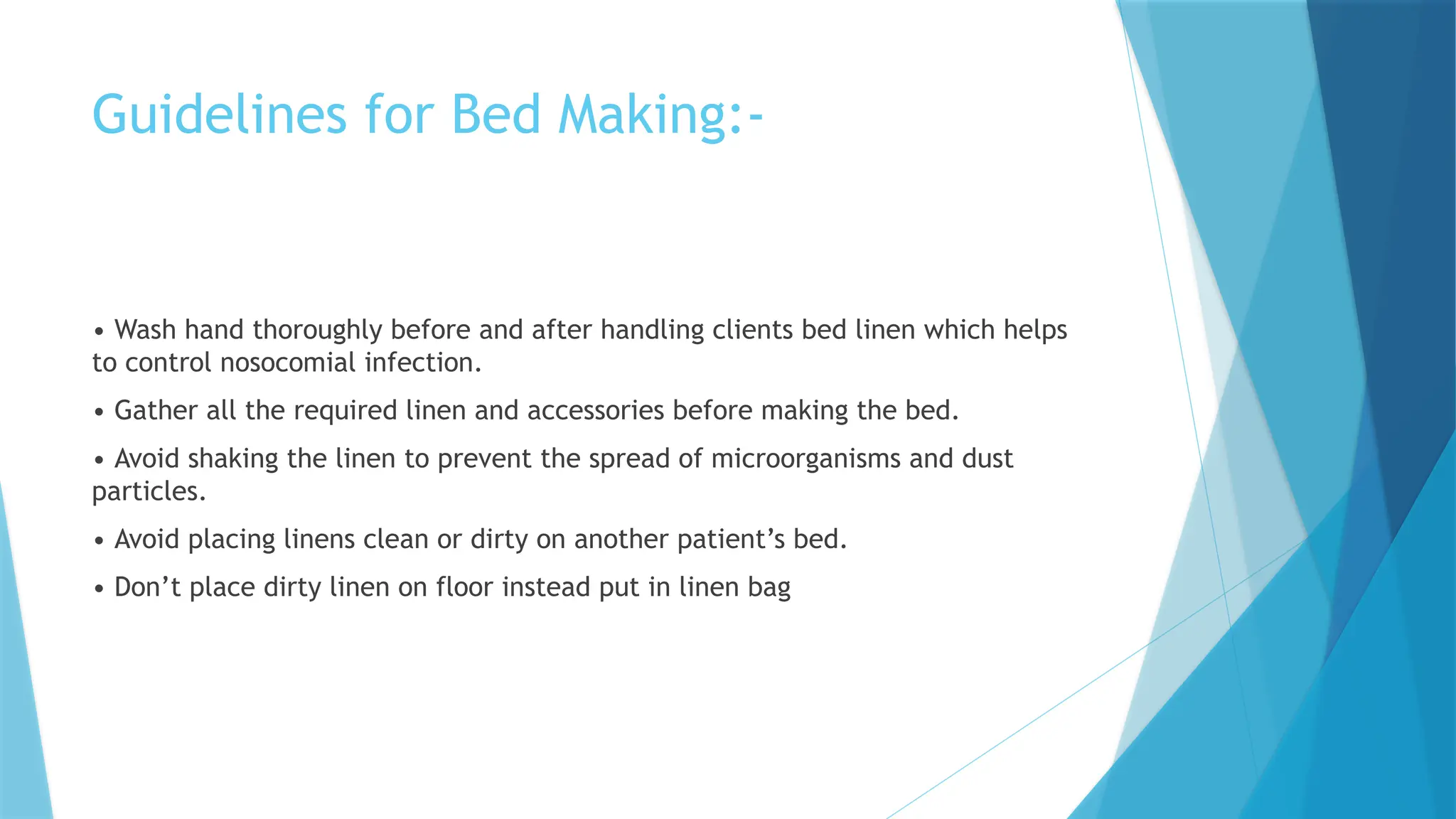
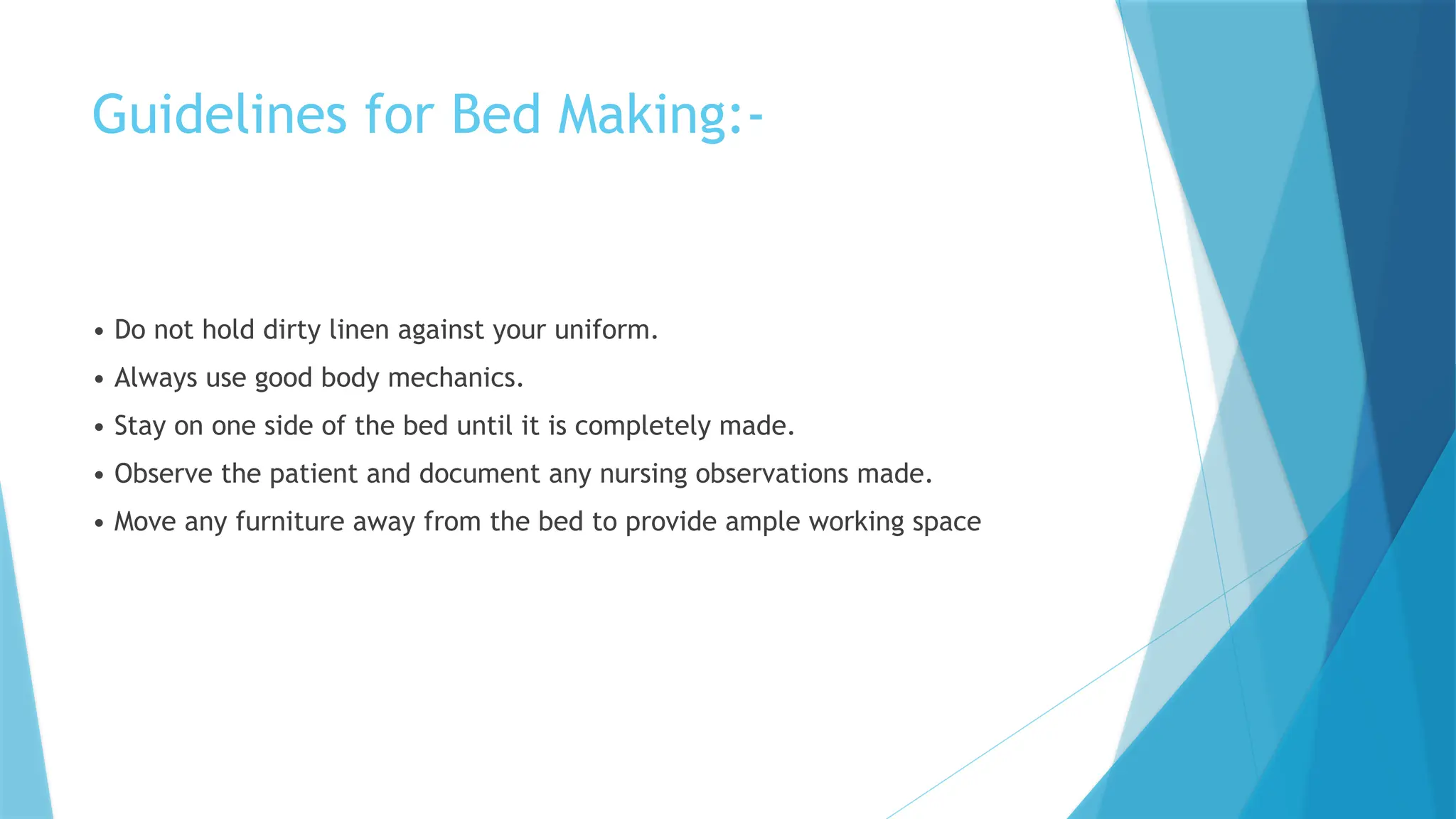
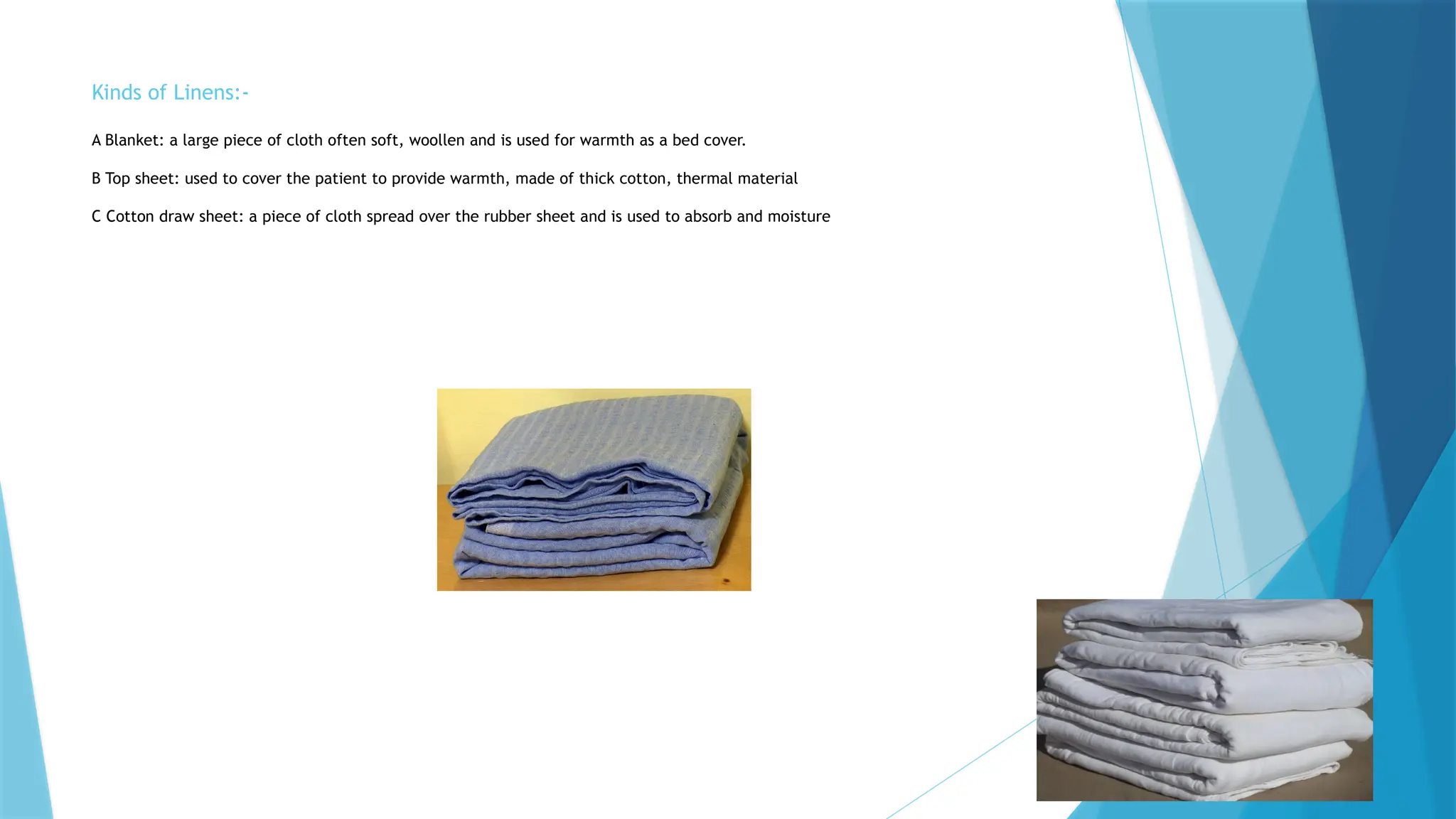
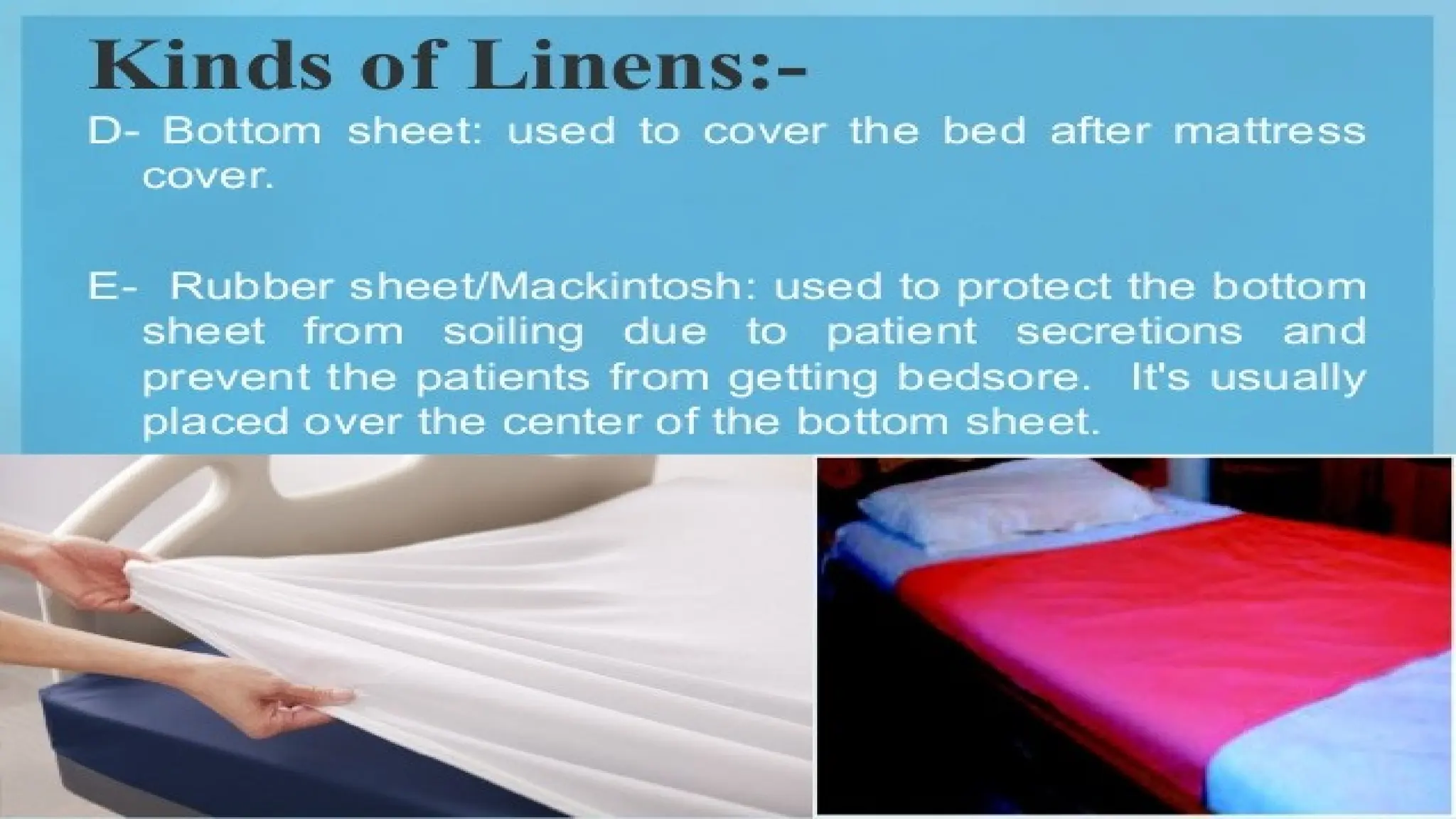
Kinds of Linens:-
A Blanket: a large piece of cloth often soft, woollen and is used for warmth as a bed cover.
B Top sheet: used to cover the patient to provide warmth, made of thick cotton, thermal material
C Cotton draw sheet: a piece of cloth spread over the rubber sheet and is used to absorb and moisture
Types of Bed Making:-
 Common types of bed:
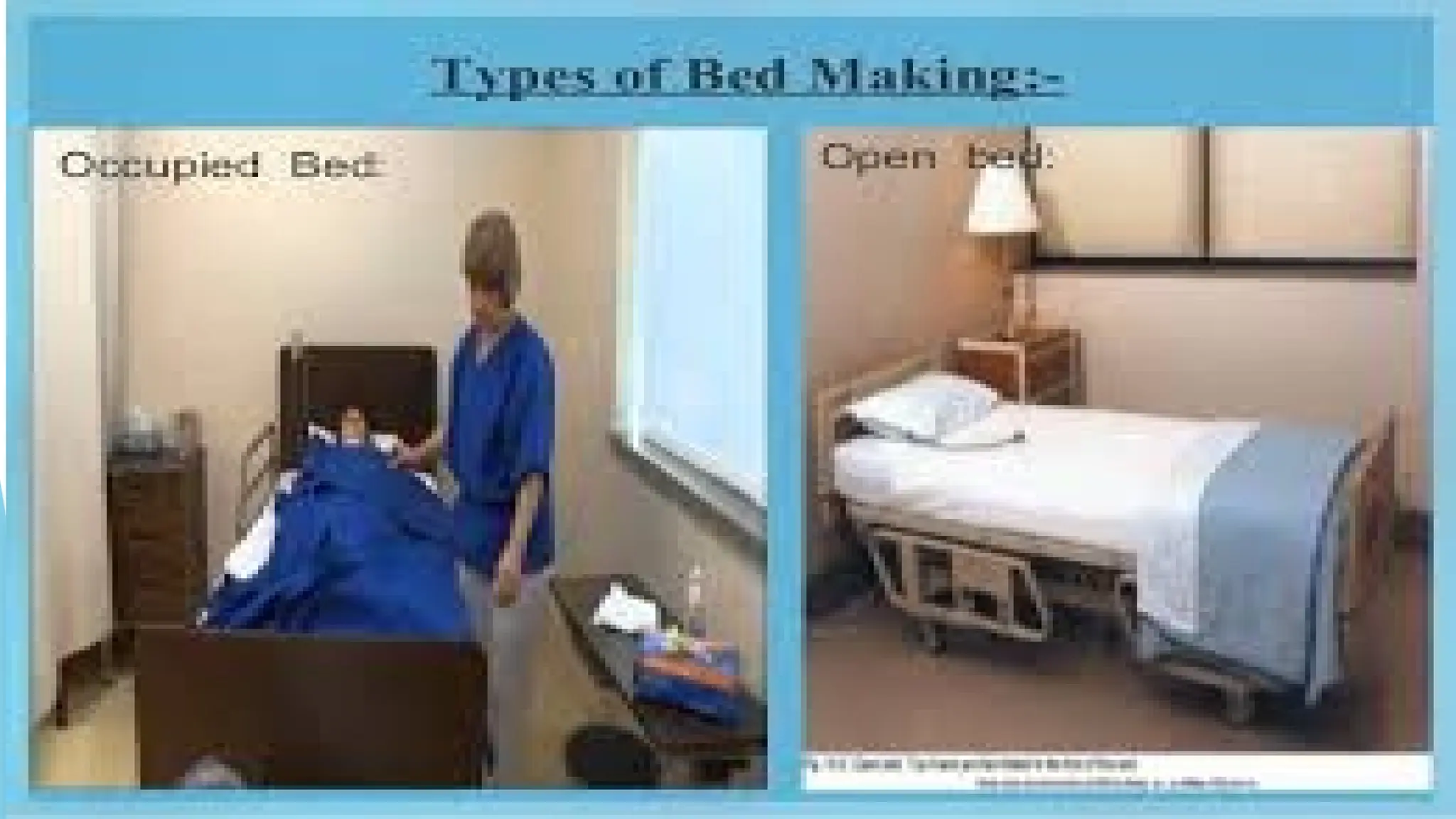
 A- Occupied Bed: Is made when the patient is not able or not permitted to get
out of the bed. Or when patient is already occupied in the bed.
 B- Unoccupied Bed: Is made when there is no patient confined in bed, while a
patient in the shower or sitting up in a chair.
 Types of unoccupied Bed:
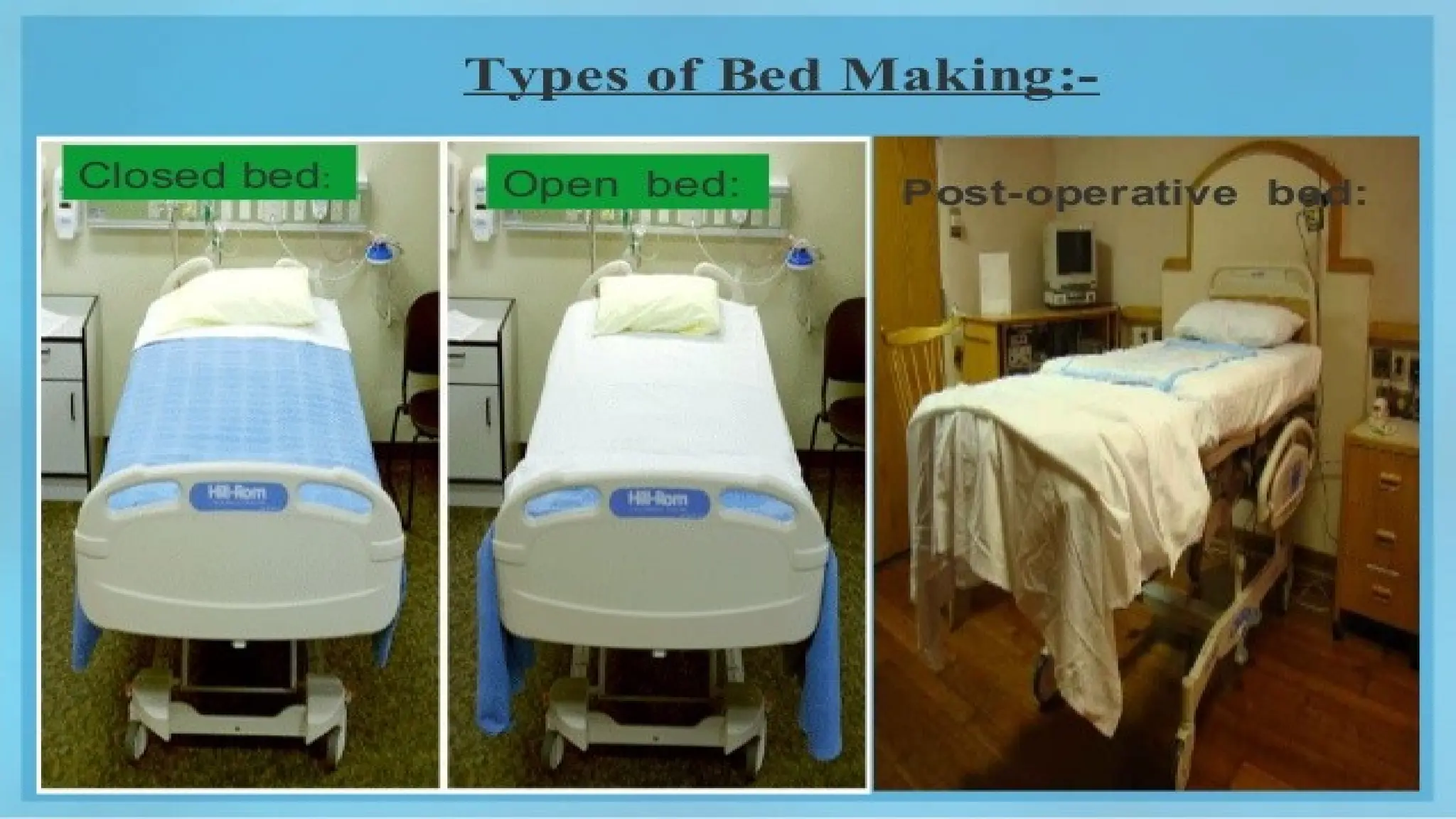
1- Open bed: the top covers are folded back so the patient can easily get back in
to bed. And is prepared for ambulatory patients.
Types of Bed Making:-
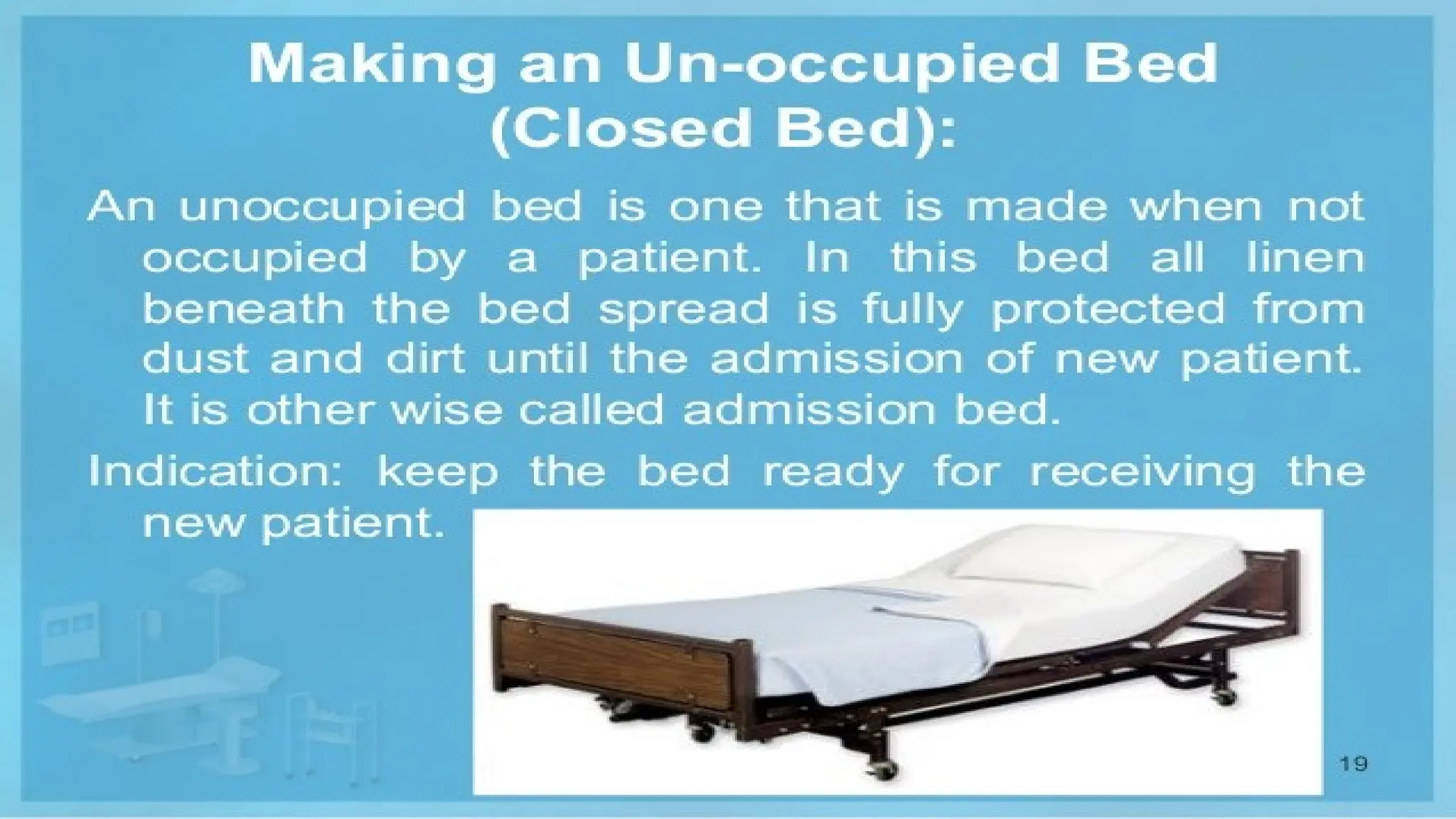
 2- Closed bed: the top sheet blankets and bedspreads are drawn up to the
head of the mattress and under the pillow; this is prepared in a hospital room
before a new client is admitted to the room. So also called admission bed.
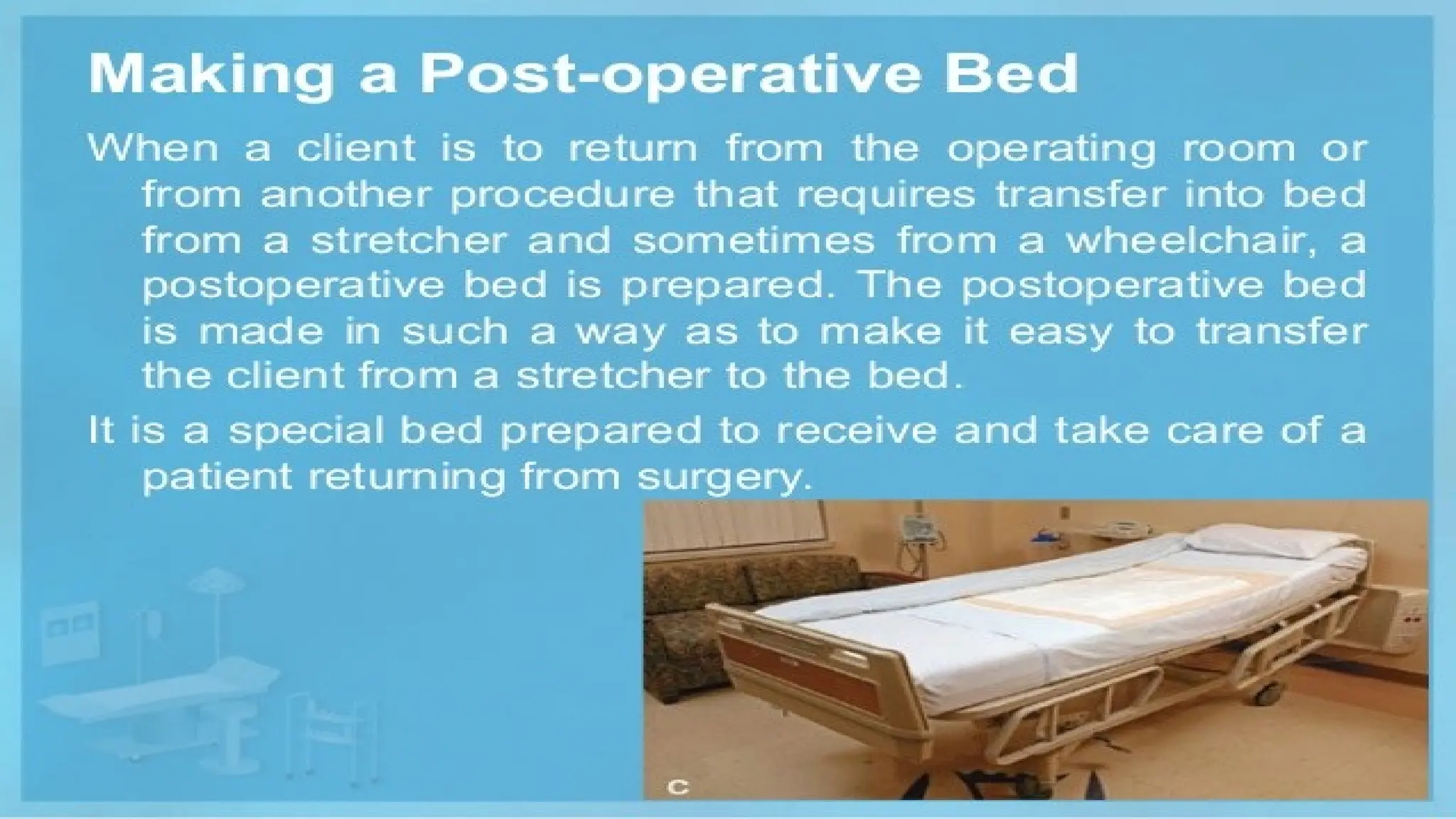
 3- Post-operative bed: known as recovery bed or anaesthetic or surgical bed,
and used for a patient with large cast or other circumstance that would make
it difficult for him to transfer and make it easy to receive patient into bed
from OT.
 4- Amputation or Divided bed: This is a bed that is prepared for a patient
having amputed limb.
Types of Bed Making:-
 5- Fracture bed: This is a hard firm bed designed for the patient with
fracture particularly of spine, pelvis or femur.
 6- Cardiac bed: this is prepared for patient with breathing difficult
and make use of cardiac table to relieve their dyspnoea.
 7 – therapeutic bed: are used to treat clients with severe joint
contractures, prolonged immobility or skin wounds such as pressure
ulcers or severe burns. These beds reduce or relive the effects of
pressure against the skin through various mechanisms. Few examples
are blanket bed or rheumatic/renal bed, burn bed etc.
Making Closed Bed:
Suggested Action :
Assessment
Check the room/ward for the need of
disinfection or hygienic level
Planning:
Prepare all required equipments:
 Trolley with –
 1.Mattress (1)
 2.Bed sheets(2):
Bottom sheet (1)
Top sheet (1)
 3. Pillow (1)
Rationale
To determine what all type of disinfection
activities are required
 Save time and make procedure more
organized
Making Closed Bed:
Suggested Action
4. Pillow cover (1)
5. Mackintosh (1)
6. Draw sheet (1)
7. Blanket (1)
8. A Tray containing:
Savlon water or Dettol water in basin
Sponge cloth (2): to wipe with
solution (1) to dry (1)
Kidney tray or paper bag (1)
9. Laundry bag or Bucket or hamper bag
Rationale
Making Closed Bed:
Suggested Action
Implementation
Perform hand hygiene.
Prepare all required equipments and
bring the articles to the bedside.
Move the chair and bed side locker
Clean Bed-side locker: Wipe with wet
and dry.
Rationale
To prevent the spread of infection
Organization facilitates accurate skill
performance
It makes space for bed making and
helps effective action.
To maintain the cleanliness
Making Closed Bed:
Suggested Action
Implementation
Clean the mattress:
1)Stand in right side.
2)Start wet wiping from top to center and from
center to bottom in right side of mattress.
3)Gather the dust and debris to the bottom.
4)Collect them into kidney tray.
5)Give dry wiping as same as procedure
6)Move to left side and Wipe with wet and dry as
same as above.
Rationale
To prevent the spread of infection
Making Closed Bed:
Suggested Action :
Implementation
Move to right side.
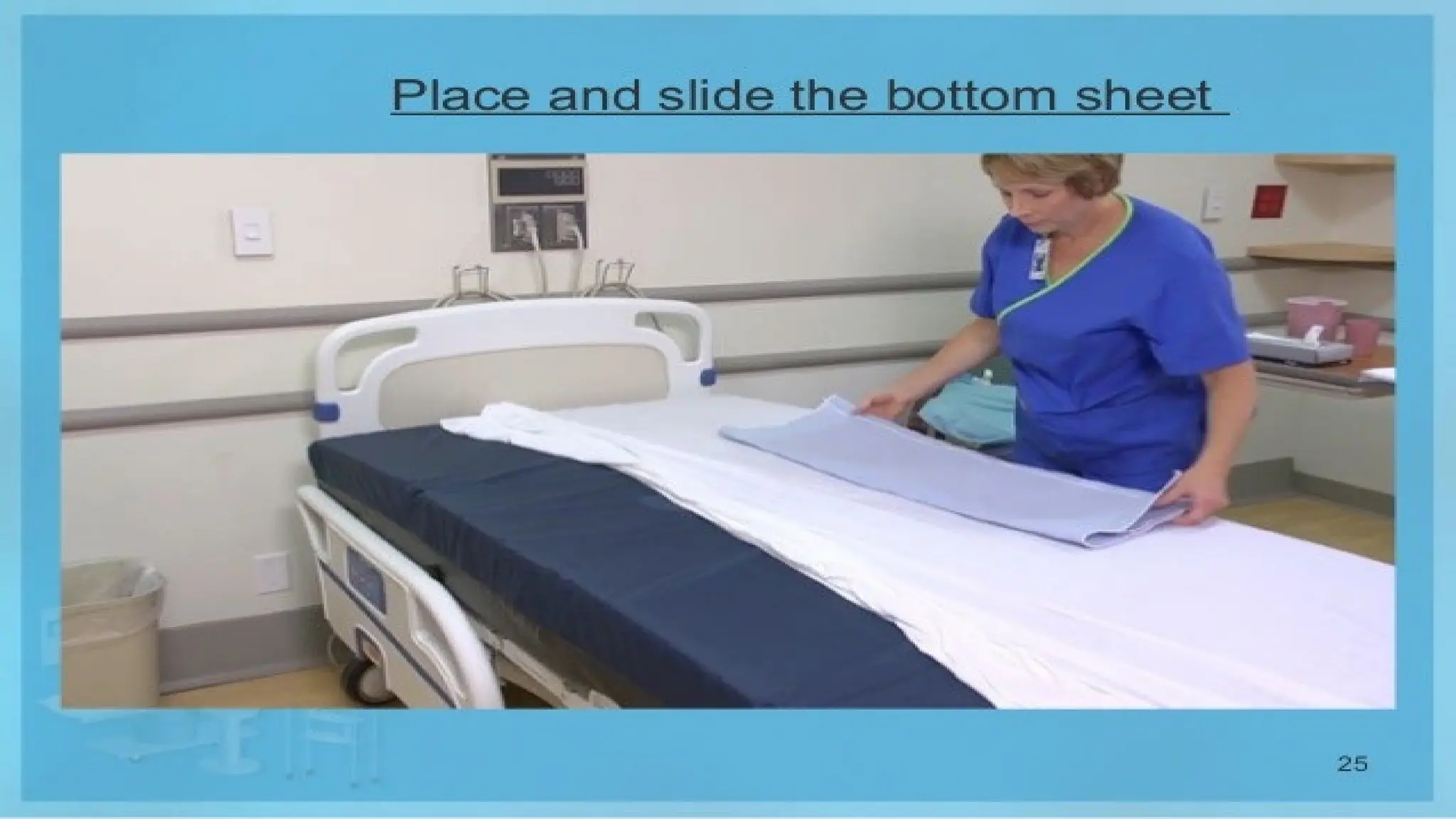
 Bottom sheet:
1)Place and slide the bottom sheet
upward over the top of the bed leaving
the bottom edge of the sheet.
2)Open it lengthwise with the center
fold along the bed center.
3)Fold back the upper layer of the sheet
toward the opposite side of the bed.
Rationale
Unfolding the sheet in this manner
allows you to make the bed on one
side.
Making Closed Bed:
Suggested Action
Implementation:
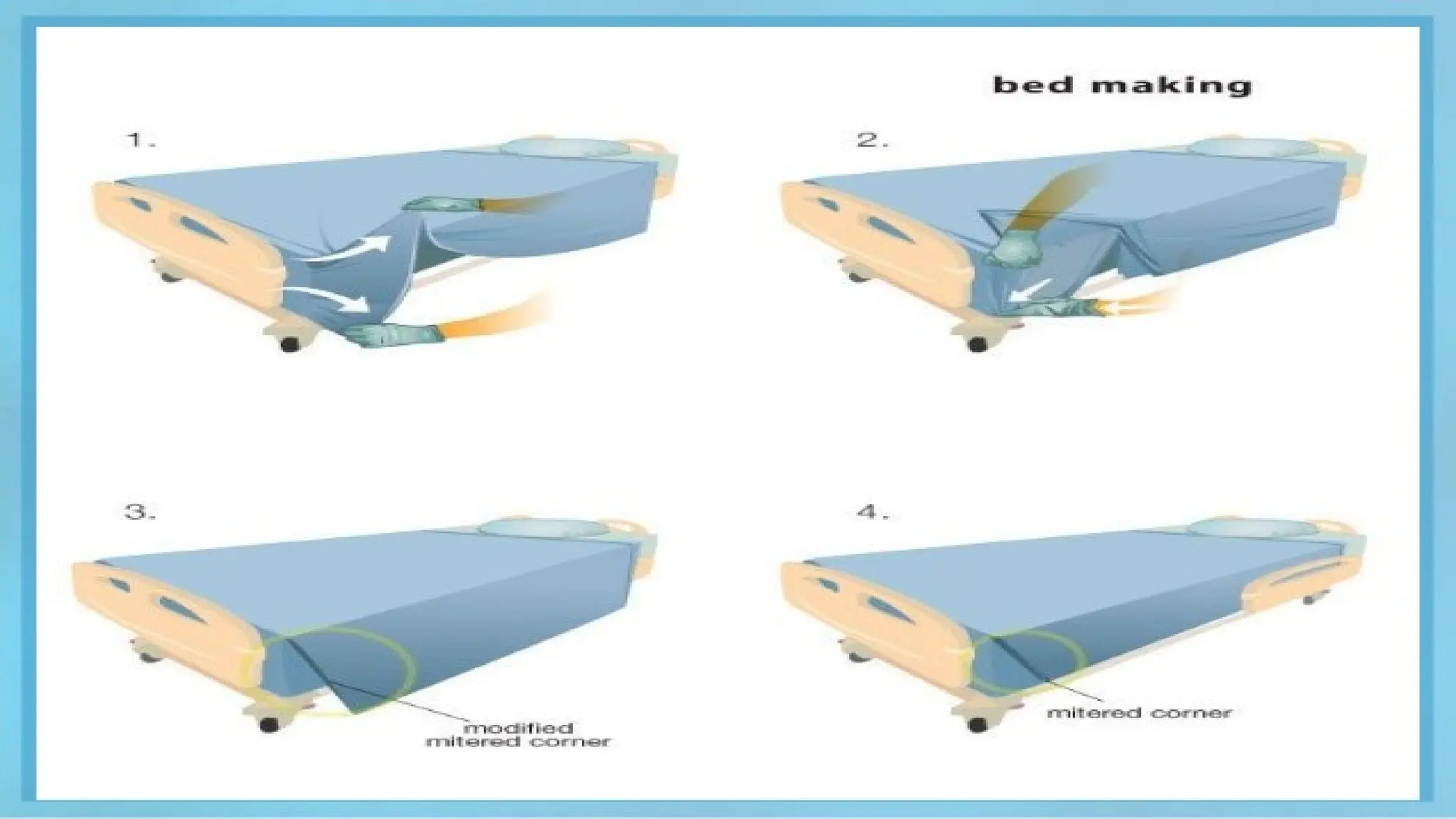
4. Tuck the bottom sheet securely under the head
of the mattress(approximately 20-30cm).
Make a mitered corner.
➀Pick up the selvage edge with your hand nearest
the hand of the bed.
➁Lay a triangle over the side of the bed
➂Tuck the hanging part of the sheet under the
mattress.
Rationale
A mitered corner has a
neat appearance and
keeps the sheet securely
under the mattress.
Making Closed Bed
Suggested Action
Implementation:
 ➃ Drop the triangle over the side
of the bed.
 ⑤Tuck the sheet under the entire
side of bed.
5) Repeat the same procedure at the
end of the corner of the bed
6) Tuck the remainder in long the side
Rationale
Tucking the bottom sheet will be
done by turn, the corner of top firstly
and the corner of the bottom later.
To secure the bottom sheet on one
side of the bed.
Making Closed Bed:
Suggested Action
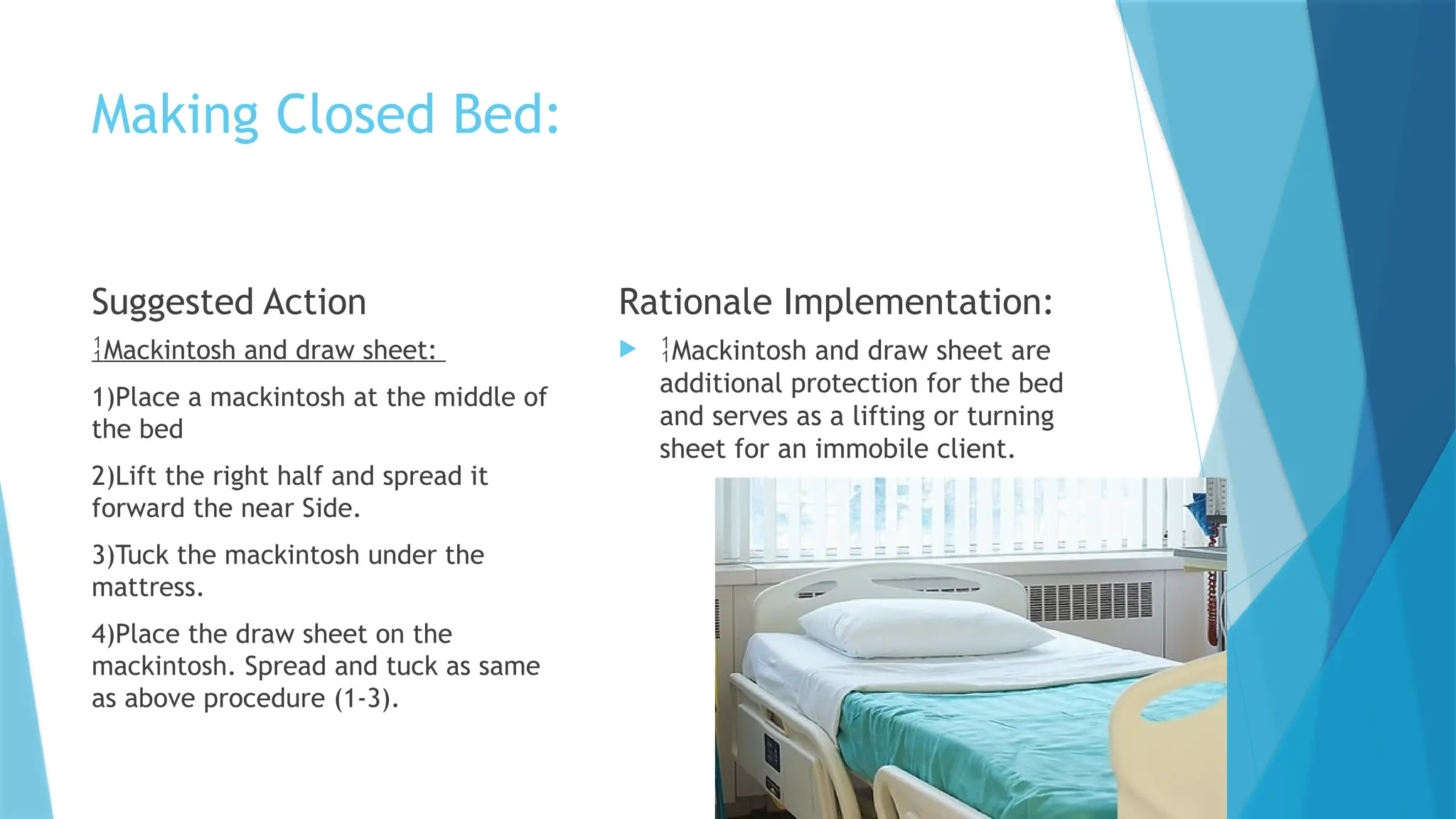
Mackintosh and draw sheet:
1)Place a mackintosh at the middle of
the bed
2)Lift the right half and spread it
forward the near Side.
3)Tuck the mackintosh under the
mattress.
4)Place the draw sheet on the
mackintosh. Spread and tuck as same
as above procedure (1-3).
Rationale Implementation:
 Mackintosh and draw sheet are
additional protection for the bed
and serves as a lifting or turning
sheet for an immobile client.
Making Closed Bed:
Suggested Action
Move to the left side of the bed.
Spreading Bottom sheet, mackintosh
and draw sheet:
1) Fold and tuck the bottom sheet as
same in the above procedure
2) Fold and tuck both the mackintosh
and the draw sheet under the
mattress as in the above procedure.
Rationale Implementation:
Secure the bottom sheet, mackintosh
and draw sheet on one side of the bed
Making Closed Bed:
Suggested Action
Implementation:
 Return to the right side.
Top sheet and blanket:
1)Place the top sheet evenly on the bed, centering it in the
below 20-30cm from the top of the mattress.
2)Spread it downward.
3)Cover the top sheet with blanket in the below 1 feet from the
top of the mattress and spread downward.
4)Fold the cuff (approximately 1 feet) in the neck part
5)Tuck all these together under the bottom of mattress. Miter
the corner.
6)Tuck the remainder in along the side
Rationale
A blanket provides warmth.
Making the cuff at the neck part
prevents irritation from blanket edge.
Tucking all these pieces together saves
time and provides a neat appearance.
Making Closed Bed:
Suggested Action
Implementation:
Repeat the same as in the above
procedure in left side.
Return to the right side.
Pillow and pillow cover:
1)Put a clean pillow cover on the pillow.
2) Place a pillow at the top of the bed
in the center with the open end away
from the door.
Rationale
To save time in this manner
A pillow is a comfortable measure.
Pillow cover keeps cleanliness of the
pillow and neat.
The open end may collect dust or
organisms. The open end away from
the door also makes neat.
Making Closed Bed:
Suggested Action
Return the bed, the chair and bed-side
table to their proper place.
Replace all equipments in proper place.
Discard lines appropriately.
Perform hand hygiene.
Document:
Document on the chart with your signature
and report any findings to senior staff.
Date & time
Type of bed
Assessment findings observed during
procedure.
Rationale
 Bedside necessities will be within
easy reach for the client
§ It makes well-setting for the next.
Proper line disposal prevents the
spread of infection.
§ To prevent the spread of infection
§ Documentation provides
coordination of care.
 Giving signature maintains
professional accountability
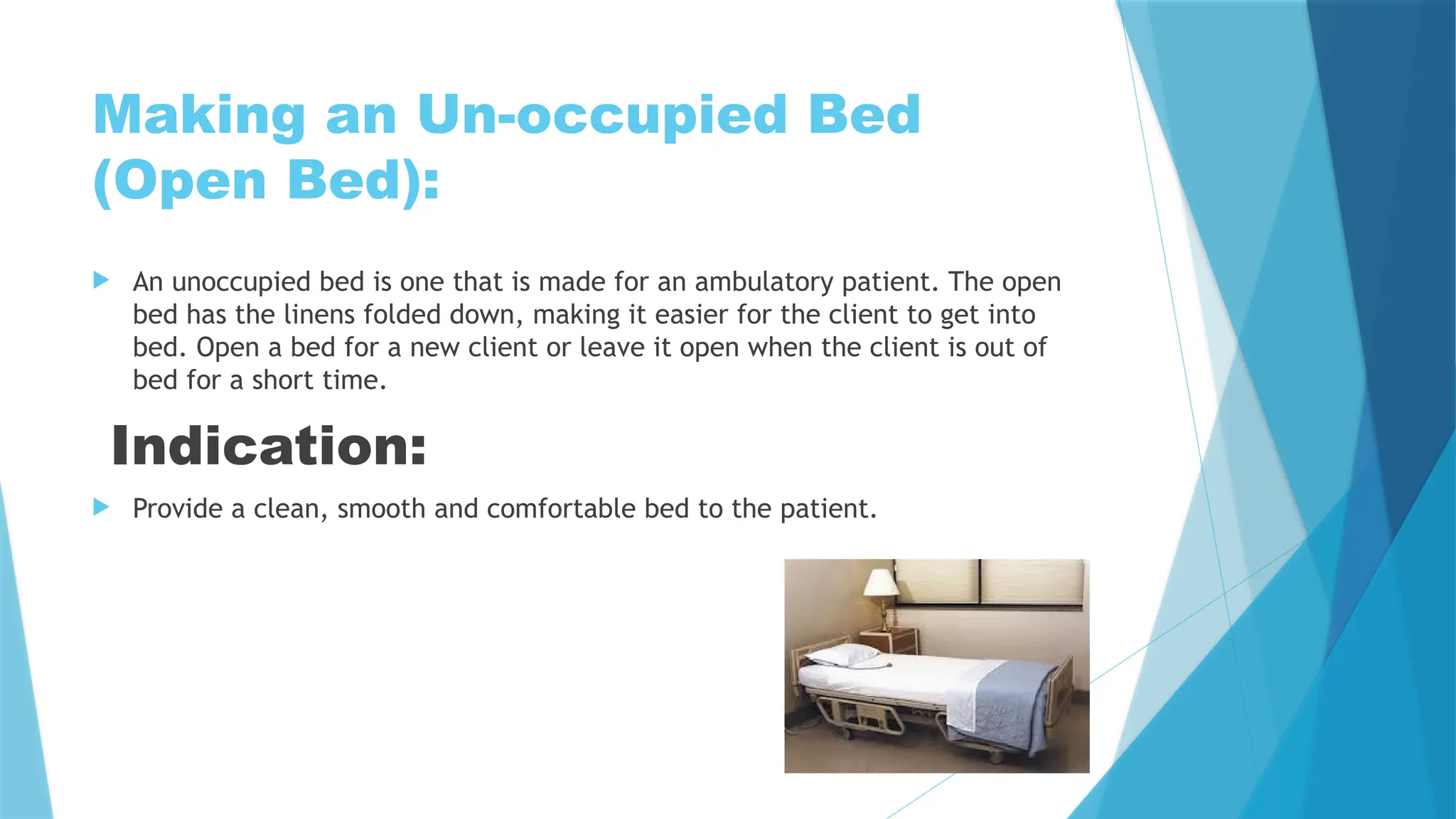
Making an Un-occupied Bed
(Open Bed):
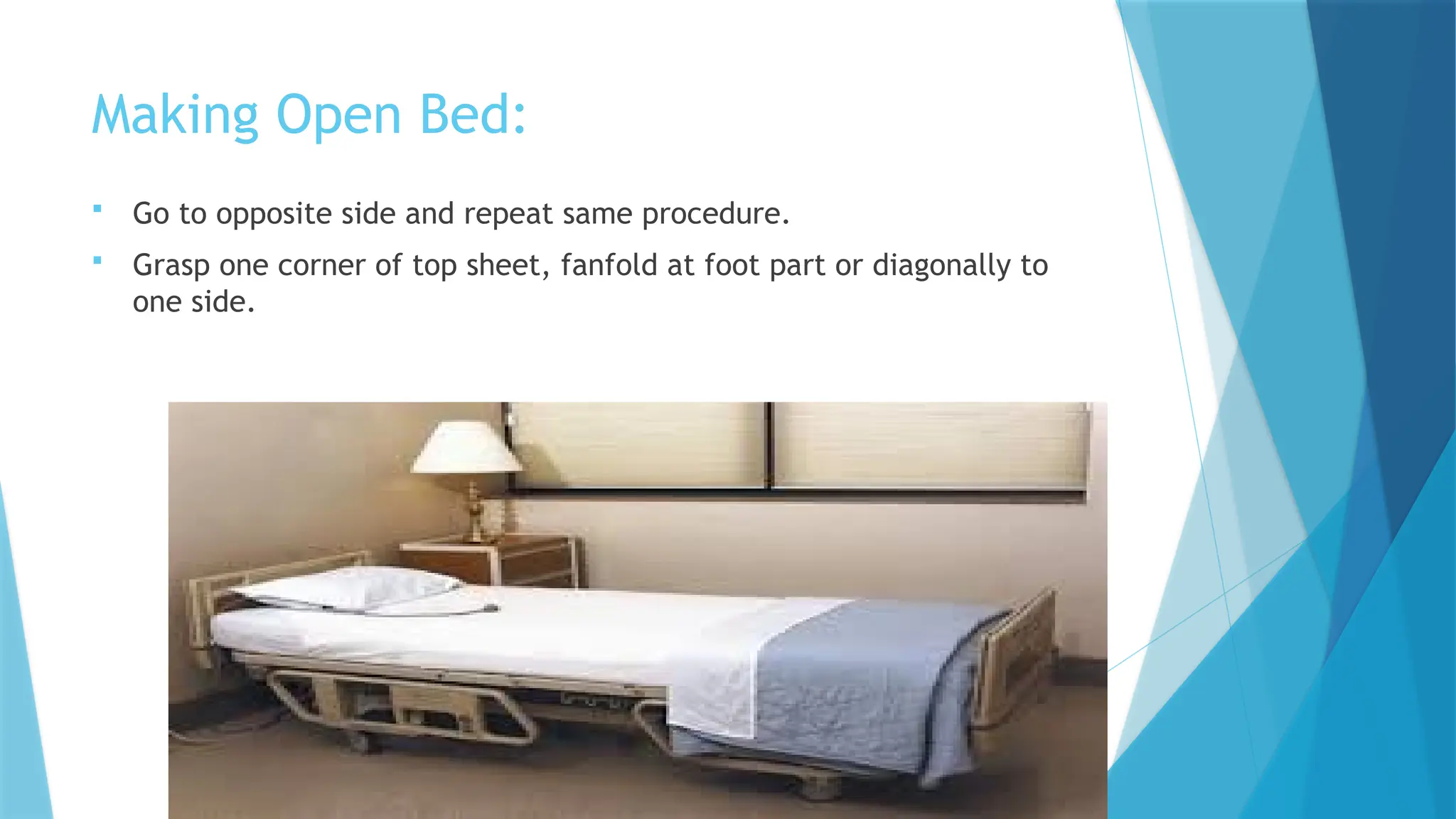
 An unoccupied bed is one that is made for an ambulatory patient. The open
bed has the linens folded down, making it easier for the client to get into
bed. Open a bed for a new client or leave it open when the client is out of
bed for a short time.
Indication:
 Provide a clean, smooth and comfortable bed to the patient.
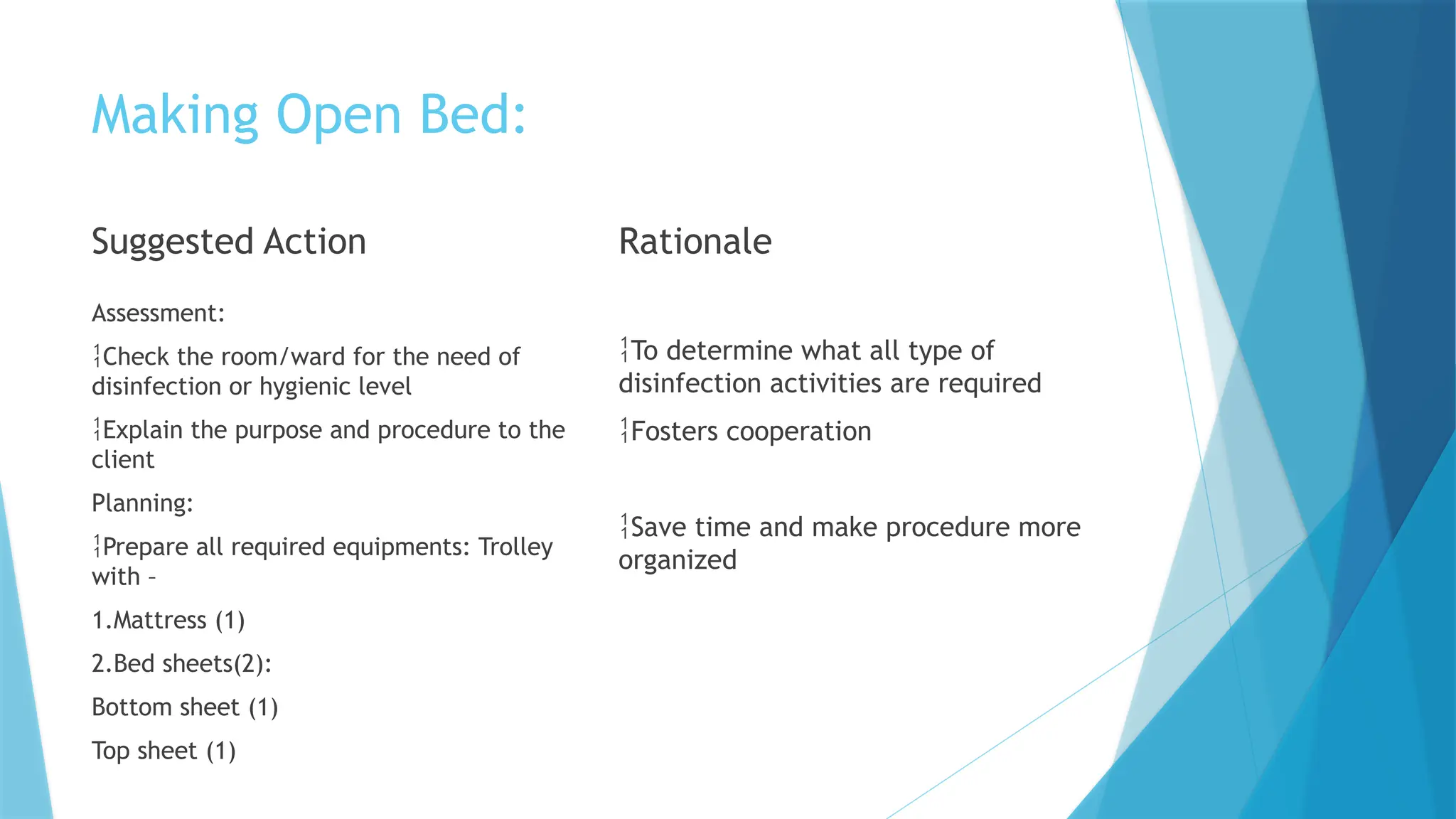
Making Open Bed:
Suggested Action
Assessment:
Check the room/ward for the need of
disinfection or hygienic level
Explain the purpose and procedure to the
client
Planning:
Prepare all required equipments: Trolley
with –
1.Mattress (1)
2.Bed sheets(2):
Bottom sheet (1)
Top sheet (1)
Rationale
To determine what all type of
disinfection activities are required
Fosters cooperation
Save time and make procedure more
organized
Making Open Bed:
Suggested Action
3. Pillow (1)
4. Pillow cover (1)
5. Mackintosh (1)
6. Draw sheet (1)
7. Blanket (1)
8. A Tray containing: Savlon water or
Dettol water in basin Sponge cloth (2):
to wipe with solution (1) to dry (1)
Kidney tray or paper bag (1)
9. Laundry bag or Bucket or hamper bag
(1)
Rationale
Making Open Bed:
Suggested Action
Perform hand hygiene.
Prepare all required equipments and
bring the articles to the bedside.
Assist the patient out of bed
Remove the client’s personal belongings
from bed side and keep in locker/safe
place
Move the chair and bed side locker
Strip the bed clothes, fold them one by
one and place them.
Rationale Implementation:
To prevent the spread of
infection
Organization facilitates accurate
skill performance
To prevent the loss/damage
It makes space for bed making
and helps effective action.
To prevent bed clothes touching
the floor
Stripping the Bed:
Removal of used linen and the airing of the mattress.
Procedure:
1- Place chair at the foot of the bed.
2- Locked the bed.
3- Remove pillow case from pillow. Place pillow on chair.
4- Loosen all bed linens starting at center of head of bed, raising the mattress with one hand
and draw out bed clothes with other.
5- Remove sheet separately. Fold each linen with soiled part inside. Wrap them all in a sheet
and place on lower bar of the bed.
6- Roll rubber sheet and place on chair.
7- Remove mattress cover.
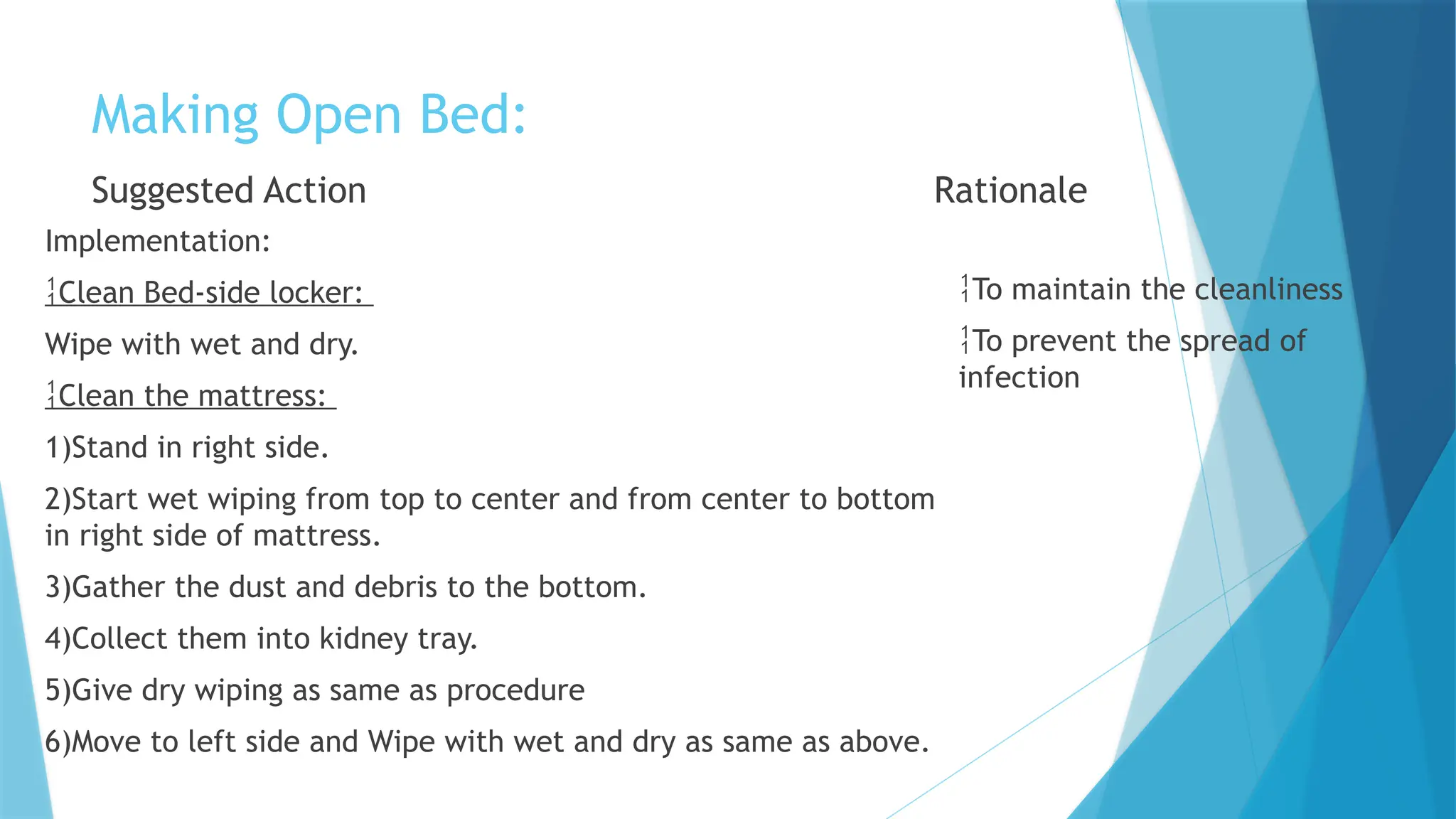
Making Open Bed:
Suggested Action
Implementation:
Clean Bed-side locker:
Wipe with wet and dry.
Clean the mattress:
1)Stand in right side.
2)Start wet wiping from top to center and from center to bottom
in right side of mattress.
3)Gather the dust and debris to the bottom.
4)Collect them into kidney tray.
5)Give dry wiping as same as procedure
6)Move to left side and Wipe with wet and dry as same as above.
Rationale
To maintain the cleanliness
To prevent the spread of
infection
Making Open Bed:
 Place clean linens on chair in order of use.
 Cover mattress.
 Place bottom sheet with center fold in center in line with rim of
matters at foot part, spread across bed. Make mitered corner of head
part, tuck extra sheet at side from head of food.
 Put rubber sheet 12-15 inches from the head of mattress. Cover with
draw sheet. Spread a cross bed. Tuck together extra length.
 Place top sheet in line with mattress at head part and spread a cross
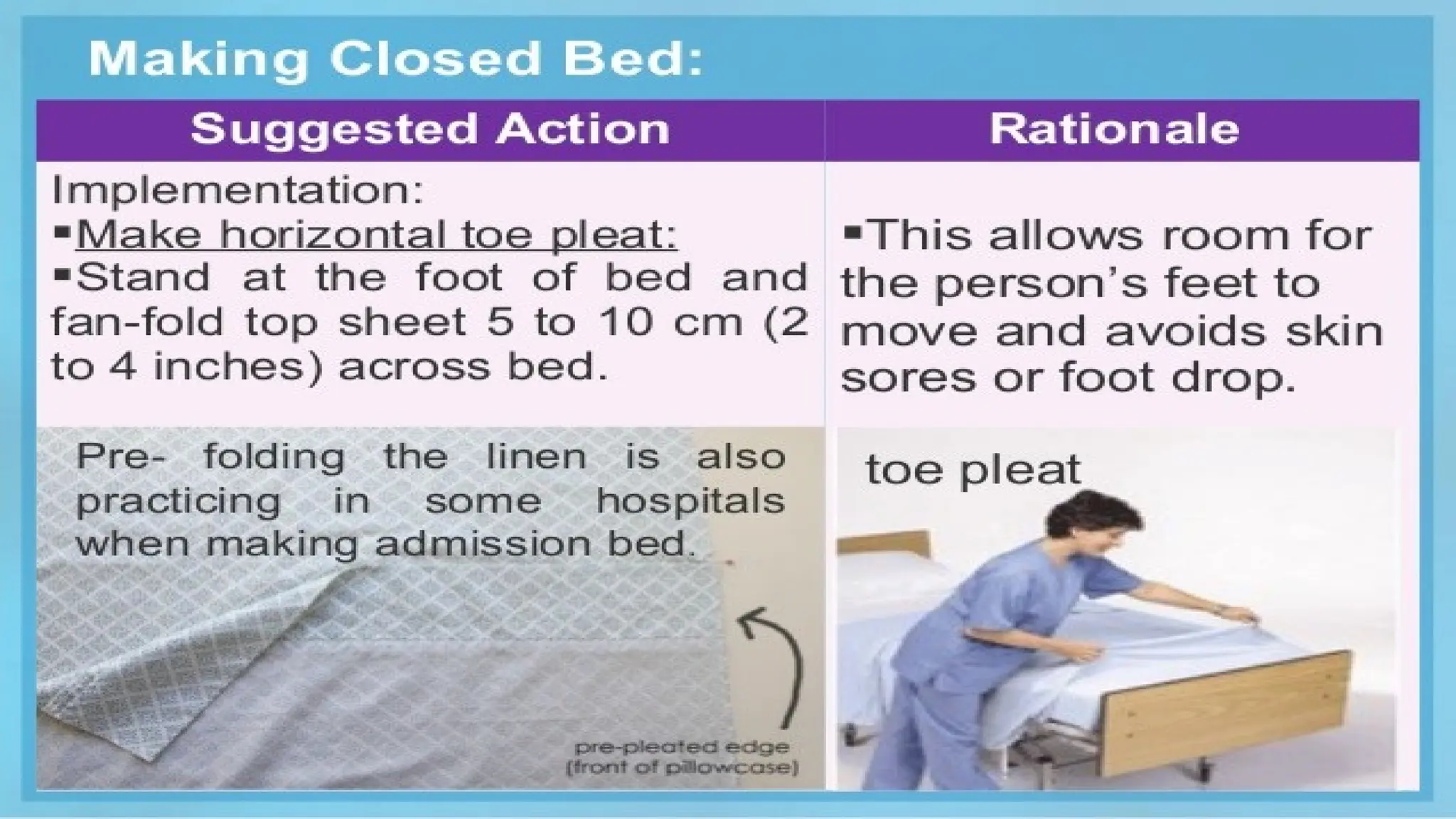
bed. Similarly spread the blanket. Form a toe pleat as in the
procedure of closed bed. Tuck extra length of sheet at foot part,
mitered corner; allow hanging free at sides.
Making Open Bed:
 Go to opposite side and repeat same procedure.
 Grasp one corner of top sheet, fanfold at foot part or diagonally to
one side.
Making an Occupied Bed:
Some clients are unable to get out of bed as a result of their specific
condition or generalized weakness. Changing bed linens with the client
in the bed is known as making an occupied bed. Work quickly and disturb
the client as little as possible.
 Indications: Provide clean and comfortable bed with least
disturbance to the patient in it.
Making Occupied Bed:
Suggested Action
Assessment:
Check the room/ward for the need of disinfection or
hygienic level
Explain the purpose and procedure to the client
To determine what all type of disinfection activities
are required Planning:
Prepare all required equipments:
Trolley with –
1.Mattress (1)
2.Bed sheets(2):
Bottom sheet (1)
Top sheet (1)
Rationale
Fosters cooperation
Save time and make procedure
more organized
Making Occupied Bed:
Suggested Action
3. Pillow (1)
4. Pillow cover (1)
5. Mackintosh (1)
6. Draw sheet (1)
7. Blanket (1)
8. A Tray containing:
Savlon water or Dettol water in basin
Sponge cloth (2): to wipe with solution (1)
to dry (1)
Kidney tray or paper bag (1)
9. Laundry bag or Bucket or hamper bag (1)
Rationale
Making Occupied Bed:
Suggested Action
Implementation:
Perform hand hygiene.
Prepare all required equipments and bring
the articles to the bedside.
Close the curtain/door
Remove the client’s personal belongings
from bed side and keep in locker/safe place
Move the chair and bed side locker
Lift the client’s head and move pillow
from center to the left side.
Rationale
To prevent the spread of infection
Organization facilitates accurate skill
performance
To maintain privacy
To prevent the loss/damage
It makes space for bed making and helps
effective action.
The pillow is comfortable measure for
the client.
Making Occupied Bed:
Suggested Action
Implementation
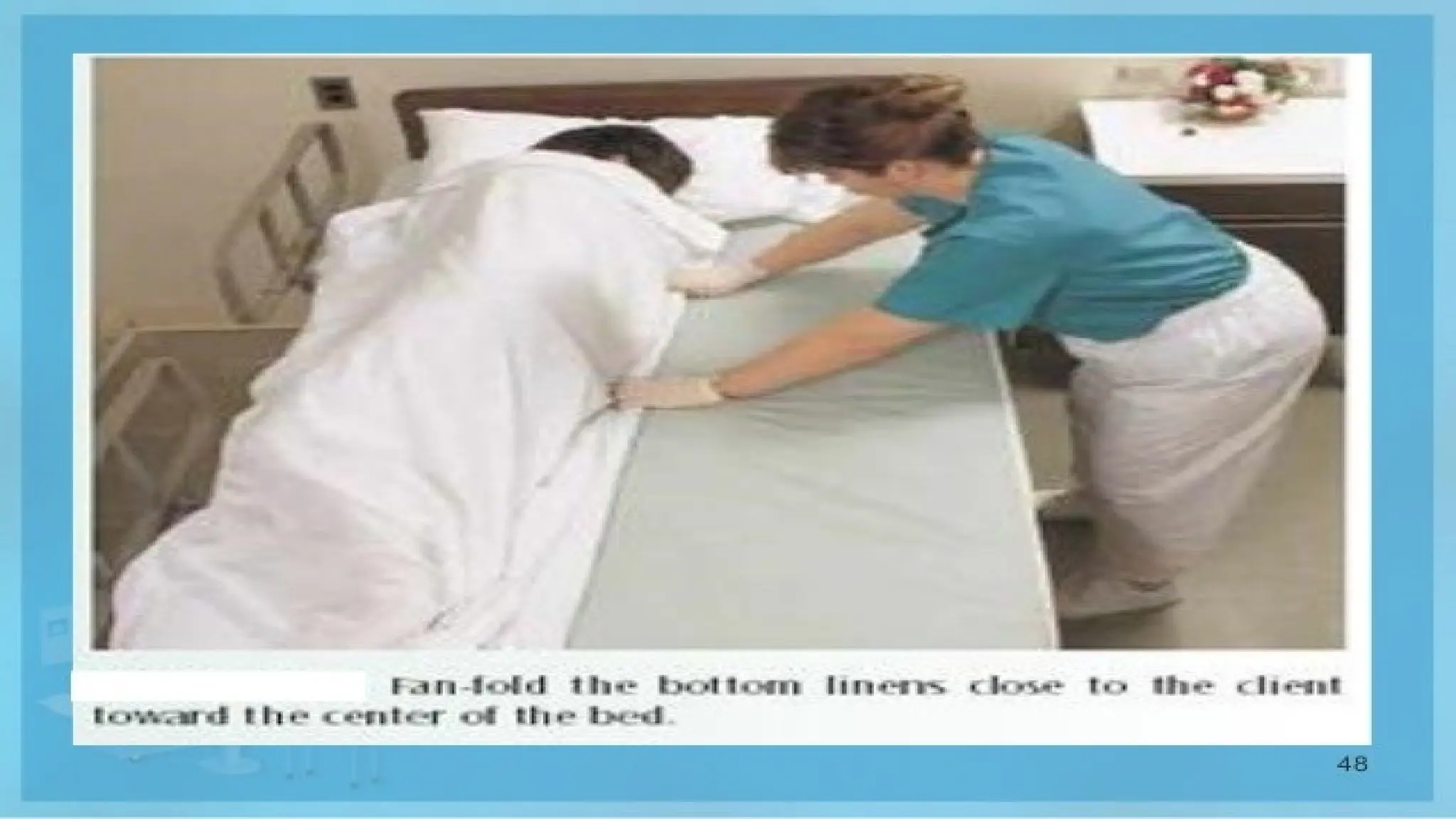
Assist the client to turn toward left
side of the bed. Adjust the pillow.
Leaves top sheet in place.
Stand in right side: Loose bottom
bed linens. Fanfold (or roll) soiled
linens from the side of the bed and
wedge them close to the client.
Wipe the surface of mattress by
sponge cloth with wet and dry.
Rationale
Moving the client as close to the
other side of the bed as possible gives
you more room to make the bed. Top
sheet keeps the client warm and
protect his or her privacy.
Placing folded (or rolled) soiled linen
close to the client allows more space
to place the clean bottom sheets.
To prevent the spread of infection.
Making Occupied Bed:
Suggested Action
Implementation:
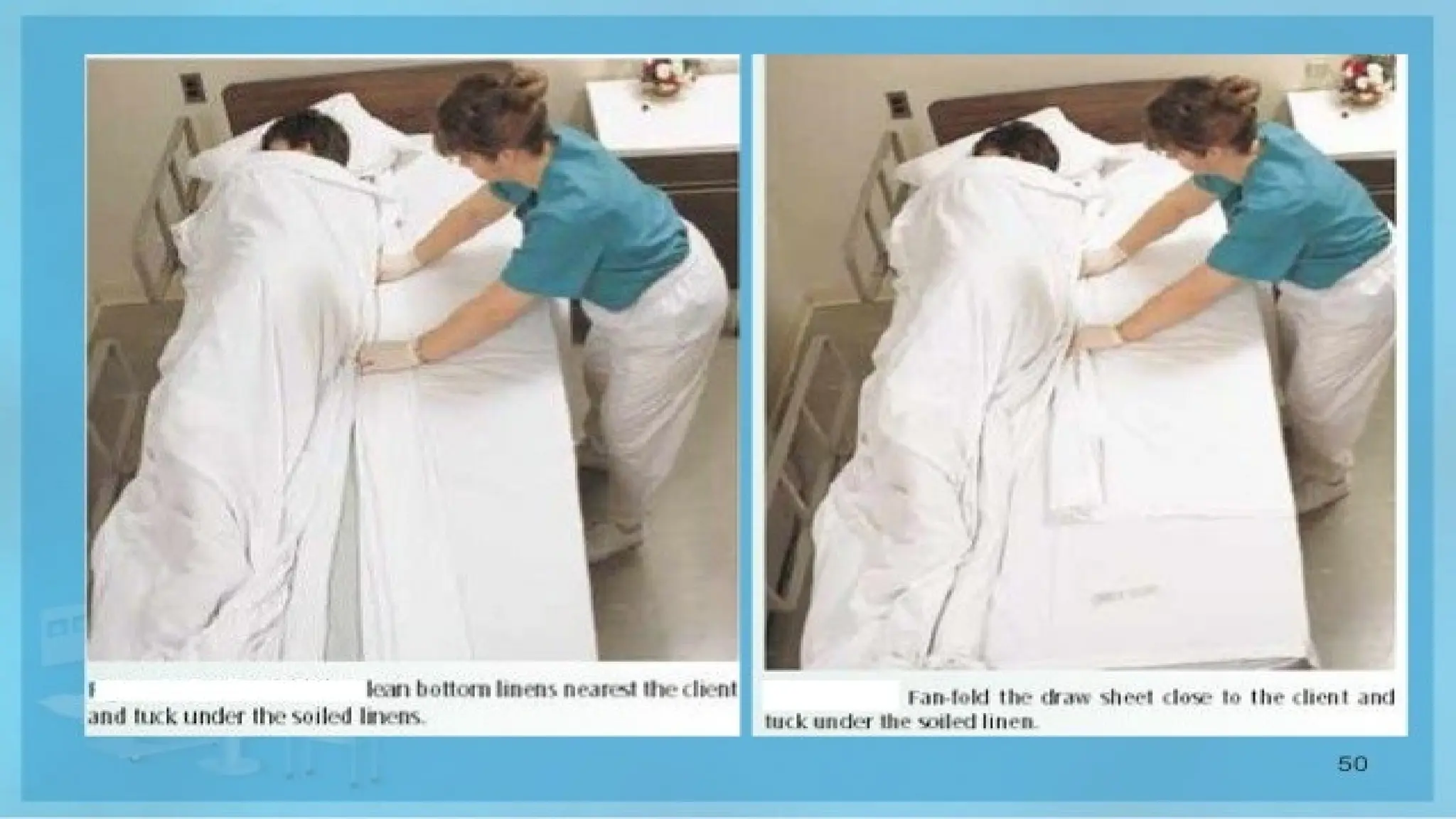
Bottom sheet, mackintosh and draw sheet:
1)Place the clean bottom sheet evenly on the bed folded lengthwise with
the center fold as close to the client’s back as possible.
2)Adjust and tuck the sheet tightly under the head of the mattress,
making mitered the upper corner.
3)Tighten the sheet under the end of the mattress and make mitered the
lower corner.
4)Tuck in along side.
5)Place the mackintosh and the draw sheet on the bottom sheet and tuck
in them together.
Rationale
Soiled linens can
easily be removed
and clean linens are
positioned to make
the other side of the
bed.
Making Occupied Bed:
Suggested Action
Implementation:
Assist the client to roll over the folded (rolled)
linen to right side of the bed. Readjust the pillow
and top sheet.
Move to left side: Discard the soiled linens
appropriately. Hold them away from your uniform.
Place them in the laundry bag (or bucket).
Wipe the surface of the mattress by sponge cloth
with wet and dry.
Rationale
Moving the client to the
bed’s other side allows you
to make the bed on that
side.
Soiled linens can
contaminate your uniform,
which may come into
contact with other clients.
To prevent the spread of
infection.
Making Occupied Bed:
Suggested Action
Implementation:
Bottom sheet, mackintosh and draw sheet:
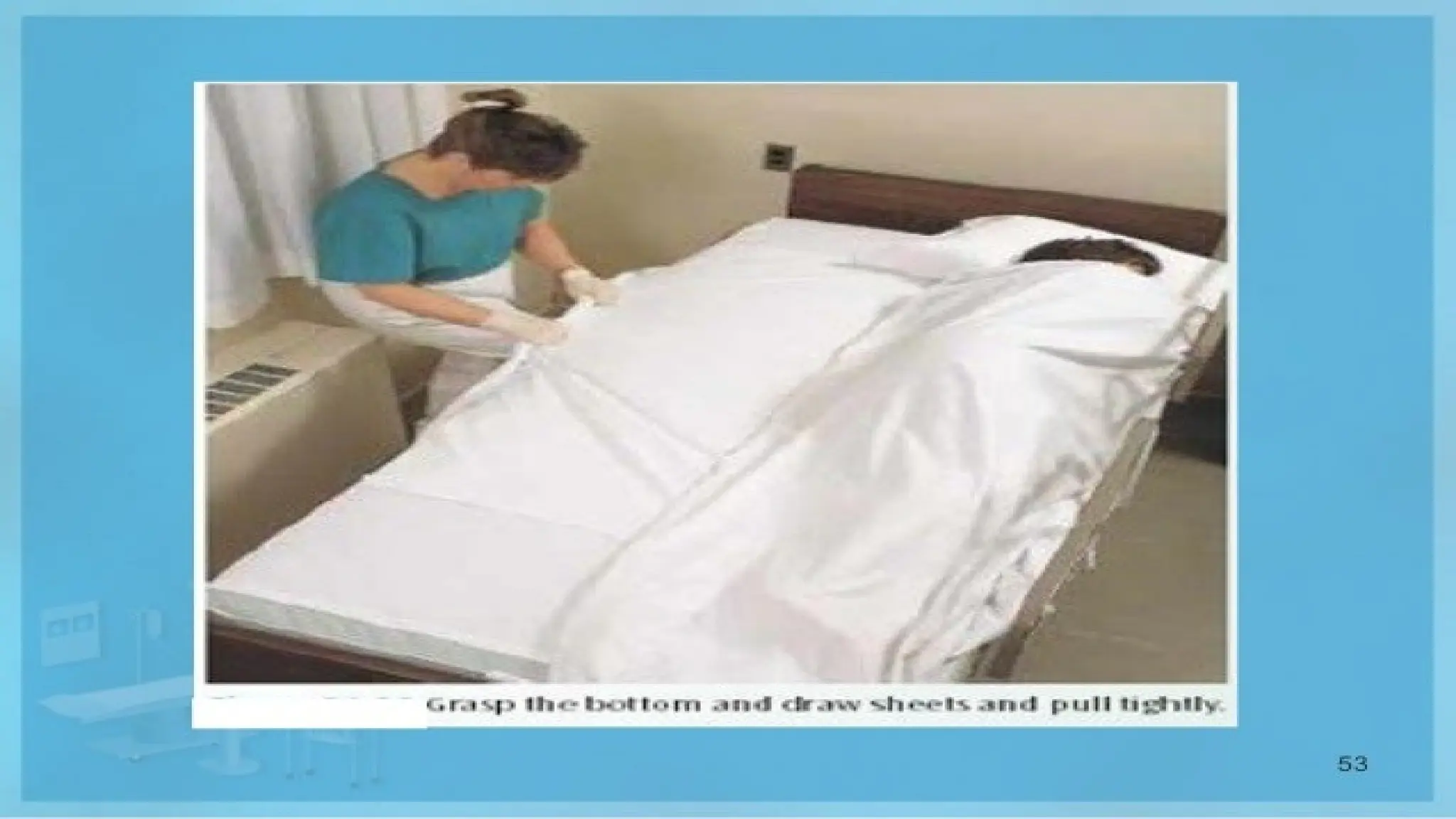
1)Grasp clean linens and gently pull them out from under the client.
2)Spread them over the bed’s unmade side. Pull the linens taut
3)Tuck the bottom sheet tightly under the head of the mattress and
miter the corner.
4)Tighten the sheet under the end of the mattress and make mitered
the lower corner.
5)Tuck in along side.
6)Tuck the mackintosh and the draw sheet under the mattress.
Rationale
Wrinkled linens
can cause skin
irritation.
Making Occupied Bed:
Suggested Action
Implementation:
Assist the client back to the center of the bed. Adjust the
pillow
Return to right side:
Clean top sheet, blanket:
1)Place the clean top sheet at the top side of the soiled
top sheet.
2)Ask the client to hold the upper edge of the clean top
sheet.
3)Hold both the top of the soiled sheet and the end of the
clean sheet with right hand and withdraw to downward.
Remove the soiled top sheet and put it into a laundry bag.
Rationale
The pillow is comfort
measure for the client.
Tucking these pieces
together saves time and
provides neat, tight corners.
Making Occupied Bed:
Suggested Action
Implementation:
3) Place the blanket over the top sheet. Fold top sheet
back over the blanket over the client.
4) Tuck the lower ends securely under the mattress.
Miter corners.
5) After finishing the right side, repeat the left side.
Remove the pillow and replace the pillow cover with
clean one and reposition the pillow to the bed under
the client’s head.
Rationale
The pillow is a
comfortable
measures for a
client
Making Closed Bed:
Suggested Action
Evaluation
 Return the bed, the chair and bed-side table to their proper
place.
 Replace all equipments in proper place. Discard lines
appropriately.
 Perform hand hygiene.
Document:
 Document on the chart with your signature and report any
findings to senior staff.
 Date & time
 Type of bed
 Assessment findings observed during procedure.
Rationale
 Bedside necessities will be within easy
reach for the client
 It makes well-setting for the next.
Proper line disposal prevents the spread
of infection.
 To prevent the spread of infection
 Documentation provides coordination of
care.
 Giving signature maintains professional
accountability
Purpose
• To provide warmth and comfort for the patient.
• To provide protection for the bed from vomiting,
bleeding, drainage and discharge.
• To arrange the bed and other furniture in order to
facilitate the transfer of the patient from stretcher
to bed.
Making Post Operative Bed:
Suggested Action
Assessment:
Check the room/ward for the need of
disinfection or hygienic level
Explain the purpose and procedure to the
client
Planning:
Prepare all required equipments:
The same linen as those used for making on
occupied bed plus the following - Bath towel
Rationale
To determine what all type of
disinfection activities are
required
Fosters cooperation
Save time and make
procedure more organized
Making Post Operative Bed:
Suggested Action
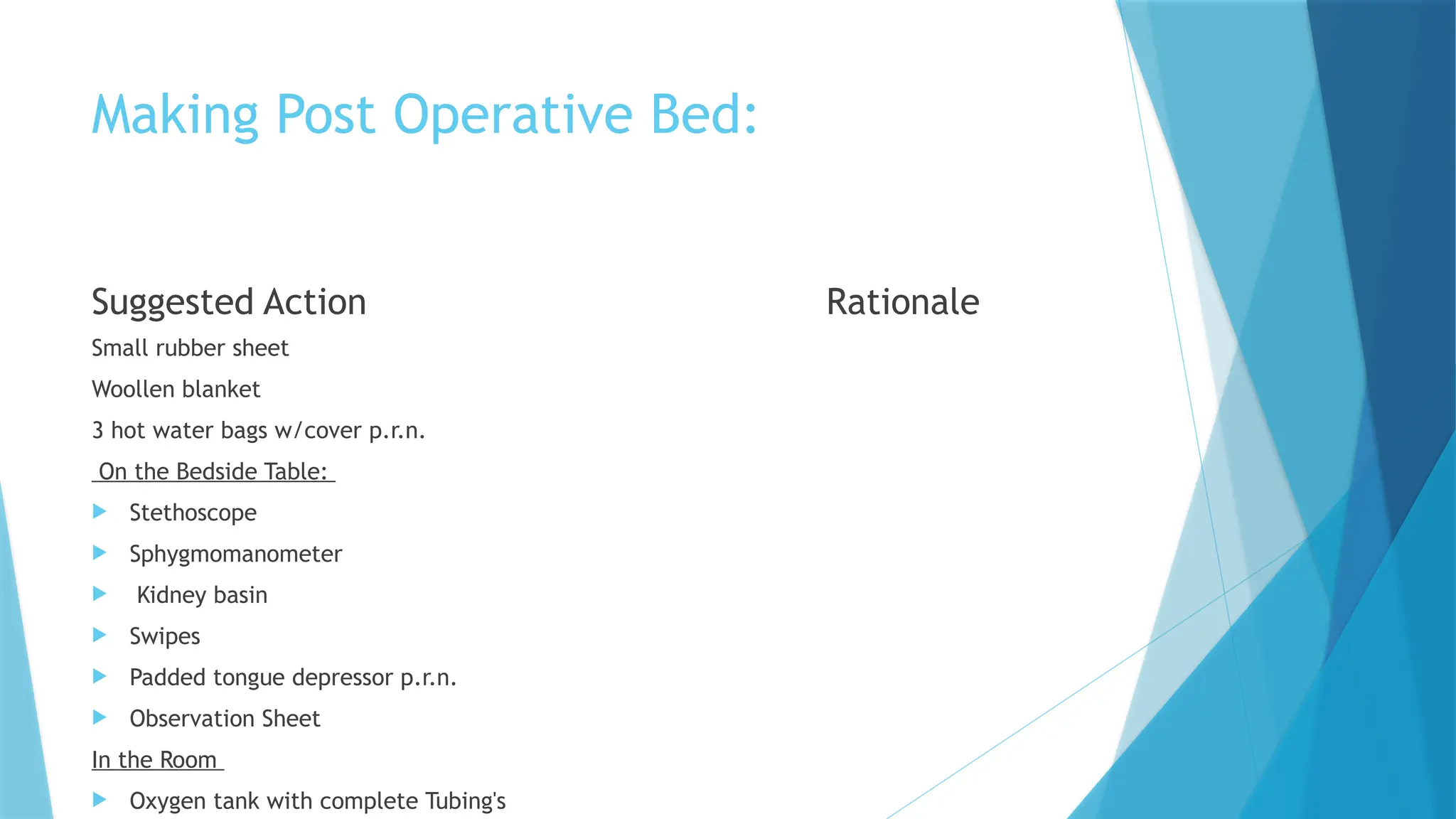
Small rubber sheet
Woollen blanket
3 hot water bags w/cover p.r.n.
On the Bedside Table:
 Stethoscope
 Sphygmomanometer
 Kidney basin
 Swipes
 Padded tongue depressor p.r.n.
 Observation Sheet
In the Room
 Oxygen tank with complete Tubing's
Rationale
Making Post Operative Bed:
Suggested Action
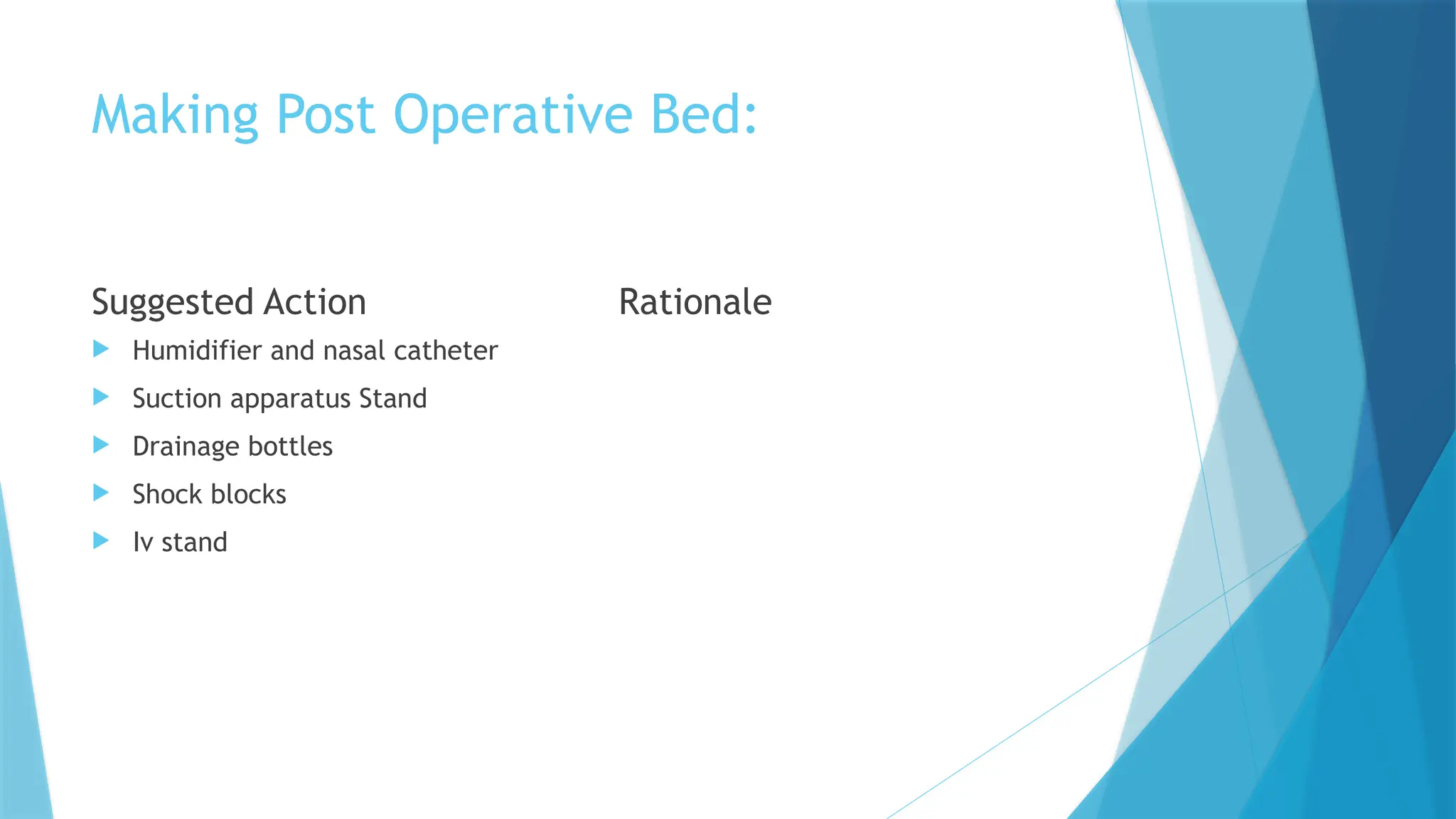
 Humidifier and nasal catheter
 Suction apparatus Stand
 Drainage bottles
 Shock blocks
 Iv stand
Rationale
Making Post Operative Bed:
Suggested Action
Implementation:
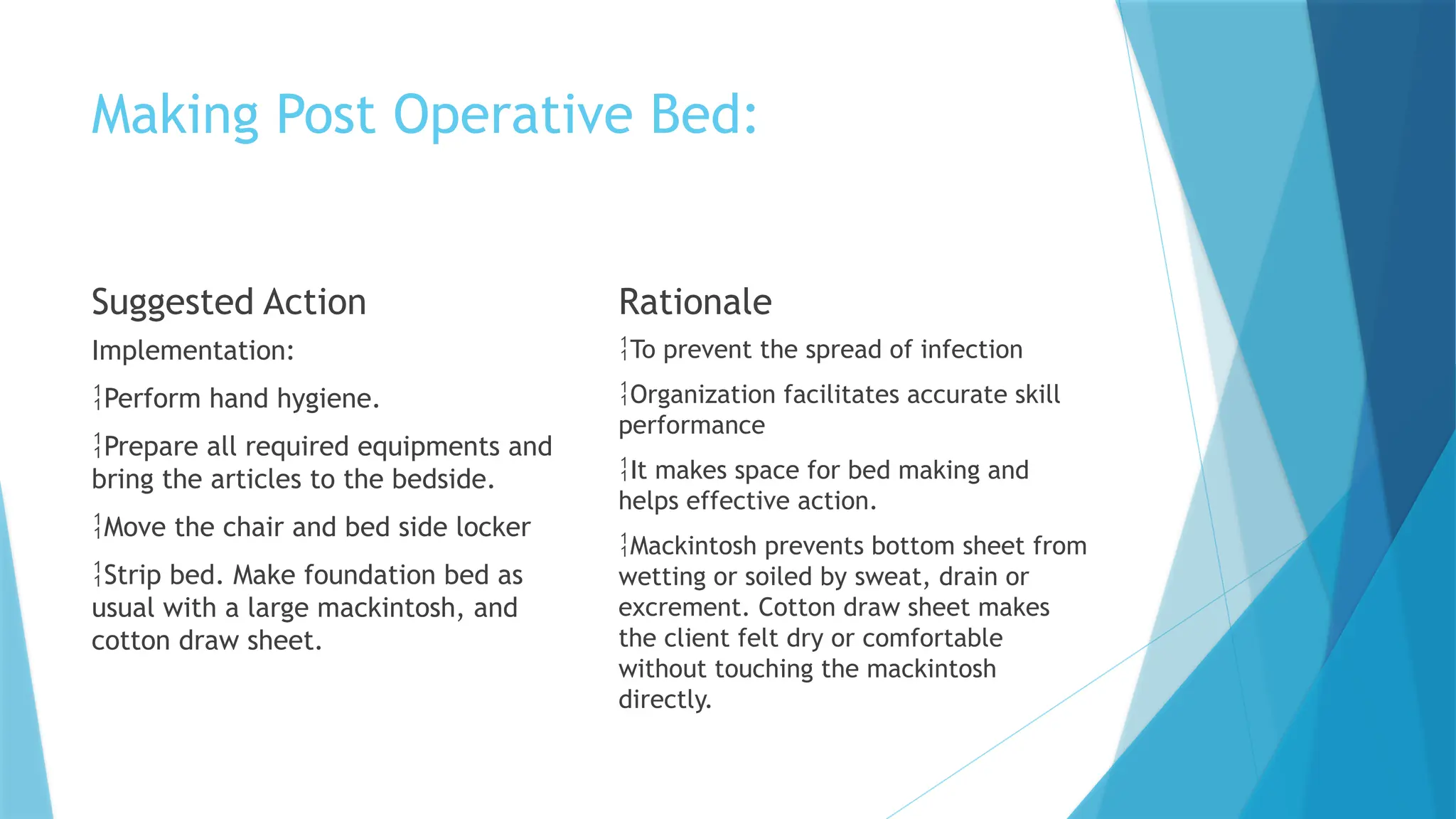
Perform hand hygiene.
Prepare all required equipments and
bring the articles to the bedside.
Move the chair and bed side locker
Strip bed. Make foundation bed as
usual with a large mackintosh, and
cotton draw sheet.
Rationale
To prevent the spread of infection
Organization facilitates accurate skill
performance
It makes space for bed making and
helps effective action.
Mackintosh prevents bottom sheet from
wetting or soiled by sweat, drain or
excrement. Cotton draw sheet makes
the client felt dry or comfortable
without touching the mackintosh
directly.
Making Post Operative Bed:
Suggested Action
Place top bedding as for closed bed
but do not tuck at foot
Fold back top bedding at the foot of
bed.
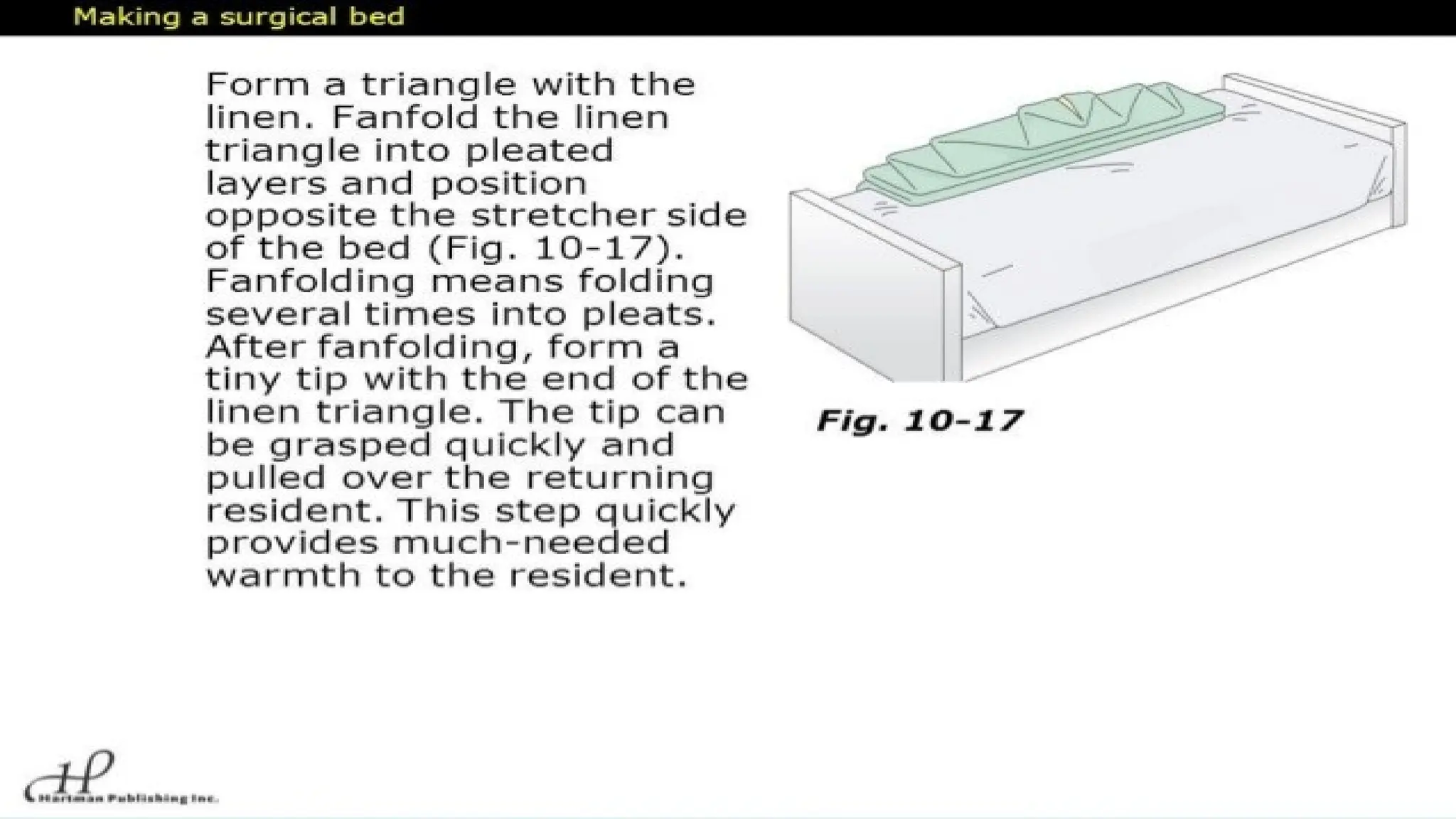
Tuck the top bedding on one side
only.
On the other side, do not tuck the
top sheet. 1)Bring head and foot
corners of it at the center of bed and
form right angles.
Rationale Implementation:
Tuck at foot may hamper the client
to enter the bed from a stretcher
To make the client’s transfer smooth
Tucking the top bedding on one side
stops the bed linens from slipping out
of place
The open side of bed is more
convenient for receiving client than
the other closed side.
Making Post Operative Bed:
Suggested Action
Implementation:
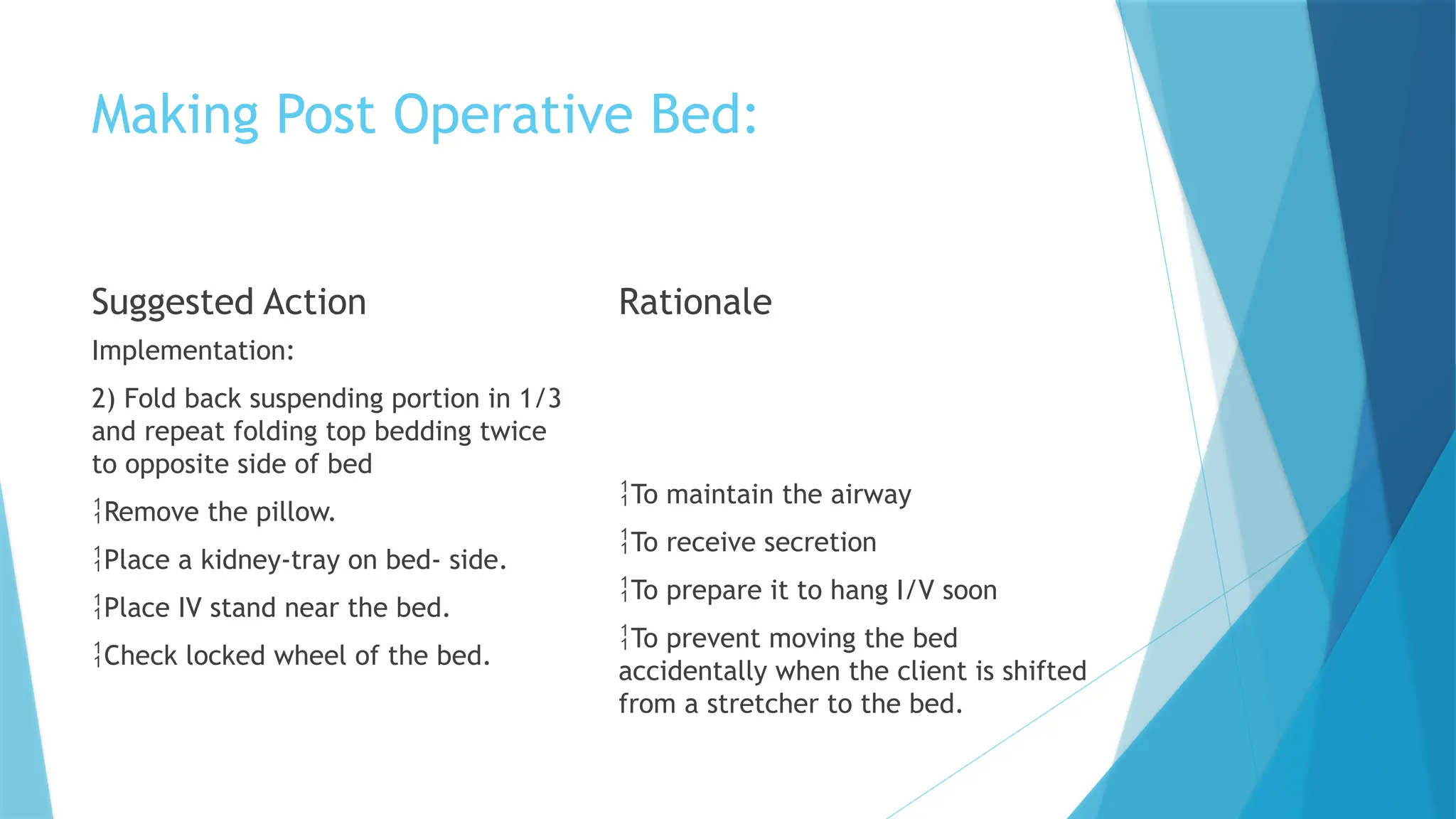
2) Fold back suspending portion in 1/3
and repeat folding top bedding twice
to opposite side of bed
Remove the pillow.
Place a kidney-tray on bed- side.
Place IV stand near the bed.
Check locked wheel of the bed.
Rationale
To maintain the airway
To receive secretion
To prepare it to hang I/V soon
To prevent moving the bed
accidentally when the client is shifted
from a stretcher to the bed.
Making Post Operative Bed:
Suggested Action
Implementation:
Put the hot water bags at the foot
and center of the bed if the weather
is cold.
Place the necessary articles on the
bedside table and the irrigating stand,
suction machine and oxygen set-up
adjacent to the bed.
Arrange unit.
Rationale
 Hot water bags (or hot bottles)
prevent the client from taking
hypothermia & remove it before
receiving the patient.
Making Post Operative Bed:
Suggested Action
Evaluation:
 Return the bed, the chair and bed-side table to their proper
place.
 Replace all equipments in proper place.
 Perform hand hygiene.
Document:
 Document on the chart with your signature and report any
findings to senior staff.
 Date & time
 Type of bed
 Assessment findings observed during procedure.
Rationale
 Bedside necessities will be within
easy reach for the client
 It makes well-setting for the
next.
 To prevent the spread of infection
 Documentation provides
coordination of care.
 Giving signature maintains
professional accountability
Purpose
 This bed is made to facilitates the dressing of the stump
 To ensure that the stump is visible to the staff moving
about the ward, so that at a glance any haemorrhage may
be observed.
 It is commonly found that the stump quivers.
Articles Required:-
 All the article as per unoccupied bed
EXTRA REQUIREMENT
 A cradle
 A flannelette sheet
 A counterpane
 A tray with a tourniquet and dressing towel
 A bed linen
Procedure:
• Gather all the needed supplies.
• Make the bed as though you are making an unoccupied bed.
• The foot end side of the top linen is folded back to the head
end at the level of the part to be observed. (if below knee
amputation).
• Spread the second set of linen starting from the level of stump.
• The second set of top linen should overlap the first by 8 to 12
inches.
• Receive the patient and elevate the stump on a small pillow and
place the sand bag on either side to support the stump.
• Place the bed cradle in position & cover the patient.
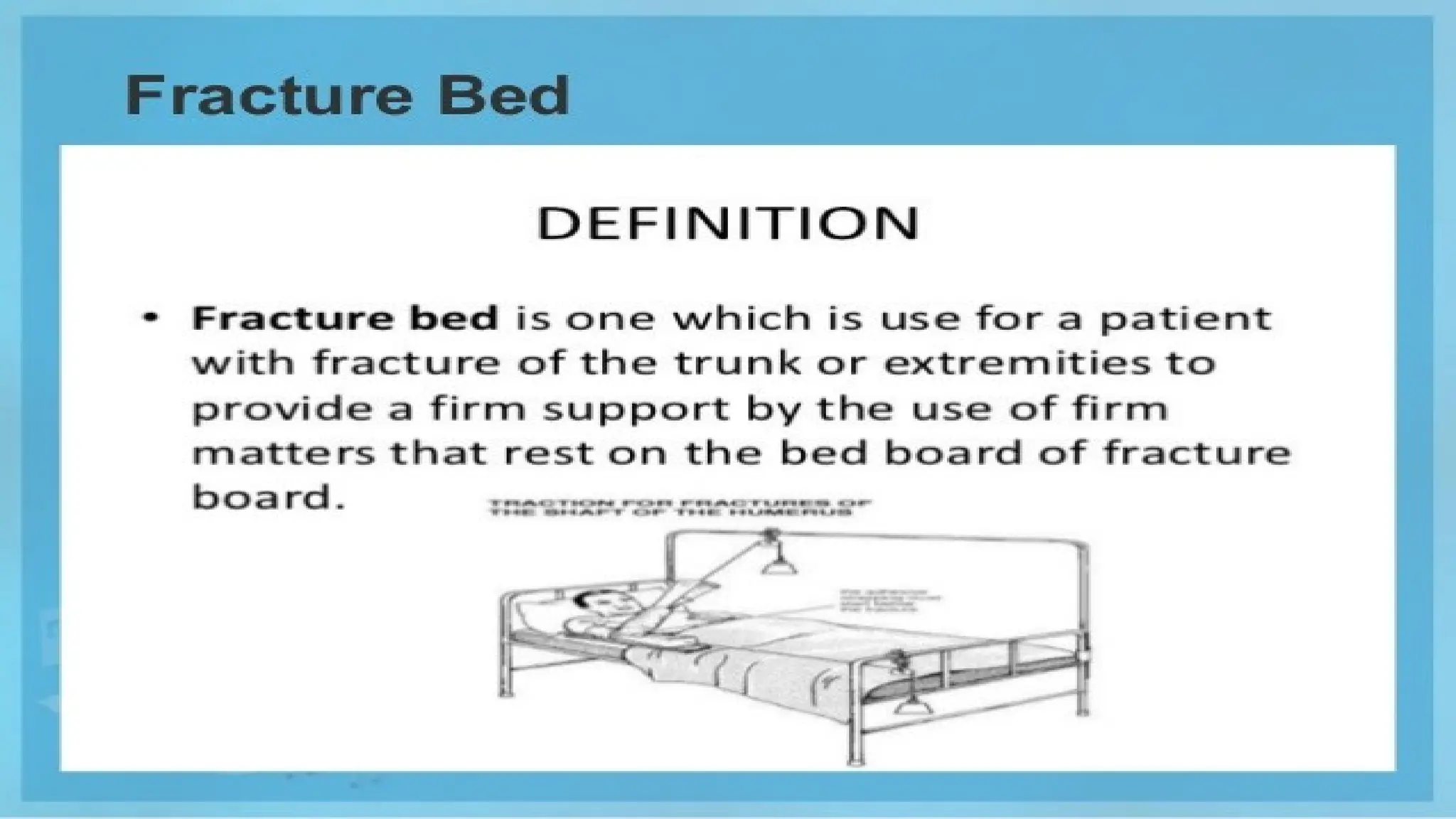
Fracture Bed
Indications:
 Aid in immobilizing the fracture
 Prevent unnecessary pain
 Provide warmth and comfort to the patient
 Prevent undue sagging of the mattress
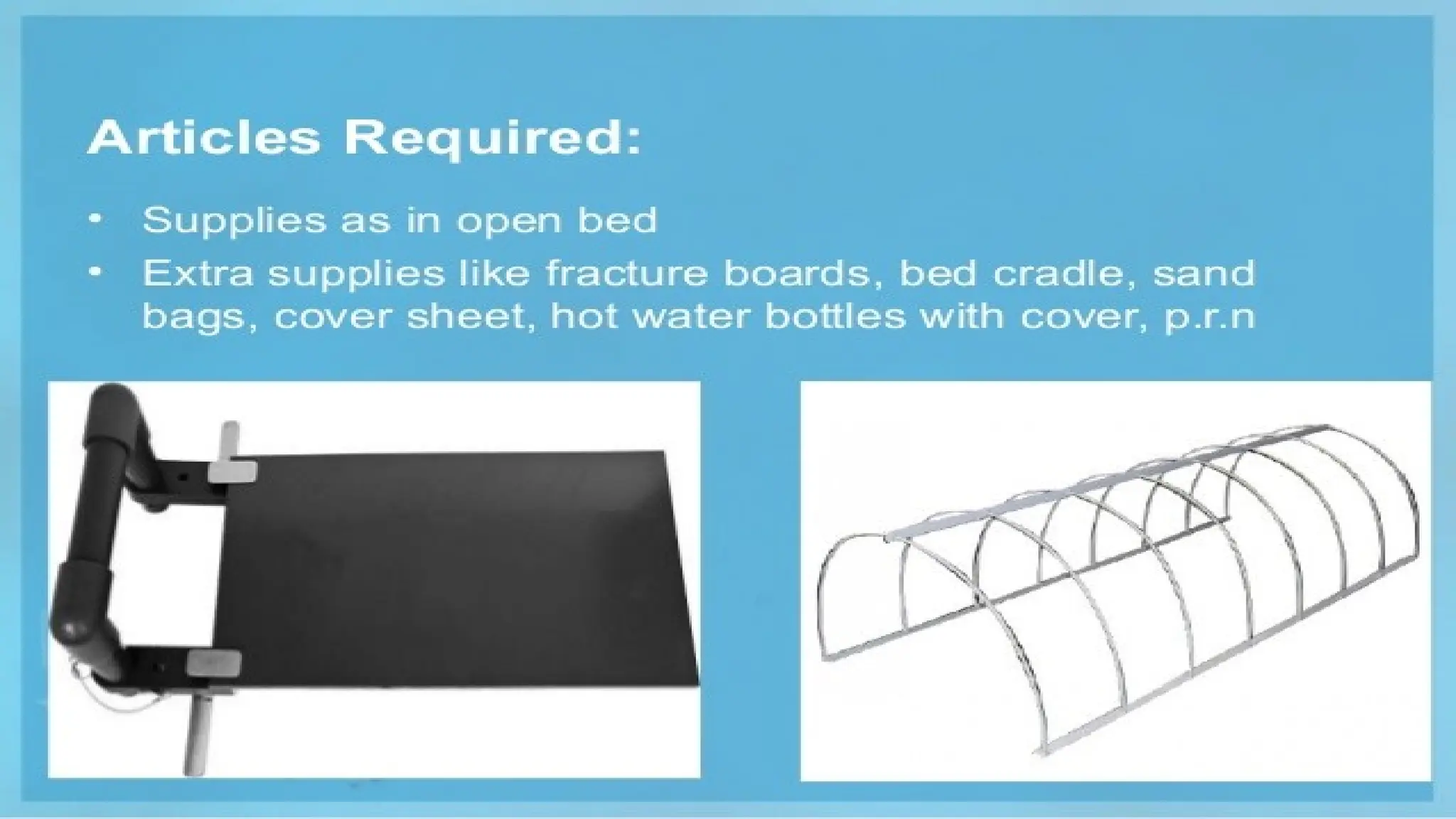
Articles Required:
Procedure:
• Gather all needed supplies. Place the fracture board
directly over the bed/cot.
• Make the bed as an open bed and spread cover sheet
between the bottom and top sheet. Place hot water bottles
in between to warm the bed. (Optional)
• Place the sand bags to support the part in order to
maintain the position.
• When the patient is received in bed, place the cradle over
the fractured part and cover it.
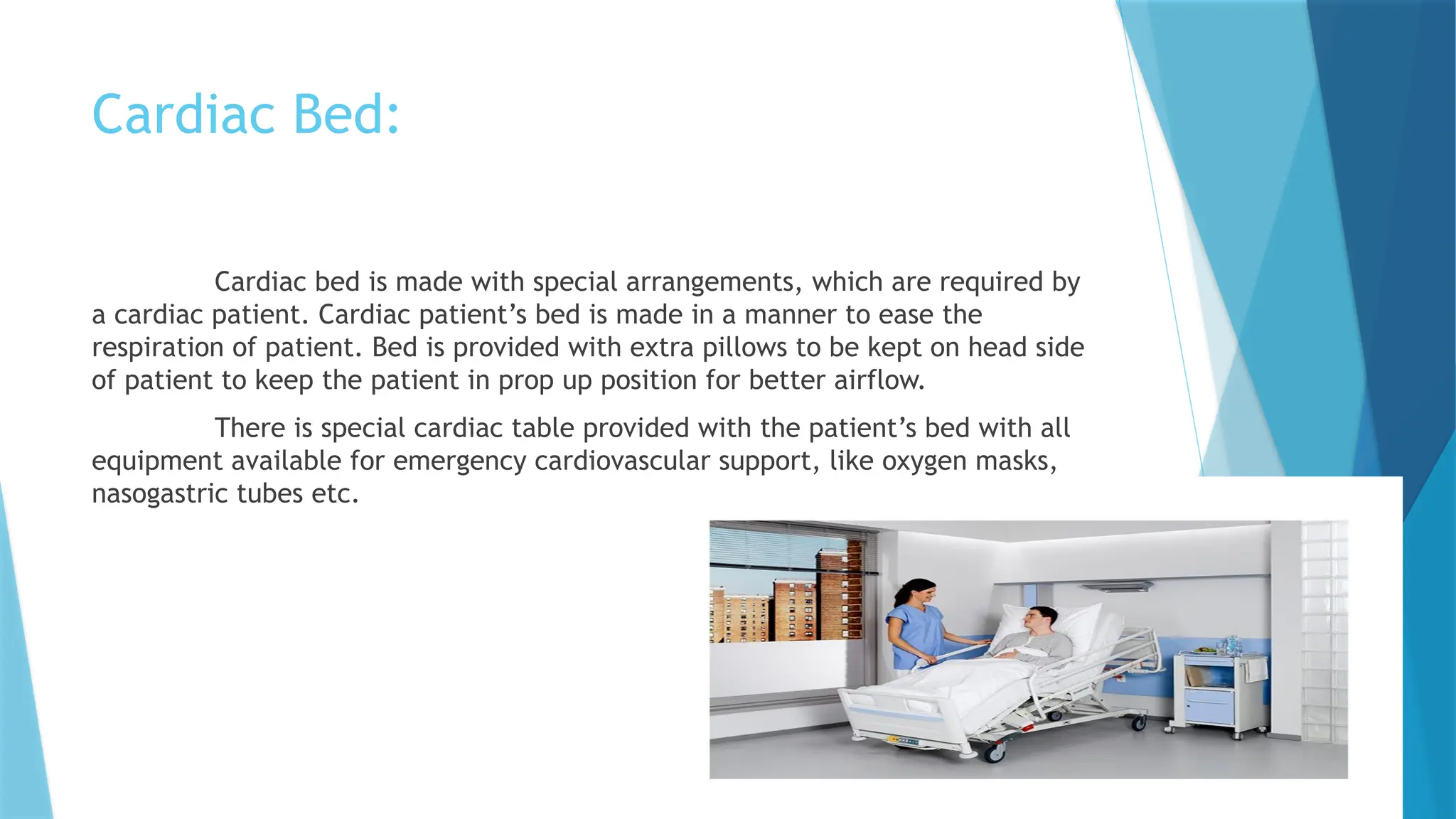
Cardiac Bed:
Cardiac bed is made with special arrangements, which are required by
a cardiac patient. Cardiac patient’s bed is made in a manner to ease the
respiration of patient. Bed is provided with extra pillows to be kept on head side
of patient to keep the patient in prop up position for better airflow.
There is special cardiac table provided with the patient’s bed with all
equipment available for emergency cardiovascular support, like oxygen masks,
nasogastric tubes etc.

BED MAKING- Technique of preparing different types of bed

  • 1.
  • 2.
    Introduction  A hospitalbed is the piece of equipment most frequently used by the hospitalized patient. Hospital beds are also found in long-term care facilities, as well as patient’s homes. The ideal hospital bed should be selected for its impact on patient’s comfort, safety, medical condition and ability to change positions.
  • 4.
    Definition:- • The techniqueof preparing different types of patient's comfortable bed in his/ her suitable position for a particular condition. • It is the process of making neat and clean bed for the client in hospital. • Stripping the Bed: Removal of used linen and the airing of the mattress.
  • 5.
    Purpose:- 1. To provideclean, safe and comfortable bed for the patient to promote rest and sleep. 2. To reduce the risk of infection by maintaining a clean environment. 3. To prevent bed sores by ensuring there are no wrinkles to cause pressure points. 4. To economize time, material and energy. 5. To observe patient and to prevent complications.
  • 9.
    Guidelines for BedMaking:- • Wash hand thoroughly before and after handling clients bed linen which helps to control nosocomial infection. • Gather all the required linen and accessories before making the bed. • Avoid shaking the linen to prevent the spread of microorganisms and dust particles. • Avoid placing linens clean or dirty on another patient’s bed. • Don’t place dirty linen on floor instead put in linen bag
  • 10.
    Guidelines for BedMaking:- • Do not hold dirty linen against your uniform. • Always use good body mechanics. • Stay on one side of the bed until it is completely made. • Observe the patient and document any nursing observations made. • Move any furniture away from the bed to provide ample working space
  • 11.
    Kinds of Linens:- ABlanket: a large piece of cloth often soft, woollen and is used for warmth as a bed cover. B Top sheet: used to cover the patient to provide warmth, made of thick cotton, thermal material C Cotton draw sheet: a piece of cloth spread over the rubber sheet and is used to absorb and moisture
  • 13.
    Types of BedMaking:-  Common types of bed:  A- Occupied Bed: Is made when the patient is not able or not permitted to get out of the bed. Or when patient is already occupied in the bed.  B- Unoccupied Bed: Is made when there is no patient confined in bed, while a patient in the shower or sitting up in a chair.  Types of unoccupied Bed: 1- Open bed: the top covers are folded back so the patient can easily get back in to bed. And is prepared for ambulatory patients.
  • 15.
    Types of BedMaking:-  2- Closed bed: the top sheet blankets and bedspreads are drawn up to the head of the mattress and under the pillow; this is prepared in a hospital room before a new client is admitted to the room. So also called admission bed.  3- Post-operative bed: known as recovery bed or anaesthetic or surgical bed, and used for a patient with large cast or other circumstance that would make it difficult for him to transfer and make it easy to receive patient into bed from OT.  4- Amputation or Divided bed: This is a bed that is prepared for a patient having amputed limb.
  • 17.
    Types of BedMaking:-  5- Fracture bed: This is a hard firm bed designed for the patient with fracture particularly of spine, pelvis or femur.  6- Cardiac bed: this is prepared for patient with breathing difficult and make use of cardiac table to relieve their dyspnoea.  7 – therapeutic bed: are used to treat clients with severe joint contractures, prolonged immobility or skin wounds such as pressure ulcers or severe burns. These beds reduce or relive the effects of pressure against the skin through various mechanisms. Few examples are blanket bed or rheumatic/renal bed, burn bed etc.
  • 19.
    Making Closed Bed: SuggestedAction : Assessment Check the room/ward for the need of disinfection or hygienic level Planning: Prepare all required equipments:  Trolley with –  1.Mattress (1)  2.Bed sheets(2): Bottom sheet (1) Top sheet (1)  3. Pillow (1) Rationale To determine what all type of disinfection activities are required  Save time and make procedure more organized
  • 20.
    Making Closed Bed: SuggestedAction 4. Pillow cover (1) 5. Mackintosh (1) 6. Draw sheet (1) 7. Blanket (1) 8. A Tray containing: Savlon water or Dettol water in basin Sponge cloth (2): to wipe with solution (1) to dry (1) Kidney tray or paper bag (1) 9. Laundry bag or Bucket or hamper bag Rationale
  • 21.
    Making Closed Bed: SuggestedAction Implementation Perform hand hygiene. Prepare all required equipments and bring the articles to the bedside. Move the chair and bed side locker Clean Bed-side locker: Wipe with wet and dry. Rationale To prevent the spread of infection Organization facilitates accurate skill performance It makes space for bed making and helps effective action. To maintain the cleanliness
  • 22.
    Making Closed Bed: SuggestedAction Implementation Clean the mattress: 1)Stand in right side. 2)Start wet wiping from top to center and from center to bottom in right side of mattress. 3)Gather the dust and debris to the bottom. 4)Collect them into kidney tray. 5)Give dry wiping as same as procedure 6)Move to left side and Wipe with wet and dry as same as above. Rationale To prevent the spread of infection
  • 23.
    Making Closed Bed: SuggestedAction : Implementation Move to right side.  Bottom sheet: 1)Place and slide the bottom sheet upward over the top of the bed leaving the bottom edge of the sheet. 2)Open it lengthwise with the center fold along the bed center. 3)Fold back the upper layer of the sheet toward the opposite side of the bed. Rationale Unfolding the sheet in this manner allows you to make the bed on one side.
  • 25.
    Making Closed Bed: SuggestedAction Implementation: 4. Tuck the bottom sheet securely under the head of the mattress(approximately 20-30cm). Make a mitered corner. ➀Pick up the selvage edge with your hand nearest the hand of the bed. ➁Lay a triangle over the side of the bed ➂Tuck the hanging part of the sheet under the mattress. Rationale A mitered corner has a neat appearance and keeps the sheet securely under the mattress.
  • 26.
    Making Closed Bed SuggestedAction Implementation:  ➃ Drop the triangle over the side of the bed.  ⑤Tuck the sheet under the entire side of bed. 5) Repeat the same procedure at the end of the corner of the bed 6) Tuck the remainder in long the side Rationale Tucking the bottom sheet will be done by turn, the corner of top firstly and the corner of the bottom later. To secure the bottom sheet on one side of the bed.
  • 28.
    Making Closed Bed: SuggestedAction Mackintosh and draw sheet: 1)Place a mackintosh at the middle of the bed 2)Lift the right half and spread it forward the near Side. 3)Tuck the mackintosh under the mattress. 4)Place the draw sheet on the mackintosh. Spread and tuck as same as above procedure (1-3). Rationale Implementation:  Mackintosh and draw sheet are additional protection for the bed and serves as a lifting or turning sheet for an immobile client.
  • 29.
    Making Closed Bed: SuggestedAction Move to the left side of the bed. Spreading Bottom sheet, mackintosh and draw sheet: 1) Fold and tuck the bottom sheet as same in the above procedure 2) Fold and tuck both the mackintosh and the draw sheet under the mattress as in the above procedure. Rationale Implementation: Secure the bottom sheet, mackintosh and draw sheet on one side of the bed
  • 30.
    Making Closed Bed: SuggestedAction Implementation:  Return to the right side. Top sheet and blanket: 1)Place the top sheet evenly on the bed, centering it in the below 20-30cm from the top of the mattress. 2)Spread it downward. 3)Cover the top sheet with blanket in the below 1 feet from the top of the mattress and spread downward. 4)Fold the cuff (approximately 1 feet) in the neck part 5)Tuck all these together under the bottom of mattress. Miter the corner. 6)Tuck the remainder in along the side Rationale A blanket provides warmth. Making the cuff at the neck part prevents irritation from blanket edge. Tucking all these pieces together saves time and provides a neat appearance.
  • 31.
    Making Closed Bed: SuggestedAction Implementation: Repeat the same as in the above procedure in left side. Return to the right side. Pillow and pillow cover: 1)Put a clean pillow cover on the pillow. 2) Place a pillow at the top of the bed in the center with the open end away from the door. Rationale To save time in this manner A pillow is a comfortable measure. Pillow cover keeps cleanliness of the pillow and neat. The open end may collect dust or organisms. The open end away from the door also makes neat.
  • 33.
    Making Closed Bed: SuggestedAction Return the bed, the chair and bed-side table to their proper place. Replace all equipments in proper place. Discard lines appropriately. Perform hand hygiene. Document: Document on the chart with your signature and report any findings to senior staff. Date & time Type of bed Assessment findings observed during procedure. Rationale  Bedside necessities will be within easy reach for the client § It makes well-setting for the next. Proper line disposal prevents the spread of infection. § To prevent the spread of infection § Documentation provides coordination of care.  Giving signature maintains professional accountability
  • 34.
    Making an Un-occupiedBed (Open Bed):  An unoccupied bed is one that is made for an ambulatory patient. The open bed has the linens folded down, making it easier for the client to get into bed. Open a bed for a new client or leave it open when the client is out of bed for a short time. Indication:  Provide a clean, smooth and comfortable bed to the patient.
  • 35.
    Making Open Bed: SuggestedAction Assessment: Check the room/ward for the need of disinfection or hygienic level Explain the purpose and procedure to the client Planning: Prepare all required equipments: Trolley with – 1.Mattress (1) 2.Bed sheets(2): Bottom sheet (1) Top sheet (1) Rationale To determine what all type of disinfection activities are required Fosters cooperation Save time and make procedure more organized
  • 36.
    Making Open Bed: SuggestedAction 3. Pillow (1) 4. Pillow cover (1) 5. Mackintosh (1) 6. Draw sheet (1) 7. Blanket (1) 8. A Tray containing: Savlon water or Dettol water in basin Sponge cloth (2): to wipe with solution (1) to dry (1) Kidney tray or paper bag (1) 9. Laundry bag or Bucket or hamper bag (1) Rationale
  • 37.
    Making Open Bed: SuggestedAction Perform hand hygiene. Prepare all required equipments and bring the articles to the bedside. Assist the patient out of bed Remove the client’s personal belongings from bed side and keep in locker/safe place Move the chair and bed side locker Strip the bed clothes, fold them one by one and place them. Rationale Implementation: To prevent the spread of infection Organization facilitates accurate skill performance To prevent the loss/damage It makes space for bed making and helps effective action. To prevent bed clothes touching the floor
  • 38.
    Stripping the Bed: Removalof used linen and the airing of the mattress. Procedure: 1- Place chair at the foot of the bed. 2- Locked the bed. 3- Remove pillow case from pillow. Place pillow on chair. 4- Loosen all bed linens starting at center of head of bed, raising the mattress with one hand and draw out bed clothes with other. 5- Remove sheet separately. Fold each linen with soiled part inside. Wrap them all in a sheet and place on lower bar of the bed. 6- Roll rubber sheet and place on chair. 7- Remove mattress cover.
  • 39.
    Making Open Bed: SuggestedAction Implementation: Clean Bed-side locker: Wipe with wet and dry. Clean the mattress: 1)Stand in right side. 2)Start wet wiping from top to center and from center to bottom in right side of mattress. 3)Gather the dust and debris to the bottom. 4)Collect them into kidney tray. 5)Give dry wiping as same as procedure 6)Move to left side and Wipe with wet and dry as same as above. Rationale To maintain the cleanliness To prevent the spread of infection
  • 40.
    Making Open Bed: Place clean linens on chair in order of use.  Cover mattress.  Place bottom sheet with center fold in center in line with rim of matters at foot part, spread across bed. Make mitered corner of head part, tuck extra sheet at side from head of food.  Put rubber sheet 12-15 inches from the head of mattress. Cover with draw sheet. Spread a cross bed. Tuck together extra length.  Place top sheet in line with mattress at head part and spread a cross bed. Similarly spread the blanket. Form a toe pleat as in the procedure of closed bed. Tuck extra length of sheet at foot part, mitered corner; allow hanging free at sides.
  • 41.
    Making Open Bed: Go to opposite side and repeat same procedure.  Grasp one corner of top sheet, fanfold at foot part or diagonally to one side.
  • 42.
    Making an OccupiedBed: Some clients are unable to get out of bed as a result of their specific condition or generalized weakness. Changing bed linens with the client in the bed is known as making an occupied bed. Work quickly and disturb the client as little as possible.  Indications: Provide clean and comfortable bed with least disturbance to the patient in it.
  • 43.
    Making Occupied Bed: SuggestedAction Assessment: Check the room/ward for the need of disinfection or hygienic level Explain the purpose and procedure to the client To determine what all type of disinfection activities are required Planning: Prepare all required equipments: Trolley with – 1.Mattress (1) 2.Bed sheets(2): Bottom sheet (1) Top sheet (1) Rationale Fosters cooperation Save time and make procedure more organized
  • 44.
    Making Occupied Bed: SuggestedAction 3. Pillow (1) 4. Pillow cover (1) 5. Mackintosh (1) 6. Draw sheet (1) 7. Blanket (1) 8. A Tray containing: Savlon water or Dettol water in basin Sponge cloth (2): to wipe with solution (1) to dry (1) Kidney tray or paper bag (1) 9. Laundry bag or Bucket or hamper bag (1) Rationale
  • 45.
    Making Occupied Bed: SuggestedAction Implementation: Perform hand hygiene. Prepare all required equipments and bring the articles to the bedside. Close the curtain/door Remove the client’s personal belongings from bed side and keep in locker/safe place Move the chair and bed side locker Lift the client’s head and move pillow from center to the left side. Rationale To prevent the spread of infection Organization facilitates accurate skill performance To maintain privacy To prevent the loss/damage It makes space for bed making and helps effective action. The pillow is comfortable measure for the client.
  • 46.
    Making Occupied Bed: SuggestedAction Implementation Assist the client to turn toward left side of the bed. Adjust the pillow. Leaves top sheet in place. Stand in right side: Loose bottom bed linens. Fanfold (or roll) soiled linens from the side of the bed and wedge them close to the client. Wipe the surface of mattress by sponge cloth with wet and dry. Rationale Moving the client as close to the other side of the bed as possible gives you more room to make the bed. Top sheet keeps the client warm and protect his or her privacy. Placing folded (or rolled) soiled linen close to the client allows more space to place the clean bottom sheets. To prevent the spread of infection.
  • 48.
    Making Occupied Bed: SuggestedAction Implementation: Bottom sheet, mackintosh and draw sheet: 1)Place the clean bottom sheet evenly on the bed folded lengthwise with the center fold as close to the client’s back as possible. 2)Adjust and tuck the sheet tightly under the head of the mattress, making mitered the upper corner. 3)Tighten the sheet under the end of the mattress and make mitered the lower corner. 4)Tuck in along side. 5)Place the mackintosh and the draw sheet on the bottom sheet and tuck in them together. Rationale Soiled linens can easily be removed and clean linens are positioned to make the other side of the bed.
  • 50.
    Making Occupied Bed: SuggestedAction Implementation: Assist the client to roll over the folded (rolled) linen to right side of the bed. Readjust the pillow and top sheet. Move to left side: Discard the soiled linens appropriately. Hold them away from your uniform. Place them in the laundry bag (or bucket). Wipe the surface of the mattress by sponge cloth with wet and dry. Rationale Moving the client to the bed’s other side allows you to make the bed on that side. Soiled linens can contaminate your uniform, which may come into contact with other clients. To prevent the spread of infection.
  • 51.
    Making Occupied Bed: SuggestedAction Implementation: Bottom sheet, mackintosh and draw sheet: 1)Grasp clean linens and gently pull them out from under the client. 2)Spread them over the bed’s unmade side. Pull the linens taut 3)Tuck the bottom sheet tightly under the head of the mattress and miter the corner. 4)Tighten the sheet under the end of the mattress and make mitered the lower corner. 5)Tuck in along side. 6)Tuck the mackintosh and the draw sheet under the mattress. Rationale Wrinkled linens can cause skin irritation.
  • 53.
    Making Occupied Bed: SuggestedAction Implementation: Assist the client back to the center of the bed. Adjust the pillow Return to right side: Clean top sheet, blanket: 1)Place the clean top sheet at the top side of the soiled top sheet. 2)Ask the client to hold the upper edge of the clean top sheet. 3)Hold both the top of the soiled sheet and the end of the clean sheet with right hand and withdraw to downward. Remove the soiled top sheet and put it into a laundry bag. Rationale The pillow is comfort measure for the client. Tucking these pieces together saves time and provides neat, tight corners.
  • 54.
    Making Occupied Bed: SuggestedAction Implementation: 3) Place the blanket over the top sheet. Fold top sheet back over the blanket over the client. 4) Tuck the lower ends securely under the mattress. Miter corners. 5) After finishing the right side, repeat the left side. Remove the pillow and replace the pillow cover with clean one and reposition the pillow to the bed under the client’s head. Rationale The pillow is a comfortable measures for a client
  • 55.
    Making Closed Bed: SuggestedAction Evaluation  Return the bed, the chair and bed-side table to their proper place.  Replace all equipments in proper place. Discard lines appropriately.  Perform hand hygiene. Document:  Document on the chart with your signature and report any findings to senior staff.  Date & time  Type of bed  Assessment findings observed during procedure. Rationale  Bedside necessities will be within easy reach for the client  It makes well-setting for the next. Proper line disposal prevents the spread of infection.  To prevent the spread of infection  Documentation provides coordination of care.  Giving signature maintains professional accountability
  • 57.
    Purpose • To providewarmth and comfort for the patient. • To provide protection for the bed from vomiting, bleeding, drainage and discharge. • To arrange the bed and other furniture in order to facilitate the transfer of the patient from stretcher to bed.
  • 58.
    Making Post OperativeBed: Suggested Action Assessment: Check the room/ward for the need of disinfection or hygienic level Explain the purpose and procedure to the client Planning: Prepare all required equipments: The same linen as those used for making on occupied bed plus the following - Bath towel Rationale To determine what all type of disinfection activities are required Fosters cooperation Save time and make procedure more organized
  • 59.
    Making Post OperativeBed: Suggested Action Small rubber sheet Woollen blanket 3 hot water bags w/cover p.r.n. On the Bedside Table:  Stethoscope  Sphygmomanometer  Kidney basin  Swipes  Padded tongue depressor p.r.n.  Observation Sheet In the Room  Oxygen tank with complete Tubing's Rationale
  • 60.
    Making Post OperativeBed: Suggested Action  Humidifier and nasal catheter  Suction apparatus Stand  Drainage bottles  Shock blocks  Iv stand Rationale
  • 61.
    Making Post OperativeBed: Suggested Action Implementation: Perform hand hygiene. Prepare all required equipments and bring the articles to the bedside. Move the chair and bed side locker Strip bed. Make foundation bed as usual with a large mackintosh, and cotton draw sheet. Rationale To prevent the spread of infection Organization facilitates accurate skill performance It makes space for bed making and helps effective action. Mackintosh prevents bottom sheet from wetting or soiled by sweat, drain or excrement. Cotton draw sheet makes the client felt dry or comfortable without touching the mackintosh directly.
  • 62.
    Making Post OperativeBed: Suggested Action Place top bedding as for closed bed but do not tuck at foot Fold back top bedding at the foot of bed. Tuck the top bedding on one side only. On the other side, do not tuck the top sheet. 1)Bring head and foot corners of it at the center of bed and form right angles. Rationale Implementation: Tuck at foot may hamper the client to enter the bed from a stretcher To make the client’s transfer smooth Tucking the top bedding on one side stops the bed linens from slipping out of place The open side of bed is more convenient for receiving client than the other closed side.
  • 64.
    Making Post OperativeBed: Suggested Action Implementation: 2) Fold back suspending portion in 1/3 and repeat folding top bedding twice to opposite side of bed Remove the pillow. Place a kidney-tray on bed- side. Place IV stand near the bed. Check locked wheel of the bed. Rationale To maintain the airway To receive secretion To prepare it to hang I/V soon To prevent moving the bed accidentally when the client is shifted from a stretcher to the bed.
  • 66.
    Making Post OperativeBed: Suggested Action Implementation: Put the hot water bags at the foot and center of the bed if the weather is cold. Place the necessary articles on the bedside table and the irrigating stand, suction machine and oxygen set-up adjacent to the bed. Arrange unit. Rationale  Hot water bags (or hot bottles) prevent the client from taking hypothermia & remove it before receiving the patient.
  • 67.
    Making Post OperativeBed: Suggested Action Evaluation:  Return the bed, the chair and bed-side table to their proper place.  Replace all equipments in proper place.  Perform hand hygiene. Document:  Document on the chart with your signature and report any findings to senior staff.  Date & time  Type of bed  Assessment findings observed during procedure. Rationale  Bedside necessities will be within easy reach for the client  It makes well-setting for the next.  To prevent the spread of infection  Documentation provides coordination of care.  Giving signature maintains professional accountability
  • 69.
    Purpose  This bedis made to facilitates the dressing of the stump  To ensure that the stump is visible to the staff moving about the ward, so that at a glance any haemorrhage may be observed.  It is commonly found that the stump quivers.
  • 70.
    Articles Required:-  Allthe article as per unoccupied bed EXTRA REQUIREMENT  A cradle  A flannelette sheet  A counterpane  A tray with a tourniquet and dressing towel  A bed linen
  • 71.
    Procedure: • Gather allthe needed supplies. • Make the bed as though you are making an unoccupied bed. • The foot end side of the top linen is folded back to the head end at the level of the part to be observed. (if below knee amputation). • Spread the second set of linen starting from the level of stump. • The second set of top linen should overlap the first by 8 to 12 inches. • Receive the patient and elevate the stump on a small pillow and place the sand bag on either side to support the stump. • Place the bed cradle in position & cover the patient.
  • 73.
    Fracture Bed Indications:  Aidin immobilizing the fracture  Prevent unnecessary pain  Provide warmth and comfort to the patient  Prevent undue sagging of the mattress
  • 74.
  • 75.
    Procedure: • Gather allneeded supplies. Place the fracture board directly over the bed/cot. • Make the bed as an open bed and spread cover sheet between the bottom and top sheet. Place hot water bottles in between to warm the bed. (Optional) • Place the sand bags to support the part in order to maintain the position. • When the patient is received in bed, place the cradle over the fractured part and cover it.
  • 76.
    Cardiac Bed: Cardiac bedis made with special arrangements, which are required by a cardiac patient. Cardiac patient’s bed is made in a manner to ease the respiration of patient. Bed is provided with extra pillows to be kept on head side of patient to keep the patient in prop up position for better airflow. There is special cardiac table provided with the patient’s bed with all equipment available for emergency cardiovascular support, like oxygen masks, nasogastric tubes etc.