SUPERFICIAL HEAT AND
COLD
 Primarily increase or decrease
temperature of skin, superficial
subcutaneous tissues
TRANSFER OF ENERGY: HEAT,
OR THE LOSS OF HEAT,
OCCURS IN ANY OF THE
FOLLOWING WAYS:
 Conduction: Contact
 Convection: movement
 Evaporation: through liquid-gas transfer
 Radiation: electromagnetic waves
 Conversion: transfer from one energy
type to another
THERAPEUTIC APPLICATION
 Heating Agents
◦ Transfer heat to patient’s body,
between various tissue / fluids
 Cooling Agents
◦ Transfer heat away from patient’s
body
HOT APPLICATION
Hot application is the application of a hot
agent, warmer than skin either in a moist
or dry from on the surface of the body;
 To relive pain and congestion,
 To provide warmth,
 To promote suppuration,
 To promote healing,
 To decrease muscle tone and
 To soften the exudates.
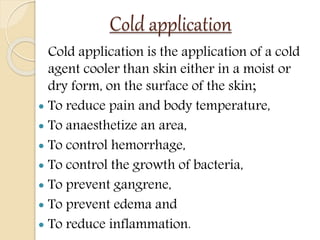
Cold application
Cold application is the application of a cold
agent cooler than skin either in a moist or
dry form, on the surface of the skin;
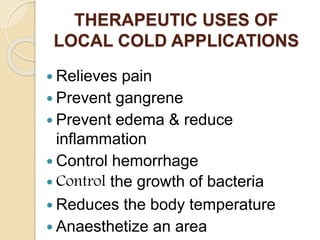
 To reduce pain and body temperature,
 To anaesthetize an area,
 To control hemorrhage,
 To control the growth of bacteria,
 To prevent gangrene,
 To prevent edema and
 To reduce inflammation.
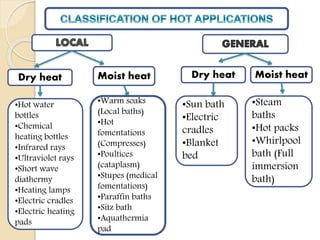
Dry heat Moist heat
•Hot water
bottles
•Chemical
heating bottles
•Infrared rays
•Ultraviolet rays
•Short wave
diathermy
•Heating lamps
•Electric cradles
•Electric heating
pads
•Warm soaks
(Local baths)
•Hot
fomentations
(Compresses)
•Poultices
(cataplasm)
•Stupes (medical
fomentations)
•Paraffin baths
•Sitz bath
•Aquathermia
pad
•Sun bath
•Electric
cradles
•Blanket
bed
Dry heat Moist heat
•Steam
baths
•Hot packs
•Whirlpool
bath (Full
immersion
bath)
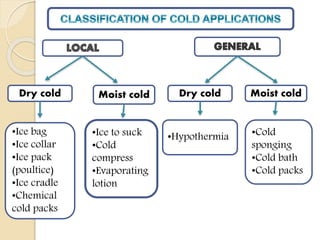
Dry cold Moist cold
•Ice bag
•Ice collar
•Ice pack
(poultice)
•Ice cradle
•Chemical
cold packs
•Ice to suck
•Cold
compress
•Evaporating
lotion
•Hypothermia
Dry cold Moist cold
•Cold
sponging
•Cold bath
•Cold packs
Local Application of heat and cold
to the body can be therapeutic, but
before using these therapies, the
nurse must understand normal
body responses to application of
heat and cold and how and when
to use.
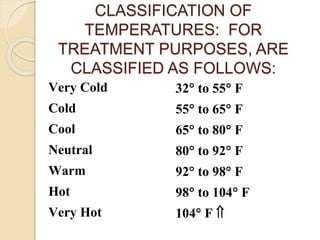
CLASSIFICATION OF
TEMPERATURES: FOR
TREATMENT PURPOSES, ARE
CLASSIFIED AS FOLLOWS:
Very Cold 32 to 55 F
Cold 55 to 65 F
Cool 65 to 80 F
Neutral 80 to 92 F
Warm 92 to 98 F
Hot 98 to 104 F
Very Hot 104 F 
Hot
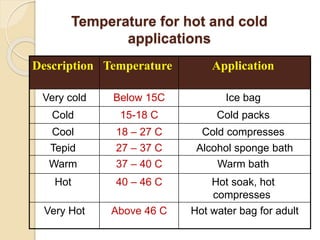
Temperature for hot and cold
applications
Description Temperature Application
Very cold Below 15C Ice bag
Cold 15-18 C Cold packs
Cool 18 – 27 C Cold compresses
Tepid 27 – 37 C Alcohol sponge bath
Warm 37 – 40 C Warm bath
Hot 40 – 46 C Hot soak, hot
compresses
Very Hot Above 46 C Hot water bag for adult
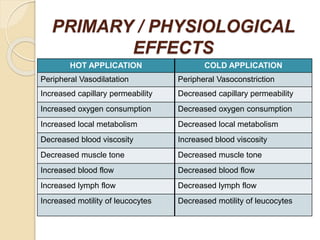
PRIMARY / PHYSIOLOGICAL
EFFECTS
HOT APPLICATION COLD APPLICATION
Peripheral Vasodilatation Peripheral Vasoconstriction
Increased capillary permeability Decreased capillary permeability
Increased oxygen consumption Decreased oxygen consumption
Increased local metabolism Decreased local metabolism
Decreased blood viscosity Increased blood viscosity
Decreased muscle tone Decreased muscle tone
Increased blood flow Decreased blood flow
Increased lymph flow Decreased lymph flow
Increased motility of leucocytes Decreased motility of leucocytes
SECONDARY EFFECT OF HOT AND
COLD APPLICATION
 With the local heat application, the maximal
increase in the of circulation & temperature
occurs after 20 to 40 min exposure. After this
time, the heat application must be discontinued
& a recovery time of 1 hour allowed otherwise
secondary effect (vasoconstriction) will take
place.
 With the cold application, the primary effects
may last only for 30 min to 1 hour. After this
time, a recovery time of one hour must be
allowed or secondary effects (vasodilatation)
SYSTEMATIC RESPONSE
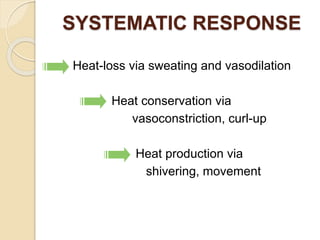
Heat-loss via sweating and vasodilation
Heat conservation via
vasoconstriction, curl-up
Heat production via
shivering, movement
SYSTEMATIC RESPONSE
What happens if heat is
applied to a large body
area?
ANSWER
EXCESSIVE PERIPHERAL
VASODILATION
Diverts large supplies
of blood from the
internal organs
Drop in the Blood Pressure
Which could lead to a safety issue
LOCAL BODY RESPONSE
 Occurs through stimulation of temperature-
sensitive sensory nerve endings/ thermal
receptors in the skin.
 Sent up the spinal cord to the hypothalamus
in the brain where impulses are recognized
as hot or cold
 Protective adaptive responses are triggered:
cold= vasoconstriction; hot= vasodilation
ADAPTATION OF THERMAL
RESPONSE
Nerve receptors strongly stimulated
initially
Declines rapidly during first few
seconds
Declines slowly over the next half hour
Receptors adapt to the new
Exceeding normal temperature
ranges can damage tissues
REBOUND Phenomenon: Heat
 Occurs at the time that maximum
therapeutic effect of hot or cold
application is achieved
 Heat produces maximum vasodilatation
in 20-30 minutes.
 Continuation beyond 30-45 minutes
causes tissue congestion, the blood
vessels constrict
REBOUND Phenomenon: Heat
 Now the opposite effect is occurring
because of reflex vascular
constriction.
 Recovery time of one hour is advised
before reapplication
REBOUND Phenomenon: Cold
 Maximum vasoconstriction occurs when
the skin temperature reaches 150 or in
about 30 minutes to one hour.
 Vasodilation begins as a protective device
to prevent the body tissue from freezing
 Recovery time of one hour is best before
reapplication.
The nurse should assess
WHY thermal therapy is
being utilized
FACTORS AFFECTING HEAT AND
COLD TOLERANCE
 Body part: Certain areas of the skin have a
sensitivity to temperature variations. The
inner aspect of the wrist and forearm, the
neck, and the perineal area are
temperature-sensitive, while the back of the
hand and the foot are not as sensitive.
 Duration of application: Therapeutic
benefits of heat and cold applications are
achieved with short periods of exposure to
temperature variations. Tolerance increases
as the length of exposure increases.
 Area of body exposed: The larger the
area exposed to heat and cold, the
lower the tolerance to temperature
changes.
 Damage to body surface area: Injured
skin areas are more sensitive than intact
areas to temperature variations.
 Individual tolerance: Tolerance to
temperature variations is affected by age
and physical condition. The young and
the aged are especially susceptible to
heat and cold. Neurosensory impairments
may interfere with the reception and
perception of stimuli, increasing the risk
of injury.
 Age: Thinner skin layers in children and
elderly people increase the risk for burns
from the heat and cold applications. Older
adults have a decreased sensitivity to
Scientific principles involved in
hot and cold applications
 Water is a good conductor of heat
 Air is a poor conductor of heat
 The flow of heat is from the hotter are to
the less hot area
 Prolonged exposure to moisture
increases the skin’s susceptibility to
maceration and skin breakdown,
reducing the protection of the intact skin.
 Moisture left on the skin causes rapid
cooling due to evaporation of the moisture
 Presence of steam increases the
temperature of the hot application
 Oil acts as insulator and delays the
transmission of heat
 Woolen absorb moisture slowly, but hold
moisture longer and cool off less quickly
than the cotton materials.
 The temperature tolerance varies with
individuals and according to the site and
area covered
 Friction produce heat.
HEAT
APPLICATION
INDICATIONS
THERAPEUTIC USES OF LOCAL
HOT APPLICATIONS
 Decreases pain
 Decreases muscle tone
 Promote healing
 Promotes suppuration
 Relives deep congestion
 Softens the exudates
 Provide warmth
 Stimulates peristalsis
Contraindications
CONTRAINDICATIONS OF HOT
APPLICATIONS
 Malignancies
 Impaired kidney, heart & lung functions
 Acutely inflammed areas
 On clients with paralysis
 Open wounds
 Edema associated with venous or lymphatic
diseases
 Headache
 Client with metabolic disorders
 Very young & very old client
 Client with very high temperature
COMPLICATIONS
COMPLICATIONS OF HOT
APPLICATIONS
 Pain
 Burns
 Maceration (with moist heat)
 Redness of the skin
 Edema
 Pallor (secondary effect)
 Hyperthermia
THERAPEUTIC
EFFECTS OF HEAT
Hemodynamic
 Increase circulation 1.5-2x normal
 Increased metabolism
(contraindicated in 2-3 days post
injury)
 Increased inflammation,
phagocytosis, & wound healing
 Decreased pain (analgesia); not as
effective as cryotherapy for acute
pain
 Decreased muscle spasm
 Decreased tissue stiffness (fluids
less viscous and collagen releases
 Depth of effects are not as great as
with cold
 Vascular changes are confined to skin
(1cm)
BUT
Neuromuscular
 Increase sensory nerve conduction
 Analgesic effects both distal and
proximal to area treated
 This is why non-acute back patients use
heat instead of ice
 Reducing muscle spasm
 Inhibits muscle contraction
GENERAL INSTRUCTION
 Assess the condition of the client prior to,
during & after the application of the heat
& cold application.
 Check vital signs.
 Maintain correct temp. for the entire
duration of the application.
 Never use any equipment unless
understand its operation completely.
 There must be a recovery period
between the application.
 Expose the client only to a safe temp.
 Don’t allow the client to adjust temp.
control
 Never ignore the complaints of a client
 Make sure that the client is in a position
to remove the application if it is causing
him discomfort.
 Client must have a calling signal with in
reach
 Never leave client even for short period
 Squeeze off water from moist heat
applications to prevent scalding.
 Apply thin layer of petroleum jelly or oil to
skin prior to the application of moist heat
application. It will reduces soaking of the
skin & therefore maceration.
 Don’t use electrical appliances close to
the open oxygen.
 Don’t use electrical appliances near
water or other fluid.
 If any sign of complication recognized
stop procedure immediately.
 After procedure, dry the body area gently
by patting not by rubbing to remove the
moisture.
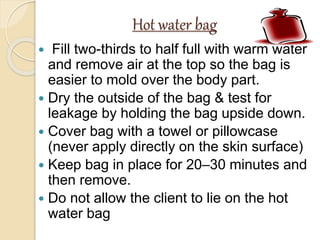
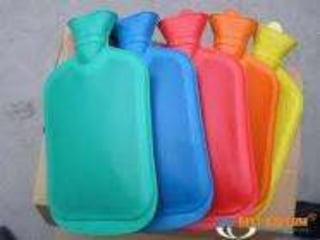
Hot water bag
 Fill two-thirds to half full with warm water
and remove air at the top so the bag is
easier to mold over the body part.
 Dry the outside of the bag & test for
leakage by holding the bag upside down.
 Cover bag with a towel or pillowcase
(never apply directly on the skin surface)
 Keep bag in place for 20–30 minutes and
then remove.
 Do not allow the client to lie on the hot
water bag
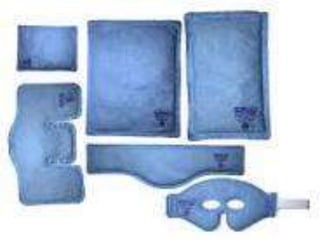
HOT PACKS / CHEMICAL
HEATING PACKS
 Commercially prepared, disposable hot
packs supply warm dry heat to an injured
area.
 Striking or squeezing the pack will
release chemicals that create the heat.
 These packs are designed to maintain a
constant temperature between 40.6º C &
AQUATHERMIA PADS
 Are useful in treating muscle sprains and for
areas with mild inflammation or edema.
 Unit consists of a waterproof plastic or
rubber pad connected by two hoses to an
electrical control unit that has a heating
element and a motor. The reservoir of the
unit is filled two-thirds full with distilled water.
 The desired temperature is usually set with
a key at 45°C for adults.
 Cover the pad with a thin cloth or pillowcase
prior to application.
 Treatment usually continues for 20–30
minutes.
 Do not have client lie on pad.
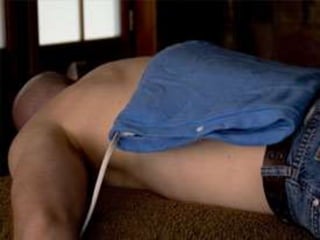
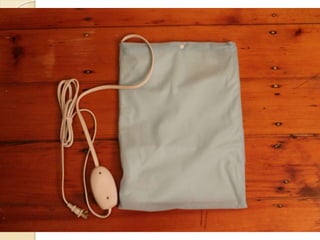
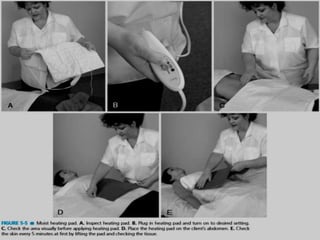
ELECTRICAL HEATING PADS
 Provide constant, even heat, are lightweight,
and can easily be molded to a body part.
 Unit composed of electrical coil enclosed
within a waterproof pad covered with cotton
or flannel cloth to absorb the perspiration &
to insulate the pad.
 Instruct the client to avoid using high setting,
to prevent burns.
 No wet dressing should be applied with
pads.
 Do not allow the client to lie directly on the
pad, because heat will not dissipate and the
client may be burned.
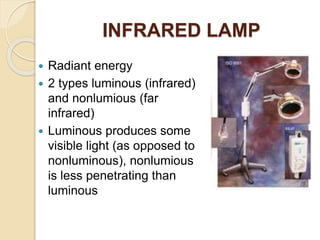
INFRARED LAMP
 Radiant energy
 2 types luminous (infrared)
and nonlumious (far
infrared)
 Luminous produces some
visible light (as opposed to
nonluminous), nonlumious
is less penetrating than
luminous
ULTRAVIOLET RAYS / LAMPS
 Transmit ultraviolet rays, which are
invisible heat rays.
 Observe the skin carefully during
and after the treatment.
 Client & therapist must use
protective goggles to shut out
reflected harmful rays.
 Duration of treatment is usually 20-
30 min
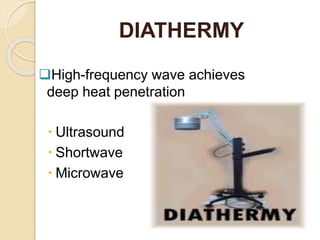
DIATHERMY
High-frequency wave achieves
deep heat penetration
 Ultrasound
 Shortwave
 Microwave
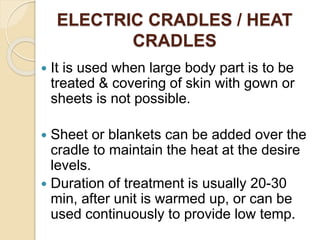
ELECTRIC CRADLES / HEAT
CRADLES
 It is used when large body part is to be
treated & covering of skin with gown or
sheets is not possible.
 Sheet or blankets can be added over the
cradle to maintain the heat at the desire
levels.
 Duration of treatment is usually 20-30
min, after unit is warmed up, or can be
used continuously to provide low temp.
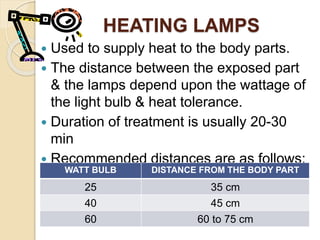
HEATING LAMPS
 Used to supply heat to the body parts.
 The distance between the exposed part
& the lamps depend upon the wattage of
the light bulb & heat tolerance.
 Duration of treatment is usually 20-30
min
 Recommended distances are as follows:
WATT BULB DISTANCE FROM THE BODY PART
25 35 cm
40 45 cm
60 60 to 75 cm
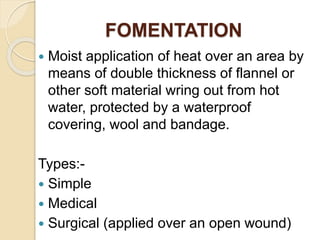
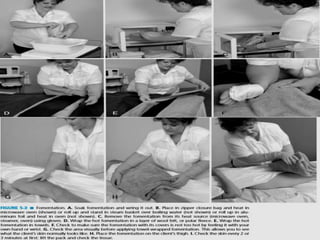
FOMENTATION
 Moist application of heat over an area by
means of double thickness of flannel or
other soft material wring out from hot
water, protected by a waterproof
covering, wool and bandage.
Types:-
 Simple
 Medical
 Surgical (applied over an open wound)
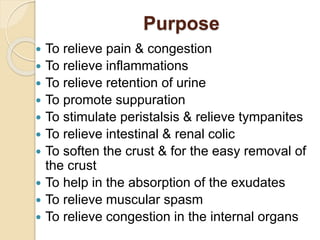
Purpose
 To relieve pain & congestion
 To relieve inflammations
 To relieve retention of urine
 To promote suppuration
 To stimulate peristalsis & relieve tympanites
 To relieve intestinal & renal colic
 To soften the crust & for the easy removal of
the crust
 To help in the absorption of the exudates
 To relieve muscular spasm
 To relieve congestion in the internal organs
TREATMENT PROCEDURE
 Have all equipment assembled at bedside
before beginning treatment
 Have the person remove clothing and
drape with a sheet.
 Explain the procedure, tell them to tell you
when it is too hot & when it isn’t hot
enough
 The duration and frequency in changing
the fomentations depend upon the desired
effect.
 Take care not to burn the person with too
 Be sure person’s feet are warm (if cold, cover with
blanket).
 Cover part to be treated with a bath towel.
 Apply fomentation. To relieve congestion, have the
fomentation cover a large area. For local effect,
make the fomentation the area size.
 Add another towel if the fomentation is too hot.
 Remove fomentation every 3-5 minutes and use cold
mitten friction or rub with cold wash cloth for 30
seconds and then dry the area.
 Reapply fomentation (3-6x in total – always finish
with cold).
 Hot fomentation - cold mitten friction and dry area -
 hot fomentation - cold mitten friction and dry
area - hot fomentation - cold mitten friction and
dry area.
 If general perspiration was produced – neutral to cool
shower or a sponge bath.
 Have person rest 30 minutes.
Contraindications
 1. Unconsciousness.
 2. Careful not to burn patient
 3. Paralyzed parts of the body.
 4. Do not use on the legs or feet of a
diabetic.
 5. Edema and varicose veins and advanced
vascular disease of the legs and feet.
 6. Malignancy.
 7. Tendency to bleed.
 8. Stomach and bowel ulcers.
Important Considerations
 Always ask if fomentations are burning the
patient. If they are too hot, put a towel
between skin and hot fomentation.
 Have extra dry towels handy to layer in
case fomentation is too hot.
 Have the room warm before you begin
treatment; make sure there are no drafts.
 Caution with the thin or aged persons and
children.
 Parts where bone is close to skin surface
are especially apt to burn.
STUPES (MEDICAL FOMENTATIONS)
 Medicine (e.g. turpentine) is applied
locally to augment the effects of the
hot compresses used.
 Commonly used to relieve
tympanites by increasing the
peristalsis & relaxing the muscle
spasm.
 Drugs used are: turpentine (1 part)
with olive oil (3 parts) for adults. For
children, turpentine (1 part) with
POULTICES (CATAPLASM)
 Application of moist heat in the
form of a soft spongy mass that
retains its heat for a varying length
of time, according to the ingredient
used.
 Starch poultices: starch and sodium
bicarbonate in the proportion of 8:1
 Duration of application is 30 to 60
min
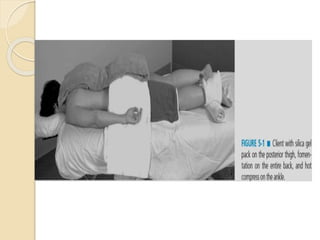
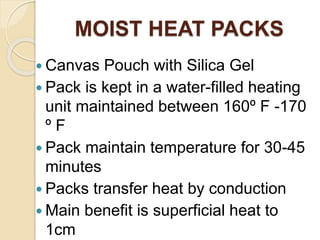
MOIST HEAT PACKS
 Canvas Pouch with Silica Gel
 Pack is kept in a water-filled heating
unit maintained between 160º F -170
º F
 Pack maintain temperature for 30-45
minutes
 Packs transfer heat by conduction
 Main benefit is superficial heat to
1cm
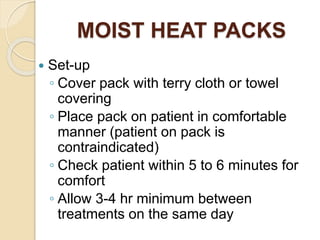
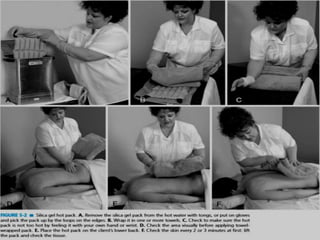
MOIST HEAT PACKS
 Set-up
◦ Cover pack with terry cloth or towel
covering
◦ Place pack on patient in comfortable
manner (patient on pack is
contraindicated)
◦ Check patient within 5 to 6 minutes for
comfort
◦ Allow 3-4 hr minimum between
treatments on the same day
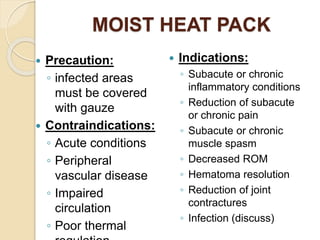
MOIST HEAT PACK
 Precaution:
◦ infected areas
must be covered
with gauze
 Contraindications:
◦ Acute conditions
◦ Peripheral
vascular disease
◦ Impaired
circulation
◦ Poor thermal
 Indications:
◦ Subacute or chronic
inflammatory conditions
◦ Reduction of subacute
or chronic pain
◦ Subacute or chronic
muscle spasm
◦ Decreased ROM
◦ Hematoma resolution
◦ Reduction of joint
contractures
◦ Infection (discuss)
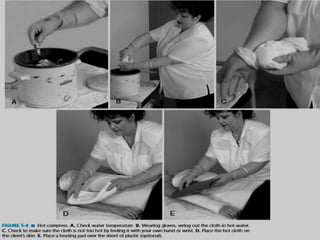
WARM COMPRESSES (GAUZE
DRESSING MOISTENED IN A
PRESCRIBED WARMED SOLUTION)
 Applied to improve circulation, relieve
edema, and fasten the suppurative process
and healing.
 For an open wound, use sterile technique.
 Solution to moisten the gauze can be
heated first to 40.5°C (105°F) or procedure
is similar to application of a wet to dry
dressing and the use of a hot water bag or a
heating pad to cover the dressing.
 Remove compress after 20–30 minutes
and redress wound.
WARM SOAKS
(LOCAL BATHS)
 Immersion of body part in warmed solution
promotes circulation, decreases edema,
increases muscle relaxation, and provides a
means to debride wounds and apply medicated
solution.
 Can also be accomplished by wrapping body
part in dressings and saturating them with
warmed solution.
 Sterile technique is generally indicated for open
wounds, such as a burn. Check agency
protocol regarding the temperature of the
solution.
 Temp. of warm water is at 105 to
110 F (40.5 to 43 C)
 Duration of treatment is usually 20
min
 Temp. of solution should be checked
frequently & additional solution is
added or the solution is replaced in
order to maintain the appropriate
PARAFFIN BATH
 A mixture of 15 to 30 ml of mineral oil to 1
pound of paraffin wax
 Temperature of 118º F to 126 ºF for upper
extremity tx.
 Temperatures of 113 º F to 121 º F for lower
extremity (circulation is less efficient)
 Paraffin can provide approx. 6x the amount of
heat as water due to low specific heat.
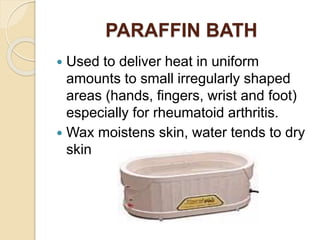
PARAFFIN BATH
 Used to deliver heat in uniform
amounts to small irregularly shaped
areas (hands, fingers, wrist and foot)
especially for rheumatoid arthritis.
 Wax moistens skin, water tends to dry
skin
PARAFFIN BATH SET UP
 Immersion Bath
◦ Clean body part
◦ Dip part quickly; allow
10 sec. to dry (turns
milky)
◦ Dip the extremity 6-12
more times
◦ Then cover with
cellophane or towel for
duration of tx (10-15
min)
◦ DO NOT touch sides or
bottom of bath (burns)
◦ After tx scrape off and
 Pack (Glove) Method
Clean extremity
◦ Immerse extremity in
bath and allow wax to dry
- repeat 7-12 more times
◦ After final withdrawal
from wax, cover
extremity with plastic
bag, or wax paper. Then
wrap in towel
◦ If indicated elevate body
part
◦ Following tx remove wax
and return to bath
PARAFFIN BATH
 Precautions
◦ Sensation is
different from
specific heat and
thermal capacity -
may cause burns
 Contraindications
◦ Open wounds (options?)
◦ Skin infections
◦ Sensory loss
◦ Peripheral vascular
disease
 Indications
◦ Subacute and chronic
inflammation
◦ limitation on ROM after
immobilization
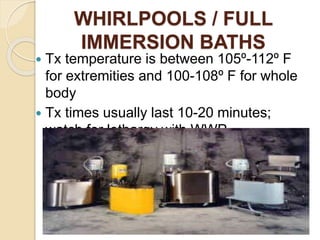
WHIRLPOOLS / FULL
IMMERSION BATHS
 Tx temperature is between 105º-112º F
for extremities and 100-108º F for whole
body
 Tx times usually last 10-20 minutes;
watch for lethargy with WWP
WARM WHIRLPOOL
 Precautions
◦ Must be connected to ground-fault
indicator
◦ Instruct patient not to turn whirlpool motor on
or off while in whirlpool
◦ Patient should be continually monitored
◦ Do not run while turbine is dry
◦ Clean tank pre and post infectious wound tx
◦ Keep clothing and bandages out of whirlpool
WARM WHIRLPOOL
 INDICATIONS
◦ Decreased ROM
◦ Subacute or
chronic
inflammatory
conditions
◦ Stiffness or
soreness
◦ Irregular shaped
areas
 CONTRAINDICATIONS
◦ Acute conditions where
water turbulence would
further irritate injured area
◦ Fever above 101º F
◦ Comprimised circulation
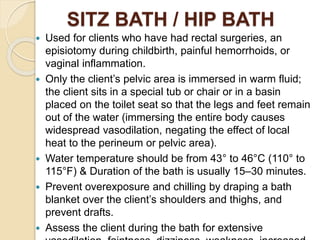
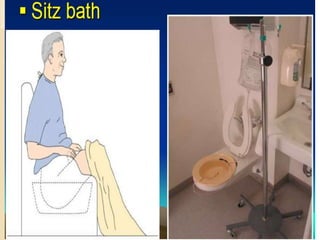
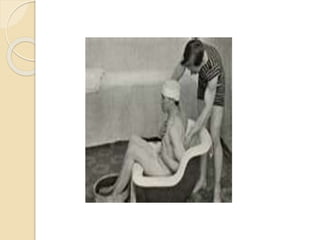
SITZ BATH / HIP BATH
 Used for clients who have had rectal surgeries, an
episiotomy during childbirth, painful hemorrhoids, or
vaginal inflammation.
 Only the client’s pelvic area is immersed in warm fluid;
the client sits in a special tub or chair or in a basin
placed on the toilet seat so that the legs and feet remain
out of the water (immersing the entire body causes
widespread vasodilation, negating the effect of local
heat to the perineum or pelvic area).
 Water temperature should be from 43° to 46°C (110° to
115°F) & Duration of the bath is usually 15–30 minutes.
 Prevent overexposure and chilling by draping a bath
blanket over the client’s shoulders and thighs, and
prevent drafts.
 Assess the client during the bath for extensive
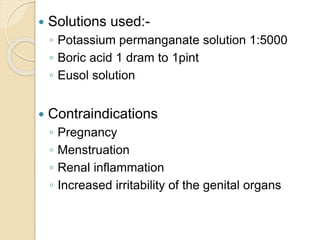
 Solutions used:-
◦ Potassium permanganate solution 1:5000
◦ Boric acid 1 dram to 1pint
◦ Eusol solution
 Contraindications
◦ Pregnancy
◦ Menstruation
◦ Renal inflammation
◦ Increased irritability of the genital organs
COUNTERIRRITANTS
 Drugs used to augment the desired
effects of the heat application to induce
vasodilatation in the superficial tissues to
affect the circulation or muscle tone in an
underlying area or distant part by reflex
action.
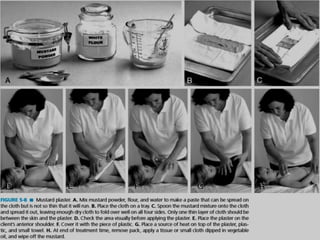
 Counterirritants include mustard,
turpentine, capsicum and liniments such
as camphor, and methyl Salicylates.
RUBEFACIENTS
 Simple form of counterirritant which
merely reddens the skin by
vasodilatation.
 Its effect is immediate and lasts only for
a short period.
 E.g. mustard plaster, Tr. iodine,
turpentine
INDICATIONS
 Relieves pain
 Prevent gangrene
 Prevent edema & reduce
inflammation
 Control hemorrhage
 Control the growth of bacteria
 Reduces the body temperature
 Anaesthetize an area
THERAPEUTIC USES OF
LOCAL COLD APPLICATIONS
Contraindications