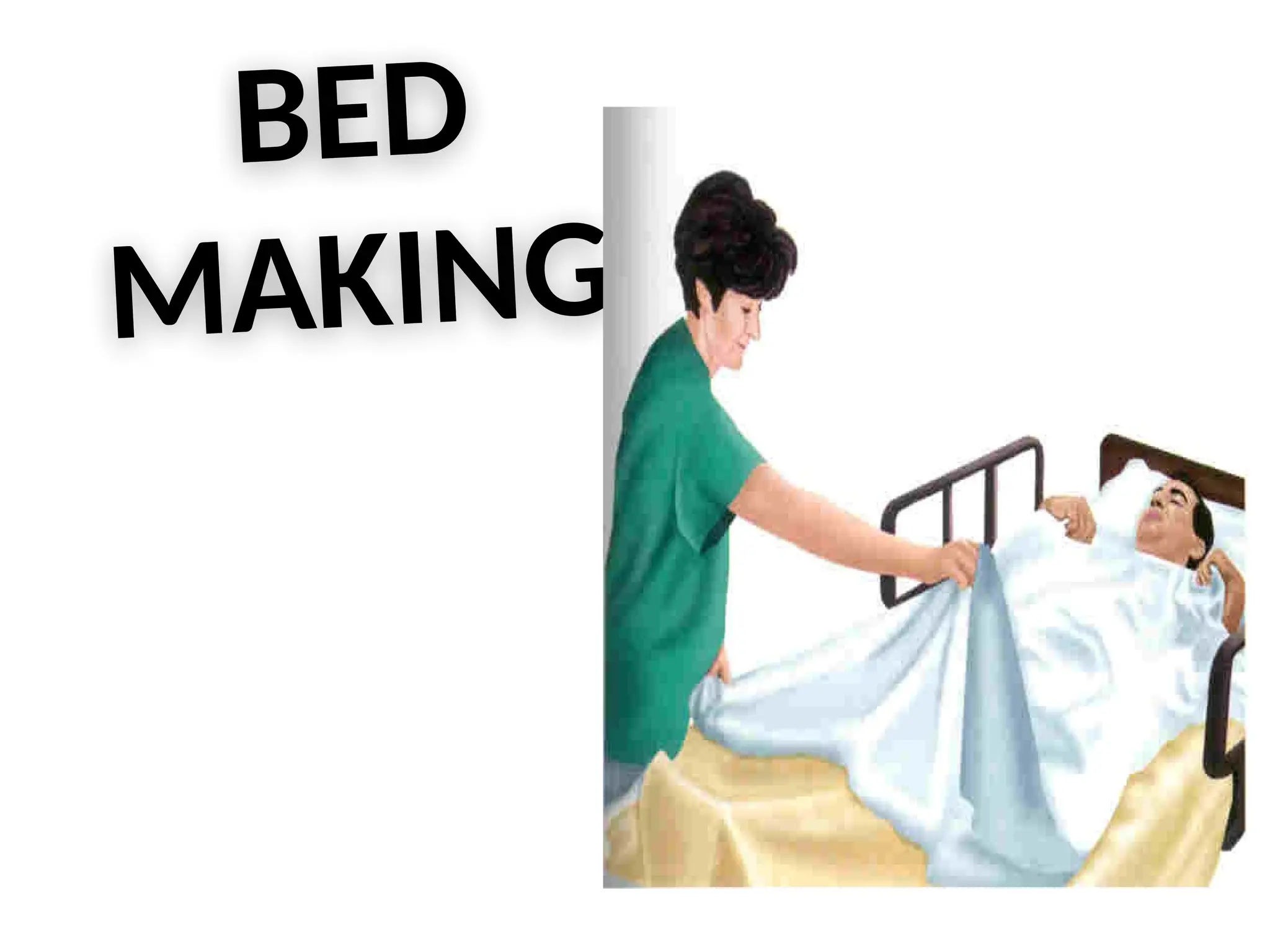
BED
MAKING
LEARNING OUTCOME
• Describe bed making
• Explain the importance of bed making
• Describe types of beds.
• Describe precautions for bed making
• Describe how each type of bed is made?
Definition of terms
• Bed Making : The technique of preparing different
types of beds, making patients / clients comfortable
in his/ her suitable position for a particular
condition.
• Fanfold : Specifically folding the edge of the sheet
used in the bed 6-8 inches outward.
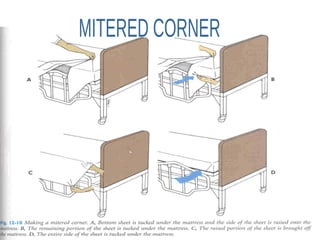
• Mitered corner : a means of anchoring sheet on
mattresses.
Definitions
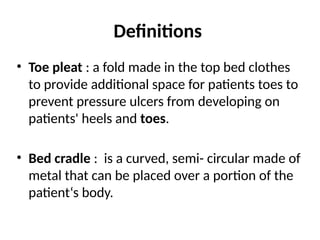
• Toe pleat : a fold made in the top bed clothes
to provide additional space for patients toes to
prevent pressure ulcers from developing on
patients' heels and toes.
• Bed cradle : is a curved, semi- circular made of
metal that can be placed over a portion of the
patient‘s body.
DESCRIPTION
• Is a process of making a bed to provide clean
and comfortable sleeping and resting
environment for the patient.
• The bed is particularly important to people who
are ill.
• It is essential for the nurse to keep the bed as
clean and comfortable as possible always.
When to make patient’s bed
• Every morning
• Usually after client’s bath
• Client is sitting in chair
• Out of room for tests
• Check throughout day and straighten linen prn
• After meals, if eating in bed, check for food
particles
• Change linen that is soiled or wet
Description
• Linen Is Changed Daily In A Hospital
• The Bed Is Usually Made In The Morning
• Linens Are Straightened During The Day If
They Become Loose Or Wrinkled
• Change The Linens Whenever They Become
Wet Or Soiled
• Check Linen For Dentures Or Other Items
Why is it so important?
Provides physical Comfort
• Provide clean and comfortable bed for the patient
• Reduce the risk of infection by maintaining a clean
environment
• Prevent bed sores by ensuring there are no
wrinkles to cause pressure sores
Psychological comfort
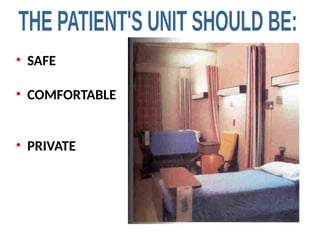
• SAFE
• COMFORTABLE
• PRIVATE
Under no circumstances do you place dirty linen
on floor, footstool, another patient’s bed or on
over the bed tables.
NOTE:
Types of Bed
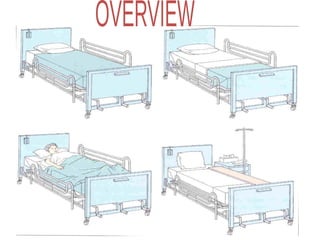
1. Unoccupied, Open, Admission
- Surgical/Post-op bed/theatre bed
2. Occupied
3. Amputation bed
4. Closed bed
5. Fracture bed
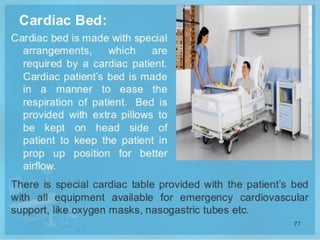
6. Cardiac bed
7. Therapeutic bed/ Blanket bed
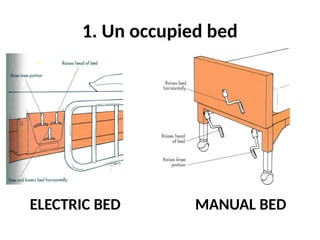
ELECTRIC BED MANUAL BED
1. Un occupied bed
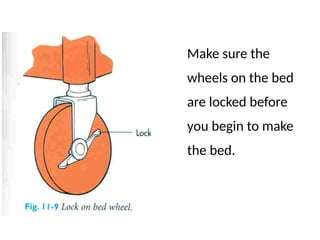
Make sure the
wheels on the bed
are locked before
you begin to make
the bed.
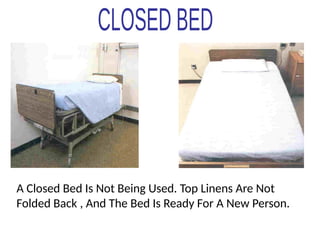
A Closed Bed Is Not Being Used. Top Linens Are Not
Folded Back , And The Bed Is Ready For A New Person.
OPEN BED
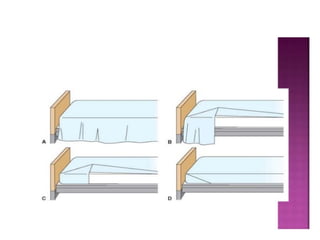
• Fanfold top sheets to foot of bed to convert
closed bed to open bed
• Fanfold means to fold sheets like accordion
pleat.
• Done to welcome a new patient or for patients
who are ambulatory or out-of-bed
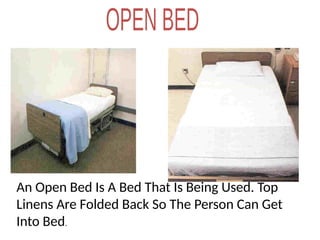
An Open Bed Is A Bed That Is Being Used. Top
Linens Are Folded Back So The Person Can Get
Into Bed.
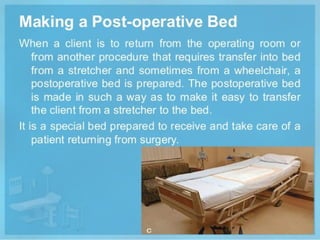
A SURGICAL BED
PURPOSE:
• To receive the post-operative client from
surgery and transfer him/her from a stretcher
to a bed
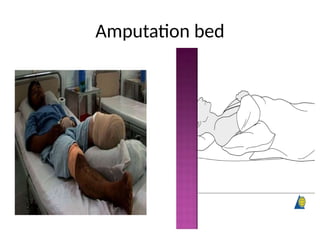
Amputation bed
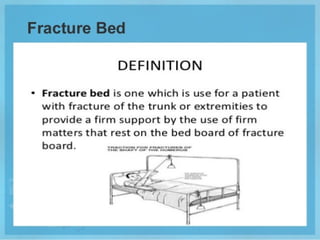
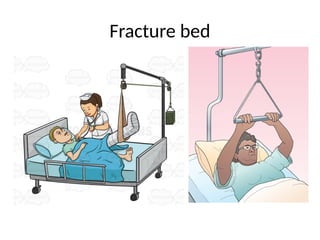
Fracture bed
Therapeutic bed
• Used to treat clients with
– severe joint contractures,
– prolonged immobility, or
– skin wounds such as pressure ulcers or severe burns.
• These beds reduce or relieve the effects of pressure
against the skins.
• These beds are more comfortable for clients who
have severe contractures because their bodies float
as if suspended in midair.
• Severe skin wounds are more likely to heal when the
effects of pressure are reduced.
Therapeutic bed
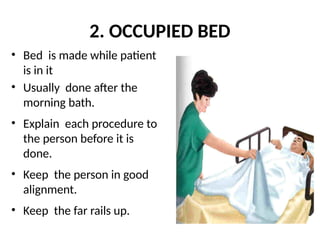
2. OCCUPIED BED
• Bed is made while patient
is in it
• Usually done after the
morning bath.
• Explain each procedure to
the person before it is
done.
• Keep the person in good
alignment.
• Keep the far rails up.
NOTE: RULES FOR BED MAKING
• Inform patient about bed making
• Have everything ready before starting to make
the bed
• If necessary, close windows
• Always work from the head of the bed except
when putting on the counter pane/bed cover
Rules for Bed making
• Use good body mechanics at
all times
• Follow standard precautions
• Always wash your hands
before handling clean linen
and after handling dirty linen
• Bring enough linen into the
person’s room
• Always keep linen clean.
Rules for Bed making
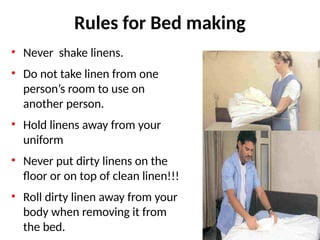
• Never shake linens.
• Do not take linen from one
person’s room to use on
another person.
• Hold linens away from your
uniform
• Never put dirty linens on the
floor or on top of clean linen!!!
• Roll dirty linen away from your
body when removing it from
the bed.
Rules for Bed making
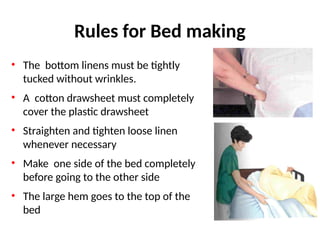
• The bottom linens must be tightly
tucked without wrinkles.
• A cotton drawsheet must completely
cover the plastic drawsheet
• Straighten and tighten loose linen
whenever necessary
• Make one side of the bed completely
before going to the other side
• The large hem goes to the top of the
bed
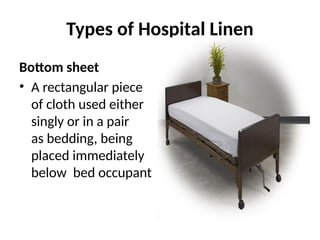
Types of Hospital Linen
Bottom sheet
• A rectangular piece
of cloth used either
singly or in a pair
as bedding, being
placed immediately
below bed occupant
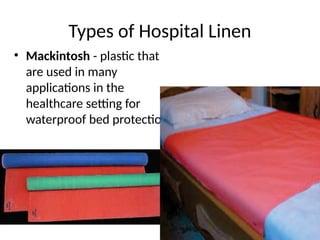
Types of Hospital Linen
• Mackintosh - plastic that
are used in many
applications in the
healthcare setting for
waterproof bed protection.
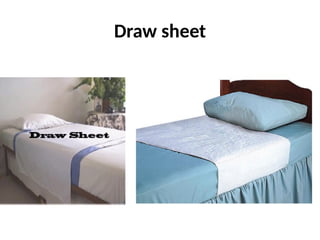
Draw sheet
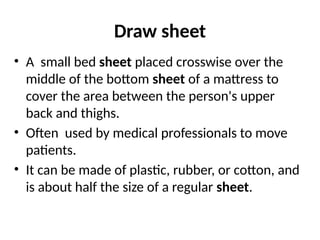
• A small bed sheet placed crosswise over the
middle of the bottom sheet of a mattress to
cover the area between the person's upper
back and thighs.
• Often used by medical professionals to move
patients.
• It can be made of plastic, rubber, or cotton, and
is about half the size of a regular sheet.
Draw sheet
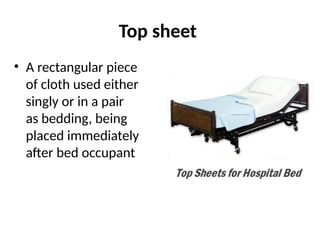
Top sheet
• A rectangular piece
of cloth used either
singly or in a pair
as bedding, being
placed immediately
after bed occupant
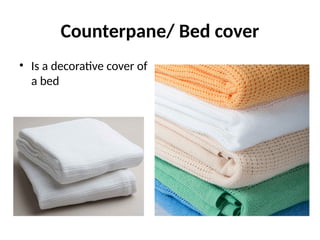
Counterpane/ Bed cover
• Is a decorative cover of
a bed
BED ACCESSORIES
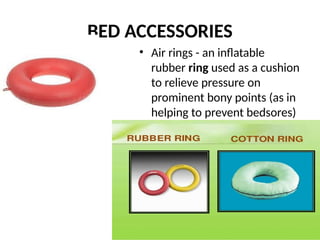
• Air rings - an inflatable
rubber ring used as a cushion
to relieve pressure on
prominent bony points (as in
helping to prevent bedsores)
BED ACCESSORIES
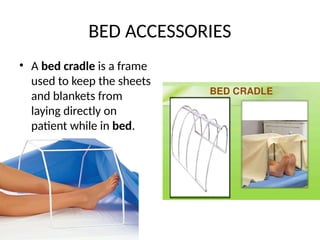
• A bed cradle is a frame
used to keep the sheets
and blankets from
laying directly on
patient while in bed.
Bed accessories
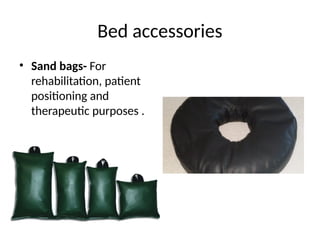
• Sand bags- For
rehabilitation, patient
positioning and
therapeutic purposes .
Bed accessories
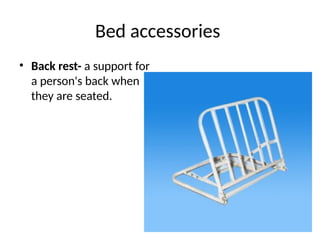
• Back rest- a support for
a person's back when
they are seated.
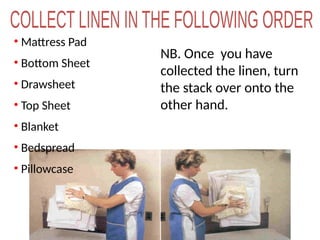
• Mattress Pad
• Bottom Sheet
• Drawsheet
• Top Sheet
• Blanket
• Bedspread
• Pillowcase
NB. Once you have
collected the linen, turn
the stack over onto the
other hand.
• Raise the bed to a comfortable working height.
• Wash your hands before and after every patient contact
• Gather all the equipment needed
• Roll the soiled linen away from your body
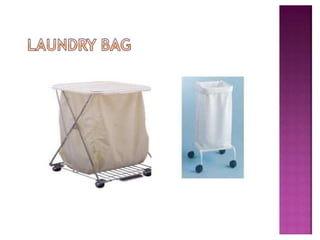
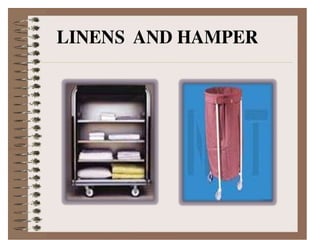
• Place the soiled linen in the linen bag or linen hamper.
And never on the floor!!!!
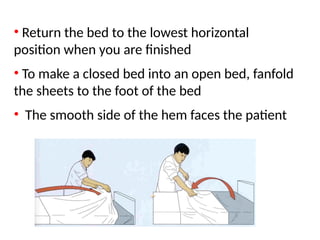
• Return the bed to the lowest horizontal
position when you are finished
• To make a closed bed into an open bed, fanfold
the sheets to the foot of the bed
• The smooth side of the hem faces the patient
Bed making procedure
A. UNOCCUPIED/ADMISSION BED.
REQUIREMENTS
A trolley containing :
• 2 bed sheets
• 1 mackintosh
• 1 Draw sheet
• 1 Blanket
• Bed cover/counterpane
• Pillow and pillow case
• Bag/container for dirty linen
• Explain procedure to patient
• Check if the bed is in good working
condition
METHOD
• Wash hands
• Place the bottom sheet in the middle of the bed
and unfold right side up
• Tuck in at the top bottom and sides pulling
tightly to ensure there are no wrinkles. When
tucking in make mitered corners.
• Place mackintosh across middle of the bed and
tuck in both sides
• Cover mackintosh with draw sheet and tuck in
both sides
• Place top sheet wrong side up and spread full
length on top of the mattress, fold back the top
30cm and leave enough loosely to tuck in at the
bottom
• Spread the blanket on top of the top sheet and
leave it hanging loose
• Fanfold or pie fold top linens
• Tuck top linens securely at the foot of the
mattress and make mitered corners
• Place the bed cover on top of top linen
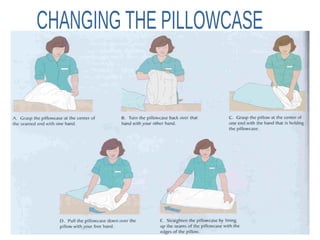
• Cover the pillow with pillow case and place in
position
NOTE
• Place dirty linen in linen container or bag
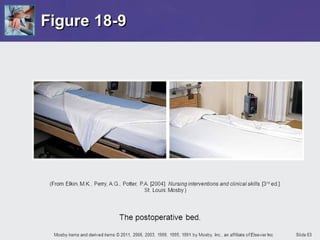
B. THEATRE BED
Requirements :
• Same as of admission bed with extras
• Post operative tray
• Vomitus bowl with lid
• Oxygen apparatus
• Suction machine and any other post operative
apparatus as necessary
METHOD
• Make as of admission/unoccupied bed from
step one to six then
• Remove pillows
• Fold the top linen in the three longitudinally
then make a pack by folding in three
transversely make sure the top end is
uppermost when the pack is complete
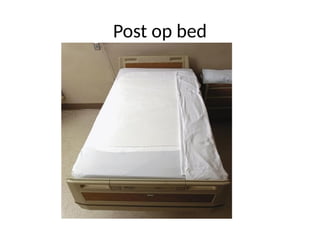
• Place the pack at the bottom of bed ready for
use
• Have post operative tray and vomitus bowl at
hand
• Place all other post operative apparatus at bed
side
Post op bed
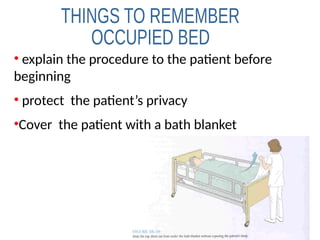
• explain the procedure to the patient before
beginning
• protect the patient’s privacy
•Cover the patient with a bath blanket
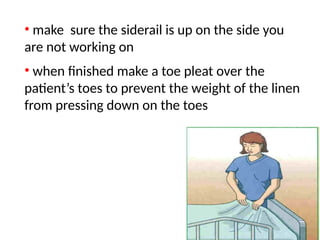
• make sure the siderail is up on the side you
are not working on
• when finished make a toe pleat over the
patient’s toes to prevent the weight of the linen
from pressing down on the toes
C. OCCUPIED BED
REQUIREMENTS
• Are as for admission bed with the following
additions depending on patient’s conditions and
these include
1.Back rest
2.Extra pillows
3.Air ring
4.Sand bags
5.Dressing towels
6. Dressing mackintosh
7. Bed cradle
8. Clean linen
METHOD
A. CHANGING THE BOTTOM SHEET
• This method is used for patients who are
nursed in an upright position e.g. heart
position.
• Preparation is as of other types of bed making
1. Explain the procedure to the patient
2. Close the windows
3. Screen the bed
4. Wash hands and put on clean gloves
5. Place clean linen on one stool at the foot of the
bed and the soiled linen container beside the
stool chair
6. Fold the clean sheet across in three
7. Strip the bed linen as usual leaving the sheet
covering the patient (blanket and sheet on cold
day)
8.Both nurses lift the patient carefully down the
bed off the draw sheet
9.One nurse supports the patient while the other
removes the draw sheet and mackintosh and
then rolls the dirty bottom sheet down as far as
the patient’s back.
• the same nurse puts in clean sheet tucking it in
at the top and on her side as far as the dirty
sheet. She then puts in mackintosh and draw
sheet.
10. While the first nurse supports the patient, the
other nurse does the same on the other side
11. Replace the back rest, pillows, and air ring
where necessary
12.Both nurses lift the patient back up the bed
and make sure the patient is comfortable
13.Both nurses working in unison then roll the
soiled sheet to the bottom of the bed from
under the patient’s legs and put it in the soiled
linen container
14.Remove crumbs and creases on the mattress,
pull the clean sheet down to the bottom of the
bed and tuck and miter the corners, straighten
and tuck in mackintosh and draw sheet
15.Put on the top bed covers as usual
16.Leave room for free movement of legs
17.Place sand bags in position
B. CHANGING FROM SIDE TO SIDE
METHOD:
1. Make as for changing bottom sheet from top to
bottom from step one to four
2. Fold the clean sheet length wise and put it on
the stool
3. Strip the top bed linen as usual, leaving the
patient covered with a sheet on a hot day.
Remove all but one pillow
4. Place the patient’s arm and legs in position for
turning and move the pillow to one side to
support the head.
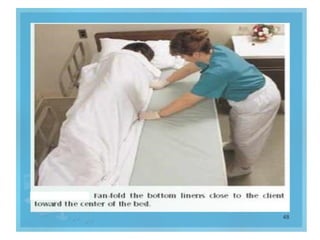
5. Roll the patient onto one side
6. The second nurse then rolls the draw sheet
and mackintosh and then the bottom sheet
closely up to the patient’s back
7. Put the clean sheet under the patient and tuck
it in at the top side and bottom
8. Put the clean mackintosh and draw sheet in
position and tuck them in at one side and then
roll closely up to the patient’s back
9. Roll the patient over the already made side
and support him while the other nurse
removes dirty linen and puts it in the soiled
linen container
10.Unroll the clean linen, pull it tightly and tuck in
11.Remove the blanket if present, straight sheet
and then replace linen
12.Leave the patient comfortable in appropriate
position
13.Remove the screens and dirty linen container
Remember
• To make bed, position is elevated
• When completed, bed is lowered
• If occupied, patient comfort & safety
• Soiled linen away from uniform
• Gloves prn
• Bath before making bed if occupied
Reference
• Nurses and Midwives Council of Malawi, 2008.
Procedure manual for General Nursing.

hOSPITAL BED MAKING PROCEDURE GUIDELINE

  • 1.
  • 2.
    LEARNING OUTCOME • Describebed making • Explain the importance of bed making • Describe types of beds. • Describe precautions for bed making • Describe how each type of bed is made?
  • 3.
    Definition of terms •Bed Making : The technique of preparing different types of beds, making patients / clients comfortable in his/ her suitable position for a particular condition. • Fanfold : Specifically folding the edge of the sheet used in the bed 6-8 inches outward. • Mitered corner : a means of anchoring sheet on mattresses.
  • 4.
    Definitions • Toe pleat: a fold made in the top bed clothes to provide additional space for patients toes to prevent pressure ulcers from developing on patients' heels and toes. • Bed cradle : is a curved, semi- circular made of metal that can be placed over a portion of the patient‘s body.
  • 5.
    DESCRIPTION • Is aprocess of making a bed to provide clean and comfortable sleeping and resting environment for the patient. • The bed is particularly important to people who are ill. • It is essential for the nurse to keep the bed as clean and comfortable as possible always.
  • 6.
    When to makepatient’s bed • Every morning • Usually after client’s bath • Client is sitting in chair • Out of room for tests • Check throughout day and straighten linen prn • After meals, if eating in bed, check for food particles • Change linen that is soiled or wet
  • 7.
    Description • Linen IsChanged Daily In A Hospital • The Bed Is Usually Made In The Morning • Linens Are Straightened During The Day If They Become Loose Or Wrinkled • Change The Linens Whenever They Become Wet Or Soiled • Check Linen For Dentures Or Other Items
  • 8.
    Why is itso important? Provides physical Comfort • Provide clean and comfortable bed for the patient • Reduce the risk of infection by maintaining a clean environment • Prevent bed sores by ensuring there are no wrinkles to cause pressure sores Psychological comfort
  • 9.
  • 10.
    Under no circumstancesdo you place dirty linen on floor, footstool, another patient’s bed or on over the bed tables. NOTE:
  • 12.
    Types of Bed 1.Unoccupied, Open, Admission - Surgical/Post-op bed/theatre bed 2. Occupied 3. Amputation bed 4. Closed bed 5. Fracture bed 6. Cardiac bed 7. Therapeutic bed/ Blanket bed
  • 13.
    ELECTRIC BED MANUALBED 1. Un occupied bed
  • 14.
    Make sure the wheelson the bed are locked before you begin to make the bed.
  • 15.
    A Closed BedIs Not Being Used. Top Linens Are Not Folded Back , And The Bed Is Ready For A New Person.
  • 16.
    OPEN BED • Fanfoldtop sheets to foot of bed to convert closed bed to open bed • Fanfold means to fold sheets like accordion pleat. • Done to welcome a new patient or for patients who are ambulatory or out-of-bed
  • 17.
    An Open BedIs A Bed That Is Being Used. Top Linens Are Folded Back So The Person Can Get Into Bed.
  • 18.
    A SURGICAL BED PURPOSE: •To receive the post-operative client from surgery and transfer him/her from a stretcher to a bed
  • 22.
  • 24.
  • 26.
    Therapeutic bed • Usedto treat clients with – severe joint contractures, – prolonged immobility, or – skin wounds such as pressure ulcers or severe burns. • These beds reduce or relieve the effects of pressure against the skins. • These beds are more comfortable for clients who have severe contractures because their bodies float as if suspended in midair. • Severe skin wounds are more likely to heal when the effects of pressure are reduced.
  • 27.
  • 29.
    2. OCCUPIED BED •Bed is made while patient is in it • Usually done after the morning bath. • Explain each procedure to the person before it is done. • Keep the person in good alignment. • Keep the far rails up.
  • 30.
    NOTE: RULES FORBED MAKING • Inform patient about bed making • Have everything ready before starting to make the bed • If necessary, close windows • Always work from the head of the bed except when putting on the counter pane/bed cover
  • 31.
    Rules for Bedmaking • Use good body mechanics at all times • Follow standard precautions • Always wash your hands before handling clean linen and after handling dirty linen • Bring enough linen into the person’s room • Always keep linen clean.
  • 32.
    Rules for Bedmaking • Never shake linens. • Do not take linen from one person’s room to use on another person. • Hold linens away from your uniform • Never put dirty linens on the floor or on top of clean linen!!! • Roll dirty linen away from your body when removing it from the bed.
  • 33.
    Rules for Bedmaking • The bottom linens must be tightly tucked without wrinkles. • A cotton drawsheet must completely cover the plastic drawsheet • Straighten and tighten loose linen whenever necessary • Make one side of the bed completely before going to the other side • The large hem goes to the top of the bed
  • 34.
    Types of HospitalLinen Bottom sheet • A rectangular piece of cloth used either singly or in a pair as bedding, being placed immediately below bed occupant
  • 35.
    Types of HospitalLinen • Mackintosh - plastic that are used in many applications in the healthcare setting for waterproof bed protection.
  • 36.
    Draw sheet • Asmall bed sheet placed crosswise over the middle of the bottom sheet of a mattress to cover the area between the person's upper back and thighs. • Often used by medical professionals to move patients. • It can be made of plastic, rubber, or cotton, and is about half the size of a regular sheet.
  • 37.
  • 38.
    Top sheet • Arectangular piece of cloth used either singly or in a pair as bedding, being placed immediately after bed occupant
  • 39.
    Counterpane/ Bed cover •Is a decorative cover of a bed
  • 41.
    BED ACCESSORIES • Airrings - an inflatable rubber ring used as a cushion to relieve pressure on prominent bony points (as in helping to prevent bedsores)
  • 42.
    BED ACCESSORIES • Abed cradle is a frame used to keep the sheets and blankets from laying directly on patient while in bed.
  • 43.
    Bed accessories • Sandbags- For rehabilitation, patient positioning and therapeutic purposes .
  • 44.
    Bed accessories • Backrest- a support for a person's back when they are seated.
  • 45.
    • Mattress Pad •Bottom Sheet • Drawsheet • Top Sheet • Blanket • Bedspread • Pillowcase NB. Once you have collected the linen, turn the stack over onto the other hand.
  • 46.
    • Raise thebed to a comfortable working height. • Wash your hands before and after every patient contact • Gather all the equipment needed • Roll the soiled linen away from your body • Place the soiled linen in the linen bag or linen hamper. And never on the floor!!!!
  • 47.
    • Return thebed to the lowest horizontal position when you are finished • To make a closed bed into an open bed, fanfold the sheets to the foot of the bed • The smooth side of the hem faces the patient
  • 48.
  • 49.
    A. UNOCCUPIED/ADMISSION BED. REQUIREMENTS Atrolley containing : • 2 bed sheets • 1 mackintosh • 1 Draw sheet • 1 Blanket • Bed cover/counterpane • Pillow and pillow case • Bag/container for dirty linen
  • 51.
    • Explain procedureto patient • Check if the bed is in good working condition
  • 52.
    METHOD • Wash hands •Place the bottom sheet in the middle of the bed and unfold right side up • Tuck in at the top bottom and sides pulling tightly to ensure there are no wrinkles. When tucking in make mitered corners.
  • 53.
    • Place mackintoshacross middle of the bed and tuck in both sides • Cover mackintosh with draw sheet and tuck in both sides • Place top sheet wrong side up and spread full length on top of the mattress, fold back the top 30cm and leave enough loosely to tuck in at the bottom
  • 54.
    • Spread theblanket on top of the top sheet and leave it hanging loose • Fanfold or pie fold top linens • Tuck top linens securely at the foot of the mattress and make mitered corners • Place the bed cover on top of top linen • Cover the pillow with pillow case and place in position
  • 55.
    NOTE • Place dirtylinen in linen container or bag
  • 59.
    B. THEATRE BED Requirements: • Same as of admission bed with extras • Post operative tray • Vomitus bowl with lid • Oxygen apparatus • Suction machine and any other post operative apparatus as necessary
  • 60.
    METHOD • Make asof admission/unoccupied bed from step one to six then • Remove pillows • Fold the top linen in the three longitudinally then make a pack by folding in three transversely make sure the top end is uppermost when the pack is complete
  • 61.
    • Place thepack at the bottom of bed ready for use • Have post operative tray and vomitus bowl at hand • Place all other post operative apparatus at bed side
  • 62.
  • 63.
    • explain theprocedure to the patient before beginning • protect the patient’s privacy •Cover the patient with a bath blanket
  • 64.
    • make surethe siderail is up on the side you are not working on • when finished make a toe pleat over the patient’s toes to prevent the weight of the linen from pressing down on the toes
  • 65.
    C. OCCUPIED BED REQUIREMENTS •Are as for admission bed with the following additions depending on patient’s conditions and these include 1.Back rest 2.Extra pillows 3.Air ring 4.Sand bags 5.Dressing towels
  • 66.
    6. Dressing mackintosh 7.Bed cradle 8. Clean linen
  • 67.
    METHOD A. CHANGING THEBOTTOM SHEET • This method is used for patients who are nursed in an upright position e.g. heart position. • Preparation is as of other types of bed making
  • 68.
    1. Explain theprocedure to the patient 2. Close the windows 3. Screen the bed 4. Wash hands and put on clean gloves 5. Place clean linen on one stool at the foot of the bed and the soiled linen container beside the stool chair 6. Fold the clean sheet across in three
  • 69.
    7. Strip thebed linen as usual leaving the sheet covering the patient (blanket and sheet on cold day) 8.Both nurses lift the patient carefully down the bed off the draw sheet 9.One nurse supports the patient while the other removes the draw sheet and mackintosh and then rolls the dirty bottom sheet down as far as the patient’s back.
  • 70.
    • the samenurse puts in clean sheet tucking it in at the top and on her side as far as the dirty sheet. She then puts in mackintosh and draw sheet. 10. While the first nurse supports the patient, the other nurse does the same on the other side
  • 71.
    11. Replace theback rest, pillows, and air ring where necessary 12.Both nurses lift the patient back up the bed and make sure the patient is comfortable 13.Both nurses working in unison then roll the soiled sheet to the bottom of the bed from under the patient’s legs and put it in the soiled linen container
  • 72.
    14.Remove crumbs andcreases on the mattress, pull the clean sheet down to the bottom of the bed and tuck and miter the corners, straighten and tuck in mackintosh and draw sheet 15.Put on the top bed covers as usual
  • 73.
    16.Leave room forfree movement of legs 17.Place sand bags in position
  • 74.
    B. CHANGING FROMSIDE TO SIDE METHOD: 1. Make as for changing bottom sheet from top to bottom from step one to four 2. Fold the clean sheet length wise and put it on the stool 3. Strip the top bed linen as usual, leaving the patient covered with a sheet on a hot day. Remove all but one pillow
  • 75.
    4. Place thepatient’s arm and legs in position for turning and move the pillow to one side to support the head. 5. Roll the patient onto one side 6. The second nurse then rolls the draw sheet and mackintosh and then the bottom sheet closely up to the patient’s back
  • 77.
    7. Put theclean sheet under the patient and tuck it in at the top side and bottom 8. Put the clean mackintosh and draw sheet in position and tuck them in at one side and then roll closely up to the patient’s back
  • 78.
    9. Roll thepatient over the already made side and support him while the other nurse removes dirty linen and puts it in the soiled linen container 10.Unroll the clean linen, pull it tightly and tuck in 11.Remove the blanket if present, straight sheet and then replace linen
  • 79.
    12.Leave the patientcomfortable in appropriate position 13.Remove the screens and dirty linen container
  • 80.
    Remember • To makebed, position is elevated • When completed, bed is lowered • If occupied, patient comfort & safety • Soiled linen away from uniform • Gloves prn • Bath before making bed if occupied
  • 82.
    Reference • Nurses andMidwives Council of Malawi, 2008. Procedure manual for General Nursing.