
 Comfort is a state of freedom from pain,
discomfort, tension & anxiety.
 Comfort is define as “the contented
enjoyment in physical or mental well-being,
freedom from pain or trouble & anxiety.”
 Discomfort is define as want of comfort or
ease due to client or annoyance.
 The alert nurse quickly sense when the
client is uncomfortable, sometimes
before he is aware of it himself.
 The skilful nurse knows may simple
ways of easing discomfort & does not
Think of a sedation first.
 Pain
 Restriction of movements due to weakness
 Wrinkled, soiled & wet bed sheets
 Improper arrangement of pillows
 Delayed or inadequate attention to meet the
personal need such as cleanliness,
elimination, nourishment etc.
 Lack of exercise
 Extreme temperature
 Inadequate ventilation
 Indigestion, irregular bowel movements
 Uncomfortable position
 Too bright light & glares
 Lack of sleep
 Noise
 Fear & anxiety
 Insecurity feelings
 Interruption of daily routines
Identification of the nursing problems
Meeting the emergencies
Daily care
 Even through two persons suffer from same type
of problem/disease, the nursing problems in the
two persons will be different.
 Some of the nursing problems are:-
 Problems related to respiratory difficulty
 Problems related to body temperature
 Problems related to consciousness
 Problems related to cardiac function
 Problems related to appetite & digestion
 Problems related to activity
 Problems related to elimination
 Problems related to mental activity
 Other Problems
 Any nursing problem which demands
immediate attention must be dealt with
immediately.
 Follow ABC
 The problem of hemorrhage, shock & pain
may become worse if immediate attention is
not given
 Certain procedure are carried out routinely in
order to make the client comfortable. Such as
 Morning Care
Evening Care
Night Care
 Mechanical service or comfort devices are
invented articles which would add to comfort of
patient when used in appropriate manner.
 These devices relive the discomfort & help in
maintaining correct posture.
 Pillows
 Back Rest
 Knee Rest
 Rolls
 Foot Rests/Foot Boards
 Sand Bags
 Air & Water Mattress
 Rings
 Bed Cradle
 Bed Blocks
 Air Cushion
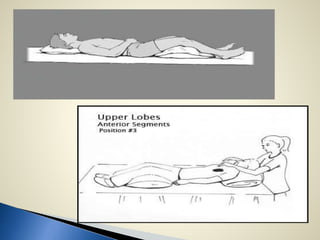
Pillows are used to give comfortable
position to the patient.
These are mostly used to support various
body part.
 Purposes:-
To maintain proper body alignment.
To support body parts in good alignment.
Help to reduce pressure.
It can be folded, rolled or tucked firmly
against the body to maintain position.
It is used to support head, neck, arms, legs &
parts of the back.
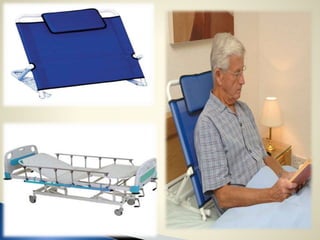
It is a mechanical device which provide a
suitable support & rest for the back of
patient in sitting position.
Purposes:-
To support back.
To facilitate breathing.
It is given especially for heart & asthma
patient even in post operative period.
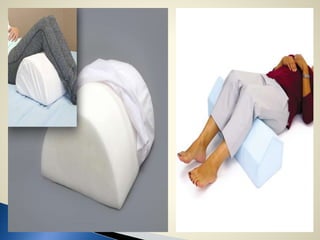
 It may be substituted by a pillow.
 It gives relaxation & thus relieves pain
on abdominal muscles & on tendons
beneath the knees.
 Many doctors do not allow knee pillows
because of the fear of thrombus
formation & pulmonary embolism.
 Change of position at frequent intervals
is necessary.
Hand rolls are made of cloth that rolled into a
cylinder about 4-5 inches long & 2-3 inches in
diameter & stiffed firmly.
 Purposes:-
To keep the fingers free being in a tight fist.
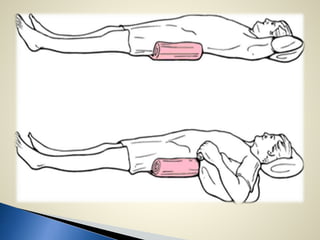
Thigh rolls are made by folding a sheet to
the desired length of 2-3 feet & then rolled
into a tight cylinder. Thigh rolls are used to
support hips & thighs, preventing them from
outward rotation & keeping the feet in
alignment in case of paralysis, fracture of
femur & hip surgery.
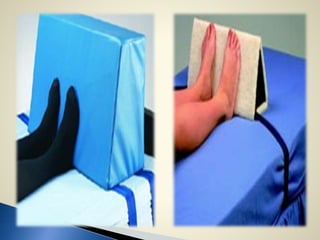
These are mechanical device used to give
rest to feet. Sand bags or Foot board may
be used.
Purposes:-
To maintain the normal position of
feet.
To promote comfort.
To prevent foot drop.
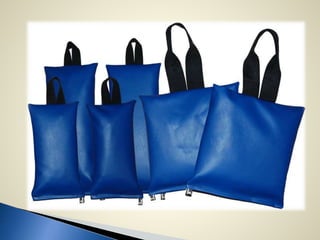
These are canvas rubber or plastic bags filled
with sand. These are used to immobilize a
part.
 Purposes:-
To relive discomfort.
Used to support body part.
Used to immobilize the body part.
Used to support as in fracture bones.
To prevent foot drop or wrist drop.
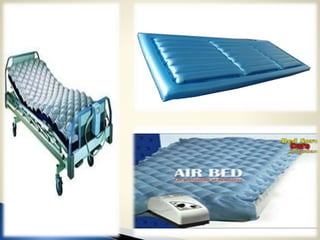
These are used for very thin & obese patients
& those who are prone to get pressure sores. It
helps in equal distribution of the pressure
exerted on the body.
 Purposes:-
To improve circulation.
To provide comfort.
To prevent pressure sore.
Used in very thin or obese patients &
chronic bed ridden patients.
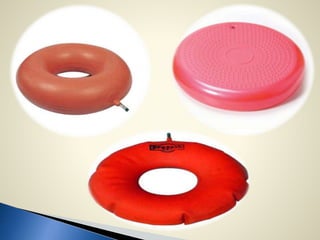
Air rings are made of rubber.
The air rings is inflated about half full,
Tested for leakage, covered & than placed under the
patient’s hips in such a way that the valve is on one side
& not in contact with body.
Cotton are made wrapped with bandage. These are
placed under bony prominences such as heels &
fastened in place if necessary.
 Purposes:-
To lift the hip from bed to prevent bed sores.
To prevent direct pressure on bony prominences.
To improve circulation
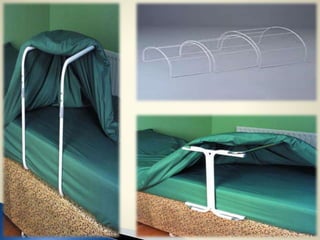
These very widely in size & in material.
These are of wooden, metal or electronic.
The bed cradle support & take off the weight of top
bedding.
These are semicircular in shape.
 Purposes:-
To prevent the top cloth if coming in contact with the
patient especially burn patient.
To apply heat in case of drying plaster casts.
Electronic bed cradles are used to supply the desired
warm in case of shock.
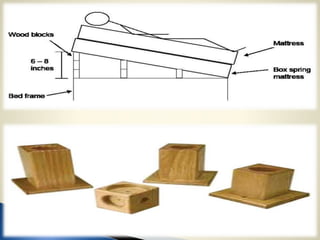
These are made-up of wood. It may be high or
low. These are placed under the foot of the
bed for various reasons.
 Purposes:-
To prevent shock.
To arrest hemorrhage.
To retain enema
After spinal anesthesia
After tonsillectomy
To provide traction.
To position in postural drainage.
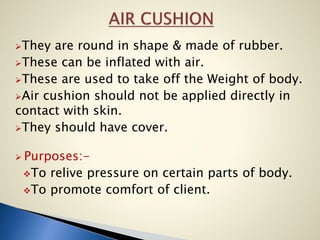
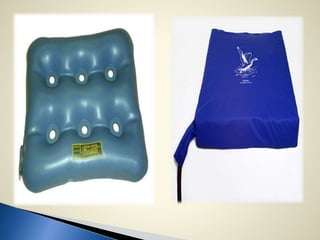
They are round in shape & made of rubber.
These can be inflated with air.
These are used to take off the Weight of body.
Air cushion should not be applied directly in
contact with skin.
They should have cover.
 Purposes:-
To relive pressure on certain parts of body.
To promote comfort of client.
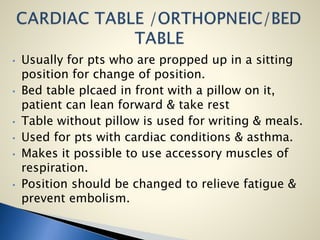
• Usually for pts who are propped up in a sitting
position for change of position.
• Bed table plcaed in front with a pillow on it,
patient can lean forward & take rest
• Table without pillow is used for writing & meals.
• Used for pts with cardiac conditions & asthma.
• Makes it possible to use accessory muscles of
respiration.
• Position should be changed to relieve fatigue &
prevent embolism.
• Is a support that is placed under patients
mattress to give added rigidity to the mattress.
• Usually made of wood/canvas & is constructed
to fit the standard hospital bed.
• Are bars positioned along the sides of the length
of the bed.
• Ensure patient’s safety & are useful for
increasing mobility.
• Provide assistance in rolling from side to side or
sitting up in bed.
• Is a triangular shaped pillow made of heavy foam.
• Used to maintain legs in abduction following
total hip replacement surgery.
Comfort Devices