“One of the features which is
thought to distinguish man
from other animals is his
desire to take medicines”
(Sir William Osler, 1849-1919)
PHARMACOLOGY
• The study of the effects of drugs on living
organisms.
• A drug is any substance that
alters physiological function,
with the potential for affecting
health.
• Medication may be defined as a
substance used to promote
health, to prevent illness, to
diagnose, to alleviate or cure
diseases.
• A medication is a drug
administered for its
therapeutic effects.
• Thus, all medications are
drugs, but not all drugs are
medications.
DEFINITIONS
• Pharmacology:- is the science of the interaction of
chemicals with living systems at all levels.
• Pharmacokinetics:- sometimes abbreviated as PK,
(from Ancient Greek pharmakon "drug“
and kinetikos "to do with motion"; ) investigates the
effects of the biological system on drugs (absorption,
distribution, elimination…) or what the body does to
the drug.
• Pharmacodynamics:- describes the fundamental
action of a drug on a physiological, biochemical or
molecular level or what the drug does to the body.
• Pharmacogenetics:- examines the
effects of genetic factors to variations in
the drug response (“Asian Flush”, Codeine
“resistance”)
• Toxicology:- studies the undesirable
effects of chemicals on living systems
(includes poisons, antidotes and unwanted
side effects of drugs)
• Pharmacy:- is the art of preparing,
compounding and dispensing chemicals
for medicinal use
Definitions
• Prophylactic refers to a drug or procedure aimed to
prevent disease
• Palliative refers to a drug or procedure aimed to relieve
symptoms
• Therapeutic refers to a drug or procedure aimed to
cure disease
• Tolerance is the increased resistance to the usual
effects of an established dose of a particular drug
• Effective dose (ED50):- is the concentration at which
50% of the subject show a predefined response.
• Efficacy:- refers to the inherent capability of a drug to
produce a desired effect.
• Potency:- compares the relative effectiveness of drugs
to produce a desired effect e.g. Drug A requires fewer
milligrams than Drug B to achieve the same
pharmacological response.
--> Drug A has the higher potency, yet, both drugs
have the same efficacy.
Definitions
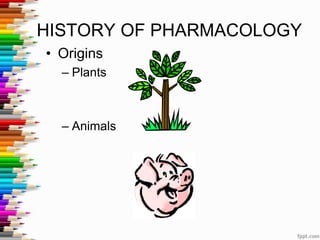
HISTORY OF PHARMACOLOGY
• Origins
– Plants
– Animals
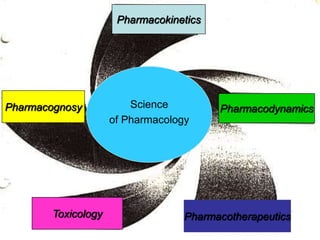
Pharmacognosy
Pharmacokinetics
Pharmacodynamics
PharmacotherapeuticsToxicology
Science
of Pharmacology
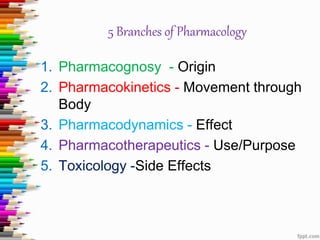
5 Branches of Pharmacology
1. Pharmacognosy - Origin
2. Pharmacokinetics - Movement through
Body
3. Pharmacodynamics - Effect
4. Pharmacotherapeutics - Use/Purpose
5. Toxicology -Side Effects
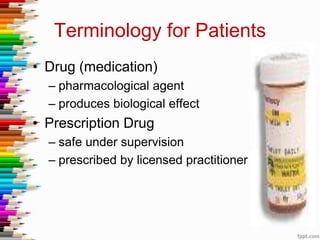
Terminology for Patients
• Drug (medication)
– pharmacological agent
– produces biological effect
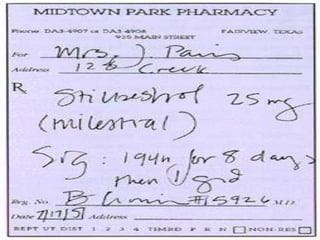
• Prescription Drug
– safe under supervision
– prescribed by licensed practitioner
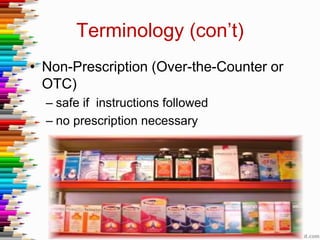
Terminology (con’t)
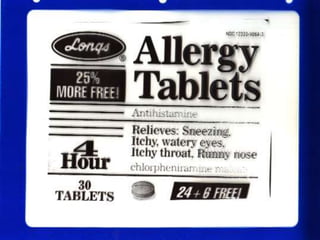
• Non-Prescription (Over-the-Counter or
OTC)
– safe if instructions followed
– no prescription necessary
Terminology (con’t)
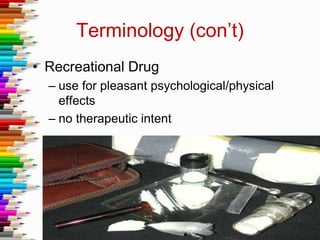
• Recreational Drug
– use for pleasant psychological/physical
effects
– no therapeutic intent
Terms Relating to Drug Action
• ONSET OF ACTION (the time it takes for
the body to respond to a drug after
administration).
• PEAK PLASMA LEVEL (the highest
blood concentration of a single drug dose
before the elimination rate equals the rate
of absorption).
• PLATEAU (maintenance of a certain
level).
Resources for Drug Information
• Pharmacopedia
– Official resource
– US Pharmacopedia, British Pharmacopedia
Resources (con’t)
• Compendia
– Non Official
– American Formulary, Facts & Comparisons,
USP Dispensing
• Pharmaceutical Firms
– Physician’s Desk Reference (PDR)
– PDR for OTC
– Package inserts
Resources (con’t)
• Journals
– Nursing 2011
– AJN
– RN
• Nursing Reference Books
• Web sites
– WebMD
– Epocrates
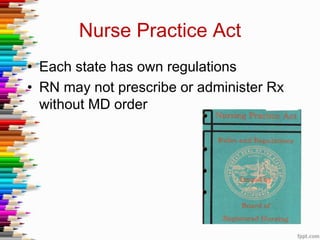
Nurse Practice Act
• Each state has own regulations
• RN may not prescribe or administer Rx
without MD order
DRUG STANDARDS AND LEGISLATION
• A drug is a chemical substance intended
to elicit a specific effect.
• Standards are set to ensure drug
uniformity in:
– Strength.
– Purity.
– Efficacy.
– Safety.
– Bioavailability (amount of absorbed drug in blood).
STANDARDS
• The United States Pharmacopeia, the
Indian Pharmacopeia and the British
Pharmacopeia (USP, IP and BP) are
standard formularies for drug preparation,
packaging, marketing and dispensing in
India.
Legislation: The FDA
• The Food and Drug Administration
(FDA) and Drug controller of India
(DCI) tests all drugs for toxicity
before granting a company the right
to market a drug.
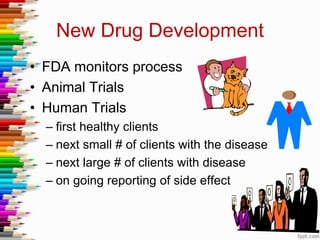
New Drug Development
• FDA monitors process
• Animal Trials
• Human Trials
– first healthy clients
– next small # of clients with the disease
– next large # of clients with disease
– on going reporting of side effect
Drug Nomenclature
• Drugs are usually referred to by their
generic name (not capitalized) or by their
trade name (always capitalized).
Drug Nomenclature (Names)
• Chemical Name
– atomic/molecular structure
• Generic Name (OFFICIAL)
– derived from chemical name
– listed in US Pharmacopedia & Formulary
• Trade Name (Brand)
– selected by Manufacturer
– copyrighted
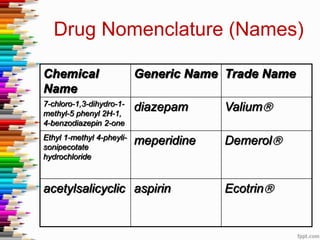
Drug Nomenclature (Names)
Chemical
Name
Generic Name Trade Name
7-chloro-1,3-dihydro-1-
methyl-5 phenyl 2H-1,
4-benzodiazepin 2-one
diazepam Valium
Ethyl 1-methyl 4-pheyli-
sonipecotate
hydrochloride
meperidine Demerol
acetylsalicyclic aspirin Ecotrin
Drug Action
• A drug’s ability to combine with a cellular
drug receptor.
• Depending on the location of the cellular
receptor, the drug can have a local effect,
a systemic effect, or both.
PHARMACOKINETICS
• For a drug to achieve a therapeutic effect, it must
proceed from the point of entry into the body to the
tissue with which it will react.
• The effectiveness is further affected by the dosage of
the drug and the amount of time the drug spends in the
body before it is excreted.
• Pharmacokinetics refers to the study of the
absorption, distribution, metabolism, and excretion of
drugs to determine the relationship between the dose of
a drug and the drug’s concentration in biological fluids.
• Drug actions are dependent on four properties:
absorption, distribution, metabolism, and excretion.
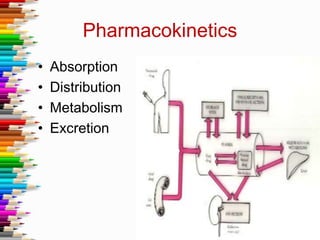
Pharmacokinetics
• Absorption
• Distribution
• Metabolism
• Excretion
Absorption
• Depends on route
• Enteral - GI system (p.o., SL, PR)
• Parenteral - Injected (ID, SQ, IM, IV)
The 4 Properties of Drug Action
The ADME scheme (also referred to as LADME if liberation is included as a
separate step from absorption):
• LIBERATION - the process of release of a drug from the pharmaceutical
formulation.
• ABSORPTION (passage of a drug from the site of administration
into the bloodstream).
• DISTRIBUTION (the movement of drugs from the blood into body
fluids and tissues).
• METABOLISM (the physical and chemical processing of a drug by
the body).
• EXCRETION (the elimination of drugs from the body.
DRUG INTERACTION
• The effect one drug can have on another
drug.
Food and Drug Interactions
• Certain drugs may interfere with the
absorption, excretion, or use in the body
of one or more nutrients.
• Certain foods may increase or decrease
the absorption of a drug into the body.
• Other foods may alter the chemical
actions of drugs, preventing their
therapeutic effect on the body.
Side Effects and Adverse
Reactions
• Drug Allergy.
• Drug Tolerance.
• Toxic Effect.
• Idiosyncratic Reaction.
• A Side Effect is an effect, whether
therapeutic or adverse, that is
secondary to the one intended;
although the term is predominantly
employed to describe Adverse
Effects, it can also apply to
beneficial, but unintended,
consequences of the use of a drug.
Factors Influencing Drug Action
• Genetic factors.
• Age.
• Height.
• Weight.
• Physical
conditions.
• Mental conditions.

Introduction Medication Administration

  • 3.
    “One of thefeatures which is thought to distinguish man from other animals is his desire to take medicines” (Sir William Osler, 1849-1919)
  • 4.
    PHARMACOLOGY • The studyof the effects of drugs on living organisms.
  • 5.
    • A drugis any substance that alters physiological function, with the potential for affecting health. • Medication may be defined as a substance used to promote health, to prevent illness, to diagnose, to alleviate or cure diseases.
  • 6.
    • A medicationis a drug administered for its therapeutic effects. • Thus, all medications are drugs, but not all drugs are medications.
  • 7.
    DEFINITIONS • Pharmacology:- isthe science of the interaction of chemicals with living systems at all levels. • Pharmacokinetics:- sometimes abbreviated as PK, (from Ancient Greek pharmakon "drug“ and kinetikos "to do with motion"; ) investigates the effects of the biological system on drugs (absorption, distribution, elimination…) or what the body does to the drug. • Pharmacodynamics:- describes the fundamental action of a drug on a physiological, biochemical or molecular level or what the drug does to the body.
  • 8.
    • Pharmacogenetics:- examinesthe effects of genetic factors to variations in the drug response (“Asian Flush”, Codeine “resistance”) • Toxicology:- studies the undesirable effects of chemicals on living systems (includes poisons, antidotes and unwanted side effects of drugs) • Pharmacy:- is the art of preparing, compounding and dispensing chemicals for medicinal use
  • 9.
    Definitions • Prophylactic refersto a drug or procedure aimed to prevent disease • Palliative refers to a drug or procedure aimed to relieve symptoms • Therapeutic refers to a drug or procedure aimed to cure disease • Tolerance is the increased resistance to the usual effects of an established dose of a particular drug
  • 10.
    • Effective dose(ED50):- is the concentration at which 50% of the subject show a predefined response. • Efficacy:- refers to the inherent capability of a drug to produce a desired effect. • Potency:- compares the relative effectiveness of drugs to produce a desired effect e.g. Drug A requires fewer milligrams than Drug B to achieve the same pharmacological response. --> Drug A has the higher potency, yet, both drugs have the same efficacy. Definitions
  • 11.
    HISTORY OF PHARMACOLOGY •Origins – Plants – Animals
  • 12.
  • 13.
    5 Branches ofPharmacology 1. Pharmacognosy - Origin 2. Pharmacokinetics - Movement through Body 3. Pharmacodynamics - Effect 4. Pharmacotherapeutics - Use/Purpose 5. Toxicology -Side Effects
  • 14.
    Terminology for Patients •Drug (medication) – pharmacological agent – produces biological effect • Prescription Drug – safe under supervision – prescribed by licensed practitioner
  • 16.
    Terminology (con’t) • Non-Prescription(Over-the-Counter or OTC) – safe if instructions followed – no prescription necessary
  • 19.
    Terminology (con’t) • RecreationalDrug – use for pleasant psychological/physical effects – no therapeutic intent
  • 20.
    Terms Relating toDrug Action • ONSET OF ACTION (the time it takes for the body to respond to a drug after administration). • PEAK PLASMA LEVEL (the highest blood concentration of a single drug dose before the elimination rate equals the rate of absorption). • PLATEAU (maintenance of a certain level).
  • 21.
    Resources for DrugInformation • Pharmacopedia – Official resource – US Pharmacopedia, British Pharmacopedia
  • 22.
    Resources (con’t) • Compendia –Non Official – American Formulary, Facts & Comparisons, USP Dispensing • Pharmaceutical Firms – Physician’s Desk Reference (PDR) – PDR for OTC – Package inserts
  • 23.
    Resources (con’t) • Journals –Nursing 2011 – AJN – RN • Nursing Reference Books • Web sites – WebMD – Epocrates
  • 24.
    Nurse Practice Act •Each state has own regulations • RN may not prescribe or administer Rx without MD order
  • 25.
    DRUG STANDARDS ANDLEGISLATION • A drug is a chemical substance intended to elicit a specific effect. • Standards are set to ensure drug uniformity in: – Strength. – Purity. – Efficacy. – Safety. – Bioavailability (amount of absorbed drug in blood).
  • 26.
    STANDARDS • The UnitedStates Pharmacopeia, the Indian Pharmacopeia and the British Pharmacopeia (USP, IP and BP) are standard formularies for drug preparation, packaging, marketing and dispensing in India.
  • 27.
    Legislation: The FDA •The Food and Drug Administration (FDA) and Drug controller of India (DCI) tests all drugs for toxicity before granting a company the right to market a drug.
  • 28.
    New Drug Development •FDA monitors process • Animal Trials • Human Trials – first healthy clients – next small # of clients with the disease – next large # of clients with disease – on going reporting of side effect
  • 29.
    Drug Nomenclature • Drugsare usually referred to by their generic name (not capitalized) or by their trade name (always capitalized).
  • 30.
    Drug Nomenclature (Names) •Chemical Name – atomic/molecular structure • Generic Name (OFFICIAL) – derived from chemical name – listed in US Pharmacopedia & Formulary • Trade Name (Brand) – selected by Manufacturer – copyrighted
  • 31.
    Drug Nomenclature (Names) Chemical Name GenericName Trade Name 7-chloro-1,3-dihydro-1- methyl-5 phenyl 2H-1, 4-benzodiazepin 2-one diazepam Valium Ethyl 1-methyl 4-pheyli- sonipecotate hydrochloride meperidine Demerol acetylsalicyclic aspirin Ecotrin
  • 32.
    Drug Action • Adrug’s ability to combine with a cellular drug receptor. • Depending on the location of the cellular receptor, the drug can have a local effect, a systemic effect, or both.
  • 33.
    PHARMACOKINETICS • For adrug to achieve a therapeutic effect, it must proceed from the point of entry into the body to the tissue with which it will react. • The effectiveness is further affected by the dosage of the drug and the amount of time the drug spends in the body before it is excreted. • Pharmacokinetics refers to the study of the absorption, distribution, metabolism, and excretion of drugs to determine the relationship between the dose of a drug and the drug’s concentration in biological fluids. • Drug actions are dependent on four properties: absorption, distribution, metabolism, and excretion.
  • 34.
  • 35.
    Absorption • Depends onroute • Enteral - GI system (p.o., SL, PR) • Parenteral - Injected (ID, SQ, IM, IV)
  • 36.
    The 4 Propertiesof Drug Action The ADME scheme (also referred to as LADME if liberation is included as a separate step from absorption): • LIBERATION - the process of release of a drug from the pharmaceutical formulation. • ABSORPTION (passage of a drug from the site of administration into the bloodstream). • DISTRIBUTION (the movement of drugs from the blood into body fluids and tissues). • METABOLISM (the physical and chemical processing of a drug by the body). • EXCRETION (the elimination of drugs from the body.
  • 37.
    DRUG INTERACTION • Theeffect one drug can have on another drug.
  • 38.
    Food and DrugInteractions • Certain drugs may interfere with the absorption, excretion, or use in the body of one or more nutrients. • Certain foods may increase or decrease the absorption of a drug into the body. • Other foods may alter the chemical actions of drugs, preventing their therapeutic effect on the body.
  • 39.
    Side Effects andAdverse Reactions • Drug Allergy. • Drug Tolerance. • Toxic Effect. • Idiosyncratic Reaction.
  • 40.
    • A SideEffect is an effect, whether therapeutic or adverse, that is secondary to the one intended; although the term is predominantly employed to describe Adverse Effects, it can also apply to beneficial, but unintended, consequences of the use of a drug.
  • 41.
    Factors Influencing DrugAction • Genetic factors. • Age. • Height. • Weight. • Physical conditions. • Mental conditions.