Practice Guidelines
Washhands thoroughly after handling a client’s bed
linen.
Hold soiled linen away from uniform.
Linen for one client is never placed on another
client’s bed.
Place soiled linen directly in a portable linen
hamper or tucked into a pillow case at the end
before it is gathered up for disposal.
3.
Principles of keepin mind
1. Micro organisms are found everywhere on the skin, on the
articles used by the client and in the environment. The
nurses take care to prevent the transference of
microorganisms from the sources to the new host by the
direct contact or indirect contact or prevent the
multiplication of the microorganisms.
2. A safe and comfortable bed will ensure rest ,sleep and
prevent several complications in bedridden patients.
3. Good body mechanisms maintain the body alignment and
prevents fatigue.
4. Planned and organized ways of working saves energy, time
and equipment.
4.
TO PREVENT SPREADOF MICRO-
ORGANISMS
• Action -
– The nurse should wash her/his hands before and after the bed making procedure to pr
event cross- infection.
– Bed linen and clothes must be changed frequently to ensure cleanliness.
– Do not drop the removed bed linen on the floor.
– Gently shake the linen to remove dust. Do not flap the bed clothing because it
transfers dust and bacteria easily.
– Linen should be folded and held away from the nurses to prevent direct contact with
dust and micro- organisms.
– Daily cleaning and dusting of beds and units will keep them free from dust and micro-
organisms. Soap, water, air and sunshine will help them to be clean.
– Damp dusting is recommended because dry dusting raises dust.
– Nurse should maintain a necessary distance from patients to prevent droplet infection.
– Clean the less contaminated area first and then the clean high contaminated area to
minimize the spreading of micro-organisms to the clean area.
– Linens should be disinfected before sending them to the laundry.
– Nurses who having respiratory infections should not attend to the clients.
5.
protected and comfortablebed
• Action -
– Nurse should make a smooth and unwrinkled bed because a wrinkled bed
exerts pressure on bony prominence and lumps. The wrinkles cause bedsores
due to friction between skin and wrinkled sheets.
– Pull the bottom sheet tightly to avoid wrinkles.
– Tuck the linen far enough and tightly to keep it fixed.
– Smooth the mattress, if there is a collection of cotton in one place before
making a bed.
– Do not keep any wet linen on the bed.
– Daily dusting should be done to remove any peeling or seeds that are adhered
to the bed linen of a bedridden client.
– A bed should have enough space to move from side to side. The movements
prevent bedsore, stimulate blood circulation and maintain muscle tone.
– Use comfort devices to provide additional comfort to the client.
6.
Good body mechanisms
•Action -
– The stability of the body is assured by keeping the centre of gravity
over its base.
– In the standing position, the nurse can have a wide base by separating
his/her feet.
– The nearer to the centre of gravity a weight is held, the less is strain
produced. E.g. it is more suitable to place the linen on the edge of the
bed instead of holding it above shoulder level.
– Flex the knees and hips when tucking the sheet under the mattress.
This position shifts the work to the long and strong muscle of the thigh
and keeps the back in good alignment.
– When placing and tucking the linen, face the direction of the work and
move with the work rather than twisting the body and overreaching.
7.
Planned and organized
•Action -
– Collect and arrange all the articles before starting the bed
making procedure.
– At the first finish on one side of the bed making and then go
to the opposite side.
– Remove the bed linen one by one holding the open end
towards the floor when stripping the bed so that
– the client's possessions and the hospital articles are not
sent to the laundry.
– The bed sheets are folded in such a way that they can be
replaced easily.
8.
Purposes of bedmaking
a) To give a neat and tidy appearance to the
unit.
b) To provide a clean and comfortable bed for
the patient.
c) To keep it ready for any emergencies.
d) To receive the patient comfortably.
e) To prevent bed sores .
f) To establish interpersonal relationship.
9.
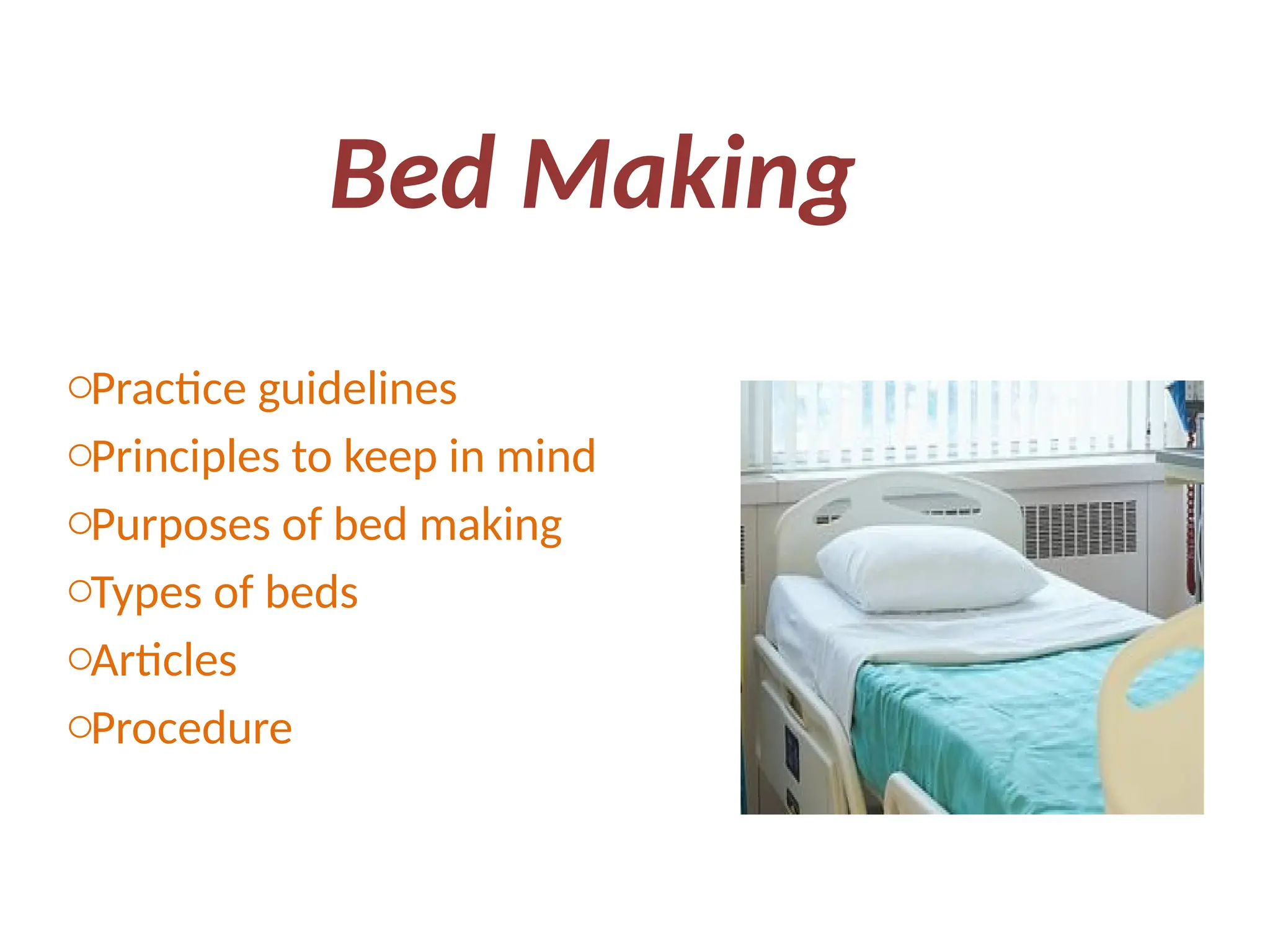
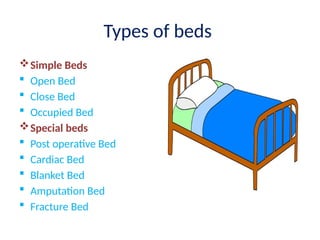
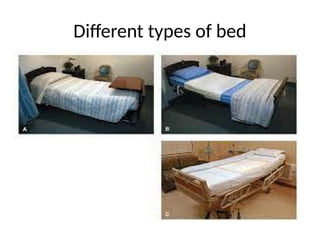
Types of beds
SimpleBeds
Open Bed
Close Bed
Occupied Bed
Special beds
Post operative Bed
Cardiac Bed
Blanket Bed
Amputation Bed
Fracture Bed
10.
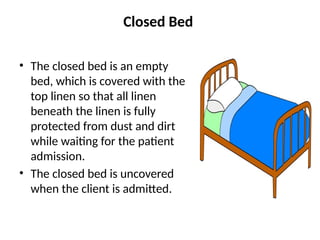
Closed Bed
• Theclosed bed is an empty
bed, which is covered with the
top linen so that all linen
beneath the linen is fully
protected from dust and dirt
while waiting for the patient
admission.
• The closed bed is uncovered
when the client is admitted.
11.
Cont.
• Open Bed-The term open bed is used to describe the hospital
bed when it is about to be occupied by a client. It is made either
for a new client or an ambulatory client.
• Admission Bed -The admission bed is made as an open bed. The
client gets into the bed after a bath and changing into a hospital
dress if it is a custom in the hospital.
• Occupied Bed -This is to make a bed with the client in. This is
made for a client who cannot get out of bed. The preparation and
the aftercare of the client will be the same as in an open bed.
12.
Cont.
• Operation BedOr Post-Anaesthetic Bed Or Recovery Bed -It is prepared for a client
who is recovering from the effects of anaesthesia following a surgical operation.
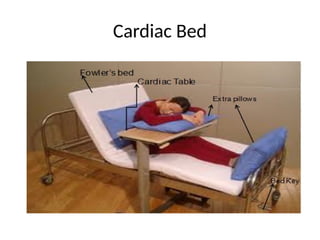
• Cardiac Bed -A cardiac bed is used to help the client to assume a sitting position that
can afford him the greatest amount of comfort with the least strain. The main purpose
of the cardiac bed is to relieve dyspnoea caused by cardiac disease.
• Fracture Bed -It uses for a client with a fracture of the trunk or extremities to provide
firm support by the use of a firm mattress that rests on a fracture board or bed board.
• Amputation Bed Or Stump Bed Or Divided Bed -An amputation bed is used after the
amputation of the leg to take the weight of the bedclothes off the site of the
operation.
• Blanket Bed -The blanket bed is made for a client who is suffering from renal disease
to promote elimination through the skin.
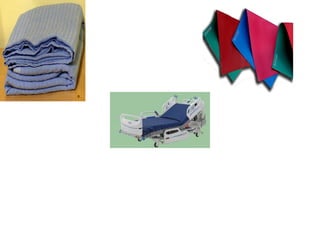
Articles
1. Cot
2. Mattressand pillow
3. Chair or stool
4. Bedside table
5. Mackintosh
6. Blanket
7. Mattress cover
8. Top sheet and bottom sheet
9. Draw sheet
10. Pillowcase
11. Counterpane
12. Laundry bag
13. Dusters
17.
Procedure
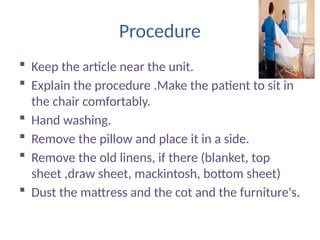
Keep thearticle near the unit.
Explain the procedure .Make the patient to sit in
the chair comfortably.
Hand washing.
Remove the pillow and place it in a side.
Remove the old linens, if there (blanket, top
sheet ,draw sheet, mackintosh, bottom sheet)
Dust the mattress and the cot and the furniture's.
Cont.
Spread thethe bottom sheet, mackintosh and
draw sheet .
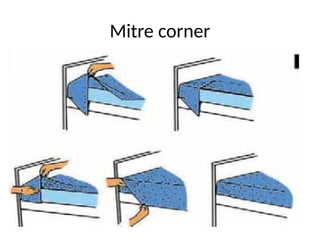
Tuck the near side first from top to bottom. Make
mitre corner. Go to opposite side. Tuck that side.
Spread the top sheet (blanket if needed).
Make a knee pleat. Tuck near side bottom and then
the opposite side. Allow the sides to hang freely.
Put the pillow cover on pillow. Place it with open
end away from the door side.




![beed Making[1].pptx](https://cdn.slidesharecdn.com/ss_thumbnails/beedmaking1-230226055907-d267997c-thumbnail.jpg?width=640&height=640&fit=bounds)


