BED MAKING
Prepared By: Mrs. Leena Sameep Sakpal.
Nursing Tutor
INTRODUCTION
• As comfort, safety, rest and sleep are all important in maintaining
health and promoting recovery from disease, special care should be
taken to provide comfortable beds to patients during their stay in
hospital.
• Making a comfortable beds is responsibility of the nurse.
• Nurse should provide clean, dry, wrinkle free and comfortable beds to
her patients.
DEFINITION
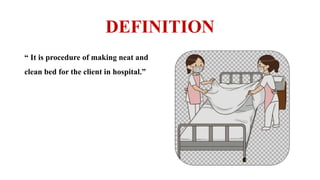
“ It is procedure of making neat and
clean bed for the client in hospital.”
PURPOSE
• To provide the clients with a safe and comfortable bed to take rest and sleep.
• To give to the unit or ward a neat appearance.
• To adapt to the needs of the client and to be ready for any emergency or critical condition of
illness.
• To economize time, material and effort.
• To prevent bedsores.
• To observe the client eg; presence of bedsore, oral hygiene, clients ability of self care etc.
can be observed during bed making.
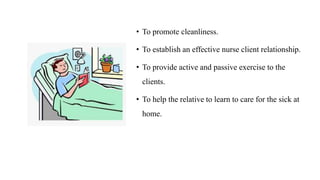
• To promote cleanliness.
• To establish an effective nurse client relationship.
• To provide active and passive exercise to the
clients.
• To help the relative to learn to care for the sick at
home.
TYPES OF BEDS
• Open bed
• Closed bed
• Admission bed
• Post-operative bed
• Cardiac bed
• Ampution bed/ Devided bed
• Fracture bed
• Therapeutic bed eg; Renal bed,
Rheumatism bed, Blanket bed
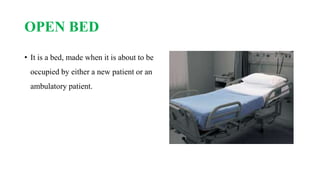
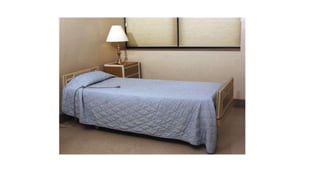
OPEN BED
• It is a bed, made when it is about to be
occupied by either a new patient or an
ambulatory patient.
CLOSED BED
• It is an unoccupied/empty bed made to recieve the patient and fully covered with
counter pane to protect from the dust and dirt.
• On admission of the patient, the closed bed is converted into an open bed.
PURPOSE
• To keep the bed ready for occupancy.
• To provide neat and tidy appearance to the unit.
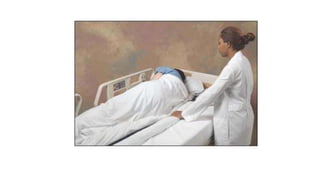
OCCUPIED BED
• This bed is made with thepatient in it.
PURPOSE
• To make a bed with least posiible discomfort to the patient.
• To handle the bed clothes skillfully while the patient is o bed, giving least
disturbances to the occupant.
• To provide a neat, clean and tidy appearance.
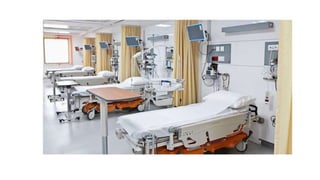
ADMISSION BED
• This is the bed which is prepared to recieve a newly admitted patient.
PURPOSE
• To welcome patient.
• To provide immediate care, safety and comfort.
• To protect the bed linen while giving bath on admission.
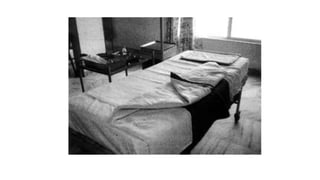
POST OPERATIVE BED
• It is a bed prepared for a patient who is recovering from the effects of anaesthesia
following surgery.
PURPOSE
• To recieve the patient conveniently.
• To provide warmth and comfort.
• To prevent shock.
• To prevent injury.
• To prevent soiling of bed.
• To meet any emergency.
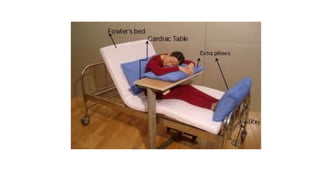
CARDIAC BED
• This bed is made for patients with cardiac diseases.
• It helps the patient to assume a sitting position which can afford him greatest
amount of comfort with least strain.
PURPOSE
• To relieve dyspnea caused by cardiac diseases.
• To prepare the bed for the cardiac patient.
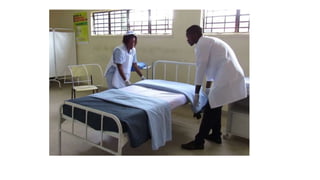
AMPUTATION/DIVIDED/CRADLE BED
• It is a bed in which top linen is divided into two parts to visualise the amputated part
of tje lower limbs without disturbing the patient.
PURPOSE
• To watch the stump for hemorrhage and apply tourniquet instantly.
• To take the weight of the bed clothes off the patient.
• To keep the stump in position.
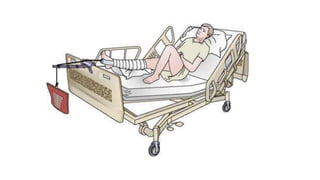
FRACTURE BED
• It is a bed which is prepared for patients with fracture, bone diseases and deformity.
PURPOSE
• To prevent undue sagging of mattress.
• To immobilize the fractured part.
• To restrict sudden jerky movements.
• To keep the traction in position.
THERAPEUTIC BEDS
(Renal/Rheumatism/Blanket Bed)
• It is a bed made for patients suffering from rheumatism or renal disease.
PURPOSE
• To carry the weight of the bed clothes off the painful joints.
• To keep the patient warm.
• To include sweating.
GENERAL INSTRUCTIONS
• Wash hands before and after the procedure.
• Do not expose the client unnecessarily.
• Protect the client from draught.
• Do not cover the clients face while placing the linen.
• Do not mix clean linen with soiled linen.
• Never place the woolen blanket next to the clients body except the bath blanket and
never allow the client to lie down on the mackintosh without lining.
• Shake the linen gently.
• Do not let the linen touch your body or uniform.
• Maintain good body mechanics.
• Make the bed firm, smooth and unwrinkled.
• Practice economy of time, energy and material.
• Arrange the bed clothes in such a way that they allow freedom in the day time but come
over the shoulders at night and the top linen loose over the feet.
• The cotton mattress must be turned, aired and made free of lumps and creases.
• Make adaptations according to weather, climatic differences, individual needs,
customs and habits of our clients.
• Always get extra help to make a bed for helpless clients and prevent them from
failing.
• The side rails may be used to prevent them falling if extra help is not available.
• Keep a reasonable distance from the face of the client to prevent cross infection.
• Inspect the cot, mattress and pillows daily for the presence of vermins and destroy
them if found on the bed.
• The nursing principles such as individuality, comfort, safety and good workmanship
should be kept in mind during the bed making.
NURSE RESPONSIBILITY
PRELIMINARY ASSESSMENT
• Check the doctor's order for specific precautions regarding the
movement and positioning of the client. Assess the client's ability for
self care.
• Check the furniture and linen available in the client's unit.
• Assess the number of clean linen needed.
• Assess the articles needed for the comfort of the client e.g.,blankets,
backrest etc.
PREPARATION OF THE ARTICLES
ARTICLES REQUIRED RATIONALE
1. Damp duster and dry duster to clean the
metal bed.
‒ To prevent spread of infection.
2. Kidney tray ‒ To recieve wastes.
3. Mattress with cover ‒ To protect mattress.
4. Bed sheets - 2 ‒ To use as bottom sheet, and top sheet.
5. Draw sheet - 1 ‒ To protect the bed linen and to cover the mackintosh.
6. Mackintosh - 1 ‒ To protect the bed linen.
7. Pillow cover - 2 ‒ To protect the pillow.
8. Pillow ‒ To provide comfort.
9. Blankets ( if required ) ‒ To provide warmth.
10. Stool/chair ‒ To keep articles.
11. Dirty linen trolley ‒ To discard soiled linen.
PREPARATION OF CLIENT AND THE UNIT
• Explain the procedure to the client to win the cooperation and confidence of the client.
• Explain how the client can assist.
• Explain the sequence of the procedure.
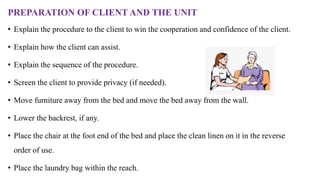
• Screen the client to provide privacy (if needed).
• Move furniture away from the bed and move the bed away from the wall.
• Lower the backrest, if any.
• Place the chair at the foot end of the bed and place the clean linen on it in the reverse
order of use.
• Place the laundry bag within the reach.
AFTER CARE OF THE CLIENT, UNIT AND EQUIPMENT
1. Help the client to get into the bed. One corner of the top linen is folded back to let the
client in. Cover the client with the top linen.
2. Any comfort devices used by the client should be replaced. 3. See that the whole unit is
clean and tidy before you leave the unit.
-The beds in a general ward should be arranged in a straight line.
-The bedpans, urinals, sputum cups, kidney trays etc.. lying in the client's unit are to be taken
away, emptied. cleaned and are put back in their proper places.
-The windows and doors should be dusted to keep them dust free.
- The cupboards are to be dusted and the articles are to be arranged in order and according
to the use.
- The water flasks should be washed and filled with clean water.
- The flower vases may be arranged and replaced.
- The washing sinks if provided in the unit, should be cleaned with some abrasive.
- Remove all the unnecessary articles which are not in
4. Send the laundry bag with the soiled linen to the laundry. If stains are present on the
sheets, remove them by appropriate methods before it is sent to the laundry.
5. If there are any blankets, put them in the sun and disinfect before they are stored in the
cupboard.
6. The duster is soaked in antiseptic lotion to disinfect it. Rinse it
with clean water and put to dry. .
7. Wash hands thoroughly
8. Record in the nurse's record any observations made on the client.
SCIENTIFIC PRINCIPLES
ANATOMY AND PHYSIOLOGY
1. The hard and soft tissues rest against the mattress. The hard tissues are- the spine,
shoulder blades, hip bones, elbows and the heels. The soft tissues are the buttocks.
2. An uneven pressure is exerted by the body against the mattress. The greatest pressure is at
the points of prominences. If the pressure remains for prolong period the part becomes
gangreneous.
3. The healthy skin needs good supply of blood so moving, rubbing and exercising is
required.
4. Muscle tone is diminished due to lying down in bed. When muscle tone is lessened, the
joints are affected so the position of the body should be approximately standing position.
MICROBIOLOGY
1. The nurse must wash her hands before and after bed making to prevent
cross infection,
2. Bed clothes must be changed frequently to ensure cleanliness.
3. In removing the bed clothes, care must be taken, not to come in contact with other
patient's bed or floor or nurses uniform.
4. The nurse should not come too close to patient's face to prevent droplet infection.
5.Daily dusting of the surroundings and bod and the thorough cleanliness on the patient's
discharge. Keep the rooms free from dust and micro-organisms. Soap water, air and
sunshine will help to clean them.
6.Since the mattresses, pillows, blanket and rubber sheet are not washed and sterilized
ordinarily. So the patient is protected from with the contact with them by washable covers.
7.Dry dusting raises dust. So damp dusting is recommended.
8.The linen removed from the isolation unit is first disinfected and then sent to the laundry.
9. The nurses having acute cold should not attend to the patients.
PHYSICS AND CHEMISTRY
1.Pillows and mattresses lessen the air layer below the body and prevent
heat loss from evaporation.
2. Air and rubber is a poor conductor of heat so it prevents evaporation and makes
the bed warm and comfortable.
3. Stability of the body is assured by keeping its centre of gravity over its base.
When the base is wide it ensures that the centre of gravity will fall through its base.
In standing position the nurse can have a wide base by separating her legs.
4. When opening and folding linen, it should be placed on the edge of the bed rather
than above shoulder.
5. When tucking the sheets under the mattress flexing is done by hips and knees.
6. Twisting of the body should be avoided during the bed making.
7. Proper support should be given to the patient during turning.
8. Woolen fibers are covered with scales which cause blankets to be irritating to the skin.
Cotton fibers are smooth on surface and do not irritate the skin.
9. Strong soaps and chlorine bleaches are sources of skin imitation, if the linen is not rinsed
well.
10. Strong alkalies destroy wool.
11.Friction is reduced by the smoothness of the sheet.
PSYCHOLOGY
1. Relieve the uncertanity of the patient by explaining what the procedure is, what she is
going to do.
2. Provide privacy by screening and draping
3.Refresh the patient mentally by having a cheerful disposition and sympathetic attitude.
4. Nurse should do her work as skillfully as possible so that her power has been done to
give the patient comfort and relief.
Bed Making ( Introduction, Purpose, Types, Articles, Scientific principles, Nurses Responsibility)

Bed Making ( Introduction, Purpose, Types, Articles, Scientific principles, Nurses Responsibility)

  • 1.
    BED MAKING Prepared By:Mrs. Leena Sameep Sakpal. Nursing Tutor
  • 2.
    INTRODUCTION • As comfort,safety, rest and sleep are all important in maintaining health and promoting recovery from disease, special care should be taken to provide comfortable beds to patients during their stay in hospital. • Making a comfortable beds is responsibility of the nurse. • Nurse should provide clean, dry, wrinkle free and comfortable beds to her patients.
  • 3.
    DEFINITION “ It isprocedure of making neat and clean bed for the client in hospital.”
  • 4.
    PURPOSE • To providethe clients with a safe and comfortable bed to take rest and sleep. • To give to the unit or ward a neat appearance. • To adapt to the needs of the client and to be ready for any emergency or critical condition of illness. • To economize time, material and effort. • To prevent bedsores. • To observe the client eg; presence of bedsore, oral hygiene, clients ability of self care etc. can be observed during bed making.
  • 5.
    • To promotecleanliness. • To establish an effective nurse client relationship. • To provide active and passive exercise to the clients. • To help the relative to learn to care for the sick at home.
  • 6.
    TYPES OF BEDS •Open bed • Closed bed • Admission bed • Post-operative bed • Cardiac bed • Ampution bed/ Devided bed • Fracture bed • Therapeutic bed eg; Renal bed, Rheumatism bed, Blanket bed
  • 7.
    OPEN BED • Itis a bed, made when it is about to be occupied by either a new patient or an ambulatory patient.
  • 8.
    CLOSED BED • Itis an unoccupied/empty bed made to recieve the patient and fully covered with counter pane to protect from the dust and dirt. • On admission of the patient, the closed bed is converted into an open bed. PURPOSE • To keep the bed ready for occupancy. • To provide neat and tidy appearance to the unit.
  • 10.
    OCCUPIED BED • Thisbed is made with thepatient in it. PURPOSE • To make a bed with least posiible discomfort to the patient. • To handle the bed clothes skillfully while the patient is o bed, giving least disturbances to the occupant. • To provide a neat, clean and tidy appearance.
  • 12.
    ADMISSION BED • Thisis the bed which is prepared to recieve a newly admitted patient. PURPOSE • To welcome patient. • To provide immediate care, safety and comfort. • To protect the bed linen while giving bath on admission.
  • 14.
    POST OPERATIVE BED •It is a bed prepared for a patient who is recovering from the effects of anaesthesia following surgery. PURPOSE • To recieve the patient conveniently. • To provide warmth and comfort. • To prevent shock. • To prevent injury. • To prevent soiling of bed. • To meet any emergency.
  • 16.
    CARDIAC BED • Thisbed is made for patients with cardiac diseases. • It helps the patient to assume a sitting position which can afford him greatest amount of comfort with least strain. PURPOSE • To relieve dyspnea caused by cardiac diseases. • To prepare the bed for the cardiac patient.
  • 18.
    AMPUTATION/DIVIDED/CRADLE BED • Itis a bed in which top linen is divided into two parts to visualise the amputated part of tje lower limbs without disturbing the patient. PURPOSE • To watch the stump for hemorrhage and apply tourniquet instantly. • To take the weight of the bed clothes off the patient. • To keep the stump in position.
  • 20.
    FRACTURE BED • Itis a bed which is prepared for patients with fracture, bone diseases and deformity. PURPOSE • To prevent undue sagging of mattress. • To immobilize the fractured part. • To restrict sudden jerky movements. • To keep the traction in position.
  • 22.
    THERAPEUTIC BEDS (Renal/Rheumatism/Blanket Bed) •It is a bed made for patients suffering from rheumatism or renal disease. PURPOSE • To carry the weight of the bed clothes off the painful joints. • To keep the patient warm. • To include sweating.
  • 23.
    GENERAL INSTRUCTIONS • Washhands before and after the procedure. • Do not expose the client unnecessarily. • Protect the client from draught. • Do not cover the clients face while placing the linen. • Do not mix clean linen with soiled linen. • Never place the woolen blanket next to the clients body except the bath blanket and never allow the client to lie down on the mackintosh without lining.
  • 24.
    • Shake thelinen gently. • Do not let the linen touch your body or uniform. • Maintain good body mechanics. • Make the bed firm, smooth and unwrinkled. • Practice economy of time, energy and material. • Arrange the bed clothes in such a way that they allow freedom in the day time but come over the shoulders at night and the top linen loose over the feet. • The cotton mattress must be turned, aired and made free of lumps and creases.
  • 25.
    • Make adaptationsaccording to weather, climatic differences, individual needs, customs and habits of our clients. • Always get extra help to make a bed for helpless clients and prevent them from failing. • The side rails may be used to prevent them falling if extra help is not available. • Keep a reasonable distance from the face of the client to prevent cross infection. • Inspect the cot, mattress and pillows daily for the presence of vermins and destroy them if found on the bed. • The nursing principles such as individuality, comfort, safety and good workmanship should be kept in mind during the bed making.
  • 26.
    NURSE RESPONSIBILITY PRELIMINARY ASSESSMENT •Check the doctor's order for specific precautions regarding the movement and positioning of the client. Assess the client's ability for self care. • Check the furniture and linen available in the client's unit. • Assess the number of clean linen needed. • Assess the articles needed for the comfort of the client e.g.,blankets, backrest etc.
  • 27.
    PREPARATION OF THEARTICLES ARTICLES REQUIRED RATIONALE 1. Damp duster and dry duster to clean the metal bed. ‒ To prevent spread of infection. 2. Kidney tray ‒ To recieve wastes. 3. Mattress with cover ‒ To protect mattress. 4. Bed sheets - 2 ‒ To use as bottom sheet, and top sheet. 5. Draw sheet - 1 ‒ To protect the bed linen and to cover the mackintosh. 6. Mackintosh - 1 ‒ To protect the bed linen. 7. Pillow cover - 2 ‒ To protect the pillow. 8. Pillow ‒ To provide comfort. 9. Blankets ( if required ) ‒ To provide warmth. 10. Stool/chair ‒ To keep articles. 11. Dirty linen trolley ‒ To discard soiled linen.
  • 28.
    PREPARATION OF CLIENTAND THE UNIT • Explain the procedure to the client to win the cooperation and confidence of the client. • Explain how the client can assist. • Explain the sequence of the procedure. • Screen the client to provide privacy (if needed). • Move furniture away from the bed and move the bed away from the wall. • Lower the backrest, if any. • Place the chair at the foot end of the bed and place the clean linen on it in the reverse order of use. • Place the laundry bag within the reach.

  • 29.
    AFTER CARE OFTHE CLIENT, UNIT AND EQUIPMENT 1. Help the client to get into the bed. One corner of the top linen is folded back to let the client in. Cover the client with the top linen. 2. Any comfort devices used by the client should be replaced. 3. See that the whole unit is clean and tidy before you leave the unit. -The beds in a general ward should be arranged in a straight line. -The bedpans, urinals, sputum cups, kidney trays etc.. lying in the client's unit are to be taken away, emptied. cleaned and are put back in their proper places. -The windows and doors should be dusted to keep them dust free.
  • 30.
    - The cupboardsare to be dusted and the articles are to be arranged in order and according to the use. - The water flasks should be washed and filled with clean water. - The flower vases may be arranged and replaced. - The washing sinks if provided in the unit, should be cleaned with some abrasive. - Remove all the unnecessary articles which are not in 4. Send the laundry bag with the soiled linen to the laundry. If stains are present on the sheets, remove them by appropriate methods before it is sent to the laundry. 5. If there are any blankets, put them in the sun and disinfect before they are stored in the cupboard.
  • 31.
    6. The dusteris soaked in antiseptic lotion to disinfect it. Rinse it with clean water and put to dry. . 7. Wash hands thoroughly 8. Record in the nurse's record any observations made on the client.
  • 32.
  • 33.
    ANATOMY AND PHYSIOLOGY 1.The hard and soft tissues rest against the mattress. The hard tissues are- the spine, shoulder blades, hip bones, elbows and the heels. The soft tissues are the buttocks. 2. An uneven pressure is exerted by the body against the mattress. The greatest pressure is at the points of prominences. If the pressure remains for prolong period the part becomes gangreneous. 3. The healthy skin needs good supply of blood so moving, rubbing and exercising is required. 4. Muscle tone is diminished due to lying down in bed. When muscle tone is lessened, the joints are affected so the position of the body should be approximately standing position.
  • 34.
    MICROBIOLOGY 1. The nursemust wash her hands before and after bed making to prevent cross infection, 2. Bed clothes must be changed frequently to ensure cleanliness. 3. In removing the bed clothes, care must be taken, not to come in contact with other patient's bed or floor or nurses uniform. 4. The nurse should not come too close to patient's face to prevent droplet infection. 5.Daily dusting of the surroundings and bod and the thorough cleanliness on the patient's discharge. Keep the rooms free from dust and micro-organisms. Soap water, air and sunshine will help to clean them.
  • 35.
    6.Since the mattresses,pillows, blanket and rubber sheet are not washed and sterilized ordinarily. So the patient is protected from with the contact with them by washable covers. 7.Dry dusting raises dust. So damp dusting is recommended. 8.The linen removed from the isolation unit is first disinfected and then sent to the laundry. 9. The nurses having acute cold should not attend to the patients.
  • 36.
    PHYSICS AND CHEMISTRY 1.Pillowsand mattresses lessen the air layer below the body and prevent heat loss from evaporation. 2. Air and rubber is a poor conductor of heat so it prevents evaporation and makes the bed warm and comfortable. 3. Stability of the body is assured by keeping its centre of gravity over its base. When the base is wide it ensures that the centre of gravity will fall through its base. In standing position the nurse can have a wide base by separating her legs. 4. When opening and folding linen, it should be placed on the edge of the bed rather than above shoulder.
  • 37.
    5. When tuckingthe sheets under the mattress flexing is done by hips and knees. 6. Twisting of the body should be avoided during the bed making. 7. Proper support should be given to the patient during turning. 8. Woolen fibers are covered with scales which cause blankets to be irritating to the skin. Cotton fibers are smooth on surface and do not irritate the skin. 9. Strong soaps and chlorine bleaches are sources of skin imitation, if the linen is not rinsed well. 10. Strong alkalies destroy wool. 11.Friction is reduced by the smoothness of the sheet.
  • 38.
    PSYCHOLOGY 1. Relieve theuncertanity of the patient by explaining what the procedure is, what she is going to do. 2. Provide privacy by screening and draping 3.Refresh the patient mentally by having a cheerful disposition and sympathetic attitude. 4. Nurse should do her work as skillfully as possible so that her power has been done to give the patient comfort and relief.