Basic Understanding on
Magnetic Resonance Imaging
(MRI) & Interpretation of MRI
Images
By : QF Gan, PT, MSc Human Anatomy (Batch
Is MRI Important
I am a Physiotherapist. During my student years, I used
to think that MRI is totally not important for a
Physiotherapist. The reason behind this is because in
every patient with MRI, there is a interpretation sheet that
comes along to tell the clinician exactly what exactly is the
findings from MRI.
However, there are times where some patient’s who walk
in for treatment with his/her MRI but forgotten the MRI
interpretation sheet. Without the knowledge, how am I to
interpret those MRIs images given in order to confirm my
assessment? Of course, everything I see is blank and
white images not knowing what are those, where to start
and how it goes.
Hence, the question is, ‘Is the basic understanding and
ability to interpret MRI images important for
physiotherapist?’
Content
 Brief History
 Introduction to MRI
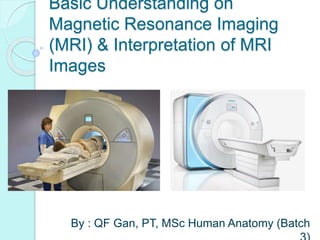
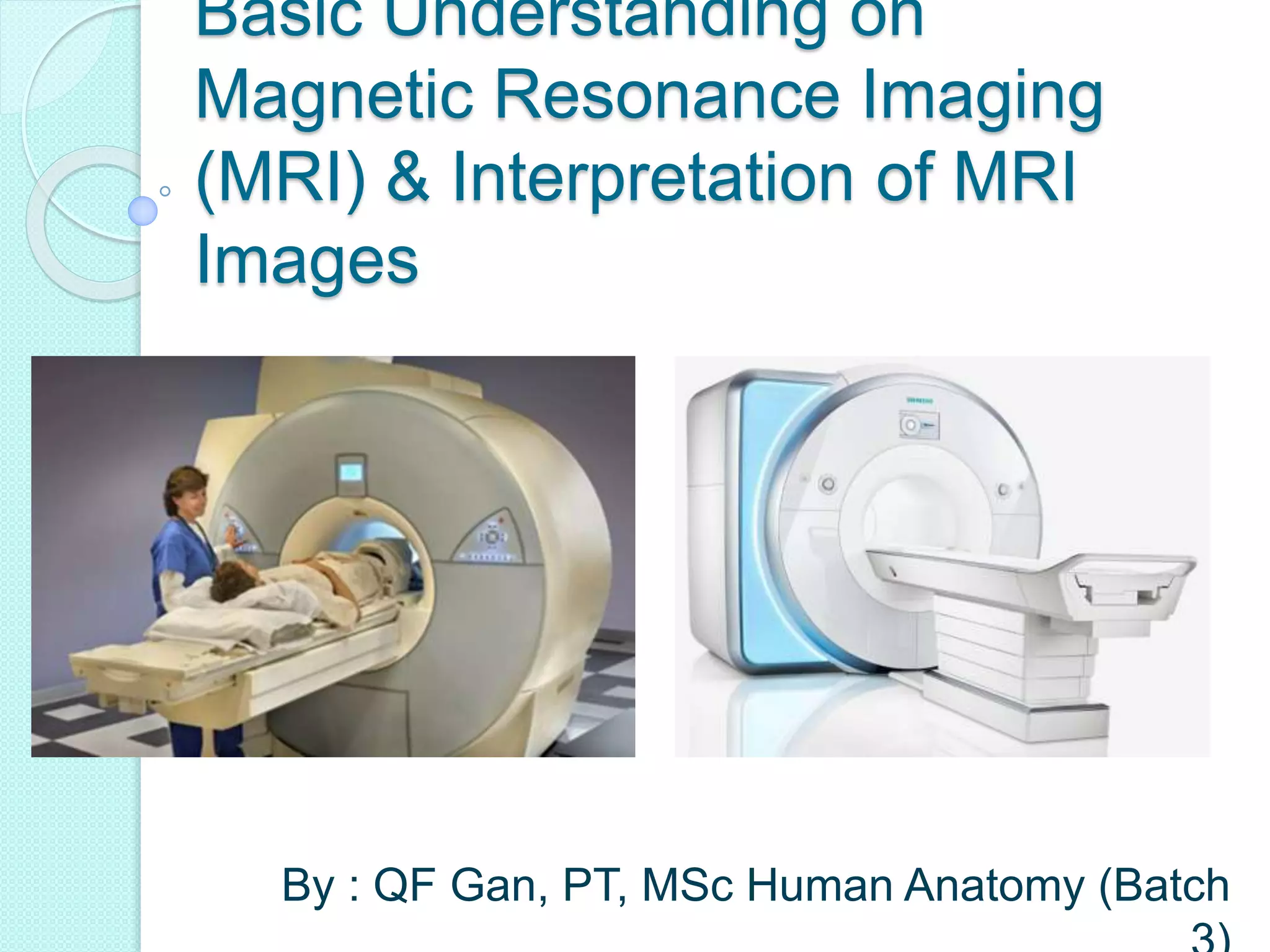
 MRI Machine
 Principles of MRI
 Advantages & Disadvantages
 Indications for MRI
 Contraindications
 Types Of MRI Machine
 Strength of Magnetic Field Used in MRI
 MRI Contrast Agent
 Types of MRI Images
 Basic Interpretation of MRI
 Q & A Session
By: Gan Quan Fu, PT
Brief History
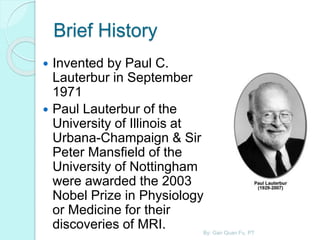
 Invented by Paul C.
Lauterbur in September
1971
 Paul Lauterbur of the
University of Illinois at
Urbana-Champaign & Sir
Peter Mansfield of the
University of Nottingham
were awarded the 2003
Nobel Prize in Physiology
or Medicine for their
discoveries of MRI. By: Gan Quan Fu, PT
Introduction to MRI
 Uses magnetic field & radio waves to
create detailed images of organs &
tissues within the body.
 Also known as nuclear magnetic
resonance (NMR).
 No ionizing radiation
 Employs radiofrequency pulse ranging
from 1 to 80MHz
By: Gan Quan Fu, PT
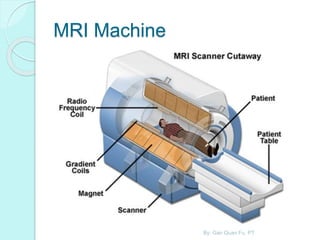
MRI Machine
By: Gan Quan Fu, PT
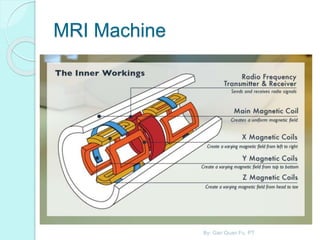
MRI Machine
By: Gan Quan Fu, PT
Principles of MRI
 Human body made up of chemical
composition (ie: hydrogen, carbon,
nitrogen sodium, phosphotus, potassium
etc.)
 Atoms these elements have different
number of protons in their nucleus and
possess different magnetic property.
 Protons of hydrogen atom are the most
abundant in the body in the form of
water.
 Magnetic properties of these atoms have
been utilized to produce magnetic
resonance signals and images.
By: Gan Quan Fu, PT
Principles of MRI
 When a patient is placed in a strong
magnetic field in MR scanner,
hydrogen nucleus in the body align
with the applied external magnetic
field.
 Hydrogen nuclei in the patients body
absorbs the energy and then
generates the MR signal when
exposed to short bursts of
electromagnetic energy in form of
radio frequency pulse.By: Gan Quan Fu, PT
Principles of MRI
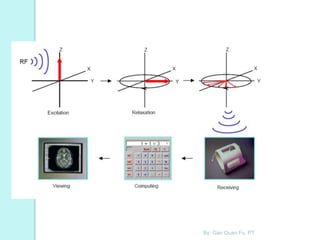
 The magnet creates a strong magnetic
field which aligns the protons of
hydrogen atoms which are then
exposed to a beam of radio waves.
 This spins the various protons of the
body and produce a faint signal which
is detected by receiver portion of the
MRI scanner.
 The receiver information is processed
by computer and image is produced.
By: Gan Quan Fu, PT
By: Gan Quan Fu, PT
Advantages & Disadvantages
Advantages Disadvantages
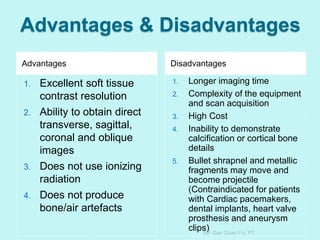
1. Excellent soft tissue
contrast resolution
2. Ability to obtain direct
transverse, sagittal,
coronal and oblique
images
3. Does not use ionizing
radiation
4. Does not produce
bone/air artefacts
1. Longer imaging time
2. Complexity of the equipment
and scan acquisition
3. High Cost
4. Inability to demonstrate
calcification or cortical bone
details
5. Bullet shrapnel and metallic
fragments may move and
become projectile
(Contraindicated for patients
with Cardiac pacemakers,
dental implants, heart valve
prosthesis and aneurysm
clips)By: Gan Quan Fu, PT
Indications for MRI
 Please contact the Author to view this
Page
 E-mail: davidgqf@gmail.com
By: Gan Quan Fu, PT
Contraindications
 Cardiac pacemakers
 Brain aneurysm clip
 Aortic clip
 Artificial heart valve
 Insulin pump
 IUD
 Joint replacement
 Prostheses (such as cochlear implant)
 Wire sutures
 Dentures (Must be Removed)
 Claustrophobia (Can be sedated or use open
MRI)
By: Gan Quan Fu, PT
Types of MRI Machine
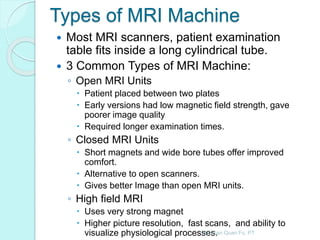
 Most MRI scanners, patient examination
table fits inside a long cylindrical tube.
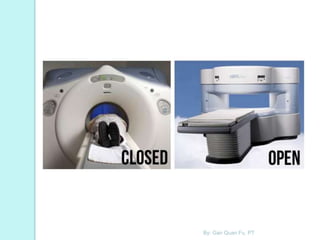
 3 Common Types of MRI Machine:
◦ Open MRI Units
 Patient placed between two plates
 Early versions had low magnetic field strength, gave
poorer image quality
 Required longer examination times.
◦ Closed MRI Units
 Short magnets and wide bore tubes offer improved
comfort.
 Alternative to open scanners.
 Gives better Image than open MRI units.
◦ High field MRI
 Uses very strong magnet
 Higher picture resolution, fast scans, and ability to
visualize physiological processes.By: Gan Quan Fu, PT
By: Gan Quan Fu, PT
Strength of Magnetic Field Used
in MRI
 Measured in Tesla (T)
[Developed by Nikola
Tesla]
 Open MRI units
◦ 0.1T to 0.3 T
 Closed MRI unit
◦ 0.5 T to 0.6 T
 High field MRI
◦ 1.0 T to 3.0 T or higher
By: Gan Quan Fu, PT
MRI Contrast Agent
 Group of contrast media used to improve
visibility of internal body structures in
magnetic resonance imaging (MRI).
 Examples are:
◦ Gadolinium
◦ Paramagnetic agent
 Shortens the T1 relaxation time and produces
increased signal intensity on T1W images.
 Dose 0.1 to 0.2 mmol/kg body weight.
 Side Effect:
◦ Nausea
◦ Vomiting,
◦ Headache,
◦ Seizures,
◦ Anaphylaxis
By: Gan Quan Fu, PT
Types of MRI Images
 Please contact the Author to view this
Page
 E-mail: davidgqf@gmail.com
By: Gan Quan Fu, PT
Basic Interpretation of MRI
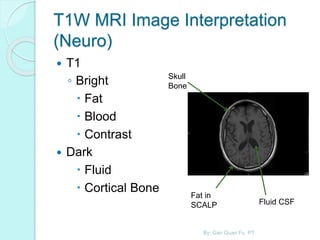
 T1
◦ Bright
 Fat
 Blood
 Contrast
◦ Dark
 Fluid
 Cortical Bone
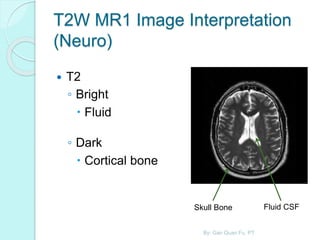
 T2
◦ Bright
 Fluid
◦ Dark
 Cortical bone
By: Gan Quan Fu, PT
T1W MRI Image Interpretation
(Neuro)
 T1
◦ Bright
 Fat
 Blood
 Contrast
 Dark
 Fluid
 Cortical Bone
Skull
Bone
Fat in
SCALP Fluid CSF
By: Gan Quan Fu, PT
T2W MR1 Image Interpretation
(Neuro)
 T2
◦ Bright
 Fluid
◦ Dark
 Cortical bone
Skull Bone Fluid CSF
By: Gan Quan Fu, PT
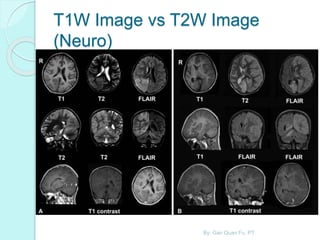
T1W Image vs T2W Image
(Neuro)
By: Gan Quan Fu, PT
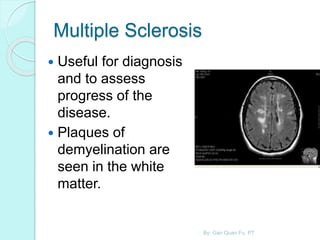
Multiple Sclerosis
 Useful for diagnosis
and to assess
progress of the
disease.
 Plaques of
demyelination are
seen in the white
matter.
By: Gan Quan Fu, PT
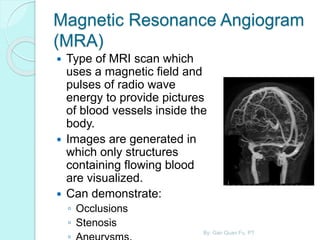
Magnetic Resonance Angiogram
(MRA)
 Type of MRI scan which
uses a magnetic field and
pulses of radio wave
energy to provide pictures
of blood vessels inside the
body.
 Images are generated in
which only structures
containing flowing blood
are visualized.
 Can demonstrate:
◦ Occlusions
◦ Stenosis
By: Gan Quan Fu, PT
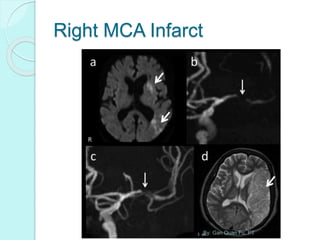
Right MCA Infarct
By: Gan Quan Fu, PT
MRI Interpretation (Abdomen)
 Please contact the Author to view this
Page
 E-mail: davidgqf@gmail.com
By: Gan Quan Fu, PT
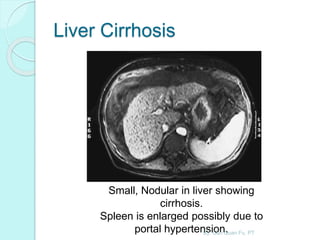
Liver Cirrhosis
Small, Nodular in liver showing
cirrhosis.
Spleen is enlarged possibly due to
portal hypertension.By: Gan Quan Fu, PT
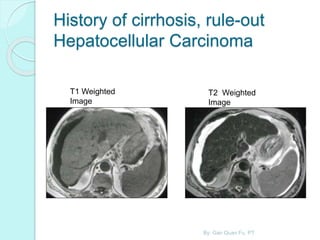
History of cirrhosis, rule-out
Hepatocellular Carcinoma
T1 Weighted
Image
T2 Weighted
Image
By: Gan Quan Fu, PT
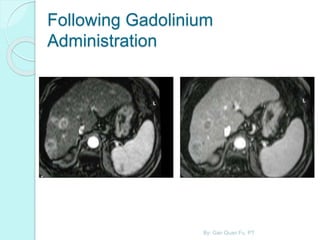
Following Gadolinium
Administration
By: Gan Quan Fu, PT
Magnetic Resonance
Cholangiopancreatogram
(MRCP)
 Technique uses magnetic resonance
imaging to visualize the biliary and
pancreatic ducts in a non-invasive
manner.
 Can be used to determine if gallstones
are lodged in any of the ducts
surrounding the gallbladder.
 Excellent for demonstration of:
◦ Biliary tract
◦ Pancreatic duct
◦ Gallbladder
By: Gan Quan Fu, PT
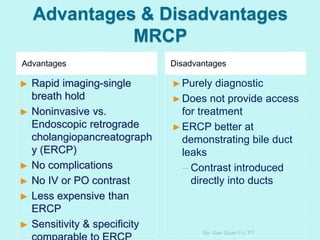
Advantages & Disadvantages
MRCP
Advantages Disadvantages
► Rapid imaging-single
breath hold
► Noninvasive vs.
Endoscopic retrograde
cholangiopancreatograph
y (ERCP)
► No complications
► No IV or PO contrast
► Less expensive than
ERCP
► Sensitivity & specificity
►Purely diagnostic
►Does not provide access
for treatment
►ERCP better at
demonstrating bile duct
leaks
– Contrast introduced
directly into ducts
By: Gan Quan Fu, PT
Choledochal cyst on MRCP
Common Bile Duct
Gall Bladder
By: Gan Quan Fu, PT
MRI of Pancreas
 Please contact the Author to view this
Page
 E-mail: davidgqf@gmail.com
By: Gan Quan Fu, PT
MRI of Breast
 Please contact the Author to view this
Page
 E-mail: davidgqf@gmail.com
By: Gan Quan Fu, PT
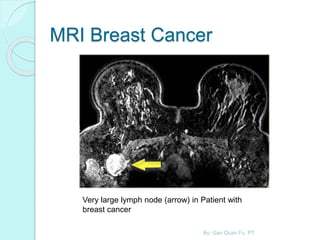
MRI Breast Cancer
Very large lymph node (arrow) in Patient with
breast cancer
By: Gan Quan Fu, PT
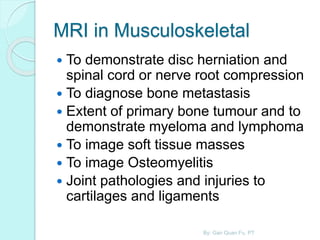
MRI in Musculoskeletal
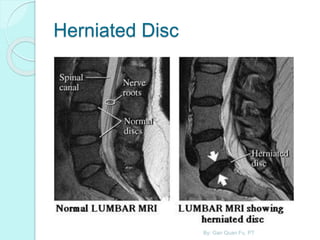
 To demonstrate disc herniation and
spinal cord or nerve root compression
 To diagnose bone metastasis
 Extent of primary bone tumour and to
demonstrate myeloma and lymphoma
 To image soft tissue masses
 To image Osteomyelitis
 Joint pathologies and injuries to
cartilages and ligaments
By: Gan Quan Fu, PT
Spine
 MRI is a better way of looking in
detail at the inner ear, cranial and
spinal nerves.
 MRI also looks at the state of
vertebrae and discs.
By: Gan Quan Fu, PT
Spine
By: Gan Quan Fu, PT
Please contact the Author to view this
Page
E-mail: davidgqf@gmail.com
Herniated Disc
By: Gan Quan Fu, PT
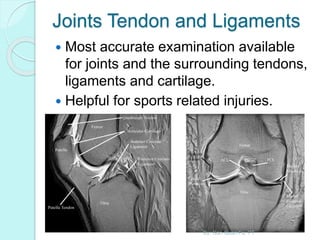
Joints Tendon and Ligaments
 Most accurate examination available
for joints and the surrounding tendons,
ligaments and cartilage.
 Helpful for sports related injuries.
By: Gan Quan Fu, PT
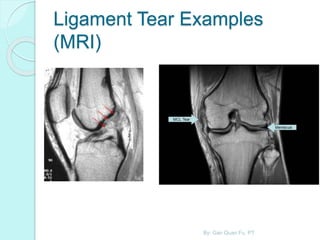
Ligament Tear Examples
(MRI)
By: Gan Quan Fu, PT
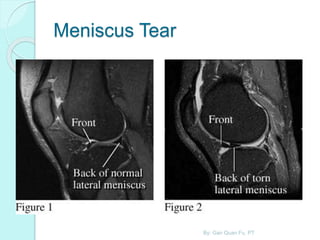
Meniscus Tear
By: Gan Quan Fu, PT
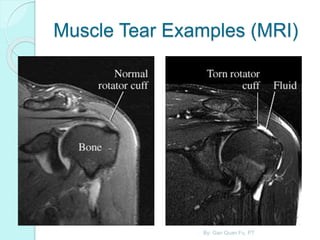
Muscle Tear Examples (MRI)
By: Gan Quan Fu, PT
Pelvis
 Please contact the Author to view
this Page
 E-mail: davidgqf@gmail.com
By: Gan Quan Fu, PT
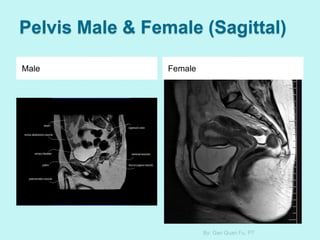
Pelvis Male & Female (Sagittal)
Male Female
By: Gan Quan Fu, PT
Pelvis
By: Gan Quan Fu, PT
Please contact the Author to view this
Page
E-mail: davidgqf@gmail.com
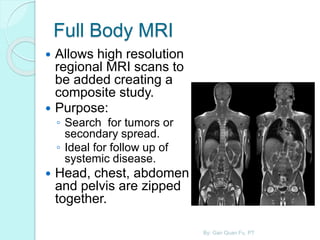
Full Body MRI
 Allows high resolution
regional MRI scans to
be added creating a
composite study.
 Purpose:
◦ Search for tumors or
secondary spread.
◦ Ideal for follow up of
systemic disease.
 Head, chest, abdomen
and pelvis are zipped
together.
By: Gan Quan Fu, PT
By: Gan Quan Fu, PT

Basicunderstandingonmagneticresonanceimagingmri 141231045409-conversion-gate01

  • 1.
    Basic Understanding on MagneticResonance Imaging (MRI) & Interpretation of MRI Images By : QF Gan, PT, MSc Human Anatomy (Batch
  • 2.
    Is MRI Important Iam a Physiotherapist. During my student years, I used to think that MRI is totally not important for a Physiotherapist. The reason behind this is because in every patient with MRI, there is a interpretation sheet that comes along to tell the clinician exactly what exactly is the findings from MRI. However, there are times where some patient’s who walk in for treatment with his/her MRI but forgotten the MRI interpretation sheet. Without the knowledge, how am I to interpret those MRIs images given in order to confirm my assessment? Of course, everything I see is blank and white images not knowing what are those, where to start and how it goes. Hence, the question is, ‘Is the basic understanding and ability to interpret MRI images important for physiotherapist?’
  • 3.
    Content  Brief History Introduction to MRI  MRI Machine  Principles of MRI  Advantages & Disadvantages  Indications for MRI  Contraindications  Types Of MRI Machine  Strength of Magnetic Field Used in MRI  MRI Contrast Agent  Types of MRI Images  Basic Interpretation of MRI  Q & A Session By: Gan Quan Fu, PT
  • 4.
    Brief History  Inventedby Paul C. Lauterbur in September 1971  Paul Lauterbur of the University of Illinois at Urbana-Champaign & Sir Peter Mansfield of the University of Nottingham were awarded the 2003 Nobel Prize in Physiology or Medicine for their discoveries of MRI. By: Gan Quan Fu, PT
  • 5.
    Introduction to MRI Uses magnetic field & radio waves to create detailed images of organs & tissues within the body.  Also known as nuclear magnetic resonance (NMR).  No ionizing radiation  Employs radiofrequency pulse ranging from 1 to 80MHz By: Gan Quan Fu, PT
  • 6.
  • 7.
  • 8.
    Principles of MRI Human body made up of chemical composition (ie: hydrogen, carbon, nitrogen sodium, phosphotus, potassium etc.)  Atoms these elements have different number of protons in their nucleus and possess different magnetic property.  Protons of hydrogen atom are the most abundant in the body in the form of water.  Magnetic properties of these atoms have been utilized to produce magnetic resonance signals and images. By: Gan Quan Fu, PT
  • 9.
    Principles of MRI When a patient is placed in a strong magnetic field in MR scanner, hydrogen nucleus in the body align with the applied external magnetic field.  Hydrogen nuclei in the patients body absorbs the energy and then generates the MR signal when exposed to short bursts of electromagnetic energy in form of radio frequency pulse.By: Gan Quan Fu, PT
  • 10.
    Principles of MRI The magnet creates a strong magnetic field which aligns the protons of hydrogen atoms which are then exposed to a beam of radio waves.  This spins the various protons of the body and produce a faint signal which is detected by receiver portion of the MRI scanner.  The receiver information is processed by computer and image is produced. By: Gan Quan Fu, PT
  • 11.
  • 12.
    Advantages & Disadvantages AdvantagesDisadvantages 1. Excellent soft tissue contrast resolution 2. Ability to obtain direct transverse, sagittal, coronal and oblique images 3. Does not use ionizing radiation 4. Does not produce bone/air artefacts 1. Longer imaging time 2. Complexity of the equipment and scan acquisition 3. High Cost 4. Inability to demonstrate calcification or cortical bone details 5. Bullet shrapnel and metallic fragments may move and become projectile (Contraindicated for patients with Cardiac pacemakers, dental implants, heart valve prosthesis and aneurysm clips)By: Gan Quan Fu, PT
  • 13.
    Indications for MRI Please contact the Author to view this Page  E-mail: davidgqf@gmail.com By: Gan Quan Fu, PT
  • 14.
    Contraindications  Cardiac pacemakers Brain aneurysm clip  Aortic clip  Artificial heart valve  Insulin pump  IUD  Joint replacement  Prostheses (such as cochlear implant)  Wire sutures  Dentures (Must be Removed)  Claustrophobia (Can be sedated or use open MRI) By: Gan Quan Fu, PT
  • 15.
    Types of MRIMachine  Most MRI scanners, patient examination table fits inside a long cylindrical tube.  3 Common Types of MRI Machine: ◦ Open MRI Units  Patient placed between two plates  Early versions had low magnetic field strength, gave poorer image quality  Required longer examination times. ◦ Closed MRI Units  Short magnets and wide bore tubes offer improved comfort.  Alternative to open scanners.  Gives better Image than open MRI units. ◦ High field MRI  Uses very strong magnet  Higher picture resolution, fast scans, and ability to visualize physiological processes.By: Gan Quan Fu, PT
  • 16.
  • 17.
    Strength of MagneticField Used in MRI  Measured in Tesla (T) [Developed by Nikola Tesla]  Open MRI units ◦ 0.1T to 0.3 T  Closed MRI unit ◦ 0.5 T to 0.6 T  High field MRI ◦ 1.0 T to 3.0 T or higher By: Gan Quan Fu, PT
  • 18.
    MRI Contrast Agent Group of contrast media used to improve visibility of internal body structures in magnetic resonance imaging (MRI).  Examples are: ◦ Gadolinium ◦ Paramagnetic agent  Shortens the T1 relaxation time and produces increased signal intensity on T1W images.  Dose 0.1 to 0.2 mmol/kg body weight.  Side Effect: ◦ Nausea ◦ Vomiting, ◦ Headache, ◦ Seizures, ◦ Anaphylaxis By: Gan Quan Fu, PT
  • 19.
    Types of MRIImages  Please contact the Author to view this Page  E-mail: davidgqf@gmail.com By: Gan Quan Fu, PT
  • 20.
    Basic Interpretation ofMRI  T1 ◦ Bright  Fat  Blood  Contrast ◦ Dark  Fluid  Cortical Bone  T2 ◦ Bright  Fluid ◦ Dark  Cortical bone By: Gan Quan Fu, PT
  • 21.
    T1W MRI ImageInterpretation (Neuro)  T1 ◦ Bright  Fat  Blood  Contrast  Dark  Fluid  Cortical Bone Skull Bone Fat in SCALP Fluid CSF By: Gan Quan Fu, PT
  • 22.
    T2W MR1 ImageInterpretation (Neuro)  T2 ◦ Bright  Fluid ◦ Dark  Cortical bone Skull Bone Fluid CSF By: Gan Quan Fu, PT
  • 23.
    T1W Image vsT2W Image (Neuro) By: Gan Quan Fu, PT
  • 24.
    Multiple Sclerosis  Usefulfor diagnosis and to assess progress of the disease.  Plaques of demyelination are seen in the white matter. By: Gan Quan Fu, PT
  • 25.
    Magnetic Resonance Angiogram (MRA) Type of MRI scan which uses a magnetic field and pulses of radio wave energy to provide pictures of blood vessels inside the body.  Images are generated in which only structures containing flowing blood are visualized.  Can demonstrate: ◦ Occlusions ◦ Stenosis By: Gan Quan Fu, PT
  • 26.
    Right MCA Infarct By:Gan Quan Fu, PT
  • 27.
    MRI Interpretation (Abdomen) Please contact the Author to view this Page  E-mail: davidgqf@gmail.com By: Gan Quan Fu, PT
  • 28.
    Liver Cirrhosis Small, Nodularin liver showing cirrhosis. Spleen is enlarged possibly due to portal hypertension.By: Gan Quan Fu, PT
  • 29.
    History of cirrhosis,rule-out Hepatocellular Carcinoma T1 Weighted Image T2 Weighted Image By: Gan Quan Fu, PT
  • 30.
  • 31.
    Magnetic Resonance Cholangiopancreatogram (MRCP)  Techniqueuses magnetic resonance imaging to visualize the biliary and pancreatic ducts in a non-invasive manner.  Can be used to determine if gallstones are lodged in any of the ducts surrounding the gallbladder.  Excellent for demonstration of: ◦ Biliary tract ◦ Pancreatic duct ◦ Gallbladder By: Gan Quan Fu, PT
  • 32.
    Advantages & Disadvantages MRCP AdvantagesDisadvantages ► Rapid imaging-single breath hold ► Noninvasive vs. Endoscopic retrograde cholangiopancreatograph y (ERCP) ► No complications ► No IV or PO contrast ► Less expensive than ERCP ► Sensitivity & specificity ►Purely diagnostic ►Does not provide access for treatment ►ERCP better at demonstrating bile duct leaks – Contrast introduced directly into ducts By: Gan Quan Fu, PT
  • 33.
    Choledochal cyst onMRCP Common Bile Duct Gall Bladder By: Gan Quan Fu, PT
  • 34.
    MRI of Pancreas Please contact the Author to view this Page  E-mail: davidgqf@gmail.com By: Gan Quan Fu, PT
  • 35.
    MRI of Breast Please contact the Author to view this Page  E-mail: davidgqf@gmail.com By: Gan Quan Fu, PT
  • 36.
    MRI Breast Cancer Verylarge lymph node (arrow) in Patient with breast cancer By: Gan Quan Fu, PT
  • 37.
    MRI in Musculoskeletal To demonstrate disc herniation and spinal cord or nerve root compression  To diagnose bone metastasis  Extent of primary bone tumour and to demonstrate myeloma and lymphoma  To image soft tissue masses  To image Osteomyelitis  Joint pathologies and injuries to cartilages and ligaments By: Gan Quan Fu, PT
  • 38.
    Spine  MRI isa better way of looking in detail at the inner ear, cranial and spinal nerves.  MRI also looks at the state of vertebrae and discs. By: Gan Quan Fu, PT
  • 39.
    Spine By: Gan QuanFu, PT Please contact the Author to view this Page E-mail: davidgqf@gmail.com
  • 40.
  • 41.
    Joints Tendon andLigaments  Most accurate examination available for joints and the surrounding tendons, ligaments and cartilage.  Helpful for sports related injuries. By: Gan Quan Fu, PT
  • 42.
  • 43.
  • 44.
    Muscle Tear Examples(MRI) By: Gan Quan Fu, PT
  • 45.
    Pelvis  Please contactthe Author to view this Page  E-mail: davidgqf@gmail.com By: Gan Quan Fu, PT
  • 46.
    Pelvis Male &Female (Sagittal) Male Female By: Gan Quan Fu, PT
  • 47.
    Pelvis By: Gan QuanFu, PT Please contact the Author to view this Page E-mail: davidgqf@gmail.com
  • 48.
    Full Body MRI Allows high resolution regional MRI scans to be added creating a composite study.  Purpose: ◦ Search for tumors or secondary spread. ◦ Ideal for follow up of systemic disease.  Head, chest, abdomen and pelvis are zipped together. By: Gan Quan Fu, PT
  • 49.

Editor's Notes

  • #6 Spectroscopy = Study of the interaction between matter and radiated energy. Non-ionizing (or non-ionising) radiation = Any type of electromagnetic radiation that does not carry enough energy per quantum to ionize atoms or molecules—that is, to completely remove an electron from an atom or molecule. Ionize = Convert (an atom, molecule, or substance) into an ion or ions, typically by removing one or more electrons.
  • #24 Fluid Attenuated Inversion Recovery (FLAIR) is an inversion-recovery pulse sequence used to nullify the signal from fluids. For example, it can be used in brain imaging to suppress cerebrospinal fluid (CSF) so as to bring out periventricular hyper intense lesions, such as multiple sclerosis (MS) plaques. By carefully choosing the inversion time TI (the time between the inversion and excitation pulses), the signal from any particular tissue can be suppressed.