MRI
MAGNETIC RESONANCE IMAGING
CONTENTS
 History
 MRI System Components
 MRI Physics
 MRI Signal Types & Coding
 Fundamental Clinical Sequences
 Tissue Contrast
 Image Quality
 Artefacts
 MRI Safety
WHAT WE PRESENT ?
This presentation aims to explain
 What is Magnetic Resonance Imaging?
 What are the componenst of MRI machine
 What is the method of imaging?
 How Visual Is Obtained ?
 Pyhsic of MRI
 Sick fuck motherfucker
HISTORY OF MRI
What is Magnet?
The word magnetism is derived from Magnesia, known
present name is Manisa, found by a shepherd at around
1000 BC. He was walking on the mountains and suddenly
he was drawn to the earth by the tracks in his sandals.
Investigating the cause, he discovered lodestone
according to Pliny The Elder, he could magnetize metal
by rubbing lodestone on it.
HISTORY OF MRI
 Hans Christian Ørsted made first experiment in 1820
 Observed a direction of coppass changes when
located in a field of wire carrying current
 Then it was discovered that surrounding quite long
wire around an empty conductor cylinder makes a
bigger magnetic field around itself.
 MRI machines rely on this concept and the section
which patients are put in surrounded current-carrying
wire.
HISTORY OF MRI
 2/3 of Human body is water
 Organs and tissues have different contents and lots of
disease change them
 Water is a molecule which includes hydrogen and
oxygen atoms. When magnetic field is applied protons
and neutrons spin around themselves randomly and
irregularly.
 That explains why MRI is used that commonly
HISTORY OF MRI
In imaging, strong magnetic field is creatived and when
body is exposed to that force, hydrogen’s nucleus’ are
sorted either along or opposite of magnetic fields
direction. If nucleuses are excited by appropriate
frequency radio wave, their energy level change and
they pass over higher energy level. When radio waves
are cut, reverse occurs and atoms give their energy to
the system. This process is called Magnetic Resonance.
The energy which is transferred during this process spread
as alternative current and by using those signals, 3D
images are obtained having detailed chemical structure
of cells.
HISTORY OF MRI
WHO ?
 Felix Bloch and Edward Purcell
 Worked individually in 1946
 There is a simple relation between resonance,
magnetic field strength and frequency of radio waves.
For every type of atom nucleuses, there is a constant
number which detecting the amplitude of radio
waves after application of magnetic field.
 Rewarded with Nobel Physics Prize in 1952
HISTORY OF MRI
NMR (Nuclear Magnetic Resonance)
 Isidor Rabi and his friends were first observers
 Nuclear Magnetic Resonance expression was used in
his book by the name of “A New Method of Measuring
Nuclear Magnetic Moment”
 Rewarded with Nobel Pyhsics Prize in 1944
HISTORY OF MRI
NMR
Between 1950 and 1970, NMR was being used for
moleculer analysis and in 1970, Raymond Damadian
showed tumoured tissues responds different signals then
healty tissues. After this, NMR began used in detecting
unhealtly tissues
HISTORY OF MRI
Gradient System
In 1973 Paul Lauterbur found Gradient System (Gx,
Gy, Gz) to pick up and excite a particular section of
human body in three dimension then boradcast a first
visual of 2 tube in Nature Magazine. He also called this
imaging by the name of Zeugmatography.
HISTORY OF MRI
Fourier in Radon out !!
 In 1975 Richard Ernst, from Zurich University built the
base of Magnetic Resonance by offering the method
of frequency and phase coding. He thought of using
Fourier Transfor instead of Radon Transform and
applied succesfully
HISTORY OF MRI
EPI
 In 1977, Damadian accoplished imaging of entire
human body.
 Same year, Peter Mansfield developed Echo Planar
Imaging (EPI) provided imaging very fast.
HISTORY OF MRI
 In 1980, Hawkens discovered the multiplanar property
of MR and detected first lesion.
 Edelstein and his friends began obtaining visuals by
using Ernst Technique.
 Initial MR works based on weight of protons and T1
technique began in clinically.
HISTORY OF MRI
 Between 1982-1983, it was figured out that T2 based
Spin-Echo technique was better for imaging
pathologic.
 Contrast agent got attraction and started being used
in 1980s and fr the first time, Schering Company
applied for patent for Gd-DTPA.
HISTORY OF MRI
 In 1987, EPI technique was used th imaging of heart’s
phase in real-time.
 Same year, Charles Dumoulin accomplished imaging
of veins without constast agents by developing
Magnetic Resonance Anjiyografi.
 In 1993, functional Magnetic Resonance Imaging
(fMRI) was discovered. Then by that time, it was
possible to explore deep parts of human braing by
usin fMRI.
HISTORY OF MRI
 In 1944, New York State and Princeton University
achieved imaging of lungs.
 Finally FDA (Food and Drug Ac.) allowed marketing up
yo 4 Tesla devices in 1998
 Today, increasing strength of magnetic field enables
to increase the quality of visual and also decreases to
time of observation.
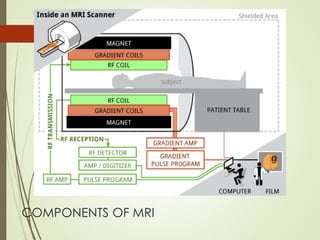
COMPONENTS OF MRI
 MAIN MAGNET
 GRADIENT COIL FEATURES
 RF SARMALLARI
 SHIELDING
 COMPUTERS
COMPONENTS OF MRI
MAIN MAGNET
 According to constructure of magnet
 Really strong from 0,02 Tesla to 3 Tesla
 FDA allows 7 Tesla MRI for only clinical
researches on human body
 For animal used experiments, it is 11 Tesla
 According to structure of magnet
Permanent (Fixed) Magnets : 0,7 T
Resistive Magnet : 0,2 T
Superconductor Magnet : 0,5 T - 7,9..T
MAIN MAGNET
According to streght
 Low Field
 Midfield 0,2 T – 1 T
 High Field 1,5 T and over
MAIN MAGNET
 Magnets are built with superconductor mostly
 Most expensive part of MRI
 3-4 km wire, liquid Helium 4K (-269 C) to provide the
resistance of wire reaches zero
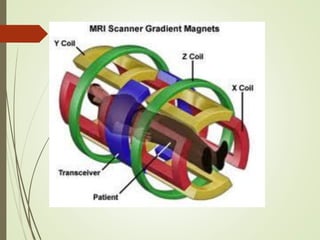
GRADIENT COILS
 In magnet,there is Gradient Features along Gx, Gy
and Gz and inner side RF Coils.
 Enable us to adjust the strenght of magnetic field.
 SI Unit is Tesla
 Rise Time is time arrival that spirals can reach top level
 Main noisy comes from Gradiant Features
 Motorbycles 90 Db, drill 100 Db, MRI 110 Db
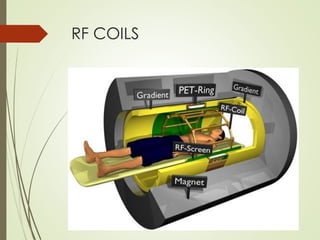
RF COILS
According to function
 Sends RF Pulse and detects return signals
(Transmitter-Receiver)
 Only sends (Transmitter)
 Only Receives (Receiver)
RF COILS
According to anatomical region
 Head
 Body
 Breast
RF COILS
According to mechanical structures
 Linear Coils
 Volume Coils
According to working principle
 Linear Coil
 Quadrature Coil
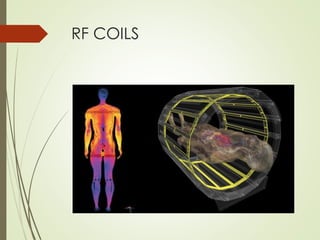
RF COILS
RF COILS
SHIELDING
 It is a shield to prevent stronge RF pulses to damage
other devices
 Also prevents other devices’ waves to distract RF Pulse
 Can be Passive and Active
 Passive is built Faraday Case
 Active is built by producing reverse magnetic fields but
expensive and can damage elevators or cars
Computers
 Enables the system work properly
 Adjusts RF pulses
 Provides power amplifiers and Gradiant Coils
work effective and sensitive
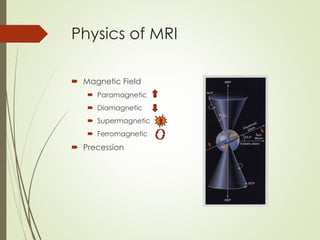
Physics of MRI
 Magnetic Field
 Paramagnetic
 Diamagnetic
 Supermagnetic
 Ferromagnetic
 Precession
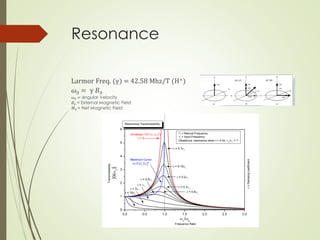
Resonance
Larmor Freq. (γ) = 42.58 Mhz/T (H+)
𝜔0 = γ 𝐵0
𝜔0 = Angular Velocity
𝐵0 = External Magnetic Field
𝑀0 = Net Magnetic Field
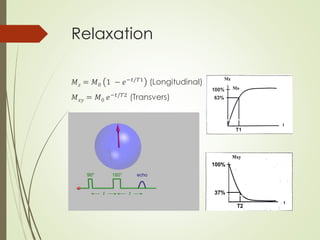
Relaxation
𝑀 𝑧 = 𝑀0 1 − 𝑒−𝑡/𝑇1
(Longitudinal)
𝑀 𝑥𝑦 = 𝑀0 𝑒−𝑡/𝑇2
(Transvers)
Gradient
 Basicly, to create a gradient is actually creating some
increment or decrement on any constant value. By
calculating, the value of this alteration at any point
divided by maximum alteration, gives us the gradient
measurement.
 In MRI systems, gradients is used to change the
external magnetic field’s value at any point as
required.
K-Space
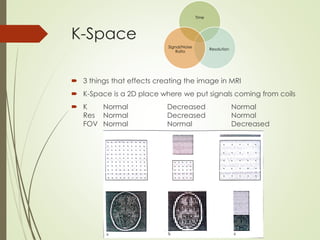
 3 things that effects creating the image in MRI
 K-Space is a 2D place where we put signals coming from coils
 K Normal Decreased Normal
Res Normal Decreased Normal
FOV Normal Normal Decreased
Time
Resolution
Signal/Noise
Ratio
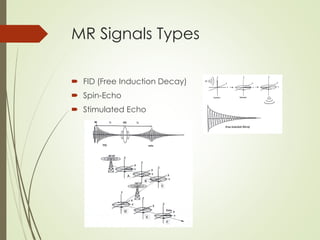
MR Signals Types
 FID (Free Induction Decay)
 Spin-Echo
 Stimulated Echo
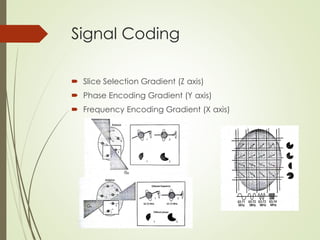
Signal Coding
 Slice Selection Gradient (Z axis)
 Phase Encoding Gradient (Y axis)
 Frequency Encoding Gradient (X axis)
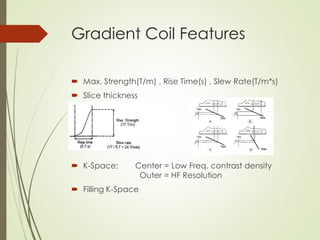
Gradient Coil Features
 Max. Strength(T/m) , Rise Time(s) , Slew Rate(T/m*s)
 Slice thickness
 K-Space: Center = Low Freq. contrast density
Outer = HF Resolution
 Filling K-Space
Fundamental Clinical
Sequences
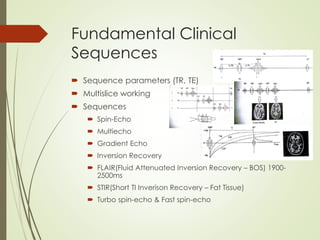
 Sequence parameters (TR, TE)
 Multislice working
 Sequences
 Spin-Echo
 Multiecho
 Gradient Echo
 Inversion Recovery
 FLAIR(Fluid Attenuated Inversion Recovery – BOS) 1900-
2500ms
 STIR(Short TI Inverison Recovery – Fat Tissue)
 Turbo spin-echo & Fast spin-echo
Tissue Contrast
 T1 Contrast
 T2 Contrast
 Proton Density Contrast
 Gradient Echo
Image Quality
 SNR (Signal Noise Ratio)
 Sequence Parameters
 NSA(Number Of Signal Average) or
NEX (Number of Excitations)
 Matrix (Acquisition)
 FOV (Field of View)
 Slice Thickness
 Slice Gap
 Choosing Phase Coding Direction
 Receiver Bandwidth
MRI ARTEFACTS
MR hardware and room shielding
 Herringbone artifact
 Moire fringes
 Zebra stripes
 Central point artifact
 RF overflow artifacts
 Inhomogeneity artifacts
 Zipper artifact
MRI ARTIFACTS
MR software
 Slice-overlap artifact aka cross-talk artifact
 Cross excitation
Patient and physiologic motion
 Phase-encoded motion artifact
 Entry slice phenomenon
MRI ARTIFACTS
Tissue heterogeneity and foreign bodies
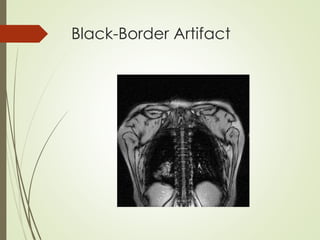
 Black-Border Artifact
 Magic Angle Effect
 Susceptibility artifact / magnetic Susceptibility
artifact
 Chemical shift artifact
MRI ARTIFACTS
Fourier transform & Nyquist sampling
theorem
 Gibbs artifact / truncation artifact
 Zero-fill artifact
 Aliasing / wrap around artefact
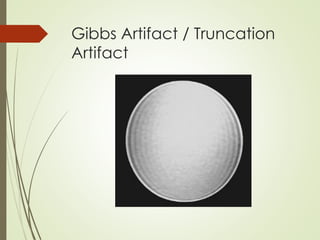
Gibbs Artifact / Truncation
Artifact
Black-Border Artifact
MRI SAFETY
 Pregnants and are not allowed to get in to MRI room
 All kind of metal items are prohibited like paper-clip,
hairgrip, neckless etc., those can reach a speed of 60
km/h under impact of 1,5 T magnetic field
 Patients must fill in a form including safety instructions
 Cardiac pacemaker, biomedical implants and
devices, aneurysm clips, Stents, infusion pumps etc.
 Patients working on metal jobs who may have swarfs
in espicelly their eyes or other possible parts of body
 Metalic implants either damage patients and make
artefact on image
Created by
Oğuz GENÇER B1205.020099
Yavuz Selim AK B1205.020050
Thanks for all
audiences

Magnetic Resonance Imaging

  • 1.
  • 2.
    CONTENTS  History  MRISystem Components  MRI Physics  MRI Signal Types & Coding  Fundamental Clinical Sequences  Tissue Contrast  Image Quality  Artefacts  MRI Safety
  • 3.
    WHAT WE PRESENT? This presentation aims to explain  What is Magnetic Resonance Imaging?  What are the componenst of MRI machine  What is the method of imaging?  How Visual Is Obtained ?  Pyhsic of MRI  Sick fuck motherfucker
  • 4.
    HISTORY OF MRI Whatis Magnet? The word magnetism is derived from Magnesia, known present name is Manisa, found by a shepherd at around 1000 BC. He was walking on the mountains and suddenly he was drawn to the earth by the tracks in his sandals. Investigating the cause, he discovered lodestone according to Pliny The Elder, he could magnetize metal by rubbing lodestone on it.
  • 5.
    HISTORY OF MRI Hans Christian Ørsted made first experiment in 1820  Observed a direction of coppass changes when located in a field of wire carrying current  Then it was discovered that surrounding quite long wire around an empty conductor cylinder makes a bigger magnetic field around itself.  MRI machines rely on this concept and the section which patients are put in surrounded current-carrying wire.
  • 6.
    HISTORY OF MRI 2/3 of Human body is water  Organs and tissues have different contents and lots of disease change them  Water is a molecule which includes hydrogen and oxygen atoms. When magnetic field is applied protons and neutrons spin around themselves randomly and irregularly.  That explains why MRI is used that commonly
  • 7.
    HISTORY OF MRI Inimaging, strong magnetic field is creatived and when body is exposed to that force, hydrogen’s nucleus’ are sorted either along or opposite of magnetic fields direction. If nucleuses are excited by appropriate frequency radio wave, their energy level change and they pass over higher energy level. When radio waves are cut, reverse occurs and atoms give their energy to the system. This process is called Magnetic Resonance. The energy which is transferred during this process spread as alternative current and by using those signals, 3D images are obtained having detailed chemical structure of cells.
  • 8.
    HISTORY OF MRI WHO?  Felix Bloch and Edward Purcell  Worked individually in 1946  There is a simple relation between resonance, magnetic field strength and frequency of radio waves. For every type of atom nucleuses, there is a constant number which detecting the amplitude of radio waves after application of magnetic field.  Rewarded with Nobel Physics Prize in 1952
  • 9.
    HISTORY OF MRI NMR(Nuclear Magnetic Resonance)  Isidor Rabi and his friends were first observers  Nuclear Magnetic Resonance expression was used in his book by the name of “A New Method of Measuring Nuclear Magnetic Moment”  Rewarded with Nobel Pyhsics Prize in 1944
  • 10.
    HISTORY OF MRI NMR Between1950 and 1970, NMR was being used for moleculer analysis and in 1970, Raymond Damadian showed tumoured tissues responds different signals then healty tissues. After this, NMR began used in detecting unhealtly tissues
  • 11.
    HISTORY OF MRI GradientSystem In 1973 Paul Lauterbur found Gradient System (Gx, Gy, Gz) to pick up and excite a particular section of human body in three dimension then boradcast a first visual of 2 tube in Nature Magazine. He also called this imaging by the name of Zeugmatography.
  • 12.
    HISTORY OF MRI Fourierin Radon out !!  In 1975 Richard Ernst, from Zurich University built the base of Magnetic Resonance by offering the method of frequency and phase coding. He thought of using Fourier Transfor instead of Radon Transform and applied succesfully
  • 13.
    HISTORY OF MRI EPI In 1977, Damadian accoplished imaging of entire human body.  Same year, Peter Mansfield developed Echo Planar Imaging (EPI) provided imaging very fast.
  • 14.
    HISTORY OF MRI In 1980, Hawkens discovered the multiplanar property of MR and detected first lesion.  Edelstein and his friends began obtaining visuals by using Ernst Technique.  Initial MR works based on weight of protons and T1 technique began in clinically.
  • 15.
    HISTORY OF MRI Between 1982-1983, it was figured out that T2 based Spin-Echo technique was better for imaging pathologic.  Contrast agent got attraction and started being used in 1980s and fr the first time, Schering Company applied for patent for Gd-DTPA.
  • 16.
    HISTORY OF MRI In 1987, EPI technique was used th imaging of heart’s phase in real-time.  Same year, Charles Dumoulin accomplished imaging of veins without constast agents by developing Magnetic Resonance Anjiyografi.  In 1993, functional Magnetic Resonance Imaging (fMRI) was discovered. Then by that time, it was possible to explore deep parts of human braing by usin fMRI.
  • 17.
    HISTORY OF MRI In 1944, New York State and Princeton University achieved imaging of lungs.  Finally FDA (Food and Drug Ac.) allowed marketing up yo 4 Tesla devices in 1998  Today, increasing strength of magnetic field enables to increase the quality of visual and also decreases to time of observation.
  • 18.
    COMPONENTS OF MRI MAIN MAGNET  GRADIENT COIL FEATURES  RF SARMALLARI  SHIELDING  COMPUTERS
  • 19.
  • 20.
    MAIN MAGNET  Accordingto constructure of magnet  Really strong from 0,02 Tesla to 3 Tesla  FDA allows 7 Tesla MRI for only clinical researches on human body  For animal used experiments, it is 11 Tesla  According to structure of magnet Permanent (Fixed) Magnets : 0,7 T Resistive Magnet : 0,2 T Superconductor Magnet : 0,5 T - 7,9..T
  • 21.
    MAIN MAGNET According tostreght  Low Field  Midfield 0,2 T – 1 T  High Field 1,5 T and over
  • 22.
    MAIN MAGNET  Magnetsare built with superconductor mostly  Most expensive part of MRI  3-4 km wire, liquid Helium 4K (-269 C) to provide the resistance of wire reaches zero
  • 23.
    GRADIENT COILS  Inmagnet,there is Gradient Features along Gx, Gy and Gz and inner side RF Coils.  Enable us to adjust the strenght of magnetic field.  SI Unit is Tesla  Rise Time is time arrival that spirals can reach top level  Main noisy comes from Gradiant Features  Motorbycles 90 Db, drill 100 Db, MRI 110 Db
  • 25.
    RF COILS According tofunction  Sends RF Pulse and detects return signals (Transmitter-Receiver)  Only sends (Transmitter)  Only Receives (Receiver)
  • 26.
    RF COILS According toanatomical region  Head  Body  Breast
  • 27.
    RF COILS According tomechanical structures  Linear Coils  Volume Coils According to working principle  Linear Coil  Quadrature Coil
  • 28.
  • 29.
  • 30.
    SHIELDING  It isa shield to prevent stronge RF pulses to damage other devices  Also prevents other devices’ waves to distract RF Pulse  Can be Passive and Active  Passive is built Faraday Case  Active is built by producing reverse magnetic fields but expensive and can damage elevators or cars
  • 31.
    Computers  Enables thesystem work properly  Adjusts RF pulses  Provides power amplifiers and Gradiant Coils work effective and sensitive
  • 32.
    Physics of MRI Magnetic Field  Paramagnetic  Diamagnetic  Supermagnetic  Ferromagnetic  Precession
  • 33.
    Resonance Larmor Freq. (γ)= 42.58 Mhz/T (H+) 𝜔0 = γ 𝐵0 𝜔0 = Angular Velocity 𝐵0 = External Magnetic Field 𝑀0 = Net Magnetic Field
  • 34.
    Relaxation 𝑀 𝑧 =𝑀0 1 − 𝑒−𝑡/𝑇1 (Longitudinal) 𝑀 𝑥𝑦 = 𝑀0 𝑒−𝑡/𝑇2 (Transvers)
  • 35.
    Gradient  Basicly, tocreate a gradient is actually creating some increment or decrement on any constant value. By calculating, the value of this alteration at any point divided by maximum alteration, gives us the gradient measurement.  In MRI systems, gradients is used to change the external magnetic field’s value at any point as required.
  • 36.
    K-Space  3 thingsthat effects creating the image in MRI  K-Space is a 2D place where we put signals coming from coils  K Normal Decreased Normal Res Normal Decreased Normal FOV Normal Normal Decreased Time Resolution Signal/Noise Ratio
  • 37.
    MR Signals Types FID (Free Induction Decay)  Spin-Echo  Stimulated Echo
  • 38.
    Signal Coding  SliceSelection Gradient (Z axis)  Phase Encoding Gradient (Y axis)  Frequency Encoding Gradient (X axis)
  • 39.
    Gradient Coil Features Max. Strength(T/m) , Rise Time(s) , Slew Rate(T/m*s)  Slice thickness  K-Space: Center = Low Freq. contrast density Outer = HF Resolution  Filling K-Space
  • 40.
    Fundamental Clinical Sequences  Sequenceparameters (TR, TE)  Multislice working  Sequences  Spin-Echo  Multiecho  Gradient Echo  Inversion Recovery  FLAIR(Fluid Attenuated Inversion Recovery – BOS) 1900- 2500ms  STIR(Short TI Inverison Recovery – Fat Tissue)  Turbo spin-echo & Fast spin-echo
  • 41.
    Tissue Contrast  T1Contrast  T2 Contrast  Proton Density Contrast  Gradient Echo
  • 42.
    Image Quality  SNR(Signal Noise Ratio)  Sequence Parameters  NSA(Number Of Signal Average) or NEX (Number of Excitations)  Matrix (Acquisition)  FOV (Field of View)  Slice Thickness  Slice Gap  Choosing Phase Coding Direction  Receiver Bandwidth
  • 43.
    MRI ARTEFACTS MR hardwareand room shielding  Herringbone artifact  Moire fringes  Zebra stripes  Central point artifact  RF overflow artifacts  Inhomogeneity artifacts  Zipper artifact
  • 44.
    MRI ARTIFACTS MR software Slice-overlap artifact aka cross-talk artifact  Cross excitation Patient and physiologic motion  Phase-encoded motion artifact  Entry slice phenomenon
  • 45.
    MRI ARTIFACTS Tissue heterogeneityand foreign bodies  Black-Border Artifact  Magic Angle Effect  Susceptibility artifact / magnetic Susceptibility artifact  Chemical shift artifact
  • 46.
    MRI ARTIFACTS Fourier transform& Nyquist sampling theorem  Gibbs artifact / truncation artifact  Zero-fill artifact  Aliasing / wrap around artefact
  • 47.
    Gibbs Artifact /Truncation Artifact
  • 48.
  • 49.
    MRI SAFETY  Pregnantsand are not allowed to get in to MRI room  All kind of metal items are prohibited like paper-clip, hairgrip, neckless etc., those can reach a speed of 60 km/h under impact of 1,5 T magnetic field  Patients must fill in a form including safety instructions  Cardiac pacemaker, biomedical implants and devices, aneurysm clips, Stents, infusion pumps etc.  Patients working on metal jobs who may have swarfs in espicelly their eyes or other possible parts of body  Metalic implants either damage patients and make artefact on image
  • 50.
    Created by Oğuz GENÇERB1205.020099 Yavuz Selim AK B1205.020050
  • 51.