This document provides an overview of magnetic resonance imaging (MRI) including:
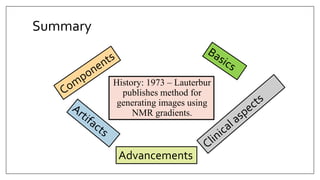
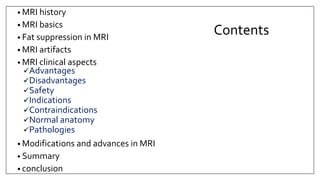
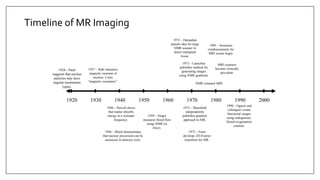
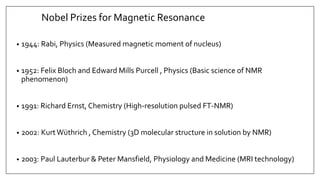
1. The history and timeline of MRI development from the 1920s to present day. Key developments include the discoveries of nuclear magnetic resonance and techniques for generating MRI images using gradients.
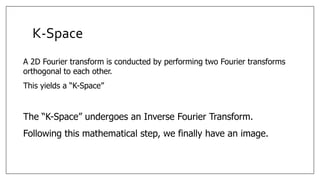
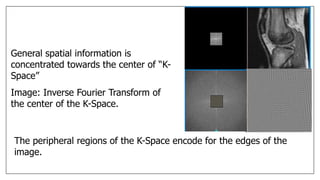
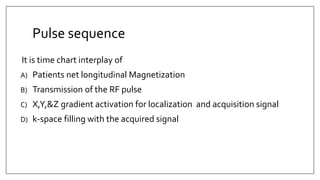
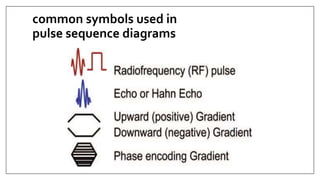
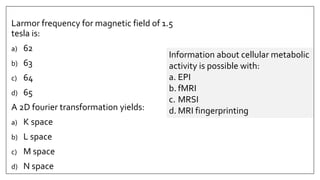
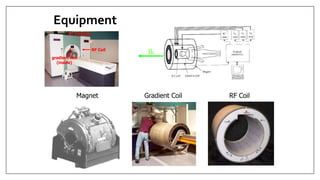
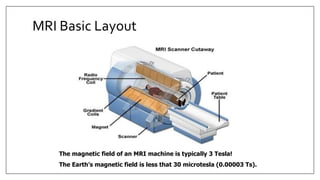
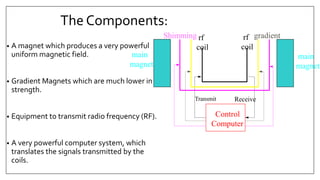
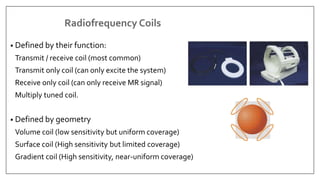
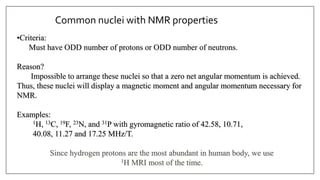
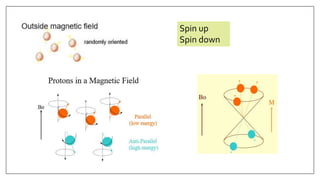
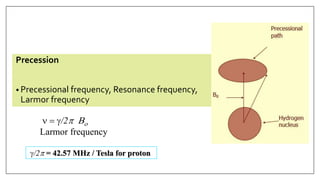
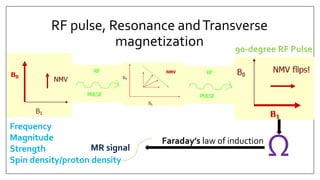
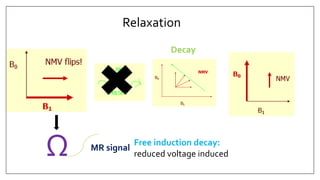
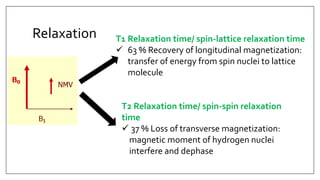
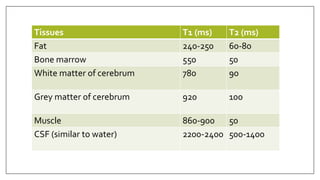
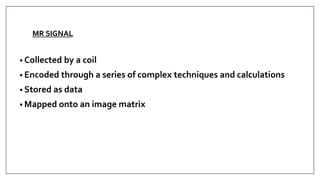
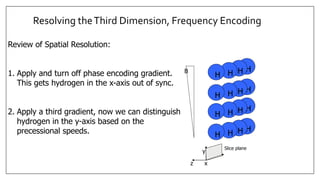
2. The basic components and principles of how MRI works including strong magnets, gradient coils, radiofrequency coils, spin precession, relaxation times, and Fourier transforms to generate images.
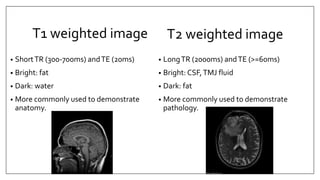
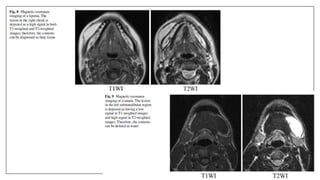
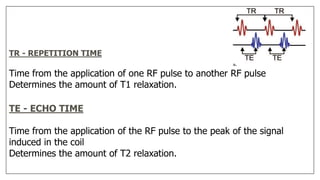
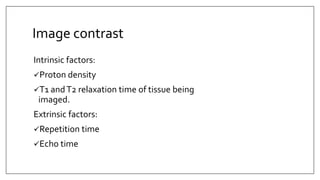
3. Explanations of fundamental MRI sequences including T1-weighted, T2-weighted images and how contrast is achieved using repetition time and echo time.
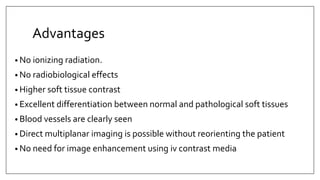
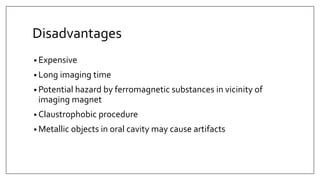
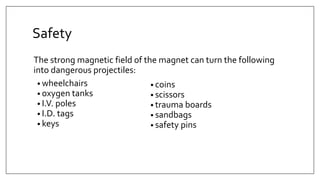
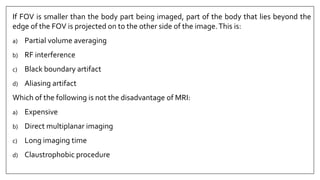
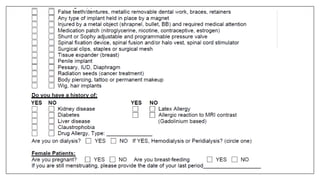
4. Clinical applications of MRI including its advantages over other imaging modalities as well as some disadvantages and
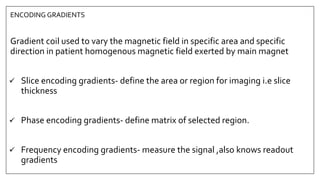
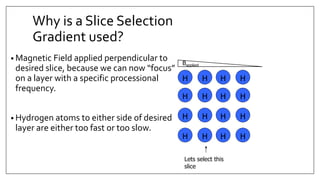
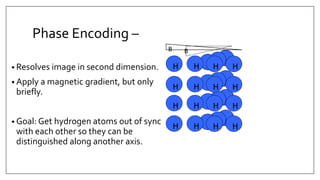
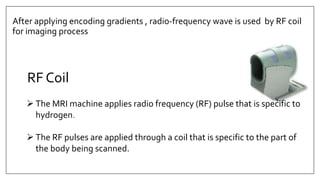
![Fourier’sTransform
• The pick up coil receives many different frequency oscillations.
• Use Fourier’sTransform to process the data.
Time [s]
Signal
Strength
1
4
Freqency [Hz]
Signal
Strength
1
0.25
f = 1/T = ¼ = .25
1.5
0.5
1.5
-1
-1.5
f = 1/T = ½ = .5
f = 1/T = 1/1 = 1
1.0
Transform](https://image.slidesharecdn.com/magneticresonanceimaging-210802051237/85/Magnetic-resonance-imaging-34-320.jpg)
![FourierTransform (cont.)
The pickup coil does not distinguish between the input of each hydrogen.
They are all read together, and constructively and destructively interfere.
Fourier’s allows us to determine which frequencies are along the axis.
For instance, if there are two hydrogen at different frequencies along an axis:
Signal
Strength
Time [s]
1
-1
4
Time [s]
1
-1
4
Time [s]
1
-1
4
+ =
Current
Fourier
Frequency [Hz]
1
0.25
Signal
Strength
0.25
Frequency [Hz]
1
0.25 1
0.25
Frequency [Hz]
1
0.25
1](https://image.slidesharecdn.com/magneticresonanceimaging-210802051237/85/Magnetic-resonance-imaging-35-320.jpg)