Basics Of Pediatric
Ventilation
Soumya Ranjan Parida
Basic B.Sc. Nursing 4th
year
Sum Nursing College
Topics
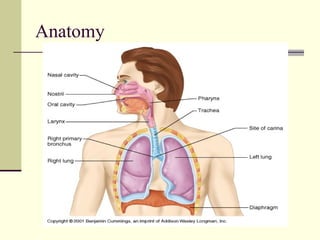
 Anatomy
 Physiology
 Pathophysiology
 Biophysics
Anatomy
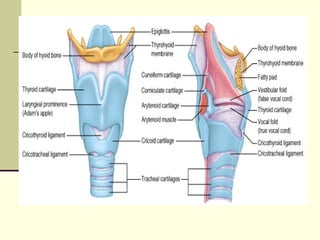
Peculiarities of Pediatric respiratory
system
 Airway of the infant or child is much smaller in diameter and
shorter in length. This markedly increases the resistance and
therefore the work of breathing.
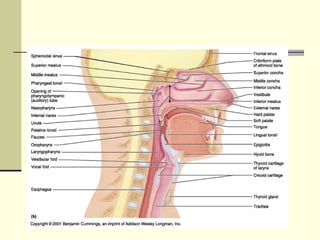
 Pediatric airway is placed anteriorly and superiorly. The glottic
opening lying higher, at approximately the level of C-2 or C-3,
as opposed to C-6 in the adult.
 Infant’s tongue is relatively larger to the oropharynx. Posterior
displacement of tongue causes severe airway obstruction.
 Epiglottis in children is long, floppy, narrow and angled away
from the axis of trachea.
 In children the narrowest portion is below the
vocal cord at the level of non distensible
cricoid cartilage and larynx is funnel shaped.
Whereas in adults the narrowest portion is at
glottic inlet and larynx is cylindrical in shape.
 In children the subglottic airway is smaller,
more compliant and less supported by
cartilage.
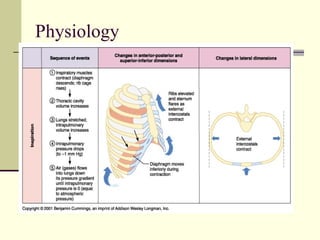
Physiology
 In children, the chest is cylindrical in shape.
Respiration are shallow and rapid due to
predominant diaphragmatic breathing and
inadequate costovertebral bucket handle
movement.
 Pediatric patient metabolizes oxygen twice as
quickly as the adult (6 mL/kg versus 3
mL/kg). So tolerance to hypoxia is less.
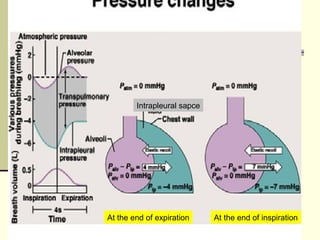
At the end of inspirationAt the end of expiration
Intrapleural sapce
Alveolar-arterial Gradient
 Oxygen and Carbon dioxide exchange takes place at
the at respiratory membrane because these two
gases move along their respective concentration
gradient to achieve equilibrium between the blood
phase in the capillary and the gas phase in the
alveoli.
 Difference between the alveolar oxygen
concentration i.e. PAO2 and arterial oxygen
concentration i.e. PaO2 is called alveolar-arterial
oxygen gradient. (A-a gradient
 Inspired atmospheric room air has PO2 of
approx 159 mm Hg and alveolar air PAO2 is
104 mm Hg.
 Alveolar air has lower PAO2 because of
humidification and because oxygen in the
alveoli is constantly being absorbed in the
pulmonary blood
Alveolar Gas Equation
 PAO2 is calculated by the alveolar gas equation:
PAO2= [FiO2(Pb-PH2O)]-(Paco2/R)
FiO2 = Fraction of the inspired oxygen
e.g. Breathing oxygen at room air with conc 21% FiO2=0.21
Pb is the barometric pressure ( assumed to be 760 mm Hg at sea
level.
PH2O= Water vapor pressure which dilutes dry oxygen content of
the atmosphere= 47 mm Hg.
R= respiratory quotient assumed to be 0.8
 Thus PAO2 depends on FiO2 i.e. fraction of the inspired oxygen.
More the FiO2 ,higher will be the PAO2.
A-a gradient:
 Normal oxygen A-a gradient is < 10 mm Hg
because no lung pathology exists to prevent
the equlibrium.
 An elevated A-a gradient indicates underlying
pulmonary pathology and is used to assess
severity of impairment of gas exchange.
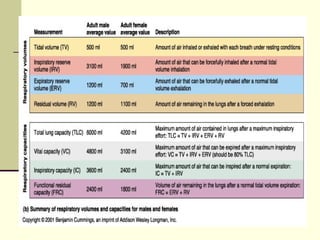
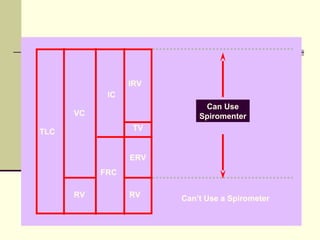
TLC
RV
VC
TV
FRC
IC
IRV
ERV
RV
Can Use
Spiromenter
Can’t Use a Spirometer
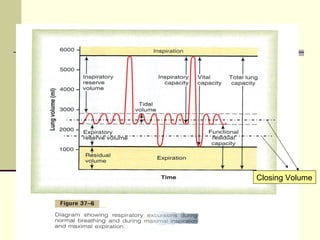
Closing Volume
 Because of the lack of elastic lung recoil of
the pediatric patient’s chest, the child also
possesses a proportionally smaller FRC. This
reduces the time that an apnea can be
allowed in a child.
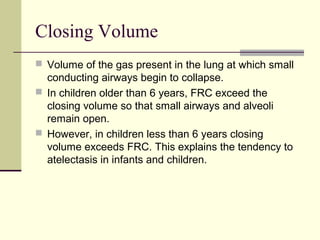
Closing Volume
 Volume of the gas present in the lung at which small
conducting airways begin to collapse.
 In children older than 6 years, FRC exceed the
closing volume so that small airways and alveoli
remain open.
 However, in children less than 6 years closing
volume exceeds FRC. This explains the tendency to
atelectasis in infants and children.
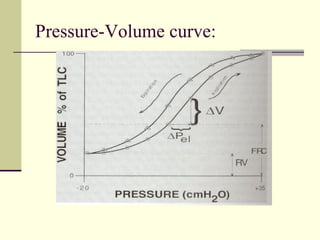
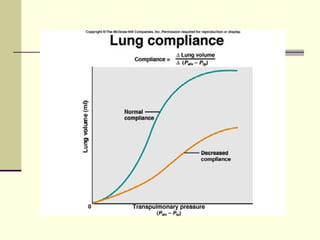
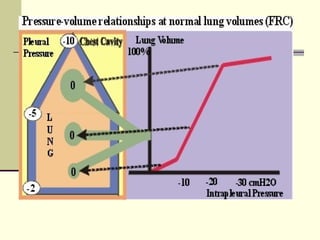
Compliance:
 Compliance is the measure of stiffness of the chest
and is determined by the elastic forces of the lung,
chest wall and surface tension.
 It is defined as the change in volume per unit change
in pressure and is expressed as litres/ cm of H2O i.e.
∆V/∆P.
 Normal lungs are highly compliant while the diseased
lung have reduced compliance.
Pressure-Volume curve:
Time Constant
 It is the product of airway resistance and compliance and is
measured in seconds.
 It is the measure of how quickly the lungs can inhale or exhale.
 One time constant fills in 63% of an alveolus and three fill 95%
of the alveolus.
 In normal child one time constant equals 0.15 seconds and
three time constants equals 0.45 sec. Thus minimum inspiratory
and expiratory time should be about 0.5 seconds.
 If sufficient time is not allowed in expiration air trapping will
occur.
 An understanding of this concept aids greatly in
selecting the safest and most effective ventilator
settings.
 In normal lung the difference between inspiratory and
expiratory time constant is minimal.
 Various diseases alter the time constant giving rise to
inspiratory and expiratory difference.
 E.g. in asthma expiratory time constant increases
because of airway resistance while in stiff lung time
constant decrease causing faster filling and emptying
of alveoli.
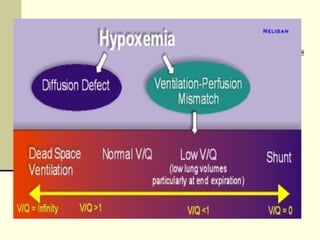
V/Q ratio:
 Ventilation (v) is the amount of gas delivered
to and exhaled through the lungs.
 Perfusion (Q) is the amount of mixed venous
blood brought to the pulmonary capillary bed.
 Relation between them is called V/Q ratio.
 Normal V/Q ratio is 1.
Pathophysiology
Dead Space Ventilation
 Dead Space ventilation occurs when inspired air is
delivered to area without perfusion.
 Anatomic Dead Space: It exits in the area of nose,
nasopharynx, trachea and large conducting airway.
 Pathologic dead space occurs when alveoli are
ventilated but not perfused.
e.g. pulmonary embolism.
 V/Q ratio tends to infinity as Q 0
Intrapulmonary Shunt
 Reverse of dead space ventilation.
 Here alveoli are perfused but not ventilated with non
oxygenated blood shunting into the arterial circulation
decreasing the PaO2
 It occurs in conditions like ARDS, pneumonia,
pulmonary hemorrhage, atelectsis and pulmonary
edema.
 It is often an indication for mechanical ventilation.
 V/Q ratio tends to zero.
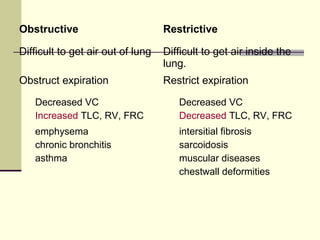
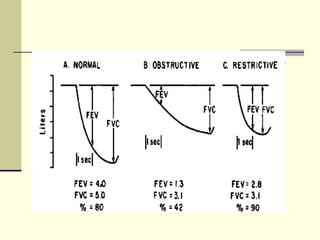
Obstructive Vs Restrictive
Obstructive Restrictive
Difficult to get air out of lung Difficult to get air inside the
lung.
Obstruct expiration Restrict expiration
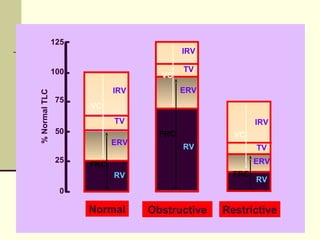
Decreased VC
Increased TLC, RV, FRC
Decreased VC
Decreased TLC, RV, FRC
emphysema
chronic bronchitis
asthma
intersitial fibrosis
sarcoidosis
muscular diseases
chestwall deformities
Normal
RV
ERV
TV
IRV
FRC
VC
Restrictive
RV
ERV
TV
IRV
FRC
VC
Obstructive
RV
ERV
TV
IRV
FRC
VC
125
100
75
50
25
0
%NormalTLC
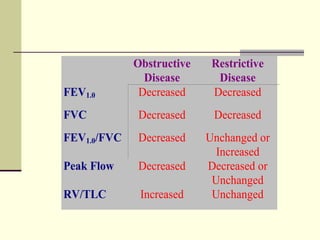
Obstructive
Disease
Restrictive
Disease
FEV1.0 Decreased Decreased
FVC Decreased Decreased
FEV1.0/FVC Decreased Unchanged or
Increased
Peak Flow Decreased Decreased or
Unchanged
RV/TLC Increased Unchanged
Auto-Peep
 Auto-PEEP is gas trapped in alveoli at end expiration,
due to inadequate time for expiration,
bronchoconstriction or mucus plugging. It increases
the work of breathing.
 If auto-PEEP occurs during mechanical ventilation,
the amount of time given over to expiration needs to
be lengthened: either by reducing the respiratory rate
or the inspiratory time, or both.
History of ventilators
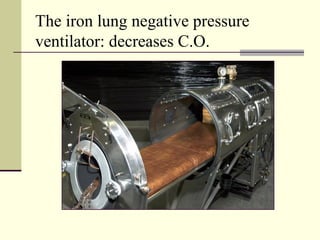
 Negative-pressure ventilators (“iron lungs”)
 Non-invasive ventilation first used in Boston
Children’s Hospital in 1928
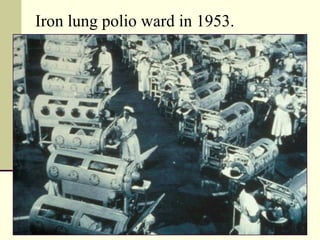
 Used extensively during polio outbreaks in
1940s – 1950s
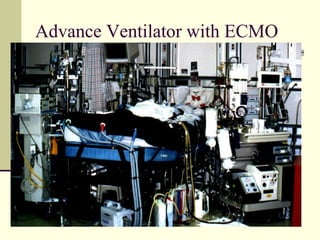
 Positive-pressure ventilators
 Invasive ventilation first used at
Massachusetts General Hospital in 1955
The iron lung negative pressure
ventilator: decreases C.O.
Iron lung polio ward in 1953.
Advance Ventilator with ECMO
Basic Terminology
 Tidal Volume: Volume of the gas that flows in and out of the
chest during breathing. In children tidal volume is 6-8 ml/kg.
 Ventilator rate: Rate of mechanical breath per minute on
ventilator.
 Minute ventilation: T.V.x V.R.
 Inspiratory Time and I:E ratio: Adjustment of the inspiratory time
is primary method by which I:E ratio is altered.Normal setting for
inspiratory time range from 0.4 to 1.5 seconds depending on the
ventilatory rate and underlying lung condition. Expiratory time
should not decreased to <0.5 seconds except in condition
associated with reduced compliance and shortened time
constant. Normal I:E ratio is usually 1:2 to 1:3.
 FiO2 is the fractional inspired oxygen concentration.
 PIP: Highest pressure during inspiratory
period. It depends upon T.V., inspiratory time,
gas flow, compliance of chest and lungs. PIP
is usually kept as low as possible as it can
cause barotrauma, pnemothorax, air leak.
 But PIP should be kept sufficient so that
patient will get adequate tidal volume and the
minute ventilation.
PEEP
 PEEP: PEEP is the baseline positive pressure in the airway during expiration. It
is designed to keep alveoli from collapsing at the end of expiration. It is very
useful when the lugs are non-compliant and have tendency to atelectsis. Normal
PEEP is 2-3 cm H2O.
 PEEP prevents decrecruitment of alveoli and it has protective effect in
prevention of ventilator associated lung injury. But the excessive PEEP can
cause following problems:
 1.Alveolar overdistention: alveoli in non-dependent zones are less likely to
collapse at end expiration. Further expansion of the alveoli may cause damage
(barotrauma).
 2. Excessively high alveolar pressures may squash the blood vessels which
surround the airspaces, causing an increase in dead space (wasted ventilation)
and an unnecessary increase in the work of breathing.
 3. Increased intrathoracic pressure as a result of PEEP/CPAP will reduce the
pressure gradient along which blood returns to the heart. This reduces right
ventricular preload, right ventricular output and ultimately cardiac output. This
may lead to a reduction in blood pressure and pooling of blood in the abdomen
and peripheries. Conversely, in severe heart failure this may be beneficial.
Mean Airway Pressure (MAP)
 MAP is the measure of average positive pressure
generated in the lung throughout the respiratory
cycle. It is not a ventilator setting but a result of
ventilator setting.
 It is determined by several factors including PIP,
PEEP, inspiratory time and flow rate.
 MAP is critical in determining both oxygenation and
barotrauma.
 Many ventilators have the ability to continuosly
monitor and display MAP allowing clinicians to see
effects of ventilatory adjustments.
Trigger/Sensitivity:
 This refers to ease with which a ventilator can sense
the patient’s demand for a breath. It is usually
expressed as a amount of negative pressure or
change in flow that a patient must create through
spontaneous breathing effort to switch on the
ventilator to deliver a mechanical breath.
 Setting the sensitivity too high may increase the work
of breathing as the patient must create a higher
intrathoracic negative pressure in order to get
assistance from ventilator.
 Setting sensitivity too low may lead to over triggering
and patient being over ventilated.
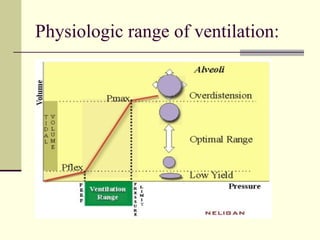
Physiologic range of ventilation:
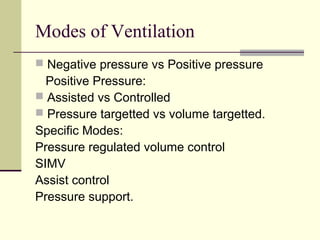
Modes of Ventilation
 Negative pressure vs Positive pressure
Positive Pressure:
 Assisted vs Controlled
 Pressure targetted vs volume targetted.
Specific Modes:
Pressure regulated volume control
SIMV
Assist control
Pressure support.
Thank You

Basics of pediatric ventilation

  • 1.
    Basics Of Pediatric Ventilation SoumyaRanjan Parida Basic B.Sc. Nursing 4th year Sum Nursing College
  • 2.
    Topics  Anatomy  Physiology Pathophysiology  Biophysics
  • 3.
  • 6.
    Peculiarities of Pediatricrespiratory system  Airway of the infant or child is much smaller in diameter and shorter in length. This markedly increases the resistance and therefore the work of breathing.  Pediatric airway is placed anteriorly and superiorly. The glottic opening lying higher, at approximately the level of C-2 or C-3, as opposed to C-6 in the adult.  Infant’s tongue is relatively larger to the oropharynx. Posterior displacement of tongue causes severe airway obstruction.  Epiglottis in children is long, floppy, narrow and angled away from the axis of trachea.
  • 7.
     In childrenthe narrowest portion is below the vocal cord at the level of non distensible cricoid cartilage and larynx is funnel shaped. Whereas in adults the narrowest portion is at glottic inlet and larynx is cylindrical in shape.  In children the subglottic airway is smaller, more compliant and less supported by cartilage.
  • 8.
  • 10.
     In children,the chest is cylindrical in shape. Respiration are shallow and rapid due to predominant diaphragmatic breathing and inadequate costovertebral bucket handle movement.  Pediatric patient metabolizes oxygen twice as quickly as the adult (6 mL/kg versus 3 mL/kg). So tolerance to hypoxia is less.
  • 11.
    At the endof inspirationAt the end of expiration Intrapleural sapce
  • 12.
    Alveolar-arterial Gradient  Oxygenand Carbon dioxide exchange takes place at the at respiratory membrane because these two gases move along their respective concentration gradient to achieve equilibrium between the blood phase in the capillary and the gas phase in the alveoli.  Difference between the alveolar oxygen concentration i.e. PAO2 and arterial oxygen concentration i.e. PaO2 is called alveolar-arterial oxygen gradient. (A-a gradient
  • 13.
     Inspired atmosphericroom air has PO2 of approx 159 mm Hg and alveolar air PAO2 is 104 mm Hg.  Alveolar air has lower PAO2 because of humidification and because oxygen in the alveoli is constantly being absorbed in the pulmonary blood
  • 14.
    Alveolar Gas Equation PAO2 is calculated by the alveolar gas equation: PAO2= [FiO2(Pb-PH2O)]-(Paco2/R) FiO2 = Fraction of the inspired oxygen e.g. Breathing oxygen at room air with conc 21% FiO2=0.21 Pb is the barometric pressure ( assumed to be 760 mm Hg at sea level. PH2O= Water vapor pressure which dilutes dry oxygen content of the atmosphere= 47 mm Hg. R= respiratory quotient assumed to be 0.8  Thus PAO2 depends on FiO2 i.e. fraction of the inspired oxygen. More the FiO2 ,higher will be the PAO2.
  • 15.
    A-a gradient:  Normaloxygen A-a gradient is < 10 mm Hg because no lung pathology exists to prevent the equlibrium.  An elevated A-a gradient indicates underlying pulmonary pathology and is used to assess severity of impairment of gas exchange.
  • 18.
  • 19.
  • 20.
     Because ofthe lack of elastic lung recoil of the pediatric patient’s chest, the child also possesses a proportionally smaller FRC. This reduces the time that an apnea can be allowed in a child.
  • 21.
    Closing Volume  Volumeof the gas present in the lung at which small conducting airways begin to collapse.  In children older than 6 years, FRC exceed the closing volume so that small airways and alveoli remain open.  However, in children less than 6 years closing volume exceeds FRC. This explains the tendency to atelectasis in infants and children.
  • 22.
    Compliance:  Compliance isthe measure of stiffness of the chest and is determined by the elastic forces of the lung, chest wall and surface tension.  It is defined as the change in volume per unit change in pressure and is expressed as litres/ cm of H2O i.e. ∆V/∆P.  Normal lungs are highly compliant while the diseased lung have reduced compliance.
  • 23.
  • 26.
    Time Constant  Itis the product of airway resistance and compliance and is measured in seconds.  It is the measure of how quickly the lungs can inhale or exhale.  One time constant fills in 63% of an alveolus and three fill 95% of the alveolus.  In normal child one time constant equals 0.15 seconds and three time constants equals 0.45 sec. Thus minimum inspiratory and expiratory time should be about 0.5 seconds.  If sufficient time is not allowed in expiration air trapping will occur.
  • 27.
     An understandingof this concept aids greatly in selecting the safest and most effective ventilator settings.  In normal lung the difference between inspiratory and expiratory time constant is minimal.  Various diseases alter the time constant giving rise to inspiratory and expiratory difference.  E.g. in asthma expiratory time constant increases because of airway resistance while in stiff lung time constant decrease causing faster filling and emptying of alveoli.
  • 28.
    V/Q ratio:  Ventilation(v) is the amount of gas delivered to and exhaled through the lungs.  Perfusion (Q) is the amount of mixed venous blood brought to the pulmonary capillary bed.  Relation between them is called V/Q ratio.  Normal V/Q ratio is 1.
  • 29.
  • 30.
    Dead Space Ventilation Dead Space ventilation occurs when inspired air is delivered to area without perfusion.  Anatomic Dead Space: It exits in the area of nose, nasopharynx, trachea and large conducting airway.  Pathologic dead space occurs when alveoli are ventilated but not perfused. e.g. pulmonary embolism.  V/Q ratio tends to infinity as Q 0
  • 31.
    Intrapulmonary Shunt  Reverseof dead space ventilation.  Here alveoli are perfused but not ventilated with non oxygenated blood shunting into the arterial circulation decreasing the PaO2  It occurs in conditions like ARDS, pneumonia, pulmonary hemorrhage, atelectsis and pulmonary edema.  It is often an indication for mechanical ventilation.  V/Q ratio tends to zero.
  • 33.
  • 34.
    Obstructive Restrictive Difficult toget air out of lung Difficult to get air inside the lung. Obstruct expiration Restrict expiration Decreased VC Increased TLC, RV, FRC Decreased VC Decreased TLC, RV, FRC emphysema chronic bronchitis asthma intersitial fibrosis sarcoidosis muscular diseases chestwall deformities
  • 35.
  • 37.
    Obstructive Disease Restrictive Disease FEV1.0 Decreased Decreased FVCDecreased Decreased FEV1.0/FVC Decreased Unchanged or Increased Peak Flow Decreased Decreased or Unchanged RV/TLC Increased Unchanged
  • 38.
    Auto-Peep  Auto-PEEP isgas trapped in alveoli at end expiration, due to inadequate time for expiration, bronchoconstriction or mucus plugging. It increases the work of breathing.  If auto-PEEP occurs during mechanical ventilation, the amount of time given over to expiration needs to be lengthened: either by reducing the respiratory rate or the inspiratory time, or both.
  • 39.
    History of ventilators Negative-pressure ventilators (“iron lungs”)  Non-invasive ventilation first used in Boston Children’s Hospital in 1928  Used extensively during polio outbreaks in 1940s – 1950s  Positive-pressure ventilators  Invasive ventilation first used at Massachusetts General Hospital in 1955
  • 40.
    The iron lungnegative pressure ventilator: decreases C.O.
  • 41.
    Iron lung polioward in 1953.
  • 42.
  • 43.
    Basic Terminology  TidalVolume: Volume of the gas that flows in and out of the chest during breathing. In children tidal volume is 6-8 ml/kg.  Ventilator rate: Rate of mechanical breath per minute on ventilator.  Minute ventilation: T.V.x V.R.  Inspiratory Time and I:E ratio: Adjustment of the inspiratory time is primary method by which I:E ratio is altered.Normal setting for inspiratory time range from 0.4 to 1.5 seconds depending on the ventilatory rate and underlying lung condition. Expiratory time should not decreased to <0.5 seconds except in condition associated with reduced compliance and shortened time constant. Normal I:E ratio is usually 1:2 to 1:3.  FiO2 is the fractional inspired oxygen concentration.
  • 44.
     PIP: Highestpressure during inspiratory period. It depends upon T.V., inspiratory time, gas flow, compliance of chest and lungs. PIP is usually kept as low as possible as it can cause barotrauma, pnemothorax, air leak.  But PIP should be kept sufficient so that patient will get adequate tidal volume and the minute ventilation.
  • 45.
    PEEP  PEEP: PEEPis the baseline positive pressure in the airway during expiration. It is designed to keep alveoli from collapsing at the end of expiration. It is very useful when the lugs are non-compliant and have tendency to atelectsis. Normal PEEP is 2-3 cm H2O.  PEEP prevents decrecruitment of alveoli and it has protective effect in prevention of ventilator associated lung injury. But the excessive PEEP can cause following problems:  1.Alveolar overdistention: alveoli in non-dependent zones are less likely to collapse at end expiration. Further expansion of the alveoli may cause damage (barotrauma).  2. Excessively high alveolar pressures may squash the blood vessels which surround the airspaces, causing an increase in dead space (wasted ventilation) and an unnecessary increase in the work of breathing.  3. Increased intrathoracic pressure as a result of PEEP/CPAP will reduce the pressure gradient along which blood returns to the heart. This reduces right ventricular preload, right ventricular output and ultimately cardiac output. This may lead to a reduction in blood pressure and pooling of blood in the abdomen and peripheries. Conversely, in severe heart failure this may be beneficial.
  • 46.
    Mean Airway Pressure(MAP)  MAP is the measure of average positive pressure generated in the lung throughout the respiratory cycle. It is not a ventilator setting but a result of ventilator setting.  It is determined by several factors including PIP, PEEP, inspiratory time and flow rate.  MAP is critical in determining both oxygenation and barotrauma.  Many ventilators have the ability to continuosly monitor and display MAP allowing clinicians to see effects of ventilatory adjustments.
  • 47.
    Trigger/Sensitivity:  This refersto ease with which a ventilator can sense the patient’s demand for a breath. It is usually expressed as a amount of negative pressure or change in flow that a patient must create through spontaneous breathing effort to switch on the ventilator to deliver a mechanical breath.  Setting the sensitivity too high may increase the work of breathing as the patient must create a higher intrathoracic negative pressure in order to get assistance from ventilator.  Setting sensitivity too low may lead to over triggering and patient being over ventilated.
  • 48.
  • 49.
    Modes of Ventilation Negative pressure vs Positive pressure Positive Pressure:  Assisted vs Controlled  Pressure targetted vs volume targetted. Specific Modes: Pressure regulated volume control SIMV Assist control Pressure support.
  • 50.