
PRESENTED BY: SOUMYA RANJAN PARIDA
Today’s OBJECTIVES….???????
What doe’s it mean?
 WHAT IS CORONAVIRUS?
 HISTORY behind it ,,,,???
 What is CURRENT SCENARIO..???
 Is it different TYPES..???
 SOURCES AND MODES OF
TRANSMISSION….??
Where to approach ..if suspecting
signs and symptoms
How to diagnose?
Is vaccine is available?
Are treatment strategies
effective??
Prevention and control?
References….
What doe’s it mean …….??????
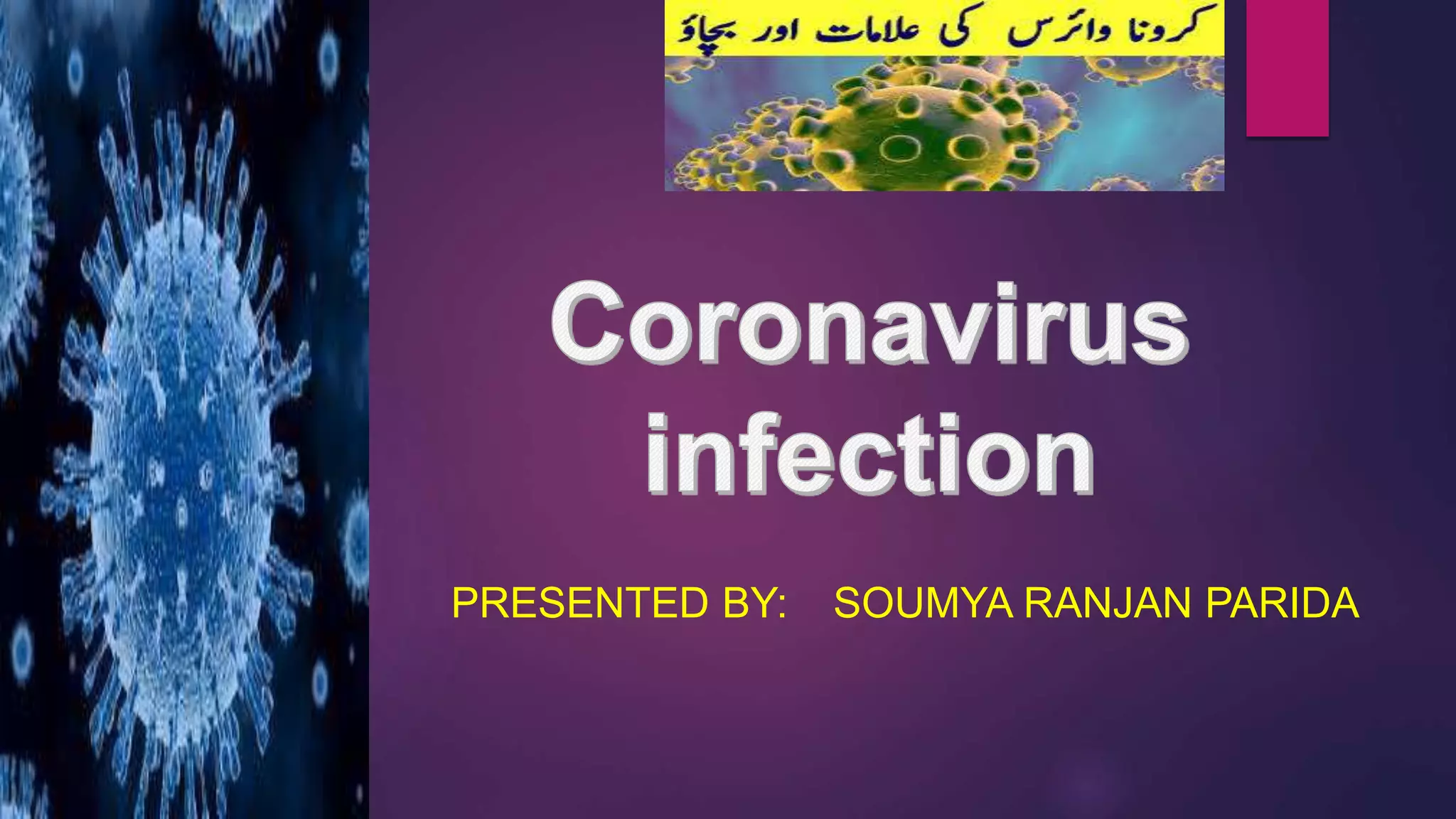
A coronavirus is a kind of common virus that
causes an infection in your nose, sinuses, or
upper throat.
Most coronaviruses are not dangerous. Some
types of coronaviruses are serious.
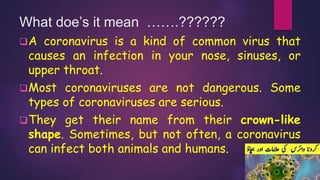
They get their name from their crown-like
shape. Sometimes, but not often, a coronavirus
can infect both animals and humans.
The respiratory infection,
which is closely related to
SARS and MERS.
HISTORY BEHIND IT..???
 Coronaviruses were first identified in the 1960s,
 About 858 people have died from Middle East respiratory
syndrome (MERS), which first appeared in 2012 in Saudi
Arabia
 And then in other countries in the Middle East, Africa, Asia,
and Europe.
 In April 2014, the first American was hospitalized for MERS in
Indiana and another case was reported in Florida.
 In May 2015, there was an outbreak of MERS in
Korea, which was the largest outbreak outside of
the Arabian Peninsula.
 In 2003, 774 people died from a severe acute
respiratory syndrome (SARS) outbreak. As of 2015,
there were no further reports of cases of SARS.
 But In early 2020, following a December 2019
outbreak in China, the World Health Organization
identified a new type, 2019 novel coronavirus (2019-
nCoV).
On 31 December 2019, WHO was
alerted to several cases of pneumonia
in Wuhan City, China. The virus did not
match any other known virus. This
raised concern because when a virus is
new, we do not know how it affects
people
CURRENT SCENARIO..???
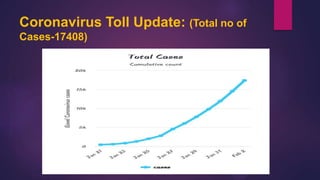
 Accoding to European CDC (central disease controle), the
majority of the confirmed cases _17,408 are in china.
Another 134 confirmed outside of china in 23 countries.
 These include, Thailand, Japan, Singapore, Tajwan,
Malaysia, South kovea, UnitedArabemirates, Vithan,
Cambodia,Nepal,Phillipies,India,Srilanka,Germany,France,It
aly,Unitdkingdom,Russia,Finland,Spain,Swedan,United
states,Canada and Austealia
Contin………
All reported death have been in China.
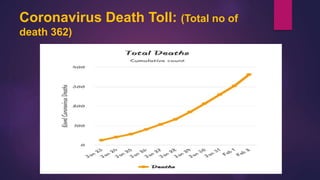
The death toll from China coronavirus out break
has jumped to 362.
Coronavirus Toll Update: (Total no of
Cases-17408)
Coronavirus Death Toll: (Total no of
death 362)
Types of Coronavirus
229E (alpha coronavirus)
NL63 (alpha coronavirus)
OC43 (beta coronavirus)
HKU1 (beta coronavirus)
Types cont….
Other human coronaviruses:-
MERS-CoV
SARS-CoV
2019 Novel Coronavirus (2019-nCoV)
What is the source of the virus…??
Health officials are not sure of the source of
the virus yet or how easily it can spread.
Coronaviruses are found in many different
animals, including camels, cattle, cats, bats
and pigs
Common Symptoms of Coronavirus
Symptoms include a fever, coughing,
and shortness of breath. They may
appear 2 to 14 days after you’re
exposed to the virus.
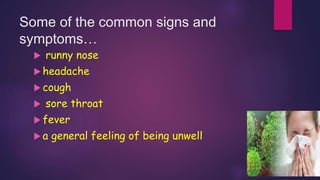
Some of the common signs and
symptoms…
 runny nose
 headache
 cough
 sore throat
 fever
 a general feeling of being unwell
How it will be Transmitted ?
Coronaviruses are a large family of viruses
that are common in many different species of
animals, including camels, cattle, cats, and
bats. Rarely, animal coronaviruses can infect
people and then spread between people such
as with MERS and SARS.
cont….
 Coughing and sneezing with out covering the
mouth
 Touching or shaking hands with infected person
 Making contact with surface or object that has the
virus and touching the nose ,eyes or mouth.
 On rare occasion coronavirus can spread through
contact with feces.
How to Diagnosis ..????
If you are experiencing symptoms, you should tell
your healthcare provider about any recent travel
or contact with animals. Most MERS-CoV
infections have been reported from countries in
the Arabian Peninsula. Therefore reporting a
travel history or contact with camels or camel
products is very important when trying to diagnose
MERS.
 Your healthcare provider may order laboratory tests on
respiratory specimens and serum (part of your blood)
to detect human coronaviruses. Laboratory testing is
more likely to be used if you have severe disease or
are suspected of having MERS.
 There is much more to learn about the transmissibility,
severity, and other features associated with 2019-
nCoV and investigations are ongoing
How is it treated?
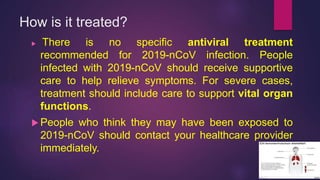
 There is no specific antiviral treatment
recommended for 2019-nCoV infection. People
infected with 2019-nCoV should receive supportive
care to help relieve symptoms. For severe cases,
treatment should include care to support vital organ
functions.
 People who think they may have been exposed to
2019-nCoV should contact your healthcare provider
immediately.
PREVENTION
 As a reminder, CDC always recommends everyday preventive
actions to help prevent the spread of respiratory viruses,
including:
 Wash your hands often with soap and water for at least 20
seconds. Use an alcohol-based hand sanitizer that contains at
least 60% alcohol if soap and water are not available.
 Avoid touching your eyes, nose, and mouth with unwashed
hands.
 Avoid close contact with people who are sick.
Conti…
 Stay home when you are sick.
 Cover your cough or sneeze with a tissue, then throw
the tissue in the trash.
 Clean and disinfect frequently touched objects and
surfaces.
 Drink plenty of water
 Avoid smoking and smokey areas
Corono

Corono

  • 1.
    PRESENTED BY: SOUMYARANJAN PARIDA
  • 2.
    Today’s OBJECTIVES….??????? What doe’sit mean?  WHAT IS CORONAVIRUS?  HISTORY behind it ,,,,???  What is CURRENT SCENARIO..???  Is it different TYPES..???  SOURCES AND MODES OF TRANSMISSION….??
  • 3.
    Where to approach..if suspecting signs and symptoms How to diagnose? Is vaccine is available? Are treatment strategies effective?? Prevention and control? References….
  • 4.
    What doe’s itmean …….?????? A coronavirus is a kind of common virus that causes an infection in your nose, sinuses, or upper throat. Most coronaviruses are not dangerous. Some types of coronaviruses are serious. They get their name from their crown-like shape. Sometimes, but not often, a coronavirus can infect both animals and humans.
  • 5.
    The respiratory infection, whichis closely related to SARS and MERS.
  • 6.
    HISTORY BEHIND IT..??? Coronaviruses were first identified in the 1960s,  About 858 people have died from Middle East respiratory syndrome (MERS), which first appeared in 2012 in Saudi Arabia  And then in other countries in the Middle East, Africa, Asia, and Europe.  In April 2014, the first American was hospitalized for MERS in Indiana and another case was reported in Florida.
  • 7.
     In May2015, there was an outbreak of MERS in Korea, which was the largest outbreak outside of the Arabian Peninsula.  In 2003, 774 people died from a severe acute respiratory syndrome (SARS) outbreak. As of 2015, there were no further reports of cases of SARS.  But In early 2020, following a December 2019 outbreak in China, the World Health Organization identified a new type, 2019 novel coronavirus (2019- nCoV).
  • 8.
    On 31 December2019, WHO was alerted to several cases of pneumonia in Wuhan City, China. The virus did not match any other known virus. This raised concern because when a virus is new, we do not know how it affects people
  • 9.
    CURRENT SCENARIO..???  Accodingto European CDC (central disease controle), the majority of the confirmed cases _17,408 are in china. Another 134 confirmed outside of china in 23 countries.  These include, Thailand, Japan, Singapore, Tajwan, Malaysia, South kovea, UnitedArabemirates, Vithan, Cambodia,Nepal,Phillipies,India,Srilanka,Germany,France,It aly,Unitdkingdom,Russia,Finland,Spain,Swedan,United states,Canada and Austealia
  • 10.
    Contin……… All reported deathhave been in China. The death toll from China coronavirus out break has jumped to 362.
  • 11.
    Coronavirus Toll Update:(Total no of Cases-17408)
  • 12.
    Coronavirus Death Toll:(Total no of death 362)
  • 13.
    Types of Coronavirus 229E(alpha coronavirus) NL63 (alpha coronavirus) OC43 (beta coronavirus) HKU1 (beta coronavirus)
  • 14.
    Types cont…. Other humancoronaviruses:- MERS-CoV SARS-CoV 2019 Novel Coronavirus (2019-nCoV)
  • 15.
    What is thesource of the virus…?? Health officials are not sure of the source of the virus yet or how easily it can spread. Coronaviruses are found in many different animals, including camels, cattle, cats, bats and pigs
  • 16.
    Common Symptoms ofCoronavirus Symptoms include a fever, coughing, and shortness of breath. They may appear 2 to 14 days after you’re exposed to the virus.
  • 17.
    Some of thecommon signs and symptoms…  runny nose  headache  cough  sore throat  fever  a general feeling of being unwell
  • 18.
    How it willbe Transmitted ? Coronaviruses are a large family of viruses that are common in many different species of animals, including camels, cattle, cats, and bats. Rarely, animal coronaviruses can infect people and then spread between people such as with MERS and SARS.
  • 19.
    cont….  Coughing andsneezing with out covering the mouth  Touching or shaking hands with infected person  Making contact with surface or object that has the virus and touching the nose ,eyes or mouth.  On rare occasion coronavirus can spread through contact with feces.
  • 20.
    How to Diagnosis..???? If you are experiencing symptoms, you should tell your healthcare provider about any recent travel or contact with animals. Most MERS-CoV infections have been reported from countries in the Arabian Peninsula. Therefore reporting a travel history or contact with camels or camel products is very important when trying to diagnose MERS.
  • 21.
     Your healthcareprovider may order laboratory tests on respiratory specimens and serum (part of your blood) to detect human coronaviruses. Laboratory testing is more likely to be used if you have severe disease or are suspected of having MERS.  There is much more to learn about the transmissibility, severity, and other features associated with 2019- nCoV and investigations are ongoing
  • 22.
    How is ittreated?  There is no specific antiviral treatment recommended for 2019-nCoV infection. People infected with 2019-nCoV should receive supportive care to help relieve symptoms. For severe cases, treatment should include care to support vital organ functions.  People who think they may have been exposed to 2019-nCoV should contact your healthcare provider immediately.
  • 23.
    PREVENTION  As areminder, CDC always recommends everyday preventive actions to help prevent the spread of respiratory viruses, including:  Wash your hands often with soap and water for at least 20 seconds. Use an alcohol-based hand sanitizer that contains at least 60% alcohol if soap and water are not available.  Avoid touching your eyes, nose, and mouth with unwashed hands.  Avoid close contact with people who are sick.
  • 24.
    Conti…  Stay homewhen you are sick.  Cover your cough or sneeze with a tissue, then throw the tissue in the trash.  Clean and disinfect frequently touched objects and surfaces.  Drink plenty of water  Avoid smoking and smokey areas