












Soamatoform Disorder
Introduction
• The somatoform disorders are a group of
psychological disorders in which a patient
experiences physical symptoms that are
inconsistent with or cannot be fully explained
by any underlying general medical or
neurologic condition.
• Physical symptoms with no demonstable
organic findings.
• The term is from Greek, “soma” for body.
• In the middle ages, these disorders were
believed to be spiritual disorder of evil and
demonic possession.
• In the 17th
century, Sydenham said, “hysteria
could simulate any medical disease”
• In the 19th century, it was Briquet who made
the first systematic description of hysteria with
430 cases.
• ‘Studies on Hysteria’ (1893-95) by Breur and
Freud gave new insights.
• Freud explained the syndrome of hysteria as
“conversion of emotional distress into physical
symptoms”
• In 1900 BC, Kahn in Medical Papyrus
described hysteria' as a number of maladies
supposedly caused by wandering of the
uterus.
• Hippocrates in Greek era and Galen in Roman
era defined 'hysteria' as a disorder of women,
attributed to the movements of uterus and
caused by sexual abstinence.
• Hypochon-driasis was described as symptoms
due to disturbance of viscera below the
diaphragm.
• Whitloch (1967) and Ludwig (1972) provided
neurophysiological bases of hysteria as
corticofugal inhibition of afferent stimulation at
the level of reticular activating system (RAS) .
1968
• Barr and Abennathy gave behavioral basis of
hysterical symptoms, conceptualizing the
symptoms as an adaptation to the frustrating
life experiences.
• In 1980, a new category of somatoform
disorder included in DSM-III.
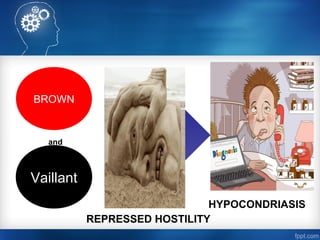
BROWN
Vaillant
HYPOCONDRIASIS
REPRESSED HOSTILITY
and
1992
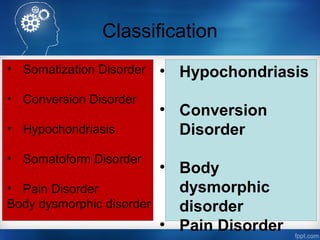
Classification
• Somatization Disorder
• Conversion Disorder
• Hypochondriasis
• Somatoform Disorder
• Pain Disorder
Body dysmorphic disorder
• Hypochondriasis
• Conversion
Disorder
• Body
dysmorphic
disorder
• Pain Disorder
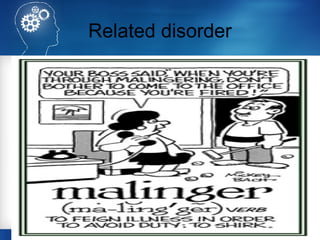
Related disorder
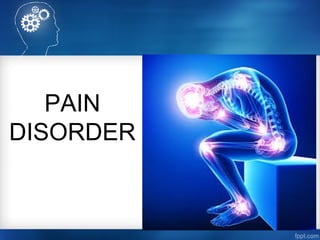
PAIN
DISORDER
• A pain disorder is characterized by the
presence of, and focus on, pain in one or more
body sites and is sufficiently severe to come to
clinical attention.
• Psychological factors are necessary in the
genesis, severity, or maintenance of the pain,
which causes significant distress, impairment,
or both.
Epidemiology
• The exact prevalence of pain disorder is not
known, because diagnostic criteria have been
frequently changing.
• One recently done community survey puts
one-year prevalence at 0.6%.
• However, it is quite common.
• The disorder is more common in women,
about twice more than in men. The peak age
of onset is in fourth and fifth decades.
Etiology
• Psychodynamic Theory
• Pain in these patients serves the purpose of
punishment and atonement for unconscious
guilt.
• History
• Pain can function as a method of obtaining
love, a punishment for wrongdoing, and a way
of expiating guilt and atoning for an innate
sense of badness.
• Among the defense mechanisms used by
patients with pain disorder are displacement,
substitution, and repression.
Behavioral factors
• Behavioral Factors Pain behaviors are
reinforced when rewarded and are inhibited
when ignored or punished.
• For example, moderate pain symptoms may
become intense when followed by the
solicitous and attentive behavior of others, by
monetary gain, or by the successful avoidance
of distasteful activities.
Interpersonal Factors
• Intractable pain has been
conceptualized as a means for
manipulation and gaining advantage
in interpersonal relationships.
• for example, to ensure the devotion
of a family member or to stabilize a
fragile marriage. Such secondary
gain is most important to patients
with pain disorder.
Biological factors
• Serotonin is probably the main
neurotransmitter in the descending
inhibitory pathways, and
endorphins also play a role in the
central nervous system modulation
of pain.
• Endorphin deficiency seems to
correlate with augmentation of
incoming sensory stimuli.
CLINICAL FEATURES
• The patient presents with preoccupation with
continuous and severe pain, which defies any
medical explanation.
• The pain may involve anybody area.
• The patients often display a lifestyle, which can
be described as the disease of the D's:
• 1. Dramatic display in describing the
painful experience .
• 2. Disuse and degeneration of various body
functions as consequences of the pain related
behavior
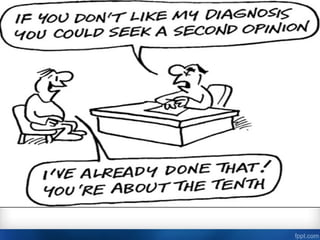
• 3. Drug misuse and doctor shopping
• 4. Dependency, passivity and learned
helplessness, which lead to demoralization
and depression
• 5.Disability pain-contingent financial
compensation or desire for compensation
through litigation and disability claims
• Alexithymia is also reported to be common in
these patients.
• Depressive symptoms are a very common
accom-paniment.
• Major depression can be diagnosed in 25-30%
of somatoform pain patients.
MANAGEMENT
• Pharmacotherapy
• Analgesic medications do not generally benefit
most patients with pain disorder.
• In addition, substance abuse and dependence
are often major problems for such patients who
receive long-term analgesic treatment.
• Sedatives and antianxiety agents are not
especially beneficial and are also subject to
abuse, misuse, and adverse effects.
•Antidepressants such as amitriptyline,
rmipramine,doxepin and phenelzine have been
found effective,
•even when depressive symptoms are not
prominent,and sometimes provide pain relief at
dosage lesser than those required to treat
depression.
• If there is no response after 6 weeks of an
adequate dose, another agent should be tried
before concluding that antidepressants are not
effective.
• Whether antidepressants reduce pain by their
• antidepressant action or have independent
direct analgesic effect (on serotonergic
inhibitory pain pathways) remains unclear.
• Anticonvulsants such as, phenytoin,
carbamazepine, and clonazepam are effective
in treating neuropathic and neuralgic pain, at
least for short periods.
• No drug should be prescribed on 'as needed
basis.
• Time contingent prescriptions are less likely to
lead to drug misuse through conditioning
Behavioural Interventions
• A wide variety of behavioral techniques like
behavior modification (using principles of
operant conditioning to discourage pain related
behavior, and to shape and reinforce new
health related behaviors), relaxation train-ing,
cognitive therapy and graduated exercise
program may be used.
• The family and other figures important to
patient may be involved in management. They
should be explained the importance of normal
• In recent years, biofeedback has been found
modera-tely helpful in some cases, especially
in migraine, myofascial pain and muscle
tension states (such as tension headaches).
Psychotherapeutic
intervention
• Traditional psychotherapeutic interventions do
not have much role in somatoform pain
disorder patients.
• However, family therapy and group therapy
along with supportive psychotherapy in
combination with other treatments, bring about
beneficial results.
Pain clinics and Pain
control Programmes
• In recent years, a number of such facilities
have come up.
• These usually have a multi-disciplinary team
consisting of physicians, psychologists,
anesthesiologists, physio-therapists and
occupational therapists.
• About 70% of patients, who go through such
programs, show improve-ment.
Diagnostic criteria
ICD-10
• (a) persistent belief in the presence of at least
one serious physical illness underlying the
presenting symptom or symptoms, even
though repeated investigations and
examinations have identified no adequate
physical explanation, or a persistent
preoccupation with a presumed deformity or
disfigurement;
• (b) persistent refusal to accept the advice and
reassurance of several different doctors that
there is no physical illness or abnormality
underlying the symptoms.
Epidemiology
• The prevalence of hypochondriasis in general
population is not known.
• The prevalence in general medical setting is
reported to be 4-9%.
• The disorder affects both sexes equally or may
be slightly predominant in men.
• The peak age of onset is probably between 20-
30, though it may occur at any age.
• However, it rarely presents for the first time
after 50.
Psychodynamic Theory
• The dynamic theory describes hypochondriasis
as an alternate channel to deflect sexual,
aggressive or oral drives or an ego defense
against guilt and low esteem or a sign of
excessive self concern.
• The aggressive and hostile wishes towards
others are transformed into physical
complaints through repression or
displacement.
• Freud explained it as a withdrawal of sexual
libido from external objects, which is reinvested
as narcissistic libido and eventually overflows
into actual somatic changes
Sociocultural Theory
• Hypochondriasis has also been visualized as a
learned social behaviour, serving the purpose
of nonverbal interpersonal communication.
• The behavior was learned because of its
success in past in eliciting caretaking and in
securing the other secondary gains of the sick
role.
• They may have assumed the sick role initially
as a result of an accident, injury or medical
illness or by modeling themselves after
someone, who successfully used the sick role.
• The sick role serves to convey about their
distress and disability to others, serving
nonverbal communication.
Neurophysiological theory
• Hypochondriasis is the result of an underlying
perceptual or cognitive abnormality.
• The patients amplify and augment normal
bodily sensations and perceive them as more
noxious and intense than does the person,
who is not hypochondriacal.
• They have constitutionally lower thresholds
and tolerance for physical discomfort.
• They misinterpret normal bodily sensations,
physiological functions, the trivial symptoms of
everyday life and the somatic symptoms of
emotional arousal by misattributing them to a
serious disease process.
Clinical features
• The most common complaints are pain and
symptoms referable to gastrointestinal and
cardiovascular systems.
• The symptoms usually run a chronic, waxing
and waning course. Often the patient comes
with a detailed patho­physiological model
explaining his symptoms.
• The hypochondriacs are profoundly
preoccupied with their bodies and their health
status.
• They keep on scrutinizing their body
functioning, always preoccupied with their body
appearance, functional limitations and health
considerations.
• They often complain of abnormal body
sensations, disturbed body functions or
anatomical deviations suggesting disease.
MANAGEMENT
• Since hypochondriacs are clinging, demanding
and harboring unrealistic expectations, their
relations with doctors are often strained and
unsatis­factory.
• Their doctor shopping behavior also elicits
negative reaction from the treating physician.
• Basic principles of treatment can be outlined
as:
• 1. Treatment by a single physician, with whom
the patient feels confident
• 2. Supportive approach and regularly
scheduled visits, that are not on as needed
basis or based on develop­ment of new or
exacerbation of existing symptoms
• 3.
• 3. Avoidance of hospitalizations, diagnostic
procedures and medications with abuse
potential
• 4. Focussing on symptoms and brief
examination in initial visit to facilitate rapport
development and gradually concentrating on
social or interpersonal problems
• The physician's approach should be of care
rather than of cure.
• The patient should be helped in learning to
cope with and tolerate their symptoms and to
live with them as adaptively as possible, rather
than to remove them.
• Selected patients respond to supportive
psycho­therapy.
• Good psychotherapy outcomes are associated
with illness of less than 3 years duration,
absence of severe personality disorder and
possibly higher social class.
• Drugs do not have any role in primary
hypochon­driasis.
• But, if there are significant anxiety or
depressive symptoms, corresponding drugs
may be used.
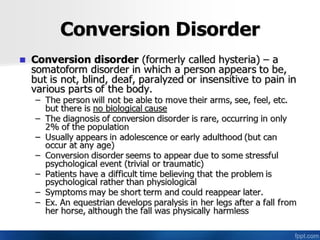
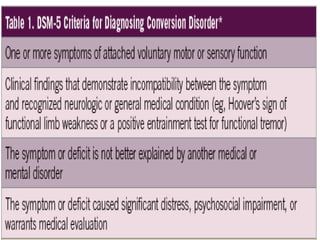
• Reported rates of conversion disorder vary
from 1 1 of 1 00,000 to 300 of 1 00,000 in
general population samples.
• Several studies have reported that 5 to 1 5
percent of psychiatric consultations in a
general hospital
• The ratio of women to men among adult
patients is at least 2 to 1 and as much as 1 0
to 1 ; among children, an even higher
predominance is seen in girls.
• Symptoms are more common on the left than
on the right side of the body in women.
• The onset of conversion disorder is generally
from late childhood to early adulthood and is
rare before 1 0 years of age or after 35 years
of age, but onset as late as the ninth decade of
life has been reported.
Etiology
• conversion disorder is caused by repression of
unconscious intrapsychic conflict and
conversion of anxiety into a physical symptom.
•
• The conflict is between an instinctual impulse
(e.g., aggression or sexuality) and the
prohibitions against its expression.
• The symptoms allow partial expression of the
forbidden wish or urge but disguise it, so that
patients can avoid consciously confronting
their unacceptable impulses;
• that is, the conversion disorder symptom
has a symbolic relation to the unconscious
conflict
Learn theory
• A conversion symptom can be seen as a piece
of classically conditioned learned behavior;
• symptoms of illness, learned in childhood, are
called forth as a means of coping with an
otherwise impossible situation.
Biological theory
• Preliminary brain­imaging studies have found
hypometabolism of the dominant hemisphere
and hypermetabolism of the nondominant
hemisphere and have implicated impaired
hemispheric communication in the cause of
conversion disorder.
• The symptoms may be caused by an
excessive cortical arousal that sets off negative
feedback loops between the cerebral cortex
and the brainstem reticular formation.
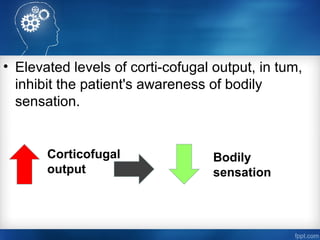
• Elevated levels of corti­cofugal output, in tum,
inhibit the patient's awareness of bodily
sensation.
Corticofugal
output
Bodily
sensation
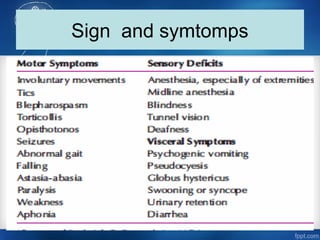
Sign and symtomps
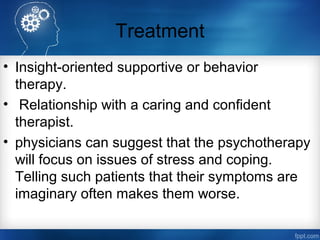
Treatment
• Insight­oriented supportive or behavior
therapy.
• Relationship with a caring and confident
therapist.
• physicians can suggest that the psychotherapy
will focus on issues of stress and coping.
Telling such patients that their symptoms are
imaginary often makes them worse.
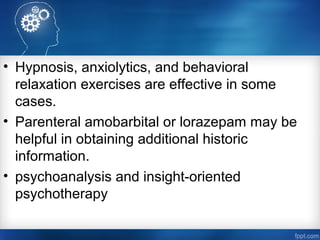
• Hypnosis, anxiolytics, and behavioral
relaxation exercises are effective in some
cases.
• Parenteral amobarbital or lorazepam may be
helpful in obtaining additional historic
information.
• psychoanalysis and insight­oriented
psychotherapy
• Body dysmorphic disorder or
dysmorphophobia is characterized by
preoccupation with some imagined defect in
appearance in a normal appearing person or a
grossly excessive concern about a slight
physical anomaly.
• The belief is not of delusional intensity.
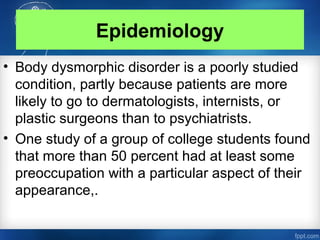
Epidemiology
• Body dysmorphic disorder is a poorly studied
condition, partly because patients are more
likely to go to dermatologists, internists, or
plastic surgeons than to psychiatrists.
• One study of a group of college students found
that more than 50 percent had at least some
preoccupation with a particular aspect of their
appearance,.
• most common age of onset is between 15 and
30 years .
• women are affected somewhat more often
than men.
• Affected patients are also likely to be
unmarried.
• More than 90 percent of patients with body
dysmorphic disorder had experienced a major
depressive episode in their lifetimes;
• About 70 percent had experienced an anxiety
disorder;
• About 30 percent had experienced a psychotic
disorder.
Etiology
• According to psychodynamic theory, these
patients invest a particular body part with a
high level of unconscious meaning that can be
traced to an event during an earlier stage of
psychosexual development.
• Important defense mechanisms are
repression, dissociation, distor­tion,
symbolization and projection.
Clinical features
• Secondary symptoms like anxiety, insomnia
and depression are often present.
• repetitive beha­viors such as mirror checking,
skin picking and reassu­rance seeking.
• Premorbidly these patients often have schizoid
or obsessional traits.
• The patients resist psychiatric referral and
psychiatric treatment
• keep on consulting plastic surgeons and
dermatologists, and requesting for cosmetic
surgery or related treatments
Mangement
• These patients are very difficult to treat, as
they refuse psychiatric referral and treatment.
• Symptoms have been reported to respond to
pimozide, other antipsychotics, tricyclic
antidepressants and monoamine oxidase
inhibitors.
• There are some recent reports of good
response to selective serotonin uptake
inhibitors like clomipramine and fluoxetine.
Nursing management
• Ineffective Coping related to inability to form a
valid appraisal of the stressors, inadequate
choices of practiced responses, and/or inability
to use available resources.
intervention
• Recognize and accept that the physical
complaint is real to the client, even though no
organic aetiology can be identified
• Identify the gains that the physical symptoms
are providing for the patient
• Initially fulfill the client’s urgent dependency
needs but gradually withdraw attention to
physical symptoms
• Minimize time given in response to physical
complaints
• Explain to the client to report any new physical
complaints to the physician
• Encourage client to verbalize fears and
anxieties
• Discuss possible alternative coping strategies
client may use in response to stress
• Help client identify ways to achieve recognition
from others without restoring to physical
complaints
• Unpleasant sensory and emotional experience
arising from actual or potential tissue damage
or described in terms of such damage
sudden /slow onset of any intensity from mild
to severe, constant or recurring without an
anticipated or predictable end and a duration
of greater than 6 months related to severe
level of anxiety, repressed ,low self­
esteem ,unmet dependency needs,secondary
gains from the sick role
• Monitor physician’s ongoing assessments and
laboratory reports to ascertain that organic
pathology is clearly ruled out.
• 2. Recognize and accept that the pain is real to
the individual, even though no organic cause
can be identified. Denying the client’s feelings
is nontherapeutic and hinders the development
of a trusting relationship.
• 3. Observe and record the duration and
intensity of the pain.
• Note factors that precipitate the onset of pain.
Identification of the precipitating stressor is
important for assessment purposes.
• This information will be used to develop a plan
for assisting the client to cope more adaptively.
• 4. Provide pain medication as prescribed by
physician.
• Client comfort and safety are nursing priorities.
5. Assist with comfort measures, such as back
rub, warm bath, and heating pad.
Be careful, however, not to respond in a way that
reinforces the behavior.
Secondary gains from physical symptoms may
prolong maladaptive behaviors.
6. Offer attention at times when client is not
focusing on pain.
•Positive reinforcement encourages repetition of
adaptive behaviors.
•7. Identify activities that serve to distract client
from focus on self and pain.
• These distractors serve in a therapeutic
manner as a transition from focus on self or
physical manifestations to focus on unresolved
psychological issues.
• 8. Encourage verbalization of feelings.
• Explore meaning that pain holds for client.
• Help client connect symptoms of pain to times
of increased anxiety and to identify specific
situations that cause anxiety to rise.
• Verbalization of feelings in a nonthreatening
environment facilitates expression and
resolution of disturbing emotional issues.
• 9. Encourage client to identify alternative
methods of coping with stress.
• These may avert the physical pain as a
maladaptive response to stress.
10. Explore ways to intervene as symptoms
begin to intensify, so that pain does not
become disabling.
(e.g., visual or auditory distractions, mental
imagery, deep­breathing exercises, application
of hot or cold compresses, relaxation
• 11. Provide positive reinforcement for adaptive
behaviors.
• Positive reinforcement enhances self­esteem
and encourages repetition of desired behaviors
Somatoform disorder and its management

Somatoform disorder and its management

  • 1.
  • 2.
    Introduction • The somatoformdisorders are a group of psychological disorders in which a patient experiences physical symptoms that are inconsistent with or cannot be fully explained by any underlying general medical or neurologic condition.
  • 3.
    • Physical symptomswith no demonstable organic findings. • The term is from Greek, “soma” for body.
  • 4.
    • In themiddle ages, these disorders were believed to be spiritual disorder of evil and demonic possession. • In the 17th century, Sydenham said, “hysteria could simulate any medical disease” • In the 19th century, it was Briquet who made the first systematic description of hysteria with 430 cases.
  • 5.
    • ‘Studies onHysteria’ (1893-95) by Breur and Freud gave new insights. • Freud explained the syndrome of hysteria as “conversion of emotional distress into physical symptoms” • In 1900 BC, Kahn in Medical Papyrus described hysteria' as a number of maladies supposedly caused by wandering of the uterus.
  • 6.
    • Hippocrates inGreek era and Galen in Roman era defined 'hysteria' as a disorder of women, attributed to the movements of uterus and caused by sexual abstinence. • Hypochon-driasis was described as symptoms due to disturbance of viscera below the diaphragm.
  • 7.
    • Whitloch (1967)and Ludwig (1972) provided neurophysiological bases of hysteria as corticofugal inhibition of afferent stimulation at the level of reticular activating system (RAS) .
  • 8.
  • 9.
    • Barr andAbennathy gave behavioral basis of hysterical symptoms, conceptualizing the symptoms as an adaptation to the frustrating life experiences. • In 1980, a new category of somatoform disorder included in DSM-III.
  • 10.
  • 11.
  • 12.
    Classification • Somatization Disorder •Conversion Disorder • Hypochondriasis • Somatoform Disorder • Pain Disorder Body dysmorphic disorder • Hypochondriasis • Conversion Disorder • Body dysmorphic disorder • Pain Disorder
  • 13.
  • 16.
  • 17.
    • A paindisorder is characterized by the presence of, and focus on, pain in one or more body sites and is sufficiently severe to come to clinical attention. • Psychological factors are necessary in the genesis, severity, or maintenance of the pain, which causes significant distress, impairment, or both.
  • 18.
    Epidemiology • The exactprevalence of pain disorder is not known, because diagnostic criteria have been frequently changing. • One recently done community survey puts one-year prevalence at 0.6%. • However, it is quite common. • The disorder is more common in women, about twice more than in men. The peak age of onset is in fourth and fifth decades.
  • 19.
    Etiology • Psychodynamic Theory •Pain in these patients serves the purpose of punishment and atonement for unconscious guilt. • History
  • 20.
    • Pain canfunction as a method of obtaining love, a punishment for wrongdoing, and a way of expiating guilt and atoning for an innate sense of badness. • Among the defense mechanisms used by patients with pain disorder are displacement, substitution, and repression.
  • 21.
    Behavioral factors • BehavioralFactors Pain behaviors are reinforced when rewarded and are inhibited when ignored or punished. • For example, moderate pain symptoms may become intense when followed by the solicitous and attentive behavior of others, by monetary gain, or by the successful avoidance of distasteful activities.
  • 22.
    Interpersonal Factors • Intractablepain has been conceptualized as a means for manipulation and gaining advantage in interpersonal relationships. • for example, to ensure the devotion of a family member or to stabilize a fragile marriage. Such secondary gain is most important to patients with pain disorder.
  • 23.
    Biological factors • Serotoninis probably the main neurotransmitter in the descending inhibitory pathways, and endorphins also play a role in the central nervous system modulation of pain. • Endorphin deficiency seems to correlate with augmentation of incoming sensory stimuli.
  • 24.
    CLINICAL FEATURES • Thepatient presents with preoccupation with continuous and severe pain, which defies any medical explanation. • The pain may involve anybody area. • The patients often display a lifestyle, which can be described as the disease of the D's: • 1. Dramatic display in describing the painful experience .
  • 25.
    • 2. Disuseand degeneration of various body functions as consequences of the pain related behavior • 3. Drug misuse and doctor shopping • 4. Dependency, passivity and learned helplessness, which lead to demoralization and depression • 5.Disability pain-contingent financial compensation or desire for compensation through litigation and disability claims
  • 26.
    • Alexithymia isalso reported to be common in these patients. • Depressive symptoms are a very common accom-paniment. • Major depression can be diagnosed in 25-30% of somatoform pain patients.
  • 27.
    MANAGEMENT • Pharmacotherapy • Analgesicmedications do not generally benefit most patients with pain disorder. • In addition, substance abuse and dependence are often major problems for such patients who receive long-term analgesic treatment. • Sedatives and antianxiety agents are not especially beneficial and are also subject to abuse, misuse, and adverse effects.
  • 28.
    •Antidepressants such asamitriptyline, rmipramine,doxepin and phenelzine have been found effective, •even when depressive symptoms are not prominent,and sometimes provide pain relief at dosage lesser than those required to treat depression.
  • 29.
    • If thereis no response after 6 weeks of an adequate dose, another agent should be tried before concluding that antidepressants are not effective. • Whether antidepressants reduce pain by their • antidepressant action or have independent direct analgesic effect (on serotonergic inhibitory pain pathways) remains unclear.
  • 30.
    • Anticonvulsants suchas, phenytoin, carbamazepine, and clonazepam are effective in treating neuropathic and neuralgic pain, at least for short periods. • No drug should be prescribed on 'as needed basis. • Time contingent prescriptions are less likely to lead to drug misuse through conditioning
  • 31.
    Behavioural Interventions • Awide variety of behavioral techniques like behavior modification (using principles of operant conditioning to discourage pain related behavior, and to shape and reinforce new health related behaviors), relaxation train-ing, cognitive therapy and graduated exercise program may be used. • The family and other figures important to patient may be involved in management. They should be explained the importance of normal
  • 32.
    • In recentyears, biofeedback has been found modera-tely helpful in some cases, especially in migraine, myofascial pain and muscle tension states (such as tension headaches).
  • 33.
    Psychotherapeutic intervention • Traditional psychotherapeuticinterventions do not have much role in somatoform pain disorder patients. • However, family therapy and group therapy along with supportive psychotherapy in combination with other treatments, bring about beneficial results.
  • 34.
    Pain clinics andPain control Programmes • In recent years, a number of such facilities have come up. • These usually have a multi-disciplinary team consisting of physicians, psychologists, anesthesiologists, physio-therapists and occupational therapists. • About 70% of patients, who go through such programs, show improve-ment.
  • 38.
    Diagnostic criteria ICD-10 • (a)persistent belief in the presence of at least one serious physical illness underlying the presenting symptom or symptoms, even though repeated investigations and examinations have identified no adequate physical explanation, or a persistent preoccupation with a presumed deformity or disfigurement;
  • 39.
    • (b) persistentrefusal to accept the advice and reassurance of several different doctors that there is no physical illness or abnormality underlying the symptoms.
  • 40.
    Epidemiology • The prevalenceof hypochondriasis in general population is not known. • The prevalence in general medical setting is reported to be 4-9%. • The disorder affects both sexes equally or may be slightly predominant in men. • The peak age of onset is probably between 20- 30, though it may occur at any age. • However, it rarely presents for the first time after 50.
  • 41.
    Psychodynamic Theory • Thedynamic theory describes hypochondriasis as an alternate channel to deflect sexual, aggressive or oral drives or an ego defense against guilt and low esteem or a sign of excessive self concern. • The aggressive and hostile wishes towards others are transformed into physical complaints through repression or displacement.
  • 42.
    • Freud explainedit as a withdrawal of sexual libido from external objects, which is reinvested as narcissistic libido and eventually overflows into actual somatic changes
  • 43.
    Sociocultural Theory • Hypochondriasishas also been visualized as a learned social behaviour, serving the purpose of nonverbal interpersonal communication. • The behavior was learned because of its success in past in eliciting caretaking and in securing the other secondary gains of the sick role.
  • 44.
    • They mayhave assumed the sick role initially as a result of an accident, injury or medical illness or by modeling themselves after someone, who successfully used the sick role. • The sick role serves to convey about their distress and disability to others, serving nonverbal communication.
  • 45.
    Neurophysiological theory • Hypochondriasisis the result of an underlying perceptual or cognitive abnormality. • The patients amplify and augment normal bodily sensations and perceive them as more noxious and intense than does the person, who is not hypochondriacal. • They have constitutionally lower thresholds and tolerance for physical discomfort.
  • 46.
    • They misinterpretnormal bodily sensations, physiological functions, the trivial symptoms of everyday life and the somatic symptoms of emotional arousal by misattributing them to a serious disease process.
  • 47.
    Clinical features • Themost common complaints are pain and symptoms referable to gastrointestinal and cardiovascular systems. • The symptoms usually run a chronic, waxing and waning course. Often the patient comes with a detailed patho­physiological model explaining his symptoms.
  • 48.
    • The hypochondriacsare profoundly preoccupied with their bodies and their health status. • They keep on scrutinizing their body functioning, always preoccupied with their body appearance, functional limitations and health considerations. • They often complain of abnormal body sensations, disturbed body functions or anatomical deviations suggesting disease.
  • 49.
    MANAGEMENT • Since hypochondriacsare clinging, demanding and harboring unrealistic expectations, their relations with doctors are often strained and unsatis­factory. • Their doctor shopping behavior also elicits negative reaction from the treating physician.
  • 50.
    • Basic principlesof treatment can be outlined as: • 1. Treatment by a single physician, with whom the patient feels confident • 2. Supportive approach and regularly scheduled visits, that are not on as needed basis or based on develop­ment of new or exacerbation of existing symptoms • 3.
  • 51.
    • 3. Avoidanceof hospitalizations, diagnostic procedures and medications with abuse potential • 4. Focussing on symptoms and brief examination in initial visit to facilitate rapport development and gradually concentrating on social or interpersonal problems
  • 52.
    • The physician'sapproach should be of care rather than of cure. • The patient should be helped in learning to cope with and tolerate their symptoms and to live with them as adaptively as possible, rather than to remove them. • Selected patients respond to supportive psycho­therapy.
  • 53.
    • Good psychotherapyoutcomes are associated with illness of less than 3 years duration, absence of severe personality disorder and possibly higher social class. • Drugs do not have any role in primary hypochon­driasis. • But, if there are significant anxiety or depressive symptoms, corresponding drugs may be used.
  • 56.
    • Reported ratesof conversion disorder vary from 1 1 of 1 00,000 to 300 of 1 00,000 in general population samples. • Several studies have reported that 5 to 1 5 percent of psychiatric consultations in a general hospital • The ratio of women to men among adult patients is at least 2 to 1 and as much as 1 0 to 1 ; among children, an even higher predominance is seen in girls.
  • 57.
    • Symptoms aremore common on the left than on the right side of the body in women. • The onset of conversion disorder is generally from late childhood to early adulthood and is rare before 1 0 years of age or after 35 years of age, but onset as late as the ninth decade of life has been reported.
  • 58.
    Etiology • conversion disorderis caused by repression of unconscious intrapsychic conflict and conversion of anxiety into a physical symptom. • • The conflict is between an instinctual impulse (e.g., aggression or sexuality) and the prohibitions against its expression.
  • 59.
    • The symptomsallow partial expression of the forbidden wish or urge but disguise it, so that patients can avoid consciously confronting their unacceptable impulses; • that is, the conversion disorder symptom has a symbolic relation to the unconscious conflict
  • 60.
    Learn theory • Aconversion symptom can be seen as a piece of classically conditioned learned behavior; • symptoms of illness, learned in childhood, are called forth as a means of coping with an otherwise impossible situation.
  • 61.
    Biological theory • Preliminarybrain­imaging studies have found hypometabolism of the dominant hemisphere and hypermetabolism of the nondominant hemisphere and have implicated impaired hemispheric communication in the cause of conversion disorder. • The symptoms may be caused by an excessive cortical arousal that sets off negative feedback loops between the cerebral cortex and the brainstem reticular formation.
  • 62.
    • Elevated levelsof corti­cofugal output, in tum, inhibit the patient's awareness of bodily sensation. Corticofugal output Bodily sensation
  • 63.
  • 65.
    Treatment • Insight­oriented supportiveor behavior therapy. • Relationship with a caring and confident therapist. • physicians can suggest that the psychotherapy will focus on issues of stress and coping. Telling such patients that their symptoms are imaginary often makes them worse.
  • 66.
    • Hypnosis, anxiolytics,and behavioral relaxation exercises are effective in some cases. • Parenteral amobarbital or lorazepam may be helpful in obtaining additional historic information. • psychoanalysis and insight­oriented psychotherapy
  • 68.
    • Body dysmorphicdisorder or dysmorphophobia is characterized by preoccupation with some imagined defect in appearance in a normal appearing person or a grossly excessive concern about a slight physical anomaly. • The belief is not of delusional intensity.
  • 69.
    Epidemiology • Body dysmorphicdisorder is a poorly studied condition, partly because patients are more likely to go to dermatologists, internists, or plastic surgeons than to psychiatrists. • One study of a group of college students found that more than 50 percent had at least some preoccupation with a particular aspect of their appearance,.
  • 70.
    • most commonage of onset is between 15 and 30 years . • women are affected somewhat more often than men. • Affected patients are also likely to be unmarried.
  • 71.
    • More than90 percent of patients with body dysmorphic disorder had experienced a major depressive episode in their lifetimes; • About 70 percent had experienced an anxiety disorder; • About 30 percent had experienced a psychotic disorder.
  • 72.
    Etiology • According topsychodynamic theory, these patients invest a particular body part with a high level of unconscious meaning that can be traced to an event during an earlier stage of psychosexual development. • Important defense mechanisms are repression, dissociation, distor­tion, symbolization and projection.
  • 73.
  • 74.
    • Secondary symptomslike anxiety, insomnia and depression are often present. • repetitive beha­viors such as mirror checking, skin picking and reassu­rance seeking. • Premorbidly these patients often have schizoid or obsessional traits. • The patients resist psychiatric referral and psychiatric treatment
  • 75.
    • keep onconsulting plastic surgeons and dermatologists, and requesting for cosmetic surgery or related treatments
  • 76.
    Mangement • These patientsare very difficult to treat, as they refuse psychiatric referral and treatment. • Symptoms have been reported to respond to pimozide, other antipsychotics, tricyclic antidepressants and monoamine oxidase inhibitors. • There are some recent reports of good response to selective serotonin uptake inhibitors like clomipramine and fluoxetine.
  • 77.
    Nursing management • IneffectiveCoping related to inability to form a valid appraisal of the stressors, inadequate choices of practiced responses, and/or inability to use available resources.
  • 78.
    intervention • Recognize andaccept that the physical complaint is real to the client, even though no organic aetiology can be identified • Identify the gains that the physical symptoms are providing for the patient • Initially fulfill the client’s urgent dependency needs but gradually withdraw attention to physical symptoms • Minimize time given in response to physical complaints
  • 79.
    • Explain tothe client to report any new physical complaints to the physician • Encourage client to verbalize fears and anxieties • Discuss possible alternative coping strategies client may use in response to stress • Help client identify ways to achieve recognition from others without restoring to physical complaints
  • 80.
    • Unpleasant sensoryand emotional experience arising from actual or potential tissue damage or described in terms of such damage sudden /slow onset of any intensity from mild to severe, constant or recurring without an anticipated or predictable end and a duration of greater than 6 months related to severe level of anxiety, repressed ,low self­ esteem ,unmet dependency needs,secondary gains from the sick role
  • 81.
    • Monitor physician’songoing assessments and laboratory reports to ascertain that organic pathology is clearly ruled out. • 2. Recognize and accept that the pain is real to the individual, even though no organic cause can be identified. Denying the client’s feelings is nontherapeutic and hinders the development of a trusting relationship.
  • 82.
    • 3. Observeand record the duration and intensity of the pain. • Note factors that precipitate the onset of pain. Identification of the precipitating stressor is important for assessment purposes. • This information will be used to develop a plan for assisting the client to cope more adaptively.
  • 83.
    • 4. Providepain medication as prescribed by physician. • Client comfort and safety are nursing priorities. 5. Assist with comfort measures, such as back rub, warm bath, and heating pad. Be careful, however, not to respond in a way that reinforces the behavior. Secondary gains from physical symptoms may prolong maladaptive behaviors.
  • 84.
    6. Offer attentionat times when client is not focusing on pain. •Positive reinforcement encourages repetition of adaptive behaviors. •7. Identify activities that serve to distract client from focus on self and pain. • These distractors serve in a therapeutic manner as a transition from focus on self or physical manifestations to focus on unresolved psychological issues.
  • 85.
    • 8. Encourageverbalization of feelings. • Explore meaning that pain holds for client. • Help client connect symptoms of pain to times of increased anxiety and to identify specific situations that cause anxiety to rise. • Verbalization of feelings in a nonthreatening environment facilitates expression and resolution of disturbing emotional issues.
  • 86.
    • 9. Encourageclient to identify alternative methods of coping with stress. • These may avert the physical pain as a maladaptive response to stress. 10. Explore ways to intervene as symptoms begin to intensify, so that pain does not become disabling. (e.g., visual or auditory distractions, mental imagery, deep­breathing exercises, application of hot or cold compresses, relaxation
  • 87.
    • 11. Providepositive reinforcement for adaptive behaviors. • Positive reinforcement enhances self­esteem and encourages repetition of desired behaviors

Editor's Notes

  • #11 Brown and Vaillant presented the concept of repressed hostility as the etiology of hypochondriasis,
  • #20 Their childhood histories are marked by physical abuse, use of pain as punishment and emotional distance from parents. They have also difficulties in expressing anger.
  • #63 Elevated levels of corti-cofugal output, in tum, inhibit the patient's awareness of bodily sensation, which may explain the observed sensory deficits in some patients with conversion disorder.
  • #66 Resolution of the conversion disorder symptom is usually spontaneous, although it is probably facilitated by insight-oriented supportive or behavior therapy. The most important feature of the therapy is a relationship with a caring and confident therapist. With patients who are resistant to the idea of psychotherapy, physicians can suggest that the psychotherapy will focus on issues of stress and coping.
  • #67 Parenteral amobarbital or lorazepam may be helpful in obtaining additional historic information, especially when a patient has recently experienced a traumatic event.
  • #68 Psychodynamic approaches include psychoanalysis and insight-oriented psychotherapy, in which patients explore intrapsychic conflicts and the symbolism
  • #74 CLINICAL FEATURES The patients present with some imaginary defects in their bodily appearance, mostly of face, nose, hair, breasts or genitalia. They may attach excessive significance of facial wrinkles and minor scar marks, and feel more distressed in social situations
  • #75 . Secondary symptoms like anxiety, insomnia and depression are often present Most patients indulge in excessive and repetitive beha­viors such as mirror checking, skin picking and reassu­rance seeking. Premorbidly these patients often have schizoid or obsessional traits.The patients resist psychiatric referral and psychiatric treatment, and keep on consulting plastic surgeons and dermatologists, and requesting for cosmetic surgery or related treatments