HIGH FLOW NASAL CANNULA
THERAPY IN NEONATAES
DR. DARSHAN
DNB Neonatology
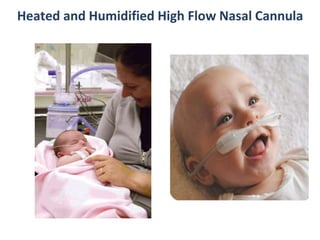
Heated and Humidified High Flow Nasal Cannula
• INTRODUCTION
• MECHANISMS
• INDICATION/CONTRAINDICATIONS
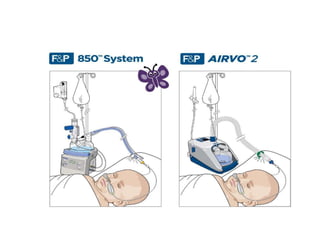
• DELIVERING SYSTEMS
• EVIDENCES
• PROTOCOLS
INTRODUCTION
• Preterm birth is a leading cause of death
world wide, but as we know since last few
decades survival is increased because of
advances in invasive ventilation and surfactant
therapies.
• But as we know invasive ventilation is
associated with its own complications like
barotrauma,volutrauma and biotrauma.
• So , nonivasive ventilation came in to picture.
• Continuous Positive Airway Pressure (CPAP) is
a well-established mode of respiratory
support in preterm newborns .
• It reduces extubation failure in previously
ventilated infants.
• CPAP is an effective alternate to intubation
and mechanical ventilation at birth for
preterm infant with RDS.
• Unfortunately, CPAP has also significant
limitations. Excessive pressure application may
result in pneumothoraces that may require
intubation and ventilation.
• Pressurised gas can cause abdominal distension
(CPAP belly syndrome) , and the bulky fixation
devices obscure the infant’s face and nasal
injuries.
• Both of these problems interfere with feeding
and positioning. These challenges are driving the
search for alternative treatments.
• HF refers to heated, humidified, blended
oxygen delivered into the nose via loose fitting
short binasal prongs, at a flow of at least 2
liters/min.
• HHHFNC allows the delivery of oxygen or a
mixture of oxygen and air at flow rates greater
than the inspiratory flow rate possible for a
neonate to achieve
• HF system is being increasingly used in many
NICUs.
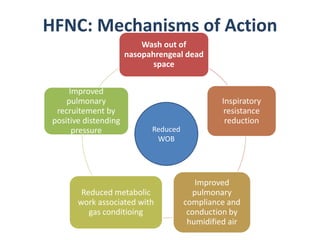
HFNC: Mechanisms of Action
Wash out of
nasopahrengeal dead
space
Inspiratory
resistance
reduction
Improved
pulmonary
compliance and
conduction by
humidified air
Reduced metabolic
work associated with
gas conditioing
Improved
pulmonary
recruitement by
positive distending
pressure Reduced
WOB
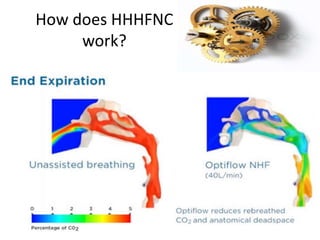
How does HHHFNC
work?
• Flush of nasal passages and oropharynx
• In HHHFNC the respiratory dead space in the
upper airway is continuously replenished and
exhaled gas instantly removed.
• This ensures that for every breath taken by the
infant there is no rebreathing of expired gas.
• The higher the gas flow the greater the flush.
Rates < 2 L/min are unlikely to achieve adequate
flush.
• In contrast to CPAP , which depend on a seal
to provide distending pressure, a seal at the
upper airways is not required for HHHFNC.
• Thus, the distending pressure provided by
HHHFNC is dynamic, depending on the phase
of the respiratory cycle.
HFNC: Mechanisms of Action
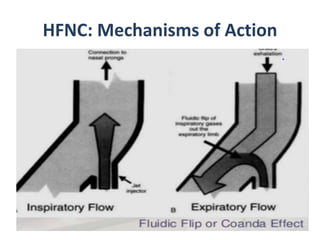
• Reduces the resistance in inspiratory phase
created by nasopharengeal and oropharengeal
airway
• ?? Coanda effect during expiration which
facilitates expiratory effort reduction
HFNC: Mechanisms of Action
• Conditioning of air consumes significant
energy
• Specifically if inspired air is cool and dry
• Humidified hot air reduces metabolic cost of
air conditioning
HFNC: Mechanisms of Action
• Humidified air protects respiratory epithelium
• Maintains ciliary functions of respi epithelium
• Improves lung compliance and conductance
HFNC: Mechanisms of Action
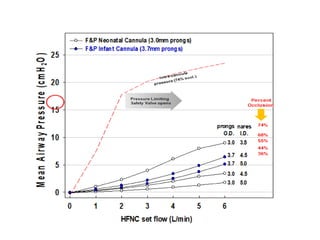
Pressure Effects
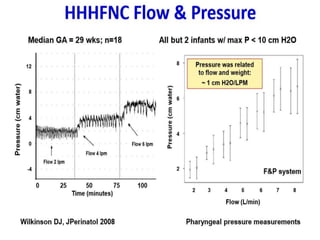
There is evidence that HHHFNC provides some PEEP,
approximately 3-5 cm H2O when flow rates up to 8 L/min
are used.
Prongs
O.D.
Nares I.D.
• Amount of CPDP produced is directly related
to the degree of flow delivered in a linear
association.
• However, the patient’s weight, the size of
nasal cannula in relation to size of nares also
impact upon CPDP produced (Collins et al
2013, Dani et al 2009).
Important difference between CPAP and HFNC is closed Vs
open system.
Correct prong size (prongs approx. 50% of the diameter of the nares) is essential.
There must be leak around the nasal prongs. This leak is very important as there is
no expiratory limb on the HHF circuit.
• Clinicians are unable to continuously measure
the pressures genetrated by HHHFNC.
• Pressure generated are unregulated and
unpredictable.
• This pressure was found to vary on an inter-
patient and even an intra-patient basis.
• Isolated reports of facial burns,perforate ear
drum and subcutaneous
emphysema/pneumocephalus.
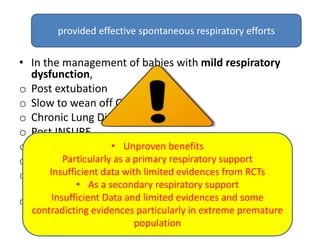
Indications
• In the management of babies with mild respiratory
dysfunction,
o Post extubation
o Slow to wean off CPAP
o Chronic Lung Disease
o Post INSURE
o Nasal trauma from CPAP prongs
o Prevention or management of apnoea of prematurity
o Other lung conditions such as pulmonary oedema,
pneumonia, meconium aspiration, bronchiolitis
o Respiratory Distress Syndrome
• Unproven benefits
Particularly as a primary respiratory support
Insufficient data with limited evidences from RCTs
• As a secondary respiratory support
Insufficient Data and limited evidences and some
contradicting evidences particularly in extreme premature
population
provided effective spontaneous respiratory efforts
Contraindications for use
• Upper airway abnormalities
• Severe cardiovascular instability
• Frequent apnoeas on CPAP
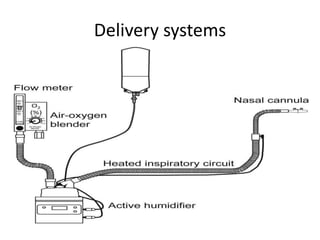
Delivery systems
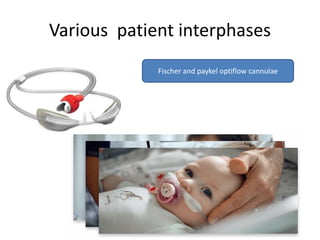
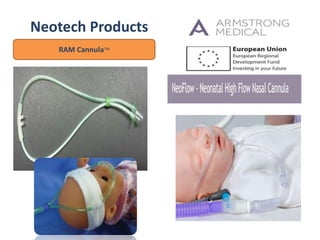
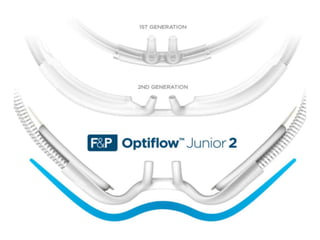
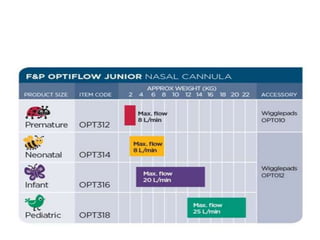
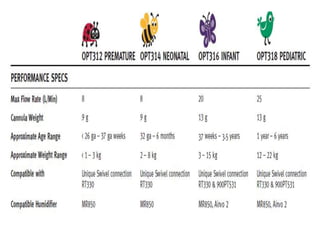
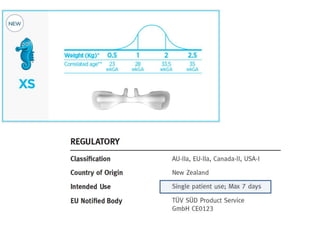
Various patient interphases
Fischer and paykel optiflow cannulae
Neotech Products
RAM CannulaTM
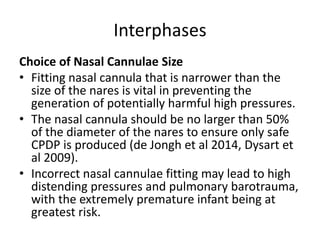
Interphases
Choice of Nasal Cannulae Size
• Fitting nasal cannula that is narrower than the
size of the nares is vital in preventing the
generation of potentially harmful high pressures.
• The nasal cannula should be no larger than 50%
of the diameter of the nares to ensure only safe
CPDP is produced (de Jongh et al 2014, Dysart et
al 2009).
• Incorrect nasal cannulae fitting may lead to high
distending pressures and pulmonary barotrauma,
with the extremely premature infant being at
greatest risk.
2
Advantages of optiflow HFNC
interphase
• Allows for natural facial movement when
patient's cheeks are compressed.
• Improves prong stability in the nostrils.
• Easier readjustment and maintenance for
caregivers
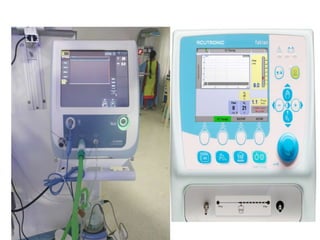
Dilivering devices
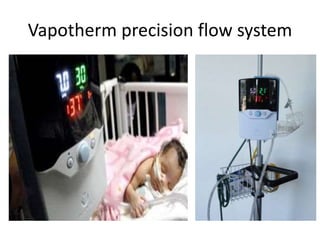
Vapotherm precision flow system
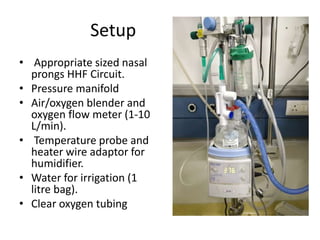
Setup
• Appropriate sized nasal
prongs HHF Circuit.
• Pressure manifold
• Air/oxygen blender and
oxygen flow meter (1-10
L/min).
• Temperature probe and
heater wire adaptor for
humidifier.
• Water for irrigation (1
litre bag).
• Clear oxygen tubing
• Position tubing down & away from baby
• –minimize fluid into the nares/airway
• –reduces risk for pressure injuries
Monitoring of a baby on HFNC
• Continuous monitoring of heart rate, respirations &
saturation
• Any signs of increased work of breathing
• Require blood gases & chest X-ray as clinically indicated
• Potential for nasal erosion still exists so the nares need
to be checked regularly.
• Tubing needs to be checked to clear “rainout” as this
can cause lavage & apnoea if excessive.
• Respiratory condition worsens check for
pneumothorax.
Evidences
This review identified 15 randomised trials including a total of
1725 premature infants that compared respiratory support with
high flow nasal cannulae (HFNC) with other forms of non-inva-
sive respiratory support in preterm infants.
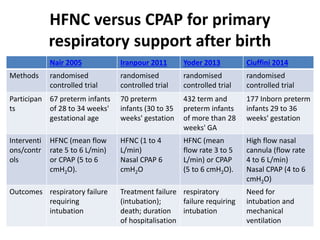
HFNC versus CPAP for primary
respiratory support after birth
Nair 2005 Iranpour 2011 Yoder 2013 Ciuffini 2014
Methods randomised
controlled trial
randomised
controlled trial
randomised
controlled trial
randomised
controlled trial
Participan
ts
67 preterm infants
of 28 to 34 weeks'
gestational age
70 preterm
infants (30 to 35
weeks' gestation
432 term and
preterm infants
of more than 28
weeks' GA
177 Inborn preterm
infants 29 to 36
weeks' gestation
Interventi
ons/contr
ols
HFNC (mean flow
rate 5 to 6 L/min)
or CPAP (5 to 6
cmH2O).
HFNC (1 to 4
L/min)
Nasal CPAP 6
cmH2O
HFNC (mean
flow rate 3 to 5
L/min) or CPAP
(5 to 6 cmH2O).
High flow nasal
cannula (flow rate
4 to 6 L/min)
Nasal CPAP (4 to 6
cmH2O)
Outcomes respiratory failure
requiring
intubation
Treatment failure
(intubation);
death; duration
of hospitalisation
respiratory
failure requiring
intubation
Need for
intubation and
mechanical
ventilation
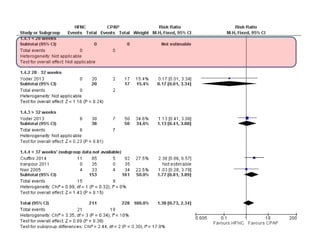
• No differences in the rates of death (typical risk ratio
(RR) 0.36, 95% confidence interval (CI) 0.01 to 8.73; 4
studies, 439 infants) or chronic lung disease (typical RR
2.07, 95% CI 0.64 to 6.64; 4 studies, 439 infants).
• The use of HFNC as primary support resulted in a
longer duration of receiving respiratory support with
similar efficacy.
• Other secondary outcomes (including nasal trauma,
durations of supplemental oxygen and hospitalisation,
pneumothorax, and sepsis) were between groups.
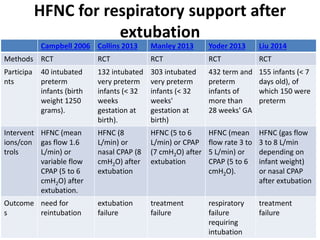
HFNC for respiratory support after
extubation
Campbell 2006 Collins 2013 Manley 2013 Yoder 2013 Liu 2014
Methods RCT RCT RCT RCT RCT
Participa
nts
40 intubated
preterm
infants (birth
weight 1250
grams).
132 intubated
very preterm
infants (< 32
weeks
gestation at
birth).
303 intubated
very preterm
infants (< 32
weeks'
gestation at
birth)
432 term and
preterm
infants of
more than
28 weeks' GA
155 infants (< 7
days old), of
which 150 were
preterm
Intervent
ions/con
trols
HFNC (mean
gas flow 1.6
L/min) or
variable flow
CPAP (5 to 6
cmH2O) after
extubation.
HFNC (8
L/min) or
nasal CPAP (8
cmH2O) after
extubation
HFNC (5 to 6
L/min) or CPAP
(7 cmH2O) after
extubation
HFNC (mean
flow rate 3 to
5 L/min) or
CPAP (5 to 6
cmH2O).
HFNC (gas flow
3 to 8 L/min
depending on
infant weight)
or nasal CPAP
after extubation
Outcome
s
need for
reintubation
extubation
failure
treatment
failure
respiratory
failure
requiring
intubation
treatment
failure
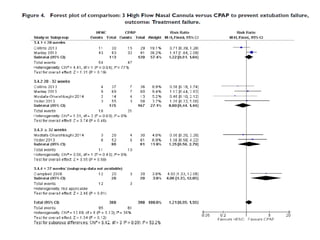
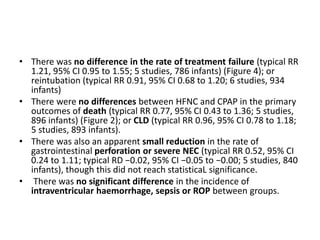
• There was no difference in the rate of treatment failure (typical RR
1.21, 95% CI 0.95 to 1.55; 5 studies, 786 infants) (Figure 4); or
reintubation (typical RR 0.91, 95% CI 0.68 to 1.20; 6 studies, 934
infants)
• There were no differences between HFNC and CPAP in the primary
outcomes of death (typical RR 0.77, 95% CI 0.43 to 1.36; 5 studies,
896 infants) (Figure 2); or CLD (typical RR 0.96, 95% CI 0.78 to 1.18;
5 studies, 893 infants).
• There was also an apparent small reduction in the rate of
gastrointestinal perforation or severe NEC (typical RR 0.52, 95% CI
0.24 to 1.11; typical RD −0.02, 95% CI −0.05 to −0.00; 5 studies, 840
infants), though this did not reach statisticaL significance.
• There was no significant difference in the incidence of
intraventricular haemorrhage, sepsis or ROP between groups.
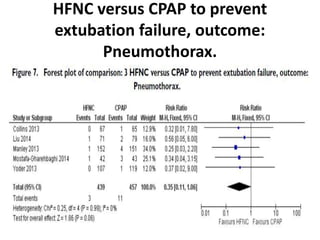
HFNC versus CPAP to prevent
extubation failure, outcome:
Pneumothorax.
Humidified HFNC versus non-
humidified HFNC to prevent
extubation failure
Woodhead 2006
Methods Randomised crossover trial
Participants 30 infants admitted to neonatal intensive care unit, intubated, planned
to extubate to HFNC
Interventions Randomised to one modality for 24 hours after extubation then
switched to other modality
Humidified HFNC - VapothermTM (mean 3.1 L/min); n = 15
Non-humidified HFNC (mean 1.8 L/min); n = 13
Outcomes Need for intubation (no pre-specified criteria); nasal mucosa
examination; pneumothorax or pneumomediastinum
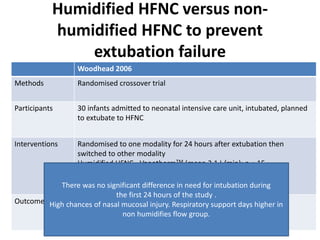
There was no significant difference in need for intubation during
the first 24 hours of the study .
High chances of nasal mucosal injury. Respiratory support days higher in
non humidifies flow group.
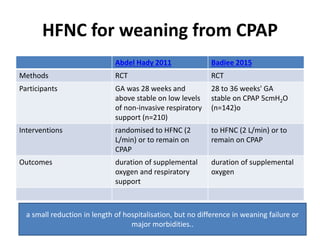
HFNC for weaning from CPAP
Abdel Hady 2011 Badiee 2015
Methods RCT RCT
Participants GA was 28 weeks and
above stable on low levels
of non-invasive respiratory
support (n=210)
28 to 36 weeks' GA
stable on CPAP 5cmH2O
(n=142)o
Interventions randomised to HFNC (2
L/min) or to remain on
CPAP
to HFNC (2 L/min) or to
remain on CPAP
Outcomes duration of supplemental
oxygen and respiratory
support
duration of supplemental
oxygen
a small reduction in length of hospitalisation, but no difference in weaning failure or
major morbidities..
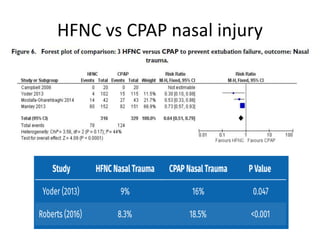
HFNC vs CPAP nasal injury
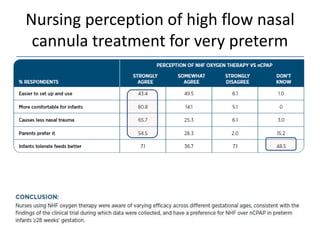
Nursing perception of high flow nasal
cannula treatment for very preterm
Ct roberts et.al. 2014
Study design RCT
population 144 Nursing staff taking care of preterm
population on respiratory support
randomised to either cpap or HFNC
Intervention Nursing staff questinaire in form of
responses options
control n CPAP
Advantage over CPAP
• Lesser air leak
• Minimises nasal trauma when compared to nCPAP
• HHHFNC allows respiratory support to be provided
alongside oral feeding .
• Optimises opportunities for parental care
administration, including skin-to-skin and
breastfeeding .
• Reduces risk of gaseous abdominal distension and
therefore may improve feed tolerance .
Protocols for HFNC
Consensus statement and unit protocol reviews
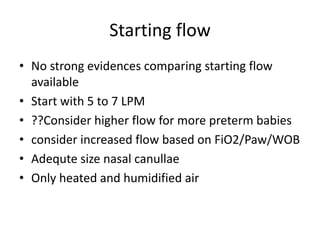
Starting flow
• No strong evidences comparing starting flow
available
• Start with 5 to 7 LPM
• ??Consider higher flow for more preterm babies
• consider increased flow based on FiO2/Paw/WOB
• Adequte size nasal canullae
• Only heated and humidified air
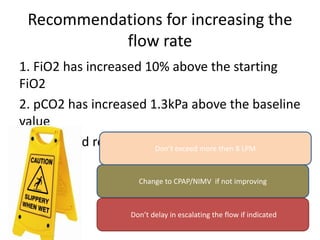
Recommendations for increasing the
flow rate
1. FiO2 has increased 10% above the starting
FiO2
2. pCO2 has increased 1.3kPa above the baseline
value
3. Increased retractions or distress notedDon’t exceed more then 8 LPM
Change to CPAP/NIMV if not improving
Don’t delay in escalating the flow if indicated
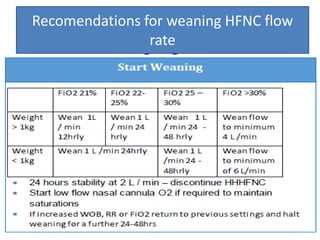
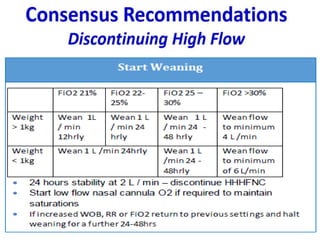
Recomendations for weaning HFNC flow
rate
Discontinuation of high flow
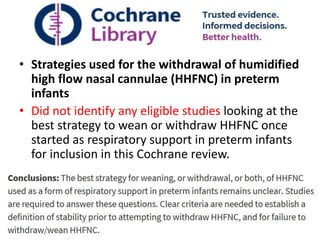
• Strategies used for the withdrawal of humidified
high flow nasal cannulae (HHFNC) in preterm
infants
• Did not identify any eligible studies looking at the
best strategy to wean or withdraw HHFNC once
started as respiratory support in preterm infants
for inclusion in this Cochrane review.
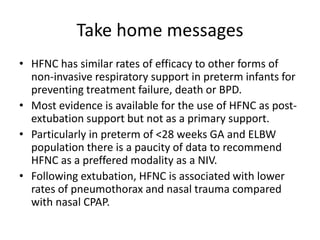
Take home messages
• HFNC has similar rates of efficacy to other forms of
non-invasive respiratory support in preterm infants for
preventing treatment failure, death or BPD.
• Most evidence is available for the use of HFNC as post-
extubation support but not as a primary support.
• Particularly in preterm of <28 weeks GA and ELBW
population there is a paucity of data to recommend
HFNC as a preffered modality as a NIV.
• Following extubation, HFNC is associated with lower
rates of pneumothorax and nasal trauma compared
with nasal CPAP.
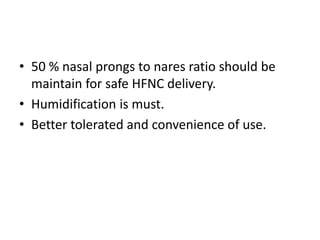
• 50 % nasal prongs to nares ratio should be
maintain for safe HFNC delivery.
• Humidification is must.
• Better tolerated and convenience of use.
THANK YOU

High flow nasal cannula in neonataes

  • 1.
    HIGH FLOW NASALCANNULA THERAPY IN NEONATAES DR. DARSHAN DNB Neonatology
  • 2.
    Heated and HumidifiedHigh Flow Nasal Cannula
  • 3.
    • INTRODUCTION • MECHANISMS •INDICATION/CONTRAINDICATIONS • DELIVERING SYSTEMS • EVIDENCES • PROTOCOLS
  • 4.
    INTRODUCTION • Preterm birthis a leading cause of death world wide, but as we know since last few decades survival is increased because of advances in invasive ventilation and surfactant therapies. • But as we know invasive ventilation is associated with its own complications like barotrauma,volutrauma and biotrauma.
  • 5.
    • So ,nonivasive ventilation came in to picture. • Continuous Positive Airway Pressure (CPAP) is a well-established mode of respiratory support in preterm newborns . • It reduces extubation failure in previously ventilated infants. • CPAP is an effective alternate to intubation and mechanical ventilation at birth for preterm infant with RDS.
  • 6.
    • Unfortunately, CPAPhas also significant limitations. Excessive pressure application may result in pneumothoraces that may require intubation and ventilation. • Pressurised gas can cause abdominal distension (CPAP belly syndrome) , and the bulky fixation devices obscure the infant’s face and nasal injuries. • Both of these problems interfere with feeding and positioning. These challenges are driving the search for alternative treatments.
  • 7.
    • HF refersto heated, humidified, blended oxygen delivered into the nose via loose fitting short binasal prongs, at a flow of at least 2 liters/min. • HHHFNC allows the delivery of oxygen or a mixture of oxygen and air at flow rates greater than the inspiratory flow rate possible for a neonate to achieve • HF system is being increasingly used in many NICUs.
  • 8.
    HFNC: Mechanisms ofAction Wash out of nasopahrengeal dead space Inspiratory resistance reduction Improved pulmonary compliance and conduction by humidified air Reduced metabolic work associated with gas conditioing Improved pulmonary recruitement by positive distending pressure Reduced WOB
  • 9.
    How does HHHFNC work? •Flush of nasal passages and oropharynx • In HHHFNC the respiratory dead space in the upper airway is continuously replenished and exhaled gas instantly removed. • This ensures that for every breath taken by the infant there is no rebreathing of expired gas. • The higher the gas flow the greater the flush. Rates < 2 L/min are unlikely to achieve adequate flush.
  • 10.
    • In contrastto CPAP , which depend on a seal to provide distending pressure, a seal at the upper airways is not required for HHHFNC. • Thus, the distending pressure provided by HHHFNC is dynamic, depending on the phase of the respiratory cycle.
  • 11.
    HFNC: Mechanisms ofAction • Reduces the resistance in inspiratory phase created by nasopharengeal and oropharengeal airway • ?? Coanda effect during expiration which facilitates expiratory effort reduction
  • 12.
    HFNC: Mechanisms ofAction • Conditioning of air consumes significant energy • Specifically if inspired air is cool and dry • Humidified hot air reduces metabolic cost of air conditioning
  • 13.
    HFNC: Mechanisms ofAction • Humidified air protects respiratory epithelium • Maintains ciliary functions of respi epithelium • Improves lung compliance and conductance
  • 14.
    HFNC: Mechanisms ofAction Pressure Effects There is evidence that HHHFNC provides some PEEP, approximately 3-5 cm H2O when flow rates up to 8 L/min are used. Prongs O.D. Nares I.D.
  • 15.
    • Amount ofCPDP produced is directly related to the degree of flow delivered in a linear association. • However, the patient’s weight, the size of nasal cannula in relation to size of nares also impact upon CPDP produced (Collins et al 2013, Dani et al 2009).
  • 16.
    Important difference betweenCPAP and HFNC is closed Vs open system. Correct prong size (prongs approx. 50% of the diameter of the nares) is essential. There must be leak around the nasal prongs. This leak is very important as there is no expiratory limb on the HHF circuit.
  • 18.
    • Clinicians areunable to continuously measure the pressures genetrated by HHHFNC. • Pressure generated are unregulated and unpredictable. • This pressure was found to vary on an inter- patient and even an intra-patient basis. • Isolated reports of facial burns,perforate ear drum and subcutaneous emphysema/pneumocephalus.
  • 19.
    Indications • In themanagement of babies with mild respiratory dysfunction, o Post extubation o Slow to wean off CPAP o Chronic Lung Disease o Post INSURE o Nasal trauma from CPAP prongs o Prevention or management of apnoea of prematurity o Other lung conditions such as pulmonary oedema, pneumonia, meconium aspiration, bronchiolitis o Respiratory Distress Syndrome • Unproven benefits Particularly as a primary respiratory support Insufficient data with limited evidences from RCTs • As a secondary respiratory support Insufficient Data and limited evidences and some contradicting evidences particularly in extreme premature population provided effective spontaneous respiratory efforts
  • 20.
    Contraindications for use •Upper airway abnormalities • Severe cardiovascular instability • Frequent apnoeas on CPAP
  • 21.
  • 22.
    Various patient interphases Fischerand paykel optiflow cannulae
  • 23.
  • 24.
    Interphases Choice of NasalCannulae Size • Fitting nasal cannula that is narrower than the size of the nares is vital in preventing the generation of potentially harmful high pressures. • The nasal cannula should be no larger than 50% of the diameter of the nares to ensure only safe CPDP is produced (de Jongh et al 2014, Dysart et al 2009). • Incorrect nasal cannulae fitting may lead to high distending pressures and pulmonary barotrauma, with the extremely premature infant being at greatest risk.
  • 28.
  • 29.
    Advantages of optiflowHFNC interphase • Allows for natural facial movement when patient's cheeks are compressed. • Improves prong stability in the nostrils. • Easier readjustment and maintenance for caregivers
  • 30.
  • 32.
  • 34.
    Setup • Appropriate sizednasal prongs HHF Circuit. • Pressure manifold • Air/oxygen blender and oxygen flow meter (1-10 L/min). • Temperature probe and heater wire adaptor for humidifier. • Water for irrigation (1 litre bag). • Clear oxygen tubing
  • 35.
    • Position tubingdown & away from baby • –minimize fluid into the nares/airway • –reduces risk for pressure injuries
  • 36.
    Monitoring of ababy on HFNC • Continuous monitoring of heart rate, respirations & saturation • Any signs of increased work of breathing • Require blood gases & chest X-ray as clinically indicated • Potential for nasal erosion still exists so the nares need to be checked regularly. • Tubing needs to be checked to clear “rainout” as this can cause lavage & apnoea if excessive. • Respiratory condition worsens check for pneumothorax.
  • 37.
    Evidences This review identified15 randomised trials including a total of 1725 premature infants that compared respiratory support with high flow nasal cannulae (HFNC) with other forms of non-inva- sive respiratory support in preterm infants.
  • 38.
    HFNC versus CPAPfor primary respiratory support after birth Nair 2005 Iranpour 2011 Yoder 2013 Ciuffini 2014 Methods randomised controlled trial randomised controlled trial randomised controlled trial randomised controlled trial Participan ts 67 preterm infants of 28 to 34 weeks' gestational age 70 preterm infants (30 to 35 weeks' gestation 432 term and preterm infants of more than 28 weeks' GA 177 Inborn preterm infants 29 to 36 weeks' gestation Interventi ons/contr ols HFNC (mean flow rate 5 to 6 L/min) or CPAP (5 to 6 cmH2O). HFNC (1 to 4 L/min) Nasal CPAP 6 cmH2O HFNC (mean flow rate 3 to 5 L/min) or CPAP (5 to 6 cmH2O). High flow nasal cannula (flow rate 4 to 6 L/min) Nasal CPAP (4 to 6 cmH2O) Outcomes respiratory failure requiring intubation Treatment failure (intubation); death; duration of hospitalisation respiratory failure requiring intubation Need for intubation and mechanical ventilation
  • 40.
    • No differencesin the rates of death (typical risk ratio (RR) 0.36, 95% confidence interval (CI) 0.01 to 8.73; 4 studies, 439 infants) or chronic lung disease (typical RR 2.07, 95% CI 0.64 to 6.64; 4 studies, 439 infants). • The use of HFNC as primary support resulted in a longer duration of receiving respiratory support with similar efficacy. • Other secondary outcomes (including nasal trauma, durations of supplemental oxygen and hospitalisation, pneumothorax, and sepsis) were between groups.
  • 41.
    HFNC for respiratorysupport after extubation Campbell 2006 Collins 2013 Manley 2013 Yoder 2013 Liu 2014 Methods RCT RCT RCT RCT RCT Participa nts 40 intubated preterm infants (birth weight 1250 grams). 132 intubated very preterm infants (< 32 weeks gestation at birth). 303 intubated very preterm infants (< 32 weeks' gestation at birth) 432 term and preterm infants of more than 28 weeks' GA 155 infants (< 7 days old), of which 150 were preterm Intervent ions/con trols HFNC (mean gas flow 1.6 L/min) or variable flow CPAP (5 to 6 cmH2O) after extubation. HFNC (8 L/min) or nasal CPAP (8 cmH2O) after extubation HFNC (5 to 6 L/min) or CPAP (7 cmH2O) after extubation HFNC (mean flow rate 3 to 5 L/min) or CPAP (5 to 6 cmH2O). HFNC (gas flow 3 to 8 L/min depending on infant weight) or nasal CPAP after extubation Outcome s need for reintubation extubation failure treatment failure respiratory failure requiring intubation treatment failure
  • 43.
    • There wasno difference in the rate of treatment failure (typical RR 1.21, 95% CI 0.95 to 1.55; 5 studies, 786 infants) (Figure 4); or reintubation (typical RR 0.91, 95% CI 0.68 to 1.20; 6 studies, 934 infants) • There were no differences between HFNC and CPAP in the primary outcomes of death (typical RR 0.77, 95% CI 0.43 to 1.36; 5 studies, 896 infants) (Figure 2); or CLD (typical RR 0.96, 95% CI 0.78 to 1.18; 5 studies, 893 infants). • There was also an apparent small reduction in the rate of gastrointestinal perforation or severe NEC (typical RR 0.52, 95% CI 0.24 to 1.11; typical RD −0.02, 95% CI −0.05 to −0.00; 5 studies, 840 infants), though this did not reach statisticaL significance. • There was no significant difference in the incidence of intraventricular haemorrhage, sepsis or ROP between groups.
  • 44.
    HFNC versus CPAPto prevent extubation failure, outcome: Pneumothorax.
  • 45.
    Humidified HFNC versusnon- humidified HFNC to prevent extubation failure Woodhead 2006 Methods Randomised crossover trial Participants 30 infants admitted to neonatal intensive care unit, intubated, planned to extubate to HFNC Interventions Randomised to one modality for 24 hours after extubation then switched to other modality Humidified HFNC - VapothermTM (mean 3.1 L/min); n = 15 Non-humidified HFNC (mean 1.8 L/min); n = 13 Outcomes Need for intubation (no pre-specified criteria); nasal mucosa examination; pneumothorax or pneumomediastinum There was no significant difference in need for intubation during the first 24 hours of the study . High chances of nasal mucosal injury. Respiratory support days higher in non humidifies flow group.
  • 46.
    HFNC for weaningfrom CPAP Abdel Hady 2011 Badiee 2015 Methods RCT RCT Participants GA was 28 weeks and above stable on low levels of non-invasive respiratory support (n=210) 28 to 36 weeks' GA stable on CPAP 5cmH2O (n=142)o Interventions randomised to HFNC (2 L/min) or to remain on CPAP to HFNC (2 L/min) or to remain on CPAP Outcomes duration of supplemental oxygen and respiratory support duration of supplemental oxygen a small reduction in length of hospitalisation, but no difference in weaning failure or major morbidities..
  • 47.
    HFNC vs CPAPnasal injury
  • 48.
    Nursing perception ofhigh flow nasal cannula treatment for very preterm Ct roberts et.al. 2014 Study design RCT population 144 Nursing staff taking care of preterm population on respiratory support randomised to either cpap or HFNC Intervention Nursing staff questinaire in form of responses options control n CPAP
  • 49.
    Advantage over CPAP •Lesser air leak • Minimises nasal trauma when compared to nCPAP • HHHFNC allows respiratory support to be provided alongside oral feeding . • Optimises opportunities for parental care administration, including skin-to-skin and breastfeeding . • Reduces risk of gaseous abdominal distension and therefore may improve feed tolerance .
  • 50.
    Protocols for HFNC Consensusstatement and unit protocol reviews
  • 51.
    Starting flow • Nostrong evidences comparing starting flow available • Start with 5 to 7 LPM • ??Consider higher flow for more preterm babies • consider increased flow based on FiO2/Paw/WOB • Adequte size nasal canullae • Only heated and humidified air
  • 52.
    Recommendations for increasingthe flow rate 1. FiO2 has increased 10% above the starting FiO2 2. pCO2 has increased 1.3kPa above the baseline value 3. Increased retractions or distress notedDon’t exceed more then 8 LPM Change to CPAP/NIMV if not improving Don’t delay in escalating the flow if indicated
  • 53.
  • 54.
    Discontinuation of highflow • Strategies used for the withdrawal of humidified high flow nasal cannulae (HHFNC) in preterm infants • Did not identify any eligible studies looking at the best strategy to wean or withdraw HHFNC once started as respiratory support in preterm infants for inclusion in this Cochrane review.
  • 56.
    Take home messages •HFNC has similar rates of efficacy to other forms of non-invasive respiratory support in preterm infants for preventing treatment failure, death or BPD. • Most evidence is available for the use of HFNC as post- extubation support but not as a primary support. • Particularly in preterm of <28 weeks GA and ELBW population there is a paucity of data to recommend HFNC as a preffered modality as a NIV. • Following extubation, HFNC is associated with lower rates of pneumothorax and nasal trauma compared with nasal CPAP.
  • 57.
    • 50 %nasal prongs to nares ratio should be maintain for safe HFNC delivery. • Humidification is must. • Better tolerated and convenience of use.
  • 58.

Editor's Notes

  • #8  American Academy of Respiratory Clinicians advocates a flow of at least 3L/min