The curriculum
development cycle
Eight steps to better
schools and better learning
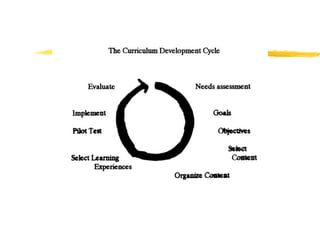
Let’s examine what happens in each step of the
curriculum development/revision cycle. This
cycle is a dynamic system that helps each school
re-vitalize and replenish what is taught to its
students.
Needs Assessment
For one child in
special education, this
would include his test
scores
For a campus, this
might include
achievement test
data, attendance,
graduation, college-
going rate, and
others
0
10
20
30
40
50
60
70
80
90
1stQtr
3rdQtr
SAT-9
Otis-
Lennon
Gradua
tion
Colleg
e
comp.
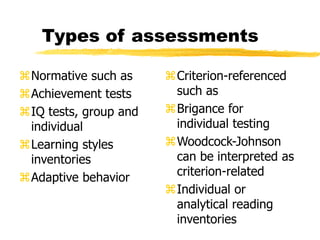
Types of assessments
Normative such as
Achievement tests
IQ tests, group and
individual
Learning styles
inventories
Adaptive behavior
Criterion-referenced
such as
Brigance for
individual testing
Woodcock-Johnson
can be interpreted as
criterion-related
Individual or
analytical reading
inventories
Don’t forget the qualitative information.
For either one child or for a school, interest
inventories can tell a lot, as can opinion
polls.
Writing Goals (second
step)
Goals do not have to
be behavioral, but
should be translatable
into behavioral
language
Need enough goals to
point the way
Writing objectives (3rd)
Objectives are more
detailed
Audience, behavior,
conditions, degree
In cognitive, affective,
and psychomotor
domains
Assessments should
be written from
objectives
Selecting content (4th)
For MRs, keep in mind the mental age of
the person or persons being written for.
Chronological ages are deceiving.
For special ed., keep it very utilitarian.
The content must be useful . . . These will
remember, at the most, one-half of what
normal persons would.
Build on students’ past experiences.
Organization of content (5)
Logical sequencing of content always
helps. But for LDs, and most MRs, it is
absolutely essential.
Build in some repetition
Provide for loop-backs for students to re-
visit things that they may have forgotten
Spiral curriculum is one very effective plan
Selection of learning
experiences
Learning experiences
do not stand alone--
they must relate to
objectives
Fun!
Interesting!
Multi-sensory
Use technology as
often as possible
Adaptation to teaching
situation
For campuses or districts, this seventh section is where teachers
make adjustments to make the new curriculum their own and in
their own ways in their classrooms.
For special education, this is where the related services
sometimes come in; special transportation, special technology,
nurse care, counseling on demand, wheelchairs, medical
assistance.
Evaluation of curricula
0
0.2
0.4
0.6
0.8
1
1stQtr
3rdQtr
K1
K2
K3
A1
P1
For many years, this
was the step never
taken
Check to see how
many students
reached each
objective
For special education,
it’s the end-of-year
meeting
The evaluation at the end of one curriculum cycle
feeds right into the needs assessment of the next.
In this way, the curriculum of the school--or for
one child--is perpetually replenished and
revitalized.

Curriculum development cycle

  • 1.
    The curriculum development cycle Eightsteps to better schools and better learning
  • 3.
    Let’s examine whathappens in each step of the curriculum development/revision cycle. This cycle is a dynamic system that helps each school re-vitalize and replenish what is taught to its students.
  • 4.
    Needs Assessment For onechild in special education, this would include his test scores For a campus, this might include achievement test data, attendance, graduation, college- going rate, and others 0 10 20 30 40 50 60 70 80 90 1stQtr 3rdQtr SAT-9 Otis- Lennon Gradua tion Colleg e comp.
  • 5.
    Types of assessments Normativesuch as Achievement tests IQ tests, group and individual Learning styles inventories Adaptive behavior Criterion-referenced such as Brigance for individual testing Woodcock-Johnson can be interpreted as criterion-related Individual or analytical reading inventories
  • 6.
    Don’t forget thequalitative information. For either one child or for a school, interest inventories can tell a lot, as can opinion polls.
  • 7.
    Writing Goals (second step) Goalsdo not have to be behavioral, but should be translatable into behavioral language Need enough goals to point the way
  • 8.
    Writing objectives (3rd) Objectivesare more detailed Audience, behavior, conditions, degree In cognitive, affective, and psychomotor domains Assessments should be written from objectives
  • 9.
    Selecting content (4th) ForMRs, keep in mind the mental age of the person or persons being written for. Chronological ages are deceiving. For special ed., keep it very utilitarian. The content must be useful . . . These will remember, at the most, one-half of what normal persons would. Build on students’ past experiences.
  • 10.
    Organization of content(5) Logical sequencing of content always helps. But for LDs, and most MRs, it is absolutely essential. Build in some repetition Provide for loop-backs for students to re- visit things that they may have forgotten Spiral curriculum is one very effective plan
  • 11.
    Selection of learning experiences Learningexperiences do not stand alone-- they must relate to objectives Fun! Interesting! Multi-sensory Use technology as often as possible
  • 12.
    Adaptation to teaching situation Forcampuses or districts, this seventh section is where teachers make adjustments to make the new curriculum their own and in their own ways in their classrooms. For special education, this is where the related services sometimes come in; special transportation, special technology, nurse care, counseling on demand, wheelchairs, medical assistance.
  • 13.
    Evaluation of curricula 0 0.2 0.4 0.6 0.8 1 1stQtr 3rdQtr K1 K2 K3 A1 P1 Formany years, this was the step never taken Check to see how many students reached each objective For special education, it’s the end-of-year meeting
  • 14.
    The evaluation atthe end of one curriculum cycle feeds right into the needs assessment of the next. In this way, the curriculum of the school--or for one child--is perpetually replenished and revitalized.