Noninvasive Ventilation In
Neonates
Objectives
Techniques
Response To NIV
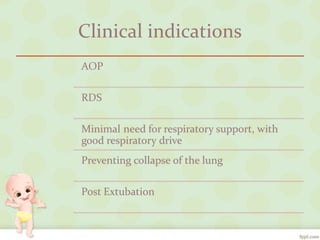
Clinical indications
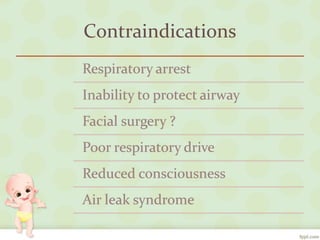
Contraindications
Evidence Based Decisions
Techniques
1. CPAP
2. BiPAP
3. SNIPPV
4. HHHFNC
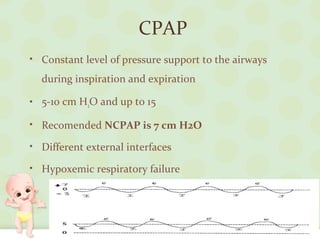
CPAP
• Constant level of pressure support to the airways
during inspiration and expiration
• 5-10 cm H2O and up to 15
• Recomended NCPAP is 7 cm H2O
• Different external interfaces
• Hypoxemic respiratory failure
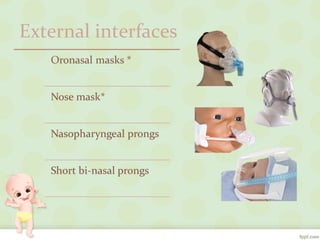
External interfaces
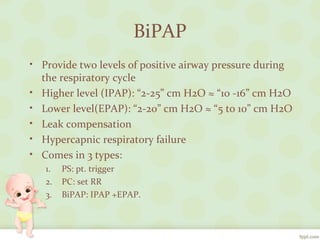
BiPAP
• Provide two levels of positive airway pressure during
the respiratory cycle
• Higher level (IPAP): “2-25” cm H2O ≈ “10 -16” cm H2O
• Lower level(EPAP): “2-20” cm H2O ≈ “5 to 10” cm H2O
• Leak compensation
• Hypercapnic respiratory failure
• Comes in 3 types:
1. PS: pt. trigger
2. PC: set RR
3. BiPAP: IPAP +EPAP.
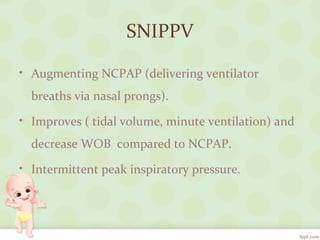
SNIPPV
• Augmenting NCPAP (delivering ventilator
breaths via nasal prongs).
• Improves ( tidal volume, minute ventilation) and
decrease WOB compared to NCPAP.
• Intermittent peak inspiratory pressure.
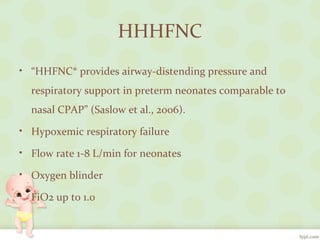
HHHFNC
• “HHFNC* provides airway-distending pressure and
respiratory support in preterm neonates comparable to
nasal CPAP” (Saslow et al., 2006).
• Hypoxemic respiratory failure
• Flow rate 1-8 L/min for neonates
• Oxygen blinder
• FiO2 up to 1.0
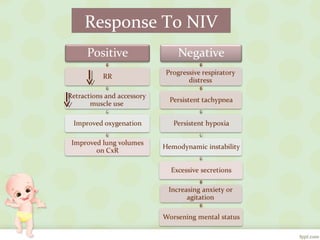
Is it working ?
Response To NIV
Clinical indications
Contraindications
Techniques
Response To NIV
Clinical indications
Contraindications
Evidence Based Decisions
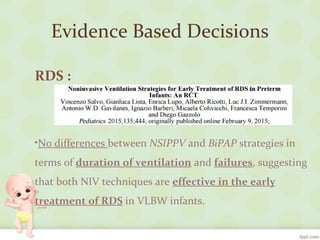
RDS :
•No differences between NSIPPV and BiPAP strategies in
terms of duration of ventilation and failures, suggesting
that both NIV techniques are effective in the early
treatment of RDS in VLBW infants.
RDS:
•HHFNC is well-tolerated by premature infants. Compared to infants
managed with NCPAP.
•No differences in deaths, ventilator-days, BPD, blood infections or
other outcomes. More infants were intubated for failing early
NCPAP compared to early HHFNC
Hypoxic respiratory failure:
•In hypoxic respiratory failure HFNC offers a good
balance between oxygenation and comfort compared
to NIV and Venturi mask and seems to be well
tolerated by patients.
AOP (HFNC vs. NCPAP)
AOP:
•HFNC is as effective as NCPAP in the management
of AOP.
• NIPPV appears to reduce the frequency of
apneas more effectively than NCPAP
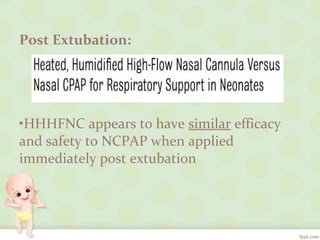
Post Extubation:
•HHHFNC appears to have similar efficacy
and safety to NCPAP when applied
immediately post extubation
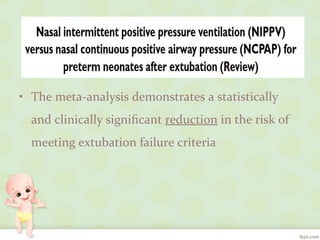
• The meta-analysis demonstrates a statistically
and clinically significant reduction in the risk of
meeting extubation failure criteria
Thank you for listening

Noninvasive ventilation in neonates

Editor's Notes

  • #6 -masks are not generally used in neonates and young infants due to the difficulty in maintaining an adequate fit and seal
  • #9 young infants is limited to 2 to 3 L/min due to mucosal irritation and dryness from the cool, dry air warmed humidified gas, reduce irretation , improved tolerance of high gas flow up to 8 L/min in infant
  • #15 2015
  • #16 2007
  • #22 2014