SL
N
O
TIM
E
SPECIFIC
OBJECTIVES
CONTENT TEACHIN
G
LEARNIN
G
ACTIVITY
A.V.AIDS
USED
EVALUATIO
N
1
2
5
min
5
min
At the end of the
class the students
will be able to;-
Introduce
glomerulonephritis.
Define
glomerulonephritis.
INTRODUCTION:
 it is a term used to refers to several
kidney disease (both kidney)
characterized by inflammation either of
the glomeruli or of the small blood
vessels in the kidney. but not all the
disease necessarily have an inflammatory
component.
 It occurs due to repeated episodes of
acute nephritic syndrome,
nephrosclerosis and hyperlipidemia.
DEFINITION :
 Glomerulonephritis is a kidney condition
that involves damage /inflammation to
the glomerulai.
 An acute inflammation of renal
glomerular parenchyma due to deposition
of immune complexes characterized by
sudden onset of
 Oliguria
 Hematuria
 Hypertension
 Edema
Teacher
introduced the
topic.
Students are
listening.
Teacher
define the
topic .
Students are
taking the
note
Powrpoint projector
Black board
Black board, chalk and
PowerPoint
projector
What is
glomerulonephrit
is I?
Define
glomerulonephrit
is
3
4
3
min
Explain the part of
nephron
.
.
INCIDENCE:
 Incidence rates of primary GN vary
between 0.2/100,000/year and 2.5
/100,000/year.
 This disease can exist sub clinically and
is therefore only detected by chance in
some patients.
 In addition, referralpolicies for
diagnostic biopsy vary between countries
this will affect the incidence rates found.
 2 to 4% of pediatic admission in india
 90% of renal disease of child hood
ANATOMYAND PHYSIOLOGYOF
NEPHRON:
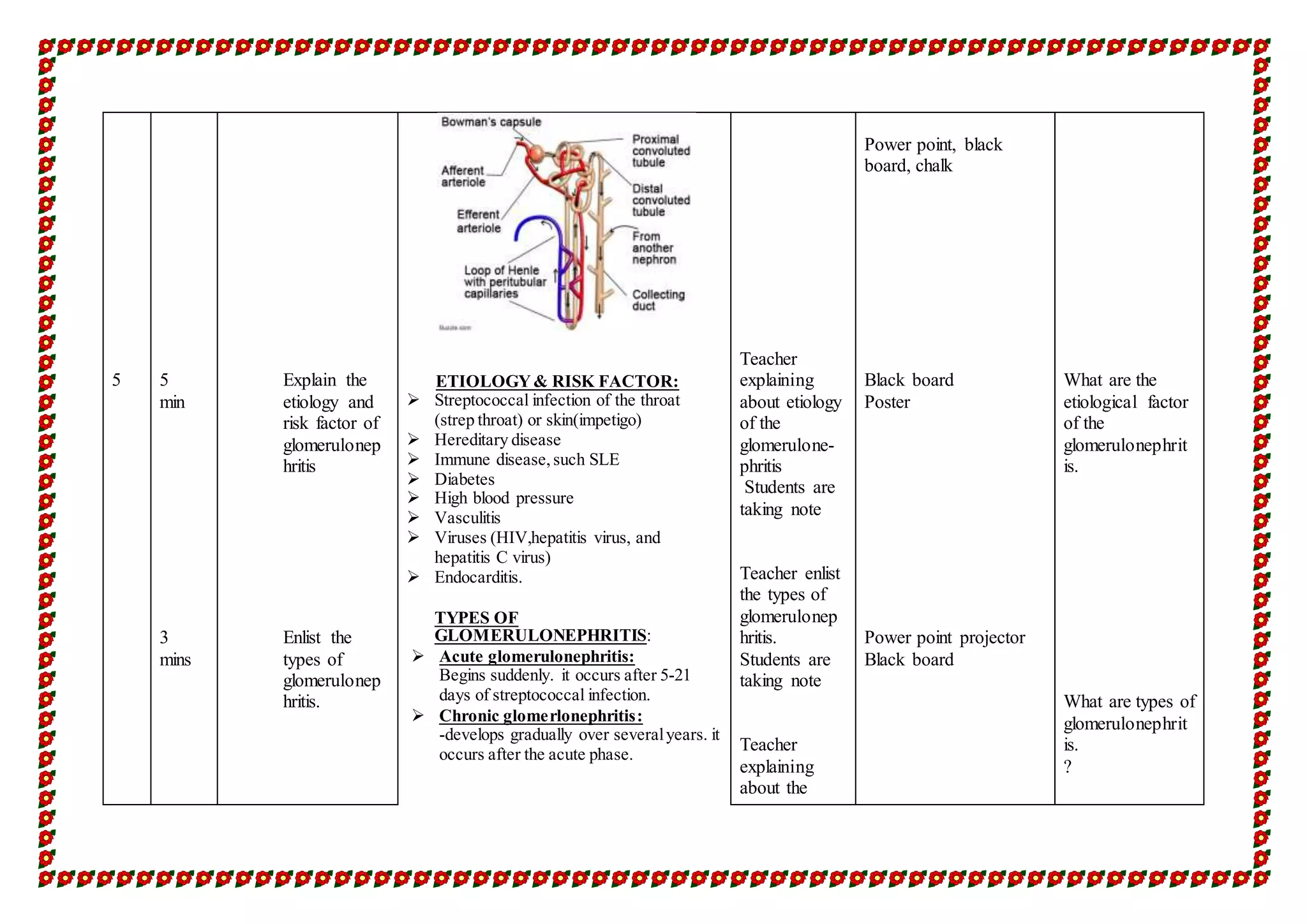
The nephron consist of a tubule closed at
one end, to form the cup –shaped
glomerular capsule (bowman’s
capsule),which almost completely
enclose a network of tinny arterial
capillaries, the glomerulus continuing
from the glomerulus capsule ,the
remainder of the nephron is about 3 cm
long & is described in three parts-
 The proximal convoluted tubule
 Loop of henle
 Distal convoluted tubule lead
them to collecting duct
Teacher
describing the
incidence
about
glomerulonep
hritis.
Teacher
explaining
about
structure and
function of
nephron .
Students are
drawing the
diagram.
Power Point projector
Black board
Power point projector
Black board,
What are the
incident rate of
glomerulonephrit
is.
What is the
structural and
functional unit of
kidney?
5 5
min
3
mins
Explain the
etiology and
risk factor of
glomerulonep
hritis
Enlist the
types of
glomerulonep
hritis.
ETIOLOGY& RISK FACTOR:
 Streptococcal infection of the throat
(strep throat) or skin(impetigo)
 Hereditary disease
 Immune disease,such SLE
 Diabetes
 High blood pressure
 Vasculitis
 Viruses (HIV,hepatitis virus, and
hepatitis C virus)
 Endocarditis.
TYPES OF
GLOMERULONEPHRITIS:
 Acute glomerulonephritis:
Begins suddenly. it occurs after 5-21
days of streptococcal infection.
 Chronic glomerlonephritis:
-develops gradually over severalyears. it
occurs after the acute phase.
Teacher
explaining
about etiology
of the
glomerulone-
phritis
Students are
taking note
Teacher enlist
the types of
glomerulonep
hritis.
Students are
taking note
Teacher
explaining
about the
Power point, black
board, chalk
Black board
Poster
Power point projector
Black board
What are the
etiological factor
of the
glomerulonephrit
is.
What are types of
glomerulonephrit
is.
?
6 7
min
Explain the
pathophysiology of
glomerulonephritis.
PATHOPHYSIOLOGY:
Due to any etiological factor
Release of Ag substance into the
circulation
Formation of Ab
Formation of Ag and Ab complex
in the glomerulus
Inflammatory response
Proliferation of epithelial cells lining the
glomerulus
Leukocytes infiltration of the glomerulus
Thickening of the glomerular filtration
membrane
Scarring and loss of glomerular filtration
membrane
patophysiolog
y of
glomerulonep
hritis.
Students are
listening.
Black board
OHP
How
glomerulonephrit
is progressing?
7
5
mins Enumerate the
clinical
manifestations of
glomerulonephritis.
Decreased GFR and glomerulus plasma
flow
Retention of sodium and water
Edema and hyper tension
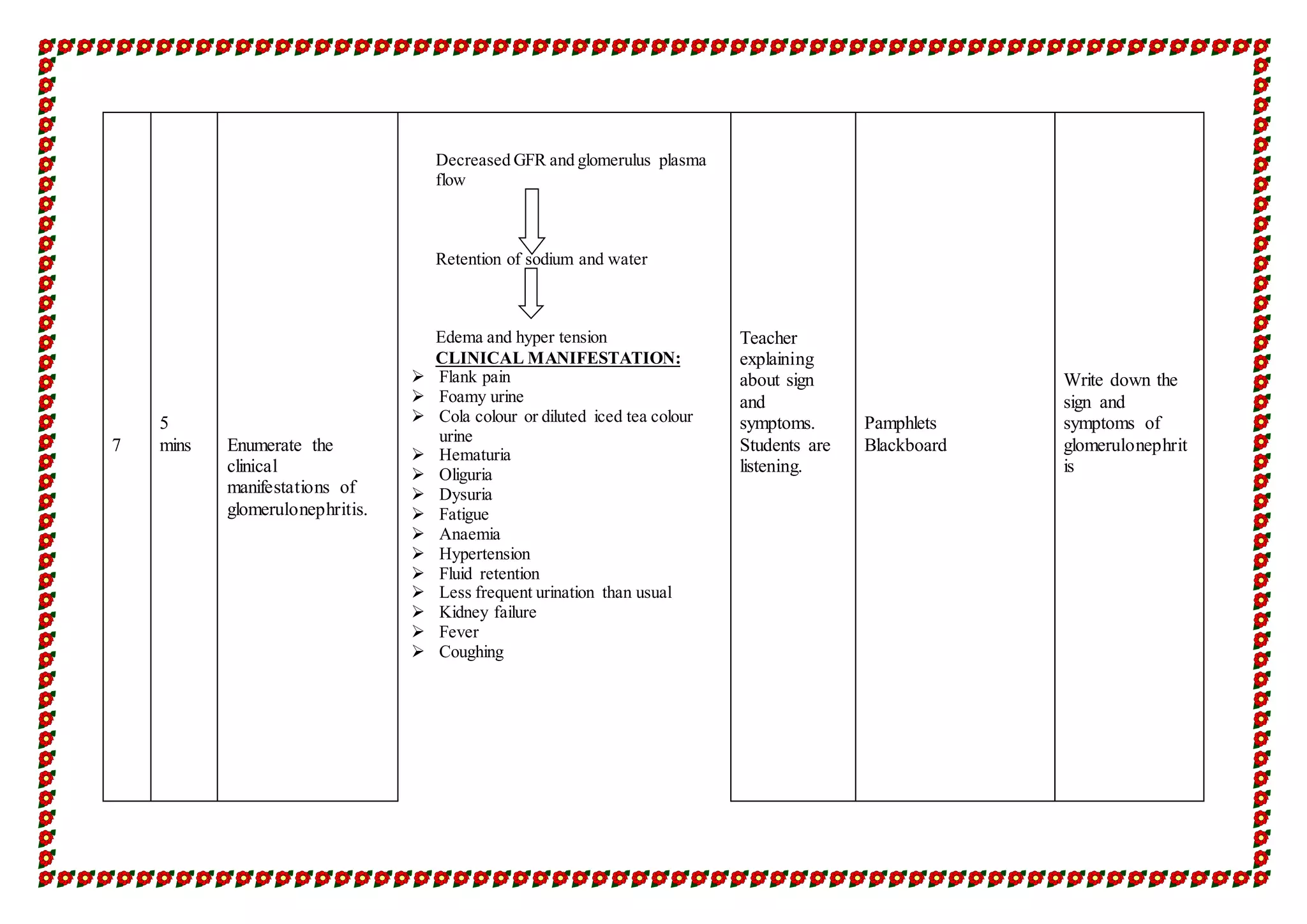
CLINICAL MANIFESTATION:
 Flank pain
 Foamy urine
 Cola colour or diluted iced tea colour
urine
 Hematuria
 Oliguria
 Dysuria
 Fatigue
 Anaemia
 Hypertension
 Fluid retention
 Less frequent urination than usual
 Kidney failure
 Fever
 Coughing
Teacher
explaining
about sign
and
symptoms.
Students are
listening.
Pamphlets
Blackboard
Write down the
sign and
symptoms of
glomerulonephrit
is
8
9
3
min
5
mins
Enlist the diagnostic
evaluation of
glomerulonephritis.
Explain the
management
of
glomerulonep
hritis.
DIAGNOSTIC EVALUATION:
 History collection
 Physical examination
 Urine analysis
 Renal Biopsy
 Intravenous pyelogram
 Abdominal ultrasound
 Abdominal CT scan
 Chest x-ray
MANAGMENT:
 Treatment depends on the cause of the
disorder, type and severity of the
symptoms.
 High Bp may be hard to control.
Controlling the BP usually the most
important part of the treatment.
 Dialysis
 Medication :
 Diuretics
 Immune suppressants
 Anti – hypertensive
 Life style changes :
 Sodium and water restriction
 Potassium ,phosphorus ,magnesium
restriction
 Limit intake of protein in the diet
 Take calcium supplements.
 Maintain a healthy weight through diet
and exercise.
 Physiotherapy treatment
 Patient education :
 Lymphatic message to reduce the edema.
 Breathing exercise-pursed lip and
Teacher
describing
about
diagnostic
evaluationof
the
glomerulonep
hritis.
Students are
taking note.
Teacher
describing
about
management
of the
glomerulonep
hritis.
Flannel board .
Black board.
What are the
diagnostic
evaluation of
glomerulonephrit
is.
What is the
medical
management of
Glomerulo
nephritis..
10
11
2
min
7
min
Enlist the
complication of
glomerulonephritis
Explain the
nursing
management
of the
glomerulonep
hritis
diaphragmatic breathing.
 Endurance exercise such as
walking,swimming,bicycling,aerobic
dancing, circulatory exercise
This exercise improve your blood
circulation, accelerate kidney to
discharge waste and toxins.
COMPLICATION:
 Acute and chronic renal failure
 Nephrotic syndrome
 Hypertension
 Electrolyte imbalance
 Pulmonary edema
 CHF due to fluid overload
NURSING MANAGMENT:
1. Nursing diagnosis:
Acute pain related to inflammation of
renal cortex as evidenced by facial
expression and verbalization of patient.
2. Nursing diagnosis:
Excess fluid volume related to
accumulation of fluid in the body as
evidenced by edema an weight gain.
3. Nursing diagnosis :
In effective breathing pattern related to
accumulation of fluid in the peritoneal cavity
as evidenced by respiration rate,dyspnea.
Shashidhar baikunje conducted a
retrospective study on post – infectious
glomerulonephritis with crescents adults
sample consisted of adults who underwent
kidney biopsy from February 2010 to June
2014.major finding of the study reveals that
the mean percentage of glomeruli with
Teacher
explaining
about
complication.
Students are
taking note.
Teacher
describing
about nursing
management.
Students are
listening.
Powerpoint projector
Black board
Powerpoint projecter
Blackboard
What are the
complication of
glomerulo
nephritis.
Writedown the
nursing
management of
glomerulonephrit
is.
12
13
5
mins
3
min
2
mins
Summarize
the topic
conclude the
topic.
crescents was 36.13%.this study concluded
that non-streptococcal infections are more
common precipitants .there was no
correlation between histological and clinical
severity. Patients treated with steroids had
better renal outcomes.
SUMMARY:
CONCLUSION:
Glomerulonephritis may be a temporary and
reversible condition, or it may get worse.
Progressive glomerulonephritis may lead to
chronic kidney failure and end – stage kidney
disease.
ASSIGNMENT:
Write assignment on details about chronic
glomerulonephris.
11
NAME OF THE STUDENT TEACHER:-
COURSE:-G.N.M.
SUBJECT:- MEDICAL SURGICAL NURSING
UNIT:- X
TOPIC:- NURSING MANAGEMENT OF RENAL AND URINARY DISORDERS
CLASS:- G.N.M. 2ND YR CLASS ROOM
NO.OF STUDENTS:- 60
DATE & TIME:-
DURATION:- 60MINS
PREVIOUS KNOWLEDGE OF THE STUDENTS:- THE STUDENTS ARE HAVING SOME KNOWLEDGE ABOUT THE ANATOMY
AND PHYSIOLOGY OF GENITO- URINARY SYSTEM.
METHODS OF TEACHING:- LECTURE CUM DISCUSSION
GENERAL OBJECTIVES:- AT THE END OF THIS CLASS THE STUDENTS WILL GET INDEPTH KNOWLEDGE ABOUT
URINARY INCONTNENCE.
SPECIFIC OBJECTIVES:- AT THE END OF THIS CLASS THE STUDENTS WILL BE ABLE TO:-
- - know urinary incontinence
- - identify etiological act-know the types of incontinence
- get knowledge about symptoms of incontinenc
-know the diagnostic evaluation
- - notify the medical management of incontinence
- - list out the surgical management of urinary incontinence
- - provide the nursing care to the incontinence patient
- - summarize the topic
- - conclude the topic
LESSON PLAN
ON
URINARY INCONTINENCE

Lesson plan on Glomerulonephitis

  • 1.
    SL N O TIM E SPECIFIC OBJECTIVES CONTENT TEACHIN G LEARNIN G ACTIVITY A.V.AIDS USED EVALUATIO N 1 2 5 min 5 min At theend of the class the students will be able to;- Introduce glomerulonephritis. Define glomerulonephritis. INTRODUCTION:  it is a term used to refers to several kidney disease (both kidney) characterized by inflammation either of the glomeruli or of the small blood vessels in the kidney. but not all the disease necessarily have an inflammatory component.  It occurs due to repeated episodes of acute nephritic syndrome, nephrosclerosis and hyperlipidemia. DEFINITION :  Glomerulonephritis is a kidney condition that involves damage /inflammation to the glomerulai.  An acute inflammation of renal glomerular parenchyma due to deposition of immune complexes characterized by sudden onset of  Oliguria  Hematuria  Hypertension  Edema Teacher introduced the topic. Students are listening. Teacher define the topic . Students are taking the note Powrpoint projector Black board Black board, chalk and PowerPoint projector What is glomerulonephrit is I? Define glomerulonephrit is
  • 2.
    3 4 3 min Explain the partof nephron . . INCIDENCE:  Incidence rates of primary GN vary between 0.2/100,000/year and 2.5 /100,000/year.  This disease can exist sub clinically and is therefore only detected by chance in some patients.  In addition, referralpolicies for diagnostic biopsy vary between countries this will affect the incidence rates found.  2 to 4% of pediatic admission in india  90% of renal disease of child hood ANATOMYAND PHYSIOLOGYOF NEPHRON: The nephron consist of a tubule closed at one end, to form the cup –shaped glomerular capsule (bowman’s capsule),which almost completely enclose a network of tinny arterial capillaries, the glomerulus continuing from the glomerulus capsule ,the remainder of the nephron is about 3 cm long & is described in three parts-  The proximal convoluted tubule  Loop of henle  Distal convoluted tubule lead them to collecting duct Teacher describing the incidence about glomerulonep hritis. Teacher explaining about structure and function of nephron . Students are drawing the diagram. Power Point projector Black board Power point projector Black board, What are the incident rate of glomerulonephrit is. What is the structural and functional unit of kidney?
  • 3.
    5 5 min 3 mins Explain the etiologyand risk factor of glomerulonep hritis Enlist the types of glomerulonep hritis. ETIOLOGY& RISK FACTOR:  Streptococcal infection of the throat (strep throat) or skin(impetigo)  Hereditary disease  Immune disease,such SLE  Diabetes  High blood pressure  Vasculitis  Viruses (HIV,hepatitis virus, and hepatitis C virus)  Endocarditis. TYPES OF GLOMERULONEPHRITIS:  Acute glomerulonephritis: Begins suddenly. it occurs after 5-21 days of streptococcal infection.  Chronic glomerlonephritis: -develops gradually over severalyears. it occurs after the acute phase. Teacher explaining about etiology of the glomerulone- phritis Students are taking note Teacher enlist the types of glomerulonep hritis. Students are taking note Teacher explaining about the Power point, black board, chalk Black board Poster Power point projector Black board What are the etiological factor of the glomerulonephrit is. What are types of glomerulonephrit is. ?
  • 4.
    6 7 min Explain the pathophysiologyof glomerulonephritis. PATHOPHYSIOLOGY: Due to any etiological factor Release of Ag substance into the circulation Formation of Ab Formation of Ag and Ab complex in the glomerulus Inflammatory response Proliferation of epithelial cells lining the glomerulus Leukocytes infiltration of the glomerulus Thickening of the glomerular filtration membrane Scarring and loss of glomerular filtration membrane patophysiolog y of glomerulonep hritis. Students are listening. Black board OHP How glomerulonephrit is progressing?
  • 5.
    7 5 mins Enumerate the clinical manifestationsof glomerulonephritis. Decreased GFR and glomerulus plasma flow Retention of sodium and water Edema and hyper tension CLINICAL MANIFESTATION:  Flank pain  Foamy urine  Cola colour or diluted iced tea colour urine  Hematuria  Oliguria  Dysuria  Fatigue  Anaemia  Hypertension  Fluid retention  Less frequent urination than usual  Kidney failure  Fever  Coughing Teacher explaining about sign and symptoms. Students are listening. Pamphlets Blackboard Write down the sign and symptoms of glomerulonephrit is
  • 6.
    8 9 3 min 5 mins Enlist the diagnostic evaluationof glomerulonephritis. Explain the management of glomerulonep hritis. DIAGNOSTIC EVALUATION:  History collection  Physical examination  Urine analysis  Renal Biopsy  Intravenous pyelogram  Abdominal ultrasound  Abdominal CT scan  Chest x-ray MANAGMENT:  Treatment depends on the cause of the disorder, type and severity of the symptoms.  High Bp may be hard to control. Controlling the BP usually the most important part of the treatment.  Dialysis  Medication :  Diuretics  Immune suppressants  Anti – hypertensive  Life style changes :  Sodium and water restriction  Potassium ,phosphorus ,magnesium restriction  Limit intake of protein in the diet  Take calcium supplements.  Maintain a healthy weight through diet and exercise.  Physiotherapy treatment  Patient education :  Lymphatic message to reduce the edema.  Breathing exercise-pursed lip and Teacher describing about diagnostic evaluationof the glomerulonep hritis. Students are taking note. Teacher describing about management of the glomerulonep hritis. Flannel board . Black board. What are the diagnostic evaluation of glomerulonephrit is. What is the medical management of Glomerulo nephritis..
  • 7.
    10 11 2 min 7 min Enlist the complication of glomerulonephritis Explainthe nursing management of the glomerulonep hritis diaphragmatic breathing.  Endurance exercise such as walking,swimming,bicycling,aerobic dancing, circulatory exercise This exercise improve your blood circulation, accelerate kidney to discharge waste and toxins. COMPLICATION:  Acute and chronic renal failure  Nephrotic syndrome  Hypertension  Electrolyte imbalance  Pulmonary edema  CHF due to fluid overload NURSING MANAGMENT: 1. Nursing diagnosis: Acute pain related to inflammation of renal cortex as evidenced by facial expression and verbalization of patient. 2. Nursing diagnosis: Excess fluid volume related to accumulation of fluid in the body as evidenced by edema an weight gain. 3. Nursing diagnosis : In effective breathing pattern related to accumulation of fluid in the peritoneal cavity as evidenced by respiration rate,dyspnea. Shashidhar baikunje conducted a retrospective study on post – infectious glomerulonephritis with crescents adults sample consisted of adults who underwent kidney biopsy from February 2010 to June 2014.major finding of the study reveals that the mean percentage of glomeruli with Teacher explaining about complication. Students are taking note. Teacher describing about nursing management. Students are listening. Powerpoint projector Black board Powerpoint projecter Blackboard What are the complication of glomerulo nephritis. Writedown the nursing management of glomerulonephrit is.
  • 8.
    12 13 5 mins 3 min 2 mins Summarize the topic conclude the topic. crescentswas 36.13%.this study concluded that non-streptococcal infections are more common precipitants .there was no correlation between histological and clinical severity. Patients treated with steroids had better renal outcomes. SUMMARY: CONCLUSION: Glomerulonephritis may be a temporary and reversible condition, or it may get worse. Progressive glomerulonephritis may lead to chronic kidney failure and end – stage kidney disease. ASSIGNMENT: Write assignment on details about chronic glomerulonephris.
  • 10.
  • 11.
    NAME OF THESTUDENT TEACHER:- COURSE:-G.N.M. SUBJECT:- MEDICAL SURGICAL NURSING UNIT:- X TOPIC:- NURSING MANAGEMENT OF RENAL AND URINARY DISORDERS CLASS:- G.N.M. 2ND YR CLASS ROOM NO.OF STUDENTS:- 60 DATE & TIME:- DURATION:- 60MINS PREVIOUS KNOWLEDGE OF THE STUDENTS:- THE STUDENTS ARE HAVING SOME KNOWLEDGE ABOUT THE ANATOMY AND PHYSIOLOGY OF GENITO- URINARY SYSTEM. METHODS OF TEACHING:- LECTURE CUM DISCUSSION GENERAL OBJECTIVES:- AT THE END OF THIS CLASS THE STUDENTS WILL GET INDEPTH KNOWLEDGE ABOUT URINARY INCONTNENCE. SPECIFIC OBJECTIVES:- AT THE END OF THIS CLASS THE STUDENTS WILL BE ABLE TO:- - - know urinary incontinence - - identify etiological act-know the types of incontinence - get knowledge about symptoms of incontinenc -know the diagnostic evaluation - - notify the medical management of incontinence
  • 12.
    - - listout the surgical management of urinary incontinence - - provide the nursing care to the incontinence patient - - summarize the topic - - conclude the topic
  • 13.