Cancer basics
A group of diseases characterized by
uncontrolled growth of abnormal cells,
with local invasion &/or metastasis
Epidemiology
 One of the commonest cause of death
in adults
 Found at all ages,
incidence increases as age advances
 ~10% are hereditary- breast, ovary, colon, brain
 Causes-
 Tobacco- oral cavity, lung, larynx, esophagus, stomach, bladder
 Ionizing radiation
 Chemotherapeutic drugs- cyclophosphamide, etoposide
 Infection- HPV, HBV/HCV, EBV, HTLV-1, H.pylori
 Hormonal imbalance- breast, uterus-endometrium, prostate
Common cancers
Infants- neuroblastoma
Childhood/adolescence- leukemia
Males- prostate, oral, lung, GIT
Females- breast, cervix, lung
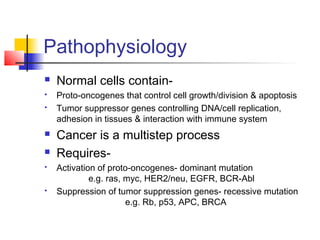
Pathophysiology
 Normal cells contain-
 Proto-oncogenes that control cell growth/division & apoptosis
 Tumor suppressor genes controlling DNA/cell replication,
adhesion in tissues & interaction with immune system
 Cancer is a multistep process
 Requires-
 Activation of proto-oncogenes- dominant mutation
e.g. ras, myc, HER2/neu, EGFR, BCR-Abl
 Suppression of tumor suppression genes- recessive mutation
e.g. Rb, p53, APC, BRCA
Symptoms- early/warning
 Non-healing oral or skin ulcer
 Lump/swelling in breast, neck, limbs
 Dysphagia
 Hoarseness
 Hemoptysis
 Painless hematuria
 Post-menopausal bleeding
 Unexplained weight loss or anemia
 Change in a mole- size, color, ulceration
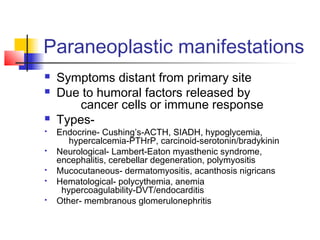
Paraneoplastic manifestations
 Symptoms distant from primary site
 Due to humoral factors released by
cancer cells or immune response
 Types-
 Endocrine- Cushing’s-ACTH, SIADH, hypoglycemia,
hypercalcemia-PTHrP, carcinoid-serotonin/bradykinin
 Neurological- Lambert-Eaton myasthenic syndrome,
encephalitis, cerebellar degeneration, polymyositis
 Mucocutaneous- dermatomyositis, acanthosis nigricans
 Hematological- polycythemia, anemia
hypercoagulability-DVT/endocarditis
 Other- membranous glomerulonephritis
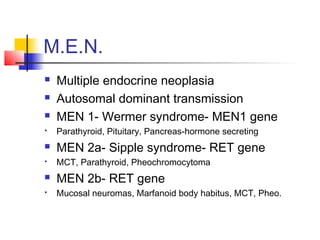
M.E.N.
 Multiple endocrine neoplasia
 Autosomal dominant transmission
 MEN 1- Wermer syndrome- MEN1 gene
 Parathyroid, Pituitary, Pancreas-hormone secreting
 MEN 2a- Sipple syndrome- RET gene
 MCT, Parathyroid, Pheochromocytoma
 MEN 2b- RET gene
 Mucosal neuromas, Marfanoid body habitus, MCT, Pheo.
Diagnosis
 Early suspicion
 Radiological Ix, as needed
 Dx is mostly histological-
sample obtained by FNAC or biopsy
 Immunohistochemistry & cytogenetics may be
required to define cancer type
 Tumor markers- measured in blood- may be diagnostic in
clinical setting, mostly for follow-up & recurrence marker
 CA-125-ovary, PSA-prostate, CEA-colon, AFP-HCC & NSGCT,
βHCG-choriocarcinoma & NSGCT, CA-19.9-
pancreas/biliary
Staging
 Follows Dx
 Blood or radiological tests, as required
 Tumor.Node.Metastasis-
TNM staging for solid cancer
 Lymphoma- Ann-Arbor staging
 Leukemia- none (CLL- Rai/Binet)
 Helps plan treatment & for prognosis
Treatment
 Local- curative/palliative, primary/adjuvant
 Surgery- ensure free-margins
 Radiation therapy- RT
 Systemic- curative/palliative, neoadjuvant/adjuvant
 Chemotherapy- CT
 Hormonal therapy
 Immunotherapy- interferon, interleukin
 Monoclonal antibody therapy
 Organ preservation- using CT & RT
 Oral, larynx, breast, bladder, limbs
Prevention & Screening
 Prevention-
 Quit tobacco
 Vaccine against HBV & HPV
 Genetic testing- BRCA 1 & 2
 Healthy lifestyle- balanced diet, no obesity, limit alcohol
 Drugs, in high risk- tamoxifen, raloxifene, finasteride, rofecoxib
 Screening- early detection in asymptomatic population-
overdiagnosis & cost-physical, monetary
 Pap smear- cervical cancer
 BSE & mammography- breast cancer
 FOBT & colonoscopy- colon cancer
 PSA, DRE, TRUS- prostate cancer
Take home
Suspect early

Cancer basics

  • 1.
    Cancer basics A groupof diseases characterized by uncontrolled growth of abnormal cells, with local invasion &/or metastasis
  • 2.
    Epidemiology  One ofthe commonest cause of death in adults  Found at all ages, incidence increases as age advances  ~10% are hereditary- breast, ovary, colon, brain  Causes-  Tobacco- oral cavity, lung, larynx, esophagus, stomach, bladder  Ionizing radiation  Chemotherapeutic drugs- cyclophosphamide, etoposide  Infection- HPV, HBV/HCV, EBV, HTLV-1, H.pylori  Hormonal imbalance- breast, uterus-endometrium, prostate
  • 3.
    Common cancers Infants- neuroblastoma Childhood/adolescence-leukemia Males- prostate, oral, lung, GIT Females- breast, cervix, lung
  • 4.
    Pathophysiology  Normal cellscontain-  Proto-oncogenes that control cell growth/division & apoptosis  Tumor suppressor genes controlling DNA/cell replication, adhesion in tissues & interaction with immune system  Cancer is a multistep process  Requires-  Activation of proto-oncogenes- dominant mutation e.g. ras, myc, HER2/neu, EGFR, BCR-Abl  Suppression of tumor suppression genes- recessive mutation e.g. Rb, p53, APC, BRCA
  • 5.
    Symptoms- early/warning  Non-healingoral or skin ulcer  Lump/swelling in breast, neck, limbs  Dysphagia  Hoarseness  Hemoptysis  Painless hematuria  Post-menopausal bleeding  Unexplained weight loss or anemia  Change in a mole- size, color, ulceration
  • 6.
    Paraneoplastic manifestations  Symptomsdistant from primary site  Due to humoral factors released by cancer cells or immune response  Types-  Endocrine- Cushing’s-ACTH, SIADH, hypoglycemia, hypercalcemia-PTHrP, carcinoid-serotonin/bradykinin  Neurological- Lambert-Eaton myasthenic syndrome, encephalitis, cerebellar degeneration, polymyositis  Mucocutaneous- dermatomyositis, acanthosis nigricans  Hematological- polycythemia, anemia hypercoagulability-DVT/endocarditis  Other- membranous glomerulonephritis
  • 7.
    M.E.N.  Multiple endocrineneoplasia  Autosomal dominant transmission  MEN 1- Wermer syndrome- MEN1 gene  Parathyroid, Pituitary, Pancreas-hormone secreting  MEN 2a- Sipple syndrome- RET gene  MCT, Parathyroid, Pheochromocytoma  MEN 2b- RET gene  Mucosal neuromas, Marfanoid body habitus, MCT, Pheo.
  • 8.
    Diagnosis  Early suspicion Radiological Ix, as needed  Dx is mostly histological- sample obtained by FNAC or biopsy  Immunohistochemistry & cytogenetics may be required to define cancer type  Tumor markers- measured in blood- may be diagnostic in clinical setting, mostly for follow-up & recurrence marker  CA-125-ovary, PSA-prostate, CEA-colon, AFP-HCC & NSGCT, βHCG-choriocarcinoma & NSGCT, CA-19.9- pancreas/biliary
  • 9.
    Staging  Follows Dx Blood or radiological tests, as required  Tumor.Node.Metastasis- TNM staging for solid cancer  Lymphoma- Ann-Arbor staging  Leukemia- none (CLL- Rai/Binet)  Helps plan treatment & for prognosis
  • 10.
    Treatment  Local- curative/palliative,primary/adjuvant  Surgery- ensure free-margins  Radiation therapy- RT  Systemic- curative/palliative, neoadjuvant/adjuvant  Chemotherapy- CT  Hormonal therapy  Immunotherapy- interferon, interleukin  Monoclonal antibody therapy  Organ preservation- using CT & RT  Oral, larynx, breast, bladder, limbs
  • 11.
    Prevention & Screening Prevention-  Quit tobacco  Vaccine against HBV & HPV  Genetic testing- BRCA 1 & 2  Healthy lifestyle- balanced diet, no obesity, limit alcohol  Drugs, in high risk- tamoxifen, raloxifene, finasteride, rofecoxib  Screening- early detection in asymptomatic population- overdiagnosis & cost-physical, monetary  Pap smear- cervical cancer  BSE & mammography- breast cancer  FOBT & colonoscopy- colon cancer  PSA, DRE, TRUS- prostate cancer
  • 12.