How to Use the
Internet to Get
Smarter
www.aboutcancer.com
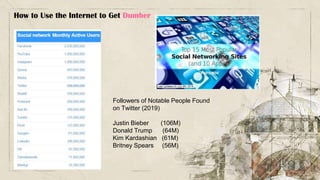
How to Use the Internet to Get Dumber
Followers of Notable People Found
on Twitter (2019)
Justin Bieber (106M)
Donald Trump (64M)
Kim Kardashian (61M)
Britney Spears (56M)
3
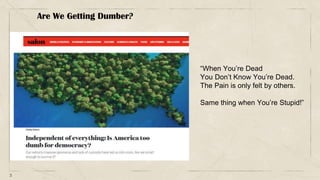
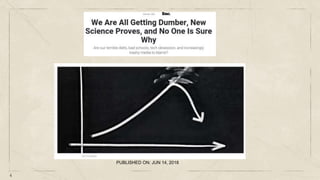
Are We Getting Dumber?
“When You’re Dead
You Don’t Know You’re Dead.
The Pain is only felt by others.
Same thing when You’re Stupid!”
4
PUBLISHED ON: JUN 14, 2018
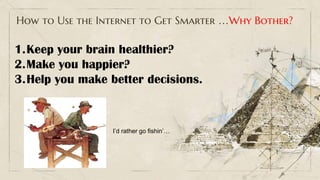
How to Use the Internet to Get Smarter …Why Bother?
1.Keep your brain healthier?
2.Make you happier?
3.Help you make better decisions.
I’d rather go fishin’…
6
Caveat Emptor!
Consider the source!
• It won’t make you happier or healthier if
you are exposed to damaging or
destructive web sites
• It won’t help you make smarter or
better decisions if you get inaccurate
information or misinterpret what you
read
7
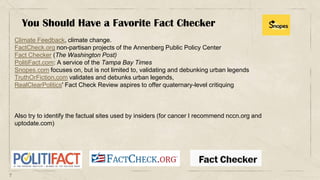
Climate Feedback, climate change.
FactCheck.org non-partisan projects of the Annenberg Public Policy Center
Fact Checker (The Washington Post)
PolitiFact.com: A service of the Tampa Bay Times
Snopes.com focuses on, but is not limited to, validating and debunking urban legends
TruthOrFiction.com validates and debunks urban legends,
RealClearPolitics' Fact Check Review aspires to offer quaternary-level critiquing
You Should Have a Favorite Fact Checker
Also try to identify the factual sites used by insiders (for cancer I recommend nccn.org and
uptodate.com)
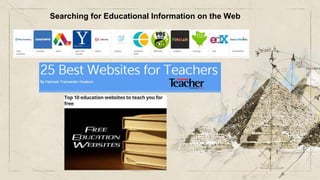
Searching for Educational Information on the Web
9
Before making a list of favorite
or ‘best’ web sites
1. Is your goal to keep your brain sharper? Go
for variety of more challenging sites (science,
history, philosophy) of varying degrees of
complexity and focus.
2. If your goal is to make yourself happier, then
art, humor, culture, sports, nostalgia may
make more sense and perhaps variety is more
important than focus or intensity.
3. If your goal is to learn and keep current with
more practical information then news, political,
economic, medical, and other consumer sites
may be best.
Practical Tips or Internet Lifehack’s
1. Create a bookmark list of favorite websites
2. Subscribe to websites or create alerts
3. Go to google or google scholar and create alerts
4. Download apps from better educational and news sites
5. Google to search a topic and then look at videos then
subscribe to their channels
6. Subscribe to the rapidly expanding lists of podcasts
7. Take advantage of MOOC’s
8. Find a useful site or video, email the link to yourself and
create educational save files (anticipate memory issues)
What is a MOOC?
• A massive open online course (MOOC) is an online course
aimed at unlimited participation and open access via the web
• MOOCs are a recent and widely researched development
in distance education first introduced in 2006 and emerged as a
popular mode of learning in 2012
• The first MOOCs emerged from the open educational
resources (OER) movement, which was sparked by MIT
OpenCourseWare project.
• Alongside the development of these open courses, other E-
learning platforms emerged — such as Khan Academy, Udemy,
and ALISON — which are viewed as similar to MOOCs and work
outside the university system or emphasize individual self-paced
lessons
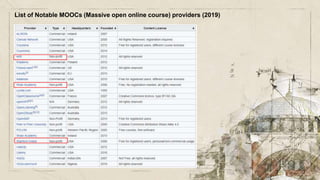
List of Notable MOOCs (Massive open online course) providers (2019)
Top High Quality ‘Free’ Educational Online Sites Everyone Should
Know About
• Coursera
• Khan Academy
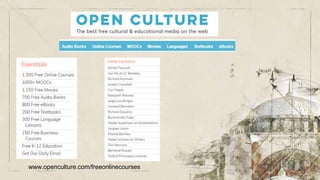
• Open Culture
• Udemy
• Academic Earth
• edX
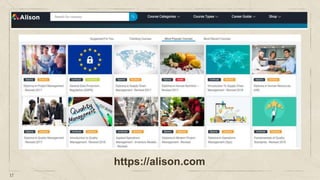
• Alison
• iTunes U
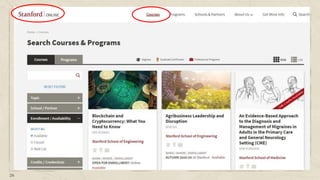
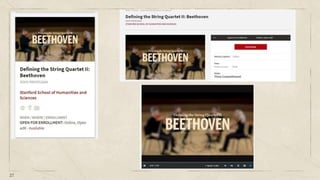
• Stanford Online
• Harvard Extension
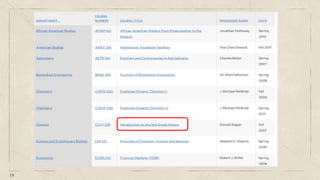
• Open Yale Courses
• UC Berkeley Class Central
• MIT OpenCourseWare
• Carnegie Mellon Open Learning Initiative
• TED-Ed
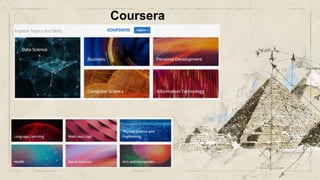
Coursera
15
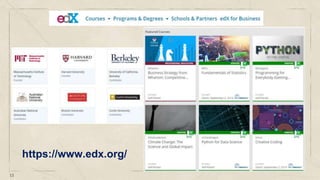
https://www.edx.org/
www.openculture.com/freeonlinecourses
17
https://alison.com
18
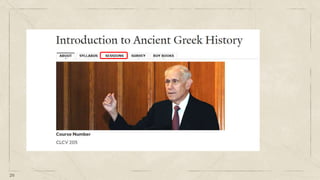
https://oyc.yale.edu/
19
20
21
22
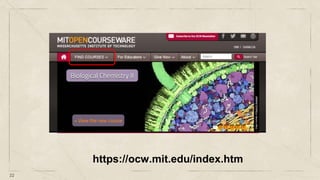
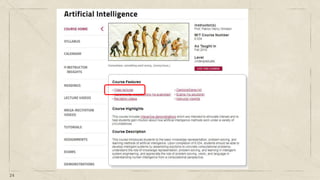
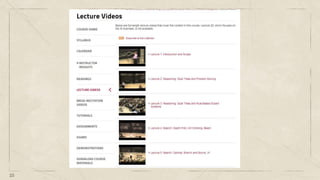
https://ocw.mit.edu/index.htm
23
24
25
26
27
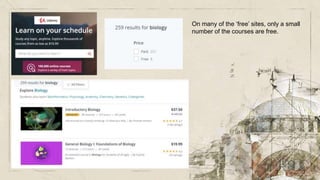
On many of the ‘free’ sites, only a small
number of the courses are free.
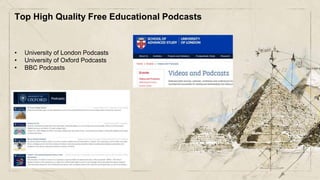
Top High Quality Free Educational Podcasts
• University of London Podcasts
• University of Oxford Podcasts
• BBC Podcasts
30
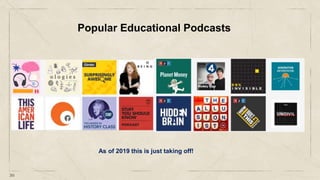
Popular Educational Podcasts
As of 2019 this is just taking off!
31
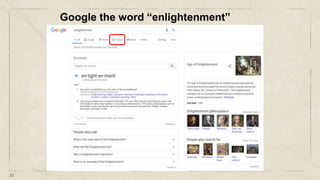
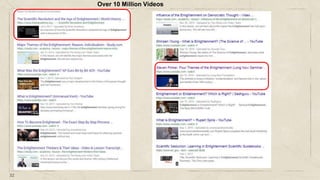
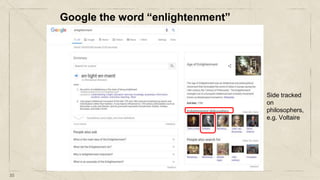
Google the word “enlightenment”
32
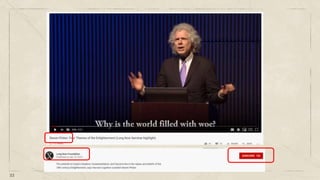
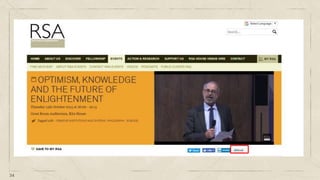
Over 10 Million Videos
33
34
35
Google the word “enlightenment”
Side tracked
on
philosophers,
e.g. Voltaire
36
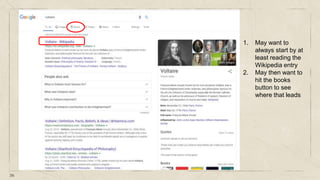
1. May want to
always start by at
least reading the
Wikipedia entry
2. May then want to
hit the books
button to see
where that leads
37
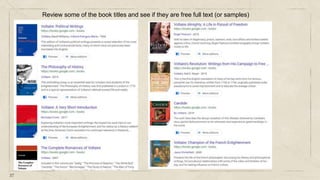
Review some of the book titles and see if they are free full text (or samples)
38
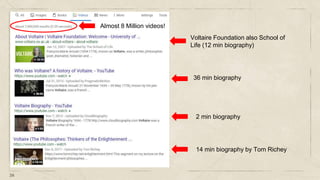
Almost 8 Million videos!
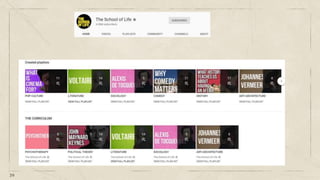
Voltaire Foundation also School of
Life (12 min biography)
36 min biography
2 min biography
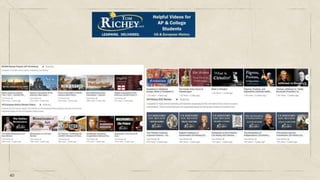
14 min biography by Tom Richey
39
40
Some of my Favorite YouTube Channels to Subscribe to
• 92nd Street Y
• Academy of Ideas
• Big Think
• Bozeman Science
• Cold Fusion
• Crash Course
• Intelligence Squared Debates or IQ2
• Kahn Academy
• MinutePhysics
• MIT OpenCourseWare
• PBS Space Time
• Stanford
• Talks at Google
• TED-Ed
• The Royal Institution
• The RSA
• The School of Life
Summary
Google any topic and click on video or books and when you find
something worth remembering email the link back to yourself
If you find an interesting YouTube channel hit ‘subscribe’ and you will
eventually have a nice library of free interesting, entertaining or
educational free videos.
Start searching through the new Podcasts that are coming out.
If you have the energy and stamina for it watch some of the full online
free university courses. You can download their apps to your phone
and watch them when convenient.
43
Cancer Information
Cancer and Science Videos
Radiation
Cancer Calculators
Other Topics
www.aboutcancer.com
Robert Miller MD

Using the internet to get smarter

  • 1.
    How to Usethe Internet to Get Smarter www.aboutcancer.com
  • 2.
    How to Usethe Internet to Get Dumber Followers of Notable People Found on Twitter (2019) Justin Bieber (106M) Donald Trump (64M) Kim Kardashian (61M) Britney Spears (56M)
  • 3.
    3 Are We GettingDumber? “When You’re Dead You Don’t Know You’re Dead. The Pain is only felt by others. Same thing when You’re Stupid!”
  • 4.
  • 5.
    How to Usethe Internet to Get Smarter …Why Bother? 1.Keep your brain healthier? 2.Make you happier? 3.Help you make better decisions. I’d rather go fishin’…
  • 6.
    6 Caveat Emptor! Consider thesource! • It won’t make you happier or healthier if you are exposed to damaging or destructive web sites • It won’t help you make smarter or better decisions if you get inaccurate information or misinterpret what you read
  • 7.
    7 Climate Feedback, climatechange. FactCheck.org non-partisan projects of the Annenberg Public Policy Center Fact Checker (The Washington Post) PolitiFact.com: A service of the Tampa Bay Times Snopes.com focuses on, but is not limited to, validating and debunking urban legends TruthOrFiction.com validates and debunks urban legends, RealClearPolitics' Fact Check Review aspires to offer quaternary-level critiquing You Should Have a Favorite Fact Checker Also try to identify the factual sites used by insiders (for cancer I recommend nccn.org and uptodate.com)
  • 8.
    Searching for EducationalInformation on the Web
  • 9.
    9 Before making alist of favorite or ‘best’ web sites 1. Is your goal to keep your brain sharper? Go for variety of more challenging sites (science, history, philosophy) of varying degrees of complexity and focus. 2. If your goal is to make yourself happier, then art, humor, culture, sports, nostalgia may make more sense and perhaps variety is more important than focus or intensity. 3. If your goal is to learn and keep current with more practical information then news, political, economic, medical, and other consumer sites may be best.
  • 10.
    Practical Tips orInternet Lifehack’s 1. Create a bookmark list of favorite websites 2. Subscribe to websites or create alerts 3. Go to google or google scholar and create alerts 4. Download apps from better educational and news sites 5. Google to search a topic and then look at videos then subscribe to their channels 6. Subscribe to the rapidly expanding lists of podcasts 7. Take advantage of MOOC’s 8. Find a useful site or video, email the link to yourself and create educational save files (anticipate memory issues)
  • 11.
    What is aMOOC? • A massive open online course (MOOC) is an online course aimed at unlimited participation and open access via the web • MOOCs are a recent and widely researched development in distance education first introduced in 2006 and emerged as a popular mode of learning in 2012 • The first MOOCs emerged from the open educational resources (OER) movement, which was sparked by MIT OpenCourseWare project. • Alongside the development of these open courses, other E- learning platforms emerged — such as Khan Academy, Udemy, and ALISON — which are viewed as similar to MOOCs and work outside the university system or emphasize individual self-paced lessons
  • 12.
    List of NotableMOOCs (Massive open online course) providers (2019)
  • 13.
    Top High Quality‘Free’ Educational Online Sites Everyone Should Know About • Coursera • Khan Academy • Open Culture • Udemy • Academic Earth • edX • Alison • iTunes U • Stanford Online • Harvard Extension • Open Yale Courses • UC Berkeley Class Central • MIT OpenCourseWare • Carnegie Mellon Open Learning Initiative • TED-Ed
  • 14.
  • 15.
  • 16.
  • 17.
  • 18.
  • 19.
  • 20.
  • 21.
  • 22.
  • 23.
  • 24.
  • 25.
  • 26.
  • 27.
  • 28.
    On many ofthe ‘free’ sites, only a small number of the courses are free.
  • 29.
    Top High QualityFree Educational Podcasts • University of London Podcasts • University of Oxford Podcasts • BBC Podcasts
  • 30.
    30 Popular Educational Podcasts Asof 2019 this is just taking off!
  • 31.
    31 Google the word“enlightenment”
  • 32.
  • 33.
  • 34.
  • 35.
    35 Google the word“enlightenment” Side tracked on philosophers, e.g. Voltaire
  • 36.
    36 1. May wantto always start by at least reading the Wikipedia entry 2. May then want to hit the books button to see where that leads
  • 37.
    37 Review some ofthe book titles and see if they are free full text (or samples)
  • 38.
    38 Almost 8 Millionvideos! Voltaire Foundation also School of Life (12 min biography) 36 min biography 2 min biography 14 min biography by Tom Richey
  • 39.
  • 40.
  • 41.
    Some of myFavorite YouTube Channels to Subscribe to • 92nd Street Y • Academy of Ideas • Big Think • Bozeman Science • Cold Fusion • Crash Course • Intelligence Squared Debates or IQ2 • Kahn Academy • MinutePhysics • MIT OpenCourseWare • PBS Space Time • Stanford • Talks at Google • TED-Ed • The Royal Institution • The RSA • The School of Life
  • 42.
    Summary Google any topicand click on video or books and when you find something worth remembering email the link back to yourself If you find an interesting YouTube channel hit ‘subscribe’ and you will eventually have a nice library of free interesting, entertaining or educational free videos. Start searching through the new Podcasts that are coming out. If you have the energy and stamina for it watch some of the full online free university courses. You can download their apps to your phone and watch them when convenient.
  • 43.
    43 Cancer Information Cancer andScience Videos Radiation Cancer Calculators Other Topics www.aboutcancer.com Robert Miller MD