Cancer Foundation Programme What is Cancer?
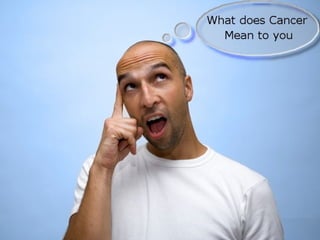
What does the word cancer mean to you?
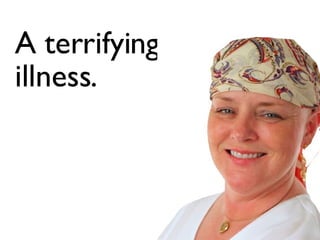
A terrifying illness.
 
 
Fear .
 
 
A brief history of Time!


There are two types of tumours:  Malignant tumours spread to other areas in the body.  Benign tumours stay in one place.


Malignant;  Having the property of invading surrounding tissues Neoplasm;  A new growth of tissue A malignant neoplasm


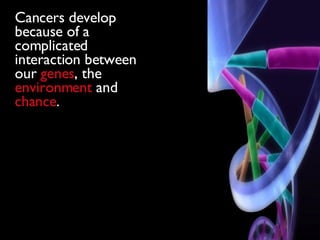
Cancers develop because of a complicated interaction between our  genes , the  environment  and  chance .
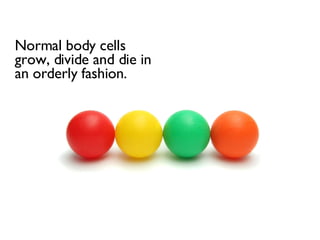
Normal body cells grow, divide and die in an orderly fashion.
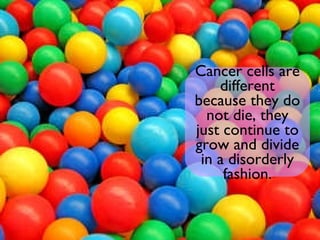
Cancer cells are different because they do not die, they just continue to grow and divide in a disorderly fashion.
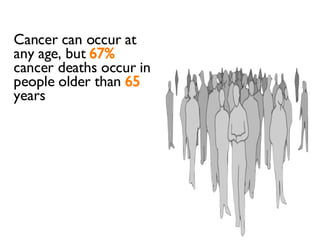
Cancer can occur at any age, but   67%  of  cancer deaths occur in people   older than   65   years
Cancer can affect people of all   nationalities   and  age groups
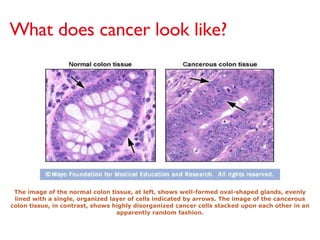
The image of the normal colon tissue, at left, shows well-formed oval-shaped glands, evenly lined with a single, organized layer of cells indicated by arrows. The image of the cancerous colon tissue, in contrast, shows highly disorganized cancer cells stacked upon each other in an apparently random fashion. What does cancer look like?
A brief history of Time!
 
Group Work
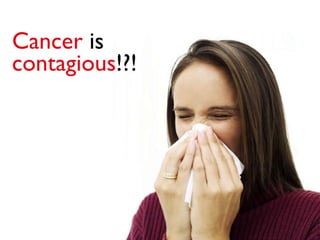
Cancer  is   contagious !?!
 
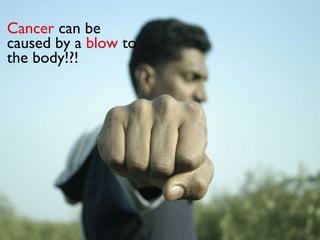
Cancer   can be caused by a   blow   to the body!?!
 
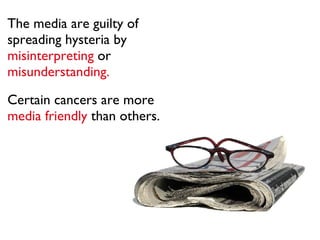
The media are guilty of spreading hysteria by  misinterpreting  or   misunderstanding.  statistics. Certain cancers are more   media friendly   than others.
The media need to distil detailed and complex research into headlines:- In January 2005 published a meta-analysis of Breast Screening The Media
Research Stated: - “  Concluded there is no evidence that screening for breast cancer Saves live” reported:- “ Mammography Screening is a waste of time.” The Media
In January 2006 published a meta-analysis of survival of patients with proven, late stage, lung cancer The Media
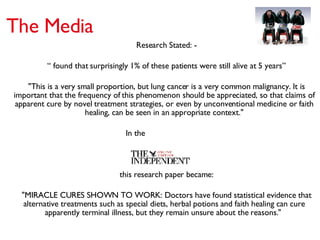
Research Stated: - “  found that surprisingly 1% of these patients were still alive at 5 years” "This is a very small proportion, but lung cancer is a very common malignancy. It is important that the frequency of this phenomenon should be appreciated, so that claims of apparent cure by novel treatment strategies, or even by unconventional medicine or faith healing, can be seen in an appropriate context." In the this research paper became:  "MIRACLE CURES SHOWN TO WORK: Doctors have found statistical evidence that alternative treatments such as special diets, herbal potions and faith healing can cure apparently terminal illness, but they remain unsure about the reasons."  The Media
 
Group Work
 
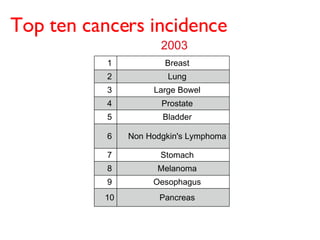
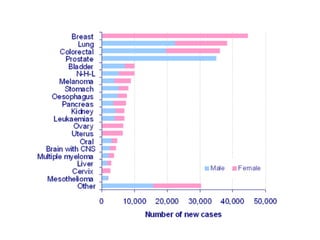
Source CRUK Website 2006 2003 Top ten cancers incidence 1 Breast 2 Lung 3 Large Bowel 4 Prostate 5 Bladder 6 Non Hodgkin's Lymphoma 7 Stomach 8 Melanoma 9 Oesophagus 10 Pancreas
 
Others
 
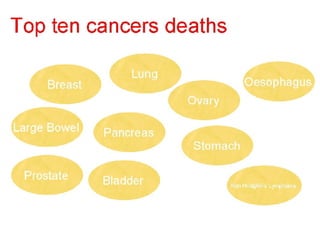
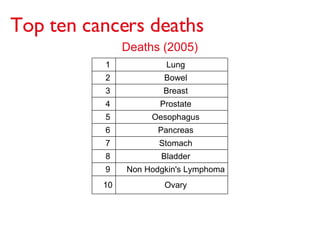
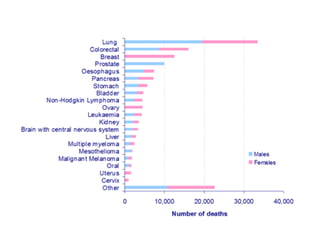
Deaths (2005) Source CRUK Website 2006 Top ten cancers deaths 1 Lung 2 Bowel 3 Breast 4 Prostate 5 Oesophagus 6 Pancreas 7 Stomach 8 Bladder 9 Non Hodgkin's Lymphoma 10 Ovary
 
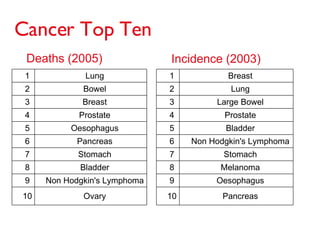
Deaths (2005) Incidence (2003) Source CRUK Website 2006 Cancer Top Ten 1 Lung 2 Bowel 3 Breast 4 Prostate 5 Oesophagus 6 Pancreas 7 Stomach 8 Bladder 9 Non Hodgkin's Lymphoma 10 Ovary 1 Breast 2 Lung 3 Large Bowel 4 Prostate 5 Bladder 6 Non Hodgkin's Lymphoma 7 Stomach 8 Melanoma 9 Oesophagus 10 Pancreas
 
Survival statistics for cancer are usually written as  “five year survival”   or  “10 year survival” .
What this means is that   X%   of patients were   still alive   at 5/10 years after   they were   diagnosed .
Often   disease free   survival   figures are used. This means everyone with that type of cancer who is   alive   and well   5 years   after diagnosis.
 
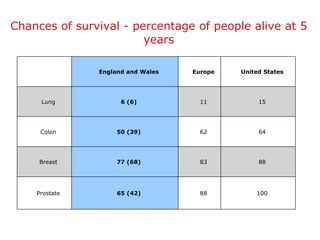
() = Pre-NHS Cancer Plan Chances of survival - percentage of people alive at 5 years England and Wales Europe United States Lung 6 (6) 11 15 Colon 50 (39) 62 64 Breast 77 (68) 83 88 Prostate 65 (42) 88 100
Is this True
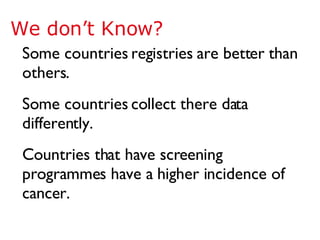
Some countries registries are better than others. Some countries collect there data differently. Countries that have screening programmes have a higher incidence of cancer. We don’t Know?
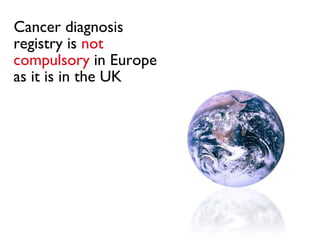
Cancer diagnosis registry is   not compulsory   in Europe as it is in the UK
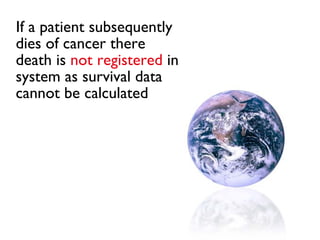
If a patient subsequently dies of cancer there death is   not registered   in system as survival data cannot be calculated
The registries can   miss cases   and survival estimates will be affected if  the  unregistered cases   have different prognoses to those registered.
The UK registries contribute more than half of the total data to EUROCARE and the data is highly representative of the UK population as a whole. Critics have argued that it is more appropriate to compare our data to the Scandinavian countries because registration systems are similar. But while Scandinavian countries do less well than many parts of Europe, UK survival is still worse.
 
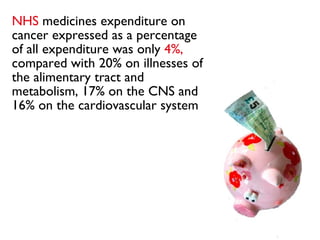
NHS   medicines expenditure on cancer expressed as a percentage of all expenditure was only   4%,   compared with 20% on illnesses of the alimentary tract and metabolism, 17% on the CNS and 16% on the cardiovascular system .
Compared to France, Germany and the USA, the UK has the   highest death rate per 100,000   of the population (236, 206, 194 and   275   respectively)
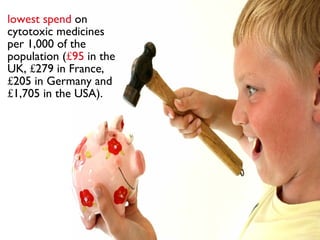
lowest spend   on cytotoxic medicines per 1,000 of the population   ( £ 95  in the UK,  £ 279 in France,  £ 205 in Germany and  £ 1,705 in the USA).
 
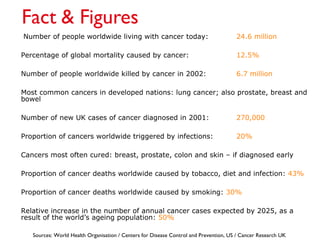
  Number of people worldwide living with cancer today:  24.6 million   Percentage of global mortality caused by cancer:  12.5% Number of people worldwide killed by cancer in 2002:  6.7 million   Most common cancers in developed nations: lung cancer; also prostate, breast and bowel Number of new UK cases of cancer diagnosed in 2001:  270,000 Proportion of cancers worldwide triggered by infections:  20% Cancers most often cured: breast, prostate, colon and skin – if diagnosed early  Proportion of cancer deaths worldwide caused by tobacco, diet and infection:   43% Proportion of cancer deaths worldwide caused by smoking:   30%  Relative increase in the number of annual cancer cases expected by 2025, as a result of the world’s ageing population:   50% Sources: World Health Organisation / Centers for Disease Control and Prevention, US / Cancer Research UK Fact & Figures
Perspective
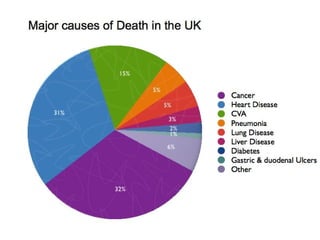
Major causes of Death in the UK
 

What Is Cancer

  • 1.
  • 2.
    What does theword cancer mean to you?
  • 3.
  • 4.
  • 5.
  • 6.
  • 7.
  • 8.
  • 9.
  • 10.
  • 11.
  • 12.
  • 13.
  • 14.
    There are twotypes of tumours: Malignant tumours spread to other areas in the body. Benign tumours stay in one place.
  • 15.
  • 16.
  • 17.
  • 18.
    Malignant; Havingthe property of invading surrounding tissues Neoplasm; A new growth of tissue A malignant neoplasm
  • 19.
  • 20.
  • 21.
  • 22.
    Cancers develop becauseof a complicated interaction between our genes , the environment and chance .
  • 23.
    Normal body cellsgrow, divide and die in an orderly fashion.
  • 24.
    Cancer cells aredifferent because they do not die, they just continue to grow and divide in a disorderly fashion.
  • 25.
    Cancer can occurat any age, but 67% of cancer deaths occur in people older than 65 years
  • 26.
    Cancer can affectpeople of all nationalities and age groups
  • 27.
    The image ofthe normal colon tissue, at left, shows well-formed oval-shaped glands, evenly lined with a single, organized layer of cells indicated by arrows. The image of the cancerous colon tissue, in contrast, shows highly disorganized cancer cells stacked upon each other in an apparently random fashion. What does cancer look like?
  • 28.
  • 29.
  • 30.
  • 31.
    Cancer is contagious !?!
  • 32.
  • 33.
    Cancer can be caused by a blow to the body!?!
  • 34.
  • 35.
    The media areguilty of spreading hysteria by misinterpreting or misunderstanding. statistics. Certain cancers are more media friendly than others.
  • 36.
    The media needto distil detailed and complex research into headlines:- In January 2005 published a meta-analysis of Breast Screening The Media
  • 37.
    Research Stated: -“ Concluded there is no evidence that screening for breast cancer Saves live” reported:- “ Mammography Screening is a waste of time.” The Media
  • 38.
    In January 2006published a meta-analysis of survival of patients with proven, late stage, lung cancer The Media
  • 39.
    Research Stated: -“ found that surprisingly 1% of these patients were still alive at 5 years” "This is a very small proportion, but lung cancer is a very common malignancy. It is important that the frequency of this phenomenon should be appreciated, so that claims of apparent cure by novel treatment strategies, or even by unconventional medicine or faith healing, can be seen in an appropriate context." In the this research paper became: "MIRACLE CURES SHOWN TO WORK: Doctors have found statistical evidence that alternative treatments such as special diets, herbal potions and faith healing can cure apparently terminal illness, but they remain unsure about the reasons." The Media
  • 40.
  • 41.
  • 42.
  • 43.
    Source CRUK Website2006 2003 Top ten cancers incidence 1 Breast 2 Lung 3 Large Bowel 4 Prostate 5 Bladder 6 Non Hodgkin's Lymphoma 7 Stomach 8 Melanoma 9 Oesophagus 10 Pancreas
  • 44.
  • 45.
  • 46.
  • 47.
    Deaths (2005) SourceCRUK Website 2006 Top ten cancers deaths 1 Lung 2 Bowel 3 Breast 4 Prostate 5 Oesophagus 6 Pancreas 7 Stomach 8 Bladder 9 Non Hodgkin's Lymphoma 10 Ovary
  • 48.
  • 49.
    Deaths (2005) Incidence(2003) Source CRUK Website 2006 Cancer Top Ten 1 Lung 2 Bowel 3 Breast 4 Prostate 5 Oesophagus 6 Pancreas 7 Stomach 8 Bladder 9 Non Hodgkin's Lymphoma 10 Ovary 1 Breast 2 Lung 3 Large Bowel 4 Prostate 5 Bladder 6 Non Hodgkin's Lymphoma 7 Stomach 8 Melanoma 9 Oesophagus 10 Pancreas
  • 50.
  • 51.
    Survival statistics forcancer are usually written as “five year survival” or “10 year survival” .
  • 52.
    What this meansis that X% of patients were still alive at 5/10 years after they were diagnosed .
  • 53.
    Often disease free survival figures are used. This means everyone with that type of cancer who is alive and well 5 years after diagnosis.
  • 54.
  • 55.
    () = Pre-NHSCancer Plan Chances of survival - percentage of people alive at 5 years England and Wales Europe United States Lung 6 (6) 11 15 Colon 50 (39) 62 64 Breast 77 (68) 83 88 Prostate 65 (42) 88 100
  • 56.
  • 57.
    Some countries registriesare better than others. Some countries collect there data differently. Countries that have screening programmes have a higher incidence of cancer. We don’t Know?
  • 58.
    Cancer diagnosis registryis not compulsory in Europe as it is in the UK
  • 59.
    If a patientsubsequently dies of cancer there death is not registered in system as survival data cannot be calculated
  • 60.
    The registries can miss cases and survival estimates will be affected if the unregistered cases have different prognoses to those registered.
  • 61.
    The UK registriescontribute more than half of the total data to EUROCARE and the data is highly representative of the UK population as a whole. Critics have argued that it is more appropriate to compare our data to the Scandinavian countries because registration systems are similar. But while Scandinavian countries do less well than many parts of Europe, UK survival is still worse.
  • 62.
  • 63.
    NHS medicines expenditure on cancer expressed as a percentage of all expenditure was only 4%, compared with 20% on illnesses of the alimentary tract and metabolism, 17% on the CNS and 16% on the cardiovascular system .
  • 64.
    Compared to France,Germany and the USA, the UK has the highest death rate per 100,000 of the population (236, 206, 194 and 275 respectively)
  • 65.
    lowest spend on cytotoxic medicines per 1,000 of the population ( £ 95 in the UK, £ 279 in France, £ 205 in Germany and £ 1,705 in the USA).
  • 66.
  • 67.
      Number ofpeople worldwide living with cancer today: 24.6 million Percentage of global mortality caused by cancer: 12.5% Number of people worldwide killed by cancer in 2002: 6.7 million Most common cancers in developed nations: lung cancer; also prostate, breast and bowel Number of new UK cases of cancer diagnosed in 2001: 270,000 Proportion of cancers worldwide triggered by infections: 20% Cancers most often cured: breast, prostate, colon and skin – if diagnosed early Proportion of cancer deaths worldwide caused by tobacco, diet and infection: 43% Proportion of cancer deaths worldwide caused by smoking: 30% Relative increase in the number of annual cancer cases expected by 2025, as a result of the world’s ageing population: 50% Sources: World Health Organisation / Centers for Disease Control and Prevention, US / Cancer Research UK Fact & Figures
  • 68.
  • 69.
    Major causes ofDeath in the UK
  • 70.

Editor's Notes

  • #2 Need to update each year using CRUK website