Prostate Cancer Screening…. Why
so controversial?
1. Prostate Cancer is very common but in most cases does
not affect survival
2. Screening with PSA greatly increased the number of cases
being diagnosed with very little survival benefit
3. Treatment options have significant side effects and
expense
Prostate Cancer, How serious Is it?
More People Die with it than of it (by 20 X)
• Cancer in Gland at autopsy (80) 59%
• Odds diagnoses with prostate cancer 11.6%
• Odds of dying of prostate cancer 2.45%
Prevalence of incidental prostate cancer: A systematic review of autopsy
studies. Int J Cancer. 2015 Oct;137(7):1749-5
5% at age<30 years to 59% by age>79 years.
Prostate Cancer Stats for 2018
Site New Cases Deaths
Prostate 164,690 (19%) 29,430 (9%)
Lung 121,680 (14%) 83,550 (26%
ColoRectal 75, 610 (9%) 27,390 (8%)
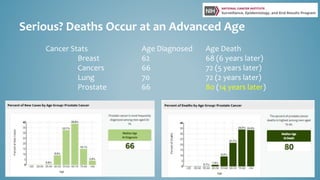
Serious? Deaths Occur at an Advanced Age
Cancer Stats Age Diagnosed Age Death
Breast 62 68 (6 years later)
Cancers 66 72 (5 years later)
Lung 70 72 (2 years later)
Prostate 66 80 (14 years later)
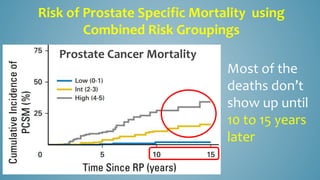
Risk of Prostate Specific Mortality using
Combined Risk Groupings
Most of the
deaths don’t
show up until
10 to 15 years
later
Prostate Cancer Mortality
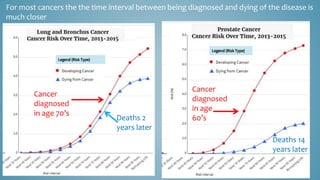
For most cancers the the time interval between being diagnosed and dying of the disease is
much closer
Cancer
diagnosed
in age 70’s
Cancer
diagnosed
in age
60’sDeaths 2
years later
Deaths 14
years later
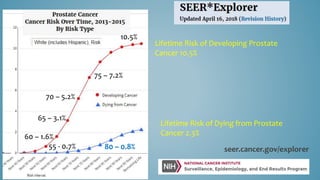
Lifetime Risk of Developing Prostate
Cancer 10.5%
Lifetime Risk of Dying from Prostate
Cancer 2.3%
seer.cancer.gov/explorer
75 – 7.2%
70 – 5.2%
10.5%
60 – 1.6%
80 – 0.8%
65 – 3.1%
55 - 0.7%
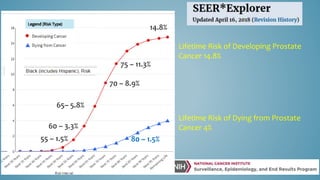
Lifetime Risk of Developing Prostate
Cancer 14.8%
Lifetime Risk of Dying from Prostate
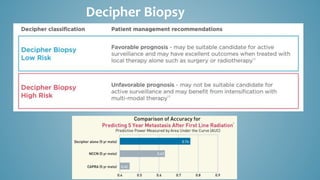
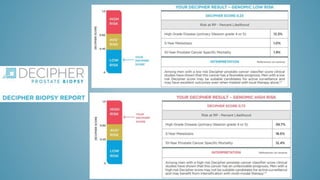
Cancer 4%
70 – 8.9%
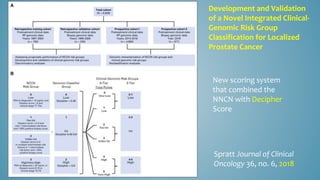
65– 5.8%
75 – 11.3%
14.8%
60 – 3.3%
80 – 1.5%55 – 1.5%
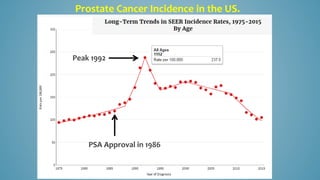
Prostate Cancer Incidence in the US.
PSA Approval in 1986
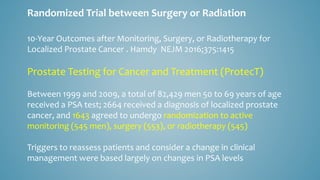
Peak 1992
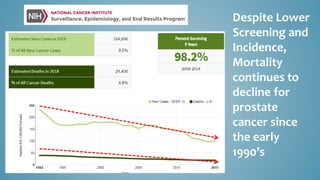
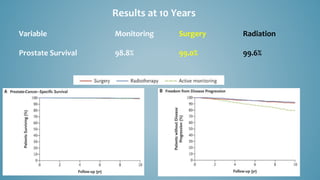
Despite Lower
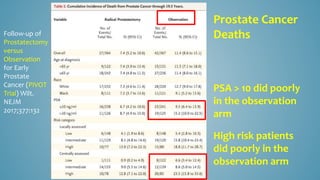
Screening and
Incidence,
Mortality
continues to
decline for
prostate
cancer since
the early
1990’s
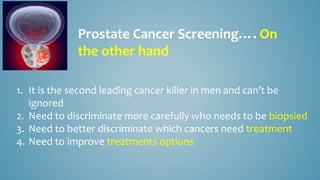
Prostate Cancer Screening…. On
the other hand
1. It is the second leading cancer killer in men and can’t be
ignored
2. Need to discriminate more carefully who needs to be biopsied
3. Need to better discriminate which cancers need treatment
4. Need to improve treatments options
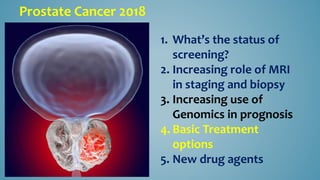
Prostate Cancer 2018
1. What’s the status of
screening?
2. Increasing role of MRI
in staging and biopsy
3. Increasing use of
Genomics in prognosis
4. Basic Treatment
options
5. New drug agents
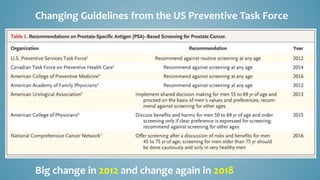
Changing Guidelines from the US Preventive Task Force
Big change in 2012 and change again in 2018
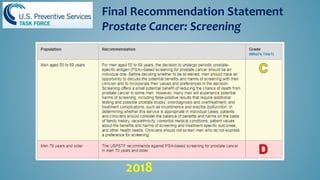
2018
Final Recommendation Statement
Prostate Cancer: Screening
2018
Age 55 – 69: Discuss it
70 or older: Don’t
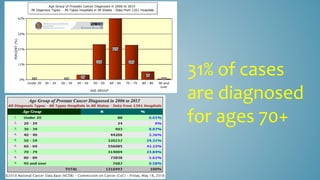
31% of cases
are diagnosed
for ages 70+
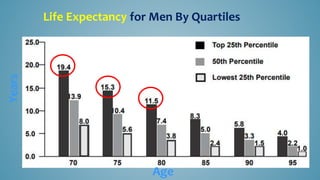
Life Expectancy for Men By QuartilesYears
Age
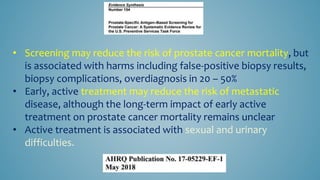
• Screening may reduce the risk of prostate cancer mortality, but
is associated with harms including false-positive biopsy results,
biopsy complications, overdiagnosis in 20 – 50%
• Early, active treatment may reduce the risk of metastatic
disease, although the long-term impact of early active
treatment on prostate cancer mortality remains unclear
• Active treatment is associated with sexual and urinary
difficulties.
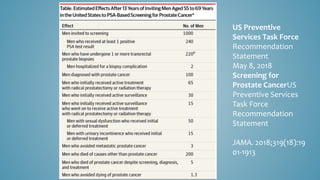
US Preventive
Services Task Force
Recommendation
Statement
May 8, 2018
Screening for
Prostate CancerUS
Preventive Services
Task Force
Recommendation
Statement
JAMA. 2018;319(18):19
01-1913
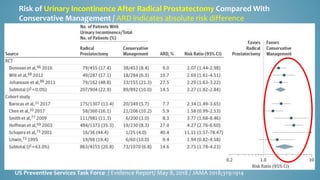
US Preventive Services Task Force / Evidence Report/ May 8, 2018 / JAMA 2018;319:1914
Risk of Urinary Incontinence After Radical Prostatectomy Compared With
Conservative Management / ARD indicates absolute risk difference
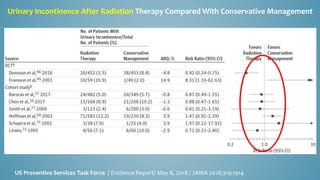
Urinary Incontinence After Radiation Therapy Compared With Conservative Management
US Preventive Services Task Force / Evidence Report/ May 8, 2018 / JAMA 2018;319:1914
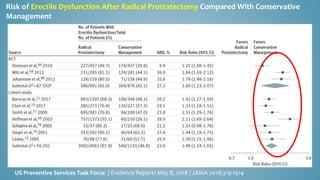
Risk of Erectile Dysfunction After Radical Prostatectomy Compared With Conservative
Management
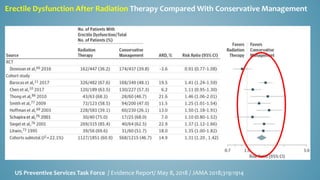
US Preventive Services Task Force / Evidence Report/ May 8, 2018 / JAMA 2018;319:1914
Erectile Dysfunction After Radiation Therapy Compared With Conservative Management
US Preventive Services Task Force / Evidence Report/ May 8, 2018 / JAMA 2018;319:1914
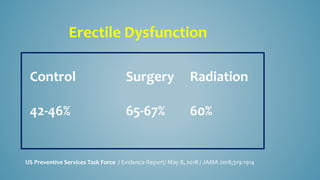
Erectile Dysfunction
Control Surgery Radiation
42-46% 65-67% 60%
US Preventive Services Task Force / Evidence Report/ May 8, 2018 / JAMA 2018;319:1914
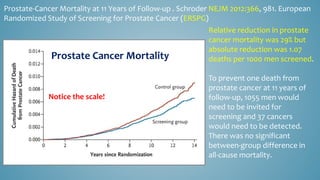
Prostate-Cancer Mortality at 11 Years of Follow-up . Schroder NEJM 2012:366, 981. European
Randomized Study of Screening for Prostate Cancer (ERSPG)
Relative reduction in prostate
cancer mortality was 29% but
absolute reduction was 1.07
deaths per 1000 men screened.
To prevent one death from
prostate cancer at 11 years of
follow-up, 1055 men would
need to be invited for
screening and 37 cancers
would need to be detected.
There was no significant
between-group difference in
all-cause mortality.
Notice the scale!
Prostate Cancer Mortality
• the estimate of approximately 1 prostate cancer death averted per 1000
men screened several times each and followed for 10 to 15 years seems a
reasonable summary of the evidence.
• review estimated that radical prostatectomy was associated with a 20-
percentage-point increase in the risk of urinary incontinence and a 30-
percentage-point increase in the risk of erectile dysfunction after 1 to 10
years
• Radiation treatment was estimated to increase the risk of erectile
dysfunction by 17 percentage points, as well as to increase the risk of
bowel dysfunction
Prostate Cancer Screening — A Perspective on the Current State of the
Evidence. Pinsky NEJM 2017;376:1285
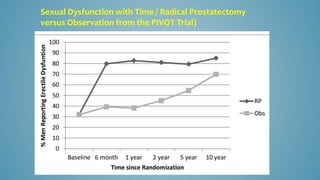
Sexual Dysfunction with Time / Radical Prostatectomy
versus Observation from the PIVOT Trial)
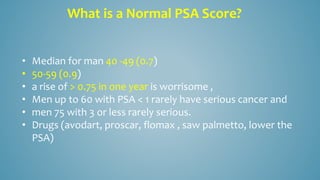
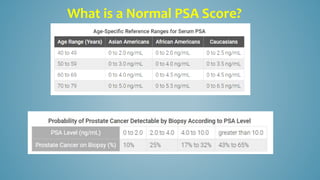
• Median for man 40 -49 (0.7)
• 50-59 (0.9)
• a rise of > 0.75 in one year is worrisome ,
• Men up to 60 with PSA < 1 rarely have serious cancer and
• men 75 with 3 or less rarely serious.
• Drugs (avodart, proscar, flomax , saw palmetto, lower the
PSA)
What is a Normal PSA Score?
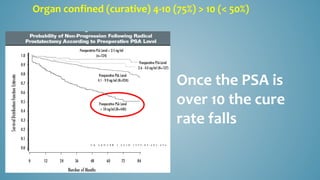
Organ confined (curative) 4-10 (75%) > 10 (< 50%)
Once the PSA is
over 10 the cure
rate falls
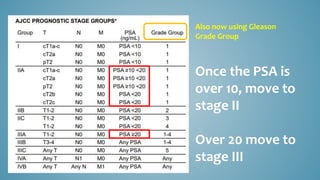
Once the PSA is
over 10, move to
stage II
Over 20 move to
stage III
Also now using Gleason
Grade Group
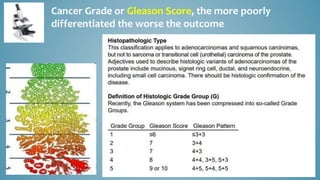
Cancer Grade or Gleason Score, the more poorly
differentiated the worse the outcome
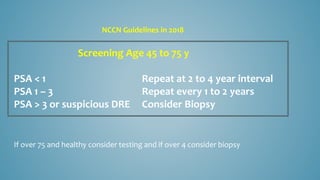
Screening Age 45 to 75 y
PSA < 1 Repeat at 2 to 4 year interval
PSA 1 – 3 Repeat every 1 to 2 years
PSA > 3 or suspicious DRE Consider Biopsy
If over 75 and healthy consider testing and if over 4 consider biopsy
NCCN Guidelines in 2018
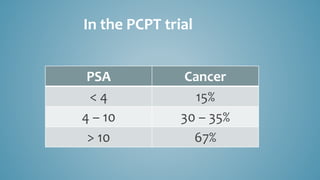
In the PCPT trial
PSA Cancer
< 4 15%
4 – 10 30 – 35%
> 10 67%
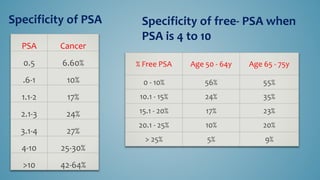
PSA Cancer
0.5 6.60%
.6-1 10%
1.1-2 17%
2.1-3 24%
3.1-4 27%
4-10 25-30%
>10 42-64%
% Free PSA Age 50 - 64y Age 65 - 75y
0 - 10% 56% 55%
10.1 - 15% 24% 35%
15.1 - 20% 17% 23%
20.1 - 25% 10% 20%
> 25% 5% 9%
Specificity of PSA Specificity of free- PSA when
PSA is 4 to 10
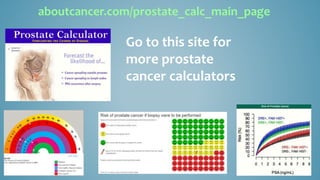
aboutcancer.com/prostate_calc_main_page
Go to this site for
more prostate
cancer calculators
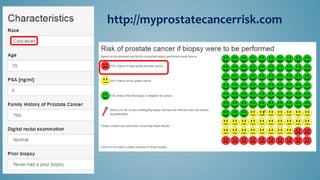
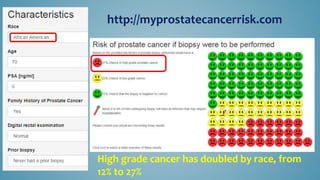
http://myprostatecancerrisk.com
High grade cancer has doubled by race, from
12% to 27%
http://myprostatecancerrisk.com
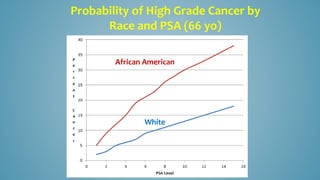
Probability of High Grade Cancer by
Race and PSA (66 yo)
African American
White
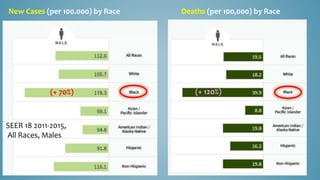
New Cases (per 100.000) by Race Deaths (per 100,000) by Race
(+ 120%)(+ 70%)
SEER 18 2011-2015,
All Races, Males
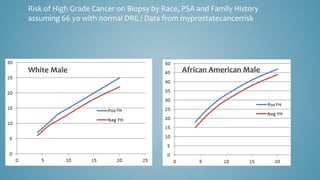
Risk of High Grade Cancer on Biopsy by Race, PSA and Family History
assuming 66 yo with normal DRE / Data from myprostatecancerrisk
White Male African American Male
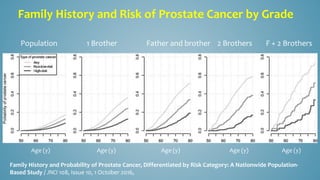
Population 1 Brother Father and brother 2 Brothers F + 2 Brothers
Age (y) Age (y) Age (y) Age (y) Age (y)
Family History and Risk of Prostate Cancer by Grade
Family History and Probability of Prostate Cancer, Differentiated by Risk Category: A Nationwide Population-
Based Study / JNCI 108, Issue 10, 1 October 2016,
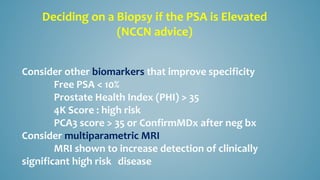
Deciding on a Biopsy if the PSA is Elevated
(NCCN advice)
Consider other biomarkers that improve specificity
Free PSA < 10%
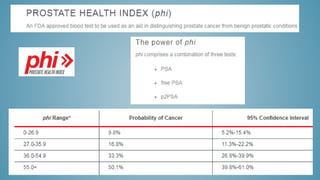
Prostate Health Index (PHI) > 35
4K Score : high risk
PCA3 score > 35 or ConfirmMDx after neg bx
Consider multiparametric MRI
MRI shown to increase detection of clinically
significant high risk disease
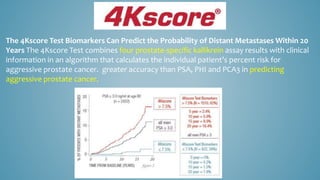
The 4Kscore Test Biomarkers Can Predict the Probability of Distant Metastases Within 20
Years The 4Kscore Test combines four prostate-specific kallikrein assay results with clinical
information in an algorithm that calculates the individual patient’s percent risk for
aggressive prostate cancer. greater accuracy than PSA, PHI and PCA3 in predicting
aggressive prostate cancer.
Prostate Cancer 2018
1. What’s the status of
screening?
2. Increasing role of MRI
in staging and biopsy
3. Increasing use of
Genomics in prognosis
4. Basic Treatment
options
5. New drug agents
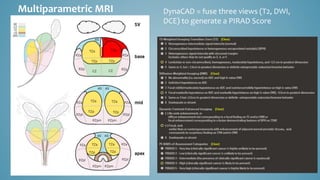
Multiparametric MRI DynaCAD = fuse three views (T2, DWI,
DCE) to generate a PIRAD Score
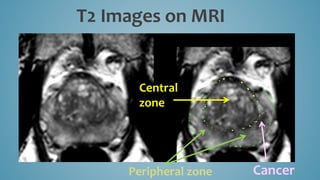
T2 Images on MRI
Central
zone
Peripheral zone Cancer
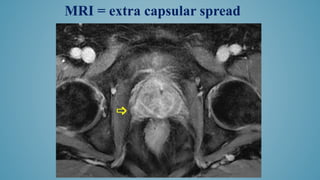
MRI = extra capsular spread
rectum
rectum
Pubic bone
peripheral
zone
cancer
nodule
Pubic bone
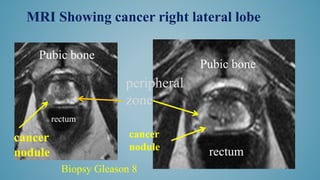
MRI Showing cancer right lateral lobe
Biopsy Gleason 8
cancer
nodule
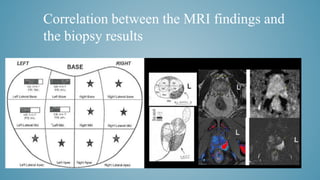
Correlation between the MRI findings and
the biopsy results
Prostate Cancer 2018
1. What’s the status of
screening?
2. Increasing role of MRI
in staging and biopsy
3. Increasing use of
Genomics in prognosis
4. Basic Treatment
options
5. New drug agents
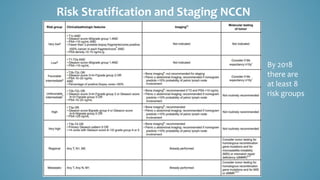
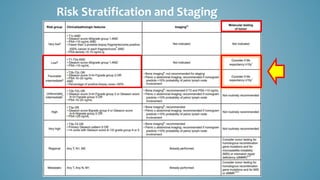
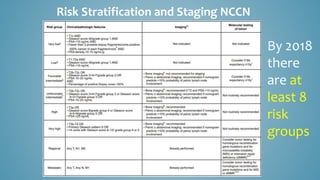
Risk Stratification and Staging NCCN
By 2018
there are
at least 8
risk groups
Risk Stratification and Staging
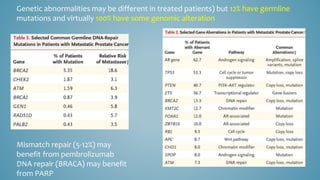
Genetic abnormalities may be different in treated patients) but 12% have germline
mutations and virtually 100% have some genomic alteration
Mismatch repair (5-12%) may
benefit from pembrolizumab
DNA repair (BRACA) may benefit
from PARP
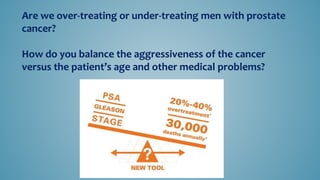
Are we over-treating or under-treating men with prostate
cancer?
How do you balance the aggressiveness of the cancer
versus the patient’s age and other medical problems?
In 2018 the NCCN Included Genomics in the
Decision Process
Genomic test evaluates the activity of genes in
the tumor that are shown to be involved in the
development and progression of prostate cancer.
Decipher Biopsy
Development and Validation
of a Novel Integrated Clinical-
Genomic Risk Group
Classification for Localized
Prostate Cancer
New scoring system
that combined the
NNCN with Decipher
Score
Spratt Journal of Clinical
Oncology 36, no. 6, 2018
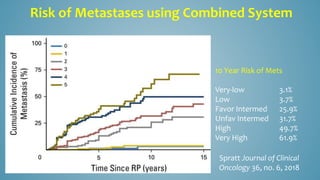
Risk of Metastases using Combined System
10 Year Risk of Mets
Very-low 3.1%
Low 3.7%
Favor Intermed 25.9%
Unfav Intermed 31.7%
High 49.7%
Very High 61.9%
Spratt Journal of Clinical
Oncology 36, no. 6, 2018
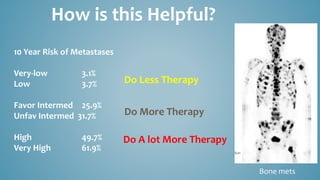
10 Year Risk of Metastases
Very-low 3.1%
Low 3.7%
Favor Intermed 25.9%
Unfav Intermed 31.7%
High 49.7%
Very High 61.9%
How is this Helpful?
Do Less Therapy
Do More Therapy
Do A lot More Therapy
Bone mets
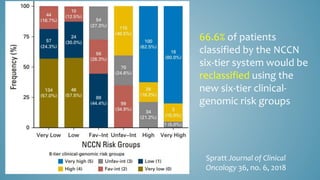
66.6% of patients
classified by the NCCN
six-tier system would be
reclassified using the
new six-tier clinical-
genomic risk groups
Spratt Journal of Clinical
Oncology 36, no. 6, 2018
After Genomics
44% Low Risk (? Over treating)
28% Favorable Intermediate
27% Unfavorable Intermediate
(? Undertreating)
Favorable Intermediate / Based on NCCN
Prostate Cancer 2018
1. What’s the status of
screening?
2. Increasing role of MRI
in staging and biopsy
3. Increasing use of
Genomics in prognosis
4. Basic Treatment
options
5. New drug agents
If you decide to Treat, which is
better, surgery or radiation?
What we need is a randomized trial
comparison.
10-Year Outcomes after Monitoring, Surgery, or Radiotherapy for
Localized Prostate Cancer . Hamdy NEJM 2016;375:1415
Prostate Testing for Cancer and Treatment (ProtecT)
Between 1999 and 2009, a total of 82,429 men 50 to 69 years of age
received a PSA test; 2664 received a diagnosis of localized prostate
cancer, and 1643 agreed to undergo randomization to active
monitoring (545 men), surgery (553), or radiotherapy (545)
Triggers to reassess patients and consider a change in clinical
management were based largely on changes in PSA levels
Randomized Trial between Surgery or Radiation
Results at 10 Years
Variable Monitoring Surgery Radiation
Prostate Survival 98.8% 99.0% 99.6%
High risk patients
did poorly in the
observation arm
PSA > 10 did poorly
in the observation
arm
Prostate Cancer
DeathsFollow-up of
Prostatectomy
versus
Observation
for Early
Prostate
Cancer (PIVOT
Trial) Wilt.
NEJM
2017;377:132
Risk Stratification and Staging NCCN
By 2018
there
are at
least 8
risk
groups
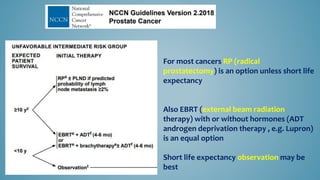
For most cancers RP (radical
prostatectomy) is an option unless short life
expectancy
Also EBRT (external beam radiation
therapy) with or without hormones (ADT
androgen deprivation therapy , e.g. Lupron)
is an equal option
Short life expectancy observation may be
best
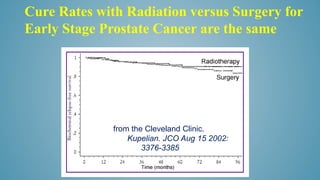
Cure Rates with Radiation versus Surgery for
Early Stage Prostate Cancer are the same
from the Cleveland Clinic.
Kupelian. JCO Aug 15 2002:
3376-3385
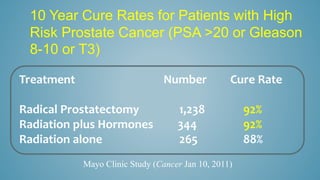
10 Year Cure Rates for Patients with High
Risk Prostate Cancer (PSA >20 or Gleason
8-10 or T3)
Treatment Number Cure Rate
Radical Prostatectomy 1,238 92%
Radiation plus Hormones 344 92%
Radiation alone 265 88%
Mayo Clinic Study (Cancer Jan 10, 2011)
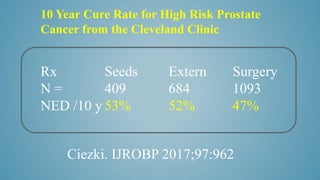
10 Year Cure Rate for High Risk Prostate
Cancer from the Cleveland Clinic
Rx Seeds Extern Surgery
N = 409 684 1093
NED /10 y 53% 52% 47%
Ciezki. IJROBP 2017;97:962
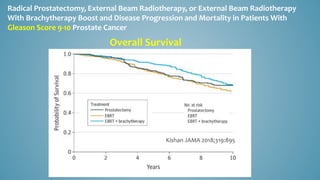
Radical Prostatectomy, External Beam Radiotherapy, or External Beam Radiotherapy
With Brachytherapy Boost and Disease Progression and Mortality in Patients With
Gleason Score 9-10 Prostate Cancer
Kishan JAMA 2018;319:895
Overall Survival
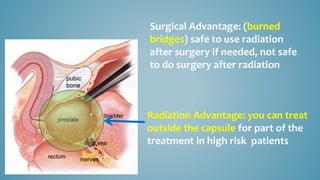
Radiation Advantage: you can treat
outside the capsule for part of the
treatment in high risk patients
Surgical Advantage: (burned
bridges) safe to use radiation
after surgery if needed, not safe
to do surgery after radiation
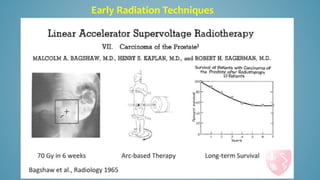
Early Radiation Techniques
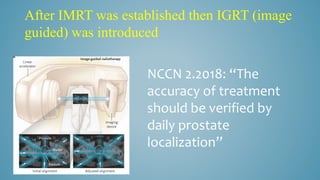
After IMRT was established then IGRT (image
guided) was introduced
NCCN 2.2018: “The
accuracy of treatment
should be verified by
daily prostate
localization”
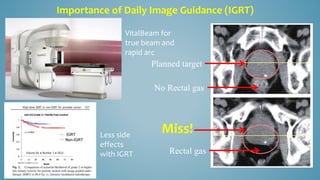
VitalBeam for
true beam and
rapid arc
Planned target
No Rectal gas
Rectal gas
Less side
effects
with IGRT
Miss!
Importance of Daily Image Guidance (IGRT)
Prostate Cancer 2018
1. What’s the status of
screening?
2. Increasing role of MRI
in staging and biopsy
3. Increasing use of
Genomics in prognosis
4. Basic Treatment
options
5. New drug agents
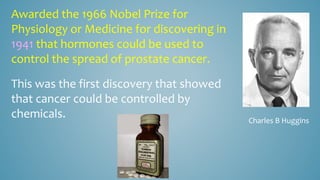
Charles B Huggins
Awarded the 1966 Nobel Prize for
Physiology or Medicine for discovering in
1941 that hormones could be used to
control the spread of prostate cancer.
This was the first discovery that showed
that cancer could be controlled by
chemicals.
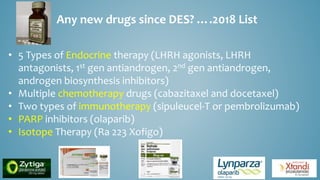
• 5 Types of Endocrine therapy (LHRH agonists, LHRH
antagonists, 1st gen antiandrogen, 2nd gen antiandrogen,
androgen biosynthesis inhibitors)
• Multiple chemotherapy drugs (cabazitaxel and docetaxel)
• Two types of immunotherapy (sipuleucel-T or pembrolizumab)
• PARP inhibitors (olaparib)
• Isotope Therapy (Ra 223 Xofigo)
Any new drugs since DES? ….2018 List
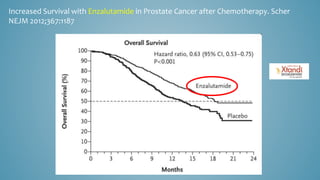
Increased Survival with Enzalutamide in Prostate Cancer after Chemotherapy. Scher
NEJM 2012;367:1187
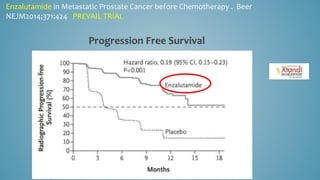
Enzalutamide in Metastatic Prostate Cancer before Chemotherapy . Beer
NEJM2014;371:424 PREVAIL TRIAL
Progression Free Survival
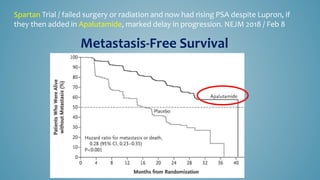
Spartan Trial / failed surgery or radiation and now had rising PSA despite Lupron, if
they then added in Apalutamide, marked delay in progression. NEJM 2018 / Feb 8
Metastasis-Free Survival
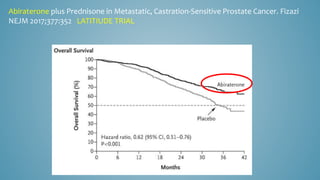
Abiraterone plus Prednisone in Metastatic, Castration-Sensitive Prostate Cancer. Fizazi
NEJM 2017;377:352 LATITIUDE TRIAL
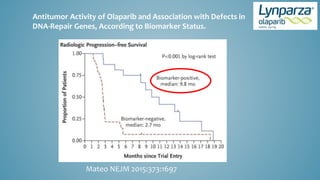
Antitumor Activity of Olaparib and Association with Defects in
DNA-Repair Genes, According to Biomarker Status.
Mateo NEJM 2015:373:1697
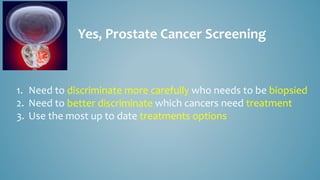
Yes, Prostate Cancer Screening
1. Need to discriminate more carefully who needs to be biopsied
2. Need to better discriminate which cancers need treatment
3. Use the most up to date treatments options
For more information go to aboutcancer.com
or the video site at:
aboutcancer.com/you_tube_videos.htm
or the YouTube site at:
youtube.com/user/robertmillermd/videos

Screening for prostate cancer 2018

  • 1.
    Prostate Cancer Screening….Why so controversial? 1. Prostate Cancer is very common but in most cases does not affect survival 2. Screening with PSA greatly increased the number of cases being diagnosed with very little survival benefit 3. Treatment options have significant side effects and expense
  • 2.
    Prostate Cancer, Howserious Is it? More People Die with it than of it (by 20 X) • Cancer in Gland at autopsy (80) 59% • Odds diagnoses with prostate cancer 11.6% • Odds of dying of prostate cancer 2.45% Prevalence of incidental prostate cancer: A systematic review of autopsy studies. Int J Cancer. 2015 Oct;137(7):1749-5 5% at age<30 years to 59% by age>79 years.
  • 3.
    Prostate Cancer Statsfor 2018 Site New Cases Deaths Prostate 164,690 (19%) 29,430 (9%) Lung 121,680 (14%) 83,550 (26% ColoRectal 75, 610 (9%) 27,390 (8%)
  • 4.
    Serious? Deaths Occurat an Advanced Age Cancer Stats Age Diagnosed Age Death Breast 62 68 (6 years later) Cancers 66 72 (5 years later) Lung 70 72 (2 years later) Prostate 66 80 (14 years later)
  • 5.
    Risk of ProstateSpecific Mortality using Combined Risk Groupings Most of the deaths don’t show up until 10 to 15 years later Prostate Cancer Mortality
  • 6.
    For most cancersthe the time interval between being diagnosed and dying of the disease is much closer Cancer diagnosed in age 70’s Cancer diagnosed in age 60’sDeaths 2 years later Deaths 14 years later
  • 7.
    Lifetime Risk ofDeveloping Prostate Cancer 10.5% Lifetime Risk of Dying from Prostate Cancer 2.3% seer.cancer.gov/explorer 75 – 7.2% 70 – 5.2% 10.5% 60 – 1.6% 80 – 0.8% 65 – 3.1% 55 - 0.7%
  • 8.
    Lifetime Risk ofDeveloping Prostate Cancer 14.8% Lifetime Risk of Dying from Prostate Cancer 4% 70 – 8.9% 65– 5.8% 75 – 11.3% 14.8% 60 – 3.3% 80 – 1.5%55 – 1.5%
  • 9.
    Prostate Cancer Incidencein the US. PSA Approval in 1986 Peak 1992
  • 10.
    Despite Lower Screening and Incidence, Mortality continuesto decline for prostate cancer since the early 1990’s
  • 11.
    Prostate Cancer Screening….On the other hand 1. It is the second leading cancer killer in men and can’t be ignored 2. Need to discriminate more carefully who needs to be biopsied 3. Need to better discriminate which cancers need treatment 4. Need to improve treatments options
  • 12.
    Prostate Cancer 2018 1.What’s the status of screening? 2. Increasing role of MRI in staging and biopsy 3. Increasing use of Genomics in prognosis 4. Basic Treatment options 5. New drug agents
  • 13.
    Changing Guidelines fromthe US Preventive Task Force Big change in 2012 and change again in 2018
  • 15.
  • 16.
  • 17.
    Age 55 –69: Discuss it 70 or older: Don’t
  • 18.
    31% of cases arediagnosed for ages 70+
  • 19.
    Life Expectancy forMen By QuartilesYears Age
  • 20.
    • Screening mayreduce the risk of prostate cancer mortality, but is associated with harms including false-positive biopsy results, biopsy complications, overdiagnosis in 20 – 50% • Early, active treatment may reduce the risk of metastatic disease, although the long-term impact of early active treatment on prostate cancer mortality remains unclear • Active treatment is associated with sexual and urinary difficulties.
  • 21.
    US Preventive Services TaskForce Recommendation Statement May 8, 2018 Screening for Prostate CancerUS Preventive Services Task Force Recommendation Statement JAMA. 2018;319(18):19 01-1913
  • 22.
    US Preventive ServicesTask Force / Evidence Report/ May 8, 2018 / JAMA 2018;319:1914 Risk of Urinary Incontinence After Radical Prostatectomy Compared With Conservative Management / ARD indicates absolute risk difference
  • 23.
    Urinary Incontinence AfterRadiation Therapy Compared With Conservative Management US Preventive Services Task Force / Evidence Report/ May 8, 2018 / JAMA 2018;319:1914
  • 24.
    Risk of ErectileDysfunction After Radical Prostatectomy Compared With Conservative Management US Preventive Services Task Force / Evidence Report/ May 8, 2018 / JAMA 2018;319:1914
  • 25.
    Erectile Dysfunction AfterRadiation Therapy Compared With Conservative Management US Preventive Services Task Force / Evidence Report/ May 8, 2018 / JAMA 2018;319:1914
  • 26.
    Erectile Dysfunction Control SurgeryRadiation 42-46% 65-67% 60% US Preventive Services Task Force / Evidence Report/ May 8, 2018 / JAMA 2018;319:1914
  • 27.
    Prostate-Cancer Mortality at11 Years of Follow-up . Schroder NEJM 2012:366, 981. European Randomized Study of Screening for Prostate Cancer (ERSPG) Relative reduction in prostate cancer mortality was 29% but absolute reduction was 1.07 deaths per 1000 men screened. To prevent one death from prostate cancer at 11 years of follow-up, 1055 men would need to be invited for screening and 37 cancers would need to be detected. There was no significant between-group difference in all-cause mortality. Notice the scale! Prostate Cancer Mortality
  • 28.
    • the estimateof approximately 1 prostate cancer death averted per 1000 men screened several times each and followed for 10 to 15 years seems a reasonable summary of the evidence. • review estimated that radical prostatectomy was associated with a 20- percentage-point increase in the risk of urinary incontinence and a 30- percentage-point increase in the risk of erectile dysfunction after 1 to 10 years • Radiation treatment was estimated to increase the risk of erectile dysfunction by 17 percentage points, as well as to increase the risk of bowel dysfunction Prostate Cancer Screening — A Perspective on the Current State of the Evidence. Pinsky NEJM 2017;376:1285
  • 29.
    Sexual Dysfunction withTime / Radical Prostatectomy versus Observation from the PIVOT Trial)
  • 30.
    • Median forman 40 -49 (0.7) • 50-59 (0.9) • a rise of > 0.75 in one year is worrisome , • Men up to 60 with PSA < 1 rarely have serious cancer and • men 75 with 3 or less rarely serious. • Drugs (avodart, proscar, flomax , saw palmetto, lower the PSA) What is a Normal PSA Score?
  • 31.
    What is aNormal PSA Score?
  • 32.
    Organ confined (curative)4-10 (75%) > 10 (< 50%) Once the PSA is over 10 the cure rate falls
  • 33.
    Once the PSAis over 10, move to stage II Over 20 move to stage III Also now using Gleason Grade Group
  • 34.
    Cancer Grade orGleason Score, the more poorly differentiated the worse the outcome
  • 36.
    Screening Age 45to 75 y PSA < 1 Repeat at 2 to 4 year interval PSA 1 – 3 Repeat every 1 to 2 years PSA > 3 or suspicious DRE Consider Biopsy If over 75 and healthy consider testing and if over 4 consider biopsy NCCN Guidelines in 2018
  • 37.
    In the PCPTtrial PSA Cancer < 4 15% 4 – 10 30 – 35% > 10 67%
  • 38.
    PSA Cancer 0.5 6.60% .6-110% 1.1-2 17% 2.1-3 24% 3.1-4 27% 4-10 25-30% >10 42-64% % Free PSA Age 50 - 64y Age 65 - 75y 0 - 10% 56% 55% 10.1 - 15% 24% 35% 15.1 - 20% 17% 23% 20.1 - 25% 10% 20% > 25% 5% 9% Specificity of PSA Specificity of free- PSA when PSA is 4 to 10
  • 39.
    aboutcancer.com/prostate_calc_main_page Go to thissite for more prostate cancer calculators
  • 40.
  • 41.
    High grade cancerhas doubled by race, from 12% to 27% http://myprostatecancerrisk.com
  • 42.
    Probability of HighGrade Cancer by Race and PSA (66 yo) African American White
  • 43.
    New Cases (per100.000) by Race Deaths (per 100,000) by Race (+ 120%)(+ 70%) SEER 18 2011-2015, All Races, Males
  • 44.
    Risk of HighGrade Cancer on Biopsy by Race, PSA and Family History assuming 66 yo with normal DRE / Data from myprostatecancerrisk White Male African American Male
  • 45.
    Population 1 BrotherFather and brother 2 Brothers F + 2 Brothers Age (y) Age (y) Age (y) Age (y) Age (y) Family History and Risk of Prostate Cancer by Grade Family History and Probability of Prostate Cancer, Differentiated by Risk Category: A Nationwide Population- Based Study / JNCI 108, Issue 10, 1 October 2016,
  • 46.
    Deciding on aBiopsy if the PSA is Elevated (NCCN advice) Consider other biomarkers that improve specificity Free PSA < 10% Prostate Health Index (PHI) > 35 4K Score : high risk PCA3 score > 35 or ConfirmMDx after neg bx Consider multiparametric MRI MRI shown to increase detection of clinically significant high risk disease
  • 48.
    The 4Kscore TestBiomarkers Can Predict the Probability of Distant Metastases Within 20 Years The 4Kscore Test combines four prostate-specific kallikrein assay results with clinical information in an algorithm that calculates the individual patient’s percent risk for aggressive prostate cancer. greater accuracy than PSA, PHI and PCA3 in predicting aggressive prostate cancer.
  • 49.
    Prostate Cancer 2018 1.What’s the status of screening? 2. Increasing role of MRI in staging and biopsy 3. Increasing use of Genomics in prognosis 4. Basic Treatment options 5. New drug agents
  • 50.
    Multiparametric MRI DynaCAD= fuse three views (T2, DWI, DCE) to generate a PIRAD Score
  • 51.
    T2 Images onMRI Central zone Peripheral zone Cancer
  • 52.
    MRI = extracapsular spread
  • 53.
    rectum rectum Pubic bone peripheral zone cancer nodule Pubic bone MRIShowing cancer right lateral lobe Biopsy Gleason 8 cancer nodule
  • 54.
    Correlation between theMRI findings and the biopsy results
  • 55.
    Prostate Cancer 2018 1.What’s the status of screening? 2. Increasing role of MRI in staging and biopsy 3. Increasing use of Genomics in prognosis 4. Basic Treatment options 5. New drug agents
  • 56.
    Risk Stratification andStaging NCCN By 2018 there are at least 8 risk groups
  • 57.
  • 58.
    Genetic abnormalities maybe different in treated patients) but 12% have germline mutations and virtually 100% have some genomic alteration Mismatch repair (5-12%) may benefit from pembrolizumab DNA repair (BRACA) may benefit from PARP
  • 59.
    Are we over-treatingor under-treating men with prostate cancer? How do you balance the aggressiveness of the cancer versus the patient’s age and other medical problems?
  • 60.
    In 2018 theNCCN Included Genomics in the Decision Process
  • 61.
    Genomic test evaluatesthe activity of genes in the tumor that are shown to be involved in the development and progression of prostate cancer.
  • 62.
  • 64.
    Development and Validation ofa Novel Integrated Clinical- Genomic Risk Group Classification for Localized Prostate Cancer New scoring system that combined the NNCN with Decipher Score Spratt Journal of Clinical Oncology 36, no. 6, 2018
  • 65.
    Risk of Metastasesusing Combined System 10 Year Risk of Mets Very-low 3.1% Low 3.7% Favor Intermed 25.9% Unfav Intermed 31.7% High 49.7% Very High 61.9% Spratt Journal of Clinical Oncology 36, no. 6, 2018
  • 66.
    10 Year Riskof Metastases Very-low 3.1% Low 3.7% Favor Intermed 25.9% Unfav Intermed 31.7% High 49.7% Very High 61.9% How is this Helpful? Do Less Therapy Do More Therapy Do A lot More Therapy Bone mets
  • 67.
    66.6% of patients classifiedby the NCCN six-tier system would be reclassified using the new six-tier clinical- genomic risk groups Spratt Journal of Clinical Oncology 36, no. 6, 2018
  • 68.
    After Genomics 44% LowRisk (? Over treating) 28% Favorable Intermediate 27% Unfavorable Intermediate (? Undertreating) Favorable Intermediate / Based on NCCN
  • 69.
    Prostate Cancer 2018 1.What’s the status of screening? 2. Increasing role of MRI in staging and biopsy 3. Increasing use of Genomics in prognosis 4. Basic Treatment options 5. New drug agents
  • 70.
    If you decideto Treat, which is better, surgery or radiation? What we need is a randomized trial comparison.
  • 71.
    10-Year Outcomes afterMonitoring, Surgery, or Radiotherapy for Localized Prostate Cancer . Hamdy NEJM 2016;375:1415 Prostate Testing for Cancer and Treatment (ProtecT) Between 1999 and 2009, a total of 82,429 men 50 to 69 years of age received a PSA test; 2664 received a diagnosis of localized prostate cancer, and 1643 agreed to undergo randomization to active monitoring (545 men), surgery (553), or radiotherapy (545) Triggers to reassess patients and consider a change in clinical management were based largely on changes in PSA levels Randomized Trial between Surgery or Radiation
  • 72.
    Results at 10Years Variable Monitoring Surgery Radiation Prostate Survival 98.8% 99.0% 99.6%
  • 73.
    High risk patients didpoorly in the observation arm PSA > 10 did poorly in the observation arm Prostate Cancer DeathsFollow-up of Prostatectomy versus Observation for Early Prostate Cancer (PIVOT Trial) Wilt. NEJM 2017;377:132
  • 74.
    Risk Stratification andStaging NCCN By 2018 there are at least 8 risk groups
  • 75.
    For most cancersRP (radical prostatectomy) is an option unless short life expectancy Also EBRT (external beam radiation therapy) with or without hormones (ADT androgen deprivation therapy , e.g. Lupron) is an equal option Short life expectancy observation may be best
  • 76.
    Cure Rates withRadiation versus Surgery for Early Stage Prostate Cancer are the same from the Cleveland Clinic. Kupelian. JCO Aug 15 2002: 3376-3385
  • 77.
    10 Year CureRates for Patients with High Risk Prostate Cancer (PSA >20 or Gleason 8-10 or T3) Treatment Number Cure Rate Radical Prostatectomy 1,238 92% Radiation plus Hormones 344 92% Radiation alone 265 88% Mayo Clinic Study (Cancer Jan 10, 2011)
  • 78.
    10 Year CureRate for High Risk Prostate Cancer from the Cleveland Clinic Rx Seeds Extern Surgery N = 409 684 1093 NED /10 y 53% 52% 47% Ciezki. IJROBP 2017;97:962
  • 79.
    Radical Prostatectomy, ExternalBeam Radiotherapy, or External Beam Radiotherapy With Brachytherapy Boost and Disease Progression and Mortality in Patients With Gleason Score 9-10 Prostate Cancer Kishan JAMA 2018;319:895 Overall Survival
  • 80.
    Radiation Advantage: youcan treat outside the capsule for part of the treatment in high risk patients Surgical Advantage: (burned bridges) safe to use radiation after surgery if needed, not safe to do surgery after radiation
  • 82.
  • 83.
    After IMRT wasestablished then IGRT (image guided) was introduced NCCN 2.2018: “The accuracy of treatment should be verified by daily prostate localization”
  • 84.
    VitalBeam for true beamand rapid arc Planned target No Rectal gas Rectal gas Less side effects with IGRT Miss! Importance of Daily Image Guidance (IGRT)
  • 85.
    Prostate Cancer 2018 1.What’s the status of screening? 2. Increasing role of MRI in staging and biopsy 3. Increasing use of Genomics in prognosis 4. Basic Treatment options 5. New drug agents
  • 86.
    Charles B Huggins Awardedthe 1966 Nobel Prize for Physiology or Medicine for discovering in 1941 that hormones could be used to control the spread of prostate cancer. This was the first discovery that showed that cancer could be controlled by chemicals.
  • 87.
    • 5 Typesof Endocrine therapy (LHRH agonists, LHRH antagonists, 1st gen antiandrogen, 2nd gen antiandrogen, androgen biosynthesis inhibitors) • Multiple chemotherapy drugs (cabazitaxel and docetaxel) • Two types of immunotherapy (sipuleucel-T or pembrolizumab) • PARP inhibitors (olaparib) • Isotope Therapy (Ra 223 Xofigo) Any new drugs since DES? ….2018 List
  • 88.
    Increased Survival withEnzalutamide in Prostate Cancer after Chemotherapy. Scher NEJM 2012;367:1187
  • 89.
    Enzalutamide in MetastaticProstate Cancer before Chemotherapy . Beer NEJM2014;371:424 PREVAIL TRIAL Progression Free Survival
  • 90.
    Spartan Trial /failed surgery or radiation and now had rising PSA despite Lupron, if they then added in Apalutamide, marked delay in progression. NEJM 2018 / Feb 8 Metastasis-Free Survival
  • 91.
    Abiraterone plus Prednisonein Metastatic, Castration-Sensitive Prostate Cancer. Fizazi NEJM 2017;377:352 LATITIUDE TRIAL
  • 92.
    Antitumor Activity ofOlaparib and Association with Defects in DNA-Repair Genes, According to Biomarker Status. Mateo NEJM 2015:373:1697
  • 93.
    Yes, Prostate CancerScreening 1. Need to discriminate more carefully who needs to be biopsied 2. Need to better discriminate which cancers need treatment 3. Use the most up to date treatments options
  • 94.
    For more informationgo to aboutcancer.com or the video site at: aboutcancer.com/you_tube_videos.htm or the YouTube site at: youtube.com/user/robertmillermd/videos