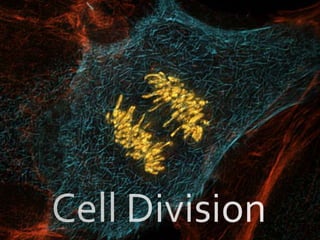
Cell Division
Cellular Reproduction Organism’s life begins as one cellRudolf Virchow (1858) stated: All cells come from cells Prokaryotes divide only to reproduceAsexual repro: 1 parent  2 daughtersAKA Binary fission (“dividing in half”)One set of DNA duplicates, cell divides
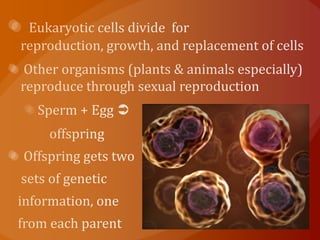
Eukaryotic cells divide  for reproduction, growth, and replacement of cells Other organisms (plants & animals especially) reproduce through sexual reproduction Sperm + Egg         offspring Offspring gets two     sets of genetic    information, one    from each parent
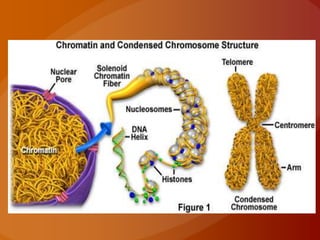
The ChromosomeDNA is contained in structures called chromosomes within the nucleus of the cell “chroma” color, “soma” body Most of the time, chromatin fills the nucleusTangled mass of fibers of DNA & protein  When a cell begins to divide, the chromatin condenses and coils into chromosomesEach chromosome has one long DNA molecule containing thousands of genes
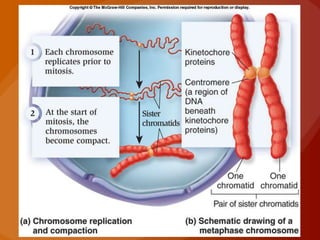
The ChromosomeBefore a cell divides, it must duplicate its chromosomes DNA replication! Once duplicated, the chromosomes have sister chromatids with identical genes, joined at a centromere When the cell divides, half goes to each daughter cell
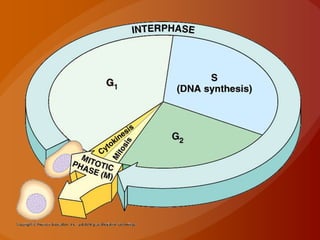
The Cell CycleSequence of events from the time a cell divides to when it forms two daughter cells Serves to double the cell’s parts, then splits Stages: Interphase  90%Mitotic phase 10%
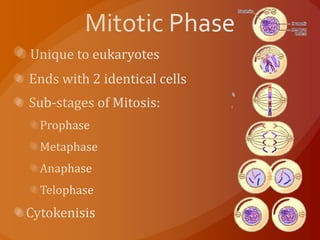
Mitotic PhaseUnique to eukaryotes Ends with 2 identical cells Sub-stages of Mitosis: ProphaseMetaphaseAnaphaseTelophaseCytokenisis
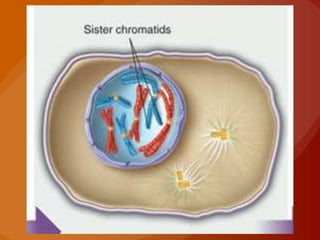
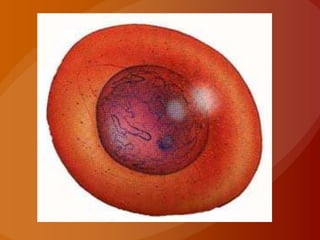
Prophase  Sister chromatids are attached at centromereCentrioles separate and extend spindle fibers Nucleolus disappears and nuclear envelope breaks downKinetochores form on each chromatid, spindle fibers attach
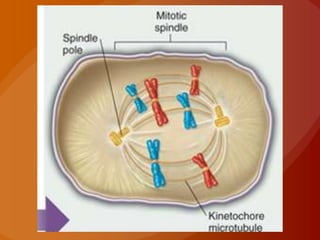
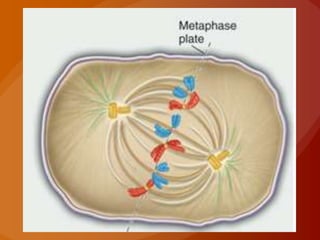
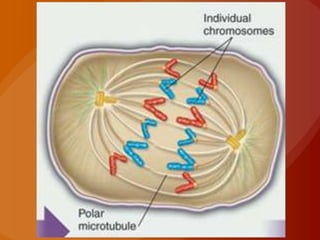
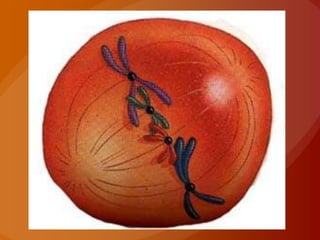
MetaphaseCentrosomes at poles Chromosomes lined up at metaphase plate (cell’s equator)Kinetochores of sister chromatids face opposite poles
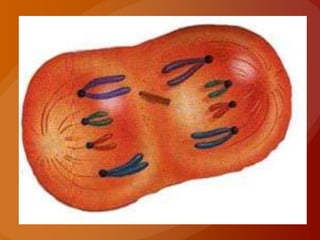
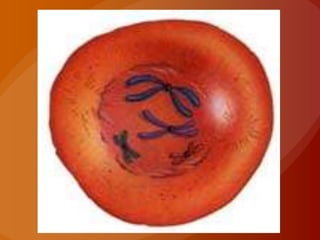
Anaphase  Spindle fibers pull sister chromatids apart forming daughter chromosomes Chromosomes move centromere first towards opposite poles Cell elongates
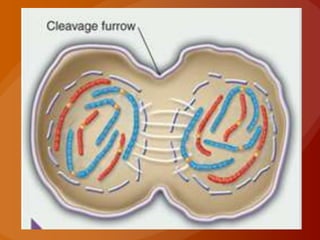
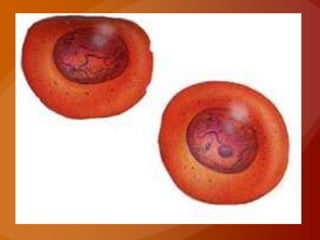
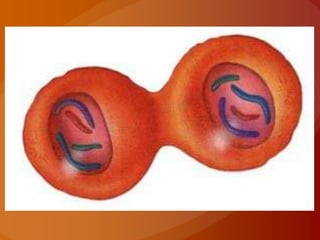
Telophase & Cytokenisis  Cell continues to elongate Daughter nuclei appear at poles Nuclear envelopes reform Spindle fibers disappearCytoplasms separate, new cell membranes form
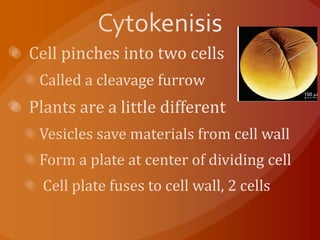
Cytokenisis  Cell pinches into two cells  Called a cleavage furrow  Plants are a little different Vesicles save materials from cell wall Form a plate at center of dividing cell  Cell plate fuses to cell wall, 2 cells
Factors that Affect Cell Division Most reasons are unknown “Growth Factors” Proteins need for division; if not present it stops  Cell-cycle control system  A system of proteins in the cell that trigger & coordinates major events in the cell cycle Make checkpoints
Factors that Affect Cell Division  Anchorage dependence  Cells must be in contact with a solid surface  Density-dependant inhibition  Division will slow as the population grows more dense
When It All Goes Wrong  Cell-cycle control system malfunctions  Cells divide excessively and in the wrong places; creates tumors  Benign: normal cells  Malignant: cancerous, invasive  Will divide indefinitely if not treated
When It All Goes Wrong  Types of Cancers Carcinoma  Skin, stomach lining Sarcoma  Supporting tissues, bones Leukemia & Lymphoma Blood producing tissues, bone marrow Treatments  Aim to stop the spread of cancerous cells by stopping division Chemotherapy (meds) and/or Radiation

Cell Division/Mitosis

  • 1.
  • 2.
    Cellular Reproduction Organism’slife begins as one cellRudolf Virchow (1858) stated: All cells come from cells Prokaryotes divide only to reproduceAsexual repro: 1 parent  2 daughtersAKA Binary fission (“dividing in half”)One set of DNA duplicates, cell divides
  • 3.
    Eukaryotic cells divide for reproduction, growth, and replacement of cells Other organisms (plants & animals especially) reproduce through sexual reproduction Sperm + Egg  offspring Offspring gets two sets of genetic information, one from each parent
  • 4.
    The ChromosomeDNA iscontained in structures called chromosomes within the nucleus of the cell “chroma” color, “soma” body Most of the time, chromatin fills the nucleusTangled mass of fibers of DNA & protein When a cell begins to divide, the chromatin condenses and coils into chromosomesEach chromosome has one long DNA molecule containing thousands of genes
  • 6.
    The ChromosomeBefore acell divides, it must duplicate its chromosomes DNA replication! Once duplicated, the chromosomes have sister chromatids with identical genes, joined at a centromere When the cell divides, half goes to each daughter cell
  • 8.
    The Cell CycleSequenceof events from the time a cell divides to when it forms two daughter cells Serves to double the cell’s parts, then splits Stages: Interphase 90%Mitotic phase 10%
  • 10.
    Mitotic PhaseUnique toeukaryotes Ends with 2 identical cells Sub-stages of Mitosis: ProphaseMetaphaseAnaphaseTelophaseCytokenisis
  • 11.
    Prophase Sisterchromatids are attached at centromereCentrioles separate and extend spindle fibers Nucleolus disappears and nuclear envelope breaks downKinetochores form on each chromatid, spindle fibers attach
  • 14.
    MetaphaseCentrosomes at polesChromosomes lined up at metaphase plate (cell’s equator)Kinetochores of sister chromatids face opposite poles
  • 16.
    Anaphase Spindlefibers pull sister chromatids apart forming daughter chromosomes Chromosomes move centromere first towards opposite poles Cell elongates
  • 18.
    Telophase & Cytokenisis Cell continues to elongate Daughter nuclei appear at poles Nuclear envelopes reform Spindle fibers disappearCytoplasms separate, new cell membranes form
  • 20.
    Cytokenisis Cellpinches into two cells Called a cleavage furrow Plants are a little different Vesicles save materials from cell wall Form a plate at center of dividing cell Cell plate fuses to cell wall, 2 cells
  • 27.
    Factors that AffectCell Division Most reasons are unknown “Growth Factors” Proteins need for division; if not present it stops Cell-cycle control system A system of proteins in the cell that trigger & coordinates major events in the cell cycle Make checkpoints
  • 28.
    Factors that AffectCell Division Anchorage dependence Cells must be in contact with a solid surface Density-dependant inhibition Division will slow as the population grows more dense
  • 29.
    When It AllGoes Wrong Cell-cycle control system malfunctions Cells divide excessively and in the wrong places; creates tumors Benign: normal cells Malignant: cancerous, invasive Will divide indefinitely if not treated
  • 30.
    When It AllGoes Wrong Types of Cancers Carcinoma Skin, stomach lining Sarcoma Supporting tissues, bones Leukemia & Lymphoma Blood producing tissues, bone marrow Treatments Aim to stop the spread of cancerous cells by stopping division Chemotherapy (meds) and/or Radiation

Editor's Notes

  • #10 G1 (G=gap): cell increases its supply of proteins and organelles and grows larger, begins after cell division; the chromosomes are singleS: DNA synthesis (replication) occurs, 1 chromosome becomes sister chromatids (In S, DNA replication results in duplicate chromosomes, one chromosome with two sister chromatids. Sister chromatids are held together by the centromere)G2: synthesis of proteins critical to cell division, leads into mitotic phase
  • #29 AD: keeps cells from replicating where they shouldn’t (tumor)DDI: if a space opens, they will fill it in (ex. Healing a cut)