Breast Cancer Staging 2018
www.aboutcancer.com www.aboutcancer.com
What tests do you need to stage
someone with breast cancer?
www.nccn.org
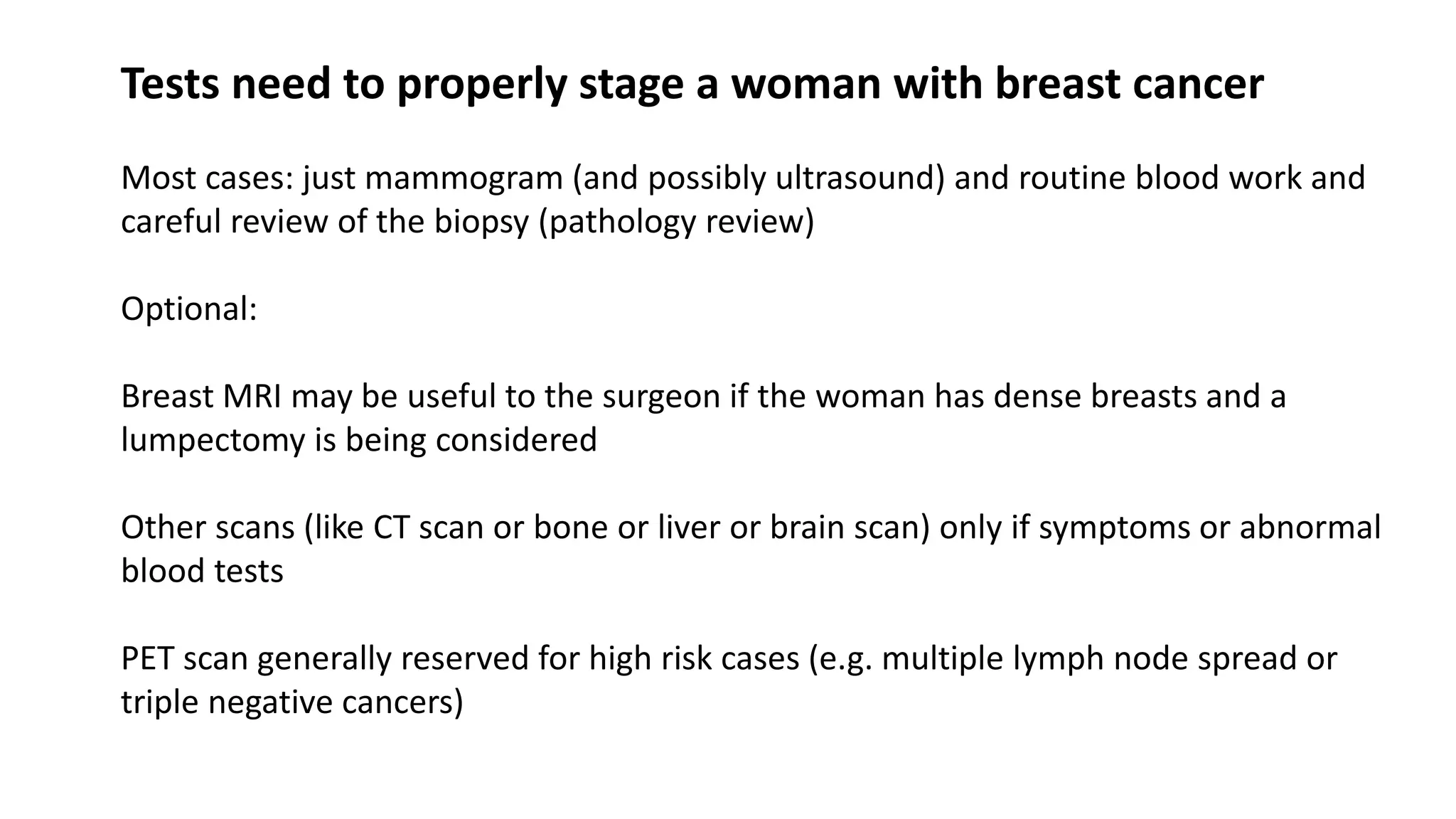
Tests need to properly stage a woman with breast cancer
Most cases: just mammogram (and possibly ultrasound) and routine blood work and
careful review of the biopsy (pathology review)
Optional:
Breast MRI may be useful to the surgeon if the woman has dense breasts and a
lumpectomy is being considered
Other scans (like CT scan or bone or liver or brain scan) only if symptoms or abnormal
blood tests
PET scan generally reserved for high risk cases (e.g. multiple lymph node spread or
triple negative cancers)
www.cap.org for CAP Cancer Protocols
Note that this is 32 pages long!
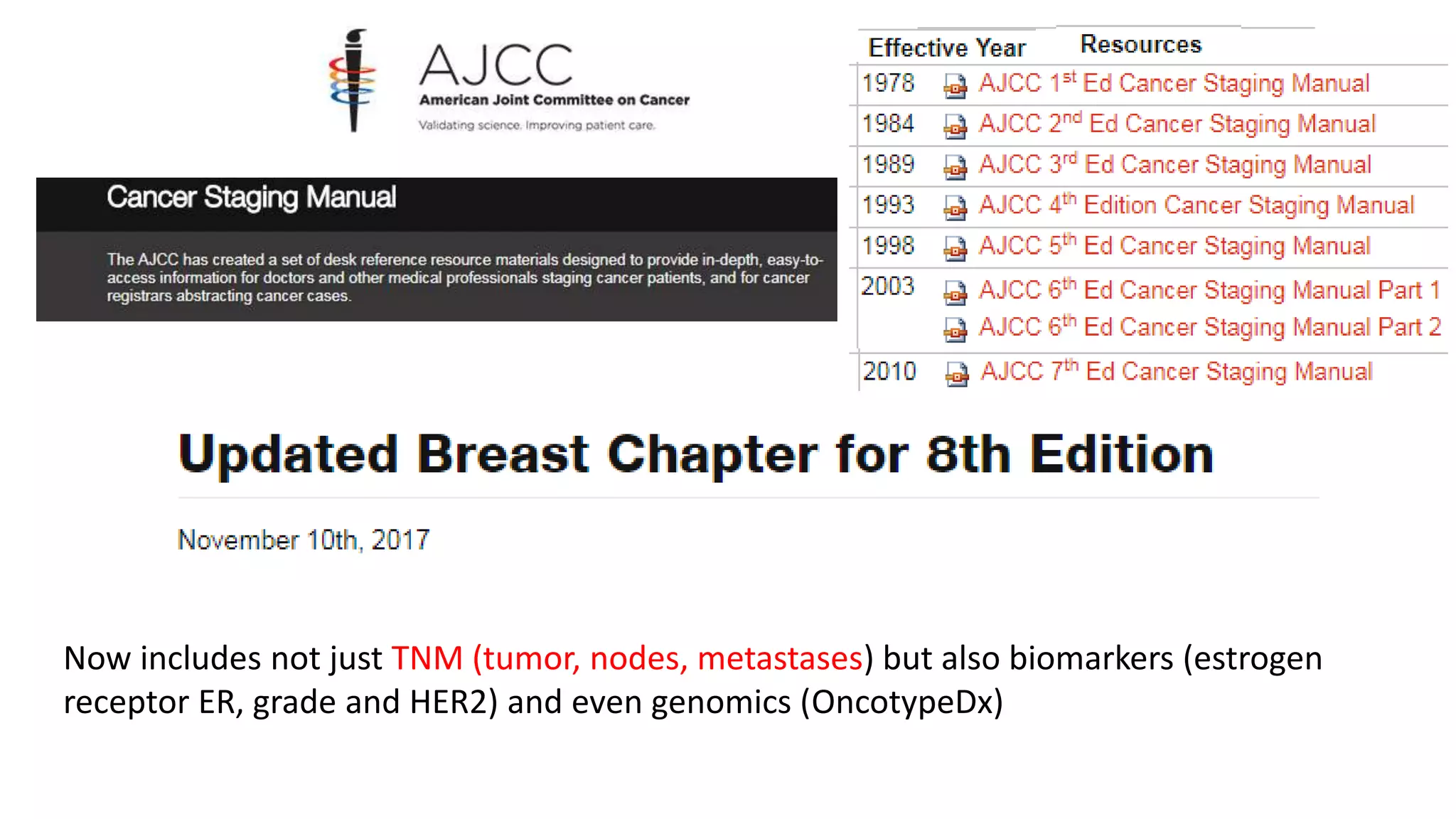
Now includes not just TNM (tumor, nodes, metastases) but also biomarkers (estrogen
receptor ER, grade and HER2) and even genomics (OncotypeDx)
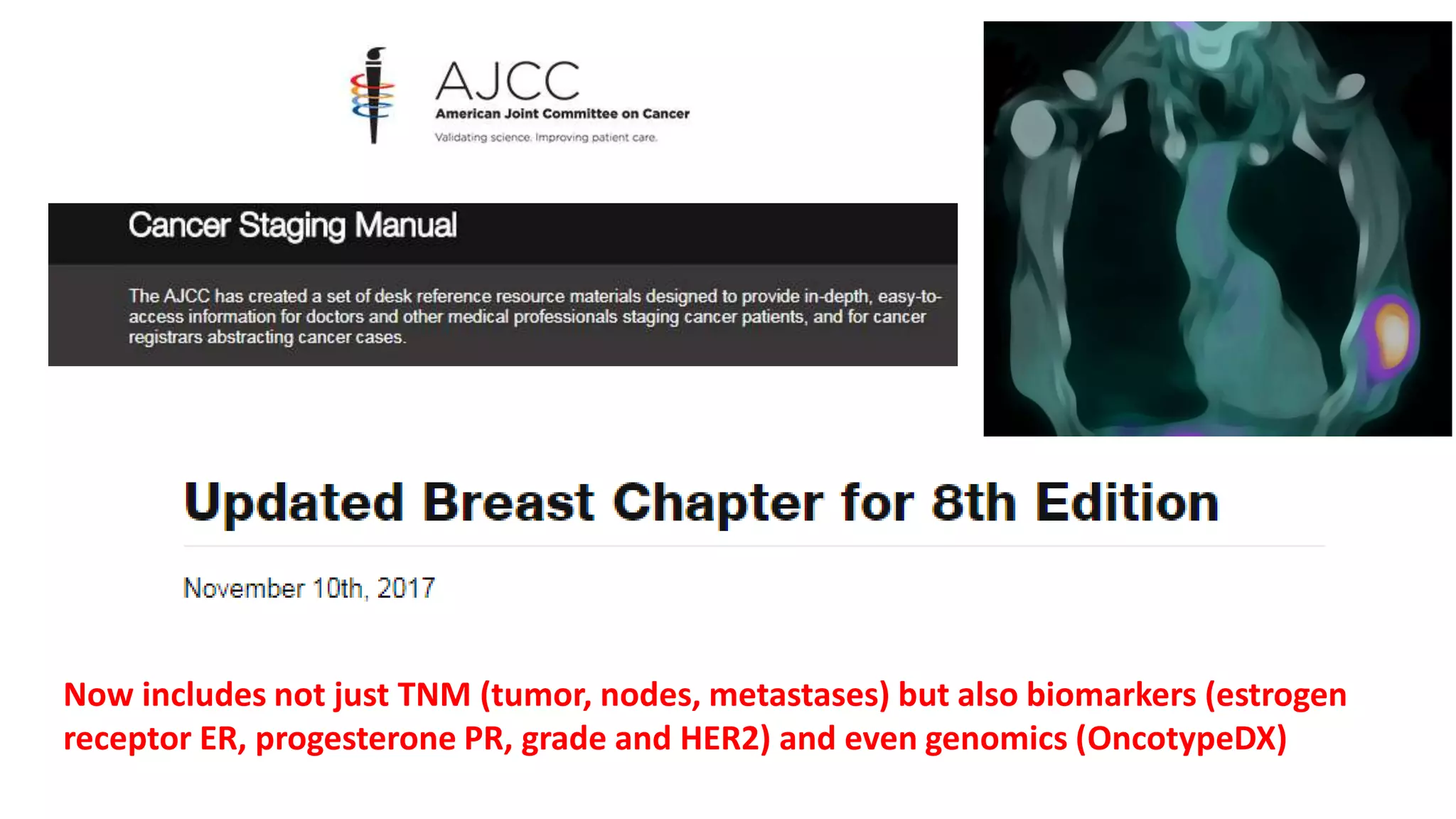
Now includes not just TNM (tumor, nodes, metastases) but also biomarkers (estrogen
receptor ER, progesterone PR, grade and HER2) and even genomics (OncotypeDX)
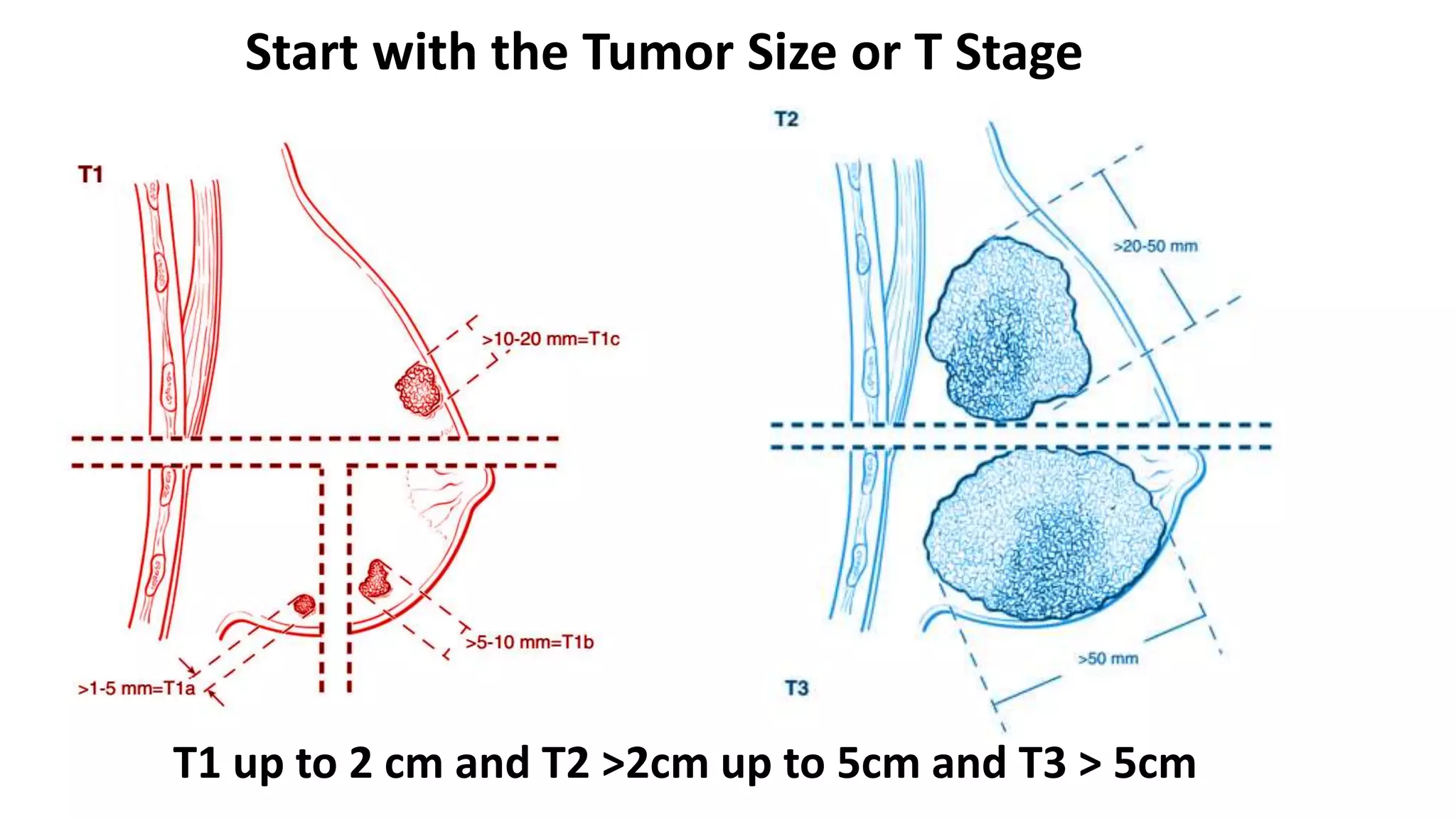
Start with the Tumor Size or T Stage
T1 up to 2 cm and T2 >2cm up to 5cm and T3 > 5cm
Tumor Invasion for T4 Stage
T4a chest wall T4b skin nodules T4b edema T4c skin and chest
T4d Inflammatory: diffuse erythema and edema > 1/3 breast)
Then Look at Lymph
Nodes for N Stage
3 Levels of Axillary
Nodes
Supraclavicular
Nodes
Internal Mammary
Nodes
Clinical Lymph Node Stages (i.e. before surgery)
Pathologic Node Status Based on Size of Cancer in the Node
N0 (i+) isolated tumor cells no large than 0.2mm , if larger and up to 2mm called
N1mi for microscopic, if > 2mm then macro node or N1
Pathologic Node Status Based Number of Nodes
Pathologic Node Status Based Location of Nodes
Pathologic Node Status
Based on Location and
Number of Nodes
Genomic Classes Not in Use Yet
Genomics = the genes (and mutations) found
in the cancer biopsy
Luminal A – high estrogen receptor positive , negative
on HER2 , and low grade or low Ki-67 , best outlook
Basal Like – triple negative (negative for estrogen,
progesterone and HER2) and they have the worst
outlook
Genomic Classes
Distant Metastatic Free Survival by Genomic Groups
Luminal A best
Basal Worst
Local and regional recurrence by
patient group
Triple Negative worst
Luminal A - second best
Local and regional recurrence by
patient group
HER2 second worst
HER2 is best if you treat with
Herceptin
Things That Affect Prognosis (DSS = disease specific survival at 5 Years)
Outcome if Combine TNM Stage with other High Risk Biomarkers
Add one point for each of
these additional risk factors
DSS = disease specific survival
(do not die from breast
cancer)
OS = overall survival
5 Year Disease Specific Survival by Stage and Risk Points
0 points
1 point
2 points
3 points
Stage based on TNM
Pathologic Prognostic Stage
Exceptions to the Rule
Any distant metastases is always Stage IV
Low risk Oncotype keeps the early stages as IA
10 Year Risk of Distant Relapse after Tamoxifen (5y)
In Node Negative Patients
Recurrence Score
RiskofRelapse
Genomics:
Test the gene
mutations in the
cancer biopsy ,
should predict
how dangerous
the cancer is, or
the risk of a
relapse or
recurrence
10 Year Risk of Distant Relapse after Tamoxifen (5y)
In Node Negative Patients
Recurrence Score
RiskofRelapse
Genomic testing on the
cancer will determine the
recurrence score
10 Year Risk of Distant Relapse after Tamoxifen (5y)
In Node Negative Patients
Recurrence Score
RiskofRelapse
A low risk recurrence score
predicts the risk of relapse
treated with Tamoxifen
Recurrence score of 8
Risk of a relapse
only 7%
10 Year Risk of Distant Relapse after Tamoxifen (5y)
In Node Negative Patients
Recurrence Score
RiskofRelapse
A high risk recurrence
score predicts the risk of
relapse treated with
Tamoxifen Recurrence score of 44
Risk of a relapse 31%
so needs to consider
adding
chemotherapy to
the hormone
therapy
Endocrine Therapy or Chemotherapy for Node Negative, ERP+, HER2 - , Based on
Recurrence Score (TAILORx Trial) NEJM 2018
Freedom from Recurrence/9y 1- 10 11-25 26+
Endocrine 99% 92%
Chemo/Endo 93% 85%
Overall Survival/ 9y
Endocrine 94% 94%
Chemo/Endo 94% 89%
Recurrence Score
Score 1-10 (Low Risk) 11-25 (Intermediate) 26+ (High Risk)
Endocrine Therapy or Chemotherapy for Node Negative, ERP+, HER2 - , Based on
Recurrence Score (TAILORx Trial) NEJM 2018
Freedom from Recurrence/9y 1- 10 11-25 26+
Endocrine 99% 92%
Chemo/Endo 93% 85%
Overall Survival/ 9y
Endocrine 94% 94%
Chemo/Endo 94% 89%
Recurrence Score
Score 1-10 (Low Risk)
Low Risk, Node Negative patients do quite well with only hormone
therapy and chemotherapy not necessary
Endocrine Therapy or Chemotherapy for Node Negative, ERP+, HER2 - , Based on
Recurrence Score (TAILORx Trial) NEJM 2018
Freedom from Recurrence/9y 1- 10 11-25 26+
Endocrine 99% 92%
Chemo/Endo 93% 85%
Overall Survival/ 9y
Endocrine 94% 94%
Chemo/Endo 94% 89%
Recurrence Score
11-25 (Intermediate) 26+ (High Risk)
Intermediate Risk, Node Negative patients do quite well with only hormone
therapy and gain very little with the addition of chemotherapy (unless
younger than 50)
Recurrence or Mortality with 1 – 3 Nodes +
Tamoxifen
ChemoRx +
Tamoxifen
Rate
Lets you compare the results with hormone
therapy alone or combined with chemotherapy
Genomics
testing in node
positive cases
to see if
chemotherapy
is better than
hormone
therapy in all
cases
Recurrence or Mortality with 1 – 3 Nodes +
Tamoxifen
ChemoRx +
Tamoxifen
RelapseRate
Low Score
Low recurrence score
Recurrence Score
Recurrence or Mortality with 1 – 3 Nodes +
Tamoxifen
ChemoRx +
Tamoxifen
RelapseRate
Low Score
ChemoRx
Tamoxifen
Low recurrence score, the
relapse rate is lowest with
Tamoxifen alone
(chemotherapy of no benefit)
Recurrence Score
Recurrence or Mortality with 1 – 3 Nodes +
Tamoxifen
ChemoRx +
Tamoxifen
High Score
High recurrence score
Recurrence Score
Recurrence or Mortality with 1 – 3 Nodes +
Tamoxifen
ChemoRx +
Tamoxifen
High Score
Tamoxifen worse
ChemoRx
best
High recurrence score Chemo Best
Recurrence Score
Recurrence or Mortality with 4 + Nodes +
Low Intermed High
Tamoxifen
Tamoxifen +
ChemoRx
At some point the benefits of
chemotherapy become obvious
Which is more important, the clinical risk categories or the
genomic analysis. What if they give conflicting information?
Does Mammaprint Outweigh the Clinical Risk in deciding on
ChemoRx (MINDACT Trial, NEJM Aug 25, 2016)
Clinical Stage = High Risk (should benefit from Chemotherapy)
Genomics = Low Risk (no need for chemotherapy)
Cure Rate (DMFS)
Nodes Involved No Chemo Yes Chemo
None 93.2% 95.7%
Yes 95.6% 96.3%
DMFS = distant metastatic free survival
Conclusion: genomics trumps clinical stage in avoiding chemotherapy
Clinical Stage = Low Risk (would not from Chemotherapy)
Genomics = High Risk (may need chemotherapy)
Cure Rate (DMFS)
Nodes Involved No Chemo Yes Chemo
None 95.1% 96%
DMFS = distant metastatic free survival
Conclusion: genomics does not trump clinical stage in adding
chemotherapy
Combing the risk factors to determine the outcome by different therapies,
The use of online calculators or genomics
Adjuvant Online (currently unavailable)
Predict: www. predict.nhs.uk
CancerMath.net
0
10
20
30
40
50
60
70
80
0 4 8 12 16 20
Number of Positive Nodes
15 Year Overall Survival Based on Tumor Size and
Number of Lymph Node Metastases
Calculation
based on 66 yo
woman with
ERP+ and HER2-,
2.5cm , grade 2
invasive ductal
cancer using
PREDICT and
treated with
Chemo +
Hormone Rx
1 cm
2.5 cm
4 cm
8 cm
predict.nhs.uk
15 Year Overall Survival Based on Tumor Size and
Number of Lymph Node Metastases
The size is
less
important
if the
number of
nodes
involved is
small
15 Year Overall Survival Based on Tumor Size and
Number of Lymph Node Metastases
Note the higher the number of involved nodes, the worse the survival
The bigger the
tumor, the
worse the
impact of the
nodes
0
10
20
30
40
50
60
70
80
0 4 8 12 16 20
percent
Positive Lymph Nodes
Surgery
Surgery +
Hormone Rx
S + H +
Chemotherapy
15 Year Overall Survival Based on Therapy and Number
of Lymph Node Metastases
Calculation
based on 66 yo
woman with
ERP+ and HER2-,
2.5cm , grade 2
invasive ductal
cancer using
PREDICT
predict.nhs.uk
In high risk
women with a
large number
of nodes, the
benefits of
chemotherapy
is large
In low risk
women with a
small number
of nodes, the
benefits of
chemotherapy
are small
15 Year Overall Survival
http://cancer.lifemath.net
/index.html
Other calculators to
determine the benefit
from more intensive
therapy
www.aboutcancer.com www.aboutcancer.com
aboutcancer.com/videos youtube.com/user/robertmillermd/videos

Breast cancer staging 2018 video power points

  • 1.
    Breast Cancer Staging2018 www.aboutcancer.com www.aboutcancer.com
  • 2.
    What tests doyou need to stage someone with breast cancer?
  • 3.
  • 4.
    Tests need toproperly stage a woman with breast cancer Most cases: just mammogram (and possibly ultrasound) and routine blood work and careful review of the biopsy (pathology review) Optional: Breast MRI may be useful to the surgeon if the woman has dense breasts and a lumpectomy is being considered Other scans (like CT scan or bone or liver or brain scan) only if symptoms or abnormal blood tests PET scan generally reserved for high risk cases (e.g. multiple lymph node spread or triple negative cancers)
  • 5.
    www.cap.org for CAPCancer Protocols Note that this is 32 pages long!
  • 6.
    Now includes notjust TNM (tumor, nodes, metastases) but also biomarkers (estrogen receptor ER, grade and HER2) and even genomics (OncotypeDx)
  • 7.
    Now includes notjust TNM (tumor, nodes, metastases) but also biomarkers (estrogen receptor ER, progesterone PR, grade and HER2) and even genomics (OncotypeDX)
  • 8.
    Start with theTumor Size or T Stage T1 up to 2 cm and T2 >2cm up to 5cm and T3 > 5cm
  • 9.
    Tumor Invasion forT4 Stage T4a chest wall T4b skin nodules T4b edema T4c skin and chest T4d Inflammatory: diffuse erythema and edema > 1/3 breast)
  • 10.
    Then Look atLymph Nodes for N Stage 3 Levels of Axillary Nodes Supraclavicular Nodes Internal Mammary Nodes
  • 11.
    Clinical Lymph NodeStages (i.e. before surgery)
  • 12.
    Pathologic Node StatusBased on Size of Cancer in the Node N0 (i+) isolated tumor cells no large than 0.2mm , if larger and up to 2mm called N1mi for microscopic, if > 2mm then macro node or N1
  • 13.
    Pathologic Node StatusBased Number of Nodes
  • 14.
    Pathologic Node StatusBased Location of Nodes
  • 15.
    Pathologic Node Status Basedon Location and Number of Nodes
  • 16.
    Genomic Classes Notin Use Yet Genomics = the genes (and mutations) found in the cancer biopsy
  • 17.
    Luminal A –high estrogen receptor positive , negative on HER2 , and low grade or low Ki-67 , best outlook Basal Like – triple negative (negative for estrogen, progesterone and HER2) and they have the worst outlook Genomic Classes
  • 18.
    Distant Metastatic FreeSurvival by Genomic Groups Luminal A best Basal Worst
  • 19.
    Local and regionalrecurrence by patient group Triple Negative worst Luminal A - second best
  • 20.
    Local and regionalrecurrence by patient group HER2 second worst HER2 is best if you treat with Herceptin
  • 21.
    Things That AffectPrognosis (DSS = disease specific survival at 5 Years)
  • 22.
    Outcome if CombineTNM Stage with other High Risk Biomarkers Add one point for each of these additional risk factors DSS = disease specific survival (do not die from breast cancer) OS = overall survival
  • 23.
    5 Year DiseaseSpecific Survival by Stage and Risk Points 0 points 1 point 2 points 3 points Stage based on TNM
  • 24.
  • 29.
    Exceptions to theRule Any distant metastases is always Stage IV Low risk Oncotype keeps the early stages as IA
  • 30.
    10 Year Riskof Distant Relapse after Tamoxifen (5y) In Node Negative Patients Recurrence Score RiskofRelapse Genomics: Test the gene mutations in the cancer biopsy , should predict how dangerous the cancer is, or the risk of a relapse or recurrence
  • 31.
    10 Year Riskof Distant Relapse after Tamoxifen (5y) In Node Negative Patients Recurrence Score RiskofRelapse Genomic testing on the cancer will determine the recurrence score
  • 32.
    10 Year Riskof Distant Relapse after Tamoxifen (5y) In Node Negative Patients Recurrence Score RiskofRelapse A low risk recurrence score predicts the risk of relapse treated with Tamoxifen Recurrence score of 8 Risk of a relapse only 7%
  • 33.
    10 Year Riskof Distant Relapse after Tamoxifen (5y) In Node Negative Patients Recurrence Score RiskofRelapse A high risk recurrence score predicts the risk of relapse treated with Tamoxifen Recurrence score of 44 Risk of a relapse 31% so needs to consider adding chemotherapy to the hormone therapy
  • 34.
    Endocrine Therapy orChemotherapy for Node Negative, ERP+, HER2 - , Based on Recurrence Score (TAILORx Trial) NEJM 2018 Freedom from Recurrence/9y 1- 10 11-25 26+ Endocrine 99% 92% Chemo/Endo 93% 85% Overall Survival/ 9y Endocrine 94% 94% Chemo/Endo 94% 89% Recurrence Score Score 1-10 (Low Risk) 11-25 (Intermediate) 26+ (High Risk)
  • 35.
    Endocrine Therapy orChemotherapy for Node Negative, ERP+, HER2 - , Based on Recurrence Score (TAILORx Trial) NEJM 2018 Freedom from Recurrence/9y 1- 10 11-25 26+ Endocrine 99% 92% Chemo/Endo 93% 85% Overall Survival/ 9y Endocrine 94% 94% Chemo/Endo 94% 89% Recurrence Score Score 1-10 (Low Risk) Low Risk, Node Negative patients do quite well with only hormone therapy and chemotherapy not necessary
  • 36.
    Endocrine Therapy orChemotherapy for Node Negative, ERP+, HER2 - , Based on Recurrence Score (TAILORx Trial) NEJM 2018 Freedom from Recurrence/9y 1- 10 11-25 26+ Endocrine 99% 92% Chemo/Endo 93% 85% Overall Survival/ 9y Endocrine 94% 94% Chemo/Endo 94% 89% Recurrence Score 11-25 (Intermediate) 26+ (High Risk) Intermediate Risk, Node Negative patients do quite well with only hormone therapy and gain very little with the addition of chemotherapy (unless younger than 50)
  • 37.
    Recurrence or Mortalitywith 1 – 3 Nodes + Tamoxifen ChemoRx + Tamoxifen Rate Lets you compare the results with hormone therapy alone or combined with chemotherapy Genomics testing in node positive cases to see if chemotherapy is better than hormone therapy in all cases
  • 38.
    Recurrence or Mortalitywith 1 – 3 Nodes + Tamoxifen ChemoRx + Tamoxifen RelapseRate Low Score Low recurrence score Recurrence Score
  • 39.
    Recurrence or Mortalitywith 1 – 3 Nodes + Tamoxifen ChemoRx + Tamoxifen RelapseRate Low Score ChemoRx Tamoxifen Low recurrence score, the relapse rate is lowest with Tamoxifen alone (chemotherapy of no benefit) Recurrence Score
  • 40.
    Recurrence or Mortalitywith 1 – 3 Nodes + Tamoxifen ChemoRx + Tamoxifen High Score High recurrence score Recurrence Score
  • 41.
    Recurrence or Mortalitywith 1 – 3 Nodes + Tamoxifen ChemoRx + Tamoxifen High Score Tamoxifen worse ChemoRx best High recurrence score Chemo Best Recurrence Score
  • 42.
    Recurrence or Mortalitywith 4 + Nodes + Low Intermed High Tamoxifen Tamoxifen + ChemoRx At some point the benefits of chemotherapy become obvious
  • 43.
    Which is moreimportant, the clinical risk categories or the genomic analysis. What if they give conflicting information? Does Mammaprint Outweigh the Clinical Risk in deciding on ChemoRx (MINDACT Trial, NEJM Aug 25, 2016)
  • 44.
    Clinical Stage =High Risk (should benefit from Chemotherapy) Genomics = Low Risk (no need for chemotherapy) Cure Rate (DMFS) Nodes Involved No Chemo Yes Chemo None 93.2% 95.7% Yes 95.6% 96.3% DMFS = distant metastatic free survival Conclusion: genomics trumps clinical stage in avoiding chemotherapy
  • 45.
    Clinical Stage =Low Risk (would not from Chemotherapy) Genomics = High Risk (may need chemotherapy) Cure Rate (DMFS) Nodes Involved No Chemo Yes Chemo None 95.1% 96% DMFS = distant metastatic free survival Conclusion: genomics does not trump clinical stage in adding chemotherapy
  • 46.
    Combing the riskfactors to determine the outcome by different therapies, The use of online calculators or genomics Adjuvant Online (currently unavailable) Predict: www. predict.nhs.uk CancerMath.net
  • 47.
    0 10 20 30 40 50 60 70 80 0 4 812 16 20 Number of Positive Nodes 15 Year Overall Survival Based on Tumor Size and Number of Lymph Node Metastases Calculation based on 66 yo woman with ERP+ and HER2-, 2.5cm , grade 2 invasive ductal cancer using PREDICT and treated with Chemo + Hormone Rx 1 cm 2.5 cm 4 cm 8 cm predict.nhs.uk
  • 48.
    15 Year OverallSurvival Based on Tumor Size and Number of Lymph Node Metastases The size is less important if the number of nodes involved is small
  • 49.
    15 Year OverallSurvival Based on Tumor Size and Number of Lymph Node Metastases Note the higher the number of involved nodes, the worse the survival The bigger the tumor, the worse the impact of the nodes
  • 50.
    0 10 20 30 40 50 60 70 80 0 4 812 16 20 percent Positive Lymph Nodes Surgery Surgery + Hormone Rx S + H + Chemotherapy 15 Year Overall Survival Based on Therapy and Number of Lymph Node Metastases Calculation based on 66 yo woman with ERP+ and HER2-, 2.5cm , grade 2 invasive ductal cancer using PREDICT predict.nhs.uk
  • 51.
    In high risk womenwith a large number of nodes, the benefits of chemotherapy is large In low risk women with a small number of nodes, the benefits of chemotherapy are small 15 Year Overall Survival
  • 52.
  • 53.