

Cancer Imaging
ASPEC / January 2021 / Robert Miller MD
1.History of imaging
technology
2.Guidelines for screening
or staging
3.Breast (mammograms,
ultrasound, MRI)
4.Lung (chest X-rays, CT,
PET scan)
5.Brain (CT, MRI)
6.Miscellaneous sites
History of Radiology
Wilhelm Conrad Röntgen
German] mechanical engineer and physicist
who, on 8 November 1895, produced and
detected electromagnetic radiation in
a wavelength range known as X-rays or
Röntgen rays.
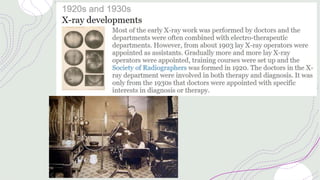
About six weeks after his discovery, he took
a picture—a radiograph—using X-rays of
his wife Anna Bertha's hand
By 1896 doctors around the world were using x-rays to take pictures of patients
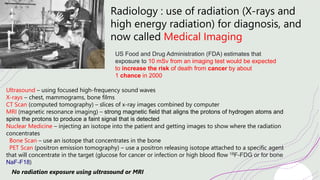
Radiology : use of radiation (X-rays and
high energy radiation) for diagnosis, and
now called Medical Imaging
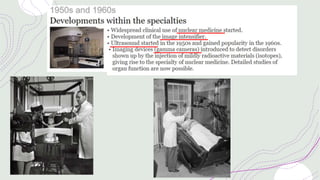
Ultrasound – using focused high-frequency sound waves
X-rays – chest, mammograms, bone films
CT Scan (computed tomography) – slices of x-ray images combined by computer
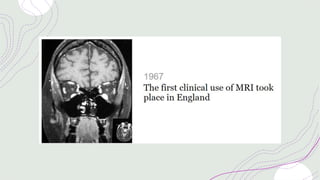
MRI (magnetic resonance imaging) – strong magnetic field that aligns the protons of hydrogen atoms and
spins the protons to produce a faint signal that is detected
Nuclear Medicine – injecting an isotope into the patient and getting images to show where the radiation
concentrates
Bone Scan – use an isotope that concentrates in the bone
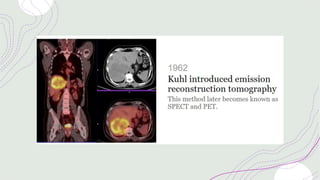
PET Scan (positron emission tomography) – use a positron releasing isotope attached to a specific agent
that will concentrate in the target (glucose for cancer or infection or high blood flow 18F-FDG or for bone
NaF-F18)
No radiation exposure using ultrasound or MRI
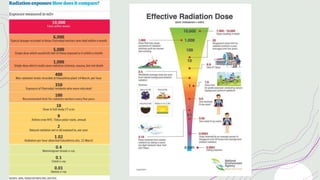
US Food and Drug Administration (FDA) estimates that
exposure to 10 mSv from an imaging test would be expected
to increase the risk of death from cancer by about
1 chance in 2000
www.xrayrisk.com/
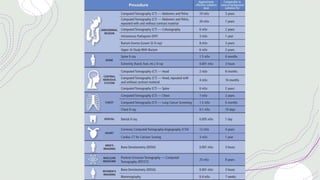
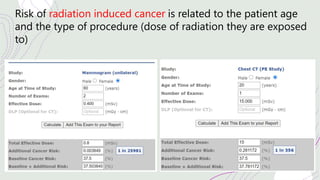
Risk of radiation induced cancer is related to the patient age
and the type of procedure (dose of radiation they are exposed
to)
Only include mammograms for breast cancer screening, Low dose CT scans
for lung cancer screening, and option of CT for colon/rectal cancer screening
NCCN.Org
Which stages or cancers need CT, MRI or PET
scans and the frequency
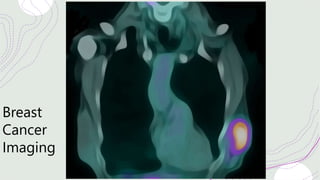
Breast
Cancer
Imaging
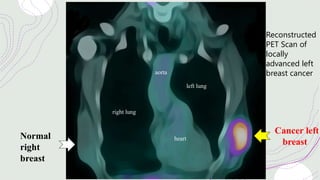
right lung
left lung
heart
Normal
right
breast
Cancer left
breast
aorta
Reconstructed
PET Scan of
locally
advanced left
breast cancer
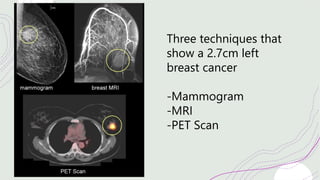
Three techniques that
show a 2.7cm left
breast cancer
-Mammogram
-MRI
-PET Scan
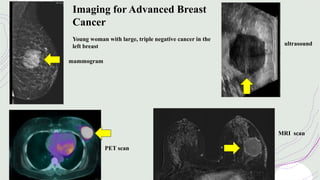
Imaging for Advanced Breast
Cancer
Young woman with large, triple negative cancer in the
left breast
mammogram
ultrasound
PET scan
MRI scan
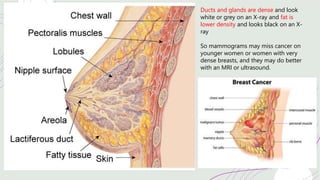
Ducts and glands are dense and look
white or grey on an X-ray and fat is
lower density and looks black on an X-
ray
So mammograms may miss cancer on
younger women or women with very
dense breasts, and they may do better
with an MRI or ultrasound.
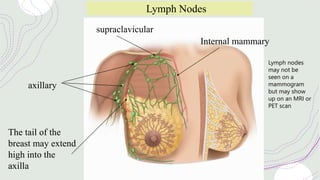
Internal mammary
supraclavicular
axillary
Lymph Nodes
The tail of the
breast may extend
high into the
axilla
Lymph nodes
may not be
seen on a
mammogram
but may show
up on an MRI or
PET scan
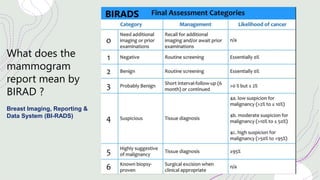
BIRADS
What does the
mammogram
report mean by
BIRAD ?
Breast Imaging, Reporting &
Data System (BI-RADS)
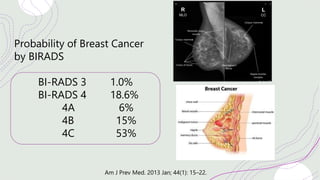
Probability of Breast Cancer
by BIRADS
BI-RADS 3 1.0%
BI-RADS 4 18.6%
4A 6%
4B 15%
4C 53%
Am J Prev Med. 2013 Jan; 44(1): 15–22.
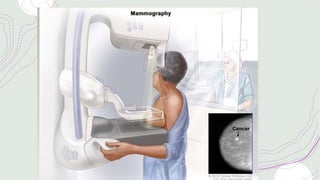
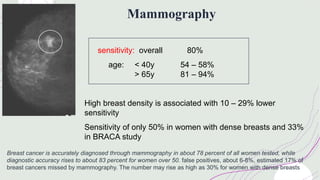
Mammography
sensitivity: overall 80%
age: < 40y 54 – 58%
> 65y 81 – 94%
High breast density is associated with 10 – 29% lower
sensitivity
Sensitivity of only 50% in women with dense breasts and 33%
in BRACA study
Breast cancer is accurately diagnosed through mammography in about 78 percent of all women tested, while
diagnostic accuracy rises to about 83 percent for women over 50. false positives, about 6-8%, estimated 17% of
breast cancers missed by mammography. The number may rise as high as 30% for women with dense breasts
How often will a mammogram miss finding a cancer in a
young woman?
42 – 46%
Never!
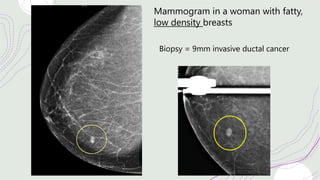
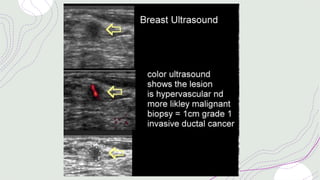
Biopsy = 9mm invasive ductal cancer
Mammogram in a woman with fatty,
low density breasts
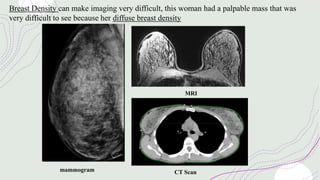
Breast Density can make imaging very difficult, this woman had a palpable mass that was
very difficult to see because her diffuse breast density
mammogram CT Scan
MRI
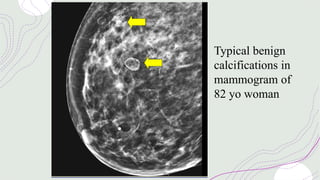
Typical benign
calcifications in
mammogram of
82 yo woman
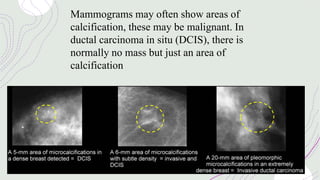
Mammograms may often show areas of
calcification, these may be malignant. In
ductal carcinoma in situ (DCIS), there is
normally no mass but just an area of
calcification
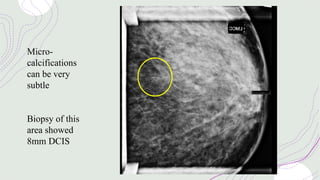
Micro-
calcifications
can be very
subtle
Biopsy of this
area showed
8mm DCIS
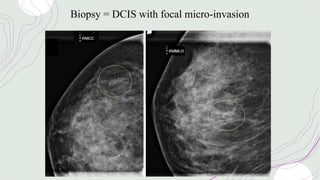
Biopsy = DCIS with focal micro-invasion
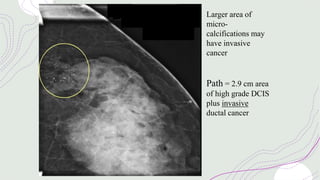
Larger area of
micro-
calcifications may
have invasive
cancer
Path = 2.9 cm area
of high grade DCIS
plus invasive
ductal cancer
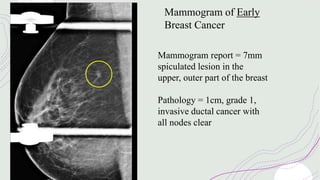
Mammogram report = 7mm
spiculated lesion in the
upper, outer part of the breast
Pathology = 1cm, grade 1,
invasive ductal cancer with
all nodes clear
Mammogram of Early
Breast Cancer
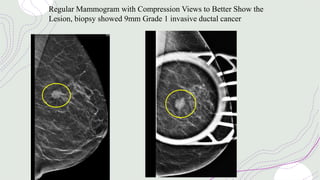
Regular Mammogram with Compression Views to Better Show the
Lesion, biopsy showed 9mm Grade 1 invasive ductal cancer
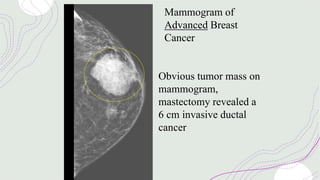
Mammogram of
Advanced Breast
Cancer
Obvious tumor mass on
mammogram,
mastectomy revealed a
6 cm invasive ductal
cancer
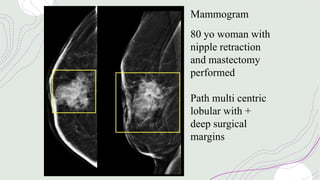
Mammogram
80 yo woman with
nipple retraction
and mastectomy
performed
Path multi centric
lobular with +
deep surgical
margins
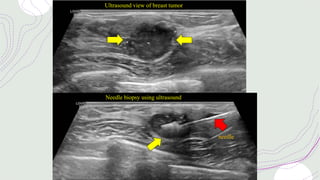
Ultrasound view of breast tumor
Needle biopsy using ultrasound
needle
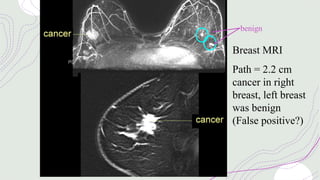
Breast MRI
Path = 2.2 cm
cancer in right
breast, left breast
was benign
(False positive?)
benign
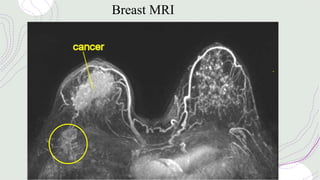
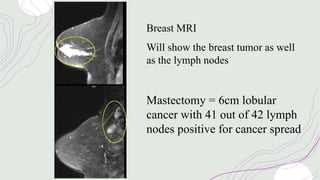
Breast MRI
Will show the breast tumor as well
as the lymph nodes
Mastectomy = 6cm lobular
cancer with 41 out of 42 lymph
nodes positive for cancer spread
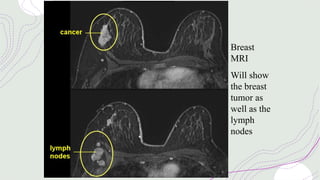
Breast
MRI
Will show
the breast
tumor as
well as the
lymph
nodes
Breast MRI
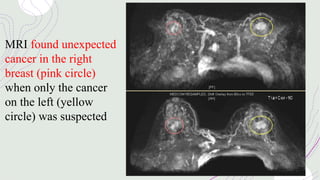
MRI found unexpected
cancer in the right
breast (pink circle)
when only the cancer
on the left (yellow
circle) was suspected
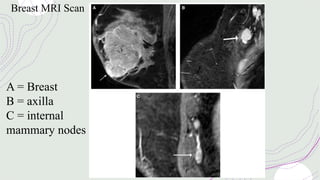
Breast MRI Scan
A = Breast
B = axilla
C = internal
mammary nodes
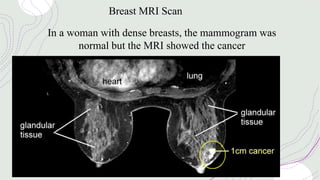
Breast MRI Scan
In a woman with dense breasts, the mammogram was
normal but the MRI showed the cancer
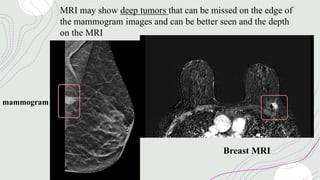
mammogram
Breast MRI
MRI may show deep tumors that can be missed on the edge of
the mammogram images and can be better seen and the depth
on the MRI
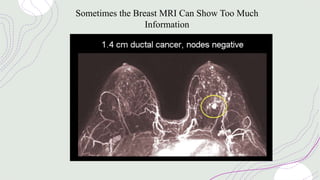
Sometimes the Breast MRI Can Show Too Much
Information
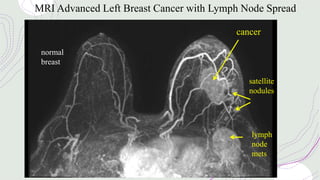
MRI Advanced Left Breast Cancer with Lymph Node Spread
normal
breast
cancer
satellite
nodules
lymph
node
mets
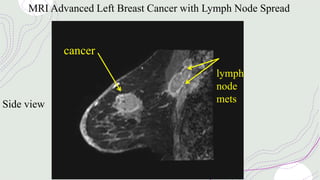
MRI Advanced Left Breast Cancer with Lymph Node Spread
Side view
cancer
lymph
node
mets
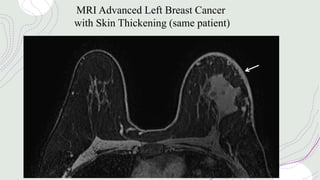
MRI Advanced Left Breast Cancer
with Skin Thickening (same patient)
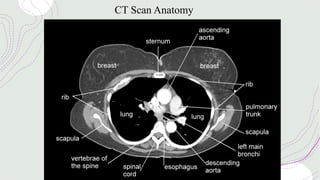
CT Scan Anatomy
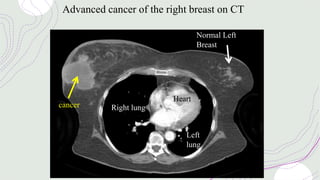
cancer
Normal Left
Breast
Heart
Left
lung
Right lung
Advanced cancer of the right breast on CT
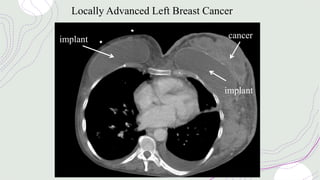
Locally Advanced Left Breast Cancer
implant cancer
implant
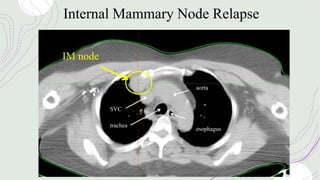
Internal Mammary Node Relapse
IM node
aorta
esophagus
trachea
SVC
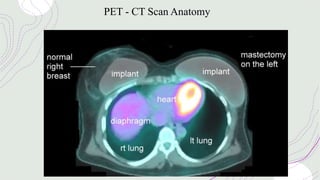
PET - CT Scan Anatomy
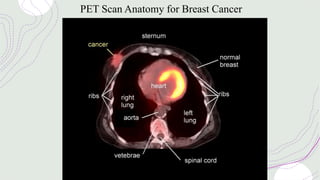
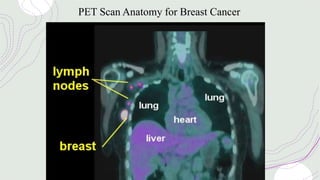
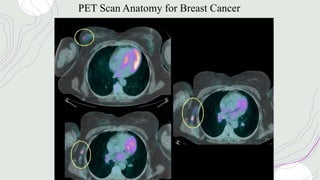
PET Scan Anatomy for Breast Cancer
Normal breast
Liver
Heart
Spine
Rt Lung
Lt Lung
Cancer in Lt breast
Cancer in Spine
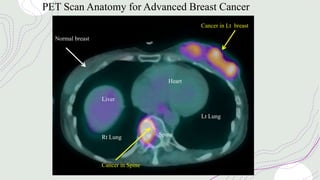
PET Scan Anatomy for Advanced Breast Cancer
3D Mammography More Likely to Find Small Invasive
Breast Cancers, Especially in Women Younger Than 50
Three-dimensional mammography (also called digital breast tomosynthesis, digital tomosynthesis, or just
tomosynthesis) creates a three-dimensional picture of the breast using X-rays.
the study found that screening with 3D mammography increased breast cancer detection rates by about
40%.
•73.7% of breast cancers found with 3D mammography were 1 centimeter (cm) or smaller and node-
negative
•65.4% of breast cancers found with digital mammography were 1 cm or smaller and node-negative
•This difference in detecting small breast cancers was especially notable in women age 40 to 49. For these
women, 3D mammography found 4.41 invasive cancers per 1,000 exams in women with nondense breasts
compared to 2.71 invasive cancers per 1,000 exams found by conventional 2D digital mammography.
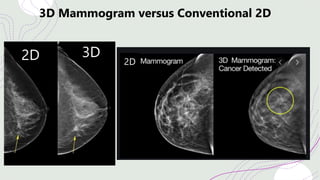
3D Mammogram versus Conventional 2D
2D 3D
2D
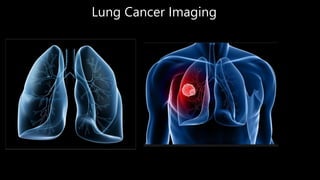
Lung Cancer Imaging
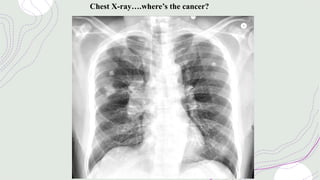
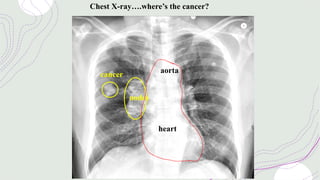
Chest X-ray….where’s the cancer?
heart
aorta
nodes
cancer
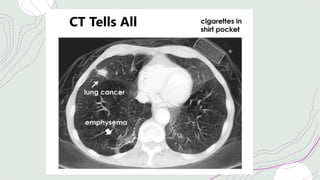
CT Tells All
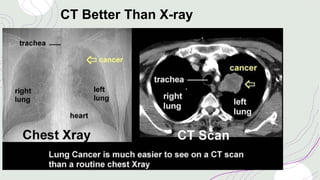
CT Better Than X-ray
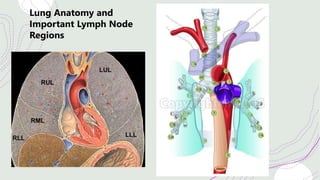
Lung Anatomy and
Important Lymph Node
Regions
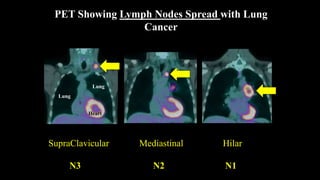
PET Showing Lymph Nodes Spread with Lung
Cancer
SupraClavicular Mediastinal Hilar
N3 N2 N1
Lung
Lung
Heart
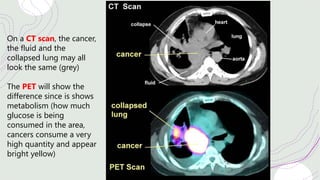
On a CT scan, the cancer,
the fluid and the
collapsed lung may all
look the same (grey)
The PET will show the
difference since is shows
metabolism (how much
glucose is being
consumed in the area,
cancers consume a very
high quantity and appear
bright yellow)
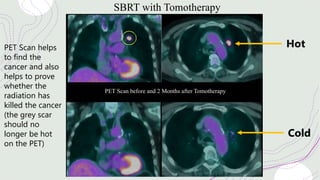
SBRT with Tomotherapy
PET Scan before and 2 Months after Tomotherapy
PET Scan helps
to find the
cancer and also
helps to prove
whether the
radiation has
killed the cancer
(the grey scar
should no
longer be hot
on the PET)
Hot
Cold
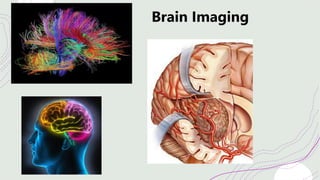
Brain Imaging
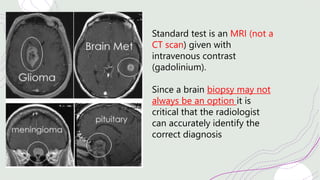
Standard test is an MRI (not a
CT scan) given with
intravenous contrast
(gadolinium).
Since a brain biopsy may not
always be an option it is
critical that the radiologist
can accurately identify the
correct diagnosis
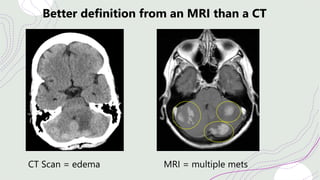
Better definition from an MRI than a CT
CT Scan = edema MRI = multiple mets
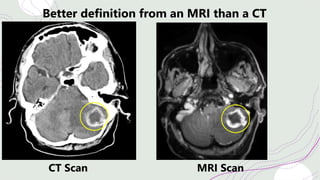
CT Scan MRI Scan
Better definition from an MRI than a CT
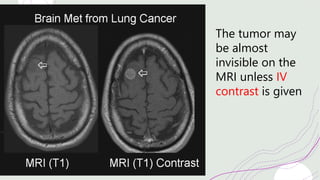
The tumor may
be almost
invisible on the
MRI unless IV
contrast is given
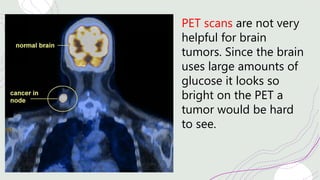
PET scans are not very
helpful for brain
tumors. Since the brain
uses large amounts of
glucose it looks so
bright on the PET a
tumor would be hard
to see.
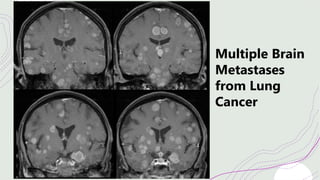
Multiple Brain
Metastases
from Lung
Cancer
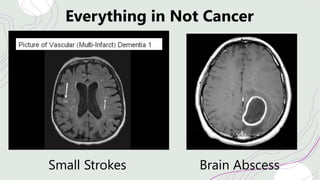
Everything in Not Cancer
Small Strokes Brain Abscess
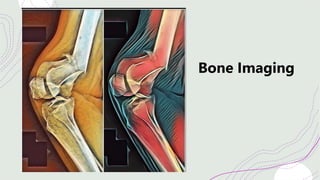
Bone Imaging
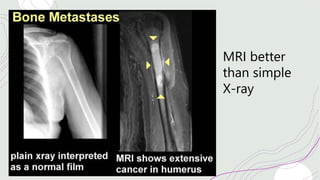
MRI better
than simple
X-ray
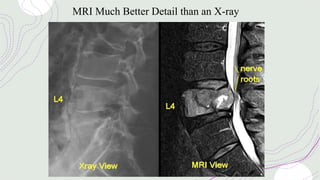
MRI Much Better Detail than an X-ray
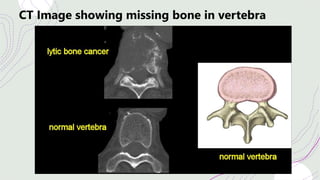
CT Image showing missing bone in vertebra
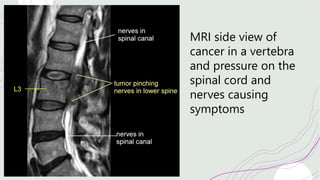
MRI side view of
cancer in a vertebra
and pressure on the
spinal cord and
nerves causing
symptoms
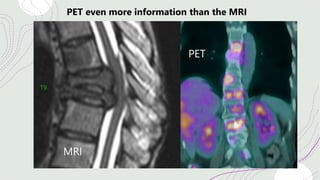
PET even more information than the MRI
MRI
PET
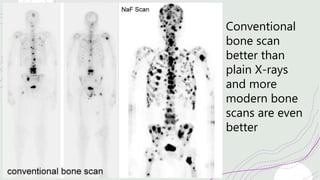
Conventional
bone scan
better than
plain X-rays
and more
modern bone
scans are even
better

Cancer imaging

  • 1.
    Cancer Imaging ASPEC /January 2021 / Robert Miller MD
  • 2.
    1.History of imaging technology 2.Guidelinesfor screening or staging 3.Breast (mammograms, ultrasound, MRI) 4.Lung (chest X-rays, CT, PET scan) 5.Brain (CT, MRI) 6.Miscellaneous sites
  • 3.
  • 4.
    Wilhelm Conrad Röntgen German]mechanical engineer and physicist who, on 8 November 1895, produced and detected electromagnetic radiation in a wavelength range known as X-rays or Röntgen rays. About six weeks after his discovery, he took a picture—a radiograph—using X-rays of his wife Anna Bertha's hand By 1896 doctors around the world were using x-rays to take pictures of patients
  • 11.
    Radiology : useof radiation (X-rays and high energy radiation) for diagnosis, and now called Medical Imaging Ultrasound – using focused high-frequency sound waves X-rays – chest, mammograms, bone films CT Scan (computed tomography) – slices of x-ray images combined by computer MRI (magnetic resonance imaging) – strong magnetic field that aligns the protons of hydrogen atoms and spins the protons to produce a faint signal that is detected Nuclear Medicine – injecting an isotope into the patient and getting images to show where the radiation concentrates Bone Scan – use an isotope that concentrates in the bone PET Scan (positron emission tomography) – use a positron releasing isotope attached to a specific agent that will concentrate in the target (glucose for cancer or infection or high blood flow 18F-FDG or for bone NaF-F18) No radiation exposure using ultrasound or MRI US Food and Drug Administration (FDA) estimates that exposure to 10 mSv from an imaging test would be expected to increase the risk of death from cancer by about 1 chance in 2000
  • 14.
  • 15.
    Risk of radiationinduced cancer is related to the patient age and the type of procedure (dose of radiation they are exposed to)
  • 16.
    Only include mammogramsfor breast cancer screening, Low dose CT scans for lung cancer screening, and option of CT for colon/rectal cancer screening NCCN.Org Which stages or cancers need CT, MRI or PET scans and the frequency
  • 17.
  • 18.
    right lung left lung heart Normal right breast Cancerleft breast aorta Reconstructed PET Scan of locally advanced left breast cancer
  • 19.
    Three techniques that showa 2.7cm left breast cancer -Mammogram -MRI -PET Scan
  • 20.
    Imaging for AdvancedBreast Cancer Young woman with large, triple negative cancer in the left breast mammogram ultrasound PET scan MRI scan
  • 21.
    Ducts and glandsare dense and look white or grey on an X-ray and fat is lower density and looks black on an X- ray So mammograms may miss cancer on younger women or women with very dense breasts, and they may do better with an MRI or ultrasound.
  • 22.
    Internal mammary supraclavicular axillary Lymph Nodes Thetail of the breast may extend high into the axilla Lymph nodes may not be seen on a mammogram but may show up on an MRI or PET scan
  • 24.
    BIRADS What does the mammogram reportmean by BIRAD ? Breast Imaging, Reporting & Data System (BI-RADS)
  • 25.
    Probability of BreastCancer by BIRADS BI-RADS 3 1.0% BI-RADS 4 18.6% 4A 6% 4B 15% 4C 53% Am J Prev Med. 2013 Jan; 44(1): 15–22.
  • 26.
    Mammography sensitivity: overall 80% age:< 40y 54 – 58% > 65y 81 – 94% High breast density is associated with 10 – 29% lower sensitivity Sensitivity of only 50% in women with dense breasts and 33% in BRACA study Breast cancer is accurately diagnosed through mammography in about 78 percent of all women tested, while diagnostic accuracy rises to about 83 percent for women over 50. false positives, about 6-8%, estimated 17% of breast cancers missed by mammography. The number may rise as high as 30% for women with dense breasts
  • 27.
    How often willa mammogram miss finding a cancer in a young woman? 42 – 46% Never!
  • 28.
    Biopsy = 9mminvasive ductal cancer Mammogram in a woman with fatty, low density breasts
  • 29.
    Breast Density canmake imaging very difficult, this woman had a palpable mass that was very difficult to see because her diffuse breast density mammogram CT Scan MRI
  • 30.
  • 31.
    Mammograms may oftenshow areas of calcification, these may be malignant. In ductal carcinoma in situ (DCIS), there is normally no mass but just an area of calcification
  • 32.
  • 33.
    Biopsy = DCISwith focal micro-invasion
  • 34.
    Larger area of micro- calcificationsmay have invasive cancer Path = 2.9 cm area of high grade DCIS plus invasive ductal cancer
  • 35.
    Mammogram report =7mm spiculated lesion in the upper, outer part of the breast Pathology = 1cm, grade 1, invasive ductal cancer with all nodes clear Mammogram of Early Breast Cancer
  • 36.
    Regular Mammogram withCompression Views to Better Show the Lesion, biopsy showed 9mm Grade 1 invasive ductal cancer
  • 37.
    Mammogram of Advanced Breast Cancer Obvioustumor mass on mammogram, mastectomy revealed a 6 cm invasive ductal cancer
  • 38.
    Mammogram 80 yo womanwith nipple retraction and mastectomy performed Path multi centric lobular with + deep surgical margins
  • 40.
    Ultrasound view ofbreast tumor Needle biopsy using ultrasound needle
  • 41.
    Breast MRI Path =2.2 cm cancer in right breast, left breast was benign (False positive?) benign
  • 42.
    Breast MRI Will showthe breast tumor as well as the lymph nodes Mastectomy = 6cm lobular cancer with 41 out of 42 lymph nodes positive for cancer spread
  • 43.
    Breast MRI Will show the breast tumoras well as the lymph nodes
  • 44.
  • 45.
    MRI found unexpected cancerin the right breast (pink circle) when only the cancer on the left (yellow circle) was suspected
  • 46.
    Breast MRI Scan A= Breast B = axilla C = internal mammary nodes
  • 47.
    Breast MRI Scan Ina woman with dense breasts, the mammogram was normal but the MRI showed the cancer
  • 48.
    mammogram Breast MRI MRI mayshow deep tumors that can be missed on the edge of the mammogram images and can be better seen and the depth on the MRI
  • 49.
    Sometimes the BreastMRI Can Show Too Much Information
  • 50.
    MRI Advanced LeftBreast Cancer with Lymph Node Spread normal breast cancer satellite nodules lymph node mets
  • 51.
    MRI Advanced LeftBreast Cancer with Lymph Node Spread Side view cancer lymph node mets
  • 52.
    MRI Advanced LeftBreast Cancer with Skin Thickening (same patient)
  • 53.
  • 54.
  • 55.
    Locally Advanced LeftBreast Cancer implant cancer implant
  • 56.
    Internal Mammary NodeRelapse IM node aorta esophagus trachea SVC
  • 57.
    PET - CTScan Anatomy
  • 58.
    PET Scan Anatomyfor Breast Cancer
  • 59.
    PET Scan Anatomyfor Breast Cancer
  • 60.
    PET Scan Anatomyfor Breast Cancer
  • 61.
    Normal breast Liver Heart Spine Rt Lung LtLung Cancer in Lt breast Cancer in Spine PET Scan Anatomy for Advanced Breast Cancer
  • 62.
    3D Mammography MoreLikely to Find Small Invasive Breast Cancers, Especially in Women Younger Than 50 Three-dimensional mammography (also called digital breast tomosynthesis, digital tomosynthesis, or just tomosynthesis) creates a three-dimensional picture of the breast using X-rays. the study found that screening with 3D mammography increased breast cancer detection rates by about 40%. •73.7% of breast cancers found with 3D mammography were 1 centimeter (cm) or smaller and node- negative •65.4% of breast cancers found with digital mammography were 1 cm or smaller and node-negative •This difference in detecting small breast cancers was especially notable in women age 40 to 49. For these women, 3D mammography found 4.41 invasive cancers per 1,000 exams in women with nondense breasts compared to 2.71 invasive cancers per 1,000 exams found by conventional 2D digital mammography.
  • 63.
    3D Mammogram versusConventional 2D 2D 3D 2D
  • 64.
  • 65.
  • 66.
    Chest X-ray….where’s thecancer? heart aorta nodes cancer
  • 67.
  • 68.
  • 69.
    Lung Anatomy and ImportantLymph Node Regions
  • 70.
    PET Showing LymphNodes Spread with Lung Cancer SupraClavicular Mediastinal Hilar N3 N2 N1 Lung Lung Heart
  • 71.
    On a CTscan, the cancer, the fluid and the collapsed lung may all look the same (grey) The PET will show the difference since is shows metabolism (how much glucose is being consumed in the area, cancers consume a very high quantity and appear bright yellow)
  • 72.
    SBRT with Tomotherapy PETScan before and 2 Months after Tomotherapy PET Scan helps to find the cancer and also helps to prove whether the radiation has killed the cancer (the grey scar should no longer be hot on the PET) Hot Cold
  • 73.
  • 74.
    Standard test isan MRI (not a CT scan) given with intravenous contrast (gadolinium). Since a brain biopsy may not always be an option it is critical that the radiologist can accurately identify the correct diagnosis
  • 75.
    Better definition froman MRI than a CT CT Scan = edema MRI = multiple mets
  • 76.
    CT Scan MRIScan Better definition from an MRI than a CT
  • 77.
    The tumor may bealmost invisible on the MRI unless IV contrast is given
  • 78.
    PET scans arenot very helpful for brain tumors. Since the brain uses large amounts of glucose it looks so bright on the PET a tumor would be hard to see.
  • 79.
  • 80.
    Everything in NotCancer Small Strokes Brain Abscess
  • 81.
  • 82.
  • 83.
    MRI Much BetterDetail than an X-ray
  • 84.
    CT Image showingmissing bone in vertebra
  • 85.
    MRI side viewof cancer in a vertebra and pressure on the spinal cord and nerves causing symptoms
  • 86.
    PET even moreinformation than the MRI MRI PET
  • 87.
    Conventional bone scan better than plainX-rays and more modern bone scans are even better