A Presentation on Bandwidth
Improvement and miniaturization of
Microstrip Antennas
1
Outline
 Overview of microstrip antennas
 Feeding methods
 Basic principles of operation
 General characteristics
 Improving bandwidth
 Miniaturization
 References
2
Outline
 Overview of microstrip antennas
 Feeding methods
 Basic principles of operation
 General characteristics
 CAD Formulas
 Radiation pattern
 Input Impedance
 Circular polarization
 Circular patch
 Improving bandwidth
 Miniaturization
 Reducing surface waves and lateral radiation
3
Overview of Microstrip Antennas
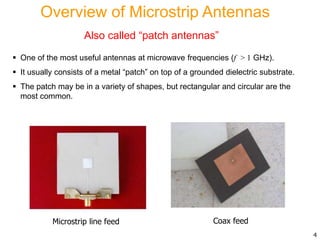
Also called “patch antennas”
 One of the most useful antennas at microwave frequencies (f > 1 GHz).
 It usually consists of a metal “patch” on top of a grounded dielectric substrate.
 The patch may be in a variety of shapes, but rectangular and circular are the
most common.
4
Microstrip line feed Coax feed
Overview of Microstrip Antennas
5
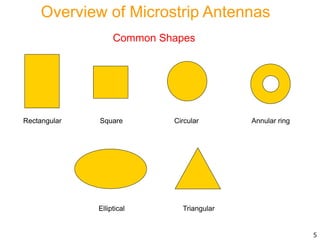
Common Shapes
Rectangular Square Circular
Elliptical
Annular ring
Triangular
 Invented by Bob Munson in 1972 (but earlier work by Dechamps
goes back to1953).
 Became popular starting in the 1970s.
6
Overview of Microstrip Antennas
History
Advantages of Microstrip Antennas
 Low profile (can even be “conformal,” i.e. flexible to conform to a
surface).
 Easy to fabricate (use etching and photolithography).
 Easy to feed (coaxial cable, microstrip line, etc.).
 Easy to use in an array or incorporate with other microstrip circuit
elements.
 Patterns are somewhat hemispherical, with a moderate directivity
(about 6-8 dB is typical).
7
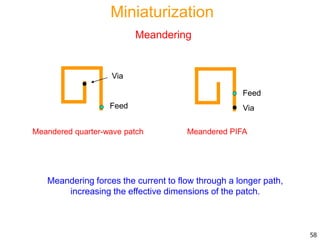
Overview of Microstrip Antennas
Disadvantages of Microstrip Antennas
 Low bandwidth (but can be improved by a variety of techniques). Bandwidths of
a few percent are typical. Bandwidth is roughly proportional to the substrate
thickness and inversely proportional to the substrate permittivity.
 Efficiency may be lower than with other antennas. Efficiency is limited by
conductor and dielectric losses*, and by surface-wave loss**.
 Only used at microwave frequencies and above (the substrate becomes too
large at lower frequencies).
 Cannot handle extremely large amounts of power (dielectric breakdown).
* Conductor and dielectric losses become more severe for thinner
substrates.
** Surface-wave losses become more severe for thicker substrates
(unless air or foam is used).
8
Overview of Microstrip Antennas
Applications
 Satellite communications
 Microwave communications
 Cell phone antennas
 GPS antennas
9
Applications include:
Overview of Microstrip Antennas
10
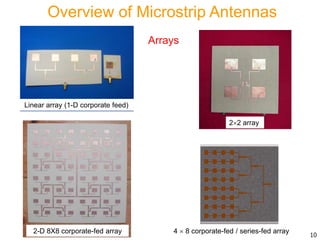
Arrays
Linear array (1-D corporate feed)
22 array
2-D 8X8 corporate-fed array 4  8 corporate-fed / series-fed array
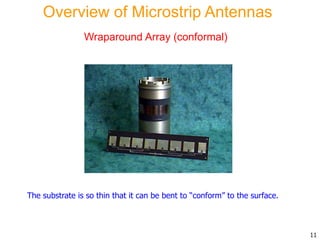
Wraparound Array (conformal)
11
Overview of Microstrip Antennas
The substrate is so thin that it can be bent to “conform” to the surface.
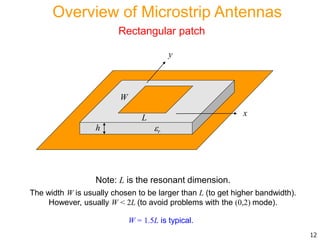
x
y
h
L
W
Note: L is the resonant dimension.
The width W is usually chosen to be larger than L (to get higher bandwidth).
However, usually W < 2L (to avoid problems with the (0,2) mode).
r
12
Overview of Microstrip Antennas
Rectangular patch
W = 1.5L is typical.
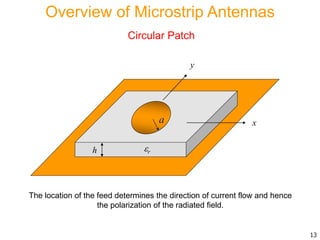
Circular Patch
x
y
h
a
r
13
Overview of Microstrip Antennas
The location of the feed determines the direction of current flow and hence
the polarization of the radiated field.
Feeding Methods
Some of the more common methods for
feeding microstrip antennas are shown.
14
The feeding methods are illustrated for a rectangular patch,
but the principles apply for circular and other shapes as well.
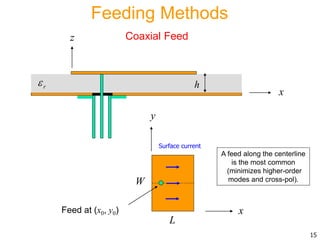
Coaxial Feed
A feed along the centerline
is the most common
(minimizes higher-order
modes and cross-pol).
x
y
L
W
Feed at (x0, y0)
Surface current
15
x
r h
z
Feeding Methods
16
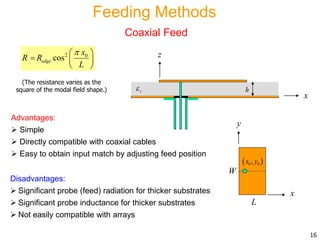
Advantages:
 Simple
 Directly compatible with coaxial cables
 Easy to obtain input match by adjusting feed position
Disadvantages:
 Significant probe (feed) radiation for thicker substrates
 Significant probe inductance for thicker substrates
 Not easily compatible with arrays
Coaxial Feed
2 0
cosedge
x
R R
L
 
  
 
x
r h
z
Feeding Methods
x
y
L
W
 0 0,x y
(The resistance varies as the
square of the modal field shape.)
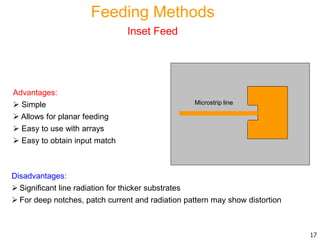
Advantages:
 Simple
 Allows for planar feeding
 Easy to use with arrays
 Easy to obtain input match
Disadvantages:
 Significant line radiation for thicker substrates
 For deep notches, patch current and radiation pattern may show distortion
17
Inset Feed
Microstrip line
Feeding Methods
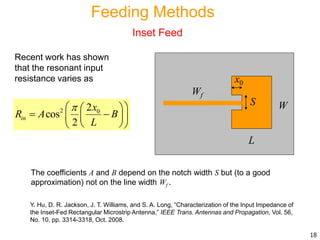
Recent work has shown
that the resonant input
resistance varies as
2 02
cos
2
in
x
R A B
L
  
   
  
The coefficients A and B depend on the notch width S but (to a good
approximation) not on the line width Wf .
Y. Hu, D. R. Jackson, J. T. Williams, and S. A. Long, “Characterization of the Input Impedance of
the Inset-Fed Rectangular Microstrip Antenna,” IEEE Trans. Antennas and Propagation, Vol. 56,
No. 10, pp. 3314-3318, Oct. 2008.
18
L
W
Wf
S
x0
Feeding Methods
Inset Feed
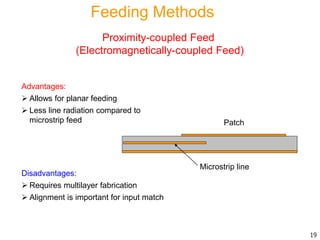
Advantages:
 Allows for planar feeding
 Less line radiation compared to
microstrip feed
Disadvantages:
 Requires multilayer fabrication
 Alignment is important for input match
Patch
Microstrip line
19
Feeding Methods
Proximity-coupled Feed
(Electromagnetically-coupled Feed)
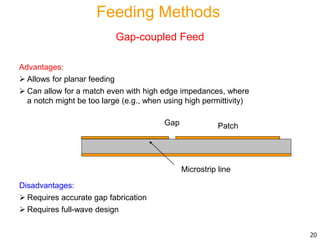
Advantages:
 Allows for planar feeding
 Can allow for a match even with high edge impedances, where
a notch might be too large (e.g., when using high permittivity)
Disadvantages:
 Requires accurate gap fabrication
 Requires full-wave design
Patch
Microstrip line
Gap
20
Feeding Methods
Gap-coupled Feed
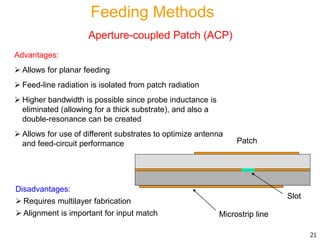
Advantages:
 Allows for planar feeding
 Feed-line radiation is isolated from patch radiation
 Higher bandwidth is possible since probe inductance is
eliminated (allowing for a thick substrate), and also a
double-resonance can be created
 Allows for use of different substrates to optimize antenna
and feed-circuit performance
Disadvantages:
 Requires multilayer fabrication
 Alignment is important for input match
Patch
Microstrip line
Slot
21
Feeding Methods
Aperture-coupled Patch (ACP)
Basic Principles of Operation
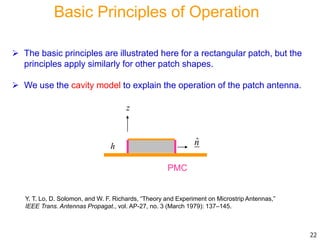
 The basic principles are illustrated here for a rectangular patch, but the
principles apply similarly for other patch shapes.
 We use the cavity model to explain the operation of the patch antenna.
22
Y. T. Lo, D. Solomon, and W. F. Richards, “Theory and Experiment on Microstrip Antennas,”
IEEE Trans. Antennas Propagat., vol. AP-27, no. 3 (March 1979): 137–145.
ˆnh
PMC
z
Basic Principles of Operation
 The patch acts approximately as a resonant cavity (with short-circuit (PEC)
walls on top and bottom, open-circuit (PMC) walls on the edges).
 In a cavity, only certain modes are allowed to exist, at different resonance
frequencies.
 If the antenna is excited at a resonance frequency, a strong field is set up inside
the cavity, and a strong current on the (bottom) surface of the patch. This
produces significant radiation (a good antenna).
Note: As the substrate thickness gets smaller the patch current radiates less, due to
image cancellation. However, the Q of the resonant mode also increases, making the
patch currents stronger at resonance. These two effects cancel, allowing the patch to
radiate well even for small substrate thicknesses.
23
Main Ideas:
Basic Principles of Operation
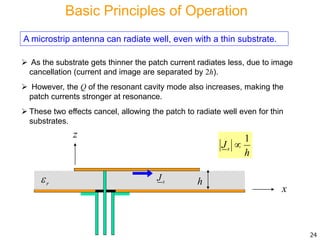
 As the substrate gets thinner the patch current radiates less, due to image
cancellation (current and image are separated by 2h).
 However, the Q of the resonant cavity mode also increases, making the
patch currents stronger at resonance.
 These two effects cancel, allowing the patch to radiate well even for thin
substrates.
24
A microstrip antenna can radiate well, even with a thin substrate.
x
r hsJ
z 1
sJ
h

General Characteristics
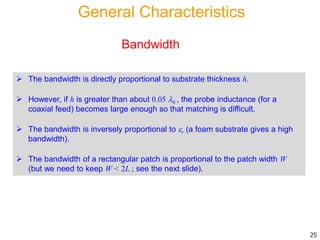
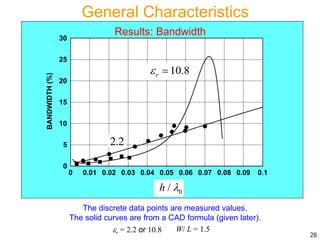
 The bandwidth is directly proportional to substrate thickness h.
 However, if h is greater than about 0.05 0 , the probe inductance (for a
coaxial feed) becomes large enough so that matching is difficult.
 The bandwidth is inversely proportional to r (a foam substrate gives a high
bandwidth).
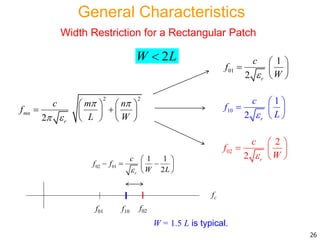
 The bandwidth of a rectangular patch is proportional to the patch width W
(but we need to keep W < 2L ; see the next slide).
Bandwidth
25
26
2 2
2
mn
r
c m n
f
L W
 
 
   
    
   
10
1
2 r
c
f
L
 
  
 
02
2
2 r
c
f
W
 
  
 
2W L
Width Restriction for a Rectangular Patch
fc
f10f01 f02
01
1
2 r
c
f
W
 
  
 
W = 1.5 L is typical.
02 01
1 1
2r
c
f f
W L
 
   
 
General Characteristics
Some Bandwidth Observations
 For a typical substrate thickness (h /0 = 0.02), and a typical substrate
permittivity (r = 2.2) the bandwidth is about 3%.
 By using a thick foam substrate, bandwidth of about 10% can be achieved.
 By using special feeding techniques (aperture coupling) and stacked
patches, bandwidths of 100% have been achieved.
27
General Characteristics
0 0.01 0.02 0.03 0.04 0.05 0.06 0.07 0.08 0.09 0.1
h / 
0
5
10
15
20
25
30
BANDWIDTH(%)
r
2.2
= 10.8
W/ L = 1.5r = 2.2 or 10.8
Results: Bandwidth
The discrete data points are measured values.
The solid curves are from a CAD formula (given later).
28
0/h 
10.8r 
2.2
General Characteristics
Radiation Efficiency
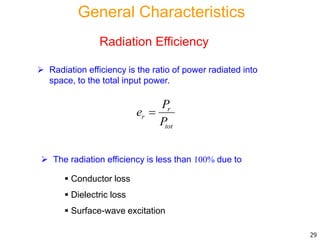
 The radiation efficiency is less than 100% due to
 Conductor loss
 Dielectric loss
 Surface-wave excitation
 Radiation efficiency is the ratio of power radiated into
space, to the total input power.
r
r
tot
P
e
P

29
General Characteristics
 Conductor and dielectric loss is more important for thinner substrates (the
Q of the cavity is higher, and thus more seriously affected by loss).
 Conductor loss increases with frequency (proportional to f 1/2) due to the
skin effect. It can be very serious at millimeter-wave frequencies.
 Conductor loss is usually more important than dielectric loss for typical
substrate thicknesses and loss tangents.
30
Some observations:
General Characteristics
Radiation Efficiency (cont.)
 Surface-wave power is more important for thicker substrates or for
higher-substrate permittivities. (The surface-wave power can be
minimized by using a thin substrate or a foam substrate.)
31
 For a foam substrate, a high radiation efficiency is obtained by making the
substrate thicker (increasing the bandwidth). There is no surface-wave power
to worry about.
 For a typical substrate such as r = 2.2, the radiation efficiency is maximum for
h / 0  0.02.
General Characteristics
Radiation Efficiency (cont.)
32
General Characteristics
Radiation Pattern
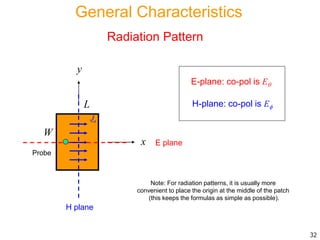
E-plane: co-pol is E
H-plane: co-pol is E
Note: For radiation patterns, it is usually more
convenient to place the origin at the middle of the patch
(this keeps the formulas as simple as possible).
x
y
L
W
E plane
H plane
Probe
Js
33
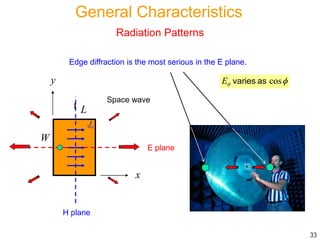
x
y
L
W
E plane
H plane
Edge diffraction is the most serious in the E plane.
General Characteristics
Radiation Patterns
Space wave
cosE varies as
Js
-90
-60
-30
0
30
60
90
120
150
180
210
240
-40
-30
-30
-20
-20
-10
-10
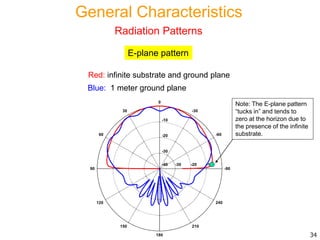
E-plane pattern
Red: infinite substrate and ground plane
Blue: 1 meter ground plane
Note: The E-plane pattern
“tucks in” and tends to
zero at the horizon due to
the presence of the infinite
substrate.
34
General Characteristics
Radiation Patterns
Directivity
The directivity is fairly insensitive to the substrate thickness.
The directivity is higher for lower permittivity, because the patch is
larger.
35
General Characteristics
Improving Bandwidth
Some of the techniques that have been successfully
developed are illustrated here.
36
The literature may be consulted for additional designs and variations.
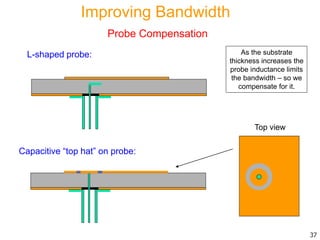
L-shaped probe:
Capacitive “top hat” on probe:
Top view
37
Improving Bandwidth
Probe Compensation
As the substrate
thickness increases the
probe inductance limits
the bandwidth – so we
compensate for it.
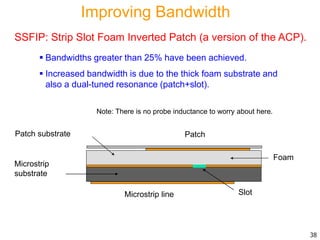
SSFIP: Strip Slot Foam Inverted Patch (a version of the ACP).
Microstrip
substrate
Patch
Microstrip line Slot
Foam
Patch substrate
 Bandwidths greater than 25% have been achieved.
 Increased bandwidth is due to the thick foam substrate and
also a dual-tuned resonance (patch+slot).
38
Improving Bandwidth
Note: There is no probe inductance to worry about here.
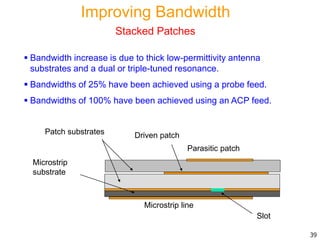
 Bandwidth increase is due to thick low-permittivity antenna
substrates and a dual or triple-tuned resonance.
 Bandwidths of 25% have been achieved using a probe feed.
 Bandwidths of 100% have been achieved using an ACP feed.
Microstrip
substrate
Driven patch
Microstrip line
Slot
Patch substrates
Parasitic patch
39
Improving Bandwidth
Stacked Patches
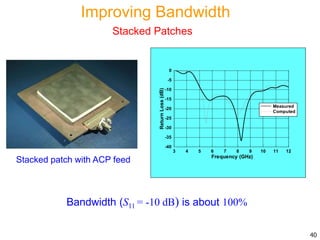
Bandwidth (S11 = -10 dB) is about 100%
Stacked patch with ACP feed
3 4 5 6 7 8 9 10 11 12
Frequency (GHz)
-40
-35
-30
-25
-20
-15
-10
-5
0
ReturnLoss(dB)
Measured
Computed
40
Improving Bandwidth
Stacked Patches
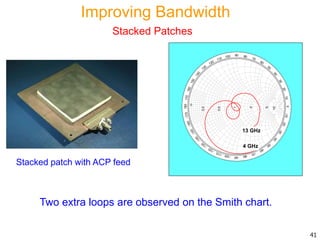
Stacked patch with ACP feed
0
0.2
0.5
1
2
5
10
180170160
150
140
130
120
110 100 90 80
70
60
50
40
30
20
100-10-20
-30
-40
-50
-60
-70
-80-90-100-110
-120
-130
-140
-150
-160-170
4 GHz
13 GHz
Two extra loops are observed on the Smith chart.
41
Stacked Patches
Improving Bandwidth
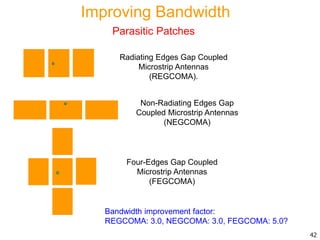
Radiating Edges Gap Coupled
Microstrip Antennas
(REGCOMA).
Non-Radiating Edges Gap
Coupled Microstrip Antennas
(NEGCOMA)
Four-Edges Gap Coupled
Microstrip Antennas
(FEGCOMA)
Bandwidth improvement factor:
REGCOMA: 3.0, NEGCOMA: 3.0, FEGCOMA: 5.0?
42
Improving Bandwidth
Parasitic Patches
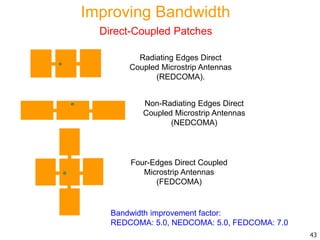
Radiating Edges Direct
Coupled Microstrip Antennas
(REDCOMA).
Non-Radiating Edges Direct
Coupled Microstrip Antennas
(NEDCOMA)
Four-Edges Direct Coupled
Microstrip Antennas
(FEDCOMA)
Bandwidth improvement factor:
REDCOMA: 5.0, NEDCOMA: 5.0, FEDCOMA: 7.0
43
Improving Bandwidth
Direct-Coupled Patches
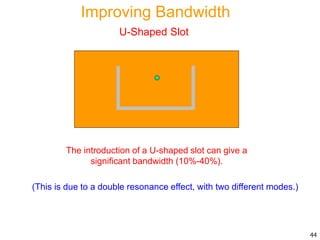
The introduction of a U-shaped slot can give a
significant bandwidth (10%-40%).
(This is due to a double resonance effect, with two different modes.)
44
Improving Bandwidth
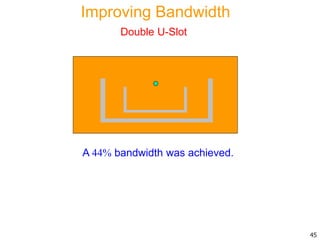
U-Shaped Slot
A 44% bandwidth was achieved.
45
Improving Bandwidth
Double U-Slot
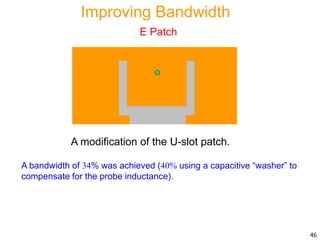
A modification of the U-slot patch.
A bandwidth of 34% was achieved (40% using a capacitive “washer” to
compensate for the probe inductance).
46
Improving Bandwidth
E Patch
Multi-Band Antennas
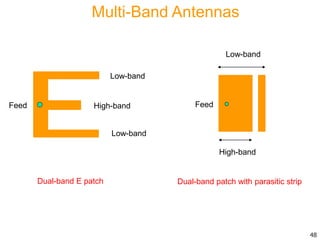
A multi-band antenna is sometimes more desirable than a broadband
antenna, if multiple narrow-band channels are to be covered.
47
Dual-band E patch
High-band
Low-band
Low-band
Feed
Dual-band patch with parasitic strip
Low-band
High-band
Feed
48
Multi-Band Antennas
Miniaturization
• High Permittivity
• Quarter-Wave Patch
• PIFA
• Capacitive Loading
• Slots
• Meandering
Note: Miniaturization usually comes at a price of reduced bandwidth!
49
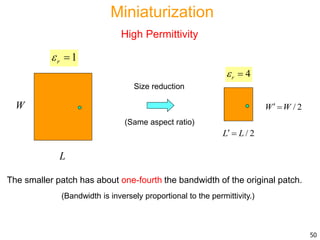
The smaller patch has about one-fourth the bandwidth of the original patch.
L
W
1r 
(Bandwidth is inversely proportional to the permittivity.)
50
4r 
/ 2L L 
/ 2W W 
Size reduction
Miniaturization
High Permittivity
(Same aspect ratio)
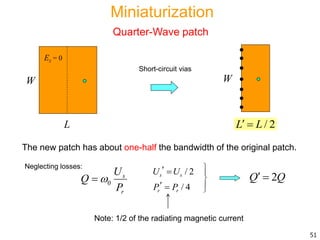
L
W
Ez = 0
The new patch has about one-half the bandwidth of the original patch.
0
s
r
U
Q
P

Neglecting losses:
/ 2s sU U 
/ 4r rP P 
2Q Q 





Short-circuit vias
51
W
/ 2L L 
Note: 1/2 of the radiating magnetic current
Miniaturization
Quarter-Wave patch
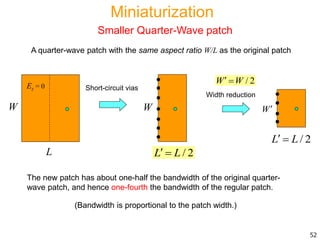
The new patch has about one-half the bandwidth of the original quarter-
wave patch, and hence one-fourth the bandwidth of the regular patch.
(Bandwidth is proportional to the patch width.)
52
/ 2W W 
A quarter-wave patch with the same aspect ratio W/L as the original patch
Width reduction
L
W
Ez = 0 Short-circuit vias
/ 2L L 
WW
/ 2L L 
Miniaturization
Smaller Quarter-Wave patch
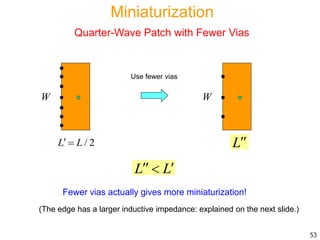
Fewer vias actually gives more miniaturization!
(The edge has a larger inductive impedance: explained on the next slide.)
53
L L 
W
L
W
/ 2L L 
Use fewer vias
Miniaturization
Quarter-Wave Patch with Fewer Vias
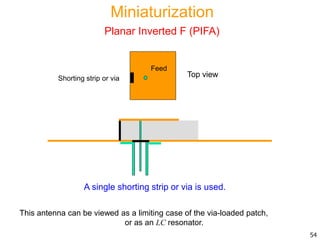
A single shorting strip or via is used.
This antenna can be viewed as a limiting case of the via-loaded patch,
or as an LC resonator.
Feed
Shorting strip or via
Top view
54
Miniaturization
Planar Inverted F (PIFA)
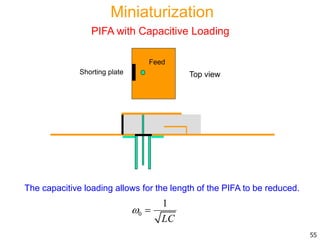
The capacitive loading allows for the length of the PIFA to be reduced.
Feed
Shorting plate Top view
55
0
1
LC
 
Miniaturization
PIFA with Capacitive Loading
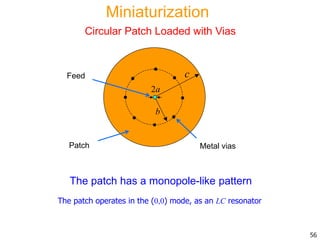
The patch has a monopole-like pattern
Feed c
b
Patch Metal vias
2a
The patch operates in the (0,0) mode, as an LC resonator
56
Miniaturization
Circular Patch Loaded with Vias
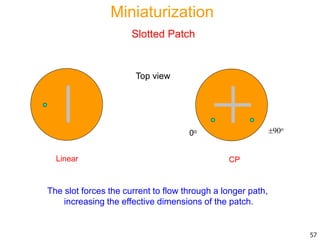
The slot forces the current to flow through a longer path,
increasing the effective dimensions of the patch.
Top view
Linear CP
0o 90o
57
Miniaturization
Slotted Patch
Meandering forces the current to flow through a longer path,
increasing the effective dimensions of the patch.
Feed
Via
Meandered quarter-wave patch
Feed
Via
Meandered PIFA
58
Miniaturization
Meandering
References
General references about microstrip antennas:
Microstrip Antenna Design Handbook, R. Garg, P. Bhartia, I. J. Bahl,
and A. Ittipiboon, Editors, Artech House, 2001.
Microstrip Patch Antennas: A Designer’s Guide, R. B. Waterhouse,
Kluwer Academic Publishers, 2003.
Advances in Microstrip and Printed Antennas, K. F. Lee, Editor, John
Wiley, 1997.
Microstrip Patch Antennas, K. F. Fong Lee and K. M. Luk, Imperial
College Press, 2011.
Microstrip and Patch Antennas Design, 2nd Ed., R. Bancroft, Scitech
Publishing, 2009.
59
References (cont.)
General references about microstrip antennas (cont.):
Millimeter-Wave Microstrip and Printed Circuit Antennas, P. Bhartia,
Artech House, 1991.
The Handbook of Microstrip Antennas (two volume set), J. R.
James and P. S. Hall, INSPEC, 1989.
Microstrip Antenna Theory and Design, J. R. James, P. S. Hall, and
C. Wood, INSPEC/IEE, 1981.
Microstrip Antennas: The Analysis and Design of Microstrip Antennas
and Arrays, D. M. Pozar and D. H. Schaubert, Editors, Wiley/IEEE
Press, 1995.
CAD of Microstrip Antennas for Wireless Applications, R. A. Sainati,
Artech House, 1996.
60
Computer-Aided Design of Rectangular Microstrip Antennas, D. R.
Jackson, S. A. Long, J. T. Williams, and V. B. Davis, Ch. 5 of Advances
in Microstrip and Printed Antennas, K. F. Lee, Editor, John Wiley, 1997.
More information about the CAD formulas presented here
for the rectangular patch may be found in:
References (cont.)
Microstrip Antennas, D. R. Jackson, Ch. 7 of Antenna Engineering
Handbook, J. L. Volakis, Editor, McGraw Hill, 2007.
61
References devoted to broadband microstrip antennas:
Compact and Broadband Microstrip Antennas, K.-L. Wong,
John Wiley, 2003.
Broadband Microstrip Antennas, G. Kumar and K. P. Ray,
Artech House, 2002.
Broadband Patch Antennas, J.-F. Zürcher and F. E. Gardiol,
Artech House, 1995.
References (cont.)
62
63

Bandwidth enhancement patch antenna

  • 1.
    A Presentation onBandwidth Improvement and miniaturization of Microstrip Antennas 1
  • 2.
    Outline  Overview ofmicrostrip antennas  Feeding methods  Basic principles of operation  General characteristics  Improving bandwidth  Miniaturization  References 2
  • 3.
    Outline  Overview ofmicrostrip antennas  Feeding methods  Basic principles of operation  General characteristics  CAD Formulas  Radiation pattern  Input Impedance  Circular polarization  Circular patch  Improving bandwidth  Miniaturization  Reducing surface waves and lateral radiation 3
  • 4.
    Overview of MicrostripAntennas Also called “patch antennas”  One of the most useful antennas at microwave frequencies (f > 1 GHz).  It usually consists of a metal “patch” on top of a grounded dielectric substrate.  The patch may be in a variety of shapes, but rectangular and circular are the most common. 4 Microstrip line feed Coax feed
  • 5.
    Overview of MicrostripAntennas 5 Common Shapes Rectangular Square Circular Elliptical Annular ring Triangular
  • 6.
     Invented byBob Munson in 1972 (but earlier work by Dechamps goes back to1953).  Became popular starting in the 1970s. 6 Overview of Microstrip Antennas History
  • 7.
    Advantages of MicrostripAntennas  Low profile (can even be “conformal,” i.e. flexible to conform to a surface).  Easy to fabricate (use etching and photolithography).  Easy to feed (coaxial cable, microstrip line, etc.).  Easy to use in an array or incorporate with other microstrip circuit elements.  Patterns are somewhat hemispherical, with a moderate directivity (about 6-8 dB is typical). 7 Overview of Microstrip Antennas
  • 8.
    Disadvantages of MicrostripAntennas  Low bandwidth (but can be improved by a variety of techniques). Bandwidths of a few percent are typical. Bandwidth is roughly proportional to the substrate thickness and inversely proportional to the substrate permittivity.  Efficiency may be lower than with other antennas. Efficiency is limited by conductor and dielectric losses*, and by surface-wave loss**.  Only used at microwave frequencies and above (the substrate becomes too large at lower frequencies).  Cannot handle extremely large amounts of power (dielectric breakdown). * Conductor and dielectric losses become more severe for thinner substrates. ** Surface-wave losses become more severe for thicker substrates (unless air or foam is used). 8 Overview of Microstrip Antennas
  • 9.
    Applications  Satellite communications Microwave communications  Cell phone antennas  GPS antennas 9 Applications include: Overview of Microstrip Antennas
  • 10.
    Overview of MicrostripAntennas 10 Arrays Linear array (1-D corporate feed) 22 array 2-D 8X8 corporate-fed array 4  8 corporate-fed / series-fed array
  • 11.
    Wraparound Array (conformal) 11 Overviewof Microstrip Antennas The substrate is so thin that it can be bent to “conform” to the surface.
  • 12.
    x y h L W Note: L isthe resonant dimension. The width W is usually chosen to be larger than L (to get higher bandwidth). However, usually W < 2L (to avoid problems with the (0,2) mode). r 12 Overview of Microstrip Antennas Rectangular patch W = 1.5L is typical.
  • 13.
    Circular Patch x y h a r 13 Overview ofMicrostrip Antennas The location of the feed determines the direction of current flow and hence the polarization of the radiated field.
  • 14.
    Feeding Methods Some ofthe more common methods for feeding microstrip antennas are shown. 14 The feeding methods are illustrated for a rectangular patch, but the principles apply for circular and other shapes as well.
  • 15.
    Coaxial Feed A feedalong the centerline is the most common (minimizes higher-order modes and cross-pol). x y L W Feed at (x0, y0) Surface current 15 x r h z Feeding Methods
  • 16.
    16 Advantages:  Simple  Directlycompatible with coaxial cables  Easy to obtain input match by adjusting feed position Disadvantages:  Significant probe (feed) radiation for thicker substrates  Significant probe inductance for thicker substrates  Not easily compatible with arrays Coaxial Feed 2 0 cosedge x R R L        x r h z Feeding Methods x y L W  0 0,x y (The resistance varies as the square of the modal field shape.)
  • 17.
    Advantages:  Simple  Allowsfor planar feeding  Easy to use with arrays  Easy to obtain input match Disadvantages:  Significant line radiation for thicker substrates  For deep notches, patch current and radiation pattern may show distortion 17 Inset Feed Microstrip line Feeding Methods
  • 18.
    Recent work hasshown that the resonant input resistance varies as 2 02 cos 2 in x R A B L           The coefficients A and B depend on the notch width S but (to a good approximation) not on the line width Wf . Y. Hu, D. R. Jackson, J. T. Williams, and S. A. Long, “Characterization of the Input Impedance of the Inset-Fed Rectangular Microstrip Antenna,” IEEE Trans. Antennas and Propagation, Vol. 56, No. 10, pp. 3314-3318, Oct. 2008. 18 L W Wf S x0 Feeding Methods Inset Feed
  • 19.
    Advantages:  Allows forplanar feeding  Less line radiation compared to microstrip feed Disadvantages:  Requires multilayer fabrication  Alignment is important for input match Patch Microstrip line 19 Feeding Methods Proximity-coupled Feed (Electromagnetically-coupled Feed)
  • 20.
    Advantages:  Allows forplanar feeding  Can allow for a match even with high edge impedances, where a notch might be too large (e.g., when using high permittivity) Disadvantages:  Requires accurate gap fabrication  Requires full-wave design Patch Microstrip line Gap 20 Feeding Methods Gap-coupled Feed
  • 21.
    Advantages:  Allows forplanar feeding  Feed-line radiation is isolated from patch radiation  Higher bandwidth is possible since probe inductance is eliminated (allowing for a thick substrate), and also a double-resonance can be created  Allows for use of different substrates to optimize antenna and feed-circuit performance Disadvantages:  Requires multilayer fabrication  Alignment is important for input match Patch Microstrip line Slot 21 Feeding Methods Aperture-coupled Patch (ACP)
  • 22.
    Basic Principles ofOperation  The basic principles are illustrated here for a rectangular patch, but the principles apply similarly for other patch shapes.  We use the cavity model to explain the operation of the patch antenna. 22 Y. T. Lo, D. Solomon, and W. F. Richards, “Theory and Experiment on Microstrip Antennas,” IEEE Trans. Antennas Propagat., vol. AP-27, no. 3 (March 1979): 137–145. ˆnh PMC z
  • 23.
    Basic Principles ofOperation  The patch acts approximately as a resonant cavity (with short-circuit (PEC) walls on top and bottom, open-circuit (PMC) walls on the edges).  In a cavity, only certain modes are allowed to exist, at different resonance frequencies.  If the antenna is excited at a resonance frequency, a strong field is set up inside the cavity, and a strong current on the (bottom) surface of the patch. This produces significant radiation (a good antenna). Note: As the substrate thickness gets smaller the patch current radiates less, due to image cancellation. However, the Q of the resonant mode also increases, making the patch currents stronger at resonance. These two effects cancel, allowing the patch to radiate well even for small substrate thicknesses. 23 Main Ideas:
  • 24.
    Basic Principles ofOperation  As the substrate gets thinner the patch current radiates less, due to image cancellation (current and image are separated by 2h).  However, the Q of the resonant cavity mode also increases, making the patch currents stronger at resonance.  These two effects cancel, allowing the patch to radiate well even for thin substrates. 24 A microstrip antenna can radiate well, even with a thin substrate. x r hsJ z 1 sJ h 
  • 25.
    General Characteristics  Thebandwidth is directly proportional to substrate thickness h.  However, if h is greater than about 0.05 0 , the probe inductance (for a coaxial feed) becomes large enough so that matching is difficult.  The bandwidth is inversely proportional to r (a foam substrate gives a high bandwidth).  The bandwidth of a rectangular patch is proportional to the patch width W (but we need to keep W < 2L ; see the next slide). Bandwidth 25
  • 26.
    26 2 2 2 mn r c mn f L W                  10 1 2 r c f L        02 2 2 r c f W        2W L Width Restriction for a Rectangular Patch fc f10f01 f02 01 1 2 r c f W        W = 1.5 L is typical. 02 01 1 1 2r c f f W L         General Characteristics
  • 27.
    Some Bandwidth Observations For a typical substrate thickness (h /0 = 0.02), and a typical substrate permittivity (r = 2.2) the bandwidth is about 3%.  By using a thick foam substrate, bandwidth of about 10% can be achieved.  By using special feeding techniques (aperture coupling) and stacked patches, bandwidths of 100% have been achieved. 27 General Characteristics
  • 28.
    0 0.01 0.020.03 0.04 0.05 0.06 0.07 0.08 0.09 0.1 h /  0 5 10 15 20 25 30 BANDWIDTH(%) r 2.2 = 10.8 W/ L = 1.5r = 2.2 or 10.8 Results: Bandwidth The discrete data points are measured values. The solid curves are from a CAD formula (given later). 28 0/h  10.8r  2.2 General Characteristics
  • 29.
    Radiation Efficiency  Theradiation efficiency is less than 100% due to  Conductor loss  Dielectric loss  Surface-wave excitation  Radiation efficiency is the ratio of power radiated into space, to the total input power. r r tot P e P  29 General Characteristics
  • 30.
     Conductor anddielectric loss is more important for thinner substrates (the Q of the cavity is higher, and thus more seriously affected by loss).  Conductor loss increases with frequency (proportional to f 1/2) due to the skin effect. It can be very serious at millimeter-wave frequencies.  Conductor loss is usually more important than dielectric loss for typical substrate thicknesses and loss tangents. 30 Some observations: General Characteristics Radiation Efficiency (cont.)
  • 31.
     Surface-wave poweris more important for thicker substrates or for higher-substrate permittivities. (The surface-wave power can be minimized by using a thin substrate or a foam substrate.) 31  For a foam substrate, a high radiation efficiency is obtained by making the substrate thicker (increasing the bandwidth). There is no surface-wave power to worry about.  For a typical substrate such as r = 2.2, the radiation efficiency is maximum for h / 0  0.02. General Characteristics Radiation Efficiency (cont.)
  • 32.
    32 General Characteristics Radiation Pattern E-plane:co-pol is E H-plane: co-pol is E Note: For radiation patterns, it is usually more convenient to place the origin at the middle of the patch (this keeps the formulas as simple as possible). x y L W E plane H plane Probe Js
  • 33.
    33 x y L W E plane H plane Edgediffraction is the most serious in the E plane. General Characteristics Radiation Patterns Space wave cosE varies as Js
  • 34.
    -90 -60 -30 0 30 60 90 120 150 180 210 240 -40 -30 -30 -20 -20 -10 -10 E-plane pattern Red: infinitesubstrate and ground plane Blue: 1 meter ground plane Note: The E-plane pattern “tucks in” and tends to zero at the horizon due to the presence of the infinite substrate. 34 General Characteristics Radiation Patterns
  • 35.
    Directivity The directivity isfairly insensitive to the substrate thickness. The directivity is higher for lower permittivity, because the patch is larger. 35 General Characteristics
  • 36.
    Improving Bandwidth Some ofthe techniques that have been successfully developed are illustrated here. 36 The literature may be consulted for additional designs and variations.
  • 37.
    L-shaped probe: Capacitive “tophat” on probe: Top view 37 Improving Bandwidth Probe Compensation As the substrate thickness increases the probe inductance limits the bandwidth – so we compensate for it.
  • 38.
    SSFIP: Strip SlotFoam Inverted Patch (a version of the ACP). Microstrip substrate Patch Microstrip line Slot Foam Patch substrate  Bandwidths greater than 25% have been achieved.  Increased bandwidth is due to the thick foam substrate and also a dual-tuned resonance (patch+slot). 38 Improving Bandwidth Note: There is no probe inductance to worry about here.
  • 39.
     Bandwidth increaseis due to thick low-permittivity antenna substrates and a dual or triple-tuned resonance.  Bandwidths of 25% have been achieved using a probe feed.  Bandwidths of 100% have been achieved using an ACP feed. Microstrip substrate Driven patch Microstrip line Slot Patch substrates Parasitic patch 39 Improving Bandwidth Stacked Patches
  • 40.
    Bandwidth (S11 =-10 dB) is about 100% Stacked patch with ACP feed 3 4 5 6 7 8 9 10 11 12 Frequency (GHz) -40 -35 -30 -25 -20 -15 -10 -5 0 ReturnLoss(dB) Measured Computed 40 Improving Bandwidth Stacked Patches
  • 41.
    Stacked patch withACP feed 0 0.2 0.5 1 2 5 10 180170160 150 140 130 120 110 100 90 80 70 60 50 40 30 20 100-10-20 -30 -40 -50 -60 -70 -80-90-100-110 -120 -130 -140 -150 -160-170 4 GHz 13 GHz Two extra loops are observed on the Smith chart. 41 Stacked Patches Improving Bandwidth
  • 42.
    Radiating Edges GapCoupled Microstrip Antennas (REGCOMA). Non-Radiating Edges Gap Coupled Microstrip Antennas (NEGCOMA) Four-Edges Gap Coupled Microstrip Antennas (FEGCOMA) Bandwidth improvement factor: REGCOMA: 3.0, NEGCOMA: 3.0, FEGCOMA: 5.0? 42 Improving Bandwidth Parasitic Patches
  • 43.
    Radiating Edges Direct CoupledMicrostrip Antennas (REDCOMA). Non-Radiating Edges Direct Coupled Microstrip Antennas (NEDCOMA) Four-Edges Direct Coupled Microstrip Antennas (FEDCOMA) Bandwidth improvement factor: REDCOMA: 5.0, NEDCOMA: 5.0, FEDCOMA: 7.0 43 Improving Bandwidth Direct-Coupled Patches
  • 44.
    The introduction ofa U-shaped slot can give a significant bandwidth (10%-40%). (This is due to a double resonance effect, with two different modes.) 44 Improving Bandwidth U-Shaped Slot
  • 45.
    A 44% bandwidthwas achieved. 45 Improving Bandwidth Double U-Slot
  • 46.
    A modification ofthe U-slot patch. A bandwidth of 34% was achieved (40% using a capacitive “washer” to compensate for the probe inductance). 46 Improving Bandwidth E Patch
  • 47.
    Multi-Band Antennas A multi-bandantenna is sometimes more desirable than a broadband antenna, if multiple narrow-band channels are to be covered. 47

  • 48.
    Dual-band E patch High-band Low-band Low-band Feed Dual-bandpatch with parasitic strip Low-band High-band Feed 48 Multi-Band Antennas
  • 49.
    Miniaturization • High Permittivity •Quarter-Wave Patch • PIFA • Capacitive Loading • Slots • Meandering Note: Miniaturization usually comes at a price of reduced bandwidth! 49

  • 50.
    The smaller patchhas about one-fourth the bandwidth of the original patch. L W 1r  (Bandwidth is inversely proportional to the permittivity.) 50 4r  / 2L L  / 2W W  Size reduction Miniaturization High Permittivity (Same aspect ratio)
  • 51.
    L W Ez = 0 Thenew patch has about one-half the bandwidth of the original patch. 0 s r U Q P  Neglecting losses: / 2s sU U  / 4r rP P  2Q Q       Short-circuit vias 51 W / 2L L  Note: 1/2 of the radiating magnetic current Miniaturization Quarter-Wave patch
  • 52.
    The new patchhas about one-half the bandwidth of the original quarter- wave patch, and hence one-fourth the bandwidth of the regular patch. (Bandwidth is proportional to the patch width.) 52 / 2W W  A quarter-wave patch with the same aspect ratio W/L as the original patch Width reduction L W Ez = 0 Short-circuit vias / 2L L  WW / 2L L  Miniaturization Smaller Quarter-Wave patch
  • 53.
    Fewer vias actuallygives more miniaturization! (The edge has a larger inductive impedance: explained on the next slide.) 53 L L  W L W / 2L L  Use fewer vias Miniaturization Quarter-Wave Patch with Fewer Vias
  • 54.
    A single shortingstrip or via is used. This antenna can be viewed as a limiting case of the via-loaded patch, or as an LC resonator. Feed Shorting strip or via Top view 54 Miniaturization Planar Inverted F (PIFA)
  • 55.
    The capacitive loadingallows for the length of the PIFA to be reduced. Feed Shorting plate Top view 55 0 1 LC   Miniaturization PIFA with Capacitive Loading
  • 56.
    The patch hasa monopole-like pattern Feed c b Patch Metal vias 2a The patch operates in the (0,0) mode, as an LC resonator 56 Miniaturization Circular Patch Loaded with Vias
  • 57.
    The slot forcesthe current to flow through a longer path, increasing the effective dimensions of the patch. Top view Linear CP 0o 90o 57 Miniaturization Slotted Patch
  • 58.
    Meandering forces thecurrent to flow through a longer path, increasing the effective dimensions of the patch. Feed Via Meandered quarter-wave patch Feed Via Meandered PIFA 58 Miniaturization Meandering
  • 59.
    References General references aboutmicrostrip antennas: Microstrip Antenna Design Handbook, R. Garg, P. Bhartia, I. J. Bahl, and A. Ittipiboon, Editors, Artech House, 2001. Microstrip Patch Antennas: A Designer’s Guide, R. B. Waterhouse, Kluwer Academic Publishers, 2003. Advances in Microstrip and Printed Antennas, K. F. Lee, Editor, John Wiley, 1997. Microstrip Patch Antennas, K. F. Fong Lee and K. M. Luk, Imperial College Press, 2011. Microstrip and Patch Antennas Design, 2nd Ed., R. Bancroft, Scitech Publishing, 2009. 59
  • 60.
    References (cont.) General referencesabout microstrip antennas (cont.): Millimeter-Wave Microstrip and Printed Circuit Antennas, P. Bhartia, Artech House, 1991. The Handbook of Microstrip Antennas (two volume set), J. R. James and P. S. Hall, INSPEC, 1989. Microstrip Antenna Theory and Design, J. R. James, P. S. Hall, and C. Wood, INSPEC/IEE, 1981. Microstrip Antennas: The Analysis and Design of Microstrip Antennas and Arrays, D. M. Pozar and D. H. Schaubert, Editors, Wiley/IEEE Press, 1995. CAD of Microstrip Antennas for Wireless Applications, R. A. Sainati, Artech House, 1996. 60
  • 61.
    Computer-Aided Design ofRectangular Microstrip Antennas, D. R. Jackson, S. A. Long, J. T. Williams, and V. B. Davis, Ch. 5 of Advances in Microstrip and Printed Antennas, K. F. Lee, Editor, John Wiley, 1997. More information about the CAD formulas presented here for the rectangular patch may be found in: References (cont.) Microstrip Antennas, D. R. Jackson, Ch. 7 of Antenna Engineering Handbook, J. L. Volakis, Editor, McGraw Hill, 2007. 61
  • 62.
    References devoted tobroadband microstrip antennas: Compact and Broadband Microstrip Antennas, K.-L. Wong, John Wiley, 2003. Broadband Microstrip Antennas, G. Kumar and K. P. Ray, Artech House, 2002. Broadband Patch Antennas, J.-F. Zürcher and F. E. Gardiol, Artech House, 1995. References (cont.) 62
  • 63.