Antenna Measurements
Antennas (Home) Antenna Basics
Testing of real antennas is fundamental to antenna theory. All the antenna theory in the world
doesn't add up to a hill of beans if the antennas under test don't perform as desired. Antenna
Measurementsis a science unto itself; as a very good antenna measurer once said to me "good
antenna measurements don't just happen".
What exactly are we looking for when we test or measure antennas?
Basically, we want to measure many of the fundamental parameters listed on the Antenna
Basicspage. The most common and desired measurements are an antenna's radiation
pattern includingantenna gain and efficiency, the impedance or VSWR, the bandwidth, and
the polarization.
The procedures and equipment used in antenna measurements are described in the following
sections:
1. Required Equipment and Ranges
In this first section on Antenna Measurements, we look at the required equipment and types of
"antenna ranges" used in modern antenna measurement systems.
2. Radiaton Pattern and Gain Measurements
The second antenna measurements section discusses how to perform the most fundamental antenna
measurement - determining an antenna's radiation pattern and extracting the antenna gain.
3. Phase Measurements
The third antenna measurements section focuses on determining phase information from an
antenna's radiation pattern. The phase is more important in terms of 'relative phase' (phase relative
to other positions on the radiation pattern), not 'absolute phase'.
4. Polarization Measurements
The fourth antenna measurements section discusses techniques for determining the polarization of
the antenna under test. These techniques are used to classify an antenna as linearly, circularly or
elliptically polarized.
5. Impedance Measurements
The fifth antenna measurement section illustrates how to determine an antenna's impedance as a
function of frequency. Here the focus is on the use of a Vector Network Analyzer (VNA).
6. Scale Model Measurements
The sixth antenna measurement section explains the useful concept of scale model measurements.
This page illustrates how to obtain measurements when the physical size of the desired test is too
large (or possibly, too small).
7. SAR (Specific Absorption Rate) Measurements
The final antenna measurement section illustrates the new field of SAR measurements and explains
what SAR is. These measurements are critical in consumer electronics as antenna design
consistently needs altered (or even degraded) in order to meet FCC SAR requirements.
Required Equipment in Antenna Measurements
For antenna test equipment, we will attempt to illuminate the test antenna (often called an Antenna-
Under-Test) with a plane wave. This will be approximated by using a source (transmitting) antenna
with known radiation pattern and characteristics, in such a way that the fields incident upon the test
antenna are approximately plane waves. More will be discussed about this in the next section. The
required equipment for antenna measurements include:
 A source antenna and transmitter - This antenna will have a known pattern that can be used to
illuminate the test antenna
 A receiver system - This determines how much power is received by the test antenna
 A positioning system - This system is used to rotate the test antenna relative to the source
antenna, to measure the radiation pattern as a function of angle.
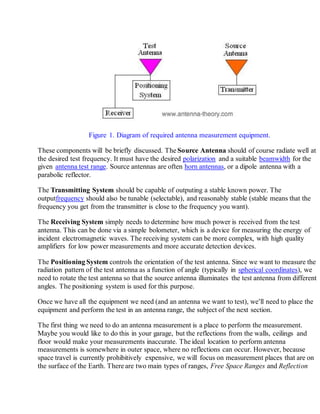
A block diagram of the above equipment is shown in Figure 1.
Figure 1. Diagram of required antenna measurement equipment.
These components will be briefly discussed. The Source Antenna should of course radiate well at
the desired test frequency. It must have the desired polarization and a suitable beamwidth for the
given antenna test range. Source antennas are often horn antennas, or a dipole antenna with a
parabolic reflector.
The Transmitting System should be capable of outputing a stable known power. The
outputfrequency should also be tunable (selectable), and reasonably stable (stable means that the
frequency you get from the transmitter is close to the frequency you want).
The Receiving System simply needs to determine how much power is received from the test
antenna. This can be done via a simple bolometer, which is a device for measuring the energy of
incident electromagnetic waves. The receiving system can be more complex, with high quality
amplifiers for low power measurements and more accurate detection devices.
The Positioning System controls the orientation of the test antenna. Since we want to measure the
radiation pattern of the test antenna as a function of angle (typically in spherical coordinates), we
need to rotate the test antenna so that the source antenna illuminates the test antenna from different
angles. The positioning system is used for this purpose.
Once we have all the equipment we need (and an antenna we want to test), we'll need to place the
equipment and perform the test in an antenna range, the subject of the next section.
The first thing we need to do an antenna measurement is a place to perform the measurement.
Maybe you would like to do this in your garage, but the reflections from the walls, ceilings and
floor would make your measurements inaccurate. The ideal location to perform antenna
measurements is somewhere in outer space, where no reflections can occur. However, because
space travel is currently prohibitively expensive, we will focus on measurement places that are on
the surface of the Earth. There are two main types of ranges, Free Space Ranges and Reflection
Ranges. Reflection ranges are designed such that reflections add together in the test region to
support a roughly planar wave. We will focus on the more common free space ranges.
Free Space Ranges
Free space ranges are antenna measurement locations designed to simulate measurements that
would be performed in space. That is, all reflected waves from nearby objects and the ground
(which are undesirable) are suppressed as much as possible. The most popular free space ranges are
anechoic chambers, elevated ranges, and the compact range.
Anechoic Chambers
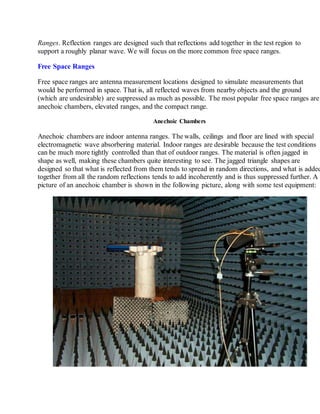
Anechoic chambers are indoor antenna ranges. The walls, ceilings and floor are lined with special
electromagnetic wave absorbering material. Indoor ranges are desirable because the test conditions
can be much more tightly controlled than that of outdoor ranges. The material is often jagged in
shape as well, making these chambers quite interesting to see. The jagged triangle shapes are
designed so that what is reflected from them tends to spread in random directions, and what is added
together from all the random reflections tends to add incoherently and is thus suppressed further. A
picture of an anechoic chamber is shown in the following picture, along with some test equipment:
The drawback to anechoic chambers is that they often need to be quite large. Often antennas need to
be several wavelenghts away from each other at a minimum to simulate far-field conditions. Hence,
it is desired to have anechoic chambers as large as possible, but cost and practical constraints often
limit their size. Some defense contracting companies that measure the Radar Cross Section of large
airplanes or other objects are known to have anechoic chambers the size of basketball courts,
although this is not ordinary. universities with anechoic chambers typically have chambers that are
3-5 meters in length, width and height. Because of the size constraint, and because RF absorbing
material typically works best at UHF and higher, anechoic chambers are most often used
forfrequencies above 300 MHz. Finally, the chamber should also be large enough that the source
antenna's main lobe is not in view of the side walls, ceiling or floor.
Elevated Ranges
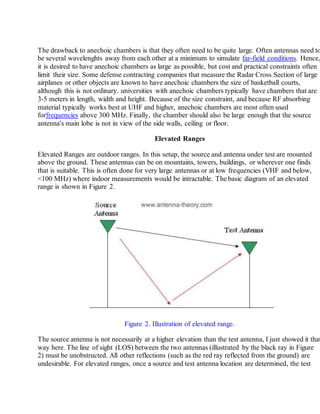
Elevated Ranges are outdoor ranges. In this setup, the source and antenna under test are mounted
above the ground. These antennas can be on mountains, towers, buildings, or wherever one finds
that is suitable. This is often done for very large antennas or at low frequencies (VHF and below,
<100 MHz) where indoor measurements would be intractable. The basic diagram of an elevated
range is shown in Figure 2.
Figure 2. Illustration of elevated range.
The source antenna is not necessarily at a higher elevation than the test antenna, I just showed it that
way here. The line of sight (LOS) between the two antennas (illustrated by the black ray in Figure
2) must be unobstructed. All other reflections (such as the red ray reflected from the ground) are
undesirable. For elevated ranges, once a source and test antenna location are determined, the test
operators then determine where the significant reflections will occur, and attempt to minimize the
reflections from these surfaces. Often rf absorbing material is used for this purpose, or other
material that deflects the rays away from the test antenna.
Compact Ranges
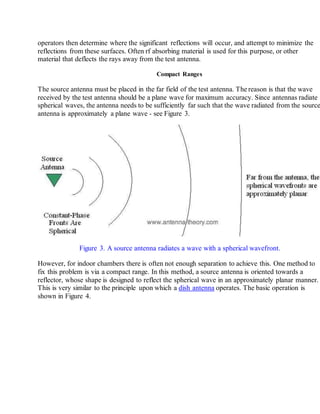
The source antenna must be placed in the far field of the test antenna. The reason is that the wave
received by the test antenna should be a plane wave for maximum accuracy. Since antennas radiate
spherical waves, the antenna needs to be sufficiently far such that the wave radiated from the source
antenna is approximately a plane wave - see Figure 3.
Figure 3. A source antenna radiates a wave with a spherical wavefront.
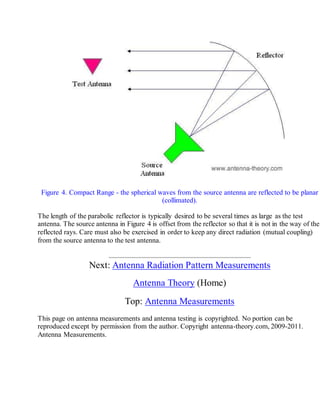
However, for indoor chambers there is often not enough separation to achieve this. One method to
fix this problem is via a compact range. In this method, a source antenna is oriented towards a
reflector, whose shape is designed to reflect the spherical wave in an approximately planar manner.
This is very similar to the principle upon which a dish antenna operates. The basic operation is
shown in Figure 4.
Figure 4. Compact Range - the spherical waves from the source antenna are reflected to be planar
(collimated).
The length of the parabolic reflector is typically desired to be several times as large as the test
antenna. The source antenna in Figure 4 is offset from the reflector so that it is not in the way of the
reflected rays. Care must also be exercised in order to keep any direct radiation (mutual coupling)
from the source antenna to the test antenna.
Next: Antenna Radiation Pattern Measurements
Antenna Theory (Home)
Top: Antenna Measurements
This page on antenna measurements and antenna testing is copyrighted. No portion can be
reproduced except by permission from the author. Copyright antenna-theory.com, 2009-2011.
Antenna Measurements.
Antenna measurement
From Wikipedia, the free encyclopedia
This article needs additionalcitations for verification. Please help improve
this article by adding citations to reliable sources. Unsourced material may be
challenged and removed. (January 2012)
Antenna measurement techniques refers to the testing of antennas to ensure that the antenna
meets specifications or simply to characterize it. Typical parameters of antennas are gain, radiation
pattern, beamwidth, polarization, and impedance.
The antenna pattern is the response of the antenna to a plane wave incident from a given direction
or the relative power density of the wave transmitted by the antenna in a given direction. For a
reciprocal antenna, these two patterns are identical. A multitude of antenna pattern measurement
techniques have been developed. The first technique developed was the far-field range, where the
antenna under test (AUT) is placed in the far-field of a range antenna. Due to the size required to
create a far-field range for large antennas, near-field techniques were developed, which allow the
measurement of the field on a surface close to the antenna (typically 3 to 10 times its wavelength).
This measurement is then predicted to be the same at infinity. A third common method is the
compact range, which uses a reflector to create a field near the AUT that looks approximately like a
plane-wave.
Contents
[hide]
 1Far-field range (FF)
 2Near-field range (NF)
o 2.1Planar near-field range
 2.1.1Rectangular planar scanning
 2.1.2Polar planar scanning
 2.1.3Bi-polar planar scanning
o 2.2Cylindrical near-field range
o 2.3Spherical near-field range
 3Free-space ranges
o 3.1Compact range
o 3.2Elevated range
o 3.3Slant range
 4Antenna parameters
o 4.1Radiation pattern
o 4.2Efficiency
o 4.3Bandwidth
o 4.4Directivity
o 4.5Gain
 5Physical background
 6Calculation of antenna parameters in reception
 7See also
 8References
 9Further reading
Far-field range (FF)[edit]
The far-field range was the original antenna measurement technique, and consists of placing the
AUT a long distance away from the instrumentation antenna. Generally, the far-field distance
or Fraunhofer distance, d, is considered to be
,
where D is the maximum dimension of the antenna and is the wavelength of the radio
wave.[1]
Separating the AUT and the instrumentation antenna by this distance reduces the phase
variation across the AUT enough to obtain a reasonably good antenna pattern.
IEEE suggests the use of their antenna measurement standard, document number IEEE-Std-
149-1979 for far-field ranges and measurement set-up for various techniques including ground-
bounce type ranges.
Near-field range (NF)[edit]
Main article: Electromagnetic near-field scanner
Planar near-field range[edit]
Planar near-field measurements are conducted by scanning a small probe antenna over a
planar surface. These measurements are then transformed to the far-field by use of aFourier
transform, or more specifically by applying a method known as stationary phase[2]
to the Laplace
transform . Three basic types of planar scans exist in near field measurements.
Rectangular planar scanning[edit]
The probe moves in the Cartesian coordinate system and its linear movement creates a regular
rectangular sampling grid with a maximum near-field sample spacing of Δx = Δy = λ /2.
Polar planar scanning[edit]
More complicated solution to the rectangular scanning method is the plane polar scanning
method.
Bi-polar planar scanning[edit]
The bi-polar technique is very similar to the plane polar configuration.
Cylindrical near-field range[edit]
Cylindrical near-field ranges measure the electric field on a cylindrical surface close to the AUT.
Cylindrical harmonics are used transform these measurements to the far-field.
Spherical near-field range[edit]
Spherical near-field ranges measure the electric field on a spherical surface close to the AUT.
Spherical harmonics are used transform these measurements to the far-field
Free-space ranges[edit]
This section
requiresexpansion.(June 2008)
The formula for electromagnetic radiation dispersion and information is:
Where D=Distance, P=Power, and S=Speed
What this means is that double the communication distance requires four times the power. It
also means double power allows double communication speed (bit rate). Double power is
approx. 3dB (10 log(2) to be exact) increase. Of course in the real world there are all sorts of
other phenomena which enter in, such as Fresnel canceling, path loss, background noise,
etc.
Compact range[edit]
A Compact Antenna Test Range (CATR) is a facility which is used to provide convenient
testing of antenna systems at frequencies where obtaining far-field spacing to the AUT
would be infeasible using traditional free space methods. It was invented by Richard C.
Johnson at the Georgia Tech Research Institute.[3]
The CATR uses a source antenna which
radiates a spherical wavefront and one or more secondary reflectors to collimate the
radiated spherical wavefront into a planar wavefront within the desired test zone. One typical
embodiment uses a horn feed antenna and a parabolic reflector to accomplish this.
The CATR is used for microwave and millimeter wave frequencies where the 2 D2
/λ far-field
distance is large, such as with high-gain reflector antennas. The size of the range that is
required can be much less than the size required for a full-size far-field anechoic chamber,
although the cost of fabrication of the specially-designed CATR reflector can be expensive
due to the need to ensure precision of the reflecting surface (typically less than λ/100 RMS
surface accuracy) and to specially treat the edge of the reflector to avoid diffracted waves
which can interfere with the desired beam pattern.
Elevated range[edit]
A means of reducing reflection from waves bouncing off the ground.
Slant range[edit]
A means of eliminating symmetrical wave reflection.
Antenna parameters[edit]
See also: Antenna (radio) § Characteristics
Except for polarization, the SWR is the most easily measured of the parameters above.
Impedance can be measured with specialized equipment, as it relates to the complexSWR.
Measuring radiation pattern requires a sophisticated setup including significant clear space
(enough to put the sensor into the antenna's far field, or an anechoic chamber designed for
antenna measurements), careful study of experiment geometry, and specialized
measurement equipment that rotates the antenna during the measurements.
Radiation pattern[edit]
Main article: Radiation pattern
The radiation pattern is a graphical depiction of the relative field strength transmitted from or
received by the antenna, and shows sidelobes and backlobes. As antennas radiate in space
often several curves are necessary to describe the antenna. If the radiation of the antenna is
symmetrical about an axis (as is the case in dipole, helical and someparabolic antennas) a
unique graph is sufficient.
Each antenna supplier/user has different standards as well as plotting formats. Each format
has its own advantages and disadvantages. Radiation pattern of an antenna can be defined
as the locus of all points where the emitted power per unit surface is the same. The radiated
power per unit surface is proportional to the squared electrical field of the electromagnetic
wave. The radiation pattern is the locus of points with the same electrical field. In this
representation, the reference is usually the best angle of emission. It is also possible to
depict the directive gain of the antenna as a function of the direction. Often the gain is given
in decibels.
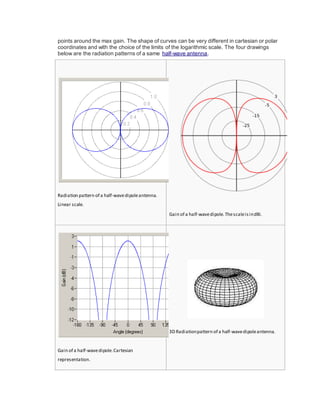
The graphs can be drawn using cartesian (rectangular) coordinates or a polar plot. This last
one is useful to measure the beamwidth, which is, by convention, the angle at the -3dB
points around the max gain. The shape of curves can be very different in cartesian or polar
coordinates and with the choice of the limits of the logarithmic scale. The four drawings
below are the radiation patterns of a same half-wave antenna.
Radiation pattern of a half-wavedipoleantenna.
Linear scale.
Gain of a half-wavedipole.ThescaleisindBi.
Gain of a half-wavedipole.Cartesian
representation.
3D Radiationpattern of a half-wavedipoleantenna.
Efficiency[edit]
Main article: Antenna efficiency
Efficiency is the ratio of power actually radiated by an antenna to the electrical power it
receives from a transmitter. A dummy load may have an SWR of 1:1 but an efficiency of 0,
as it absorbs all the incident power, producing heat but radiating no RF energy; SWR is no
measure of an antenna's efficiency. Radiation in an antenna is caused by radiation
resistance which cannot be directly measured but is a component of the
total resistance which includes the loss resistance. Loss resistance results in heat
generation rather than radiation, thus reducing efficiency. Mathematically, efficiency is equal
to the radiation resistance divided by total resistance (real part) of the feed-point impedance.
Efficiency is defined as the ratio of the power that is radiated to the total power used by the
antenna; Total power = power radiated + power loss.
Bandwidth[edit]
Main article: Antenna bandwidth
IEEE defines bandwidth as "The range of frequencies within which the performance of
the antenna, with respect to some characteristic, conforms to a specified standard." [4]
In
other words, bandwidth depends on the overall effectiveness of the antenna through a
range of frequencies, so all of these parameters must be understood to fully
characterize the bandwidth capabilities of an antenna. This definition may serve as a
practical definition, however, in practice, bandwidth is typically determined by measuring
a characteristic such as SWR or radiated power over the frequency range of interest.
For example, the SWR bandwidth is typically determined by measuring the frequency
range where the SWR is less than 2:1. Another frequently used value for determining
bandwidth for resonant antennas is the -3dB Return Loss value.
Directivity[edit]
Main article: Directivity
Antenna directivity is the ratio of maximum radiation intensity (power per unit surface)
radiated by the antenna in the maximum direction divided by the intensity radiated by a
hypothetical isotropic antenna radiating the same total power as that antenna. For
example, a hypothetical antenna which had a radiated pattern of a hemisphere (1/2
sphere) would have a directivity of 2. Directivity is a dimensionless ratio and may be
expressed numerically or in decibels (dB). Directivity is identical to the peak value of
the directive gain; these values are specified without respect to antenna efficiency thus
differing from the power gain (or simply "gain") whose value is reduced by an
antenna's efficiency.
Gain[edit]
Main article: Antenna gain
Gain as a parameter measures the directionality of a given antenna. An antenna with a
low gain emits radiation in all directions equally, whereas a high-gain antenna will
preferentially radiate in particular directions. Specifically, the Gain or Power gain of an
antenna is defined as the ratio of the intensity (power per unit surface) radiated by the
antenna in a given direction at an arbitrary distance divided by the intensity radiated at
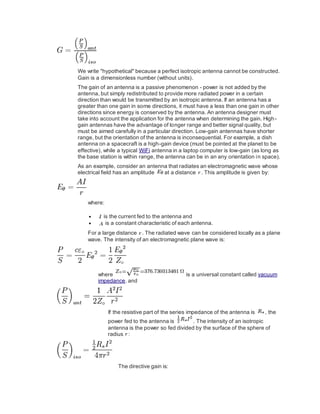
the same distance by an hypothetical isotropic antenna:
We write "hypothetical" because a perfect isotropic antenna cannot be constructed.
Gain is a dimensionless number (without units).
The gain of an antenna is a passive phenomenon - power is not added by the
antenna, but simply redistributed to provide more radiated power in a certain
direction than would be transmitted by an isotropic antenna. If an antenna has a
greater than one gain in some directions, it must have a less than one gain in other
directions since energy is conserved by the antenna. An antenna designer must
take into account the application for the antenna when determining the gain. High-
gain antennas have the advantage of longer range and better signal quality, but
must be aimed carefully in a particular direction. Low-gain antennas have shorter
range, but the orientation of the antenna is inconsequential. For example, a dish
antenna on a spacecraft is a high-gain device (must be pointed at the planet to be
effective), while a typical WiFi antenna in a laptop computer is low-gain (as long as
the base station is within range, the antenna can be in an any orientation in space).
As an example, consider an antenna that radiates an electromagnetic wave whose
electrical field has an amplitude at a distance . This amplitude is given by:
where:
 is the current fed to the antenna and
 is a constant characteristic of each antenna.
For a large distance . The radiated wave can be considered locally as a plane
wave. The intensity of an electromagnetic plane wave is:
where is a universal constant called vacuum
impedance. and
If the resistive part of the series impedance of the antenna is , the
power fed to the antenna is . The intensity of an isotropic
antenna is the power so fed divided by the surface of the sphere of
radius :
The directive gain is:
For the commonly utilized half-wave dipole, the particular
formulation works out to the following, including
its decibel equivalency, expressed as dBi (decibels referenced
toisotropic radiator):
(In most cases 73.13, is adequate)
(Likewise,1.64 and2.15dBi are usually thecitedvalues)
Sometimes, the half-wave dipole is taken as a
reference instead of the isotropic radiator. The gain is
then given in dBd (decibels over dipole):
0 dBd = 2.15 dBi
Physical background[edit]
The measured electrical field was radiated seconds
earlier.
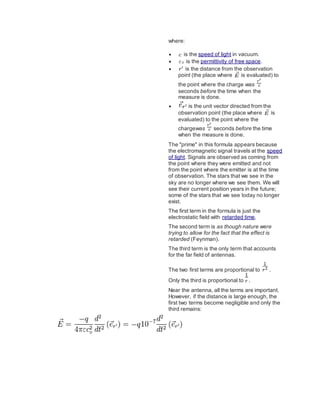
The electrical field created by an electric charge
is
where:
 is the speed of light in vacuum.
 is the permittivity of free space.
 is the distance from the observation
point (the place where is evaluated) to
the point where the charge was
seconds before the time when the
measure is done.
 is the unit vector directed from the
observation point (the place where is
evaluated) to the point where the
chargewas seconds before the time
when the measure is done.
The "prime" in this formula appears because
the electromagnetic signal travels at the speed
of light. Signals are observed as coming from
the point where they were emitted and not
from the point where the emitter is at the time
of observation. The stars that we see in the
sky are no longer where we see them. We will
see their current position years in the future;
some of the stars that we see today no longer
exist.
The first term in the formula is just the
electrostatic field with retarded time.
The second term is as though nature were
trying to allow for the fact that the effect is
retarded (Feynman).
The third term is the only term that accounts
for the far field of antennas.
The two first terms are proportional to .
Only the third is proportional to .
Near the antenna, all the terms are important.
However, if the distance is large enough, the
first two terms become negligible and only the
third remains:
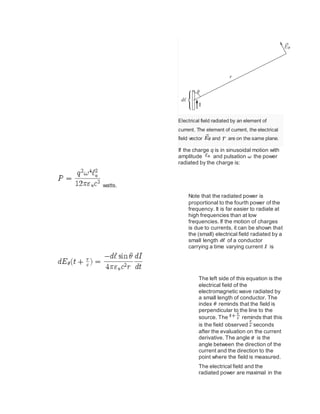
Electrical field radiated by an element of
current. The element of current, the electrical
field vector and are on the same plane.
If the charge q is in sinusoidal motion with
amplitude and pulsation the power
radiated by the charge is:
watts.
Note that the radiated power is
proportional to the fourth power of the
frequency. It is far easier to radiate at
high frequencies than at low
frequencies. If the motion of charges
is due to currents, it can be shown that
the (small) electrical field radiated by a
small length of a conductor
carrying a time varying current is
The left side of this equation is the
electrical field of the
electromagnetic wave radiated by
a small length of conductor. The
index reminds that the field is
perpendicular to the line to the
source. The reminds that this
is the field observed seconds
after the evaluation on the current
derivative. The angle is the
angle between the direction of the
current and the direction to the
point where the field is measured.
The electrical field and the
radiated power are maximal in the
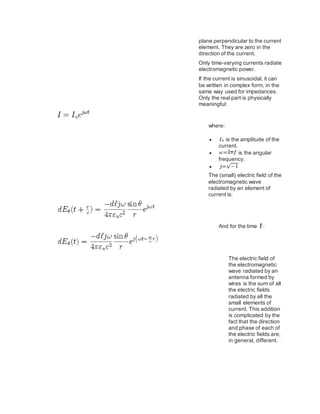
plane perpendicular to the current
element. They are zero in the
direction of the current.
Only time-varying currents radiate
electromagnetic power.
If the current is sinusoidal, it can
be written in complex form, in the
same way used for impedances.
Only the real part is physically
meaningful:
where:
 is the amplitude of the
current.
 is the angular
frequency.

The (small) electric field of the
electromagnetic wave
radiated by an element of
current is:
And for the time :
The electric field of
the electromagnetic
wave radiated by an
antenna formed by
wires is the sum of all
the electric fields
radiated by all the
small elements of
current. This addition
is complicated by the
fact that the direction
and phase of each of
the electric fields are,
in general, different.
Calculation of
antenna
parameters in
reception[edit]
The gain in any given
direction and the
impedance at a
given frequency are
the same when the
antenna is used in
transmission or in
reception.
The electric field of an
electromagnetic wave
induces a
small voltage in each
small segment in all
electric conductors.
The induced voltage
depends on the
electrical field and the
conductor length. The
voltage depends also
on the relative
orientation of the
segment and the
electrical field.
Each small voltage
induces a current and
these currents
circulate through a
small part of the
antenna impedance.
The result of all those
currents and tensions
is far from immediate.
However, using
the reciprocity
theorem, it is possible
to prove that the
Thévenin equivalent
circuit of a receiving
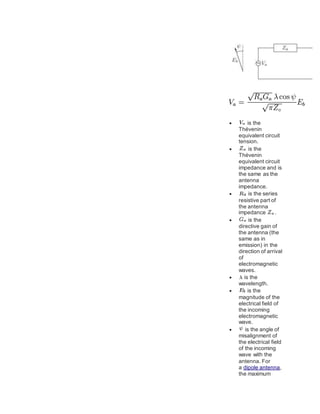
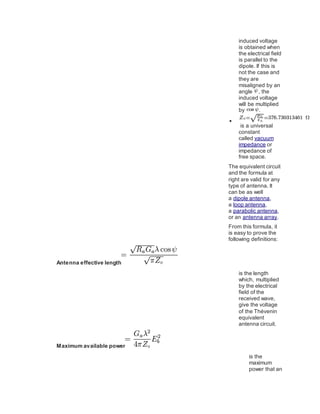
antenna is:
 is the
Thévenin
equivalent circuit
tension.
 is the
Thévenin
equivalent circuit
impedance and is
the same as the
antenna
impedance.
 is the series
resistive part of
the antenna
impedance .
 is the
directive gain of
the antenna (the
same as in
emission) in the
direction of arrival
of
electromagnetic
waves.
 is the
wavelength.
 is the
magnitude of the
electrical field of
the incoming
electromagnetic
wave.
 is the angle of
misalignment of
the electrical field
of the incoming
wave with the
antenna. For
a dipole antenna,
the maximum
induced voltage
is obtained when
the electrical field
is parallel to the
dipole. If this is
not the case and
they are
misaligned by an
angle , the
induced voltage
will be multiplied
by .

is a universal
constant
called vacuum
impedance or
impedance of
free space.
The equivalent circuit
and the formula at
right are valid for any
type of antenna. It
can be as well
a dipole antenna,
a loop antenna,
a parabolic antenna,
or an antenna array.
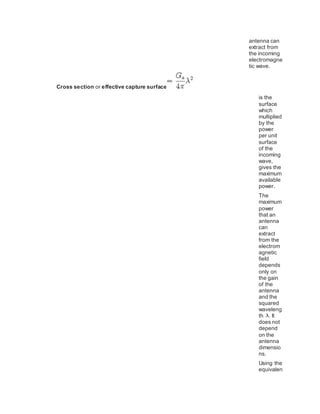
From this formula, it
is easy to prove the
following definitions:
Antenna effective length
is the length
which, multiplied
by the electrical
field of the
received wave,
give the voltage
of the Thévenin
equivalent
antenna circuit.
Maximum available power
is the
maximum
power that an
antenna can
extract from
the incoming
electromagne
tic wave.
Cross section or effective capture surface
is the
surface
which
multiplied
by the
power
per unit
surface
of the
incoming
wave,
gives the
maximum
available
power.
The
maximum
power
that an
antenna
can
extract
from the
electrom
agnetic
field
depends
only on
the gain
of the
antenna
and the
squared
waveleng
th . It
does not
depend
on the
antenna
dimensio
ns.
Using the
equivalen
t circuit, it
can be
shown
that the
maximum
power is
absorbed
by the
antenna
when it is
terminate
d with a
load
matched
to the
antenna
input
impedanc
e. This
also
implies
that
under
matched
condition
s, the
amount
of power
re-
radiated
by the
receiving
antenna
is equal
to that
absorbed
.
See
also[e
dit]
 Free
spac
e
 Impe
danc
e of
free
spac
e
 Near
and
far
field
Refer
ences[
edit]
1. J
u
m
p
u
p
^
C
.
A
.
B
a
l
a
n
is
.
A
n
t
e
n
n
a
T
h
e
o
r
y
:
A
n
a
ly
si
s
a
n
d
D
e
si
g
n
,
3
r
d
e
d
.
W
il
e
y
I
n
t
e
r
s
ci
e
n
c
e
,
2
0
0
5
.
2. J
u
m
p
u
p
^
A
s
y
m
p
t
o
ti
c
B
e
h
a
vi
o
r
o
f
M
o
n
o
d
r
o
m
y
,
S
p
ri
n
g
e
r
B
e
rl
i
n
/
H
e
i
d
e
l
b
e
r
g
,
1
9
9
1
,
I
S
B
N
9
7
8
-
3
-
5
4
0
-
5
5
0
0
9
-
9
3. J
u
m
p
u
p
^
M
c
L
e
e
s
,
L
e
a
(
2
0
1
0
-
0
2
-
0
3
).
"
G
T
R
I
a
n
t
e
n
n
a
e
x
p
e
rt
a
n
d
e
n
g
i
n
e
e
ri
n
g
m
e
n
t
o
r
d
i
e
s
".
T
h
e
W
h
is
tl
e
(
G
e
o
r
g
i
a
I
n
s
ti
t
u
t
e
o
f
T
e
c
h
n
o
l
o
g
y
).
R
e
tr
i
e
v
e
d
2
0
1
1
-
1
1
-
0
9
.
4. J
u
m
p
u
p
^
"
I
E
E
E
s
t
a
n
d
a
r
d
d
e
fi
n
iti
o
n
s
o
f
t
e
r
m
s
f
o
r
a
n
t
e
n
n
a
s
.,
"
I
E
E
E
S
t
d
1
4
5
-
1
9
9
3
,
p
p
.
6
,
2
1
J
u
n
1
9
9
3
[
1
]
Furth
er
readi
ng[edit]
 Brow
n, F.
W.
(Nov
embe
r
1964
),
"How
to
Meas
ure
Ante
nna
Gain"
, CQ:
40–
???
Categorie
s:
 Antennas
(radio)
Navigat
ion
menu
 Not
logged in
 Talk
 Contribut
ions
 Create
account
 Log in
 Article
 Talk
 Read
 Edit
 View
history
Go
 Main page
 Contents
 Featured
content
 Current
events
 Random
article
 Donate to
Wikipedia
 Wikipedia
store
Interaction
 Help
 About
Wikipedia
 Community
portal
 Recent
changes
Print/expor
t

Antenna measurements

  • 1.
    Antenna Measurements Antennas (Home)Antenna Basics Testing of real antennas is fundamental to antenna theory. All the antenna theory in the world doesn't add up to a hill of beans if the antennas under test don't perform as desired. Antenna Measurementsis a science unto itself; as a very good antenna measurer once said to me "good antenna measurements don't just happen". What exactly are we looking for when we test or measure antennas? Basically, we want to measure many of the fundamental parameters listed on the Antenna Basicspage. The most common and desired measurements are an antenna's radiation pattern includingantenna gain and efficiency, the impedance or VSWR, the bandwidth, and the polarization. The procedures and equipment used in antenna measurements are described in the following sections: 1. Required Equipment and Ranges In this first section on Antenna Measurements, we look at the required equipment and types of "antenna ranges" used in modern antenna measurement systems. 2. Radiaton Pattern and Gain Measurements The second antenna measurements section discusses how to perform the most fundamental antenna measurement - determining an antenna's radiation pattern and extracting the antenna gain. 3. Phase Measurements The third antenna measurements section focuses on determining phase information from an antenna's radiation pattern. The phase is more important in terms of 'relative phase' (phase relative to other positions on the radiation pattern), not 'absolute phase'. 4. Polarization Measurements The fourth antenna measurements section discusses techniques for determining the polarization of the antenna under test. These techniques are used to classify an antenna as linearly, circularly or elliptically polarized.
  • 2.
    5. Impedance Measurements Thefifth antenna measurement section illustrates how to determine an antenna's impedance as a function of frequency. Here the focus is on the use of a Vector Network Analyzer (VNA). 6. Scale Model Measurements The sixth antenna measurement section explains the useful concept of scale model measurements. This page illustrates how to obtain measurements when the physical size of the desired test is too large (or possibly, too small). 7. SAR (Specific Absorption Rate) Measurements The final antenna measurement section illustrates the new field of SAR measurements and explains what SAR is. These measurements are critical in consumer electronics as antenna design consistently needs altered (or even degraded) in order to meet FCC SAR requirements. Required Equipment in Antenna Measurements For antenna test equipment, we will attempt to illuminate the test antenna (often called an Antenna- Under-Test) with a plane wave. This will be approximated by using a source (transmitting) antenna with known radiation pattern and characteristics, in such a way that the fields incident upon the test antenna are approximately plane waves. More will be discussed about this in the next section. The required equipment for antenna measurements include:  A source antenna and transmitter - This antenna will have a known pattern that can be used to illuminate the test antenna  A receiver system - This determines how much power is received by the test antenna  A positioning system - This system is used to rotate the test antenna relative to the source antenna, to measure the radiation pattern as a function of angle. A block diagram of the above equipment is shown in Figure 1.
  • 3.
    Figure 1. Diagramof required antenna measurement equipment. These components will be briefly discussed. The Source Antenna should of course radiate well at the desired test frequency. It must have the desired polarization and a suitable beamwidth for the given antenna test range. Source antennas are often horn antennas, or a dipole antenna with a parabolic reflector. The Transmitting System should be capable of outputing a stable known power. The outputfrequency should also be tunable (selectable), and reasonably stable (stable means that the frequency you get from the transmitter is close to the frequency you want). The Receiving System simply needs to determine how much power is received from the test antenna. This can be done via a simple bolometer, which is a device for measuring the energy of incident electromagnetic waves. The receiving system can be more complex, with high quality amplifiers for low power measurements and more accurate detection devices. The Positioning System controls the orientation of the test antenna. Since we want to measure the radiation pattern of the test antenna as a function of angle (typically in spherical coordinates), we need to rotate the test antenna so that the source antenna illuminates the test antenna from different angles. The positioning system is used for this purpose. Once we have all the equipment we need (and an antenna we want to test), we'll need to place the equipment and perform the test in an antenna range, the subject of the next section. The first thing we need to do an antenna measurement is a place to perform the measurement. Maybe you would like to do this in your garage, but the reflections from the walls, ceilings and floor would make your measurements inaccurate. The ideal location to perform antenna measurements is somewhere in outer space, where no reflections can occur. However, because space travel is currently prohibitively expensive, we will focus on measurement places that are on the surface of the Earth. There are two main types of ranges, Free Space Ranges and Reflection
  • 4.
    Ranges. Reflection rangesare designed such that reflections add together in the test region to support a roughly planar wave. We will focus on the more common free space ranges. Free Space Ranges Free space ranges are antenna measurement locations designed to simulate measurements that would be performed in space. That is, all reflected waves from nearby objects and the ground (which are undesirable) are suppressed as much as possible. The most popular free space ranges are anechoic chambers, elevated ranges, and the compact range. Anechoic Chambers Anechoic chambers are indoor antenna ranges. The walls, ceilings and floor are lined with special electromagnetic wave absorbering material. Indoor ranges are desirable because the test conditions can be much more tightly controlled than that of outdoor ranges. The material is often jagged in shape as well, making these chambers quite interesting to see. The jagged triangle shapes are designed so that what is reflected from them tends to spread in random directions, and what is added together from all the random reflections tends to add incoherently and is thus suppressed further. A picture of an anechoic chamber is shown in the following picture, along with some test equipment:
  • 5.
    The drawback toanechoic chambers is that they often need to be quite large. Often antennas need to be several wavelenghts away from each other at a minimum to simulate far-field conditions. Hence, it is desired to have anechoic chambers as large as possible, but cost and practical constraints often limit their size. Some defense contracting companies that measure the Radar Cross Section of large airplanes or other objects are known to have anechoic chambers the size of basketball courts, although this is not ordinary. universities with anechoic chambers typically have chambers that are 3-5 meters in length, width and height. Because of the size constraint, and because RF absorbing material typically works best at UHF and higher, anechoic chambers are most often used forfrequencies above 300 MHz. Finally, the chamber should also be large enough that the source antenna's main lobe is not in view of the side walls, ceiling or floor. Elevated Ranges Elevated Ranges are outdoor ranges. In this setup, the source and antenna under test are mounted above the ground. These antennas can be on mountains, towers, buildings, or wherever one finds that is suitable. This is often done for very large antennas or at low frequencies (VHF and below, <100 MHz) where indoor measurements would be intractable. The basic diagram of an elevated range is shown in Figure 2. Figure 2. Illustration of elevated range. The source antenna is not necessarily at a higher elevation than the test antenna, I just showed it that way here. The line of sight (LOS) between the two antennas (illustrated by the black ray in Figure 2) must be unobstructed. All other reflections (such as the red ray reflected from the ground) are undesirable. For elevated ranges, once a source and test antenna location are determined, the test
  • 6.
    operators then determinewhere the significant reflections will occur, and attempt to minimize the reflections from these surfaces. Often rf absorbing material is used for this purpose, or other material that deflects the rays away from the test antenna. Compact Ranges The source antenna must be placed in the far field of the test antenna. The reason is that the wave received by the test antenna should be a plane wave for maximum accuracy. Since antennas radiate spherical waves, the antenna needs to be sufficiently far such that the wave radiated from the source antenna is approximately a plane wave - see Figure 3. Figure 3. A source antenna radiates a wave with a spherical wavefront. However, for indoor chambers there is often not enough separation to achieve this. One method to fix this problem is via a compact range. In this method, a source antenna is oriented towards a reflector, whose shape is designed to reflect the spherical wave in an approximately planar manner. This is very similar to the principle upon which a dish antenna operates. The basic operation is shown in Figure 4.
  • 7.
    Figure 4. CompactRange - the spherical waves from the source antenna are reflected to be planar (collimated). The length of the parabolic reflector is typically desired to be several times as large as the test antenna. The source antenna in Figure 4 is offset from the reflector so that it is not in the way of the reflected rays. Care must also be exercised in order to keep any direct radiation (mutual coupling) from the source antenna to the test antenna. Next: Antenna Radiation Pattern Measurements Antenna Theory (Home) Top: Antenna Measurements This page on antenna measurements and antenna testing is copyrighted. No portion can be reproduced except by permission from the author. Copyright antenna-theory.com, 2009-2011. Antenna Measurements.
  • 8.
    Antenna measurement From Wikipedia,the free encyclopedia This article needs additionalcitations for verification. Please help improve this article by adding citations to reliable sources. Unsourced material may be challenged and removed. (January 2012) Antenna measurement techniques refers to the testing of antennas to ensure that the antenna meets specifications or simply to characterize it. Typical parameters of antennas are gain, radiation pattern, beamwidth, polarization, and impedance. The antenna pattern is the response of the antenna to a plane wave incident from a given direction or the relative power density of the wave transmitted by the antenna in a given direction. For a reciprocal antenna, these two patterns are identical. A multitude of antenna pattern measurement techniques have been developed. The first technique developed was the far-field range, where the antenna under test (AUT) is placed in the far-field of a range antenna. Due to the size required to create a far-field range for large antennas, near-field techniques were developed, which allow the measurement of the field on a surface close to the antenna (typically 3 to 10 times its wavelength). This measurement is then predicted to be the same at infinity. A third common method is the compact range, which uses a reflector to create a field near the AUT that looks approximately like a plane-wave. Contents [hide]  1Far-field range (FF)  2Near-field range (NF) o 2.1Planar near-field range  2.1.1Rectangular planar scanning  2.1.2Polar planar scanning  2.1.3Bi-polar planar scanning o 2.2Cylindrical near-field range o 2.3Spherical near-field range  3Free-space ranges o 3.1Compact range o 3.2Elevated range o 3.3Slant range  4Antenna parameters o 4.1Radiation pattern o 4.2Efficiency o 4.3Bandwidth o 4.4Directivity o 4.5Gain  5Physical background  6Calculation of antenna parameters in reception  7See also  8References  9Further reading
  • 9.
    Far-field range (FF)[edit] Thefar-field range was the original antenna measurement technique, and consists of placing the AUT a long distance away from the instrumentation antenna. Generally, the far-field distance or Fraunhofer distance, d, is considered to be , where D is the maximum dimension of the antenna and is the wavelength of the radio wave.[1] Separating the AUT and the instrumentation antenna by this distance reduces the phase variation across the AUT enough to obtain a reasonably good antenna pattern. IEEE suggests the use of their antenna measurement standard, document number IEEE-Std- 149-1979 for far-field ranges and measurement set-up for various techniques including ground- bounce type ranges. Near-field range (NF)[edit] Main article: Electromagnetic near-field scanner Planar near-field range[edit] Planar near-field measurements are conducted by scanning a small probe antenna over a planar surface. These measurements are then transformed to the far-field by use of aFourier transform, or more specifically by applying a method known as stationary phase[2] to the Laplace transform . Three basic types of planar scans exist in near field measurements. Rectangular planar scanning[edit] The probe moves in the Cartesian coordinate system and its linear movement creates a regular rectangular sampling grid with a maximum near-field sample spacing of Δx = Δy = λ /2. Polar planar scanning[edit] More complicated solution to the rectangular scanning method is the plane polar scanning method. Bi-polar planar scanning[edit] The bi-polar technique is very similar to the plane polar configuration.
  • 10.
    Cylindrical near-field range[edit] Cylindricalnear-field ranges measure the electric field on a cylindrical surface close to the AUT. Cylindrical harmonics are used transform these measurements to the far-field. Spherical near-field range[edit] Spherical near-field ranges measure the electric field on a spherical surface close to the AUT. Spherical harmonics are used transform these measurements to the far-field Free-space ranges[edit] This section requiresexpansion.(June 2008) The formula for electromagnetic radiation dispersion and information is: Where D=Distance, P=Power, and S=Speed What this means is that double the communication distance requires four times the power. It also means double power allows double communication speed (bit rate). Double power is approx. 3dB (10 log(2) to be exact) increase. Of course in the real world there are all sorts of other phenomena which enter in, such as Fresnel canceling, path loss, background noise, etc.
  • 11.
    Compact range[edit] A CompactAntenna Test Range (CATR) is a facility which is used to provide convenient testing of antenna systems at frequencies where obtaining far-field spacing to the AUT would be infeasible using traditional free space methods. It was invented by Richard C. Johnson at the Georgia Tech Research Institute.[3] The CATR uses a source antenna which radiates a spherical wavefront and one or more secondary reflectors to collimate the radiated spherical wavefront into a planar wavefront within the desired test zone. One typical embodiment uses a horn feed antenna and a parabolic reflector to accomplish this. The CATR is used for microwave and millimeter wave frequencies where the 2 D2 /λ far-field distance is large, such as with high-gain reflector antennas. The size of the range that is required can be much less than the size required for a full-size far-field anechoic chamber, although the cost of fabrication of the specially-designed CATR reflector can be expensive due to the need to ensure precision of the reflecting surface (typically less than λ/100 RMS surface accuracy) and to specially treat the edge of the reflector to avoid diffracted waves which can interfere with the desired beam pattern. Elevated range[edit] A means of reducing reflection from waves bouncing off the ground. Slant range[edit] A means of eliminating symmetrical wave reflection. Antenna parameters[edit] See also: Antenna (radio) § Characteristics Except for polarization, the SWR is the most easily measured of the parameters above. Impedance can be measured with specialized equipment, as it relates to the complexSWR. Measuring radiation pattern requires a sophisticated setup including significant clear space (enough to put the sensor into the antenna's far field, or an anechoic chamber designed for antenna measurements), careful study of experiment geometry, and specialized measurement equipment that rotates the antenna during the measurements. Radiation pattern[edit] Main article: Radiation pattern The radiation pattern is a graphical depiction of the relative field strength transmitted from or received by the antenna, and shows sidelobes and backlobes. As antennas radiate in space often several curves are necessary to describe the antenna. If the radiation of the antenna is symmetrical about an axis (as is the case in dipole, helical and someparabolic antennas) a unique graph is sufficient. Each antenna supplier/user has different standards as well as plotting formats. Each format has its own advantages and disadvantages. Radiation pattern of an antenna can be defined as the locus of all points where the emitted power per unit surface is the same. The radiated power per unit surface is proportional to the squared electrical field of the electromagnetic wave. The radiation pattern is the locus of points with the same electrical field. In this representation, the reference is usually the best angle of emission. It is also possible to depict the directive gain of the antenna as a function of the direction. Often the gain is given in decibels. The graphs can be drawn using cartesian (rectangular) coordinates or a polar plot. This last one is useful to measure the beamwidth, which is, by convention, the angle at the -3dB
  • 12.
    points around themax gain. The shape of curves can be very different in cartesian or polar coordinates and with the choice of the limits of the logarithmic scale. The four drawings below are the radiation patterns of a same half-wave antenna. Radiation pattern of a half-wavedipoleantenna. Linear scale. Gain of a half-wavedipole.ThescaleisindBi. Gain of a half-wavedipole.Cartesian representation. 3D Radiationpattern of a half-wavedipoleantenna.
  • 13.
    Efficiency[edit] Main article: Antennaefficiency Efficiency is the ratio of power actually radiated by an antenna to the electrical power it receives from a transmitter. A dummy load may have an SWR of 1:1 but an efficiency of 0, as it absorbs all the incident power, producing heat but radiating no RF energy; SWR is no measure of an antenna's efficiency. Radiation in an antenna is caused by radiation resistance which cannot be directly measured but is a component of the total resistance which includes the loss resistance. Loss resistance results in heat generation rather than radiation, thus reducing efficiency. Mathematically, efficiency is equal to the radiation resistance divided by total resistance (real part) of the feed-point impedance. Efficiency is defined as the ratio of the power that is radiated to the total power used by the antenna; Total power = power radiated + power loss. Bandwidth[edit] Main article: Antenna bandwidth IEEE defines bandwidth as "The range of frequencies within which the performance of the antenna, with respect to some characteristic, conforms to a specified standard." [4] In other words, bandwidth depends on the overall effectiveness of the antenna through a range of frequencies, so all of these parameters must be understood to fully characterize the bandwidth capabilities of an antenna. This definition may serve as a practical definition, however, in practice, bandwidth is typically determined by measuring a characteristic such as SWR or radiated power over the frequency range of interest. For example, the SWR bandwidth is typically determined by measuring the frequency range where the SWR is less than 2:1. Another frequently used value for determining bandwidth for resonant antennas is the -3dB Return Loss value. Directivity[edit] Main article: Directivity Antenna directivity is the ratio of maximum radiation intensity (power per unit surface) radiated by the antenna in the maximum direction divided by the intensity radiated by a hypothetical isotropic antenna radiating the same total power as that antenna. For example, a hypothetical antenna which had a radiated pattern of a hemisphere (1/2 sphere) would have a directivity of 2. Directivity is a dimensionless ratio and may be expressed numerically or in decibels (dB). Directivity is identical to the peak value of the directive gain; these values are specified without respect to antenna efficiency thus differing from the power gain (or simply "gain") whose value is reduced by an antenna's efficiency. Gain[edit] Main article: Antenna gain Gain as a parameter measures the directionality of a given antenna. An antenna with a low gain emits radiation in all directions equally, whereas a high-gain antenna will preferentially radiate in particular directions. Specifically, the Gain or Power gain of an antenna is defined as the ratio of the intensity (power per unit surface) radiated by the antenna in a given direction at an arbitrary distance divided by the intensity radiated at the same distance by an hypothetical isotropic antenna:
  • 14.
    We write "hypothetical"because a perfect isotropic antenna cannot be constructed. Gain is a dimensionless number (without units). The gain of an antenna is a passive phenomenon - power is not added by the antenna, but simply redistributed to provide more radiated power in a certain direction than would be transmitted by an isotropic antenna. If an antenna has a greater than one gain in some directions, it must have a less than one gain in other directions since energy is conserved by the antenna. An antenna designer must take into account the application for the antenna when determining the gain. High- gain antennas have the advantage of longer range and better signal quality, but must be aimed carefully in a particular direction. Low-gain antennas have shorter range, but the orientation of the antenna is inconsequential. For example, a dish antenna on a spacecraft is a high-gain device (must be pointed at the planet to be effective), while a typical WiFi antenna in a laptop computer is low-gain (as long as the base station is within range, the antenna can be in an any orientation in space). As an example, consider an antenna that radiates an electromagnetic wave whose electrical field has an amplitude at a distance . This amplitude is given by: where:  is the current fed to the antenna and  is a constant characteristic of each antenna. For a large distance . The radiated wave can be considered locally as a plane wave. The intensity of an electromagnetic plane wave is: where is a universal constant called vacuum impedance. and If the resistive part of the series impedance of the antenna is , the power fed to the antenna is . The intensity of an isotropic antenna is the power so fed divided by the surface of the sphere of radius : The directive gain is:
  • 15.
    For the commonlyutilized half-wave dipole, the particular formulation works out to the following, including its decibel equivalency, expressed as dBi (decibels referenced toisotropic radiator): (In most cases 73.13, is adequate) (Likewise,1.64 and2.15dBi are usually thecitedvalues) Sometimes, the half-wave dipole is taken as a reference instead of the isotropic radiator. The gain is then given in dBd (decibels over dipole): 0 dBd = 2.15 dBi Physical background[edit] The measured electrical field was radiated seconds earlier. The electrical field created by an electric charge is
  • 16.
    where:  is thespeed of light in vacuum.  is the permittivity of free space.  is the distance from the observation point (the place where is evaluated) to the point where the charge was seconds before the time when the measure is done.  is the unit vector directed from the observation point (the place where is evaluated) to the point where the chargewas seconds before the time when the measure is done. The "prime" in this formula appears because the electromagnetic signal travels at the speed of light. Signals are observed as coming from the point where they were emitted and not from the point where the emitter is at the time of observation. The stars that we see in the sky are no longer where we see them. We will see their current position years in the future; some of the stars that we see today no longer exist. The first term in the formula is just the electrostatic field with retarded time. The second term is as though nature were trying to allow for the fact that the effect is retarded (Feynman). The third term is the only term that accounts for the far field of antennas. The two first terms are proportional to . Only the third is proportional to . Near the antenna, all the terms are important. However, if the distance is large enough, the first two terms become negligible and only the third remains:
  • 17.
    Electrical field radiatedby an element of current. The element of current, the electrical field vector and are on the same plane. If the charge q is in sinusoidal motion with amplitude and pulsation the power radiated by the charge is: watts. Note that the radiated power is proportional to the fourth power of the frequency. It is far easier to radiate at high frequencies than at low frequencies. If the motion of charges is due to currents, it can be shown that the (small) electrical field radiated by a small length of a conductor carrying a time varying current is The left side of this equation is the electrical field of the electromagnetic wave radiated by a small length of conductor. The index reminds that the field is perpendicular to the line to the source. The reminds that this is the field observed seconds after the evaluation on the current derivative. The angle is the angle between the direction of the current and the direction to the point where the field is measured. The electrical field and the radiated power are maximal in the
  • 18.
    plane perpendicular tothe current element. They are zero in the direction of the current. Only time-varying currents radiate electromagnetic power. If the current is sinusoidal, it can be written in complex form, in the same way used for impedances. Only the real part is physically meaningful: where:  is the amplitude of the current.  is the angular frequency.  The (small) electric field of the electromagnetic wave radiated by an element of current is: And for the time : The electric field of the electromagnetic wave radiated by an antenna formed by wires is the sum of all the electric fields radiated by all the small elements of current. This addition is complicated by the fact that the direction and phase of each of the electric fields are, in general, different.
  • 19.
    Calculation of antenna parameters in reception[edit] Thegain in any given direction and the impedance at a given frequency are the same when the antenna is used in transmission or in reception. The electric field of an electromagnetic wave induces a small voltage in each small segment in all electric conductors. The induced voltage depends on the electrical field and the conductor length. The voltage depends also on the relative orientation of the segment and the electrical field. Each small voltage induces a current and these currents circulate through a small part of the antenna impedance. The result of all those currents and tensions is far from immediate. However, using the reciprocity theorem, it is possible to prove that the Thévenin equivalent circuit of a receiving antenna is:
  • 20.
     is the Thévenin equivalentcircuit tension.  is the Thévenin equivalent circuit impedance and is the same as the antenna impedance.  is the series resistive part of the antenna impedance .  is the directive gain of the antenna (the same as in emission) in the direction of arrival of electromagnetic waves.  is the wavelength.  is the magnitude of the electrical field of the incoming electromagnetic wave.  is the angle of misalignment of the electrical field of the incoming wave with the antenna. For a dipole antenna, the maximum
  • 21.
    induced voltage is obtainedwhen the electrical field is parallel to the dipole. If this is not the case and they are misaligned by an angle , the induced voltage will be multiplied by .  is a universal constant called vacuum impedance or impedance of free space. The equivalent circuit and the formula at right are valid for any type of antenna. It can be as well a dipole antenna, a loop antenna, a parabolic antenna, or an antenna array. From this formula, it is easy to prove the following definitions: Antenna effective length is the length which, multiplied by the electrical field of the received wave, give the voltage of the Thévenin equivalent antenna circuit. Maximum available power is the maximum power that an
  • 22.
    antenna can extract from theincoming electromagne tic wave. Cross section or effective capture surface is the surface which multiplied by the power per unit surface of the incoming wave, gives the maximum available power. The maximum power that an antenna can extract from the electrom agnetic field depends only on the gain of the antenna and the squared waveleng th . It does not depend on the antenna dimensio ns. Using the equivalen
  • 23.
    t circuit, it canbe shown that the maximum power is absorbed by the antenna when it is terminate d with a load matched to the antenna input impedanc e. This also implies that under matched condition s, the amount of power re- radiated by the receiving antenna is equal to that absorbed . See also[e dit]  Free spac e  Impe danc e of free spac e
  • 24.
  • 25.
  • 26.
  • 27.
  • 28.
  • 29.
  • 30.
  • 31.
    Categorie s:  Antennas (radio) Navigat ion menu  Not loggedin  Talk  Contribut ions  Create account  Log in  Article  Talk  Read  Edit  View history Go  Main page  Contents  Featured content  Current events  Random article  Donate to Wikipedia  Wikipedia store Interaction  Help  About Wikipedia  Community portal  Recent changes
  • 32.