MILLIMETER WAVE MICROSTRIP PATCH
ANTENNA FOR FUTURE 5G
APPLICATIONS
GUIDED BY
SANISH V S
Asst. professor
Dept of ECE, JCET
PRESENTED BY
GANA U KUMAR
JCE17ECCP03
S4 MTECH
OBJECTIVE
• To design a microstrip patch antenna for Ka-band (27-40GHz)
• For 5G application
• Operating frequency 28GHz
• Bandwidth > 1GHz
• Return loss > -15dB
• Gain > 7dB
• VSWR < 2dB
Microstrip Patch Antenna
Microstrip patch antenna consist of following basic components:
 Ground Plane
 Substrate plane
 Patch
 Microstrip Feed
•The patch is made of conducting material such as copper or gold of any possible
shape
• Dielectric substrate having different dielectric constant is used for fabrication
• Different design shapes and notches of the patch and cutting slots are used to get
better output.
CIRCULAR PATCH
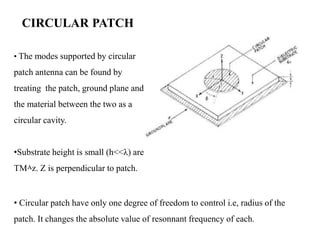
• The modes supported by circular
patch antenna can be found by
treating the patch, ground plane and
the material between the two as a
circular cavity.
•Substrate height is small (h<<λ) are
TM۸z. Z is perpendicular to patch.
• Circular patch have only one degree of freedom to control i.e, radius of the
patch. It changes the absolute value of resonnant frequency of each.
FEEDING TECHNIQUE
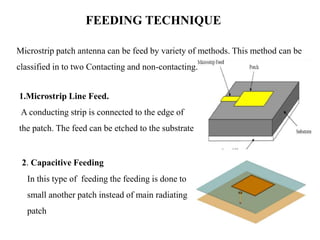
Microstrip patch antenna can be feed by variety of methods. This method can be
classified in to two Contacting and non-contacting.
1.Microstrip Line Feed.
A conducting strip is connected to the edge of
the patch. The feed can be etched to the substrate
2. Capacitive Feeding
In this type of feeding the feeding is done to
small another patch instead of main radiating
patch
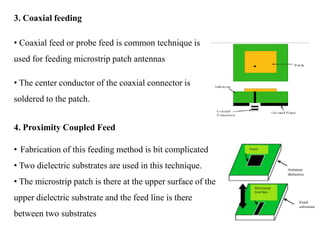
3. Coaxial feeding
• Coaxial feed or probe feed is common technique is
used for feeding microstrip patch antennas
• The center conductor of the coaxial connector is
soldered to the patch.
4. Proximity Coupled Feed
• Fabrication of this feeding method is bit complicated
• Two dielectric substrates are used in this technique.
• The microstrip patch is there at the upper surface of the
upper dielectric substrate and the feed line is there
between two substrates
ANTENNA ARRAYS
• An antenna array(often called a ‘phased array’) is a set of two or more
antennas.
• The signals from the antennas are combined or processed in order to achieve
improved performance over that a single antenna.
The array can be used to:
increase the overall gain
provide diversity reception
cancel out interference from a particular set of directions
"steer" the array so that it is most sensitive in a particular direction
determine the direction of arrival of the incoming signals
to maximize the Signal to Interference Plus Noise Ratio (SINR)
CIRCULAR ARRAY
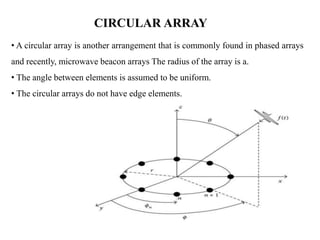
• A circular array is another arrangement that is commonly found in phased arrays
and recently, microwave beacon arrays The radius of the array is a.
• The angle between elements is assumed to be uniform.
• The circular arrays do not have edge elements.
• Circular arrays also have the capability to compensate the effect of mutual
coupling by breaking down the array excitation into a series of symmetrical spatial
components.
• Applications are radio direction finding, air and space navigation, underground
propagation, radar and sonar.
• Circular array can provide 2D angular scan both horizontally and vertically
Feeding Array Antennas
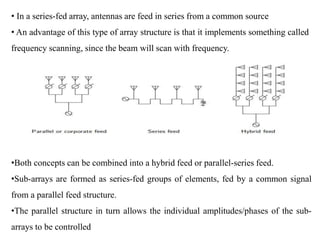
• In a parallel or corporate feed network, all the elements are feed in parallel from
a single source.
•The power splitters are realized using special RF power dividers, such as
Wilkinson power dividers, or lossless combiners.
• In a series-fed array, antennas are feed in series from a common source.
• In a series-fed array, antennas are feed in series from a common source
• An advantage of this type of array structure is that it implements something called
frequency scanning, since the beam will scan with frequency.
•Both concepts can be combined into a hybrid feed or parallel-series feed.
•Sub-arrays are formed as series-fed groups of elements, fed by a common signal
from a parallel feed structure.
•The parallel structure in turn allows the individual amplitudes/phases of the sub-
arrays to be controlled
5G MILLIMETER WAVE ANTENNA
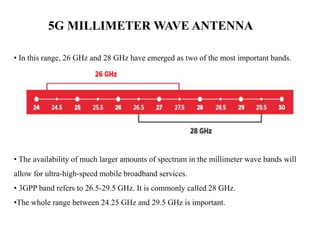
• In this range, 26 GHz and 28 GHz have emerged as two of the most important bands.
• The availability of much larger amounts of spectrum in the millimeter wave bands will
allow for ultra-high-speed mobile broadband services.
• 3GPP band refers to 26.5-29.5 GHz. It is commonly called 28 GHz.
•The whole range between 24.25 GHz and 29.5 GHz is important.
Features of 5G
• Less Traffic
•25Mbps Connectivity Speed
• Uploading and down loading speed of 5G touching the peak
• Better and fast solution
Advantages of 5G
• Data bandwidth of 1Gbps or higher
• Globally accessible
• Dynamic Information Access
• World wide cellular phones
• Extra ordinary data capabilities
• High connectivity
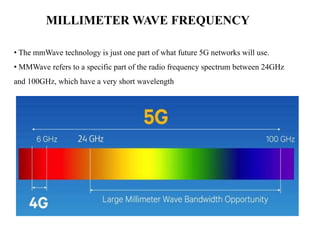
MILLIMETER WAVE FREQUENCY
• The mmWave technology is just one part of what future 5G networks will use.
• MMWave refers to a specific part of the radio frequency spectrum between 24GHz
and 100GHz, which have a very short wavelength
• The objective with mmWave is to increase the data bandwidth available over
smaller, densely populated areas.
• Wave length is between 10mm to 1mm
APPLICATIONS
• Scientific research
• Tele communications
• Weapons systems
• Security screening
• Thickness gauging
• Medicine
• Police speed radar
DESIGN APPROACH OF MICROSTRIP PATCH
ANTENNA
In the typical design procedure of circular microstrip patch antenna, three essential
parameters are:
Frequency of operation (fo):
The resonant frequency of the antenna must be selected appropriately.
The antenna designed should be useful for 5G communication.
The 5G spectrum ranges from 26.5 to 29.5.
Hence the resonant frequency selected for design is 28GHz.
Dielectric constant of the substrate (ԑr):
High copper losses may occur due to using a very thin substrate while a thicker
substrate can degrade the performance of antenna due to surface waves.
In the proposed antenna design, a Roger RT-5880 substrate is used whose
dielectric constant is 2.2
Height of dielectric substrate (h):
For the microstrip patch antenna to be used in communication system, it is
essential that the antenna is not bulky.
Hence the height of dielectric substrate is 0.508mm
SOFTWARE USED
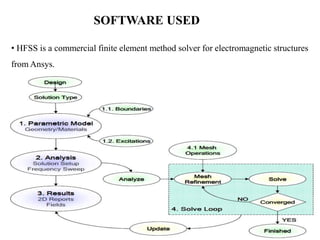
• HFSS is a commercial finite element method solver for electromagnetic structures
from Ansys.
Features of HFSS:
Capabilities:
• Accurate full-wave EM simulation
• Import/export of 3D structures
• Direct and iterative matrix solvers 17
• Eigen mode matrix solver
Solution Data (Visualization):
• S-, Y-, Z-parameter matrix (2D plot, Smith Chart)
• Current, E-field, H-field (3D static and animated field
• plot in vector display or magnitude display)
• Far-field calculation (2D, 3D, gain, radiation pattern)
Ansoft terminology
The Ansoft HFSS window has several optional panels
Important steps in designing antenna are:
SUBSTRATE SELECTION
• The first important step in designing an antenna was the selection of the
substrate.
• The impedance matching and bandwidth of an antenna are highly influenced by
the parameters of substrate like height, dielectric constant and tangent loss (tanδ).
• The proposed antenna design, a Roger RT-5880 substrate is used whose
dimensions and electrical properties are given in Table below
Parameters values
Dielectric constant 2.2
Loss tangent 0.0013
Dimension 6×6mm
Substrate height 0.508mm
ANTENNA STRUCTURE AND DESIGN
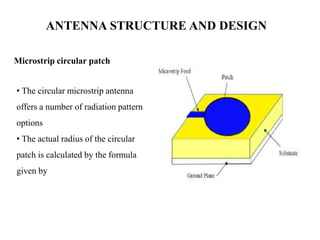
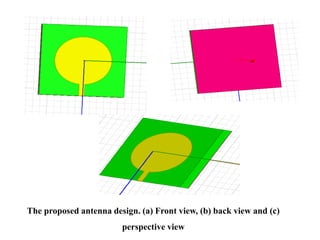
Microstrip circular patch
• The circular microstrip antenna
offers a number of radiation pattern
options
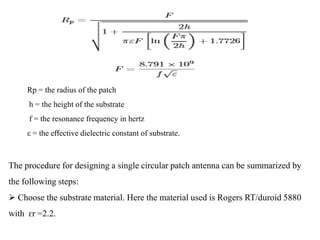
• The actual radius of the circular
patch is calculated by the formula
given by
Rp = the radius of the patch
h = the height of the substrate
f = the resonance frequency in hertz
ε = the effective dielectric constant of substrate.
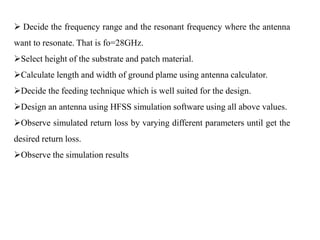
The procedure for designing a single circular patch antenna can be summarized by
the following steps:
 Choose the substrate material. Here the material used is Rogers RT/duroid 5880
with ԑr =2.2.
 Decide the frequency range and the resonant frequency where the antenna
want to resonate. That is fo=28GHz.
Select height of the substrate and patch material.
Calculate length and width of ground plame using antenna calculator.
Decide the feeding technique which is well suited for the design.
Design an antenna using HFSS simulation software using all above values.
Observe simulated return loss by varying different parameters until get the
desired return loss.
Observe the simulation results
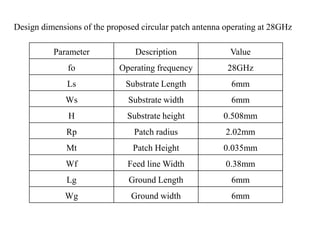
Parameter Description Value
fo Operating frequency 28GHz
Ls Substrate Length 6mm
Ws Substrate width 6mm
H Substrate height 0.508mm
Rp Patch radius 2.02mm
Mt Patch Height 0.035mm
Wf Feed line Width 0.38mm
Lg Ground Length 6mm
Wg Ground width 6mm
Design dimensions of the proposed circular patch antenna operating at 28GHz
The proposed antenna design. (a) Front view, (b) back view and (c)
perspective view
CIRCULAR ARRAY DESIGN
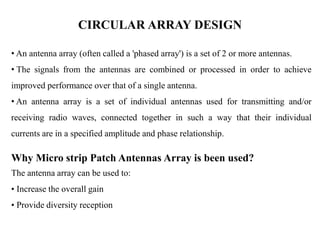
• An antenna array (often called a 'phased array') is a set of 2 or more antennas.
• The signals from the antennas are combined or processed in order to achieve
improved performance over that of a single antenna.
• An antenna array is a set of individual antennas used for transmitting and/or
receiving radio waves, connected together in such a way that their individual
currents are in a specified amplitude and phase relationship.
Why Micro strip Patch Antennas Array is been used?
The antenna array can be used to:
• Increase the overall gain
• Provide diversity reception
• Cancel out interference from a particular set of directions
• "Steer" the array so that it is most sensitive in a particular direction
• Determine the direction of arrival of the incoming signals
• To maximize the Signal to Interference Plus Noise Ratio (SINR)
Array Design
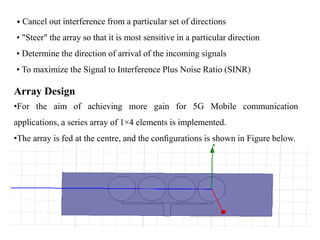
•For the aim of achieving more gain for 5G Mobile communication
applications, a series array of 1×4 elements is implemented.
•The array is fed at the centre, and the configurations is shown in Figure below.
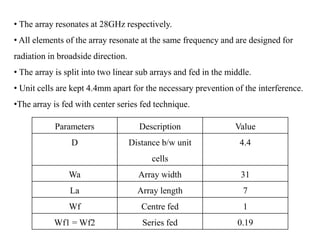
• The array resonates at 28GHz respectively.
• All elements of the array resonate at the same frequency and are designed for
radiation in broadside direction.
• The array is split into two linear sub arrays and fed in the middle.
• Unit cells are kept 4.4mm apart for the necessary prevention of the interference.
•The array is fed with center series fed technique.
Parameters Description Value
D Distance b/w unit
cells
4.4
Wa Array width 31
La Array length 7
Wf Centre fed 1
Wf1 = Wf2 Series fed 0.19
RESULT AND DISCUSSIONS
• The simulated and measured results of the proposed unit cell design of the
antenna are discussed
MICROSTRIP PATCH ANTENNA
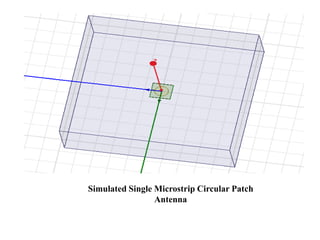
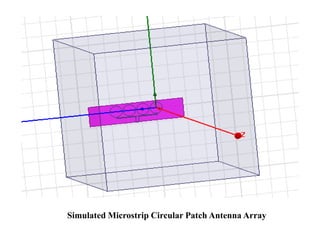
• The simulated microstrip patch antennas is shown in the figure.
• A single circular microstrip patch antenna and its array is been simulated by
using HFSS software
• Here substrate material used is Rogers RT/duroid 5880 height is h= 0.508mm
ԑr=2.2.
Simulated Single Microstrip Circular Patch
Antenna
Simulated Microstrip Circular Patch Antenna Array
RETURN LOSS
•Return loss is the ratio of incident power to the reflected power of an antenna in
decibels (dB).
•Return loss of an antenna is represented by S11 (dB). For an antenna to
perform in effective way, S11 (dB) should be less than−10dB.
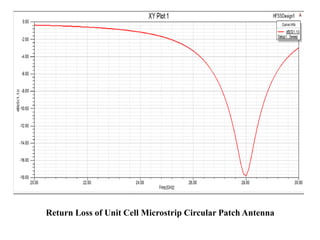
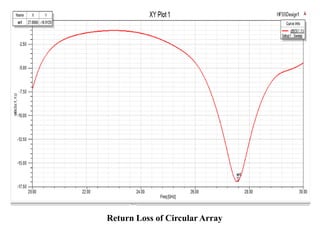
•The proposed antenna has S11 (dB) of −18dB at 28GHz, and array of the
suggested antenna has return losses of −16dB at 28GHz . Graphs of both the
unit cell and 1×4 array configurations are given in Figure.
Return Loss of Unit Cell Microstrip Circular Patch Antenna
Return Loss of Circular Array
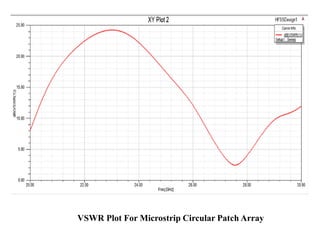
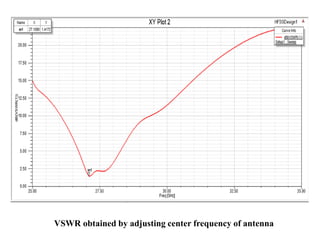
VSWR
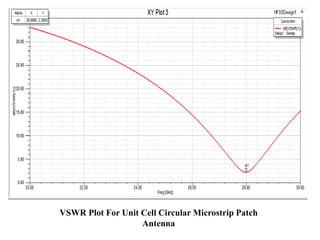
• VSWR Impedance matching of the antenna and transmission line is a key
factor in evaluating the antenna performance.
• VSWR parameter defines how well the impedance of antenna is matched with
transmission line by taking the ratio of the reflected maximum and minimum
voltage wave.
• A value of VSWR ≤ 2 is considered as the main requirement.
VSWR Plot For Unit Cell Circular Microstrip Patch
Antenna
VSWR Plot For Microstrip Circular Patch Array
VSWR obtained by adjusting center frequency of antenna
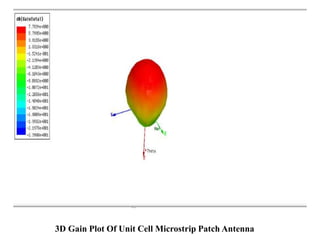
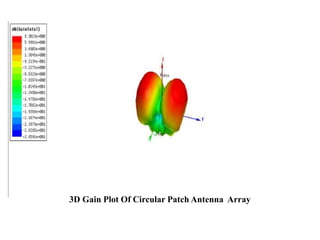
3D Gain Plots of the Proposed Antenna
•Antenna gain is defined as the radio between the radiation intensity in a given
particular direction and total input power.
• The radiation intensity Unexpressed the power radiated per solid angle.
• Microstrip unit cell circular patch antennas can provide gain of 7.78dB.
• Circular array can provide gain of 8.90dB.
3D Gain Plot Of Unit Cell Microstrip Patch Antenna
3D Gain Plot Of Circular Patch Antenna Array
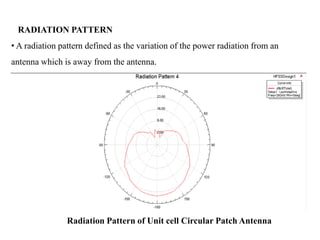
RADIATION PATTERN
• A radiation pattern defined as the variation of the power radiation from an
antenna which is away from the antenna.
Radiation Pattern of Unit cell Circular Patch Antenna
Radiation Pattern Of Circular Array
CONCLUSION
• The main goal of this project is to design and develop 5G antenna and it’s
array.
• A circular microstrip patch antenna with its array is presented for possible
future 5G applications.
• The basics of microstrip fractal antenna are studied in detail and all the
design considerations of the antenna is been examined.
• Thus here size reduction along with the large bandwidth and high gain are the
major considerations for designing the antenna.
• The 5G antenna is designed in an operating frequency 28GHz and simulated.
The various design parameters such as return loss, VSWR, radiation pattern
and gain are obtained using simulation.
• The antenna is further configured to an array of 1 × 4 linear elements to make it
suitable for 5G mobile communication systems.
• This simple design is achieved on a Rogers 5880 substrate which resonates at
millimeter-wave frequencies of 28GHz as a unit cell and with an array.
• These antennas can be used for 5G applications.
• The Millimeter wave microstrip patch antenna are simulated and can be further
fabricated for 5G applications.
REFERENCES
1. Hakimi, S. and S. K. A. Rahim, “Millimeter-wave microstrip bent line grid array
antenna for 5G mobile communication networks,” 2014 Asia-Pacific Microwave
Conference (APMC), 622–624, IEEE, November 2014.
2. Ojaroudiparchin, N., M. Shen, and G. F. Pedersen, “A 28GHz FR-4 compatible
phased array antenna for 5G mobile phone applications,” 2015 International
Symposium Antennas and Propagation (ISAP), 1–4, IEEE, November 2015.
3. Jandi, Y., F. Gharnati, and A. O. Said, “Design of a compact dual bands patch
antenna for 5G applications,” 2017 International Conference on Wireless Technologies,
Embedded and Intelligent Systems (WITS), 1–4, IEEE, April 2017.
4. Agyapong, P. K., M. Iwamura, D. Staehle, W. Kiess, and A. Benjebbour, “Design
considerations for a 5G network architecture,” IEEE Communications Magazine, Vol.
52, No. 11, 65–75, 2014.
5. Panwar, N., S. Sharma, and A. K. Singh, “A survey on 5G: The next generation of
mobile communication,” Physical Communication, Vol. 18, 64–84, 2016
6. Reddy, N. K., A. Hazra, and V. Sukhadeve, “A compact elliptical microstrip patch
antenna for future 5G mobile wireless communication,” IEEE Transactions on Engineering
and Applied Sciences, Vol. 1, No. 1, 1–4, 2017.
7. Loharia, N., S. B. Rana, and N. Kumar, “5G futurecommunication: Requirements and
challenges,” 47 Mid-term Symposium on Modern Information and Communication
Technologies for Digital India (MICTDI 2016), Chandigarh, India, 2016.
8. Kumar, A. and M. Gupta, “A review on activities of fifth generation mobile
communication system,” Alexandria Engineering Journal, Vol. 57, No. 2, 1125–1135, June
2018.
9.Chen, Z. and Y. P. Zhang, “FR4 PCB grid array antenna for millimeter-wave 5G mobile
communications,” 2013 IEEE MTT-S International Microwave Workshop Series on RF and
Wireless Technologies for Biomedical and Healthcare Applications (IMWS-BIO), 1–3, IEEE,
December 2013.
10. Cao, Y., K. S. Chin, W. Che, W. Yang, and E. S. Li, “A compact 38GHz multibeam
antenna array with multifolded butler matrix for 5G applications,” IEEE Antennas and
Wireless Propagation Letters, Vol. 16, 2996–2999, 2017.

Millimeter wave circular microstrip Patch antenna for 5 g applications

  • 1.
    MILLIMETER WAVE MICROSTRIPPATCH ANTENNA FOR FUTURE 5G APPLICATIONS GUIDED BY SANISH V S Asst. professor Dept of ECE, JCET PRESENTED BY GANA U KUMAR JCE17ECCP03 S4 MTECH
  • 2.
    OBJECTIVE • To designa microstrip patch antenna for Ka-band (27-40GHz) • For 5G application • Operating frequency 28GHz • Bandwidth > 1GHz • Return loss > -15dB • Gain > 7dB • VSWR < 2dB
  • 3.
    Microstrip Patch Antenna Microstrippatch antenna consist of following basic components:  Ground Plane  Substrate plane  Patch  Microstrip Feed •The patch is made of conducting material such as copper or gold of any possible shape • Dielectric substrate having different dielectric constant is used for fabrication • Different design shapes and notches of the patch and cutting slots are used to get better output.
  • 4.
    CIRCULAR PATCH • Themodes supported by circular patch antenna can be found by treating the patch, ground plane and the material between the two as a circular cavity. •Substrate height is small (h<<λ) are TM۸z. Z is perpendicular to patch. • Circular patch have only one degree of freedom to control i.e, radius of the patch. It changes the absolute value of resonnant frequency of each.
  • 5.
    FEEDING TECHNIQUE Microstrip patchantenna can be feed by variety of methods. This method can be classified in to two Contacting and non-contacting. 1.Microstrip Line Feed. A conducting strip is connected to the edge of the patch. The feed can be etched to the substrate 2. Capacitive Feeding In this type of feeding the feeding is done to small another patch instead of main radiating patch
  • 6.
    3. Coaxial feeding •Coaxial feed or probe feed is common technique is used for feeding microstrip patch antennas • The center conductor of the coaxial connector is soldered to the patch. 4. Proximity Coupled Feed • Fabrication of this feeding method is bit complicated • Two dielectric substrates are used in this technique. • The microstrip patch is there at the upper surface of the upper dielectric substrate and the feed line is there between two substrates
  • 7.
    ANTENNA ARRAYS • Anantenna array(often called a ‘phased array’) is a set of two or more antennas. • The signals from the antennas are combined or processed in order to achieve improved performance over that a single antenna. The array can be used to: increase the overall gain provide diversity reception cancel out interference from a particular set of directions "steer" the array so that it is most sensitive in a particular direction determine the direction of arrival of the incoming signals to maximize the Signal to Interference Plus Noise Ratio (SINR)
  • 8.
    CIRCULAR ARRAY • Acircular array is another arrangement that is commonly found in phased arrays and recently, microwave beacon arrays The radius of the array is a. • The angle between elements is assumed to be uniform. • The circular arrays do not have edge elements.
  • 9.
    • Circular arraysalso have the capability to compensate the effect of mutual coupling by breaking down the array excitation into a series of symmetrical spatial components. • Applications are radio direction finding, air and space navigation, underground propagation, radar and sonar. • Circular array can provide 2D angular scan both horizontally and vertically Feeding Array Antennas • In a parallel or corporate feed network, all the elements are feed in parallel from a single source. •The power splitters are realized using special RF power dividers, such as Wilkinson power dividers, or lossless combiners. • In a series-fed array, antennas are feed in series from a common source.
  • 10.
    • In aseries-fed array, antennas are feed in series from a common source • An advantage of this type of array structure is that it implements something called frequency scanning, since the beam will scan with frequency. •Both concepts can be combined into a hybrid feed or parallel-series feed. •Sub-arrays are formed as series-fed groups of elements, fed by a common signal from a parallel feed structure. •The parallel structure in turn allows the individual amplitudes/phases of the sub- arrays to be controlled
  • 11.
    5G MILLIMETER WAVEANTENNA • In this range, 26 GHz and 28 GHz have emerged as two of the most important bands. • The availability of much larger amounts of spectrum in the millimeter wave bands will allow for ultra-high-speed mobile broadband services. • 3GPP band refers to 26.5-29.5 GHz. It is commonly called 28 GHz. •The whole range between 24.25 GHz and 29.5 GHz is important.
  • 12.
    Features of 5G •Less Traffic •25Mbps Connectivity Speed • Uploading and down loading speed of 5G touching the peak • Better and fast solution Advantages of 5G • Data bandwidth of 1Gbps or higher • Globally accessible • Dynamic Information Access • World wide cellular phones • Extra ordinary data capabilities • High connectivity
  • 13.
    MILLIMETER WAVE FREQUENCY •The mmWave technology is just one part of what future 5G networks will use. • MMWave refers to a specific part of the radio frequency spectrum between 24GHz and 100GHz, which have a very short wavelength
  • 14.
    • The objectivewith mmWave is to increase the data bandwidth available over smaller, densely populated areas. • Wave length is between 10mm to 1mm APPLICATIONS • Scientific research • Tele communications • Weapons systems • Security screening • Thickness gauging • Medicine • Police speed radar
  • 15.
    DESIGN APPROACH OFMICROSTRIP PATCH ANTENNA In the typical design procedure of circular microstrip patch antenna, three essential parameters are: Frequency of operation (fo): The resonant frequency of the antenna must be selected appropriately. The antenna designed should be useful for 5G communication. The 5G spectrum ranges from 26.5 to 29.5. Hence the resonant frequency selected for design is 28GHz.
  • 16.
    Dielectric constant ofthe substrate (ԑr): High copper losses may occur due to using a very thin substrate while a thicker substrate can degrade the performance of antenna due to surface waves. In the proposed antenna design, a Roger RT-5880 substrate is used whose dielectric constant is 2.2 Height of dielectric substrate (h): For the microstrip patch antenna to be used in communication system, it is essential that the antenna is not bulky. Hence the height of dielectric substrate is 0.508mm
  • 17.
    SOFTWARE USED • HFSSis a commercial finite element method solver for electromagnetic structures from Ansys.
  • 18.
    Features of HFSS: Capabilities: •Accurate full-wave EM simulation • Import/export of 3D structures • Direct and iterative matrix solvers 17 • Eigen mode matrix solver Solution Data (Visualization): • S-, Y-, Z-parameter matrix (2D plot, Smith Chart) • Current, E-field, H-field (3D static and animated field • plot in vector display or magnitude display) • Far-field calculation (2D, 3D, gain, radiation pattern) Ansoft terminology The Ansoft HFSS window has several optional panels
  • 19.
    Important steps indesigning antenna are: SUBSTRATE SELECTION • The first important step in designing an antenna was the selection of the substrate. • The impedance matching and bandwidth of an antenna are highly influenced by the parameters of substrate like height, dielectric constant and tangent loss (tanδ). • The proposed antenna design, a Roger RT-5880 substrate is used whose dimensions and electrical properties are given in Table below Parameters values Dielectric constant 2.2 Loss tangent 0.0013 Dimension 6×6mm Substrate height 0.508mm
  • 20.
    ANTENNA STRUCTURE ANDDESIGN Microstrip circular patch • The circular microstrip antenna offers a number of radiation pattern options • The actual radius of the circular patch is calculated by the formula given by
  • 21.
    Rp = theradius of the patch h = the height of the substrate f = the resonance frequency in hertz ε = the effective dielectric constant of substrate. The procedure for designing a single circular patch antenna can be summarized by the following steps:  Choose the substrate material. Here the material used is Rogers RT/duroid 5880 with ԑr =2.2.
  • 22.
     Decide thefrequency range and the resonant frequency where the antenna want to resonate. That is fo=28GHz. Select height of the substrate and patch material. Calculate length and width of ground plame using antenna calculator. Decide the feeding technique which is well suited for the design. Design an antenna using HFSS simulation software using all above values. Observe simulated return loss by varying different parameters until get the desired return loss. Observe the simulation results
  • 23.
    Parameter Description Value foOperating frequency 28GHz Ls Substrate Length 6mm Ws Substrate width 6mm H Substrate height 0.508mm Rp Patch radius 2.02mm Mt Patch Height 0.035mm Wf Feed line Width 0.38mm Lg Ground Length 6mm Wg Ground width 6mm Design dimensions of the proposed circular patch antenna operating at 28GHz
  • 24.
    The proposed antennadesign. (a) Front view, (b) back view and (c) perspective view
  • 25.
    CIRCULAR ARRAY DESIGN •An antenna array (often called a 'phased array') is a set of 2 or more antennas. • The signals from the antennas are combined or processed in order to achieve improved performance over that of a single antenna. • An antenna array is a set of individual antennas used for transmitting and/or receiving radio waves, connected together in such a way that their individual currents are in a specified amplitude and phase relationship. Why Micro strip Patch Antennas Array is been used? The antenna array can be used to: • Increase the overall gain • Provide diversity reception
  • 26.
    • Cancel outinterference from a particular set of directions • "Steer" the array so that it is most sensitive in a particular direction • Determine the direction of arrival of the incoming signals • To maximize the Signal to Interference Plus Noise Ratio (SINR) Array Design •For the aim of achieving more gain for 5G Mobile communication applications, a series array of 1×4 elements is implemented. •The array is fed at the centre, and the configurations is shown in Figure below.
  • 27.
    • The arrayresonates at 28GHz respectively. • All elements of the array resonate at the same frequency and are designed for radiation in broadside direction. • The array is split into two linear sub arrays and fed in the middle. • Unit cells are kept 4.4mm apart for the necessary prevention of the interference. •The array is fed with center series fed technique. Parameters Description Value D Distance b/w unit cells 4.4 Wa Array width 31 La Array length 7 Wf Centre fed 1 Wf1 = Wf2 Series fed 0.19
  • 28.
    RESULT AND DISCUSSIONS •The simulated and measured results of the proposed unit cell design of the antenna are discussed MICROSTRIP PATCH ANTENNA • The simulated microstrip patch antennas is shown in the figure. • A single circular microstrip patch antenna and its array is been simulated by using HFSS software • Here substrate material used is Rogers RT/duroid 5880 height is h= 0.508mm ԑr=2.2.
  • 29.
    Simulated Single MicrostripCircular Patch Antenna
  • 30.
    Simulated Microstrip CircularPatch Antenna Array
  • 31.
    RETURN LOSS •Return lossis the ratio of incident power to the reflected power of an antenna in decibels (dB). •Return loss of an antenna is represented by S11 (dB). For an antenna to perform in effective way, S11 (dB) should be less than−10dB. •The proposed antenna has S11 (dB) of −18dB at 28GHz, and array of the suggested antenna has return losses of −16dB at 28GHz . Graphs of both the unit cell and 1×4 array configurations are given in Figure.
  • 32.
    Return Loss ofUnit Cell Microstrip Circular Patch Antenna
  • 33.
    Return Loss ofCircular Array
  • 34.
    VSWR • VSWR Impedancematching of the antenna and transmission line is a key factor in evaluating the antenna performance. • VSWR parameter defines how well the impedance of antenna is matched with transmission line by taking the ratio of the reflected maximum and minimum voltage wave. • A value of VSWR ≤ 2 is considered as the main requirement.
  • 35.
    VSWR Plot ForUnit Cell Circular Microstrip Patch Antenna
  • 36.
    VSWR Plot ForMicrostrip Circular Patch Array
  • 37.
    VSWR obtained byadjusting center frequency of antenna
  • 38.
    3D Gain Plotsof the Proposed Antenna •Antenna gain is defined as the radio between the radiation intensity in a given particular direction and total input power. • The radiation intensity Unexpressed the power radiated per solid angle. • Microstrip unit cell circular patch antennas can provide gain of 7.78dB. • Circular array can provide gain of 8.90dB.
  • 39.
    3D Gain PlotOf Unit Cell Microstrip Patch Antenna
  • 40.
    3D Gain PlotOf Circular Patch Antenna Array
  • 41.
    RADIATION PATTERN • Aradiation pattern defined as the variation of the power radiation from an antenna which is away from the antenna. Radiation Pattern of Unit cell Circular Patch Antenna
  • 42.
    Radiation Pattern OfCircular Array
  • 43.
    CONCLUSION • The maingoal of this project is to design and develop 5G antenna and it’s array. • A circular microstrip patch antenna with its array is presented for possible future 5G applications. • The basics of microstrip fractal antenna are studied in detail and all the design considerations of the antenna is been examined. • Thus here size reduction along with the large bandwidth and high gain are the major considerations for designing the antenna. • The 5G antenna is designed in an operating frequency 28GHz and simulated. The various design parameters such as return loss, VSWR, radiation pattern and gain are obtained using simulation.
  • 44.
    • The antennais further configured to an array of 1 × 4 linear elements to make it suitable for 5G mobile communication systems. • This simple design is achieved on a Rogers 5880 substrate which resonates at millimeter-wave frequencies of 28GHz as a unit cell and with an array. • These antennas can be used for 5G applications. • The Millimeter wave microstrip patch antenna are simulated and can be further fabricated for 5G applications.
  • 45.
    REFERENCES 1. Hakimi, S.and S. K. A. Rahim, “Millimeter-wave microstrip bent line grid array antenna for 5G mobile communication networks,” 2014 Asia-Pacific Microwave Conference (APMC), 622–624, IEEE, November 2014. 2. Ojaroudiparchin, N., M. Shen, and G. F. Pedersen, “A 28GHz FR-4 compatible phased array antenna for 5G mobile phone applications,” 2015 International Symposium Antennas and Propagation (ISAP), 1–4, IEEE, November 2015. 3. Jandi, Y., F. Gharnati, and A. O. Said, “Design of a compact dual bands patch antenna for 5G applications,” 2017 International Conference on Wireless Technologies, Embedded and Intelligent Systems (WITS), 1–4, IEEE, April 2017. 4. Agyapong, P. K., M. Iwamura, D. Staehle, W. Kiess, and A. Benjebbour, “Design considerations for a 5G network architecture,” IEEE Communications Magazine, Vol. 52, No. 11, 65–75, 2014. 5. Panwar, N., S. Sharma, and A. K. Singh, “A survey on 5G: The next generation of mobile communication,” Physical Communication, Vol. 18, 64–84, 2016
  • 46.
    6. Reddy, N.K., A. Hazra, and V. Sukhadeve, “A compact elliptical microstrip patch antenna for future 5G mobile wireless communication,” IEEE Transactions on Engineering and Applied Sciences, Vol. 1, No. 1, 1–4, 2017. 7. Loharia, N., S. B. Rana, and N. Kumar, “5G futurecommunication: Requirements and challenges,” 47 Mid-term Symposium on Modern Information and Communication Technologies for Digital India (MICTDI 2016), Chandigarh, India, 2016. 8. Kumar, A. and M. Gupta, “A review on activities of fifth generation mobile communication system,” Alexandria Engineering Journal, Vol. 57, No. 2, 1125–1135, June 2018. 9.Chen, Z. and Y. P. Zhang, “FR4 PCB grid array antenna for millimeter-wave 5G mobile communications,” 2013 IEEE MTT-S International Microwave Workshop Series on RF and Wireless Technologies for Biomedical and Healthcare Applications (IMWS-BIO), 1–3, IEEE, December 2013. 10. Cao, Y., K. S. Chin, W. Che, W. Yang, and E. S. Li, “A compact 38GHz multibeam antenna array with multifolded butler matrix for 5G applications,” IEEE Antennas and Wireless Propagation Letters, Vol. 16, 2996–2999, 2017.