RECTANGULAR MICROSTRIP
PATCH ANTENNA
ABHIMANYU KUMAR GAUTAM
ABHINAV KUMAR
ANKIT GUPTA
BRAJESH KUMAR
GAUTAM KUMAR
IKBAL AHMED LASKER
CONTENTS
• Introduction
• Fundamental parameters of antennas
• Rectangular microstrip patch antenna
• HFSS
• Design specification of rectangular patch antenna
• Analysis of patch antenna
• Results of patch antenna
• Advantage & disadvantage
• Application
• Conclusion
• References
Introduction
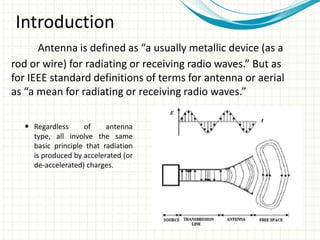
Antenna is defined as “a usually metallic device (as a
rod or wire) for radiating or receiving radio waves.” But as
for IEEE standard definitions of terms for antenna or aerial
as “a mean for radiating or receiving radio waves.”
 Regardless of antenna
type, all involve the same
basic principle that radiation
is produced by accelerated (or
de-accelerated) charges.
Types of antennas
. Wire antenna
. Aperture antenna
. Microstrip antenna
. Array antenna
. Reflector antenna
. Lens antenna
Fundamental parameters of
antennas
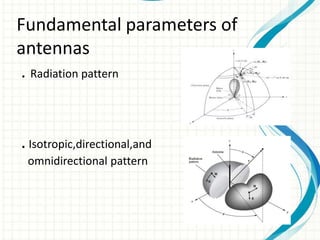
. Radiation pattern
.Isotropic,directional,and
omnidirectional pattern
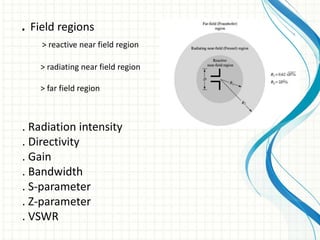
. Field regions
> reactive near field region
> radiating near field region
> far field region
. Radiation intensity
. Directivity
. Gain
. Bandwidth
. S-parameter
. Z-parameter
. VSWR
Rectangular microstrip patch
antenna
>In general Micro strip antennas are also known as
“ PRINTED ANTENNAS ”.
>These are mostly used at microwave
frequencies
>Because the size of the antenna is directly
tied to the half wavelength at the resonant frequency.
>Micro strip patch antenna or patch antenna is
a narrowband wide-beam antenna.
>The patch usually fed along the centerline
to symmetry and thus minimize excitation of
undesirable modes.
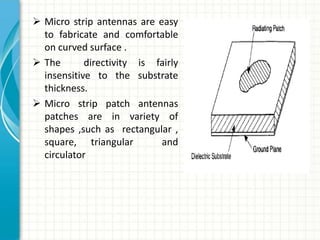
 Micro strip antennas are easy
to fabricate and comfortable
on curved surface .
 The directivity is fairly
insensitive to the substrate
thickness.
 Micro strip patch antennas
patches are in variety of
shapes ,such as rectangular ,
square, triangular and
circulator
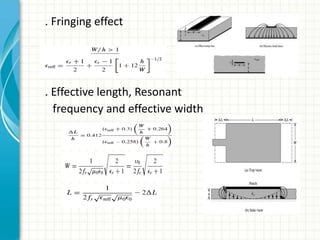
. Fringing effect
. Effective length, Resonant
frequency and effective width
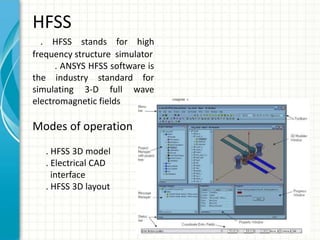
HFSS
. HFSS stands for high
frequency structure simulator
. ANSYS HFSS software is
the industry standard for
simulating 3-D full wave
electromagnetic fields
Modes of operation
. HFSS 3D model
. Electrical CAD
interface
. HFSS 3D layout
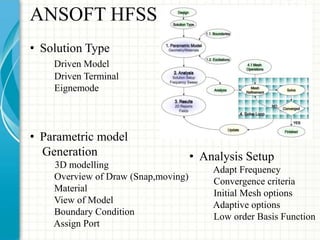
ANSOFT HFSS
• Solution Type
Driven Model
Driven Terminal
Eignemode
• Parametric model
Generation
3D modelling
Overview of Draw (Snap,moving)
Material
View of Model
Boundary Condition
Assign Port
• Analysis Setup
Adapt Frequency
Convergence criteria
Initial Mesh options
Adaptive options
Low order Basis Function
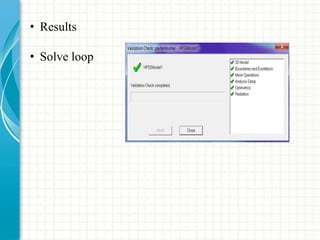
• Results
• Solve loop
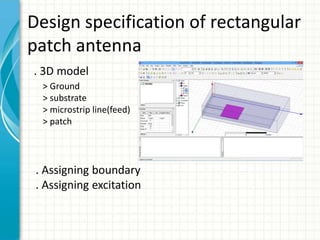
Design specification of rectangular
patch antenna
. 3D model
> Ground
> substrate
> microstrip line(feed)
> patch
. Assigning boundary
. Assigning excitation
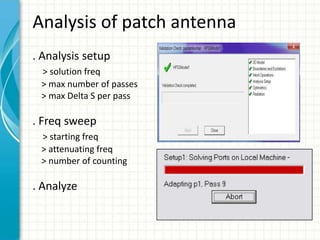
Analysis of patch antenna
. Analysis setup
> solution freq
> max number of passes
> max Delta S per pass
. Freq sweep
> starting freq
> attenuating freq
> number of counting
. Analyze
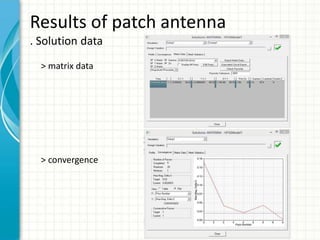
Results of patch antenna
. Solution data
> matrix data
> convergence
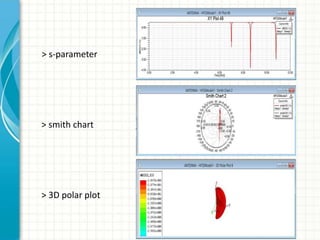
> s-parameter
> smith chart
> 3D polar plot
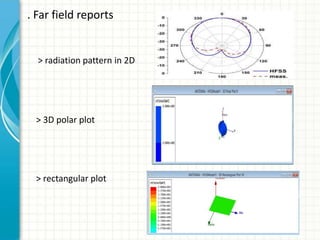
. Far field reports
> radiation pattern in 2D
> 3D polar plot
> rectangular plot
Advantage & disadvantage
.Advantage
Easy to fabricate on curved surfaces
Easily integrated on MIC circuits
Dual frequency and dual polarization can be easily made.
Low cost , Less size in volume
Mechanically robust on rigid surface
 Compatible with modular design
.Disadvantage
Narrow bandwidth
Lower efficiency & gain(nearly 6db)
Large ohmic losses in feed structure of arrays
Excitation of surface waves
Most microstrip antennas radiate into half-space
Low power handling capability
Application :-
Used in mobile satellite communication system.
Used in aircraft , spacecraft & missiles
Direct broad cast television(DBS).
GPS system.
Telemetry & telemedicine
Radar application
Remedies:-
Low power and low gain can overcome by arrays configuration.
Surface wave associated limitations such as poor efficiency,
increased mutual coupling, reduced gain and radiation pattern
can overcome.
The band width can increase upto 60% by using some special
techniques.
Conclusion
 Return loss, gain and efficiency are acceptable
 Bandwidth enhancement of 20dB is possible
 Our future work will be carried out using different feeding
techniques with different software………
 Simple, small size and high efficiency antenna can be
designed
References
 C. A. Balanis, “Antenna Theory, Analysis and Design,” John Wiley & Sons, New
York,1997.
 B.-K. Ang and B.-K. Chung “A wideband e-shaped microstrip patch antenna
for 5–6ghz wireless communications”. Progress in Electromagnetics
Research, PIER 75, 397–407, 2007
 Mr.Anil K.K. leacturer of ECE Department,cochin university college of
engineering, CUSAT
 www.google.com
 www.ansoft.com
 www.wikipedia.com
 www.electronicsforyou.com
 www.scribd.com
Rectangularmicrostrippatchantenna

Rectangularmicrostrippatchantenna

  • 1.
    RECTANGULAR MICROSTRIP PATCH ANTENNA ABHIMANYUKUMAR GAUTAM ABHINAV KUMAR ANKIT GUPTA BRAJESH KUMAR GAUTAM KUMAR IKBAL AHMED LASKER
  • 2.
    CONTENTS • Introduction • Fundamentalparameters of antennas • Rectangular microstrip patch antenna • HFSS • Design specification of rectangular patch antenna • Analysis of patch antenna • Results of patch antenna • Advantage & disadvantage • Application • Conclusion • References
  • 3.
    Introduction Antenna is definedas “a usually metallic device (as a rod or wire) for radiating or receiving radio waves.” But as for IEEE standard definitions of terms for antenna or aerial as “a mean for radiating or receiving radio waves.”  Regardless of antenna type, all involve the same basic principle that radiation is produced by accelerated (or de-accelerated) charges.
  • 4.
    Types of antennas .Wire antenna . Aperture antenna . Microstrip antenna . Array antenna . Reflector antenna . Lens antenna
  • 5.
    Fundamental parameters of antennas .Radiation pattern .Isotropic,directional,and omnidirectional pattern
  • 6.
    . Field regions >reactive near field region > radiating near field region > far field region . Radiation intensity . Directivity . Gain . Bandwidth . S-parameter . Z-parameter . VSWR
  • 7.
    Rectangular microstrip patch antenna >Ingeneral Micro strip antennas are also known as “ PRINTED ANTENNAS ”. >These are mostly used at microwave frequencies >Because the size of the antenna is directly tied to the half wavelength at the resonant frequency. >Micro strip patch antenna or patch antenna is a narrowband wide-beam antenna. >The patch usually fed along the centerline to symmetry and thus minimize excitation of undesirable modes.
  • 8.
     Micro stripantennas are easy to fabricate and comfortable on curved surface .  The directivity is fairly insensitive to the substrate thickness.  Micro strip patch antennas patches are in variety of shapes ,such as rectangular , square, triangular and circulator
  • 9.
    . Fringing effect .Effective length, Resonant frequency and effective width
  • 10.
    HFSS . HFSS standsfor high frequency structure simulator . ANSYS HFSS software is the industry standard for simulating 3-D full wave electromagnetic fields Modes of operation . HFSS 3D model . Electrical CAD interface . HFSS 3D layout
  • 11.
    ANSOFT HFSS • SolutionType Driven Model Driven Terminal Eignemode • Parametric model Generation 3D modelling Overview of Draw (Snap,moving) Material View of Model Boundary Condition Assign Port • Analysis Setup Adapt Frequency Convergence criteria Initial Mesh options Adaptive options Low order Basis Function
  • 12.
  • 13.
    Design specification ofrectangular patch antenna . 3D model > Ground > substrate > microstrip line(feed) > patch . Assigning boundary . Assigning excitation
  • 14.
    Analysis of patchantenna . Analysis setup > solution freq > max number of passes > max Delta S per pass . Freq sweep > starting freq > attenuating freq > number of counting . Analyze
  • 15.
    Results of patchantenna . Solution data > matrix data > convergence
  • 16.
    > s-parameter > smithchart > 3D polar plot
  • 17.
    . Far fieldreports > radiation pattern in 2D > 3D polar plot > rectangular plot
  • 18.
    Advantage & disadvantage .Advantage Easyto fabricate on curved surfaces Easily integrated on MIC circuits Dual frequency and dual polarization can be easily made. Low cost , Less size in volume Mechanically robust on rigid surface  Compatible with modular design .Disadvantage Narrow bandwidth Lower efficiency & gain(nearly 6db) Large ohmic losses in feed structure of arrays Excitation of surface waves Most microstrip antennas radiate into half-space Low power handling capability
  • 19.
    Application :- Used inmobile satellite communication system. Used in aircraft , spacecraft & missiles Direct broad cast television(DBS). GPS system. Telemetry & telemedicine Radar application Remedies:- Low power and low gain can overcome by arrays configuration. Surface wave associated limitations such as poor efficiency, increased mutual coupling, reduced gain and radiation pattern can overcome. The band width can increase upto 60% by using some special techniques.
  • 20.
    Conclusion  Return loss,gain and efficiency are acceptable  Bandwidth enhancement of 20dB is possible  Our future work will be carried out using different feeding techniques with different software………  Simple, small size and high efficiency antenna can be designed
  • 21.
    References  C. A.Balanis, “Antenna Theory, Analysis and Design,” John Wiley & Sons, New York,1997.  B.-K. Ang and B.-K. Chung “A wideband e-shaped microstrip patch antenna for 5–6ghz wireless communications”. Progress in Electromagnetics Research, PIER 75, 397–407, 2007  Mr.Anil K.K. leacturer of ECE Department,cochin university college of engineering, CUSAT  www.google.com  www.ansoft.com  www.wikipedia.com  www.electronicsforyou.com  www.scribd.com

Editor's Notes

  • #2 This template can be used as a starter file for presenting training materials in a group setting.SectionsSections can help to organize your slides or facilitate collaboration between multiple authors. On the Home tab under Slides, click Section, and then click Add Section.NotesUse the Notes pane for delivery notes or to provide additional details for the audience. You can see these notes in Presenter View during your presentation. Keep in mind the font size (important for accessibility, visibility, videotaping, and online production)Coordinated colors Pay particular attention to the graphs, charts, and text boxes.Consider that attendees will print in black and white or grayscale. Run a test print to make sure your colors work when printed in pure black and white and grayscale.Graphics, tables, and graphsKeep it simple: If possible, use consistent, non-distracting styles and colors.Label all graphs and tables.
  • #3 Give a brief overview of the presentation. Describe the major focus of the presentation and why it is important.Introduce each of the major topics.To provide a road map for the audience, you can repeat this Overview slide throughout the presentation, highlighting the particular topic you will discuss next.
  • #4 This is another option for an overview using transitions to advance through several slides.
  • #8 This is another option for an overview slide.
  • #9 What will the audience be able to do after this training is complete?Briefly describe each objective and how the audience will benefit from this presentation.
  • #10 What will the audience be able to do after this training is complete?Briefly describe each objective and how the audience will benefit from this presentation.
  • #11 Add slides to each topic section as necessary, including slides with tables, graphs, and images. See next section for sampletable, graph, image, and video layouts.
  • #12 Keep it brief. Make your text as brief as possible to maintain a larger font size.
  • #15 Add a case study or class simulation to encourage discussion and apply lessons.
  • #16 Discuss outcomes of the case study or class simulation.Cover best practices.
  • #17 Summarize presentation content by restating the important points from the lessons.What do you want the audience to remember when they leave your presentation?